Differences between Non- flowering plants and Flowering plants
| Aspect | Non-flowering plants | Flowering plants (angiosperms) |
|---|---|---|
| Examples | Mosses, liverworts and ferns; also conifers, cycads and ginkgos (the gymnosperms) | Grasses and cereals, oaks, roses, and almost all fruit and vegetable crops |
| Reproductive structures | No flowers. Mosses and ferns reproduce by spores. Gymnosperms produce seeds, usually on the scales of a cone | Reproduce using flowers. A flower carries the reproductive organs – stamens (male) and carpels (female). Many flowers carry both, though some species have separate male and female flowers |
| Seeds | Mosses and ferns make no seeds at all. Gymnosperm seeds are naked – they are not enclosed in an ovary or a fruit | Seeds develop inside an ovary, which ripens into a fruit around them |
| Dispersal | Mosses and ferns release very light spores carried by wind or water. Conifer seeds are usually spread by wind or by animals | Seeds and fruits are spread by wind, water, animals, or by fruits that split open explosively |
| Water and fertilisation | Mosses and ferns need a film of water so that the male gametes can swim to the egg. Gymnosperms do not – their male gametes travel inside pollen grains | No water needed for fertilisation. Pollen is carried by wind or animals from anther to stigma |
Non-flowering plants and flowering plants are two major plant groupings with distinct reproductive structures and processes.
Non-flowering plants do not produce flowers, but they do not all reproduce in the same way. Mosses and ferns reproduce by spores and make no seeds at all. Conifers, cycads and ginkgos (the gymnosperms) do produce seeds, but the seeds are not enclosed in an ovary or a fruit – they usually sit on the scales of a cone.
Flowering plants, on the other hand, reproduce through the use of flowers. Flowers are reproductive structures with both male and female reproductive organs. Pollination, or the transfer of pollen from the male reproductive organ to the female reproductive organ, results in the generation of seeds contained within a fruit or an ovary.
The two groups also differ in how they spread to new places. Mosses and ferns release very light spores that are carried away by wind or water, while conifer seeds are usually blown by the wind or carried by animals. Flowering plants use a wider range of methods, spreading their seeds and fruits by wind, water, animals, or by fruits that split open explosively.
Differences between Tap Root and Fibrous Root
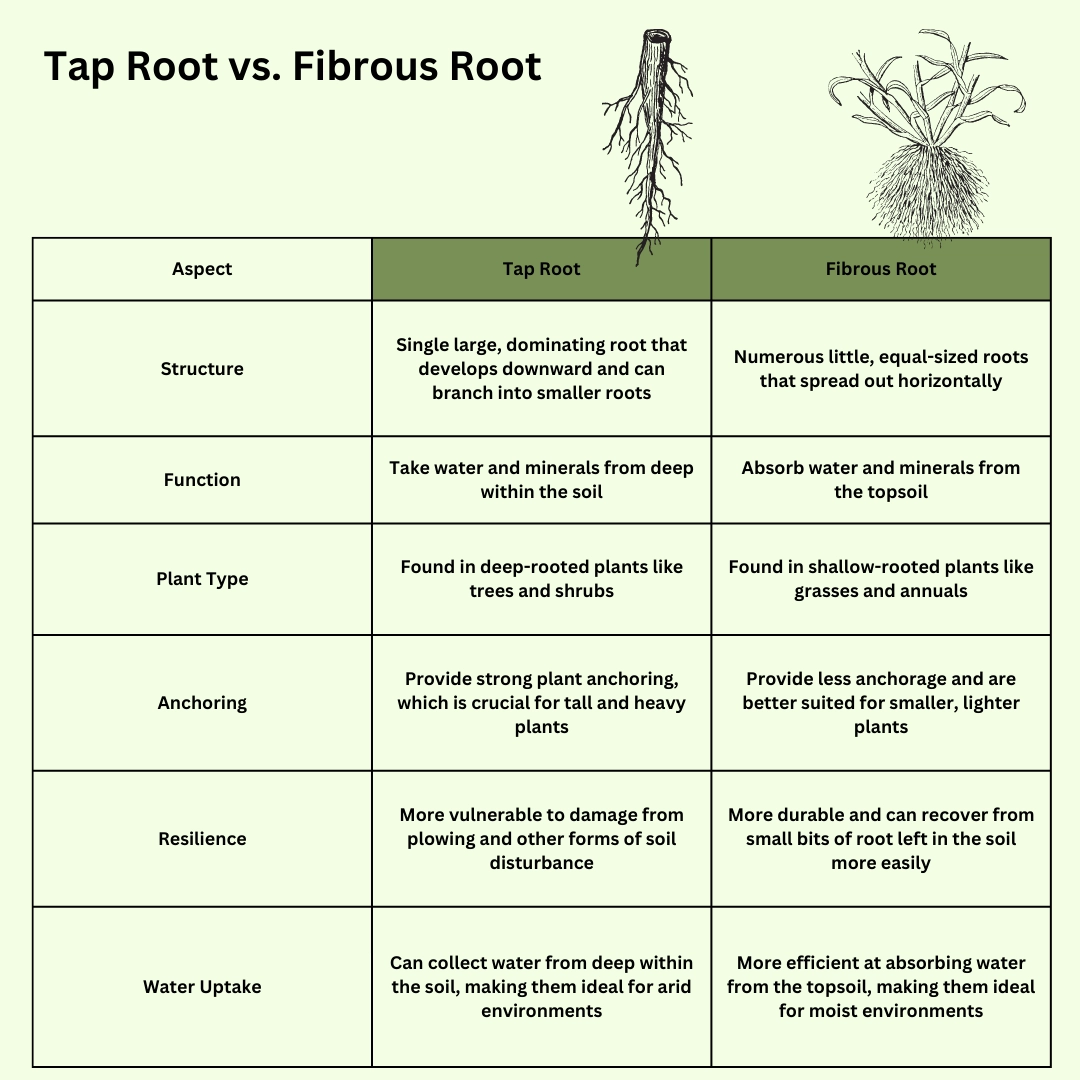
Tap roots and fibrous roots are two forms of root systems found in plants, each with its own set of characteristics
Structure: Tap roots have a single large, dominating root that develops downward and can branch into smaller roots, whereas fibrous roots contain numerous little, equal-sized roots that spread out horizontally.
Function: Tap roots take water and minerals from deep within the soil, whereas fibrous roots absorb water and minerals from the topsoil.
Plant type: Tap roots are found in deep-rooted plants like trees and shrubs, whereas fibrous roots are found in shallow-rooted plants like grasses and annuals.
Anchoring: Tap roots give strong plant anchoring, which is crucial for tall and heavy plants, whereas fibrous roots provide less anchorage and are better suited for smaller, lighter plants.
Resilience: Tap roots are more vulnerable to damage from plowing and other forms of soil disturbance, but fibrous roots are more durable and can recover from small bits of root left in the soil more easily.
Water uptake: Tap roots can collect water from deep within the soil, making them ideal for arid environments, whereas fibrous roots are more efficient at absorbing water from the topsoil, making them ideal for moist environments.
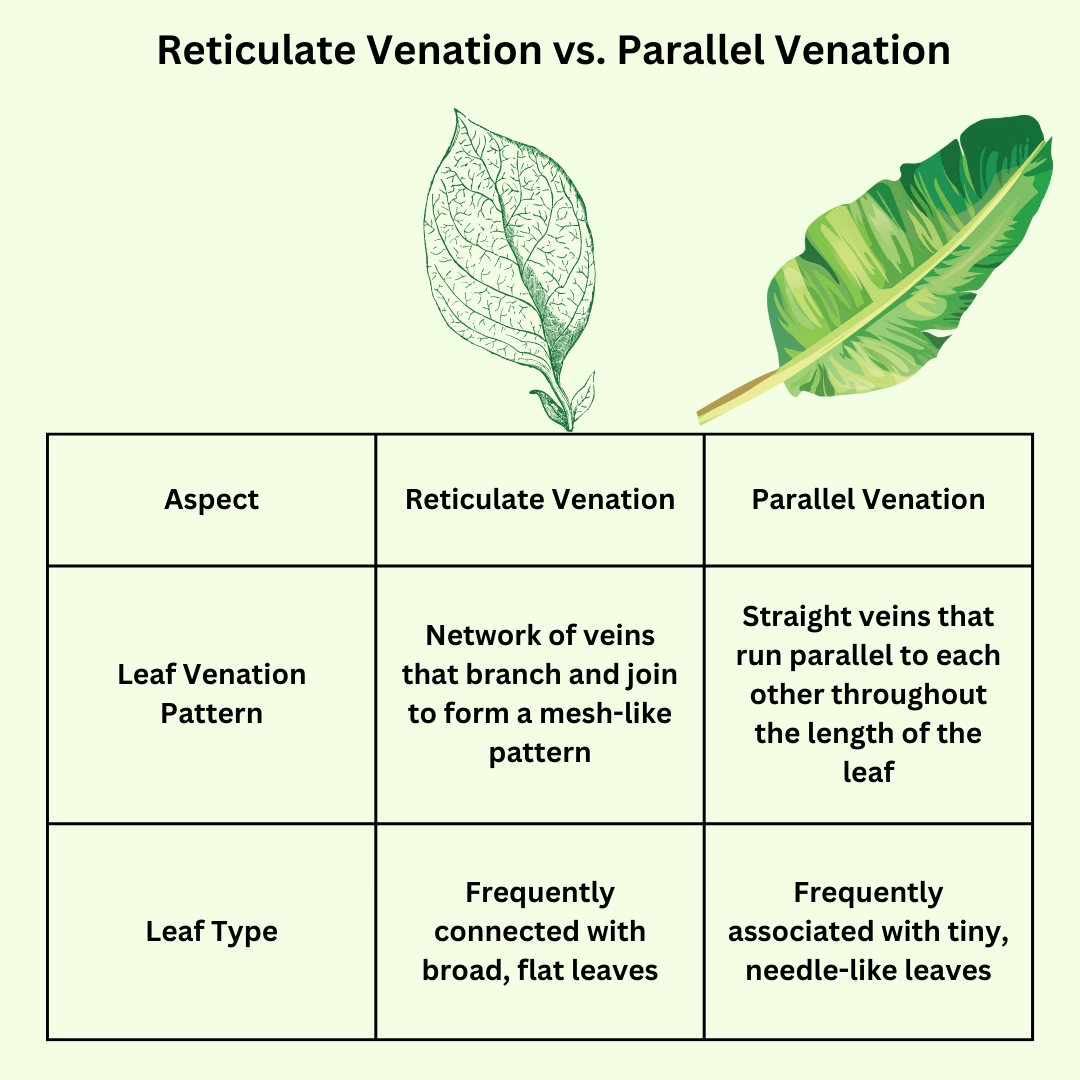
Differences between Reticulate venation and Parallel venation
| Aspect | Reticulate venation | Parallel venation |
|---|---|---|
| Pattern of veins | Veins branch and join to form a net-like or mesh-like pattern | The main veins run alongside one another from the base to the tip of the leaf, without forming a network |
| Leaf shape | Usually broad, flat leaves | Usually long, narrow, strap-like leaves |
| Which plants | Typical of dicotyledons | Typical of monocotyledons |
| Examples | Hibiscus, mango, oak, rose, bean | Grass, maize, wheat, banana, lily |
Needle-shaped leaves such as those of a pine tree are not an example of parallel venation. A pine is a conifer, not a monocotyledon, and each needle contains only one or two unbranched veins.
Plants have two types of leaf venation patterns: reticulate venation and parallel venation.
Reticulate venation is distinguished by a network of veins that branch and join to form a mesh-like pattern, whereas parallel venation is distinguished by straight veins that run parallel to each other throughout the length of the leaf. Reticulate venation is typical of dicotyledons, which usually have broad, flat leaves such as those of a hibiscus, a mango or an oak. Parallel venation is typical of monocotyledons, which usually have long, narrow, strap-like leaves such as those of grass, maize, banana or a lily.
Differences between Monocotyledonous and dicotyledonous plants
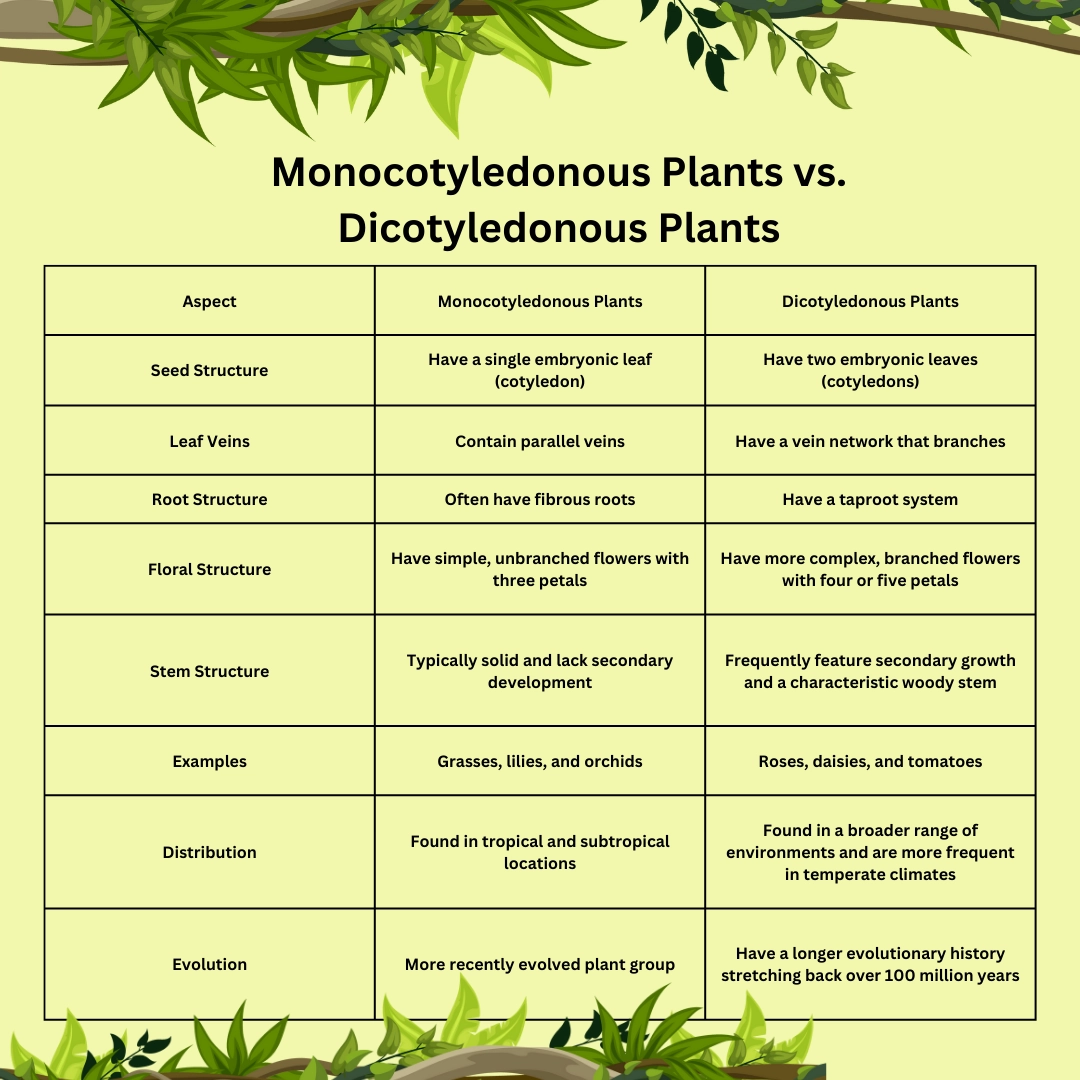
The two major groups of flowering plants are monocotyledonous and dicotyledonous, and they differ in various ways.
Seed structure: Monocot seeds have a single embryonic leaf (cotyledon), whereas dicot seeds have two embryonic leaves (cotyledons).
Leaf veins: Monocot leaves contain parallel veins, but dicot leaves have a vein network that branches.
Root structure: Monocots often have fibrous roots, whereas dicots have a taproot system.
Floral structure: Monocots have simple, unbranched flowers with three petals, whereas dicots have more complex, branched flowers with four or five petals.
Stem structure: Monocot stems are typically solid and lack secondary development, whereas dicot stems frequently feature secondary growth and a characteristic woody stem.
Examples: Monocots are grasses, lilies, and orchids, while dicots are roses, daisies, and tomatoes.
Distribution: Monocots are found in tropical and subtropical locations, whereas dicots are found in a broader range of environments and are more frequent in temperate climates.
Evolution: Monocots are a more recently evolved plant group, but dicots have a longer evolutionary history stretching back over 100 million years.
differences between gymnosperms and angiosperms
| Aspect | Gymnosperms | Angiosperms |
|---|---|---|
| Reproductive structures | No flowers. Seeds are produced on the scales of cones | Produce flowers, which carry the reproductive organs |
| Seeds | Naked seeds – not enclosed in an ovary or a fruit | Seeds develop inside an ovary, which ripens into a fruit |
| Pollination | Almost always by wind | Often by animals such as insects and birds, but many, including the grasses and cereals, are wind-pollinated |
| Male gametes | Carried inside pollen grains and delivered to the ovule through a pollen tube. A pollen grain is not itself a gamete – it contains the male gametes | The same: the male gametes are carried inside pollen grains and delivered through a pollen tube. Neither group needs water for fertilisation |
| Embryo | The fertilised egg (the zygote) grows into an embryo inside the seed | The same: the fertilised egg (the zygote) grows into an embryo inside the seed |
| Examples | Conifers such as pine, fir and spruce; cycads; ginkgo | Grasses and cereals, oaks, roses, and almost all fruit and vegetable crops |
| Evolution | Appeared earlier in the evolutionary history of plants | Appeared later and are now the largest group of land plants |
Gymnosperms and angiosperms are two groups of plants that differ in their reproductive structures and other characteristics. Here are some key differences between the two:
- Reproductive structures: Gymnosperms are plants that produce seeds, but the seeds are not enclosed in a fruit. Instead, the seeds are protected by a seed coat and are exposed, either on the surface of a cone or in the axils of modified leaves called scales. Angiosperms are plants that produce seeds enclosed in a fruit.
- Pollination: Gymnosperms are almost always pollinated by wind. Many angiosperms are pollinated by animals such as insects and birds, which is why so many flowers are brightly coloured and scented – but plenty of angiosperms, including the grasses and cereals, are wind-pollinated too.
- Reproductive cells: In both groups the male gametes are carried inside pollen grains. A pollen grain is not itself a gamete – it is a tiny structure that contains the male gametes and delivers them to the ovule through a pollen tube. Because the gametes never have to swim, neither group needs water for fertilisation.
- Embryo development: This works the same way in both groups – the fertilised egg is the zygote, and the zygote grows into the embryo inside the seed. The real difference is what surrounds that seed: a gymnosperm seed sits exposed on a cone scale, while an angiosperm seed develops inside an ovary that ripens into a fruit.
- Examples: Gymnosperms include conifers such as pine, fir and spruce, as well as cycads and ginkgo. Angiosperms include grasses and cereals, oaks, roses, and almost all fruit and vegetable crops.
- Evolution: Gymnosperms are considered to be more primitive than angiosperms, as they appeared earlier in the evolutionary history of plants. Angiosperms are considered to be more advanced, as they have evolved more complex reproductive structures and have a wider range of ecological adaptations.