Key points at a glance
- Cell biology is the study of cells – their structure, how they work, and how they work together.
- Start with cell theory: all living things are made of cells, the cell is the basic unit of life, and all cells come from existing cells.
- Learn the organelles by function, not as a list of names. Every question asks what a structure does.
- Plant and animal cells share a nucleus, cytoplasm, cell membrane, mitochondria and ribosomes. Plant cells add a cellulose cell wall, chloroplasts and a permanent vacuole.
- Specialised cells are the topic's favourite question: describe the adaptation, then say what it lets the cell do.
- Spread the work over a week in short sessions rather than cramming. Recall beats re-reading.
Cell biology is where almost every other topic in biology starts, which is why it is worth learning properly rather than just before the test. This guide covers the facts you actually need – the organelles, the plant and animal comparison, specialised cells and the levels of organisation – alongside a realistic way to work through them.
Learn some background information
- Cell biology is the study of cells, and how they function and interact with other cells. Cell biology focuses on the structure, function, and organisation of cells as well as their chemical, physical and molecular properties.
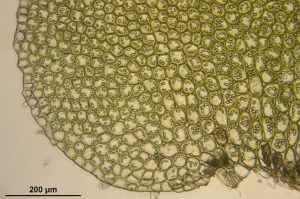
- Understand who first saw cells. In 1665 the English scientist Robert Hooke looked at a thin slice of cork through an early microscope and saw rows of tiny empty boxes. They reminded him of the small rooms – cells – that monks lived in, so that is what he called them, and the name stuck. Hooke was actually looking at the dead cell walls left behind in the cork rather than living cells.
- Learn what you can do with cell biology knowledge. You can study disease at the molecular level, which helps scientists work out why our bodies become ill and how to treat illness. Understanding cellular processes also improves industrial processes such as brewing and the production of biofuels using microorganisms like algae or yeast.
Cell theory in three statements
Naming cells was only the beginning. It took another 170 years for biologists to work out what cells actually meant, and the conclusion they reached is called cell theory. It has three parts:
- All living organisms are made of one or more cells.
- The cell is the basic unit of structure and function in living things.
- All cells arise from pre-existing cells.
The first two were proposed in the late 1830s, by Matthias Schleiden working on plants and Theodor Schwann working on animals. The third was added later, and it was the important one: it ruled out the old idea that living things could simply appear from non-living material.
Find out what the basics are
- Start with the basic building blocks: what a cell is, how cells work and how they interact with one another to carry out the functions of the body. Get comfortable with how each part works on its own before moving on to how it fits into a whole organism.
- Understand that there are different types of cells, tissues and organs, each with its own role. Muscle cells make up skeletal muscle while nerve cells make up nerves, and the two do completely different jobs.
- Learn the terms you will meet constantly – mitochondria, organelles, endoplasmic reticulum, Golgi apparatus, cell membrane – and make sure you can say what each one does, not just spell it.
Learn the technical terms
So, what are these terms you keep meeting?
- Cell theory: the principle that all living things are made of cells, that the cell is the basic unit of life, and that cells come only from other cells.
- Cell nucleus: the organelle that contains the chromosomes and controls the activities of the cell by controlling which proteins are made.
- Cell membrane: a thin, partially permeable layer surrounding the cell. It is not a sieve full of holes – it is a double layer of lipid molecules with proteins embedded in it, and those proteins control which substances can cross.
- Cytoplasm: the jelly-like material filling the cell, where most of the cell's chemical reactions take place. The organelles sit within it.
- Mitochondria: the site of aerobic respiration. Mitochondria do not create energy. They release energy that is already stored in glucose and transfer it to ATP, the molecule the rest of the cell uses to pay for its activities. Cells with high energy demands, such as muscle and liver cells, contain the most.
- Ribosomes: tiny structures where proteins are assembled from amino acids.
- Endoplasmic reticulum: a network of membranes running through the cytoplasm, along which newly made molecules are transported.
- Golgi apparatus: sorts, modifies and packages proteins into vesicles ready to be sent where they are needed.
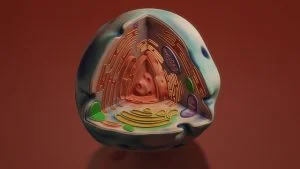
The organelles and what each one does
If you learn one table from this page, learn this one. Questions are almost always phrased as "state the function of X", so the second column is where the marks are.
| Structure | Function |
|---|---|
| Nucleus | Contains the chromosomes and controls the cell's activities |
| Cytoplasm | Where most of the cell's chemical reactions happen |
| Cell membrane | Controls which substances enter and leave the cell |
| Mitochondria | Site of aerobic respiration, releasing energy from glucose |
| Ribosomes | Site of protein synthesis |
| Cell wall (plants) | Made of cellulose; strengthens the cell and stops it bursting |
| Chloroplasts (plants) | Contain chlorophyll and carry out photosynthesis |
| Permanent vacuole (plants) | Filled with cell sap; keeps the cell firm and supports the plant |
Our lesson on the cell membrane, nucleus, chromosomes and cell wall goes into more detail on each of these.
Plant cells and animal cells compared
| Structure | Animal cell | Plant cell |
|---|---|---|
| Nucleus | Yes | Yes |
| Cytoplasm | Yes | Yes |
| Cell membrane | Yes | Yes |
| Mitochondria | Yes | Yes |
| Ribosomes | Yes | Yes |
| Cell wall | No | Yes – made of cellulose |
| Chloroplasts | No | Yes, in the green parts of the plant only |
| Permanent vacuole | No, only small temporary ones | Yes, one large central vacuole |
| Shape | Varied and often irregular | Fixed and box-like |
Both are eukaryotic cells, which means both keep their DNA inside a nucleus. Bacteria do not, which is what makes them prokaryotic.
Specialised cells
Most cells in a multicellular organism are differentiated – their structure has changed to suit one particular job. Questions on this topic follow a fixed pattern: name the adaptation, then explain what it allows the cell to do. Answering only half of that gets only half the marks.
| Cell | Adaptation | What it allows |
|---|---|---|
| Red blood cell | Biconcave disc shape; no nucleus; full of haemoglobin | Large surface area and maximum room for oxygen to be carried |
| Sperm cell | A tail, and many mitochondria in the middle section | Can swim to the egg, with energy released to keep it moving |
| Nerve cell (neurone) | Very long, with branched endings | Carries electrical impulses over long distances and connects to many other cells |
| Muscle cell | Contains protein fibres that can shorten; many mitochondria | Contracts to produce movement, with plenty of energy available |
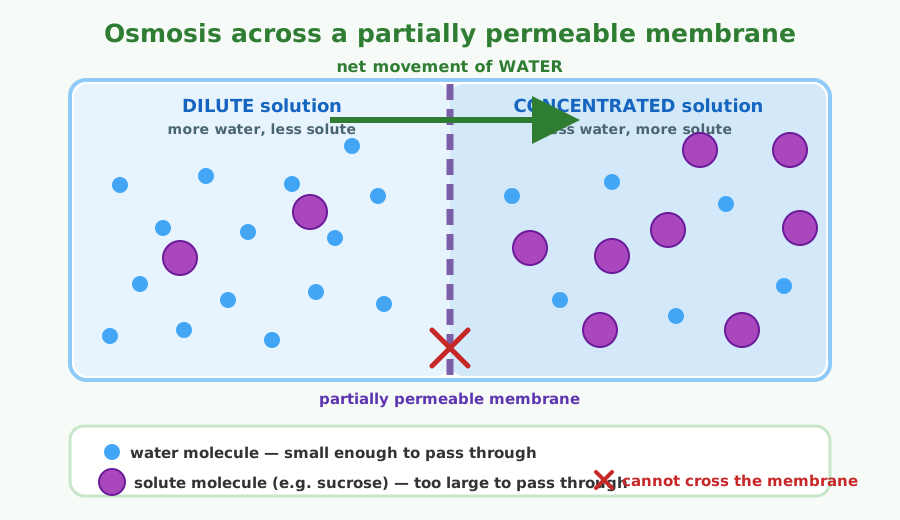
| Root hair cell | A long, thin extension into the soil; no chloroplasts | Large surface area for absorbing water by osmosis and minerals by active transport |
| Palisade mesophyll cell | Column-shaped and packed with chloroplasts, near the top of the leaf | Absorbs as much light as possible for photosynthesis |
| Ciliated epithelial cell | Tiny hair-like cilia on the exposed surface | Sweeps mucus and trapped dust away from the lungs |
| Xylem vessel | Dead, hollow, with the end walls removed and walls strengthened by lignin | Carries water up the plant in an uninterrupted column and supports the stem |
Group your learning into different categories
To keep things organised, group your learning into categories. Cell biology is a big subject, so breaking it into smaller modules helps enormously.
The most useful grouping is the levels of organisation. Cells of the same type form tissues, tissues form organs, organs work together in organ systems, and organ systems make up the organism:
cell → tissue → organ → organ system → organism

Take one worked example and follow it all the way up. A muscle cell is a cell; many muscle cells together form muscle tissue; muscle tissue, together with glandular tissue and epithelial tissue, forms the stomach, which is an organ; the stomach works with the intestines, liver and pancreas as the digestive system; and all the systems together make the organism. Being able to place any structure on that ladder is worth easy marks.
Spread the learning over a week
What can you do if you are new to the subject and do not know how long it will take to learn everything? Plan your study time in advance, even before you know exactly what you will be covering.
How much time will you give it each day? What will your daily schedule look like? Have you left room for breaks?
As a rule of thumb, it is better to spread learning over a week than to cram it in at the last minute. This is especially true for vocabulary and names, which is most of this topic.
Short sessions at regular intervals – twenty minutes a day, say – produce memories that are much easier to recall later. Material crammed the night before tends to fade quickly once the pressure is off.
One improvement worth making: do not simply re-read your notes. Close them and try to write out the organelle table from memory, then check what you missed. Recalling something is far more effective than recognising it, and it also tells you honestly what you do not yet know.
Remember to take notes
- This may seem obvious, but take notes as you learn the basics.
- Notes help you remember what you have covered and give you something to revise from later.
- Notes can also be turned into a mind map, or into flashcards with a structure on one side and its function on the other – a format that suits this topic particularly well.
Exam tips
- Write that mitochondria release or transfer energy, never that they "make" or "produce" it. Examiners take marks off for this specific wording.
- The cell membrane is partially permeable, not "semi-permeable holes". Say it controls what enters and leaves.
- For any specialised cell question, give the adaptation and the reason. "It has a tail" is half an answer; "it has a tail so it can swim to the egg" is the whole one.
- Do not say plant cells have chloroplasts and leave it there. Only cells that receive light have them, which is why root cells do not.
- Learn the levels of organisation in order and be ready to place an example on each rung.
- Where a question offers marks for a comparison, answer in matched pairs – state the plant cell point and the animal cell point for the same feature.
Learning cell biology basics can be fun and easy to do!
Learning new things can be a drag. It is hard, it takes time and effort, and you are often left feeling you need another class just to understand the first one.
But cell biology does not have to be like that. Learn the structures by what they do, use tables and flashcards rather than paragraphs, and test yourself instead of re-reading. With that in mind, browse our blog's biology section for more science lessons and study notes.
Frequently asked questions about learning cell biology
What is cell biology?
Cell biology is the study of cells: their structure, how they work, how they divide, and how they interact with one another. It underpins genetics, physiology and disease, which is why it is usually the first topic taught in a biology course.
Who discovered cells and when?
Robert Hooke first saw and named cells in 1665, looking at a slice of cork through an early microscope. The tiny compartments reminded him of the rooms monks lived in. He was actually seeing the dead cell walls left in the cork rather than living cells.
What are the three parts of cell theory?
That all living organisms are made of one or more cells; that the cell is the basic unit of structure and function in living things; and that all cells come from pre-existing cells. The first two were proposed in the late 1830s and the third was added later.
What is the function of the mitochondria?
Mitochondria are the site of aerobic respiration. They release the energy stored in glucose and transfer it to ATP, which the cell then uses for movement, active transport and building molecules. They do not create energy, and cells with high energy demands contain the most of them.
What do plant cells have that animal cells do not?
A cellulose cell wall, chloroplasts in the green parts of the plant, and a large permanent vacuole filled with cell sap. Everything else – nucleus, cytoplasm, cell membrane, mitochondria and ribosomes – is present in both.
What is a specialised cell?
A cell whose structure has changed to suit one particular job, a process called differentiation. A red blood cell has no nucleus so it can carry more haemoglobin; a root hair cell has a long extension to increase its surface area for absorbing water.
What are the levels of organisation in a living organism?
Cells form tissues, tissues form organs, organs form organ systems, and organ systems make up the organism. Muscle cell, muscle tissue, stomach, digestive system, human being is a worked example of the whole ladder.
What is the best way to revise cell biology?
Learn structures by function rather than by name, use a table or flashcards with the structure on one side and its job on the other, and test yourself by recalling rather than re-reading. Short daily sessions across a week work far better than one long session the night before.
How long does it take to learn cell biology basics?
The core content – organelles, plant versus animal cells, specialised cells and the levels of organisation – can be covered in a week of short daily sessions. Making it stick takes longer, so return to it briefly every few weeks rather than trying to finish it in one go.