Key points at a glance
- Monocots have one cotyledon (seed leaf) in the seed; dicots have two.
- Monocot leaves usually have parallel venation; dicot leaves usually have reticulate (net-like) venation.
- Monocots usually have a fibrous root system; dicots usually have a taproot system.
- Monocot flower parts are usually in threes or multiples of three; dicot flower parts are usually in fours or fives, or multiples of them.
- Monocot stems have scattered vascular bundles; dicot stems have them arranged in a ring.
- Examples: monocots – grasses, wheat, maize, rice, onion, lily, tulip, orchid, banana, palm. Dicots – pea, bean, sunflower, rose, hibiscus, mango, oak, tomato.
Flowering plants or angiosperms
Flowering plants or angiosperms are classified into two groups: They are
- Monocotyledonous or monocots
- Dicotyledonous or in short dicots.
We must analyze the many structural characteristics of angiosperms, such as roots, stems, leaves, and flowers, in order to distinguish between monocots and dicots. However, the differences between monocots and dicots start with the seed.
Monocot vs dicot – comparison table
If you only have a minute before a test, this table covers everything you are likely to be asked.
| Feature | Monocots | Dicots |
|---|---|---|
| Number of cotyledons in the seed | One | Two |
| Leaf venation | Parallel | Reticulate (net-like) |
| Leaf shape | Usually long and narrow, strap-like | Usually broad, with a stalk |
| Root system | Fibrous (many roots of similar size) | Taproot (one main root with side branches) |
| Stem branching | Usually unbranched | Usually branched |
| Vascular bundles in the stem | Scattered throughout the stem | Arranged in a ring near the outside |
| Secondary growth (getting woody) | Normally absent | Common in trees and shrubs |
| Number of flower parts | Three, or a multiple of three | Four or five, or a multiple of them |
| Pollen grain apertures | One (monosulcate) | Usually three (tricolpate) |
| Typical examples | Grass, wheat, maize, rice, onion, lily, tulip, orchid, banana, palm | Pea, bean, sunflower, rose, hibiscus, mango, oak, tomato |
What is Cotyledons?
You may have observed that while some seeds can easily be split into two seed lobes, others cannot.
Seed leaves are the name for these seed lobes. Cotyledon is another name for it.
Seeds with two cotyledons or seed leaves are called dicot seeds
Some seeds have only one seed leaf, making it impossible to separate them into two seed lobes. These types of seeds are called monocot seeds.
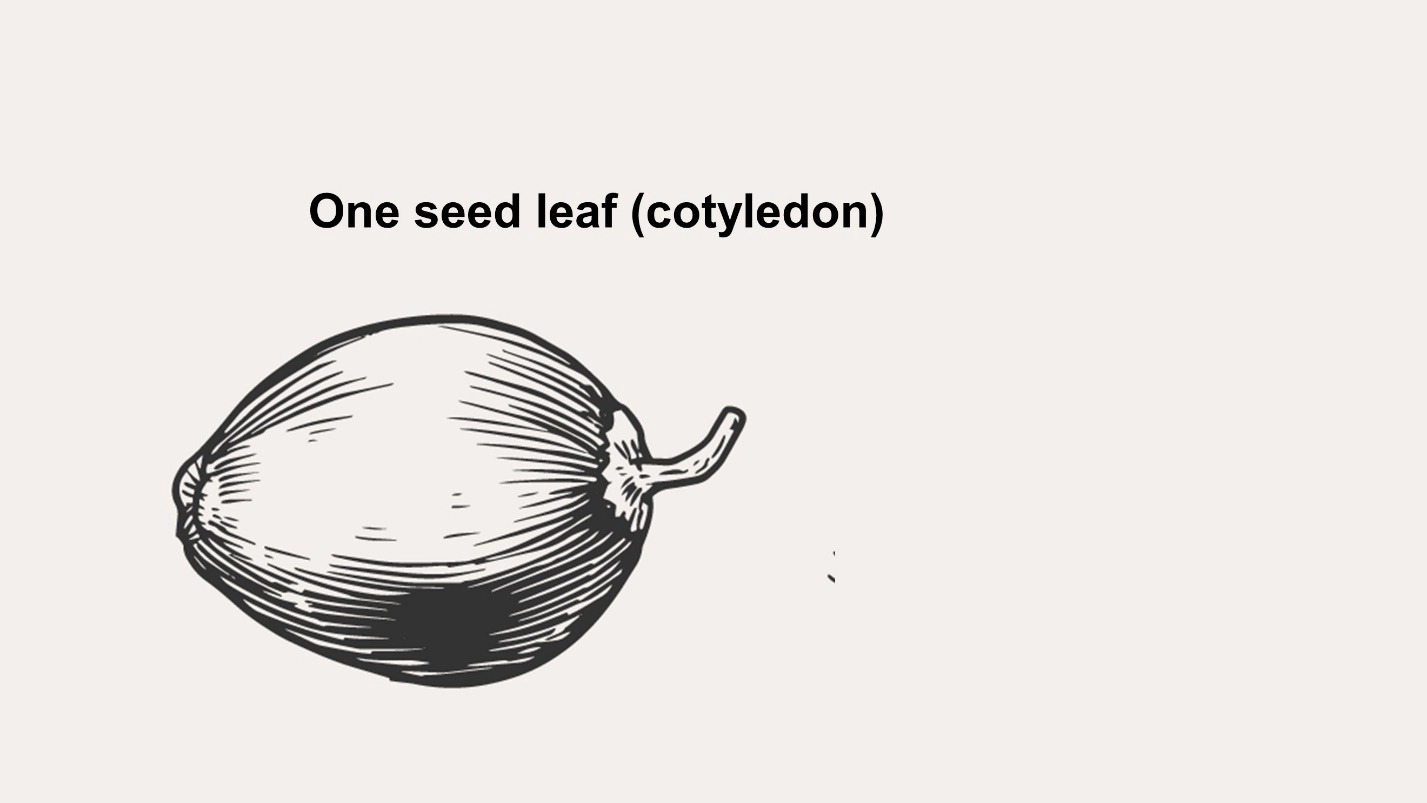
The cotyledon is a food store for the young plant. A soaked bean or pea splits neatly into two halves, and each half is one cotyledon – that is a dicot. A soaked grain of maize or wheat will not split in the same way, because it has only one.
Structural Differences between Monocot and Dicot
Branches
When you observe nature, you may see plants with branches. Dicots can be identified by their branched stems. The stems of monocot plants are not branched.
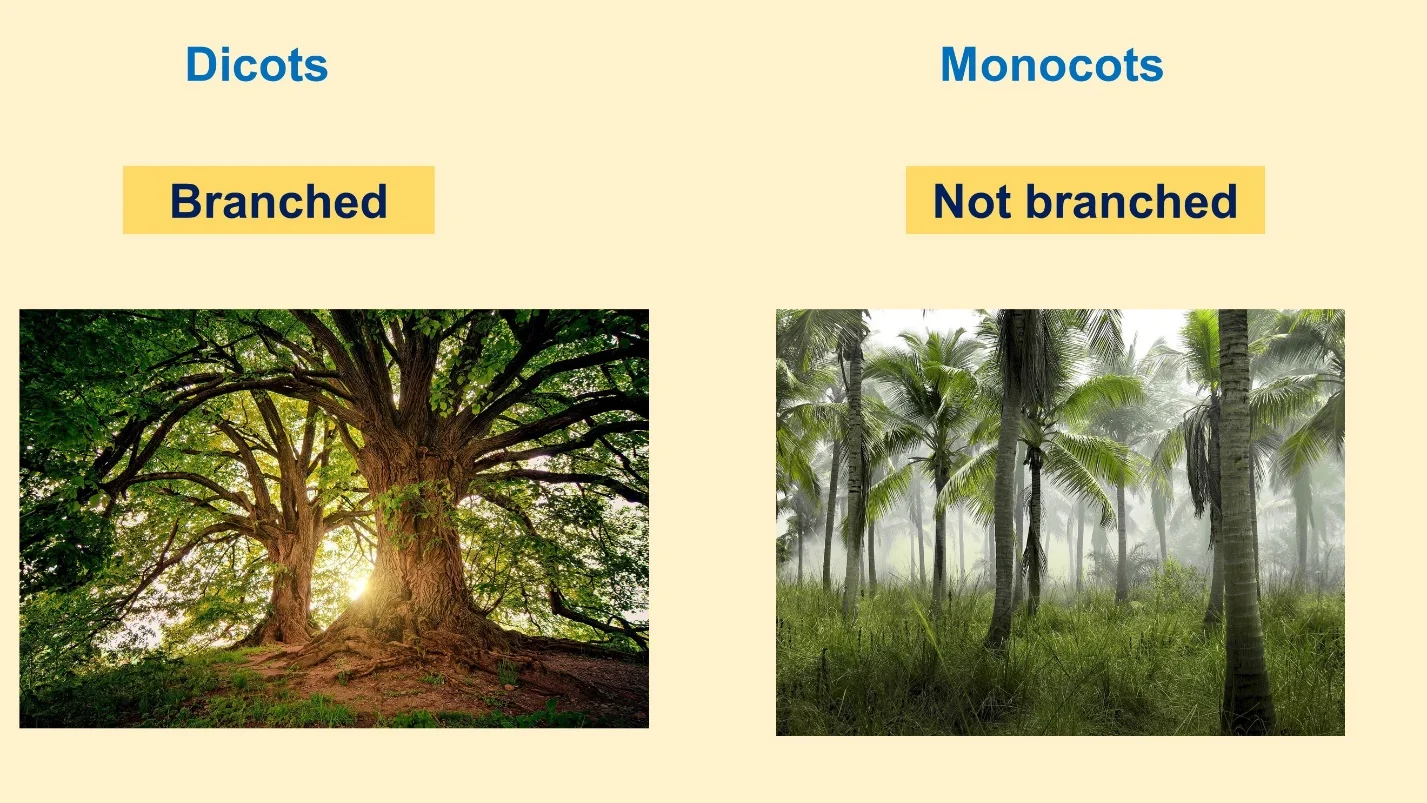
Treat this as a useful rule of thumb rather than an absolute law. Most familiar monocots – grasses, cereals, palms, banana plants – grow as a single unbranched stem, while most dicot shrubs and trees branch freely. There are exceptions, such as bamboo, which is a monocot that does produce branches.
Venation patterns
Leaf venation refers to how the veinlets are arranged in the leaf. In plants, there are primarily two venation patterns. The patterns are reticulate venation and parallel venation.
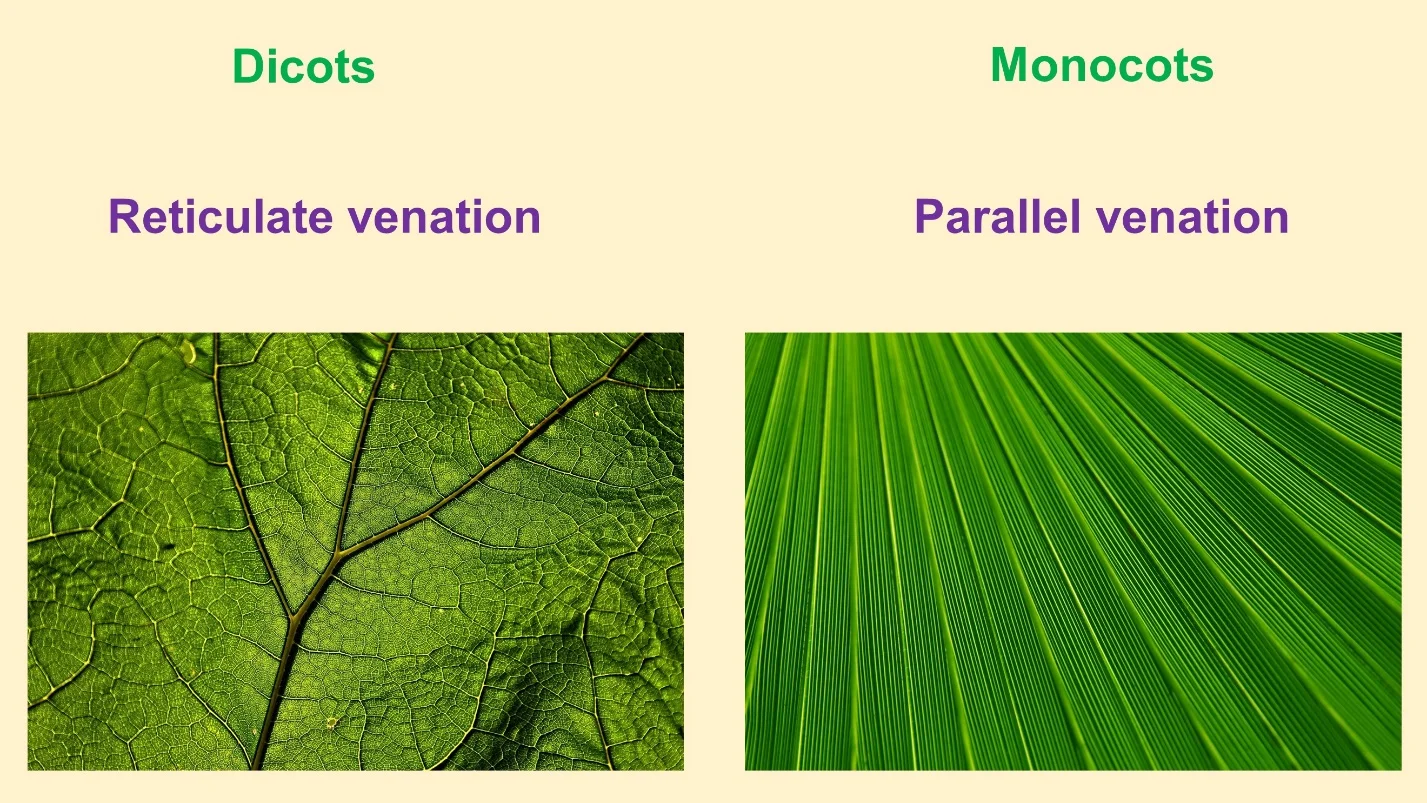
This leaf has branches that initiated from the midrib and spread as a web. This is reticulate venation. It can be seen in dicot plants. When veinlets are parallel to the midrib, we call it a monocot plant.
Venation is the quickest field test of all. Pick a leaf, hold it up to the light and look at the veins: if they run side by side along the length of the leaf, you are almost certainly holding a monocot; if they branch and rejoin into a net, it is a dicot.
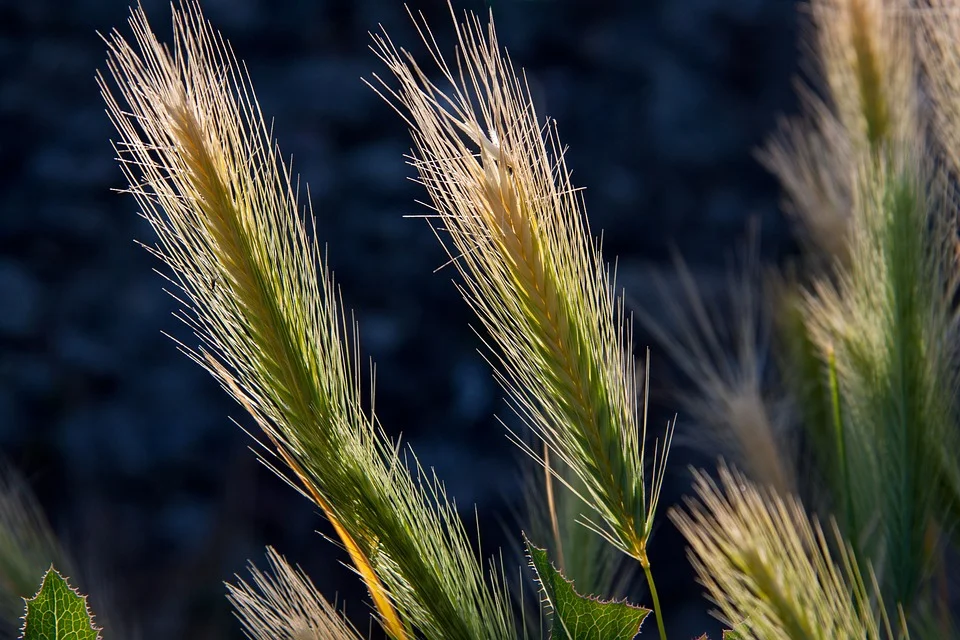
Wheat and barley are grasses, and grasses are monocots. Notice the long narrow leaves with veins running straight down them, and the single unbranched stem.
Number of petals in flowers
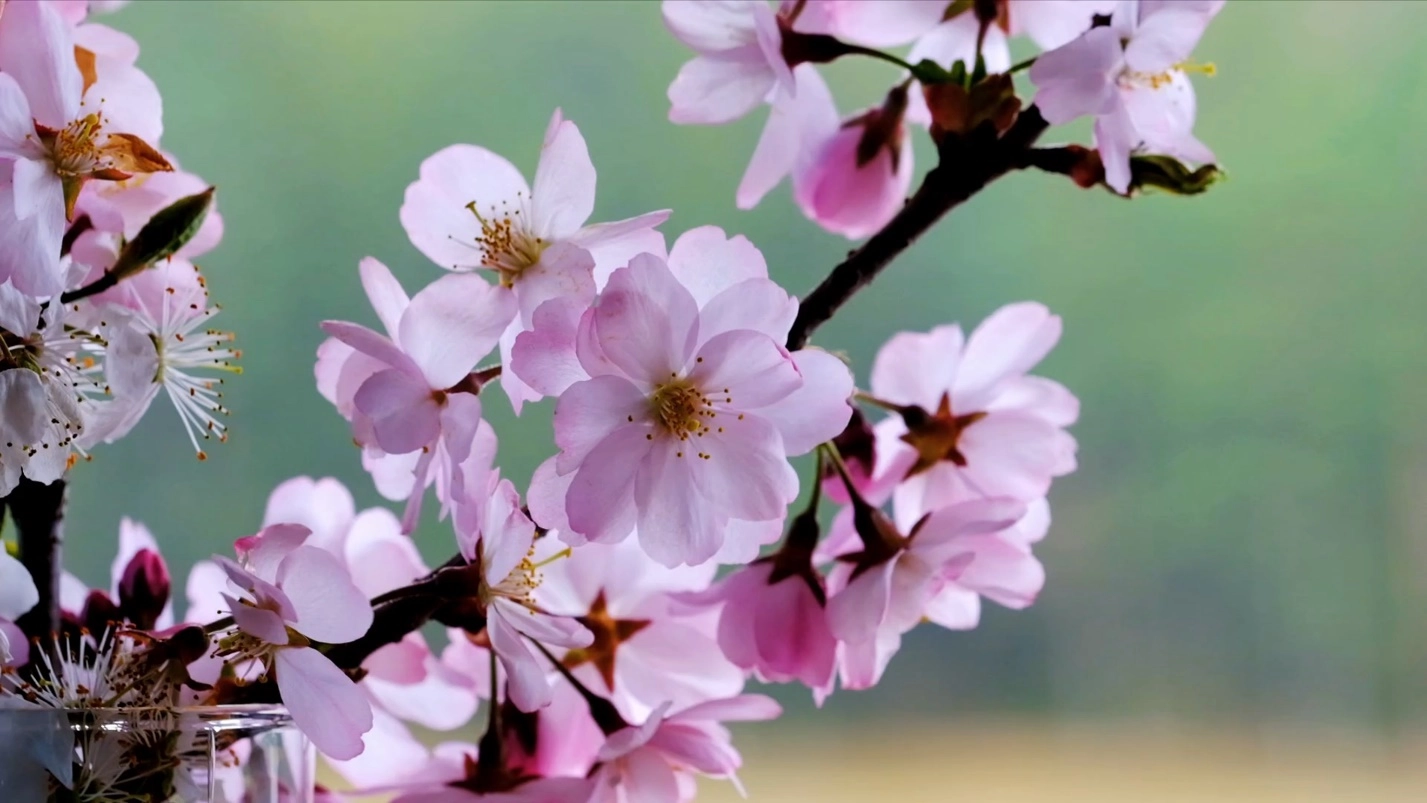
Monocot flowers have their parts in threes: three petals, or six, or another multiple of three. Dicot flowers have their parts in fours or fives, or multiples of four or five.
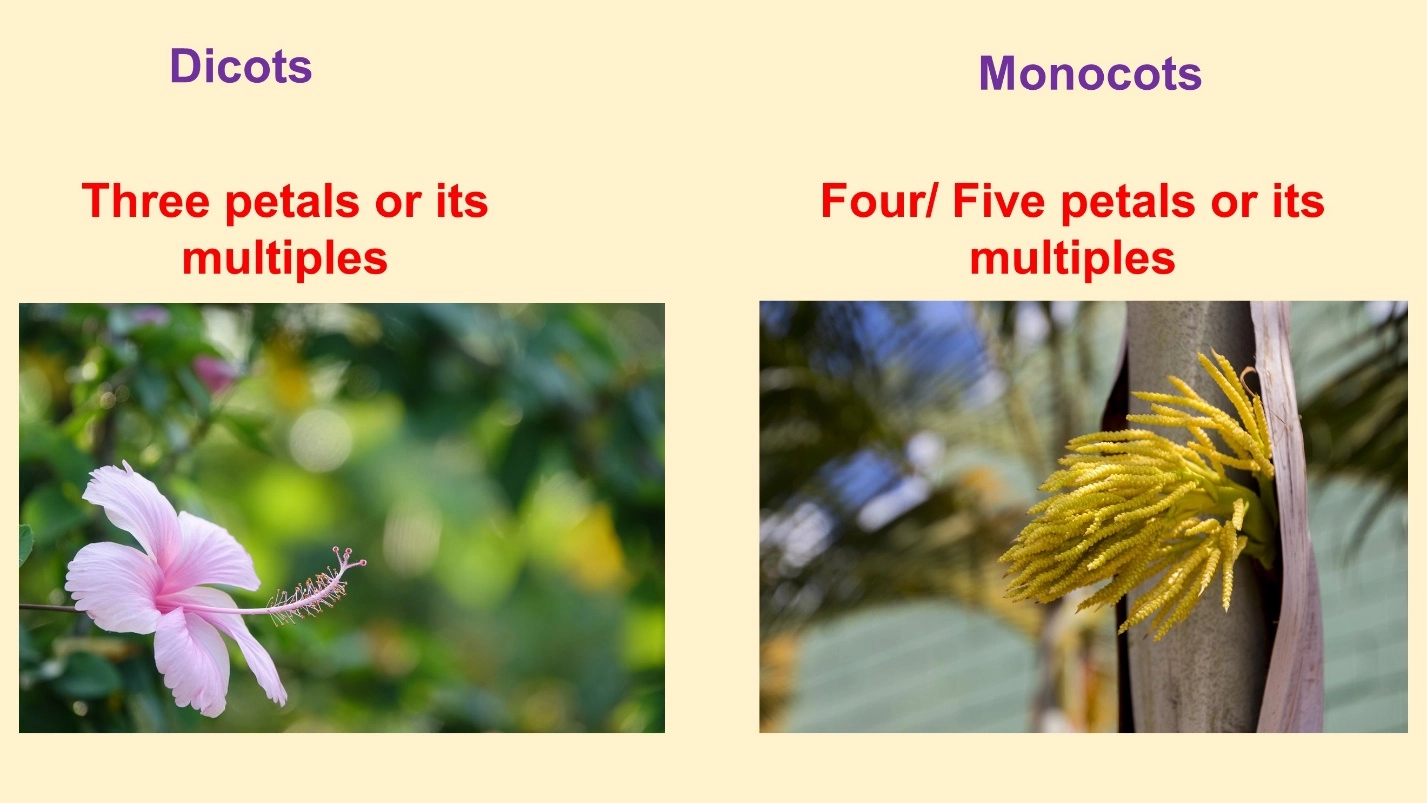
A tulip is a good example. It looks as though it has six petals, and six is a multiple of three – the flower is built on a plan of threes, and tulips are monocots. A wild rose or a buttercup, by contrast, has five petals, and both are dicots.

The tulips above also show the other monocot features clearly: long strap-shaped leaves with parallel veins, and stems that do not branch.
Root system
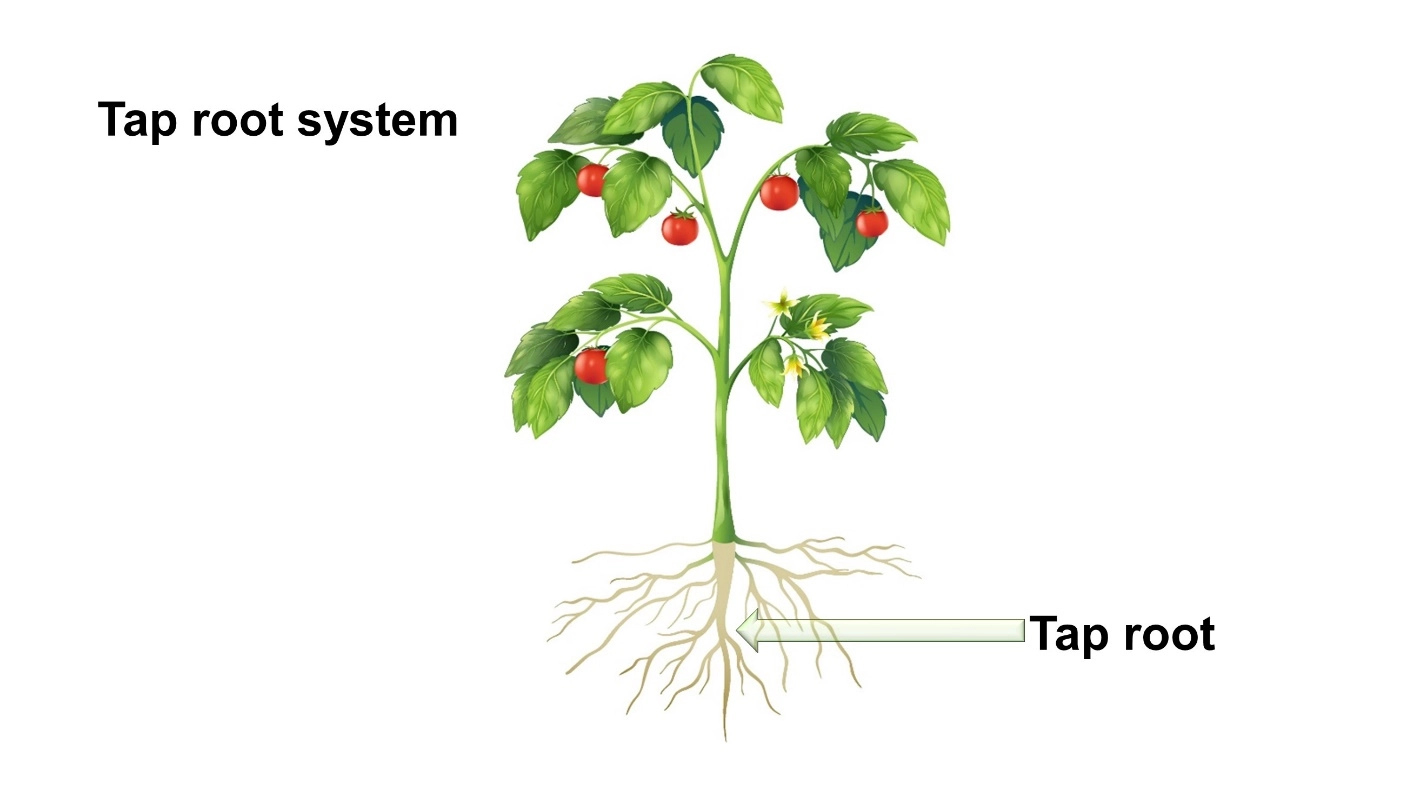
Plants with a tap root system can be used to separate dicot plants from monocot plants. This is because dicot plants have a tap root system but monocot plants have a fibrous root system.
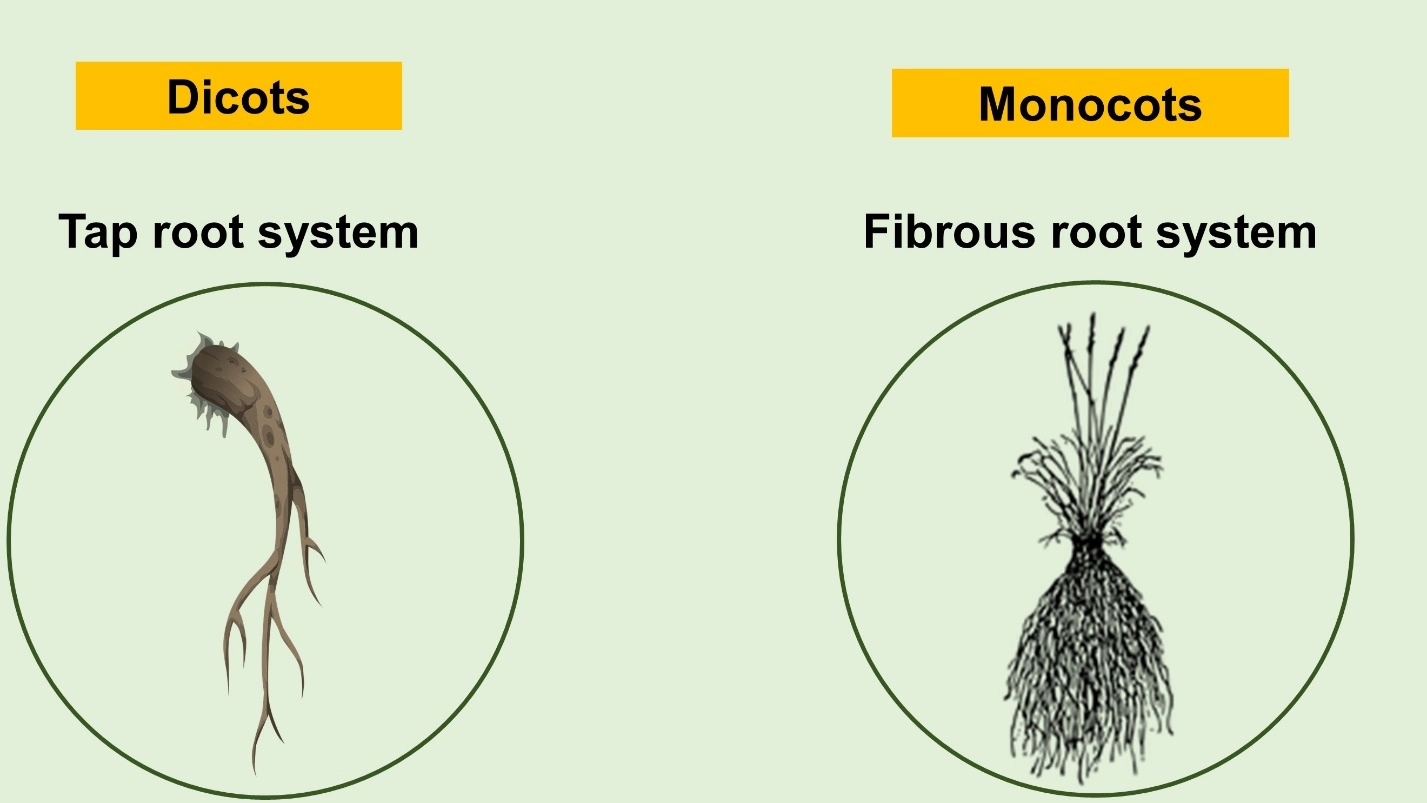
A taproot is one thick main root growing straight down, with thinner side roots coming off it – a carrot or a dandelion is the classic picture. A fibrous root system is a dense mat of roots of roughly equal thickness, which is why grass turf holds together when you lift it and why grasses are so good at holding soil in place. This difference matters in plant adaptations: taproots reach deep water, fibrous roots exploit the surface layer quickly.
Vascular bundles inside the stem
If you cut a stem across and look at the cut surface, you can see the vascular bundles – the tubes of xylem and phloem that carry water and food through the plant. In a monocot stem these bundles are scattered all through the tissue. In a dicot stem they are lined up in a neat ring near the outside.
That ring is what makes secondary growth possible. A layer of dividing cells between the xylem and phloem adds new tissue year after year, which is how dicot trees get thicker and woody. Monocots do not normally have this, so a palm trunk grows in a different way from an oak trunk. The xylem in both is the tissue that carries the water lost in transpiration.
Pollen grains
Under a microscope, monocot pollen grains typically have a single furrow or pore, while dicot pollen grains usually have three. Botanists use this feature a great deal, and it is one of the reasons the two groups were separated in the first place.
A note on modern classification
The monocot and dicot split is still the standard way this topic is taught, and it works well as a practical identification tool. It is worth knowing, though, that botanists no longer treat "dicots" as a single natural group. Genetic evidence shows that the plants once lumped together as dicots include several separate lineages, and most of them are now placed in a group called the eudicots. Monocots, on the other hand, really do form one natural group.
Why the difference matters
- Food supply. The world's staple cereals – rice, wheat, maize, barley, oats – are all monocots, while most pulses, fruits and oilseeds are dicots.
- Farming and weed control. Some weedkillers act selectively on broad-leaved dicot weeds and leave monocot grasses and cereals unharmed, which only works because the two groups differ structurally.
- Timber. Because true secondary growth is a dicot feature, hardwood timber comes from dicot trees.
- Propagation. The root and stem differences affect how easily a plant can be grown from cuttings, a topic covered in our notes on vegetative propagation in plants.
How to identify a plant in five steps
- Look at a leaf. Parallel veins point to a monocot; net-like veins point to a dicot.
- Count the flower parts. Threes mean monocot; fours or fives mean dicot.
- Look at the stem. Unbranched suggests monocot; branched suggests dicot.
- Ease the plant out of loose soil and look at the roots. A mat of similar roots is fibrous (monocot); one thick central root is a taproot (dicot).
- If you have a seed, soak it overnight and try to split it. Two halves means two cotyledons, so it is a dicot.
Now you can use this knowledge to identify plants in your garden and your surroundings.
Exam tips
- The safest single answer to "what is the main difference?" is the number of cotyledons – that is what the two names actually mean.
- Write comparisons in matched pairs. Say "monocots have parallel venation whereas dicots have reticulate venation", not just "dicots have net veins".
- Use the words usually or typically. These are general trends with exceptions, and examiners accept hedged answers.
- Do not confuse the two root types: fibrous = monocot, taproot = dicot.
- If you are given an unlabelled stem cross-section, scattered bundles = monocot, ring of bundles = dicot.
Frequently asked questions
What is the main difference between a monocot and a dicot?
The number of cotyledons, or seed leaves, inside the seed. A monocot seed has one and a dicot seed has two. Every other difference – venation, roots, flower parts, stem anatomy – follows from the two groups being separate lineages.
How many petals do monocots and dicots have?
Monocot flowers have parts in threes or multiples of three, so three or six petals is typical. Dicot flowers have parts in fours or fives, or multiples of them, so four or five petals is typical.
Is grass a monocot or a dicot?
Grass is a monocot. So are all the cereal crops that belong to the grass family, including wheat, rice, maize, barley and oats.
Is a sunflower a monocot or a dicot?
A sunflower is a dicot. It has two cotyledons, net-veined leaves, a branching taproot and a stem with vascular bundles arranged in a ring.
Do monocots have taproots?
Not normally. Monocots typically develop a fibrous root system, in which many roots of similar thickness grow from the base of the stem, rather than one dominant central root.
Why are monocot stems not woody?
Because monocots do not normally have the ring of dividing tissue that produces secondary growth. Woody thickening in trees and shrubs comes from that ring, which is a feature of dicot stems.
Can you tell a monocot from a dicot just by looking at the leaf?
Usually yes. Parallel venation is a strong indicator of a monocot and reticulate venation of a dicot. It is still worth checking a second feature, such as the roots or the flower, before you commit to an answer.