Rearranging formulas means changing which letter sits on its own, so you can find a different quantity. You do it with inverse operations, doing exactly the same thing to both sides, until the letter you want is by itself. It matters because one formula becomes several: learn F = ma once and you can also find acceleration or mass, without memorising three separate rules.
What does rearranging a formula mean?
A formula is a rule that links quantities using letters. In F = ma, force (F) equals mass (m) multiplied by acceleration (a). The letter on its own, usually on the left of the equals sign, is called the subject of the formula. Here the subject is F.
Sometimes you know F and m and need a. Then you change the subject: you rearrange the formula so that a is on its own.
F = ma → a = F ÷ m
Teachers say "make a the subject", "change the subject of the formula" or "rearrange the formula for a". All three mean the same job. Both spellings of the plural are correct, too: formulas is the everyday English form and formulae is the traditional Latin one, which the Department for Education’s GCSE maths content still uses.
Rearranging is not quite the same as solving an equation. When you rearrange, the answer still contains letters, such as a = F ÷ m. When you solve an equation, you end up with a number, such as x = 4. The steps are the same, but a rearranged formula can be used again and again with different numbers.
One quick note: this article is about algebra, not chemical formulae such as H₂O. If you want those, see how to write a chemical formula.
The steps for rearranging a formula
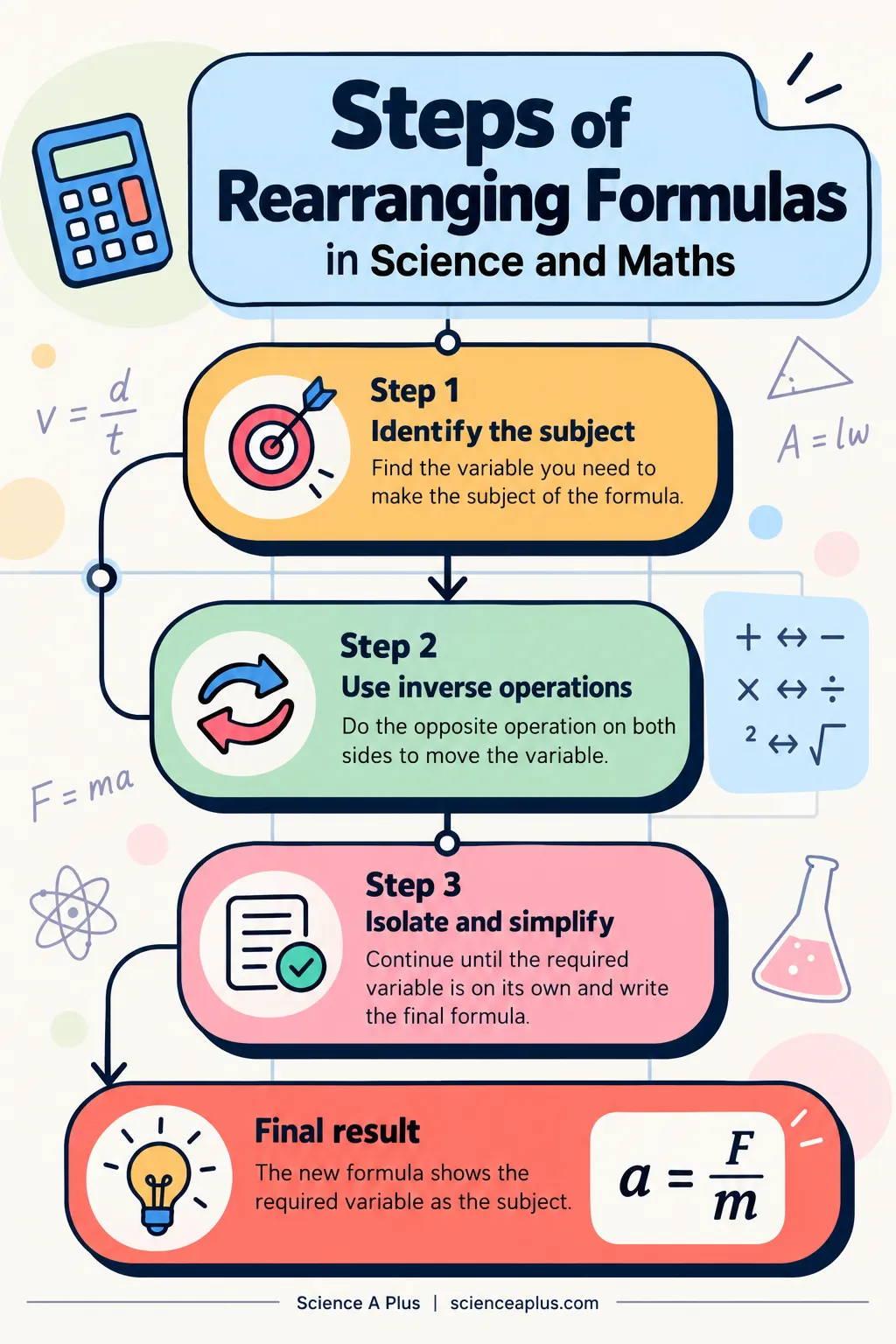
The card above shows the core method. Here it is in words, with one extra habit at the end that makes your answers far more reliable.
- Identify the subject. Find the letter you want to end up on its own. Circle it if it helps.
- Use inverse operations on both sides. Look at what is being done to the letter, then do the opposite to both sides of the formula.
- Isolate and simplify. Keep going until the letter is alone, then write it with the subject on the left.
- Check. Put simple numbers into the original formula, work out the answer, and then put them into your rearranged version. You should get the same result.
The tool behind step 2 is the inverse operation: the operation that undoes another one.
| Operation | Inverse (undoes it) |
|---|---|
| Add | Subtract |
| Subtract | Add |
| Multiply | Divide |
| Divide | Multiply |
| Square | Square root |
| Cube | Cube root |
A first worked example: F = ma
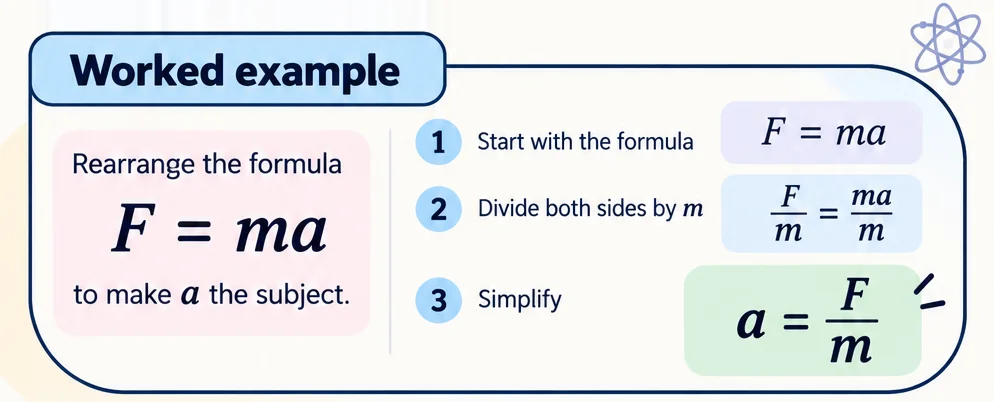
In F = ma, the letter a is being multiplied by m. The inverse of multiplying by m is dividing by m, so divide both sides by m.
F = ma
F ÷ m = ma ÷ m
a = F ÷ m
On the right, the m on top and the m underneath cancel, because m ÷ m = 1. Now check it with invented numbers. Take F = 12 N and m = 4 kg. Then a = 12 ÷ 4 = 3 m/s². Substitute back into the original: F = ma = 4 × 3 = 12 N. It matches, so the rearranging is right.
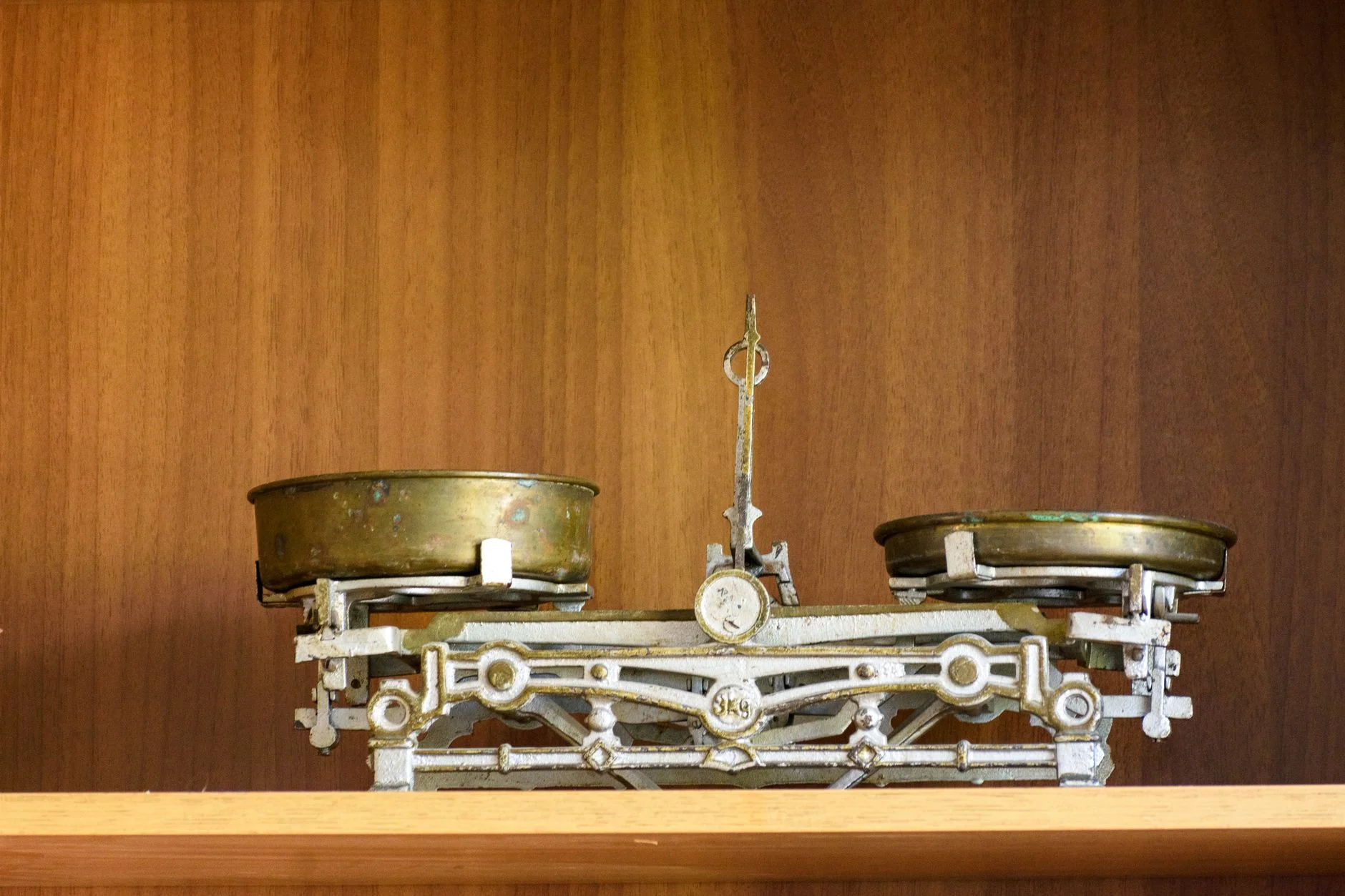

The analogy is the point here: a formula is only useful while both sides stay equal. That is why every line of working in this article does the same operation to the left-hand and right-hand sides.
Where this comes up at GCSE
Rearranging formulas is not an optional extra. The Department for Education’s GCSE maths content says students must "understand and use standard mathematical formulae; rearrange formulae to change the subject". AQA’s GCSE Maths specification lists it as item A5 and adds "including use of formulae from other subjects in words and using symbols".
It is just as clear in the sciences. AQA’s GCSE Physics and GCSE Chemistry both list "change the subject of an equation" as a mathematical skill, directly beside "substitute numerical values into algebraic equations using appropriate units for physical quantities". In other words, you are expected to rearrange first, or substitute first, and get the units right either way.
Even when an equation is printed for you, you still have to use it. Knowing how to rearrange is what turns a formula on the sheet into a mark on your paper. For a wider plan, see these tips for revising GCSE maths quickly.
Next, we work through one-step examples drawn from maths and physics.
One-step rearranging: worked examples
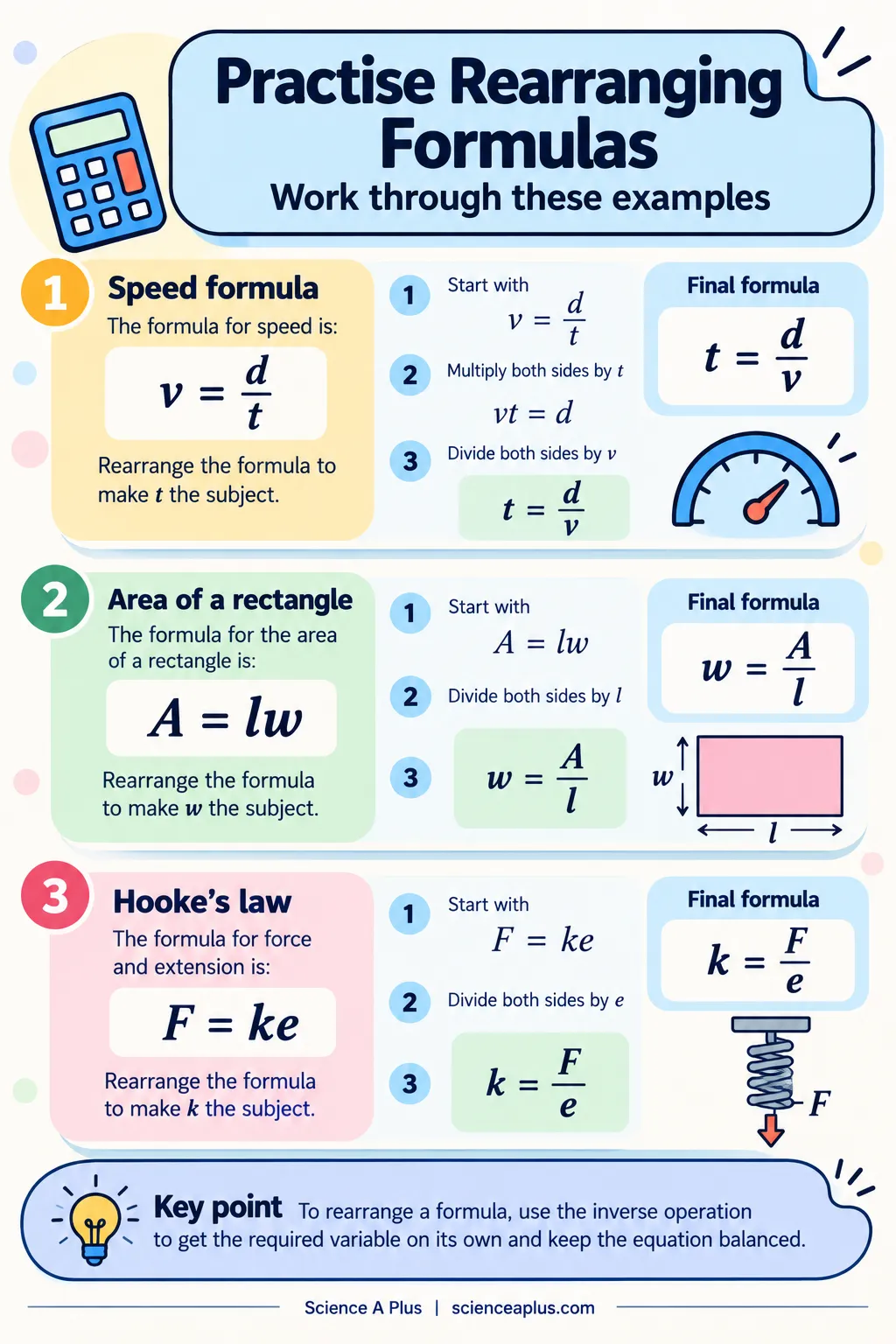
The practice card above shows three one-step rearrangements: speed, the area of a rectangle and Hooke’s law. Each needs just one inverse operation. We work through them in turn, and every set of numbers here is invented for practice.
Speed, distance and time

The card writes speed as v = d ÷ t, with d for distance. AQA Physics writes the same relationship as s = vt, where s is distance travelled. The algebra is identical, so use the letters on your own equation sheet. We will use s = vt here.
To find the time, t is being multiplied by v, so divide both sides by v.
s = vt
s ÷ v = t
t = s ÷ v
A runner covers 100 m at 8 m/s. Then t = 100 ÷ 8 = 12.5 s. Check: 8 × 12.5 = 100, so it works.
Units are where marks quietly disappear. Suppose a cyclist goes 1.5 km in 2 minutes and you want the speed in m/s. Convert first: 1.5 km = 1500 m and 2 minutes = 120 s. Then v = s ÷ t = 1500 ÷ 120 = 12.5 m/s. Check: 12.5 × 120 = 1500.
Area of a rectangle
The area of a rectangle is A = lw (length times width). To make w the subject, divide both sides by l.
A = lw
w = A ÷ l
If A = 24 cm² and l = 6 cm, then w = 24 ÷ 6 = 4 cm. Check: 6 × 4 = 24.
Hooke’s law
For a spring, force F, spring constant k and extension e are linked by F = ke. To find the spring constant, divide both sides by e.
F = ke
k = F ÷ e
A force of 6 N stretches a spring by 15 cm. The spring constant is measured in newtons per metre, so change 15 cm to 0.15 m first. Then k = 6 ÷ 0.15 = 40 N/m. Check: 40 × 0.15 = 6 N. AQA adds that extension is directly proportional to force only "provided that the limit of proportionality is not exceeded", so the formula stops working if you overstretch the spring.
The same pattern appears in Newton’s laws of motion, where F = ma is rearranged for mass, acceleration or force depending on the question.
Two-step formulas
Many formulas need two inverse operations. The rule is to undo the operations in the reverse order to how the formula was built. For y = mx + c that means undoing the addition first, then the multiplication. Take y = mx + c, the equation of a straight line, and make x the subject. First, x is multiplied by m and then c is added, so we subtract c from both sides, then divide both sides by m.
y = mx + c
y − c = mx
x = (y − c) ÷ m
With y = 11, m = 2 and c = 3, x = (11 − 3) ÷ 2 = 4. Check: 2 × 4 + 3 = 11.
The same two steps work on a science formula. In v = u + at (final speed from starting speed, acceleration and time), make a the subject:
v = u + at
v − u = at
a = (v − u) ÷ t
With u = 5, v = 25 and t = 4, a = 20 ÷ 4 = 5 m/s². Check: 5 + 5 × 4 = 25.
A typical question reads "rearrange w = 7t − 5 to make t the subject". Add 5 to both sides to get w + 5 = 7t, then divide by 7. So t = (w + 5) ÷ 7. If w = 30, then t = 35 ÷ 7 = 5, and checking gives 7 × 5 − 5 = 30.
Why you undo things in reverse (BIDMAS)
BIDMAS is the order for working out an expression: Brackets, Indices, Division, Multiplication, Addition, Subtraction. Multiplication and division rank equally and are worked left to right, and so do addition and subtraction. PEMDAS and BODMAS name the same rules with different words, since parentheses are just brackets.
BIDMAS tells you how a value is built up. Rearranging does the reverse, so you undo the steps in the opposite order. It is like putting on socks and then shoes: to get the socks off, the shoes come off first.
Look at y = 3(x + 2)² − 5. Building y from x goes: add 2, square, multiply by 3, subtract 5. To make x the subject, undo those in reverse: add 5, divide by 3, square root, subtract 2.
y + 5 = 3(x + 2)²
(y + 5) ÷ 3 = (x + 2)²
±√((y + 5) ÷ 3) = x + 2
x = −2 ± √((y + 5) ÷ 3)
With y = 22, (22 + 5) ÷ 3 = 9, the root is ±3, and x = 1 or x = −5. Check both: 3 × (1 + 2)² − 5 = 22 and 3 × (−5 + 2)² − 5 = 22.
Formulas with brackets and fractions
The perimeter of a rectangle is P = 2(l + w). Divide both sides by 2, then subtract w:
P ÷ 2 = l + w
l = P ÷ 2 − w
If P = 20 and w = 3, then l = 10 − 3 = 7. Check: 2 × (7 + 3) = 20.
Now a fraction. The Celsius-Fahrenheit link is C = 5(F − 32) ÷ 9. Multiply both sides by 9, divide by 5, then add 32:
9C = 5(F − 32)
9C ÷ 5 = F − 32
F = 9C ÷ 5 + 32
At C = 20, F = 36 + 32 = 68. At C = 100, F = 180 + 32 = 212. Check the first: 5 × (68 − 32) ÷ 9 = 5 × 36 ÷ 9 = 20.
When the subject is on the bottom of a fraction
Take v = d ÷ t and make t the subject. The t is underneath, so multiply both sides by t to bring it up, then divide both sides by v.
v = d ÷ t
vt = d
t = d ÷ v
A fraction bar behaves as if there are brackets around the top and the bottom. The same idea matters on a calculator: to work out (v − u) ÷ t or (2y + 1) ÷ (y − 1), put brackets around anything that is on the top or bottom of a fraction, or the machine follows BIDMAS in a way you did not intend. If you need a refresher, read how to use a scientific calculator.
Make t the subject of v = u + at. (2 marks)
Subtract u from both sides: v − u = at. Then divide both sides by a: t = (v − u) ÷ a.
Powers and roots
When the subject is squared, the rule is: get the squared term on its own first, then take the square root of both sides. Roots come last, not first.
Start with kinetic energy, Eₖ = ½mv². To make v the subject, undo the ½ by multiplying by 2, undo the m by dividing by m, then undo the square with a square root.
Eₖ = ½mv²
2Eₖ = mv²
2Eₖ ÷ m = v²
v = √(2Eₖ ÷ m)
With Eₖ = 100 J and m = 2 kg, v = √(200 ÷ 2) = √100 = 10 m/s. Check: ½ × 2 × 10² = 100 J.
The electrical power formula P = I²R works the same way. Divide both sides by R, then take the root: I = √(P ÷ R). If P = 36 W and R = 4 Ω, then I = √9 = 3 A, and 3² × 4 = 36 confirms it.
For the area of a circle, A = πr², divide by π first and then take the root: r = √(A ÷ π). With A = 50 cm², r = √(50 ÷ π) = 3.99 cm to three significant figures.
Cubes follow the same idea with a cube root. The volume of a sphere is V = ⁴⁄₃πr³. Multiply both sides by 3, divide by 4π, then take the cube root.
3V = 4πr³
r³ = 3V ÷ 4π
r = ∛(3V ÷ 4π)
If V = 36π, then 3V ÷ 4π = 108π ÷ 4π = 27 and r = ∛27 = 3. Check: ⁴⁄₃π × 27 = 36π.
The speed formula v² − u² = 2as needs the same care. To make a the subject, divide both sides by 2s: a = (v² − u²) ÷ 2s. With u = 3, v = 7 and s = 10, a = (49 − 9) ÷ 20 = 2 m/s². Check: 49 − 9 = 40 and 2 × 2 × 10 = 40.
Plus or minus?
In pure maths, a square root has two answers, which is why y = 3(x + 2)² − 5 gave x = 1 or x = −5 earlier. Revision notes for AQA Maths tell students to take plus-or-minus square roots when solving. In the science examples above, a length, or a speed taken as a size, comes out as the positive root, because a negative length makes no physical sense.
When the subject appears twice
Sometimes the letter you want sits in two places, such as 3x + p = x + q. This is usually a Higher tier skill. The method has four steps:
- Expand any brackets and clear any fractions.
- Gather every term containing the subject on one side, and everything else on the other.
- Factorise so the subject appears only once.
- Divide by whatever is multiplying the subject.
An easy case first, 3x + p = x + q, where no factorising is needed because the x terms combine.
3x + p = x + q
3x − x = q − p
2x = q − p
x = (q − p) ÷ 2
If p = 2 and q = 10, x = 8 ÷ 2 = 4. Check: 3 × 4 + 2 = 14 and 4 + 10 = 14.
A harder case: y = (x + 1) ÷ (x − 2), make x the subject. Multiply to clear the fraction, then gather and factorise.
y(x − 2) = x + 1
xy − 2y = x + 1
xy − x = 1 + 2y
x(y − 1) = 2y + 1
x = (2y + 1) ÷ (y − 1)
Try y = 4: x = 9 ÷ 3 = 3. Check in the original: (3 + 1) ÷ (3 − 2) = 4. It works.
Rearranging formulas in science
The same method runs through physics, chemistry and biology. The table collects some common formulas with a rearrangement and a worked example. All numbers are invented for practice.
| Subject | Formula | Rearranged | Example |
|---|---|---|---|
| Physics | F = ma | a = F ÷ m | 12 N, 4 kg gives 3 m/s² |
| Physics | V = IR | R = V ÷ I | 12 V, 0.5 A gives 24 Ω |
| Physics | ρ = m ÷ V | V = m ÷ ρ | 3 kg, 1,500 kg/m³ gives 0.002 m³ |
| Chemistry | concentration = mass ÷ volume | mass = concentration × volume | 40 g/dm³, 250 cm³ (0.25 dm³) gives 10 g |
| Chemistry (Higher) | moles = mass ÷ Mr | mass = moles × Mr | 0.5 mol of CO₂ (Mr 44) gives 22 g |
| Chemistry only | % yield = actual ÷ theoretical × 100 | actual = % yield × theoretical ÷ 100 | 80% of 25 g gives 20 g |
| Biology | magnification = image ÷ real size | real size = image ÷ magnification | 6 mm image, ×200 gives 0.03 mm |
The chemistry rows come with conditions. AQA says concentration can be measured in mass per given volume (g/dm³), and that working with moles from mass and Mr is Higher Tier only. Percentage yield is in the chemistry-only course, not combined science. Mr is simply the sum of the relative atomic masses.
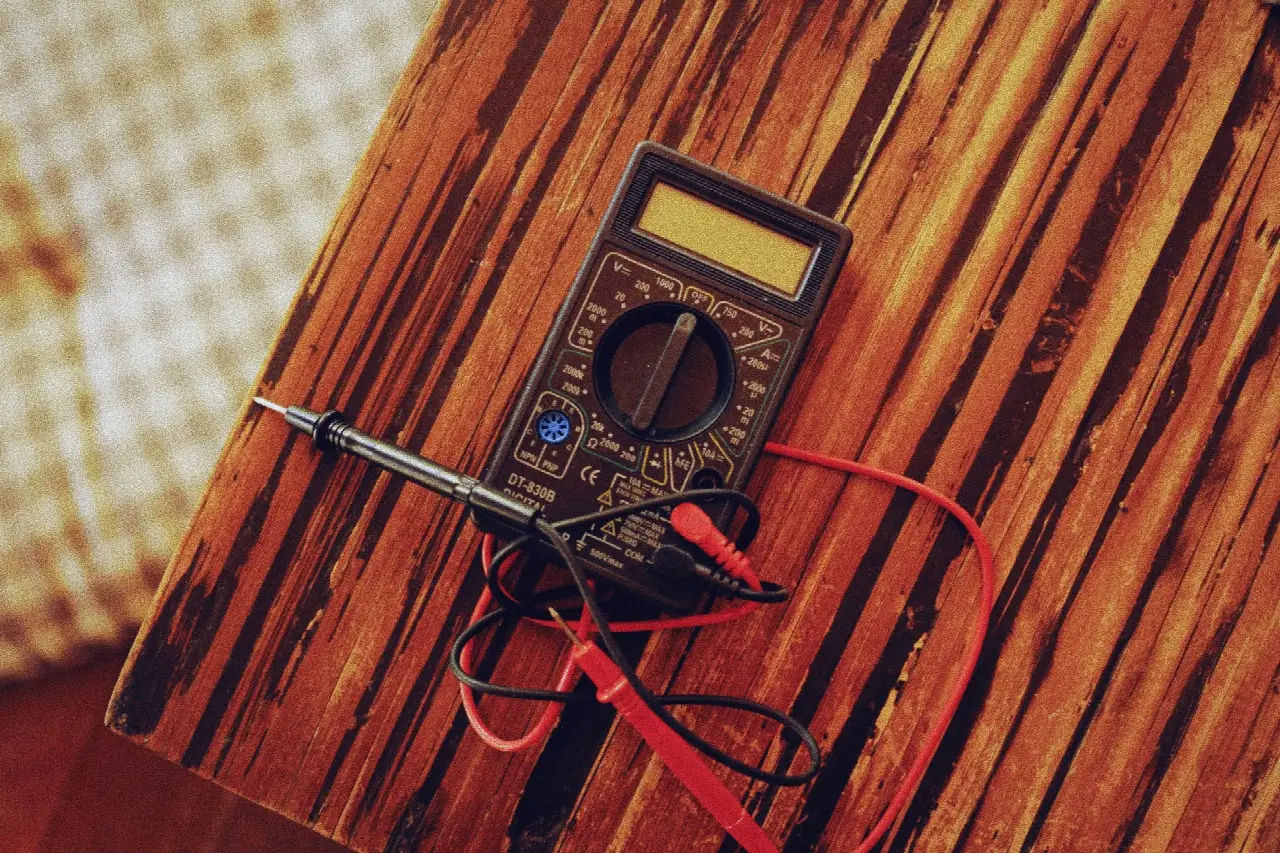

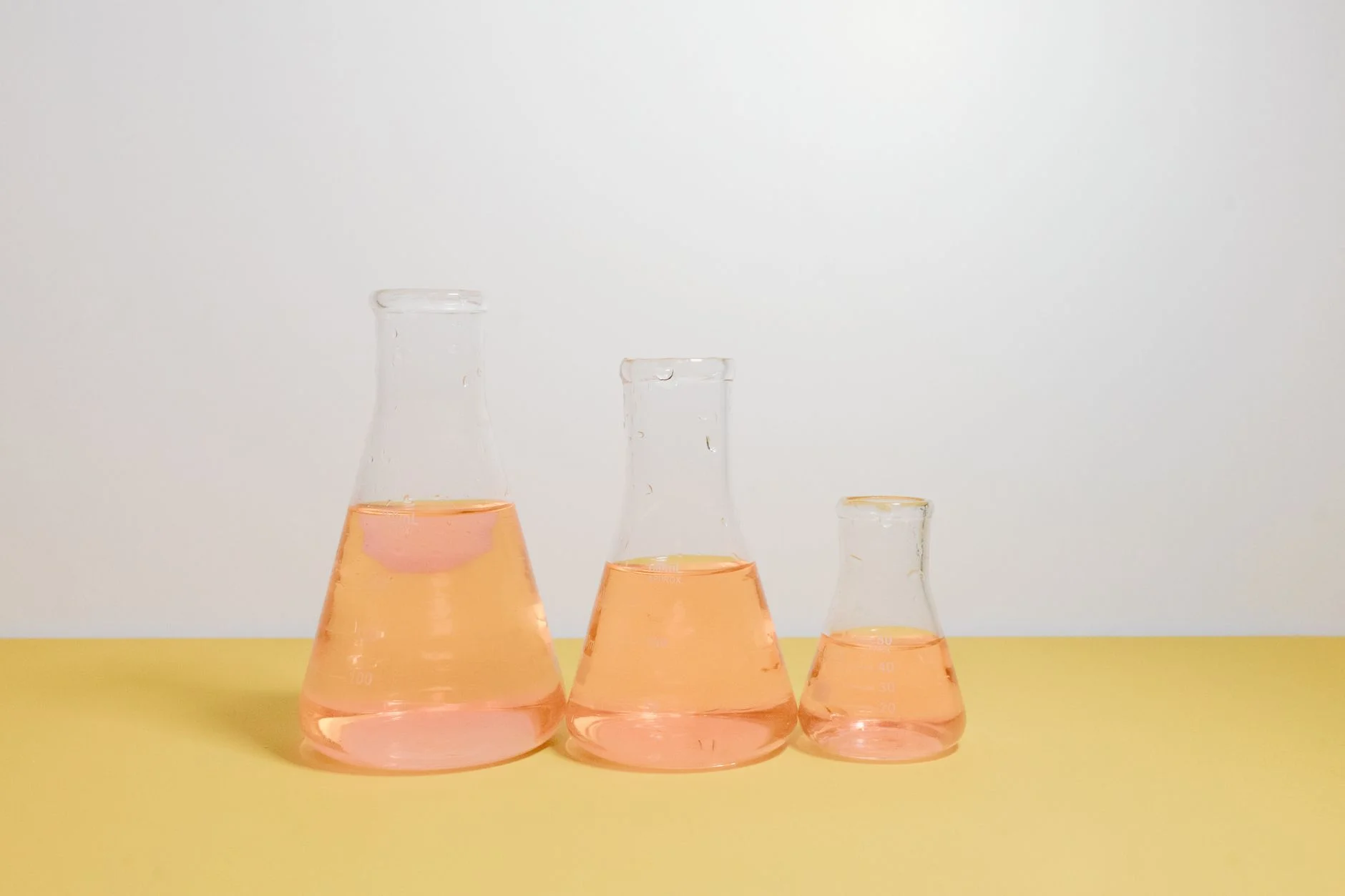
Here is a chemistry rearrangement in full. From concentration = mass ÷ volume, multiply both sides by volume to get mass = concentration × volume. Pour 250 cm³ of a 40 g/dm³ solution: convert the volume to 0.25 dm³, and the mass is 40 × 0.25 = 10 g. Check: 10 ÷ 0.25 = 40. For carbon dioxide, Mr = 12 + 2 × 16 = 44, so 0.5 mol has a mass of 0.5 × 44 = 22 g.
Physics formulas turn up in real settings too, such as the physics of electric cars. The equation E = Pt (energy transferred = power × time) rearranges to P = E ÷ t or t = E ÷ P, depending on which quantity is missing. Pairs of look-alike quantities are compared in common comparisons in physics, which helps when two letters look alike.
Biology: finding real size from a microscope image

Magnification is image size divided by real size. To find the real size, rearrange: multiply both sides by real size, then divide both sides by magnification.
magnification = image size ÷ real size
real size = image size ÷ magnification
A cell drawn 6 mm across at ×200 has a real size of 6 ÷ 200 = 0.03 mm. Since 1 mm = 1,000 µm, that is 30 µm. Check: 30 µm × 200 = 6,000 µm = 6 mm.
AQA’s June 2025 GCSE Biology examiners’ report describes a question where students had to recall and apply the magnification formula. It says a common source of error was an incorrect rearrangement of the equation when solving for actual size, and that many students overlooked converting cm to mm before µm. For more practice with this skill, see improving your maths skills in GCSE science cell biology.
Check your own rearranging with a calculator
Pick a formula, enter two values, and the checker below shows the rearranged form, the answer and a substitute-back check. Use it to test the answers you work out yourself, not to replace working them out. Enter values in standard units, such as metres and kilograms.
Common mistakes when rearranging formulas
Most lost marks come from a small set of slips. Each one below has been computed, so you can see how far off the answer ends up.
- Dividing only one term. From y = mx + c, writing x = y ÷ m − c forgets that c was never divided by m. With y = 11, m = 2 and c = 3 it gives 2.5, but the correct answer is 4.
- Turning the fraction upside down. From v = d ÷ t, writing t = v ÷ d with v = 5 m/s and d = 100 m gives 0.05 s. The correct answer is 20 s. A sense check helps: 100 m at 5 m/s cannot take a twentieth of a second.
- Rooting term by term. From a² + b² = c², writing a = c − b gives 8 when c = 13 and b = 5. The correct answer is 12.
- Forgetting the units. In F = ke, using 15 cm instead of 0.15 m gives k = 6 ÷ 15 = 0.4 N/m. The correct answer is 40 N/m.
- Forgetting the final root. Stopping at v² = 100 is not an answer for v. Take the root: v = 10.
- Changing a sign wrongly. If a + b = c, then a = c − b. Moving a term across the equals sign means doing the opposite operation to both sides, so the sign changes only because you subtracted.
Formula triangles: helpful or risky?
A formula triangle is a memory aid: cover the letter you want and read off what is left. It works for formulas with three letters of the form a = b × c, such as F = ma or V = IR. It cannot rearrange v² − u² = 2as, which has more variables and a power.
Teachers disagree about triangles. David Wait, a head of physics writing for the Royal Society of Chemistry, argues that they limit "what students can reasonably access in questions" and that algebraic rearranging carries across subjects better. He would consider them only for lower-attaining students to gain some marks. The Flying Colours Maths blog takes the opposite view: a triangle "used appropriately, works just fine".
There is one exam warning. In AQA’s June 2025 Biology report, students relying on "symbols or triangle methods" did not gain credit for recalling the magnification equation, because these were "not creditworthy". The safe plan is to learn the algebra, and use a triangle, if at all, only as a quick check.
Exam technique for rearranging formulas
Here is that approach for kinetic energy. A 2 kg trolley has 100 J of kinetic energy. Substitute first: 100 = ½ × 2 × v². That simplifies to 100 = v², so v = 10 m/s. Only one line of rearranging was needed, and no marks were put at risk by a wrongly rearranged formula.
Three more habits protect your marks:
- Convert units before you start. Centimetres to metres, minutes to seconds, cm³ to dm³.
- Do not round early. The same AQA Biology report reminds students not to round answers to calculation questions too early. Keep the full calculator value until the last line.
- Show every step. Showing your working gives the examiner something to credit: where a mark scheme allows method marks, they can be earned even if the final number is wrong, but a bare wrong answer earns nothing.
Use this checklist each time. Ticks are remembered on this device.
- Write the formula first
- Circle the letter that must become the subject
- Convert units
- Do the same operation to both sides, undoing in reverse order
- Write subject = … with the subject on the left
- Substitute back to check
- Ask whether the size of the answer makes sense
Rearranging also fits into a wider revision plan. See how to start revising for GCSE science subjects for a schedule. Which formulas you meet depends on your course, so read double science versus triple science to see what you will be asked.
Practice questions on rearranging formulas
Try each question on paper first. Then tap to reveal the model answer.
Make x the subject of y = ax. (1 mark)
Divide both sides by a: x = y ÷ a.
Make x the subject of 5x = r. (1 mark)
Divide both sides by 5: x = r ÷ 5.
Make t the subject of w = 7t − 5. Then find t when w = 30. (2 marks)
Add 5 to both sides, then divide by 7: t = (w + 5) ÷ 7. When w = 30, t = 35 ÷ 7 = 5.
Make a the subject of v² − u² = 2as. Then find a when u = 3, v = 7 and s = 10. (3 marks)
Divide both sides by 2s: a = (v² − u²) ÷ 2s. Then a = (49 − 9) ÷ 20 = 2 m/s².
Make h the subject of Eₚ = mgh. Find h when Eₚ = 60 J, m = 2 kg, taking g = 10 N/kg. (2 marks)
Divide both sides by mg: h = Eₚ ÷ (mg). Then h = 60 ÷ (2 × 10) = 3 m.
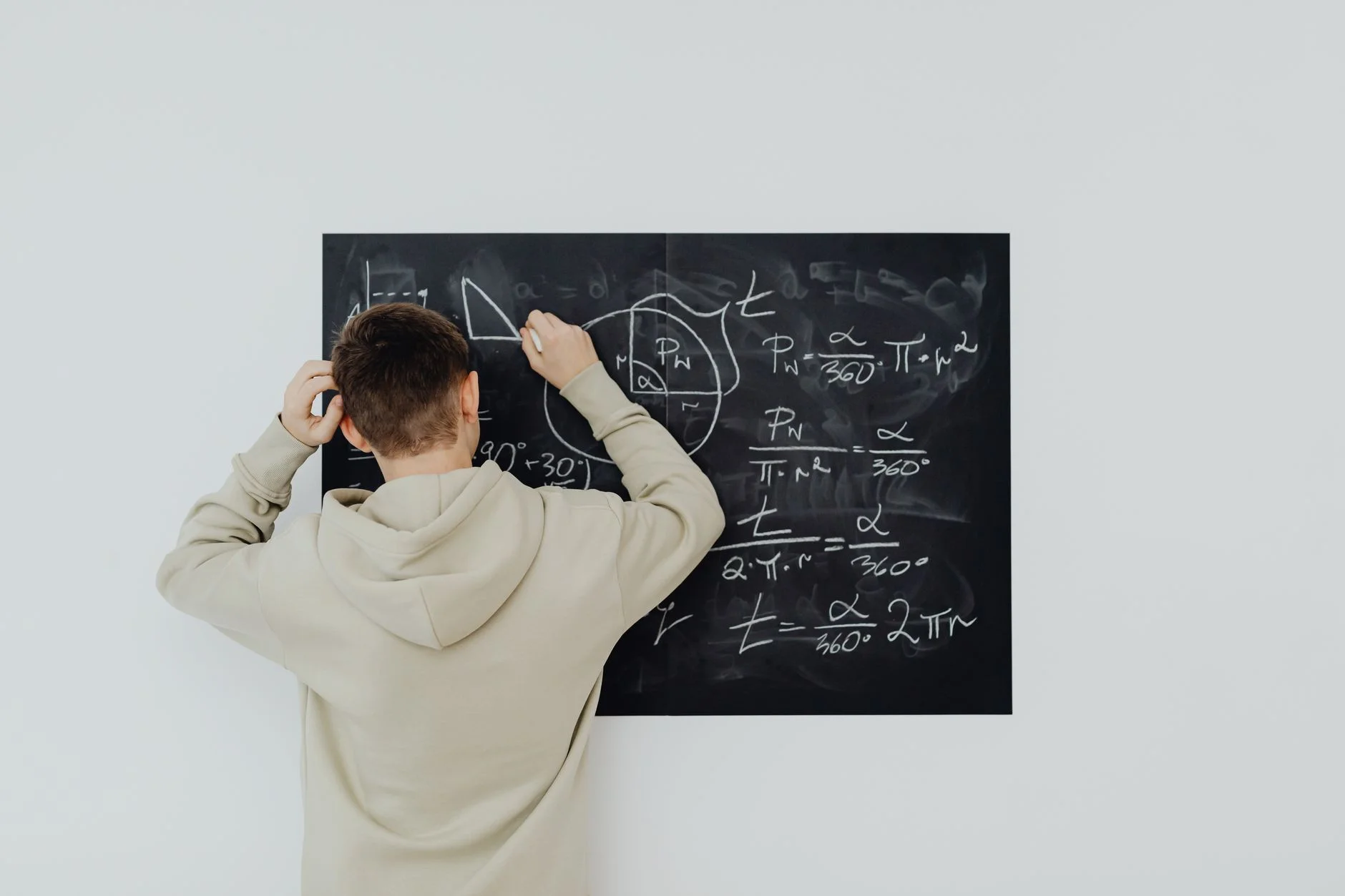
The area of a sector is A = (α ÷ 360) × πr². Make α the subject. (2 marks)
Multiply both sides by 360, then divide by πr²: α = 360A ÷ (πr²). Check with r = 4 and A = 4π: α = 360 × 4π ÷ (16π) = 90°. The student in the photo at the top of this article is working with this type of formula.
Higher: make x the subject of y = (x + 1) ÷ (x − 2). (4 marks)
Multiply out: y(x − 2) = x + 1, so xy − 2y = x + 1. Gather the x terms: xy − x = 1 + 2y. Factorise: x(y − 1) = 2y + 1. Divide: x = (2y + 1) ÷ (y − 1).
Flip cards and quiz
First, a quick drill. Each card shows an operation, and the back shows what undoes it.
Frequently asked questions about rearranging formulas
How do you rearrange a formula step by step?
Identify the letter you want as the subject. Look at what is being done to it, then do the inverse operation to both sides, working in reverse order. Keep going until the letter is alone, write it on the left, and finally check by substituting numbers into the original formula.
What does it mean to make x the subject?
Making x the subject means rearranging the formula so that x is on its own on one side, usually the left, and everything else is on the other side. For y = mx + c, the answer is x = (y − c) ÷ m. It is also called changing the subject of a formula.
What is the difference between rearranging a formula and solving an equation?
Both use the same steps. When you rearrange a formula, the result still contains letters, such as a = F ÷ m, and can be reused with different numbers. When you solve an equation, you work towards a single numerical answer, such as x = 4.
How do you rearrange a formula with a fraction?
If the subject is in the denominator, multiply both sides by it to bring it up. For v = d ÷ t, multiplying by t gives vt = d, and dividing by v gives t = d ÷ v. If the fraction has a longer top or bottom, treat each as if it were in brackets.
How do you rearrange a formula with a square or square root?
Get the squared term on its own first, then take the square root of both sides. For Eₖ = ½mv², multiply by 2, divide by m, then take the root: v = √(2Eₖ ÷ m). To undo a square root, square both sides. Never take the root of each term separately.
How do you rearrange a formula when the subject appears twice?
This is usually a Higher tier skill. Expand any brackets, gather every term containing the subject on one side, factorise so the subject appears once, then divide. For y = (x + 1) ÷ (x − 2), the result is x = (2y + 1) ÷ (y − 1).
Do you need to memorise physics equations for GCSE?
It depends on your exam board and course. Ofqual has confirmed formula and equation sheets for GCSE maths, physics and combined science exams in 2025, 2026 and 2027, and from 2028 onwards for the lifetime of the current qualifications. Separate biology and chemistry are not named, so check your own board’s sheet with your teacher.
Should you use formula triangles?
Triangles only work for formulas with three letters of the form a = b × c, so they cannot rearrange something like v² − u² = 2as. Some teachers accept them for a quick check, others argue algebra transfers better. Learning the algebra is the safer approach, and you can use a triangle as a check afterwards.
Is BIDMAS the same as PEMDAS?
Yes. BIDMAS (Brackets, Indices, Division, Multiplication, Addition, Subtraction) and PEMDAS name the same rules with different words, as does BODMAS. Parentheses are brackets, and exponents are indices. Multiplication and division rank equally and are worked left to right, as are addition and subtraction.
How can you check you have rearranged a formula correctly?
Choose simple numbers, put them into the original formula, and work out the missing value. Then put the same numbers into your rearranged version. If the two answers match, your rearrangement is right. For F = ma with F = 12 and m = 4, both routes give a = 3.