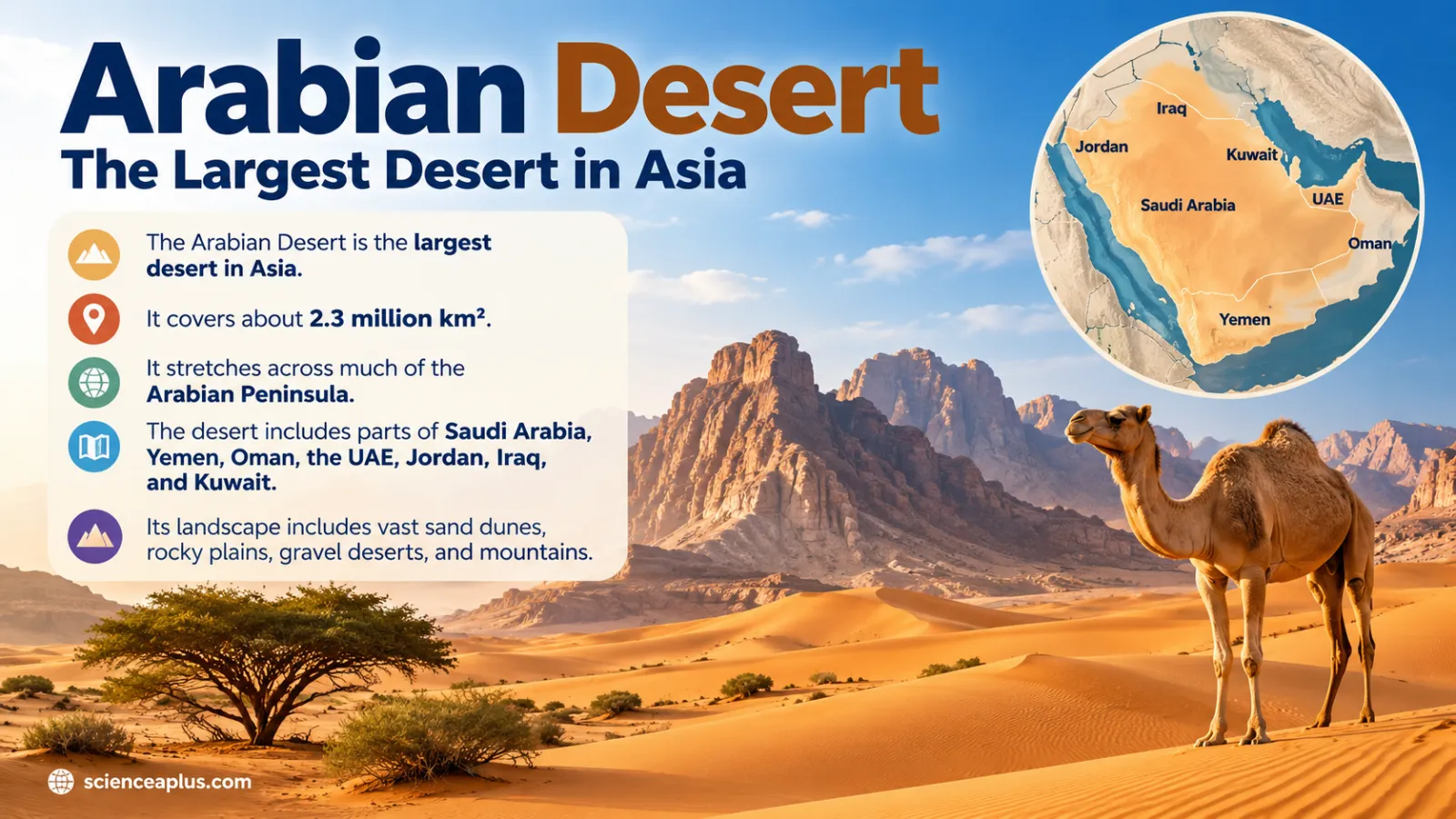
Where is the Arabian Desert? The Arabian Desert covers almost the whole Arabian Peninsula in Western Asia, between the Red Sea and the Persian Gulf. Most of it lies in Saudi Arabia. At about 2.33 million km², it is the largest desert in Asia, and its heart is the Rub’ al Khali, or Empty Quarter.
Picture a land where sand dunes rise as high as skyscrapers, summer days pass 50 °C and rain may not fall for years. That is the Arabian Desert. Yet it is far from empty. Gazelles, foxes and a small wild cat with furry feet live here, people have herded camels across it for thousands of years, and some of the world’s biggest cities and oil fields sit within it.
This guide covers where the desert is, how big it is, what its landscapes look like, its extreme climate, the plants and animals that survive there, and why it matters to the rest of the world. It is written for GCSE geography and biology, but anyone curious about deserts will find something new.
Where is the Arabian Desert?
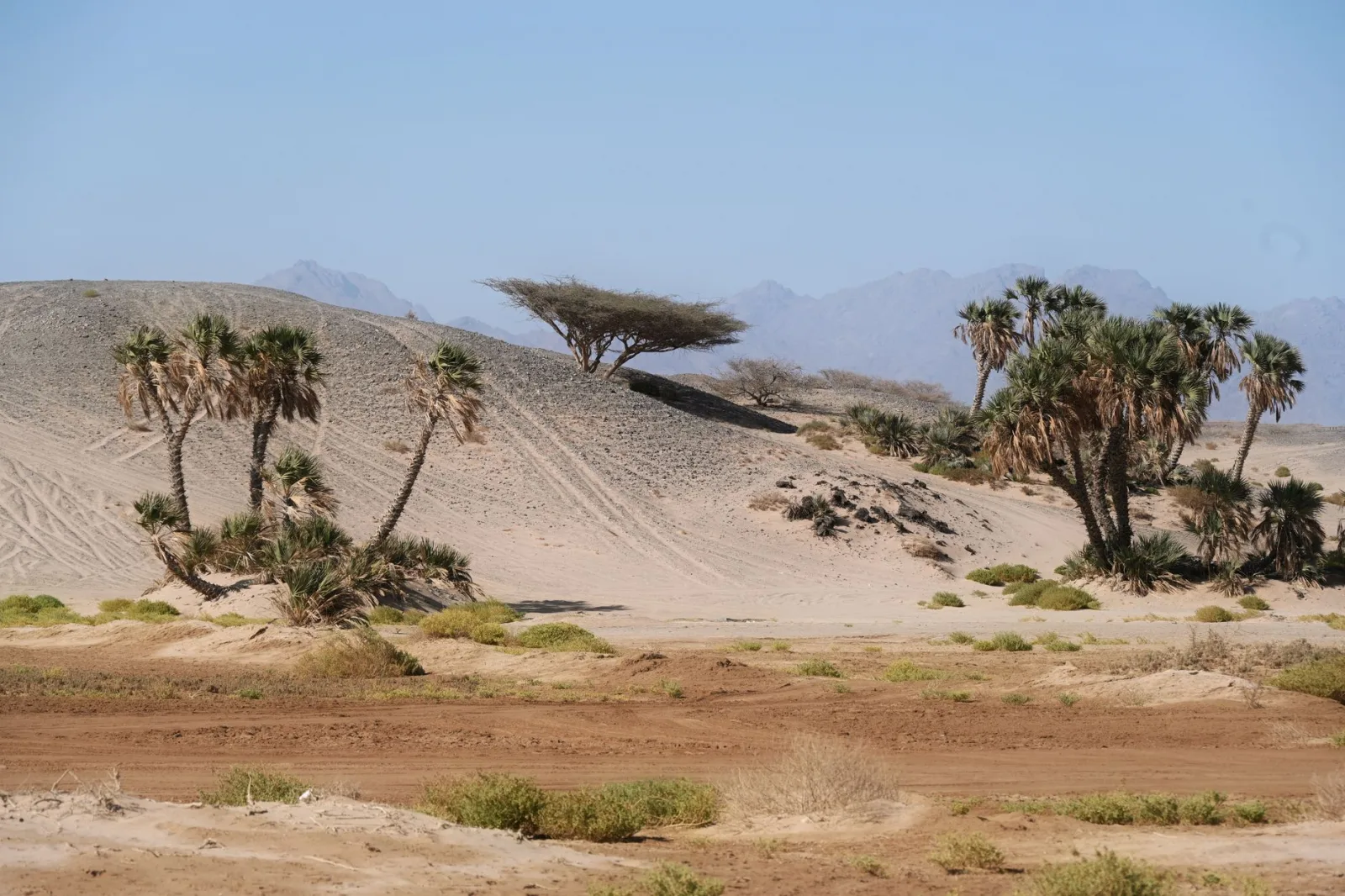
The Arabian Desert sits on the Arabian Peninsula, the large block of land joining Africa to the rest of Asia. The Red Sea lies along its western side, the Persian Gulf and the Gulf of Oman along its eastern side, and the Arabian Sea to the south. To the north, the desert fades into the dry plains of Jordan and Iraq.
It stretches from Yemen in the south-west to the Persian Gulf, and from Oman in the south-east up to Jordan and Iraq. In other words, the Arabian Desert covers almost the whole Arabian Peninsula. Saudi Arabia holds by far the largest share.
| Country | Part of the Arabian Desert |
|---|---|
| Saudi Arabia | Most of the desert, including An Nafud, Ad Dahna and the largest part of the Rub’ al Khali |
| Yemen | Southern edge of the Rub’ al Khali |
| Oman | Eastern edge of the Rub’ al Khali and sandy and gravel deserts inland |
| United Arab Emirates | North-eastern edge of the Rub’ al Khali |
| Qatar and Kuwait | Low, dry plains along the Persian Gulf |
| Jordan and Iraq | Northern desert plains and, in Jordan, the mountains of Wadi Rum |
Geographers do not all draw the edges in the same place. Some include small areas of Iran, Israel and Egypt’s Sinai Peninsula, because the same dry landscape continues there. Deserts do not stop neatly at borders, so you will see slightly different maps in different books.
How big is the Arabian Desert?
The Arabian Desert covers about 2,330,000 km² (900,000 square miles). That makes it the largest desert in Asia, bigger than the Gobi to the north-east.
How does it rank worldwide? It depends on how you define a desert. A desert is a place that gets very little rain, not necessarily a hot one. Count the frozen polar deserts of Antarctica and the Arctic, and the Arabian Desert comes about fourth in the world. Leave the polar deserts out, and it is the second-largest desert on Earth, beaten only by the Sahara in North Africa.
Deserts around the world are dry for different reasons. Chile’s Atacama is dry because cold ocean currents and mountains block rain; read about it in our guide to the driest desert in the world. The Arabian Desert is dry mainly because it sits under a belt of sinking, dry air near the Tropic of Cancer, the same belt that creates the Sahara. Its neighbour to the east across the Arabian Sea, the Thar Desert of India and Pakistan, is much smaller and gets more rain from the monsoon.
Landscapes of the Arabian Desert: more than sand
Many people imagine endless dunes, but the Arabian Desert is a patchwork of very different landscapes. Here are the main types you would cross on a journey through it.
- Sand seas (ergs). Huge areas of dunes shaped by the wind. The Rub’ al Khali in the south is the biggest, and An Nafud in the north covers about 65,000 km².
- Sand ribbons. Ad Dahna is a long, narrow band of sand that curves through central Saudi Arabia, linking An Nafud with the Rub’ al Khali.
- Gravel plains. Flat stretches of stones and pebbles, left behind after the wind blew the finer sand away.
- Rocky plateaus and mountains. Mountains rise along the Red Sea coast in the west and in Oman in the east. In southern Jordan, the red sandstone peaks of Wadi Rum mark the north-western edge of the desert region.
- Salt flats (sabkhas). Flat, crusty areas near the coasts and in low basins, where water evaporates and leaves salt behind.
- Wadis. Dry valleys that can turn into rushing streams for a few hours after a rare storm.
- Oases. Green patches where groundwater reaches the surface, so date palms and crops can grow.
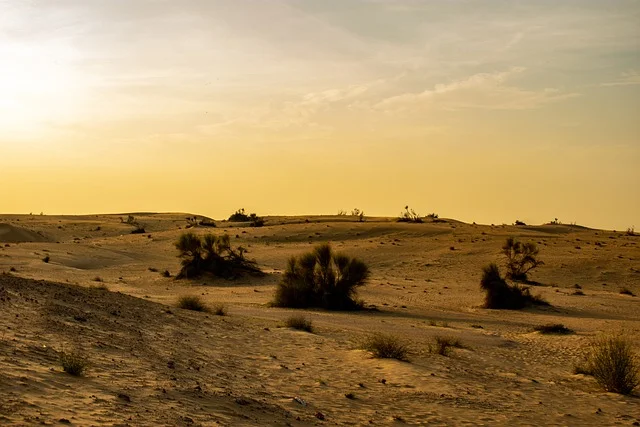
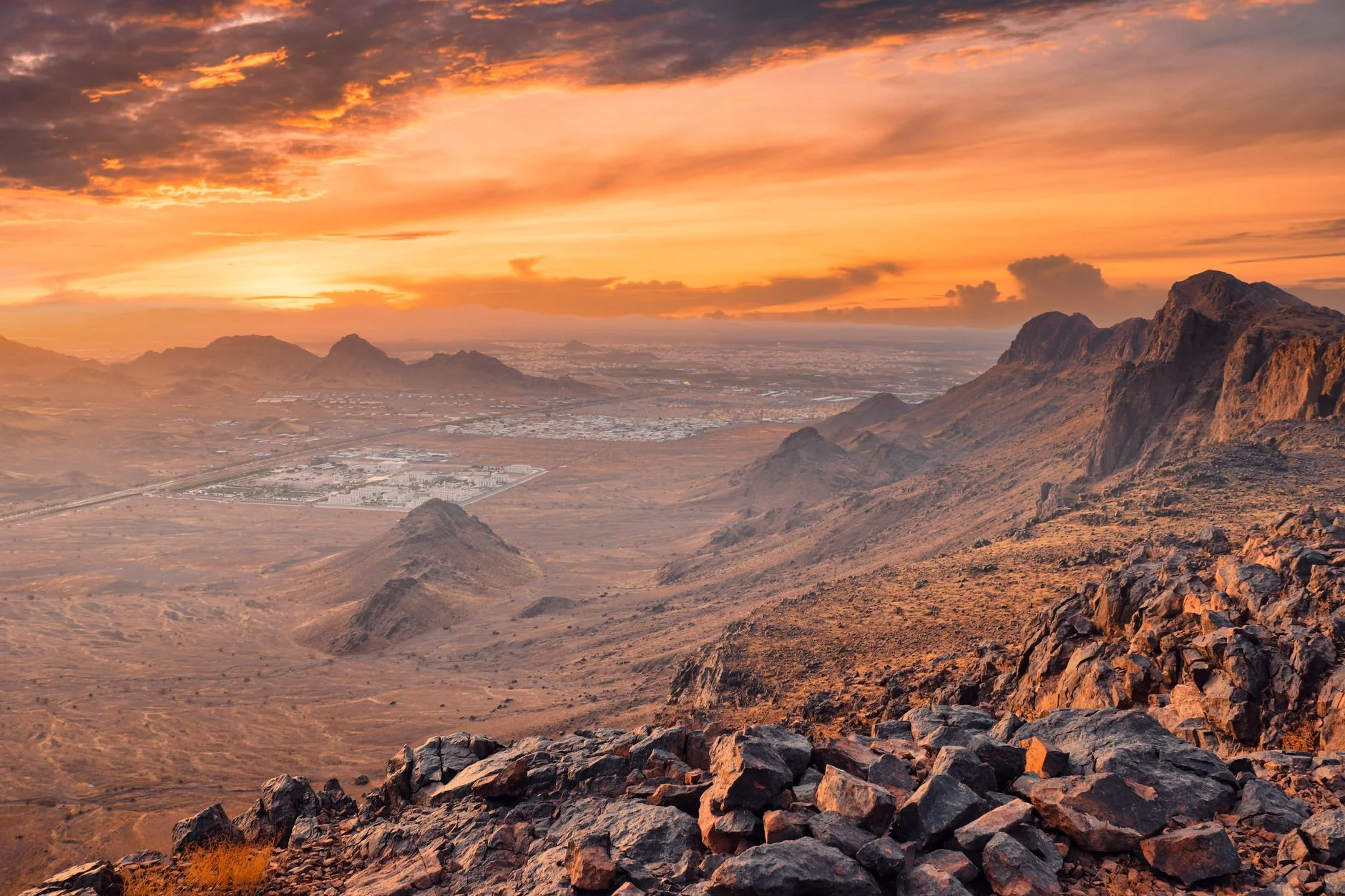
This variety matters for wildlife. A sand cat hunts on soft dunes, a Nubian ibex climbs rocky cliffs, and migrating birds stop to rest at oases. Each landscape is its own small world within the larger Arabian Desert.
The Rub’ al Khali: the Empty Quarter
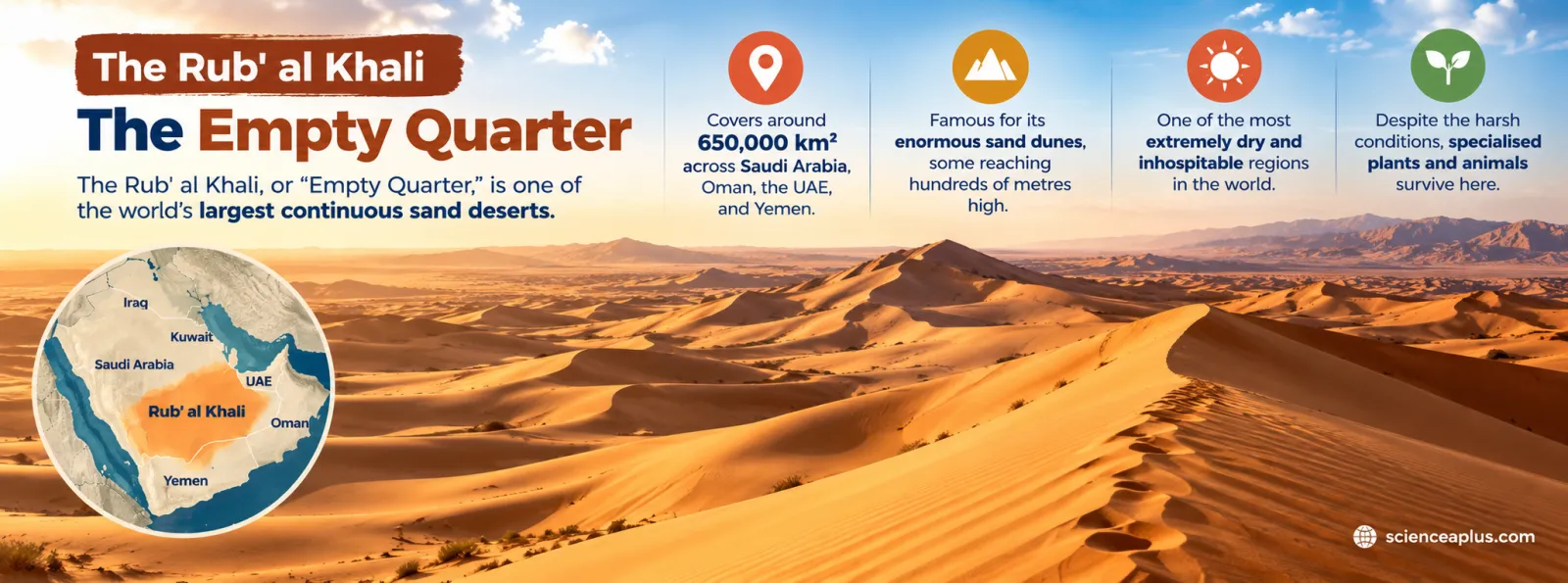
At the southern heart of the Arabian Desert lies the Rub’ al Khali, Arabic for “the Empty Quarter”. It covers about 650,000 km² (250,000 square miles) and stretches roughly 1,000 km long and 500 km wide across Saudi Arabia, Oman, the United Arab Emirates and Yemen. It is the largest continuous body of sand in the world.
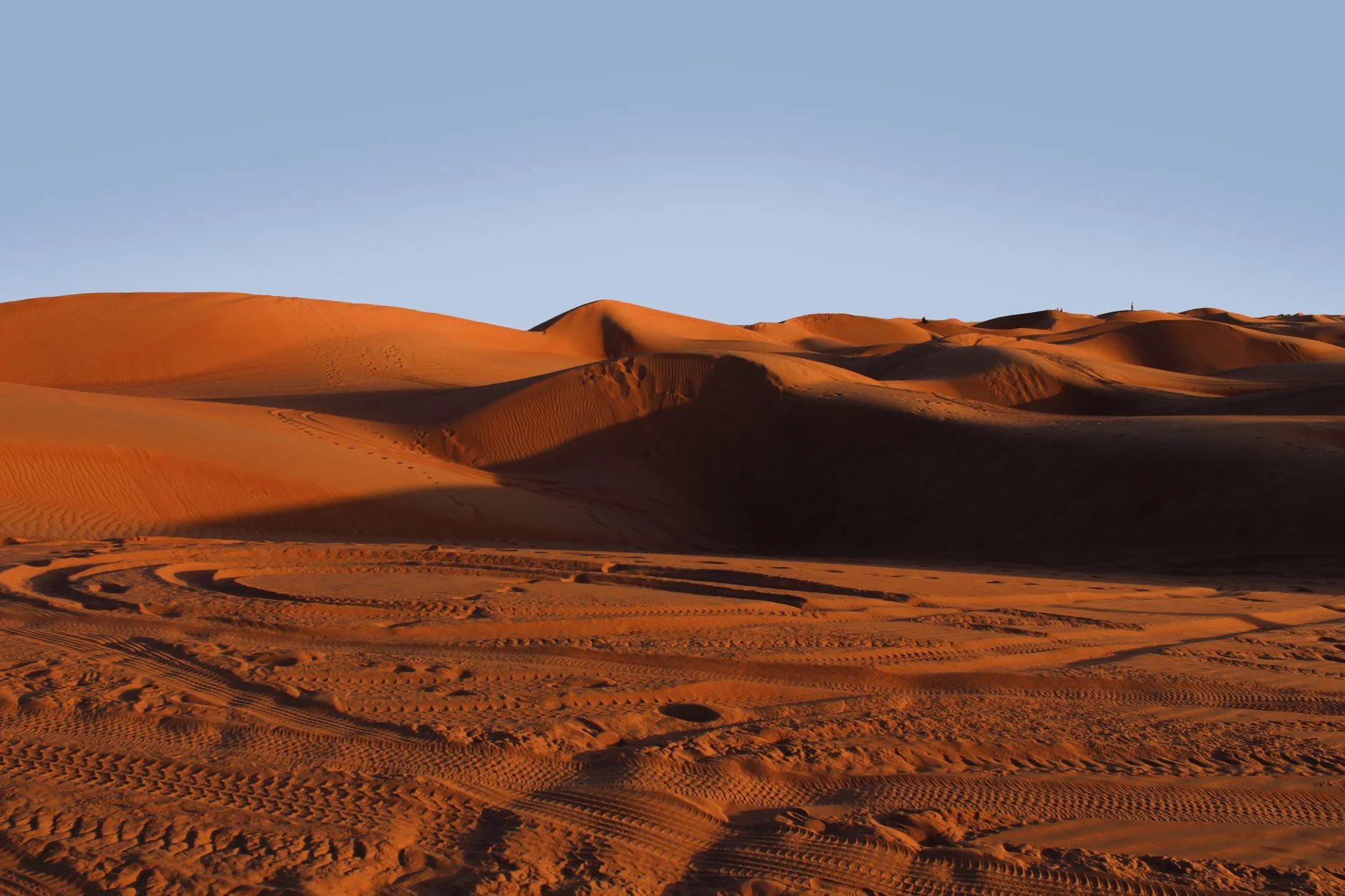
The dunes here are giants. Some reach about 250 metres high, taller than most skyscrapers. Between the dune ridges lie flat floors of gravel and gypsum. The land slopes gently from about 800 metres above sea level in the south-west to almost sea level in the north-east, near the Persian Gulf.
The Empty Quarter is hyper-arid, which means extremely dry. Most of it receives less than 50 mm of rain a year, and some places can go years with none at all. Only about 37 plant species have been recorded in the whole sand sea, a tiny number for such a huge area.
A desert that was once full of lakes
The Rub’ al Khali has not always been so dry. Thousands of years ago, during wetter periods, rain filled shallow lakes between the dunes. Scientists have found fossils of hippopotamus, water buffalo and long-horned cattle there, animals that could only have survived with plenty of water and grass.
Crossing the Empty Quarter
For centuries, the Bedouin crossed parts of the sands with their camels, using their knowledge of wells and grazing. The first recorded crossing by a European was made by the British explorer Bertram Thomas in 1930–31. Harry St John Philby crossed it the next year, in 1932.
The most famous account came from Wilfred Thesiger, who crossed the Rub’ al Khali twice between 1946 and 1948 with Bedu companions. His book Arabian Sands (1959) describes thirst, heat and the skill of the people who guided him. Today, part of the Empty Quarter also holds the Shaybah oil field, discovered in 1968, which shows how much the region has changed.
Arabian Desert climate: hot days, cold nights
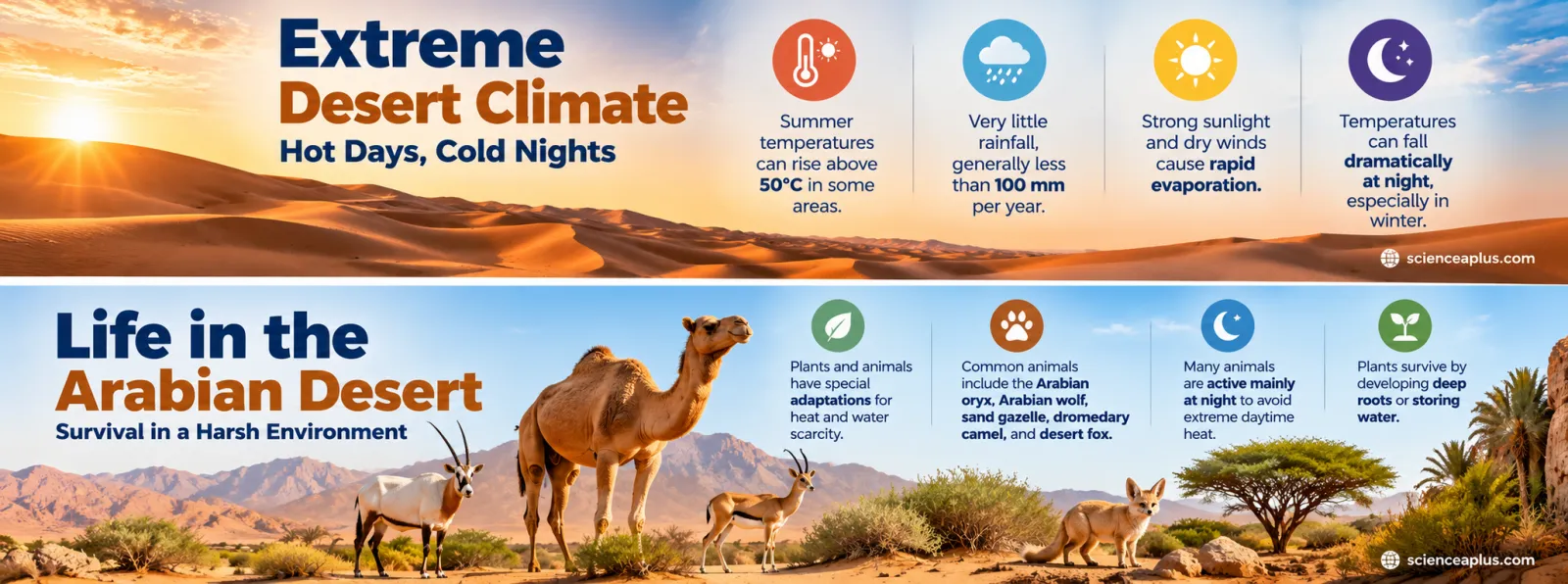
The Arabian Desert has a hot desert climate. Summers are long and fierce, and winters are mild by day but can be surprisingly cold at night. Rain is rare and unreliable.
How hot does the Arabian Desert get?
In summer, daytime temperatures are generally over 40 °C in low-lying areas, and record highs pass 50 °C. On 21 July 2016, a weather station at Mitribah in Kuwait, on the north-eastern edge of the desert, recorded 53.9 °C. The World Meteorological Organization checked the reading carefully and accepted it as the highest temperature ever recorded in Asia, and the third highest verified anywhere on Earth.
| Climate feature | Arabian Desert |
|---|---|
| Summer daytime | Generally over 40 °C in low-lying areas |
| Record high | 53.9 °C, Mitribah, Kuwait (21 July 2016) |
| Winter nights | Can fall below freezing in places |
| Rainfall (most areas) | About 100 mm a year or less |
| Rainfall (Rub’ al Khali) | Less than 50 mm a year |
| Sunshine | Very high — clear skies most of the year |
Why are desert nights so cold?
The answer is the lack of clouds and water vapour. During the day, clear skies let strong sunlight heat the sand and rock. At night, there are no clouds to act like a blanket, and the dry air holds very little heat. The ground loses its heat quickly by radiation, so temperatures drop sharply. That is why the Arabian Desert can be baking hot at noon and freezing cold before dawn in winter.
Rain, wind and sandstorms
Most of the desert gets about 100 mm of rain a year or less, compared with several hundred millimetres in a typical wet place. When rain does arrive, it often falls as a short, heavy storm. Water rushes down the wadis as flash floods and then soaks into the ground or evaporates within hours. Very little of it completes the usual journey of the water cycle through rivers back to the sea.
Strong winds are a big part of desert life. They lift sand and dust into sandstorms that can blot out the Sun, and they slowly shape the dunes. Over thousands of years, wind-blown sand also scrapes and polishes rock. Huge daily temperature swings make rocks expand and contract until they crack. Both are examples of weathering and erosion of rocks, and you can see their results in the carved cliffs of Wadi Rum and the gravel plains of Saudi Arabia.
Explain why the Arabian Desert receives so little rain. (3 marks)
It lies in the subtropical high-pressure belt near the Tropic of Cancer, where air sinks (1). Sinking air warms and becomes drier, so clouds rarely form (1). Much of the interior is also far from moist sea winds, so little water vapour reaches it (1).
Suggest why flash floods happen in desert wadis. (2 marks)
Rain falls in short, heavy bursts (1). The hard, dry ground and bare surfaces let little water soak in quickly, so it runs off fast down the narrow valleys (1).
Plants of the Arabian Desert
About 900 plant species grow across the wider Arabian Desert region, though only about 37 have been found in the Rub’ al Khali itself. Most are low shrubs, tough grasses and small flowering plants. Trees such as acacias grow where their roots can reach water, and date palms thrive at oases.
Desert plants survive by saving water. Their tricks fall into three main groups:
- Finding water. Some shrubs and acacia trees grow very deep roots to reach moisture far below the surface. Others spread shallow roots wide to catch every drop of a brief shower.
- Saving water. Small, waxy or hairy leaves lose less water by evaporation. Some plants drop their leaves altogether in the hottest months.
- Avoiding drought. Many small annual plants spend dry years as seeds. After rain, they sprout, flower and make new seeds within a few weeks, then die back before the ground dries out again.
These are classic examples of adaptations seen in plants and animals: features shaped by natural selection that help a living thing survive in its habitat.
Arabian Desert animals
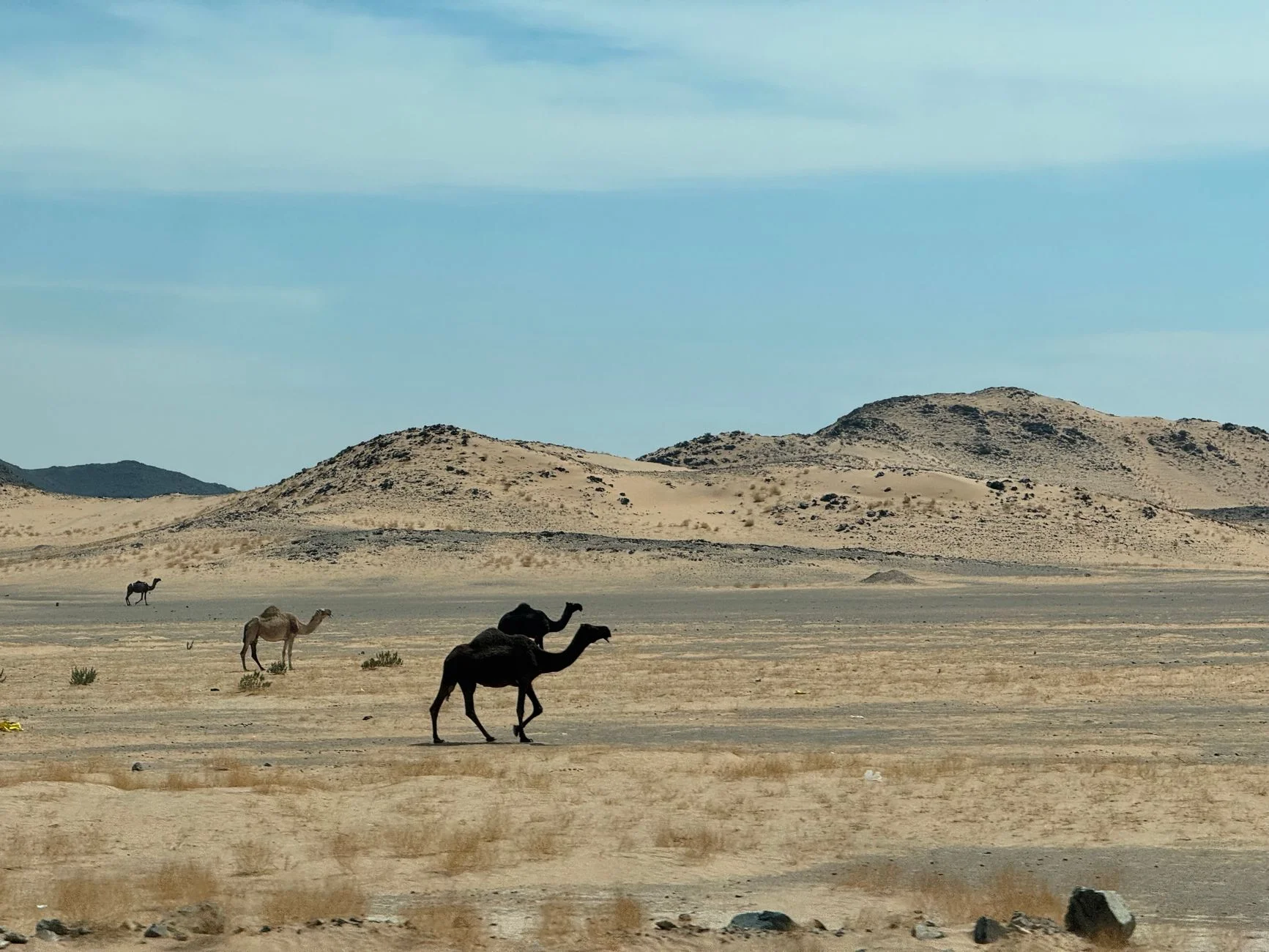
It is easy to think nothing could live in such heat, but the wider Arabian Desert region supports about 102 native mammal species and about 310 bird species, plus many reptiles and insects. Most animals avoid the worst heat by being active at night, at dawn or at dusk, and by sheltering in burrows or shade during the day.
| Animal | Type | How it copes |
|---|---|---|
| Arabian oryx | Antelope | Pale coat reflects sunlight; rests in shade by day |
| Sand gazelle | Antelope | Feeds at cooler times of day; IUCN Vulnerable |
| Nubian ibex | Wild goat | Climbs rocky mountains and cliffs |
| Sand cat | Small wild cat | Furry soles; gets water from its prey |
| Arabian wolf | Wild dog | Small body and large ears lose heat |
| Rüppell’s fox and red fox | Foxes | Hunt at night; shelter in dens |
| Striped hyena and caracal | Carnivores | Range widely to find food |
| Jirds, gerbils and jerboas | Rodents | Live in burrows; active at night |
The Arabian wolf is a small desert form of the grey wolf. Its slim body and large ears help it lose heat, which is the opposite of the big, thick-coated wolves of cold northern forests. To see how much wolves vary, compare it with the biggest wolf in the world.
The sand cat: a cat with furry feet
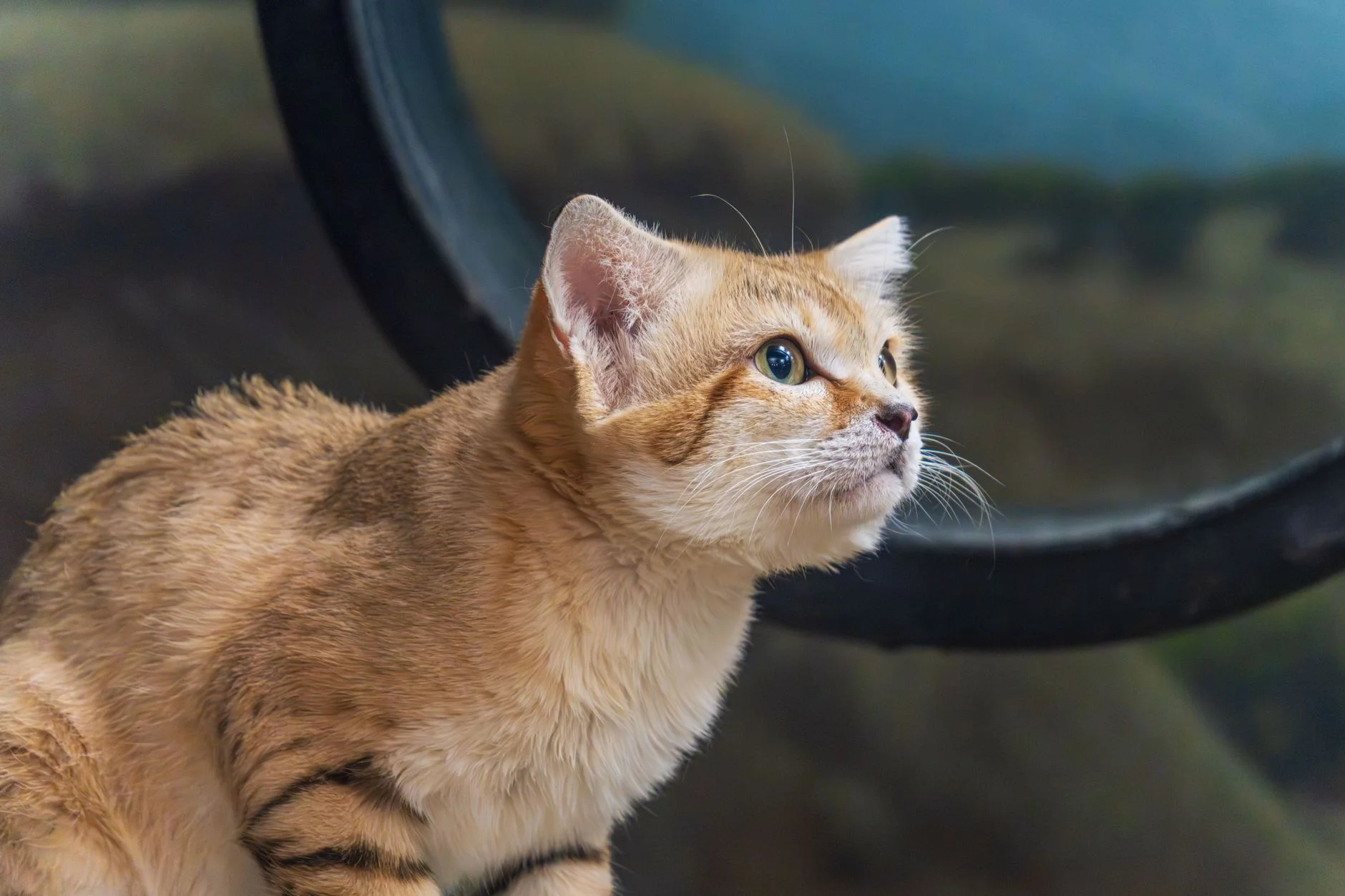
The sand cat is one of the most remarkable Arabian Desert animals. It weighs only about 1.35–3.4 kg, similar to a small house cat. Thick fur covers the soles of its feet, protecting them from scorching sand by day and cold sand at night. Its large ears and enlarged ear passages let it hear rodents moving under the sand.
The sand cat can get all the water it needs from its prey, so it can live far from any water source. It mainly hunts jirds, gerbils and mice, and also takes birds, reptiles and insects. It will even hunt venomous snakes. The IUCN lists the sand cat as Least Concern worldwide, but it is rare in some countries and is listed as Endangered nationally in the United Arab Emirates.
Reptiles do well in the desert because they need far less food and water than mammals. Lizards bask in the morning sun and hide in burrows at midday, and several snakes hunt at night. Learn more in our guide to snake species of deserts. Together, plants, insects, rodents, reptiles and predators link into a desert food chain and food web, where every species depends on others for energy.
The Arabian oryx: back from the brink
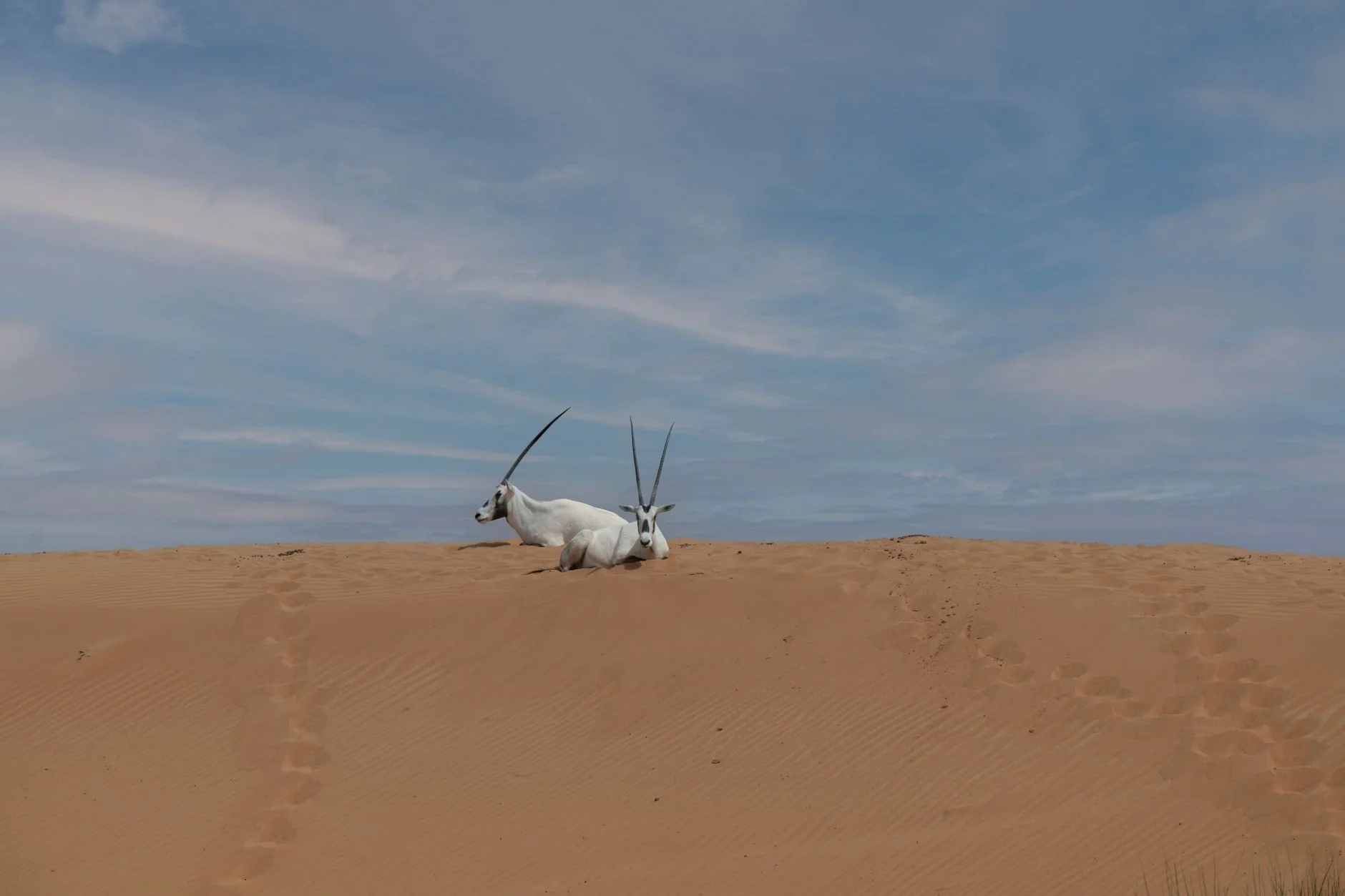
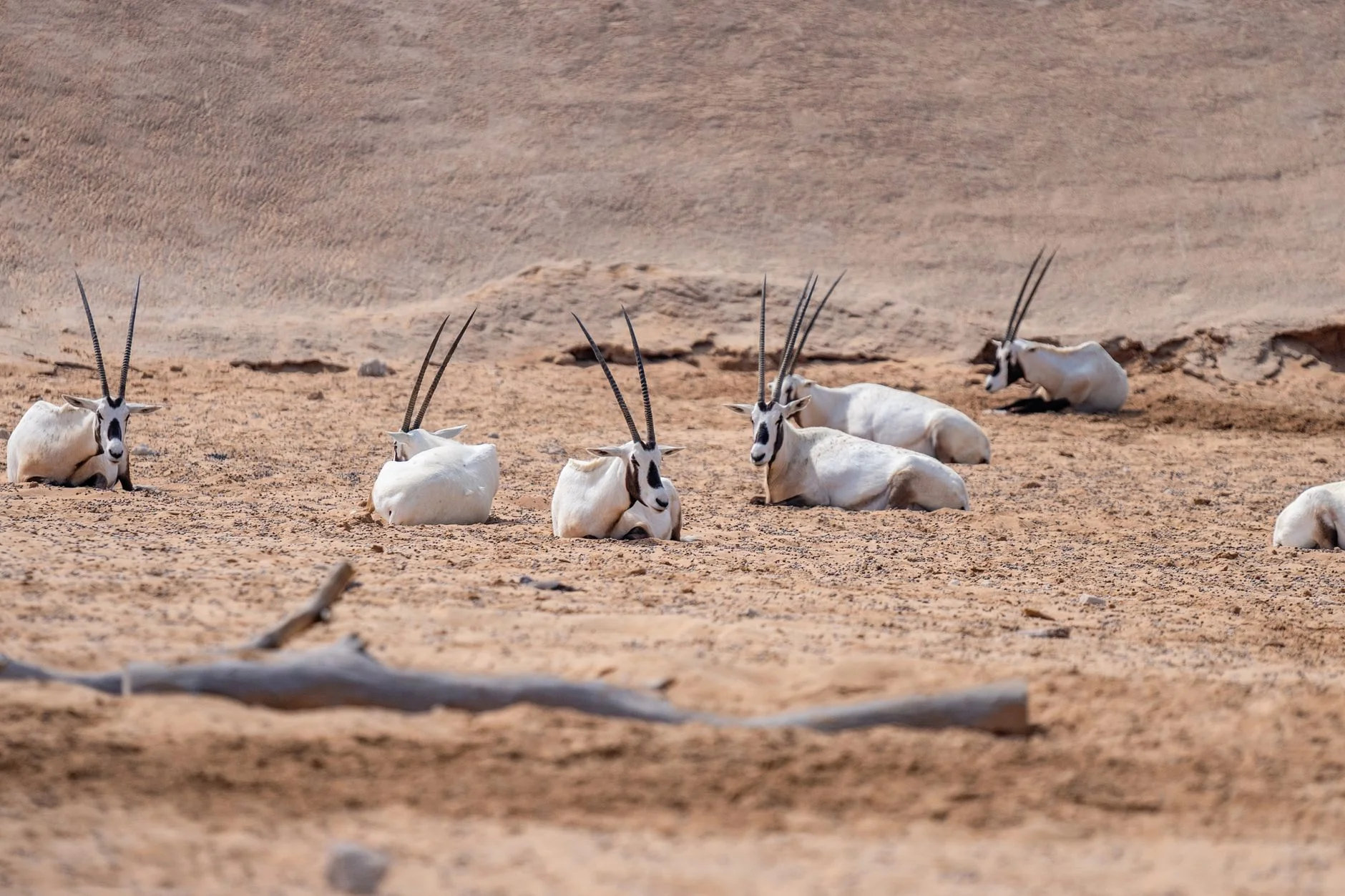
The Arabian oryx is a white antelope with dark legs and long, almost straight horns. It is perfectly suited to the desert. Its pale coat reflects sunlight, it can travel long distances to find grazing after rain, and it rests in shade through the hottest hours.
By the 1970s, hunting had wiped it out in the wild. Its comeback is one of the great conservation success stories:
- 1972: the last wild Arabian oryx were reported, and the species became Extinct in the Wild.
- 1982: animals bred in captivity were released in Oman, on the stony plateau of Jiddat al-Harasis.
- Later: more reintroductions followed in Saudi Arabia, the United Arab Emirates, Jordan and Israel.
- 2011: with about 1,000 oryx back in the wild, the IUCN moved it to Vulnerable. It was the first species ever to improve from Extinct in the Wild to Vulnerable.
It is still Vulnerable today, because poaching, drought and habitat loss remain real threats.
The camel: built for the Arabian Desert
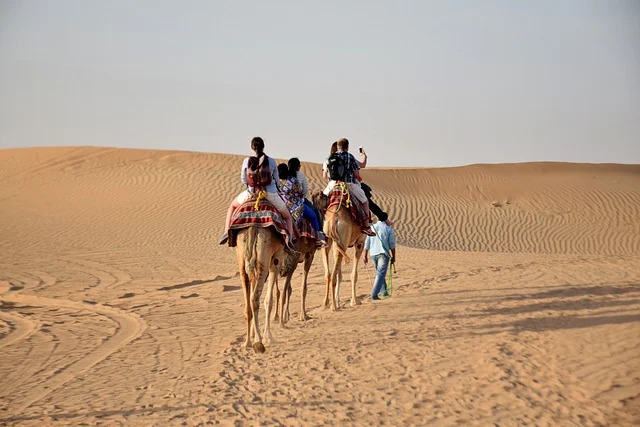
The dromedary, or one-humped camel, is the animal most linked with Arabia. Research published in 2016 found that it was first domesticated in the south-east of the Arabian Peninsula about 3,000–4,000 years ago. Adult males weigh about 400–600 kg and stand about 1.8–2 metres at the shoulder.
Camels have a whole kit of desert adaptations, according to the Natural History Museum:
- They can lose up to about 30% of their body weight in water and survive, then drink very large amounts quickly to refill.
- Their body temperature rises during the day and falls at night, so they do not waste water on sweating.
- They produce thick, syrupy urine, which saves water.
- They can close their nostrils fully and have long eyelashes to keep out blowing sand.
- Their wide, two-toed feet spread out like snowshoes so they do not sink into soft sand.
Try the calculator to see how much water that 30% can mean for a real camel.
People of the Arabian Desert
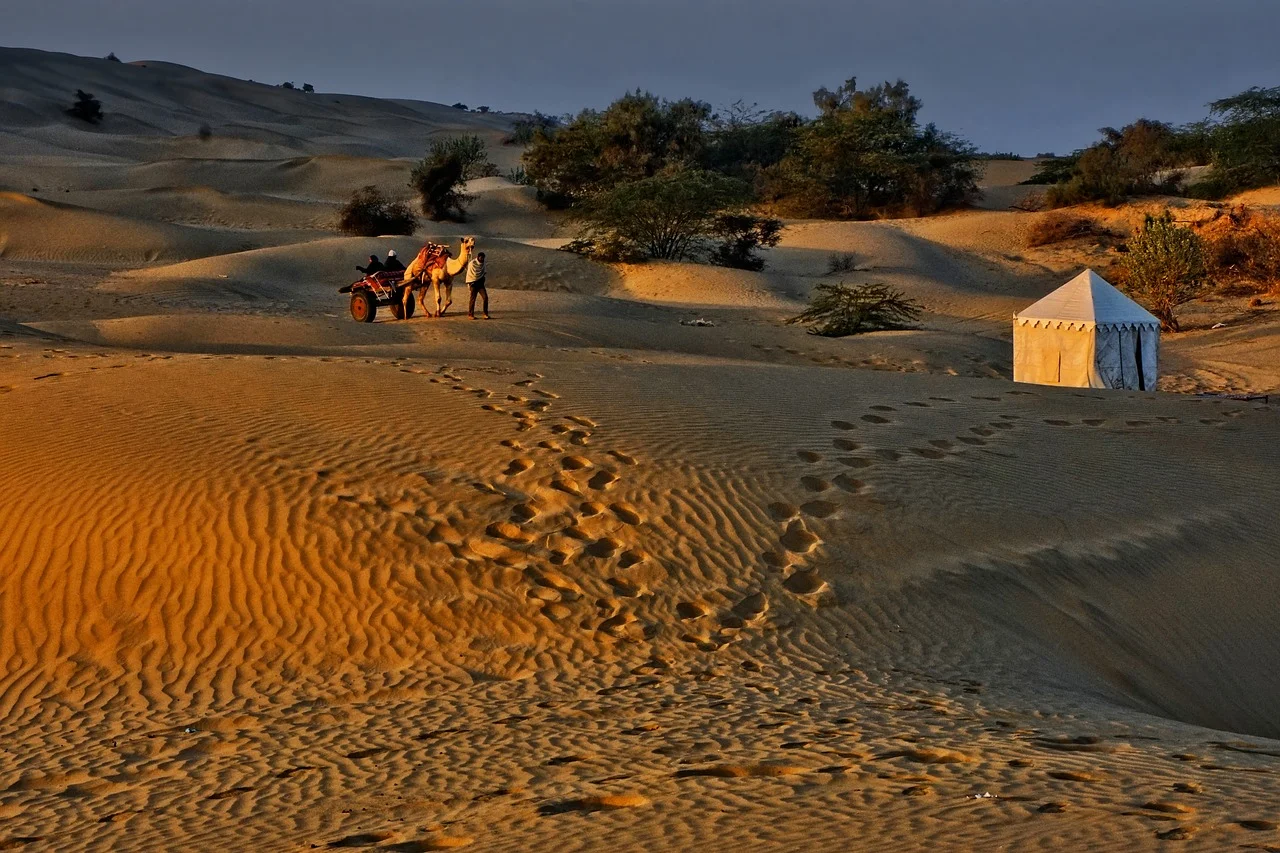
People have lived in and around the Arabian Desert for thousands of years. The best-known desert people are the Bedouin (Bedu), who traditionally moved from place to place with herds of camels, goats and sheep, following rain and fresh grazing. They knew where every well was and how to read the dunes and the stars. Today, many Bedouin families live in towns, though herding traditions continue.
The desert is not empty of cities either. Riyadh, the capital of Saudi Arabia and home to more than 7 million people, lies in the middle of the Arabian Desert. Large coastal cities such as Dubai, Abu Dhabi and Kuwait City sit on its edges.
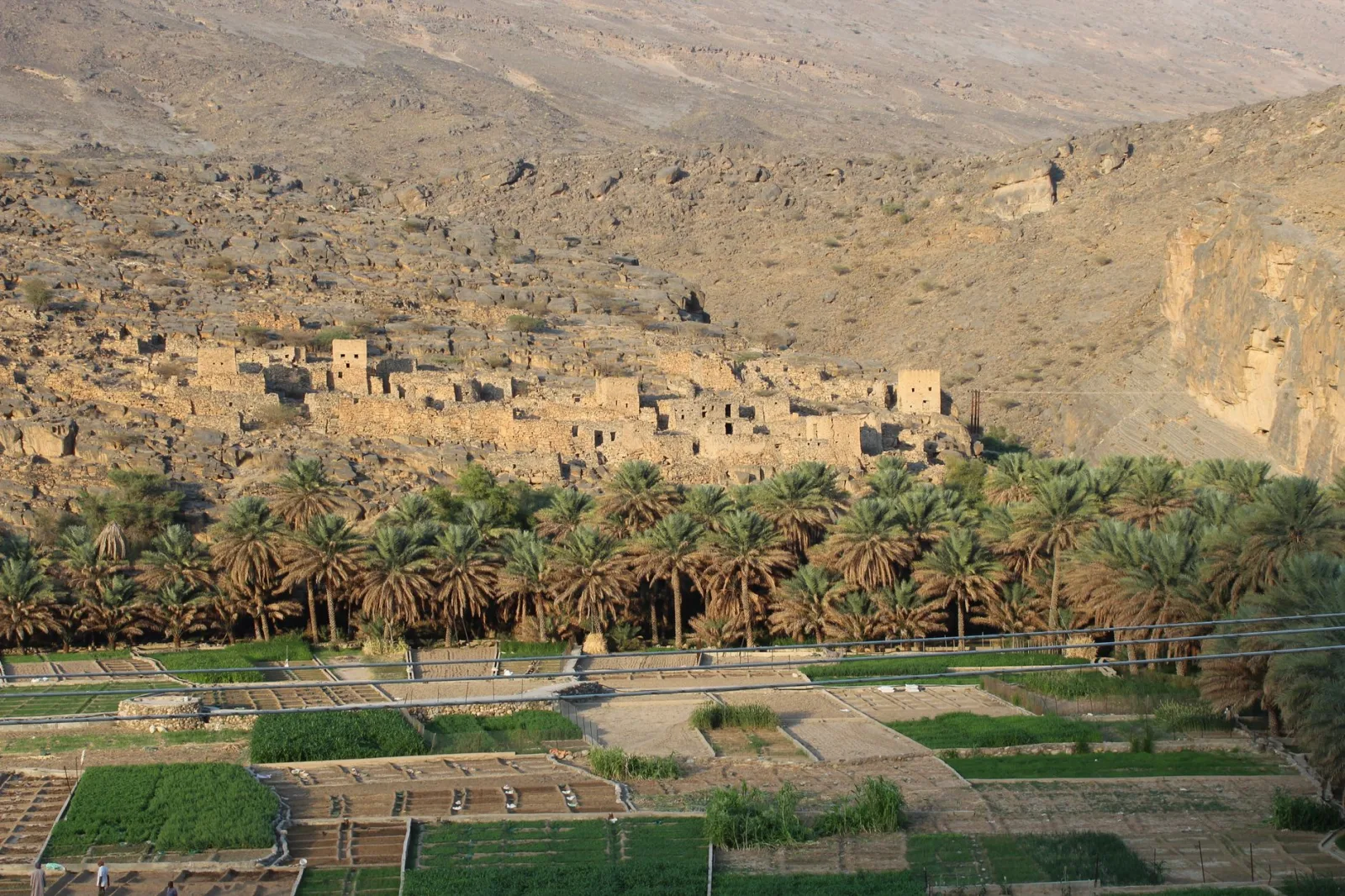
Oases: islands of green
An oasis forms where groundwater reaches the surface through springs or wells. The water lets people grow date palms, vegetables and animal feed in the middle of the desert. The Al-Ahsa Oasis in eastern Saudi Arabia is often called the largest palm oasis in the world, with about 2.5 million date palms fed by springs and a huge underground aquifer. It became a UNESCO World Heritage Site in 2018.
Why the Arabian Desert matters
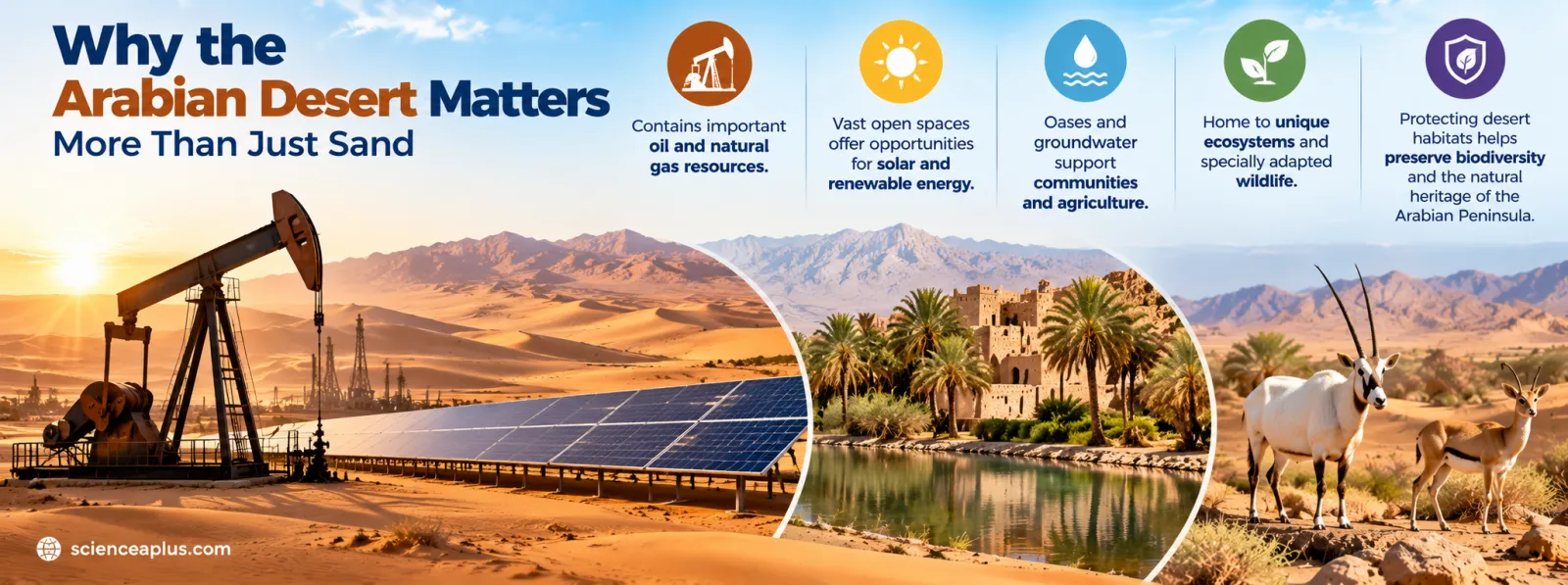
The Arabian Desert is important far beyond the peninsula, for its energy, its wildlife and its history.
Oil and natural gas
Below the sand lie some of the largest oil and gas reserves on Earth. The Ghawar field in eastern Saudi Arabia, discovered in 1948, is the largest conventional oil field in the world. The Shaybah field lies deep in the Empty Quarter. The desert also holds natural gas, phosphates and sulfur. Oil wealth has transformed the region, paying for new cities, roads and desalination plants that turn seawater into drinking water.
Sunshine for solar power
With clear skies and some of the highest sunshine totals anywhere, the Arabian Desert is an ideal place to collect solar energy. Countries in the region are building large solar farms to cut their use of oil and gas at home. Solar power has trade-offs too, from dust settling on panels to land use, so read about the pros and cons of solar energy to weigh them up.
Wildlife under pressure
The Arabian Desert’s wildlife faces several threats: overgrazing by livestock, poaching and hunting, and off-road driving that crushes plants and breaks up the fragile desert surface. Only about 4% of the desert ecoregion is protected. Climate change is also bringing hotter extremes. The return of the Arabian oryx shows that protection works when countries act together.
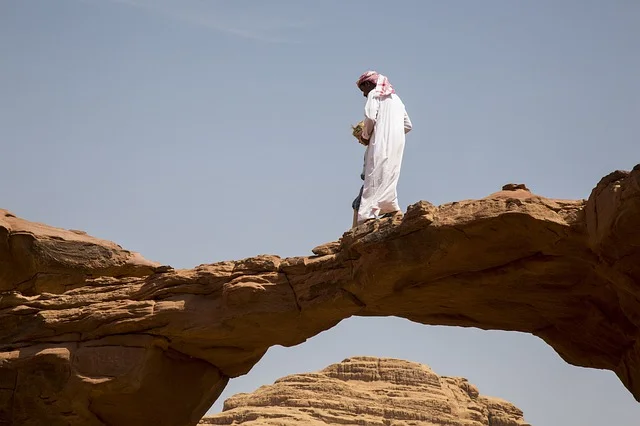
Places such as Wadi Rum in southern Jordan, a UNESCO World Heritage Site, now draw visitors from around the world to see desert landscapes and rock art. If you ever visit a desert, plan ahead and carry plenty of water; our guide to walking, hiking and driving in the desert explains how to stay safe.
Frequently asked questions about the Arabian Desert
Where is the Arabian Desert located?
The Arabian Desert is in Western Asia and covers almost the whole Arabian Peninsula, between the Red Sea to the west and the Persian Gulf to the east. Most of it lies in Saudi Arabia, and it also reaches Yemen, Oman, the United Arab Emirates, Qatar, Kuwait, Jordan and Iraq.
How big is the Arabian Desert?
The Arabian Desert covers about 2,330,000 square kilometres, or about 900,000 square miles. That makes it the largest desert in Asia. Leaving out the polar deserts of Antarctica and the Arctic, it is the second-largest desert on Earth after the Sahara in North Africa.
Is the Arabian Desert the largest desert in Asia?
Yes. At about 2.33 million square kilometres, the Arabian Desert is the largest desert in Asia, larger than the Gobi Desert of China and Mongolia. Its largest single feature, the Rub’ al Khali or Empty Quarter, is the biggest continuous body of sand anywhere in the world.
What is the Empty Quarter?
The Empty Quarter, or Rub’ al Khali, is the vast sand sea in the south of the Arabian Desert. It covers about 650,000 square kilometres across Saudi Arabia, Oman, the UAE and Yemen. Its dunes reach about 250 metres high, and most of it receives less than 50 millimetres of rain a year.
How hot does the Arabian Desert get?
Summer days in low-lying parts of the Arabian Desert are generally over 40 °C, and record highs pass 50 °C. The highest verified temperature is 53.9 °C, recorded at Mitribah in Kuwait on 21 July 2016. The World Meteorological Organization accepts it as the hottest temperature ever measured in Asia.
Does it get cold in the Arabian Desert?
Yes. Winter days are usually mild, but nights can be cold, and temperatures fall below freezing in some places. The clear skies and dry air that allow strong heating during the day also let heat escape quickly after sunset, which creates a large difference between day and night temperatures.
What animals live in the Arabian Desert?
Arabian Desert animals include the Arabian oryx, sand gazelle, Nubian ibex, sand cat, Arabian wolf, striped hyena, caracal, Rüppell’s fox and red fox, along with jirds, jerboas, lizards and snakes. The dromedary camel was domesticated here. Most wild animals avoid the heat by being active at night or at dawn and dusk.
How much rain does the Arabian Desert get?
Most of the Arabian Desert gets about 100 millimetres of rain a year or less, and the Rub’ al Khali usually gets under 50 millimetres. Rain often falls in short, heavy storms that cause flash floods in dry valleys called wadis, and some areas can go years without any rain at all.
Why is the Arabian oryx important?
The Arabian oryx is a symbol of successful conservation. Hunting wiped it out in the wild by 1972, but captive-bred animals were released in Oman from 1982 and later in other countries. In 2011, it became the first species to improve from Extinct in the Wild to Vulnerable on the IUCN Red List.