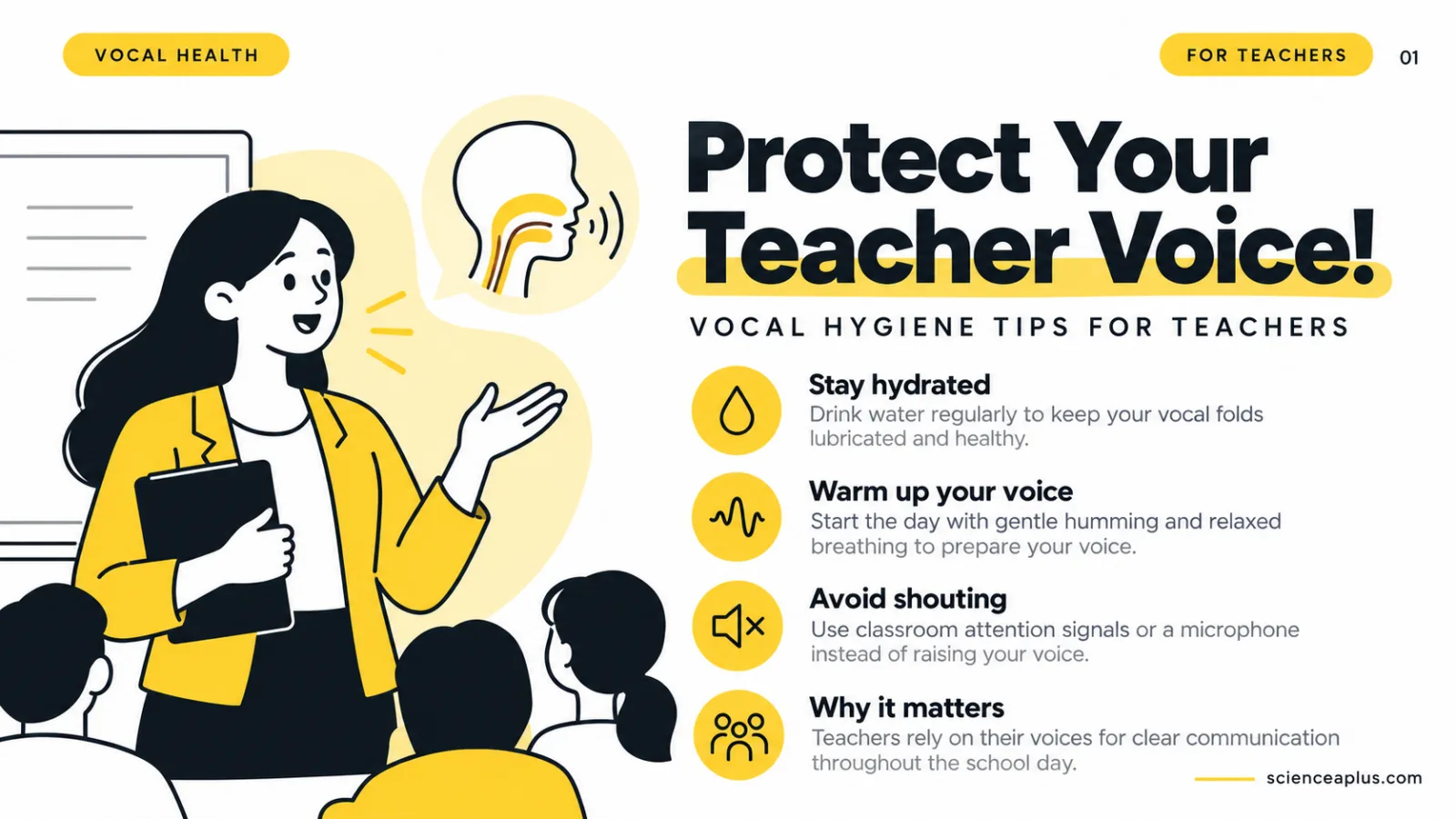
The best vocal hygiene tips for teachers start with one idea: your voice is a tool you use all day, so it needs care like any other. Vocal hygiene means the daily habits and surroundings that keep your vocal folds healthy, such as staying hydrated, resting your voice, avoiding shouting and cutting down on irritants like smoke and dust.
The need is real. In a large US survey, 57.7% of teachers said they had had a voice problem at some point in their lives, about double the rate for people in other jobs. A clear, steady voice is also part of what makes an effective teacher, because pupils can only follow what they can comfortably hear.
This article explains the science behind voice care first, then turns it into habits. You will see how the voice is made, how loud a classroom really is, how distance and microphones change what pupils hear, which daily habits help, and when a hoarse voice needs a GP. It is written for teachers and trainee teachers, and the sound and breathing science will also help GCSE students.
This is general education, not medical advice. If you have worries about your own voice, the section on warning signs later in this article explains when to speak to a GP or call NHS 111.
Why do teachers lose their voices?

Teaching is one of the most voice-heavy jobs there is. Teachers talk for hours, often over background noise, and often to a room of 30 people at once. The Royal College of Speech and Language Therapists (RCSLT) lists teachers, performers, call centre workers and bar staff as people who may be at higher risk of voice disorders because of their occupation. Smoking, reflux, dehydration and poor air quality add to the risk.
Researchers have put numbers on it. A large US telephone survey by Roy and colleagues in 2004 questioned 2,531 people in Iowa and Utah, including 1,243 teachers and 1,288 non-teachers. It is a US study, so the rates should not be read as UK figures, but the pattern is clear:
- Voice problem at the time of the survey: 11.0% of teachers, compared with 6.2% of non-teachers.
- Voice problem at some point in life: 57.7% of teachers, compared with 28.8% of non-teachers.
- Asked a doctor or speech-language pathologist about their voice: 14.3% of teachers, compared with 5.5% of non-teachers.
The authors concluded that teaching is a high-risk occupation for voice disorders. Women reported more lifetime voice problems than men, at 46.3% compared with 36.9%. A second paper from the same research team found that teachers had missed more workdays because of voice problems in the previous year, and were more likely to consider changing jobs because of their voice.
How much do teachers actually use their voices?
A US study led by Ingo Titze in 2007 fitted 31 teachers with voice dosimeters, small devices that record when the vocal folds are vibrating. Across more than 6,600 hours of recordings, teachers’ vocal folds were vibrating for an average of 23% of their time at work. Off duty the figure fell to 13% during off-work hours and 12% at weekends.
That works out at about 1 hour 50 minutes of actual voicing in an 8-hour working day. The same team counted up to 20,000 separate voicing occurrences per day, and suggested that the high number of times the folds are brought together to start a sound may be a fatiguing factor. Teaching asks a lot of a small piece of tissue.
How your voice works: the larynx and vocal folds
To look after your voice, it helps to know how it is made. Voice scientists describe three parts working together, a little like a musical instrument.
- The power source: your lungs. The air from your respiratory system provides the pressure, driven by the diaphragm and the abdominal and chest muscles.
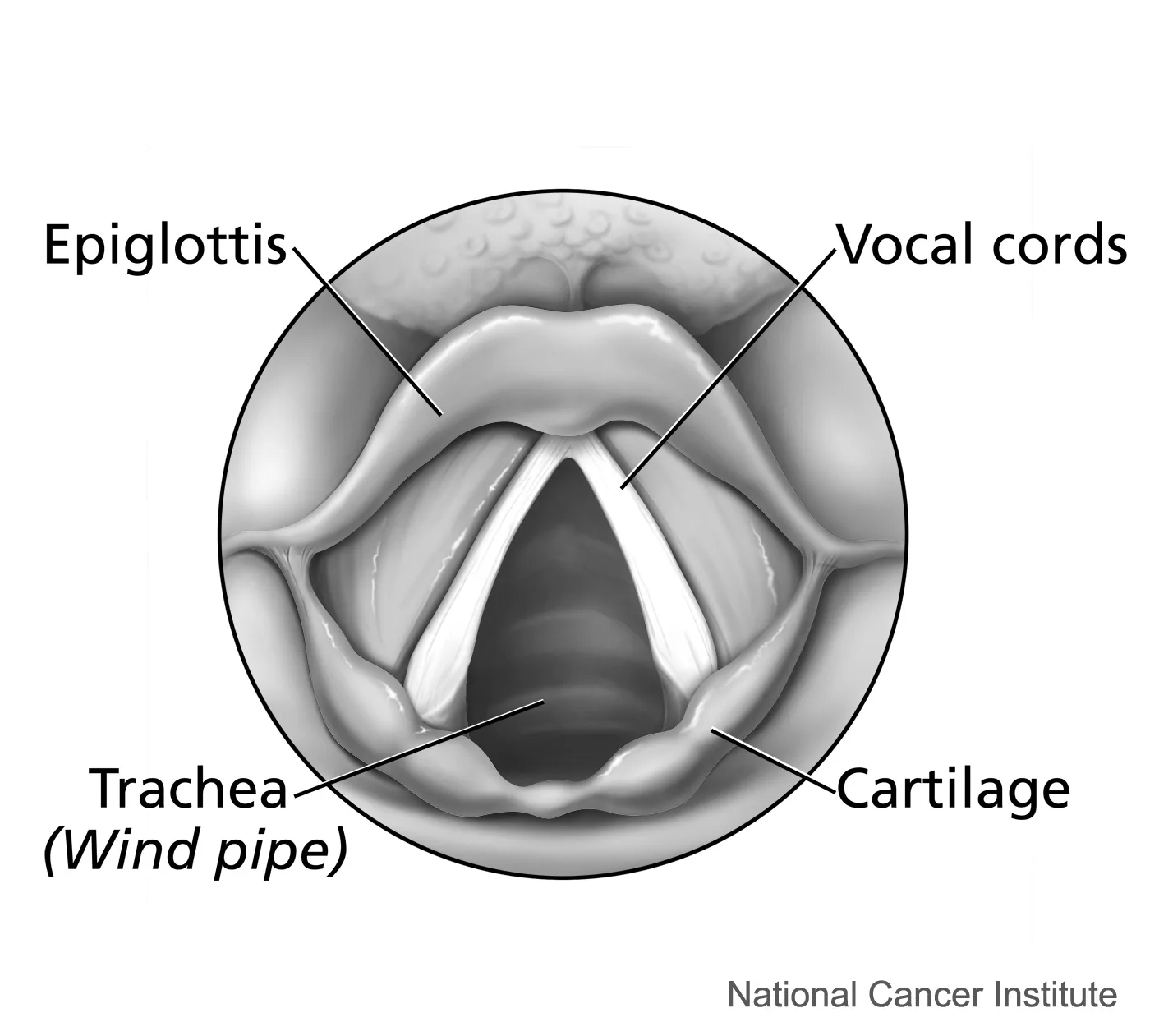
- The vibrator: your vocal folds. These two folds of tissue sit in the larynx (the voice box) at the top of the windpipe. They are often called vocal cords, but they are not strings, and nothing plucks them.
- The resonators: throat, mouth and nasal passages. These shape and amplify the buzz made by the folds into the voice that people recognise.
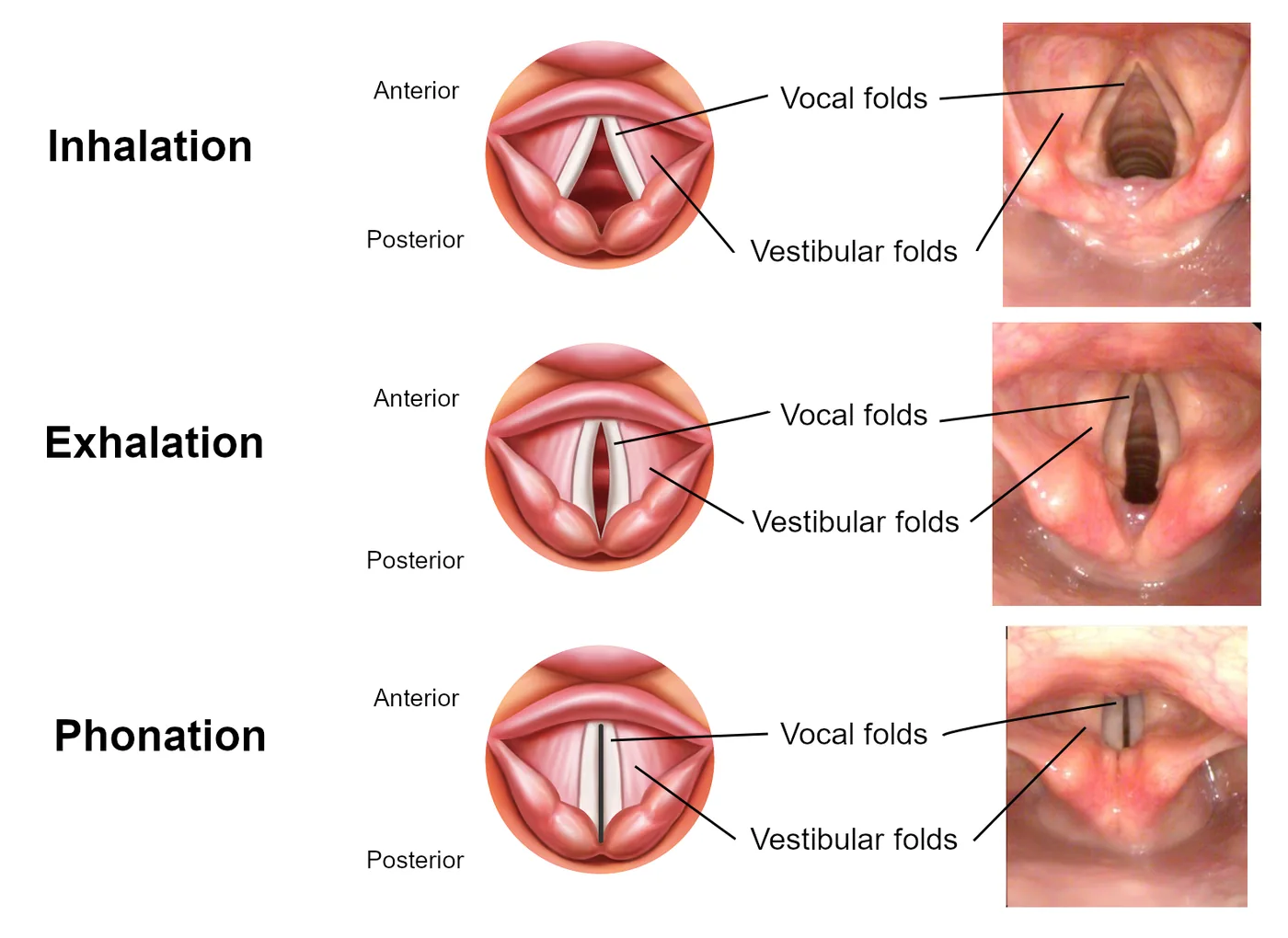
When you breathe, the folds stay apart so air flows freely. To speak, they come together and the airflow sets them vibrating.
Why do vocal folds vibrate?
Here is the short version of the classic explanation, called the myoelastic-aerodynamic theory. When the folds are closed, air pressure builds up below them. Eventually the pressure blows them apart and a small puff of air escapes. The elastic recoil of the tissue, helped by the Bernoulli effect (fast-moving air has lower pressure), pulls them shut again. Then the cycle repeats.
The Voice Foundation notes that lung pressure controls the open phase, while the passing air creates the Bernoulli effect that controls the close phase. The folds do not just open and shut like a door. A ripple called the mucosal wave travels through the tissue, with the lower edge of each fold opening first and the upper edge following.
The National Center for Voice and Speech adds an honest caveat: Bernoulli forces alone cannot account for the continual energy transfer from the airstream to the tissue. Scientists now think the vibration is sustained by an asymmetry in the air-pressure push between opening and closing. The picture is still being refined, which is how science works.
The pitch of your voice depends mainly on how fast the folds vibrate. Frequency is measured in hertz (Hz), the number of vibrations per second:
frequency (Hz) = number of vibrations ÷ time (s)
In typical speech, men’s vocal folds vibrate at about 110 Hz and women’s at about 180 to 220 Hz, according to the Voice Foundation. That means a teacher’s vocal folds open and close more than a hundred times every second they are voicing, which adds up to a great deal of work over a teaching day.
Know your voice vocabulary
These terms come up again and again in voice science and in clinics. Tap each card to check your understanding.
Now you know how the sound is made, the next question is what a classroom does to it. Noise, distance and room acoustics all change how hard your voice has to work, and they come down to some surprisingly neat physics.
How loud is a classroom? Decibels explained
Sound level is measured in decibels (dB). The scale is logarithmic, which means the numbers grow slowly even when the sound energy grows very fast. The level is calculated from the sound intensity, with 0 dB set at the quietest sound a healthy ear can detect, an intensity of 10⁻¹² W/m².
L = 10 log₁₀(I ÷ I₀)
Two rules of thumb save a lot of calculation:
- Every +10 dB means 10 times the intensity, and +20 dB means 100 times.
- Doubling the intensity adds only about +3 dB, because 10 log₁₀ 2 is about 3.

So how loud are classrooms? London studies by Shield and Dockrell, summarised in a 2021 research impact case study, found average levels of 72 dB in occupied primary classrooms and 64 dB in occupied secondary classrooms. Levels in primary schools varied by up to 20 dB depending on pupil numbers, age and activity. The most common source of classroom noise was pupils talking.
| Situation | Typical level | Source |
|---|---|---|
| Threshold of hearing | 0 dB | Definition of the scale |
| Empty classroom, UK design limit for background noise (BB93) | 35 dB maximum | Shield and Dockrell case study |
| Normal conversation | about 60–70 dBA | NIDCD (US National Institutes of Health) |
| Occupied secondary classroom (average) | 64 dB | Shield and Dockrell case study |
| Occupied primary classroom (average) | 72 dB | Shield and Dockrell case study |
The same case study found that an increase of 5 dB in average background classroom noise was linked with a 13% drop in Key Stage 2 SATs scores across the schools studied. That is an association, not proof that noise alone causes lower results, but it shows why quieter rooms matter for pupils as well as for teachers. It also found that absorptive ceilings were more effective than carpet at reducing noise and reverberation.
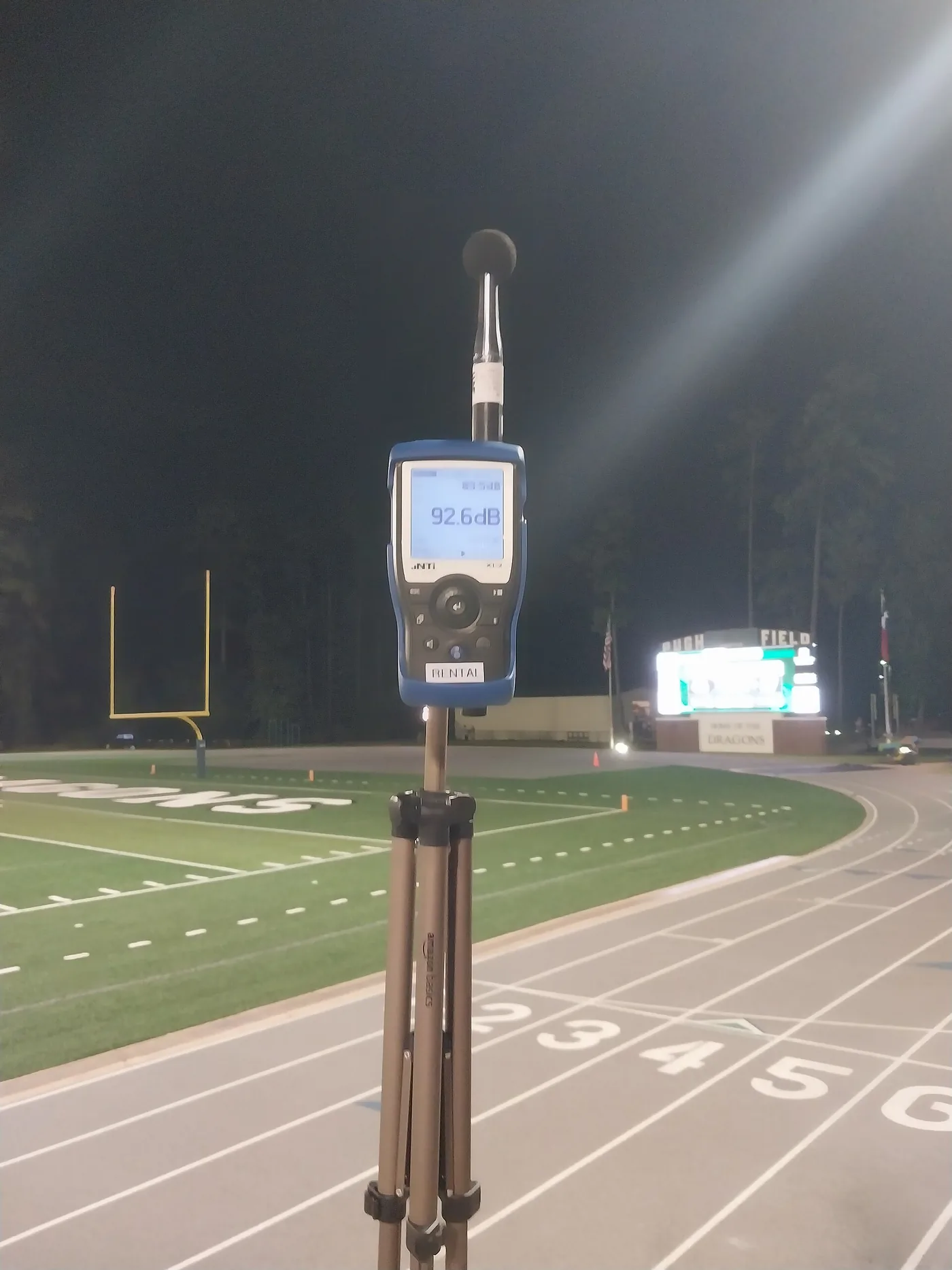
A sound level meter, like the one shown, is the instrument used to measure these levels in decibels. A microphone picks up the sound and the meter converts its intensity to a decibel reading.
Why noise makes you talk louder
Most of us raise our voices without noticing when the background gets loud. A 2018 study by Nusseck and colleagues recorded 113 teachers during lessons of about 48 minutes. Teachers’ voice level was strongly linked with classroom noise level. For some teachers the voice level rose and fell with the noise, while for others it stayed constantly high. Noise was highest at the start and end of lessons and in sports lessons.
The RCSLT advises avoiding talking above loud background noise. We cover practical ways to do that later in this article, but the physics of why it is so tiring is worth understanding first.
Sound intensity and distance: the inverse-square law
Sound spreads out in all directions from a speaker. As it spreads, the same energy covers a bigger and bigger area, so the intensity falls. For a point source with no reflections, the intensity is inversely proportional to the square of the distance:
I ∝ 1 ÷ r² · L = 10 log₁₀(I ÷ I₀)
That has a neat consequence. Doubling your distance from the source makes the intensity one quarter of what it was, which is a drop of about 6 dB. Going from 1 m to 4 m is two doublings, so about 12 dB quieter.
This only holds when there are no reflections or reverberation. In a classroom the walls, ceiling and floor bounce sound back, so the real drop with distance is smaller than the free-field maths suggests. It is still a useful model, and it supports a simple piece of advice from Cambridge University Hospitals NHS Foundation Trust: keep children close when giving instructions. The closer your pupils are, the less your voice has to do. If you want to see more everyday applications, take a look at physics in everyday life.
Try it yourself with the calculator below. The default values are an example, not a measurement of any real teacher.
Does a microphone help? Voice amplification for teachers
If distance and noise make your voice work harder, an amplifier takes some of the load. A small randomised trial by Roy and colleagues in 2002, another US study, tested this with 44 teachers who already had voice disorders. They were split into three groups for six weeks: 15 used a portable voice amplifier, 15 received vocal hygiene instruction, and 14 formed a no-treatment control group.
Only the amplification group improved significantly on self-rated voice handicap and severity. The control group’s self-rated voice handicap got worse. Both treatments did better than the control on some measures, and there was no significant difference between the two treatments. Teachers using amplification also reported greater ease of voice production and better compliance.

This was a small trial, so it does not prove that every teacher needs a microphone. But it fits with advice from both the RCSLT, “when possible, use amplification to avoid voice strain”, and Cambridge University Hospitals, which recommends amplification when speaking to large groups or to people far away.
Maths practice questions
Voice science makes good GCSE-style practice. Before you start, it may help to revise rearranging formulas. Tap each question to reveal the model answer.
A teacher’s vocal folds vibrate at an average of 200 Hz during 1 hour 50 minutes of voicing. About how many vibrations is that? (2 marks)
1 hour 50 minutes = 6,600 s. Number of vibrations = frequency × time = 200 × 6,600 = 1,320,000. At 110 Hz the same calculation gives 726,000.
How many times more intense is a 72 dB primary classroom than a 52 dB one? (2 marks)
The difference is 20 dB. Every 10 dB is a factor of 10, so 20 dB is 10 × 10 = 100 times the intensity.
Two pupils each make 60 dB of noise. Why is the total about 63 dB, not 120 dB? (2 marks)
Decibels are a logarithmic scale, so levels are not added directly. Intensities add, and two equal sources double the intensity. Doubling the intensity raises the level by 10 log₁₀ 2, which is about 3 dB, so 60 dB becomes about 63 dB.
A voice measures 66 dB at 1 m outdoors. Estimate the level at 4 m. (3 marks)
From 1 m to 4 m is two doublings of distance. Each doubling reduces the level by about 6 dB, so the total drop is about 12 dB. The level at 4 m is about 66 − 12 = 54 dB. Indoors it would be a little higher because of reflections.
Calculate the wavelength of a 200 Hz voice sound if sound travels at about 340 m/s. (2 marks)
Wavelength = speed ÷ frequency = 340 ÷ 200 = 1.7 m. At 110 Hz the wavelength would be about 3.1 m.
With the science of sound in place, you are ready for the practical part: the daily habits that reduce the strain on your voice, and the reasons each one works.
Vocal hygiene tips for teachers: the habits that matter most
Now for the practical part. These vocal hygiene tips for teachers draw on advice from the NHS, Cambridge University Hospitals NHS Foundation Trust (CUH) and the RCSLT, plus the research described earlier. Each tip comes with the reason it works, so you can adapt it to your own timetable.
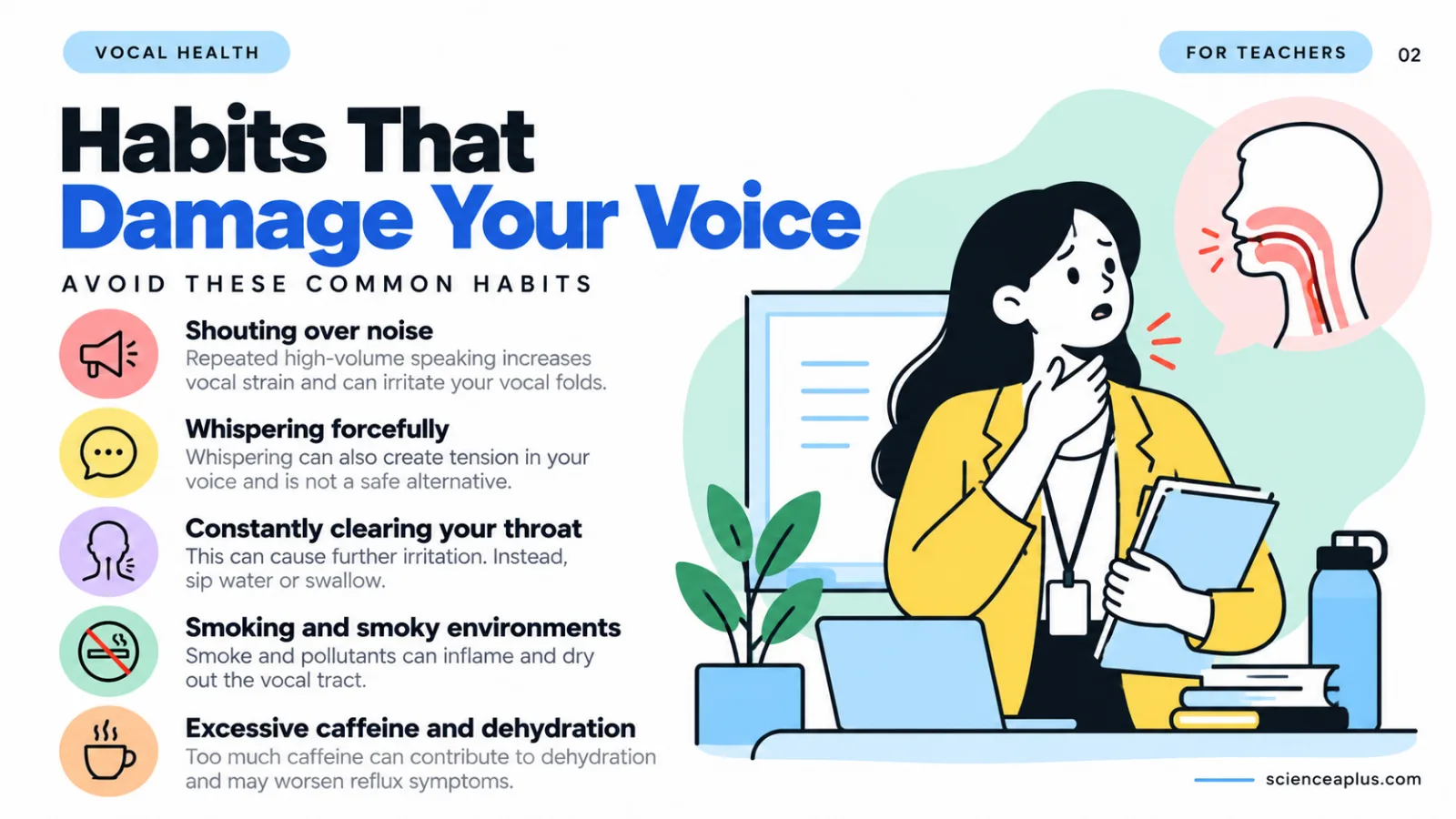
None of this replaces advice from a professional. If your voice is struggling, see the guidance on when to speak to a GP just below.
Keep hydrated, and know why it works
The NHS advises drinking about 6 to 8 cups or glasses of fluid a day, and more if you are active for long periods, unwell, pregnant or breastfeeding. Water, lower-fat milk and lower-sugar drinks all count, and so do tea and coffee. A systematic review of voice and hydration research (Alves and colleagues, 2019) found that drinking water improved several voice measures in the studies it covered, while dehydration through fasting and no fluids made them worse. The authors called systemic hydration the easiest and most cost-effective way to improve voice quality.
The same review found that mouth-breathing dried the surface of the vocal folds and raised the phonation threshold pressure, which is the minimum lung pressure needed to start the folds vibrating. In plain terms, a dry voice takes more effort to start. CUH also suggests steam inhalation to moisten the larynx. Keeping a glass within reach makes it easy to sip regularly through the day, and warm water is a fine choice if you prefer it.



Moisten the air
Dry air is harsh on a hard-working larynx. For laryngitis, the NHS suggests keeping the air moist by putting out bowls of water. The RCSLT recommends a humidifier or water spray in centrally heated rooms. CUH adds that chalk, chemical fumes and dry heat can irritate, so keep rooms well ventilated where you can.
Do not shout, and do not whisper either
Shouting is the obvious culprit, and the RCSLT warns that trying to speak too loudly can lead to a constricted and often harsh vocal pitch. Whispering feels like a gentle alternative, but the NHS says it plainly: when you have laryngitis, do not talk loudly or whisper, as both strain your voice. CUH agrees that talking quietly is better than whispering if your voice is tiring.
What works better is emphasis, energy and variety. The RCSLT notes that these project the voice better than a loud and strained voice. Relaxed, balanced posture and controlled breathing help too, and it is worth being aware of the reverberation in your room.
You can also reduce how often you need to raise your voice at all:
- Agree a non-verbal attention signal with your class, and use eye contact and gesture.
- Keep children close when giving instructions.
- Use a whistle in large, outdoor or noisy spaces such as sports halls and swimming pools (CUH).
- Outdoors, stand on a platform or near a wall if possible (RCSLT).
Warm up and rest your voice
Before your first lesson, the RCSLT suggests relaxing your shoulders and neck and gently humming. It also recommends enough sleep and exercise, and resting your voice when you can. Think of voice breaks as part of your lesson plan, not a luxury.
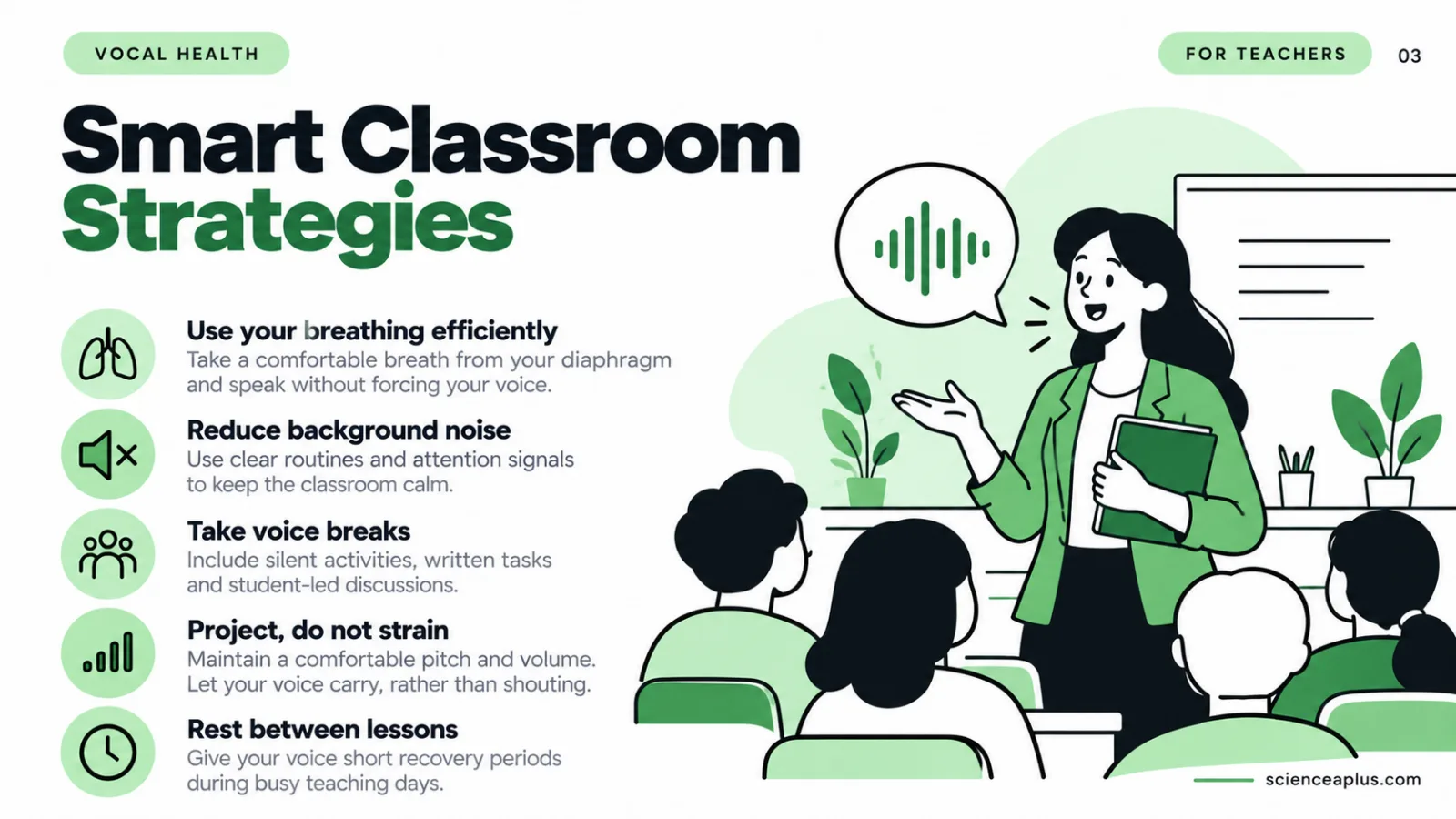
CUH suggests organising your teaching so that you talk less when your voice is tired. Use audio-visual aids, handouts or written instructions, and try a silent written task now and then. If you do get laryngitis while teaching, CUH advises taking a day off and resting your voice.
Cut the irritants
Some habits irritate the vocal folds without you noticing:
- Throat clearing. The RCSLT says vigorous throat clearing can irritate the folds. Sip water or cough gently instead.
- Smoke, vapour and dust. Smoking, vaping, dust and smoke all irritate the vocal folds, according to the RCSLT. Read more about smoking and sore throats. CUH advises asking your GP about support if you want to stop smoking.
- Reflux. A hoarse voice can be a symptom of acid reflux, according to the NHS. Its tips include smaller, more frequent meals and not eating within 3 or 4 hours before bed. Our guide to lifestyle changes for acid reflux goes into more detail.
- Medicated lozenges. CUH advises avoiding medicated lozenges unless prescribed by your GP. For a dry throat it suggests citrus fruit, chewing gum or a plain boiled sweet.
Your daily voice routine
Use this checklist as a daily routine. Your ticks are saved in your own browser, so they will still be there when you come back.
- Glass of water on the desk before the first lesson
- Gentle hum and shoulder roll before the first lesson
- Attention signal agreed with the class
- One silent or written task in every lesson
- Pupils close by for instructions
- Microphone for assemblies, PE and large groups
- No whispering when hoarse: talk quietly instead
- A voice-free lunch break
Healthy habits protect most voices most of the time. But sometimes a voice does not recover on its own, and that is when it needs professional attention.
Warning signs your voice needs a break
Everyone has a rough voice day now and then. Typical signs that your voice needs rest include hoarseness, throat discomfort, vocal tiredness by the end of the day, and sometimes losing your voice for a while. The RCSLT suggests keeping an eye on any voice changes and not disregarding them.
The most common reason for a sudden hoarse voice is laryngitis, inflammation of the voice box. The NHS says it usually comes on suddenly and gets worse during the first 3 days, with a hoarse voice, sometimes losing your voice, and a sore throat. It also says that laryngitis usually goes away on its own after 1 to 2 weeks, and that you do not need to see a GP.
While you recover, the NHS suggests that you:
- speak as little as possible and rest your voice;
- drink plenty of fluids;
- keep the air moist by putting out bowls of water;
- avoid smoking and smoky or dusty places;
- do not talk loudly or whisper, as both strain your voice;
- do not drink too much caffeine or alcohol, which can cause dehydration.
CUH adds that if you get laryngitis while teaching, you should take a day off and rest your voice. That can feel difficult during a busy term, but it is the NHS and hospital advice. Good sleep also matters, and lack of sleep affects general health, which in turn affects how well you recover.
Keep a voice diary

If your voice keeps troubling you, a simple voice diary turns vague complaints into useful information. A few lines a day are enough. Note:
- when the symptoms started and how long they lasted;
- what you were doing, such as whole-class teaching, PE or an assembly;
- what you had to drink, and whether you were unwell;
- how the voice felt at the start and end of the day.
Writing things down can reveal patterns. Maybe your voice is always worst after a day of PE, or after a long meeting at the end of a busy week. That is useful for you, and for any professional you see later.
Who can help: GP, ENT and speech and language therapists
Your GP is the first stop. They may refer you to an ENT (ear, nose and throat) specialist, who can examine your vocal folds. A speech and language therapist can teach you voice care, breathing and exercises to look after your voice in the long term. The RCSLT has information on this on its voice page, and CUH asks teachers to take a speech and language therapist’s advice seriously.
Asking for help early is not a sign of weakness. For a teacher, voice care is part of the job, in the same way that a runner looks after their legs.
Frequently asked questions about vocal hygiene for teachers
What is vocal hygiene?
Vocal hygiene means the daily habits and surroundings that keep your vocal folds healthy. It includes drinking enough fluid, resting your voice, avoiding shouting and strained whispering, and cutting down on irritants such as smoke and dust. It is a way of caring for your voice before problems start, not a medical treatment.
Why do teachers lose their voices so often?
Teachers use their voices for long periods, often over background noise. A US study found that teachers’ vocal folds vibrated for an average of 23% of their working time. A large US survey also found that 57.7% of teachers had had a voice problem at some point, compared with 28.8% of non-teachers.
How can teachers protect their voice in a noisy classroom?
Agree a non-verbal attention signal, keep pupils close when giving instructions, and use written instructions or silent tasks to give your voice breaks. Use amplification for large groups, and avoid talking above loud background noise. Drink water through the day and warm up gently before your first lesson. Ask a speech and language therapist if you need personal advice.
Is whispering bad for your voice?
The NHS advises that when you have laryngitis you should not talk loudly or whisper, because both strain your voice. Cambridge University Hospitals suggests talking quietly rather than whispering if your voice is tiring. If your voice is hoarse, resting it by speaking as little as possible is the better choice.
Does coffee or tea dry out your voice?
The NHS counts tea and coffee as fluid and says caffeine is fine in moderation, but also says too much caffeine or alcohol can cause dehydration. Two systematic reviews found no measured harm to voice from caffeine, though the evidence is limited. If coffee gives you heartburn, reflux may irritate your voice instead.
How much water should I drink to help my voice?
The NHS advises about 6 to 8 cups or glasses of fluid a day, and more if you are active for long periods, unwell, pregnant or breastfeeding. Water, lower-fat milk and lower-sugar drinks all count, as do tea and coffee. Keeping a glass on your desk makes regular sips easy during the school day.
Do voice amplifiers help teachers?
A small US randomised trial of 44 teachers with voice disorders found that only the group using a portable voice amplifier improved significantly on self-rated voice handicap and severity. The RCSLT advises using amplification when possible to avoid voice strain. It is a small study, so ask a professional about your own situation.
How loud is a classroom in decibels?
London studies by Shield and Dockrell found average levels of about 72 dB in occupied primary classrooms and 64 dB in occupied secondary classrooms. Primary levels varied by up to 20 dB depending on pupil numbers, age and activity. For comparison, normal conversation is about 60 to 70 dBA, according to the NIDCD.
When should I see a GP about a hoarse voice?
NHS 111 Wales advises seeing a GP if you have had a hoarse voice for more than 3 weeks. The NHS also says to see a GP if laryngitis symptoms do not improve after 2 weeks, or if you keep getting voice problems. Call 111 if it is very painful or hard to swallow, and 999 if you have difficulty breathing.
How long does laryngitis last?
The NHS says laryngitis usually goes away on its own after 1 to 2 weeks, and you do not need to see a GP. Speak as little as possible, drink plenty of fluids and keep the air moist. If symptoms do not improve after 2 weeks, or keep returning, see a GP.