What is broadcasting in television? Broadcasting means sending the same programme from one source to many screens at once, usually by radio waves from transmitters or satellites, and now also over cable and the internet. Everyone who is tuned in receives the same picture and sound at the same moment. That is how a news bulletin, a football match or a royal wedding reaches millions of homes together.
The idea is old, but it is still being refined. BBC television began on 2 November 1936 from Alexandra Palace in London, so this month marks 90 years since that first broadcast. This article explains the science behind television broadcasting: how pictures become radio waves, why Freeview uses a particular band of frequencies, why satellite TV has a delay, and why a live stream can lag behind the same match on an aerial.
What is broadcasting in television?
In television, broadcasting is a one-to-many system. A studio makes a programme, a broadcast transmitter sends it out, and every television receiver in range can pick it up. The transmitter does not need to know who is watching, so the same signal serves one household or ten million. The short version: one programme, many viewers, at the same time.
Compare that with a phone call or a video call. A call is one-to-one: a separate connection is set up for each pair of people. Broadcasting works more like a lighthouse. It shines in every direction, and anyone with the right receiver can use the signal. This idea shows up in many places in physics in everyday life, from car radios to Wi-Fi.
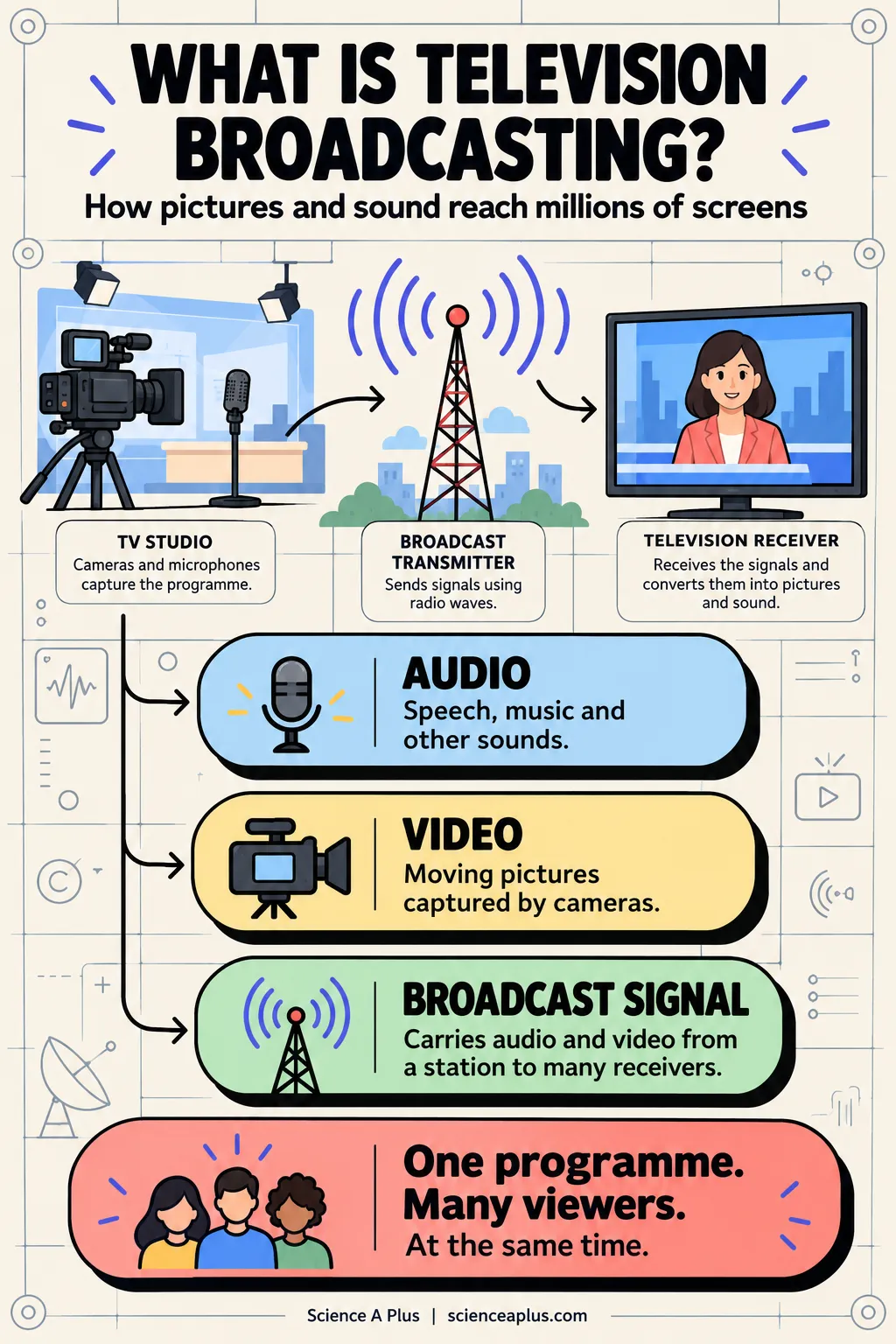
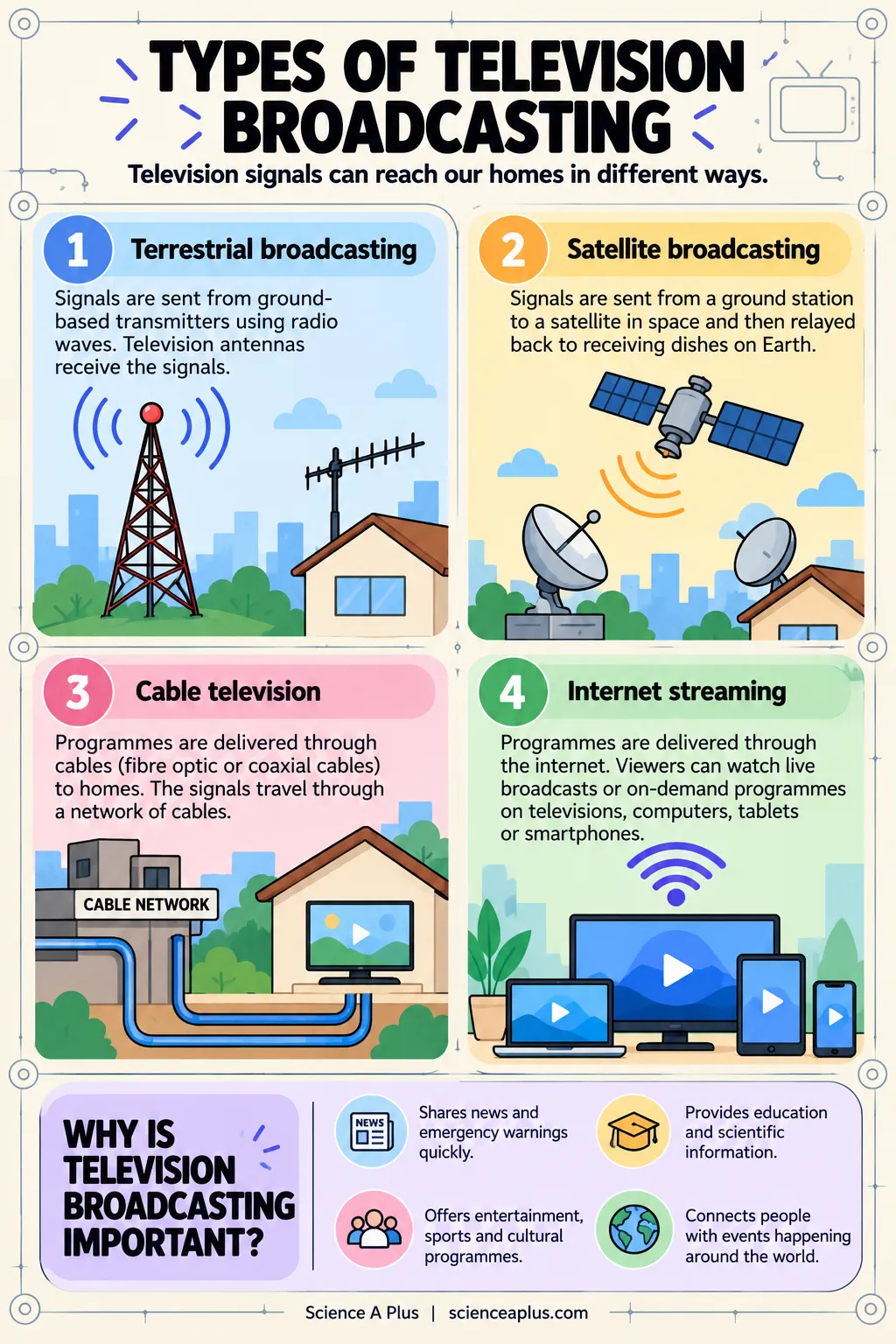
The card above shows the three things every broadcast chain needs:
- A studio, where cameras and microphones capture the programme as video and audio.
- A broadcast transmitter, which sends the signal out using radio waves.
- A television receiver, which converts the signal back into pictures and sound.
Those three stages hide a lot of physics and engineering. The sections below follow the programme through five steps, from the camera lens to the screen in your living room.
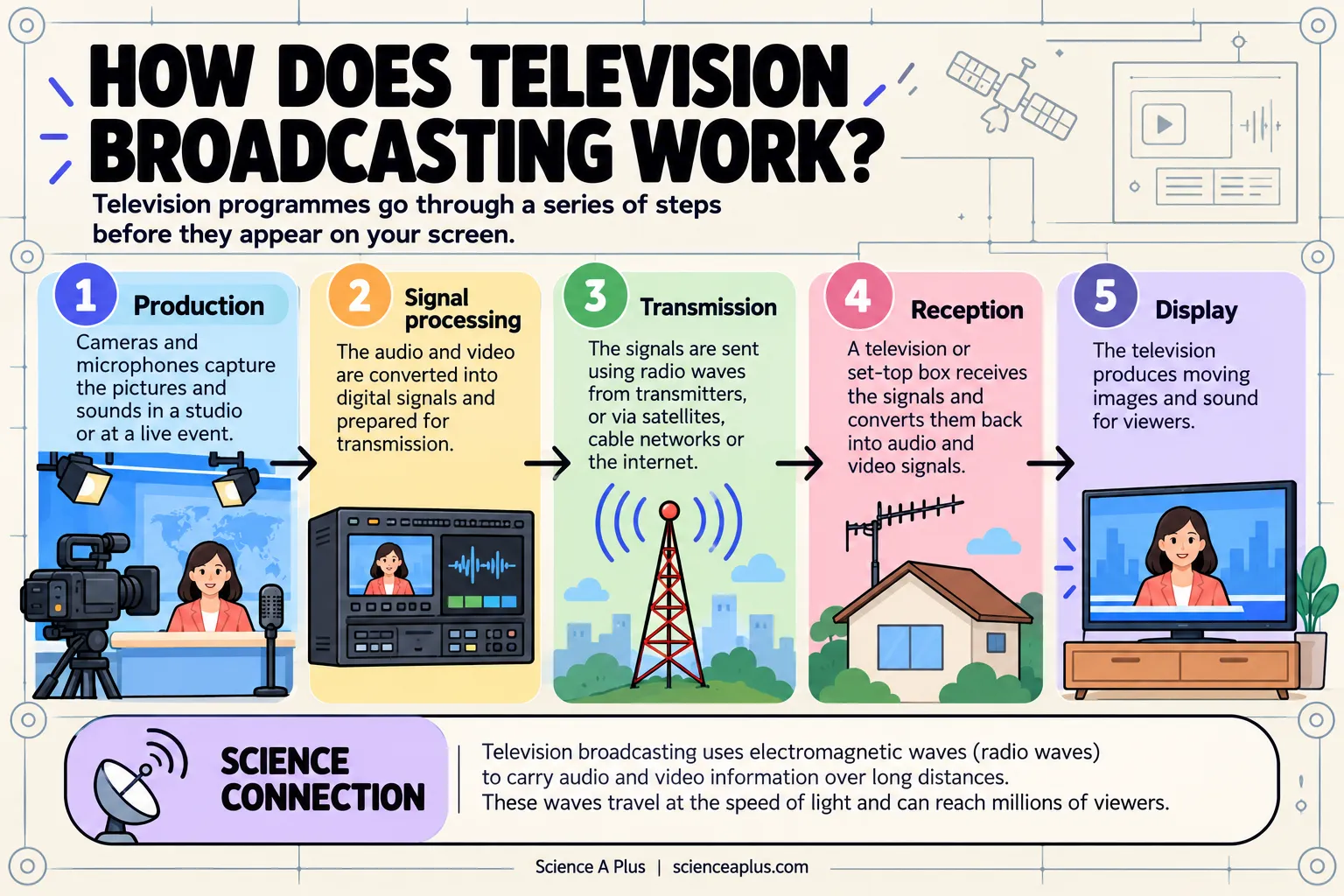
How does television broadcasting work? The five steps
However the signal travels, television broadcasting works through the same five steps: production, signal processing, transmission, reception and display. Only step 3, the route taken, changes between aerial, satellite, cable and internet TV.
1. Production: capturing light and sound
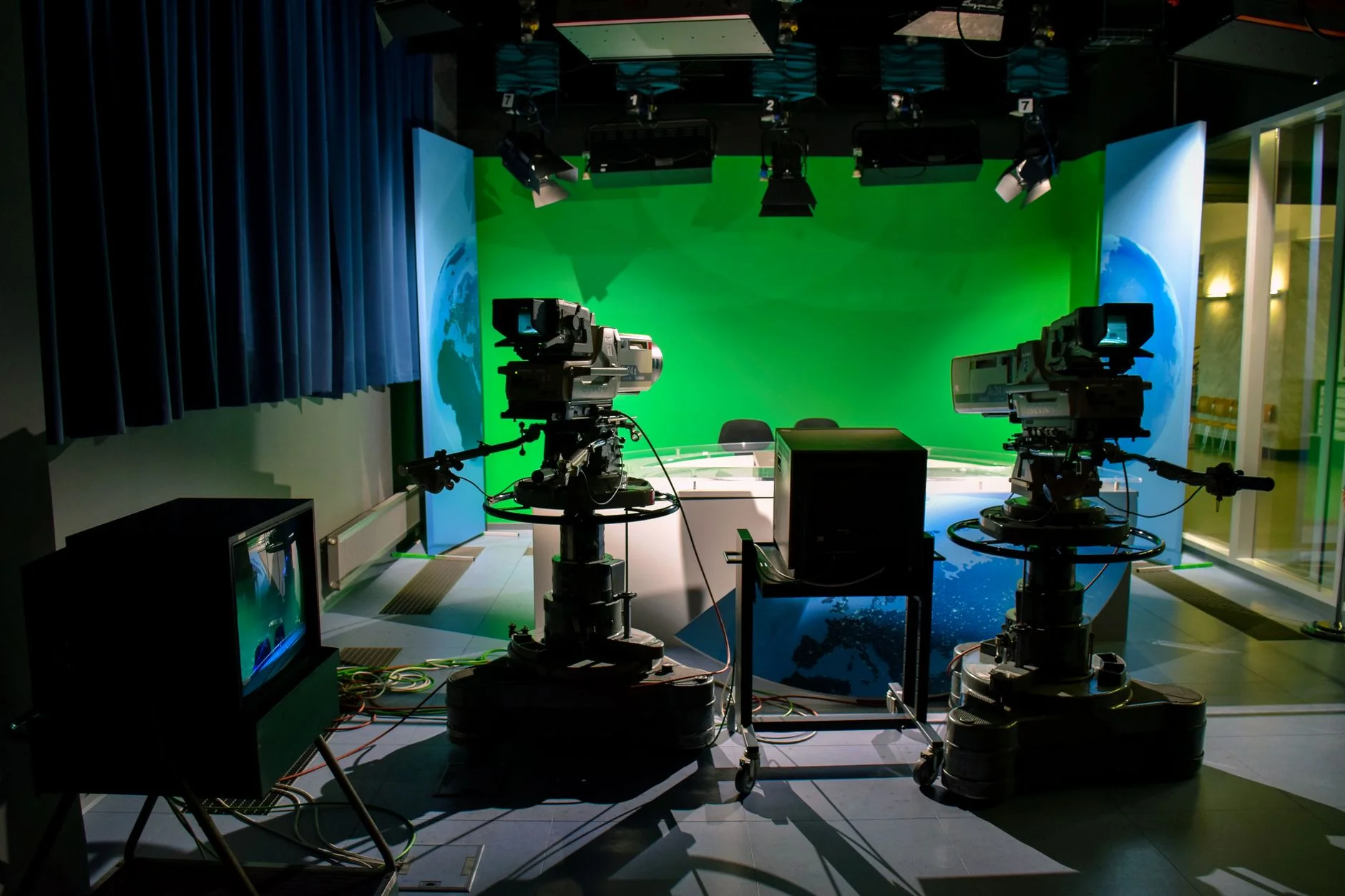
Production happens in a studio, or at the side of a pitch or a news scene. A camera lens focuses light on a sensor, and the sensor turns the light into electrical signals. Microphones do the same job for sound, turning pressure changes in the air into a varying electrical signal.
At this stage the programme is just electricity: one signal for the picture and one for the sound. Next, those signals must be prepared so they can travel.
2. Signal processing: turning pictures into numbers
Modern television converts the programme into digital signals, which means long strings of 1s and 0s. Digital data can be compressed, protected against errors and shared out between many channels. There is a catch: video contains a huge amount of data.
Here is the maths for one uncompressed high-definition picture. A 1080-line HD frame has 1,920 × 1,080 pixels. If each pixel uses 24 bits for its colour and the picture is refreshed 25 times a second, the data rate is:
1,920 × 1,080 × 24 bits × 25 frames/s ≈ 1.24 × 10⁹ bit/s
That is about 1.24 gigabits every second for a single channel, far more than a broadcast frequency can carry for many channels. So the signal is compressed by a codec, a method that throws away repeated and unnoticeable information. Older digital TV used MPEG-2, mainly for standard-definition services. The planned future platform for UK terrestrial TV uses MPEG-4 AVC as its baseline, and a newer codec called HEVC can give roughly 40–50% more compression than MPEG-4 AVC for similar picture quality. Ultra-high-definition pictures have around four times as many pixels as HD, so better compression matters even more.
After compression, several channels are bundled into one data stream called a multiplex. The UK government describes a multiplex as a digital bundle of TV and radio services that share the same frequency.
Why must a TV signal be compressed before it is broadcast? (2 marks)
Uncompressed HD video needs about 1.24 Gbit/s, but a broadcast frequency can only carry a limited data rate. Compression removes repeated or unnoticeable information, so the data rate falls and many channels can share one multiplex.
3. Transmission: sending the signal out
The processed signal is sent to viewers by one of four routes. Radio waves from land-based transmitters carry it to aerials. Satellites relay it to dishes. Cable networks carry it as electrical or light pulses, and the internet delivers it as data packets. Each route is explained later in this article.
4. Reception: catching the signal
At home, an aerial or satellite dish collects the signal. A tuner inside the television, or a set-top box, picks out the channel you want and decodes the data back into video and audio. Without a tuner, the aerial would deliver every channel at once as a jumble.
5. Display: rebuilding the programme
Finally, the screen turns the decoded picture into light, pixel by pixel, and the speakers turn the audio signal back into sound waves. The whole chain, from lens to screen, takes only a few seconds for broadcast television, even though it includes digital coding and decoding.
With the five steps in mind, the next section looks at the most familiar route: terrestrial television, which uses radio waves from tall masts to rooftop aerials, and the physics that governs it.
Radio waves: the science behind TV broadcasting
Terrestrial television, the kind that arrives through a rooftop aerial, is broadcast with radio waves. Radio waves are electromagnetic waves with a long wavelength and a low frequency compared with light or X-rays. According to the AQA GCSE Physics specification, they can be produced by oscillations in electrical circuits. In a transmitter, a rapidly alternating current in the transmitting aerial makes the radio waves that spread out across the countryside.
The same specification explains what happens at the other end: when radio waves are absorbed, they may create an alternating current with the same frequency as the radio wave itself. That is exactly how your aerial works. If you have tried the electromagnetic induction experiment, you have seen a changing magnetic field induce a current in a coil. A radio wave carries a changing electric and magnetic field, so it can push electrons back and forth in the metal rods of an aerial in the same way.
Every electromagnetic wave obeys the wave equation, which links speed, frequency and wavelength:
v = f λ
For radio waves in air, v is 3.00 × 10⁸ m/s. So a higher frequency means a shorter wavelength. The same relationship explains the colours of light, as in the article on why street lights turn purple, and it explains the size of every aerial and dish in this article.
UHF channels and the frequencies Freeview uses
UK digital terrestrial television (Freeview) uses part of the UHF band, which stands for ultra high frequency. UHF covers 300 MHz to 3 GHz. Today the UK uses 470–694 MHz for television, and the bands immediately above this have already been reallocated to mobile broadband.
The band is cut into channels, each 8 MHz wide, numbered 21 to 48. Channel 21 occupies 470–478 MHz, so its centre is 474 MHz. The centre frequency of any channel C is about:
centre frequency ≈ 306 + 8C (in MHz)
For channel 48 that gives 306 + 384 = 690 MHz. Channels above 48 were cleared around 2020 so that the 700 MHz band could be used for mobile services.
| Use | Frequency range | Wavelength (λ = c ÷ f) |
|---|---|---|
| UK terrestrial TV (Freeview) | 470–694 MHz (UHF) | ≈ 0.64 m to ≈ 0.43 m |
| UK satellite TV (Sky, Freesat) | ≈ 10.7–12.75 GHz (Ku band, SHF) | ≈ 2.8 cm to ≈ 2.4 cm |
Use the calculator to see how frequency controls wavelength and aerial size.
Try 474 MHz (channel 21), then 11,700 MHz, a satellite frequency. Notice how the wavelength shrinks from tens of centimetres to a couple of centimetres. Higher frequency means shorter wavelength, and shorter wavelengths allow smaller aerial elements and dishes.
How a TV aerial works
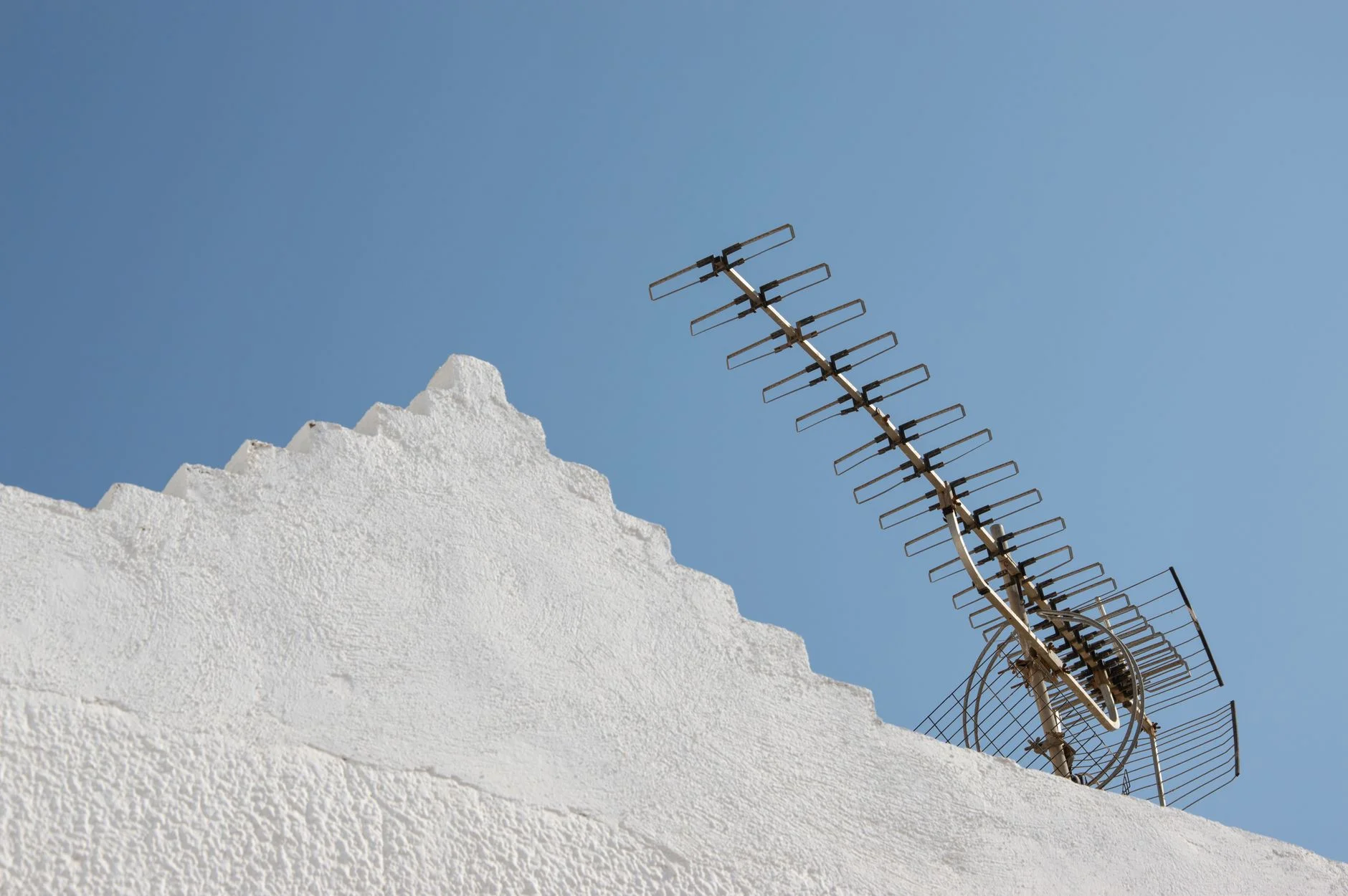
A rooftop television aerial is usually a Yagi aerial: a long bar with many short metal rods across it. The rods are sized to the wavelength of the signal. A simple half-wave element is about half a wavelength long, so at 600 MHz (λ = 0.500 m) it is about 25 cm. Each rod picks up a tiny alternating current, and the bar combines them so the signal from one direction is boosted.
That is why your aerial points at a particular transmitter. UHF waves travel mostly in straight lines, and hills and buildings block them. To cover the whole country, the network operator Arqiva transmits from 1,154 TV broadcast sites, from giant masts to small local relays. Together they bring the main public-service channels to about 98.5% of homes, while the commercial multiplexes reach around 90%.
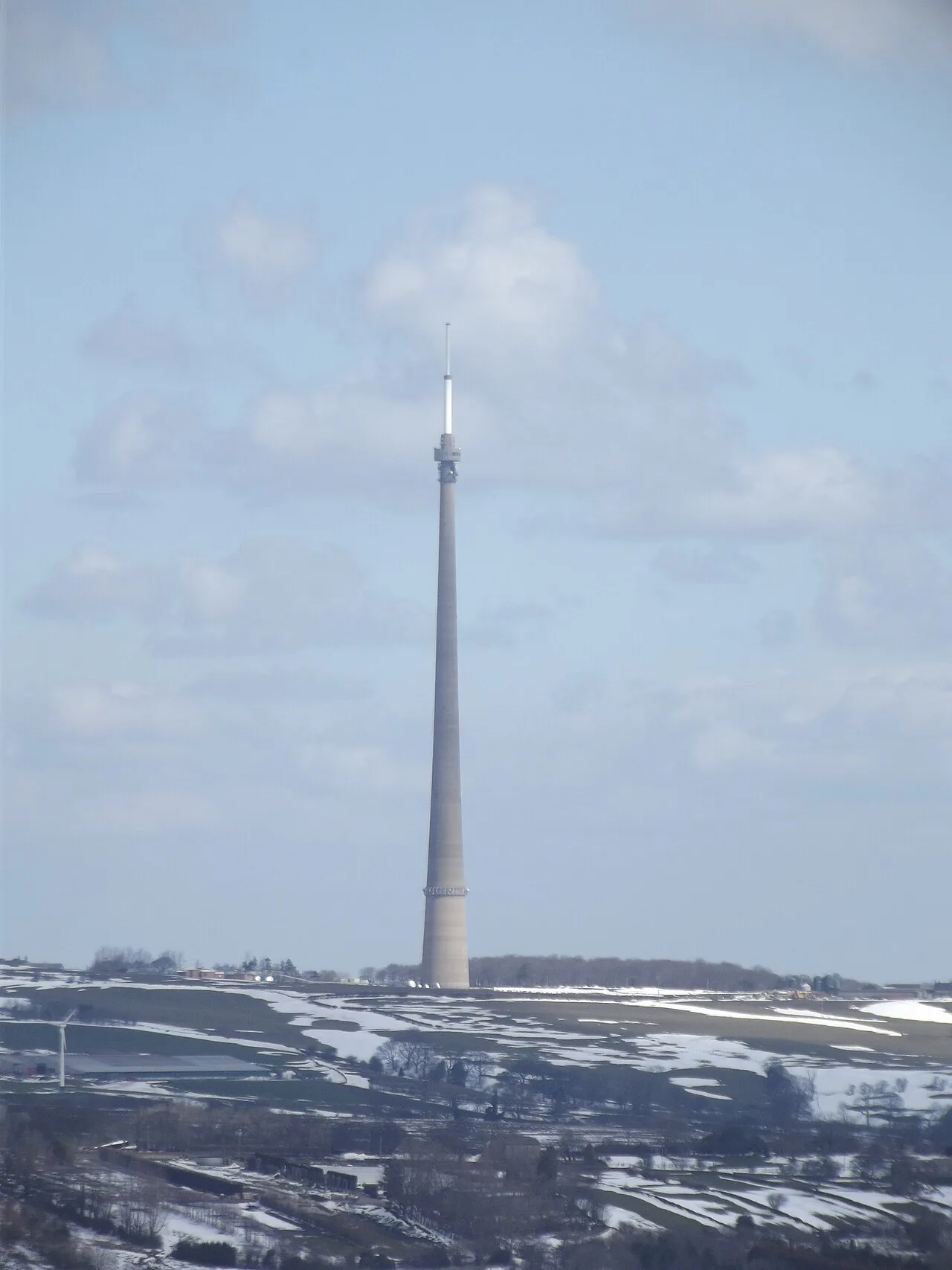
Some masts are huge. The concrete tower at Emley Moor in West Yorkshire is the tallest freestanding structure in the UK, at more than 300 metres. It began transmitting in 1971, after the previous guyed mast there collapsed in March 1969. Height helps because UHF waves travel mostly in straight lines, so a high antenna can “see” further over hills and buildings.
Modulation: putting pictures on a carrier wave
A plain radio wave carries no information, just like a steady hum carries no tune. To send a programme, the transmitter changes a property of the wave in step with the signal. This is called modulation, and the unchanged wave is the carrier.
Old analogue UK television, used from 1964 on UHF, drew a picture of 625 lines, 25 frames a second, in 8 MHz channels. The strength (amplitude) of the carrier wave carried the picture, and its frequency carried the sound. A weak signal gave a snowy picture because any noise changed the signal directly. Digital television instead sends 1s and 0s by switching the carrier between set patterns of amplitude and phase, a method called QAM, spread over thousands of closely spaced carriers (COFDM). If you want a wider comparison of analogue and digital ideas, see this list of common comparisons in physics.
| Feature | Analogue TV | Digital TV |
|---|---|---|
| Signal | Continuously varying wave | Stream of 1s and 0s |
| Weak signal | Snowy, noisy picture | Perfect picture, or freezing and blocks |
| Channels per frequency | One | A multiplex of several services |
| UK status | Switched off in stages, 2007–2012 | Current Freeview service |
The UK analogue switchover started on 17 October 2007 and finished on 24 October 2012, with Northern Ireland the last region to switch.
DVB-T and DVB-T2: why Freeview HD needed a new signal
Digital terrestrial television in the UK launched in 1998 using a standard called DVB-T. Freeview HD uses a newer standard, DVB-T2, while the standard Freeview channels still use DVB-T. Both use COFDM, but DVB-T2 adds a denser pattern, 256-QAM, which carries 8 bits per cell instead of the 6 bits of 64-QAM. The DVB Project states that DVB-T2 gives a capacity increase of at least 30% in equivalent reception conditions, using existing aerials.
More capacity means more data per second, which is what high-definition pictures need. The technical launch of Freeview HD was on 2 December 2009, from Winter Hill near Manchester and Crystal Palace in London.
Calculate the wavelength of a 690 MHz TV signal. (2 marks)
λ = v ÷ f = 3.00 × 10⁸ ÷ 6.90 × 10⁸ = 0.435 m (about 43.5 cm).
Terrestrial broadcasting is only one way to deliver television. Next come the other routes, which use microwaves, light in glass and internet data.
Types of television broadcasting
There are four main types of television broadcasting: terrestrial, satellite, cable and internet streaming. Terrestrial TV was covered above. The other three differ in how the signal travels, what you need at home and which physics does the work.
| Type | How the signal travels | What you need at home | Physics in action |
|---|---|---|---|
| Terrestrial | UHF radio waves from masts | Aerial and TV tuner | Radio waves, mostly line of sight |
| Satellite | Ku-band microwaves from 35,786 km up | Dish and satellite receiver | Geostationary orbit |
| Cable | Light in fibre, plus coaxial copper for the last stretch | Cable box or router | Total internal reflection |
| Streaming and IPTV | Internet data packets | Broadband and a smart TV or app | Data compression, one-to-one delivery |
How satellite TV works
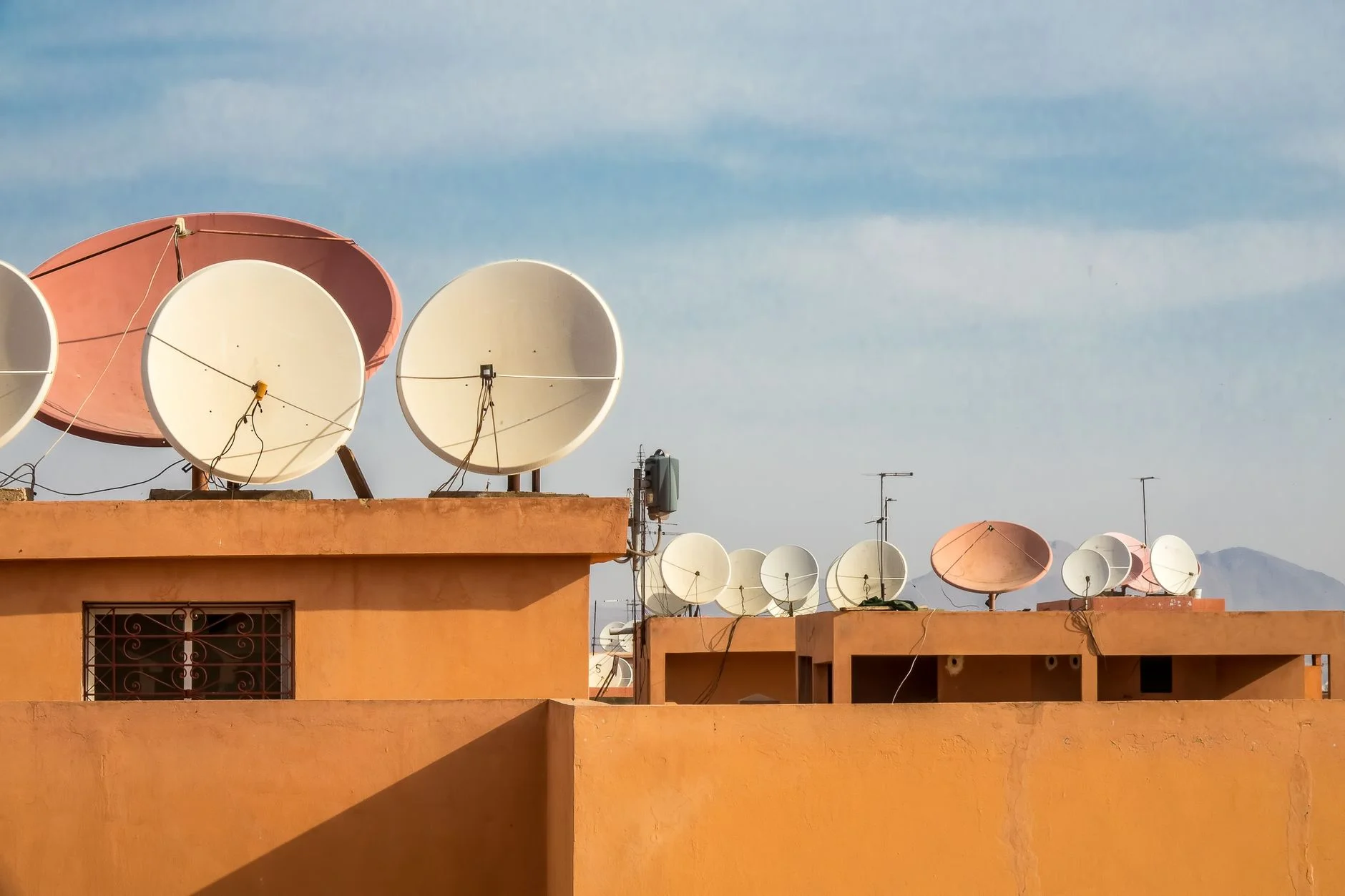
Satellite television is still broadcasting: one signal serves millions of dishes. Large earth stations send the programmes up to a satellite (the uplink). The satellite relays them back down over a wide area (the downlink), where small home dishes collect them.
The satellites used for TV sit in geostationary orbit, 35,786 km above the equator. One orbit takes 23 hours 56 minutes 4 seconds, matching the Earth’s spin, so the satellite appears to stay over one fixed spot. That allows ground antennas to stay fixed, which is why home dishes never need to move. Three evenly spaced geostationary satellites give near-global coverage.
In the UK and Ireland, Sky and Freesat pictures come from the Astra satellites at 28.2° East, in the Ku band at about 10.7–12.75 GHz. The satellites are south-east of the UK, so dishes there point roughly south-east. At those frequencies the wavelength is only about 2.5 cm: GCSE texts class such waves as microwaves, and the AQA specification lists microwaves for satellite communications. Their short wavelength is a big reason a dish can be compact.
Geostationary orbit is a valuable and busy ring of space. For more on satellites and what else is up there, see this overview of rockets, telescopes and satellites, and this article on how to solve the problem of space junk.

Why satellite TV has a delay
Radio waves and microwaves travel at the speed of light, but 35,786 km is a long way. The signal goes up and then down again, so the travel time is:
time = distance ÷ speed = 2 × 35,786 km ÷ 299,792 km/s ≈ 0.239 s
From the UK the dish looks up at a slant, so the distance is nearer 39,000 km each way. Try it in the calculator: the delay rises to about 0.26 s. That is travel time only. In a real TV chain, coding, compression and decoding add more delay.
Cable and fibre: TV as light
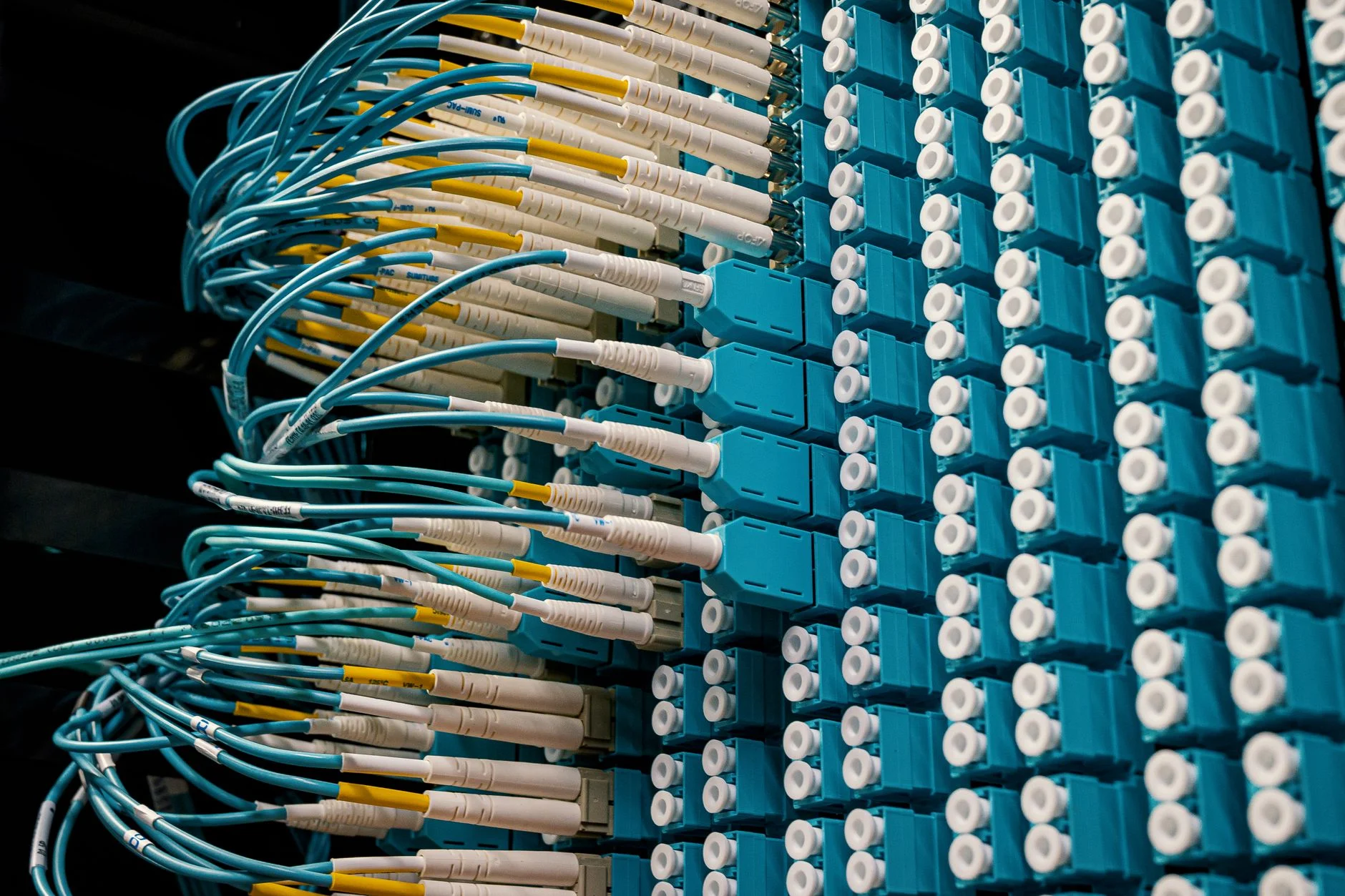
Cable television carries programmes through a network of cables. Fibre-optic cables send them as pulses of light in thin strands of glass, and coaxial copper cables often cover the last stretch to the home.
Light stays inside the fibre because of total internal reflection. The glass core has a slightly higher refractive index than the cladding around it (typically about 1.47–1.48 for the core and 1.46 for the cladding), so light that hits the boundary at a shallow angle reflects back into the core instead of escaping. Light travels more slowly in glass: the speed is c ÷ n, so with n ≈ 1.47 it is about 3.0 × 10⁸ ÷ 1.47 ≈ 2.0 × 10⁸ m/s, roughly two-thirds of the speed in a vacuum. Fibre is also the backbone of the internet, as described in this guide to computer networks.
Internet streaming and IPTV
The UK government defines IPTV as live or on-demand TV services delivered over an internet connection. Streaming lets you watch on smart TVs, computers, tablets and phones, live or whenever you like. Freely, a service offering live TV over broadband, launched on 30 April 2024 from Everyone TV, which is owned by the BBC, ITV, Channel 4 and Channel 5.
There is an important scientific difference from a mast or satellite. Streaming usually sends a separate copy of the programme to each viewer, called unicast delivery. A transmitter radiates one signal that any number of aerials can receive. For a huge live event, internet networks must carry a stream for each viewer, which is why big events can strain them.
Why live streams lag behind broadcast TV
Have you noticed a goal appear on a neighbour’s television before it reaches your phone? That gap is called latency. In 2025 the delay for everything streamed on iPlayer was reported as around 40 seconds, compared with around 8–10 seconds for traditional TV broadcasts. From June 2025 BBC R&D trialled a low-latency method, Low-Latency DASH, on an iPlayer beta, aiming to close the gap.
Distance does not explain the lag. The satellite journey takes only about 0.24 s. Most of the delay comes from processing and buffering. A live stream passes through four main stages:
- Encoding: the live video is compressed into a streaming format.
- Packaging: the video is cut into short chunks, and the player has to wait for whole chunks to be ready.
- Buffering: your device stores several chunks in advance so that a small network hiccup does not freeze the picture.
- Decoding: your device expands the data back into pictures and sound.
Each stage trades delay for reliability. A bigger buffer means fewer interruptions but a longer wait, and shorter chunks mean less delay but more demand on the network.
Why is a live internet stream usually further behind than a satellite signal, even though the satellite signal travels 71,572 km? (2 marks)
The satellite signal’s journey takes only about 0.24 s at the speed of light. The stream’s delay comes mainly from processing: encoding, packaging into chunks, buffering and decoding, which together add many seconds.
Broadcasting has changed enormously over its history, but the reasons it matters have stayed much the same. The final section looks at those reasons, the history, the future of Freeview and some practice questions.
Why television broadcasting is important
Television broadcasting matters because it can put the same information in front of a whole country at once. The summary card shown earlier in this article lists four reasons:
- News and emergency warnings can reach people quickly.
- Education and science programmes bring ideas into the home.
- Entertainment, sport and culture give shared experiences.
- Connecting people with events happening around the world.
There is a science point behind the first of these. A broadcast transmitter sends out one signal, so the load on the network is the same whether one household or ten million are watching. A stream needs a separate copy for every viewer. That is why broadcast remains so efficient for huge live audiences, and why people still discuss its place beside online services, as in the debate over the importance and disadvantages of social media or online education.
Viewing habits are changing, though. Ofcom’s Media Nations 2026 report says that in 2025 people in the UK watched on average 4 hours 23 minutes of video a day at home across all devices. Of that, 53% was broadcasters’ programmes, and about 90 minutes a day was TV watched live at the time of broadcast, down 12 minutes on 2024. YouTube viewing on TV sets has roughly doubled since 2022. The government's Green Paper says digital terrestrial TV remains vital for over 4 million homes, although its use is declining.
A short history of TV broadcasting
- 2 November 1936: the BBC Television Service launches from Alexandra Palace, London, often described as the world’s first regular “high-definition” service (then meaning at least 240 lines).
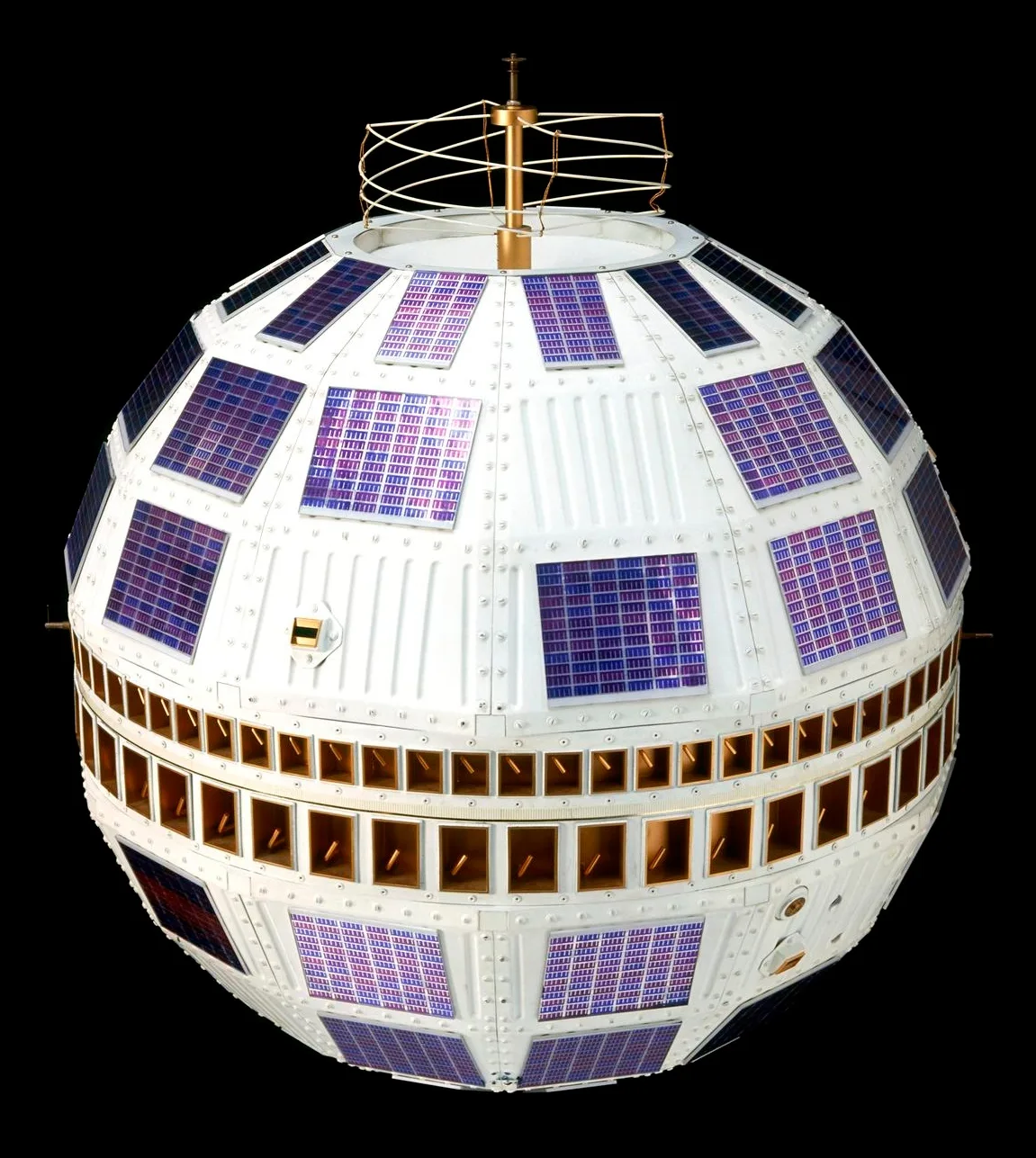
- 23 July 1962: Telstar 1 carries the first public live television across the Atlantic. It was not geostationary, so it only worked while in view of both stations.
- 1964: UK 625-line television begins on UHF.
- 1971: the Emley Moor tower begins transmitting.
- 1998: UK digital terrestrial television launches on DVB-T.
- 2007–2012: analogue switch-off, from 17 October 2007 to 24 October 2012.
- 2 December 2009: the technical launch of Freeview HD (DVB-T2).
- 30 April 2024: Freely launches live TV over broadband.
Is Freeview being switched off? The future of TV broadcasting
No date has been set. On 23 June 2026 the government published a Green Paper called “Watch this space: a new strategic direction for UK media”. It says the government remains committed to digital terrestrial television until at least the end of 2034. The consultation, which closed on 31 August 2026, asked for views on a managed move to internet TV by 2034 or by 2044. As of November 2026 no final decision has been published.
For the debate about how much of daily life can rely on the internet, see Is the internet dead?. The physics stays the same either way: whether a programme arrives as radio waves, microwaves or pulses of light, it is an electromagnetic wave doing the carrying.
Maths practice questions
Tap each question to reveal a worked answer. Use c = 3.00 × 10⁸ m/s.
1. What is the wavelength of UHF channel 21, with a centre frequency of 474 MHz? (2 marks)
λ = 3.00 × 10⁸ ÷ 4.74 × 10⁸ = 0.633 m.
2. A satellite signal has a wavelength of 2.5 cm. What is its frequency? (2 marks)
Convert 2.5 cm to 0.025 m. f = 3.00 × 10⁸ ÷ 0.025 = 1.2 × 10¹⁰ Hz = 12 GHz.
3. Use centre frequency = 306 + 8C to find the centre frequency of UHF channel 48. (1 mark)
306 + 8 × 48 = 306 + 384 = 690 MHz.
4. How long does a signal take to go up to a geostationary satellite and back down, with 35,786 km each way? Use c = 3.00 × 10⁵ km/s. (2 marks)
Distance = 2 × 35,786 = 71,572 km. Time = 71,572 ÷ 300,000 = 0.239 s.
5. Light travels 100 km along fibre with a refractive index of 1.47. Find its speed and the time taken. (3 marks)
v = 3.00 × 10⁸ ÷ 1.47 = 2.04 × 10⁸ m/s. t = 1.00 × 10⁵ ÷ 2.04 × 10⁸ = 4.9 × 10⁻⁴ s, which is about 0.49 ms.
6. An example codec squeezes uncompressed HD video (1.24 Gbit/s) down to 8 Mbit/s. This is an example figure, not a real channel rate. What is the compression ratio? (2 marks)
1.24 Gbit/s = 1,240 Mbit/s. Ratio = 1,240 ÷ 8 ≈ 155, so about 155 : 1.
Frequently asked questions about television broadcasting
What is broadcasting in television?
Broadcasting in television means sending the same programme from one source to many screens at once. A studio produces the audio and video, a transmitter sends them out using radio waves, satellites, cable or the internet, and a receiver turns the signal back into pictures and sound for every viewer.
How does television broadcasting work?
It works in five steps. Cameras and microphones produce the programme, the signal is processed and compressed into digital data, it is transmitted by radio waves, satellite, cable or internet, and a receiver decodes it. Finally the screen and speakers display the picture and sound.
What are the main types of television broadcasting?
The four main types are terrestrial, satellite, cable and internet streaming. Terrestrial uses radio waves from masts to an aerial. Satellite beams signals from orbit to a dish. Cable sends them through fibre or coaxial cables, and streaming delivers them as data over a broadband connection.
What frequency does Freeview use?
UK digital terrestrial television, including Freeview, uses part of the UHF band, currently 470–694 MHz. It is divided into channels 21 to 48, each 8 MHz wide. Channel 21 occupies 470–478 MHz, and the bands above this have been reallocated to mobile broadband.
How does satellite TV work?
Earth stations send programmes up to a satellite in geostationary orbit, 35,786 km above the equator. The satellite relays them back down to small home dishes. Because the satellite seems to stay over one spot, the dishes point at it and do not need to move.
Why is satellite TV delayed?
The signal travels about 35,786 km up and the same distance down, which takes around 0.24 s at the speed of light. From the UK the slant distance is longer, so it is closer to 0.26 s. Coding, compression and decoding add further delay in a real TV chain.
What is the difference between DVB-T and DVB-T2?
DVB-T is the original digital terrestrial standard, used for standard Freeview channels since 1998. DVB-T2 is newer and carries Freeview HD. It adds denser 256-QAM modulation and gives at least 30% more capacity in equivalent conditions, while working with existing aerials.
What is IPTV?
IPTV stands for internet protocol television. The UK government defines it as live or on-demand TV services delivered over an internet connection. Examples include catch-up apps and Freely, a live TV service over broadband. Unlike a transmitter, it usually sends a separate stream to each viewer.
Why is live streaming behind normal TV?
Streams are encoded, cut into short chunks, buffered by your device and then decoded, and each stage adds delay. In 2025 iPlayer’s live stream was reported at around 40 seconds behind, against around 8–10 seconds for traditional broadcasts. Low-latency trials aim to shrink that gap.
Is Freeview being switched off?
No switch-off date has been set. The government’s June 2026 Green Paper says it remains committed to digital terrestrial television until at least the end of 2034. It consulted on a managed move to internet TV by 2034 or 2044, and as of November 2026 no final decision has been published.