
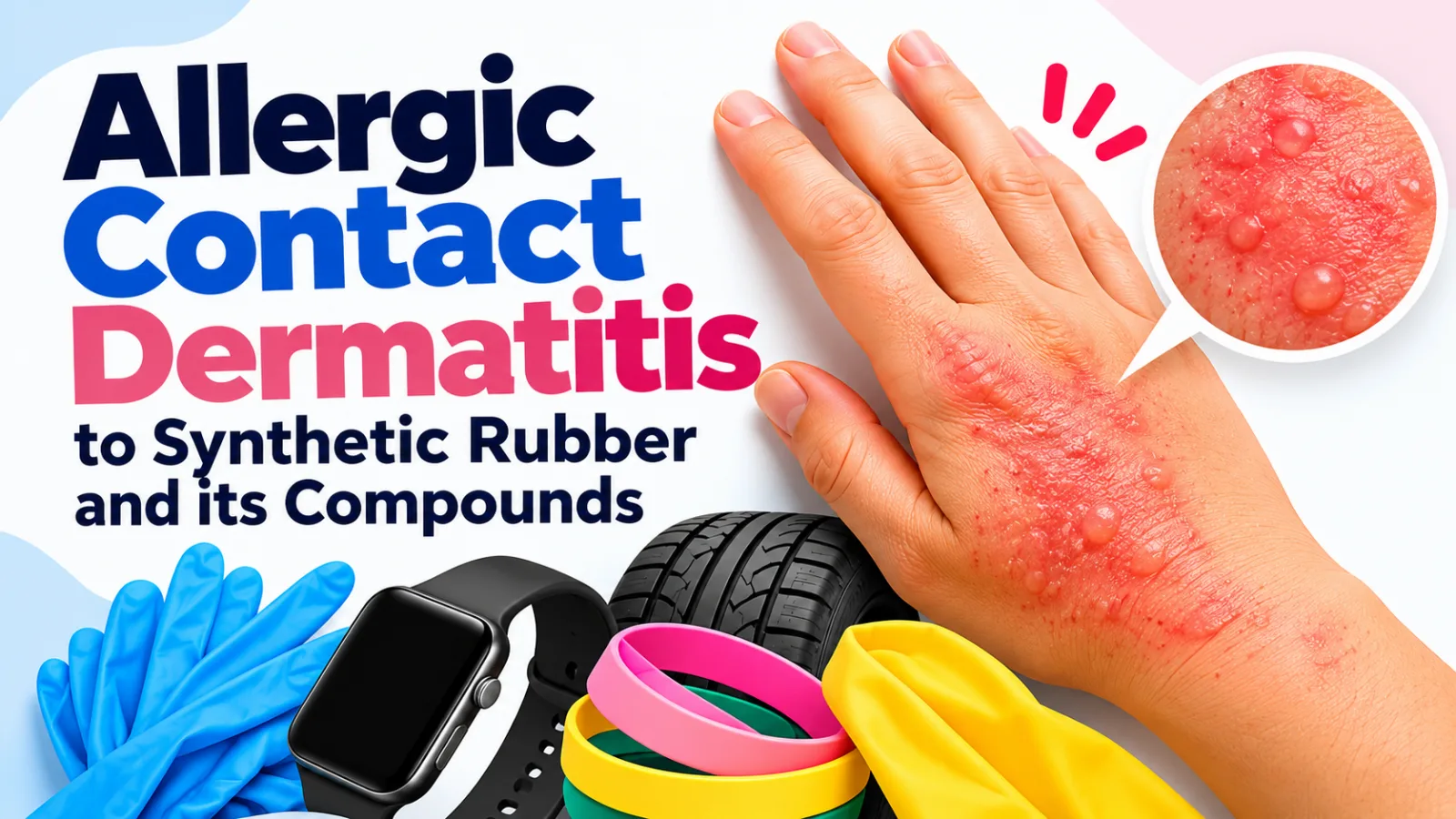
Yes, you can be allergic to shoes. A shoe allergy is usually a reaction to chemicals in the leather, the glue or the rubber, not to the shoe as a whole. The medical name is allergic contact dermatitis: an itchy, red, sometimes blistered rash that appears where the skin touched something it has learned to react to.
The same rubber chemicals that irritate feet in trainers and boots can also cause a rubber allergy to gloves, watch straps and elastic. This article explains how the allergy works, how it differs from latex allergy, and what to do about it.
What is allergic contact dermatitis?
Contact dermatitis is eczema, or inflammation of the skin, caused by something touching it. It is not contagious, so you cannot catch it from someone else or pass it on.
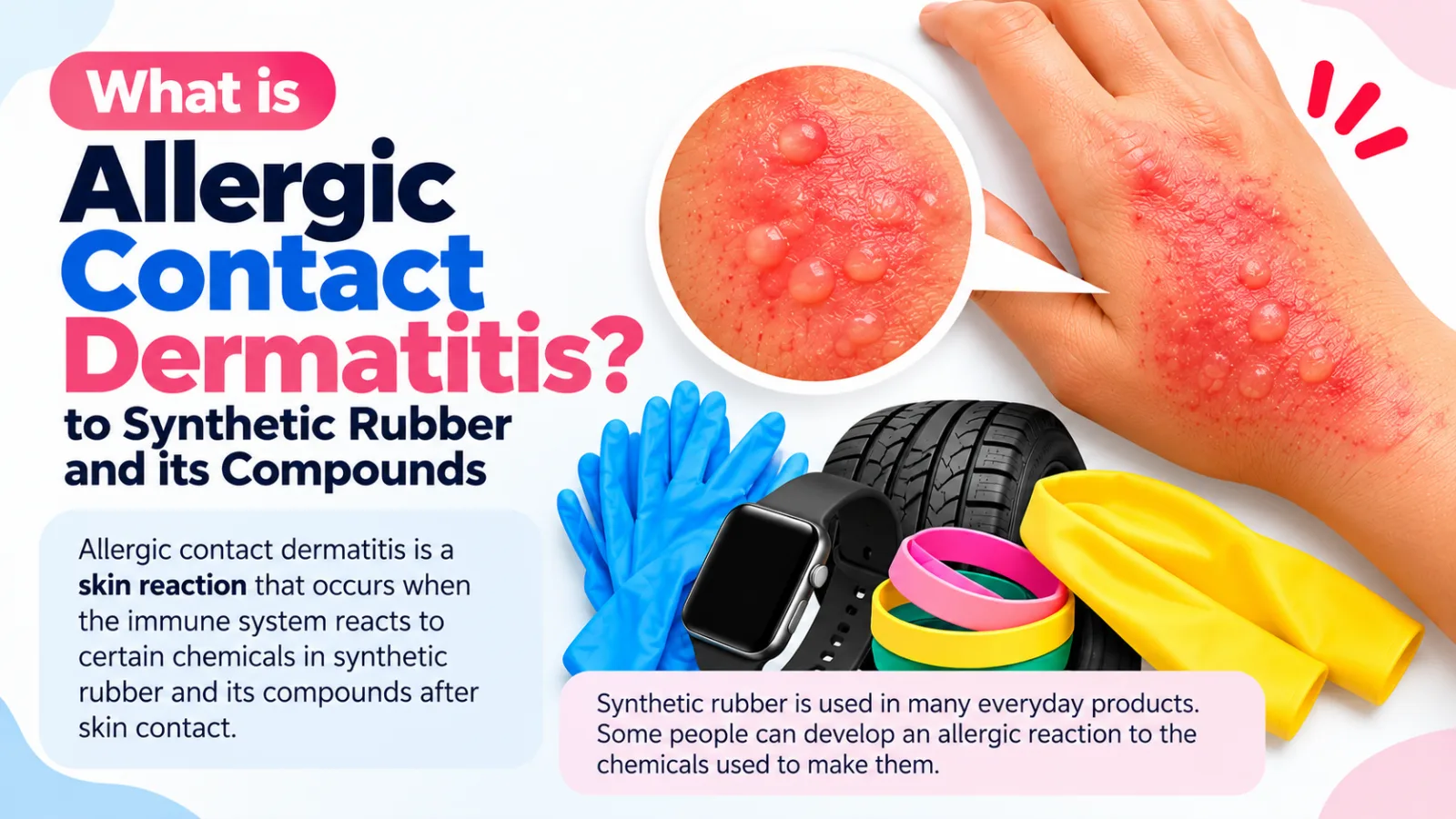
Irritant vs allergic contact dermatitis
There are two main types, and they look similar on the skin. Irritant contact dermatitis is the more common one. Allergic contact dermatitis (ACD) needs the immune system to be involved.
| Feature | Irritant contact dermatitis | Allergic contact dermatitis |
|---|---|---|
| How common | Most cases | Less common |
| Cause | Direct damage to the skin | Immune reaction in a sensitised person |
| Typical triggers | Detergents, friction, sweat, water | Specific chemicals such as rubber accelerators, chromium salts, glue resins |
| Who is affected | Almost anyone with enough exposure | Only people who have become sensitised |
| Does the immune system learn it? | No | Yes, and it is usually lifelong |
| Test | Based on history and exposure | Patch testing |
How the allergy develops: sensitisation and elicitation
Allergic contact dermatitis is a type IV hypersensitivity. That means it is a delayed reaction driven by T cells, a kind of white blood cell, rather than the antibodies behind a hay fever or peanut reaction. You can read more about the cells involved in our guide to the human immune system.
It happens in two stages. In the first, called sensitisation, the skin meets the chemical and the immune system learns to treat it as a threat. There is no rash at this point, and it can take days or years of contact. Immune cells in the skin carry the chemical to nearby lymph nodes, part of the lymphatic system, where T cells learn to recognise it.
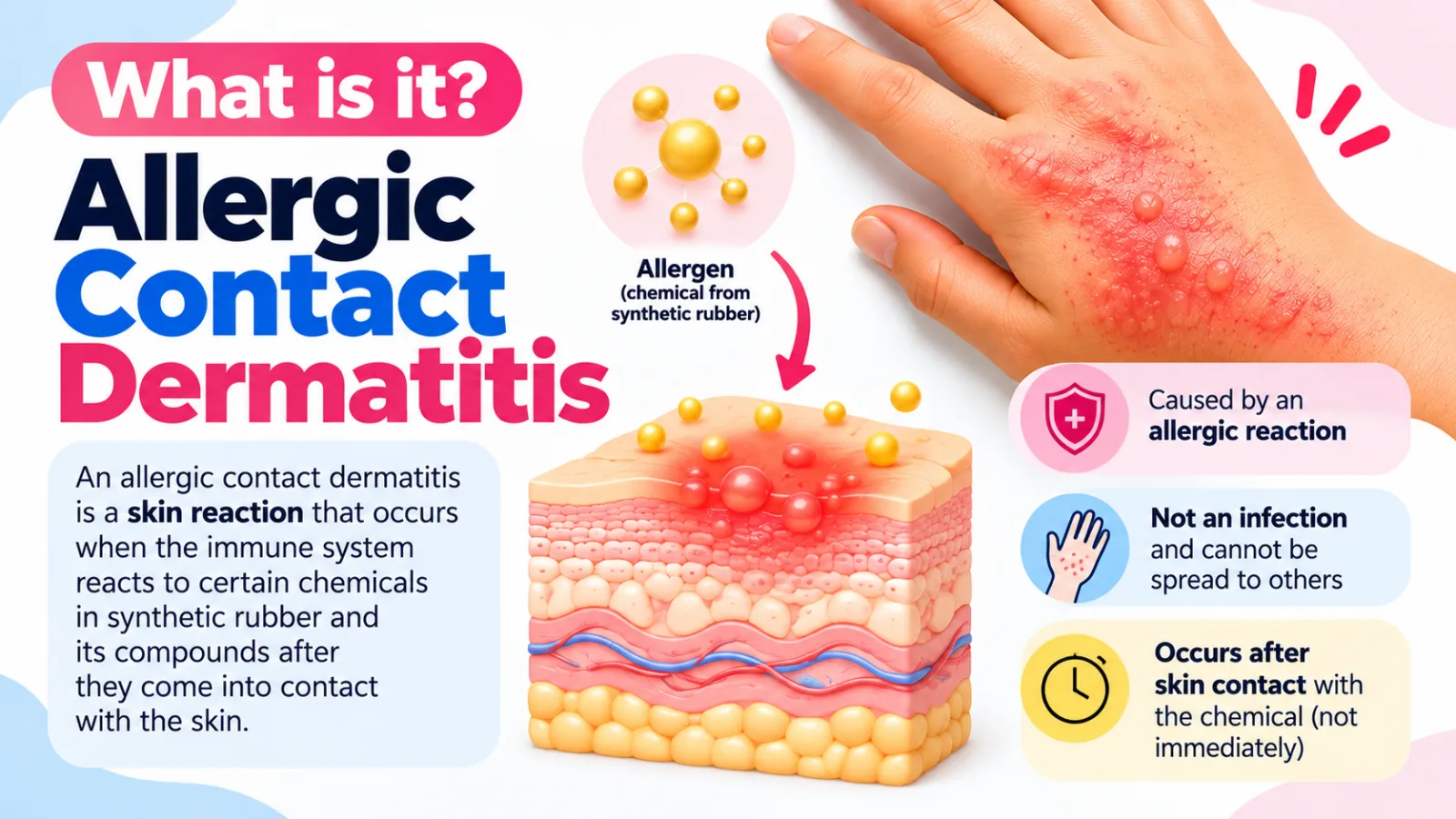
The second stage is elicitation. When the skin touches the chemical again, the primed T cells react and the rash appears. Once you are sensitised, it usually lasts for life, so the aim is to avoid the trigger.
Rubber allergy vs latex allergy
People often use “rubber allergy” and “latex allergy” as if they mean the same thing. They do not. A rubber allergy of the kind that causes allergic contact dermatitis is usually a reaction to the chemicals added during manufacture to speed up vulcanisation or to protect the rubber. A latex allergy is a reaction to proteins in natural rubber latex.
| Feature | Rubber chemical allergy (ACD) | Latex allergy |
|---|---|---|
| Type of reaction | Type IV, delayed, T-cell-mediated | Type I, immediate, IgE antibodies |
| Cause | Rubber chemicals such as thiurams, carbamates and mercaptobenzothiazole (MBT) | Proteins in natural rubber latex |
| Timing | About 24–72 hours after contact | Within minutes |
| Symptoms | Itchy, red or darker, sometimes blistered rash where the skin touched the item | Hives, runny nose, wheezing |
| Test | Patch test | Skin-prick test |
| Anaphylaxis risk | Does not cause anaphylaxis | Rarely, yes |
| Synthetic rubbers (nitrile, neoprene) | May still contain the same accelerator chemicals | Contain no latex proteins |
The last row matters in real life. Synthetic rubbers such as nitrile and neoprene contain no latex proteins, but they often contain the same accelerator chemicals. Someone with a rubber glove allergy to thiurams may therefore still react to a synthetic glove.
Severe swelling of the face or lips, or difficulty breathing after contact with latex, is an emergency. Call 999.
Can you be allergic to shoes? Shoe contact dermatitis
Yes, you can. Shoe contact dermatitis is an itchy, red rash on the feet caused by something in your footwear touching the skin. You are not allergic to the shoe as a whole. You react to one or more chemicals used to make it.
That is why a shoe allergy is not always a rubber allergy. Patch-test studies, such as the North American Contact Dermatitis Group’s 2005–2018 shoe data, show that leather-tanning chemicals (chromate) and shoe glue resins were each found at least as often as any single rubber chemical.

Most cases are allergic contact dermatitis: a delayed immune reaction in someone who has already become sensitised. Sweat makes things worse, because it helps allergens leach out of the shoe and onto your skin. A warm, damp shoe worn all day is the perfect delivery system.
The usual culprits in shoes
The table below lists the chemicals that patch tests most often pick out. Cobalt and some dyes also turn up, but these seven are the headline names.
| Allergen | Where it is found in shoes | Other places you meet it |
|---|---|---|
| Potassium dichromate (chromium salts) | Used to tan leather, so it is in leather uppers and linings | Other tanned leather goods |
| p-tert-butylphenol formaldehyde resin (PTBFR) | Shoe glues | Other glued items |
| Colophony | Shoe glues | Other adhesives |
| Mercaptobenzothiazole (MBT) and mercapto mix | Shoe rubber, such as soles | Other rubber products |
| Thiuram mix | Rubber parts of shoes | Rubber gloves, where it is a leading cause of allergy |
| Mixed dialkyl thioureas | Neoprene insoles | Wetsuits and knee supports |
| Black rubber mix (para-phenylenediamine derivatives such as IPPD) | Black rubber boots and soles | Tyres and handles |
Black rubber has its own story. Our guide to black rubber mix allergy explains why it behaves differently from the other rubber chemicals.
Where on the foot it shows up
The pattern of the rash gives useful clues. Shoe dermatitis usually appears on the top (dorsum) of the feet and on the toes. It often affects both feet in a similar way, and it typically spares the skin between the toes. If the trigger is a rubber sole or insole, the soles are the likely site.

Remember the delay. The rash usually appears 1–3 days after contact, so it is easy to blame the wrong pair of shoes, or a new sock or cream. Other foot problems can look similar, so see our overview of common foot health problems for comparison.
Shoe allergy or athlete’s foot?
Itchy, scaly feet are often blamed on athlete’s foot, which is a fungal infection. The two can look alike, but the pattern differs. A GP can tell them apart, for example by testing skin scrapings, so do not guess and keep treating the wrong thing.
- Shoe allergy: usually affects the tops of the feet and the toes, often both feet in a similar way, and typically spares the skin between the toes.
- Athlete’s foot: typically starts between the toes.
- Shoe allergy: an allergic reaction, which comes 1–3 days after contact.
- Athlete’s foot: a fungal infection, confirmed by skin scrapings.
Quick check: a rash on the tops of both feet, with the skin between the toes clear. Is this more likely to be shoe contact dermatitis or athlete’s foot? (2 marks)
More likely shoe contact dermatitis. It affects the tops of both feet and spares the skin between the toes, whereas athlete’s foot typically starts between the toes. A pharmacist or GP can help work out which it is.
Symptoms of allergic contact dermatitis
The symptoms of allergic contact dermatitis look a lot like other types of eczema, which is one reason the cause is so easy to miss. With a shoe allergy or rubber allergy, the rash usually shows up where the allergen touched your skin, such as the feet in shoes or the hands in gloves. Here is what to look for.
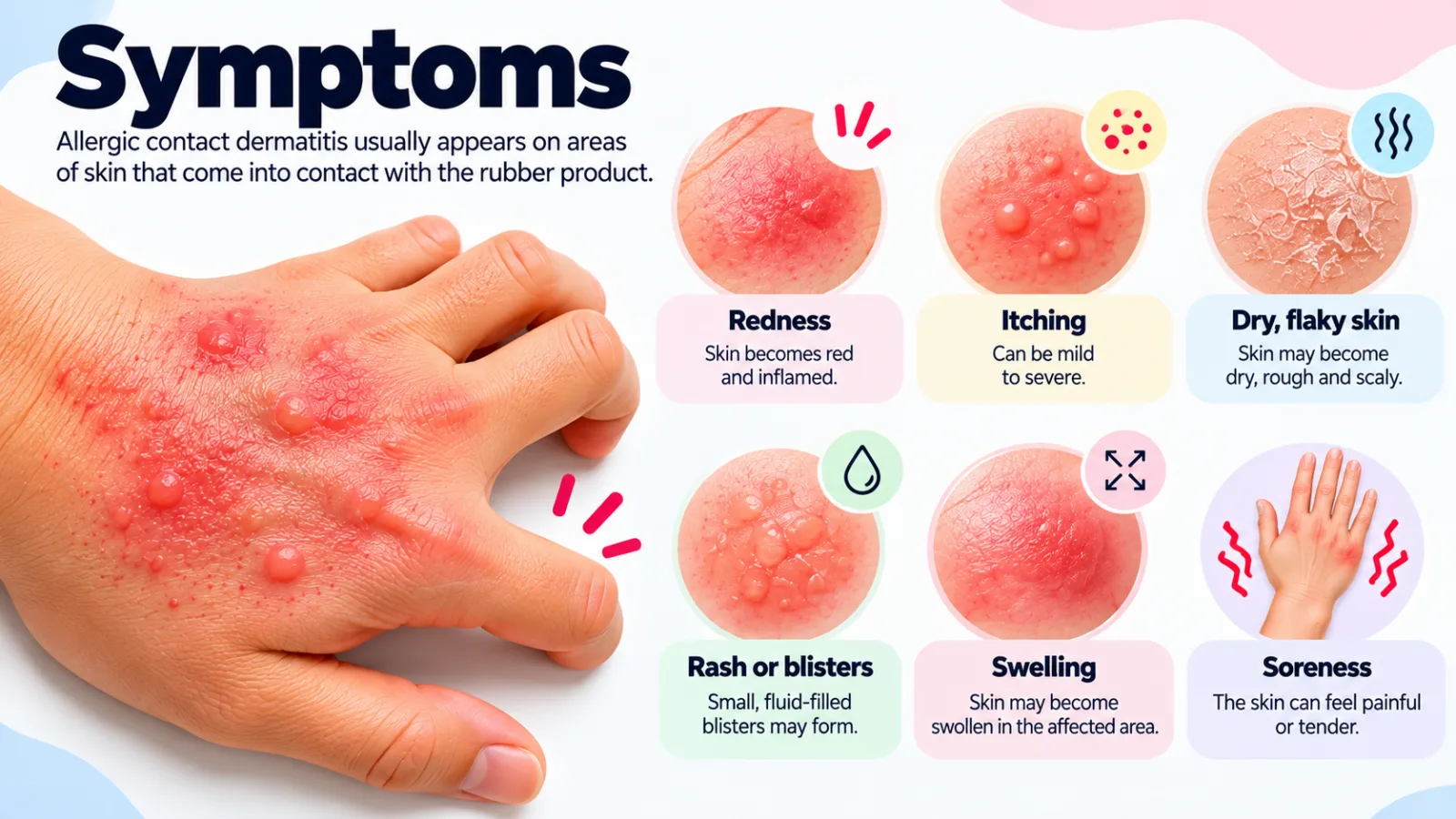
- Red or darker patches of skin. On brown or black skin, redness can be harder to see, so the patch may look darker, purplish or greyer than the skin around it.
- Itching. This is often the main complaint and can be intense.
- Burning or stinging in the affected area.
- Swelling of the skin.
- Small fluid-filled blisters that may weep and then crust over.
- Dry, cracked, scaly skin, especially if contact with the allergen carries on for a long time.
The rash is usually limited to the area that touched the trigger, but it can spread beyond it. Because allergic contact dermatitis is a delayed reaction, the rash typically appears about 24–72 hours after contact. You may not link today’s itchy feet with the shoes you wore two days ago.
If you have a rash that is not improving, is severe or is spreading, speak to a GP or pharmacist. Do not try to work out the cause on your own, because other skin conditions can look very similar.
How long does contact dermatitis last?
It varies from person to person. Once the trigger is removed, the rash usually starts to settle within days and can take a few weeks to clear. If you keep touching the allergen without realising it, the rash can keep coming back or never fully go away.
This is why finding the cause matters. Once you are sensitised, the allergy is usually lifelong, so the aim is to avoid the trigger rather than wait for it to wear off. If you notice pus, crusting, heat or a fever, see a GP promptly, as these can be signs of infection. In the UK you can also call NHS 111 for advice.
Other everyday sources of rubber chemicals
A rubber allergy is rarely just about shoes. The same accelerator and antioxidant chemicals (thiurams, carbamates, mercaptobenzothiazole, thioureas and black rubber chemicals) turn up in many rubber products. If you have been told you are allergic to one of them, you may meet it in lots of places.
- Gloves. Thiuram mix is a leading cause of rubber glove allergy. Ordinary nitrile gloves are not automatically safe, because they often still contain accelerators.
- Rubber watch straps and elastic in waistbands, bra straps and socks.
- Swimming goggles and masks with rubber seals or straps.
- Balloons, hoses and tubing.
- Tyres and black rubber handles, where black rubber mix chemicals such as IPPD can be found.
- Sports grips and equipment handles.
- Wetsuits, knee supports and insoles made of neoprene, which can contain thioureas.
Not everyone who is allergic to one of these chemicals reacts to every product, because the amount and type of chemical differs between brands and materials. A dermatologist can tell you exactly which ones to avoid.
Rubber allergy is also just one of many allergies people live with. If you want to see how it compares, read our guide to the most common allergy.
How is allergic contact dermatitis diagnosed? Patch testing
Guessing the cause from the rash alone is difficult. A GP can refer you to a dermatologist on the NHS, who can arrange patch testing. This is different from a skin-prick test, which is used for immediate allergies such as latex allergy.
Here is what usually happens.
- The dermatologist asks about your rash, your job, your hobbies, and the shoes, gloves and other products you use.
- Small amounts of standard allergens are placed on patches. This is usually a baseline series, sometimes with a shoe or rubber series added.
- Sometimes small pieces of your own shoes or gloves are tested too.
- The patches are taped to your back and left in place for 48 hours.
- The skin is checked at about day 2 and again at day 3–4. Sometimes there is a further reading at around day 7.
- Your results show which substances you react to, and you are given advice on how to avoid them.
Because the test looks for a delayed reaction, the extra readings are important. Follow the instructions you are given about keeping the patches in place.
Allergy tests are a bigger topic than rubber alone. If you are curious about how allergies change over time, you can read whether childhood allergies can go away. Be aware, though, that once you are sensitised to a rubber chemical, the allergy usually lasts for life.
Treatment and self-care for allergic contact dermatitis
There is no cure for the underlying allergy, because once you are sensitised it usually lasts for life. Treatment therefore has two jobs: calm the rash that is already there, and stop it coming back. The NHS advice for contact dermatitis follows the same pattern whether the trigger is a shoe, a glove or a watch strap.

The first step is to avoid the trigger. That is easier said than done with allergic contact dermatitis, because the rash can appear one to three days after contact. If you suspect a pair of shoes or a type of glove, stop using it while you sort out what is going on, and ask your GP about patch testing so you know what you are really dealing with.
Emollients and steroid creams
Emollients are moisturisers. Used often, they help repair dry, cracked skin and make it a better barrier. They are a sensible daily habit even when the skin looks calm.
For flare-ups, the NHS describes steroid creams and ointments. A pharmacist can advise on milder ones, while stronger ones are prescribed by a GP. Follow the instructions on the pack or from the prescriber, and do not use steroid products on a rash without advice if you are unsure what is causing it.
Looking after itchy skin
Scratching damages the skin and can let infection in, which makes the rash worse. Try to keep the affected skin clean, avoid harsh soaps and hot water, and keep it covered from the allergen. With a shoe allergy, that means giving your feet a break from the suspect shoes and changing damp socks promptly, because sweat makes shoe allergens leach out more.
Preventing shoe and rubber allergy flare-ups
Once a patch test has named the allergen, prevention becomes practical. A dermatologist can give you product lists specific to your allergen, which is much more useful than a general “avoid rubber” rule. The checklist below covers the habits that help most. Ticks are remembered in your browser.
- Ask for patch testing, so you know whether your trigger is leather, glue or rubber chemicals.
- Choose rubber-free or accelerator-free products once the allergen is known, as ordinary nitrile gloves often still contain accelerators.
- For chromium allergy, look for vegetable-tanned or chrome-free leather.
- Choose shoes made without the glue or rubber that triggers your rash.
- Swap rubber insoles for foam ones, and check they do not contain a glue or rubber you react to.
- Wear cotton socks and change them when they are damp.
- Air your shoes between wears, and avoid wearing the same pair every day.
- Moisturise with an emollient often, even when your skin looks fine.
Remember that a synthetic rubber is not automatically safe. Nitrile and neoprene contain no latex proteins, but they often contain the same accelerator chemicals that cause rubber allergy in the first place. Neoprene can also contain thioureas, which matters for insoles, wetsuits and knee supports.
Living and working with a rubber allergy
Occupational contact dermatitis is common in healthcare, cleaning, hairdressing and construction, where hands are often wet and gloves are worn for hours. Rubber glove allergy, often to thiuram mix, is a typical example.
In the UK, employers have a legal duty to reduce workers’ exposure to substances that can harm the skin, and the Health and Safety Executive (HSE) gives guidance on this. Telling your employer, or your school, early is sensible. Reasonable steps might include accelerator-free gloves, a change of footwear policy or protecting your hands during wet work.
Keep a note of what you react to, and bring the details of your patch test result to work and to future medical appointments. You can mention your allergy to a dentist, nurse or pharmacist, because rubber is used in many everyday items. Contact dermatitis is not contagious, so you cannot pass it on to classmates or colleagues.
Test yourself on shoe and rubber allergy
Key points to remember
Frequently asked questions about shoe and rubber allergy
Can you be allergic to shoes?
Yes. People can develop allergic contact dermatitis from materials in shoes. The commonest culprits are chromium salts used to tan leather, glues containing resins or colophony, and rubber chemicals such as MBT, thiurams and carbamates. A patch test can show which of these is responsible for your rash.
What are the symptoms of a shoe allergy?
Typical symptoms are red or darker patches, itching, burning or stinging, and swelling. Small fluid-filled blisters may weep and crust, and long-term exposure can leave skin dry, cracked and scaly. Redness can be harder to see on brown or black skin. See a GP if symptoms do not improve.
How long does contact dermatitis last?
Once you stop touching the trigger, the rash usually starts to settle within days and can take a few weeks to clear. It may return quickly if you meet the allergen again, because the allergy is usually lifelong. A GP can advise if the rash is not improving.
Is it athlete’s foot or an allergy?
Athlete’s foot is a fungal infection that typically starts between the toes. Shoe contact dermatitis usually affects the tops of the feet and toes, often on both feet, and tends to spare the skin between the toes. A GP can tell them apart.
What is the difference between latex allergy and rubber allergy?
Latex allergy is an immediate reaction to proteins in natural rubber latex, causing hives, a runny nose or wheezing within minutes, and rarely anaphylaxis. Rubber allergy to chemicals is a delayed skin reaction appearing a day or more later and does not cause anaphylaxis. They need different tests.
What is thiuram mix?
Thiuram mix is a group of rubber chemicals added to speed up vulcanisation, the process that makes rubber durable. It is used in patch testing and is a leading cause of rubber glove allergy. People allergic to thiurams may need accelerator-free gloves, as ordinary nitrile gloves often still contain accelerators.
What is a patch test for contact dermatitis?
A patch test is done by a dermatologist, usually after an NHS referral. Small amounts of standard allergens, and sometimes pieces of your own shoes or gloves, are taped to your back for 48 hours. The skin is read at about day 2 and day 3–4, and occasionally day 7.
How is contact dermatitis on the feet treated?
NHS advice is to avoid the trigger, use emollients often, and use steroid creams or ointments for flare-ups. A pharmacist can advise on mild ones, and a GP prescribes stronger ones. See a GP if the rash is severe, spreading, not improving or shows signs of infection.
Is contact dermatitis contagious?
No. Contact dermatitis is not contagious, so you cannot catch it from someone else or pass it on. It is caused either by direct skin damage from irritants or by your own immune system reacting to an allergen you have become sensitised to. You can share a changing room safely.