What is the difference between eau de parfum and eau de toilette? Eau de parfum has a higher concentration of aromatic compounds dissolved in ethanol than eau de toilette. Commonly quoted ranges are about 15–20% against about 5–15%, so eau de parfum usually smells stronger and lasts longer. No law fixes those numbers, though, so they vary between sources and makers.
The labels on a bottle are really chemistry in disguise. Every fragrance is a solution: a mixture of smelly molecules (the solute) dissolved in a liquid (the solvent). The labels tell you roughly how much solute there is. In this article you will see how that works, what perfume is made of, why scents change over an hour and how your nose detects them.
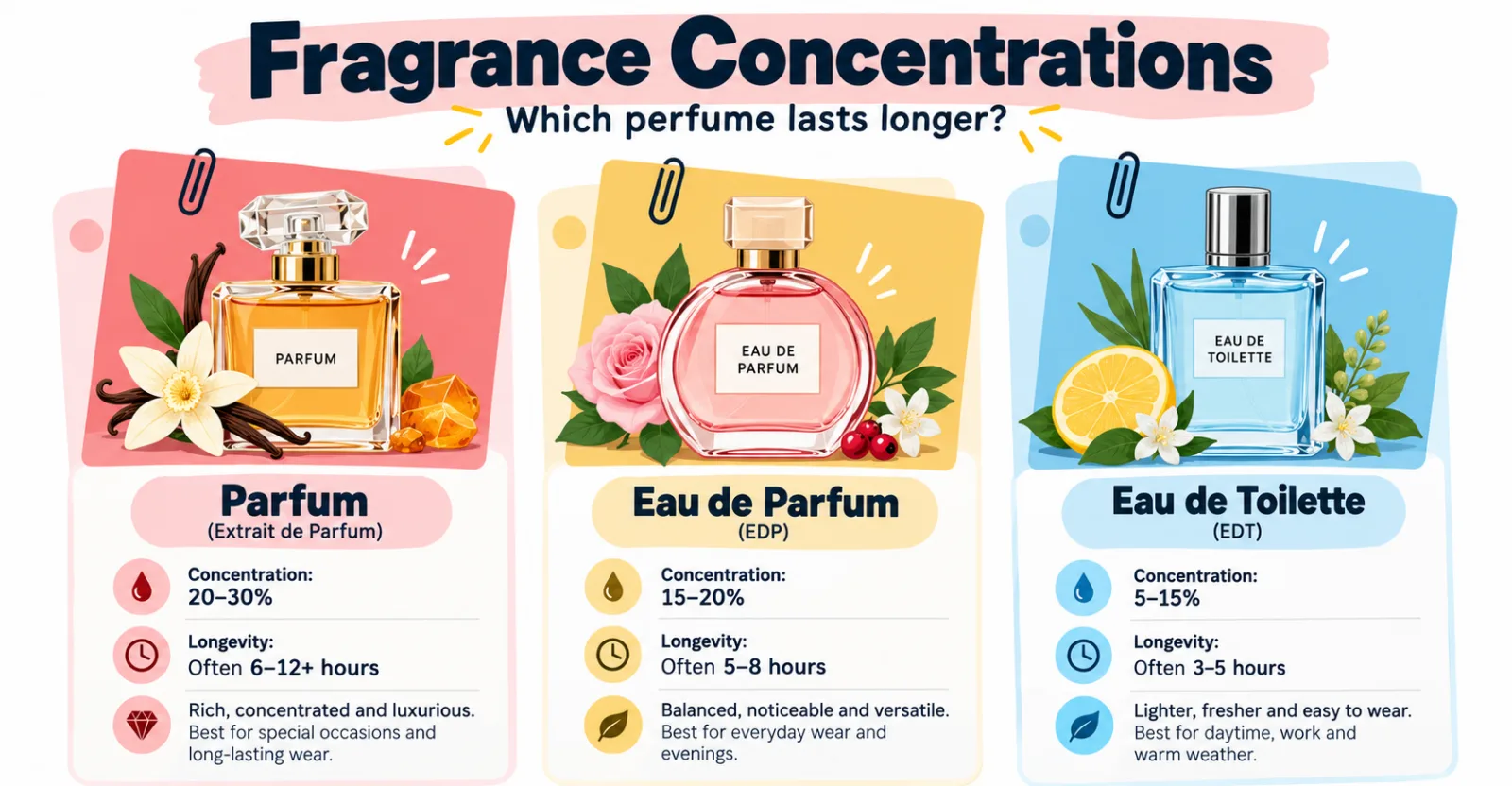
Parfum vs eau de parfum vs eau de toilette: a fragrance concentration chart
The words parfum, eau de parfum, eau de toilette, eau de cologne and eau fraîche are French terms. They describe the approximate amount of aromatic compounds, often called “perfume oil”, in the bottle. In fine fragrance the solvent is typically ethanol, sometimes mixed with water.
Here is the fragrance concentration chart. Notice that there are two sets of numbers, because published sources do not agree.
| Type | Also called | Wikipedia / NYT range | Our infographic | Typical feel |
|---|---|---|---|---|
| Parfum | Extrait de parfum, pure perfume | 15–30% (typically about 20%) | 20–30% | Richest and usually the longest-lasting |
| Eau de parfum (EDP) | — | 15–20% | 15–20% | Strong and long-lasting |
| Eau de toilette (EDT) | — | 5–15% (typically about 10%) | 5–15% | Lighter and fresher |
| Eau de cologne (EDC) | Cologne | 2–3% | 2–5% | Light and quick to fade |
| Eau fraîche | — | 3% or less | about 1–3% | The lightest |
The two columns disagree on purpose. That disagreement is the real lesson: the percentages are rough guides, not exact definitions. The pattern is the same everywhere, though. As the percentage of aromatic compounds goes up, the scent generally gets stronger and lasts longer.
What “concentration” means in a perfume
In GCSE chemistry, a solution is a solute dissolved in a solvent. In a bottle of perfume the solute is a blend of aroma compounds, and the solvent is mostly ethanol. The percentage on a fragrance chart is a percentage concentration by volume:
% concentration = volume of aroma compounds ÷ total volume × 100
Take a 50 ml bottle at 20%. The aroma compounds make up 50 × 20 ÷ 100 = 10 ml, and the remaining 40 ml is solvent. If you wanted to dilute that same 10 ml of aroma compounds down to 10%, the total volume would have to be 100 ml. The amount of solute stays the same; only the volume of solvent changes. It is the same idea you meet in a standard solution practical.
Try your own numbers in the calculator below.
A 30 ml eau de toilette contains 3 ml of aroma compounds. Calculate its percentage concentration. (2 marks)
Concentration = 3 ÷ 30 × 100 = 10%. This sits in the usual range quoted for an eau de toilette.
Eau de parfum vs eau de toilette: the key difference
The key difference between eau de parfum and eau de toilette is concentration. An eau de parfum carries more aromatic compounds in the same volume of liquid, so each spray delivers more molecules to the air and to your skin. That is why it usually smells stronger and lingers longer.
Within one company’s range, the eau de parfum version of a scent is normally more concentrated than its eau de toilette. Sometimes the two versions also use different mixtures of ingredients, not just different amounts. So they can smell noticeably different, not simply “stronger” or “weaker”.
Comparing parfum vs eau de parfum follows the same logic. Parfum, also called extrait, sits at the top of the concentration chart. It contains the most aroma compounds and the least solvent. “Stronger” does not always mean “better”, though. A very concentrated scent can be overpowering, and a lighter one can be easier to wear. The formula, not just the label, shapes how a fragrance behaves.
What does “eau de toilette” mean?
The French word eau means water, and toilette meant getting washed and dressed, which is grooming rather than the bathroom fixture. So “eau de toilette” is a fragrance for the grooming routine. It tells you nothing about the chemistry; the concentration range does that.
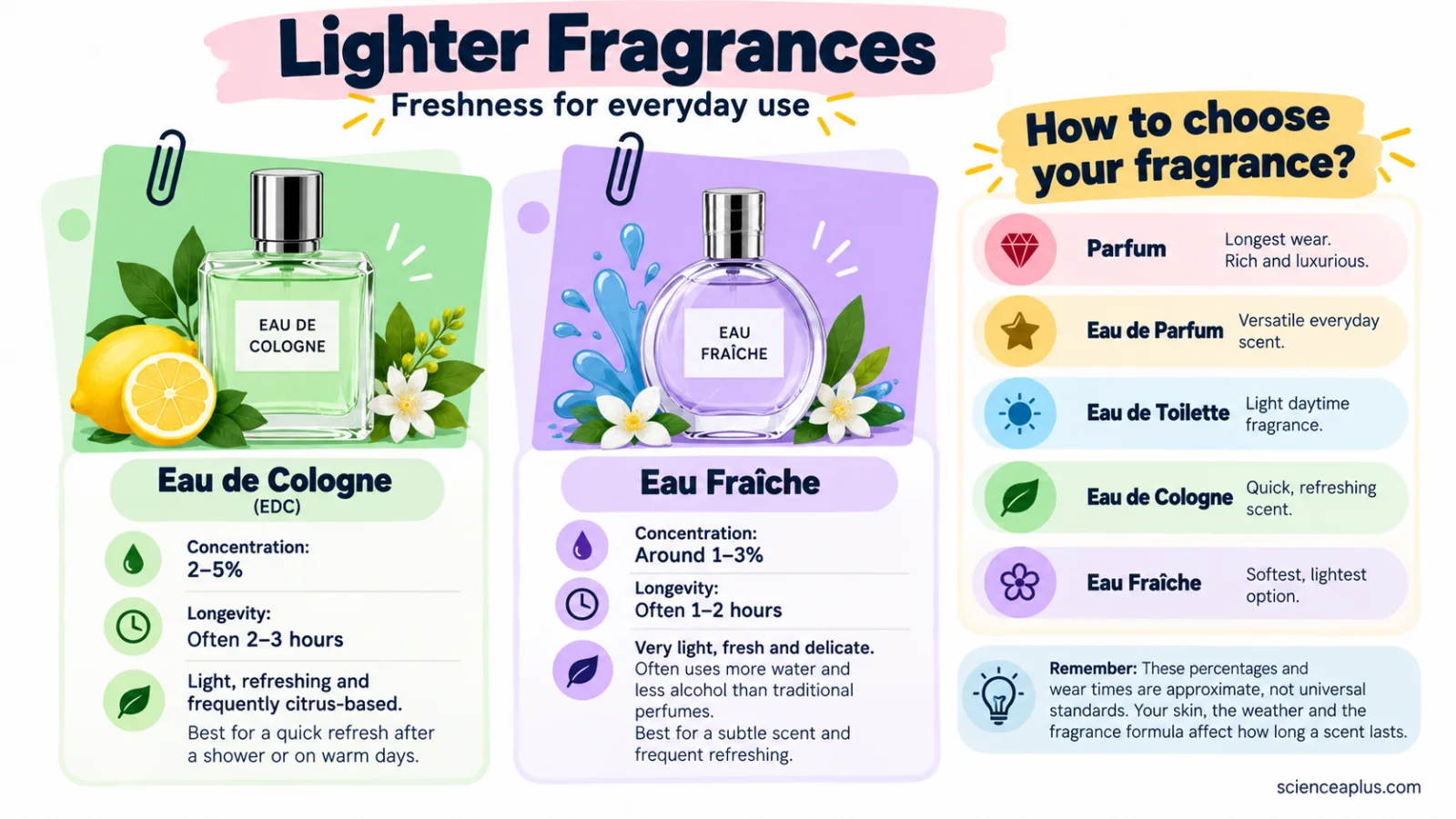
Eau de cologne and eau fraîche: the lightest types
Eau de cologne is traditionally credited to Giovanni Maria (Johann Maria) Farina, an Italian-born perfumer who settled in Cologne, Germany. The Farina firm dates from 1709. The original scent was citrus-led, built from bergamot, lemon and orange, and he named it after his adopted city.
When comparing eau de cologne vs eau de toilette, the cologne is lighter. A typical cologne holds only about 2–5% aromatic compounds, depending on the source, so the scent is bright but fades quickly. Today the word “cologne” is often used loosely, especially in the United States, for men’s fragrance in general.
So what is eau fraîche? It is the lightest category, at about 3% or less. Some eau fraîche products may be diluted with water rather than with oil or alcohol, which is one reason they are so light. If you are curious how water is purified, read about what distilled water is.
That covers the labels. The next question is what is actually inside the bottle, and where the molecules come from.
What is perfume made of? The chemistry of a bottle
So what is perfume made of? Three things, in most cases: a solvent, a blend of aroma compounds, and sometimes a little water. The solvent in fine fragrance is typically ethanol (C₂H₅OH). It has a relative formula mass of about 46 and boils at about 78 °C, so it evaporates easily and carries the scent molecules into the air.
The aroma compounds are the part you actually smell. Some come from plants, such as citrus peel, flowers and wood. Others are made by organic synthesis in a laboratory. Synthetic does not automatically mean cheaper, and natural does not automatically mean better; each is just a source of molecules with a particular structure.
The chemistry of perfume is therefore mostly the chemistry of small organic molecules that evaporate at skin temperature. Which molecules a perfumer chooses, and in what amounts, decides how the scent smells and how it changes with time.
Meet the molecules behind the smell
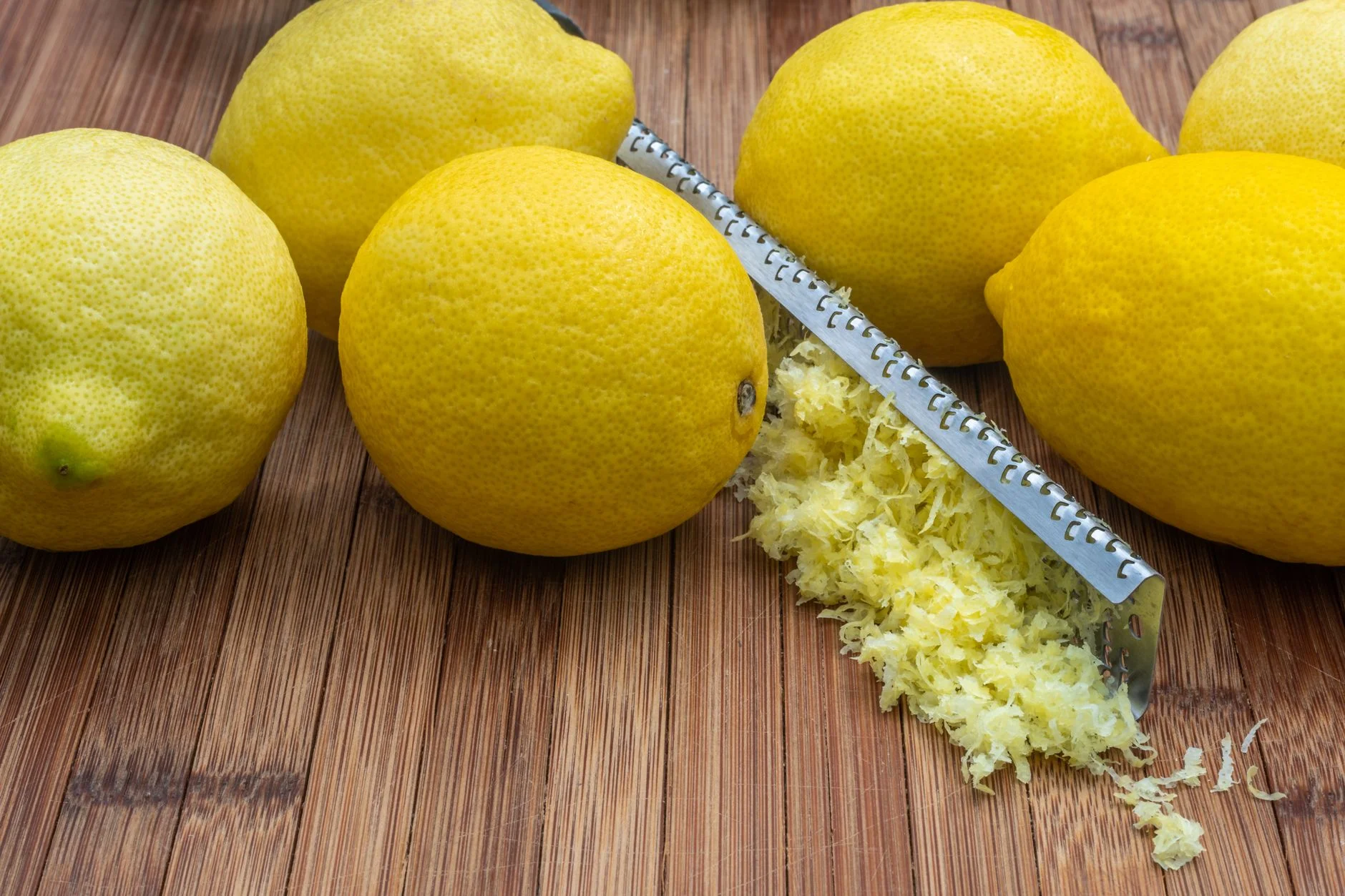
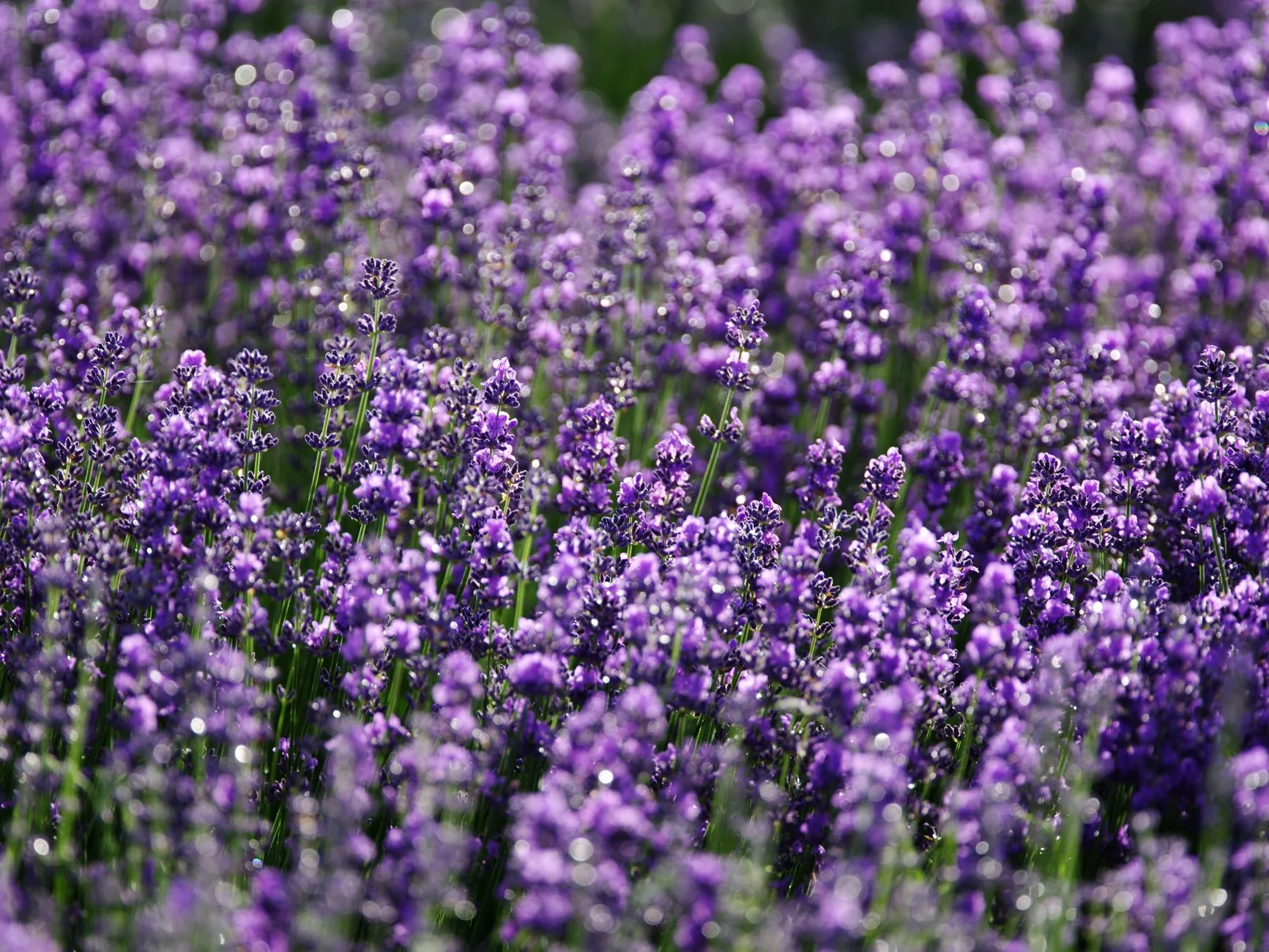
Four real aroma molecules show how different plants give different smells. Their boiling points matter a great deal later, when we look at evaporation.
| Molecule | Formula | Boiling point | Smells of / found in | Typical note |
|---|---|---|---|---|
| Limonene | C₁₀H₁₆ | about 176 °C | Lemon-like; the main compound in most citrus peel oils | Top |
| Linalool | C₁₀H₁₈O | about 198 °C | Main compound of lavender, with linalyl acetate | Middle |
| Geraniol | C₁₀H₁₈O | about 230 °C | A major component of rose oil | Middle |
| Vanillin | C₈H₈O₃ | about 285 °C | The main smell compound of vanilla | Base |
Expressed lemon oil averages about 65% limonene, so limonene is a large part of a lemon’s smell. Lavender is rich in linalool and linalyl acetate. Rose oil contains geraniol among its major compounds. The “typical note” column is a simplification, because perfumers combine many molecules, but boiling point is a good clue to where each one sits.
How aroma compounds are extracted from plants
Perfumers cannot simply squeeze a rose. The aroma compounds are a tiny part of the plant, so they have to be separated from everything else. This is separation chemistry in action, and several of the methods are ones you meet at school. If you want the wider picture, see our guide to compound separation techniques in chemistry.
Steam distillation
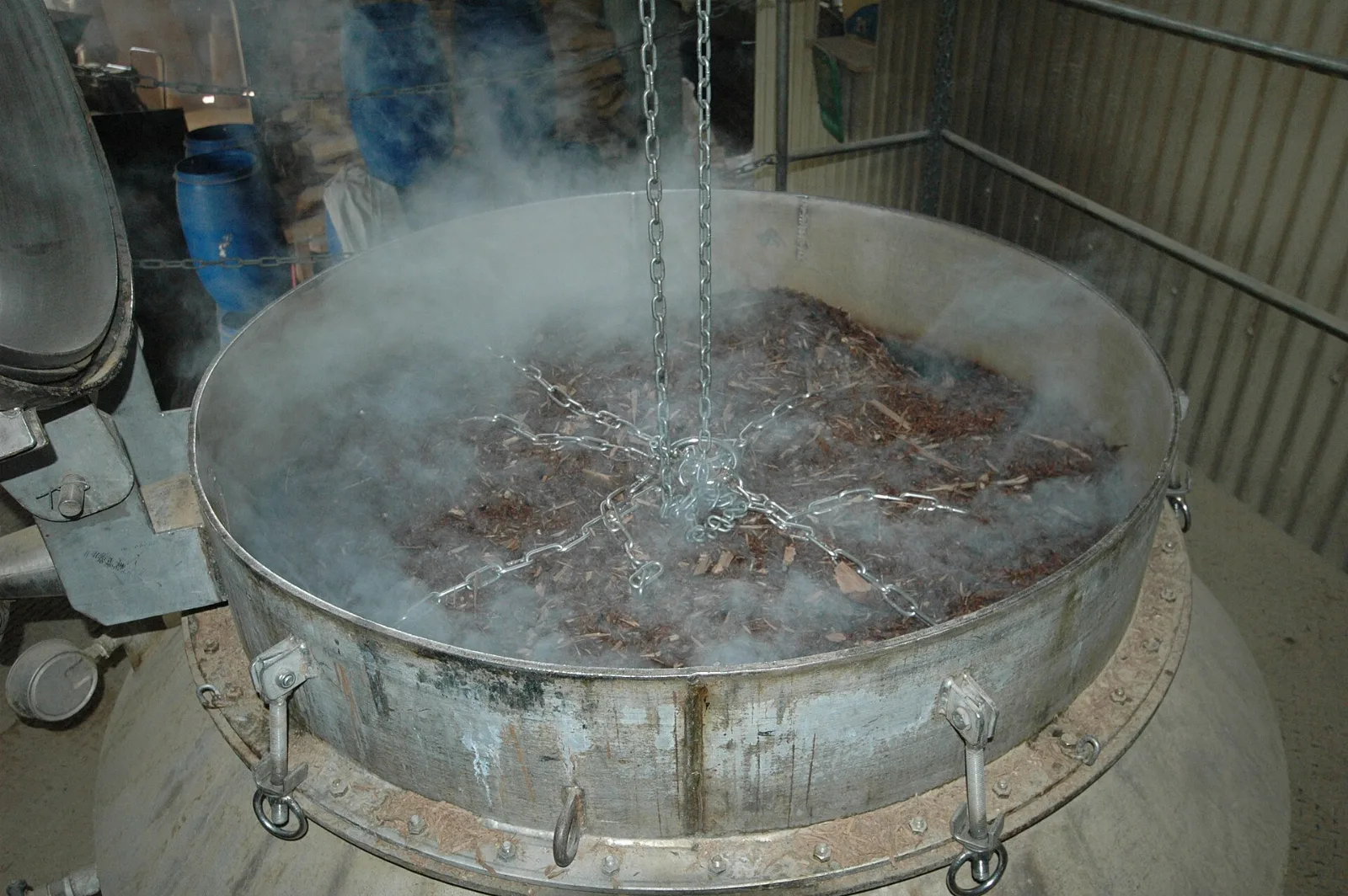
In steam distillation, steam passes through plant material and carries the volatile aroma compounds out with it. The vapour is then cooled and condenses back into a liquid. Because oil and water do not mix, the oil separates from the water. In a traditional Florentine flask the oil floats on top and the water can be drained away.
The leftover scented water is called a hydrosol. This method is used for fresh flowers, leaves and stems, such as rose and orange blossom, and also for woods such as sandalwood, shown here in an oil still.
Expression
Citrus peel oils are different. The peel contains so much oil that it can be pressed out directly, a method called expression or cold pressing. No heat is used, so the delicate citrus oils are not damaged.
Solvent extraction: concretes and absolutes
For some plant materials, steam is not the method used. Instead, the plant material is soaked in a solvent such as hexane. This produces a waxy substance called a concrete. Ethanol is then used to extract the aroma compounds from the concrete, giving an absolute. Solvent extraction is the most used and economically important extraction technique in modern perfumery.
A newer method uses supercritical carbon dioxide, which can extract aroma compounds at low temperatures.
Enfleurage
Enfleurage, which soaks scent into fat, is a historic method that is now largely obsolete.
Is perfume safe? Flammability and allergens
Two safety points follow directly from the chemistry. The first is flammability. Ethanol has a flash point of about 13–14 °C, which means its vapour can ignite near a flame at normal room temperatures. A perfume with a high ethanol content is therefore flammable.
The second point is allergens. Some aroma molecules can cause skin reactions in some people. In the EU, Regulation (EU) 2023/1545 extends the list of fragrance allergens that must be named on cosmetic labels from 24 to more than 80 substances. They must be listed when present above 0.001% in leave-on products and 0.01% in rinse-off products. New products placed on the EU market from 31 July 2026 must comply, and products already on the market may continue to be made available until 31 July 2028. This is EU law. Great Britain sets its own cosmetics rules, so check current UK government guidance rather than assuming the EU dates apply (Northern Ireland generally follows EU cosmetics rules under the Windsor Framework).
IFRA: the industry’s own safety limits
Alongside the law, the fragrance industry polices itself. The International Fragrance Association (IFRA) is its self-regulatory body. Its Standards place some fragrance ingredients in one of three groups: prohibited, restricted to set amounts, or allowed only to a specification, using safety data gathered by the Research Institute for Fragrance Materials (RIFM). In practice that means a limit on how much of a given molecule a product can contain. It is a concentration idea again: safety is judged as a percentage of the finished product.
You may see names such as linalool, limonene or geraniol in an ingredients list. These are the same molecules from the table above. Anyone who reacts to a fragrance should stop using it and speak to a pharmacist or GP. For more on why some substances trigger reactions, read about the most common allergy.
The photographs below show where this chemistry happens in practice: a perfumer’s bench and the testing of a sample.
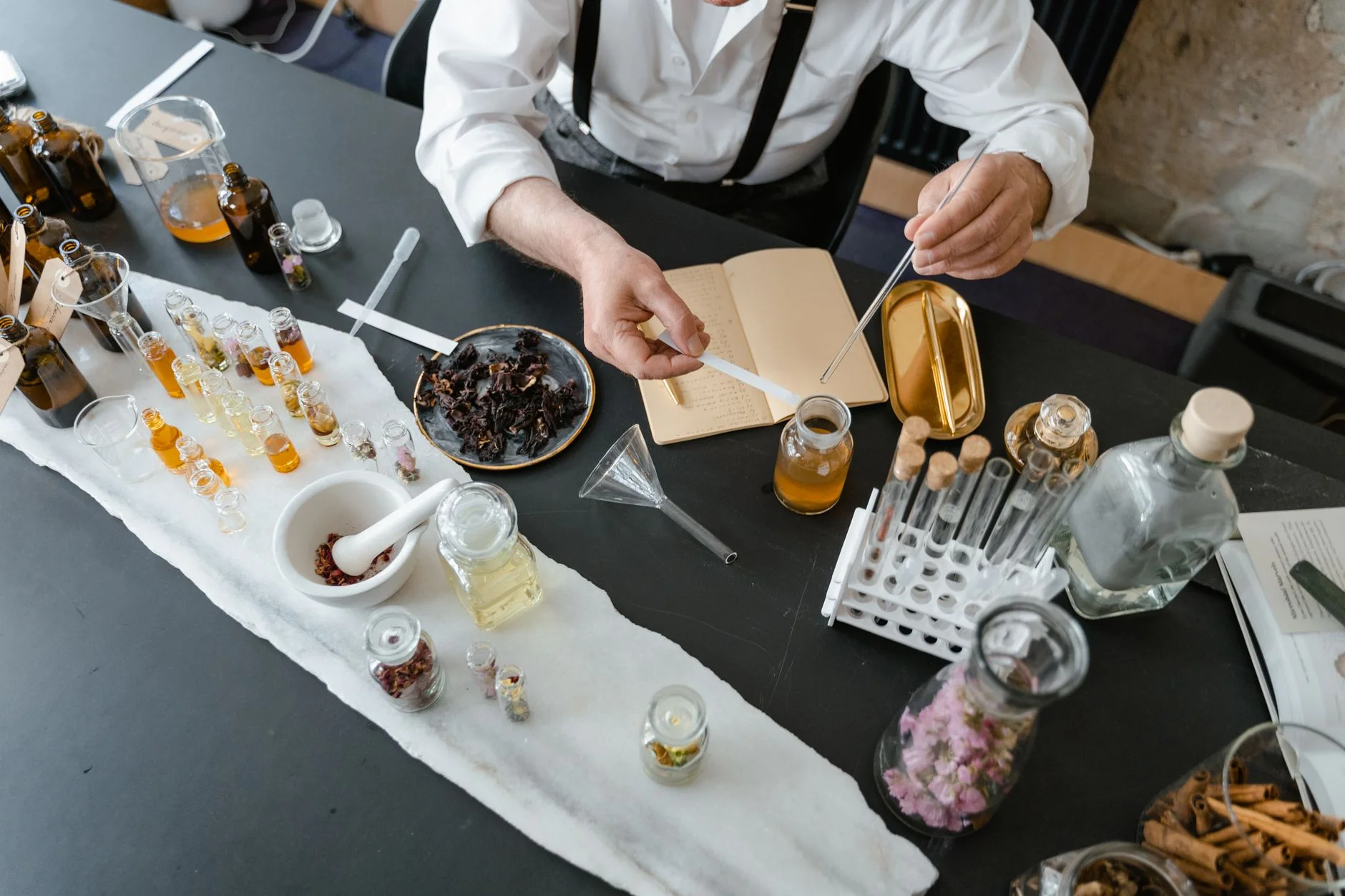
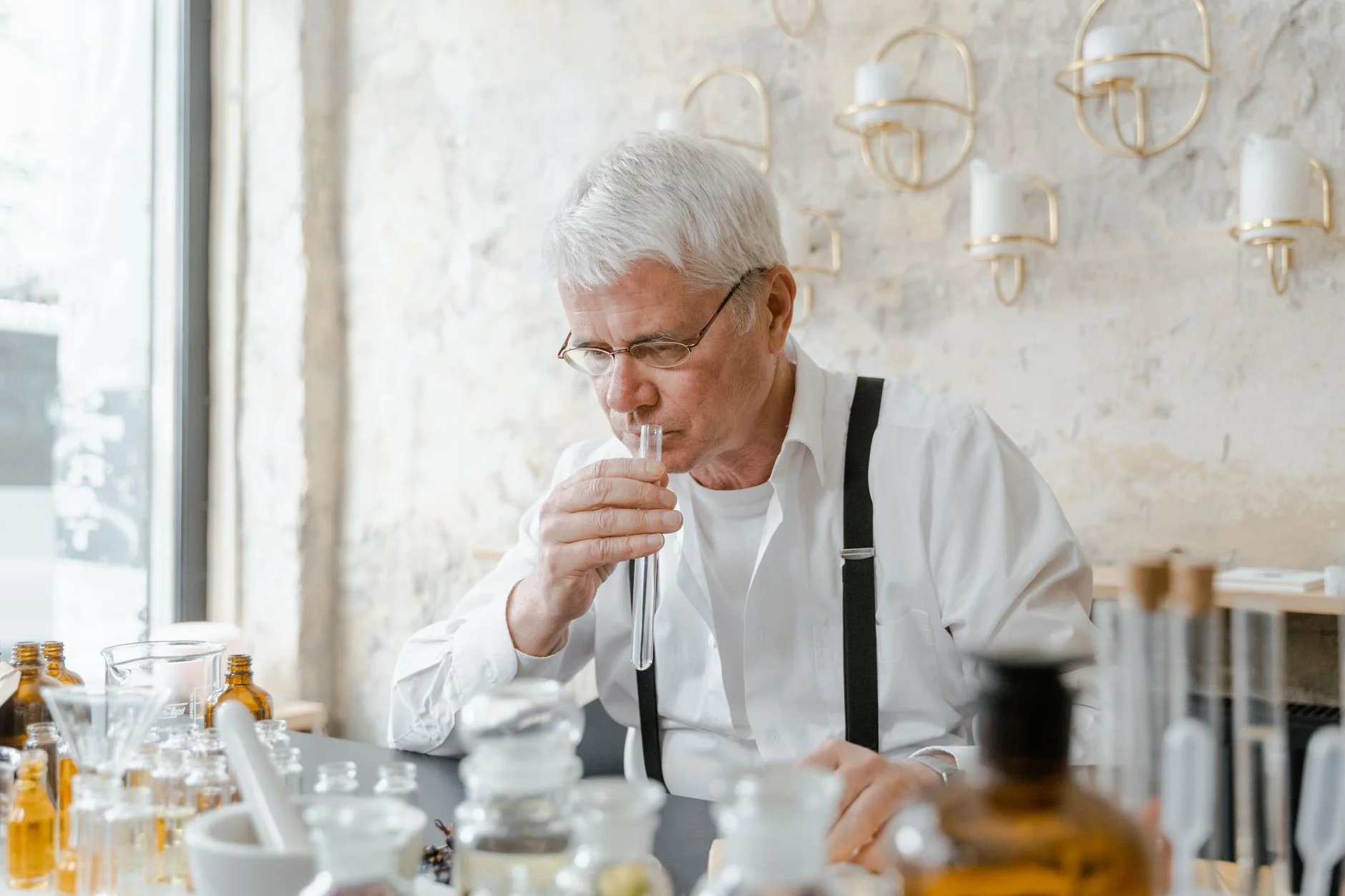
Why perfume evaporates: volatility explained
A perfume can only be smelled because its molecules leave the liquid and enter the air. That change from liquid to gas is evaporation, and the particle model explains it. The particles in a liquid are held together by forces between molecules. A particle at the surface that gains enough energy can break free and become a gas.
How easily that happens is called volatility. A substance with weaker forces between its molecules has a lower boiling point and evaporates more readily at skin temperature. Boiling point is therefore a useful guide to volatility, although it is a simplification and not an exact timer.
Look back at the molecule table above. Ethanol, with a boiling point of about 78 °C, evaporates first. That is why a splash of perfume feels cool on your skin: evaporation takes energy from the surface it leaves. Limonene (about 176 °C) comes next, then linalool (about 198 °C) and geraniol (about 230 °C). Vanillin (about 285 °C) is far less volatile and stays on the skin the longest.
How a scent spreads: evaporation then diffusion
Evaporation gets the molecules into the air, but you still have to smell them. They spread by diffusion, the net movement of particles from a region of higher concentration to a region of lower concentration. Close to your skin there are lots of scent molecules; a metre away there are very few. Random motion, and any draught in the room, carries them outwards until someone’s nose picks them up.
Warm skin gives the molecules more energy, so they escape faster. This is the same kinetic idea behind a hot drink steaming more than a cold one. It is also one reason a fragrance can seem stronger on a warm day.
Our noses are remarkably sensitive to some molecules. Gas suppliers add a strong-smelling chemical to natural gas so leaks are noticed, as explained in our article on ethyl mercaptan and gas smell. Perfume uses the same principle: only a tiny number of molecules need to reach the nose.
Top, middle and base notes
Perfumers group ingredients by volatility into three levels, called notes. The scale used by the perfumer Poucher gave each material an evaporation coefficient from 1 to 100. Top notes score about 1–14, middle notes about 15–60 and base notes about 61–100.
- Top notes are small, light molecules that evaporate quickly. They form the first impression when you spray.
- Middle (heart) notes become noticeable as the top notes fade, usually after about 20 minutes to an hour.
- Base notes are the least volatile, heaviest molecules. They linger for hours, and on a paper strip they can last for days.
Here is the key idea: all notes begin evaporating at the same moment. The scent seems to change only because the fast-evaporating molecules run out first, leaving the slower ones behind. Some perfumers also add a fixative, such as benzoin, which slows the evaporation of the whole blend.
Test your understanding with the flip cards. Tap each one to see whether the molecule is a top, middle or base note.
Explain why the citrus smell of a perfume fades before the vanilla smell. (3 marks)
Limonene has a lower boiling point (about 176 °C) than vanillin (about 285 °C). This means the forces between limonene molecules are weaker. Limonene therefore evaporates faster and runs out first, leaving the vanilla smell.
Why does a higher concentration usually last longer?
A spray of parfum puts more aroma molecules on your skin than a spray of eau de cologne. There is simply more to evaporate, so the scent takes longer to disappear. That is the main reason a higher concentration usually lasts longer.
Many retail guides give wear times for each type. Treat them as a rough guide only, because skin, weather and the formula all change them.
| Type | Rough wear time (guide only) |
|---|---|
| Parfum | often 6–12+ hours |
| Eau de parfum | about 5–8 hours |
| Eau de toilette | about 3–5 hours |
| Eau de cologne | about 2–3 hours |
| Eau fraîche | about 1–2 hours |
This answers a common question: which lasts longer, eau de parfum or eau de toilette? On average the eau de parfum, but not always. The formula matters as much as the label. A blend rich in base notes can outlast a more concentrated one made mostly of top notes.
Skin, weather and why wear times vary
The infographic above says it plainly: your skin, the weather and the formula all affect how long a scent lasts. The particle model explains the weather part. Warmer air and warmer skin give molecules more energy, so more of them escape from the liquid each second and the scent may seem stronger at first but may fade sooner. On a cold day, evaporation is slower, so the scent may be fainter and spread less.
Skin differs between people, so the same perfume can last for different lengths of time on different wearers. Wear times are a rough guide, not a constant.
Maths practice: percentage concentration and dilution
Percentage concentration of a perfume is a ratio, so these questions use the same method as GCSE solutions work. Try them before opening the answers.
A 75 ml bottle of eau de parfum is 18% aroma compounds by volume. How many ml of aroma compounds does it contain? (2 marks)
75 × 18 ÷ 100 = 13.5 ml of aroma compounds. The other 61.5 ml is solvent (mostly ethanol, sometimes some water).
50 ml of a 20% perfume is diluted with ethanol until it is 10%. What is the final volume, and how much ethanol was added? (3 marks)
The aroma compounds stay the same: 50 × 20 ÷ 100 = 10 ml. Final volume = 10 ÷ 10 × 100 = 100 ml. Ethanol added = 100 − 50 = 50 ml. This is the same idea as c₁V₁ = c₂V₂.
Once a scent has left the skin and reached your nose, a different branch of science takes over. The final section follows the molecules inside your head.
How does smell work?
Smell is a chemical sense. When you sniff, odorant molecules travel up your nose and dissolve in a layer of mucus. There they bind to receptor proteins on the surface of smell-detecting cells. The cells send signals along nerve fibres to the olfactory bulb at the front of the brain, and from there to other brain areas.
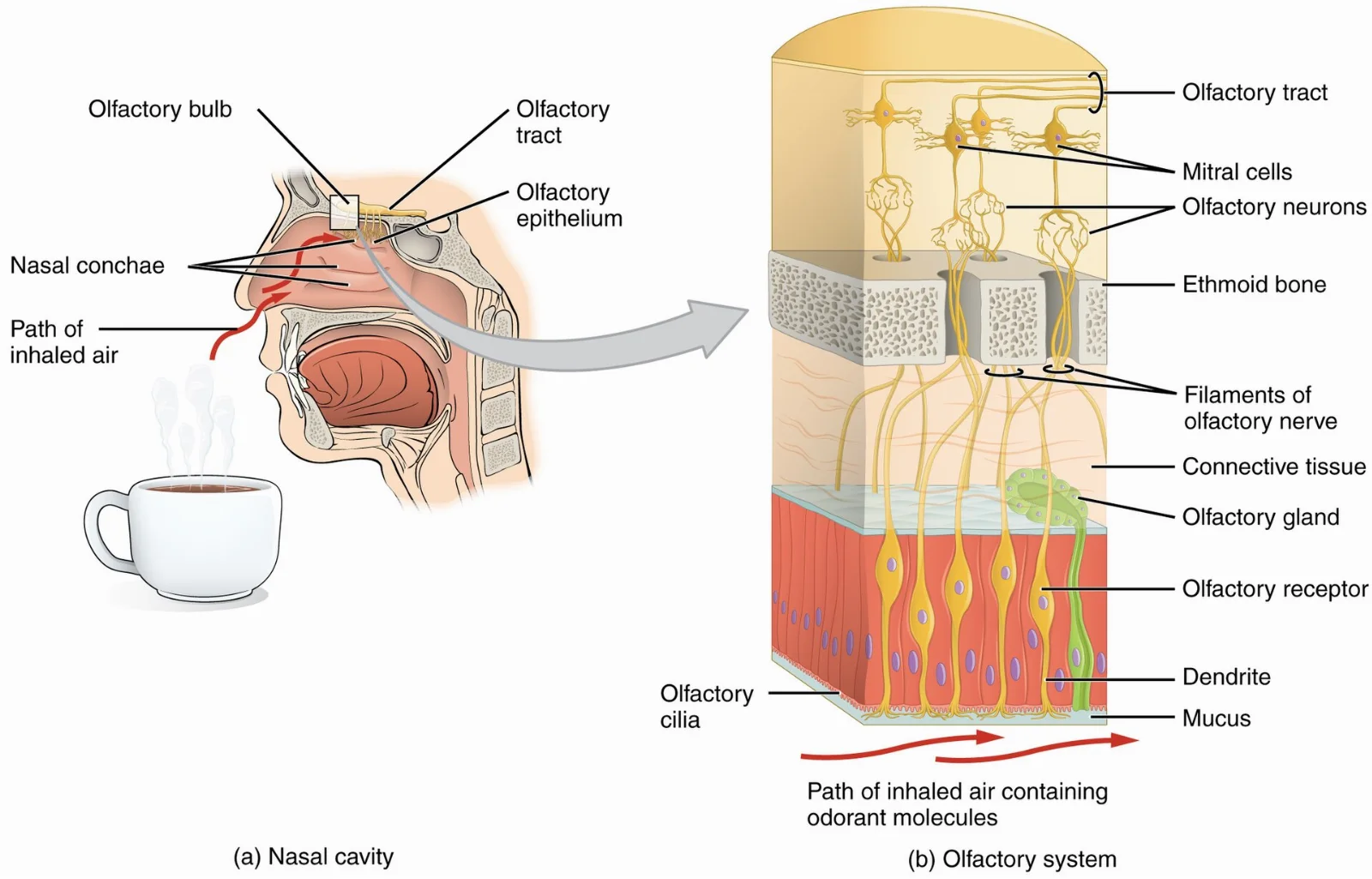
The details were uncovered by Richard Axel and Linda Buck, who won the 2004 Nobel Prize in Physiology or Medicine for discovering odorant receptors and how the olfactory system is organised. They found a family of about 1,000 genes, around 3% of our genes, that give rise to a similar number of receptor types. This work was done in mice. Humans have a somewhat smaller number, and roughly 400 of our odorant receptor genes are intact and working.
Three ideas make the system clever:
- Each smell-detecting cell carries only one type of receptor, and each receptor type detects a limited number of odorants.
- Cells with the same receptor send their nerve fibres to the same spot in the olfactory bulb, called a glomerulus. There are about 2,000 of them.
- Most odours are made of several molecules, and each molecule activates several receptors. The result is a pattern, like a mosaic, that the brain reads as one smell.
This combination code lets us recognise and remember about 10,000 different odours. It also explains why a perfume smells like a single scent, even though it is a blend of many molecules. Dogs do even better: the olfactory epithelium of a dog is about 40 times larger in area than ours. To explore the wider system, see our article on neuroscience and the brain.
Why scents trigger memories

Have you ever smelled something and been taken straight back to a place or a person? That is not imagination. Signals from the olfactory bulb reach the amygdala and the hippocampus, brain areas involved in emotion and memory. This close connection helps explain why scents can trigger strong memories.
It is one reason perfumers think about more than chemistry. A scent is also a message to the part of the brain that stores feelings. Whether a particular smell feels pleasant, though, depends on each person’s experience.
Why can’t I smell my own perfume?
Nearly everyone has noticed it. You put perfume on in the morning, and an hour later you cannot smell it, yet a colleague says it is still obvious. The effect is called olfactory adaptation, sometimes nicknamed “nose blindness”. With constant exposure, our perception of an unchanging smell fades.
The molecules have not vanished. Your nose and brain have simply stopped paying attention to a smell that has not changed, which frees them to notice new ones. This is a useful feature of the sense, but it means you are a poor judge of how strong your own fragrance is.
If you are curious about training and testing your sense of smell, see our guide to aromatherapy and olfactory exercises.
Frequently asked questions about parfum, eau de parfum and eau de toilette
Which lasts longer, eau de parfum or eau de toilette?
On average, eau de parfum lasts longer because it contains more aroma compounds, roughly 15–20% against about 5–15%. Wear times are only a rough guide, though. Skin, weather and the formula all matter, and a base-note-rich eau de toilette can outlast a lighter eau de parfum.
Is parfum stronger than eau de parfum?
Usually, yes. Parfum, also called extrait, typically holds about 15–30% aroma compounds, which is at the top of the chart. However, there is no legal standard for these percentages, so a particular eau de parfum from one maker may be stronger than a parfum from another.
What does eau de toilette mean?
Eau de toilette is French for “toilet water”, where toilette meant getting washed and dressed rather than the bathroom. It is a fragrance with a moderate concentration of aromatic compounds, commonly quoted as about 5–15%, which makes it lighter than an eau de parfum.
What is the difference between eau de cologne and eau de toilette?
Eau de cologne is lighter. It usually contains only about 2–5% aromatic compounds, while eau de toilette contains about 5–15%. Cologne takes its name from Cologne in Germany, where Farina made a citrus-led scent that gave the style its name. The word describes concentration, not whether a fragrance is for men or women.
What is eau fraîche?
Eau fraîche is the lightest fragrance type, usually quoted at about 3% aromatic compounds or less. Some products may be diluted with water rather than with oil or alcohol. It is the lightest of the five types in our chart.
Is there a legal standard for perfume concentrations?
No. There is no legal standard that fixes the percentages for eau de parfum, eau de toilette or the other types. They are industry conventions, which is why sources quote different ranges, and why an eau de toilette from one fragrance house can be more concentrated than an eau de parfum from another.
What is perfume made of?
Perfume is made of aroma compounds dissolved in a solvent, which is typically ethanol, sometimes mixed with water. The aroma compounds can come from plants, through methods such as distillation, expression and solvent extraction, or be made by organic synthesis. Together they form a solution.
What are top, middle and base notes?
Notes group aroma materials by how quickly they evaporate. Top notes are light and evaporate fast, forming the first impression. Middle notes appear as the top notes fade, after roughly 20 minutes to an hour. Base notes evaporate slowest and linger for hours, which gives a scent its lasting character.
Why can’t I smell my own perfume?
This is olfactory adaptation. When you are exposed to an unchanging smell for a long time, your perception of it fades, even though the molecules are still there. Other people, who have not been smelling it all day, can still notice it clearly.