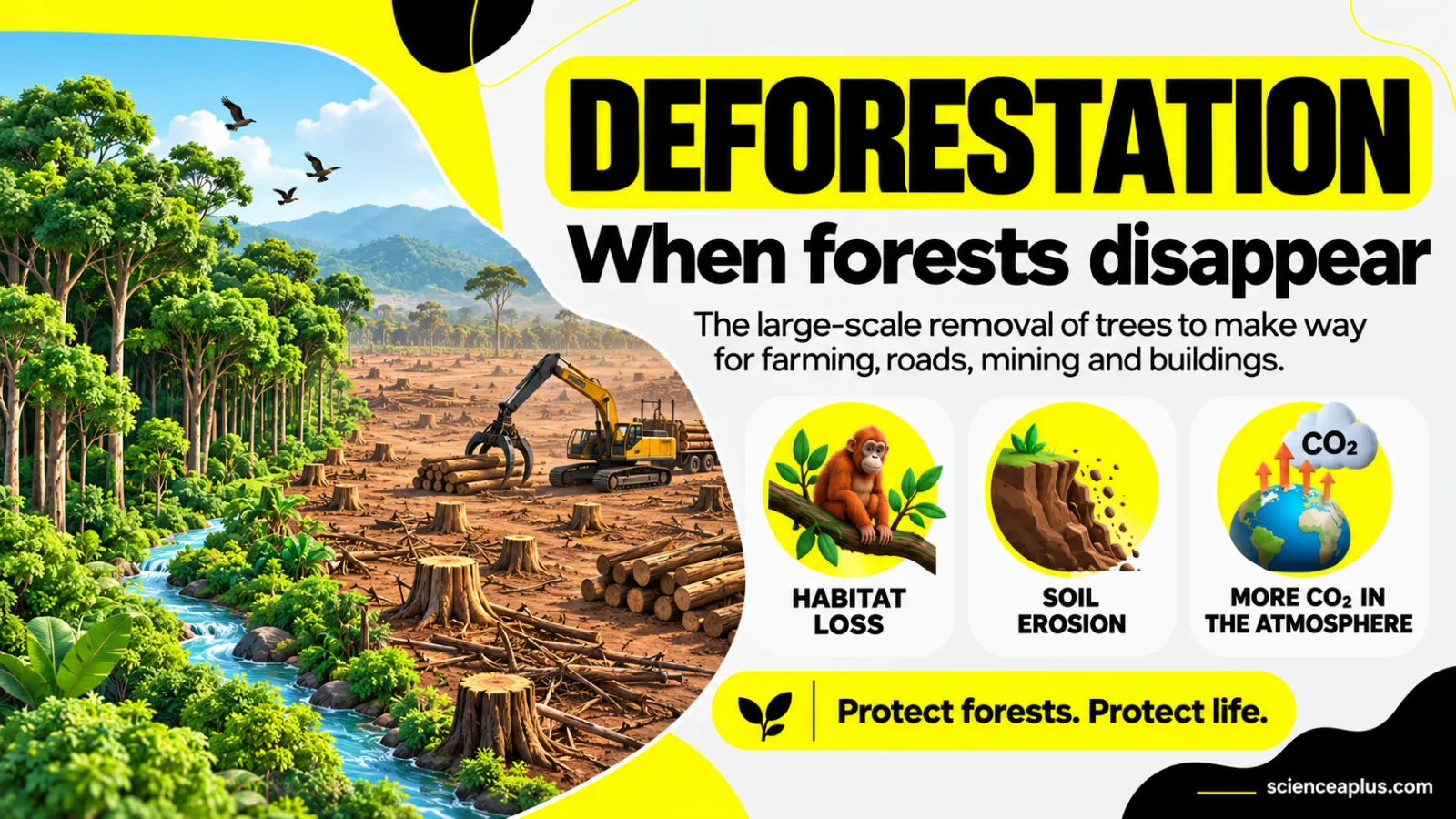
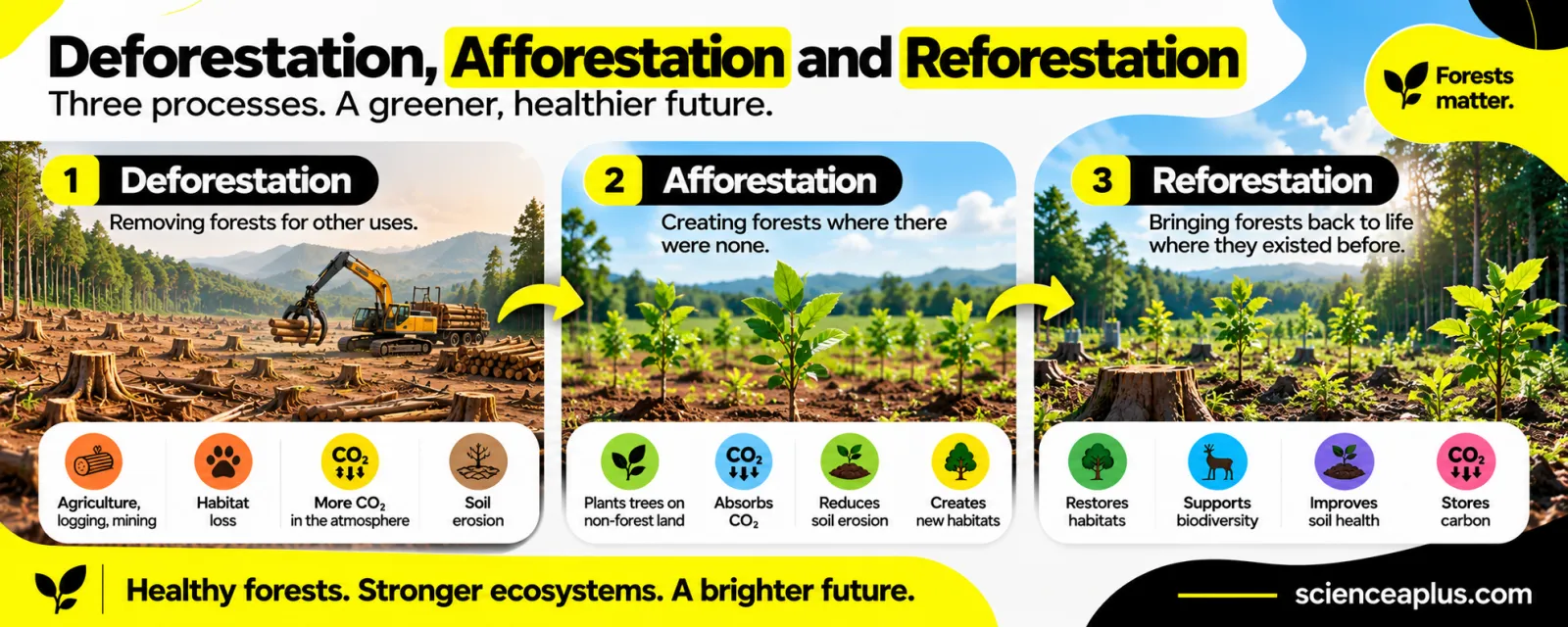
Deforestation, afforestation and reforestation describe three different things that happen to forests. Deforestation is forest being cleared and turned into another use, such as farmland. Afforestation is planting a new forest where there was none. Reforestation is bringing a forest back to land where it grew before.
The scale of forest loss is hard to picture. In 2025, about 4.3 million hectares of tropical primary forest were lost, which is more than 11 football pitches every minute. This article explains the three terms, the science behind the damage (carbon, water and soil), the effect on jungle species, the latest 2025 data and some worked maths questions.
Deforestation, afforestation and reforestation: what’s the difference?
The three words sound alike, so they are easy to mix up. Each one follows the meanings used by the UN Food and Agriculture Organization (FAO), which is the source for most official forest statistics.
- Deforestation is the conversion of forest to another land use, such as farmland, mines, roads or towns.
- Afforestation is establishing forest, by planting or deliberate seeding, on land that was not forest before (or has not been for a long time), for example grassland or old farmland.
- Reforestation is re-establishing forest on land that was forest and was cleared, by planting, seeding or natural regeneration.
The table below compares them side by side.
| Process | What happens to the land | Example | Effect on CO₂ | Effect on wildlife |
|---|---|---|---|---|
| Deforestation | Forest is cleared and the land gets a new use | Rainforest cleared for cattle pasture or oil palm | Stored carbon is released when the wood burns or rots, and the trees no longer absorb CO₂ | Habitat is lost, broken up or degraded |
| Afforestation | New forest is created where there was none | Woodland planted on old farmland | Growing trees absorb CO₂ over many years | New habitat appears, but only slowly |
| Reforestation | Forest returns to land that was forest before | Replanting after logging or a wildfire | Growing trees absorb CO₂ again | Native habitats are restored |
What is deforestation?
The word deforestation has a precise meaning. In FAO statistics it is the conversion of forest to another land use. That matters because cutting trees down is not always deforestation. If a plantation is felled and the trees are allowed to grow back, the land stays forest, so the felling does not count.
It also explains why you will see different figures for forest loss. Satellite projects such as Global Forest Watch report tree cover loss, which includes fire, storms and logging where forest may regrow. FAO reports deforestation, which is a permanent change of land use. Tree cover loss is not the same as deforestation, and it is worth stating this difference in an exam answer.
Forests are a huge resource to lose. One study published in 2015 estimated that there are about 3 trillion trees on Earth, roughly 422 for every person alive at the time. The same study found that people cut down over 15 billion trees each year and that the number of trees has fallen by about 46% since the start of human civilisation.
The layers of a forest also matter when we count the damage. The top layer, the forest canopy, shelters the animals, soil and cooler air below it, so removing it changes the whole ecosystem and not just the trees.
How much forest is the world losing? (2025 data)
Two big sources give the current picture. They use different methods, so the numbers do not match, but together they tell a clear story.
FAO Global Forest Resources Assessment 2025
The FAO report, launched on 21 October 2025 and covering 236 countries and areas, found that forests cover 4.14 billion hectares, about 32% of the world’s land. That is roughly a third of all the land on Earth.
- Deforestation slowed to 10.9 million hectares per year in 2015–2025, down from 17.6 million hectares per year in 1990–2000.
- Forest expansion (new forest from planting and natural spread) was 6.78 million hectares per year in 2015–2025.
- Net forest loss is deforestation minus expansion, so 10.9 − 6.78 = 4.12 million hectares per year. In the 1990s the net loss was 10.7 million hectares per year.
The net figure is lower than the deforestation figure, but do not read it as good news by itself. New plantations do not instantly replace the species, soil and stored carbon of an old forest.
Global Forest Watch: 2025 tree cover loss
The University of Maryland and the World Resources Institute published their 2025 data on 29 April 2026. It tracks tree cover loss by satellite.
- Tropical primary forest loss in 2025 was 4.3 million hectares. That is 36% less than in 2024, but still 46% higher than a decade earlier.
- 2024 was the record year, with 6.7 million hectares of tropical primary forest lost, nearly half of it caused by fire.
- Across all forest types, global tree cover loss was 25.5 million hectares in 2025, down 14%. Fires caused 42% of it.
- Brazil cut its primary forest loss not caused by fire by 41%, to the lowest level on record. Brazil still had the largest area of tropical primary forest loss, followed by Bolivia and then the Democratic Republic of the Congo. Indonesia’s primary forest loss rose from 2024 to 2025, though it stayed well below its mid-2010s peak.
Fire is a growing part of the story. FAO estimates that fires affect an average of 261 million hectares of land each year, nearly half of it forest.
Causes of deforestation
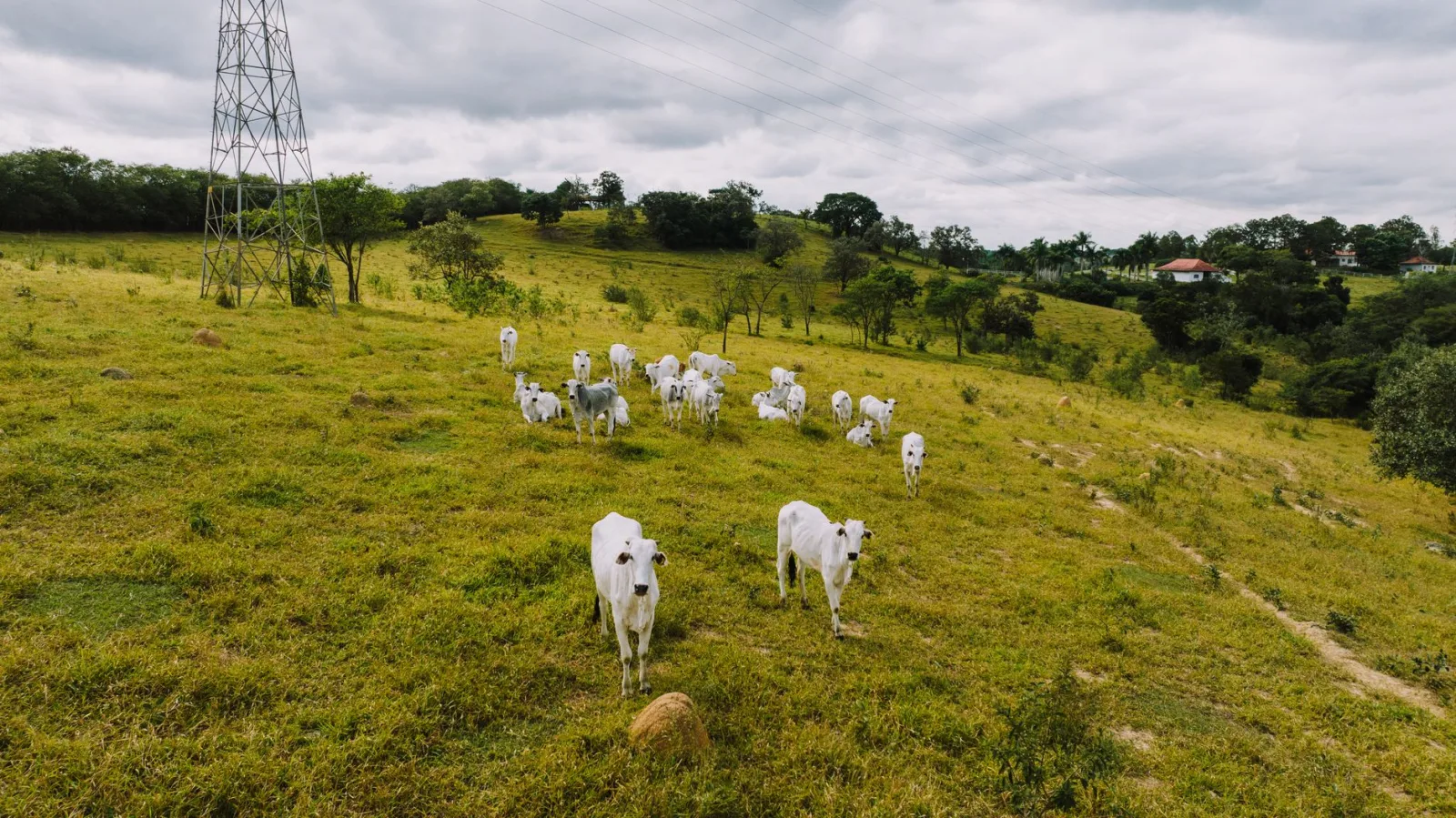
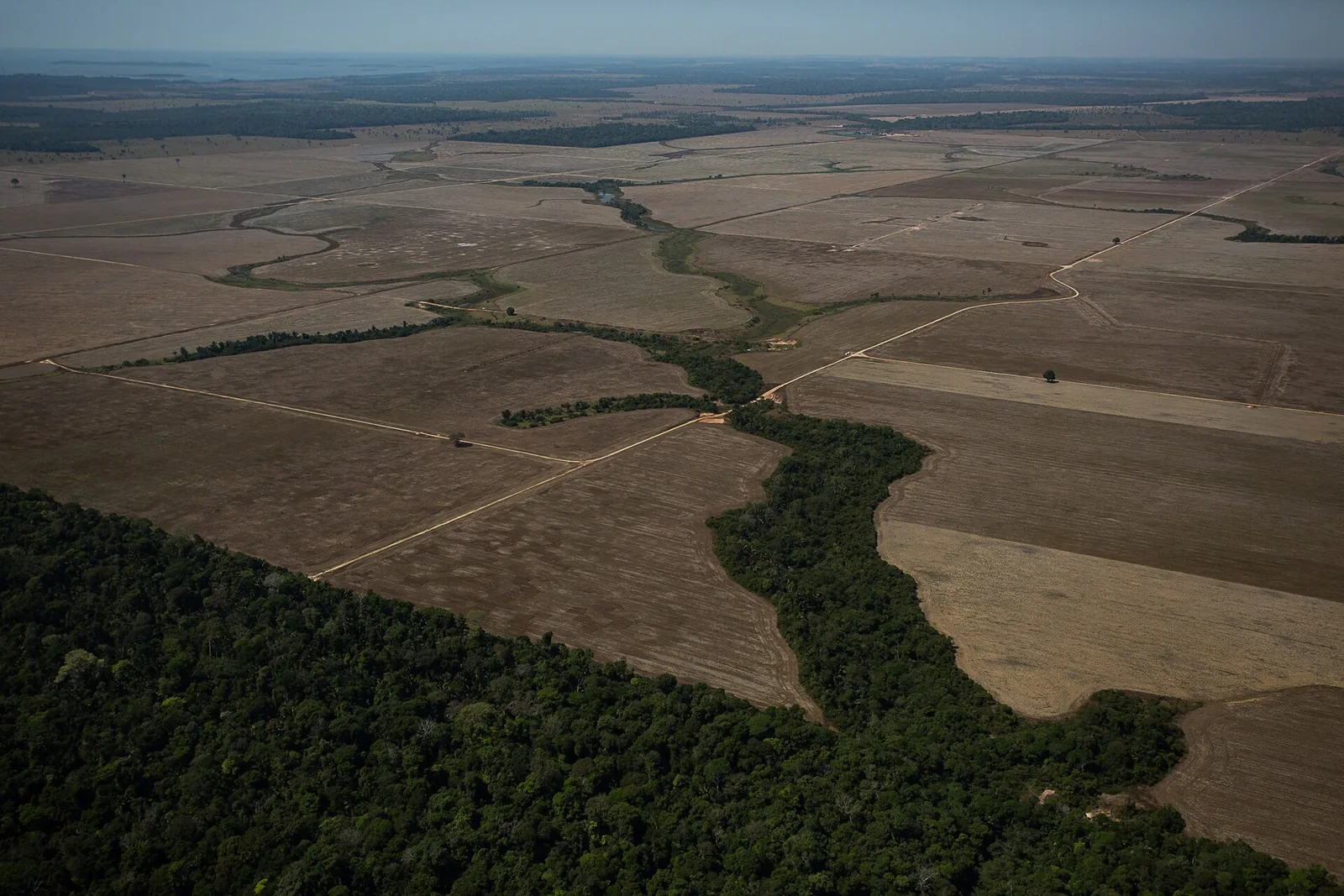
The main cause is simple: people want land to grow food. According to an FAO remote-sensing survey covering 2000–2018, agricultural expansion drives almost 90% of global deforestation. Cropland expansion accounts for almost half of forest loss (about 50%), and livestock grazing for almost 40%.
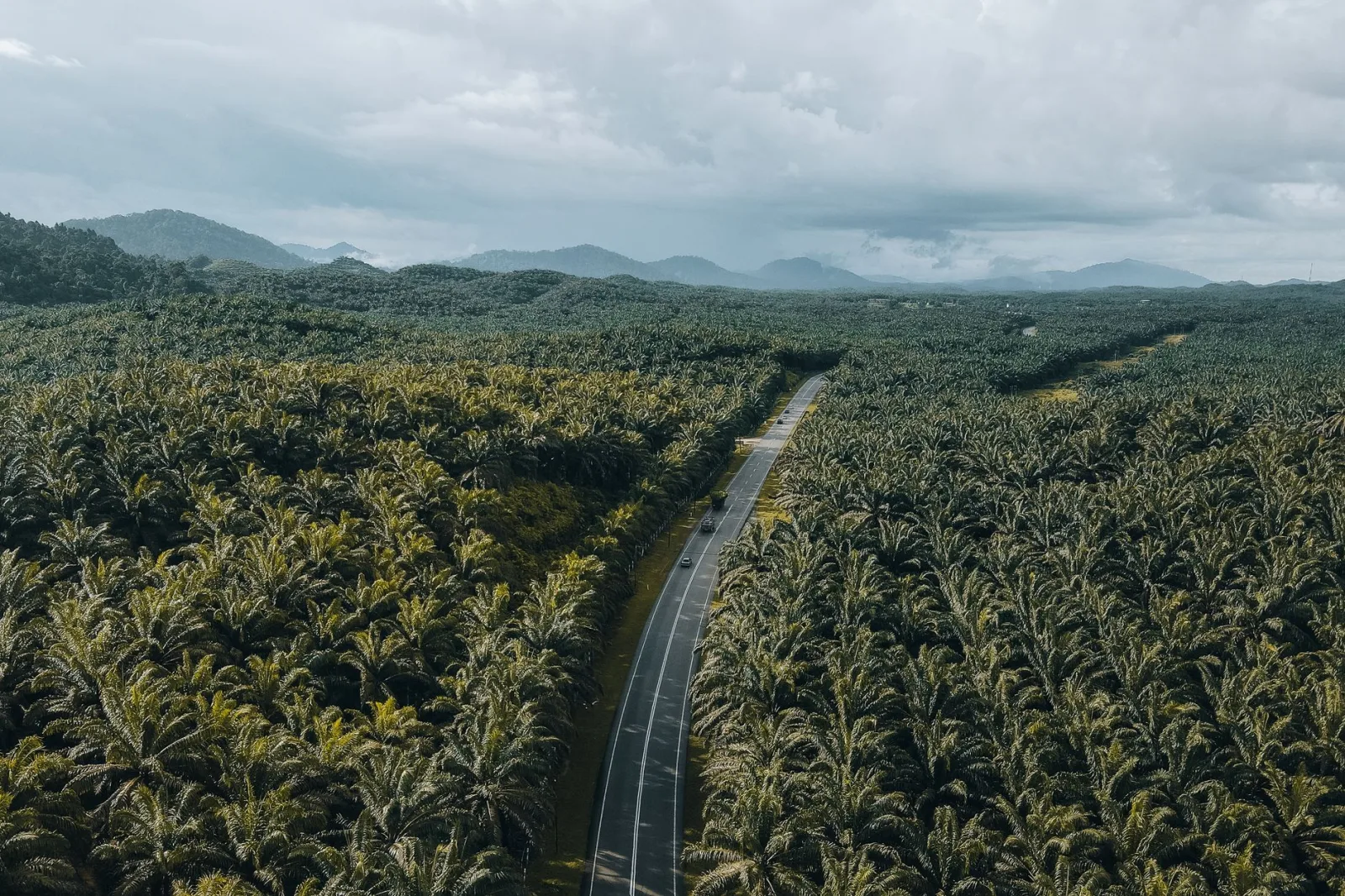
The pattern differs between continents. In South America almost three-quarters of deforestation is due to livestock grazing, which means cattle pasture. In Africa and Asia, conversion to cropland dominates, at over 75%. Crops linked to clearing in the tropics include soy and oil palm, and beef is linked to grazing.
Farming is not the only cause. Other drivers include:
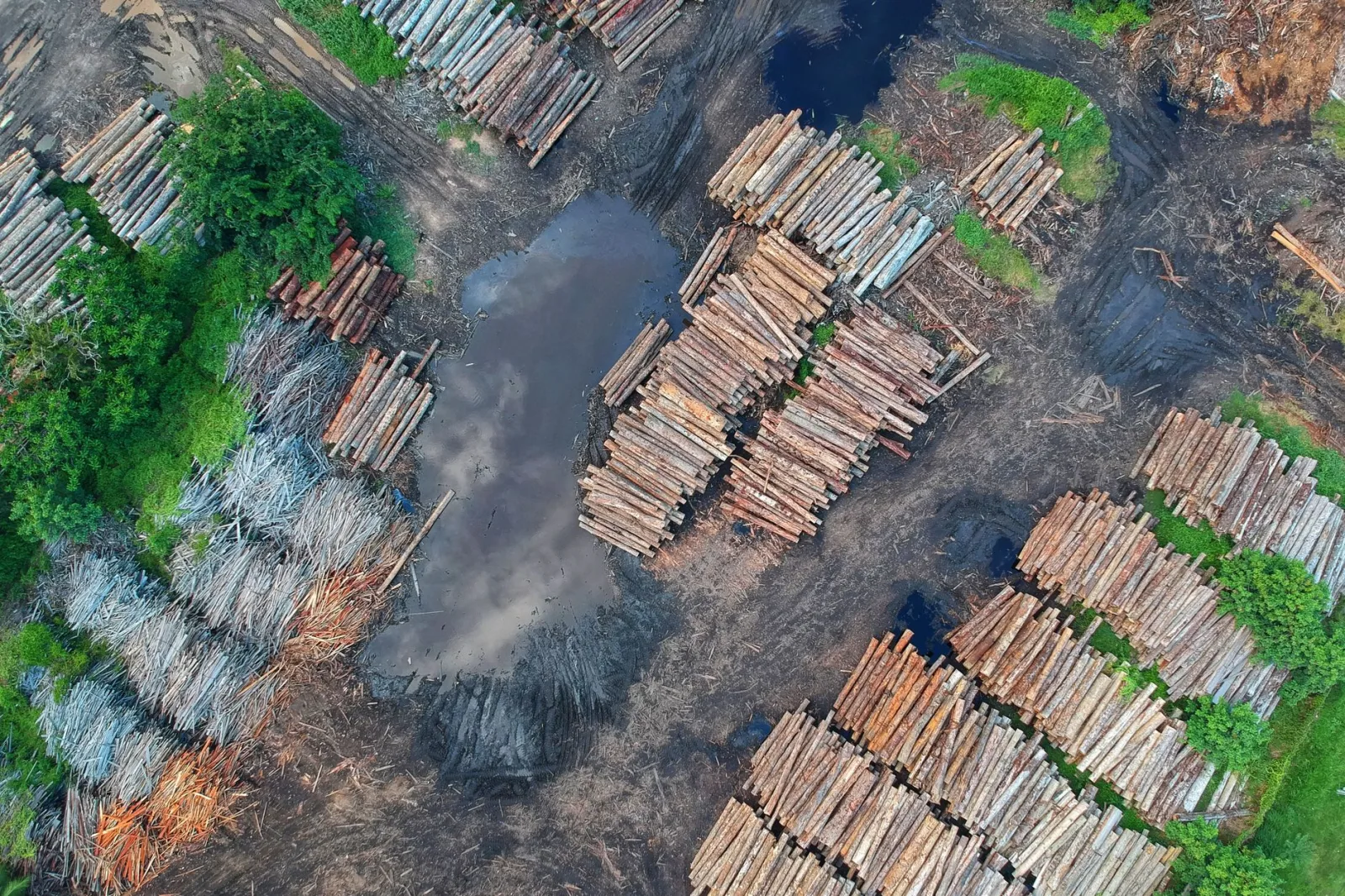
- Logging for timber and paper, which also opens up new roads into the forest.
- Mining, which clears land for pits and access tracks.
- Roads and towns, which cut forest into pieces and invite more clearing.
- Fire, which is often used to clear land and can spread into forest that was not meant to burn.
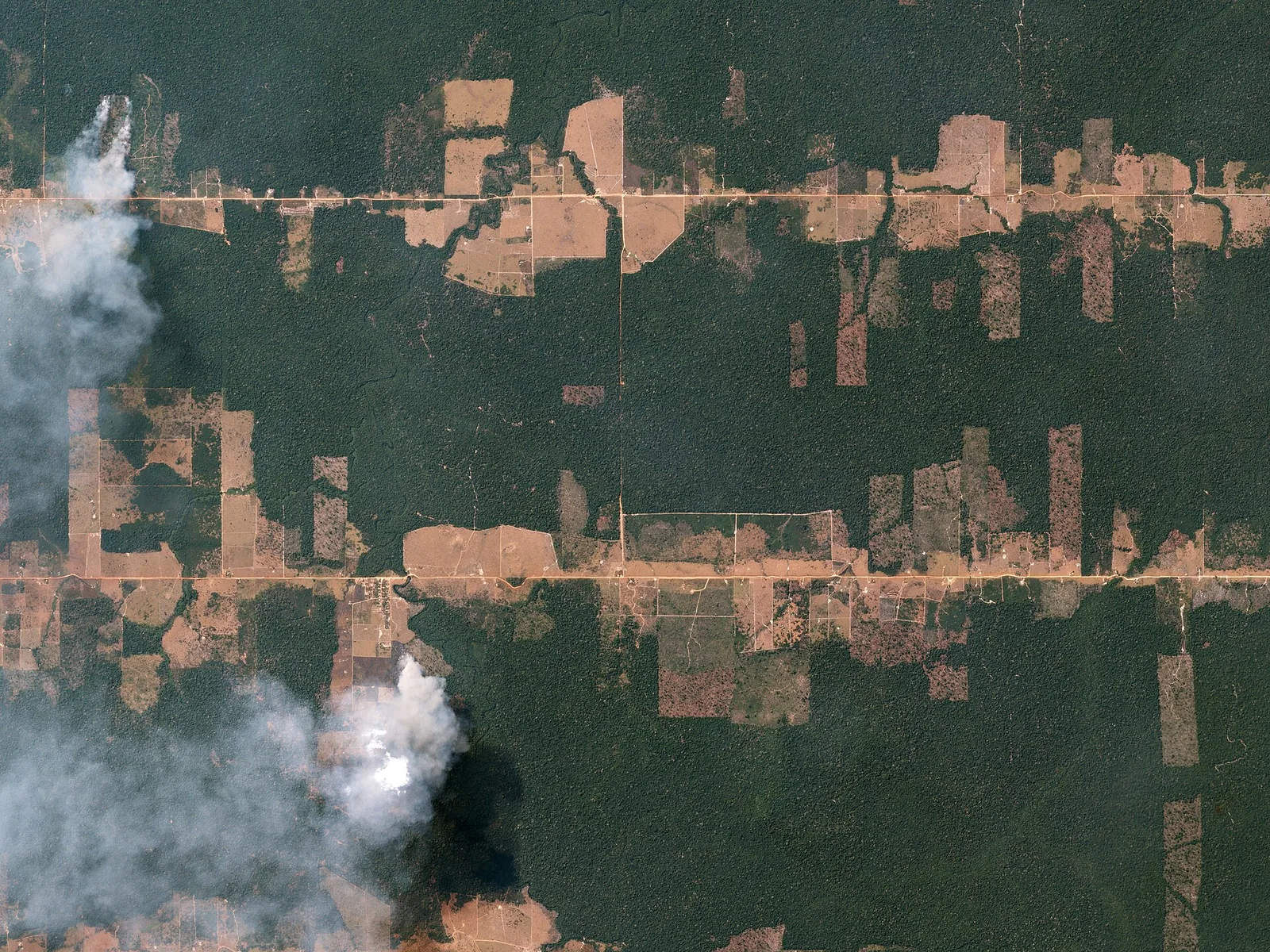
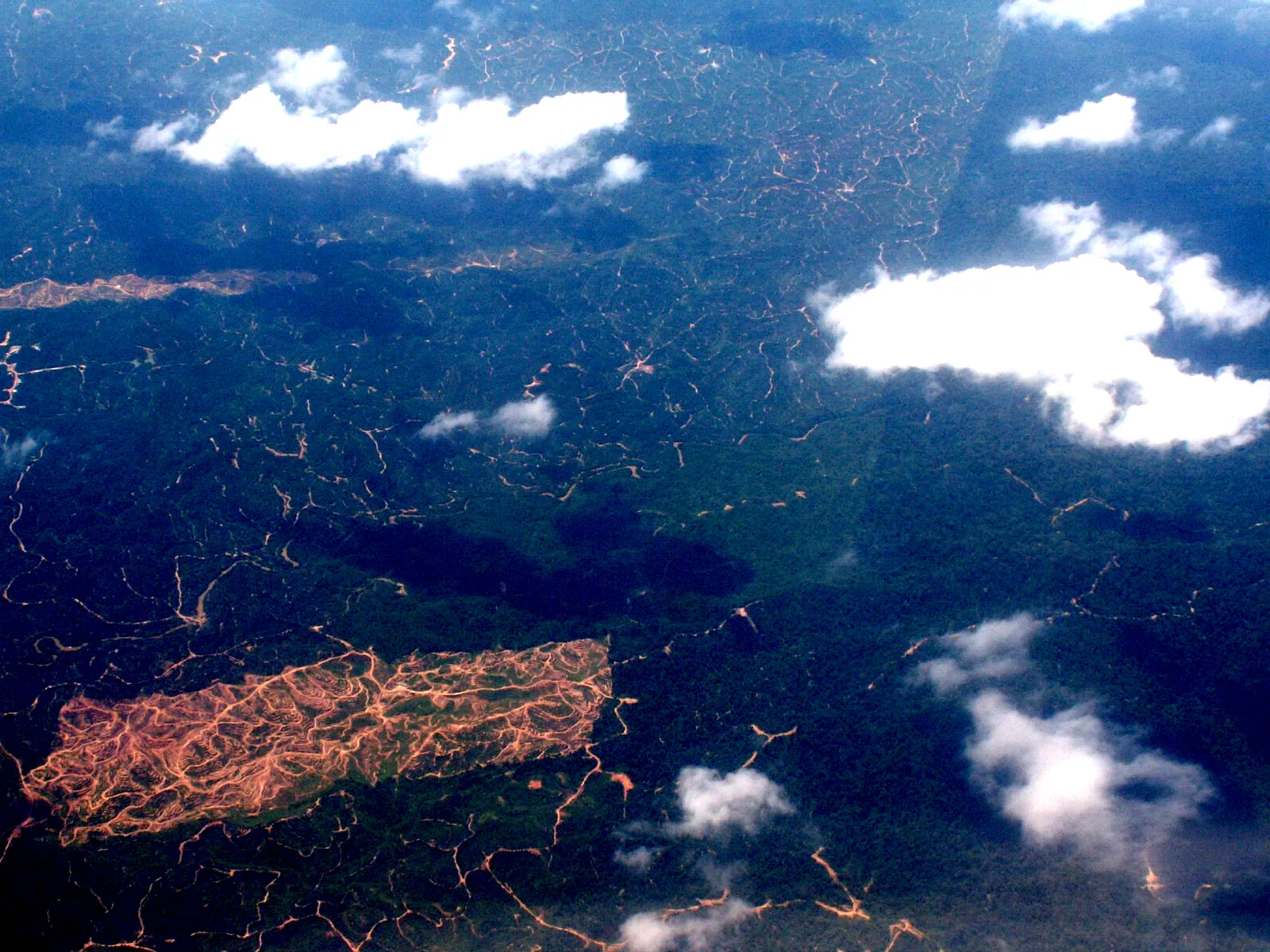
The photograph shows a famous pattern called a “fishbone”. A new road is cut into the forest first, and smaller side roads then branch off it, so the clearings form a herringbone shape. Roads make forests easy to reach, which is why they often come before large-scale clearing.
Most deforestation between 2000 and 2018 happened in tropical areas, and FAO’s earlier assessment found that about 420 million hectares of forest have been lost since 1990. Swipe through the pictures below to see some of the drivers on the ground.
Effects of deforestation on the carbon cycle
Forests are part of the carbon cycle, and the link starts with photosynthesis. Leaves take in carbon dioxide from the air and water from the soil, and use light energy trapped by chlorophyll to make glucose and oxygen.
6CO₂ + 6H₂O → C₆H₁₂O₆ + 6O₂
The glucose is turned into wood, leaves, roots and soil carbon. This is how a forest becomes a store of carbon. Forests worldwide hold about 714 gigatonnes of carbon, so what happens to them matters for the whole carbon cycle.
Deforestation affects the cycle in two ways. First, the cleared trees can no longer absorb CO₂. Second, the carbon already stored in them goes back into the air. If the wood is burned, combustion releases the carbon as CO₂ straight away. If it is left to rot, decomposers respire and release CO₂ more slowly. Extra CO₂ strengthens the greenhouse effect, which traps more heat in the atmosphere.
Do not confuse this with the CO₂ that your own body makes. That comes from respiration, and it is the gas carried to your lungs by your blood. Leaves do the opposite job on a vast scale, taking CO₂ in rather than putting it out.
The numbers behind the carbon story
- A 2021 study estimated that forests were a net sink of about 7.6 billion tonnes of CO₂ equivalent per year in 2001–2019. They emitted about 8.1 billion tonnes and absorbed about 15.6 billion tonnes. These figures are very uncertain, so treat them as estimates.
- The Global Carbon Budget 2025 projected emissions from land-use change, mostly deforestation, at about 4.1 billion tonnes of CO₂ in 2025. Fossil fuels were responsible for about 38.1 billion tonnes, so the total was about 42.2 billion tonnes.
- Over 2015–2024, Brazil, Indonesia and the Democratic Republic of the Congo together gave about 57% of net land-use change CO₂ emissions.
How much CO₂ does one tree lock up?
You can estimate this from the tree’s dry mass. Dry wood is roughly half carbon, and the IPCC default carbon fraction is 0.47. To turn a mass of carbon into a mass of CO₂, multiply by 44 ÷ 12, because the relative formula mass of CO₂ is 44 and the relative atomic mass of carbon is 12.
CO₂ = dry mass × 0.47 × 44 ÷ 12
For a large tree with 2,000 kg of dry wood: 2,000 × 0.47 = 940 kg of carbon, and 940 × 44 ÷ 12 ≈ 3,450 kg, or about 3.4 tonnes of CO₂. Try your own numbers in the calculator.
Effects of deforestation on the water cycle
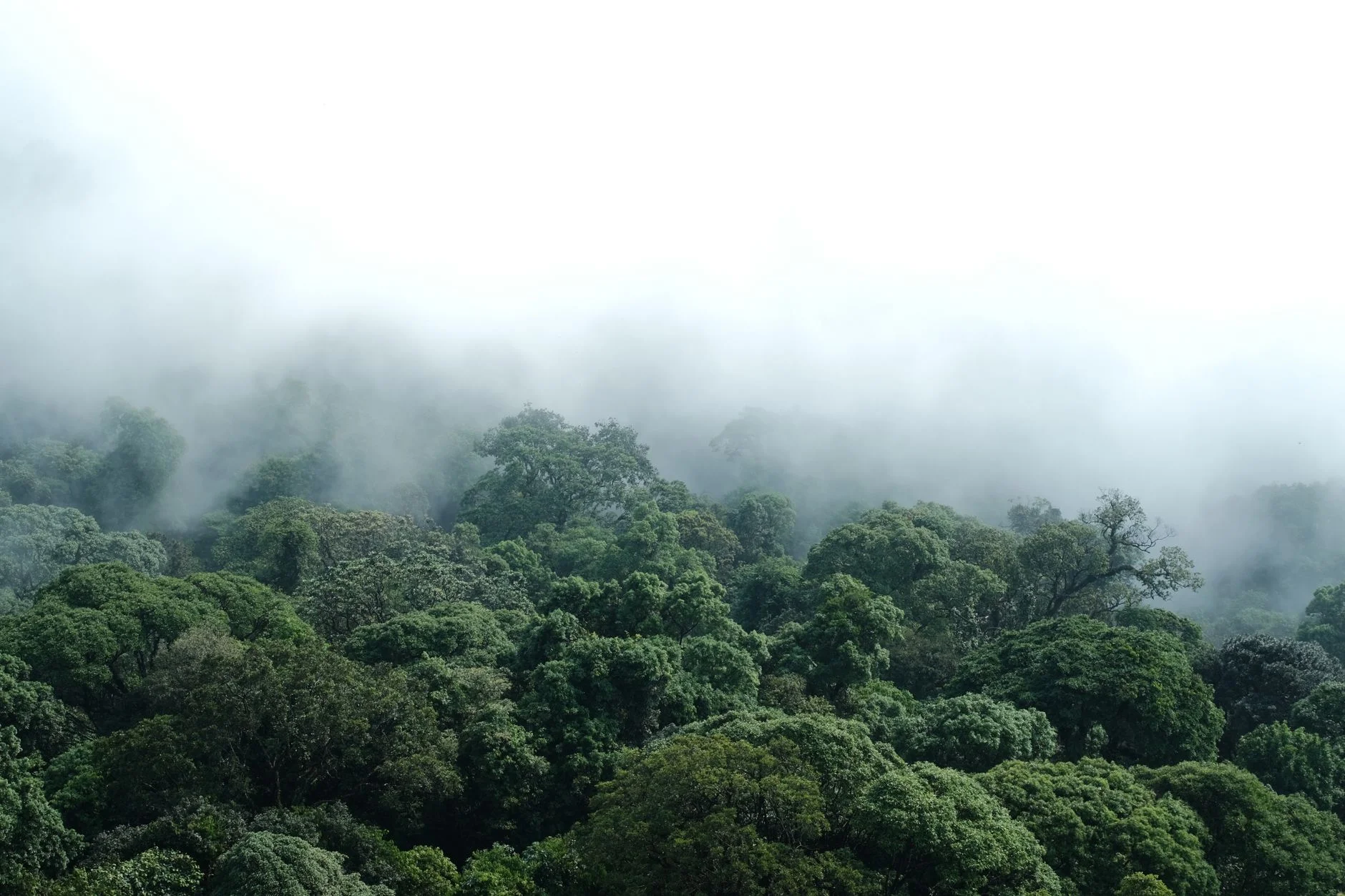
Forests do not just sit in the water cycle. They help drive it. Roots take up water from the soil, and the water travels up the trunk and leaves the plant as vapour through tiny pores called stomata in the leaves. This loss of water vapour is called transpiration.
The vapour rises, cools and condenses into clouds, and falls again as rain. In a large forest this adds a great deal of moisture to the air. An estimate by the scientist Antonio Nobre suggests the Amazon releases about 20 billion tonnes of water vapour a day. That is more than the roughly 17 billion tonnes a day that the Amazon River pours into the Atlantic. Treat both figures as estimates, not exact measurements.
Air currents carrying this moisture are sometimes called “flying rivers”, and they bring rain to southern Brazil and the La Plata basin.
When forest is removed, transpiration falls. Less water vapour enters the air, so there may be less rain downwind. At the same time more rain reaches the ground without being caught by leaves or held by roots, so more of it runs off the surface. That means faster, muddier streams and a greater chance of flash floods.
Deforestation and soil erosion
A forest protects its soil in several ways. The canopy intercepts rain and softens the impact of raindrops. A layer of leaf litter slows the water running over the ground. Roots bind the soil together and make channels, so rain soaks in (infiltration) rather than running off.
Once the trees go, those protections vanish. This is what usually happens, step by step:
- Rain hits bare soil directly, and the drops knock soil particles loose.
- Water cannot soak in as easily, so more of it runs over the surface.
- The run-off carries the topsoil away, because there are no roots to hold it.
- The soil ends up in rivers, which silt up and become muddy. Silted rivers are more likely to flood.
- On steep slopes, loose soil can slip, so landslides become more likely.
There is a further problem. Nutrients are washed (leached) out of the soil by heavy rain. Tropical farmland made from cleared forest can therefore lose its fertility quickly, which is one reason farmers keep moving on to clear new land.
Test your own understanding with these exam-style questions. Tap each one to reveal a model answer.
Explain how deforestation can increase the concentration of carbon dioxide in the atmosphere. (3 marks)
Trees take in carbon dioxide for photosynthesis, so fewer trees means less CO₂ is removed from the air (1). When the trees are burned, the carbon stored in them is released as CO₂ by combustion (1). If the wood rots, decomposers respire and release CO₂ (1).
Suggest why rivers downstream of cleared forest often become muddy and flood more. (2 marks)
With no roots or leaf litter to hold the soil, rain washes topsoil into the rivers, making them muddy (1). Without the trees to intercept and absorb water, more rain runs off the surface into the rivers quickly, so they flood more easily (1).
The threat of deforestation to jungle and forest species
Forests are home to most of the land animals and plants we know. According to the FAO and UN Environment Programme, forests provide habitat for 80% of amphibian species, 75% of bird species and 68% of mammal species, and they contain more than 60,000 tree species. When a forest is cleared, all of that life loses its home. You can read more about the variety of life in biodiversity in jungle ecosystems.
Habitat loss and fragmentation
Clearing does not always remove a forest in one go. Roads and fields often cut it into small, isolated patches, which is called habitat fragmentation. This causes several problems:
- Populations in small patches are smaller, so they are more likely to die out.
- Animals cannot cross the gaps to find mates, so related animals breed together (inbreeding) and the population becomes less healthy.
- The edges of a patch are drier, hotter and windier than the shaded forest interior, so some species cannot live there (edge effects).
Some species disappear before scientists have even described them. People also lose useful things from forests, such as foods and medicines that were never studied.
Broken food webs
Every forest species is linked to others. Pollinators carry pollen between plants, and seed dispersers spread the seeds of forest trees. Primates such as the monkeys of the Amazon are seed dispersers: if their numbers fall, fewer new trees grow, and that in turn affects every animal that depends on those trees. Removing one link can ripple through the whole food web.
Rivers and people
Forest loss also changes the water. Silt from eroded soil clouds the water and fills channels, which makes floods more likely along the jungle rivers that people rely on. Many Indigenous and other forest-dependent communities lose their homes, food and culture when the forest goes.
Case study: the Bornean orangutan
The Bornean orangutan (Pongo pygmaeus) shows what the threat of deforestation looks like for one species. The IUCN Red List classes it as Critically Endangered, a status it was given in 2016.
A study published in 2018 by Voigt and colleagues used field surveys from 1999 to 2015. It estimated that about 148,500 Bornean orangutans were lost in those 16 years, a decline of more than half. The causes were habitat loss, mainly from logging, oil palm and pulp plantations and fire, and killing. The study also found large losses even where forest remained, which shows that standing trees are not enough if hunting continues. This is an estimate from a study rather than a headcount, and we do not give a current total because sources disagree.
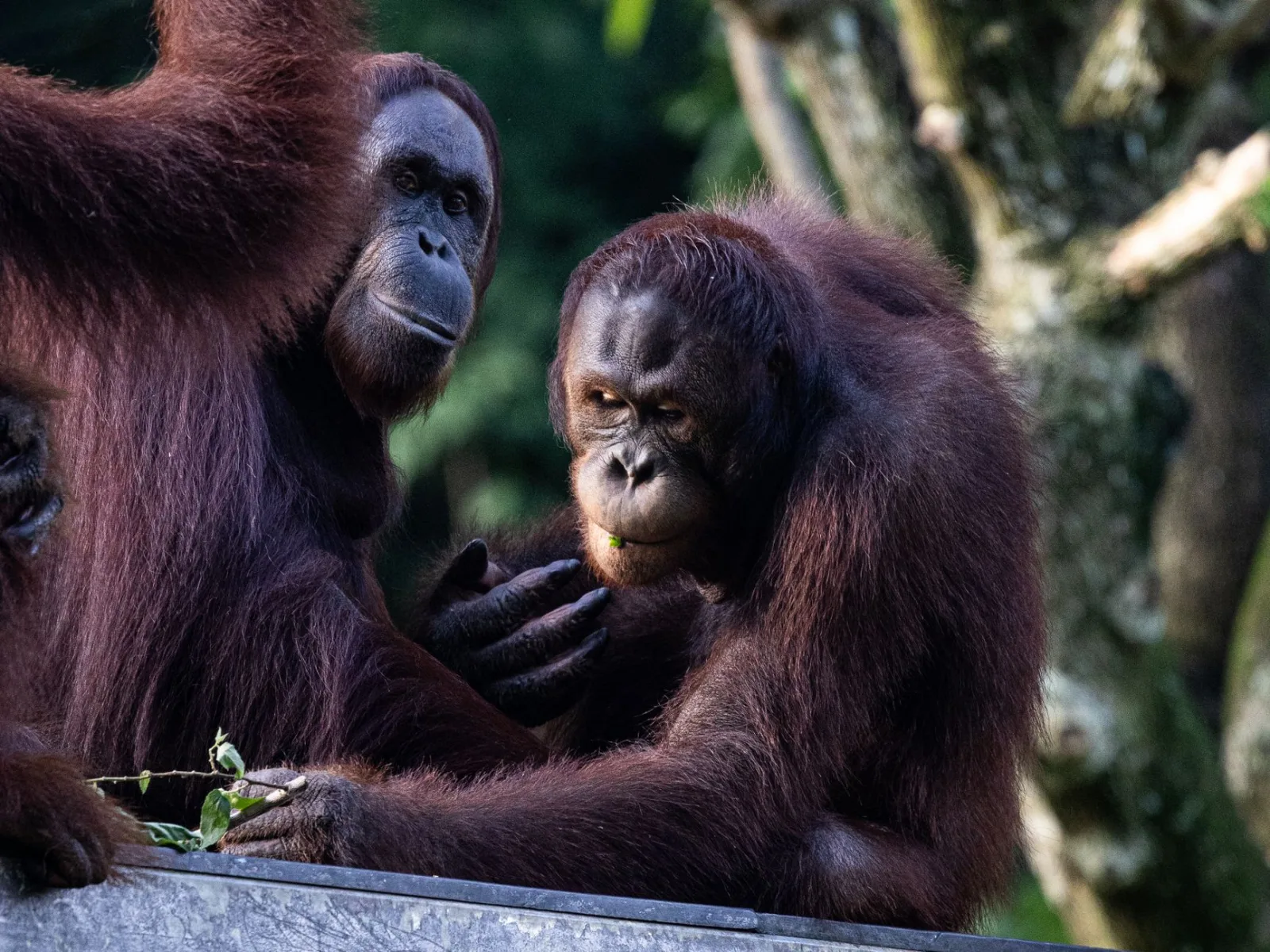
An ape that depends on the canopy cannot simply move into a plantation. When logging, oil palm and fire remove the trees, and hunting continues in the forest that is left, there is very little safe habitat remaining.
What happens when the forest goes?
Flip each card to see how one part of the ecosystem is affected.
What is afforestation?
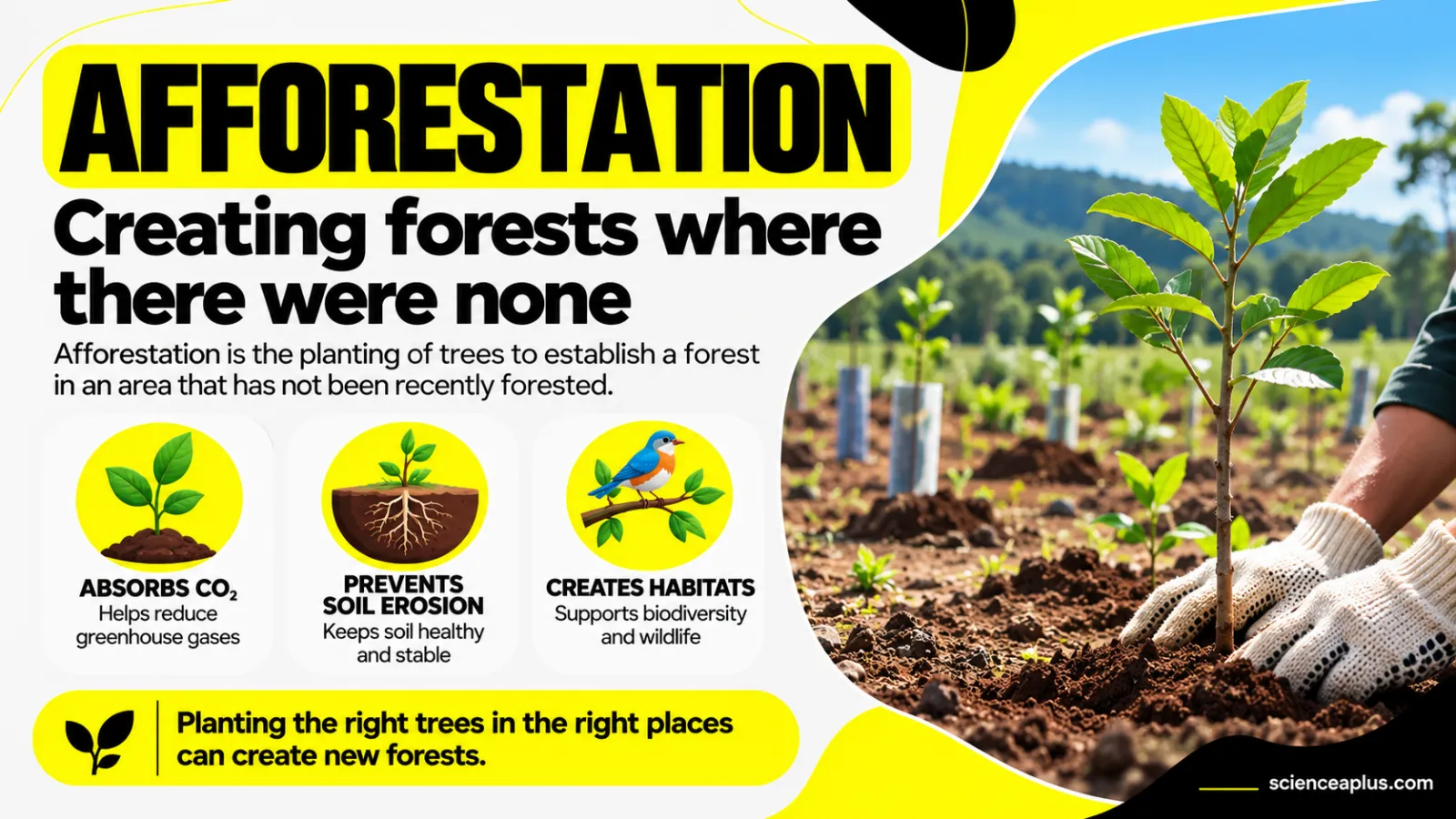
Afforestation means creating a forest on land that was not recently forest, by planting trees or deliberately sowing seeds. Typical sites are grassland or former farmland. In the UK, planting new woodland is afforestation, and the UK created about 13,000 hectares of new woodland in 2025/26.
The benefits are clear. Trees absorb CO₂ as they grow, their roots help to protect soil, and new woodland becomes a habitat for wildlife. The cautions matter just as much, because the wrong planting can do harm:
- Planting on natural grassland, peat bogs or wetlands can damage those habitats, and, on peat in particular, can release carbon already stored in the soil.
- A single non-native species (a monoculture) supports less wildlife than a mixed native wood and is more vulnerable to pests and disease.
Foresters sum this up as “right tree, right place”.
What is reforestation?
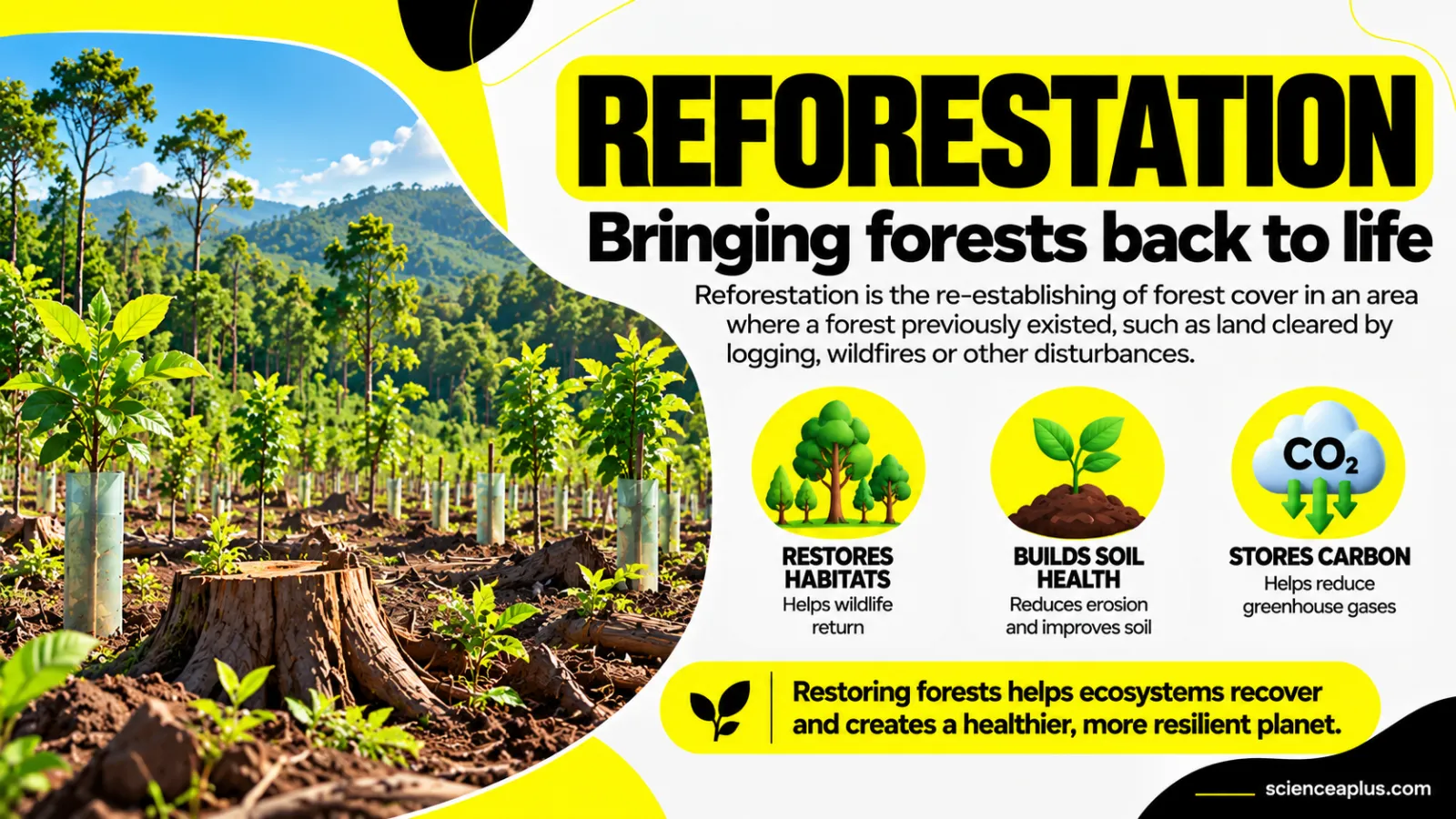
Reforestation means re-establishing forest on land that was forest before and was cleared by logging, fire or another disturbance. It can happen by planting, by sowing seeds, or by natural regeneration, where the forest regrows by itself. In the UK, restocking a felled plantation counts as reforestation, and about 14,000 hectares of publicly funded restocking took place in 2025/26.
Reforestation with native species restores habitats faster than afforestation creates brand new ones, because the soil, seed sources and many of the local species are still nearby.
The difference between afforestation and reforestation in one line each
- Afforestation: new forest on land that was not forest.
- Reforestation: forest brought back on land that was forest before.
- Deforestation: forest cleared and the land used for something else.
The challenges of reforestation and tree planting
Planting trees sounds simple, but restoring a forest is hard to do well. Several problems come up again and again:
- Right tree, right place. Planting the wrong species, or planting on natural grassland, peat bog or wetland, can harm those habitats and, on peat soils, release carbon from the soil.
- Monocultures. Rows of one species hold less wildlife than a natural forest and are more vulnerable to pests and disease.
- Aftercare. Young trees need years of care, such as watering, weeding and protection from grazing animals.
- Cost and competition for land. Land used for trees cannot be used for farming, so there are costs and arguments about who should use it.
- Slow carbon storage. A young tree locks up carbon slowly, and a forest takes decades to build up a large store.
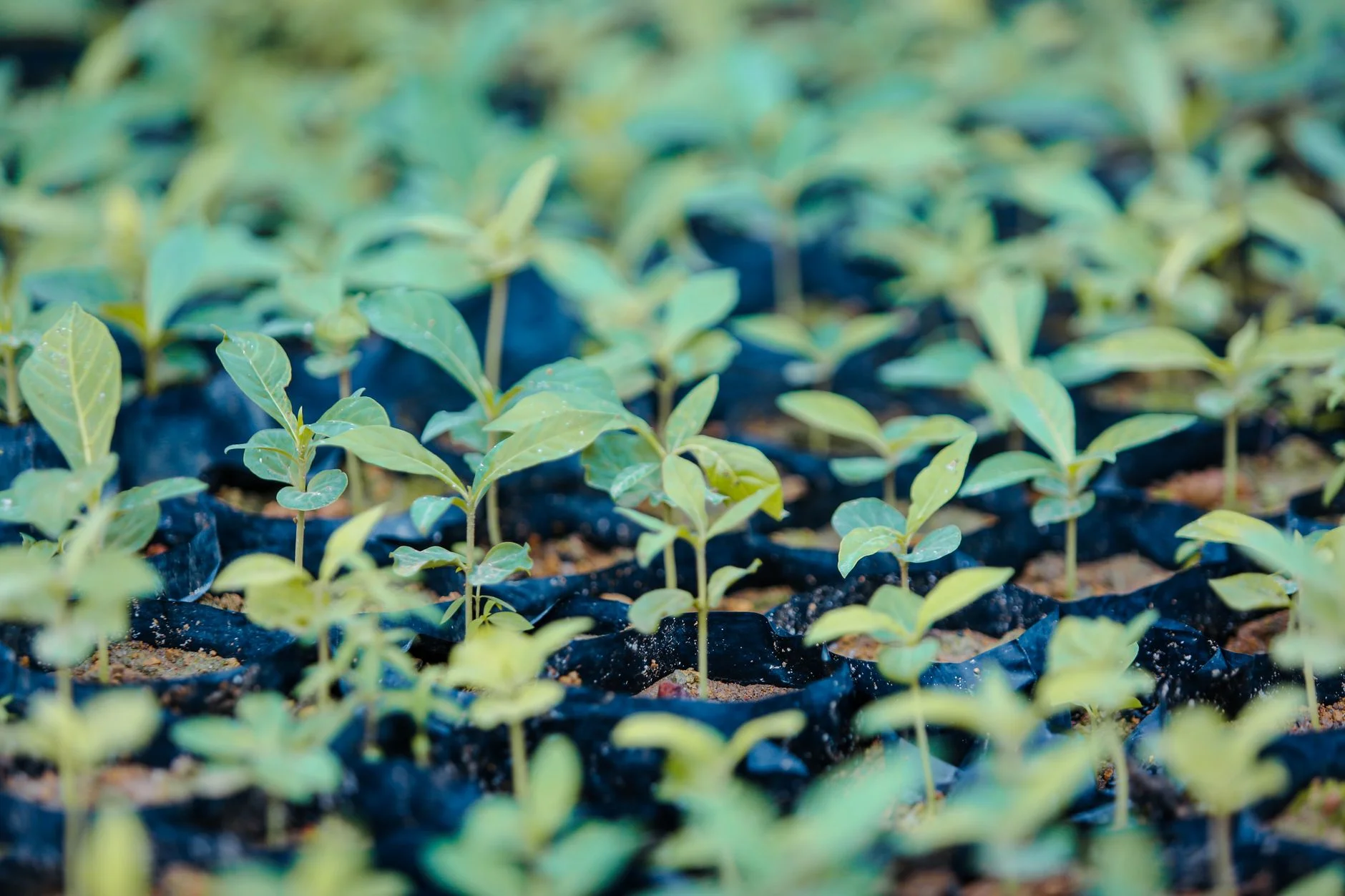
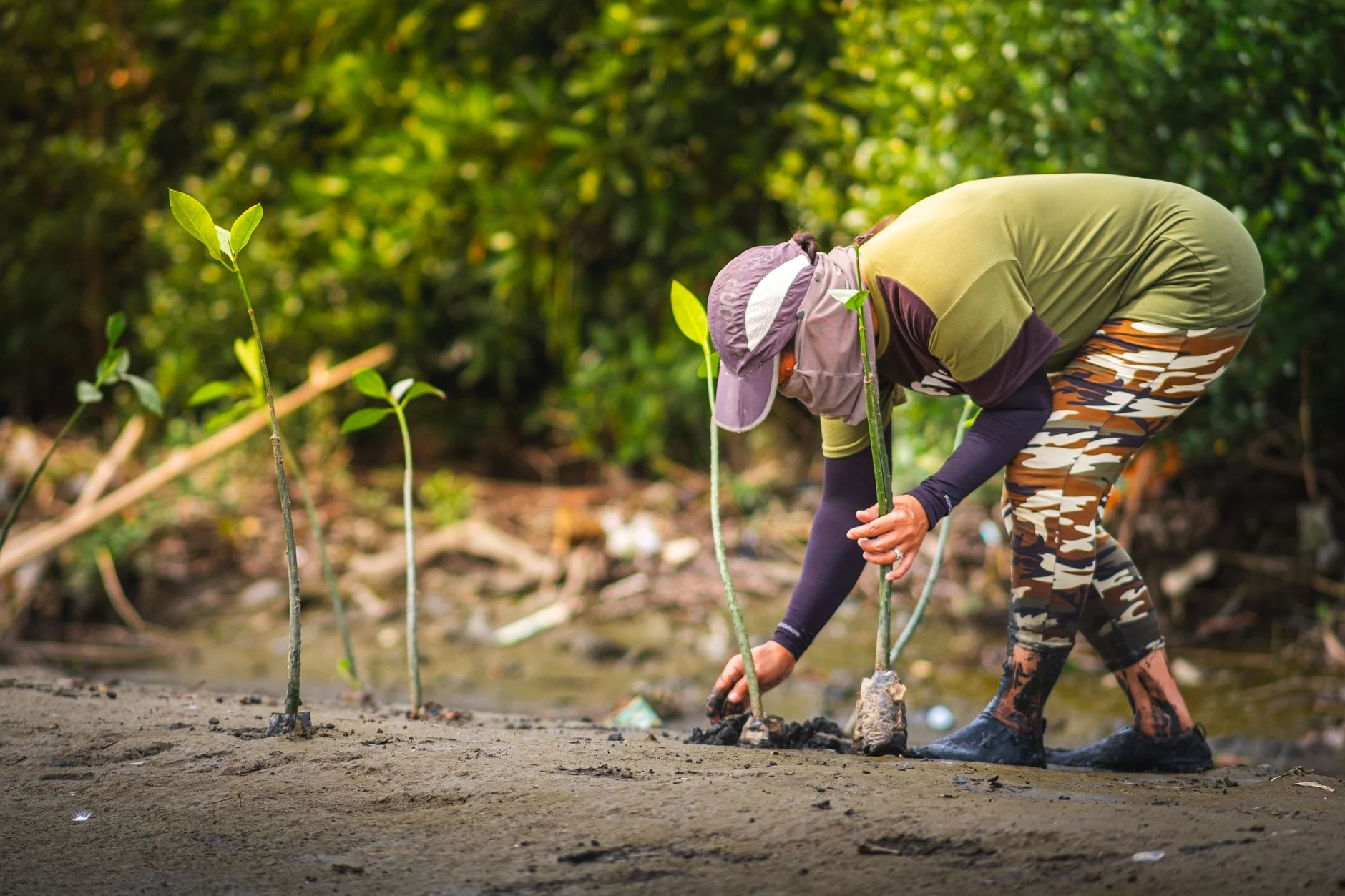
Because of that last point, protecting existing forest comes first. Cutting down an old forest releases its stored carbon straight away, but a replacement forest needs decades to take it back in.
How can we stop deforestation?
There is no single fix, because the causes are many. These are the main solutions:
- Protect forests. About 20% of the world’s forests, 813 million hectares, are already in legally protected areas.
- Enforce laws and use satellite monitoring. Maps like Global Forest Watch show where trees are being lost, so illegal clearing can be found quickly.
- Use sustainable, certified timber. Certification schemes (such as FSC and PEFC) set standards for responsible forest management and check wood against them, although they are not a guarantee.
- Reduce demand for products linked to clearing. Beef, soy and palm oil are linked to tropical deforestation, so choosing certified products and wasting less food helps.
- Support Indigenous land rights. The Indigenous communities who live in forests have a long-standing interest in looking after them.
- Restore degraded land. The Bonn Challenge, launched by Germany and the IUCN in 2011, aims to bring 350 million hectares of degraded and deforested land into restoration by 2030.
Countries also set their own targets. UK woodland covered 3.30 million hectares on 31 March 2026, which is 14% of UK land (Scotland 20%, Wales 15%, England 10% and Northern Ireland 9%). In England the law sets a target for tree canopy and woodland cover of at least 16.5% of land by the end of 2050.
What can you do?
Tick off the actions you have tried. Your ticks are saved in your browser.
- Check labels for certified wood and paper products
- Cut food waste at home
- Plant or care for native trees with a local group
- Use a forest-monitoring map for a school project
- Talk or write about deforestation with friends and family
Maths practice questions: forests in numbers
Numbers turn forest loss into something you can calculate. Tap each question to check the worked answer. One hectare is 10,000 m² and 100 hectares make 1 km². A football pitch of 105 m × 68 m is 7,140 m², or 0.714 hectares.
In 2025, 4.3 million hectares of tropical primary forest were lost. How many hectares is that per minute, and how many football pitches (0.714 ha)? (3 marks)
There are 365 × 24 × 60 = 525,600 minutes in a year. 4,300,000 ÷ 525,600 = 8.18 hectares per minute. Then 8.18 ÷ 0.714 ≈ 11.5 football pitches per minute.
Use the calculator to try other yearly totals, such as the 6.7 million hectares lost in 2024.
Tropical primary forest loss fell from 6.7 million ha (2024) to 4.3 million ha (2025). Calculate the percentage change. (2 marks)
Change = 4.3 − 6.7 = −2.4 million ha. Percentage change = −2.4 ÷ 6.7 × 100 = −35.8%, so loss fell by about 36%.
FAO reports deforestation of 10.9 million ha per year and forest expansion of 6.78 million ha per year. What is the net loss, and why is it lower than the deforestation figure? (2 marks)
Net loss = 10.9 − 6.78 = 4.12 million ha per year. It is lower because new forest from planting and natural spread offsets some of the loss. However, new forest does not immediately replace the species and stored carbon of the old forest.
A felled tree has a dry mass of 1,500 kg. Using a carbon fraction of 0.47, how much CO₂ was locked up in it? (3 marks)
Carbon = 1,500 × 0.47 = 705 kg. CO₂ = 705 × 44 ÷ 12 = 2,585 kg, or about 2.6 tonnes of CO₂.
UK woodland covers 3.30 million ha, which is 14% of UK land. Estimate the UK’s land area in km². (3 marks)
Land area = 3.30 ÷ 0.14 ≈ 23.6 million ha. Since 1 km² = 100 ha, that is about 236,000 km². It is an estimate, because 14% is a rounded figure.
About 148,500 Bornean orangutans were lost over the 16 years from 1999 to 2015. Estimate the mean loss per year. (2 marks)
148,500 ÷ 16 ≈ 9,300 orangutans per year. This is an average of a study estimate, not a count for each year.
Frequently asked questions about deforestation, afforestation and reforestation
What is the difference between afforestation and reforestation?
Afforestation means establishing a forest on land that was not forest before, such as grassland or old farmland. Reforestation means re-establishing forest on land that was forest and was cleared by logging, fire or another disturbance, either by planting or by natural regeneration. Deforestation is the opposite of both.
What are the main causes of deforestation?
Agricultural expansion drives almost 90% of global deforestation. Cropland expansion accounts for almost half of forest loss and livestock grazing for almost 40%. Other causes include logging, mining, roads, towns and fire. Soy, oil palm and beef are the products most often linked to tropical clearing.
How much forest is lost each year?
FAO estimates that deforestation was 10.9 million hectares per year in 2015–2025. After forest expansion of 6.78 million hectares per year, the net loss was 4.12 million hectares per year. Global Forest Watch recorded 4.3 million hectares of tropical primary forest loss in 2025.
How does deforestation affect the carbon cycle?
Trees absorb carbon dioxide by photosynthesis and store carbon in wood and soil. When forest is cleared, that CO₂ is no longer absorbed, and burning or rotting wood releases the stored carbon back to the air. The extra CO₂ strengthens the greenhouse effect.
How does deforestation affect the water cycle?
Trees release water vapour through their leaves by transpiration, which forms clouds and rain. Removing forest reduces transpiration, so less rain may fall downwind. More rainwater also runs over the surface instead of soaking in, which increases run-off and the risk of flash floods.
Why does deforestation cause soil erosion?
Canopy, leaf litter and roots normally protect the soil and help water soak in. After clearing, rain hits bare soil and runs off, washing the topsoil away. The soil silts up rivers, and on steep slopes loose ground may slip in landslides.
How does deforestation affect animals?
Forests are habitat for 80% of amphibian species, 75% of bird species and 68% of mammal species. Clearing removes food and shelter, and fragmentation leaves small isolated populations. The Bornean orangutan, now Critically Endangered, lost an estimated 148,500 individuals between 1999 and 2015.
Does the Amazon produce 20% of the world’s oxygen?
No. The Amazon produces at most about 6–9% of photosynthetic oxygen, and the forest’s own respiration and its decomposers use nearly all of it, so its net oxygen effect is about zero. Its real value is carbon storage, rainfall and biodiversity.
Can planting trees stop climate change?
Not on its own. Growing trees absorb CO₂, but slowly over decades. The Global Carbon Budget 2025 projected about 38.1 billion tonnes of CO₂ from fossil fuels against about 4.1 billion tonnes from land-use change, so cutting fossil-fuel use and protecting existing forest must come first.
How can we stop deforestation?
Protect forests, enforce laws and use satellite monitoring, buy certified timber, and reduce demand for products linked to clearing such as beef, soy and palm oil. Supporting Indigenous land rights and restoring degraded land, as the Bonn Challenge aims to do, also helps.