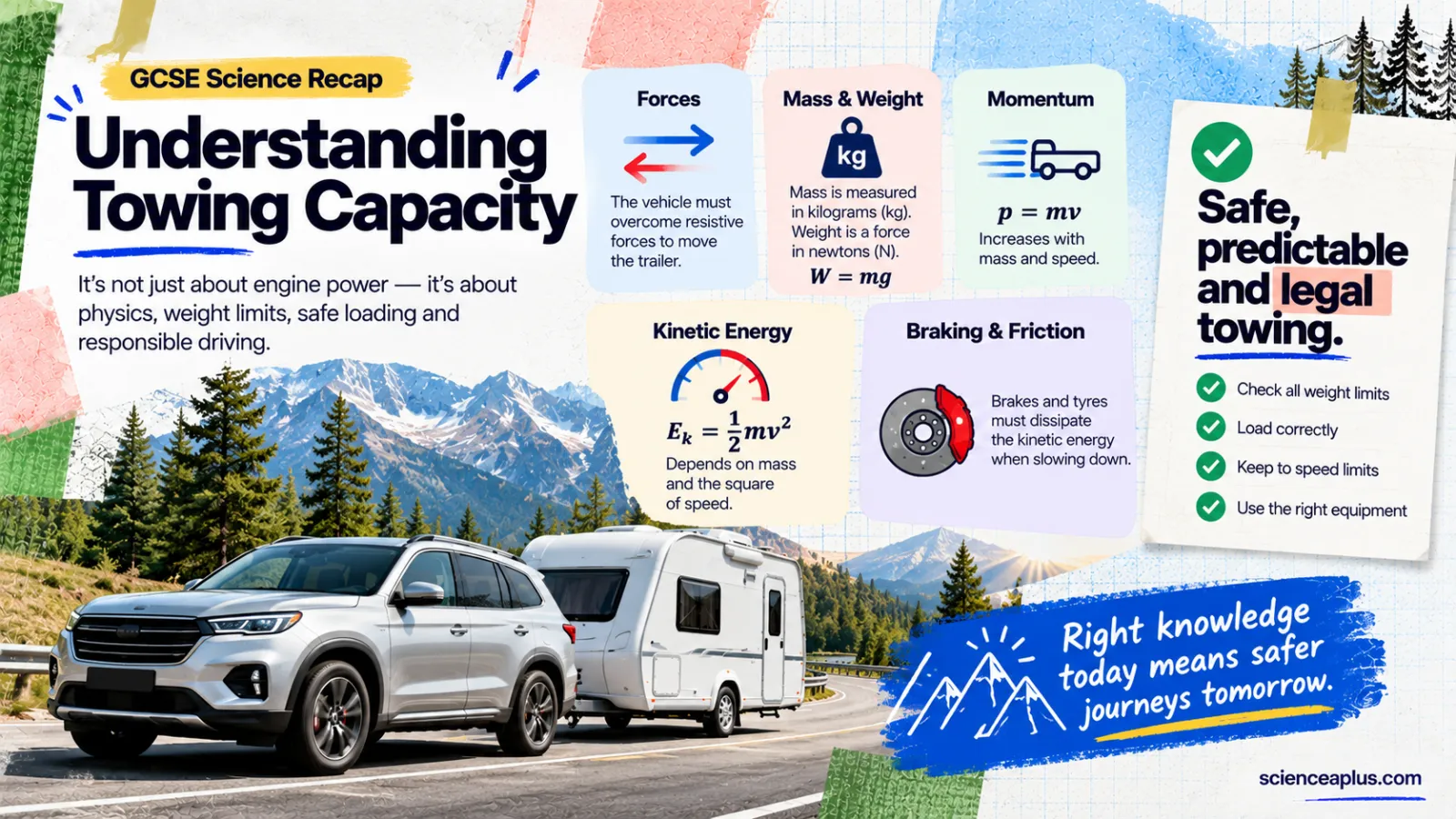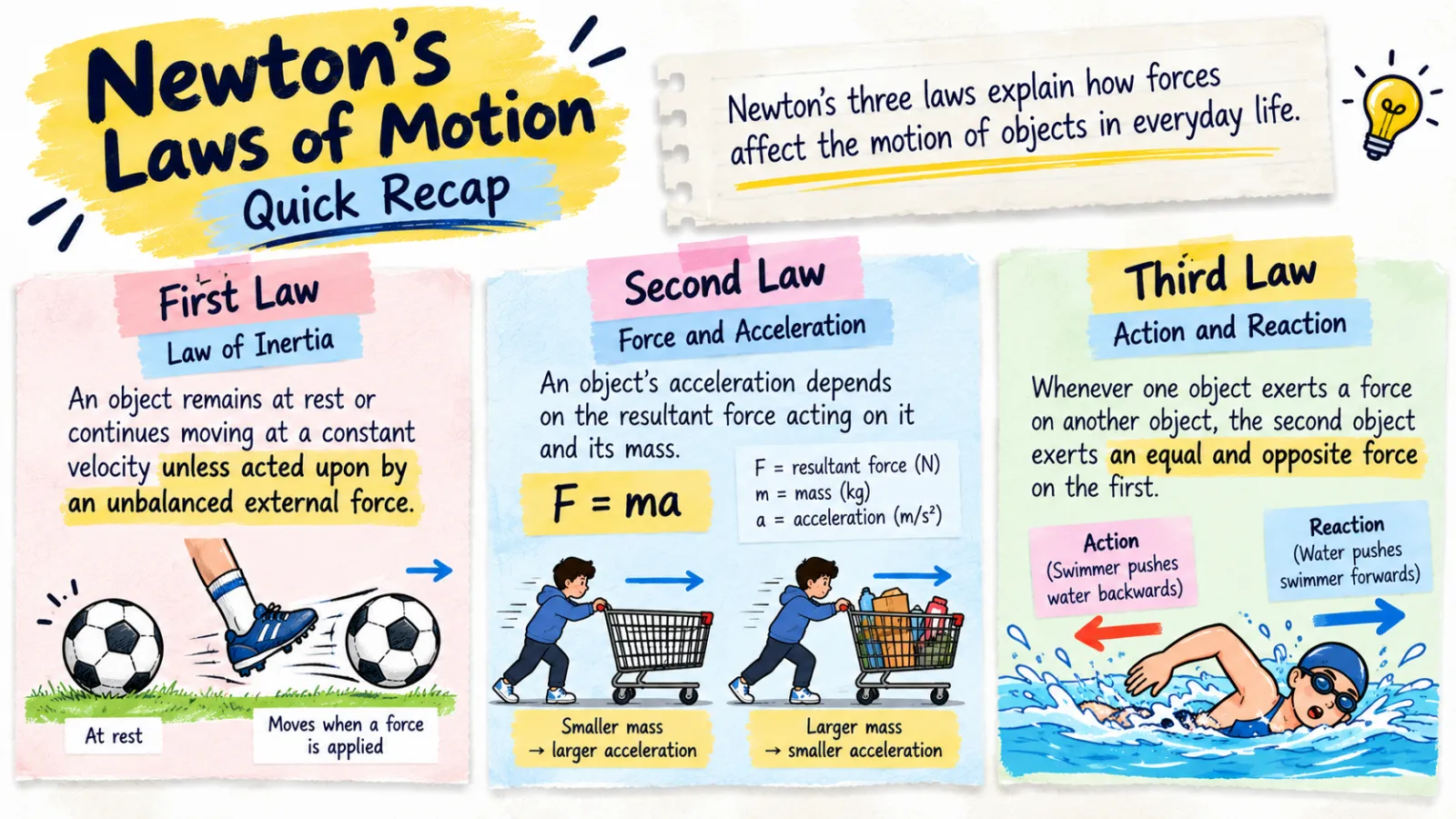
The advantages and disadvantages of dams can be summed up in one breath. Dams store water in reservoirs, which lets us make hydroelectric power, supply drinking water and control floods. But they also flood land, force people to move, block migrating fish and trap sediment. Whether a dam is good or bad depends on where and how it is built.
This guide covers GCSE Physics (energy resources) and GCSE Geography (river management), with real examples from Kielder Water in Northumberland to the Three Gorges Dam in China. You will also find two calculators, exam questions with model answers and a self-marking quiz.
What is a dam and what is a reservoir?
A dam is a barrier built across a river or valley to hold back water. The lake of stored water that builds up behind it is called a reservoir. Rain and snowmelt, which arrive through the water cycle, keep topping the reservoir up.

Engineers have a precise definition of a "large dam". The International Commission on Large Dams (ICOLD) counts a dam as large if it is 15 m or more high, measured from the lowest foundation to the crest. A dam 5–15 m high also counts if it holds back more than 3 million m³ of water. ICOLD's World Register of Dams includes more than 55,000 dams.
Dams come in two broad families. Concrete dams, such as gravity and arch dams, resist the water by their sheer weight or by curving against it. Embankment dams are huge banks of earth and rock, like the one at Kielder Water, which you will meet later in this article. A weir is different: it is a low wall that water simply flows over, and it does not store much water.
Many dams are multipurpose. One structure may generate electricity, supply water, irrigate crops, reduce flood risk and provide a place for recreation, all at once.
How does a hydroelectric dam work?
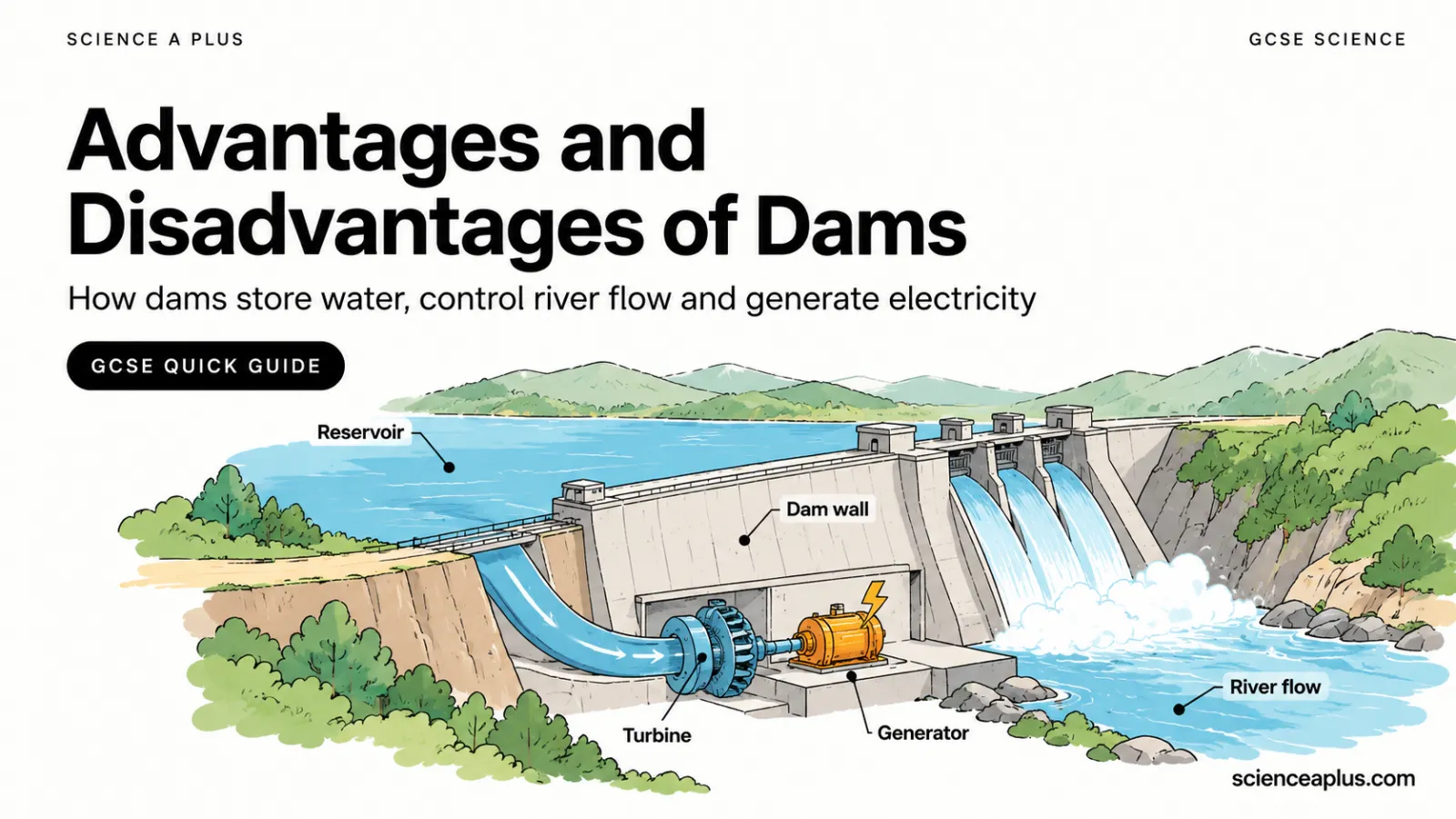
A hydroelectric dam is an energy-transfer machine. Water held high up in the reservoir has a store of gravitational potential energy. The higher the water and the more of it there is, the bigger the store:
Eₚ = m × g × h
Here m is the mass of water in kg, g is the gravitational field strength (9.81 N/kg on Earth) and h is the height in metres.
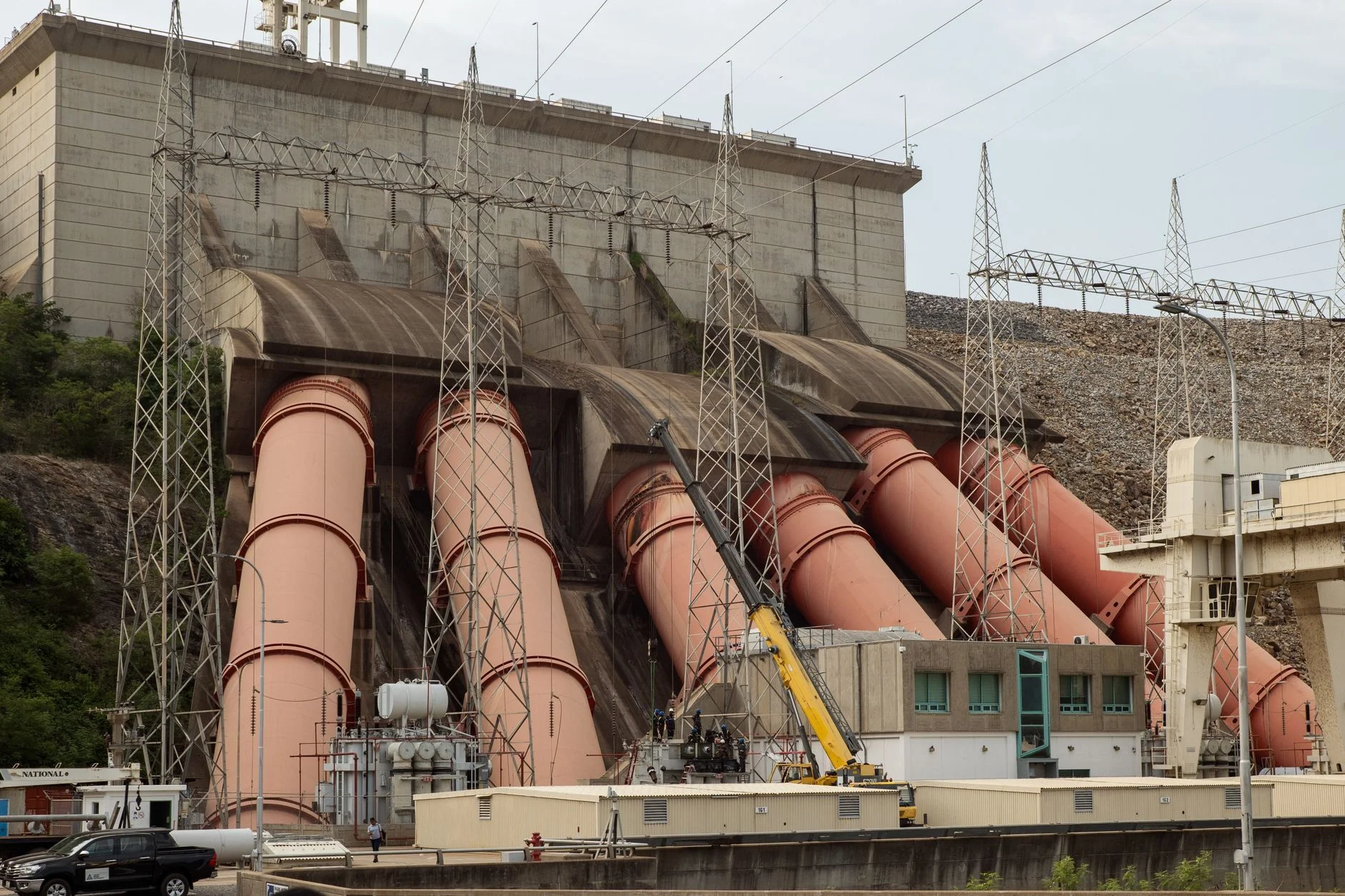
When the operators open a gate, water rushes down a large pipe called a penstock. As it falls, the gravitational potential store is transferred to the kinetic energy store of the moving water. That fast-moving water pushes against the blades of a turbine and makes it spin. The turbine is connected to a generator, which uses electromagnetic induction to produce electricity; how generators work explains the details. Transformers then raise the voltage so the electricity can travel along power lines to the National Grid.
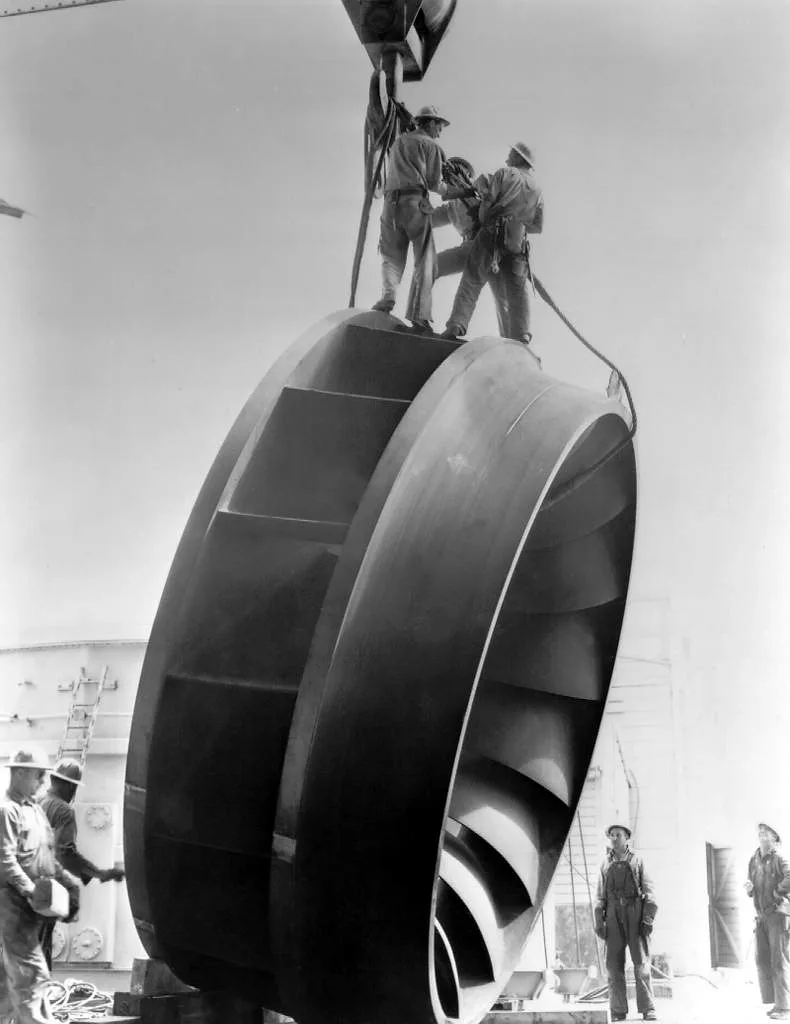
The spinning turbine in the photo is a Francis turbine runner. It is enormous, as the workers standing beside it show. Each turbine needs a powerful flow of water, which is why the penstocks are so wide.
From raindrop to light bulb
- Rain and snowmelt fill the reservoir behind the dam.
- The water stores gravitational potential energy because it is high above the turbines.
- Water falls down the penstock and its energy is transferred to the kinetic store.
- The moving water spins the turbine, which turns the generator.
- The generator produces electricity, which flows through transformers to the grid and your light bulb.
How much power can a dam produce? Two things matter most: the head (the height the water falls) and the flow rate (how much water passes through each second). The power is given by:
P = ρ × g × Q × h × η
In this equation ρ (rho) is the density of water, 1,000 kg/m³ for fresh water. The flow rate Q is in m³/s, the head h is in metres and η (eta) is the efficiency of the turbine and generator, as a fraction. Double the head or double the flow and you double the power.
Hydropower is also very efficient. According to the US Bureau of Reclamation, today's hydropower turbines can convert more than 90 per cent of the available energy into electricity. It contrasts that with about 50 per cent for the best fossil-fuel plants.
Why are dams thicker at the bottom?
Water pressure grows with depth. You can calculate the extra pressure from a column of water with the equation from GCSE Physics:
p = h × ρ × g
At 100 m deep, fresh water adds about 981 kPa, or roughly 9.8 bar. Every 10 m of depth adds about 1 bar. The wall at the bottom of a reservoir must withstand far more force than the wall near the top, which is why many dam walls are much thicker at the base. Try different depths in the calculator.
Describe the energy transfers in a hydroelectric power station. (3 marks)
Water high in the reservoir has a gravitational potential energy store. As it falls through the penstock, this is transferred to the kinetic energy store of the moving water. The moving water turns the turbine, which drives the generator, and energy is transferred electrically. Some energy is wasted to the thermal stores of the surroundings.
Advantages of dams: the benefits
The advantages of dams fall into a few big groups: clean power, a controllable energy supply, stored water, flood protection and recreation. Here is each one in turn.
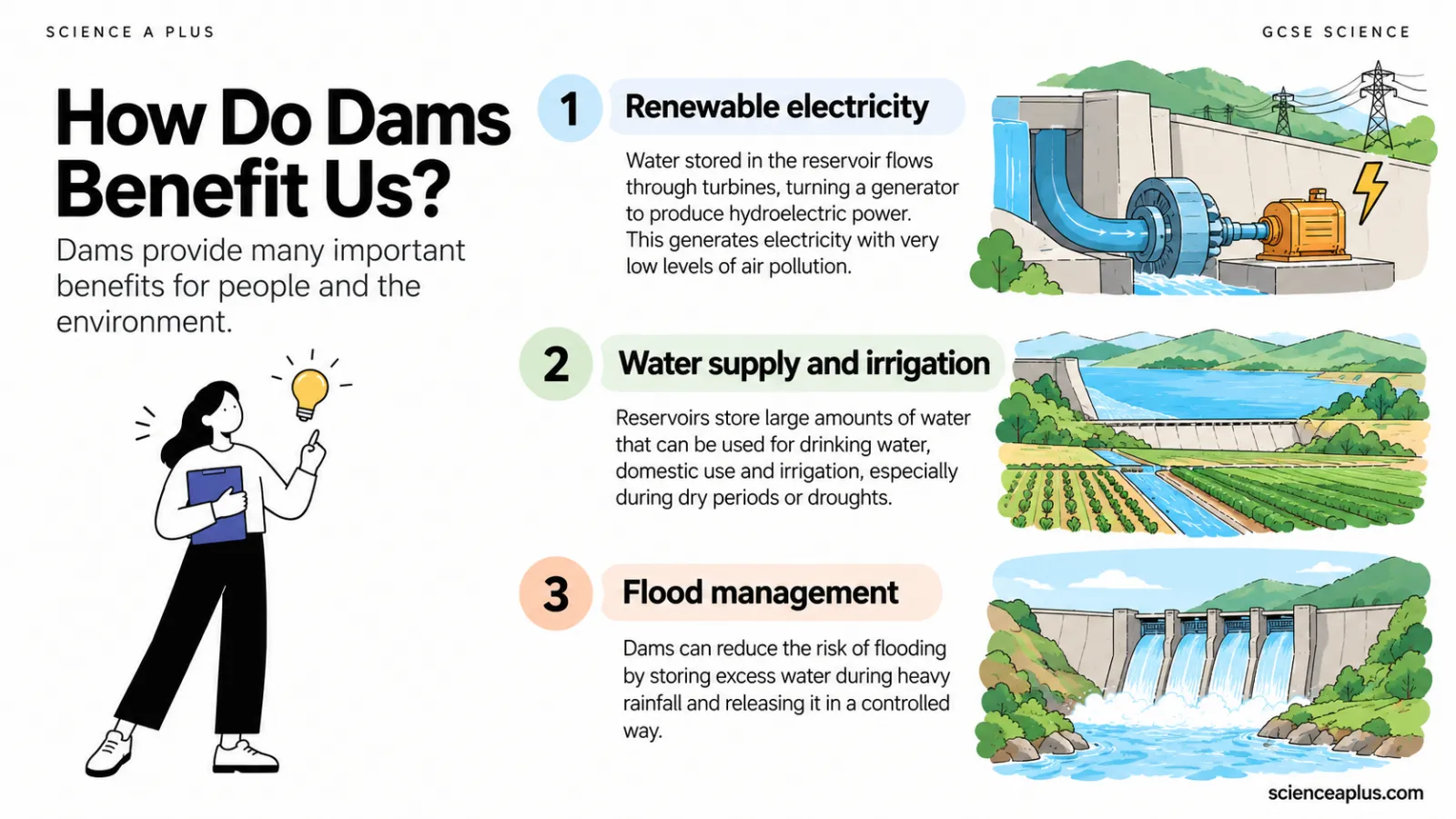
Renewable, low-carbon electricity
Hydropower is the world's largest source of renewable electricity. According to the International Hydropower Association (IHA), global installed hydropower capacity reached 1,469 GW by the end of 2025. About 28 GW was commissioned during 2025 alone, and China accounted for more than 40 per cent of those additions.
Ember's Global Electricity Review 2026 reports that hydropower produced a record 4,437 TWh in 2025. Even so, its share of global electricity fell to an all-time low of 14%, because solar and wind are growing faster. Renewables as a whole supplied 33.8 per cent of the world's electricity that year.
The climate advantage is clear when you compare lifecycle emissions, which include building the power station as well as running it:
| Source | Median lifecycle emissions (g CO₂-equivalent per kWh) |
|---|---|
| Hydropower | 24 |
| Natural gas | 490 |
| Coal | 820 |
These are IPCC median values, and individual dams vary widely. We return to that later. For now, note that hydropower is far lower than gas or coal. You can read about the full range of fuels in our guide to energy sources and their uses.
Now use the equation from earlier to test a hypothetical power station. Change the head, flow and efficiency to see what happens to the output.
Power on demand and pumped storage
Unlike wind and solar, a hydroelectric station can be turned up or down quickly, and the reservoir stores energy for later. The water is already waiting behind the dam, so the operators simply open the gates when demand rises. This makes a useful partner for the weather-dependent sources described in our article on the advantages and disadvantages of wind energy.
Pumped storage goes a step further. When electricity is spare, pumps push water uphill to a high reservoir. When demand is high, the water runs back down through turbines. It works like a giant "water battery". The IHA reports that global pumped storage capacity reached 201 GW, above 200 GW for the first time, and a record 11.6 GW was added in 2025. Whether renewable power lives up to the hype is a fair question, and renewable energy expectations vs reality looks at it.
Water supply and irrigation
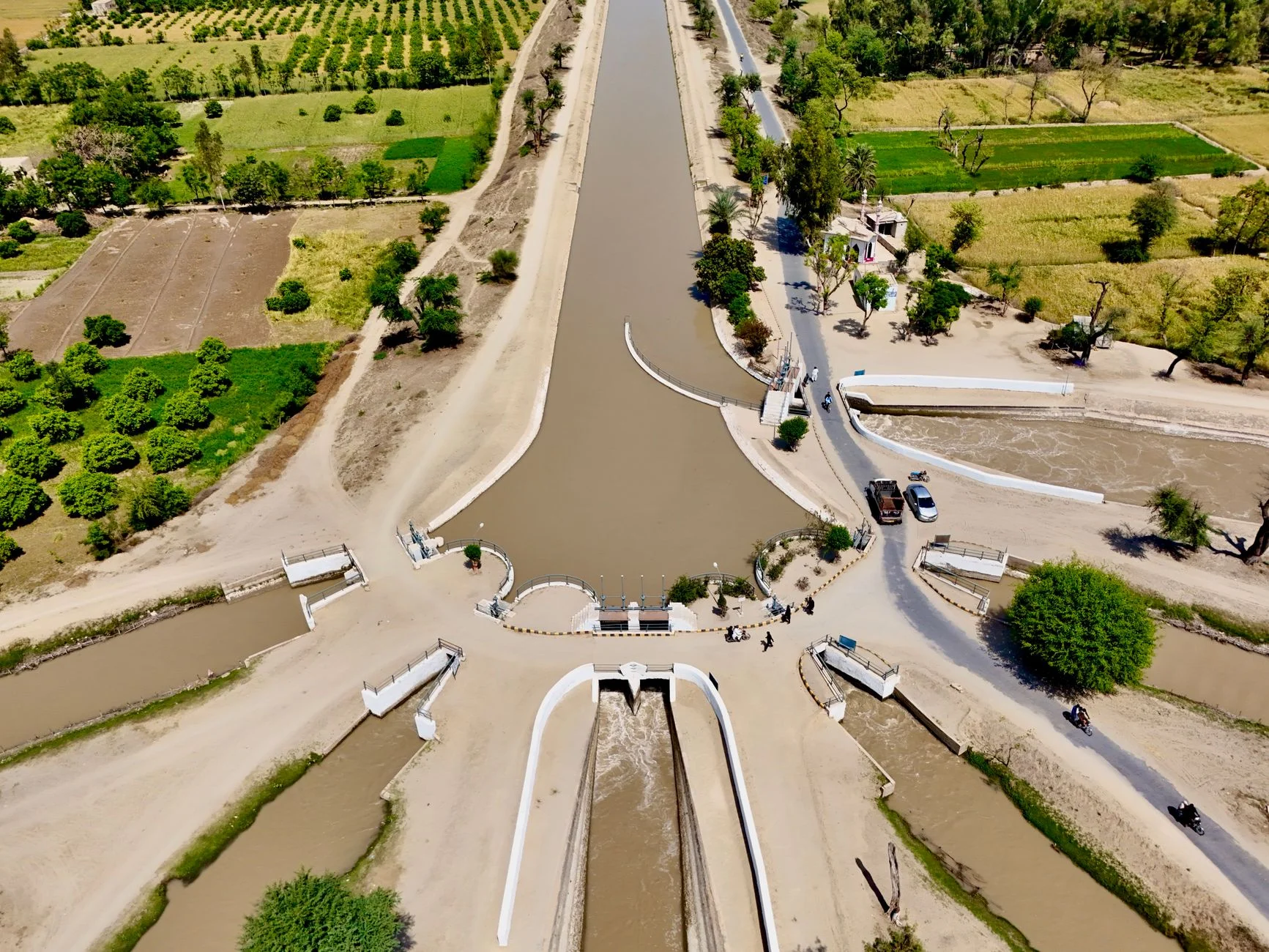
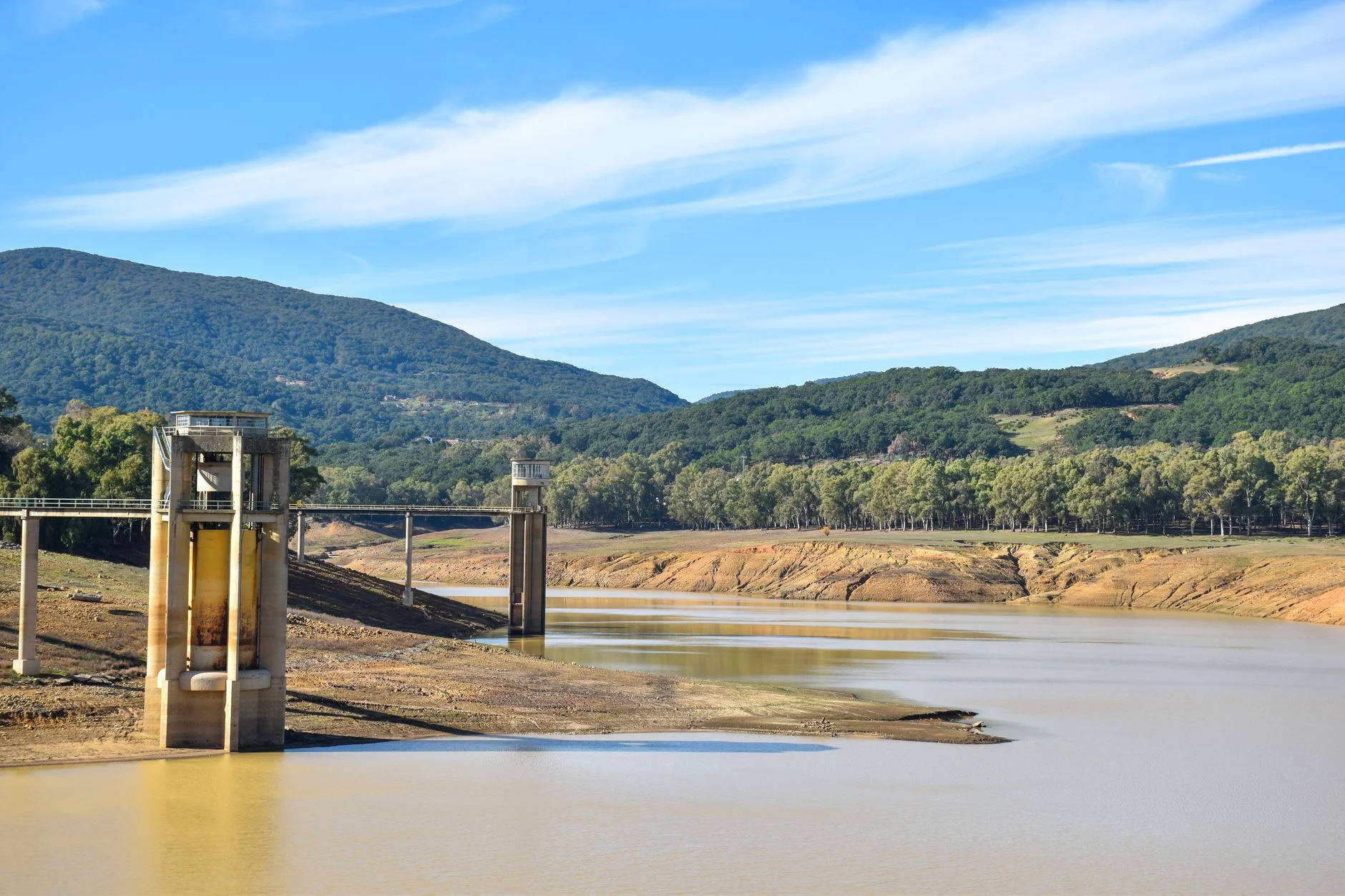
Reservoirs give people a guaranteed water supply for drinking, homes, industry and irrigation, even through droughts. ICOLD notes that reservoirs mainly guarantee supplies for irrigation, domestic and industrial use during dry periods. Farmers can draw on the stored water in dry seasons, so crops do not depend entirely on the rain on the day.
There is a limit, though. Storage only helps if enough rain falls to refill the reservoir.
Flood control
During heavy rainfall, a reservoir can hold back the surplus water and release it slowly. This reduces the flood peak downstream. Geographers call this hard engineering because it changes the river with a physical structure.
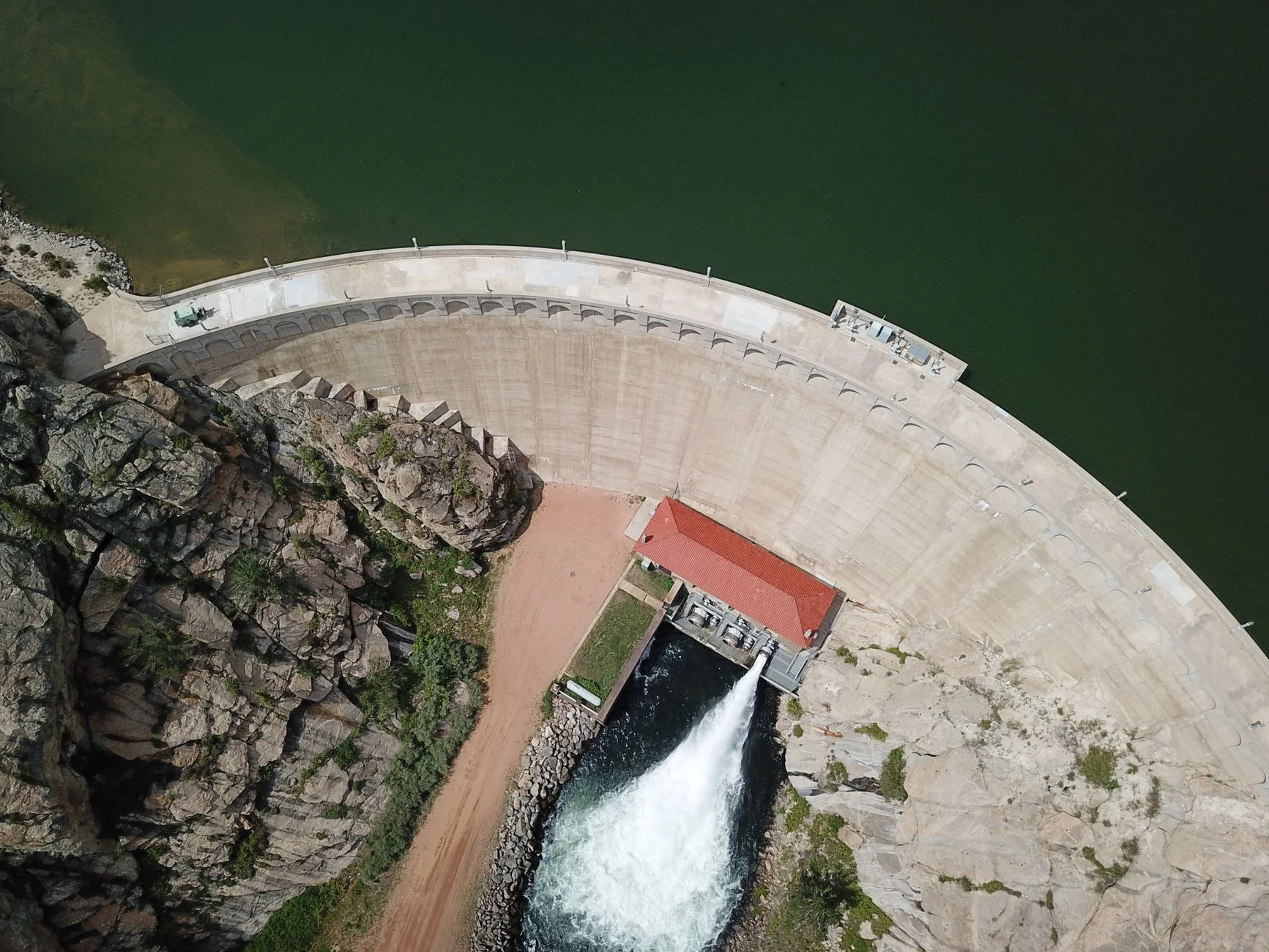
Dams also have spillways, which safely pass extra water around or over the dam when the reservoir is full. Releases can be planned and controlled, instead of arriving as a sudden surge.
Recreation, tourism and transport
Many reservoirs become leisure sites for sailing, fishing and water sports. The best UK example is Kielder Water in Northumberland. It is the UK's largest artificial lake by capacity, holding about 200 billion litres. It was opened in 1982 by the Queen, cost £167 million and took seven years to build. It supplies water to north-east England and is now a popular tourism and forest-park site.
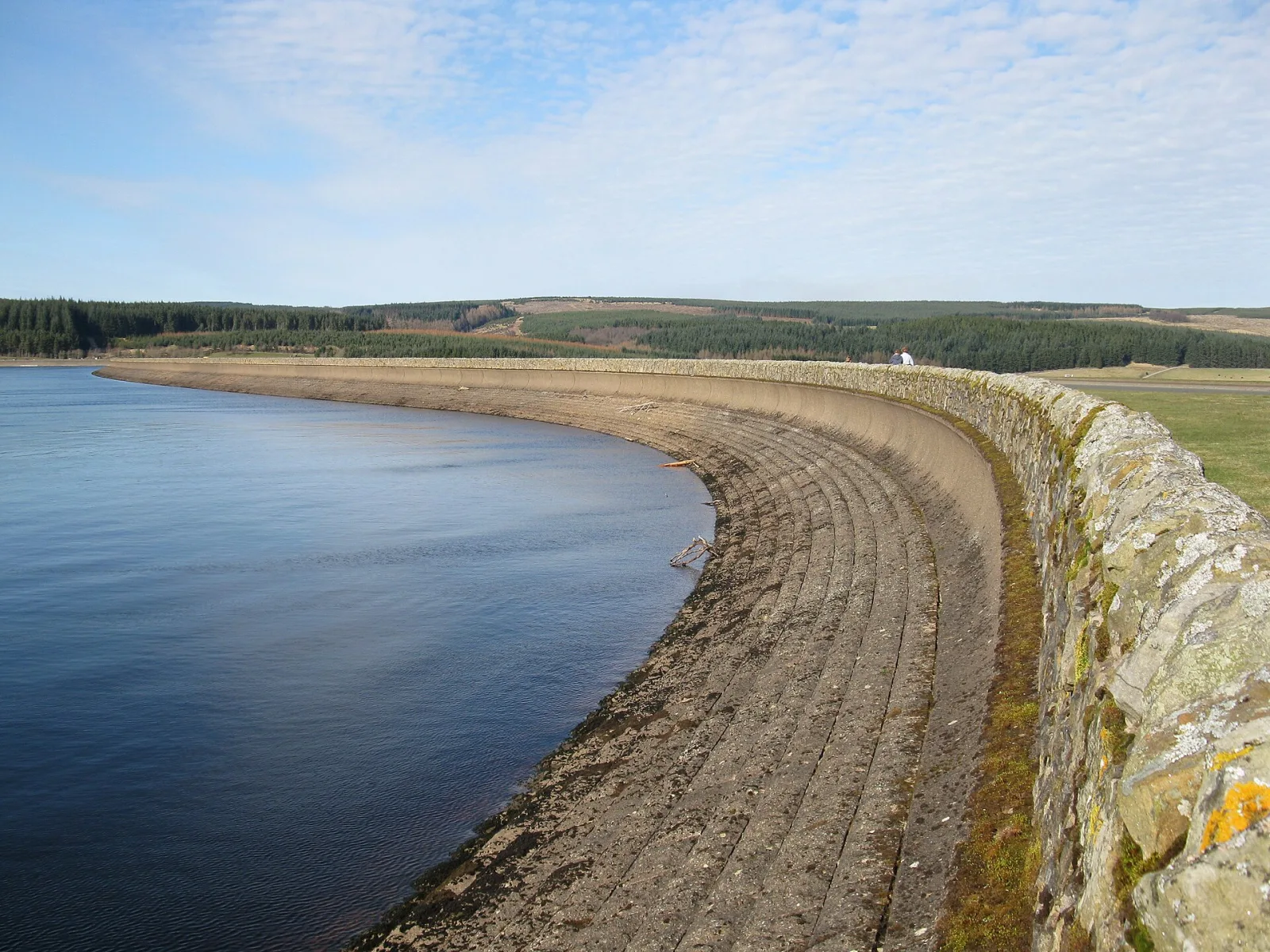
The long curving embankment in the photo is typical of an earth-and-rock dam. Its sloping face is armoured with rock, yet it holds back a vast volume of water.
Famous dams around the world
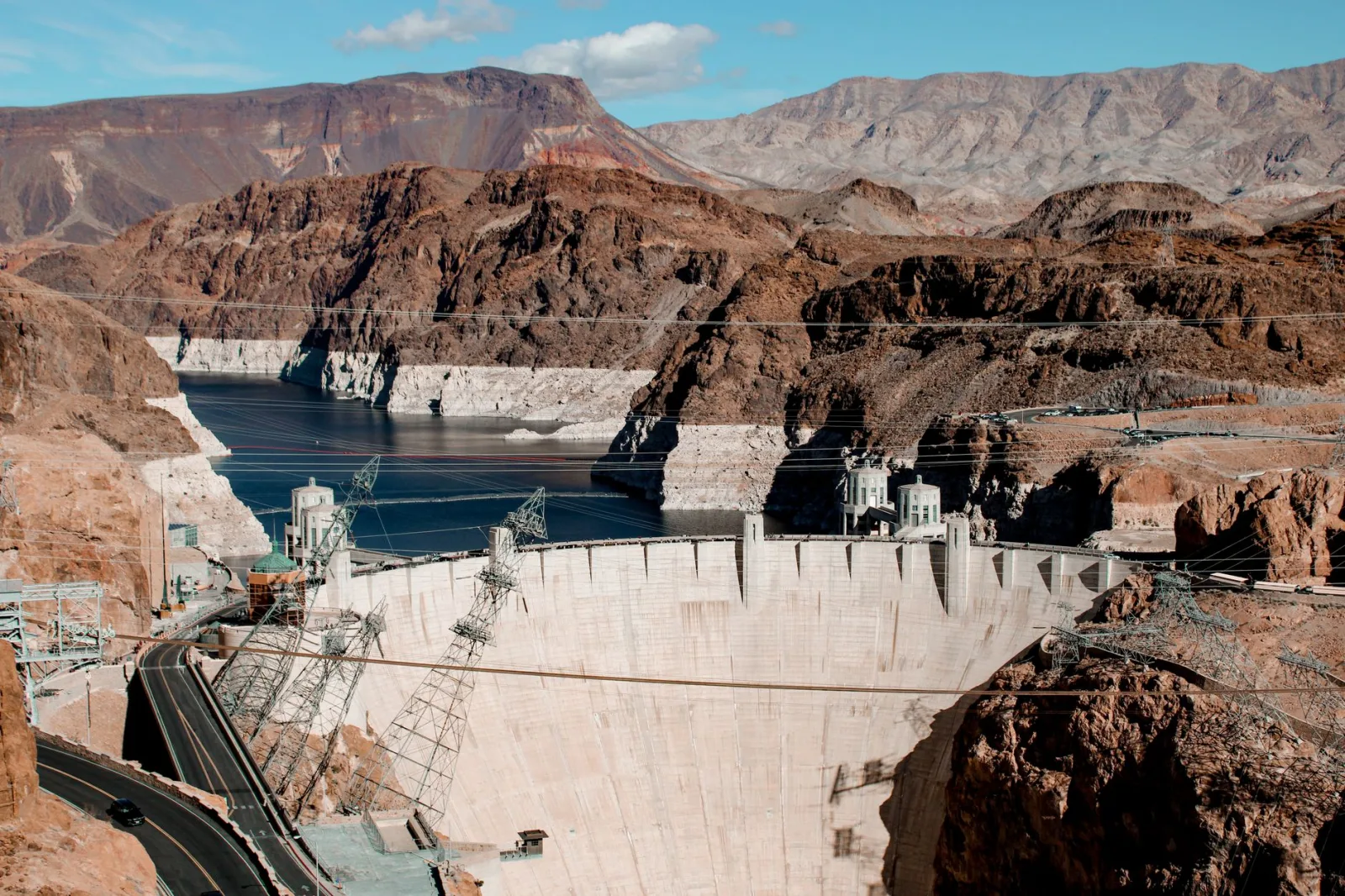
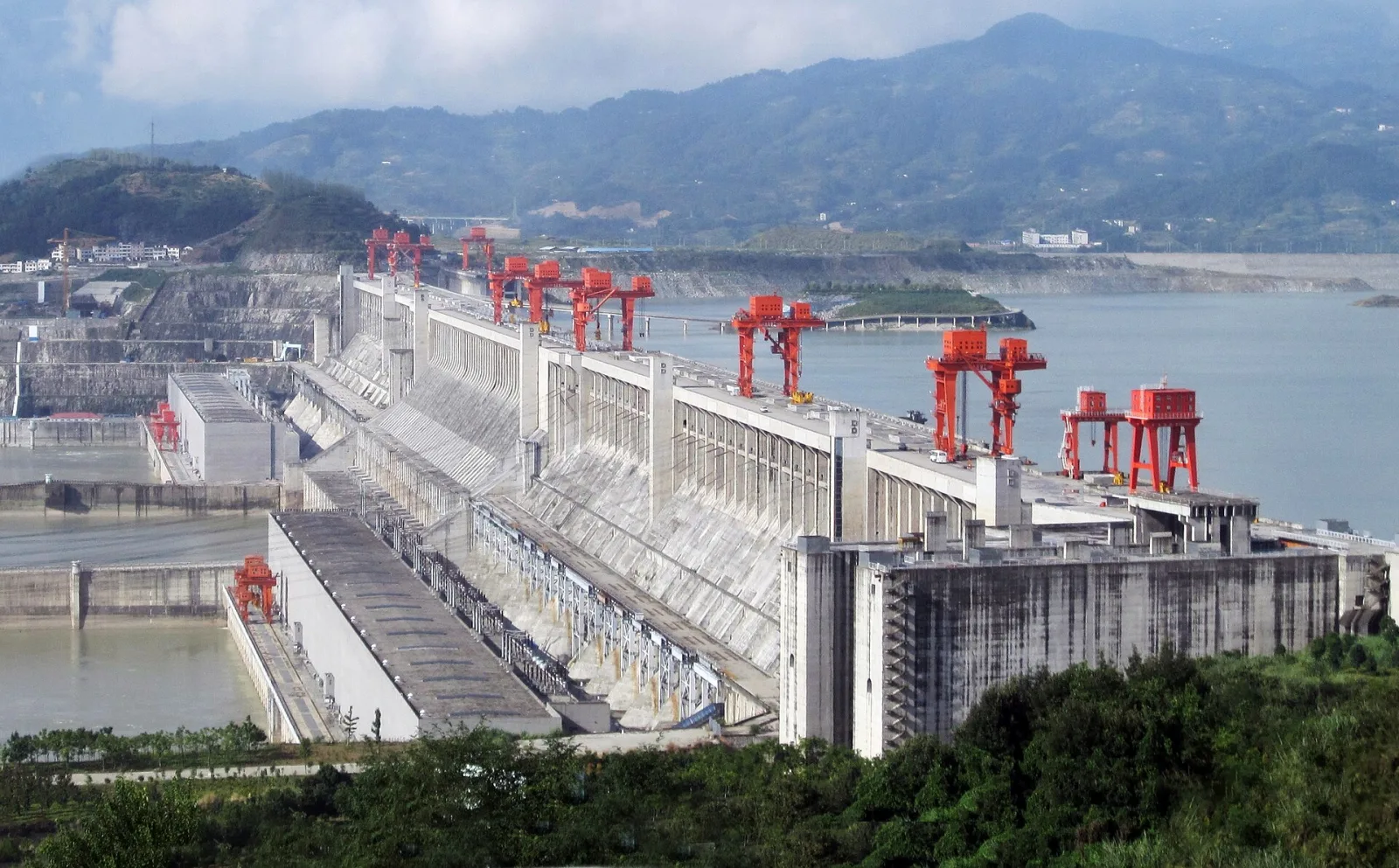
Some dams are engineering landmarks. Hoover Dam on the Colorado River, on the Arizona–Nevada border, is about 221 m (726 ft) tall. Its generators total about 2,080 MW, and it holds back Lake Mead. The Three Gorges Dam on China's Yangtze is the world's largest power station by installed capacity, at 22,500 MW. Its reservoir stretches about 660 km. Swipe through the photos below.
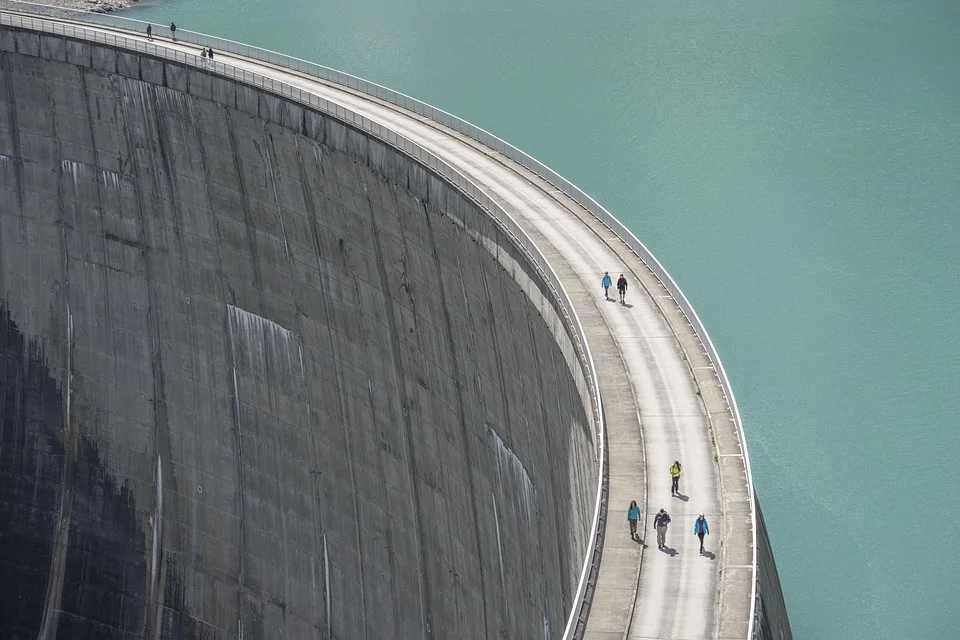
Disadvantages of dams: the costs
The disadvantages of dams are just as real as the benefits. The environmental impact of dams comes from three things: the land that is flooded, the river that is cut in two, and the sediment and water that no longer move freely downstream. Here are the main negative effects of dams.
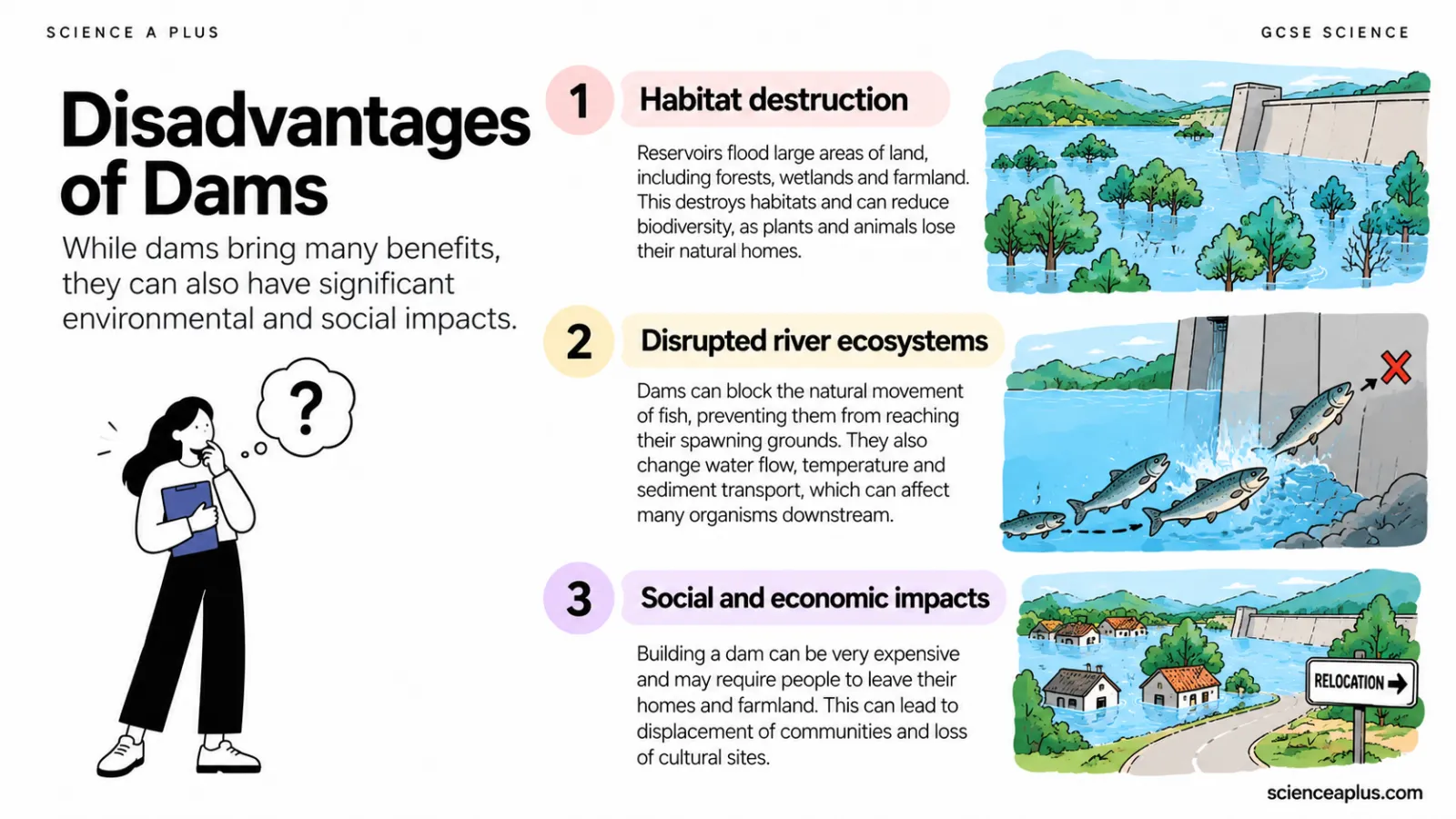
Flooded land and lost habitats
Filling a reservoir drowns whatever was in the valley: forests, wetlands, farmland, villages and cultural sites. Wildlife that lived there loses its home. A whole ecosystem can be replaced by open water, and the animals and plants that depended on the river valley may not be able to move elsewhere.
People forced to move
Dams do not only displace wildlife. The World Commission on Dams estimated in 2000 that between 40 and 80 million people worldwide had been displaced by large dams. Many were never properly compensated.
The Three Gorges Dam in China is a clear example. More than 1.3 million people were relocated to make way for a reservoir about 660 km long. They lost homes, farmland and in some cases places of cultural importance. You can see the dam in the photo carousel earlier in this article.
Blocked fish and broken rivers
Many fish, such as salmon, must travel up rivers to reach their spawning grounds. A dam wall can stop them completely. Dams also change the flow, temperature and oxygen levels of the water below them, which affects other river life.
The numbers are stark. The WWF and ZSL Living Planet Index 2024 found that monitored populations of migratory freshwater fish fell by 81% on average between 1970 and 2020. The data covered 1,864 populations of 284 species. Europe's decline was 75 per cent, and Latin America and the Caribbean's was 91 per cent. Habitat loss and degradation, including river fragmentation by dams and other barriers, make up about half of the threats.
Rivers are also losing their freedom to flow. A 2019 study in the journal Nature found that only 37 per cent of the world's rivers longer than 1,000 km still flow freely along their whole length, and only 23 per cent flow uninterrupted to the ocean. Dams and reservoirs are the main cause of the loss.
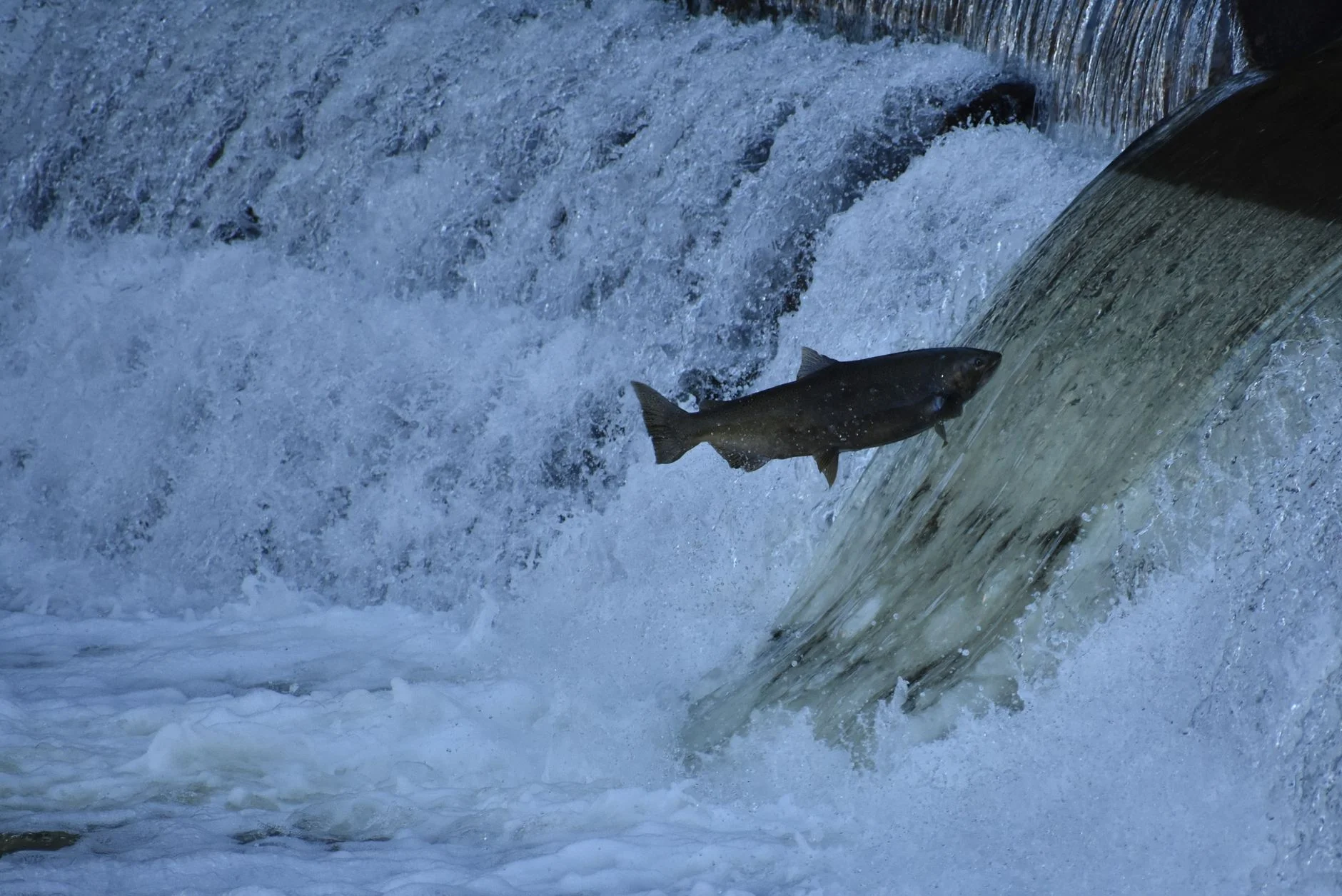
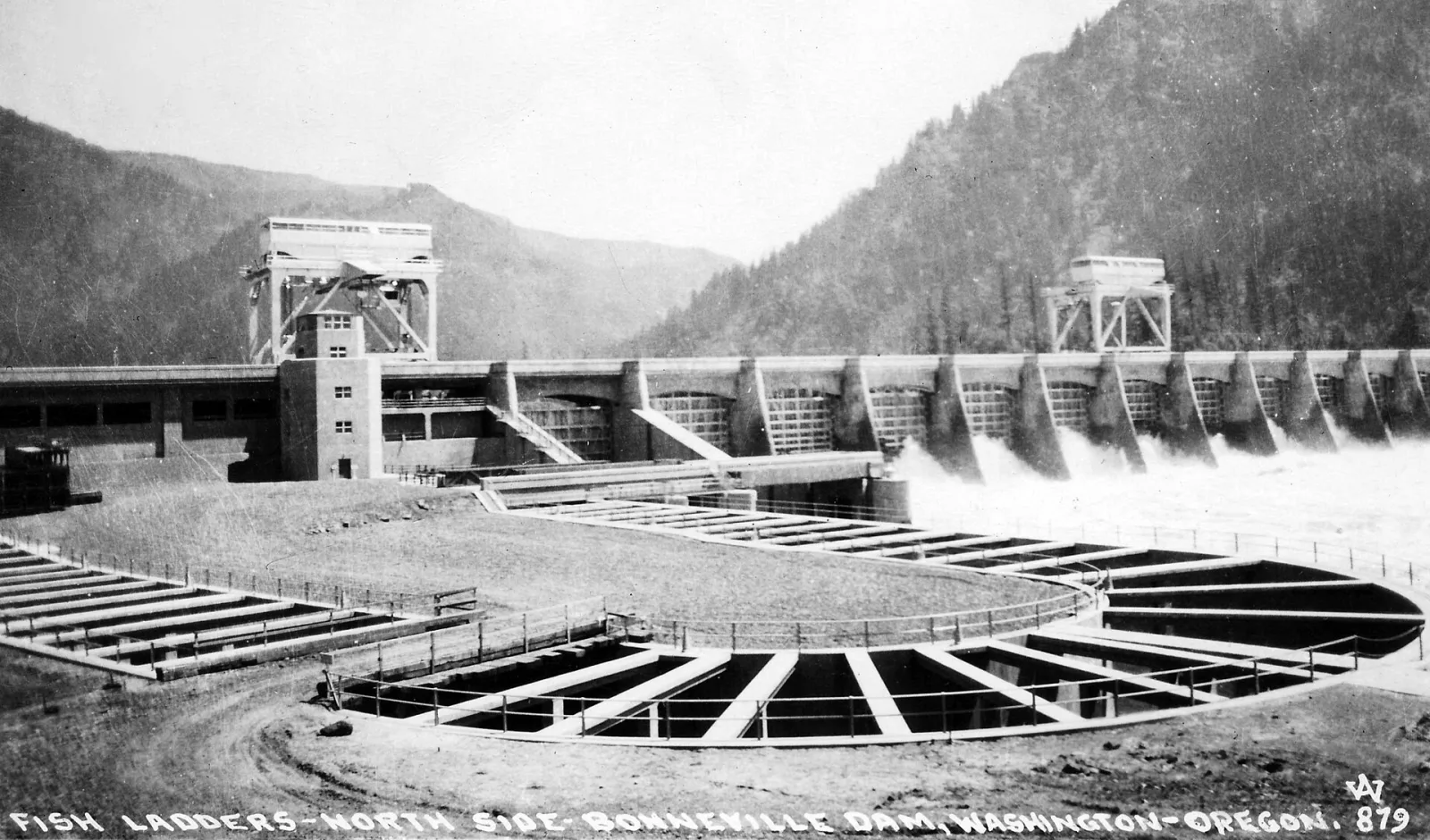
A fish ladder is one fix. It works like a staircase of small pools, so salmon can leap from one to the next and get around the dam. We look at more solutions in the final section.
Trapped sediment and erosion downstream
Rivers carry silt, sand and gravel. When the water slows down in a still reservoir, this sediment settles on the bottom. Two problems follow.
- Downstream: less silt reaches the fields, so there is less natural fertiliser and farmers may need chemical fertiliser instead. Riverbanks and deltas can erode because the sediment that used to replace what the water washed away has gone.
- Upstream: the reservoir slowly fills with silt, which reduces the amount of water it can store.
Below the Aswan High Dam in Egypt, the Nile no longer carries its yearly load of sediment in floodwater. Its banks are eroding and the Nile delta is shrinking. Sudden releases of water can also erode the channel downstream. For the science behind this, read our guide to weathering and erosion of rocks.
Explain why a dam can increase erosion downstream. (2 marks)
Sediment is trapped in the reservoir, so the water released below the dam carries little load. This clean water has spare energy to erode the bed and banks of the river. Sudden releases of water increase the erosion further.
Greenhouse gases from reservoirs
Hydropower has low emissions, but a reservoir is not a magic exception. Plants and soil that are flooded rot underwater and release carbon dioxide and methane. Methane is a much stronger greenhouse gas than CO₂. Emissions vary greatly from dam to dam, and are generally highest in some warm, shallow tropical reservoirs. That is why the IPCC range for hydropower is so wide. A few reservoirs emit far more than the median. See our guide to the greenhouse effect and the climate crisis for the bigger picture.
Cost, dam failure and safety
Dams are very expensive to build and maintain. Kielder Water cost £167 million, which was a great deal of money in the 1970s and 1980s. Money is not the only worry. If a dam fails, the water stored behind it can cause a catastrophe downstream.
A UK example came at Toddbrook Reservoir near Whaley Bridge in Derbyshire. On 1 August 2019, after heavy rain, part of the spillway collapsed. The dam itself was not breached, but about 1,500 people were evacuated as a precaution. The independent review led by Professor David Balmforth found the spillway design "inadequate" and the maintenance "intermittent". The government accepted its recommendations.
The law is strict. Under the Reservoirs Act 1975, a "large raised reservoir" is one holding 25,000 m³ or more of water above the surrounding land, which is about 10 Olympic swimming pools. In England the Environment Agency enforces the rules. Qualified panel engineers must inspect high-risk reservoirs at least every 10 years.
Multipurpose river projects: one dam, many jobs
Most of the dams above were built to do several jobs at once. A multipurpose river project (also called a multipurpose river valley project) uses one dam, or a chain of dams, and its reservoir to meet several needs. The usual list is irrigation, hydroelectricity, flood control and water supply. Many projects add inland navigation, fisheries and recreation as well.
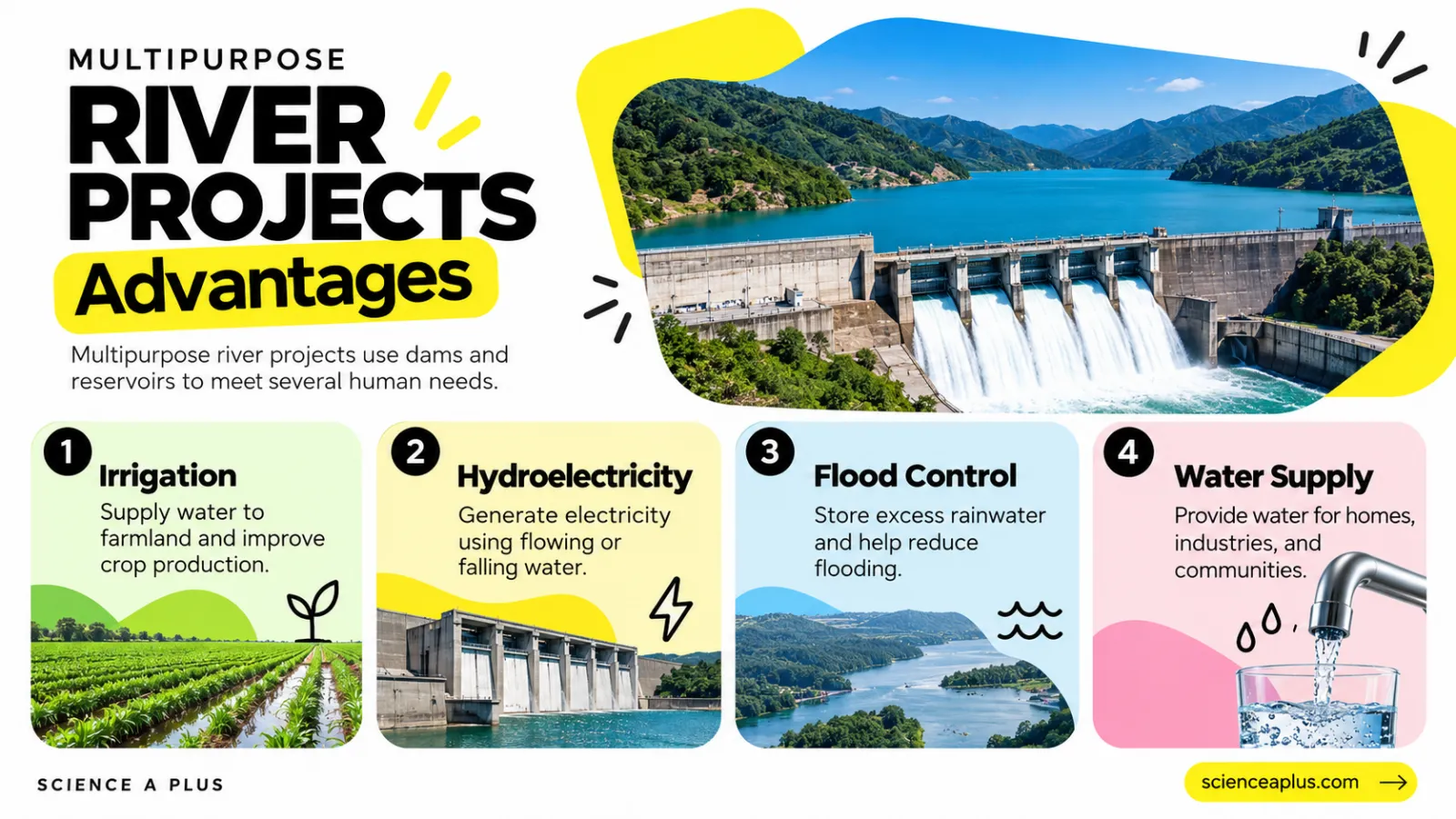
The idea is simple. A river is wild, so it floods in the wet season and shrinks in the dry season. A dam stores the surplus and releases it in a controlled way. The same stored water can then protect towns from floods, irrigate fields, spin turbines and top up taps. A dam that does only one of these jobs wastes much of what the reservoir offers.
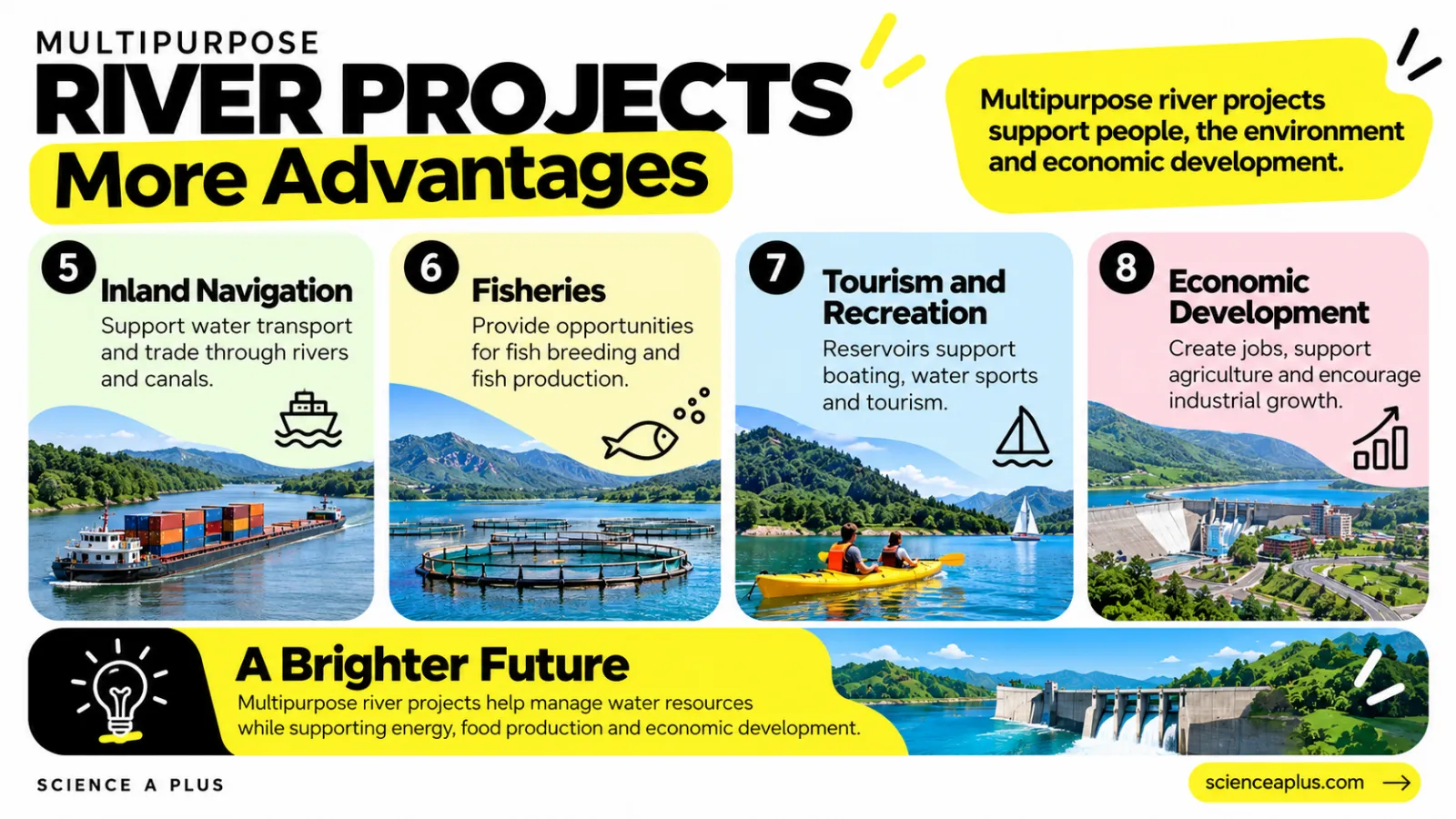
In the second infographic, navigation and fisheries are two of the extra benefits. Deeper, calmer water behind a dam and a series of locks can let barges travel along a river, and reservoirs can support fish farming. Tourism and jobs follow, although the benefits are not shared equally.
Real multipurpose projects
- Tennessee Valley Authority (USA). Created by Congress in 1933 as part of the New Deal, it was built to deal with navigation, flood control and electricity, and to help the region develop. By the end of the Second World War it had completed a 650-mile (1,050 km) navigation channel along the Tennessee River. Its dams displaced more than 125,000 people.
- Damodar Valley Corporation (India). Set up in 1948 after the disastrous 1943 flood in Bengal, and modelled on the TVA. It aimed to provide flood control, irrigation, electricity and navigation. Eight dams were proposed, but only four were built: Tilaiya, Konar, Maithon and Panchet.
- Bhakra Nangal (India). The Bhakra Dam on the Sutlej was finished in 1963. It is about 226 m tall, has two power houses with a combined capacity of about 1,325 MW, and feeds canals that irrigate farmland in Punjab, Haryana and Rajasthan. Its reservoir, Gobind Sagar, drowned roughly 370 villages.
- Accelerated Mahaweli Development Programme (Sri Lanka). The Mahaweli is Sri Lanka’s longest river. In 1977 the government shortened a plan that was meant to take about 30 years to roughly six. Its main dams, Kotmale, Victoria, Randenigala and Rantembe, were built to make electricity and to send water to dry-zone farmland. Victoria is an arch dam of 730 million m³ storage with a 210 MW power station, built between 1978 and 1985. The wider master plan covered about 365,000 hectares of irrigation development.
- Three Gorges (China). Besides its 22,500 MW of power, its reservoir holds about 22 km³ of floodwater, and its ship locks passed about 160 million tonnes of cargo in 2022, against about 18 million tonnes a year before the dam. Over a million people had to move.
The science of falling water
Hydroelectricity depends on energy being transferred. Water high in the reservoir has gravitational potential energy: E = m × g × h, where m is mass in kg, g is 9.81 N/kg and h is the height of fall (the head) in metres. Real dams care about the energy delivered each second, which is power:
P = ρ × g × Q × h × η
Here ρ is the density of water (1,000 kg/m³), Q is the flow in m³/s and η (eta) is the efficiency of the turbine and generator. This is why engineers want a high head and a large, steady flow, and why a reservoir that smooths the flow can be so useful. Try the hydroelectric calculator earlier in this article with your own numbers.
How much energy does 1 m³ of water give up when it falls 100 m? (3 marks)
1 m³ of water has a mass of 1,000 kg. E = m × g × h = 1,000 × 9.81 × 100 = 981,000 J. That is about 0.27 kWh (981,000 ÷ 3,600,000), so a real turbine at 90% efficiency would deliver about 0.25 kWh from each cubic metre.
Two other bits of science work against the benefits. First, sedimentation. A dam slows the river, so the silt it carries sinks and builds up in the reservoir. Studies of thousands of large reservoirs estimate that they lose roughly 0.5–1% of their storage capacity each year, and some estimates run higher. Second, evaporation. A wide, shallow reservoir exposes a huge surface to the sun. Published estimates for Lake Nasser behind the Aswan High Dam put the loss at about 10–16 billion m³ every year, depending on the method.
A reservoir stores 500 million m³ and loses 0.8% of its capacity to silt each year. How much is lost in a year, and how much is left after 10 years? (3 marks)
Loss per year = 500 million × 0.008 = 4 million m³. Over 10 years, assuming the same loss each year, that is 40 million m³, so about 460 million m³ remains. Real rates vary between reservoirs and from year to year.
The trade-offs
The same projects have costs. Reservoirs flood land and move people, from the 125,000 displaced by the TVA to the villages beneath Gobind Sagar and the more than a million resettled for Three Gorges. Dams block fish and change a river’s natural flow, and silt that would have fed deltas gets trapped behind the wall. Water diverted for irrigation or power can leave less for communities downstream, and dams on shared rivers can cause disputes between countries.
For these reasons, modern projects are planned with environmental and social impact assessments, consultation with the people affected, fish passes and managed releases, which we cover later in this article. Whether a multipurpose project is a success depends on how fairly the costs and benefits are shared.
Weighing up the good and bad of dams
So are dams good or bad? Most advantages have a matching disadvantage, and the pros and cons of dams often sit side by side on the same river.
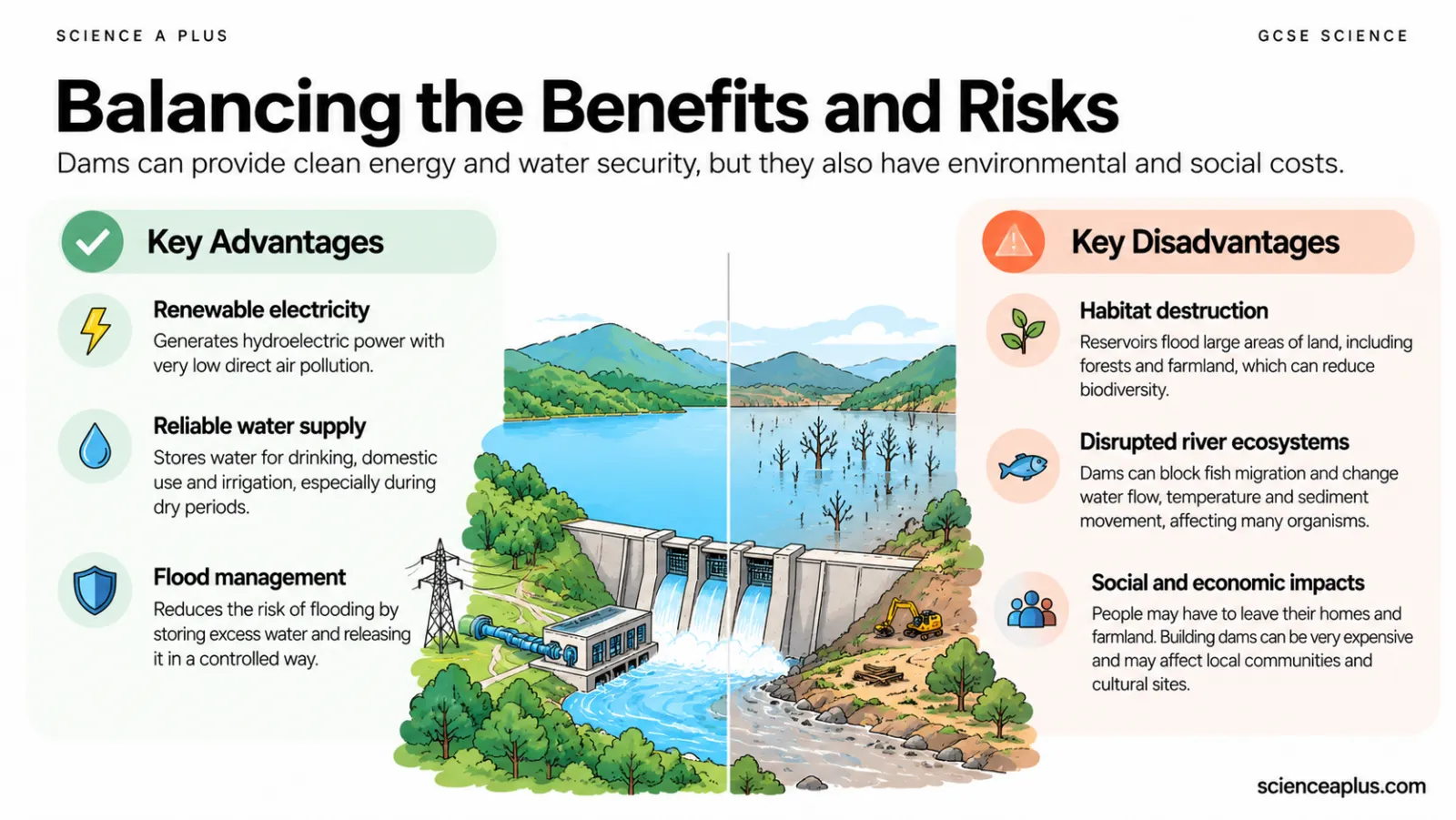
| Advantage | Matching disadvantage |
|---|---|
| Clean, low-carbon electricity | Reservoir gases and lost land |
| Water storage for dry seasons | Drought can empty the reservoir, and silt slowly fills it |
| Flood control downstream | Flooding of land and villages upstream |
| Recreation and tourism | Displaced communities |
| Reliable, controllable power | Blocked fish and a high cost |
The honest answer is that it depends on the dam: its location, size, design and management. A small dam on a river with no migrating fish and few people nearby is a very different proposition from a giant dam that floods a populated valley. The multipurpose river projects section above shows how one project can be planned to serve several purposes, and where those purposes pull against each other.
Test your judgement with these flip cards. Decide whether each situation is a benefit or a cost, then tap to check.
Can dams be made better?
Engineers and river managers have found ways to reduce some of the damage. None of them removes every problem, but they show that dams do not have to be all-or-nothing.
Fish passes and fish ladders
A fish pass or fish ladder lets fish climb past a weir or dam. The Environment Agency and its partners build passes and remove barriers for salmon. On the River Don in Sheffield, salmon have returned to stretches of river for the first time in over 200 years.
Releasing natural-style flows
Rivers normally rise and fall with the seasons. Dam managers can release water in patterns closer to the natural flow, instead of a steady trickle or a sudden surge. This helps wildlife and plants that depend on those changes downstream.
Taking old dams down
Sometimes the best fix is to remove the barrier. Dam Removal Europe counted at least 603 river barriers removed across Europe in 2025. That is a record for the fifth year running, beating the previous record of 542 in 2024. The removals reconnected more than 3,740 km of river, with Sweden (173), Finland (143) and Spain (109) leading the way.
Europe has roughly 1.2 million barriers, and more than 150,000 of them are obsolete. Most removals are small weirs and old dams, not the big hydropower dams.
A well-known case is the Elwha River in Washington, USA. After two old dams were removed, Chinook salmon reached the upper river in 2014 for the first time in 102 years.
New large dams are still being debated in places such as the Mekong and Amazon basins. Our article on jungle rivers and their importance for local communities explains why those rivers matter so much to the people living along them.
Are dams worth it? Exam practice
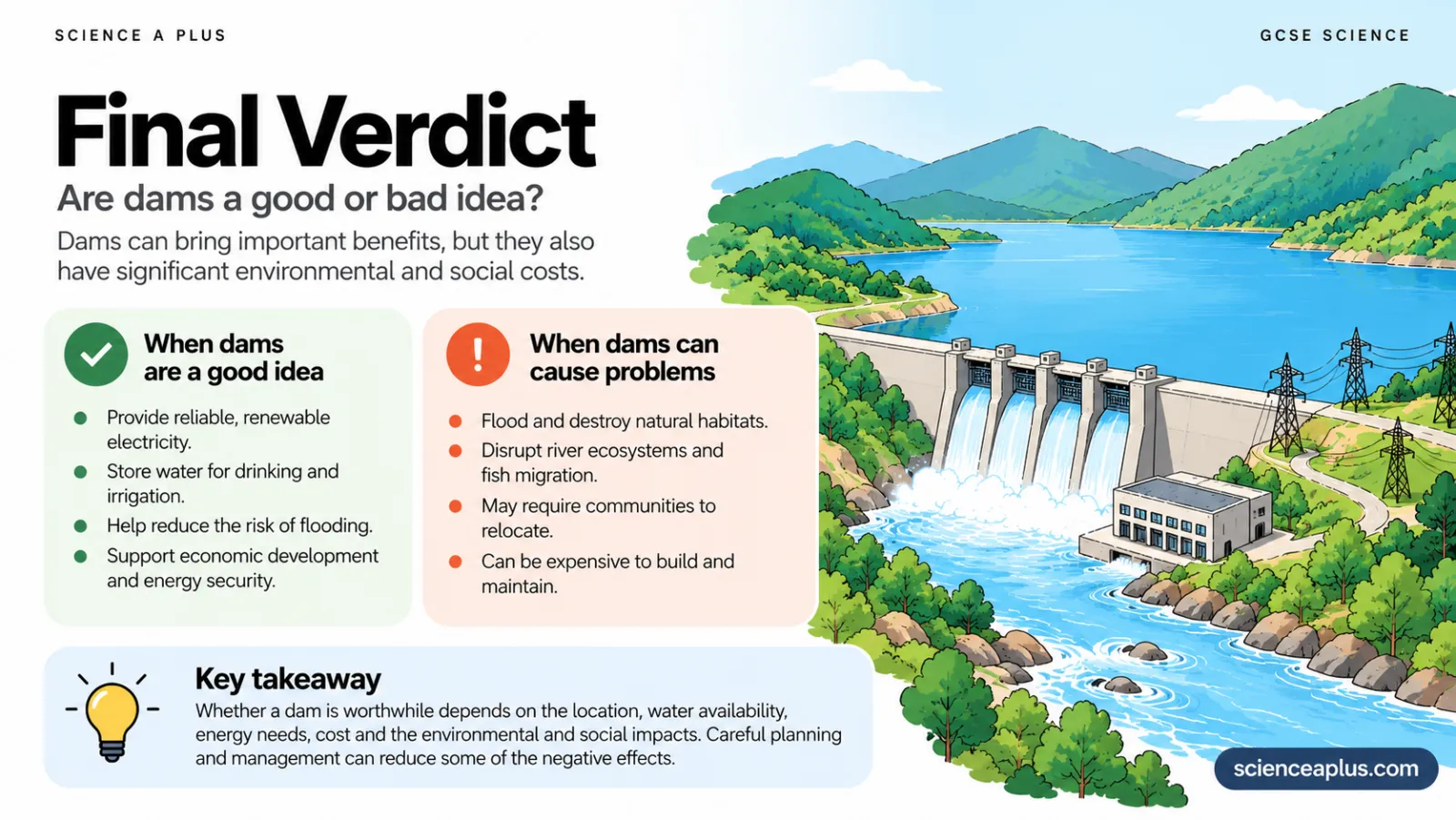
The final infographic sums it up: a dam is worth it when the benefits outweigh the costs in a specific place, and a problem when they do not.
Evaluate the use of a large dam to manage a river. (6 marks)
Advantages: a large dam can generate low-carbon hydroelectric power from the falling water, and a reservoir stores water for drinking and irrigation, so people have a supply through droughts. It can also reduce flood peaks downstream by storing floodwater and releasing it slowly. Disadvantages: the reservoir floods land and homes, so habitats are destroyed and people may be displaced, as at Three Gorges. A dam also blocks migrating fish and traps sediment, which can cause erosion downstream, as below Aswan. Overall, a dam is worthwhile where the need for power and water is high and the impacts can be reduced, for example with fish passes. It is more questionable where many people are displaced or fish runs would be lost.
Give two reasons why hydroelectric power is described as renewable. (2 marks)
The water is replenished by the water cycle, as rain refills the reservoir. The water is not used up or burned to make the electricity.
Before you answer an "evaluate" question, run through this checklist:
- Name the dam or give an example.
- Give one economic, one social and one environmental point.
- Cover both sides: advantages and disadvantages.
- Use a number from the evidence.
- Finish with a judgement that explains your reasoning.
Frequently asked questions about dams
What are the advantages and disadvantages of dams?
The advantages of dams are low-carbon electricity, stored water for drinking and irrigation, flood control and recreation. The disadvantages are flooded land, displaced people, blocked fish migration, trapped sediment, reservoir greenhouse gases, high costs and failure risk. Whether a dam is worthwhile depends on its location, size and management.
Why are dams bad for the environment?
Reservoirs flood forests, wetlands and farmland, destroying habitats. Dams block fish migration, change river flow, temperature and oxygen, and trap sediment that downstream banks and deltas need. Rotting plants in reservoirs also release carbon dioxide and methane. The impact varies greatly between dams.
How do dams affect fish?
Dams block fish such as salmon from reaching their spawning grounds and change the flow, temperature and oxygen of the river. WWF found migratory freshwater fish populations fell by 81 per cent on average from 1970 to 2020, with river barriers a major threat. Fish passes can help fish get around.
How does a hydroelectric dam make electricity?
Water stored high in the reservoir has gravitational potential energy. It falls through a pipe called a penstock, transferring energy to its kinetic store. The moving water spins a turbine connected to a generator, which produces electricity by electromagnetic induction. The power depends on the height of the fall and the flow rate.
Is hydroelectric power renewable and carbon-free?
Hydroelectric power is renewable because the water cycle refills the reservoir with rain. It is low-carbon but not carbon-free. Hydropower has a median lifecycle emission of 24 g CO₂-equivalent per kWh, compared with 490 for natural gas and 820 for coal. Some reservoirs emit far more than the median.
How do dams help prevent flooding?
A dam stores excess water in its reservoir during heavy rain and releases it slowly in a controlled way, which reduces the flood peak downstream. Spillways safely pass extra water when the reservoir is full. The reservoir itself can flood land upstream, so flood control has a cost.
Can dams cause earthquakes?
Rarely, yes. The weight of a large reservoir can trigger earthquakes in some places. The best-known case is the Koyna reservoir in India, where a magnitude 6.3 earthquake in 1967 killed more than 170 people. Most reservoirs never cause a felt earthquake.
Are reservoirs in the UK safe?
UK reservoirs are regulated under the Reservoirs Act 1975. Large raised reservoirs hold 25,000 m³ or more above the surrounding land. In England the Environment Agency enforces the rules, and qualified engineers must inspect high-risk reservoirs at least every 10 years. Failures are rare, but the 2019 Toddbrook incident showed why maintenance matters.
Why are some dams being removed?
Old dams can be unsafe, expensive to maintain or no longer useful, and they block fish and sediment. Removing them reconnects rivers. Dam Removal Europe counted at least 603 barriers removed in 2025, reconnecting more than 3,740 km of river. Most of these were small weirs and old dams.
What is a multipurpose river project?
A multipurpose river project uses a dam or chain of dams, and the reservoir behind it, for several purposes at once: irrigation, hydroelectricity, flood control and water supply, and often navigation, fisheries and recreation. Examples include the Tennessee Valley Authority in the USA, the Damodar Valley Corporation and Bhakra Nangal in India, and Sri Lanka’s Accelerated Mahaweli Development Programme.
What are the advantages and disadvantages of multipurpose river projects?
The advantages are electricity, irrigation water, flood protection, water supply, navigation, fisheries and tourism from one structure. The disadvantages are flooded land and displaced people, blocked fish and changed river flow, silt building up in the reservoir, evaporation losses, high costs, and disputes when a river is shared. The purposes can also compete, for example flood control against power generation.