What are the disadvantages of friction? Friction wastes energy by transferring it to the thermal store of the surroundings, so machines heat up and become less efficient. It also wears surfaces away, slows moving objects, increases fuel use and causes noise and vibration. We reduce it with lubricants, ball bearings, smooth surfaces and streamlined shapes.
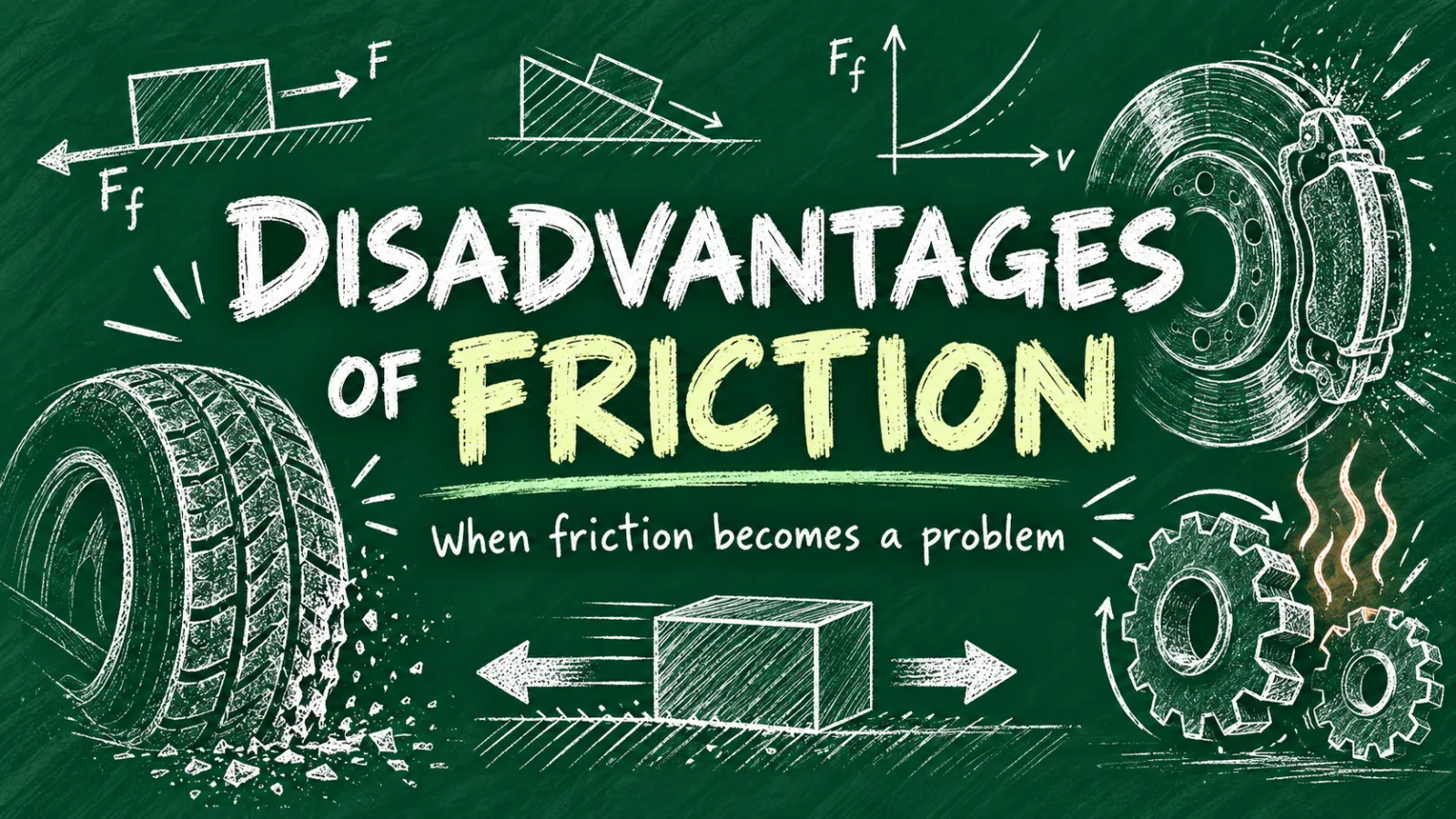
Friction is one of those forces that you rarely notice until it causes trouble. A squeaky door, a worn-out trainer, a bike that is hard to pedal and a car engine that needs oil changes all come down to the same thing. This guide explains what friction is, how big it can be, and then works through each of the main disadvantages of friction, with real numbers from engineering studies and the ideas you need for GCSE physics.
What is friction?
Friction is a contact force that opposes motion. It acts whenever two surfaces touch and either slide over each other or try to. Its direction is always opposite to the way the object is moving (or trying to move), which is why it slows things down.
Why does it happen? Even surfaces that look smooth are rough on a microscopic scale. When two surfaces are pressed together, they only really touch at the tips of tiny bumps. Those high points catch on each other and can stick together at the contact points. To slide one surface over the other, a force has to break or deform those contacts, and that takes work.
Friction does not only happen between solids. When an object moves through a fluid (a liquid or a gas), it pushes the fluid out of the way and rubs against it. That resistance is called drag. Air resistance and water resistance are both frictional forces, and GCSE exam boards treat air resistance as a type of friction. If you want a gentler introduction with everyday examples, try our friction physics lesson first.
Types of friction
Physicists split friction into four main types. They all oppose motion, but they are very different in size, which matters a lot when engineers try to reduce friction.
| Type of friction | When it acts | Everyday example |
|---|---|---|
| Static friction | Between surfaces that are not yet moving; stops an object starting to slide | A heavy wardrobe that will not budge until you push hard |
| Sliding (kinetic) friction | Between surfaces sliding over each other | A box being dragged across a floor |
| Rolling friction | When a wheel or ball rolls over a surface | A bicycle wheel on a road |
| Fluid friction (drag) | When an object moves through a liquid or gas | Air resistance on a cyclist; water resistance on a swimmer |
The maximum static friction is usually a little bigger than sliding friction. That is why it takes a big shove to get a heavy box moving, and then slightly less effort to keep it going. Rolling friction is far smaller than either, and drag grows quickly as speed increases: at everyday speeds it rises roughly with the square of the speed, so doubling your speed roughly quadruples the air resistance.
Friction is also behind the "resultant force" ideas in Newton's laws. An object moves at a steady speed when the driving force exactly balances friction and drag, so the resultant force is zero.
How big is friction? The equation F = μN
For two dry, solid surfaces, the friction force depends on two things: the materials and how hard the surfaces are pressed together. This is summed up in a simple equation.
F = μ × N
Here F is the friction force in newtons, N is the normal (contact) force pressing the surfaces together, and μ (the Greek letter "mu") is the coefficient of friction. The coefficient has no units. A big μ means a grippy pair of surfaces; a small μ means a slippery pair. On a flat floor, the normal force equals the object's weight, so N = m × g, with g = 9.8 N/kg on Earth.
Here are some typical coefficients for clean, dry surfaces (static values from engineering data tables). Real values vary with surface finish, dirt, temperature and moisture, so treat them as rough guides.
| Surfaces in contact | Typical coefficient μ |
|---|---|
| Glass on glass | 0.9–1.0 |
| Rubber tyre on dry asphalt | about 0.9 |
| Rubber on wet asphalt | 0.25–0.75 |
| Steel on steel (dry) | 0.5–0.8 |
| Wood on wood | 0.25–0.5 |
| Steel on steel (greased) | about 0.16 |
| Ice on ice (at 0 °C) | about 0.1 |
| PTFE (Teflon) on PTFE | about 0.04 |
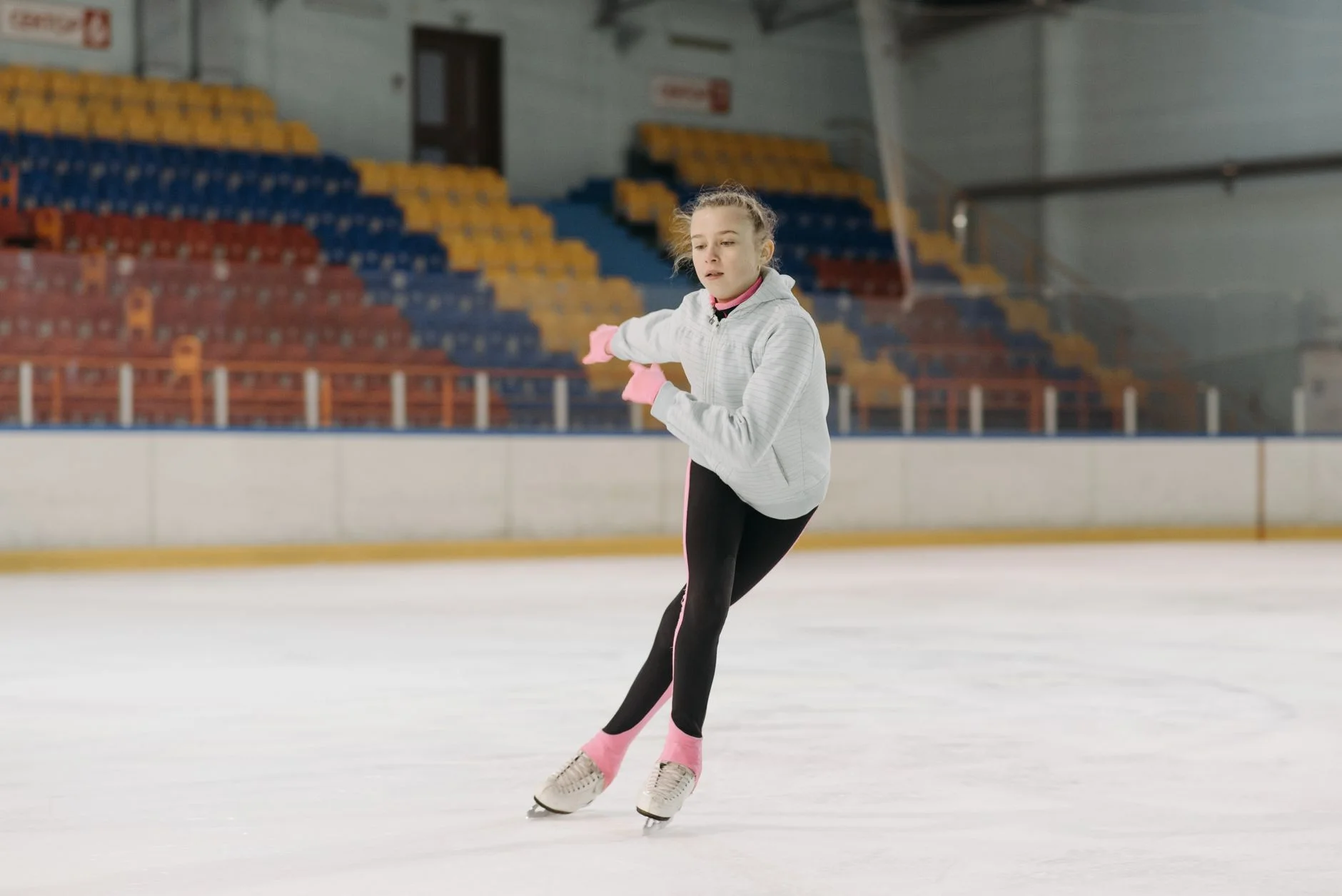
| Steel skate blade on ice | about 0.03 |
Worked example. A 20 kg wooden crate rests on a wooden floor with μ = 0.4. The normal force is N = 20 × 9.8 = 196 N. The friction force you must overcome to start it sliding is F = 0.4 × 196 = 78.4 N. Lubrication makes a huge difference: greasing two steel surfaces drops μ from 0.5–0.8 to about 0.16, cutting the friction force between them to between a fifth and a third of its dry value.
Friction is not all bad
Before listing the problems, it is worth remembering that life without friction would be impossible. The advantages and disadvantages of friction often come from the same force acting in different places.
- Walking and running: static friction between your shoe and the ground pushes you forward. On ice, where μ is tiny, you slip.
- Grip and braking: tyres grip the road, and brake pads squeeze discs to slow a car down.
- Holding things: nails, screws and knots stay in place because of friction, and you can hold a pen or a cup.
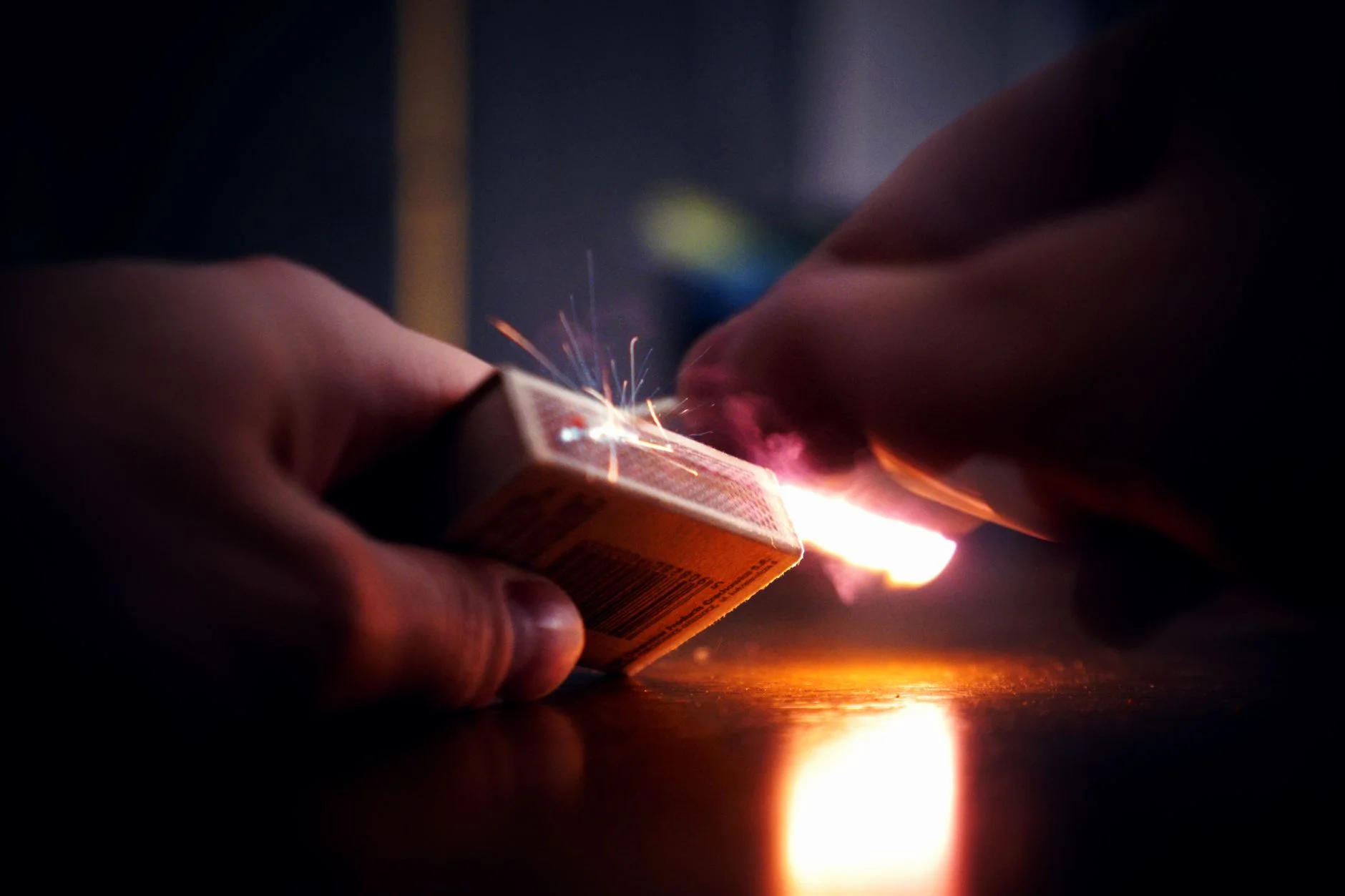
- Lighting a match: rubbing the match head on the rough strip heats it enough to start a chemical reaction.
- Writing: pencil lead rubs off onto paper only because of friction.
So friction is useful when we need grip, and a nuisance when we want things to move freely. The rest of this guide focuses on that second side: the disadvantages of friction and what engineers do about them.
The main disadvantages of friction
Most of the problems friction causes can be grouped under a few headings. Each one is explained in its own section below, with examples you can use in exam answers.
- It wastes energy as heat. Work done against friction transfers energy to thermal stores, so machines are less efficient.
- It causes wear and tear. Rubbing surfaces lose material, so tyres, shoes, gears and bearings wear out and need replacing.
- It slows moving objects. Vehicles need a bigger driving force, and more fuel, to keep moving against friction and air resistance.
- It makes noise and vibration. Squeaking brakes, creaking hinges and rattling machinery all come from friction.
- It costs money. Wasted fuel, repairs and replacement parts add up to a huge share of the world's energy use.
Several of these are linked. Heat from friction speeds up wear, wear makes surfaces rougher, and rougher surfaces cause more friction, so a small problem can grow if a machine is not maintained.
1. Friction wastes energy as heat
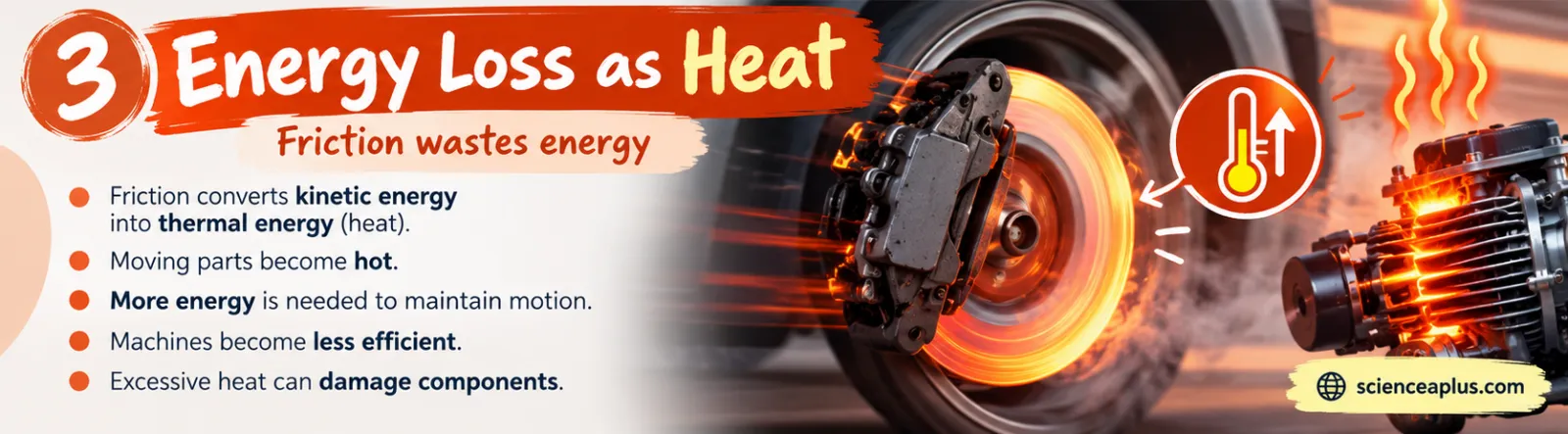
Rub your hands together quickly and they warm up. That simple test shows the biggest disadvantage of friction. Whenever a force does work against friction, energy is transferred away from the kinetic store of the moving object and into the thermal store of the surfaces and the surroundings.
In GCSE language, that energy is dissipated: it spreads out into the surroundings and becomes much harder to use again. It has not been destroyed (energy is always conserved), but it is no longer doing anything useful. Our guide to the different kinds of energy explains energy stores in more detail.
Because some of the input energy ends up as unwanted heat, no real machine is 100 % efficient. Efficiency compares the useful energy you get out with the total energy you put in:
efficiency = useful output energy transfer ÷ total input energy transfer
The more friction there is inside a machine, the more energy is dissipated and the lower its efficiency. The AQA specification gives lubrication as a key example of a way to reduce unwanted energy transfers, alongside thermal insulation.
Hot brakes
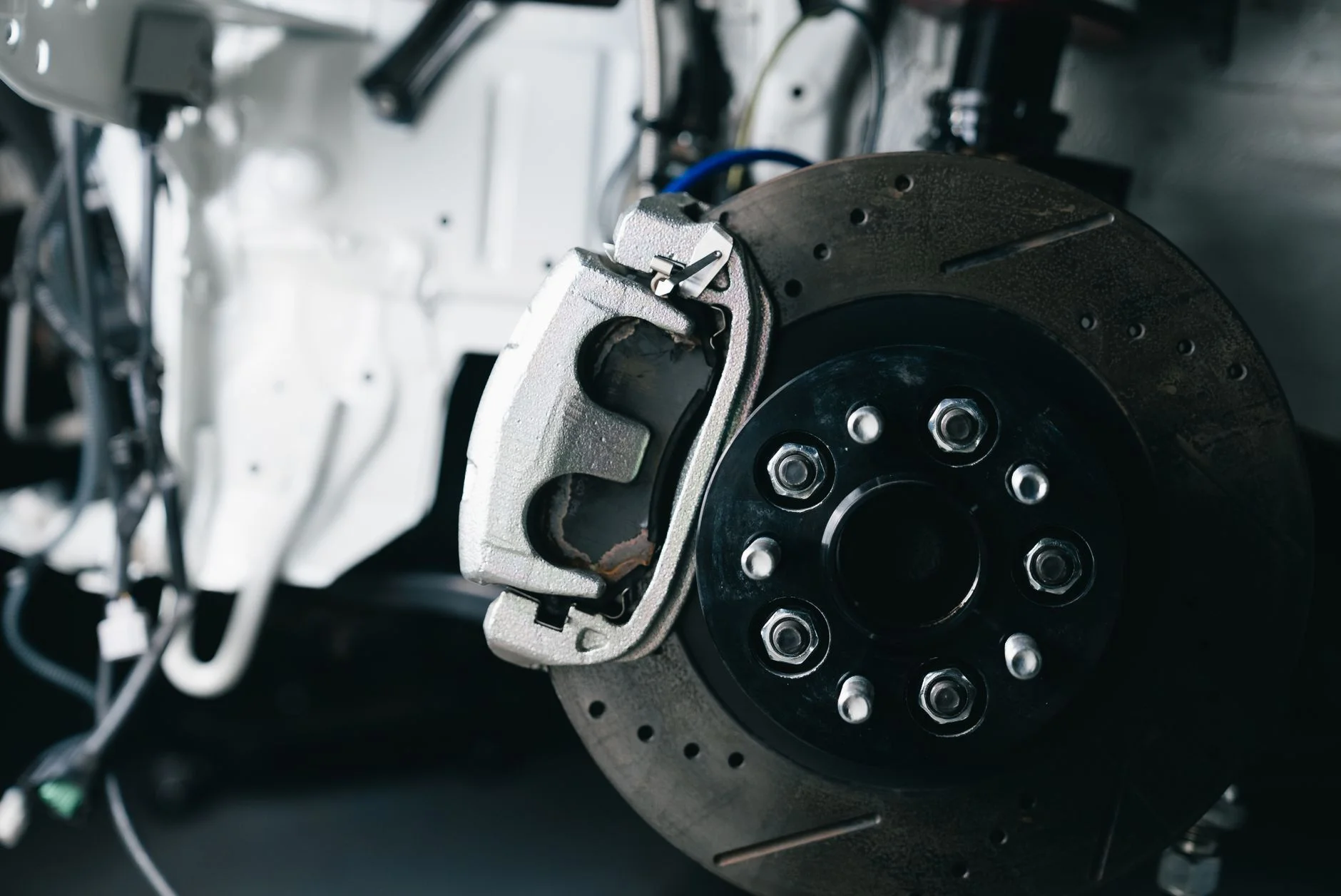
Brakes are the clearest example. When a driver presses the brake pedal, pads are squeezed against a spinning disc attached to the wheel. The friction force does work, the car's kinetic energy falls, and the brakes heat up. On a long, steep downhill, brakes can get so hot that they work less well, an effect called brake fade. That is why drivers are advised to select a lower gear on long, steep descents rather than relying only on the brakes.
Engineers have found a way to claw some of that energy back. Electric and hybrid cars use regenerative braking: the motor runs as a generator when the car slows down, so part of the kinetic energy goes into the battery instead of heating the brakes. You can read more in our article on the physics of electric cars.
Heat can also damage machines directly. Engine oil breaks down if it overheats, plastic parts can soften, and metal parts expand, which can make moving parts bind together. That is why engines and many industrial machines need cooling systems as well as lubrication.
2. Wear and tear
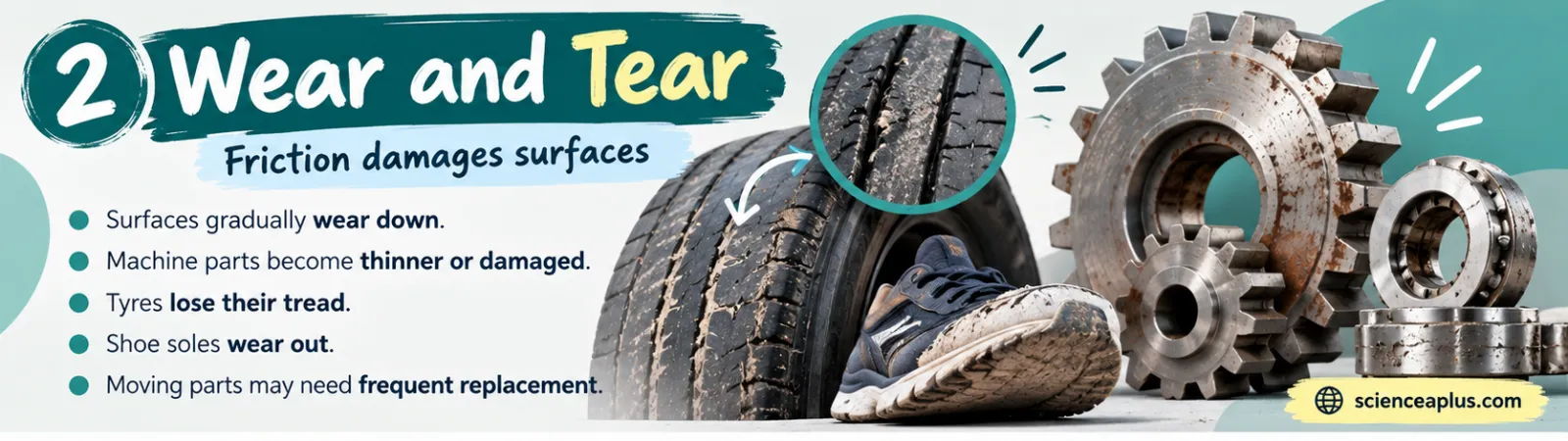
Every time two surfaces rub, a tiny amount of material is scraped away. One rub does almost nothing, but millions of them add up. This gradual loss of material is called wear, and it is the second big disadvantage of friction.
You can see wear all around you:
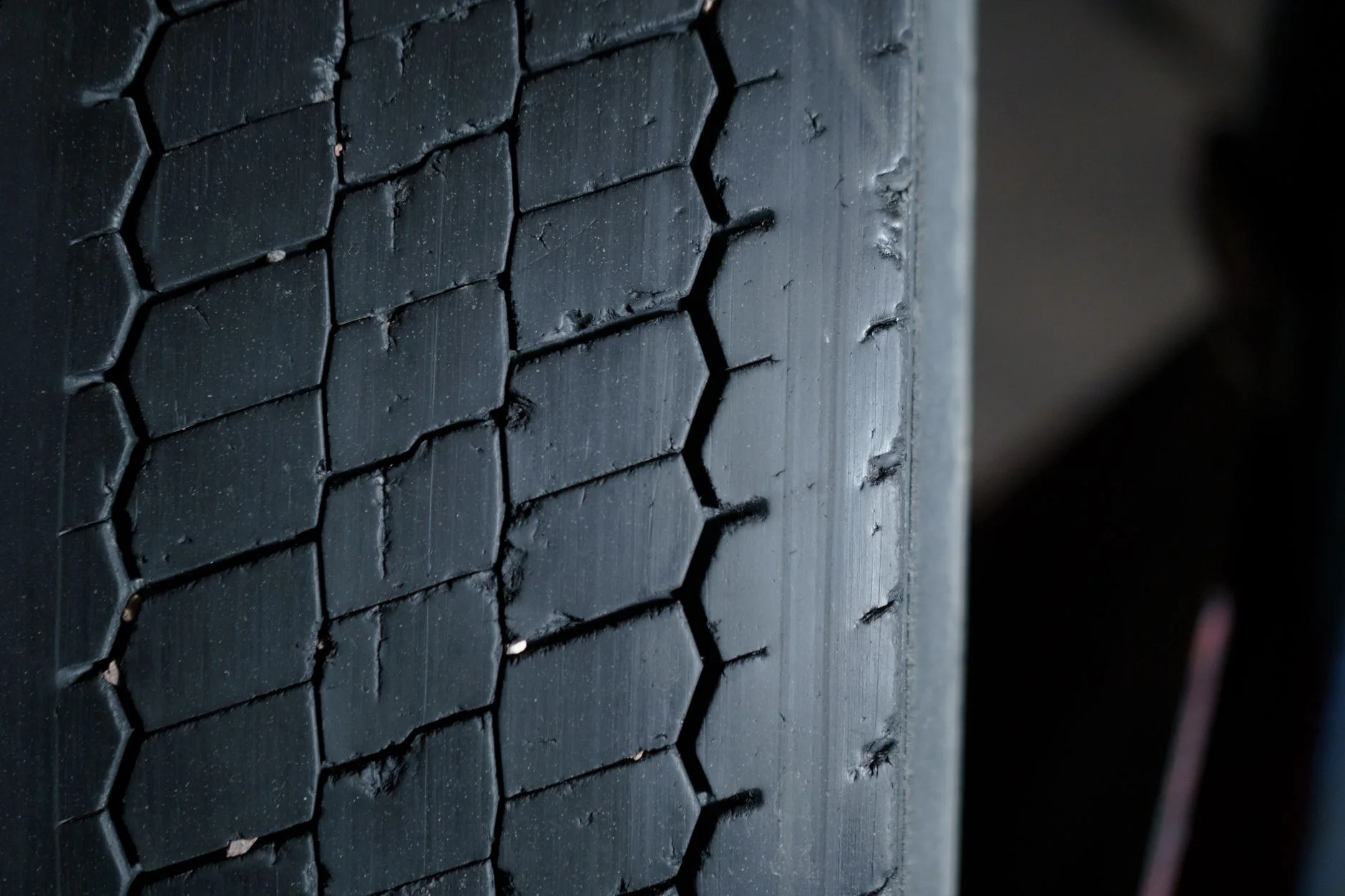
- Tyres lose their tread, which reduces grip in the wet. Worn tyres have to be replaced.
- Shoe soles wear thin, especially at the heel.
- Brake pads and discs get thinner each time they are used, so they are checked and replaced during servicing.
- Gears, chains and bearings in machines lose their shape, become loose and start to rattle.
- Carpets and stairs wear down along the routes people walk most often.
- Skin can be damaged too: repeated rubbing from a badly fitting shoe causes blisters. Our guide to friction sores covers how to look after rubbed skin.
Worn parts are not just a cost. They can be dangerous. A worn tyre takes longer to stop on a wet road, and a worn bearing can seize and break a machine. That is why vehicles have regular safety checks, and why factories plan maintenance before parts fail.
Where does the worn material go?
The material does not vanish. Tiny particles from tyres, brakes and road surfaces are released into the air and washed into drains and rivers. In 2019 the UK's Air Quality Expert Group reported that brake wear, tyre wear and road-surface wear make up about 60 % of the fine particles (PM2.5) and 73 % of the coarser particles (PM10), by mass, released directly by road transport in the UK. As exhaust fumes have been cleaned up, this friction-made pollution has become a bigger share of the problem.
3. Friction slows things down
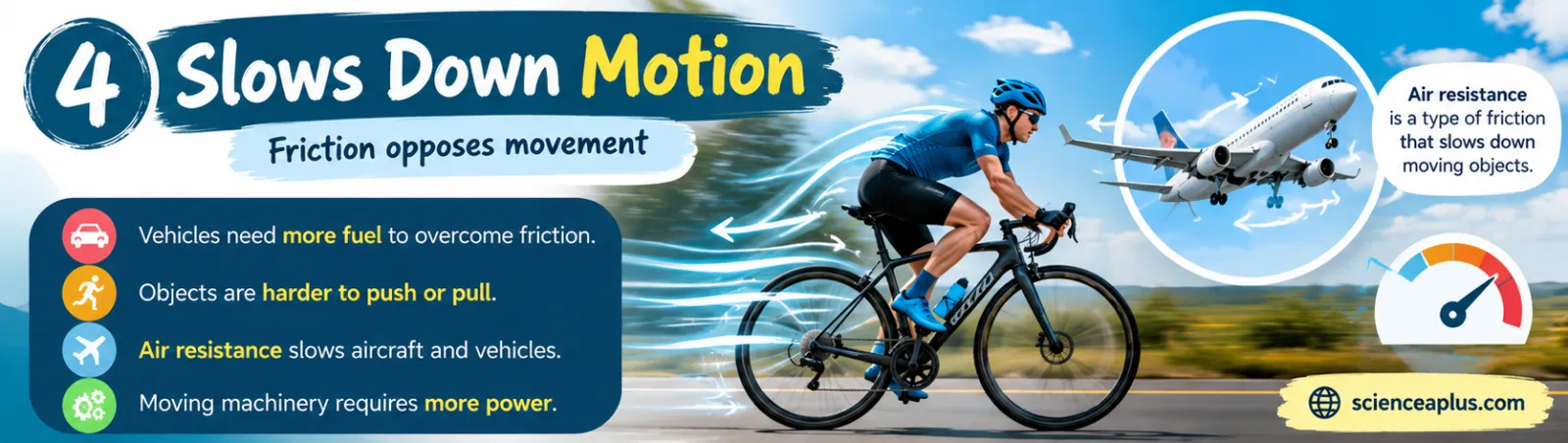
Friction always acts against motion, so anything that moves has to keep pushing against it. Stop pedalling a bike on a flat road and you gradually slow down, because friction in the wheels and chain, rolling resistance from the tyres and air resistance all act backwards. To keep a steady speed, the driving force must be as big as all those resistive forces added together.
That has three practical consequences:
- Vehicles use more fuel. An engine or motor must supply extra force, and extra energy, just to overcome friction and drag.
- Things are harder to push or pull. Moving furniture, dragging a sledge over grass or turning a stiff tap all need a bigger force.
- Machines need more power. A motor that has to fight friction needs a higher power rating to do the same job.
Air resistance: friction from the air
For fast-moving objects, air resistance (drag) is often the biggest resistive force. Unlike sliding friction, drag depends strongly on speed. At everyday speeds it rises roughly with the square of the speed, so a car at 100 km/h feels about four times the air resistance it feels at 50 km/h. That is why fuel use climbs at motorway speeds, and why racing cyclists crouch low and wear tight clothing.

Drag also sets a speed limit for falling objects. When a skydiver jumps, their weight pulls them down and air resistance pushes up. As they speed up, the drag grows until it equals their weight. The resultant force is then zero and they stop accelerating. This top speed is called terminal velocity, about 53–56 m/s (roughly 190–200 km/h) for a skydiver falling belly-down. Opening a parachute increases the drag massively, so the terminal velocity drops to a safe landing speed. In this case drag is an advantage, not a disadvantage.
4. Noise and vibration
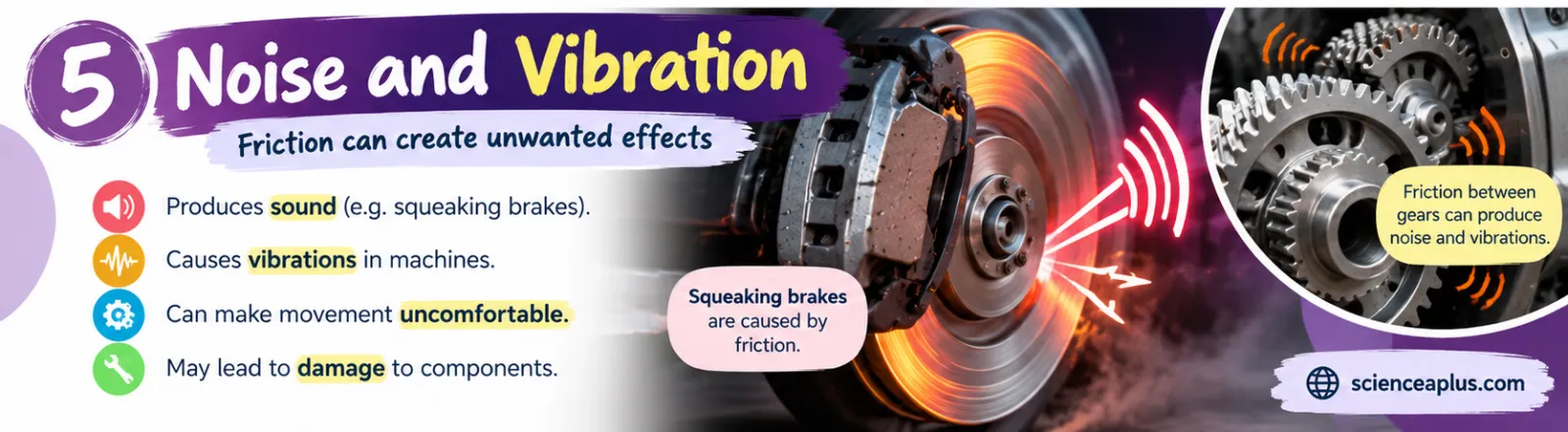
When two surfaces rub, they often do not slide smoothly. They stick, then slip, then stick again, many times a second. Each slip makes the surfaces vibrate, and vibrations produce sound. This "stick–slip" effect is behind a whole family of irritating noises:
- squealing brakes on cars, bikes and trains;
- a creaking door hinge that needs oil;
- squeaky trainers on a sports-hall floor;
- whining or grinding gears in a worn gearbox.
Noise is wasted energy too: some of the work done against friction goes into sound waves instead of useful motion. Vibration can also shake bolts loose, crack parts over time and make journeys uncomfortable. In some cases a new noise is a useful warning. Many brake pads have a small metal tab that squeals against the disc when the pad has worn too thin, telling the driver it is time for a replacement.
Friction-made sound is not always unwanted, though. A violin bow makes the string vibrate using exactly the same stick–slip action, and players rub rosin on the bow to increase the friction.
5. The hidden cost of friction
Put the wasted energy, the wear and the repairs together and friction turns out to be one of the most expensive forces on Earth. The study of friction, wear and lubrication even has its own name: tribology, from the Greek tribos, meaning rubbing. The word was coined by the British engineer Peter Jost, whose 1966 report to the UK government estimated that industry could save over £515 million a year, about 1 % of the UK's economy at the time, simply by controlling friction and wear better.
How much energy does friction waste?
Modern studies give some striking numbers:
- Passenger cars: a 2012 study by Kenneth Holmberg, Peter Andersson and Ali Erdemir found that about one-third of a car's fuel energy is used to overcome friction in the engine, gearbox, tyres and brakes. Only about 21.5 % of the fuel energy actually moves the car.
- The whole world: a 2017 study by Holmberg and Erdemir in the journal Friction estimated that about 23 % of the world's total energy use (119 exajoules a year) comes from tribological contacts. Around 20 % goes on overcoming friction and about 3 % on remaking worn parts and spare equipment.
The good news from the same 2017 study is that much of this loss could be avoided. Using better lubricants, coatings and designs could cut the energy lost to friction and wear by about 40 % within 15 years. In the long term (about 15 years), the study estimated this could save around €970 billion and about 3,140 million tonnes of carbon dioxide emissions. Reducing friction is therefore a climate issue as well as an engineering one.
Check your understanding
Explain why a car's brakes get hot when it stops. (3 marks)
Work is done by the friction force between the brake pads and the disc (wheel). This reduces the kinetic energy of the car. The energy is transferred to the thermal store of the brakes, so their temperature rises.
A cyclist rides at a steady speed on a flat road. Explain why she must keep pedalling. (2 marks)
Friction and air resistance act backwards on the bike. She must provide a driving force equal to these resistive forces so that the resultant force is zero and her speed stays constant.
Give two disadvantages of friction in a car engine. (2 marks)
Any two from: energy is wasted as heat, lowering efficiency; moving parts wear out; more fuel is needed; noise and vibration are produced.
A lot of popular ideas about friction are half-true at best. For more surprises like the meteor myth, read our list of common misconceptions about physics.
How to reduce friction
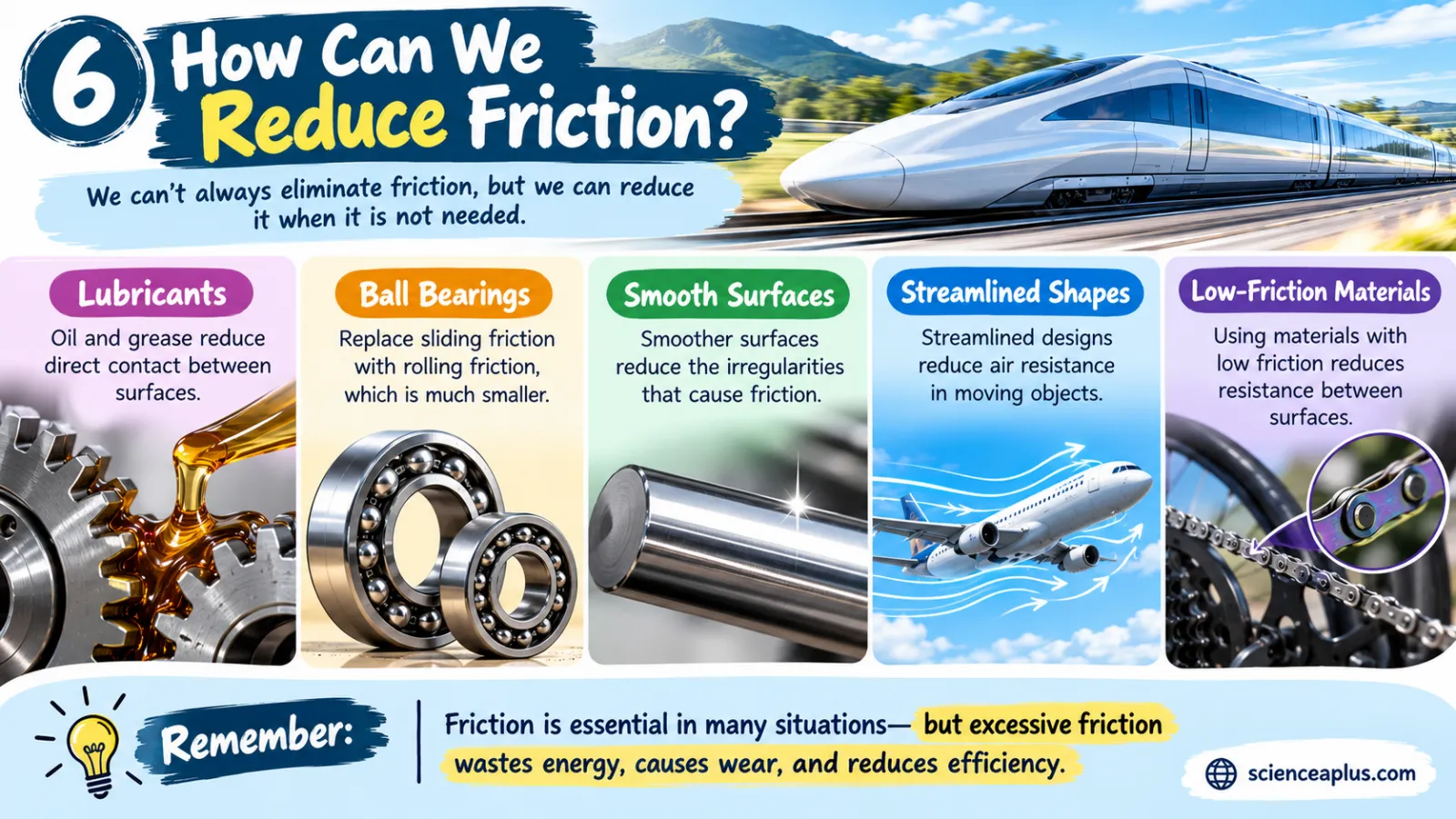
We can never remove friction completely, and we would not want to, but we can reduce it wherever it is unwanted. Engineers use a handful of tried-and-tested methods. Most work in one of three ways: keeping surfaces apart, swapping sliding for rolling, or changing the shape or material of the moving object.
| Method | How it reduces friction | Example |
|---|---|---|
| Lubrication | A thin layer of oil or grease keeps the surfaces apart, so the bumps cannot catch on each other | Engine oil, a greased bike chain, oiled hinges |
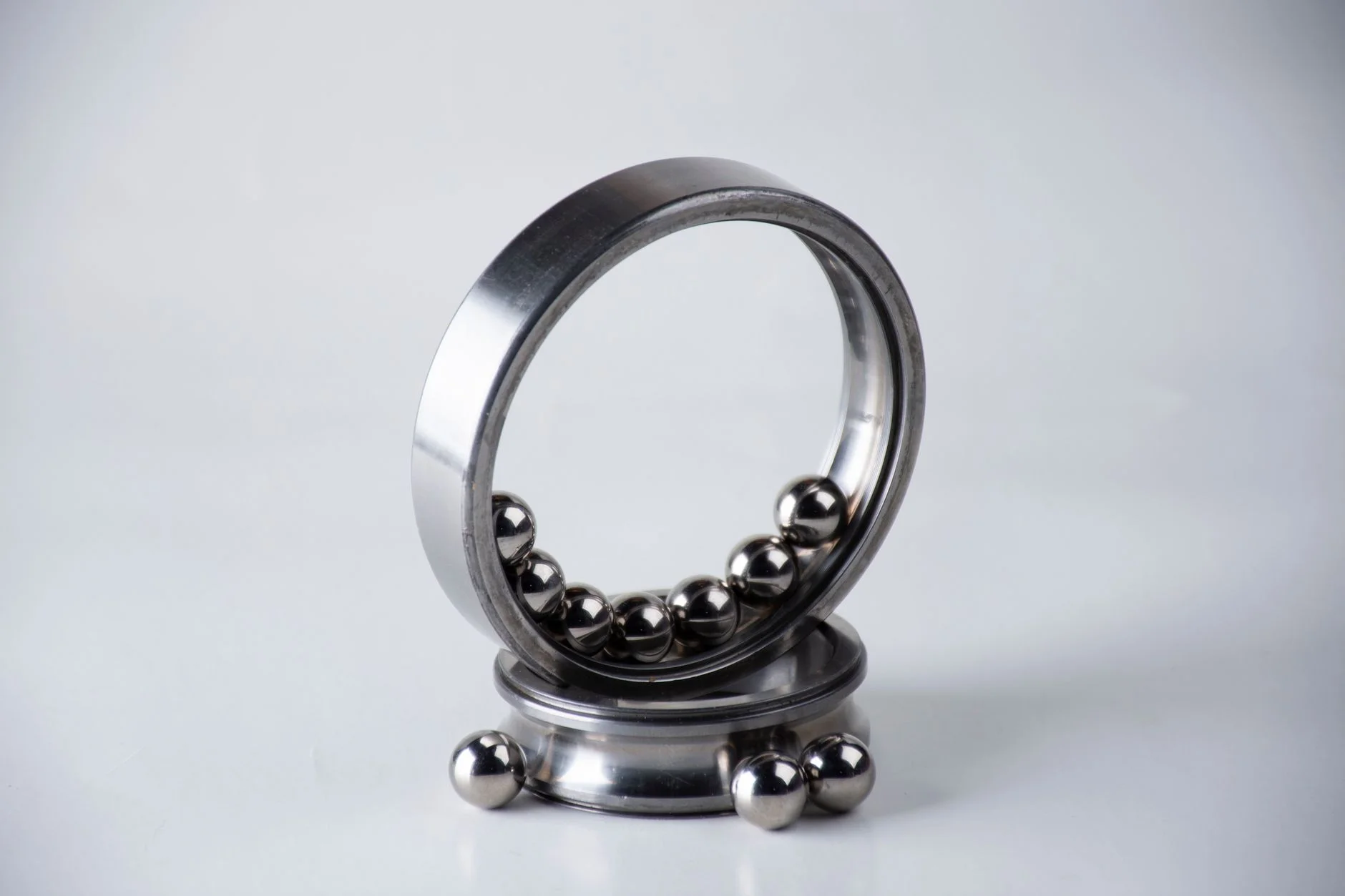
| Ball and roller bearings | Replace sliding friction with much smaller rolling friction | Wheel hubs, skateboard wheels, electric motors |
| Streamlining | A smooth, tapered shape lets air or water flow round easily, reducing drag | Aircraft, high-speed trains, a cyclist's helmet |
| Smoother surfaces | Polishing removes some of the bumps that interlock | Polished machine parts, a waxed ski |
| Low-friction materials | Some materials have a very small coefficient of friction | PTFE (Teflon) coatings on pans and sliding parts |
| Air cushions and magnetic levitation | Lift the object so its surfaces do not touch at all | Hovercraft, maglev trains, air-hockey tables |
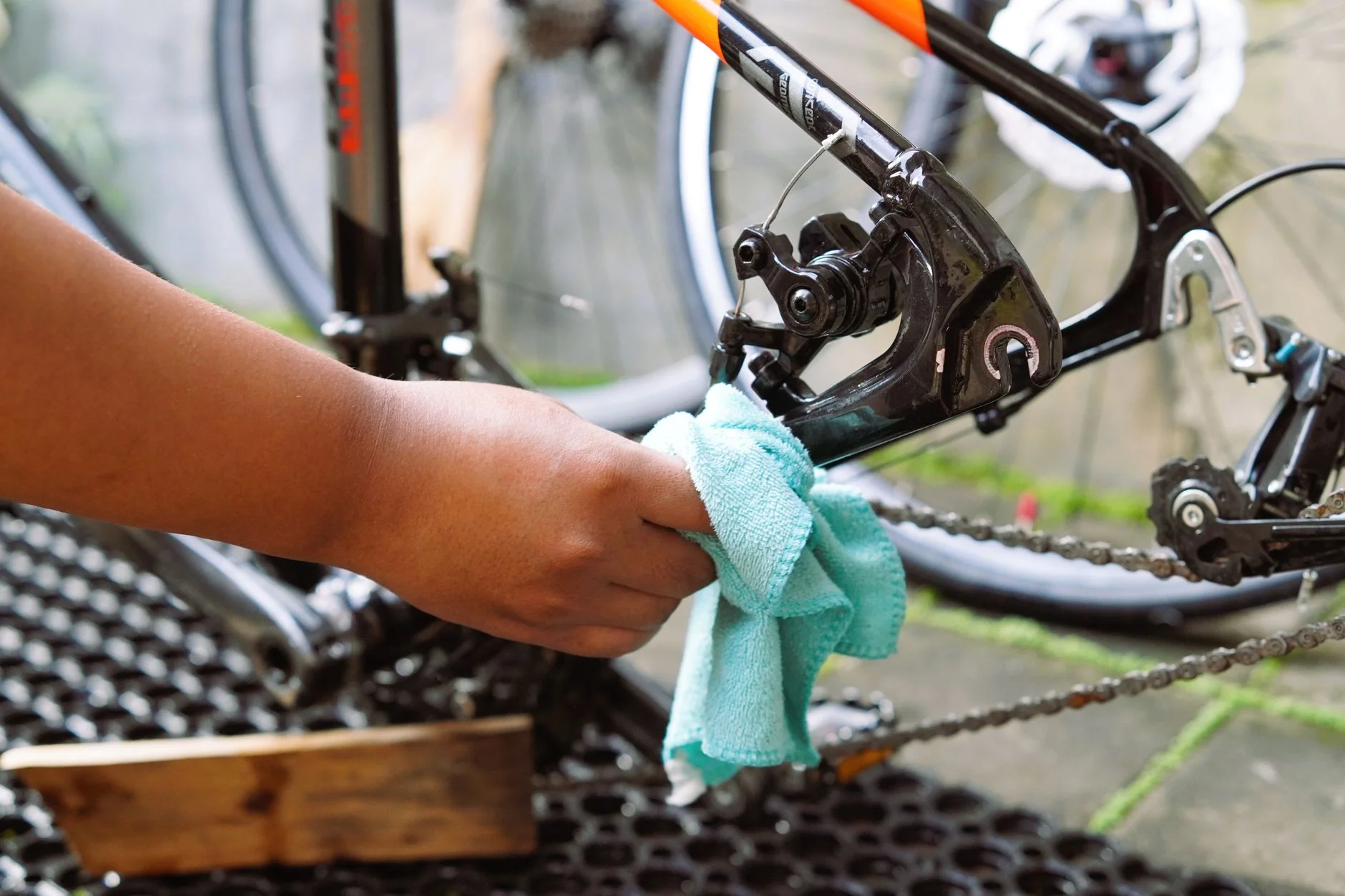
| Alignment and maintenance | Parts that are lined up and kept clean rub less | Wheel alignment on cars, cleaning a bike chain |
Lubricants
Lubrication is the method the GCSE specification names. Oil and grease form a slippery film between surfaces. Greasing two steel surfaces drops the coefficient of friction from 0.5–0.8 to around 0.16, and a full oil film in a running engine does even better. Lubricants also carry heat away and wash out tiny worn particles. Our guide to hardware lubricants, sealants and adhesives explains which products suit which jobs.
Ball bearings and wheels
Rolling is far easier than sliding. Engineering tables give a rolling resistance coefficient of about 0.001–0.002 for ball bearings and for steel train wheels on steel rails, compared with 0.5–0.8 for dry steel sliding on steel. A car tyre rolling on a tarmac road is only around 0.01–0.02. This is why the wheel was such a big invention, and why almost every spinning shaft in a machine sits on bearings.
Streamlining
Because drag grows quickly with speed, fast vehicles are shaped to slip through the air. A rounded nose and a long, tapered tail let air flow smoothly instead of swirling behind the vehicle. Swimmers, cyclists and skiers copy the same idea with tight clothing and tucked body positions.
- A door hinge that squeaks (could it use a drop of oil?)
- A pair of shoes with worn soles or heels
- A bike chain that looks dry or rusty
- Something with wheels or bearings: a skateboard, office chair or suitcase
- A non-stick (PTFE-coated) pan
- Warm hands after rubbing them together
Advantages and disadvantages of friction compared
The same force can help in one place and hurt in another. This side-by-side table is a quick way to revise both, and it fits nicely alongside our other common comparisons in physics.
| Advantages of friction | Disadvantages of friction |
|---|---|
| Lets us walk and run without slipping | Wastes energy as heat, lowering efficiency |
| Lets tyres grip the road and brakes stop vehicles | Wears out tyres, shoes, brakes and machine parts |
| Holds nails, screws and knots in place | Slows vehicles, so they need more fuel |
| Lets us strike a match and write with a pencil | Causes noise and vibration |
| Parachutes use air resistance to land safely | Costs huge sums in energy, repairs and spare parts |
Frequently asked questions about the disadvantages of friction
What are the disadvantages of friction?
Friction wastes energy by transferring it to the thermal store of the surroundings, which lowers the efficiency of machines. It also wears away surfaces such as tyres, shoes and gears, slows down moving objects so vehicles use more fuel, and produces unwanted noise and vibration. Together these make friction very costly.
What are 5 disadvantages of friction?
Five disadvantages of friction are: it wastes energy as heat; it lowers the efficiency of machines; it causes wear and tear on moving parts, tyres and shoes; it slows vehicles down so they need more fuel; and it produces noise and vibration, such as squeaking brakes and creaking hinges.
How can friction be reduced?
Friction can be reduced by using lubricants such as oil and grease, fitting ball or roller bearings so parts roll instead of slide, streamlining shapes to cut air resistance, polishing surfaces, and using low-friction materials such as PTFE. Hovercraft and maglev trains go further by stopping the surfaces touching at all.
Why is friction both an advantage and a disadvantage?
Friction is useful when we need grip, for example to walk, brake, hold a nail in place or strike a match. It is a disadvantage when we want things to move freely, because it wastes energy as heat, wears out parts and slows motion. The same force helps in some places and hinders in others.
What energy transfer happens because of friction?
When work is done against friction, energy is transferred from the kinetic store of the moving object to the thermal store of the surfaces and surroundings. The surfaces warm up. This energy is dissipated, which means it spreads out and is wasted, so it can no longer be used for anything useful.
Why do brakes get hot?
When the brakes are applied, friction between the brake pads and the disc does work on the wheel. This reduces the kinetic energy of the vehicle, and the energy is transferred to the thermal store of the brakes, so their temperature rises. On long downhill stretches brakes can overheat and become less effective.
Is air resistance a type of friction?
Yes. Air resistance, also called drag, is a frictional force that acts on objects moving through air. Like other friction it opposes motion and transfers energy to thermal stores. Unlike sliding friction, it depends strongly on speed, rising roughly with the square of the speed at everyday speeds.
How much energy is lost to friction worldwide?
A 2017 study by Kenneth Holmberg and Ali Erdemir estimated that about 23 % of the world's total energy use, roughly 119 exajoules a year, comes from tribological contacts. About 20 % is used to overcome friction and about 3 % to remake worn parts. Better lubricants and designs could cut these losses by about 40 %.
Does the area of contact affect friction?
For ordinary dry solid surfaces, no. The friction force depends on the coefficient of friction and the normal force pressing the surfaces together (F = μN), not on the apparent area of contact. Ball bearings reduce friction because they replace sliding with rolling, not because they touch over a smaller area.