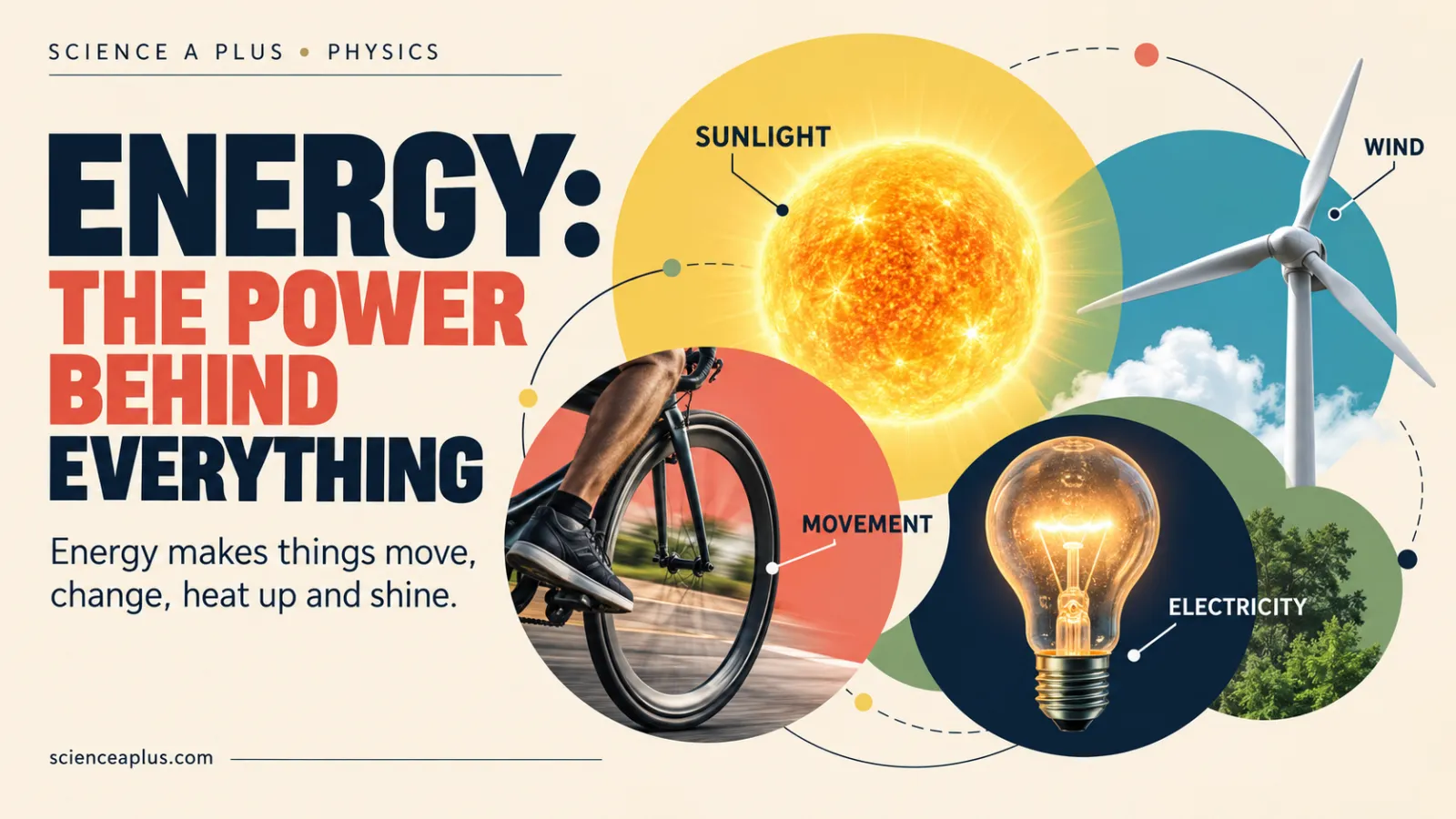
Energy sources and their uses are the starting point for everything that moves, heats or lights up. An energy source (or energy resource) is where we get energy from. Renewable sources are the Sun, wind, water, geothermal heat and biomass; non-renewable sources are coal, oil, natural gas and nuclear fuel. We use them for transport, heating and generating electricity.
This guide also explains the different kinds of energy: the eight energy stores and the four ways energy is transferred between them. You will find real UK figures for 2025, a pros and cons comparison of every major source, and eight worked maths questions with click-to-reveal answers.
What is energy?
Energy is what makes things happen. It is measured in joules (J). One watt is one joule per second, so a 2,000 W kettle running for three minutes transfers 360,000 J.
Physics talks about a system, which is an object or a group of objects. When a system changes, the way its energy is stored changes. A ball thrown upwards, a car braking and a kettle heating water are all systems where energy moves from one store to another.
The big rule is the conservation of energy: energy can be transferred usefully, stored or dissipated, but it cannot be created or destroyed. Dissipated energy ends up spread out in less useful stores, usually the thermal store of the surroundings. People often call it “wasted” energy. Rubbing surfaces together is a classic cause, which you can explore in our friction lesson.
Total energy before = total energy after (energy is never created or destroyed)
Different kinds of energy: the eight energy stores
At GCSE, the different kinds of energy are organised as eight energy stores. Think of each store as a container that can hold energy until something transfers it elsewhere. The table shows where the energy is held, an everyday example and a typical use.
| Energy store | Where the energy is | Everyday example | How we use it |
|---|---|---|---|
| Kinetic | Any moving object | A cyclist, wind, flowing water | Travel; turning turbines |
| Gravitational potential | Objects raised above the ground | Water behind a dam, a book on a shelf | Hydroelectric power |
| Elastic potential | Stretched or squashed objects | A bow, a trampoline, a spring | Launching arrows; absorbing bumps |
| Thermal (internal) | The moving particles in hot objects | A hot water tank, the Earth’s hot rocks | Heating; geothermal power |
| Chemical | Bonds in food, fuels and batteries | Petrol, wood, a slice of toast | Fuelling bodies, cars and power stations |
| Magnetic | Magnets and magnetic materials that attract or repel | Two fridge magnets pushed together | Motors and generators |
| Electrostatic | Electric charges that attract or repel | A balloon rubbed on hair, a thundercloud | Static effects such as lightning |
| Nuclear | The nuclei of atoms | Uranium fuel, the Sun | Nuclear power stations |
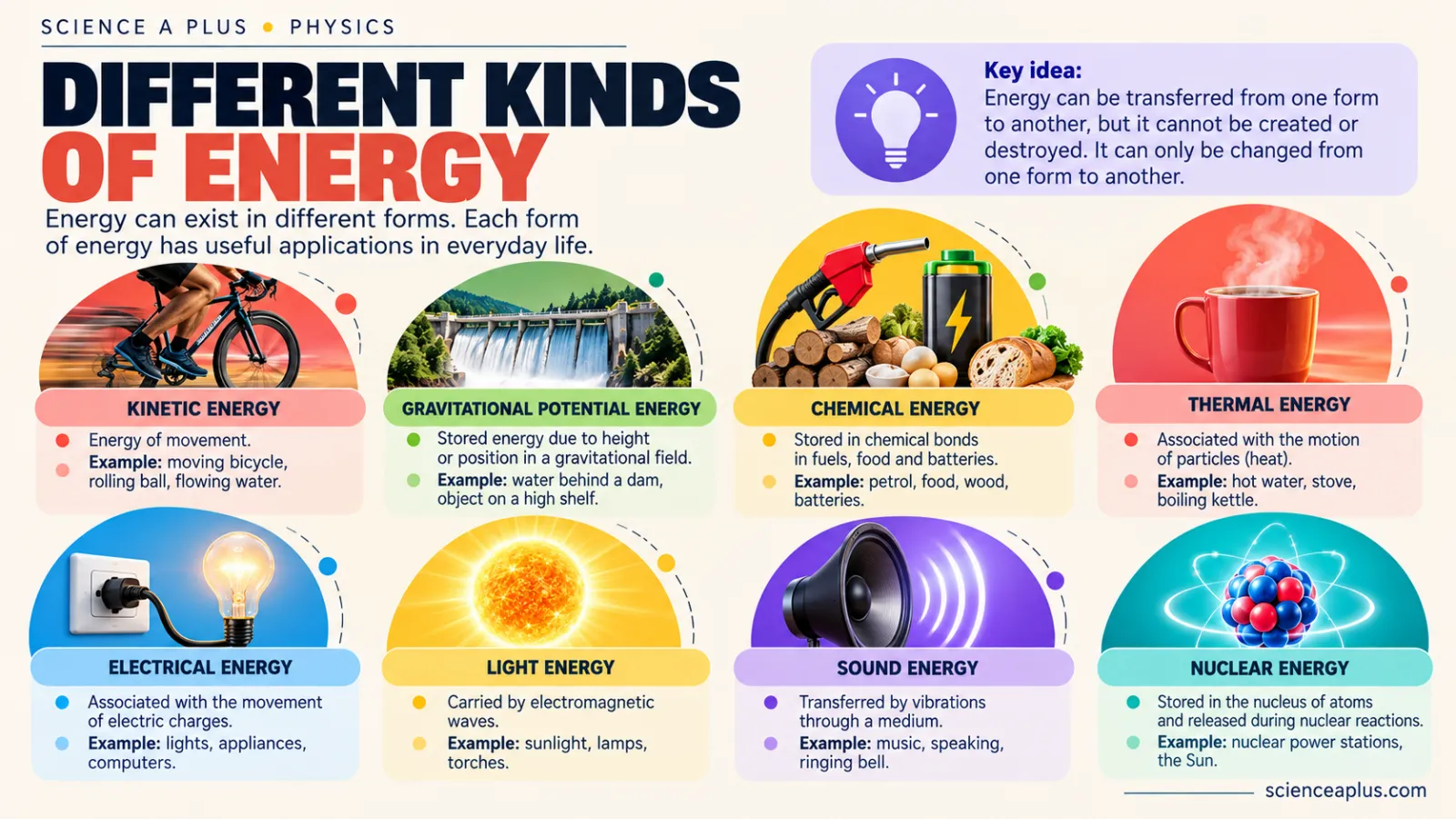
Chemical stores matter most for everyday life. Fuels release their energy when they burn, as explained in our combustion lesson. Food is a chemical store too, and plants fill theirs using sunlight in photosynthesis. That is why almost every living thing depends, directly or indirectly, on the Sun.
How energy is transferred: four pathways
A store only matters when energy moves in or out of it. Energy is transferred in four ways:
- Mechanically: a force does work. Pushing a trolley transfers energy to its kinetic store.
- Electrically: work is done when a current flows. A toaster transfers energy electrically to its heating element.
- By heating: energy moves from a hotter object to a cooler one, such as a radiator warming a room.
- By radiation: energy is carried by waves such as light and infrared. Sunlight crosses space to reach us by radiation. (Sound also carries energy, as vibrations passing through a material.)
| Old “form of energy” | GCSE wording |
|---|---|
| Heat | Thermal store; energy transferred by heating |
| Mechanical | Kinetic and gravitational potential stores; energy transferred mechanically |
| Electrical | Energy transferred electrically (work done by a current) |
| Light | Energy transferred by radiation |
| Sound | Energy transferred by sound waves |
| Chemical | Chemical store |
| Nuclear | Nuclear store |

A roller coaster shows several stores at work. The motor lifts the train up the first hill, filling the gravitational potential store. On the way down that energy moves into the kinetic store, and a little is dissipated by friction and air resistance.
Energy transfers you use every day
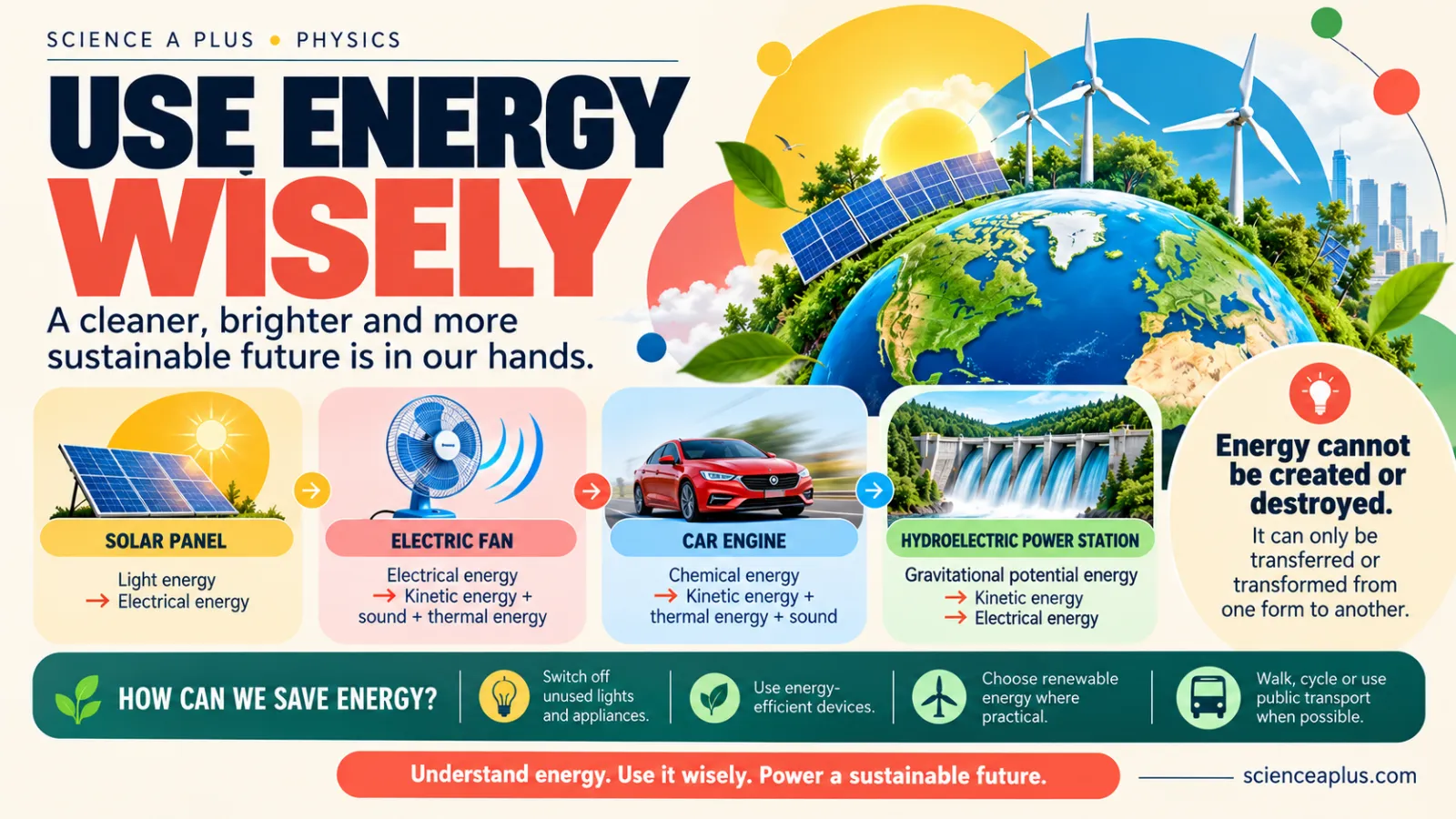
An energy chain names the store the energy starts in, the pathway and the store it ends up in. Here are four you can describe in an exam.
- Kettle: energy is transferred electrically to the thermal store of the water. Some also heats the kettle and the surroundings, so not all of it is useful.
- Car engine: the chemical store of the fuel is emptied, filling the kinetic store of the car. The rest goes to the thermal store of the surroundings as waste.
- Hydroelectric power station: the gravitational potential store of the water in the reservoir becomes the kinetic store of the water and the turbine. A generator then transfers energy electrically.
- Solar panel: energy is transferred by radiation (light) and then electrically. Some also heats the panel itself.
In every chain the total stays the same. What changes is how much ends up in a useful store and how much is dissipated.
You can reduce unwanted transfers in two main ways: lubrication reduces friction between moving parts, and thermal insulation slows the loss of energy by heating.
Flip the cards: the eight energy stores
With the stores and transfers clear, the next step is to look at where we actually get our energy from: the energy sources themselves.
What is an energy source (energy resource)?
An energy source, also called an energy resource, is a supply of energy we can use. The main ones in GCSE courses are fossil fuels (coal, oil and gas), nuclear fuel, biofuels, wind, hydroelectricity, geothermal, the tides, the Sun and water waves. We use them for three big jobs: transport, electricity generation and heating.
A renewable energy resource is one that is being, or can be, replenished as it is used. A non-renewable resource is finite: we use it far faster than nature can make more. The next section covers the renewable sources, and the non-renewable ones follow later in this guide.
Many resources trace back to the Sun. Sunlight drives the wind and waves, plants store its energy as biomass, and ancient plants and plankton became the fossil fuels. The exceptions are the tides, which come mainly from the Moon’s gravity, and geothermal and nuclear energy, which come from inside the Earth and its atoms.
Renewable energy sources and their uses
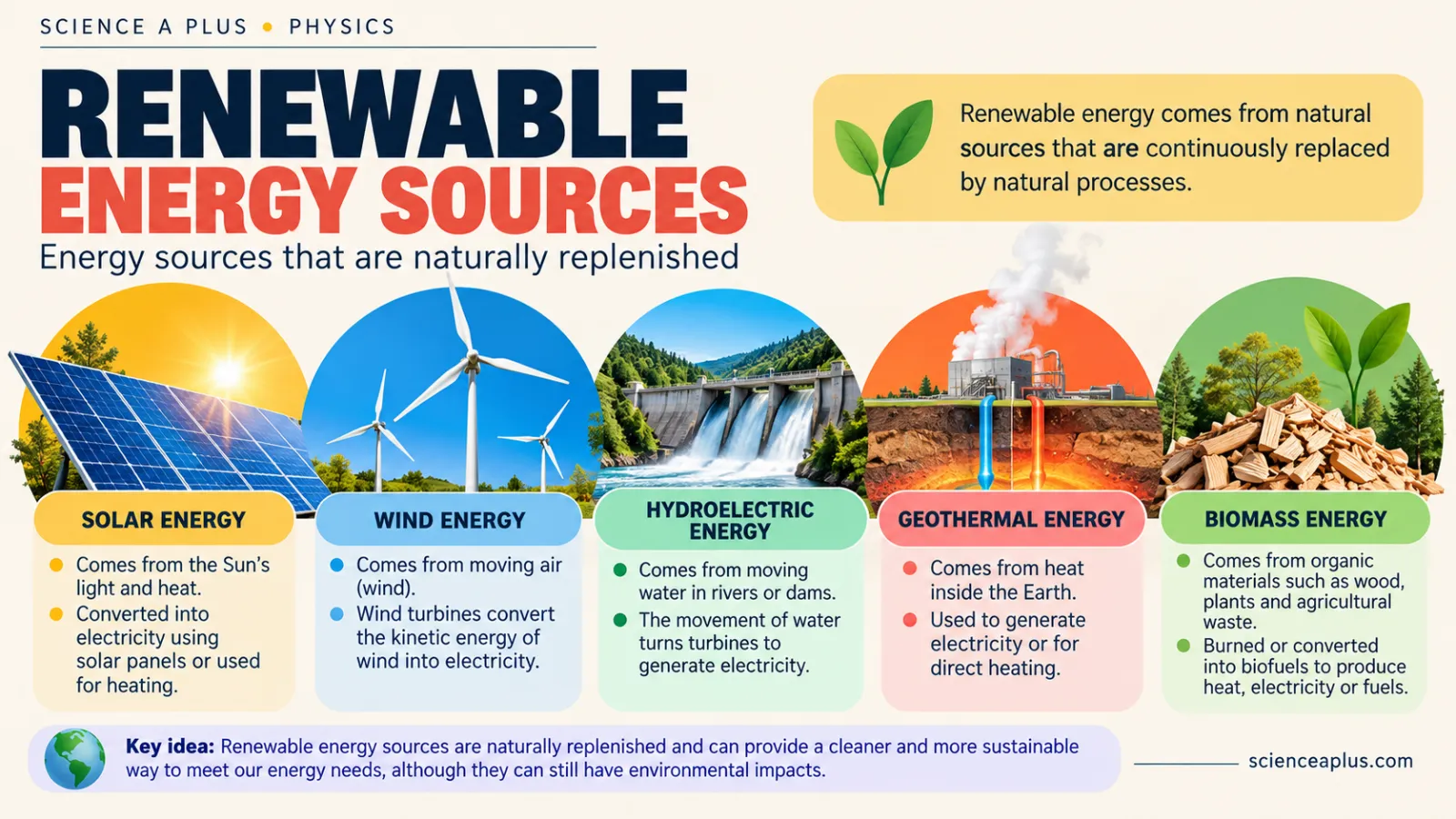
For each source below you will see which energy store it draws on, what it is used for, its main pros and cons, and a real example. Together they supplied a record 52.1% of UK electricity in 2025, up from 50.5% in 2024.
Solar energy
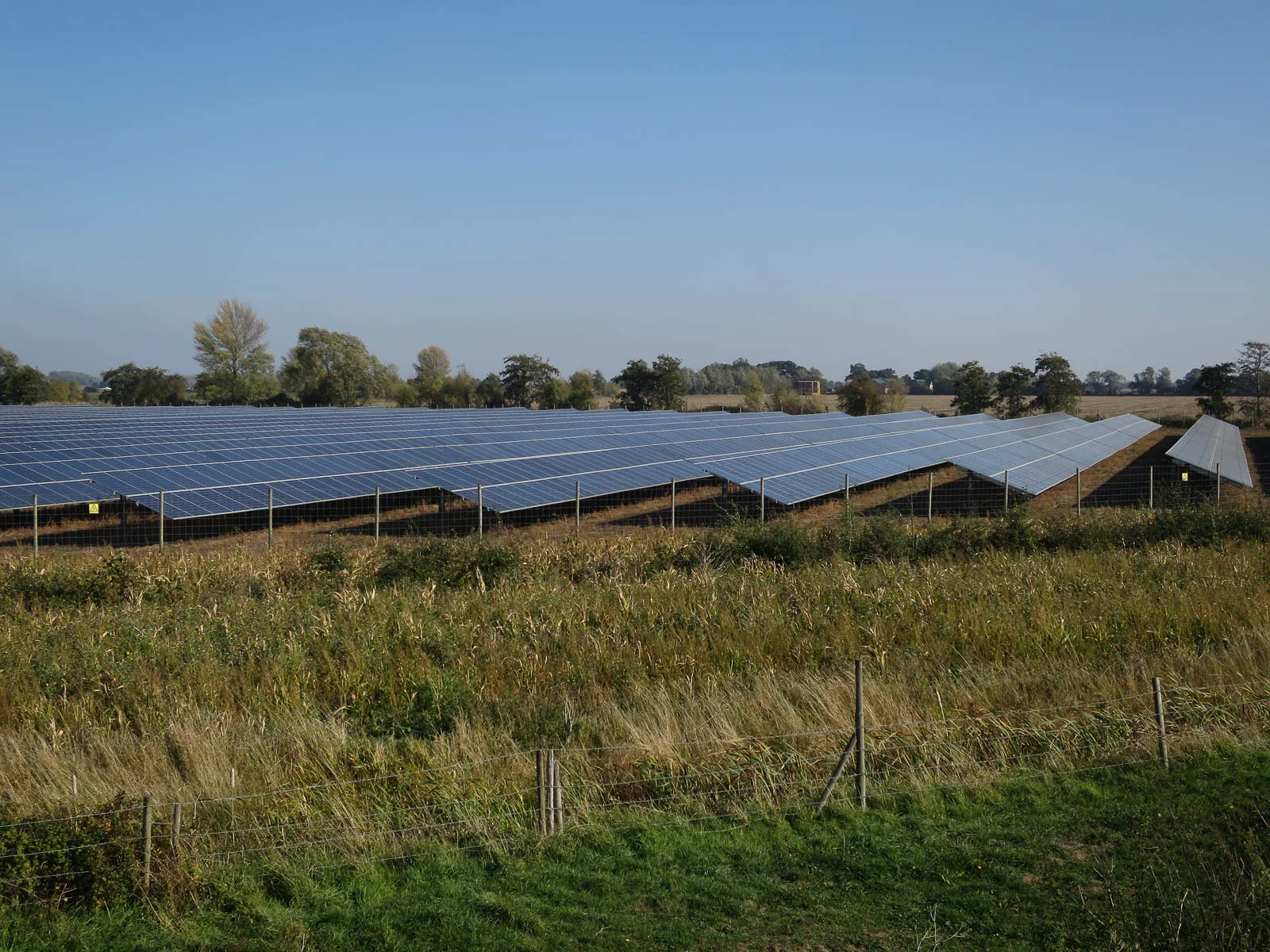
Solar panels draw on energy carried to Earth by radiation from the Sun. Photovoltaic (PV) panels transfer it electrically, while solar thermal panels use it to heat water. In the UK, solar supplied 6.9% of electricity in 2025, a record 20.1 TWh, and 2025 was the country’s sunniest year on record.
Pros: the fuel is free and nothing is emitted while the panels run. Cons: output stops at night and drops in winter and cloud. UK solar panels delivered only 11.1% of their maximum possible output across 2025. Our guide to the pros and cons of solar energy goes deeper.
Wind energy
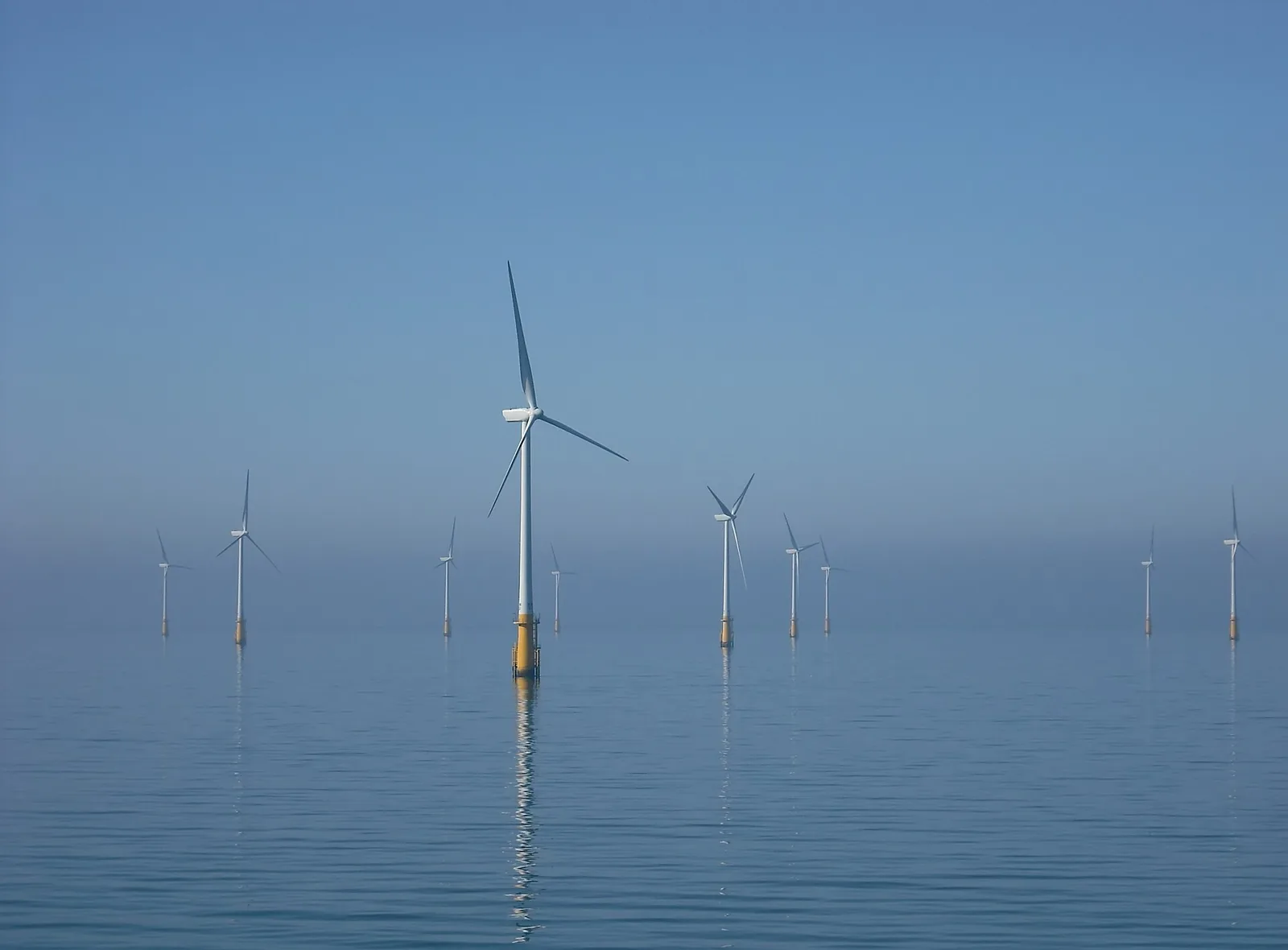
Wind is a kinetic store of moving air. It turns turbine blades, which drive a generator. Wind was the UK’s second-largest electricity source in 2025 at 29.5%: offshore wind gave 17.7% (a record 52.0 TWh) and onshore wind 11.7%.
Pros: no fuel costs and very low lifecycle emissions. Cons: output varies with the weather. The load factor, which compares actual output with the maximum possible, was 24.1% for UK onshore wind and 36.4% for offshore. The sea winds are steadier, which is why so many new wind farms are offshore. See the advantages and disadvantages of wind energy for more.
Hydroelectricity and pumped storage
A hydroelectric station starts with water in a reservoir, which is a gravitational potential store. The water falls through turbines, which spin a generator. In 2025 hydro supplied about 1.8% of UK electricity, and its output fell 6% because there was around 6% less rain.
Pros: reliable, and it can respond quickly when demand rises. Cons: dams flood valleys and change ecosystems, and the UK has few suitable sites. The good and bad of dams is a useful follow-up.
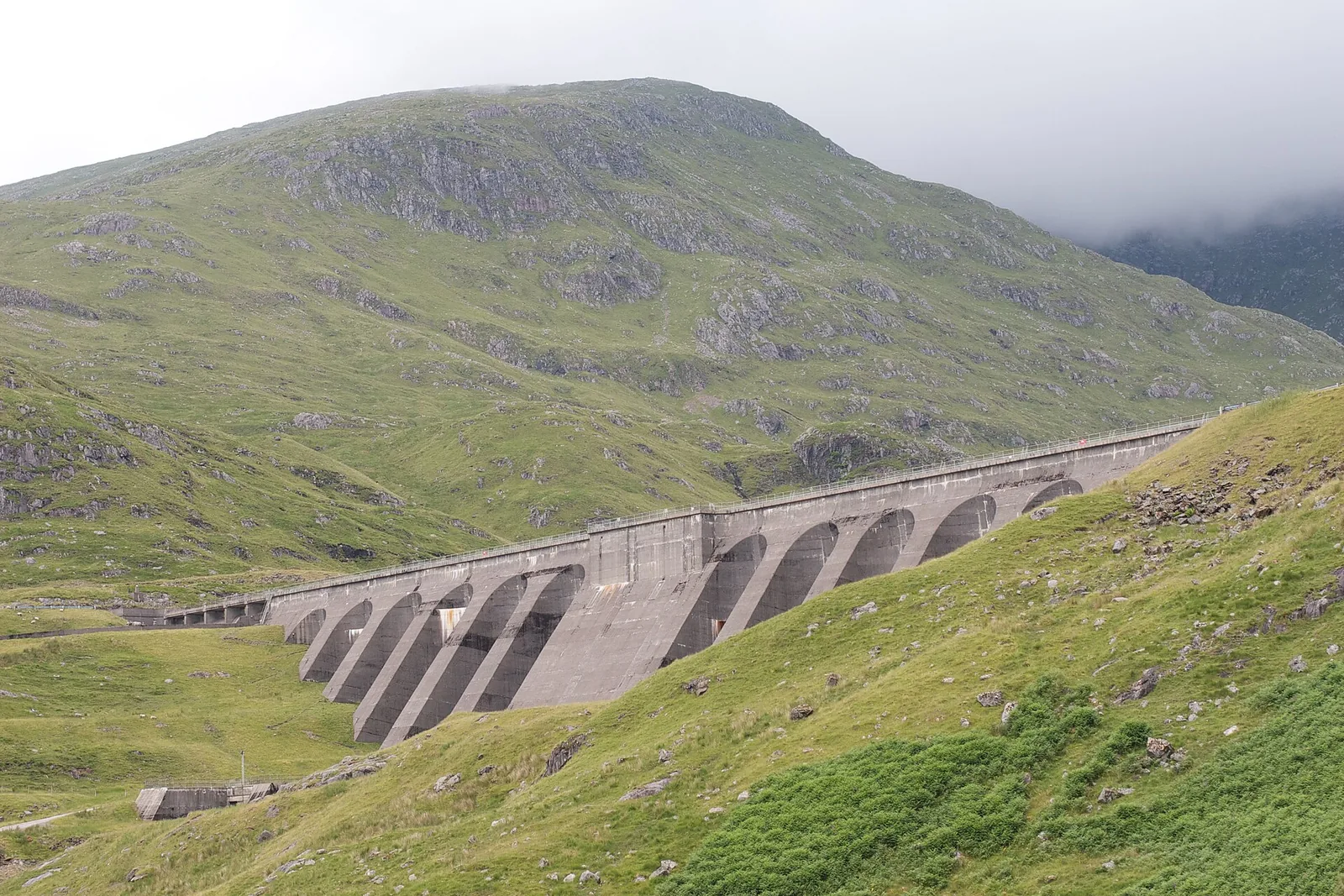
Pumped storage is different: it stores energy rather than supplying it. At Cruachan (the “Hollow Mountain”) in Argyll, spare electricity pumps water uphill from Loch Awe to a reservoir on Ben Cruachan. When demand peaks, the water runs back through reversible turbines. The station can deliver up to 440 MW and can reach full load in about 30 seconds.
Tides and waves
Tides, caused mainly by the Moon’s gravity, are very predictable, so a tidal barrage or turbine produces electricity on a known schedule. The drawbacks are few suitable sites, high costs and harm to estuary habitats. Waves are smaller and more variable, and wave power is still an early-stage technology.
Geothermal energy
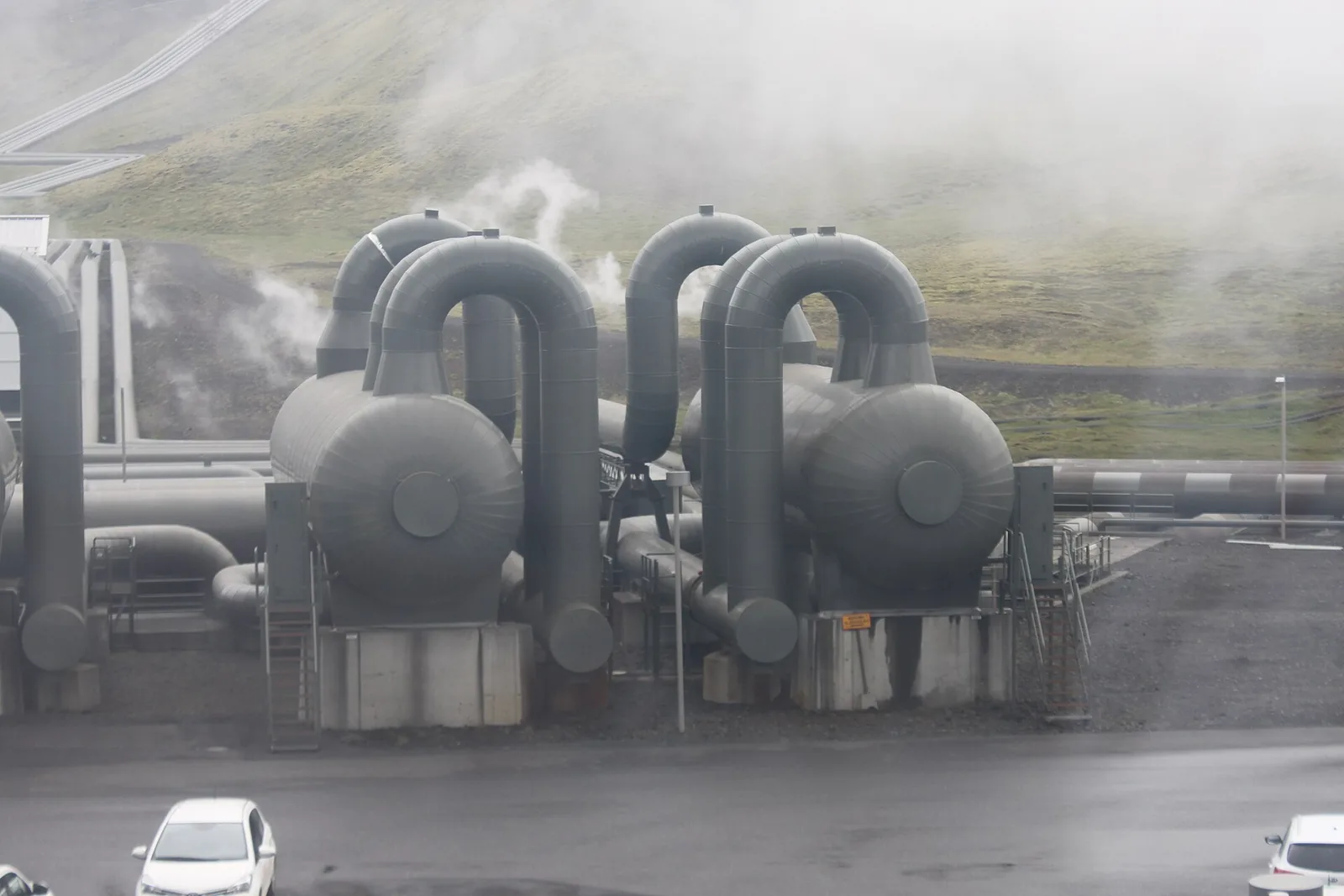
Geothermal power draws on the thermal store of hot rocks underground. This heat comes from radioactive decay inside the Earth plus heat left from its formation. Steam or hot water from boreholes turns turbines or heats buildings directly.
Pros: it runs day and night in any weather. Cons: it is only practical where hot rock is close to the surface or drilling is deep and costly, and it can release gases such as hydrogen sulfide and carbon dioxide. Iceland generates about 30% of its electricity this way and heats roughly 85–90% of its homes. In the UK, United Downs in Cornwall became the country’s first deep geothermal power plant, supplying the grid from late February 2026 with about 3 MW of electricity from water above 190 °C, drawn from well over 5 km down.
Biomass and biofuels
Biomass is the chemical store in plant and animal material: wood, wood pellets, crops, waste and biogas. Biofuels such as bioethanol and biodiesel are used mainly for transport. It counts as renewable because the plants can be regrown. The “carbon neutral” label is debated, though, because burning releases carbon dioxide now while regrowth takes years. Growing fuel crops can also compete with land for food, and moving pellets uses energy.
The best-known UK example is Drax Power Station in North Yorkshire. Four of its six units were converted from coal to biomass, the fourth in 2018, and it stopped burning coal in 2021. It burns wood pellets, much of it imported from North America. In 2025, plant biomass supplied a record 27.8 TWh, about 18% of UK renewable generation. You can read about biomass gasification if you want to see another way to use it.
Explain why a wind farm’s load factor is lower than a biomass power station’s. (2 marks)
Wind speed varies, and turbines only produce full power in strong (but not too strong) winds, so they often run below their maximum. A biomass station can burn fuel whenever it is needed, so it runs for more of the time. In 2025 UK bioenergy had a load factor of 63%, compared with 24.1% for onshore and 36.4% for offshore wind.
Which energy store does each renewable source use?
| Renewable source | Energy store or pathway it draws on | Main use |
|---|---|---|
| Solar | Radiation from the Sun | Electricity; heating water |
| Wind | Kinetic store of moving air | Electricity |
| Hydroelectric | Gravitational potential store of water | Electricity; storage |
| Geothermal | Thermal store of hot rocks | Electricity; heating |
| Biomass and biofuels | Chemical store in plants and waste | Electricity; heat; transport fuel |
Renewables are only half of the story. Fossil fuels and nuclear power still supply most of the world’s total energy, so we turn to those next.
Non-renewable energy sources and their uses
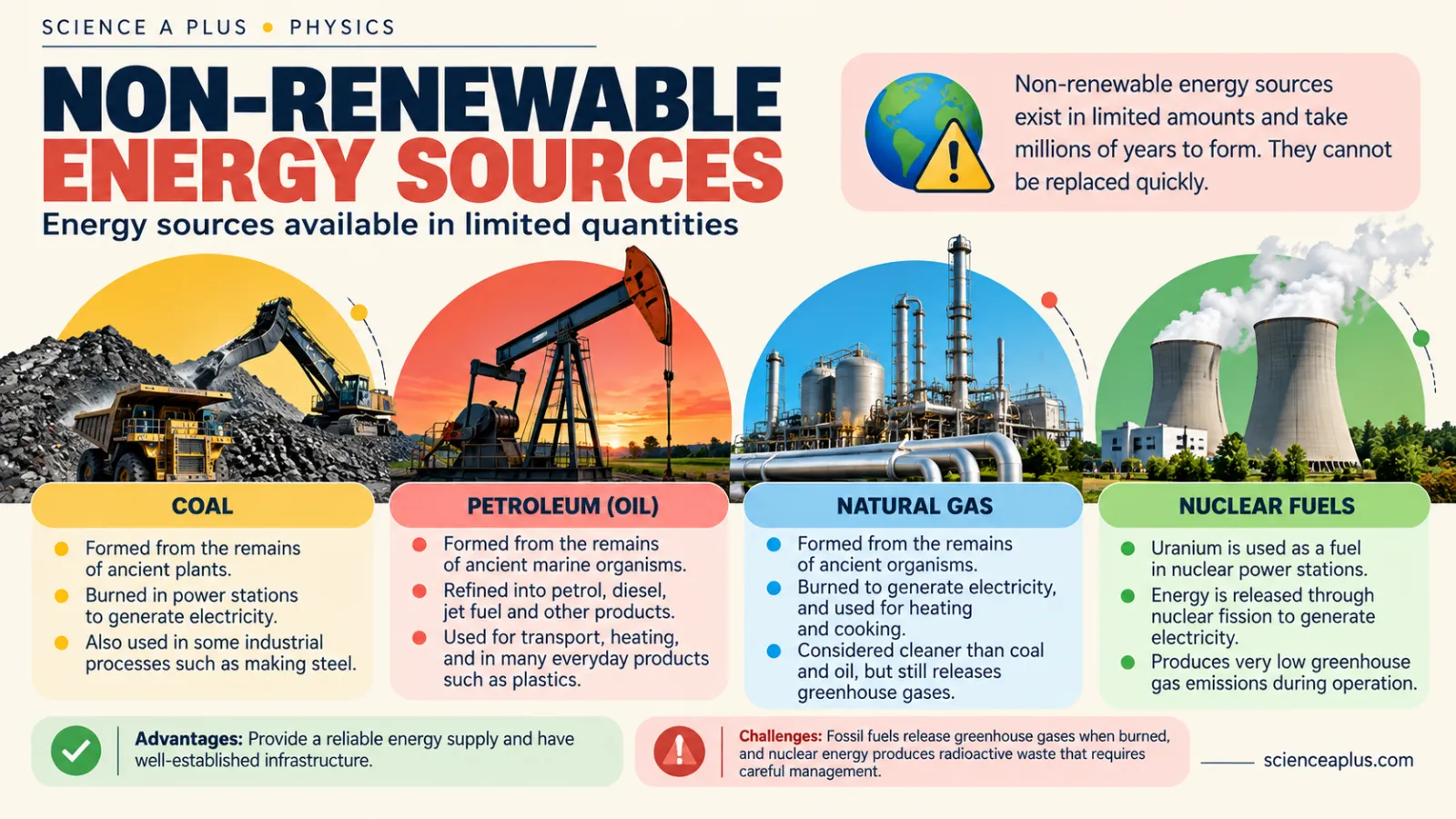
Non-renewable energy sources are finite. The three fossil fuels (coal, oil and natural gas) formed over millions of years from the remains of living things, and nuclear fuel is mined uranium. We can use them far faster than nature can replace them, which is why they are not renewable. Their great strength is that they pack a lot of energy into a small, easily stored amount of fuel.
Coal
Coal formed from land plants that grew in ancient swamps, then were buried and compressed over millions of years. The material changes step by step from peat to lignite, bituminous coal and finally anthracite. Many of the great coal-forming forests date from the Carboniferous period, which began about 359 million years ago. Coal seams sit in sedimentary rock in the Earth’s crust.
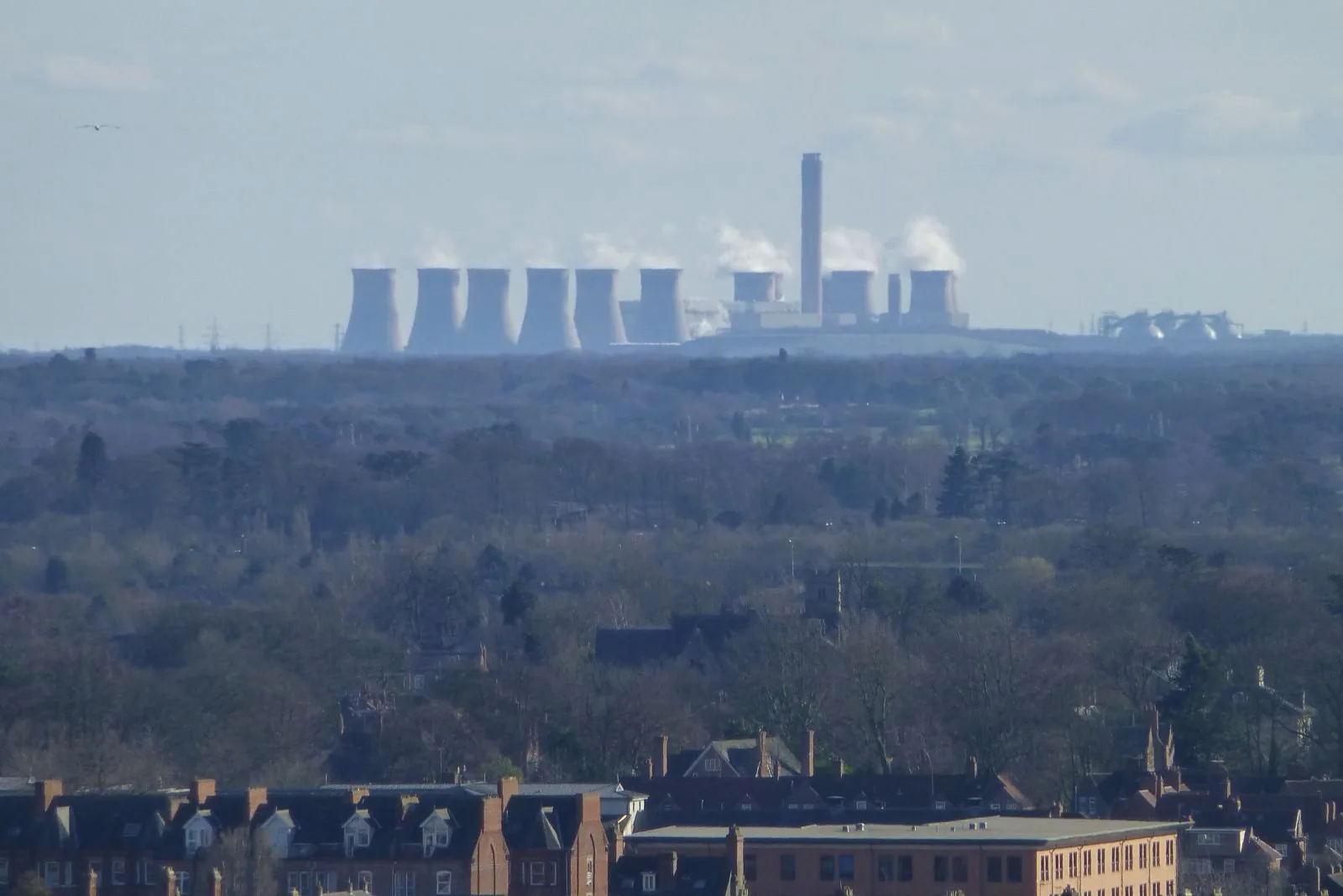
Coal is burned in power stations and used to make coke for steel-making and in cement production. The UK no longer generates electricity from it: the last coal power station, Ratcliffe-on-Soar in Nottinghamshire, closed on 30 September 2024. Worldwide, though, coal is still the largest single source of electricity at 34% (IEA, 2025).
The drawbacks are serious. Coal produces the most carbon dioxide per unit of electricity of any common source, about 820 gCO₂e per kWh over its lifecycle (IPCC median). Sulfur dioxide from burning it causes acid rain, and mining is hazardous. Learn more about the main gas involved in carbon dioxide (CO₂).
Crude oil
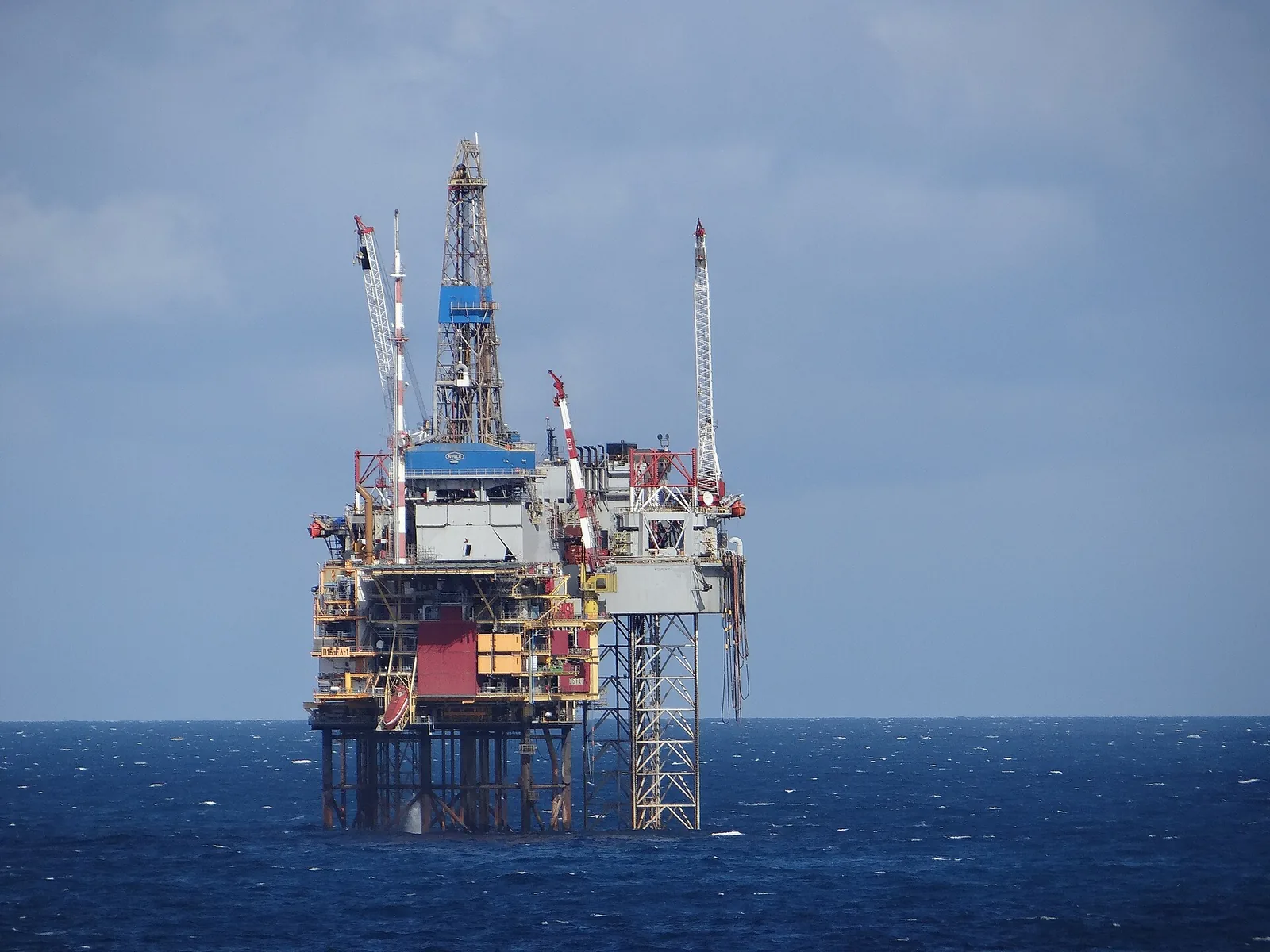
Crude oil formed mainly from tiny marine organisms such as plankton and algae that were buried on the sea floor. It is separated by fractional distillation into petrol, diesel, jet fuel and heating oil, and it also supplies the raw material for plastics.
Oil is an energy-dense liquid that is easy to move and store, which makes it ideal for vehicles. In 2025 oil supplied about 92% of the energy used for UK transport. The downsides are carbon dioxide, air pollution and the risk of oil spills.
Natural gas
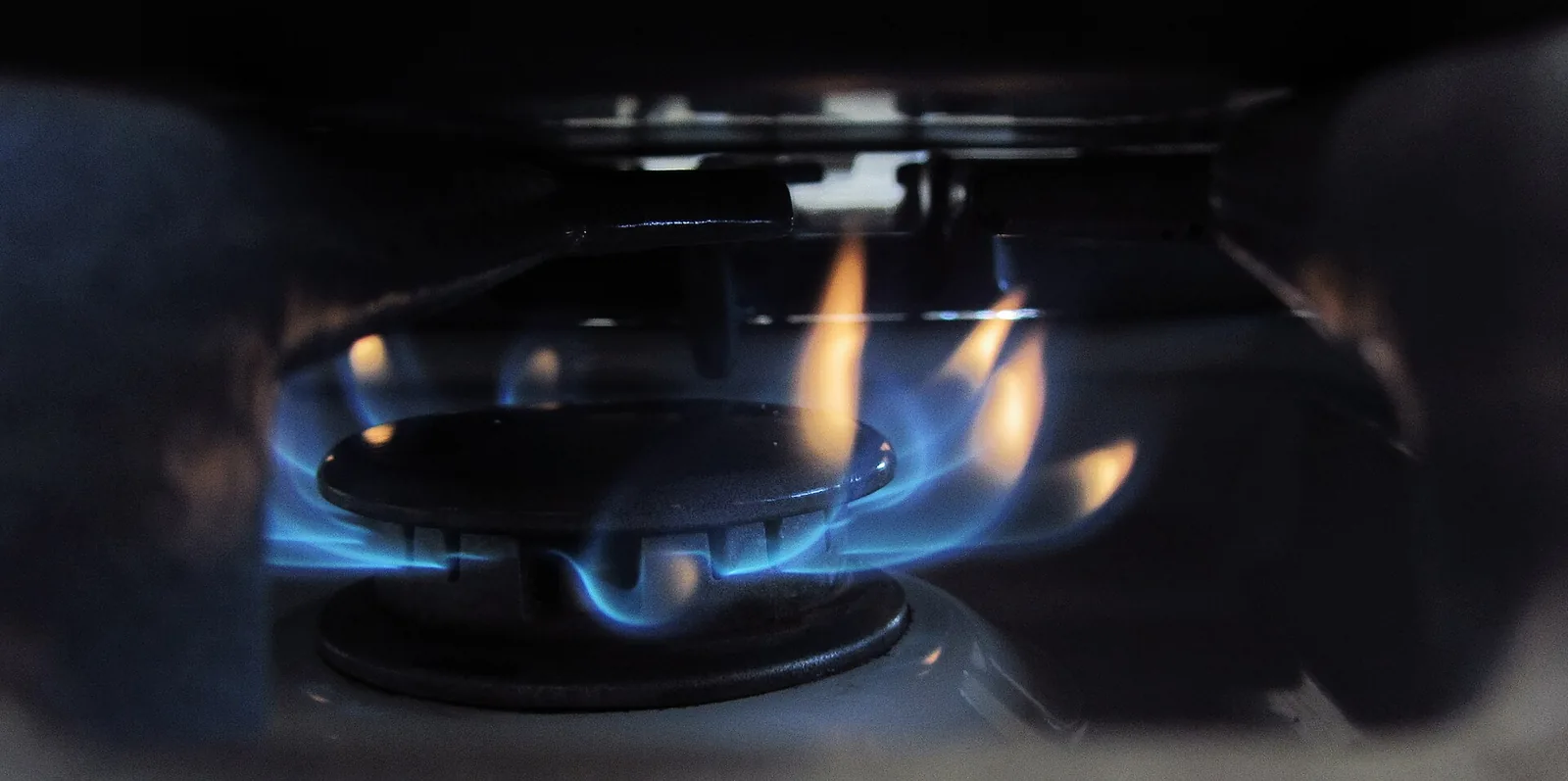
Natural gas forms in a similar way to oil, and it is mostly methane, not pure methane. Read more about methane (CH₄) if you want the chemistry. Gas heats our homes and cookers, runs power stations and industry, and is used to make hydrogen by steam reforming.
In 2025 gas supplied about 63% of UK home energy and 31.7% of UK electricity, which made it the largest single source of electricity, just ahead of wind at 29.5%. Gas stations can be switched on quickly, so they balance the grid when the wind drops. Burning gas gives roughly 490 gCO₂e per kWh over its lifecycle, compared with 820 for coal, but leaked methane is a powerful greenhouse gas. There is more detail in the disadvantages of natural gas.
Nuclear fuel
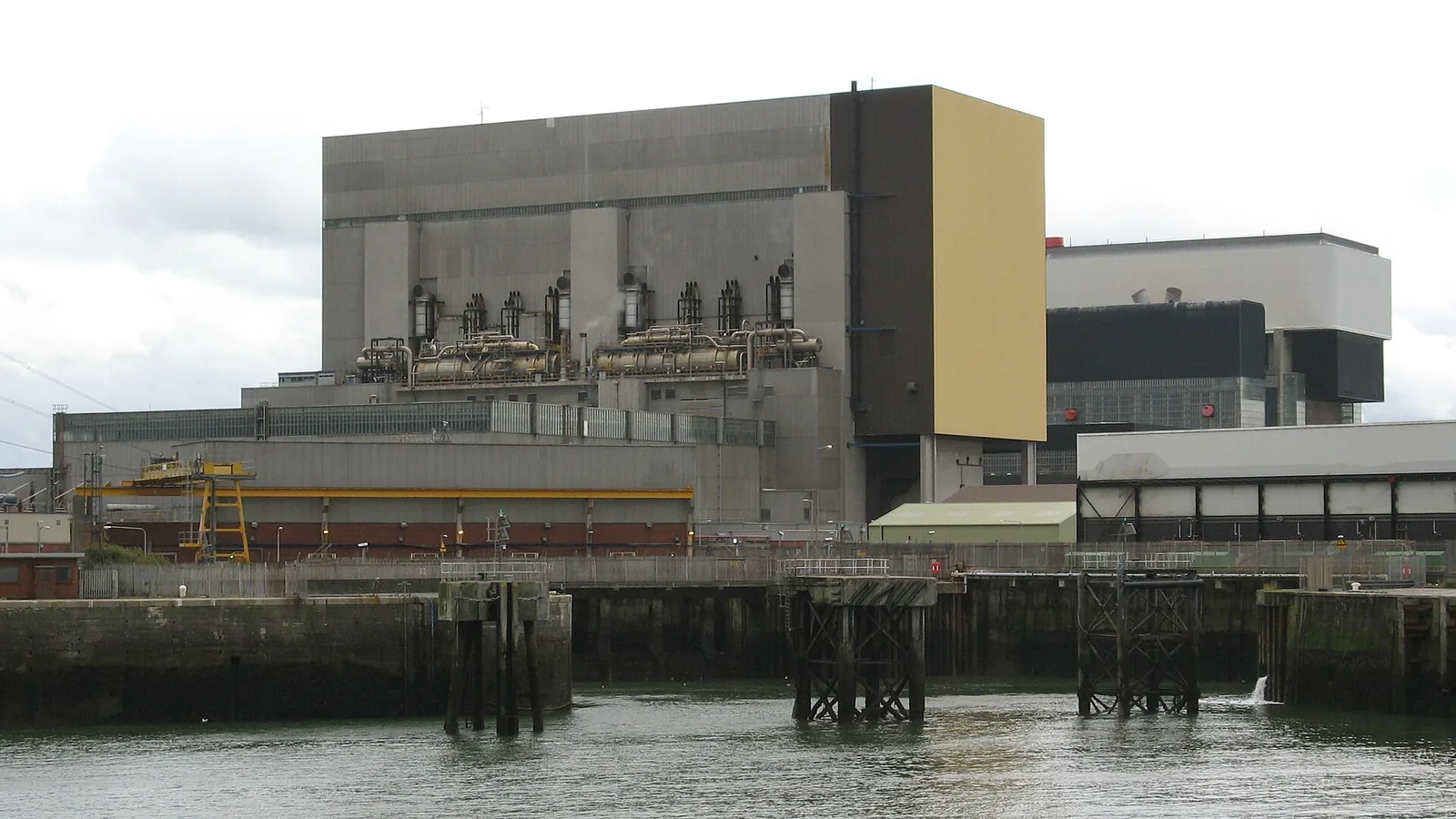
Nuclear power stations use fission: the nuclei of uranium-235 split, releasing energy from the nuclear store. That heats water into steam, which spins turbines. Uranium is mined and finite, so nuclear fuel is non-renewable.
It is extremely compact. According to the US Nuclear Energy Institute, one uranium fuel pellet holds about as much energy as around a tonne of coal. Nuclear power supplied 12.2% of UK electricity in 2025, its lowest output in decades because of outages and closures. Its lifecycle emissions are very low, about 12 gCO₂e per kWh, and it runs steadily day and night.
The drawbacks are radioactive waste that needs safe storage for a very long time, high costs, slow construction and the risk of accidents. At Hinkley Point C in Somerset, the first unit is expected in 2030, and the project will cost tens of billions of pounds.
Do not confuse fission with fusion. The Sun’s energy comes from nuclear fusion, where hydrogen nuclei join to make helium. Fusion power stations on Earth are still experimental.
Advantages and disadvantages of energy sources compared
No energy source is perfect. This table compares the main ones. The carbon figures are lifecycle medians from the IPCC (2014), covering building, running and decommissioning, so even wind and solar are not zero.
| Source | Renewable? | Lifecycle CO₂ (gCO₂e/kWh) | Reliable on demand? | Main uses | Big drawback |
|---|---|---|---|---|---|
| Coal | No | 820 | Yes | Steel-making, cement, electricity | Most CO₂; acid rain |
| Oil | No | High (burned) | Yes | Transport, plastics, heating | CO₂, pollution, spills |
| Natural gas | No | 490 | Yes, quick to start | Home heating, electricity, industry | CO₂; methane leaks |
| Nuclear (fission) | No | 12 | Yes, steady output | Electricity | Waste; cost; slow to build |
| Biomass | Yes | 230 | Yes | Electricity, heat, transport fuel | Burning releases CO₂ now; land use |
| Hydroelectric | Yes | 24 | Yes | Electricity, storage | Floods valleys; few sites |
| Geothermal | Yes | 38 | Yes | Electricity, heating | Few sites; deep drilling is costly |
| Solar PV | Yes | 48 (utility); 41 (rooftop) | No, daylight only | Electricity, heating water | Weak in UK winter |
| Onshore wind | Yes | 11 | No, weather-dependent | Electricity | Variable output |
| Offshore wind | Yes | 12 | No, weather-dependent | Electricity | Variable output |
| Tides and waves | Yes | Low | Tides predictable; waves variable | Electricity | Few sites; high cost |
Burning fossil fuels adds carbon dioxide to the air, which strengthens the greenhouse effect and drives climate change. You can see how in our guide to the climate crisis. Other impacts include air pollution from burning fuels, land and habitat loss from dams and mines, and radioactive waste from nuclear power.
Science can identify these problems, but it cannot always solve them alone. Political, social, ethical and economic factors also decide which resources a country uses. That is why a reliable low-carbon source can still be debated for its cost, and a cheap one for its pollution.
Give one advantage and one disadvantage of using natural gas to generate electricity. (2 marks)
Advantage: gas stations can be switched on quickly, so they can meet sudden rises in demand. Disadvantage: burning gas releases carbon dioxide, which contributes to climate change (and leaked methane is also a greenhouse gas).
Why is nuclear fuel described as non-renewable even though nuclear power emits little carbon dioxide? (2 marks)
Uranium is mined and the supply is finite, so it cannot be replenished as it is used. Being low-carbon is a separate property from being renewable.
Uses of energy in everyday life
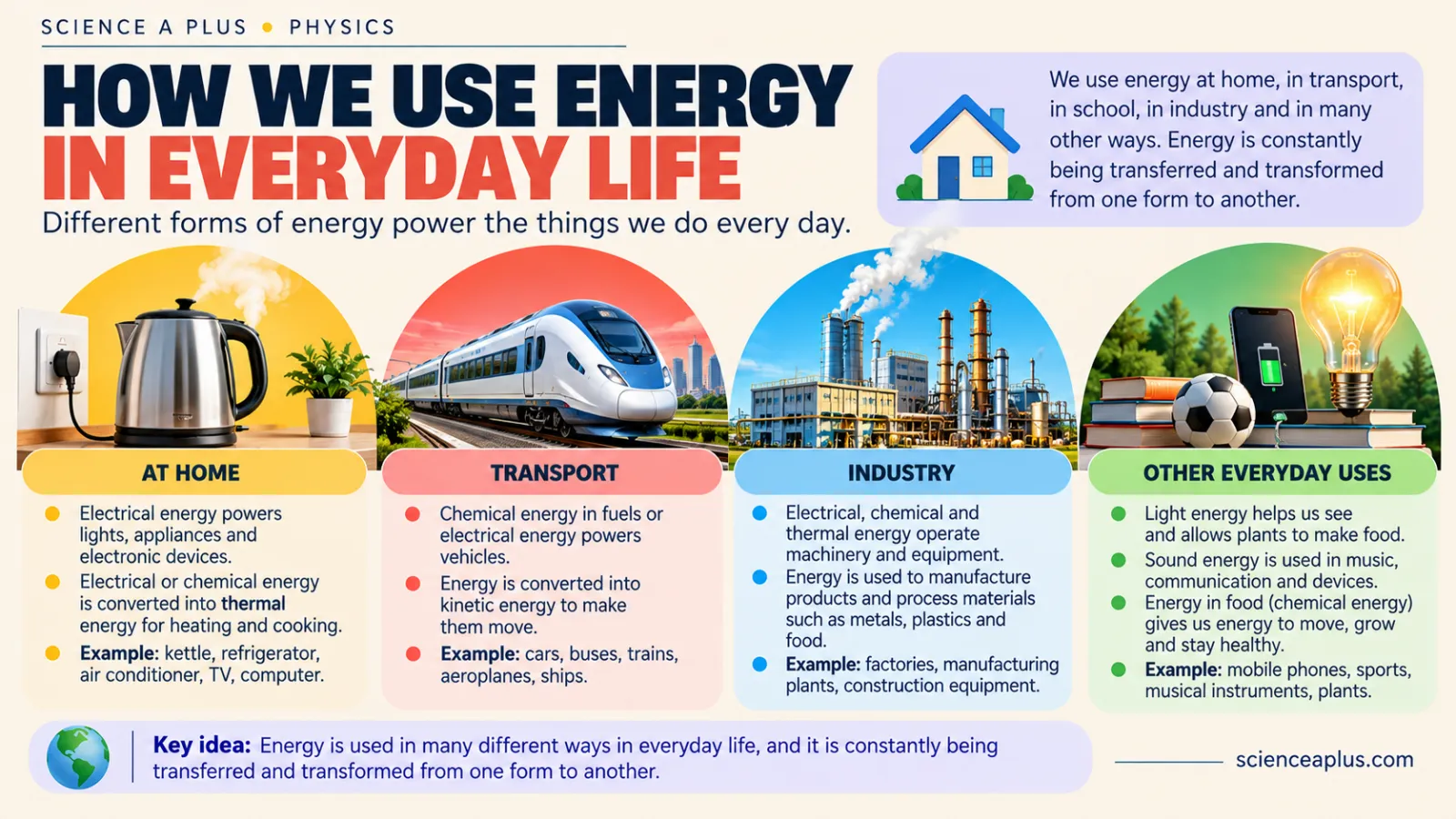
The uses of energy fall into three big groups: transport, heating and electricity. Together they account for nearly everything we do, from driving to school to charging a phone. In 2025 the UK used 127.7 million tonnes of oil equivalent (Mtoe) of final energy, and it was split like this:
- Transport: about 43%
- Homes: about 27%
- Services (offices, shops, schools and hospitals): about 17%
- Industry: about 14%, the lowest in at least 50 years
Each sector leans on a different fuel. Oil supplied about 92% of transport energy, while gas supplied about 63% of the energy used in homes, with electricity providing about 24%. Overall, oil gave about 46% of UK final energy, gas about 28% and electricity about 19%. As more people drive electric cars, some transport energy is moving from oil to electricity.
Where the UK gets its electricity (2025)
Electricity is only one slice of our energy, but it is the part that has changed fastest. Here are the main sources of the 293.6 TWh generated in the UK in 2025:
| Source | Share of UK electricity, 2025 |
|---|---|
| Natural gas | 31.7% |
| Wind (total) | 29.5% |
| Offshore wind | 17.7% |
| Onshore wind | 11.7% |
| Nuclear | 12.2% |
| Plant biomass | about 9.5% |
| Solar | 6.9% |
| Hydro | about 1.8% |
| Coal | 0% (no coal-fired electricity) |
The shares do not add up to 100% because smaller sources are not listed. Renewables generated a record 52.1% of UK electricity in 2025, the second year running above half. Wind and solar together reached a record 36.3%.
That is only electricity, though. Across all UK primary energy, just 22.0% came from low-carbon sources in 2025, and fossil fuels still supplied about three-quarters. The gap exists because transport and heating still depend heavily on oil and gas. Our article on renewable energy expectations versus reality explores that gap.
World energy sources at a glance
The International Energy Agency (IEA) reports that in 2025:
- Renewables supplied 34% of global electricity, up from 32% in 2024 and 23% a decade earlier.
- Wind and solar together supplied 17%.
- Coal was still the largest single source of electricity at 34%, with natural gas at 21%.
- Low-emissions sources (renewables plus nuclear) supplied 43%, the highest in 50 years.
Global energy demand grew by 1.3%, and solar PV was the largest single source of that growth. Even so, fossil fuels still supply around four-fifths of the world’s total energy, because heating, transport and industry use far more than electricity alone.
Using energy wisely
Every unit of energy saved is one we do not have to generate. The biggest wins come from efficiency: getting the same useful job done with less energy. Thermal insulation slows the loss of energy by heating from your home, and lubrication reduces friction between moving parts. Switching things off helps too. You can also generate your own heat, for example with solar water heating at home.
- Switch off lights and devices when you leave a room
- Keep heat in with insulation and draught-proofing
- Choose efficient appliances
- Take shorter showers to cut the energy used to heat water
- Walk, cycle or use public transport for short journeys
Money gives a good incentive. Ofgem’s price cap for 1 October to 31 December 2026 averages 26.32p per kWh for electricity on Direct Debit across England, Scotland and Wales. The government has also removed VAT from electricity bills from 1 October 2026 to 31 March 2027. Real bills vary, but the numbers are handy for the practice questions below.
Maths practice questions: energy calculations
Energy calculations are a staple of GCSE physics. Use these equations, with g = 9.8 N/kg for gravity. Tap each question to reveal the model answer after you have tried it.
Efficiency = useful output energy transfer ÷ total input energy transfer
Energy transferred E = power P × time t
Cost = energy in kWh × price per kWh
Kinetic energy Ek = ½ × m × v²
Gravitational potential energy Ep = m × g × h
Efficiency (energy) — A motor is supplied with 500 J of energy and transfers 350 J usefully to the kinetic store of the load. Calculate its efficiency. (2 marks)
350 ÷ 500 = 0.70 = 70%. The other 150 J is dissipated, mostly heating the motor and surroundings.
Efficiency (power) — A gas power station takes in 1,000 MW from burning gas and delivers 480 MW of electrical power. Calculate its efficiency and the wasted power. (3 marks)
480 ÷ 1,000 = 0.48 = 48%; wasted = 1,000 − 480 = 520 MW, mostly heating the surroundings (cooling water/air).
E = P t — A 2,000 W kettle is switched on for 3 minutes. How much energy is transferred? (3 marks)
t = 3 × 60 = 180 s; E = 2,000 × 180 = 360,000 J (360 kJ).
kWh and cost — A 3 kW electric heater runs for 4 hours. Calculate the energy in kWh and the cost at 26.32p per kWh. (3 marks)
E = 3 × 4 = 12 kWh; cost = 12 × 26.32 = 315.84p ≈ £3.16. (12 kWh = 12 × 3.6 MJ = 43.2 MJ.)
Kinetic energy — A cyclist and bike have a total mass of 80 kg and travel at 5 m/s. Calculate the kinetic energy. (2 marks)
Ek = ½ × 80 × 5² = 0.5 × 80 × 25 = 1,000 J.
Gravitational potential energy — A 0.5 kg book is lifted 2.0 m onto a shelf. g = 9.8 N/kg. Calculate the energy transferred to its gravitational potential store. (2 marks)
Ep = 0.5 × 9.8 × 2.0 = 9.8 J.
GPE → KE (roller coaster) — A 500 kg roller-coaster car drops 20 m from rest. Ignoring friction and air resistance, find (a) the GPE lost, (b) its speed at the bottom. g = 9.8 N/kg. (4 marks)
(a) Ep = 500 × 9.8 × 20 = 98,000 J; (b) ½ × 500 × v² = 98,000 → v² = 392 → v ≈ 19.8 m/s. Real speed is lower because some energy is dissipated by friction and air resistance.
Hydroelectric — 1,000 kg of water falls 50 m through a turbine that is 90% efficient. g = 9.8 N/kg. How much electrical energy is produced? (3 marks)
Ep = 1,000 × 9.8 × 50 = 490,000 J; useful = 0.90 × 490,000 = 441,000 J (441 kJ).
Check your running-cost answers with the first calculator, then use the second to test the roller-coaster question with your own numbers.
Frequently asked questions about energy sources and their uses
What are the main energy sources and their uses?
The main energy sources are renewable (solar, wind, hydro, geothermal, biomass, tides and waves) and non-renewable (coal, oil, natural gas and nuclear fuel). We use them for three main jobs: transport, generating electricity and heating. Oil mostly powers transport, while gas heats homes and generates electricity.
What are the different kinds of energy?
At GCSE, the different kinds of energy are the eight energy stores: kinetic, gravitational potential, elastic potential, thermal, chemical, magnetic, electrostatic and nuclear. Energy moves between them by four transfer pathways: mechanically, electrically, by heating and by radiation. Older courses call these “forms of energy”.
What are the 8 energy stores at GCSE?
The eight energy stores are kinetic (moving objects), gravitational potential (raised objects), elastic potential (stretched or squashed objects), thermal (hot objects), chemical (food, fuels and batteries), magnetic (magnets), electrostatic (electric charges) and nuclear (atomic nuclei). Energy can be transferred between stores but never created or destroyed.
Are light and sound energy stores?
No. Light and sound are ways energy is transferred, not stores. Light carries energy by radiation, and sound waves carry energy through a material. Electricity is also a transfer pathway, because energy is transferred electrically when a current does work. Older textbooks call all three “forms of energy”.
What is the difference between renewable and non-renewable energy sources?
A renewable energy resource is being, or can be, replenished as it is used, such as wind, solar or geothermal energy. A non-renewable resource, such as coal, oil, natural gas or uranium, is finite and is used much faster than it forms. Renewables generally emit less carbon dioxide over their lifetime.
Is nuclear energy renewable?
No. Nuclear power stations use uranium, which is mined and finite, so nuclear fuel is non-renewable. Nuclear power is low-carbon, with a lifecycle figure of about 12 gCO₂e per kWh, but low-carbon and renewable are different ideas. The Sun’s energy comes from nuclear fusion, which is a separate process.
What is the most used energy source in the UK?
For electricity, natural gas was the largest single source in 2025 at about 31.7%, just ahead of wind at 29.5%. For total energy, oil is the most used fuel, at about 46% of final energy, mainly because it supplies about 92% of transport energy.
Which energy source is the cleanest?
Judged by lifecycle carbon dioxide, onshore wind (11 gCO₂e per kWh), offshore wind (12) and nuclear (12) are lowest, compared with 820 for coal. No source is perfectly clean: each has other impacts, such as habitat change, waste or land use.
How do you calculate the cost of using an electrical appliance?
Convert the power to kilowatts, multiply by the hours used to get kilowatt-hours, then multiply by the price per kWh. For example, a 3 kW heater running for 4 hours uses 12 kWh. At 26.32p per kWh, that costs about £3.16.