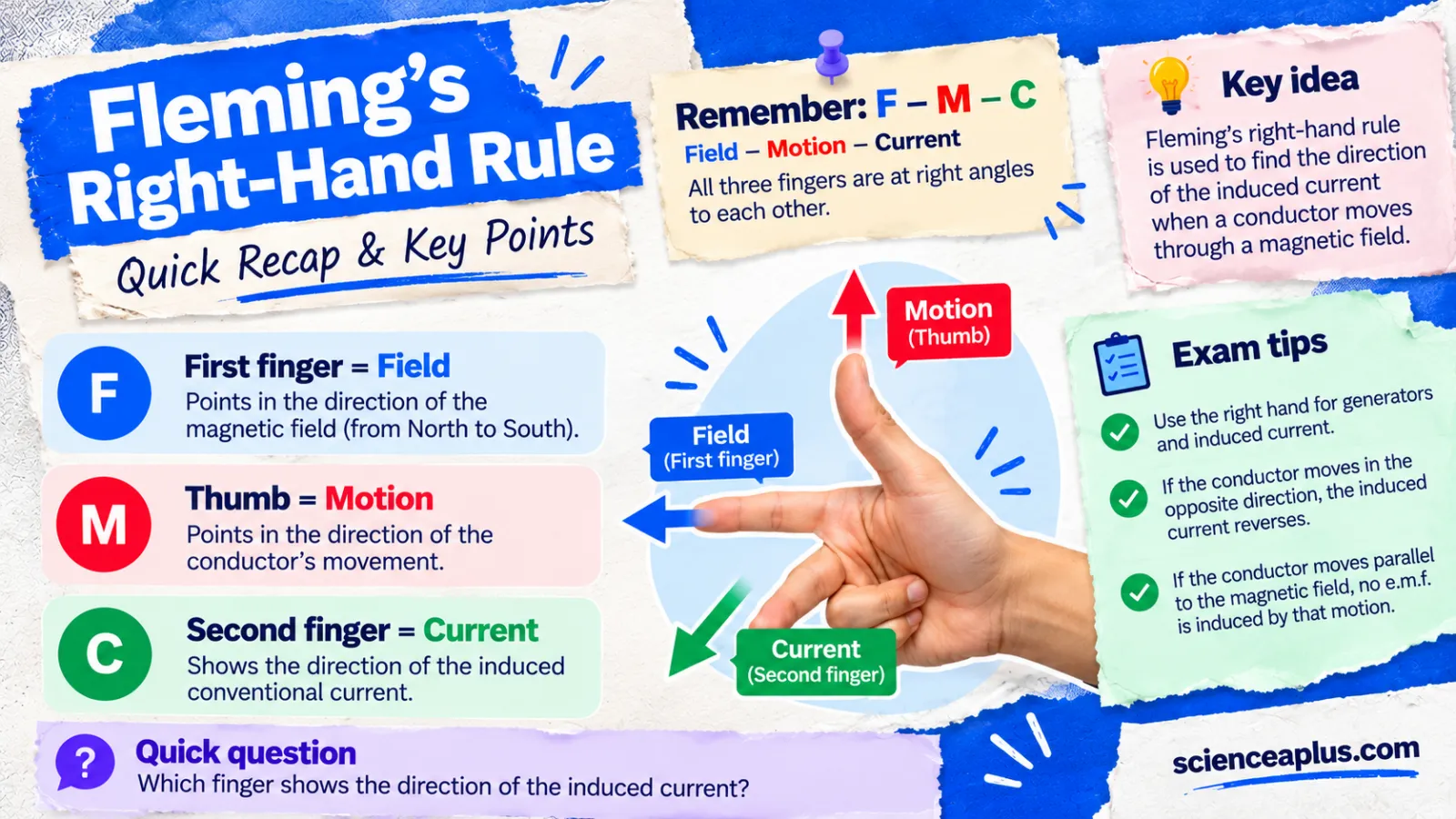
Fleming’s right-hand rule tells you which way an induced current flows when a wire moves through a magnetic field. Hold your right thumb, first finger and second finger at right angles, point them in the right directions, and the answer appears in seconds.
This guide shows the rule step by step, then works through six direction problems with a checked diagram. It compares the right-hand rule with the left-hand rule, says exactly where it sits in the GCSE and A-level specifications, and finishes with maths questions, a quiz and an FAQ. The recap card at the top of this page gives you the whole rule on one picture.
What is Fleming’s right-hand rule?
Fleming’s right-hand rule gives the direction of the induced current when a conductor that is part of a circuit moves through a magnetic field. You hold the thumb, first finger and second finger of your right hand at right angles to one another. The thumb shows the Motion of the conductor relative to the field. The first finger shows the magnetic Field, from north to south. The second finger shows the induced Current.
This is the generator effect. If a conductor moves relative to a magnetic field, or the field around it changes, a potential difference (p.d.) is induced across the ends of the conductor. If the conductor is part of a complete circuit, a current flows. You can see the effect for yourself in the electromagnetic induction experiment, where a magnet moved in and out of a coil makes a meter needle flick.
The rule gives the direction of conventional current, which flows from positive to negative. If you work with electron flow instead, you get the opposite answer. The page on the direction of current explains why the two conventions exist and why physics questions use conventional current.
One more detail matters: the motion is measured relative to the field. Moving a magnet one way past a still wire is the same as moving the wire the opposite way through a still field. So if a question moves the magnet instead of the wire, reverse the direction before you use your thumb.
How to use Fleming’s right-hand rule, step by step
The rule is easy once you do the steps in the same order every time. Follow this method and you will not mix up the fingers.
- Find the field direction. Outside a magnet, field lines run from the north pole to the south pole. Decide which way the first finger will point.
- Find the motion of the wire. Work out which way the wire moves relative to the field. If the magnet moves and the wire is still, reverse the magnet’s direction.
- Make the rule shape with your right hand. Hold the thumb, first finger and second finger at right angles to one another, like the corner of a box.
- Point the first finger along the field. Keep it pointing that way for the next step.
- Turn your wrist until the thumb points along the motion. Do not move the first finger while you do this. Your hand will end up in an awkward-looking position, and that is normal.
- Read the current from the second finger. It points in the direction of the induced conventional current.
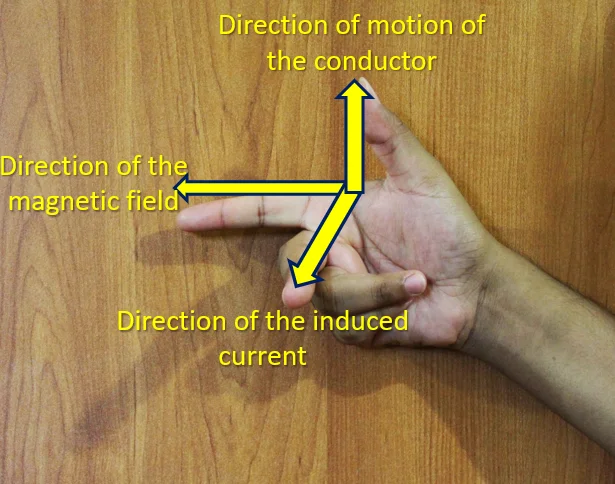
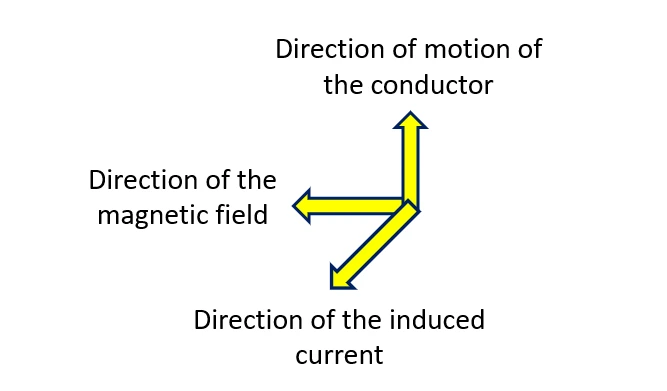
How to remember which finger is which
Think of the letters in F–M–C: the First finger is the Field, the thuMb is the Motion, and the seCond finger is the Current. These are memory aids, not rules of nature, so use whichever one sticks.
Some books use “FBI” instead: thumb is the force or motion, first finger is the field B, second finger is the current I. For the right-hand rule, read the thumb as motion. To remember the hand, think “Generators: Right hand” and “Motors: Left hand”.
Whichever mnemonic you pick, practise it with a real hand. Reading the rule is not the same as turning your wrist into the right position, and the wrist twist is where most mistakes happen. A good habit is to do it with the textbook diagram in front of you and say each finger aloud: “field, motion, current”.
Who was Fleming?
The rule is named after John Ambrose Fleming, who was born in Lancaster on 29 November 1849 and died in Sidmouth on 18 April 1945. In 1885 he became head of the new Department of Electrical Technology at University College London. In 1904, while working for the Marconi Company, he built the first vacuum tube, a two-electrode diode that he called the “oscillation valve”.
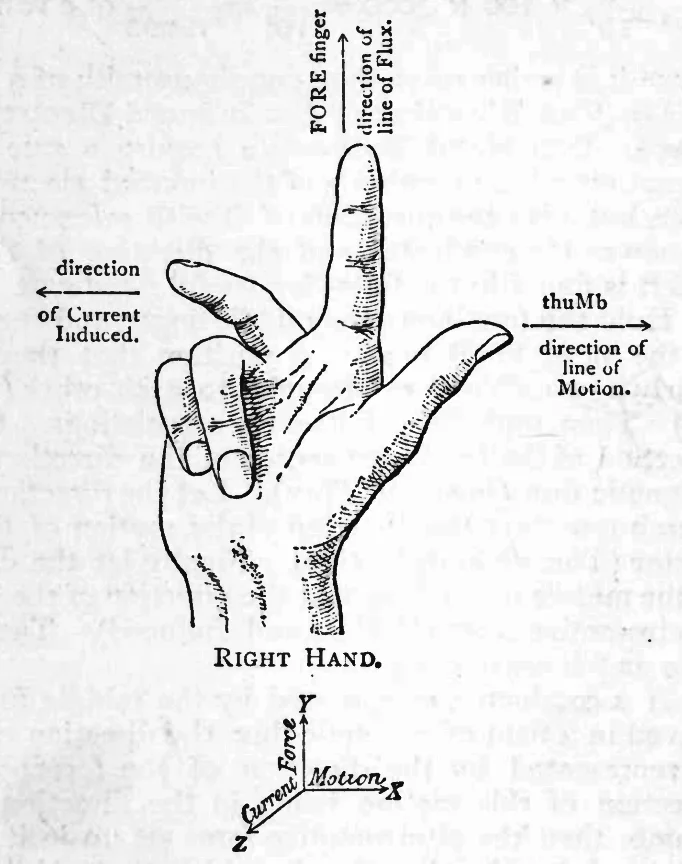
His two hand rules were originated in the late 19th century as a simple way to work out the direction of motion in a motor, or the direction of current in a generator.
The original drawing below comes from his 1902 book Magnets and Electric Currents. Look closely at the labels. The fore finger is marked “direction of line of flux”, the thumb is marked “direction of line of motion”, and the third direction is “direction of current induced”, all under the heading “RIGHT HAND”. That is exactly the same rule you are learning, more than a century later.
In the next section we put the rule to work. Six worked problems show how the same six steps handle every direction, including the case where there is no current at all.
Fleming’s right-hand rule examples: finding the direction of the induced current
The best way to learn the rule is to use it. The examples below all use the same page axes: right, left, up and down are directions on the page. Two symbols cover the third dimension. ⊗ means into the page, like the tail of an arrow flying away from you. ⊙ means out of the page, like the tip of an arrow coming towards you.
For each example, work out your own answer with your right hand first, then tap the box to check. Every answer below has been checked with the vector form of the rule, so you can trust it.
Example 1: wire moving up between N and S
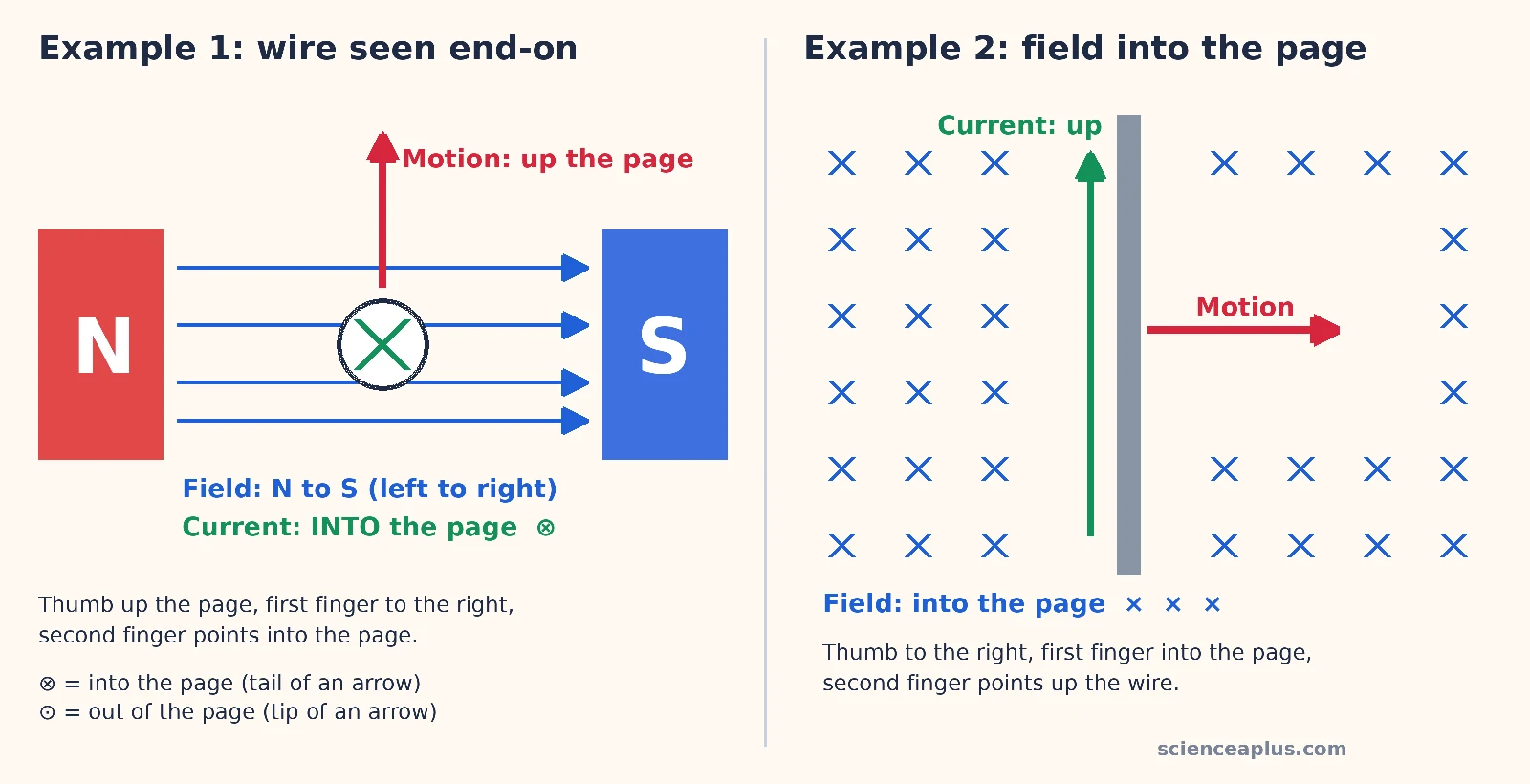
A wire is seen end-on between a north pole on the left and a south pole on the right. The field therefore points from left to right, and the wire moves up the page. Point your first finger to the right, turn your wrist until the thumb points up, and look at your second finger.
Which way does the induced current flow?
The current flows into the page ⊗. First finger right (field), thumb up (motion), second finger away from you (current).
Example 2: vertical wire moving to the right
The field points into the page, and a vertical wire moves to the right. Point your first finger away from you, into the page. Turn your wrist so that the thumb points right. Your second finger now points along the wire.
Which way does the current flow along the wire?
The current flows up the wire. First finger into the page (field), thumb right (motion), second finger up (current).
Now run the Lenz check. The current is flowing up the wire, so the motor effect applies to it: a current in a magnetic field feels a force. Use the left-hand rule: first finger into the page, second finger up, and the thumb points to the left. The force on the wire opposes its motion. That makes sense because the energy for the current has to come from somewhere, and it comes from the work you do pushing the wire. The wire is pushed back because the induced current feels a motor-effect force from the field; energy conservation (Lenz’s law) requires it.
Example 3: N pole above, S pole below
This time the north pole is above the wire and the south pole is below it, so the field points down the page. The wire moves to the right. Point your first finger down, then turn your wrist until the thumb points right.
Which way does the induced current flow?
The current flows into the page ⊗. First finger down (field), thumb right (motion), second finger away from you (current).
Example 4: field out of the page, wire moving down
The field points out of the page ⊙, towards you, and the wire moves down the page. Point your first finger towards yourself and turn the wrist until the thumb points down.
Which way does the induced current flow?
The current flows to the left. First finger out of the page (field), thumb down (motion), second finger left (current).
Example 5: moving the magnets instead of the wire
Here the wire stays still and the magnets are moved down the page. The field points from left to right. Remember that the thumb shows the motion of the wire relative to the field. If the magnets move down, then from the wire’s point of view the field moves down, which is the same as the wire moving up through a still field.
Which way does the induced current flow?
The current flows into the page ⊗. This is the same as Example 1, because the relative motion is the same. First finger right (field), thumb up (relative motion of the wire), second finger away from you.
Example 6: when there is no current
The wire moves from left to right, parallel to a field that also points from left to right. Try the rule. You cannot put the first finger and the thumb along the same line while keeping them at right angles. That is your clue that something is wrong.
Is a current induced?
No induced current. The wire is moving along the field lines, so it does not cut across them. The same happens if a vertical wire slides straight up along its own length: no p.d. is induced along the wire. To induce a current, the wire must cut across the field lines.
Try it yourself
Here are three more problems with no diagram. Draw a quick sketch on paper, use your right hand, and then reveal the answer.
(a) The field points from right to left and the wire moves up the page. Which way does the current flow?
The current flows out of the page ⊙. First finger left (field), thumb up (motion), second finger towards you (current).
(b) The field points into the page and the wire moves to the left. Which way does the current flow?
The current flows down the page. First finger into the page (field), thumb left (motion), second finger down (current).
(c) The field points down the page and the wire moves into the page. Which way does the current flow?
The current flows to the left. First finger down (field), thumb into the page (motion), second finger left (current).
If you got all three, you can use the rule in any orientation. If you got one wrong, check whether you moved your first finger while turning your wrist, or whether you used the left hand by mistake. Use the direction finder below to check any combination you like, including motors, and to see what happens when the motion is parallel to the field.
Fleming’s right-hand rule vs left-hand rule
Fleming gave us two hand rules, and mixing them up is the most common mistake in this topic. The right-hand rule is for the generator effect: something moves, and a current appears. The left-hand rule is for the motor effect: a current flows, and something moves. Compare them side by side.
| Rule | Hand | Used for | Thumb | First finger | Second finger | Cause → effect |
|---|---|---|---|---|---|---|
| Fleming’s right-hand rule | Right | Generators, dynamos and moving wires (generator effect) | Motion of the conductor | Magnetic field (N to S) | Induced current | Motion and field cause a current |
| Fleming’s left-hand rule | Left | Electric motors (motor effect) | Force (thrust, or motion) | Magnetic field (N to S) | Current | Current and field cause a force |
The two hands differ because cause and effect are swapped. In a motor, a current in a magnetic field makes a force, so the thumb is the result. In a generator, motion in a magnetic field makes a current, so the second finger is the result. Using the wrong hand reverses the answer, so the choice of hand matters.
The same machine can do both jobs. A motor can act as a generator, and when it does, the current reverses while the motion and the field stay the same. This is the idea behind regenerative braking in electric cars. The page on the physics of electric cars covers the left-hand rule, the force equation F = BIl, and how a motor is used as a generator when the car slows down.
Where Fleming’s right-hand rule works in real life
Every generator is built around the same idea: a conductor moves through a magnetic field, and a p.d. is induced across its ends. Fleming’s right-hand rule tells you the direction of the current that results.
The AC generator
In an AC generator, also called an alternator, a coil spins in a magnetic field. Look at one side of the coil. For half of each turn it moves up through the field, and for the other half it moves down. Put the two motions into the rule and the induced current points one way, then the other. The current reverses every half turn, which is why the output is alternating current. AQA states that the generator effect is used in an alternator to generate AC and in a dynamo to generate DC. If you want to see the coil, slip rings and brushes in detail, read how generators work.
Power stations and wind turbines
In a power station, steam, falling water or moving air turns a turbine. The turbine turns a generator, and the generator pushes wires through a magnetic field. The energy source changes, but the physics inside the generator stays the same. Wind power is a good example, and you can weigh its pros and cons in the advantages and disadvantages of wind energy.


Microphones
Microphones also use the generator effect. Sound waves move part of the microphone through a magnetic field, and the movement induces a small p.d. that copies the pattern of the sound. The size and direction of the induced p.d. change as the motion changes.
In all these cases, the same factors control the size of the induced p.d. A faster movement, a stronger field, or more of the wire inside the field all increase it. Reversing the motion or the field reverses the direction of the current. If you reverse both, the direction stays the same, because the two reversals cancel.
When not to use the right-hand rule
The right-hand rule is built for a straight piece of wire that moves across a field. It is awkward when nothing moves in the simple way the rule needs. The standard example is the transformer.
In a transformer, nothing moves. An alternating current in the primary coil makes a changing magnetic field in the iron core, and that changing field induces a p.d. in the secondary coil. There is no wire sliding through a field, so there is no thumb to point. Use Lenz’s law and the idea of a changing field instead. The induced current produces a field that opposes the original change. For the numbers, you use the transformer equations Vp ÷ Vs = np ÷ ns and Vs × Is = Vp × Ip (for a 100% efficient transformer), which are on the AQA GCSE Physics equation sheet for the Higher Tier. You will use them in the maths questions at the end of this article.
The same applies when a magnet is pushed into a coil. You can use the right-hand rule on every little piece of wire in the coil, but that is slow. It is much quicker to say that the induced current makes a field that opposes the change, and to work out the direction from there.
Before you move on, notice what the two hand rules have in common. Both need three directions at right angles, both use conventional current, and both give the wrong answer if you use the wrong hand. The difference is only which of the three directions is the result. Next, we check what each exam board actually requires.
Is Fleming’s right-hand rule on the GCSE and A-level specifications?
This is the question students ask most, and the honest answer surprises people. We read the official specifications on 25 October 2026. AQA GCSE Physics (8463) names Fleming’s left-hand rule and does not mention the right-hand rule anywhere. The left-hand rule is in section 4.7.2.2 and is Higher Tier only. For induced current, AQA asks you to recall the factors that affect the size and direction of the induced p.d. and current, and to apply the principles of the generator effect (section 4.7.3.1, Higher Tier, physics only).

| Board / specification | Left-hand rule named? | Right-hand rule named? | What you must do about induced current direction |
|---|---|---|---|
| AQA GCSE Physics 8463 | Yes, 4.7.2.2 (Higher) | No | Recall factors affecting size and direction; apply the generator effect (4.7.3.1, Higher, physics only) |
| AQA GCSE Combined Science: Trilogy 8464 | Yes, 6.7.2.2 (Higher) | No | The generator effect section is not in this specification |
| Edexcel GCSE Physics 1PH0 | Yes, 12.12 | No | 13.2: recall the factors that affect the size and direction of an induced p.d., and describe how the field produced opposes the original change |
| OCR GCSE Gateway Physics A J249 | Yes, P4.2b | No | P4.2e: a changing field can induce a p.d. that could drive a current, generating a field that opposes the change |
| Cambridge IGCSE Physics 0625 (2026–28) | Relative directions of force, field and current, 4.5.4 (Supplement) | Not by name | 4.5.1 (Supplement): state and use the relative directions of force, field and induced current |
| AQA A-level Physics 7408 | Yes, 3.7.5.1 | No | Faraday’s and Lenz’s laws, including a straight conductor moving in a magnetic field |
| OCR A-level Physics A H556 | Yes, 6.3.1(d) | No | Faraday’s law and Lenz’s law |
The pattern is clear. Every GCSE and A-level specification we checked names Fleming’s left-hand rule (Cambridge IGCSE only gives the relative directions), but none of the specifications we checked names the right-hand rule. All of them expect you to work out the direction of an induced current, and the right-hand rule is the fastest way to do that for a moving wire. Treat it as a tool, and learn the Lenz’s law wording as well. Check your own board’s current specification, because documents are updated.
Common mistakes with Fleming’s right-hand rule
- Using the left hand for a generator. Generators use the right hand, motors the left.
- Swapping the thumb and first finger. The thumb is motion, the first finger is the field.
- Pointing the field from south to north. Field lines run from N to S outside a magnet.
- Using electron flow. The rule gives conventional current, so electron flow runs the opposite way.
- Fingers not at right angles. If your three directions are not mutually at right angles, the rule is not being used properly.
- Forgetting that motion is relative. If the magnet moves and the wire is still, reverse the magnet’s direction for your thumb.
- Expecting a current when the wire moves parallel to the field, or slides along its own length. No field lines are cut, so no p.d. is induced.
- Confusing it with the grip rule. The right-hand grip rule finds the field around a wire, not an induced current.
Maths practice questions
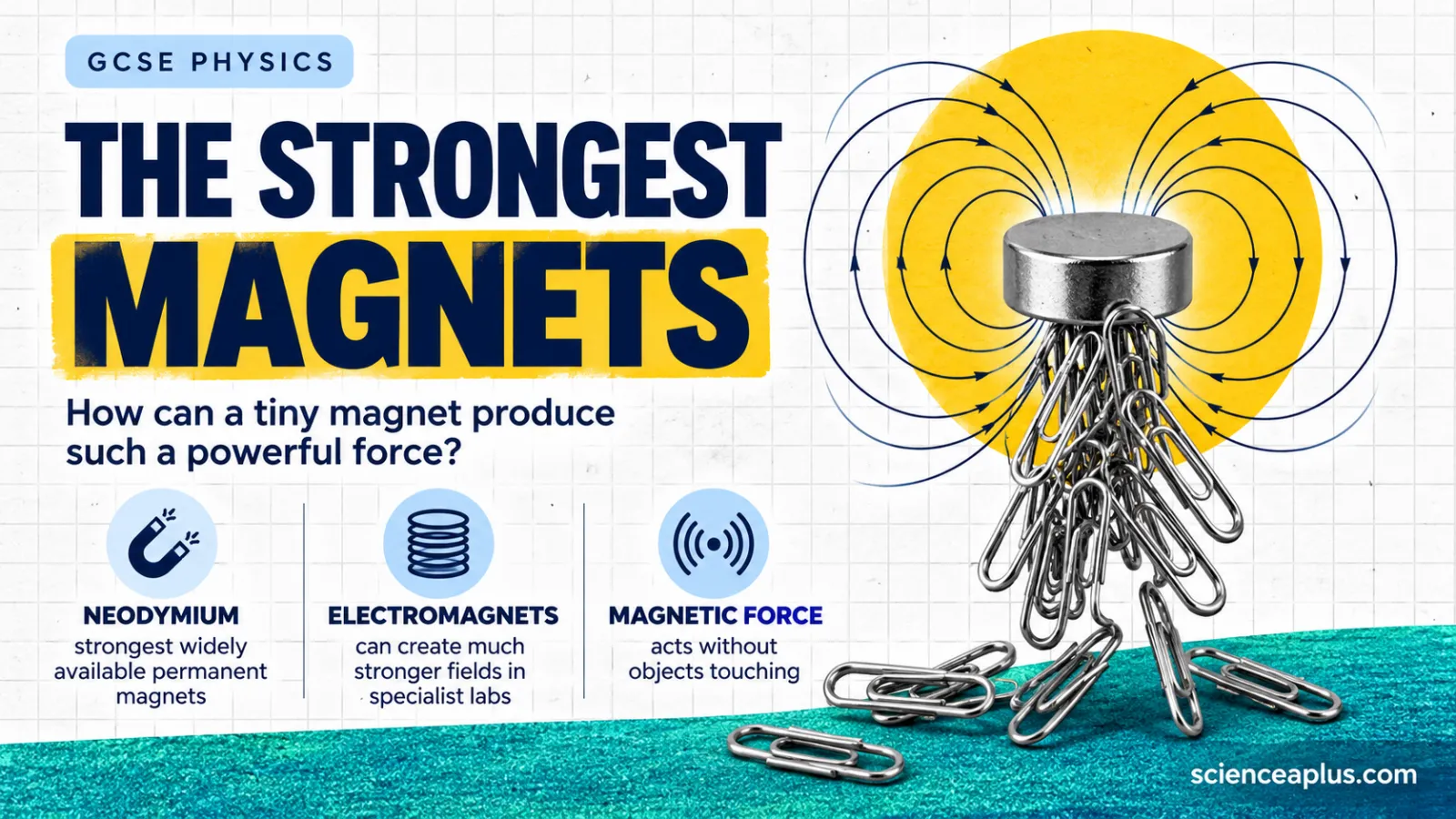
Stronger magnets give a bigger force on a current and a bigger induced p.d., as you can see on the page about the strongest magnets. Here are the equations you need.
F = B × I × l
ε = B × l × v (A-level)
I = V ÷ R
P = V × I
Vp ÷ Vs = np ÷ ns
Vs × Is = Vp × Ip
F = BIl and the two transformer equations are on the AQA GCSE Physics equation sheet (Higher Tier). ε = Blv is A-level stretch. Questions are marked ★ (easier) to ★★★ (hardest). Tap each one to reveal the answer.
1. ★ A wire 0.15 m long carries 3.0 A at right angles to a 0.20 T field. (a) What is the force? (b) The field points left to right and the current flows into the page. Which way is the force?
(a) F = BIl = 0.20 × 3.0 × 0.15 = 0.090 N. (b) Left-hand rule: first finger right, second finger into the page, so the thumb points down the page.
2. ★ A 0.10 m wire in a 0.40 T field feels a force of 0.12 N. What is the current?
I = F ÷ (B × l) = 0.12 ÷ (0.40 × 0.10) = 3.0 A.
3. ★★ A force of 0.048 N acts on 0.080 m of wire carrying 2.0 A at right angles to a field. What is the magnetic flux density?
B = F ÷ (I × l) = 0.048 ÷ (2.0 × 0.080) = 0.30 T.
4. ★★ (A-level stretch) A metal rod 0.25 m long slides at 4.0 m/s across a 0.50 T field that points into the page. The rod is vertical on the page and moves to the right. (a) What is the induced e.m.f.? (b) Which way does the induced current flow in the rod?
(a) ε = Blv = 0.50 × 0.25 × 4.0 = 0.50 V. (b) Right hand: thumb right, first finger into the page, so the second finger points up the rod. This matches Example 2 above.
5. ★★★ (A-level stretch) The rod in question 4 is part of a circuit of total resistance 2.0 Ω. (a) What is the current? (b) What is the force on the rod from this current, and in which direction? (c) Show that the power needed to push the rod equals the electrical power.
(a) I = ε ÷ R = 0.50 ÷ 2.0 = 0.25 A. (b) F = BIl = 0.50 × 0.25 × 0.25 = 0.03125 ≈ 0.031 N. Left-hand rule (current up, field into the page) gives a force to the left, opposing the motion, as Lenz’s law predicts. (c) Mechanical power = F × v = 0.03125 × 4.0 = 0.125 W. Electrical power = ε × I = 0.50 × 0.25 = 0.125 W. They are equal, so energy is conserved.
6. ★★ (A-level stretch) An aircraft with a 60 m wingspan flies level at 250 m/s where the vertical part of Earth’s magnetic field is 5.0 × 10⁻⁵ T. What is the e.m.f. between the wing tips? (All values are given for the question.)
ε = Blv = 5.0 × 10⁻⁵ × 60 × 250 = 0.75 V. That is tiny, so it is no use as a power source.
7. ★ A transformer has 460 turns on the primary and 24 turns on the secondary and is connected to 230 V AC. What is the secondary p.d., and is it step-up or step-down?
Vs = Vp × ns ÷ np = 230 × 24 ÷ 460 = 12 V, so it is a step-down transformer. The right-hand rule cannot be used here because nothing moves: the changing field in the core induces the p.d.
8. ★★ The 12 V secondary in question 7 supplies 2.5 A to a lamp. Assuming 100% efficiency, what current is drawn from the 230 V supply?
P = Vs × Is = 12 × 2.5 = 30 W. Ip = 30 ÷ 230 = 0.1304 ≈ 0.13 A.
Frequently asked questions about Fleming’s right-hand rule
What is Fleming’s right-hand rule used for?
Fleming’s right-hand rule is used to find the direction of the induced current when a conductor moves through a magnetic field. It applies to generators, dynamos and any wire cutting across field lines. The thumb shows the motion, the first finger the field and the second finger the current.
Which finger shows the current in Fleming’s right-hand rule?
The second finger shows the current. It is the induced conventional current, flowing from positive to negative. The thumb shows the motion of the conductor relative to the field and the first finger shows the field from north to south. A helpful memory aid is thuMb for Motion, First for Field, seCond for Current.
What is the difference between Fleming’s left-hand and right-hand rules?
The left-hand rule finds the force on a current-carrying wire in a magnetic field, which is the motor effect. The right-hand rule finds the induced current when a wire moves in a field, which is the generator effect. The first finger is the field in both rules, but the thumb and second finger swap roles.
Why do generators use the right hand and motors the left hand?
Cause and effect are swapped. In a motor, a current and a field cause a force, so the left-hand rule gives the thumb as the result. In a generator, motion and a field cause a current, so the right-hand rule gives the second finger as the result. Different results need different hands.
Is Fleming’s right-hand rule on the AQA GCSE specification?
No. AQA GCSE Physics 8463 names only Fleming’s left-hand rule, in section 4.7.2.2 for Higher Tier. For induced current it asks you to recall the factors affecting the direction and apply the generator effect. The right-hand rule is a useful tool, but the specification does not mention it by name.
Does Fleming’s right-hand rule use conventional current or electron flow?
It uses conventional current, which flows from positive to negative. If you try to use electron flow with the same fingers, you get the opposite direction. Always treat the second finger as conventional current, and only switch to electron flow if a question asks you for the movement of electrons.
What happens if the wire moves parallel to the magnetic field?
No p.d. is induced and no current flows. The wire must cut across the field lines. The same is true if a wire slides along its own length. In both cases the rule cannot be applied, because the thumb and first finger would lie along the same line instead of at right angles.
Is Fleming’s right-hand rule the same as the right-hand grip rule?
No. The right-hand grip rule shows the direction of the magnetic field around a current-carrying wire or solenoid: curl your fingers round the wire with the thumb along the conventional current. Fleming’s right-hand rule uses three fingers at right angles to find an induced current.
Who invented Fleming’s rules?
The rules were originated by John Ambrose Fleming in the late 19th century. They give a simple way to work out the direction of motion in a motor or of current in a generator. Fleming also built the first vacuum tube in 1904, a two-electrode diode he called the oscillation valve.