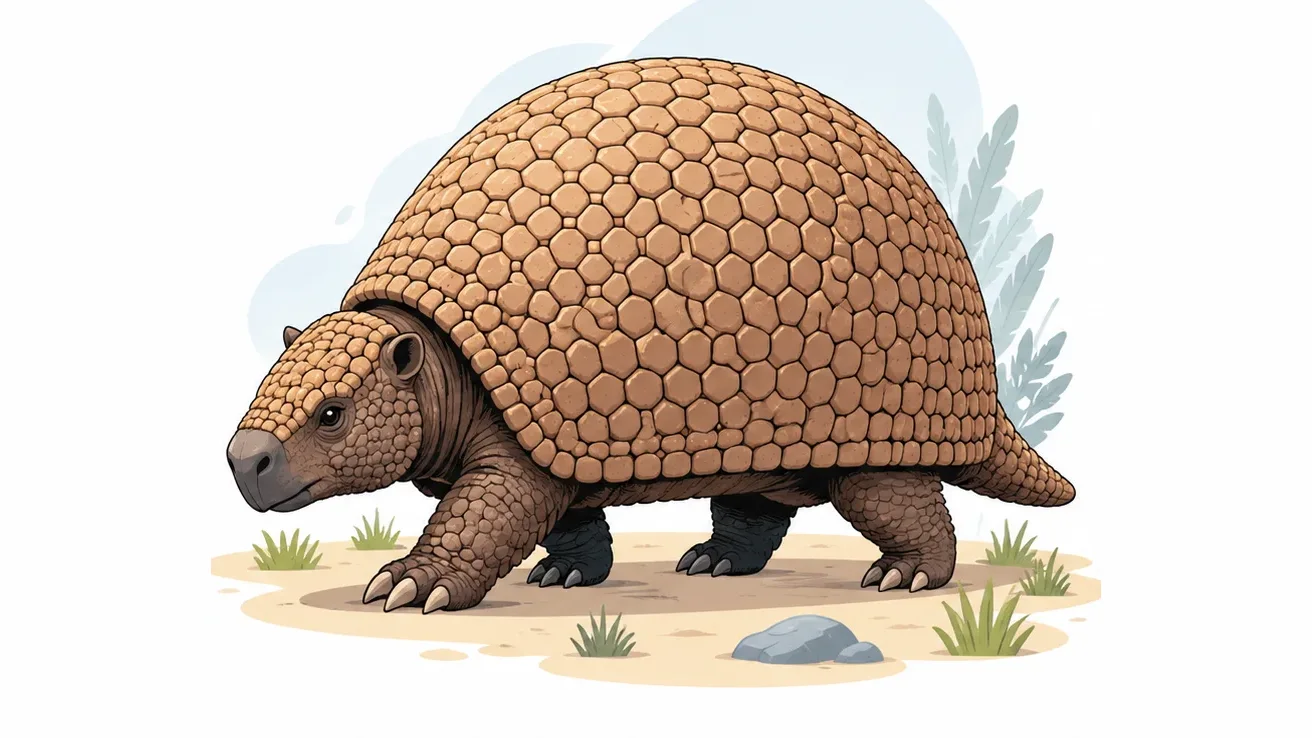
Glyptodon was a giant, plant-eating mammal that lived in South America during the Ice Age. It carried a domed shell made of hundreds of bony plates, and DNA shows that it was a true relative of today’s armadillos. As a mammal, it belongs with the animals described in the main families of mammals, not with dinosaurs or reptiles.
What was Glyptodon?
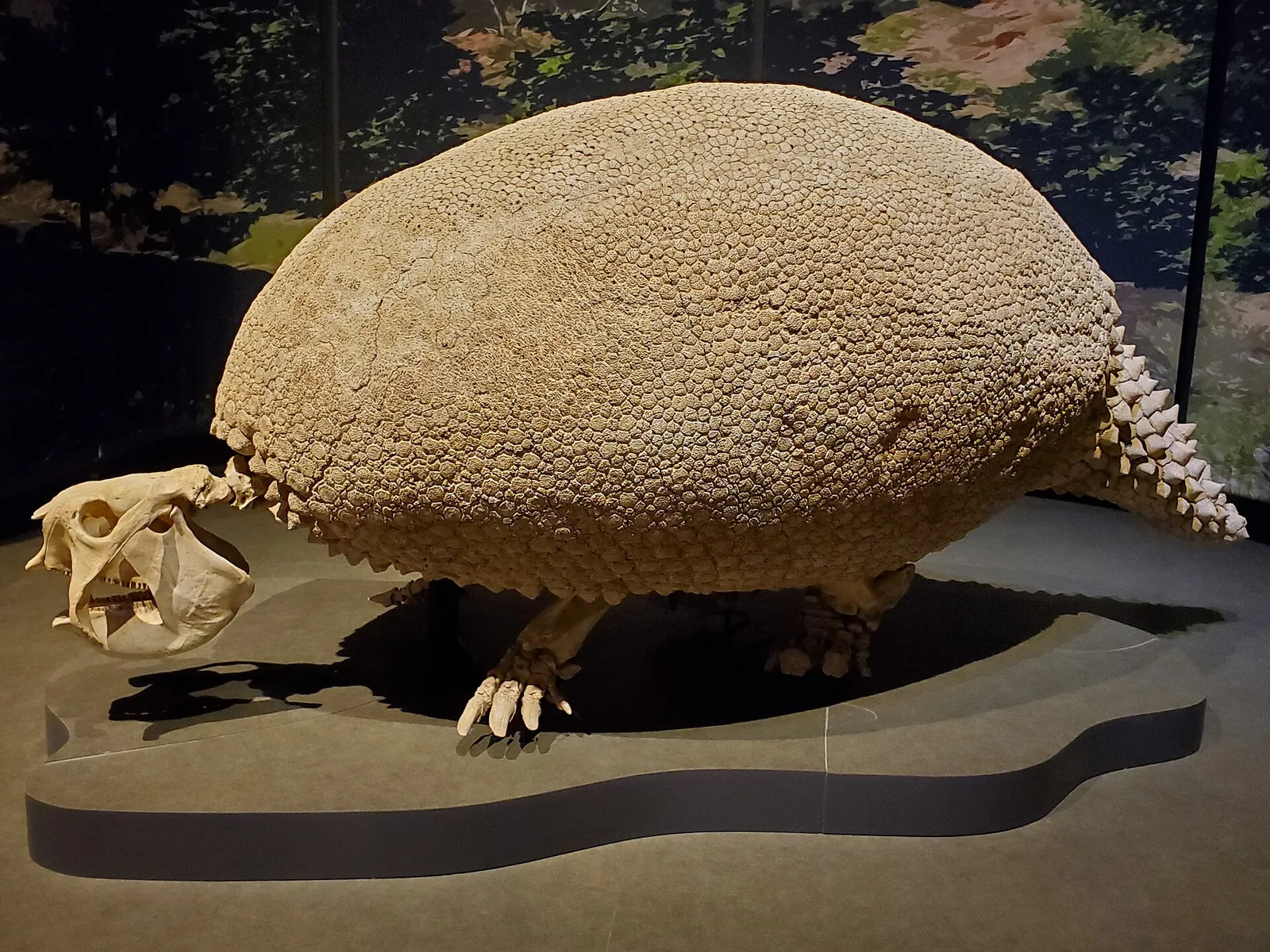
Glyptodon belonged to a group called the glyptodonts: large, heavily armoured plant-eaters whose shell, or carapace, was built from fused bony plates called osteoderms. An osteoderm is a plate of bone that forms inside the skin. Armadillos have them too, but in a glyptodont they joined together into one rigid dome.
Glyptodon was a mammal. As a placental mammal it did not lay eggs. That puts it in a different box from the other groups of vertebrates such as reptiles and birds. It was not a dinosaur, and it was not a giant tortoise either, despite the shell.
Many people searching for the “glyptodon animal” expect a single, well-defined species. In fact the name covers a genus (a group of close species), and scientists still argue about how many species it contained. Names you may meet include Glyptodon reticulatus, G. munizi and G. jatunkhirkhi, which was described from the Bolivian Andes in 2020. A 2019 review argued that the southern South American forms were really one species, G. reticulatus.
What does the name Glyptodon clavipes mean?
The genus was named by the British anatomist Richard Owen in 1839, and the type species was Glyptodon clavipes. The word Glyptodon comes from Greek words meaning “carved” and “tooth”, because its cheek teeth look sculpted. Clavipes comes from Latin words for “club” and “foot”.
If you are hunting for animals beginning with G, this one fits neatly into any list of animals that start with G, alongside much more familiar creatures.
How big was Glyptodon?
Sizes quoted online vary a great deal, and the honest answer is a range. A research project at the Arroyo del Vizcaíno fossil site in Uruguay says Glyptodon had a mass between one and two tonnes. Estimates for individual species are lower and higher, from roughly 400 kg up to about 2,000 kg, depending on the species and on the method used to calculate it.
Length is just as hard. The shell of a Glyptodon was probably around 2 metres long. One partial skeleton measured in Victorian times came out at about 3.5 metres, but that figure is old and the specimen was incomplete. Bones are often missing, and scientists have to scale up from the pieces they have, so every number is an estimate.
Glyptodon was big, but it was not the biggest glyptodont. That title belongs to Doedicurus, which reached up to about 4 metres long and roughly 2,400 kg. The table puts the sizes side by side, with a tiny living relative for scale.
| Animal | Approximate length | Approximate mass |
|---|---|---|
| Glyptodon | Shell around 2 m (estimates vary) | About 1–2 tonnes (some lower estimates) |
| Doedicurus | Up to about 4 m | Up to about 2,400 kg |
| Pink fairy armadillo (living) | About 9–17 cm | Tiny |
When and where did Glyptodon live?
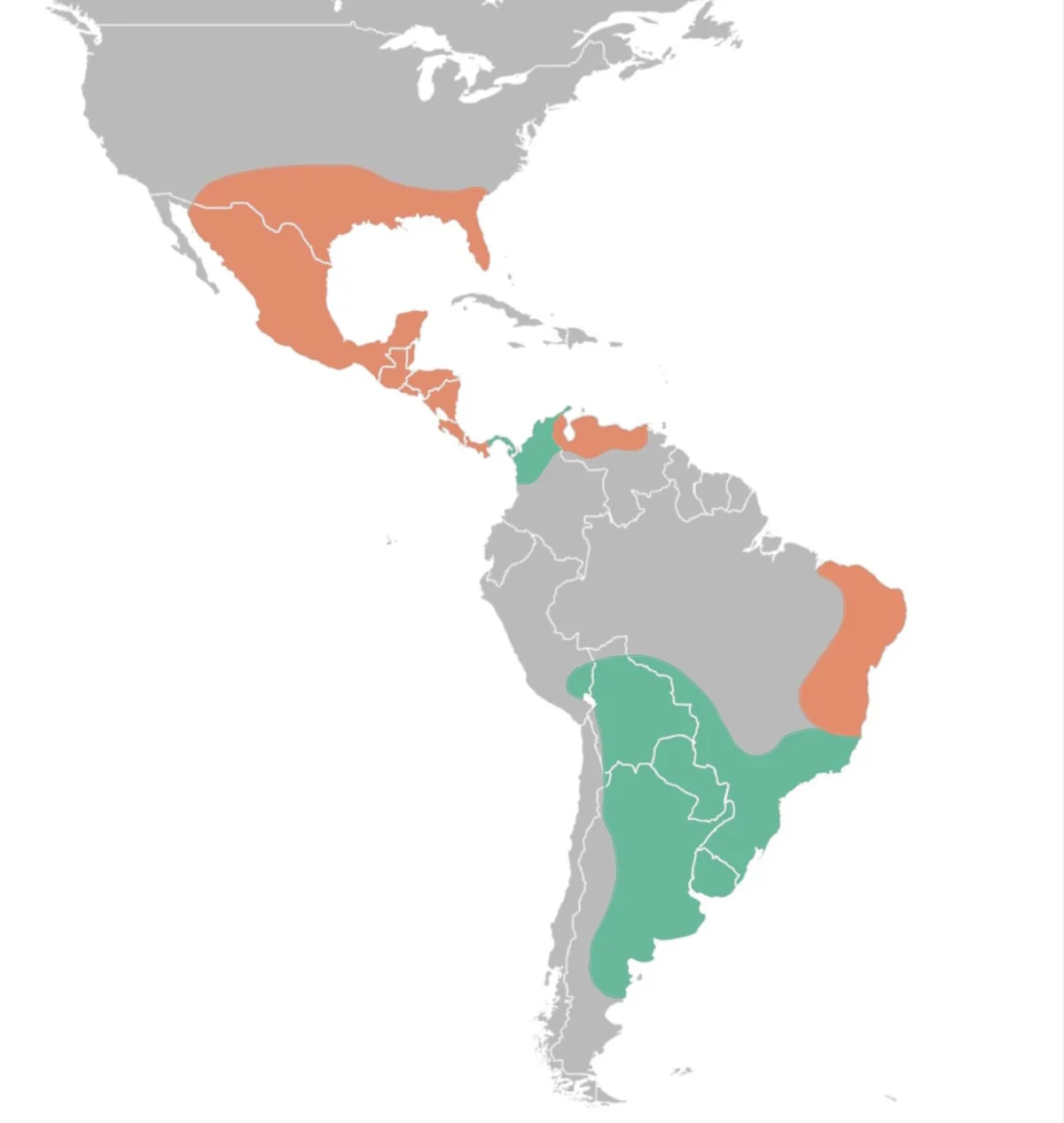
Glyptodon lived only in South America. On one published range, the genus appears about 1.8 million years ago and lasts until roughly 8,000 years ago, although the youngest dates are debated, and most fossils point to about 11,000 to 12,000 years ago. Either way, it belongs to the Pleistocene, the epoch popularly known as the Ice Age.
Its fossils turn up from the lowland grasslands of the Pampas, which were grassland dotted with patches of forest and shrubs, right up into the Andes of Peru and Bolivia, where some fossils lie above 4,100 metres. The northernmost record comes from central Colombia.
The North American look-alike: Glyptotherium
If you see a “Glyptodon” fossil from the United States, it is almost certainly something else. Its close cousin Glyptotherium likely began in South America, then travelled north by land after the Isthmus of Panama formed. Glyptotherium remains are known from Venezuela, Central America, Mexico and the southern USA, from Florida and South Carolina to Arizona.
The two animals look very alike, and Glyptodon was usually the larger of the pair, with a longer shell. Still, the map in this article keeps them apart: one genus in the south, the other spreading north.
A giant armadillo? What DNA shows
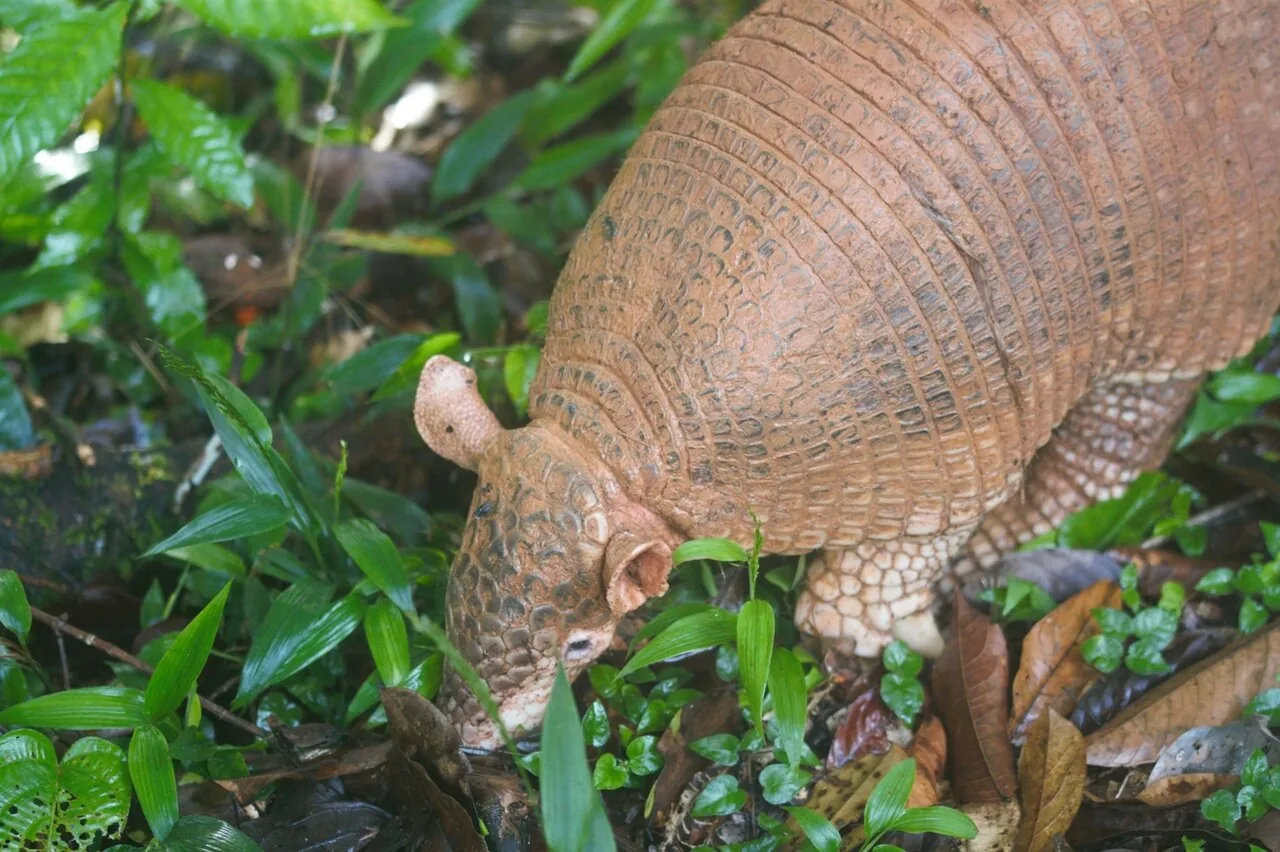
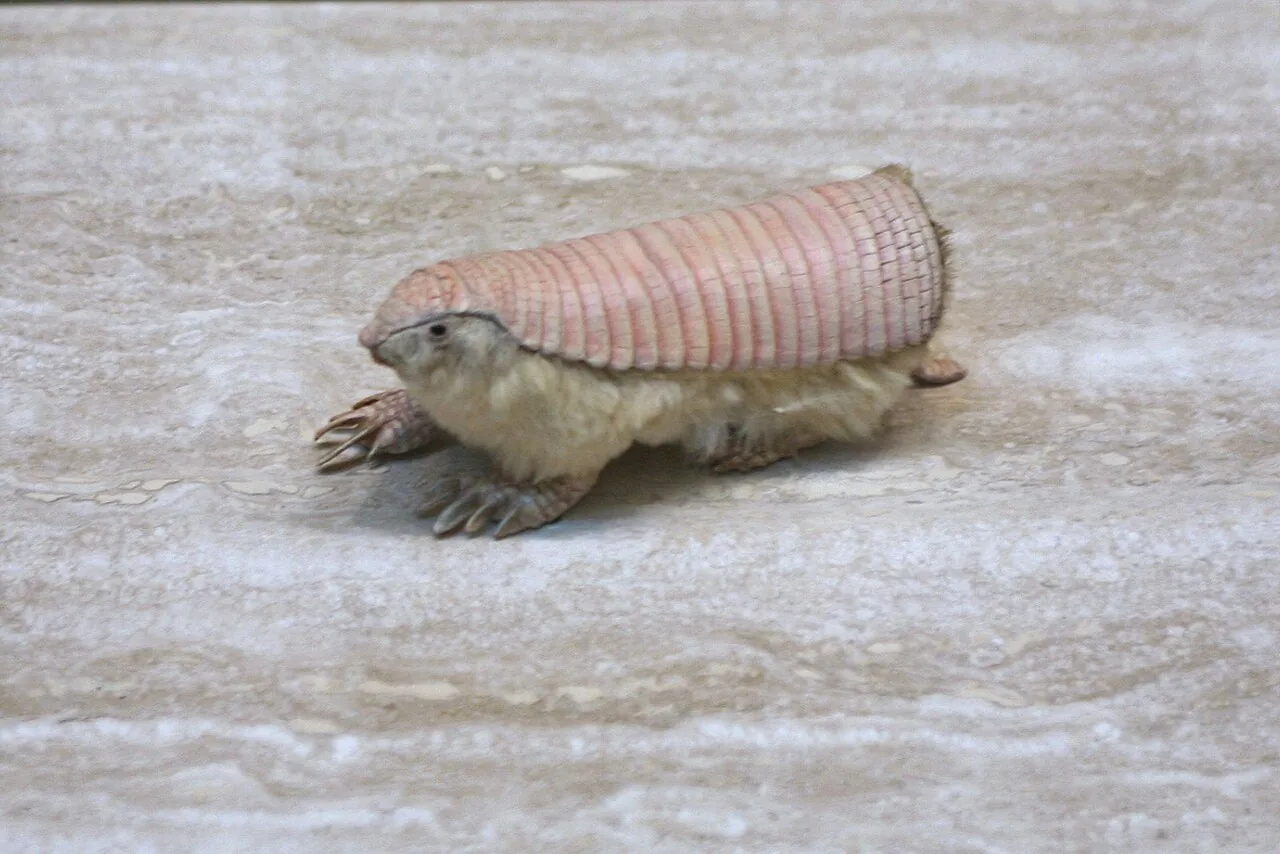
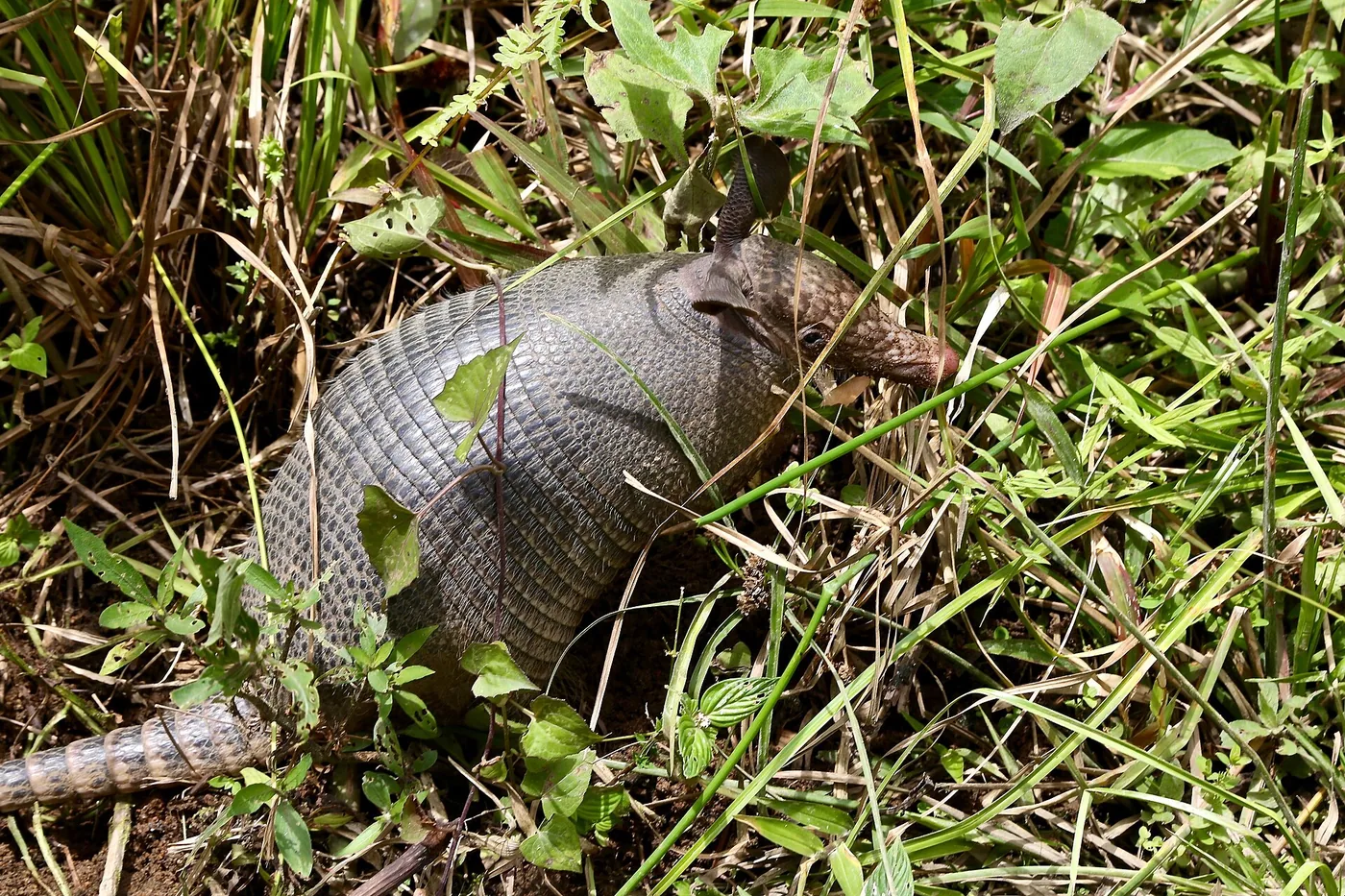
For a long time, scientists could see that glyptodonts and armadillos both had bony armour, but nobody could be sure whether they were relatives or just look-alikes. In 2016, a team led by Frédéric Delsuc settled the question by recovering DNA from a shell fragment of Doedicurus, a glyptodont. Their DNA did not come from every sample, as other attempts failed, but the one that worked was enough.
The result was clear. Glyptodonts sit deep inside the armadillo family tree, in the same family as the giant armadillo and the pink fairy armadillo. Delsuc and his colleagues described them as “no more than another subfamily of armadillos”. The glyptodont branch split away no earlier than about 35 million years ago.
That makes the answer to “is glyptodont related to armadillo?” a firm yes. The living nine-banded armadillo is a more distant cousin, from a different family.
Notice the contrast in size. Pink fairy armadillos are only about 9 to 17 cm long and live underground, yet they share ancestors with a plant-eater that weighed a tonne or more. After the split from other armadillos, body size in glyptodonts increased spectacularly until they died out.
How Glyptodon’s armour worked
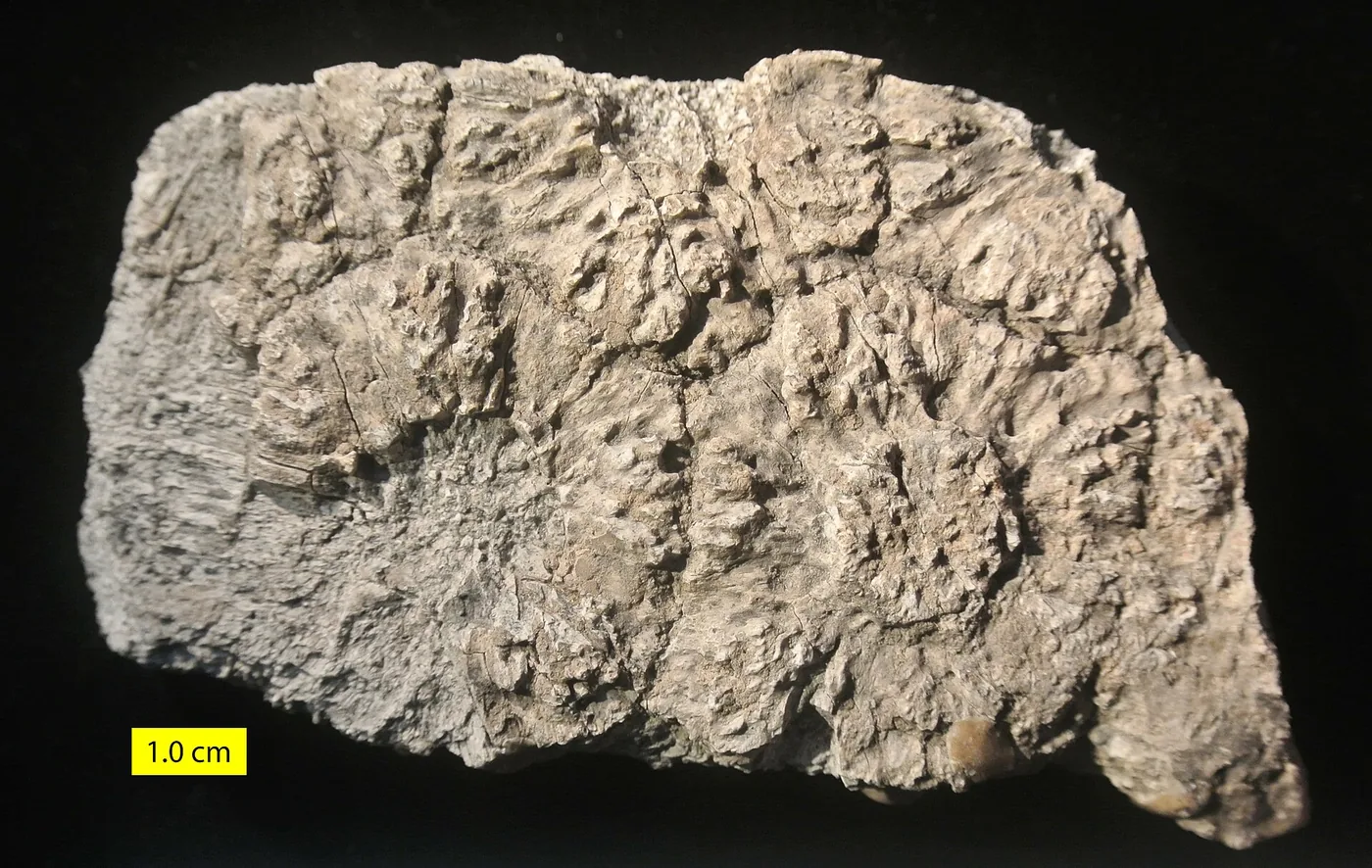
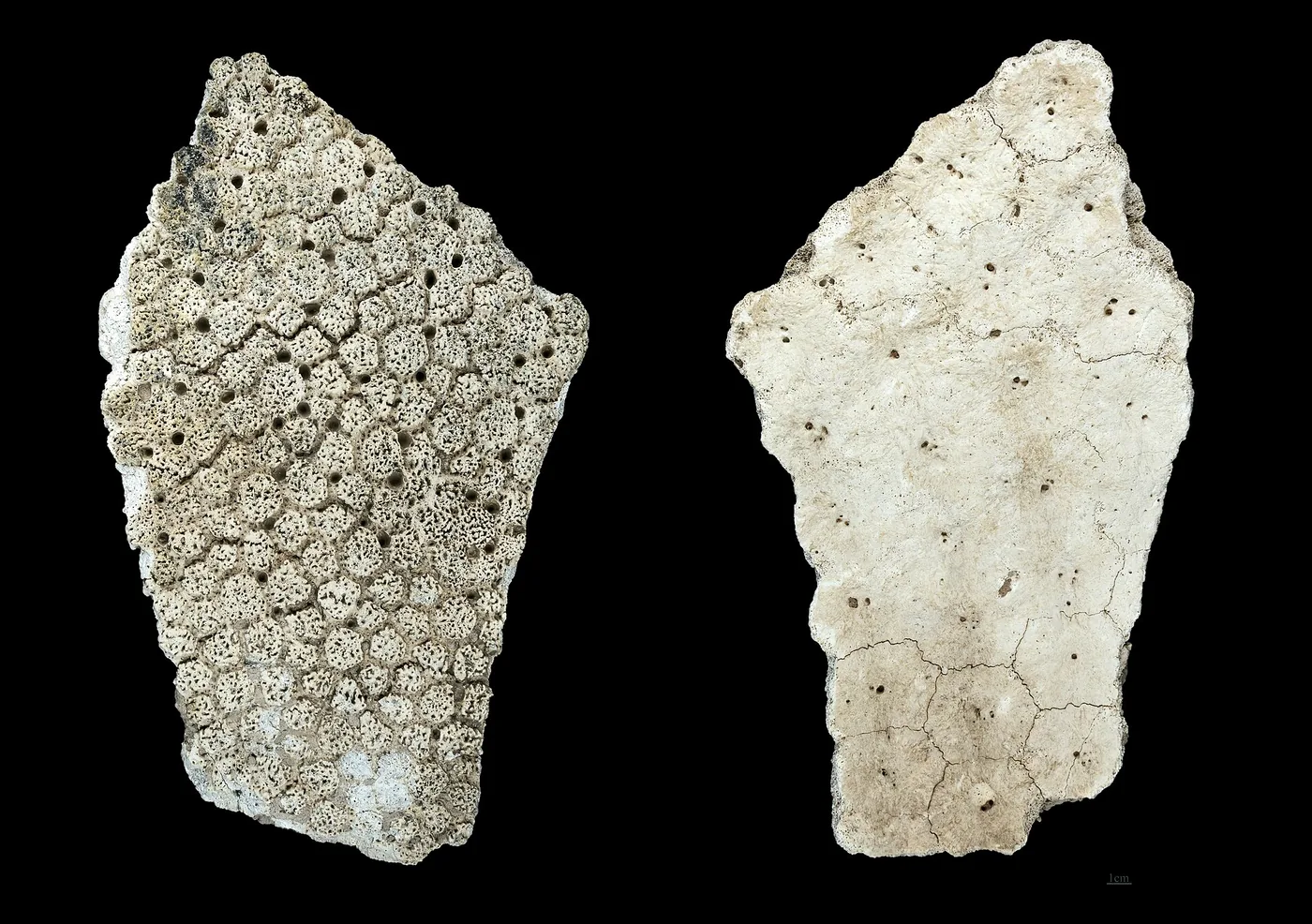
The most striking thing about Glyptodon is its shell. Like other glyptodonts, it was covered in bony, scale-like plates called osteoderms, which together formed a domed carapace. The plates were much thicker than a turtle’s shell, and a Glyptodon shell was made of hundreds of interconnected pieces. We do not know the exact number, so be wary of any page that gives a precise count.
Look closely at a fossil fragment and you can see the pattern. Each plate has a raised pattern on its outer face, and neighbouring plates fit together. In the front and sides of the shell the plates were strongly fused, which limited how much the body could bend.
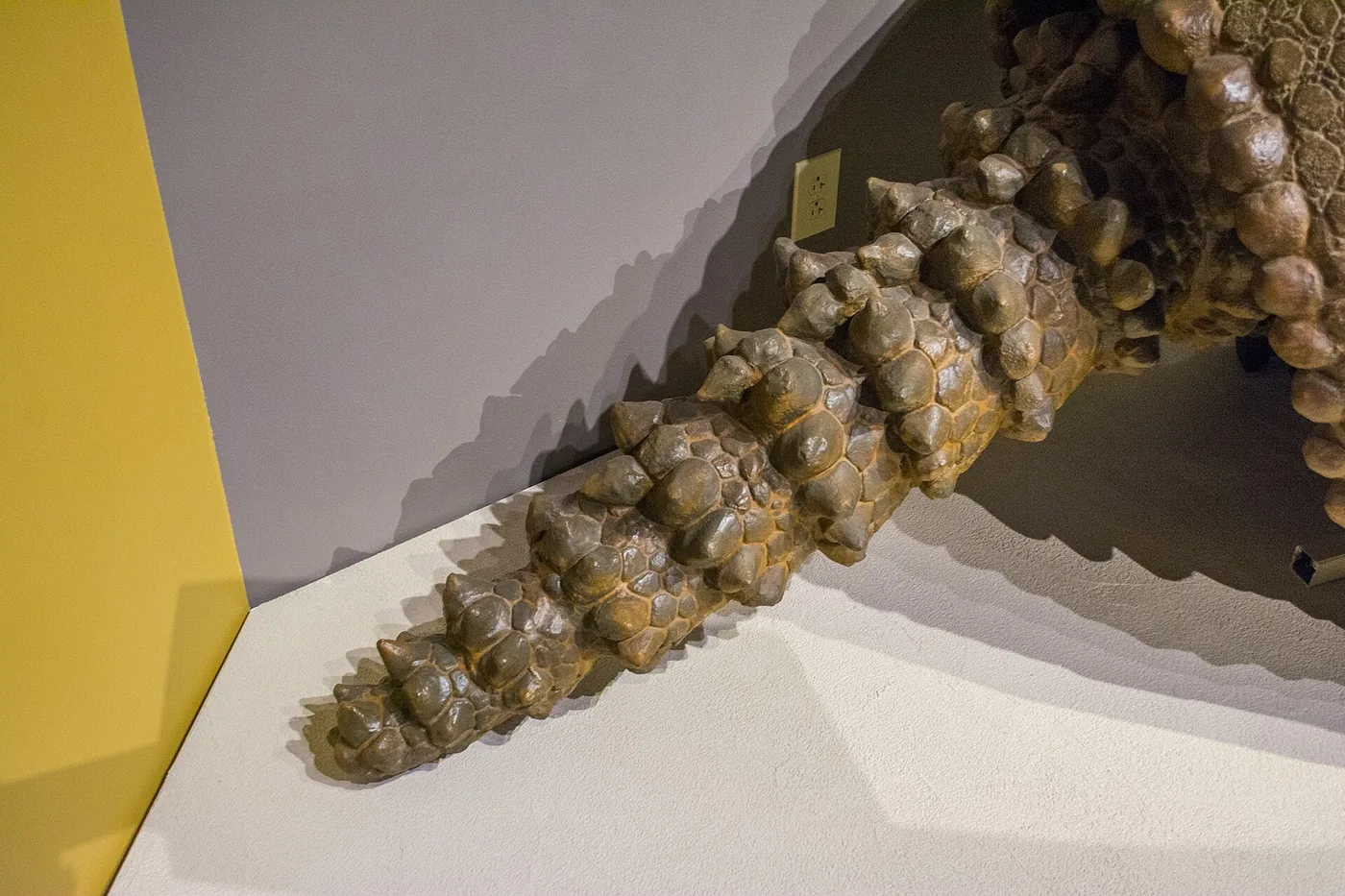
Not a tortoise: no retractable head and no bottom shell
A tortoise can pull its head and legs into its shell, and the shell has a plate underneath. Glyptodon could not do either. Glyptodonts could not retract their heads, so they carried extra armour on their skulls instead. Their underside, face and legs were protected only by small osteoderms embedded in the skin.
In 1866 the naturalist Hermann Burmeister suggested that Glyptodon had a turtle-like bottom shell, or plastron. That idea turned out to be wrong. It is a good example of how early fossil reconstructions often had to be corrected as better specimens were found.
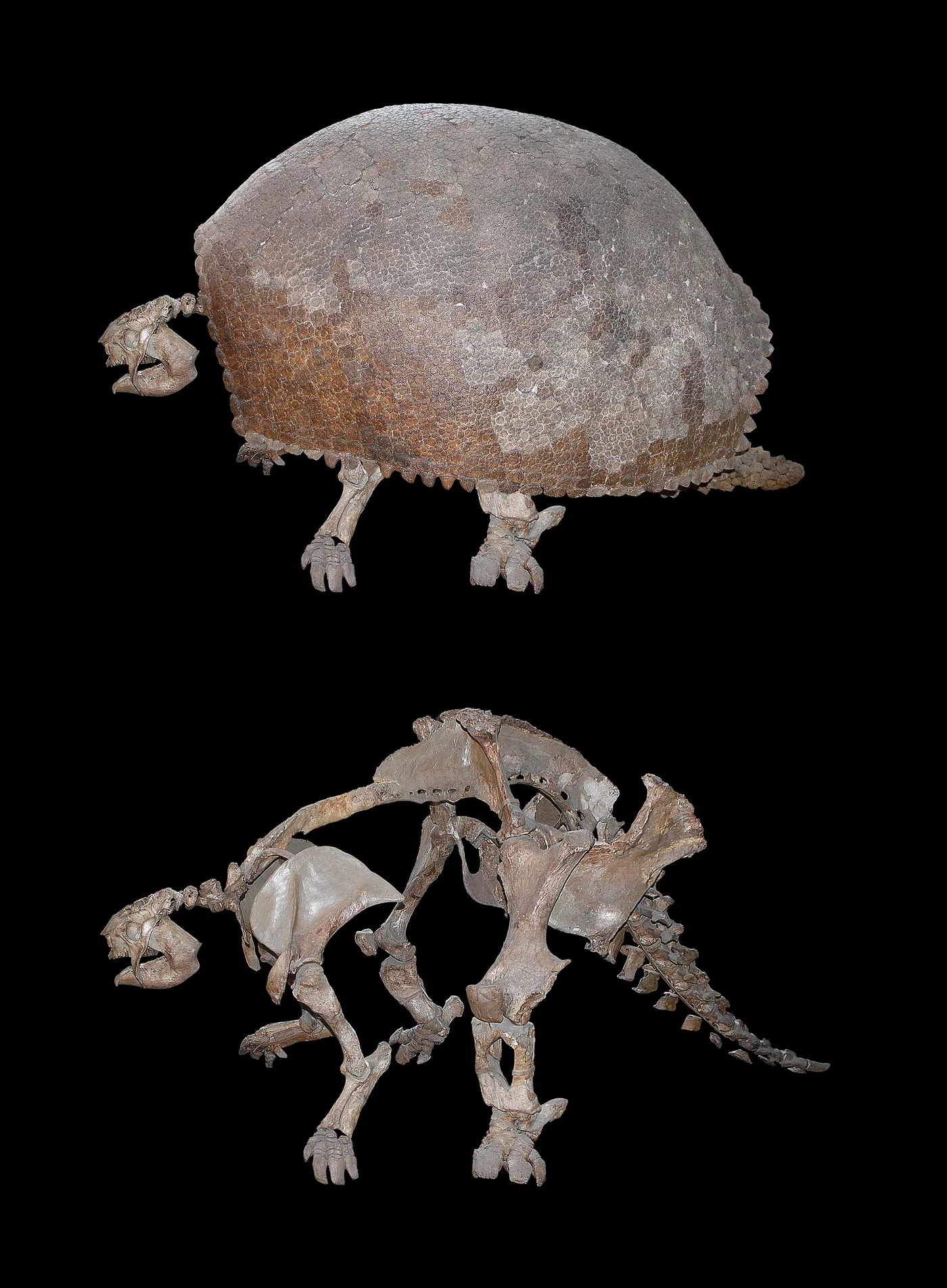
A shell fused to the skeleton
The shell was not the only part of the body that was rigid. In glyptodonts the pelvis and some of the vertebrae were fused, and the pelvis was fused to the carapace. This meant the shell was firmly attached to the skeleton.
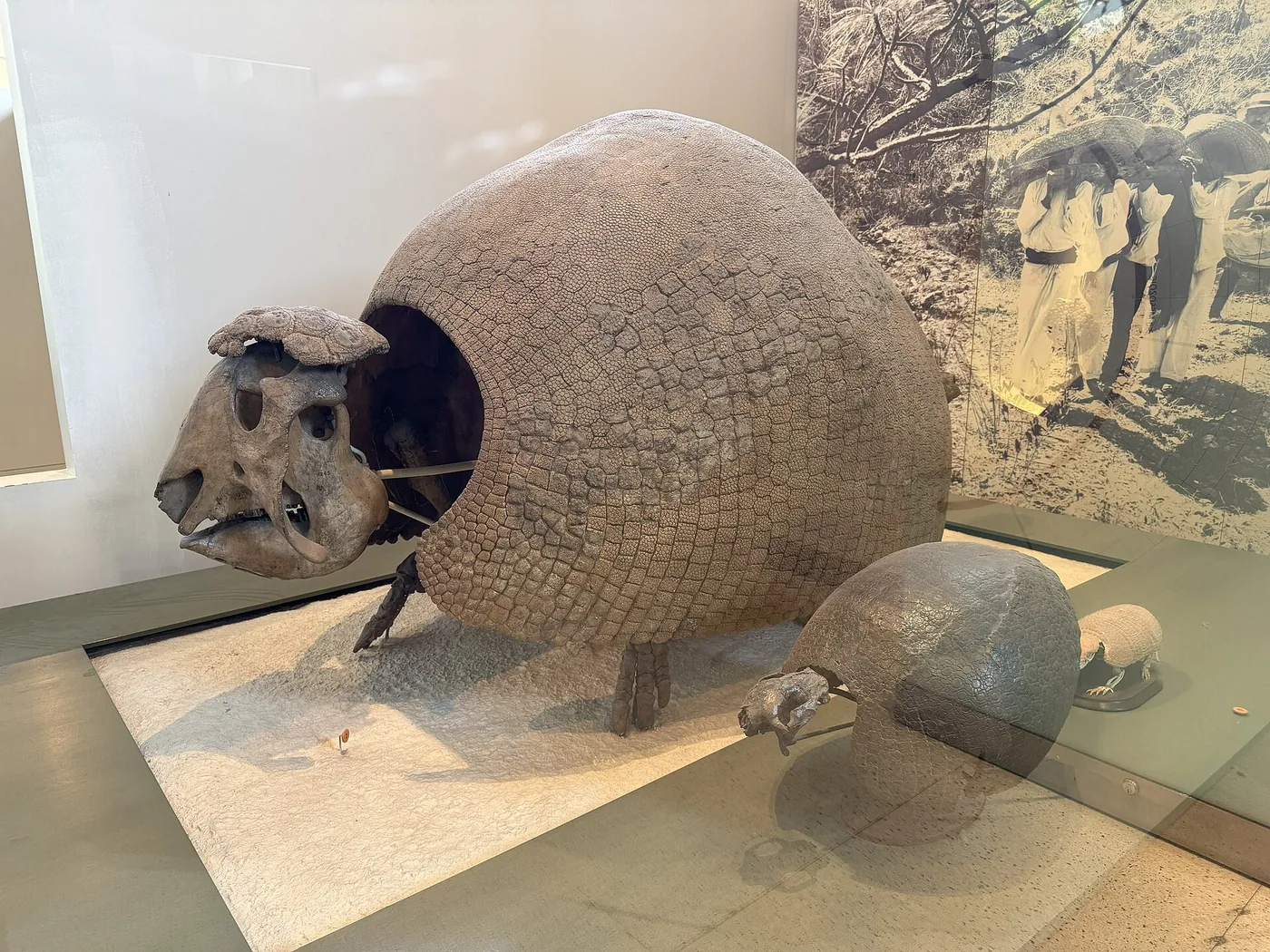
The limbs were short and built for bearing weight, a design that scientists call graviportal. Together with the immobile pelvis, it suggests that Glyptodon walked slowly and rather awkwardly. The photo of the Berlin skeleton shows how the bones sit beneath the dome.
Suggest one benefit and one cost to an animal of having a rigid bony shell. (2 marks)
Benefit: it protects the animal from bites and blows. Cost: it is heavy and limits how much the body can bend, so the animal is likely to move slowly.
Did Glyptodon have a club tail?
No. This is the most common mistake on the internet. If you picture a glyptodont swinging a spiked mace, you are thinking of Doedicurus and its relative Panochthus, both of which had bony tail clubs. The tail of Glyptodon was different: it had a series of mobile rings made of cone-shaped osteoderms, ending in a short tube.
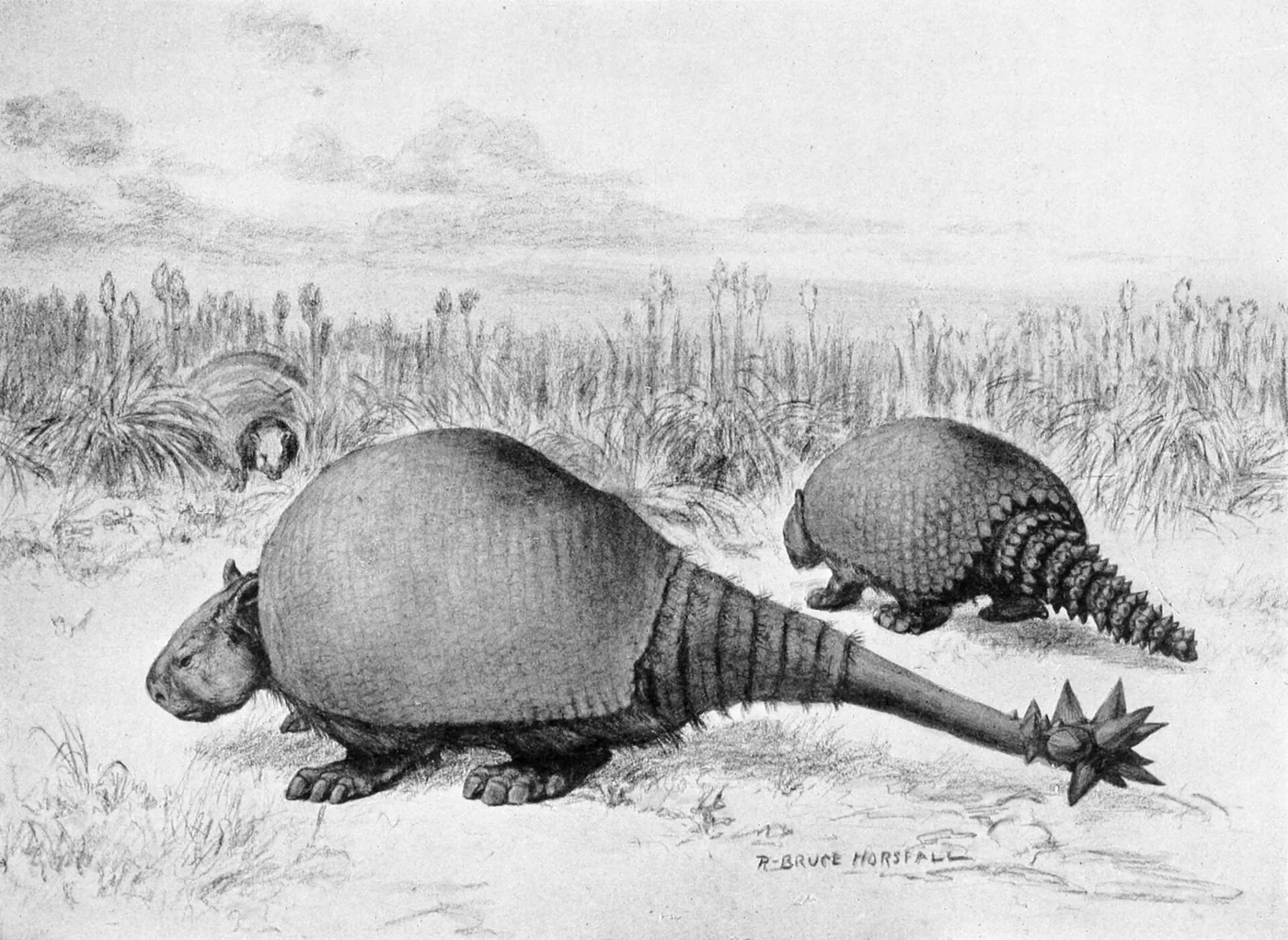
The old painting above shows the contrast. The animal in front, Doedicurus, has the long spiked club. Glyptodon, behind it, has a ringed tail that tapers away. The illustration dates from 1913, so treat it as an old reconstruction rather than a photograph of the truth.
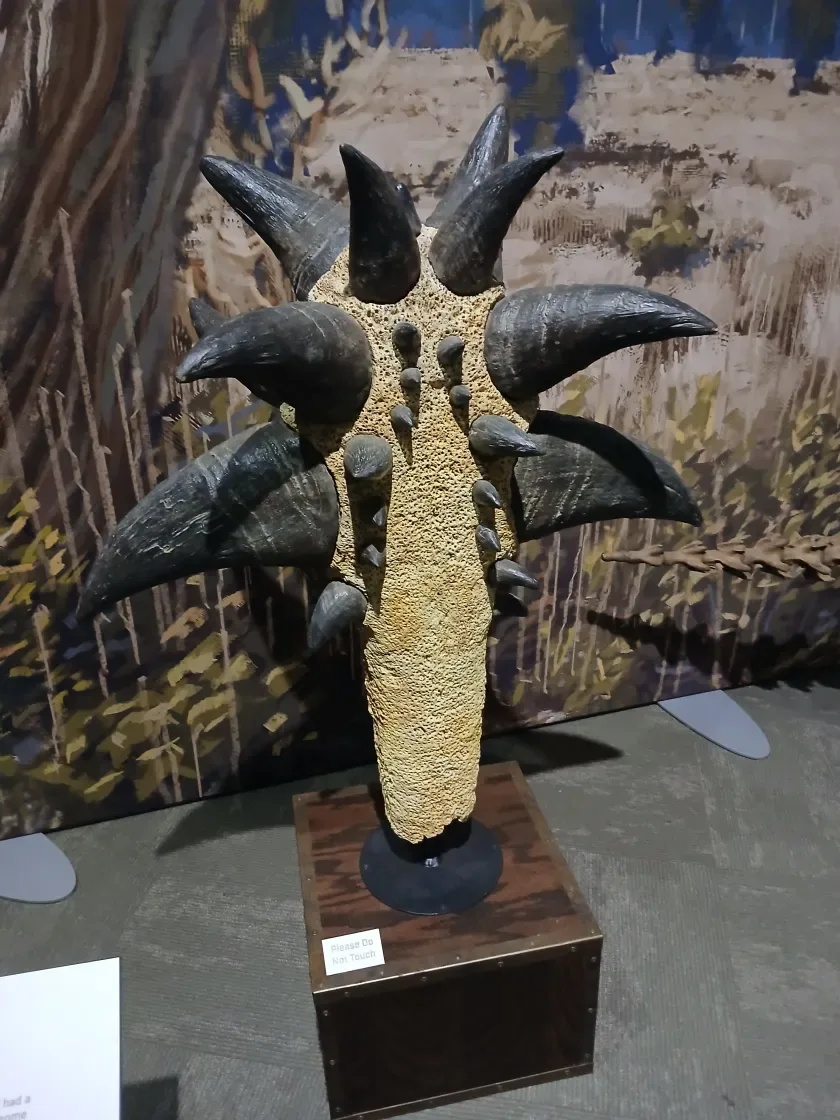
A weapon or a fighting tool?
Scientists have asked what the clubs were for. A study by Alexander, Fariña and Vizcaíno in 1999 estimated the energy of a tail blow and compared it with the energy needed to fracture a glyptodont carapace. The two were “of the same order of magnitude”, so damage seen on some shells could reasonably come from fights between glyptodonts of the same species. A fatty pad under the shell may have cushioned the blows.
A later study by Blanco, Jones and Rinderknecht in 2009 looked at where the club would strike hardest. Its “sweet spot” lies on the side of the club, between two-thirds and three-quarters of the way along. The authors thought the clubs would be of little use against fast predators, though they might still deter them, and they favoured fights between glyptodonts. They also stress that the question “remains uncertain”.
A modern comparison is the antlers of deer. They are used mainly in contests between males of the same species, but they can also warn off a predator. This is only an analogy, and nobody has watched a glyptodont fight, so treat the explanation as a well-argued hypothesis.
Who might have hunted Glyptodon?
Glyptodon shared its world with large predators, including the sabre-toothed cat Smilodon and the giant bear Arctotherium. A skull of a young Glyptotherium has holes probably made by a large sabre-toothed cat, though a jaguar is also possible. The palaeontologists David Gillette and Clayton Ray thought this youngster was probably stranded, perhaps in mud, or otherwise weakened. Researchers disagree about whether sabre teeth could pierce the armour of an adult, so a big cat may have attacked mainly the young and weak. To see how modern hunters bring down large prey, read about how big cats catch their prey.
What did Glyptodon eat?
Glyptodon was a herbivore. Like the cattle and horses of today, it fed on plants, and the clues are written in its skull and teeth. Our article on herbivores, carnivores and omnivores explains these feeding groups in more detail.
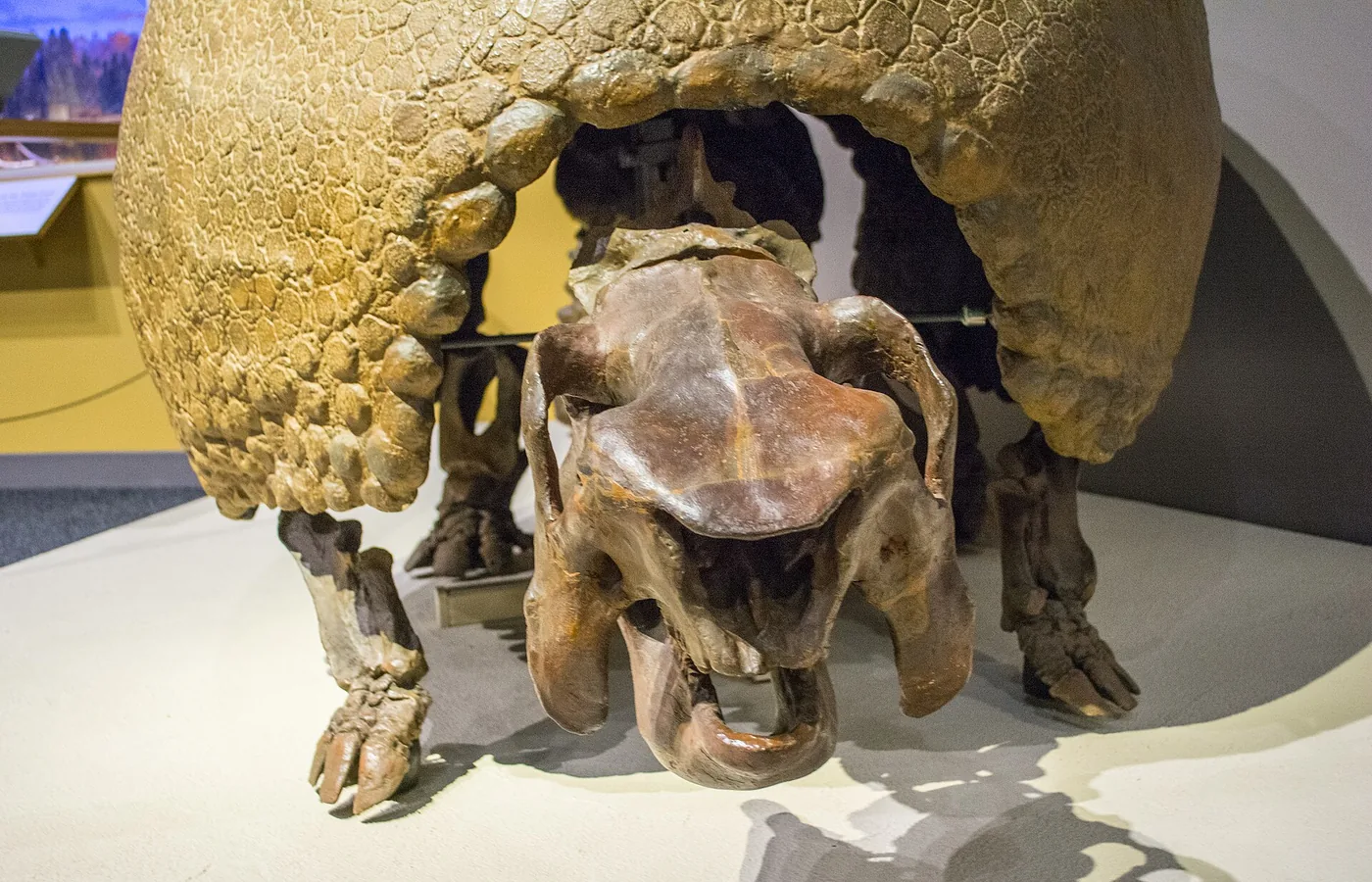
Start with the teeth. Glyptodonts lacked incisor-like and canine-like teeth, so there were no front teeth for biting. The cheek teeth did the work. They had no enamel, and they were extremely high-crowned (the scientific word is hypsodont), which means that the tooth is tall and keeps wearing down in use. High-crowned teeth are typical of animals that chew tough plants, because the plants wear teeth away.
The jaw gives a second clue. Glyptodon had a wide muzzle, which is a typical sign of an animal that takes in plants in bulk rather than picking out small, choice morsels. The skull sat low under the front rim of the shell, and the fused neck suggests that Glyptodon foraged close to the ground.
What chemistry says about its diet
Scientists can also measure carbon isotopes in fossil teeth and bones. Different plants leave different chemical signatures: trees, shrubs, herbs and cool-climate grasses (called C3 plants) are different from many warm-climate grasses (C4 plants). The results suggest a mixed diet, with both C3 plants and C4 grasses at lower latitudes, and mainly C3 plants at higher ones. In simple terms, Glyptodon ate grasses and other low plants, and the menu changed with where it lived.
| Clue | What it shows |
|---|---|
| No front teeth | It did not bite off food in the way that we do |
| High-crowned cheek teeth with no enamel | It chewed tough, gritty plants |
| Wide muzzle | It fed in bulk, taking in a lot of plant material at once |
| Carbon isotopes | A mixed diet of C3 plants and C4 grasses, depending on the region |
| Fused neck | It probably fed near the ground |
The long-tongue myth
Some websites say that Glyptodon “used its long tongue to rip off vegetation”. The evidence says otherwise. A 2010 study of the hyoid, the small bone system that supports the tongue, found that its fusion in Glyptodon suggests limited tongue protrusion. The tongue was probably powerful, but its job was to move food around the mouth, not to pull plants into it.
Did Glyptodon burrow?
Many pages claim that Glyptodon was an excellent digger and made deep burrows. There is no good evidence for it. Its rigid shell would have made digging awkward, and the upper-arm bone has a weakly developed deltoid crest, a ridge where muscles attach. Studies of the limbs give mixed signals, so digging was probably limited, although we cannot say it was impossible.
Compare that with its tiny living relative, the pink fairy armadillo, which really does live underground. For a modern animal that really does dig a burrow, look at the gopher tortoise and its burrow.
How Glyptodon moved and lived
With short, weight-bearing legs and a pelvis fused to a heavy shell, Glyptodon was probably slow and cumbersome. Footprints can add evidence. A glyptodont track from Pehuén-Có in Argentina was named Glyptodontichnus pehuencoensis in a 2015 review of the site.
The habitat ranged from the Pampas, a grassland dotted with forest and shrubs, to the high Andes. That is a wide range of landscapes. For scale, you can compare it with the animals in our list of the largest animals in the world: Glyptodon was big, but it would not make the top of that list.
Did it live in herds? We do not know. No source we have checked supports a claim about social life, so the honest answer is that fossils tell us very little about how Glyptodon behaved in groups.
Darwin and the first Glyptodon fossils
Charles Darwin collected glyptodont fossils in South America in 1832 and 1833, during the voyage of HMS Beagle. In a letter to his teacher John Stevens Henslow, written in 1832, he described “a large surface of the osseous polygonal plates” and added: “Immediately I saw them I thought they must belong to an enormous Armadillo”.
That was bold, because experts at the time assigned such plates to Megatherium, the giant ground sloth. In his Journal of Researches, Darwin described at the Bajada “the osseous armour of a gigantic armadillo-like animal, the inside of which, when the earth was removed, was like a great cauldron”. He also wrote of the “wonderful relationship in the same continent between the dead and the living”.
Darwin’s link between fossil and living armadillo-type animals mattered for his later thinking about evolution. Even so, we should be careful: the plates he found are best described as armadillo-like armour of the kind later known as glyptodonts, and not every one of his specimens has been confirmed as Glyptodon itself.
Early collectors had mixed up the shells with Megatherium, which is why Darwin’s sharp eye mattered. Sadly, some of the original fossils kept in London were destroyed when the Royal College of Surgeons was bombed in 1941.
Why did Glyptodon become extinct?
All glyptodonts died out around the end of the last ice age. The youngest widely accepted records of Glyptodon are about 11,000 to 12,000 years ago, although a few younger dates are debated. Its big relative Doedicurus lived until about 10,000 years ago.
Glyptodon was not alone. South America lost about 82% of its megafaunal species, the large animals of the time. A 2021 study by Prates and Perez found that the radiocarbon record of these animals falls sharply after about 12,900 years ago and is almost gone by 11,600 years ago. The causes are still strongly debated.
Climate and changing plants
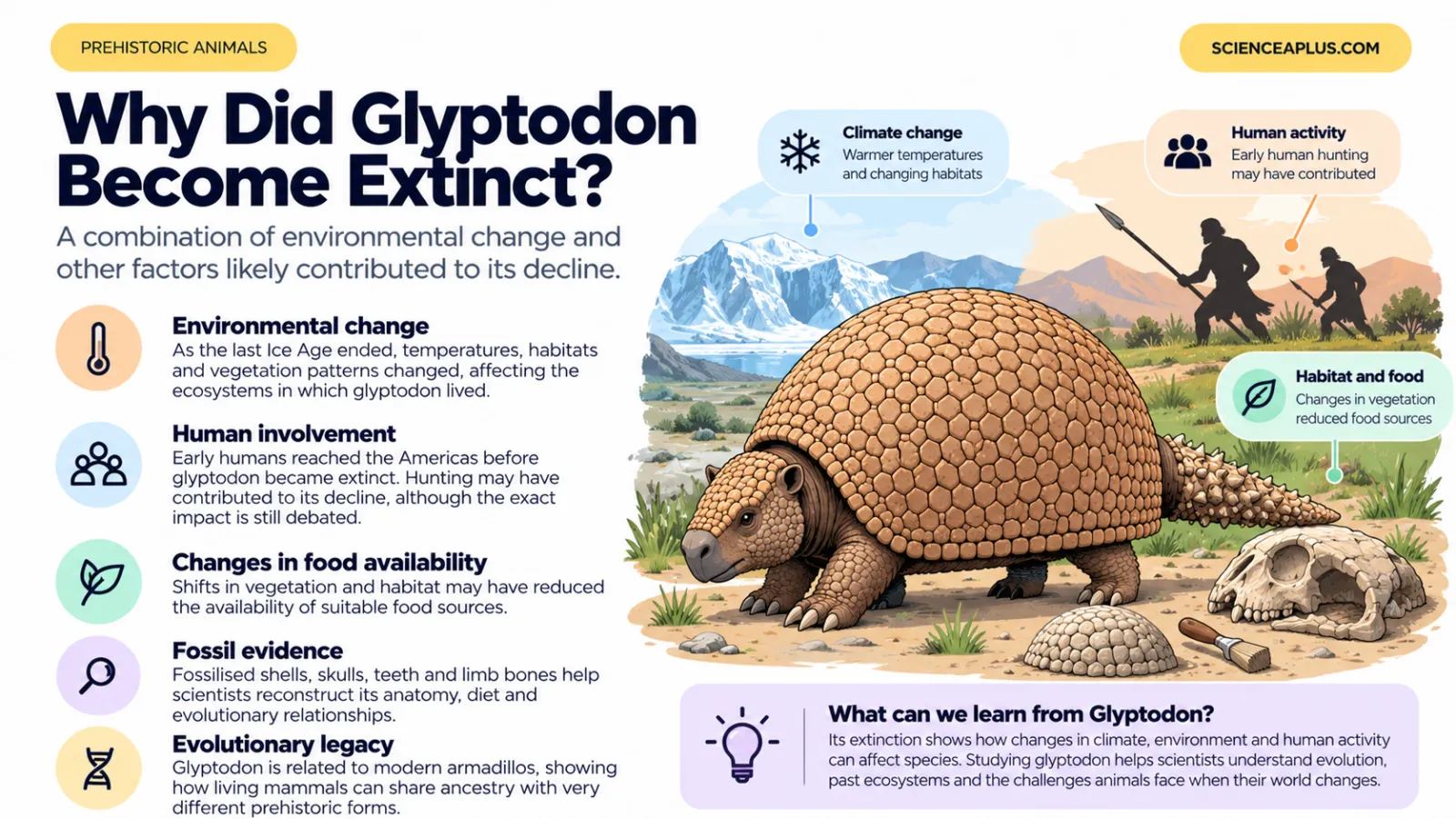
One idea is that the world was changing. The extinction of Glyptodon coincides roughly with the end of a cold spell called the Antarctic Cold Reversal, about 12,500 years ago, and some researchers link the warming and shifting plant communities that followed to losses of grazing animals. A herbivore that depends on certain plants can struggle when those plants move or disappear. For the modern version of this problem, see our article on the impact of climate change on ecosystems and food chains.
The infographic lists “changes in vegetation” as a cause. Treat that as one possibility, not as the answer, because the evidence for it is less certain than the card suggests.
Humans and glyptodonts
The second idea is that people played a part. Humans reached South America by about 16,600 to 15,100 years ago on one screened dataset, so people and Glyptodon overlapped for a few thousand years. Prates and Perez proposed human hunting as the main factor in the megafauna losses, with environmental change as a secondary but necessary one. Other scientists disagree.
We need to keep the species straight, because the evidence is uneven.
- A 2024 study reported 32 cut marks on bones of the glyptodont Neosclerocalyptus at Merlo in Argentina, dated to about 21,000 years ago. If correct, humans arrived earlier than the usual date. The excavation was small, and more work is planned, so this is a challenge to the standard story rather than a settled fact.
- In Venezuela, four of six skulls of Glyptotherium from Muaco and Taima-Taima have similar breaks where the head shield is thin. One hypothesis is that humans struck them. The sample is small, and the breaks may be a coincidence. One carcass could have yielded up to about 170 kg of flesh.
- For Glyptodon itself, direct evidence is weak. At Pay Paso 1 in Uruguay, spear points were found at a site that also yielded fossils of Glyptodon and horse, but that does not show that the animals were hunted.
So the fair summary is that humans and Glyptodon shared the continent, and humans may well have hunted its relatives, but nobody has directly shown that people drove Glyptodon to extinction.
The extinction was also a smaller event than the great extinctions in Earth’s history; for the biggest ones, read about the five mass extinctions. For the modern parallel, see the extinction crisis.
What fossils still cannot tell us
Fossils are good at shape and size, but poor at many other things. We do not know what colour Glyptodon was, how it behaved in groups, exactly when the last one died, or even how many species there really were. Scientists keep revising these answers as new specimens, new dating methods and new DNA are found. That is how science is supposed to work.
Frequently asked questions about Glyptodon
What was a Glyptodon?
Glyptodon was a large, plant-eating mammal that lived in South America during the Ice Age. It carried a domed shell built from fused bony plates called osteoderms. DNA shows that glyptodonts were armadillo relatives, so Glyptodon was an armoured mammal, not a reptile or a dinosaur.
How big was a Glyptodon?
Estimates vary. One Uruguayan fossil project gives a mass of between one and two tonnes, while estimates for individual species range from about 400 kg to 2,000 kg. The shell was probably around 2 metres long. It was big, but Doedicurus, at up to about 4 metres, was larger.
Is Glyptodon a dinosaur?
No. Glyptodon was a mammal, and it lived tens of millions of years after the last dinosaurs. The armoured dinosaur Ankylosaurus lived about 68 to 66 million years ago. The similar shell and tail rings evolved separately, which is called convergent evolution, so the animals are not related.
Is Glyptodon related to armadillos?
Yes. In 2016, scientists recovered DNA from a shell fragment of the glyptodont Doedicurus. It showed that glyptodonts sit deep inside the armadillo family tree, close to the giant armadillo and the pink fairy armadillo. They described glyptodonts as no more than another subfamily of armadillos.
Did Glyptodon live in North America?
Not by the strict definition. Glyptodon lived in South America. Fossils from North and Central America, including the southern USA, belong to the close relative Glyptotherium, which probably spread north after the Isthmus of Panama formed. The two are similar, which is why they are often confused.
Did Glyptodon have a club tail?
No. Glyptodon had a tail made of a series of mobile rings of cone-shaped bone, ending in a short tube. Its relatives Doedicurus and Panochthus had bony tail clubs, some with spikes. Scientists think such clubs may have been used mainly in fights between glyptodonts, though this is still uncertain.
What did Glyptodon eat?
Glyptodon ate plants. Its cheek teeth were high-crowned for grinding, it lacked front teeth, and it had a wide muzzle for feeding in bulk. Carbon isotopes suggest a mixed diet of grasses and other low plants, depending on where it lived. It was not a meat-eater.
Did Glyptodon live with humans?
Yes, for a few thousand years. People reached South America by about 16,600 to 15,100 years ago, while Glyptodon survived until about 11,000 to 12,000 years ago. Relatives such as Glyptotherium may have been hunted, but direct evidence that people hunted Glyptodon itself is weak.
When and why did Glyptodon go extinct?
Glyptodon died out about 11,000 to 12,000 years ago, at the end of the last ice age, though a few younger dates are debated. The causes are still disputed. Climate change, shifting plants and human hunting have all been proposed, and many scientists think a combination was involved.