Yes, in our own galaxy there are more trees than stars. Scientists estimate about 3 trillion trees on Earth, while the Milky Way holds roughly 100–400 billion stars. But the answer flips for the whole universe, which contains far more stars than Earth has trees. Here is how we know, and how sure we can be.
The short answer: more trees than stars, but only in the Milky Way
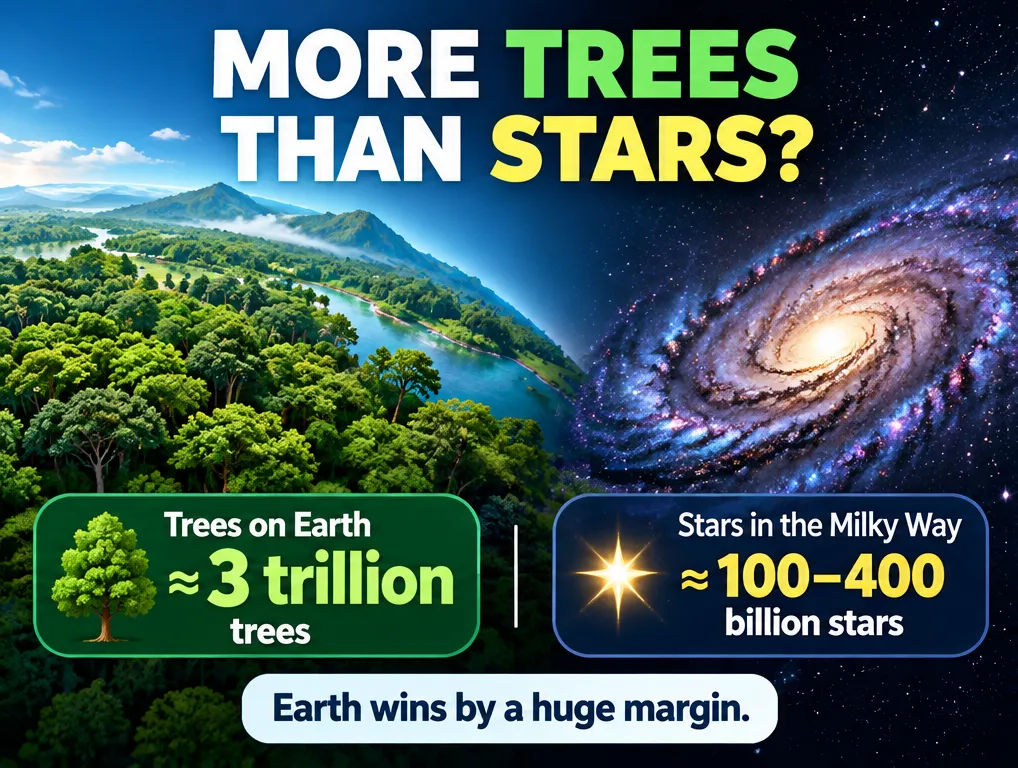
The question sounds like a riddle, yet it has a real, number-based answer. One side of the comparison comes from forest ecology. The other comes from astronomy. Both are estimates, and both involve counting things that are far too many to count one by one.
The headline figures are simple. Earth has about 3.04 trillion trees. The Milky Way has roughly 100–400 billion stars. Divide one by the other and you get somewhere between 7.6 and 30 trees for every star in our galaxy. So in the contest of trees vs stars, the trees win, as long as we stay inside the Milky Way.
Two details matter before we go further. First, the Milky Way is a barred spiral galaxy about 100,000 light-years across, and our Sun is just one star in it, about 26,000 light-years from the centre. Second, the Milky Way is only one galaxy. The observable universe holds hundreds of billions to perhaps 2 trillion galaxies, so across the whole universe the stars vastly outnumber Earth’s trees. The claim only works for our own galaxy.
In this article we will look at how many trees are on Earth, how scientists count them, how many stars are in the Milky Way, and how far we can trust each number.
How many trees are on Earth?
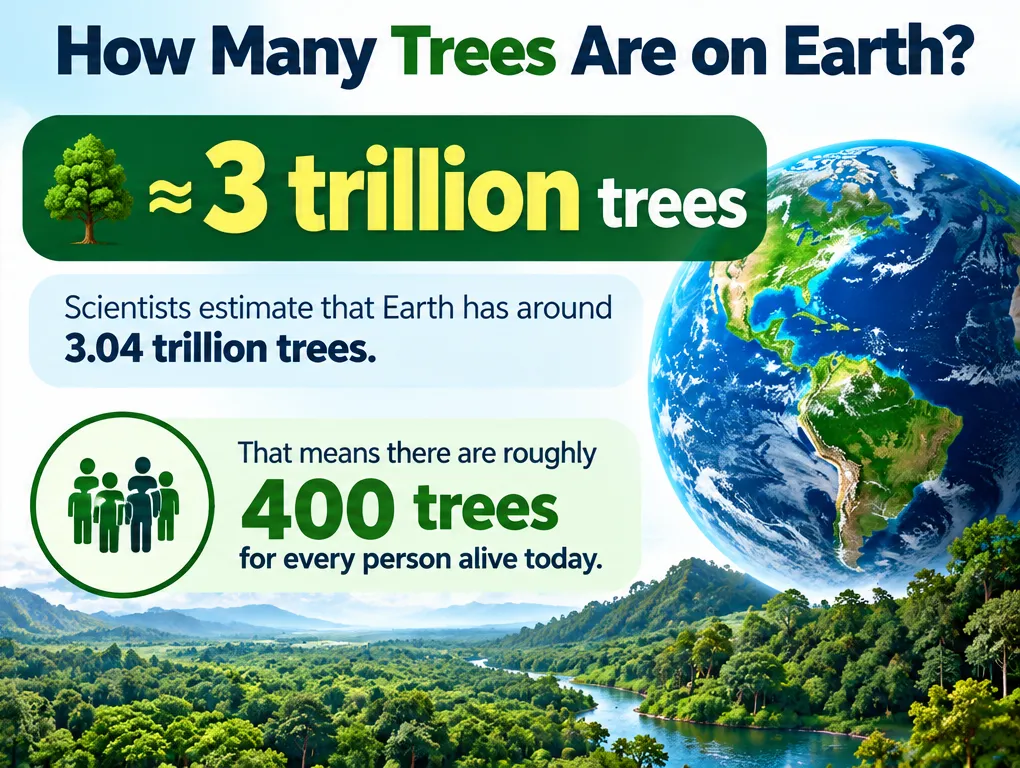
For a long time, the best guess was about 400 billion trees. In 2015, a study in the journal Nature, led by Thomas Crowther of Yale University, changed that. The team estimated about 3.04 trillion trees, roughly seven to eight times more than earlier figures.
That works out at about 422 trees for every person alive at the time. With today’s population of around 8.3 billion, it is roughly 365 trees per person. The figure has dropped because the world has more people, and because the number of trees has also fallen since 2015.
Where do the trees grow?
Trees are not spread evenly. The study found that most grow in three great forest belts.
| Biome | Trees (approx.) |
|---|---|
| Tropical and subtropical forests | 1.39 trillion |
| Boreal forests (the cold northern belt) | 0.74 trillion |
| Temperate forests | 0.61 trillion |
Notice how the tropics hold the biggest share. That is why scientists worry so much about tropical forest loss, since every hectare lost there removes a lot of trees at once. The boreal belt is the next largest, stretching across the cold north, while temperate forests hold the smallest of the three shares.
Forests as a whole cover about 32% of the world’s land, which is around 4.14 billion hectares according to the FAO’s 2025 assessment. Within a forest, the leafy upper layer is called the canopy, and it is where much of the life and photosynthesis happens.
How do scientists count three trillion trees?
Nobody walked the planet counting trunks. Counting every tree is impossible, so scientists did what astronomers do: they sampled a small part and scaled it up. The 2015 team combined three kinds of evidence.
- Plot surveys. Researchers count the trees in small sample areas on the ground. The study pulled together more than 400,000 of these tree-density counts from every continent except Antarctica.
- Satellite images. Satellites show where forest exists and how dense it looks from above, which fills the gaps between survey plots.
- Statistical models. Computer models link tree density to climate, soil and human impact, so the team could estimate numbers in places nobody had measured.
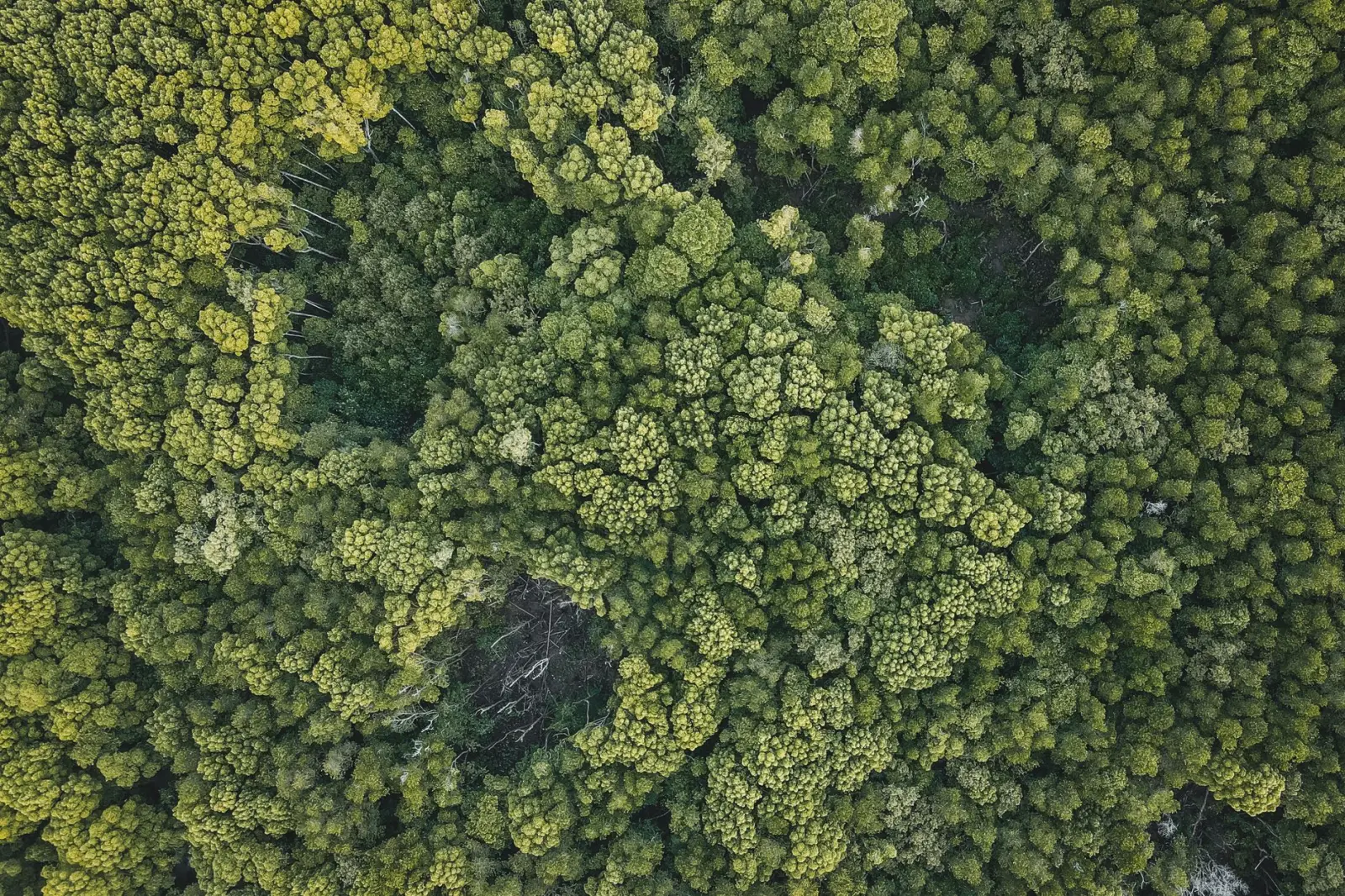
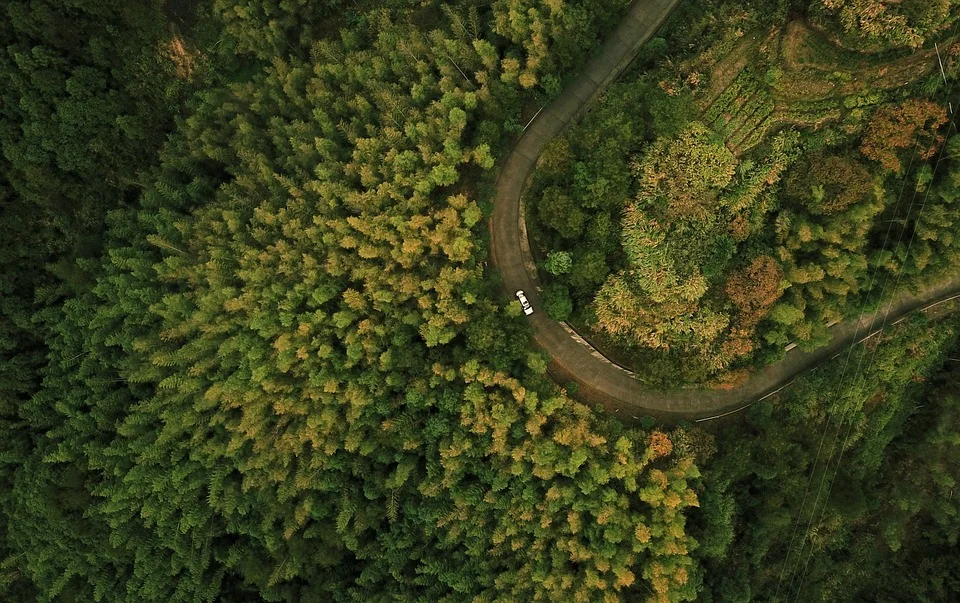
Each method has limits. Plots only cover tiny patches, satellites cannot see individual trunks under a thick canopy, and models are only as good as the data fed into them. Combining all three lets each one cover the weaknesses of the others.
This is why the number jumped so sharply. The huge set of ground-based counts, combined with satellite images and models, pushed the estimate to about seven to eight times the earlier figure of roughly 400 billion.
The stars get the same treatment. We look at a galaxy from the inside, and the way light reaches us is part of why stars seem to twinkle. Dust also blocks much of our view, so astronomers cannot simply count them either. Next, we will look at how they estimate how many stars are in the Milky Way, and why the answer has such a wide range.
How many stars are in the Milky Way?
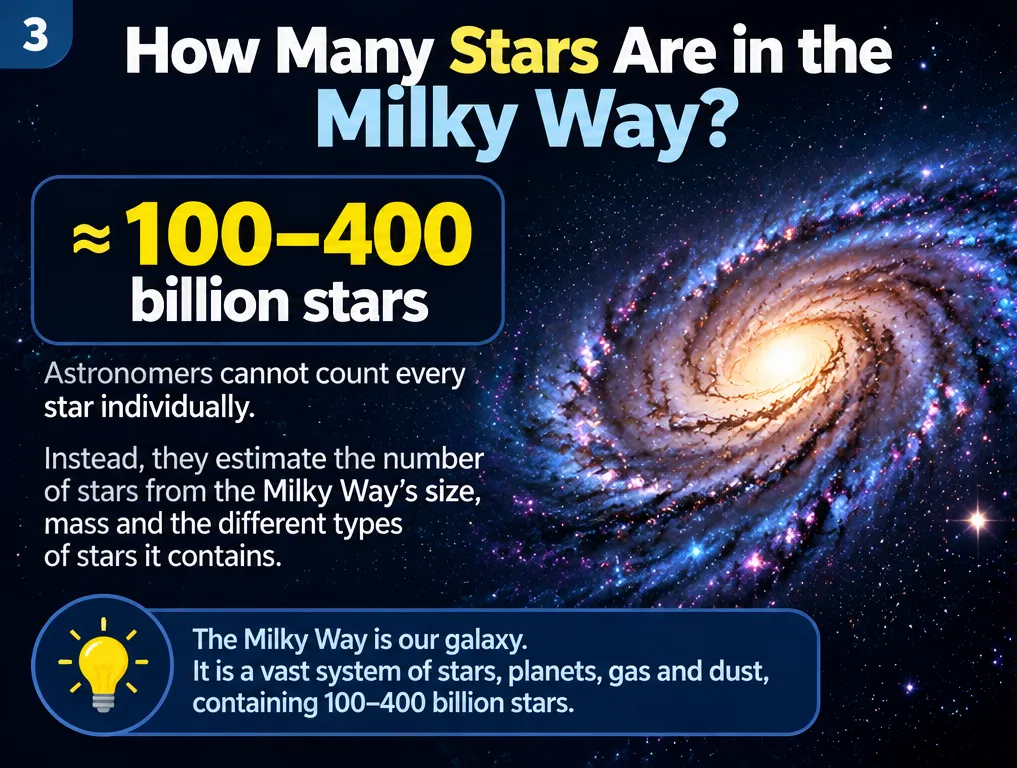
The Milky Way is a barred spiral galaxy about 100,000 light-years across, and astronomers estimate that it contains roughly 100–400 billion stars. That is a huge range, and the gap between the two ends alone is about 300 billion stars. So why can’t we give a single figure?
The first problem is our position. We are inside the galaxy, not looking at it from outside. The Sun is just one star, about 26,000 light-years from the centre, tucked into a spiral arm. Trying to count the stars of the Milky Way from here is a bit like trying to count every tree in a forest while standing in the middle of it.
The second problem is dust. Clouds of gas and dust drift between the stars and block our view of large parts of the galaxy, especially towards the centre. We simply cannot see everything that is there.
The third problem is that most stars are faint. The majority are small, dim red dwarfs, and these are very hard to spot unless they are close to us. A galaxy can hold huge numbers of stars that never show up in a telescope image.
So how do astronomers count stars?
They do not count them one by one. Instead, astronomers estimate the total from the galaxy’s mass and from the mix of different star types. If you know roughly how much mass the galaxy holds, and what share of that mass is made of bright stars, medium stars and faint red dwarfs, you can work out how many stars it takes to add up to the total.
That method is why the answer is a range rather than a single number. A small change in how many red dwarfs you assume changes the final count by billions. If you want to see how the telescopes and satellites behind these measurements work, our guide to exploring the universe with rockets, telescopes and satellites is a good place to start.
Putting the numbers side by side
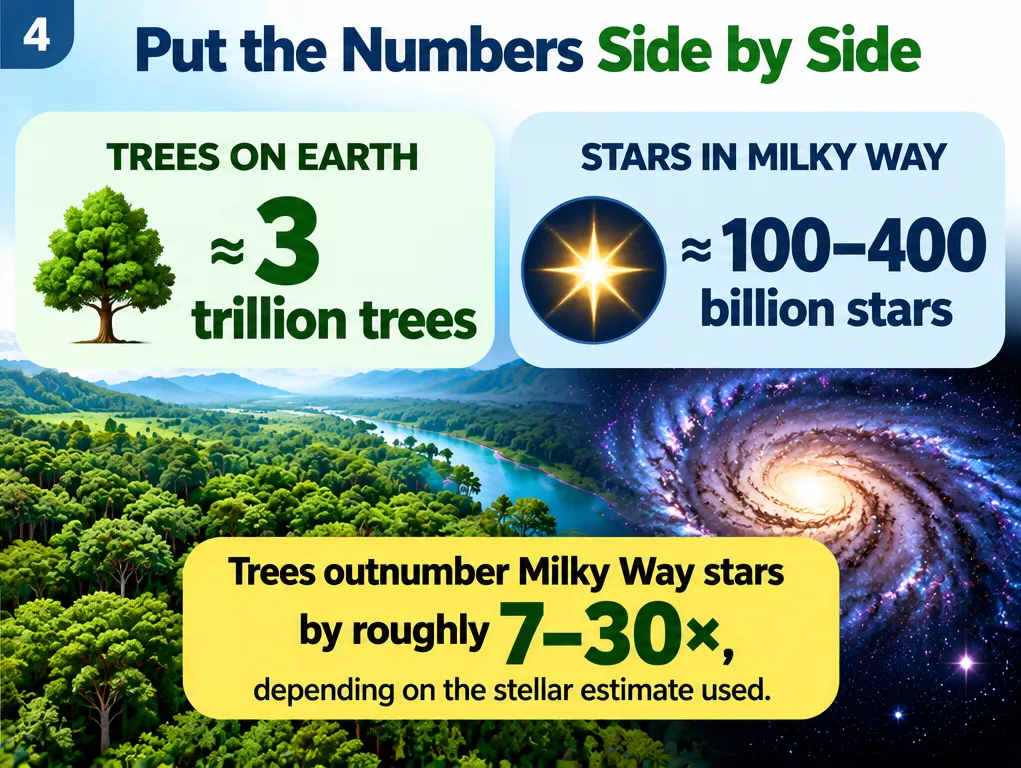
Now we can answer the big question: are there more trees than stars in the Milky Way? The 2015 study estimated about 3.04 trillion trees on Earth. Our galaxy holds about 100–400 billion stars. Dividing one by the other gives the trees-vs-stars comparison.
3.04 trillion ÷ 400 billion ≈ 7.6 trees per star
3.04 trillion ÷ 100 billion ≈ 30 trees per star
Whichever end of the star estimate you pick, trees win. For every star in our galaxy there are somewhere between 7.6 and 30 trees on Earth. Try it yourself with the calculator below.
The catch: the numbers are estimates
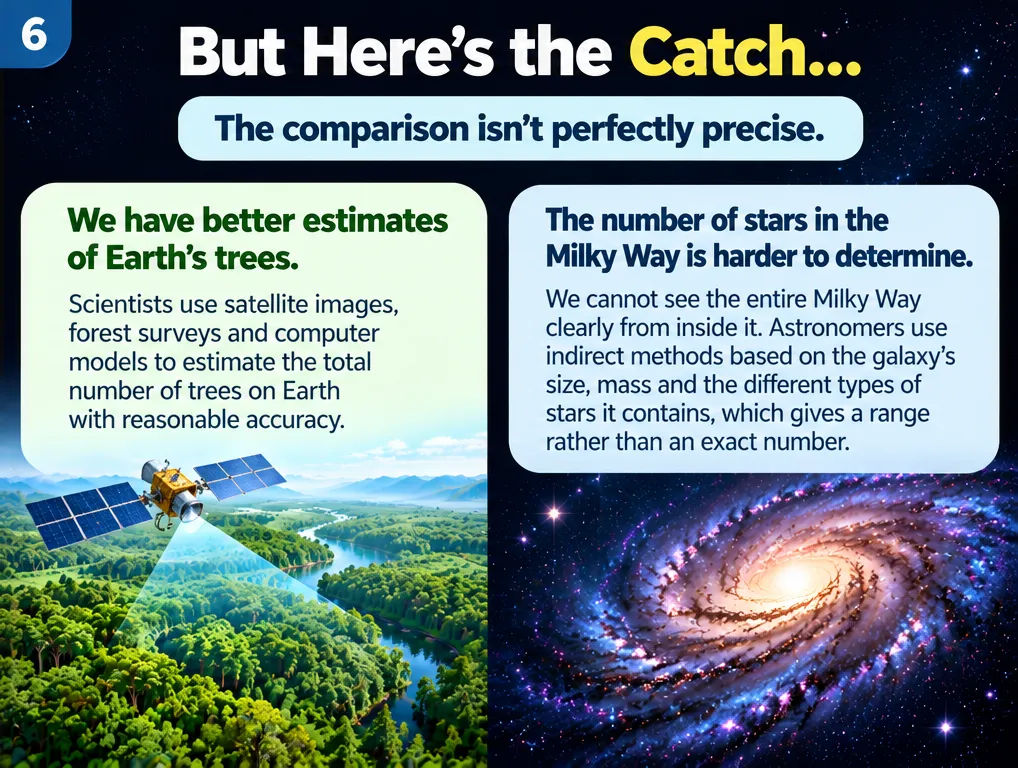
It is tempting to treat “3.04 trillion trees” and “100–400 billion stars” as exact figures. They are not. Both are scientific estimates, and each has its own uncertainty.
On the tree side, nobody has counted every tree. The 2015 study combined more than 400,000 ground-based tree-density counts from every continent except Antarctica with satellite images and computer models. That produced a figure about seven to eight times higher than earlier estimates of around 400 billion. It also shows how much a better method can change an answer. On top of that, the number is not fixed. About 15 billion trees are cut down each year, so the count has fallen since 2015.
On the star side, the uncertainty comes from dust, our position inside the galaxy and the difficulty of spotting faint red dwarfs. The estimate spans a factor of four, from 100 to 400 billion.
The important point is that the conclusion survives the uncertainty. Even if the tree count is somewhat lower today, and even if the star count sits at the top of its range, trees still outnumber the stars of the Milky Way. Good science does not need perfect numbers. It needs honest ranges and a clear method.
What about the whole universe?
So far we have compared trees with stars in a single galaxy. But the Milky Way is only one galaxy among many. The observable universe holds hundreds of billions to perhaps 2 trillion galaxies, and each one contains its own stars.
Multiply even the low end of that galaxy count by the stars in each galaxy and the total is far, far larger than 3.04 trillion. In other words, there are vastly more stars in the universe than trees on Earth.
Even counting the stars in the universe is only part of the story. Most of what shapes the cosmos is something we cannot see at all. If you are curious about the mysterious force behind the expansion of space, read our explainer on dark energy in the universe.
So the fair answer is a two-part one. Yes, there are more trees on Earth than stars in the Milky Way. No, there are not more trees than stars in the universe, and not even close.
Why are trees so important?
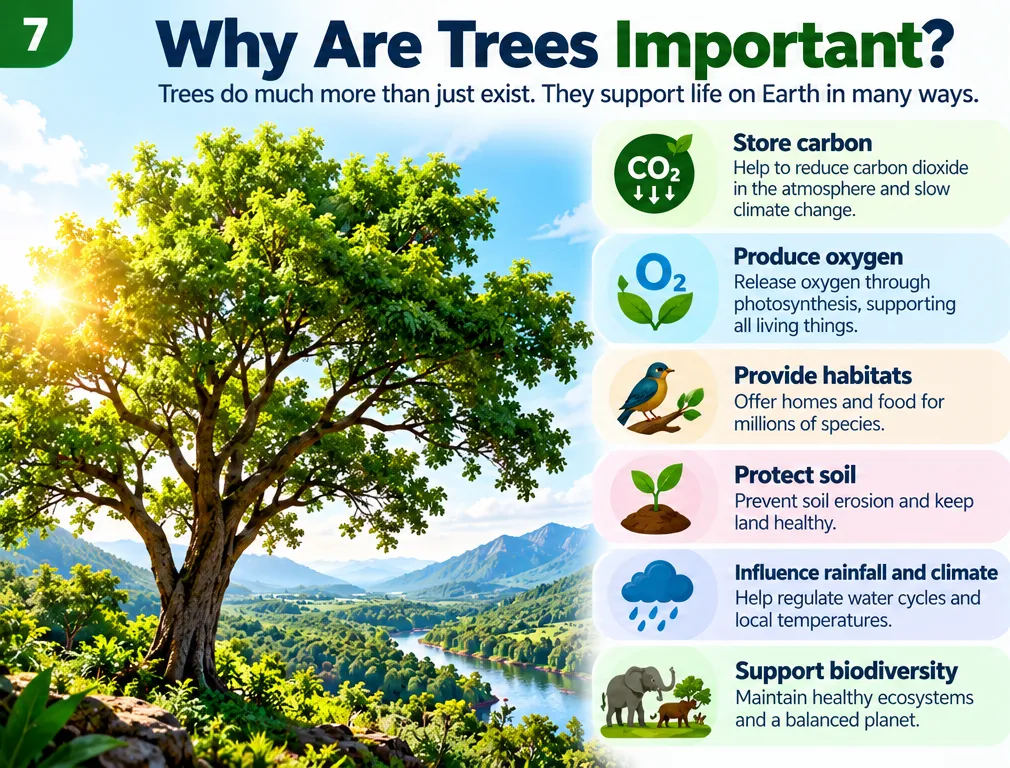
Three trillion trees is a staggering number, but the number only matters because of what trees do. A forest is not just a pile of wood. It is a working system that touches the air, the water, the soil and almost every other living thing nearby. Here are the main jobs trees do for us.
- They absorb carbon dioxide and store carbon. Trees take CO₂ from the air and build it into their trunks, branches, roots and leaves. That carbon stays locked away for as long as the tree lives, and for longer if the wood is not burned or left to rot.
- They release oxygen. Oxygen is given off as a by-product of photosynthesis, the process that turns light, water and CO₂ into sugars.
- They provide habitats. Forests are home to a huge range of animals, fungi, insects, birds and plants. Many species depend on trees for food, shelter or nesting sites.
- They protect the soil. Roots hold soil together, and leaves and branches soften the force of falling rain, which reduces erosion.
- They influence rainfall and temperature. Forests affect local rainfall patterns, and shade and water loss from leaves help to keep the surrounding area cooler.
- They supply things people need. Wood, food, medicines and livelihoods all come from trees.
The carbon job links trees directly to climate. Carbon moves between the air, living things, soil and oceans in a continuous loop, and trees are one of the biggest stores along the way. Our carbon cycle lesson shows how that loop works and why cutting down forests tips the balance.
So when we ask how many trees are on Earth, we are really asking how much of this work is being done. More trees, in the right places, means more carbon stored, more habitat and more protected soil. Fewer trees means the opposite.
Where are the world's trees?
Trees are not spread evenly across the planet. The 2015 study led by Thomas Crowther found that most of the world's roughly 3.04 trillion trees grow in three broad forest zones. Forests cover about 32% of the world's land, which is around 4.14 billion hectares according to the FAO's 2025 assessment. Here is how the main zones compare.
Tropical and subtropical forests
This zone holds the most trees by far, about 1.39 trillion. Warm temperatures and plentiful rain allow trees to grow all year round, so these forests are dense and packed with life.
Boreal forests
Boreal forests stretch across the cold northern parts of the world and contain about 0.74 trillion trees. The growing season is short and the winters are harsh, yet this is still the second-largest zone by tree numbers.
Temperate forests
Temperate forests, with about 0.61 trillion trees, grow in regions with four distinct seasons. Many of the trees here are deciduous trees, which drop their leaves in autumn to save energy through the cold months.
These counts came from more than 400,000 ground-based surveys on every continent except Antarctica, combined with satellite images and computer models. The result shows that where a tree grows depends on climate, soil and human impact.
Record-breaking trees
Among those trillions of trees, a few are true champions. Each one holds a record that no other known tree has beaten.
- Tallest: Hyperion, a coast redwood in California, stands about 116 m tall.
- Largest by volume: General Sherman, a giant sequoia, holds the title for the greatest volume of wood.
- Among the oldest: Great Basin bristlecone pines have lived for more than 4,800 years.
It is worth noting that "tallest", "largest" and "oldest" are three different records. A tree can be enormously tall without being the biggest in volume, and the oldest trees are often small and twisted rather than huge. Scientists also describe these as the "known" record holders, because there is always a chance that an even taller or older tree is waiting to be measured.
Records like these remind us that trees are far from simple. Some grow into giants, some survive for millennia, and about 58,000 species are known to science, with perhaps another 9,000 still to be discovered.
Test what you have learned so far with the flip cards below. Try to answer in your head before you tap.
Whether a tree is a record holder or just one of billions, each one adds to the total that makes the trees-versus-stars comparison so striking. The big question is how long that total will last, and that is where we turn next.
Are we losing trees?
Yes. The same 2015 study that found about 3.04 trillion trees also found that people cut down about 15 billion trees every year. Since the start of human civilisation, the number of trees on Earth has fallen by roughly 46%.
Fifteen billion sounds enormous, and it is. It is also roughly twice the number of people alive today. Every year, humans remove a number of trees larger than the global population.
That does not mean the trees will vanish next year. Three trillion is a huge starting stock, and some trees are replanted or regrow naturally. But the direction of travel matters, because a forest that is cleared is not the same as a forest that is planted afterwards.
How much of the land is forest?
According to the FAO Global Forest Resources Assessment 2020, forests cover about 32% of the world’s land. That is around 4.14 billion hectares.
The picture is not entirely bleak. Net forest loss has slowed in recent decades, partly because some countries are planting trees and some abandoned farmland is growing back into forest. However, deforestation continues. The FAO estimated that about 10.9 million hectares of forest were deforested each year between 2015 and 2025.
Deforestation means forest is cleared and the land is turned to another use, such as farming, mining or building. Our guide to deforestation, afforestation and reforestation explains the difference between cutting forests down and growing them back, and it is worth knowing all three terms for your exam. For the causes and consequences in more detail, read about the threat of deforestation.
What happens to species?
Trees are not just wood. Each forest is a habitat for many other species, from insects and fungi to birds and mammals. When trees go, the animals and plants that depend on them often go too. You can see how this works in tropical forests in our article on the importance of biodiversity in jungle ecosystems.
Trees themselves are also at risk. About 58,000 tree species are known (BGCI GlobalTreeSearch), and a 2022 study estimated that around 73,000 exist, so about 9,000 have not yet been discovered. The 2021 State of the World’s Trees report found that about 30% of tree species are threatened with extinction.
So there may be far more trees than stars we can see in our corner of the galaxy, but the variety of trees is shrinking. A forest of three trillion trees is only as resilient as the number of different species in it.
What can we do?
Individual choices will not fix everything, but the big changes are made of many small ones. Scientists and conservation groups generally point to a few approaches that work together.
- Protect the forests we have. An existing forest already holds its carbon, its soil and its wildlife. Keeping it standing is usually easier than rebuilding it.
- Restore damaged land. Reforestation puts trees back where forest was lost, and afforestation plants trees where there was no forest before.
- Plant the right trees in the right places. Native species suit the local soil, climate and wildlife. A single-species plantation in the wrong place can use up water and support far fewer animals.
- Choose sustainable wood and paper. Look for products from responsibly managed forests, and reuse and recycle paper where you can.
- Look after the trees near you. Street trees, school grounds and local woods all absorb carbon dioxide, cool the air and give shelter to wildlife.
Try this checklist. Your ticks are remembered in your browser, so you can come back to it.
- Find out which trees grow near your home or school
- Choose paper and wood products from responsibly managed forests
- Reuse or recycle paper instead of throwing it away
- Join or support a local tree-planting or woodland project
- Choose native tree species when planting
- Tell a friend or family member how many trees are cut down each year
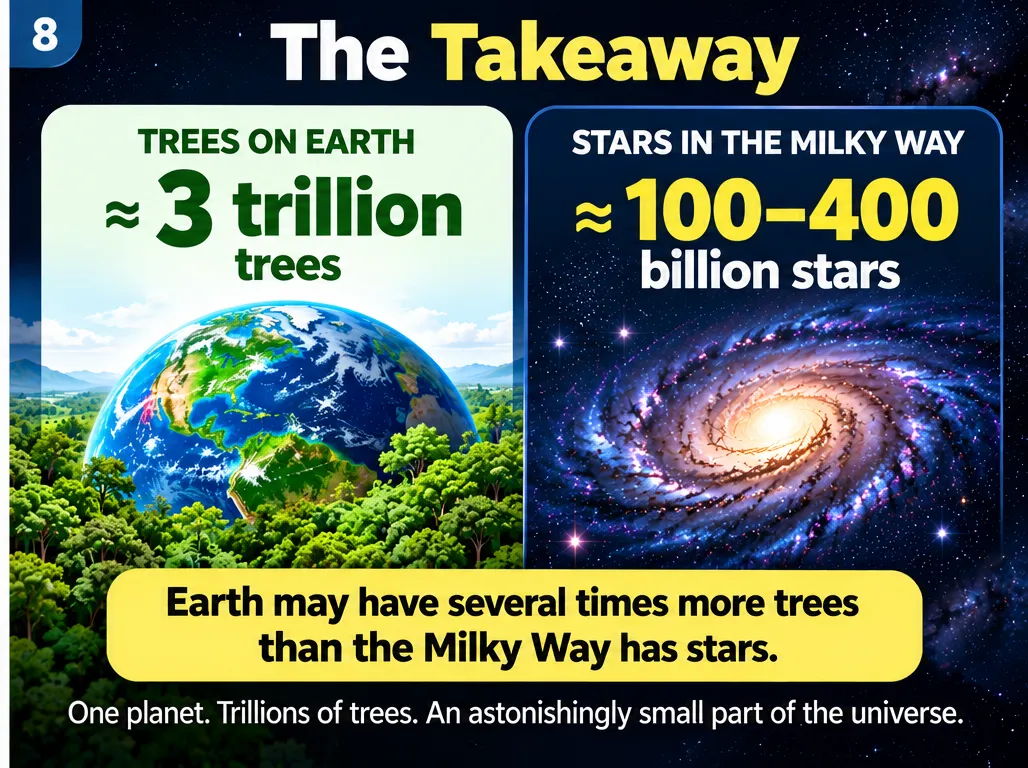
The takeaway
So, are there more trees than stars? In the Milky Way, yes. With about 3 trillion trees on Earth and roughly 100–400 billion stars in our galaxy, there are around 7.6 to 30 trees for every star. Across the whole universe, though, stars win by an enormous margin.
The more useful question may be what we do with the trees we have. About 15 billion are cut down each year, and the number has fallen by roughly 46% since civilisation began. Three trillion is a big number, but it is not a safe one.
Frequently asked questions about trees and stars
Are there more trees than stars in the Milky Way?
Yes. Earth has about 3.04 trillion trees, while the Milky Way has roughly 100–400 billion stars. That works out at about 7.6 to 30 trees for every star. Both figures are estimates, but even the highest star estimate is well below the tree count.
How many trees are there on Earth?
A 2015 study in Nature, led by Thomas Crowther of Yale, estimated about 3.04 trillion trees. That was roughly seven to eight times higher than earlier estimates of about 400 billion. The true number is lower today, because trees are still being cut down faster than they are replaced.
How many trees are there per person?
The 2015 study gave about 422 trees per person. With today’s population of roughly 8.3 billion, and the tree count having fallen since 2015, the figure is now roughly 365 trees per person. Treat both numbers as estimates rather than exact counts.
How many stars are in the Milky Way?
The Milky Way contains roughly 100–400 billion stars. The range is wide because we view the galaxy from inside it, dust blocks much of the view, and most stars are faint red dwarfs. Astronomers estimate the total from the galaxy’s mass and the mix of star types.
Are there more stars in the universe than trees on Earth?
Yes, by a huge margin. The observable universe holds hundreds of billions to perhaps 2 trillion galaxies, and each galaxy contains many millions or billions of stars. So the total number of stars in the universe is far greater than the roughly 3 trillion trees on Earth.
How do scientists count trees?
Scientists use three main tools. They count the trees in sample plots on the ground, they study satellite images of forest cover, and they build statistical models linking tree density to climate, soil and human impact. The 2015 study combined more than 400,000 ground-based density counts with satellite data.
How many trees are cut down every year?
About 15 billion trees are cut down each year, according to the 2015 study. The number of trees on Earth has fallen by roughly 46% since the start of human civilisation. Some trees are replanted or regrow naturally, so the net loss is smaller than the total cut.
Which forests have the most trees?
Tropical and subtropical forests hold the most trees, about 1.39 trillion. Boreal forests, such as those in the far north, hold about 0.74 trillion, and temperate forests hold about 0.61 trillion. Together these three types of forest account for most of the world’s trees.
Why are trees important?
Trees absorb carbon dioxide and store carbon, and they release oxygen through photosynthesis. They provide habitats for many species, protect soil from erosion, and influence rainfall and local temperature. People also depend on them for wood, food, medicines and livelihoods.