
A good tutor can help a child improve their GCSE results, but the size of the gain depends on how the tutoring is done. The best evidence comes from the Education Endowment Foundation (EEF), which finds that one to one tuition can add up to five months of progress on average, when tutoring is high quality and linked to classroom teaching. That is an average across many studies, not a promise for any single pupil.
If you are weighing up whether a tutor is worth it, this guide sets out what the research says, what a tutor actually does in a lesson, how to choose one safely, and how you can support the work at home. It is written for parents, so there is no hard sell: for some children a tutor is exactly right, and for others a different kind of help comes first.
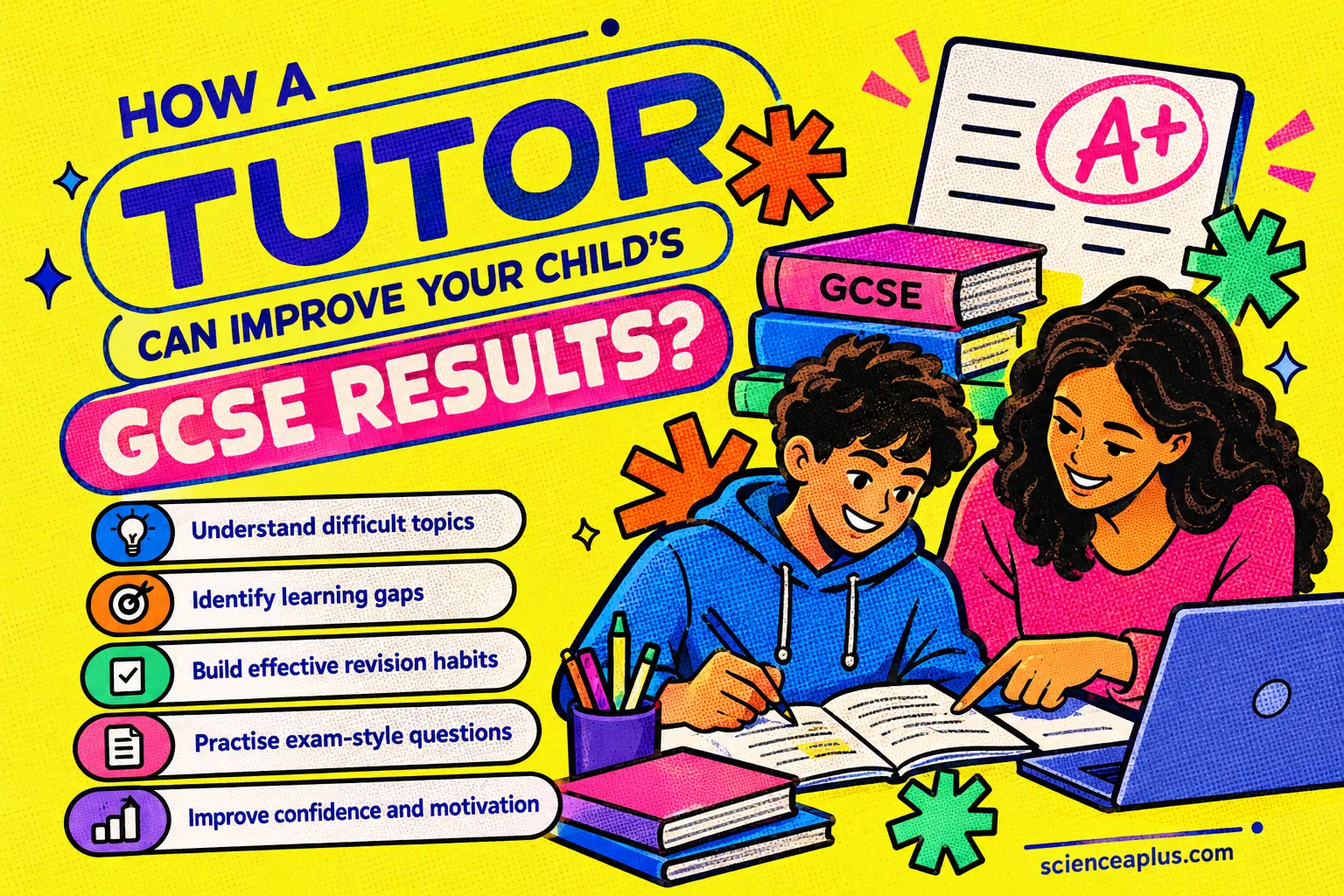
Does a private tutor really improve GCSE results?
Tutoring works best when it does something a busy classroom cannot: it focuses on one pupil, finds the exact point where understanding breaks down, and fixes it. A teacher with thirty pupils has to move the whole class on. A tutor can stop and spend twenty minutes on one idea your child has never quite grasped, then move on only when it has stuck.
That is the theory. The research gives a more careful answer, and it is worth reading before you spend money.
What the EEF evidence says about tuition
The EEF runs the Teaching and Learning Toolkit, a summary of research on what helps pupils learn. Two entries matter here: one to one tuition and small group tuition. The Toolkit expresses impact as “months of additional progress” over a school year, compared with similar pupils who did not receive the approach.
| Approach | Average extra progress | In secondary schools | Cost compared with other approaches |
|---|---|---|---|
| One to one tuition | About +5 months | About +4 months | Considerably more expensive |
| Small group tuition (2–5 pupils) | About +4 months | About +2 months (fewer studies) | Lower than one to one |
Source: EEF Teaching and Learning Toolkit. Figures are averages and the Toolkit is updated from time to time, so check the current Toolkit pages on the EEF website for the latest numbers.
Two things stand out. First, tuition has a real effect: five months is a lot. Second, the effect is smaller for secondary-age pupils than for primary pupils, which is the age group GCSE students belong to. A realistic reading is that tutoring helps GCSE students, but not by magic.
What makes tutoring work, according to the research
The EEF does not just say that tuition works. It also describes the conditions that make it more likely to work. These points are useful when you are judging a tutor.
- It is linked to school work. Tuition should be additional to normal teaching but explicitly connected with it. A tutor who knows what your child’s teacher is covering, and which exam board they are sitting, is more useful than one working from a generic book.
- It is targeted. Diagnostic assessment, a short check of what the pupil knows and does not know, helps tutors aim at the real gaps instead of repeating what is already secure.
- It is regular and time-limited. The Toolkit suggests short, frequent sessions over a fixed period, short, regular sessions over several weeks (the EEF suggests around 30 minutes, three to five times a week, for a limited block of weeks). Most families will not follow that pattern exactly, but it shows that focused bursts beat vague, open-ended arrangements.
- Progress is monitored. Someone should check whether the sessions are making a difference, and change the plan if they are not.
Notice what is missing from that list: nothing about a tutor’s fame, a glossy website or a promise of top grades. The method matters more than the label.
The National Tutoring Programme: what happened to it?
You may have heard of the National Tutoring Programme (NTP). It was a government scheme in England that gave state schools funding to buy one to one or small group tuition, mainly for pupils whose learning had been hit by the pandemic and for disadvantaged pupils. It ran for four academic years, from 2020/21 to 2023/24, and funded more than five million tutoring courses.
The ring-fenced funding ended in August 2024. Since September 2024, schools have had to pay for tutoring from their own budgets if they want to continue, and the Department for Education has encouraged them to do so. In practice this means that some schools still run tutoring in school, while others do not. It is worth asking your child’s school what they offer before you look elsewhere, because school-led tutoring is usually linked closely to the curriculum.
When a tutor is most likely to help
Tutoring tends to pay off in a few common situations:
- Your child understood a subject up to a point, then fell behind, often after missing lessons or changing teachers.
- One subject, often maths or a science, holds back an otherwise strong set of grades.
- Your child knows the content but loses marks because of exam technique.
- Confidence has dropped and they avoid the subject altogether.
It is less likely to help when the underlying problem is something else: exhaustion, anxiety, a poor study routine, or a lack of interest that no explanation will fix. If grades have dropped suddenly, start by reading how to help your child after poor grades, which looks at causes before solutions. And if the exams are still some way off, starting GCSE revision early may do more than a last-minute tutor.
The next section looks at what a good tutor actually does, lesson by lesson.
What a good GCSE tutor actually does
The research tells you what conditions help. This section describes what that looks like in a real lesson. A good tutor is not simply a second teacher repeating the textbook. They do five jobs, and each one links to a specific way results can improve.

1. Make difficult topics understandable
Most pupils have a handful of topics that never quite made sense: moles in chemistry, simultaneous equations, the structure of a long-answer essay. In class there is rarely time to go back. A tutor can explain the same idea in a different way, with a new example or diagram, until it clicks.
Children who ask “why?” and get a clear answer remember far more than children who copy down a method they do not follow. If your child is revising science, our guide to starting revision for GCSE science shows how topics fit together, which is exactly what a tutor should reinforce.
2. Find and fill learning gaps
This is the heart of effective tutoring. Gaps are often small, such as a skipped rule for rearranging formulae or a misunderstood word, but they pile up. A weakness in Year 8 algebra can quietly cost marks across GCSE maths and physics three years later.
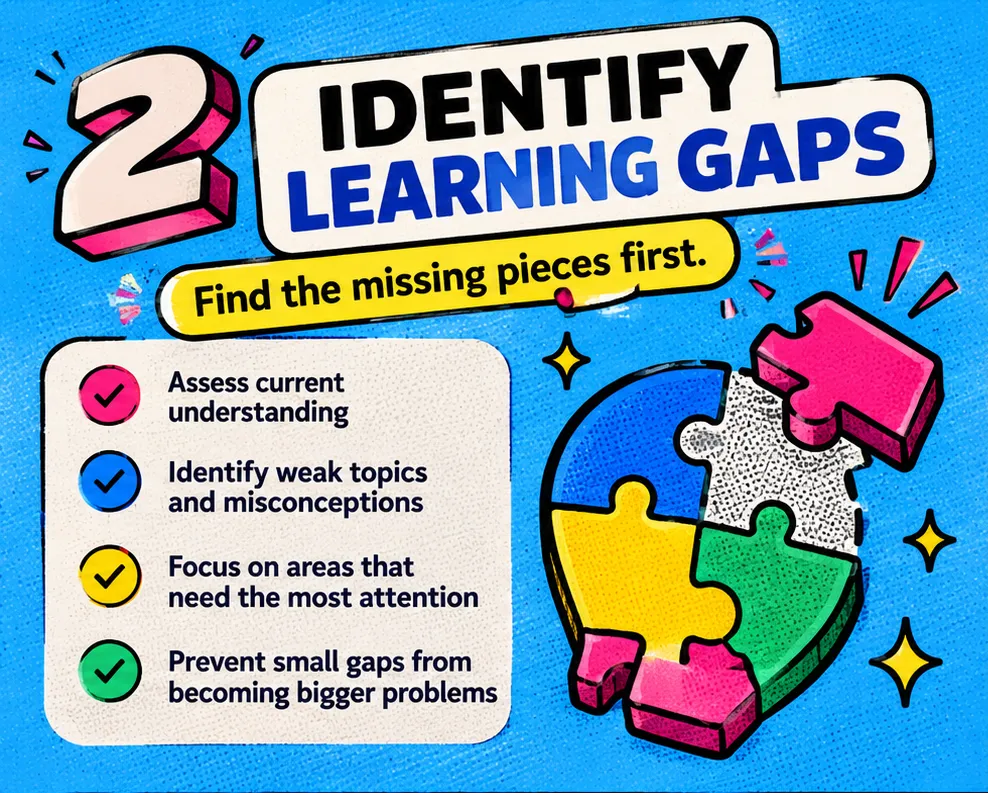
A good tutor begins with a short diagnostic: a few past-paper questions or a quick conversation to see where understanding stops. They then choose what to teach based on what they find, not on the order of a book. That is the same “diagnostic assessment” the EEF recommends for targeting tuition.
3. Teach exam technique, not just content
Knowing the content is only part of GCSE success. Marks are lost when a pupil misreads a question, gives a description when the question said “explain”, skips the working in a calculation, or runs out of time. Many pupils have never been taught these skills explicitly.
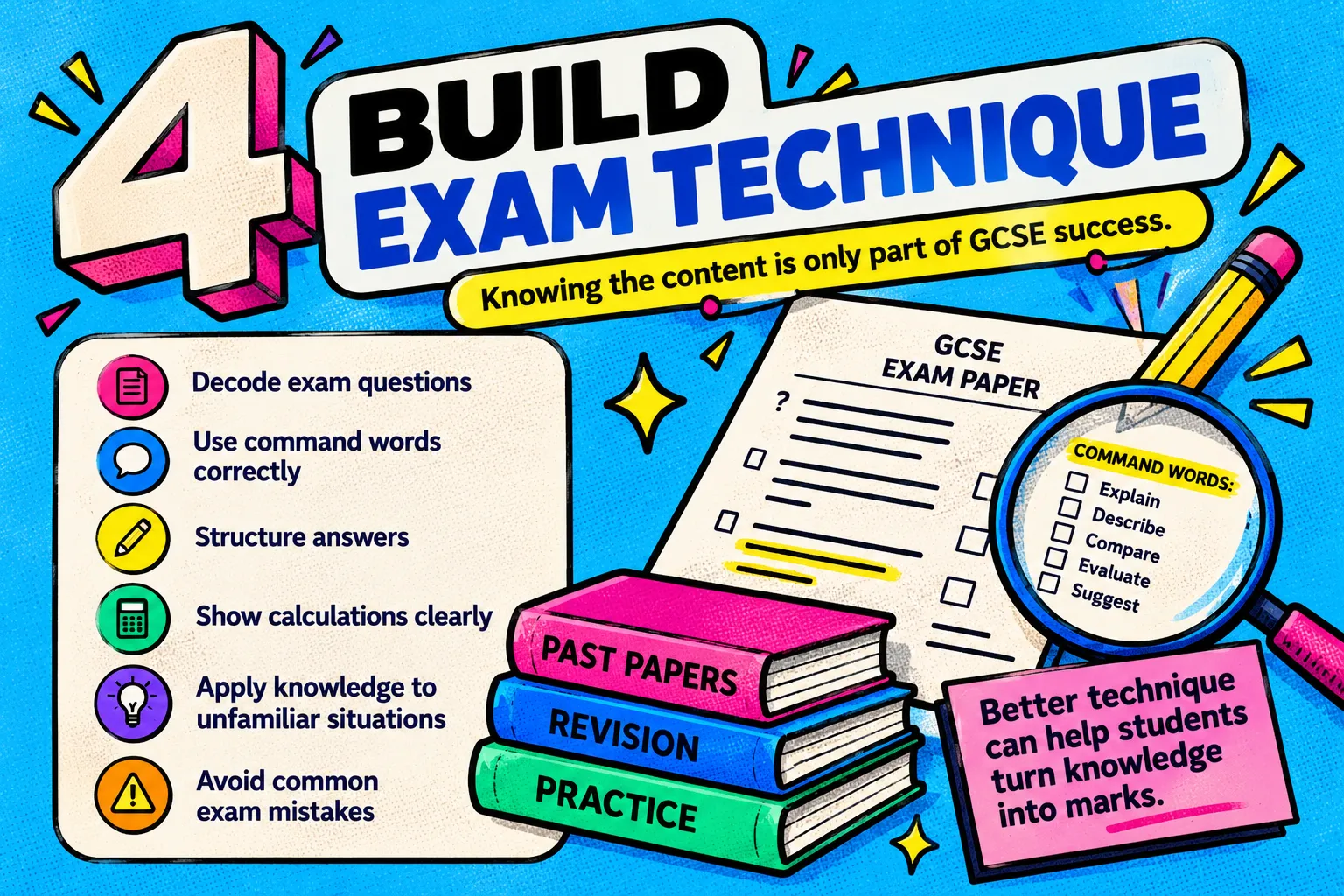
A tutor can work through command words such as describe, explain, compare, evaluate and suggest, show how a mark scheme rewards answers, and practise structuring longer responses. For maths, they can show why writing out each step earns method marks even if the final answer is wrong. Our tips on revising GCSE maths quickly are a good companion to this kind of work.
4. Build a practise, feedback, correct, repeat habit
Working through worksheets is not the same as improving. The pattern that works is a loop: practise a question, get feedback, correct the mistake, then try a similar question again. Mistakes are the useful part, because they show exactly what to fix.
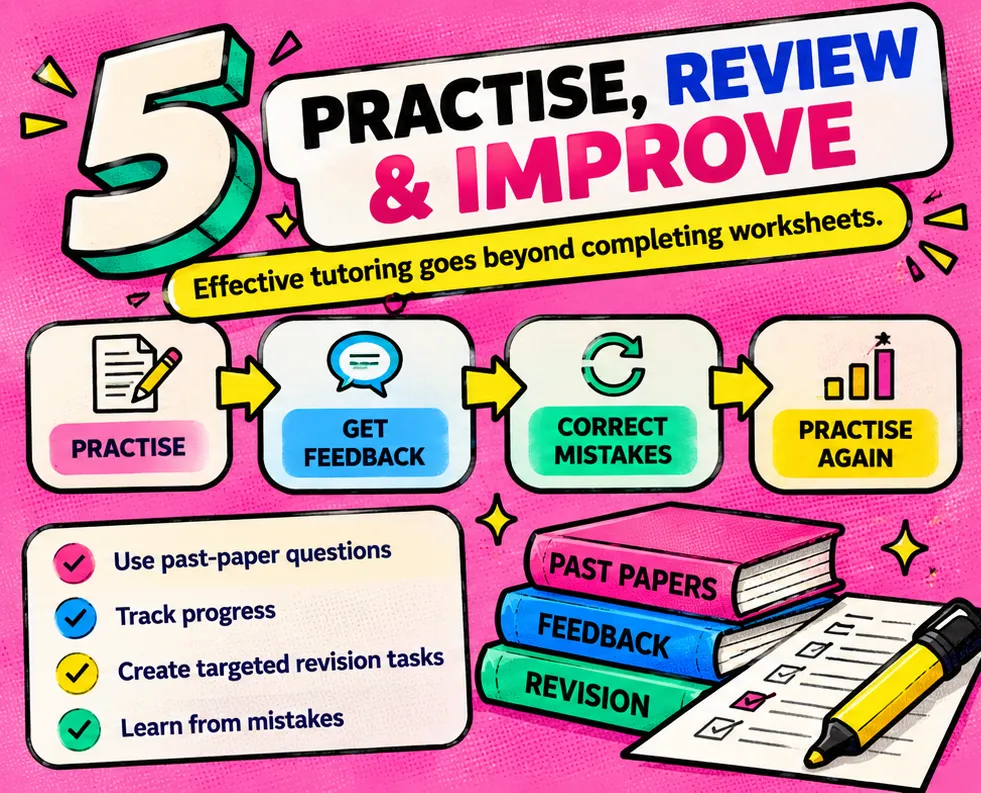
Cognitive scientists have long found that testing yourself on material, rather than rereading it, helps memory last. A tutor who sets short quizzes and brings back earlier topics is using this principle, sometimes called retrieval practice. You can read more about the habit in how to practise and remember what you study.
5. Rebuild confidence and motivation
A pupil who has been stuck for months often decides “I’m just bad at this”. That belief can be as damaging as the missing knowledge, because it stops them trying. When a tutor sets tasks at the right level and a pupil succeeds, the belief starts to change. Confidence is not a side effect here. It is one of the main ways results actually go up.
A tutor session in practice
Every tutor works differently, but a well-run 60-minute session often follows a pattern like this. It is a guide rather than a rule, so do not worry if your tutor’s sessions look a little different.
- Quick recap (5–10 minutes). A few questions on last week’s topic to check what stuck.
- Teach or re-teach (15–20 minutes). One focused idea, explained with examples and checked by asking the pupil to explain it back.
- Guided practice (15–20 minutes). Exam-style questions, with the tutor stepping back as the pupil gains confidence.
- Feedback and plan (5–10 minutes). What went well, what to fix, and a small piece of work for before next time.
Notice that the pupil is doing most of the thinking. If a session consists mainly of the tutor talking, or of the tutor doing the homework while your child watches, the learning is not happening. Ask your child afterwards: “What could you do at the end that you couldn’t do at the start?”
Reveal: spot the good tutoring sign
Try these three questions. Think of your answer before you tap.
A tutor starts the first lesson by asking your child to attempt a few past-paper questions and explain their thinking. Is that a good or a poor sign?
A good sign. It is a diagnostic: the tutor is finding out what your child knows and where they get stuck before deciding what to teach.
A tutor promises “two grades higher in six weeks”. Is that a good or a poor sign?
A poor sign. Nobody can guarantee a grade jump. The EEF’s figures are averages, and results depend on the pupil’s starting point, effort and time. An honest tutor talks about a plan and progress checks, not guarantees.
After each session, the tutor sends a two-line note: topics covered, what is still shaky and a small task for the week. Good or poor?
Good. It shows the work is monitored and linked to a plan, and it keeps you informed without having to sit in the lesson.
How to choose a GCSE tutor
Because the research shows that how tutoring is done matters, choosing the tutor is the most important decision you will make. Tutoring in the UK is not a regulated profession in the way teaching in a school is, so almost anyone can advertise as a tutor. That does not make tutors untrustworthy, but it does mean the checking is up to you.
Qualifications and experience
There is no single qualification that guarantees a good tutor. Qualified teachers know the curriculum and the exam boards well. University students and graduates can be excellent, especially in their own subject and when they sat the same exams recently. What matters is whether they can explain clearly, know the specification your child is following, and have taught GCSE students before.
Questions worth asking:
- Which exam board and tier (foundation or higher) have you taught recently?
- How do you find out what my child already knows?
- How will you keep me informed about progress?
- Can you give me a reference from another parent?
Do not be shy about asking for references. A confident tutor will expect it.
Safeguarding and DBS checks
Your child will spend time alone with this person, in your home or online, so safeguarding comes first. A Disclosure and Barring Service (DBS) certificate shows what criminal-record information was held on the date it was issued. It is useful, but it is not a guarantee of future behaviour, so treat it as one piece of the picture alongside references and your own judgement.
Here is how it works for private tutors:
- Parents cannot request a DBS check on a tutor. The tutor has to apply, and they then choose whether to share the result with you.
- Self-employed tutors have had a route to an Enhanced DBS check since 21 January 2026, applying through a DBS umbrella body. Tutors who work for an agency or tuition company are usually checked by that organisation.
- You can ask to see it. The DBS’s advice for parents is that a tutor can get a check and you can ask to see it. Look at the original certificate, not a photocopy, check that it applies to the right type of work, and note the issue date.
- The DBS Update Service lets a tutor who has subscribed share an up-to-date status, so an old certificate does not leave you guessing.
Always book a trial session
Many tutors offer a first lesson that is free or shorter, and even if yours does not, treat the first session as a trial. Sit nearby for part of it, if your child is comfortable with that. Afterwards, ask your child three things: Did you understand more at the end? Did the tutor listen to you? Would you like to go again? A pupil who feels talked down to or lost after the first lesson is unlikely to improve, however good the tutor’s CV looks.
Red flags
- Guaranteed grades or results.
- Pressure to sign up for a large number of lessons in advance.
- Reluctance to provide references, identification or a DBS certificate.
- Wanting to communicate privately with your child, or to meet somewhere without your knowledge.
- No interest in what school is teaching, the exam board, or your child’s past results.
Online or in-person tutoring?
Since the pandemic, online tutoring has become common, and the EEF has run trials of online tuition. Neither format is automatically better. The best choice depends on your child and your area.

| Online | In person | |
|---|---|---|
| Choice of tutors | Much wider: not limited to your town, so easier to find a subject specialist | Limited to people who can travel to you or whom you can travel to |
| Convenience | No travel, flexible times, recordings or shared notes sometimes available | More time spent travelling; a good fit for families who prefer face-to-face |
| Focus | Needs a quiet space and a reliable connection; distractions are easier | A tutor in the room can notice drifting attention and body language |
| Writing and diagrams | Needs a digital whiteboard or a camera pointed at paper | Natural: both can write on the same page |
| Safeguarding | Use a shared space; check the platform’s rules | An adult should be in the house |
For younger or easily distracted pupils, in-person often works better. For older, self-motivated GCSE students who need a specific subject specialist, online can be excellent. If your child is already spending many hours on screens for school, our article on the advantages and disadvantages of online education may help you weigh the format.
Individual, small group or tuition centre?
Following the EEF figures, one to one tuition has the largest average effect but costs the most. Small group tuition, with two to five pupils, is often cheaper per child and can work well when pupils share the same gap, for instance a group preparing for the same maths paper. Large classes at a tuition centre are closer to ordinary teaching, so they are less personalised. If your child needs to be pushed to work and enjoys company, a small group can be a good compromise.
What does tutoring cost?
Rates vary widely, depending on the region, the subject, the tutor’s experience and whether lessons are online, in person or through an agency, so any figure we gave would soon be wrong. The better approach is to compare a few tutors in your area and ask exactly what is included.
- Is the lesson length 45 or 60 minutes?
- Is there a charge for cancellations or missed lessons?
- Do you pay per lesson or in advance, and what happens to unused lessons?
- Are materials and past papers included?
Because the EEF recommends a limited period of regular sessions, you may not need a tutor for the whole of Year 10 and 11. A focused block of several weeks aimed at one subject, perhaps before mocks or in the spring term before the exams, can be a sensible way to control the cost. Many free and low-cost options also exist, such as school catch-up sessions, free online lessons and past papers, so do check these first.
A short checklist before you book
Tick these off as you go. The ticks are saved in your browser, so you can come back to them.
- Checked which exam board and tier my child is on
- Asked the school which topics need most work
- Asked the tutor about subject and GCSE experience
- Asked to see a DBS certificate and checked the date
- Spoken to at least one reference
- Agreed the fee, cancellation rules and a review point
- Booked a trial session and asked my child how it went
If your child resists the idea of a tutor at all, it is worth finding out why before you book. Some pupils worry about feeling “stupid”, while others feel they have no time. Our guide on what to do when you have no motivation to study can help start that conversation.
How parents can support the tutoring
A tutor works for an hour or two a week. The rest of the week is down to your child, and you have more influence on that than you might think. You do not need to know the subject. You need to make the tutoring easy to use.

- Share information. Pass on recent test results, teacher comments, the exam board and the mock exam dates. The EEF stresses that tutoring should link with school teaching, and you are the link.
- Agree a goal. “Move from a 4 to a 5 in maths” or “finish the whole of paper 1 in time” is more useful than “do better”. Revisit it every few weeks.
- Protect the time. Keep a regular slot, a quiet space and a charged laptop. Missed sessions cost more than the fee.
- Ask for work between sessions, and check it gets done. Ten minutes of practice a day usually beats one long cram.
- Ask your child to teach you. Explaining a topic aloud shows what is secure and what is not, even if you do not understand the topic yourself.
- Encourage active revision. Short self-tests and making flashcards work better than rereading notes.
- Look after the basics. Sleep, food and some downtime affect learning. Our article on balancing sleep and work for GCSE results covers this.
When a tutor is not the answer
Sometimes the most helpful move is not to hire a tutor. Consider other steps first when:
- Your child is anxious or exhausted. A tutor adds another demand to someone who needs less pressure, not more. Talk to the school, and to a GP if the worry is affecting sleep or daily life.
- There is no routine. Revision that has never been planned will not be fixed by one hour a week with a tutor.
- The reason is learning needs that have not been identified. If you suspect dyslexia or another need, raise it with the school’s special educational needs coordinator (SENCo) first, because tutoring alone may not solve it.
- The cost would cause real financial stress. Free school support, past papers and good revision habits go a long way.
Choosing not to hire a tutor is not a failure. The goal is better learning, and there are several ways to get there.
The real goal: a more independent learner
The best tutors work towards making themselves unnecessary. Over time your child should understand what they are learning, revise independently, manage their time, approach exams calmly and take responsibility for their progress. If after several months a pupil still cannot do anything without the tutor in the room, something needs to change.
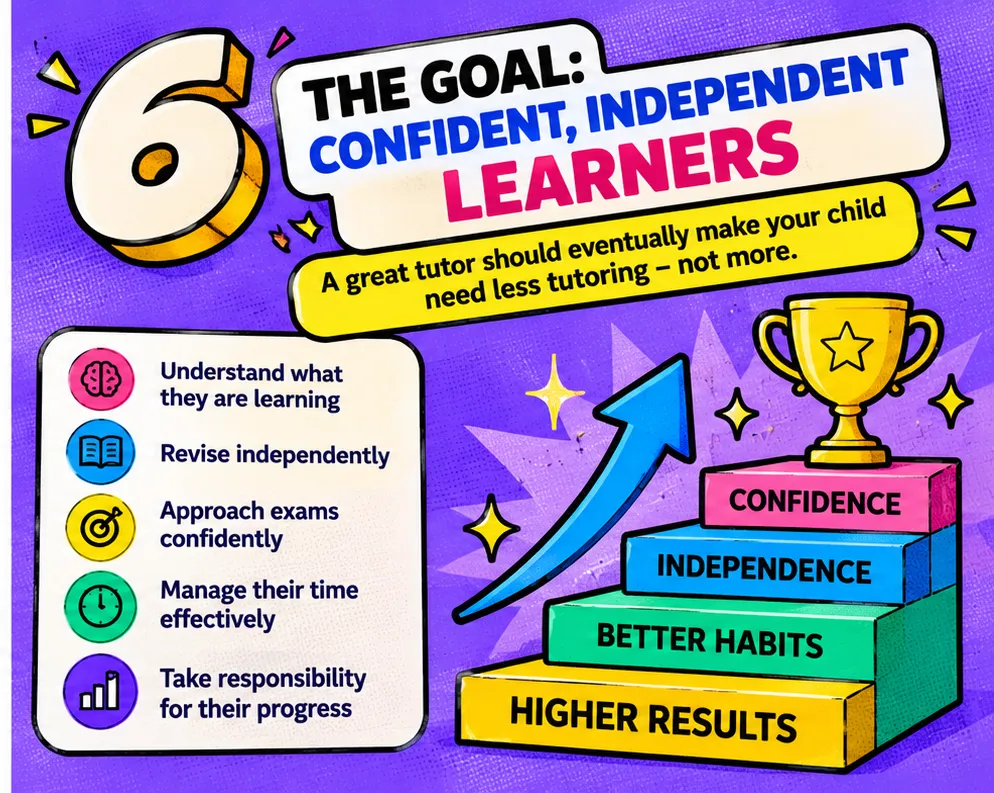
Review the arrangement every half term: Is my child more confident? Do their marks in tests show progress? Are they doing more of the thinking? If the answers are yes, great. If not, talk to the tutor, change the approach, or stop.
Flip cards: tutoring vocabulary
Test yourself
Frequently asked questions about GCSE tutors
Does a tutor really improve GCSE results?
Often, yes, but not for everyone. The EEF finds one to one tuition can add up to five months’ progress on average, when tutoring is high quality and linked to classroom teaching, and about four for small groups. These are averages from many studies. Results depend on the pupil, the tutor, and whether sessions are targeted at real gaps and linked to school work.
When should my child start GCSE tutoring?
Sooner is usually better than a last-minute rush, because gaps take time to fill. Many families start in Year 10 or early in Year 11, or when a subject begins to slip. A focused block of a few weeks before mock exams can also help, rather than a long open-ended arrangement.
How many sessions a week does my child need?
There is no single answer. EEF guidance suggests short, regular sessions over several weeks (around 30 minutes, three to five times a week, for a limited block of weeks) work best. Most families choose one weekly session and add more before exams. Quality and follow-up practice matter more than the number of hours.
How do I know if a tutor is any good?
Look for a clear plan rather than promises. A good tutor checks what your child knows, knows the exam board, sets work between sessions and reports back. Ask for references, book a trial and ask your child whether they understood more by the end of the lesson.
Do private tutors need a DBS check?
Parents cannot request one on a tutor’s behalf. Since 21 January 2026, eligible self-employed tutors can apply for an Enhanced DBS check through an umbrella body, and you can ask to see it. Agency tutors are usually checked by the agency. Treat the certificate as one safeguard among several.
Is online tutoring as good as face-to-face?
It can be. Online tutoring offers a wider choice of specialists and saves travel, but needs a quiet space and good focus. In-person lessons suit pupils who are easily distracted. The best format is the one your child will concentrate in, taught by a tutor who knows the course.
What happened to the National Tutoring Programme?
It was a government scheme that funded school tutoring in England for four academic years, from 2020/21 to 2023/24, and it ended in August 2024. Schools no longer receive ring-fenced tutoring funding, so some still offer tutoring from their own budgets. Ask your child’s school what is available.
How much does a GCSE tutor cost?
Rates vary by area, subject, tutor experience and whether lessons are online, in person or through an agency. Compare several tutors and ask about lesson length, cancellation rules and materials. Free options, such as school catch-up sessions and past papers, are worth trying alongside or before paid tuition.
Is small group tuition better than one to one?
One to one has a larger average effect in the EEF Toolkit, but small group tuition is cheaper and still helps, especially when pupils share the same gap. For pupils with very specific problems, one to one is often better. For general exam practice, a small group can work well.
What can I do if I cannot afford a tutor?
Plenty. Ask the school about catch-up groups, use past papers with mark schemes, and build a regular revision routine. Practise with flashcards and short self-tests. Many pupils improve with strong habits alone, and a tutor is an extra, not a requirement.