
The best way to improve reading habits of children is to make reading short, regular and enjoyable: a few minutes every day, books they have chosen themselves, an adult who reads with them, and no pressure. Skills matter, but enjoyment decides whether a child keeps reading when nobody is checking.
This guide gives you nine practical tips, backed by figures from the National Literacy Trust, the OECD and the Department for Education. It also covers reluctant readers, phonics, screen time, dyslexia signs and what to try at each age.
What the evidence says about children and reading for pleasure
Every year the National Literacy Trust (NLT) asks tens of thousands of UK pupils how they feel about reading. Its 2026 report, published in June 2026, is based on responses from 125,375 children and young people aged 5 to 18 in 479 schools. It found that 36.1% said they enjoyed reading in their free time, up from 32.7% in 2025.
The 2025 figure was the lowest in the survey's history. It was 36% lower than when the NLT first asked in 2005. So there is a small recovery, but most children still do not read for fun.
| Measure (National Literacy Trust) | 2025 report | 2026 report |
|---|---|---|
| Pupils who enjoy reading in free time | 32.7% (ages 8–18) | 36.1% (ages 5–18) |
| Pupils aged 8–18 who read daily in free time | 18.7% | 20.3% |
| Pupils aged 5–8 who enjoy reading | 62.6% | 61.6% |
| Pupils aged 5–8 who read daily | 44.5% | 45.5% |
The two years do not use exactly the same age group for the headline enjoyment figure, so treat the first row as a direction of travel, not a precise comparison. The rest of the rows compare like with like.
Two patterns stand out. First, young children are the keenest readers, and the gap between them and teenagers is big. Second, inequality is growing: in 2026 enjoyment rose more among pupils who do not get free school meals than among those who do. In 2025, 19.4% of pupils not on free school meals read daily, against 15.8% of those who were.
It is not only a UK pattern
The OECD's PISA study tests 15-year-olds around the world. Between 2009 and 2018, the average across OECD countries showed 5 points more students saying reading is a waste of time and 5 points fewer reading for enjoyment. The OECD's PISA 2025 results, published on 8 September 2026, showed average reading scores across OECD countries falling by 28 points between 2015 and 2025, about one and a half years of learning and the lowest level PISA has recorded. The OECD notes that the fall has coincided with greater digitalisation, longer screen time and less reading for enjoyment.
The picture for younger readers in England is better. In the 2021 PIRLS study of Year 5 pupils, England scored 558 and ranked 4th of 43 education systems, up from joint 8th in 2016. Skills at age ten are strong; the worry is whether children keep reading by choice as they get older.
Tip 1: Make reading a small daily habit
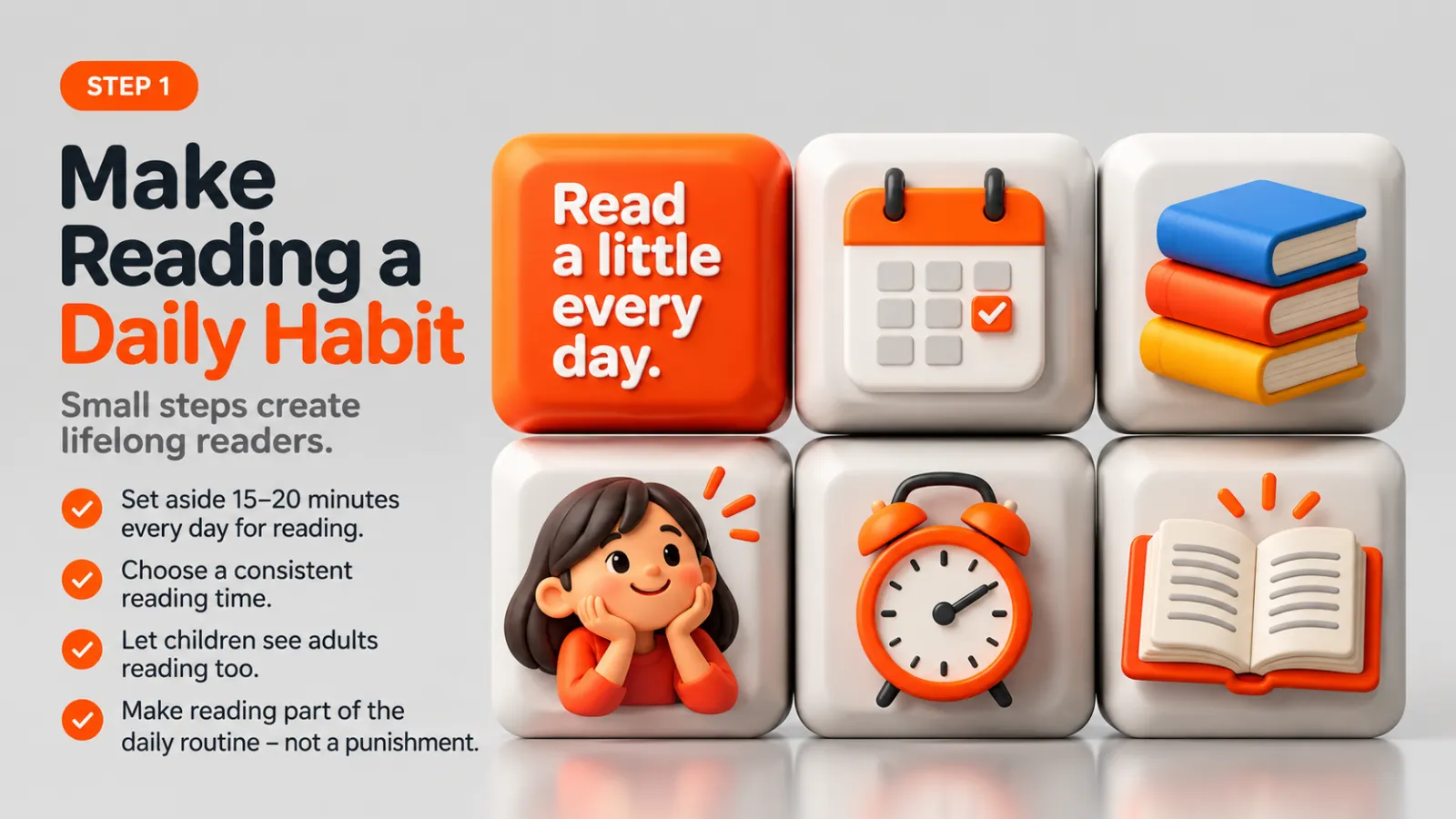
Habits form through repetition, not through long sessions. A child who reads for ten relaxed minutes every night does more for the habit than one who is forced through an hour at the weekend. Aim for a short, predictable slot of about 15 to 20 minutes, and let it shrink on busy days instead of skipping it.
Pick a time that already exists in your day. Bedtime is the classic choice, because quiet reading helps children wind down; see our guide to sleep hygiene and mental health for why a calm routine before bed matters. Others work just as well: after school with a snack, on the bus, or while a sibling finishes a bath.
Make the habit easy to start
- Anchor it. Link reading to something that always happens: teeth brushed, then pyjamas, then book.
- Keep the book where they will be. One by the bed, one in the school bag, one in the car.
- Use a visible tracker. A wall chart with a sticker per day works for younger children; older ones may prefer a simple reading log on their phone or in a notebook.
- Never use reading as a punishment or take it away as a sanction. It should feel like a treat, not a chore.

Children copy what they see. If they never see an adult with a book, magazine, newspaper or e-reader, reading looks like something that only happens at school. Read your own book at the same time as theirs. Even a few minutes of silent reading side by side sends a message that reading is something people choose to do.
Tip 2: Turn "how long?" into "how many pages?"
Reading time is easy to measure, but it is a poor target for a slow reader, who may only manage a page in the time a fluent reader finishes a chapter. Many families find a mix of the two works best: a minimum time, plus a goal such as finishing a book a month.
The calculator below helps you set a sensible goal. Type in the number of words in a book (most children's chapter books are listed on publishers' websites, or you can estimate from a sample page) and your child's reading speed. To find that speed, time them reading one page aloud or silently, count the words on the page and divide by the minutes it took.
The note under the result gives typical adult silent reading speeds of 200 to 300 words per minute, and the default of 100 words per minute is only an example. Many children read more slowly or more quickly than either, so use your child's own figure. The point is to turn a vague worry ("they never finish anything") into a plan: 20 minutes a day adds up to a book over a few weeks, and children can see their progress.
If you are a teenager reading this for your own study, the same idea applies to long texts. Our post on how to read faster explains why speed comes from reading a lot, not from tricks.
Celebrate effort, not just finishing
Praise the habit ("you read every night this week") more than the result ("you finished the whole book"). Children who feel watched or tested may start to read for the reward and stop once it disappears. A small ritual works better than prizes: a trip to choose a new book, a pizza night where everyone talks about what they are reading, or a favourite character on a poster.
Tip 3: Let children choose what they read
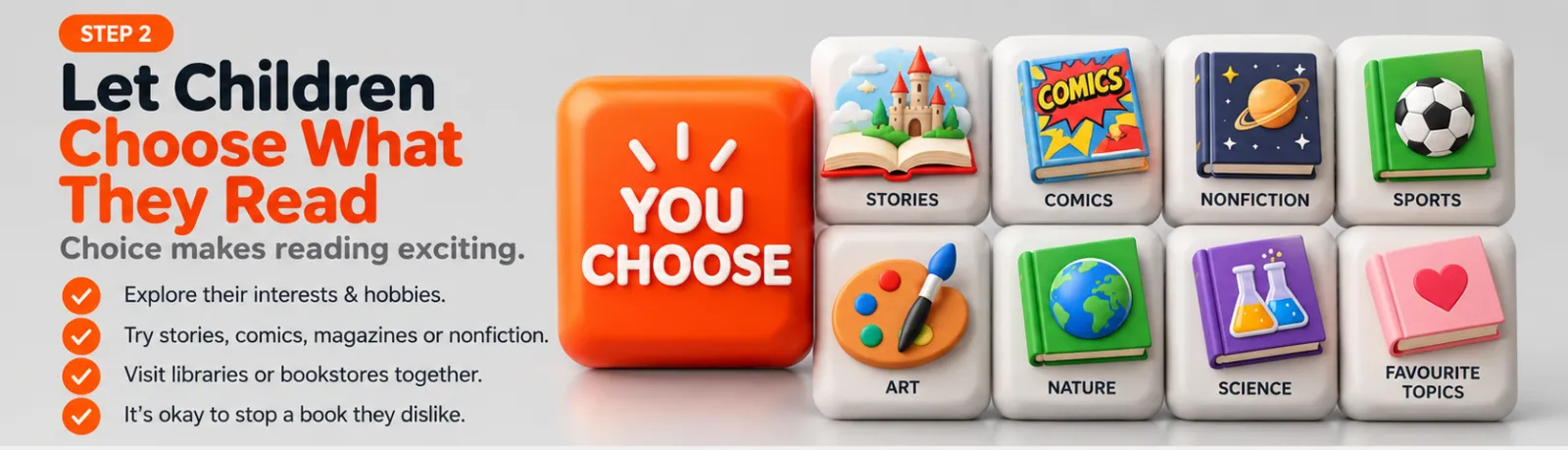
Choice is the single most useful lever a parent has. In the NLT's 2025 survey, 8 to 18-year-olds were asked what would make them pick up a text. The top answers were all about personal interest:
- 38.1% said a link to a favourite film or TV series;
- 37.1% said it matched their interests or hobbies;
- 30.9% said an interesting cover or title;
- 26.6% said freedom to choose what to read.
Notice what is missing: being told to read by an adult was not among the top motivators. If your child loves football, space, horses, Minecraft or Lego, find books about those things. Fiction is not better than non-fiction, and a graphic novel is not "cheating". BookTrust, the children's reading charity, makes the same point: letting children pick their own books increases their interest.
Ideas for finding a book they will actually finish
- Follow a screen interest. If they love a TV series or film, look for the book it came from or a book on the same theme.
- Try the "five-finger" rule of thumb: ask them to read one page and hold up a finger for each word they cannot read. Many fingers means the book is probably too hard for now, and that is fine. Come back to it later or read it to them.
- Let them abandon a book. Adults do it all the time. Give a book a fair try, then swap it.
- Allow re-reading. Going back to a favourite is normal and builds fluency.
- Mix formats. Print books, ebooks, audiobooks, magazines and graphic novels all count.


Science is a great gateway for curious children. Facts about animals, space and the human body work well for readers who say they "don't like stories". Science museums can start the spark: see our piece on science museums and science learners for ideas, and then look for books on whatever caught their eye.
Tip 4: Use libraries, and push for a school library
Libraries remove the biggest barrier to choice, which is cost. Children can borrow without worrying about spending money on a book they might dislike, and they can try a new genre for free. Many libraries also run holiday reading challenges and story sessions, and a librarian is often the best person to suggest what to read next.
BookTrust also points parents of babies and toddlers to free Bookstart packs, which are handed out through health visitors and libraries. Ask at your local library what is on offer in your area.
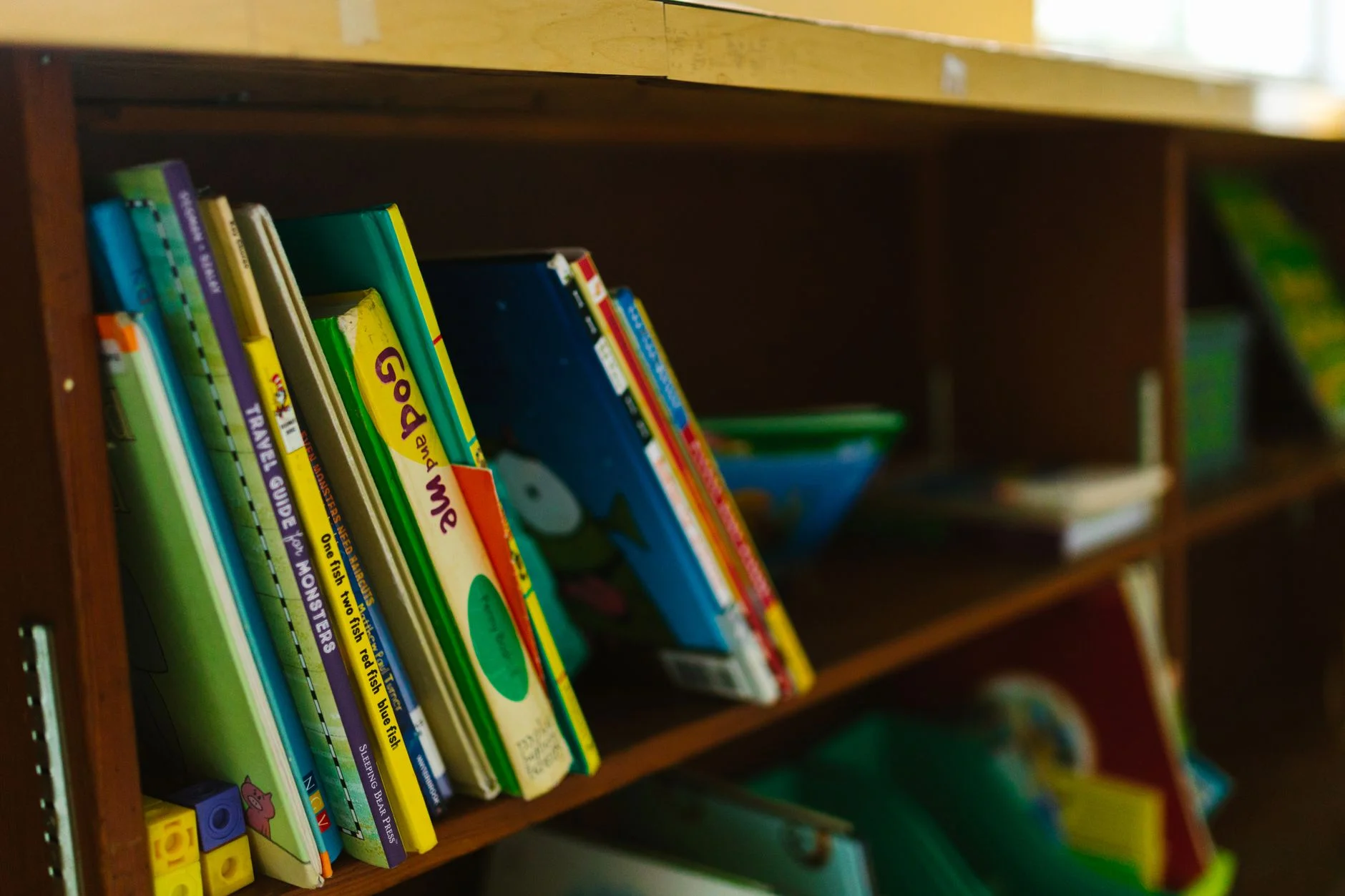
Access at school matters too. In 2022 the NLT found that 1 in 7 state primary schools in the UK had no school library or dedicated reading space, rising to 1 in 4 in the most disadvantaged communities. If your child's school has a thin book collection, you can ask the head teacher or parent group what the plan is, offer to help run a book swap, or ask whether the school can join a local schools library service.
Tip 5: Create a reading-friendly home
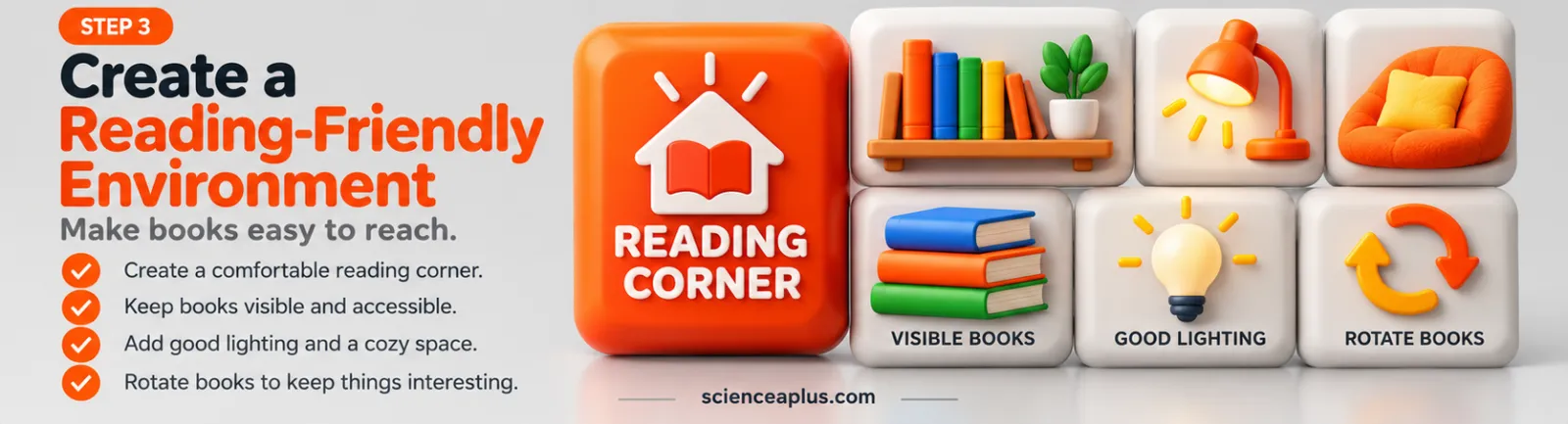
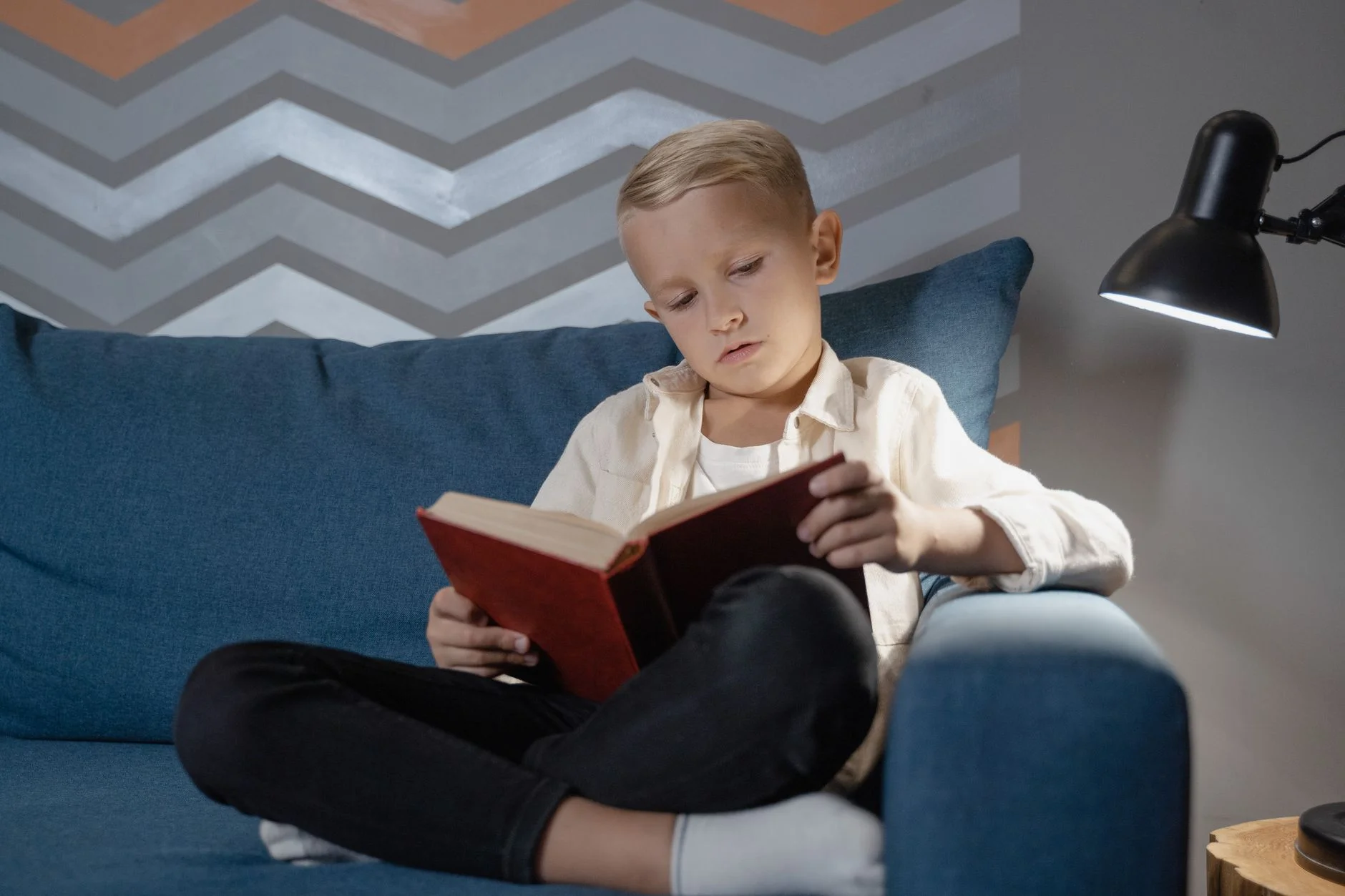
You do not need a whole room, only an inviting spot and easy access to books. The principle is simple: make books easy to reach. A child is much more likely to pick up a book lying on the sofa than one in a cupboard.
- A comfortable seat, a beanbag or cushions in a quiet corner
- Good lighting, ideally a lamp that points at the page
- A low shelf or basket with the covers facing outwards so children can see them
- A small rotating selection, with older books swapped for new or borrowed ones every few weeks
- Books in other rooms: the bathroom, the car, the kitchen table
- Screens in another room during reading time
Rotating books keeps the shelf fresh without buying more. Put half away in a box and bring them out again in a month; to a child they feel new. Second-hand shops, charity shops and swaps with friends are cheap ways to add variety.
Help for reluctant readers
A reluctant reader is not a bad reader. Some children have decided that reading is boring because it was hard, because of pressure, or because they only ever meet books that do not interest them. Here are things that tend to help.
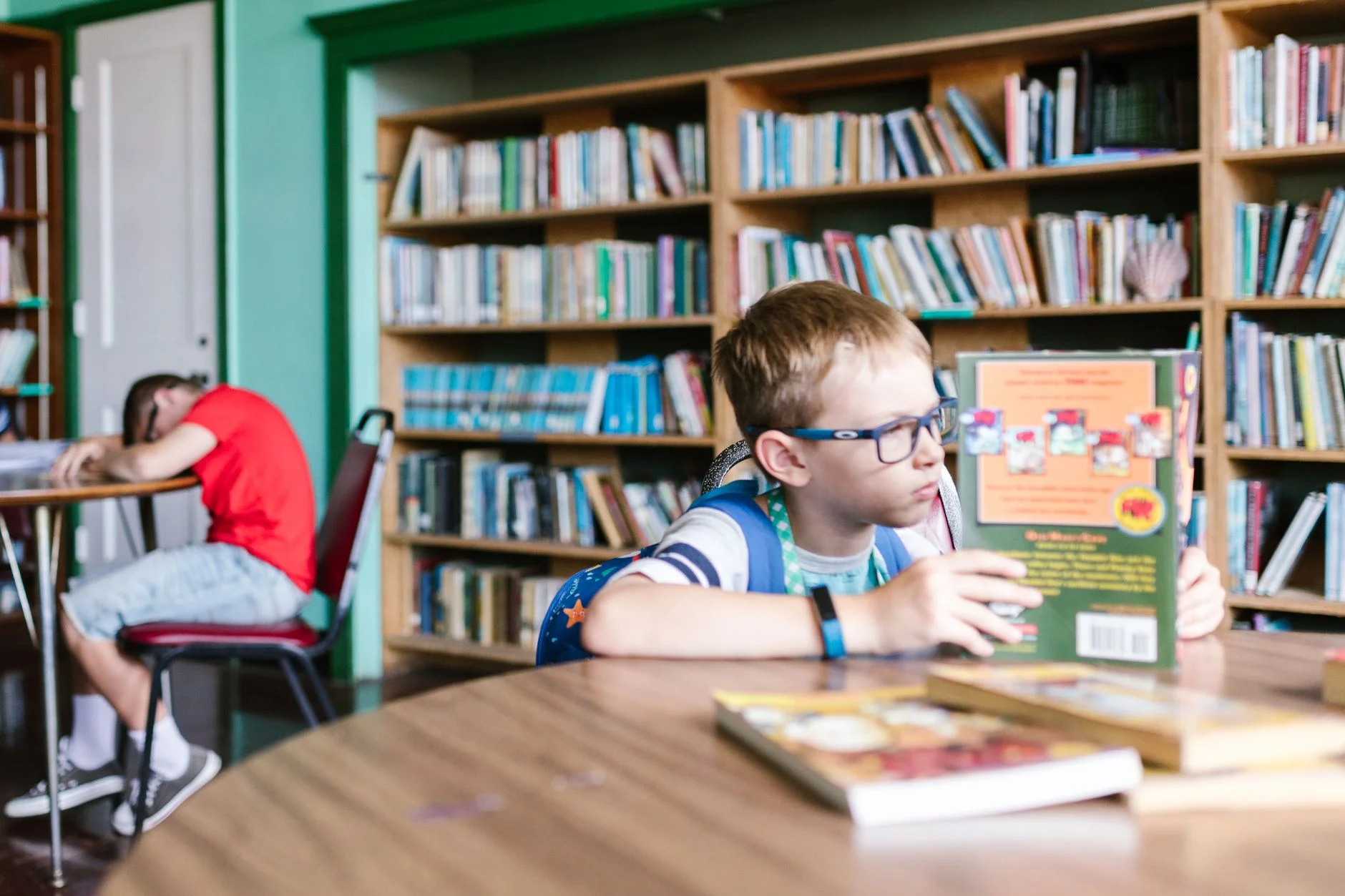
Strategies that work
- Lower the stakes. Drop the quizzes and the "read to the end of the chapter" rule for a few weeks. The goal is to rebuild a positive feeling.
- Read the first chapter aloud. Hooked children often take the book over. This works well with a series.
- Offer shorter texts. Magazines, short stories, joke books, graphic novels and non-fiction with captions are all good starts.
- Try audiobooks alongside the print book. Following the words while listening can support fluency and understanding.
- Connect to what they love. Find a book about their sport, band, game, craft or favourite animal.
- Check the basics. If reading is stubbornly hard, vision, hearing and decoding skills may need a look. See the dyslexia section later in this guide.
Boys deserve a specific mention. The NLT's 2025 report found especially steep drops in enjoyment among boys, particularly boys aged 11 to 16, and in 2026 boys aged 5 to 8 saw enjoyment fall. Male role models who read, such as dads, grandfathers, coaches and older brothers, can make a visible difference, as can books that match interests like football, gaming, humour and facts.
Finally, build vocabulary naturally rather than through lists. Wide reading exposes children to words they would not hear in everyday speech; a handy follow-up for older children is our list of English vocabulary words, which they can browse and then look out for in books.
Tip 6: Read aloud and talk about books
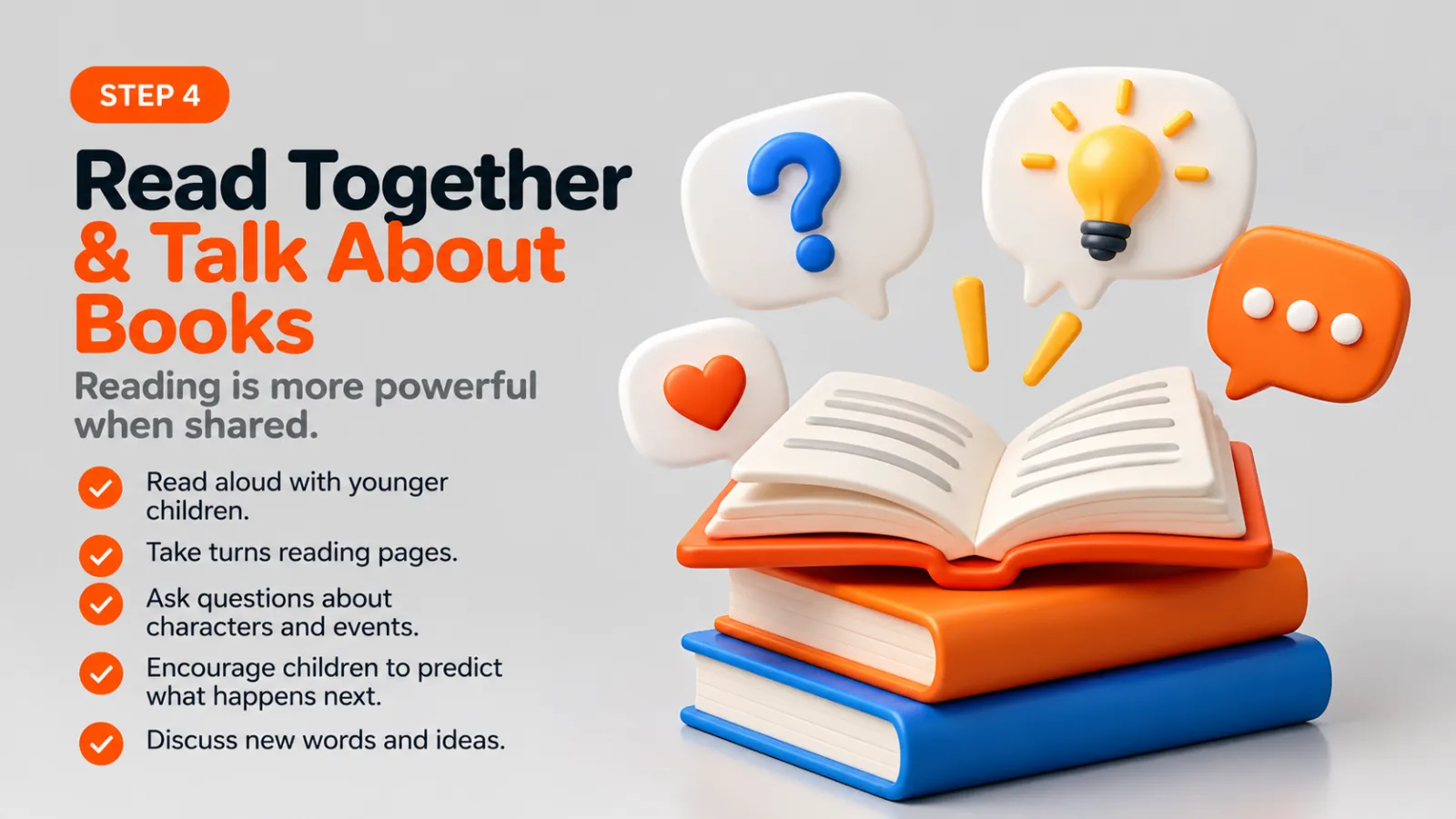
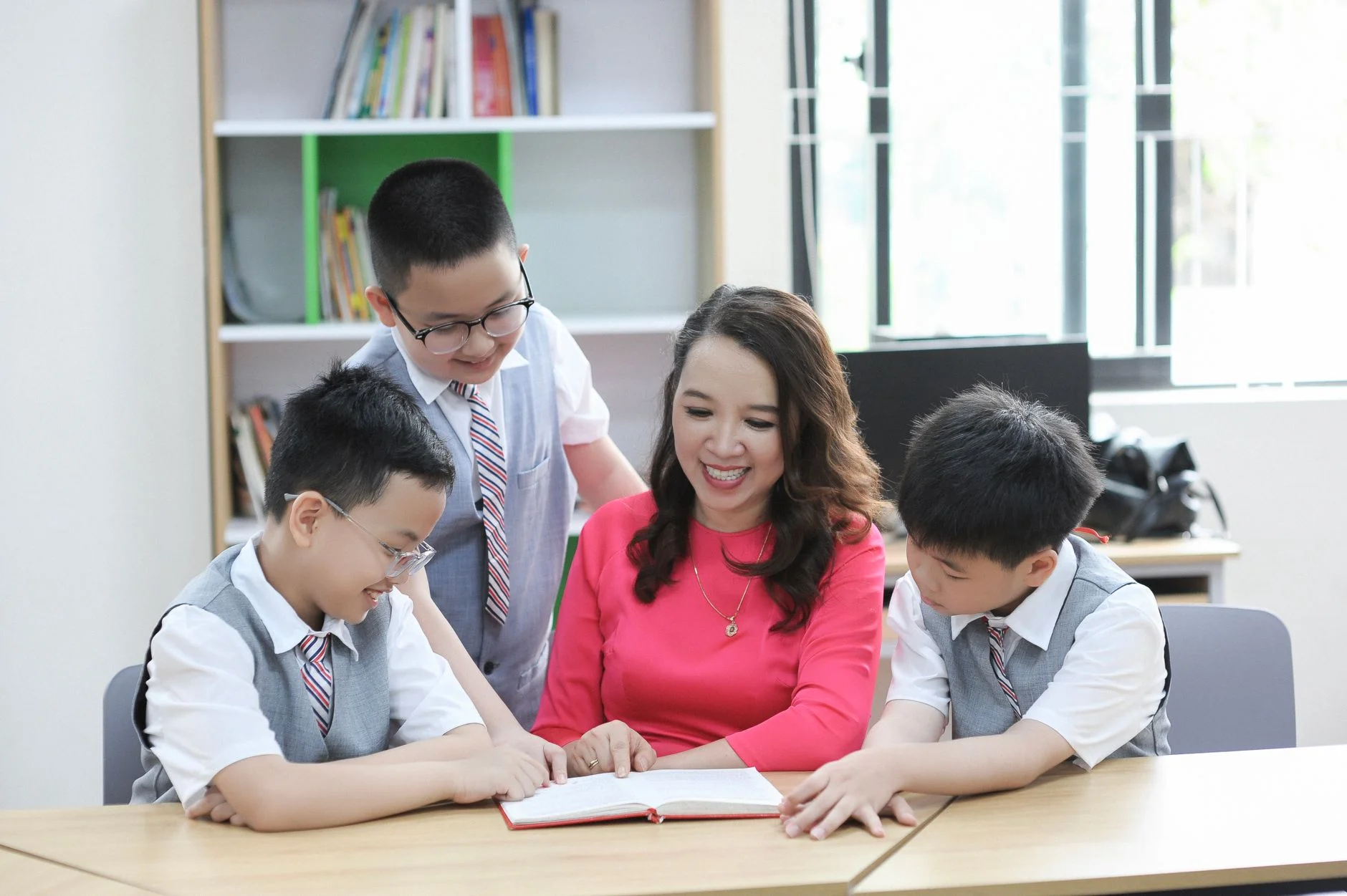
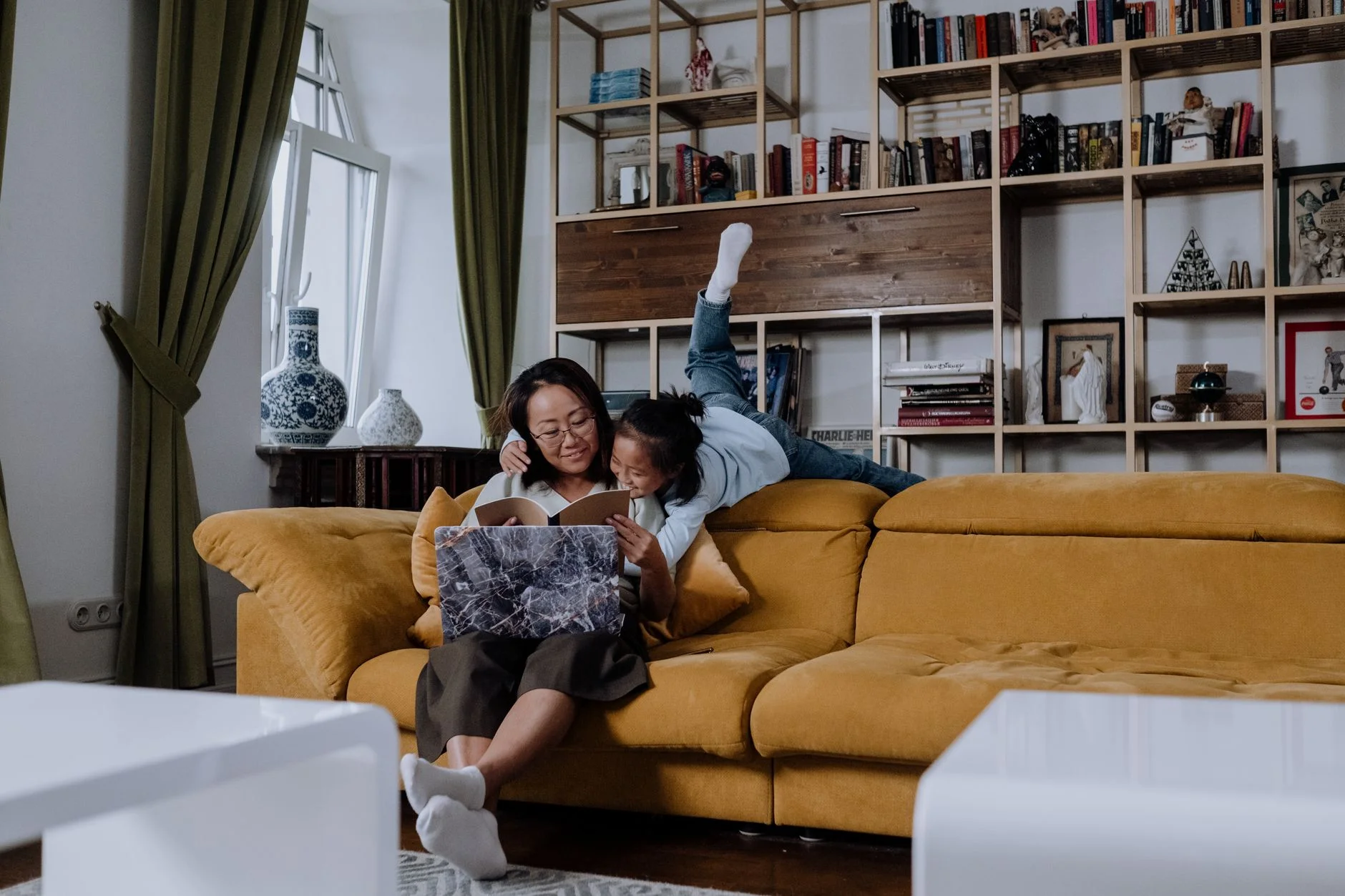
Reading aloud is not only for toddlers. When you read to a child, they hear fluent, expressive reading, meet words and ideas that are more advanced than they could read themselves, and associate books with warmth and attention. BookTrust advises that there is no right or wrong way to share a story, so funny voices, sound effects and acting out scenes are all welcome.
It also advises parents to keep reading aloud as children get older. A child of nine or ten who can read independently may still enjoy a chapter of a longer story at bedtime, and you can choose books slightly above their own level to stretch their listening and vocabulary.
Make it a conversation
The magic is in the talk around the book. You do not need a script. Try questions like these and let the child do most of the speaking:
- "What do you think will happen next?" (prediction)
- "Why do you think she did that?" (inference)
- "What was the best bit? What was the strangest bit?" (opinion)
- "Have you ever felt like that?" (connection to real life)
- "What does that word mean? Can we guess from the sentence?" (vocabulary)
Look at the pictures too. BookTrust suggests using them as conversation starters, and for beginner readers the pictures carry as much of the story as the words. Take turns reading pages once a child is ready, so the book is shared rather than performed.
Age-by-age tips for building reading habits
Children develop at their own pace, and the ages below are a rough guide, not a checklist. Use them as ideas rather than targets.
| Age | What helps most | Try this |
|---|---|---|
| Babies and toddlers (0–4) | Sharing books and talking | Board books, rhymes and songs; pick up free Bookstart packs through your health visitor or library; point and name things in pictures |
| Early primary (5–7) | Phonics practice plus lots of listening | Short, decodable books from school; you read a page, they read a page; keep bedtime stories going |
| Upper primary (8–11) | Choice and series | Series books, non-fiction, comics and audiobooks; library trips; reading in a favourite spot |
| Early secondary (11–14) | Staying connected to reading as other interests grow | Books linked to games, films and sports; graphic novels; leave books lying around; let them see you read |
| Older teens (14–18) | Autonomy and purpose | Magazines, online articles, poetry, biographies; swap recommendations; make time before exams for something they choose |
The NLT's 2026 report found the largest increases in reading enjoyment among 14 to 18-year-olds, which suggests older teenagers can be won back to reading. By contrast, enjoyment among 5 to 8-year-olds, though still high at 61.6%, slipped slightly. Do not assume that young children will keep their love of books without support.
Phonics and comprehension: you need both
You may hear arguments about whether children learn to read best through phonics or through meaning. In reality they do different jobs, and children need both.
Phonics teaches children to link letters and sounds so that they can decode (sound out) written words. Comprehension is understanding what the words mean. Without decoding, a child cannot get the words off the page. Without comprehension, they are only calling out words. A good reading habit needs the two to work together.
The phonics screening check in England
In England, Year 1 pupils, typically aged 6, take a short phonics screening check. The Department for Education describes it as a statutory assessment that confirms whether a child has met the expected standard in phonic decoding. Children read 40 words, scoring from 0 to 40, and the pass mark is 32. The check includes made-up words, so children have to decode them rather than rely on memory.
| Phonics check 2024/25 (England, Year 1) | Met expected standard |
|---|---|
| All pupils | 80% (the same as 2024) |
| Girls | 84% |
| Boys | 76% |
| Disadvantaged pupils | 67% (68% in 2024) |
| Non-disadvantaged pupils | 84% |
Source: Department for Education, published 9 October 2025. These are the latest published figures at the time of writing, for the 2024/25 school year.
For parents the message is practical. Support the check at home with games and short decodable books, but keep it relaxed; a child who fails the check is not failing at reading. Schools can offer extra help to children who need it. Talk to your child's teacher if you are worried.
Then build comprehension
Once a child can decode, the next job is to make sense of the text. The Education Endowment Foundation (EEF) reports that teaching reading comprehension strategies gives pupils several months' extra progress on average. The strategies it lists include inferring meaning from context, summarising, asking questions and checking your own understanding. All of them can be practised at home through the kind of book talk described above.
Memory also matters, because children need to hold ideas in mind as they read. Our guide on how to improve memory for better learning has simple techniques that older children can use with textbooks. For younger children, spelling practice reinforces phonics; our list of spelling words by grade is a handy reference.
The relationship between reading enjoyment and skill
Children who read more tend to read better, and children who read better tend to enjoy reading more, so the two feed each other. That is why struggling readers can get stuck: reading is hard, so they avoid it, so they practise less. Reading aloud together, easier books and plenty of choice are the best way to break the cycle.
Tip 7: Keep screens and books in balance
Screens are not the enemy of reading, but they compete for the same free time. The OECD's PISA 2025 report notes that falling reading scores have coincided with greater digitalisation, longer screen time and less reading for enjoyment. A video game or a streaming series is designed to be hard to put down; a book is quieter, so it needs a protected slot.
- Protect reading time, not just limit screens. "After dinner we read for 20 minutes" works better than a vague "get off that tablet".
- Use screens as a bridge. A child who loves a game or series may enjoy the related books, and audiobooks and ebooks are still reading.
- Keep devices out of the bedroom at bedtime. This helps sleep and leaves room for a book.
- Take care of tired eyes. Our guide to eye safety from digital devices has simple habits such as breaks and good lighting.
- Be a role model. If you are on your phone every evening, a ban for the child will feel unfair.
When reading is hard: signs of dyslexia and where to get help
Sometimes a child avoids reading because it is genuinely harder for them. The NHS describes dyslexia as a common learning difficulty in which the brain works differently from most people's. It affects reading, writing and sometimes numbers, and it does not affect intelligence.
Signs the NHS lists
- Before school: speech that develops later than in other children, and little interest in language activities such as learning the alphabet.
- In primary school: reading at a level below what is expected for their age; written work that looks messy with lots of spelling mistakes; being slow and hesitant when reading aloud; difficulty with numbers, time and sequences; and problems organising schoolwork.
- In older children: difficulty understanding and remembering information, and trouble planning and organising.
Having one or two of these signs does not mean a child has dyslexia, and only a proper assessment can say. If you are worried, speak to the school's special educational needs coordinator (SENCO). The NHS says the SENCO can arrange screening at school and may suggest a GP visit to rule out hearing or vision problems. Formal assessments by an educational psychologist or specialist teacher usually need a referral.

Support that helps at home
- Praise effort and keep reading enjoyable; confidence matters as much as skill.
- Read aloud together and use audiobooks, so reading difficulty does not block access to stories and ideas.
- Ask school about adjustments such as visual aids, technology support and small-group teaching. If more help is needed, an education, health and care plan (EHCP) can be requested.
- The British Dyslexia Association offers information and resources for parents.
If a poor reading result is worrying you, see our advice on how to help your child after poor grades in school. And for children with messy handwriting, which can also be linked to learning differences, our article on handwriting tips may help. This guide is educational information and not a diagnosis.
Tip 8: Make reading fun
Enjoyment is the engine of the whole habit, so build in play. Here are five ideas, none needing much preparation:
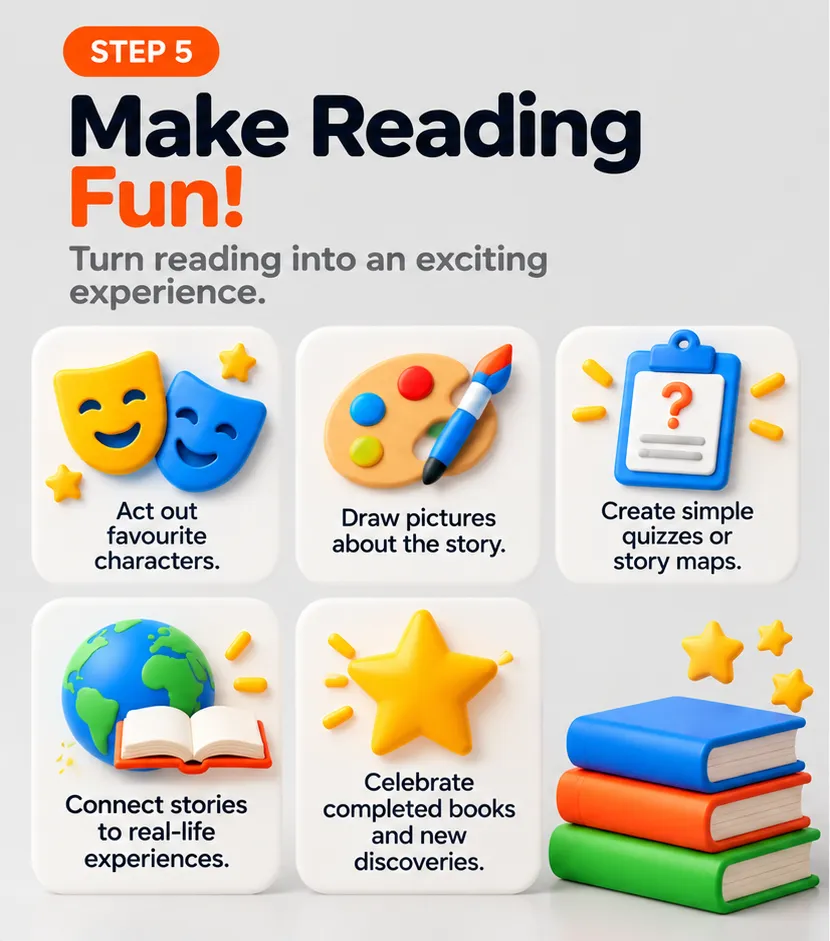

- Act out favourite characters. Voices, costumes and puppet shows turn a story into a game.
- Draw pictures about the story. A comic strip of the best scene or a map of the setting.
- Make simple quizzes or story maps. Children love setting questions for adults.
- Connect stories to real life. After a book about space, look at the night sky; after one about the sea, visit a beach or aquarium.
- Celebrate finished books. A sticker, a shelf of finished books or a family "book of the month".
Science-minded children can be drawn in by books that explain how things work. When they move on to textbooks, our tips on studying science from textbooks show them how to read for understanding.
Tip 9: Build a lifelong reading culture
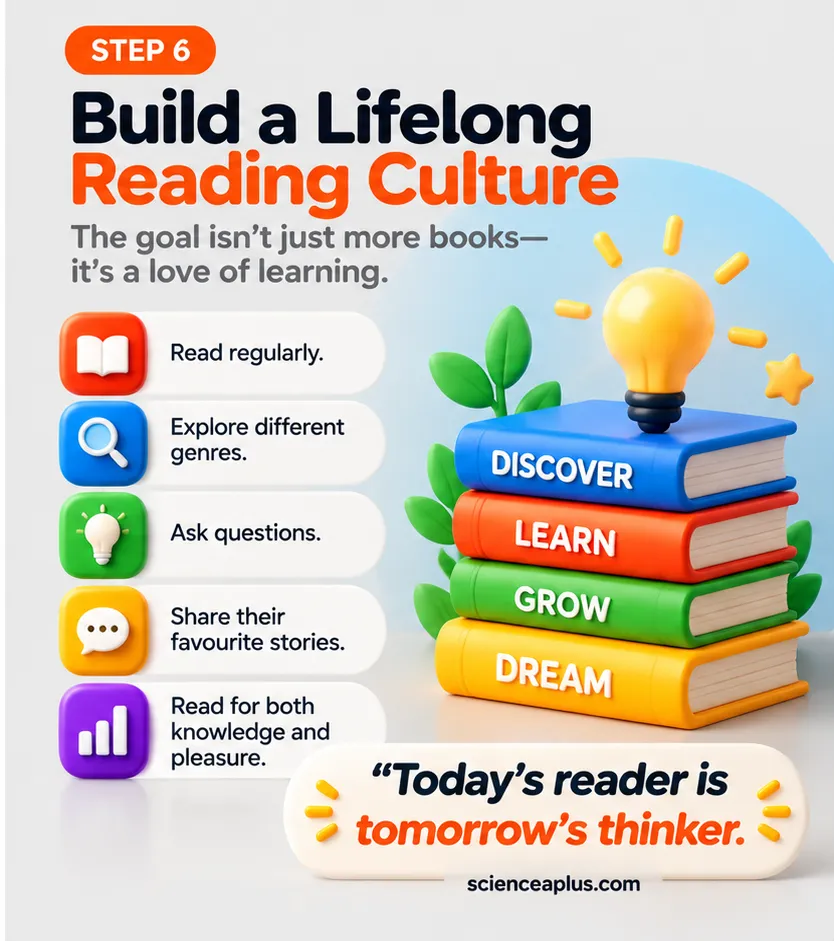
The goal is not just more books. It is a child who reads because they want to, for pleasure and for knowledge, for the rest of their life. Over time that means reading regularly, exploring different kinds of books, asking questions, sharing favourite stories and reading both to learn and to relax. Reading aloud, family book talk and a house full of books all help to make reading normal.
Quick check: your reading-habit plan
- We have a regular reading slot, even if it is only 10 minutes
- My child chooses most of their books
- We visit the library or swap books regularly
- There is a comfortable reading spot and books are easy to see
- I read aloud, and we talk about the story
- Screens are off or in another room during reading time
- I have spoken to school if reading seems unusually hard
Test yourself: reading habits
Frequently asked questions about children's reading habits
How can I get my child to read more?
Make reading short, daily and enjoyable. Let them choose books about their interests, read aloud together, keep books easy to reach and protect a regular slot, such as bedtime. Avoid pressure and punishments. Small, steady habits work better than occasional long sessions.
How much should a child read each day?
There is no official rule. Many families aim for about 15 to 20 minutes a day, which is easy to repeat. For a younger or reluctant child, start with five or ten minutes and build up. Regular reading matters more than the exact length of time.
What can I do if my child hates reading?
Lower the stakes and change the type of reading. Try comics, magazines, audiobooks or books linked to a favourite hobby or film. Read the first chapter aloud and let them choose. If reading seems very hard, speak to the school about whether more support is needed.
Is it too late to improve reading habits in teenagers?
No. The National Literacy Trust's 2026 report found the biggest rise in enjoyment among 14 to 18-year-olds. Offer choice, such as magazines, graphic novels, audiobooks and books linked to their interests. Leave books around, share recommendations and respect their independence.
Are audiobooks and comics really reading?
Yes, for building a reading habit. Children who say they do not enjoy reading still read comics, song lyrics, news and fan fiction. These formats build vocabulary and interest, and can lead to longer books. Audiobooks also let children enjoy stories that are above their independent reading level.
Should I keep reading aloud to older children?
Yes. BookTrust advises parents to keep reading aloud as children get older. A chapter of a longer book at bedtime lets you share stories above their own reading level and keeps books linked with time together. It also gives you a chance to talk about ideas.
What is the phonics screening check?
It is a short statutory assessment taken by Year 1 pupils in England, usually aged 6. Children read 40 words and the pass mark is 32. In 2024/25, 80% of pupils met the expected standard. It shows whether a child is on track to decode words.
What are the signs of dyslexia in children?
The NHS lists reading below the expected level for their age, messy written work with many spelling mistakes, slow and hesitant reading aloud, trouble with numbers and time, and difficulty organising schoolwork. These signs do not prove dyslexia. Speak to the school's SENCO for screening and advice.
Does screen time stop children reading?
Screens compete for free time, and the OECD notes that falling reading for enjoyment has coincided with greater digitalisation and screen time. Screens do not have to replace books, though. Protect a daily reading slot, keep devices out of the bedroom at bedtime and use screen interests as a bridge to books.
How can libraries help my child's reading?
Libraries remove the cost of choosing books, so children can try new authors and genres for free. Many offer story sessions and reading challenges, and librarians can recommend books. BookTrust also notes that free Bookstart packs for young children are available through health visitors and libraries.