Look up at the night sky and it seems calm and unchanging. It is not. The space between distant galaxies is stretching, and since about 5 billion years ago that stretching has been getting faster. Whatever is behind this speed-up is called dark energy, and nobody yet knows what it really is.
What is dark energy? Dark energy is the name for the unknown cause of the accelerating expansion of the universe. It makes up about 68–69% of everything in the cosmos, yet we cannot see it, touch it or collect it. We only know it exists because of what it does to the expanding universe on the very largest scales.
What is dark energy?
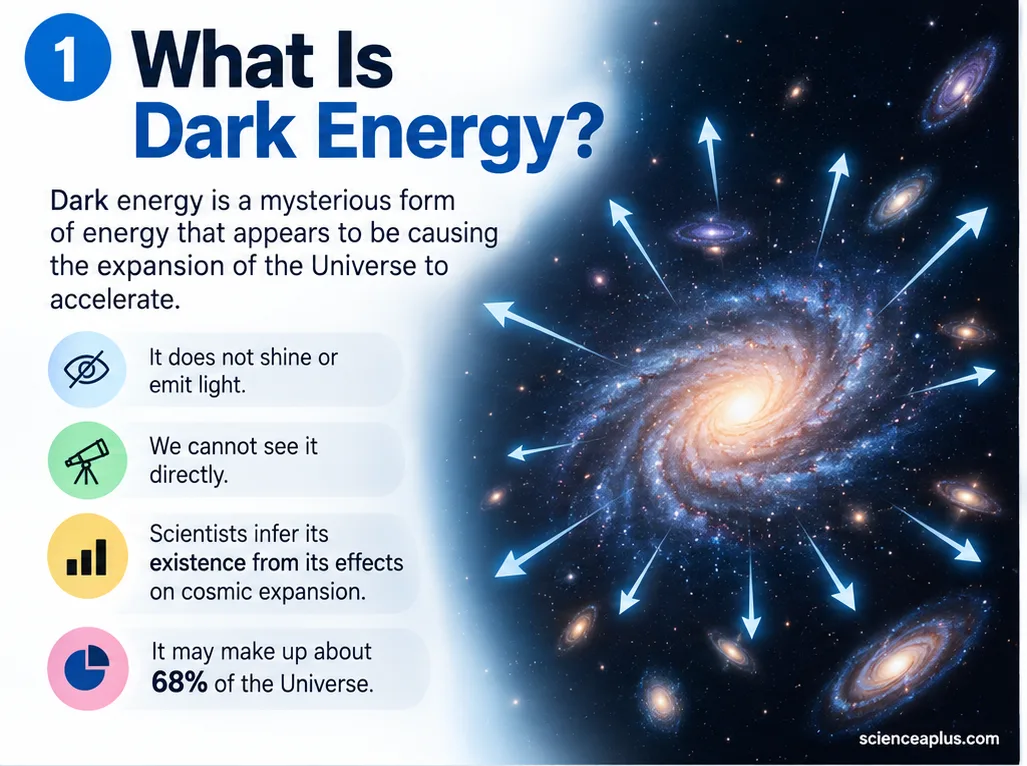
The universe is about 13.8 billion years old. For most of that time, gravity has been the main character in the story. Matter pulls on other matter, so you would expect the expansion that began with the Big Bang to slow down as everything tugs on everything else.
That is not what we see. Instead, the expansion is accelerating. Something is pushing space apart faster and faster, and it is strong enough to beat the combined pull of all the matter in the universe. Michael Turner coined the name “dark energy” in 1998 for this mysterious something.
The word “dark” here means “unknown”, not “evil” or “black”. Dark energy does not give out light, absorb light or block it. It is detected only through its effect on how the universe grows over billions of years.
Measurements from the Planck satellite (2018 results) give this rough breakdown of the universe:
- about 68–69% dark energy
- about 26–27% dark matter
- only about 5% ordinary matter: the atoms that make up stars, planets and you
So everything you have ever seen through a telescope is a tiny fraction of what is out there. Dark energy is also very thinly spread. Its density is equivalent to roughly 10−26 kg per cubic metre, about a few hydrogen atoms in every cubic metre of space. It only wins out because space is so unimaginably huge.
The universe is expanding
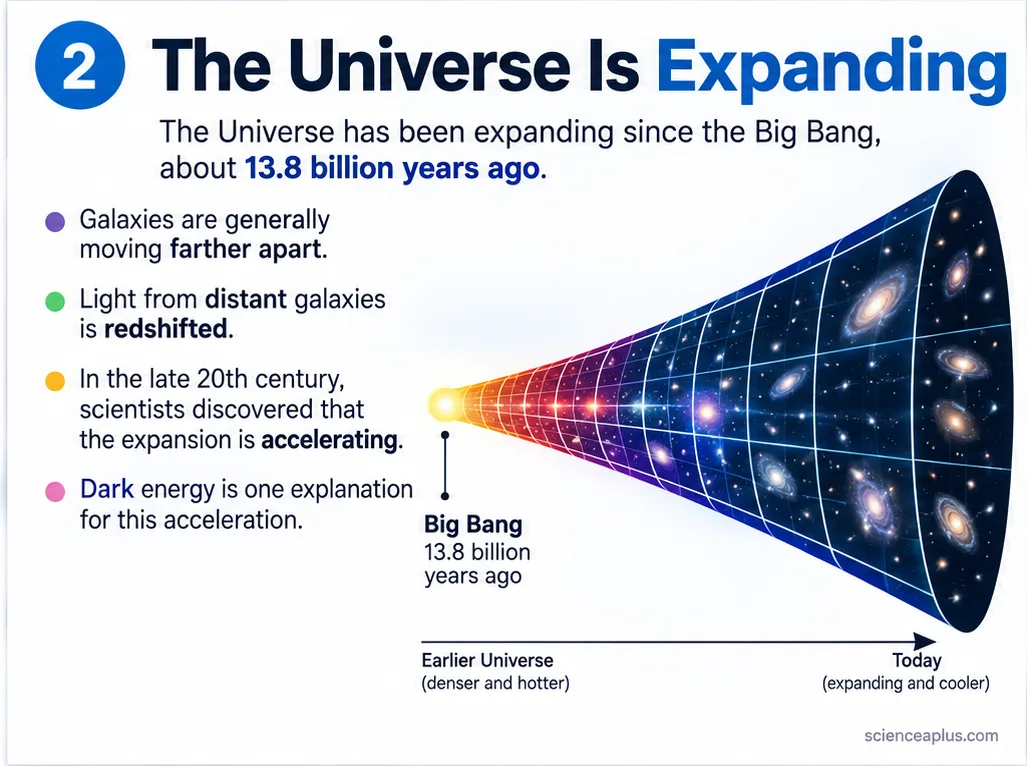
To understand dark energy, you first need to understand the expanding universe itself. The idea is simple to state and astonishing to take in: the galaxies are not moving through space like cars along a road. Space itself is stretching, carrying the galaxies apart.
A common picture is a balloon covered in dots. As you blow it up, every dot moves away from every other dot, and the further apart two dots are, the faster they separate. No dot sits at the “centre”. Every galaxy sees the others receding.
The idea came together in the late 1920s. Georges Lemaître proposed it in 1927, and Edwin Hubble published convincing observations in 1929. Both noticed that distant galaxies appear to be rushing away from us, and the further away they are, the faster they go.
Red-shift: the evidence
How can anyone tell how fast a galaxy far away is moving? The answer is red-shift, and it is a key idea in GCSE physics.
Light behaves as a wave. If the source of a wave is moving away from you, the waves arrive stretched out, with a longer wavelength. For visible light, longer wavelengths are towards the red end of the spectrum. So light from a receding galaxy is shifted towards the red. The faster the galaxy is receding, the bigger the shift.
When astronomers split the light from galaxies into spectra, they find the same pattern of dark lines in every galaxy, but shifted. Almost every distant galaxy shows red-shift, and the more distant the galaxy, the larger the shift. That tells us the universe is expanding.
If you want a wider view of how these ideas fit together, our article on the beauty of cosmology explores how scientists piece together the story of the universe.
The Hubble–Lemaître law
Hubble and Lemaître’s observations can be summed up in a single, neat relationship. The speed at which a galaxy moves away from us is proportional to its distance from us:
v = H₀ × d
Here v is the galaxy’s recession speed, d is its distance, and H₀ is the Hubble constant. The Hubble constant is measured in kilometres per second per megaparsec (km/s/Mpc). One megaparsec is about 3.26 million light-years.
The value of H₀ is currently around 67–68 km/s/Mpc if measured from the early universe using the cosmic microwave background, and about 73 km/s/Mpc from nearby galaxies. That disagreement is a puzzle in its own right, called the Hubble tension, which we come back to later.
In everyday terms, take H₀ ≈ 70 km/s/Mpc. A galaxy 100 Mpc away (about 326 million light-years) would be receding at around 7,000 km/s. Try your own numbers in the calculator below and see how speed changes with distance and with different values of H₀.
Even within our own neighbourhood, galaxies in the Local Group are held together by gravity. Only on huge scales, across millions of light-years and more, does the stretching of space win, and that is exactly where dark energy makes its mark.
The 1998 surprise: the expansion is speeding up
Through most of the twentieth century, astronomers expected the expanding universe to be slowing down. Gravity is an attractive force, and all the matter in the universe should be pulling the galaxies back towards each other. The only open question was how quickly the slowdown was happening, and whether it would ever stop.
In 1998, two rival teams set out to measure that slowdown. The Supernova Cosmology Project was led by Saul Perlmutter. The High-Z Supernova Search Team included Brian Schmidt and Adam Riess. Both teams studied very distant exploding stars, and both reached the same shocking answer: the expansion is not slowing down. It is accelerating.
Type Ia supernovae: cosmic standard candles
The teams used type Ia supernovae. These are explosions of white dwarf stars, and they reach nearly the same peak brightness every time. That makes them standard candles: if you know how bright a candle really is, how dim it looks tells you how far away it is.
The teams found that distant type Ia supernovae were fainter than expected. They were further away than a slowing, or even a steady, expansion could explain. Space had stretched more than predicted while their light was travelling to us, so the expansion must have sped up along the way.
The discovery earned Perlmutter, Schmidt and Riess the Nobel Prize in Physics in 2011. Later work suggests the acceleration began about 5 billion years ago. Before that, the gravity of matter was still winning and slowing the expansion down.
Scientists needed a name for whatever was driving this acceleration. In 1998 the cosmologist Michael Turner coined the term dark energy. It is a label for an unknown cause, not a description of a known substance.
How do we know dark energy exists?
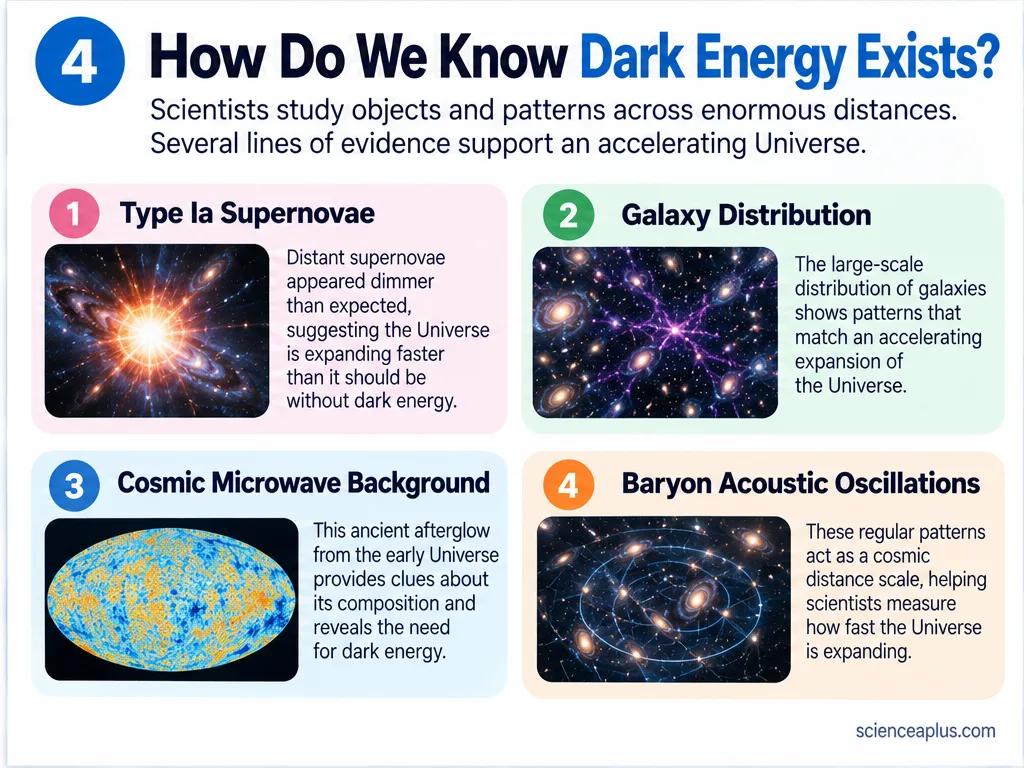
Supernovae were the first clue, but a single measurement is never enough in science. Today, several independent methods all point towards the same conclusion. Here is how we know dark energy exists.
| Evidence | What it shows |
|---|---|
| Type Ia supernovae | Distant explosions look fainter than expected, so the expansion has been accelerating for the last 5 billion years or so. |
| Cosmic microwave background (CMB) | Maps from WMAP and Planck show the universe is geometrically flat. That needs more energy than matter alone can supply. |
| Baryon acoustic oscillations (BAO) | Galaxies show a preferred spacing of about 500 million light-years (≈150 Mpc), a “standard ruler” that reveals how space has stretched over time. |
| Large-scale structure and gravitational lensing | How clusters of galaxies grow, and how they bend light, matches a universe with dark energy. |
The CMB is the oldest light we can see, released when the universe was young. Its patterns tell us about the overall geometry of space. Together with the supernova results, it makes the case for dark energy much stronger than either one alone.
BAO work in a similar way to the supernovae, but with a ruler instead of a candle. Sound waves rippled through the early universe and left a faint pattern in where galaxies tend to form. Because we know the real size of that pattern, measuring its apparent size at different distances shows how the universe has expanded.
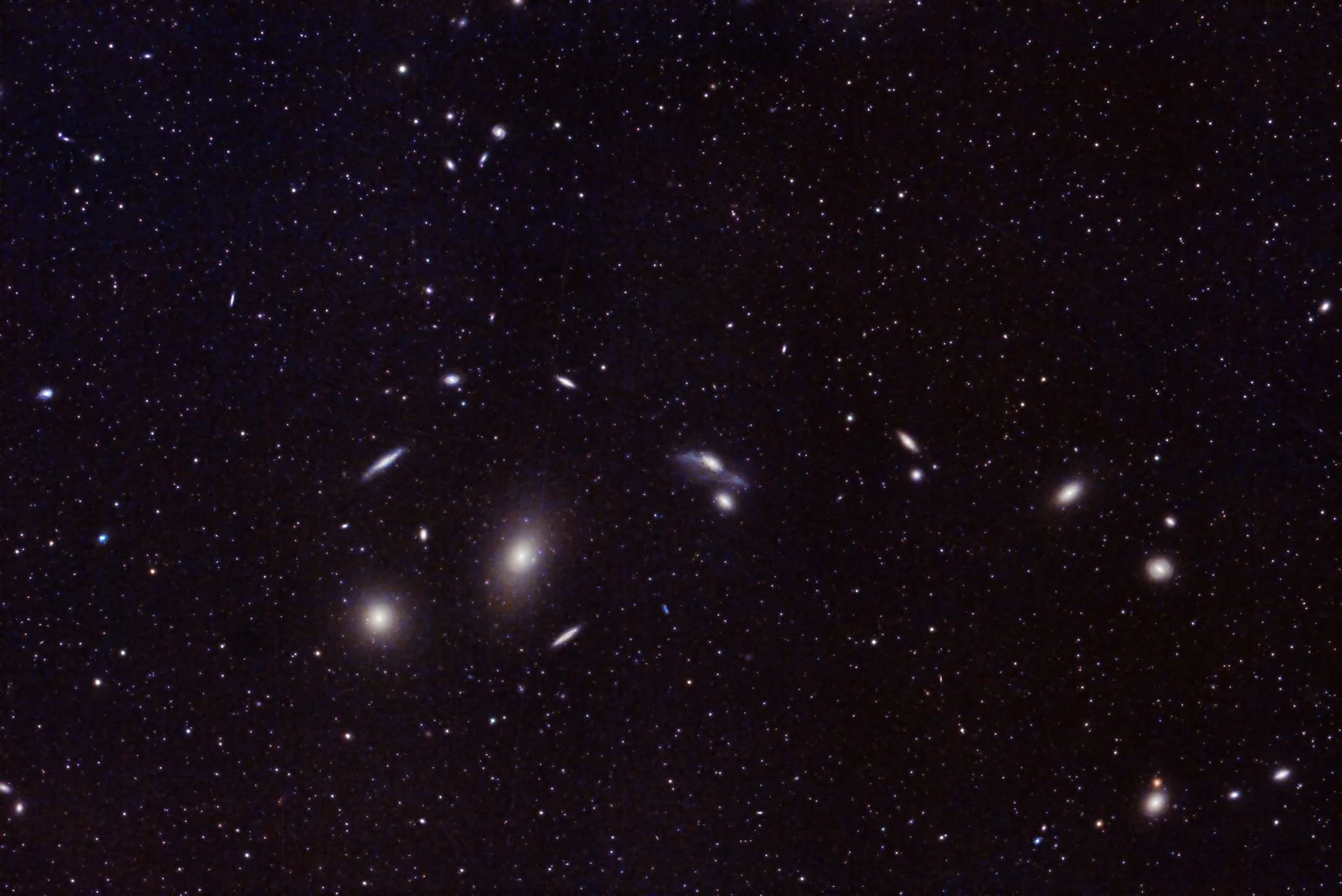
Notice that no single line of evidence has to carry the whole argument. The supernovae measure the expansion directly. The CMB measures the shape of space. BAO and large-scale structure check both against the distribution of galaxies. When separate methods agree, scientists become far more confident.
What is the universe made of?
Once you accept that dark energy exists, you can ask how much of it there is. Measurements from the Planck satellite give a clear answer, and it is a humbling one. The universe is about 13.8 billion years old, and the matter we know best makes up only a small slice of it.
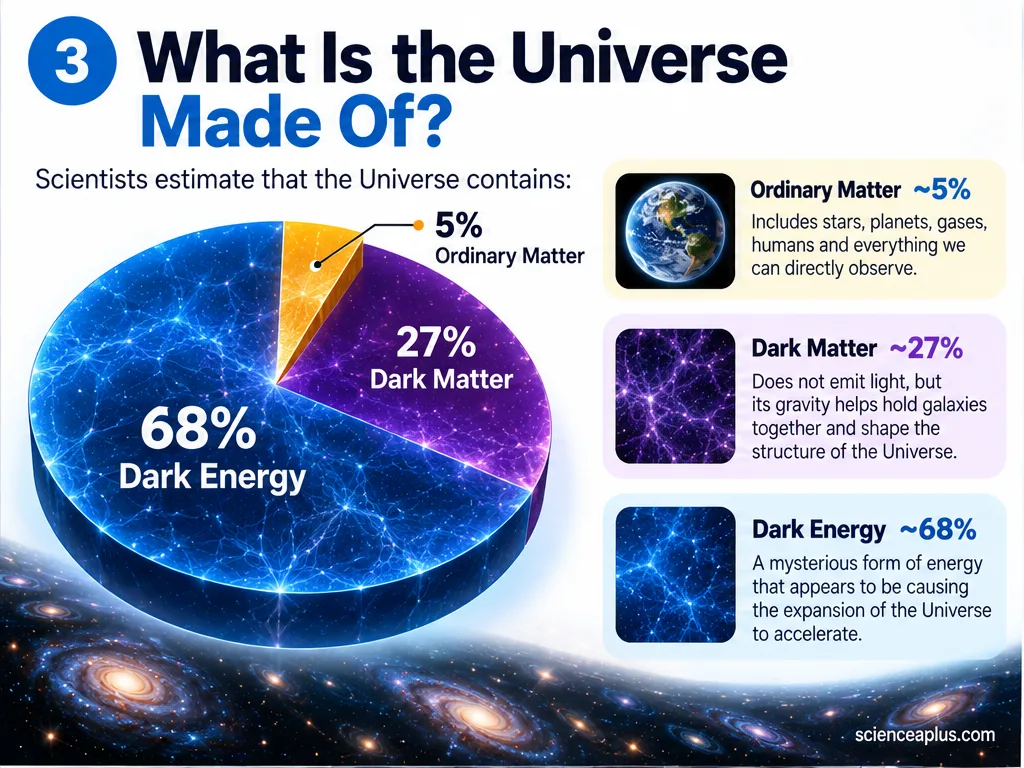
| Ingredient | Share of the universe | What we know |
|---|---|---|
| Dark energy | about 68–69 % | Drives the accelerating expansion. Its nature is unknown. |
| Dark matter | about 26–27 % | Invisible, but its gravity holds galaxies together. Its nature is unknown. |
| Ordinary (baryonic) matter | about 5 % | Atoms: stars, planets, gas, and us. |
So when people ask what percentage of the universe is dark energy, the answer is roughly 68–69 %. Everything made of atoms, including every star and galaxy you have ever seen in a photograph, adds up to only about 5 %. If you are curious about that visible 5 %, our guide to the most common element in the universe looks at what ordinary matter is mostly made from.
It may seem odd that something so thin can beat gravity. But in the early universe, matter was packed more tightly, so gravity dominated and slowed the expansion. As space grew, matter thinned out. Dark energy, which stays constant per volume in the leading explanation, did not thin out. Eventually it took over, which fits the date of about 5 billion years ago for the start of the acceleration.
Next, we will compare dark energy with its better-known cousin, dark matter, and look at what scientists think dark energy might actually be.
Dark energy vs dark matter: what is the difference?
The names sound similar, and both are invisible, so people often mix them up. They are two separate puzzles. Dark matter adds extra gravity that pulls things together. Dark energy does the opposite job on the largest scales: it drives the accelerating expansion of the universe.
Neither is understood. Both are named from what they do, not from what they are. Here is how they compare.
| Feature | Dark matter | Dark energy |
|---|---|---|
| Share of the universe (Planck 2018) | About 26–27 % | About 68–69 % |
| Effect | Pulls: extra gravity | Pushes: speeds up the expansion |
| Where it matters | In and around galaxies and clusters | Across the vast gaps between galaxies |
| Main evidence | Galaxy rotation curves and gravitational lensing | Faint distant type Ia supernovae, the CMB, baryon acoustic oscillations |
| Visible in light? | No | No |
| Understood? | No | No |
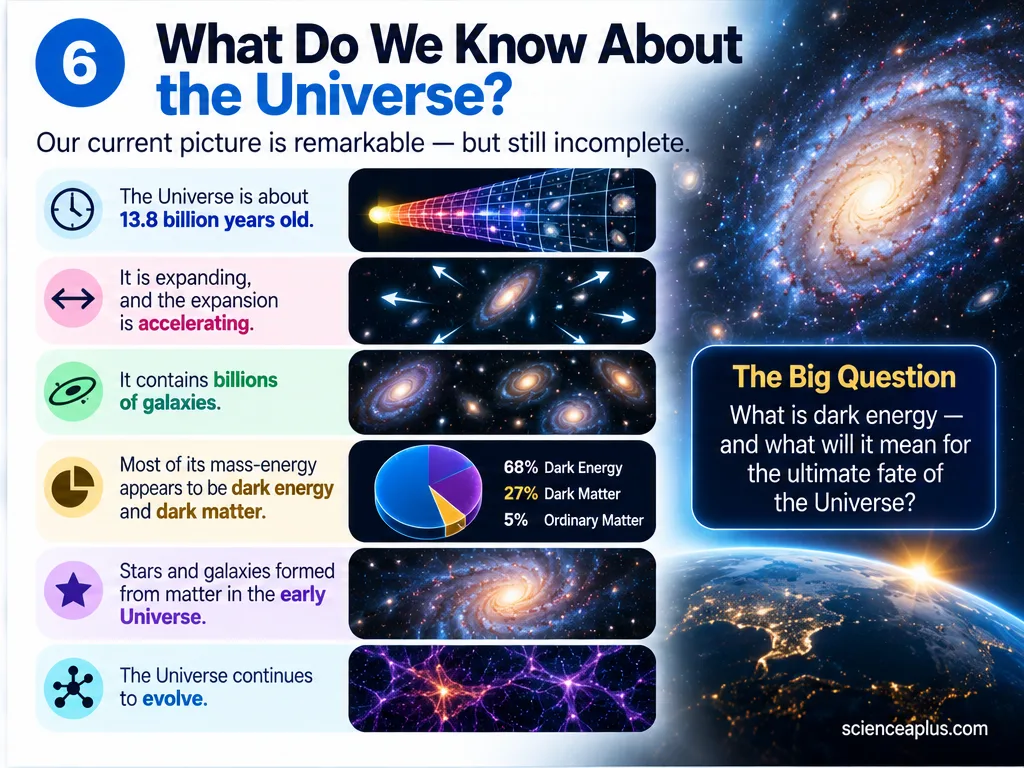
Ordinary matter, the stuff that makes up stars, planets and you, is only about 5 % of the total. Together, dark matter and dark energy make up roughly 95 % of everything.
What could dark energy be?
Nobody knows what dark energy is. The term was coined by Michael Turner in 1998, soon after the supernova discovery. Physicists have three main ideas, and each makes different predictions for the future.
The cosmological constant
The leading explanation is the cosmological constant, written Λ (lambda). Einstein added it to his equations in 1917 to keep the universe static. When the expansion was discovered, he reportedly called it his “biggest blunder”, according to George Gamow’s account.
Today Λ is read as vacuum energy, the energy of empty space itself. Its density stays constant. Because the density does not thin out as space grows, a bigger volume means more total dark energy. That is why it only began to win out over gravity once matter had spread thin, about 5 billion years ago.
The density is tiny: about 10-26 kg per cubic metre, equivalent to a few hydrogen atoms in each cubic metre. It only matters across vast volumes.
There is a serious problem. Quantum theory predicts a vacuum energy about 10120 times larger than the value we observe. This has been called the worst prediction in physics.
Quintessence
Quintessence proposes that dark energy is a dynamical field, something whose strength changes over time. Unlike a true constant, it could grow or fade as the universe ages. This matters now because recent DESI results hint that dark energy might be weakening, although that is not confirmed.
Modified gravity
A third idea says there is no dark energy at all. Instead, gravity itself might behave differently on cosmic scales, so Einstein’s general relativity would need adjusting. Any such theory must still match everything we already measure, including the CMB and the growth of galaxy clusters.
Testing general relativity is a theme across modern astrophysics. Black holes are one extreme test of it, as explored in our article on what black holes can teach us.
Flip cards: key dark energy terms
Test your recall of the six terms that come up most often. Try to answer before you tap.
The Hubble tension: two ways to measure the expanding universe
The expanding universe has a speed limit problem. The Hubble constant, H₀, tells us how fast space is stretching at the present day, and astronomers can measure it in two very different ways. The trouble is that the answers do not match.
Start with the early universe. The Planck satellite studied the cosmic microwave background and, using our standard model, predicts H₀ ≈ 67–68 km/s/Mpc. Now look locally. Cepheid variable stars and type Ia supernovae (the SH0ES project) give H₀ ≈ 73 km/s/Mpc. One megaparsec is about 3.26 million light-years, so these figures are speeds per huge distance.
That gap is the Hubble tension. It is bigger than the errors claimed by either team, and nobody has yet explained it. It might be a hidden measurement error. It might also mean that something is missing from our model, possibly including how dark energy behaves.
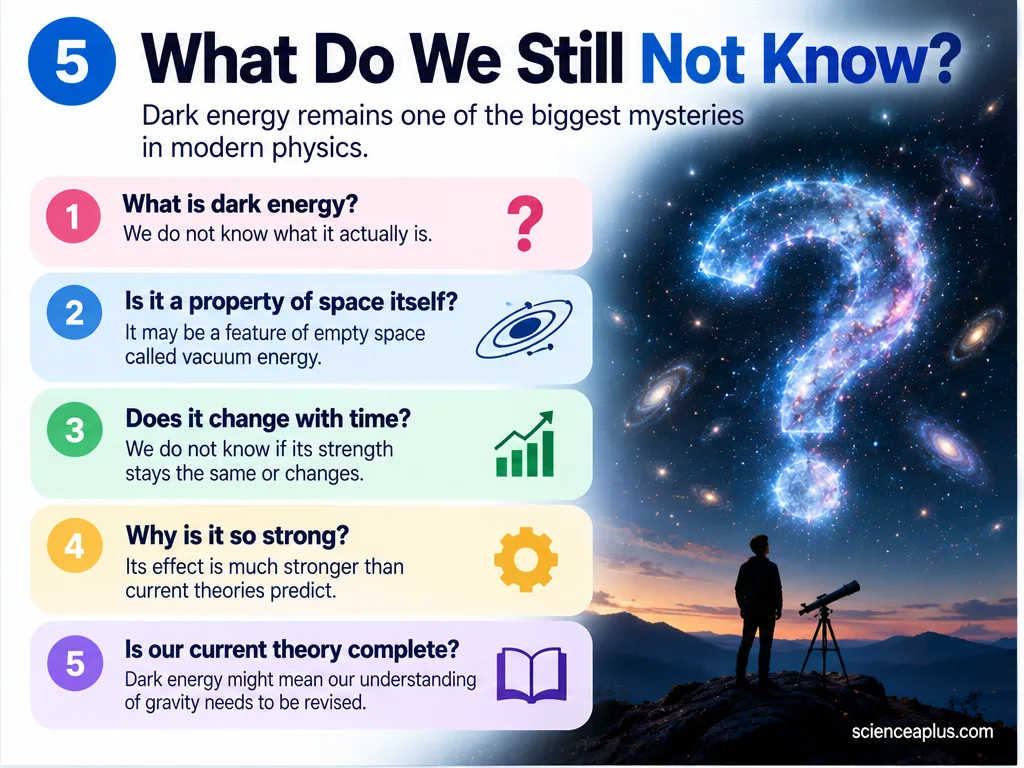
New clues: DESI, Euclid, Rubin and Roman
The next few years should tell us far more about dark energy. Several huge surveys are mapping the sky in three dimensions, so we can watch how the accelerating expansion has changed over cosmic time.
The Dark Energy Spectroscopic Instrument (DESI), at Kitt Peak in Arizona, released results in 2024 and again in March 2025 (its second data release, DR2). They hint that dark energy may be weakening over time rather than staying constant. The evidence is about 2.8–4.2 sigma, depending on which datasets are combined. That is below the 5-sigma standard for a discovery, so it is not confirmed. It is an exciting hint, not a result.
Other telescopes are joining in:
- Euclid – the European Space Agency’s telescope, launched on 1 July 2023, is mapping billions of galaxies.
- Vera C. Rubin Observatory – released its first images in June 2025 and is carrying out its ten-year Legacy Survey of Space and Time (LSST).
- Nancy Grace Roman Space Telescope – NASA’s mission, launched on 30 August 2026 and now on its way to the Sun–Earth L2 point.
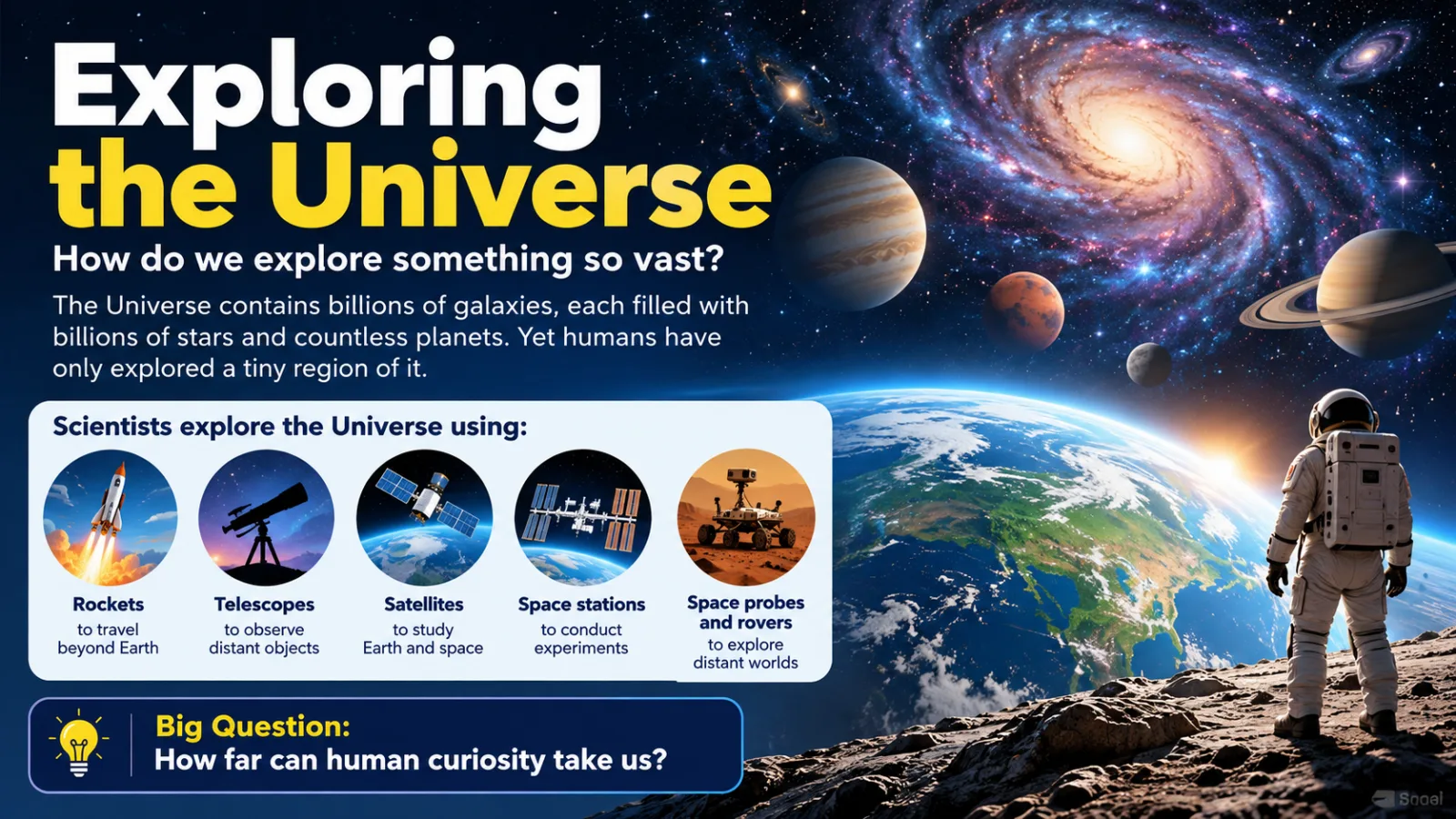
Space telescopes such as the James Webb Space Telescope look deep into the past, while these surveys count and measure galaxies on a grand scale. You can read about the wider toolkit in our guide to exploring the universe with rockets, telescopes and satellites.
How will the universe end? It depends on dark energy
The long-term fate of the universe hangs on what dark energy does next. Each possible ending is a different answer to that question.
- Big Freeze (heat death): if dark energy stays constant, expansion continues forever. Galaxies outside our Local Group eventually disappear from view, and the universe grows cold and dark.
- Big Rip (speculative): if dark energy grows stronger over time, it could eventually overwhelm gravity’s grip.
- Big Crunch (speculative): if dark energy weakens or even reverses, expansion might one day turn around.
The Big Freeze is the favourite for now, because a constant cosmological constant fits current data well. The other two are possibilities, not predictions.
Nothing here is imminent. Gravity still holds our galaxy and the solar system (see how our solar system formed) together, and the familiar constellations will look the same to us in our lifetimes (how many constellations are there?).
Why can’t we just ‘see’ dark energy? (2 marks)
Dark energy does not give out, absorb or reflect light, so telescopes cannot image it directly. We only detect it through its effect: it makes distant type Ia supernovae look fainter than expected and changes the way galaxies are spread across the universe.
Test yourself: dark energy quiz
Key points: what to remember about dark energy
- Dark energy makes up about 68–69% of the universe and drives its accelerating expansion.
- The Hubble constant is about 67–68 km/s/Mpc from the early universe but about 73 from local measurements: the Hubble tension.
- DESI hints that dark energy may weaken over time, but at 2.8–4.2 sigma it is not confirmed.
- Euclid, Rubin and Roman will test these ideas with billions of galaxies.
- The universe’s fate (Big Freeze, Big Rip or Big Crunch) depends on how dark energy behaves.
Frequently asked questions about dark energy
What is dark energy in simple terms?
Dark energy is the name for whatever is making the expansion of the universe speed up. We cannot see it or touch it. We only know it exists because distant supernovae and other measurements show space stretching faster over time than gravity alone would allow.
What percentage of the universe is dark energy?
Planck satellite data from 2018 suggests about 68–69% of the universe is dark energy. Around 26–27% is dark matter and only about 5% is ordinary matter, the atoms that make up stars, planets and people. Most of the universe is therefore unexplained.
How do we know dark energy exists?
Several lines of evidence agree. In 1998 distant type Ia supernovae looked fainter than expected, showing acceleration. The cosmic microwave background shows a flat universe needing more energy than matter provides. Baryon acoustic oscillations, gravitational lensing and the growth of structure also fit.
What is the difference between dark energy and dark matter?
Dark matter pulls: its gravity holds galaxies together, and we infer it from galaxy rotation curves and gravitational lensing. Dark energy pushes: it drives the accelerating expansion of the universe. Both are invisible and neither is yet understood, but they do opposite jobs.
Who discovered dark energy?
Two teams found the acceleration in 1998: the Supernova Cosmology Project led by Saul Perlmutter, and the High-Z Supernova Search Team of Brian Schmidt and Adam Riess. They shared the 2011 Nobel Prize in Physics. Michael Turner coined the term “dark energy” in 1998.
What is the cosmological constant?
The cosmological constant (Λ) is the leading explanation for dark energy. Einstein added it in 1917 to keep the universe static. Today it represents vacuum energy, the energy of empty space, which stays constant per volume. Quantum theory predicts a value about 10120 times too large.
What is the Hubble tension?
The Hubble tension is the mismatch between two measurements of how fast the universe is expanding. Early-universe data from Planck gives about 67–68 km/s/Mpc, while local measurements using Cepheids and supernovae give about 73. Scientists do not yet know why they disagree.
Is dark energy getting weaker?
Possibly, but this is unconfirmed. DESI results from 2024 and March 2025 hint that dark energy may weaken over time. The evidence is about 2.8–4.2 sigma depending on the data used, below the 5-sigma standard for discovery. More data from Euclid and Rubin should help.
Will the universe end in a Big Rip?
A Big Rip is speculative. It would only happen if dark energy grew stronger over time. If dark energy stays constant, the likely end is a Big Freeze, with endless expansion. If it weakens or reverses, a Big Crunch becomes possible. Current evidence does not point to a Big Rip.