Why are listening skills important for education? Listening is how much classroom learning arrives: explanations, instructions, questions and discussion all reach you through your ears first. Good listeners understand more, follow tasks correctly, work better in groups and give stronger answers. UK evidence now treats speaking and listening as a core skill, not an extra.
This guide explains the importance of listening skills for education: what listening is, what UK research and policy say, how it links to memory and reading, and practical steps for students, teachers and parents — plus two popular myths to avoid.
What are listening skills?
Listening skills are the abilities you use to receive a spoken message, hold it in mind and make sense of it. The Skills Builder Universal Framework, used by many UK schools and employers, lists listening as one of eight essential skills and defines it as “the receiving, retaining and processing of information or ideas”. Notice the three parts: you take the message in, you keep hold of it, and you think about it.
Hearing vs listening
Hearing and listening are not the same thing. Hearing is physical: your ears detect sound whether you want them to or not. Listening is mental: you choose to pay attention, interpret the words and connect them with what you already know. You can hear a whole lesson and still not listen to it.
That difference is good news: listening is a skill, so it can be taught, practised and improved. A student who “never listens” is often being let down by distractions, tiredness, missing strategies or (sometimes) a hearing problem.
The parts of good listening
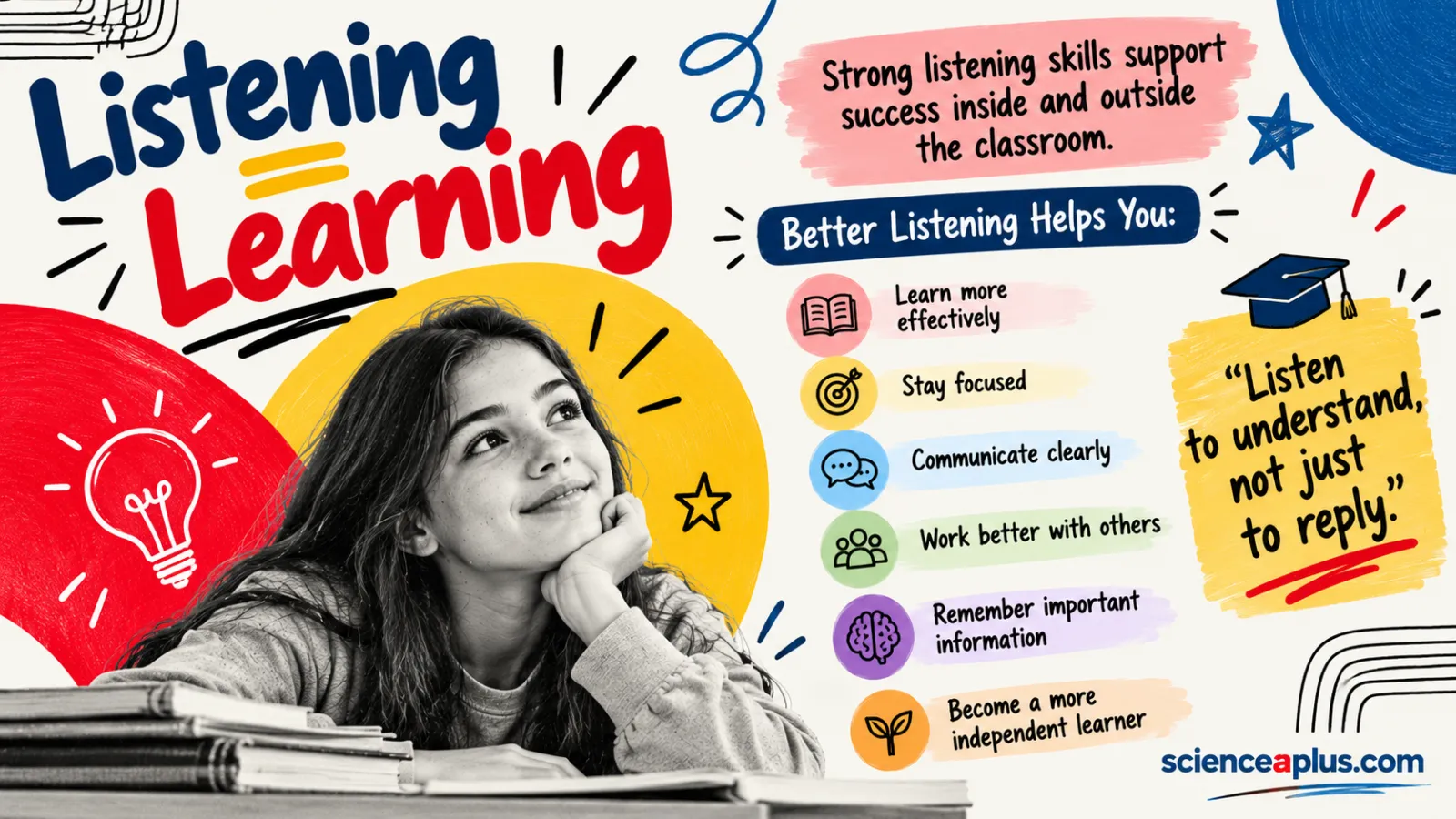
Listening in school is more than sitting still and being quiet. A good listener usually does several things at once:
- Attends — focuses on the speaker and blocks out distractions.
- Understands — works out the meaning, including unfamiliar words and the main point.
- Remembers — holds the key information long enough to use it, often with help from notes.
- Evaluates — asks “Does this make sense? Is the evidence good?”
- Responds — asks a question, builds on an idea or acts on an instruction.
The last step matters. Listening and speaking are partners: the quality of what you say in a discussion depends on how carefully you listened first. That is why many schools now teach them together, alongside reading and writing. If you want to see how spoken and written communication fit together, read our guide to oral and written communication skills for students.
Why listening skills are important in education
Almost everything in a classroom passes through listening at some point. Teachers explain new ideas aloud, give safety instructions before practicals, ask questions and respond to answers. Classmates share ideas in pairs and groups. Even in a lesson built around reading, you still listen to how the task works and to feedback on your work.
Here are the main reasons listening skills for education matter so much:
- Understanding new content. Explanations often include examples, warnings and links to earlier topics that are not in the textbook.
- Following instructions. Missing one step in a method or an exam question can cost marks, time or safety.
- Learning through discussion. Talking ideas through with others helps you test and deepen your understanding — but only if you listen to what they say.
- Using feedback. Spoken feedback is only useful if you take it in and act on it.
- Relationships and wellbeing. Feeling listened to builds trust between students, teachers and parents.
- Future work. Employers often rank listening among the essential skills for work.
Teachers are listeners too. Strong teachers listen to students’ answers to spot misconceptions, notice who is struggling and adjust the lesson. Listening carefully is one of the qualities we explore in what makes an effective teacher.


What the UK evidence says about listening and oracy
In UK schools, listening is usually discussed under the word oracy. Oracy means being able to express yourself well in speech and to listen and respond well to others. Over the last two years it has moved from a “nice extra” towards the centre of education policy in England.
The Oracy Education Commission (2024)
In October 2024 the Oracy Education Commission, chaired by Geoff Barton (a former English teacher, headteacher and general secretary of the Association of School and College Leaders), published its report We need to talk. It defined oracy as “articulating ideas, developing understanding and engaging with others through speaking, listening and communication”. Its headline recommendation was that oracy should become the “fourth R”, with equal status to reading, writing and arithmetic.
The Commission split oracy education into three overlapping parts: learning to talk, listen and communicate; learning through talk, listening and communication; and learning about talk, listening and communication. It also argued that speaking and listening skills are essential foundations for reading and writing.
The Curriculum and Assessment Review (2025)
The independent Curriculum and Assessment Review, chaired by Professor Becky Francis, published its final report on 5 November 2025 and recommended a national oracy framework. In its response, the government said it will create a new oracy framework for primary schools and a combined oracy, reading and writing framework for secondary schools. It also promised clearer expectations in the English curriculum, particularly for speaking, listening and drama. The revised national curriculum is due to be published in 2027 for first teaching from September 2028.
The Education Endowment Foundation (EEF)
The EEF’s Teaching and Learning Toolkit summarises research on what works in classrooms. It rates oral language interventions — approaches built on spoken interaction between teachers and pupils and between peers — as high impact for very low cost, with an average of about +6 months’ additional progress. Many of the studies measure literacy outcomes such as reading comprehension, which shows how closely talk, listening and reading are linked.
| Source | Year | What it says about listening |
|---|---|---|
| Oracy Education Commission, We need to talk | 2024 | Oracy (speaking, listening, communication) should be the “fourth R” |
| Curriculum and Assessment Review + government response | 2025 | New oracy frameworks; clearer speaking and listening in English from 2028 |
| EEF Toolkit: oral language interventions | Ongoing | High impact, very low cost, about +6 months’ progress |
| EEF, Improving Literacy in Secondary Schools | 2019 | Provide opportunities for structured talk in every subject |
| Voice 21 Oracy Framework | Ongoing | Listening sits in the social and emotional strand of oracy |
How listening improves learning
Listening is not just a polite habit. It is one of the main routes by which new knowledge gets into long-term memory. When you listen carefully, you notice the key idea, connect it to what you already know and spot the parts you don’t understand yet. When you only half-listen, the information never gets properly processed, so there is nothing to remember later.

Listening and your working memory
Spoken information is fleeting. Unlike a page of a textbook, you can’t scroll back through a sentence your teacher said a minute ago. Your brain has to hold it briefly in working memory — a small mental “notepad” we use to keep information in mind while we think about it. Working memory has a limited capacity, so long, fast or complicated speech can easily overload it.
Psychologists Susan Gathercole and Tracy Packiam Alloway, whose classroom guide on working memory is widely used in UK schools, found that children with poor working memory often fail to follow instructions not because they are naughty or lazy, but because the information is lost from memory before they can use it. That is a useful reminder for students and teachers alike: listening problems are often memory overload problems.
The good news is that you can work with your working memory rather than against it. Writing down key words, asking for an instruction to be repeated, and turning what you heard into a quick summary all free up mental space. You can find more science-backed techniques in our guide to improving memory for learning and exams, and more about how your brain processes information in neuroscience and the brain.
Listening is a building block for reading and writing
Spoken language comes before written language. Children learn thousands of words by hearing them in conversation and stories long before they can read them. Later, the vocabulary and sentence patterns you have heard make reading easier, and reading in turn adds new words to your spoken vocabulary.
That link is why the Oracy Education Commission described speaking and listening as essential foundations for reading and writing, and why the EEF’s evidence on oral language approaches is measured mainly through reading comprehension. In secondary school this continues subject by subject: science, history and maths each have their own vocabulary, and hearing a teacher use words such as osmosis, bias or coefficient correctly in context helps you understand and use them yourself.
Listening can be taught: the evidence
Can you actually get better at listening, or are some people just “good listeners”? Research says it can be taught. In a 2010 study published in the journal Language Learning, Larry Vandergrift and Marzieh Tafaghodtari followed 106 university students learning French as a second language for one semester. One group was taught a simple listening cycle:
- Predict — before listening, think about what you might hear.
- Monitor — while listening, check whether your predictions are right.
- Evaluate — afterwards, review what you understood and what you missed.
- Problem-solve — use clues and context to fill the gaps, then listen again.
The students taught this cycle significantly outperformed a comparison group on a listening test, and the less-skilled listeners improved the most. This kind of “thinking about your own thinking” is called metacognition. The study was about learning a language, but the same predict–monitor–evaluate habit works when you listen to any lesson.
Listening helps you follow instructions
A lot of lost marks and wasted time come down to instructions that were heard but not listened to. Teachers give instructions for tasks, homework, practical work, timed questions and exams — and they often give several steps at once.

Following instructions well involves three steps: listen to the whole instruction, think about what it is asking, then act. The most common mistake is starting to act after the first step, before the instruction has finished. In a science practical, that might mean adding a chemical before reading the safety warning or measuring the wrong quantity. In an exam, it might mean answering the question you expected instead of the one that was asked.
Tips for students
- Wait until the speaker has finished before you start — the most important detail is often at the end.
- Count the steps on your fingers or write them as a numbered list.
- Repeat the instruction back in your own words, either in your head or to a partner.
- If you missed part of it, ask straight away: “Could you repeat the second step, please?” That is a sign of a good listener, not a weak one.

Taking notes while you listen
Note-taking is one of the best ways to support listening, because it forces you to decide what matters. Good notes are not a transcript. Instead, listen for signal phrases such as “the key point is…”, “there are three reasons…” or “this often comes up in exams…”, and write short key words, arrows and questions. Leave space to add details afterwards from your textbook.
The real lesson from that old research is encouraging: forgetting is normal, so build in quick reviews. A two-minute recap at the end of the lesson and another look a few days later will help far more than trying to “listen harder” once.
Listening builds communication skills
Communication is a two-way street. A brilliant speaker in a group where nobody listens achieves very little. In lessons, group projects and debates, listening is what turns a set of separate opinions into a real conversation where ideas get tested and improved.

The Oracy Framework, developed by the charity Voice 21 with Oracy Cambridge and used in many UK schools, breaks oracy into four strands: physical (voice, body language), linguistic (vocabulary and language choices), cognitive (thinking, reasoning and building on ideas) and social and emotional (how you engage with others). Listening sits at the heart of the social and emotional strand, but it supports the cognitive strand too — you can’t build on someone’s idea if you didn’t hear it properly.
Listening in group work
Group work goes wrong when everyone is waiting for their turn to talk. It goes right when people listen, ask questions and connect ideas. Good group listeners:
- let each person finish before replying;
- refer back to what others said (“Building on Amira’s point…”);
- invite quieter members to contribute;
- disagree with the idea, not the person.
These habits also help teams cope with mistakes and setbacks — something we look at in growth mindset in teamwork for GCSE students.


Listening in debates and discussions
The EEF’s guidance report Improving Literacy in Secondary Schools recommends giving students opportunities for structured talk, such as preparing debates or presentations. Debate is an excellent listening workout: to rebut an argument you must first understand it accurately. A useful rule in class debates is that before you reply, you briefly summarise the other speaker’s point in your own words. If you need ideas to practise with, try our list of topics for a science debate.
Body language and tone still matter — they add to the words, but they don’t replace them.
Active listening: what it really means
Active listening is one of the most used phrases in education and careers advice. The term was popularised in 1957 by psychologists Carl Rogers and Richard Farson. They called it “active” because the listener has a definite job to do: rather than passively absorbing words, they try to grasp both the facts and the feelings in what is being said.
In the classroom, active listening usually involves these techniques:
Barriers to listening in school
Most people listen less well than they think, and the reasons are usually practical rather than a lack of effort. Common barriers include:
| Barrier | What it looks like | What helps |
|---|---|---|
| Phones and notifications | Checking a buzz mid-explanation and losing the thread | Phone away and on silent during lessons and study |
| Background noise | Chatter, corridor noise, poor acoustics | Sit nearer the speaker; agreed quiet signals |
| Tiredness and hunger | Drifting off, rereading the same line | Regular sleep, breakfast, short movement breaks |
| Thinking about your reply | Planning what you’ll say instead of listening | Note your idea, then return your attention |
| Assuming you know | “We’ve done this before” and tuning out | Listen for what is new or different this time |
| Hearing difficulties | Asking people to repeat things, struggling in noisy rooms | Tell a teacher; see a GP for a hearing check |
Listening skills for teachers
Teachers spend a large part of every day talking, but listening is just as important a teaching skill. Listening carefully to pupils’ answers — including the wrong ones — reveals misconceptions that a quick “Good, anyone else?” would miss. Waiting a few seconds after asking a question gives more pupils time to think before someone answers.
Teachers can also make listening easier for the class: speaking clearly, facing the room, cutting background noise and checking understanding by asking pupils to explain an idea back, rather than asking “Does everyone understand?” Looking after your own voice helps too, especially in noisy rooms; see our vocal hygiene tips for teachers.
How to become a better listener: 7 steps for students
Improving your listening skills doesn’t need special equipment or extra lessons. It is a set of small habits that you repeat until they become automatic. These seven steps work in lessons, revision sessions, online videos and conversations at home.

- Pay attention on purpose. Decide to listen before the speaker starts. Look at them and the board, not at the window.
- Avoid distractions. Phone away and on silent, laptop tabs closed, and sit where you can see and hear clearly.
- Don’t interrupt. Let the speaker finish. If an idea pops into your head, write one word to remind you and keep listening.
- Ask questions. A short clarifying question is the quickest fix for a gap in your understanding.
- Take notes. Key words, arrows and questions — not every word.
- Think about the message. Ask yourself: what is the main point, and how does it link to what I already know?
- Summarise the key points. At the end, say or write the main idea in one or two sentences.
Steps 6 and 7 are where listening turns into learning. Summarising forces your brain to retrieve and organise what you heard, which helps it stick better than simply hearing it once. For more on making that stick, read how to practise and remember what you study.
Your listening checklist
Tick these off during your next week of lessons. Your ticks are saved in your browser, so you can come back to them.
- I predicted what a lesson would cover before it started.
- I kept my phone away and on silent for a whole lesson.
- I waited for a full instruction before starting a task.
- I asked at least one clarifying question.
- I paraphrased a classmate’s idea before replying to it.
- I wrote key-word notes instead of copying everything.
- I summarised the main point of a lesson in one sentence.
Listening and the GCSE Spoken Language endorsement
Listening is assessed directly at GCSE. GCSE English Language in England includes a Spoken Language endorsement: a prepared, formal presentation followed by questions and feedback. It is reported as a separate grade — Pass, Merit, Distinction or Not Classified — and does not count towards your 9–1 grade, but it is shown as a separate line on your certificate.
Listening is built into the criteria. Students “must listen to and respond appropriately to questions and feedback”. The AQA criteria show how the listening part rises through the grades:
| Grade | Listening and responding criterion |
|---|---|
| Pass | Listens to questions/feedback and gives an appropriate response in a straightforward manner |
| Merit | Listens to questions/feedback, responding formally and in some detail |
| Distinction | Listens to questions/feedback, responds perceptively and, if appropriate, elaborates with further ideas and information |
Try these practice questions. Think of your own answer first, then tap to reveal a model answer.
Explain the difference between hearing and listening. (2 marks)
Hearing is the physical process of the ears detecting sound, which happens automatically. Listening is an active mental process: paying attention to the sound, interpreting its meaning and connecting it to what you already know.
Give two reasons why students may fail to follow a spoken instruction, and one way a teacher could help. (3 marks)
The instruction may overload working memory if it has too many steps; the student may be distracted (for example by a phone or noise) or start acting before the instruction ends. A teacher could break the instruction into smaller steps and back it up in writing on the board.
Listening at home and in revision
Listening skills are not just for school. More and more learning happens through videos, podcasts and recorded lessons, and the same habits apply. Pause a video to predict what comes next, write key-word notes, and summarise at the end instead of letting it play in the background.

At home, talking through what you learned that day — with someone who listens and asks one question — is a simple form of review.
Finally, good listening includes listening critically. When you hear a claim in a lesson, a video or a debate, ask what evidence supports it. That habit — the same one that led us to question the “25%” and “93%” myths in this guide — is at the heart of critical thinking in science education.
Frequently asked questions about listening skills in education
Why are listening skills important for students?
Listening skills help students understand new content, follow instructions accurately, learn from discussion and use spoken feedback. Much classroom teaching is delivered through talk, so students who listen actively catch the key points, examples and warnings that are easy to miss. Listening also supports reading, writing and good relationships with teachers and classmates.
What is the difference between hearing and listening?
Hearing is the physical process of your ears detecting sound, and it happens whether you want it to or not. Listening is an active mental process: choosing to pay attention, interpreting the words and connecting them to what you already know. You can hear a whole lesson without listening to it, but listening can be learned and practised.
What is active listening?
Active listening is a way of listening in which you work to understand both the facts and the feelings in what someone says. The term was popularised by psychologists Carl Rogers and Richard Farson in a 1957 pamphlet called Active Listening. Typical techniques include giving full attention, not interrupting, paraphrasing, asking clarifying questions and summarising the main points at the end.
How can students improve their listening skills?
Students can improve listening by predicting what a lesson will cover, putting phones away, waiting until instructions finish, asking clarifying questions, taking key-word notes, and summarising the main point at the end. Research on metacognitive listening found that a predict, monitor and evaluate cycle helped learners improve, especially those who started as weaker listeners.
How can teachers improve students’ listening skills?
Teachers can break instructions into short chunks, repeat crucial information, back up spoken instructions in writing and invite pupils to ask when they forget. Structured talk such as debates and paired discussion, explicit teaching of active listening techniques and asking pupils to explain ideas back all help. Reducing background noise also makes listening easier for everyone.
What is oracy in UK schools?
Oracy is the ability to express yourself well in speech and to listen and respond to others. The Oracy Education Commission defined it as articulating ideas, developing understanding and engaging with others through speaking, listening and communication. In 2024 it recommended oracy become the “fourth R”, alongside reading, writing and arithmetic.
Is listening assessed at GCSE?
Yes. GCSE English Language includes a Spoken Language endorsement, graded Pass, Merit, Distinction or Not Classified, separately from the 9–1 grade. Students give a prepared formal presentation and must listen to and respond appropriately to questions and feedback. Higher grades require more detailed and perceptive responses to what the audience asks.
Is it true that we only remember 25% of what we hear?
Not as a general rule. The figure comes from Nichols and Stevens’ 1957 book, which reported that people remembered about half of a talk immediately afterwards and about a quarter two months later. How much you remember depends on attention, prior knowledge and review, so quick recaps can greatly improve recall.