Self-development is the deliberate work of getting better at being a learner and a person: knowing your strengths, setting goals, building habits and learning from mistakes. It matters for students because the skills it builds, such as planning, self-control and reflection, are the ones that decide how well you use your time in school and what you can do after it.
This guide looks at why self-development is important for students using real research rather than slogans. You will find what the evidence says about self-regulation, goal setting, habits and feedback, what employers say they want, and a simple weekly plan you can start this week.
What is self-development for students?
Self-development (sometimes called personal development) means taking charge of your own growth. For a student, that covers three connected areas.
- Learning skills: how you plan, revise, check your understanding and recover from a poor result.
- Personal habits: sleep, movement, screen time and routines that give your brain what it needs.
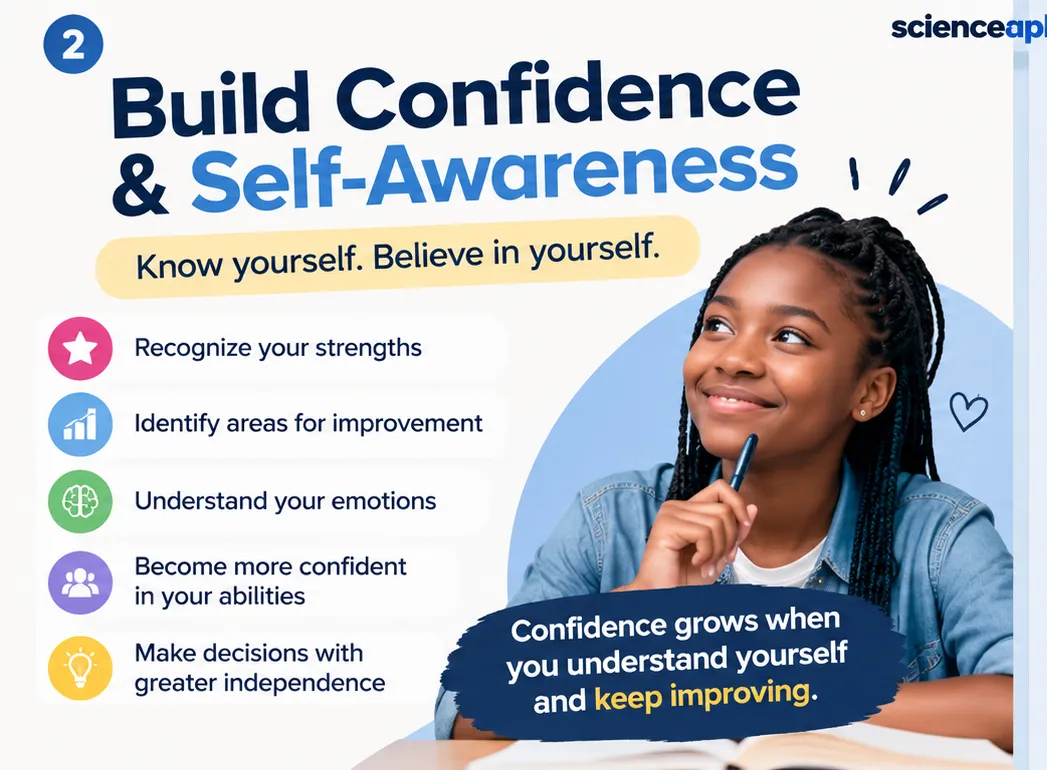
- Self-awareness: knowing what you are good at, where you struggle and how you react under pressure.
None of this is about becoming a different person. It is about getting better at things you already do every day, such as starting homework, listening in lessons and asking for help.
Why self-development is important for students: the short version
There are three solid reasons, and each one is backed by evidence you can check.
- It improves how you learn. The Education Endowment Foundation (EEF), an independent UK charity that reviews teaching research, rates teaching pupils to manage their own learning as worth about +8 months of additional progress, with similar impact across age groups, at very low cost.
- It makes good behaviour automatic. Goals, planning and habit research show how small, repeated actions turn into routines that need less willpower.
- It prepares you for work. In the World Economic Forum's Future of Jobs Report 2025, employers expected 39% of workers' core skills to change by 2030. Learning how to learn is the one skill that does not go out of date.
The rest of this article explains each of these, then turns them into steps. If you came here because grades have dipped, you may also like our guide on what to do after poor grades in school, which is written for parents but is useful for students too.
Self-regulation and metacognition: the skills behind good learning
Two long words sit at the centre of this topic, and both are simpler than they sound.
Metacognition means thinking about your own thinking. Before a task you ask, "What do I already know about this?" During it you ask, "Is this working?" Afterwards you ask, "What would I do differently?"
Self-regulation means managing your thoughts, feelings and actions so that you can reach a goal: starting when you would rather not, staying calm when a question looks hard, and stopping a distraction before it takes over.
The EEF's Teaching and Learning Toolkit groups the two together. It reports that metacognition and self-regulation approaches have a high potential impact, about +8 months of additional progress, with similar impact across age groups (EEF Teaching and Learning Toolkit, updated 2025), for very low cost. It also gives a warning. The impact can be hard to realise in practice.
The EEF's advice is that the most effective approach is explicitly teaching strategies to plan, monitor and evaluate a piece of learning, and that this works best on challenging tasks from the normal curriculum rather than as a separate "study skills" lesson.
Plan, monitor, evaluate: a three-step routine
You can use that cycle on any piece of GCSE work. Here it is applied to a science practice question.
| Stage | Question to ask yourself | Example for a GCSE science question |
|---|---|---|
| Plan | What is being asked, and what do I already know? | Underline the command word, such as "explain" or "calculate", and list the key terms you can remember. |
| Monitor | Am I on track? Do I need a different strategy? | Halfway through, check the units and whether your answer is the right size. |
| Evaluate | What worked, and what will I change next time? | Mark it with the mark scheme and write one sentence on the mistake you will avoid. |
The habit of writing that last sentence is more valuable than it looks. Many students re-read notes and feel confident without testing themselves. Our guide on how to practise and remember what you study shows how to turn that vague confidence into checked knowledge.
Know yourself first
Self-awareness is the starting point, because you cannot plan around strengths and weaknesses you have not noticed. Useful questions include:
- Which subjects do I find easy, and why?
- When do I concentrate best: early, after school or in the evening?
- What do I do when work feels too hard? Do I avoid it, rush it or ask for help?
- Which feelings, such as boredom, worry or tiredness, tend to derail me?
Write your answers down and revisit them every half term. Patterns appear quickly once they are on paper.
Quick check: what is the difference between metacognition and self-regulation?
Metacognition is thinking about your own thinking and learning (knowing what you know and what you do not). Self-regulation is using that knowledge to manage your thoughts, feelings and actions, for example by starting a task, changing strategy or resisting a distraction.
Why does the EEF say these approaches work best on real curriculum tasks?
Because learning strategies are easiest to understand and use when they are tied to the work you are actually doing, such as a science question, rather than practised on their own without content.
Goal setting: why specific goals beat "do my best"
Goals are the engine of self-development, and goal setting is one of the most studied topics in psychology. In 2002, Edwin Locke and Gary Latham published a review of 35 years of their own and others' work in the journal American Psychologist. Their central finding is that specific, difficult goals lead to higher performance than easy goals or vague instructions to "do your best".
There are conditions attached, and they are worth knowing:
- You need feedback on how you are doing, so you can adjust.
- You must be committed to the goal, not just have been handed it.
- You need the ability and knowledge to do the task, or time to learn how.
In other words, "get better at chemistry" is a wish, while "score at least 70% on the next bonding test by practising 10 questions three times a week" is a goal. The second one is specific, measurable and gives you feedback in the form of a test score.
Difficult does not mean impossible. A goal that is far beyond your current level can discourage you, so check it against your starting point. Our guide to having realistic goals explains how to find the stretch that is hard but reachable.
A simple goal template
Try writing each goal in this form: "By [date], I will [specific result], measured by [evidence], by doing [action] [how often]."
By 20 December, I will reach 75% on a Biology topic test, measured by the test score, by doing 15 minutes of practice questions on four school days a week.
Notice that the action sits inside the goal. Outcomes such as a grade are not fully in your control, but practice is.
If-then plans: the research-backed way to follow through
Setting a goal is the easy part. The harder part is starting when the moment comes. This is where implementation intentions help. The idea comes from psychologist Peter Gollwitzer: instead of only deciding what you want, you decide in advance when and where you will act, using an "if... then..." sentence.
In 2006, Gollwitzer and Paschal Sheeran combined the results of 94 independent tests in a meta-analysis. Forming an implementation intention had an average effect of d = 0.65 on reaching goals. In research terms, that is a medium-to-large effect, and the studies covered areas such as health behaviour and academic work.
The format is simple:
If [situation], then I will [action].
- If it is 4:30 p.m. and I have just got home, then I will do 20 minutes of science revision at the kitchen table before I check my phone.
- If I notice I am scrolling instead of working, then I will put my phone in another room and set a 25-minute timer.
- If I get a question wrong, then I will write the correct method in my mistakes notebook before moving on.
The plan works because the situation itself becomes the cue. You are not relying on motivation at the moment you least feel like it. If that is your problem, read our guide on how to stop procrastinating today.

Habits: how long do they really take?
You have probably heard that a habit takes 21 days. The best-known real study says something different. In 2009 (printed in 2010), Phillippa Lally and colleagues at University College London published How are habits formed in the European Journal of Social Psychology.
Ninety-six volunteers each chose a new eating, drinking or activity habit and tried to repeat it in the same situation every day for 12 weeks. Eighty-two gave enough data to analyse, and the habit curve fitted well for 39 of them. The key results were:
- Among participants whose habit data fitted the model well, it took a median of 66 days for the behaviour to reach its plateau of automaticity, meaning it felt automatic.
- The range was huge: from 18 days to a predicted 254 days, depending on the person and the habit.
- Exercise habits tended to take longer than eating and drinking habits.
- Missing one day did not materially affect the process of forming the habit.
The last point matters for students. One missed evening of revision does not ruin your routine. What matters is returning the next day, and not giving up because a streak broke.
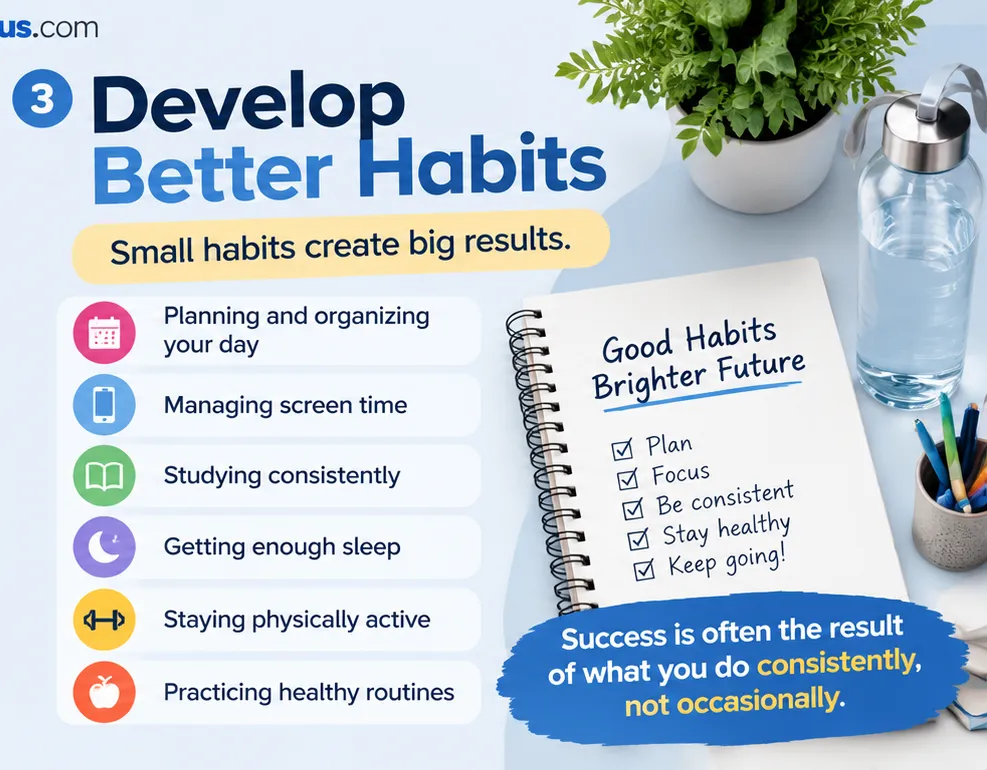
Five rules for building a study habit
- Start tiny. Ten minutes is better than a plan for two hours that you skip.
- Use the same cue. Link the habit to something that already happens, such as "after dinner" or "when I sit at my desk".
- Remove friction. Put your book and pen out the night before, and your phone out of reach.
- Track it simply. A tick on a calendar is enough. The tick is feedback, and feedback keeps goals alive.
- Expect it to take weeks. If it is not automatic after a fortnight, you are normal, not failing.
Patience is part of the process. Our article on the importance of patience and perseverance goes deeper into why slow progress is still progress.
Tick off your starter habits
Choose one or two, not all of them. Your ticks are saved on this device.
- Write tomorrow's top three tasks before bed
- Do 20 minutes of focused study at the same time each day
- Put my phone out of reach while I work
- Write one "what I learned today" sentence
- Pack my bag and prepare my workspace the night before
Sleep, movement and wellbeing: the basics that make the rest work
Self-development is not only about timetables. Your brain and body do the learning, so basic care comes first. Three areas matter most.
Sleep
Teenagers are commonly advised to aim for roughly 8 to 10 hours of sleep a night, which is more than most adults need. Many get less, especially on school nights. A regular bedtime, a dark and cool bedroom and putting screens away before sleep all help. Our guide to sleep hygiene and mental health has a full routine to try.

Movement
The NHS guidance for children and young people aged 5 to 18 is to aim for an average of at least 60 minutes of moderate or vigorous physical activity a day across the week. It also recommends a variety of activities that build movement skills, muscles and bones. That could be walking to school, football, dance, cycling or PE. It does not have to be a gym. If you find it hard to start, our article on how to motivate yourself to exercise offers realistic ways in.
Wellbeing and asking for help
Looking after wellbeing includes taking breaks, spending time with friends and noticing when stress is getting too big. Self-development does not mean coping alone. If you feel low, anxious or overwhelmed for more than a short spell, talk to a parent or carer, a teacher or your GP. In the UK you can also use NHS 111 for health advice, and in an emergency call 999.

Skills employers want, and how self-development builds them
School is the start of your learning, not the end of it. The World Economic Forum's Future of Jobs Report 2025 is based on a survey of more than 1,000 employers, representing over 14 million workers in 22 industries and 55 economies. Employers expected 39% of workers' core skills to change by 2030.
When the report listed the core skills employers value, the top five were:
| Skill | Share of employers who called it a core skill |
|---|---|
| Analytical thinking | 69% |
| Resilience, flexibility and agility | 67% |
| Leadership and social influence | 61% |
| Creative thinking | 57% |
| Motivation and self-awareness | 52% |
Look at that list again. Resilience, motivation and self-awareness are exactly what self-development trains. They are not school subjects, but you practise them every time you recover from a bad mark, plan your own revision or stay calm in an exam.
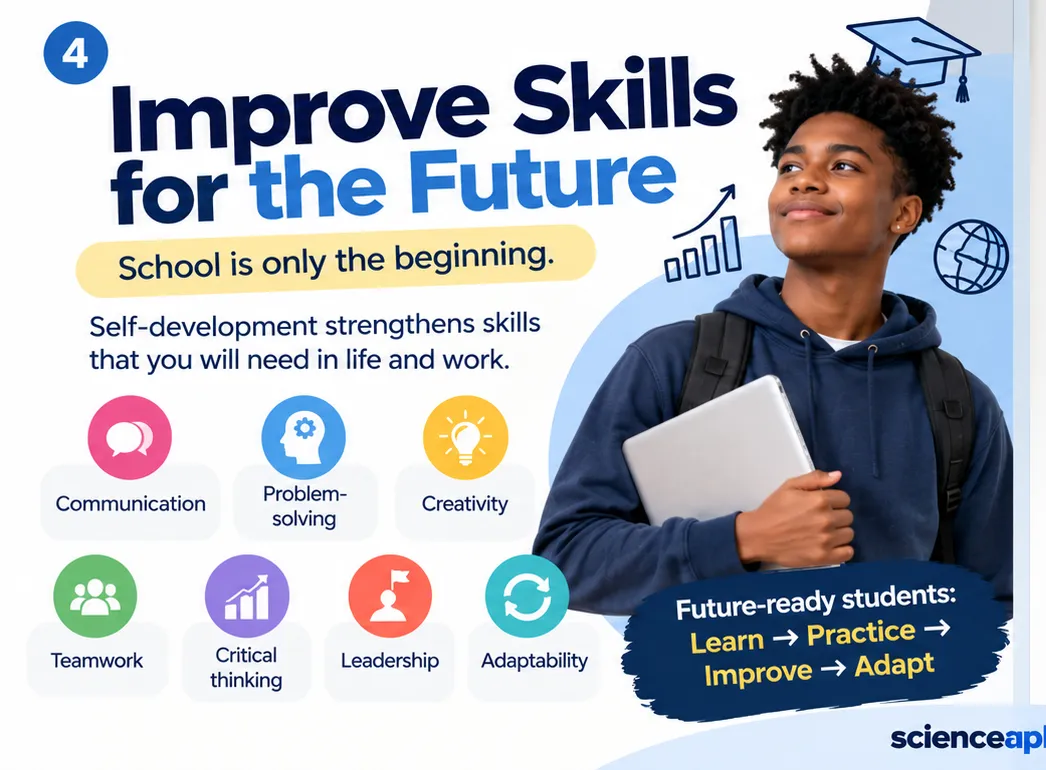
Which skill do you build with which habit?
- Analytical thinking grows when you ask "why?" about a result. See why critical thinking is important for science students.
- Resilience and adaptability grow when you try again after a setback. Read more in our guide to agility and adaptability skills for students.
- Communication and social influence grow in group work, presentations and discussions. Try our oral and written communication skills for students guide.
- Motivation and self-awareness grow when you set goals, track progress and reflect, as described above.
Be careful with claims that a particular skill "guarantees" a job. The report describes what employers expect and say they value, which is useful guidance, not a promise about any individual.
Reflection and feedback: how mistakes become progress
Reflection is the step many students skip. You finish a test, glance at the score and move on. Real improvement comes from asking what the result tells you.
Feedback matters just as much. In a widely cited 2007 review in the Review of Educational Research, John Hattie and Helen Timperley concluded that feedback is among the most powerful influences on learning and achievement, but that its effect can be positive or negative depending on the type of feedback and how it is given.
So the aim is to seek feedback that is useful. Good feedback usually answers three questions: Where am I going? How am I doing? What should I do next? A comment such as "Good effort" feels nice, while "Your method was right, but you forgot to convert cm to m" tells you exactly what to change.
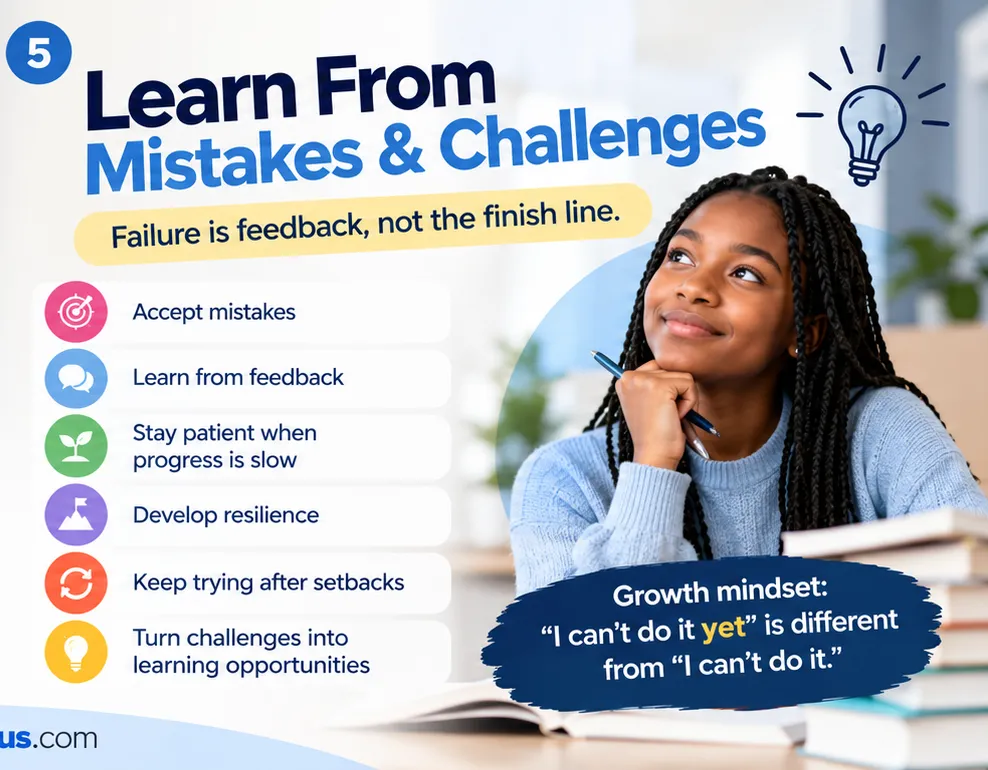
How to learn from a mistake in four steps
- Name it. Was it a knowledge gap, a careless slip, a misread question or a timing problem?
- Fix it. Redo the question correctly without looking at the answer.
- Record it. Add it to a mistakes log with the date and the correct idea.
- Re-test it. Try a similar question a week later.
This is where mindset comes in. Carol Dweck's "growth mindset" idea is that abilities can develop with effort and good strategies. It is popular in schools, and it works best alongside concrete strategies like the ones above, rather than as a slogan. For a classroom-friendly take, read our post on growth mindset in teamwork for GCSE students.
Why can feedback sometimes make performance worse?
According to Hattie and Timperley's 2007 review, the effect depends on the type of feedback and how it is given. Feedback that is vague, or that focuses on you personally rather than on the task, is less useful than feedback that explains what to do next.
A practical weekly self-development plan
Here is a plan that puts the research into one page. It takes about 15 minutes to set up on Sunday and a few minutes a day after that. Adjust the times to fit your own timetable.
| Day | Focus | Small action (10–20 minutes) |
|---|---|---|
| Sunday | Plan | Write one specific goal for the week and three if-then plans. Check next week's deadlines. |
| Monday | Study habit | Do your chosen study habit at the planned time and place. Tick it off. |
| Tuesday | Body | Fit in activity you enjoy, aiming towards an average of 60 minutes a day across the week. |
| Wednesday | Skill | Practise one future skill, such as explaining a topic aloud to someone else. |
| Thursday | Feedback | Ask a teacher or friend one specific question about your work: "What is one thing I could improve?" |
| Friday | Reflect | Write down what went well and what you got wrong. Update your mistakes log. |
| Saturday | Rest and people | Do something social or creative. Rest is part of the plan, not a reward for finishing it. |
Keep the plan flexible. If you miss a day, remember Lally's finding: one missed opportunity did not materially change habit formation. Carry on the next day.
Your Sunday set-up checklist
- Write one specific goal for the week
- Write three if-then plans
- Choose one habit to track
- Check my bedtime for school nights
- Plan one activity I enjoy
- Choose one person to ask for feedback
Common mistakes to avoid
- Too many changes at once. Pick one or two habits and stick to them for several weeks.
- Vague goals. "Work harder" gives you nothing to measure.
- Treating a slip as failure. One bad day is data, not a verdict.
- Ignoring sleep. A late-night revision session often costs more than it gains. Our article on why you should start revising for GCSE early shows how earlier starts reduce the pressure.
- Doing it alone. Tell someone your goal. A parent, teacher or friend can give the feedback you cannot give yourself.
Self-development also means balance. Friends, hobbies and downtime protect your energy, as we explain in a balanced social life. If pressure is building, our guide to a stress-free life for everyone has calming strategies. And if you are curious about where these skills lead, see how to make your career AI-proof.

Frequently asked questions about self-development for students
Why is self-development important for students?
It helps students take charge of their own learning. Research from the EEF suggests that teaching pupils to plan, monitor and evaluate their learning has a high impact for low cost, and habits like goal setting and reflection also prepare students for work and adult life.
What is self-development in simple words?
Self-development means deliberately improving yourself over time. For a student that includes learning how to study, setting goals, building healthy routines, understanding your strengths and weaknesses, and learning from mistakes and feedback.
What are examples of self-development for students?
Examples include writing a weekly goal, keeping a mistakes log, making an if-then revision plan, going to bed at a regular time, being active every day, asking a teacher for specific feedback, and joining a club or taking on a role that stretches you.
How long does it take to form a good study habit?
It varies. In a University College London study by Lally and colleagues, the median time for a new behaviour to feel automatic was 66 days among participants whose habit data fitted the model well, with a range from 18 to a predicted 254 days. Start small, repeat it in the same situation and expect weeks, not days.
What is the difference between metacognition and self-regulation?
Metacognition is knowing and thinking about your own learning, such as realising you have not understood a topic. Self-regulation is acting on that awareness by managing your attention, feelings and behaviour, for example by changing strategy or removing a distraction.
What are implementation intentions?
They are "if-then" plans that link a situation to an action, for example "If it is 5 p.m., then I will start my science revision". A 2006 meta-analysis of 94 tests found an average effect of d = 0.65 on goal achievement.
How much sleep and exercise should a student get?
NHS guidance for ages 5 to 18 is an average of at least 60 minutes of moderate or vigorous activity a day across the week. Teenagers are commonly advised to aim for around 8 to 10 hours of sleep a night. Ask your GP if you have persistent sleep problems.
What skills do employers want from young people?
In the World Economic Forum's 2025 report, the most commonly named core skills were analytical thinking (69% of employers), resilience, flexibility and agility (67%), leadership and social influence (61%), creative thinking (57%), and motivation and self-awareness (52%).
What should I do if I keep failing to stick to my goals?
Make the goal smaller and more specific, attach it to a time and place with an if-then plan, and remove obstacles. A single missed day did not materially affect habit formation in Lally's study, so restart the next day. If low mood is part of the picture, speak to a trusted adult or your GP.