How do you let go of negative thoughts? You notice the thought, check it against the evidence, and swap it for a more balanced one. The NHS calls this “catch it, check it, change it”. You also calm your body and bring your attention back to the present moment. Everyone has negative thoughts, and you cannot delete them, but you can change how much they steer your day. This article is educational, not medical advice. If you are struggling, see the help section near the end.
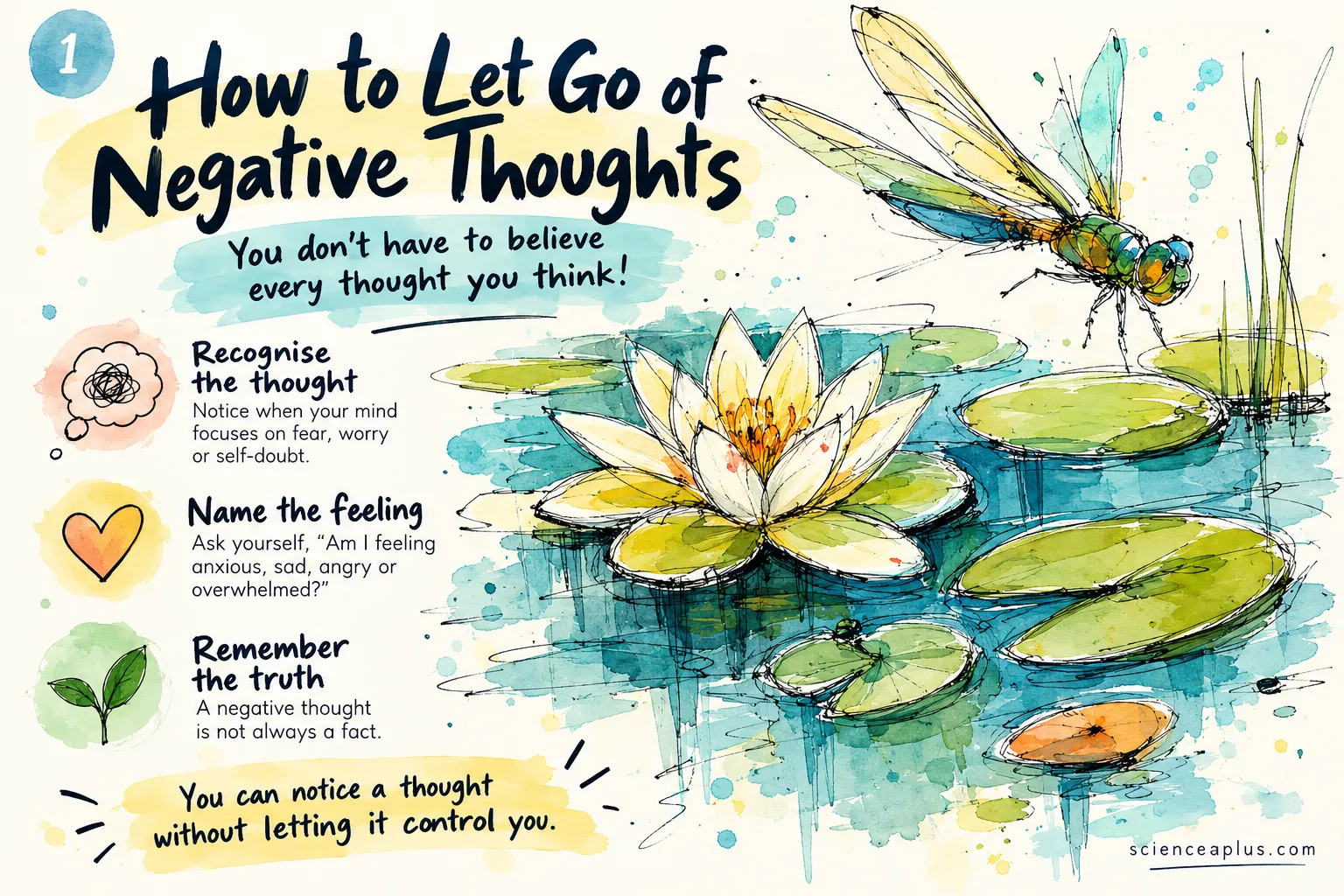
Why do I have so many negative thoughts?
If your mind seems to replay the one awkward moment and skip the nine good ones, you are not broken. Psychologists have a name for it: the negativity bias. In a well-known 2001 review called “Bad is stronger than good”, Roy Baumeister and colleagues looked across many areas of psychology. They found that bad events, bad emotions and bad feedback tend to have more impact than good ones of the same size.
The same review found that bad first impressions form faster and are harder to undo than good ones, and that negative information is processed more thoroughly. The researchers suggest an evolutionary reason: being extra alert to threats may have helped our ancestors survive. That is an explanation they propose, not something that has been proved.
Whatever the reason, the practical point is useful. A thought feeling loud and convincing does not mean it is accurate. Your brain is built to pay close attention to possible problems, and that includes problems that never happen. If you are curious about how the brain works more generally, see our guide to neuroscience and the brain.
Rumination: when thoughts go round in circles

A single negative thought passing through is normal. The trouble starts when it keeps coming back. Rumination means going over the same negative thoughts again and again, like a song stuck on repeat. In everyday language, people call it overthinking.
A major 2008 review by Susan Nolen-Hoeksema, Blair Wisco and Sonja Lyubomirsky, called “Rethinking rumination”, collected the evidence. It found that rumination can worsen low mood, increase negative thinking, make problem solving harder, get in the way of taking action and wear away social support. It has also been linked with anxiety and with unhealthy ways of coping. Overthinking feels productive, as if you are working something out, but it often just keeps you stuck.
The same review draws a helpful line between rumination and genuine self-reflection. Reflection asks, “What can I learn, and what could I do next?” Rumination asks, “Why does this always happen to me?” and never reaches an answer. If your thinking leads to a plan or a lesson, it is reflection. If it only produces a worse mood, it is probably rumination.
There is encouraging news in the same review. Many experiments found that positive distractions relieve low mood. Doing something absorbing, such as a walk, a hobby or a chat with a friend, gives your mind somewhere else to go. We return to this idea in the section on grounding and movement.
Emotions also colour how we judge things. When you are anxious or upset, a neutral text message can look like an insult. Our article on whether emotions influence critical thinking explains why, and why it helps to pause before treating a feeling as proof.
Why you can’t just push a thought away: the white bear experiment
The obvious advice is “just stop thinking about it”. Unfortunately, psychology suggests that this tends to backfire. In 1987, Daniel Wegner and his team ran a now-famous study. Volunteers spoke aloud for five minutes, saying whatever came into their heads, with one rule: they must not think of a white bear. If a white bear did pop into mind, they had to ring a bell.
The bell rang. Even in that short time, people could not keep the bear out of their minds. Then came the twist. When the same people were later asked to think about a white bear for five minutes, they thought about it significantly more than another group who had been asked to think about the bear from the start. Trying to suppress the thought made it bounce back harder, a “rebound”.
The study had a second experiment with a hopeful result. People who were given one specific other thought to focus on, a chosen distracter, showed less preoccupation with the bear afterwards. So the lesson is not “give up”. It is “do not fight the thought head-on; steer your attention somewhere else on purpose”.
A thought is not a fact
This is the most useful idea in the whole topic, and it is worth saying slowly. The NHS mindfulness guidance describes thoughts as “simply mental events that do not have to control us”. A thought such as “I’m going to fail” is something your brain produced, in the same way it produces a daydream. It may be accurate, partly accurate or completely wrong. Your job is not to obey it or to fight it, but to look at it.
The next section turns this idea into a practical routine, with a step-by-step method used in cognitive behavioural therapy (CBT), a talking therapy that looks at how thoughts, feelings and actions link together. You will also meet eight common “unhelpful thinking styles”, and you can practise spotting them with flip cards and reveal questions.
How to let go of negative thoughts with “catch it, check it, change it”

The NHS Every Mind Matters service teaches a simple three-step method from CBT called catch it, check it, change it. It does not ask you to stop thoughts or force yourself to feel cheerful. It asks you to treat a thought like a witness in a courtroom: listen, then question it.
- Catch it. Notice that an unhelpful thought has appeared. A change in mood is often the clue: if you suddenly feel worse, ask yourself, “What just went through my head?”
- Check it. Test the thought against the evidence rather than accepting it automatically. The questions in the next section help.
- Change it. Replace the thought with a more balanced one, based on the evidence you found.
CBT rests on the idea that situations affect how we think, feel and act, and that these things influence one another. The NHS describes CBT as a talking therapy in which a therapist helps you change how you think and act. The self-help version is the same idea in miniature. By changing a thought, you can sometimes change the feeling that follows it. The NHS is clear about the limits: reframing is about thinking more flexibly and feeling more in control, and you will not always manage to change a thought.
Unhelpful thinking styles to catch

The first step is easier when you know what to look for. Negative thoughts tend to follow patterns, sometimes called unhelpful thinking styles or cognitive distortions. An NHS hospital patient booklet (Royal National Orthopaedic Hospital) describes eight common ones. The NHS Every Mind Matters page also mentions always expecting the worst, ignoring the good, black-and-white thinking and blaming yourself for everything that goes wrong.
Imagine a student who gets one question wrong in a science test and decides, “I’m rubbish at science.” That single mark has become a label. Spotting the pattern does not make the feeling vanish, but it reminds you that your brain is using a habit, not reporting the facts. Tap each card below to see the style and a typical example.
Some of these styles feed on comparison with other people. Assuming that friends are judging you is a form of mind reading, and it can make peer pressure feel stronger than it really is. Our article on negative and positive peer pressure gives examples that teenagers recognise.
Check it: questions to test a negative thought
Once you have caught a thought, the NHS suggests checking it with a handful of questions. Write them down or say them in your head:
- How likely is the outcome you are worried about?
- Is there good evidence for it?
- Are there other explanations or possible outcomes?
- Is there good evidence for alternative ways of looking at it?
- What would you say to a friend who was thinking this way?
Checking often leads to a more flexible thought. “I always fail” might become “I did badly this time, and I can learn from it and improve.” That shift, treating mistakes as information rather than a verdict, is the heart of a growth mindset, which we cover in our guide to growth mindset for GCSE students.
Use a thought record

Thoughts are slippery when they live only in your head. Writing them down makes them solid enough to examine. The NHS offers a thought record with seven prompts. Tick them off as you work through them. Your ticks are remembered in your browser.
- The situation: what happened?
- My feelings: how did this make me feel at first?
- Unhelpful thoughts I had
- Evidence to support my unhelpful thoughts
- Evidence against my unhelpful thoughts
- Alternative, more realistic or neutral thoughts
- How I feel now
Here is a made-up example to show how the prompts fit together. It is an illustration of the method, not a real case.
| Prompt | Example |
|---|---|
| The situation | I got my mock science result back, and it was lower than I hoped. |
| My feelings | Sinking, embarrassed, anxious. |
| Unhelpful thoughts | “I’m rubbish at science. I’ll fail the real exam.” |
| Evidence for | This result was lower than my last one. |
| Evidence against | I did well on two topics. I had not revised the other topics properly. My teacher gave feedback on what to practise. |
| Alternative thought | “This mock shows me which topics need work, and I have time to practise them.” |
| How I feel now | Still disappointed, but calmer and clearer about what to do. |
Notice that the final feeling is not “delighted”. The aim of a thought record is a thought that is more realistic or neutral, not forced positivity. A small shift is a real result.
Practise reframing
Try these two. Think of your own answer first, then tap to reveal a suggested one.
“Everyone thought my presentation was terrible.” Which thinking style is this, and what is a more balanced thought? (practice)
This is mind reading (and possibly a mental filter if you are ignoring any positive reactions). A more balanced thought might be: “I felt nervous, and I do not know what everyone thought. A few people nodded, and I can ask my teacher for feedback on one thing to improve.”
“I made a mistake in the lab, so I’m a useless scientist.” Which thinking style is this? (practice)
This is labelling, and also all-or-nothing thinking. A more balanced thought might be: “I made a mistake, as scientists often do. I can work out what went wrong and repeat the experiment more carefully.”
“My friend hasn’t answered my message. I must have upset her.” Which thinking styles are at work? (practice)
This combines mind reading and personalisation. Other explanations are possible: she may be busy, out of signal or have her phone on silent. A balanced thought is: “I do not know why she has not replied yet, and there are plenty of ordinary reasons.”
Worry time: give your worries an appointment
Sometimes the problem is not one thought but a stream of worries that arrive at the worst moments, such as in the middle of a lesson or at 11 pm. The NHS Every Mind Matters service suggests a technique called worry time. You set aside a short period each day, for example 10 or 15 minutes, at the same time each day (some time before bed), to write your worries down and look for solutions.
During the rest of the day, when a worry pops up, you tell yourself you will deal with it at worry time and refocus on the here and now. It is a way of saying “not now” rather than “never”. This also fits the white bear findings from earlier: instead of fighting a worry, you are giving it a time and place, and putting your attention somewhere else for now.
- Pick a time and a place. A regular slot works best, away from your bed if you can.
- Keep a notepad handy. When a worry appears during the day, jot down a word or two and carry on.
- At worry time, write the worries out in full. Seeing them on paper often makes them feel smaller and more specific.
- Sort them. Ask, “Can I do something about this?”
- Stop when the time is up. Close the notebook and do something calm.
The sorting step matters. The NHS separates practical worries, which you can act on, from hypothetical worries, where you have no influence. For a practical worry, such as an upcoming deadline, you make a plan. For a hypothetical one, such as “What if something bad happens next year?”, the aim is to accept that you cannot control it and shift your focus. The NHS describes a “worry tree” to help you sort them.
Worries often feel loudest at bedtime, and our guide to sleep hygiene and mental health has more on building a calm evening routine.
Bring your mind back to now
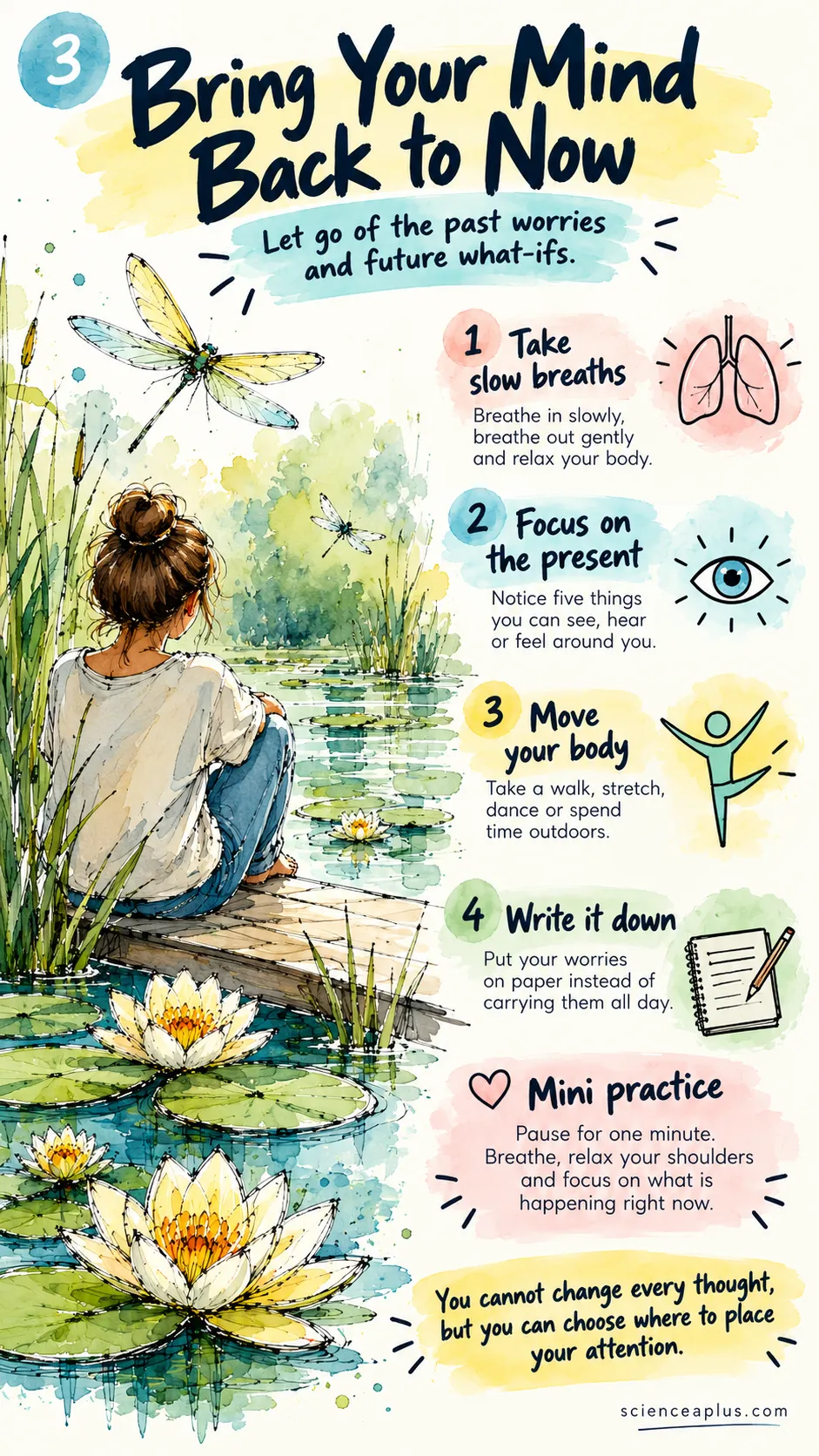
Rumination drags your mind into the past or the future. Mindfulness does the opposite. The NHS describes it as paying attention to what is going on inside and outside ourselves, moment by moment. It can help us see that thoughts are simply mental events that do not have to control us. The NHS also says it can free you from “reliving past problems or pre-living future worries”.
NHS tips for practising include noticing the everyday, such as the taste of your food or the feel of your feet on the ground, and silently naming your thoughts and feelings as they pass (“planning”, “worrying”, “remembering”). Think of the dragonfly picture earlier: you watch thoughts come and go without chasing them.
One caution is worth knowing. The NHS says that some people find mindfulness does not help, or that it makes them feel worse. If that happens to you, you do not need to push on. Talk to your GP or another trusted adult about other approaches.
A quick grounding exercise
This simple exercise gets your attention back into your senses. It is a common tool, not a treatment, and it asks only for a minute or two:
- Pause and take one slow breath
- Look around and name five things you can see
- Notice how your feet feel on the floor
- Listen for sounds near you and far away
- Tell yourself, “I am here, right now”, then carry on with what you were doing
The NHS breathing exercise
Breathing slowly gives your body a clear job to do. The NHS breathing exercise for stress takes about five minutes:
- Let your breath flow deep down into your belly, without forcing it.
- Breathe in gently through your nose, counting from 1 to 5. You may not reach 5 at first, and that is fine.
- Breathe out through your mouth, counting 1 to 5.
- Keep going for at least five minutes.
Calming your body may make it easier to think clearly about a worry. If stress is a regular companion, our article on a stress-free life gives more ideas for everyday life.
Move your body and get outside



Your body and your thoughts are not separate. The NHS’s five steps to mental wellbeing include being physically active and paying attention to the present moment, and the NHS says regular exercise can boost your mood if you have depression. The general guideline for adults is 150 minutes of moderate-intensity activity a week. That might sound like a lot, but it can be made of short walks, a bike ride to school or a game with friends. If getting started is the hard part, see our tips on how to motivate yourself to exercise.
Time outdoors matters too. A 2019 study led by researchers at the University of Exeter, published in Scientific Reports, looked at 19,806 people in England. It found that people who spent at least 120 minutes a week in nature were more likely to report good health and high well-being. The benefits peaked at 200–300 minutes a week, with no extra gain beyond that, and it did not matter whether the time came in one long visit or several short ones.
This was an association, not proof that nature causes better well-being. People who feel well may simply be more likely to go outside. Even so, a regular walk costs nothing and gives your mind a break from the loop. Try the calculator to see how your week adds up.
Moving, breathing, writing and talking are different ways of changing the channel. None of them makes negative thoughts disappear for good, but each gives you a way to step back so that a thought is something you notice, not something that controls you.
Build habits for a calmer mind
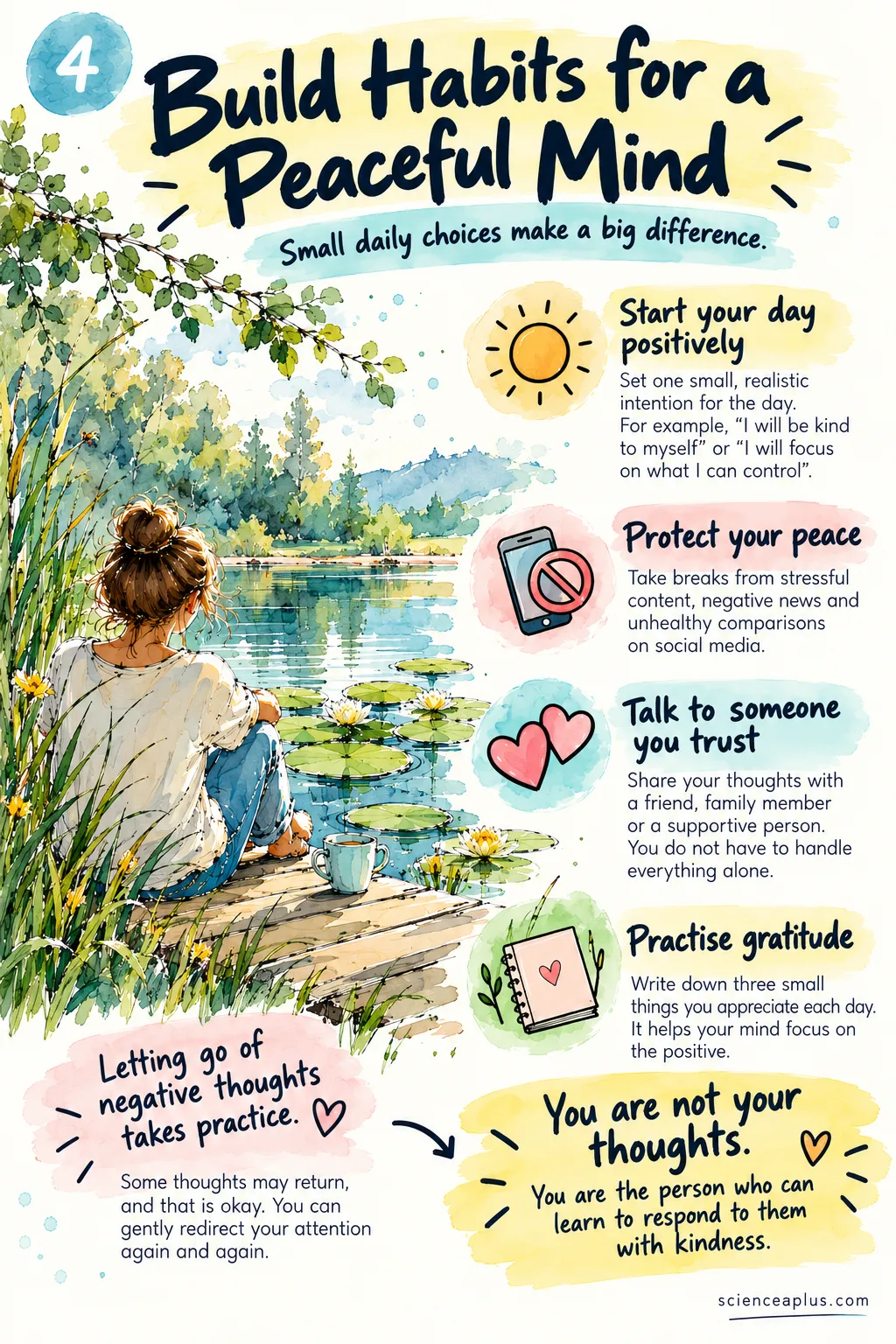
Catching and checking thoughts works best when it sits on top of everyday habits that look after your mind. The NHS suggests five steps to mental wellbeing, and each one gives negative thoughts less room to take over:
- Connect with other people. Talking to a friend or family member lets you hear another view of a thought.
- Be physically active. Movement gives your mind a break, as the previous section explained.
- Learn new skills. Absorbing activities, from a musical instrument to a coding project, are a natural form of positive distraction.
- Help other people. Helping someone else shifts your attention outwards.
- Pay attention to the present moment. This is mindfulness, the skill covered above.
The habit card above also suggests setting a small intention for the day, taking breaks from stressful content, and noticing what went well. The first two are practical: choose one small thing you want to do, and step away from news or social media feeds that leave you feeling worse. Noticing what went well, sometimes called “three good things”, is a popular habit. Treat it as something to try, not a guaranteed fix. If you enjoy it, it can balance the negativity bias a little by training your attention to catch good moments too. Our article on positive psychology facts explores the science of well-being in more depth, and lifestyle choices that improve brain function covers daily habits for a healthy brain.
How does CBT help with negative thoughts?
Everything in this article is a self-help version of ideas from cognitive behavioural therapy, or CBT. The NHS describes CBT as a talking therapy where a therapist helps you to change how you think and act. In sessions, you explore how situations make you think, feel and act. It can include noticing emotions and physical feelings without reacting to them, and gradually doing activities you have been avoiding.
CBT is usually delivered over between 5 and 15 sessions, according to the NHS. It is recommended for depression, anxiety conditions including OCD and phobias, post-traumatic stress disorder (PTSD) and more. A trained therapist can tailor it to you in a way an article cannot.
Guidance from the National Institute for Health and Care Excellence (NICE) also shows where self-help fits. For adults with less severe depression, NICE guideline NG222 says to consider the least intrusive and least resource-intensive treatment first. Its first-line options include guided self-help (structured CBT, behavioural activation or problem solving), group CBT, group exercise and group mindfulness and meditation.
When to get help for negative thoughts


Negative thoughts are a normal part of being human, and self-help tools can go a long way. But some situations call for more support. Consider speaking to someone if negative thoughts are affecting your daily life, such as your sleep, your schoolwork or job, or your friendships, or if they do not ease or keep coming back. This article cannot tell you whether you have a particular condition. A GP or mental health professional can, and the NHS says a GP can advise you about helpful treatments and help you access mental health services.
If you are a student, you can also talk to a teacher, a school counsellor or another adult you trust. Telling someone is a strength, not a weakness.
Frequently asked questions about letting go of negative thoughts
How do you let go of negative thoughts?
Start by noticing the thought and reminding yourself that a thought is not a fact. The NHS technique is to catch it, check it against the evidence and change it to a more balanced thought. Grounding, slow breathing, movement and talking to someone you trust can help you step back from the thought.
Why does my brain focus on the negative?
Psychologists call this the negativity bias. A major 2001 review found that bad events, feelings and feedback tend to have more impact than good ones, and that bad impressions form faster. The researchers suggest it may have helped our ancestors survive by keeping them alert to threats, though this is a suggestion rather than proof.
Is it normal to have negative thoughts?
Yes. Because the brain gives bad information extra weight, everyone has negative thoughts from time to time. A passing negative thought is not a sign that something is wrong. If negative thoughts are affecting your daily life or will not ease, it is a good idea to talk to your GP.
Can you stop negative thoughts by ignoring them?
Trying hard to push a thought away often makes it return. In the 1987 white bear study, people who tried to suppress a thought later thought about it more. A better approach is to notice the thought, check it, and deliberately move your attention to something absorbing.
What is the “catch it, check it, change it” technique?
It is a three-step reframing method from NHS Every Mind Matters, based on CBT. Catch an unhelpful thought, check it with questions such as “How likely is it?” and “What would I say to a friend?”, then change it to a more balanced thought. You will not always manage to change a thought, and that is fine.
What are unhelpful thinking styles?
They are habits of thinking that make situations seem worse than they are. Examples include mind reading, catastrophising, all-or-nothing thinking, labelling, shoulds and musts, emotional reasoning, mental filter and personalisation. Psychologists also call them cognitive distortions. Learning to recognise them makes it easier to question them.
What is worry time and does it help?
Worry time is a short period each day, say 10 or 15 minutes, when you write your worries down and look for solutions. During the day you tell yourself you will deal with a worry later. The NHS suggests it as a self-help technique, and it may suit some people better than others.
Does exercise help with negative thoughts?
The NHS says regular exercise can boost your mood if you have depression, and it lists being physically active as one of its five steps to mental wellbeing. Exercise also gives your mind a break from going over the same thoughts. It is one useful tool, not a cure, and it works best alongside other support.
When should I get help for negative thoughts?
Seek help if negative thoughts affect your sleep, school, work or relationships, or do not ease or keep coming back. Speak to your GP, use NHS 111 online or call 111 and choose the mental health option, or call Samaritans on 116 123. In an emergency, call 999 or go to A&E.