
Ask people for the most common colours worldwide and five names appear on most everyday lists: blue, black, white, red and green. They fill our skies, clothes, flags, phones and forests. But why these five? Part of the answer is culture and habit. The bigger part is physics and biology: what light is, what objects do to it, and how our eyes and brains turn it into the colours we name.
This guide starts with the colours people see and choose most often, then moves on to the science behind them. By the end you will be able to explain why a leaf looks green, why the sky looks blue, how a screen makes yellow without any yellow light, and how to work out the frequency of a colour of light.

The five most common colours worldwide
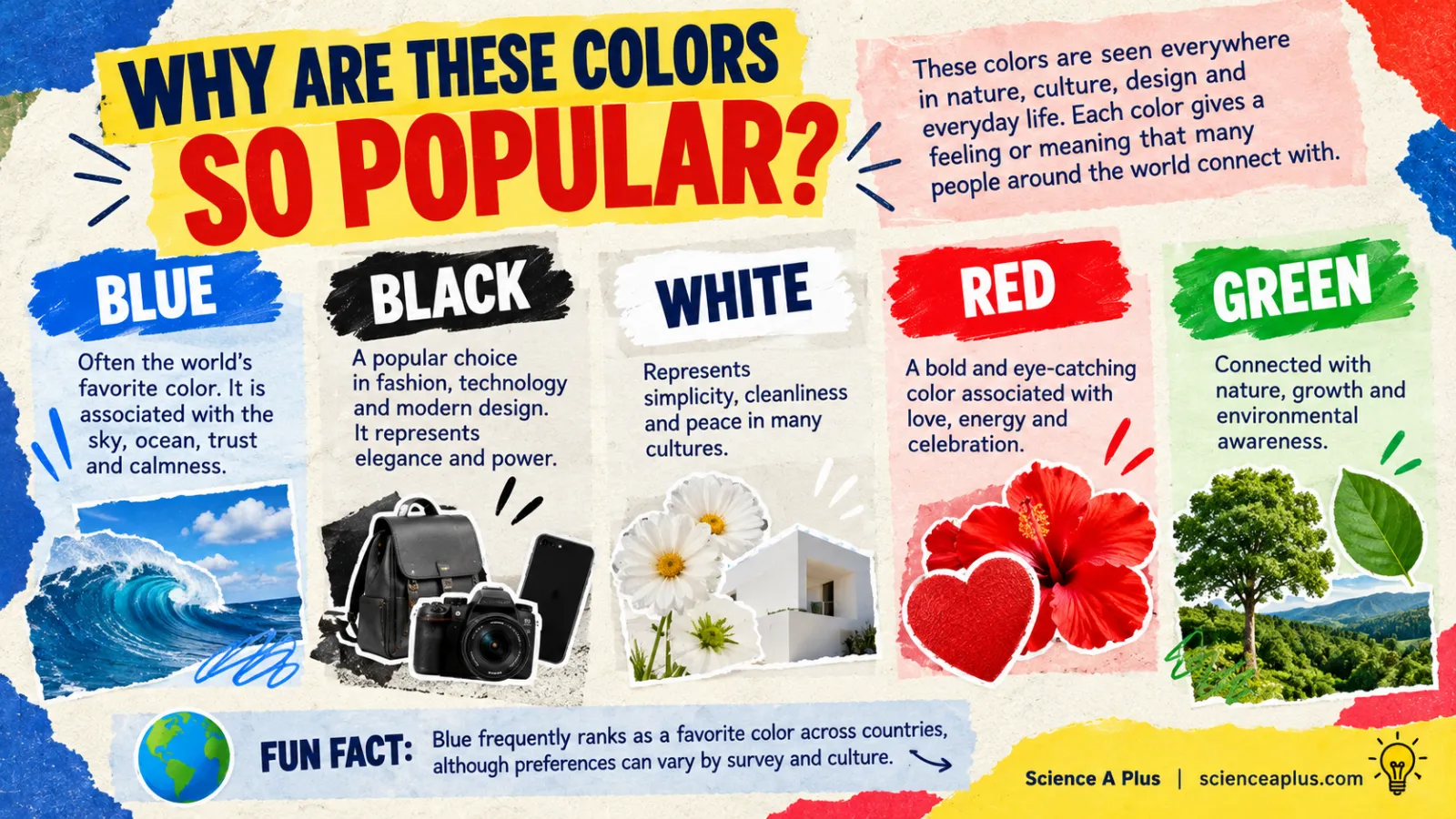
No single survey can rank every colour in every place, so "most common" depends on what you count: favourite colours, colours in nature, colours on cars or colours in national flags. The five below appear at the top of most everyday lists, and the slide below sums up why each one matters to people.
Blue: the world's favourite colour
A 2015 YouGov survey of ten countries across four continents found blue was the most popular colour in every one of them. Blue's share ranged from 23% in Indonesia to 33% in Great Britain, and it led the next colour by 8 to 18 percentage points. Second place changed from country to country: green in Thailand, China and the United States, red in Indonesia, Singapore, Germany and Britain, and purple in Hong Kong.
So the slide's fun fact holds: blue often ranks as a favourite across countries, although preferences vary by survey and by culture. Blue is also the colour most of us link with the sky and the sea, which are among the largest coloured things we ever look at.
Black and white: no colour, or all of them?
Black and white are the odd pair, because they are about how much light comes back to your eye, not which wavelength. A black surface absorbs almost all visible light, so very little reaches you. A white surface scatters almost all wavelengths back equally, so your eye gets the full mixture and your brain reads it as white.
That is why a black car gets hotter than a white one on a sunny day: the black paint turns more of the light's energy into heat. In fashion and design, black suggests elegance and power, while white suggests simplicity and cleanliness. Meanings differ between cultures, though. White is linked with weddings in many Western countries and with mourning in some other places.
Red: the longest wavelength you can see
Red sits at the long-wavelength end of the visible spectrum. It is bold and eye-catching, which is why it is used for stop signs, warning lights and celebrations, and it is linked with love and energy in many cultures. Physics adds a practical bonus: the air scatters red light less than blue light, so red stands out better through thin haze.
Green: the colour of plants
Green is the colour of plant life and, for many people, of nature, growth and environmental awareness. Plants look green because of chlorophyll, the pigment that captures light for photosynthesis. Chlorophyll absorbs mostly red and blue light and reflects much of the green, so green is the colour that reaches your eyes. You will see the details in the science section below.
Most common colours of people, cars and objects
The question can also mean the most common colour of a particular thing. Here is what the evidence says for the ones people search for most. The science behind each is explained properly later in the article.
Most common eye colour
Brown is the most common eye colour in the world. Brown irises contain a lot of the pigment melanin, which absorbs much of the light entering the front layer of the iris. Green and hazel irises contain less melanin. Blue irises contain very little melanin, and there is no blue pigment at all: the blue is structural colour, caused by light scattering in the iris, a bit like the blue of the sky.
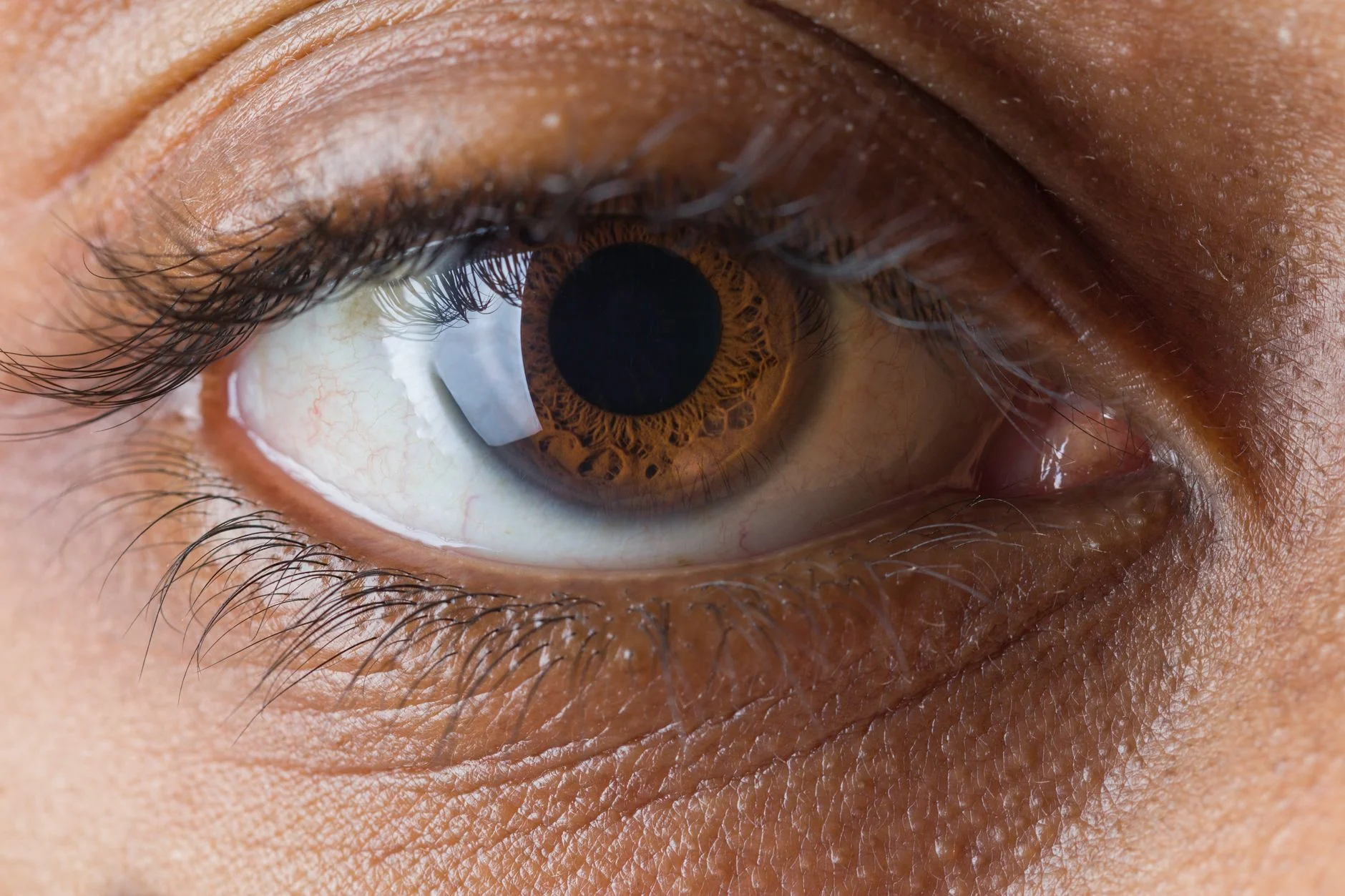
Eye colour is not controlled by one gene but by several working together, which is why brothers and sisters can have different colours. If you want the genetics background, our guide to genetics definitions explains genes and alleles.
Most common hair colour
Black (or very dark brown) is the most common natural hair colour worldwide, followed by brown. Blonde and red hair are much rarer, and red hair is usually put at roughly 1 to 2% of people. Exact percentages vary between sources, because no one has measured the hair of everybody on Earth.
Hair colour comes from two kinds of melanin made by cells called melanocytes. Eumelanin is black or brown. Pheomelanin is red or yellow. A lot of eumelanin gives black hair, a little gives blonde, and a mix with plenty of pheomelanin gives red. You can read how missing melanin changes animals in our guide to albino animals.

Most common car colour
Car colours are the one place where there are good annual numbers. Axalta, a paint maker, publishes a yearly global report of new vehicles. Its 2025 report, published in December 2025, put white first at 29%, black second at 23% and grey third at 22%. Silver was 7% and blue 6%. Those three neutral colours together are about three-quarters of all vehicles.
Europe was the exception: grey led there at 26%, just ahead of white at 25%. These figures are for new cars painted that year, not every car on the road.
The science behind it: what is colour?
Colour is not a property that objects simply "have". It is a sensation produced when light of certain wavelengths reaches your eye and your brain interprets the signals. Light is an electromagnetic wave, and visible light is the narrow band of that spectrum that our eyes can detect.
The visible spectrum and wavelengths
Visible light has wavelengths from roughly 380 nm to 750 nm. A nanometre (nm) is one billionth of a metre, so these waves are far smaller than a hair's width. Violet has the shortest visible wavelength and red the longest. The boundaries between colours are not sharp, and sources differ by a few nanometres, so treat the table as approximate.
| Colour | Approximate wavelength |
|---|---|
| Violet | 380–450 nm |
| Blue | 450–495 nm |
| Green | 495–570 nm |
| Yellow | 570–590 nm |
| Orange | 590–620 nm |
| Red | 620–750 nm |
Just outside this band sit ultraviolet (shorter than violet) and infrared (longer than red). We cannot see either, but they are the same kind of wave. All of them travel at the same speed in a vacuum, about 3.00 × 10⁸ m/s.
Wavelength, frequency and the wave equation
Every wave obeys the wave equation, which links the speed of the wave, its frequency and its wavelength:
c = f × λ
Here c is the speed of light in m/s, f is frequency in hertz (Hz) and λ is wavelength in metres. Because c is fixed, a shorter wavelength means a higher frequency. For green light of wavelength 550 nm (5.50 × 10⁻⁷ m):
f = c ÷ λ = 3.00 × 10⁸ ÷ 5.50 × 10⁻⁷ ≈ 5.45 × 10¹⁴ Hz
That is about 545 million million waves arriving every second. Use the calculator below to try other colours. It also shows the energy of one photon of that light, which rises as the wavelength falls.
White light is a mixture
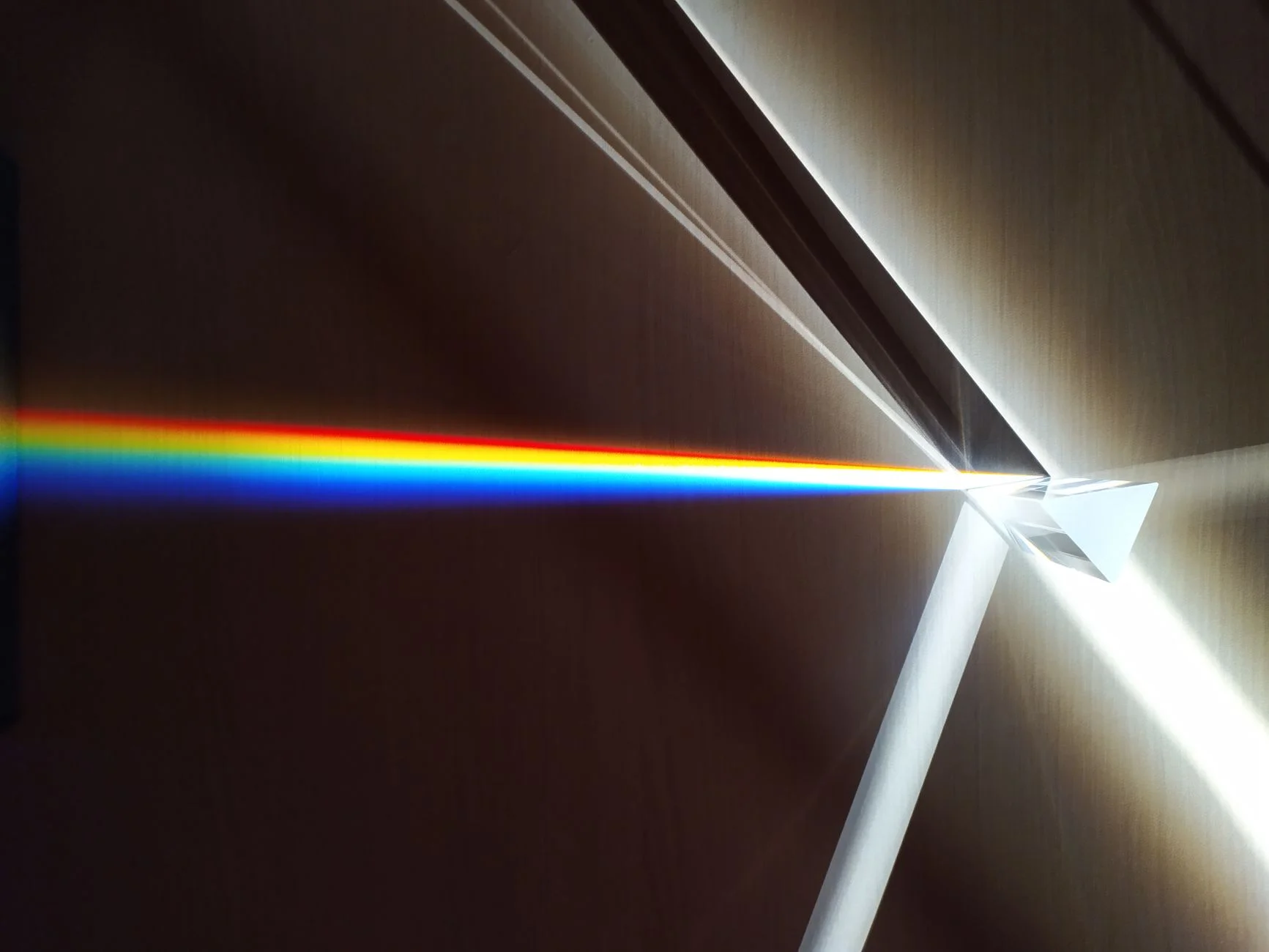
Sunlight looks white, but it is a mixture of all the visible wavelengths. A glass prism separates them because glass slows each wavelength by a slightly different amount, so each bends by a different angle. This is called dispersion. Violet is slowed and bent most, red least.

White LED lights make white in a different way. Many use a blue LED chip coated with a yellow phosphor, and your eye reads the blue-plus-yellow mixture as white. If you have ever wondered what happens when that coating fails, see why street lights turn purple.
Rainbows: dispersion inside raindrops
A rainbow is dispersion on a huge scale. Sunlight enters a raindrop and bends (refracts), reflects off the back of the drop, and bends again as it leaves. Because violet bends more than red, the colours leave at slightly different angles. In the main rainbow red appears at about 42° from the point opposite the Sun and violet at about 40°, so red is on the outside of the arc.
The fainter second rainbow, when you can see it, comes from two reflections inside each drop and has its colours in the reverse order, with red on the inside. The rainbow photo on this page shows the pattern.
Why do objects look coloured? Absorption and reflection
A white light source contains every visible wavelength. When it strikes an object, some wavelengths are absorbed (their energy goes into the object) and some are reflected or scattered. Only the reflected ones reach your eye, so the object's colour is the light it does not absorb.
- A red tomato absorbs most blue and green light and reflects red.
- A green leaf absorbs mostly red and blue light and reflects green.
- A white page reflects nearly all wavelengths.
- A black shirt absorbs nearly all of them.
This explains a classic experiment. In pure red light, a red apple still looks red, but a green apple looks almost black, because it has no green light to reflect and absorbs the red. The colour you see depends on both the object and the light source.
Why the sky is blue
Sunlight is scattered by gas molecules in the air. This is called Rayleigh scattering, and it is much stronger for short wavelengths: the scattering is proportional to 1 ÷ λ4. Blue light at 450 nm is therefore scattered about (700 ÷ 450)4 ≈ 5.9 times more than red light at 700 nm. Scattered blue light arrives at your eye from every direction in the sky, so the sky looks blue. At sunset the light travels through much more air, most of the blue is scattered out of the beam, and the reds and oranges remain.
The sea looks blue partly because it reflects the sky, and partly because water itself absorbs red light more strongly than blue, so the light that comes back is blue-green.
Mixing colours: light versus paint
People are often confused about colour mixing because two different systems exist, and they behave in opposite ways.
Additive mixing: red, green and blue light
Screens, projectors and stage lights add coloured light. The additive primaries are red, green and blue (RGB). Red plus green light looks yellow, green plus blue looks cyan, red plus blue looks magenta, and all three together look white. A screen has no yellow light to give you, only red and green pixels glowing together.
Subtractive mixing: cyan, magenta and yellow pigment
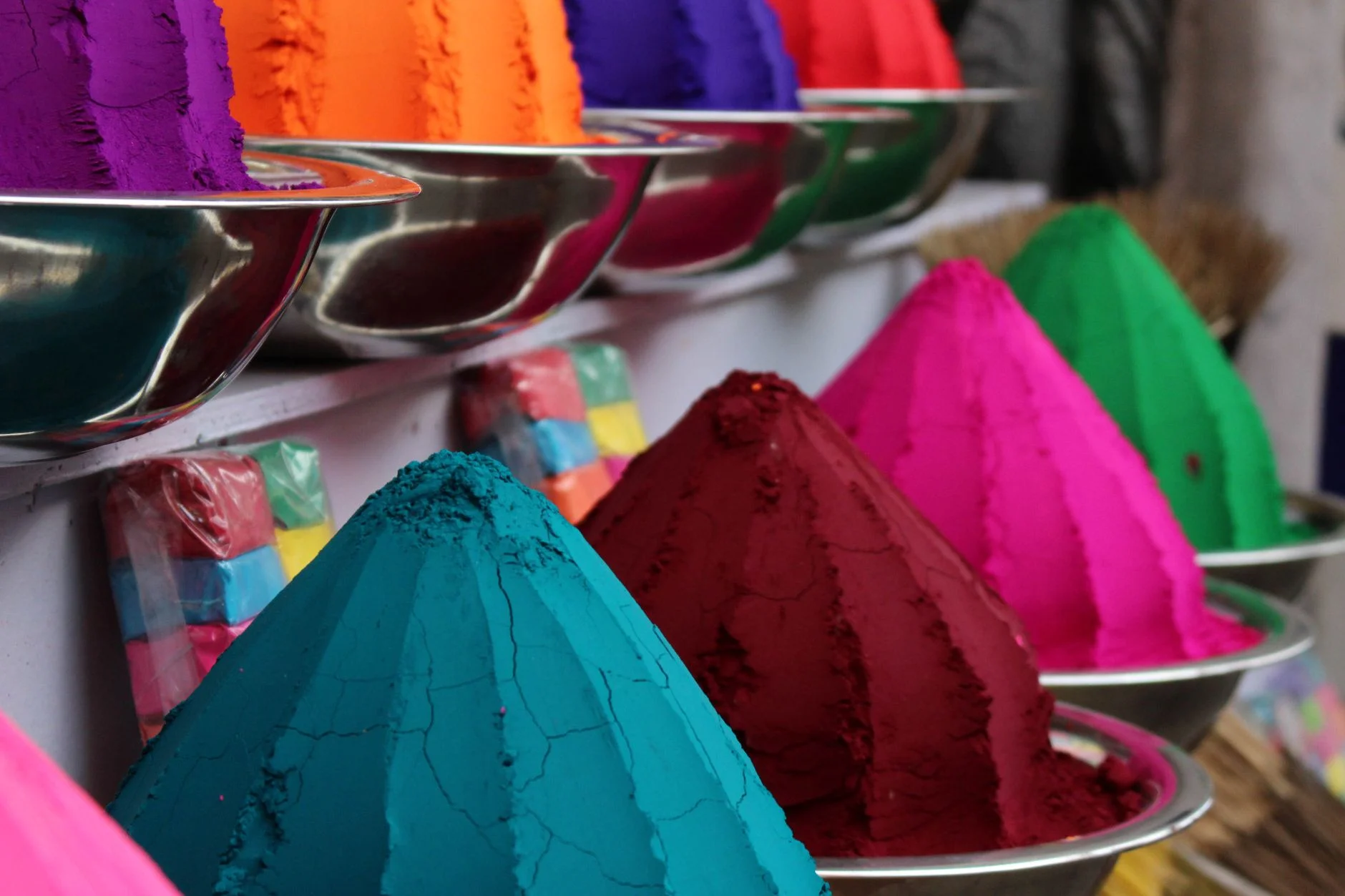
Paints, inks and dyes subtract light, because each pigment absorbs some wavelengths from the white light falling on it. The subtractive primaries are cyan, magenta and yellow (CMY). Cyan ink absorbs red, magenta absorbs green and yellow absorbs blue. Mix cyan and yellow and the only light not absorbed is green, so the mixture looks green. Mix all three and almost everything is absorbed, giving a dark brown or black. Printers add a separate black ink (K) to get a true black, hence the name CMYK.
How your eyes see colour: cone cells
The back of your eye is lined with the retina, which contains two kinds of light-detecting cells. Rods work in dim light and see only shades of grey. Cones need brighter light and give you colour. A human retina contains roughly 4.5 to 7 million cones and about 90 to 120 million rods, depending on the source, and the cones are packed most densely at the centre of your field of view.
There are three types of cone, each containing a different light-sensitive pigment. Their sensitivity peaks at about 420 nm (short, S, blue-violet), 535 nm (medium, M, green) and 565 nm (long, L, yellow-green to red). Each type responds to a wide range of wavelengths, and the ranges overlap. Exact peak values differ a little between sources and between people.
No single cone can tell you the colour. Your brain compares how strongly the three types respond. Light at 580 nm excites the L and M cones strongly, with little response from the S cones, and your brain reads that pattern as yellow. This is why a screen can fool you: red and green pixels glowing together excite your L and M cones in the same pattern as real yellow light, even though no 580 nm light is present.
Colour vision deficiency (colour blindness)
Colour vision deficiency (CVD) means that some colours are harder to tell apart, often reds and greens. It affects about 1 in 12 men and 1 in 200 women, according to NI Direct, a UK government health site. It is much more common in men because the genes for the L and M cone pigments sit on the X chromosome. A man has one X chromosome, so a single faulty copy has an effect. A woman has two and usually has a working backup copy.
The NHS says colour vision deficiency can be passed on in families and that there is currently no treatment for the inherited type, although most people adapt to seeing colours differently. It can also develop later because of eye conditions, other illnesses, injury or some medicines. Colour vision testing is not part of the routine NHS eye test, but you can ask an optician for one, such as the Ishihara test, which uses patterns of coloured dots.
Colours in nature: pigments and structural colour
Living things make colour in two very different ways, and the difference is a favourite exam topic.
Pigment colour: chemistry that absorbs light
A pigment is a molecule that absorbs some wavelengths and reflects others. Chlorophyll in leaves absorbs mostly red and blue light, using that energy for photosynthesis, and reflects green. In autumn the chlorophyll breaks down, and the yellow and orange pigments that were there all along show through. Melanin in skin, hair and eyes is another pigment, and it absorbs light across a wide range, which is why it looks brown or black.
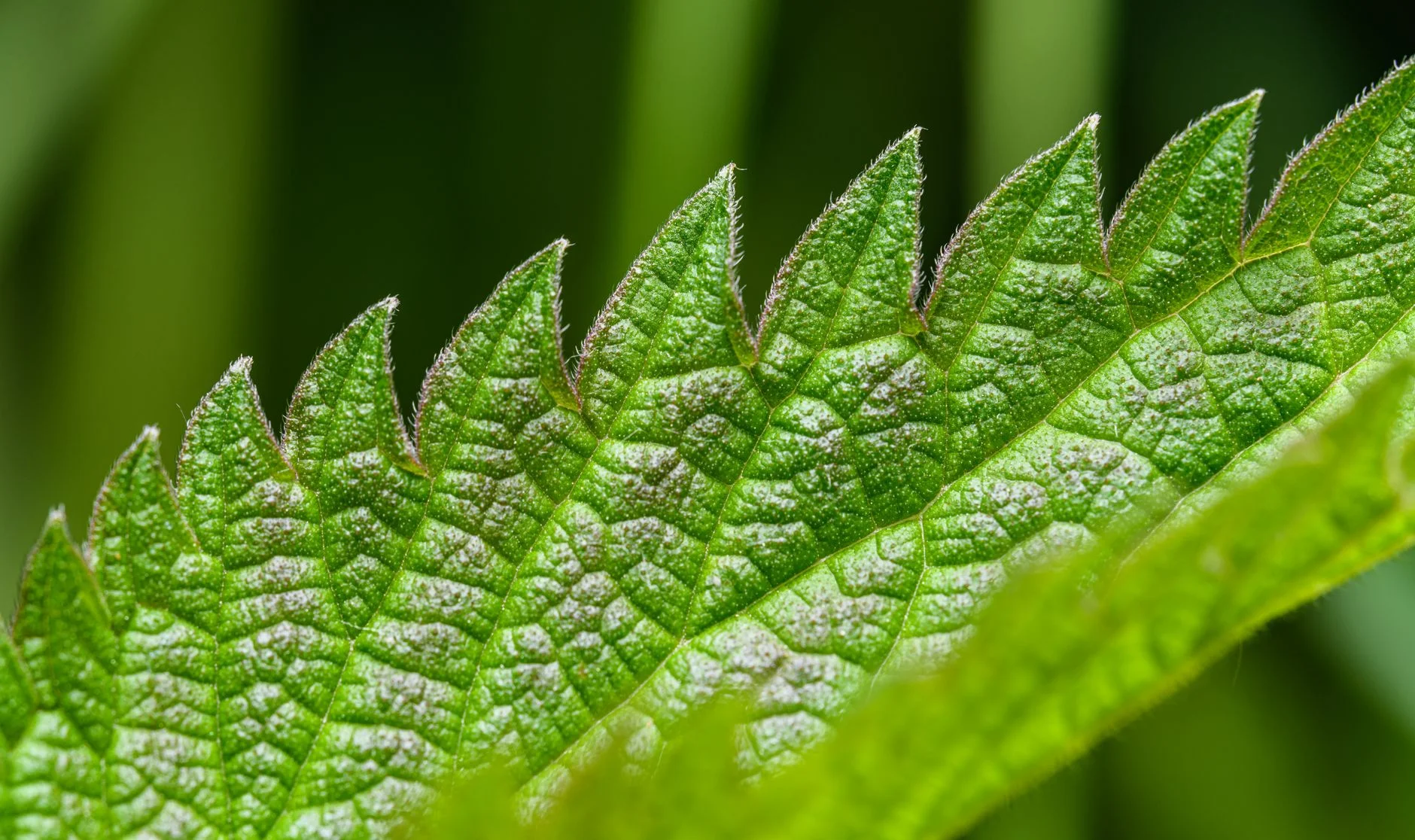
Pigments fade, because the molecules are slowly damaged by light and air. That is why old paint, posters and clothes lose colour. For a deeper look at how pigments colour animals, see why birds have different coloured feathers.
Structural colour: shape that bends light
Some of the brightest natural colours contain little or no pigment. In structural colour the colour comes from microscopic structures, such as layers or ridges, that scatter or interfere with light so that certain wavelengths are strengthened. The wings of a blue morpho butterfly look brilliant blue because of tiny ridged scales on the wing that reflect blue light, not because of blue pigment. A peacock's feathers work in a similar way, and their colours change as you move because the structure reflects different wavelengths at different angles. This shimmer is called iridescence.

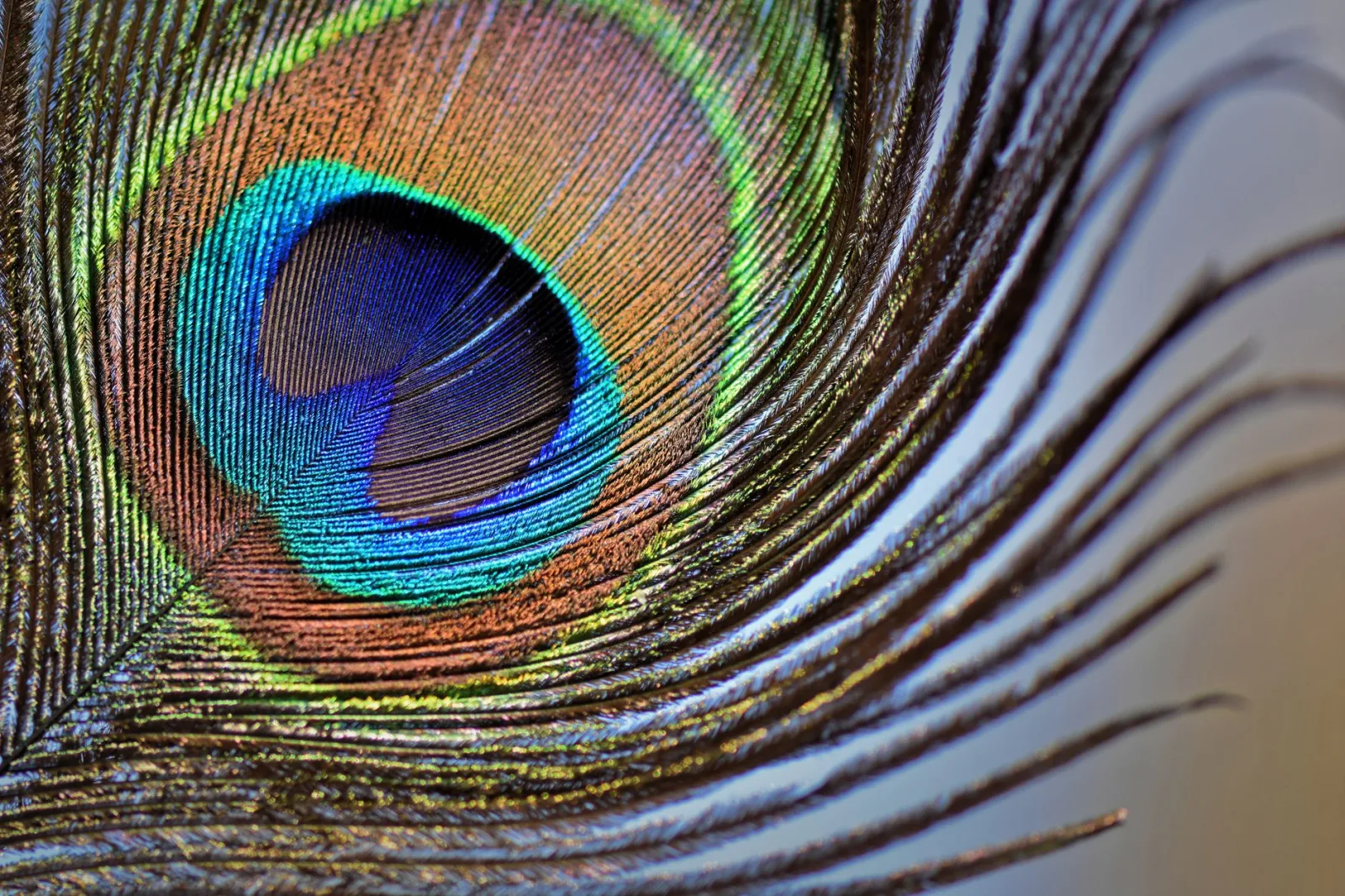
The blue iris from earlier is structural colour too. For a related example of what happens when pigment is missing from a bird, see our article on the albino peacock.
Colour codes: RGB and hex on a screen
On a screen, every colour is a mix of red, green and blue light, each given a brightness value from 0 (off) to 255 (full). That is one byte per channel, so there are 256 × 256 × 256 = 16,777,216 possible colours. A colour is written as three numbers, such as RGB(255, 128, 0), which is full red, half green and no blue, giving orange.
Web designers write the same numbers in hexadecimal (base 16), using the digits 0–9 and the letters A–F, with two characters per channel. The code #FF8000 means FF (255) red, 80 (128) green and 00 (0) blue. To convert a pair, multiply the first digit by 16 and add the second: A0 is 10 × 16 + 0 = 160, and 4B is 4 × 16 + 11 = 75.
| Colour | RGB | Hex | How it is made |
|---|---|---|---|
| Red | 255, 0, 0 | #FF0000 | Red only |
| Green | 0, 255, 0 | #00FF00 | Green only |
| Blue | 0, 0, 255 | #0000FF | Blue only |
| Yellow | 255, 255, 0 | #FFFF00 | Red + green |
| Cyan | 0, 255, 255 | #00FFFF | Green + blue |
| Magenta | 255, 0, 255 | #FF00FF | Red + blue |
| White | 255, 255, 255 | #FFFFFF | All three at full |
| Black | 0, 0, 0 | #000000 | All three off |
Notice how white is "all on" for light, while black is "all off". Paint works the opposite way, which links back to additive and subtractive mixing. Screens glow with this red, green and blue light, so if you want advice on looking after your eyes around them, read eye safety from digital devices.
Maths practice questions: colour and light
Colour science is a good place to practise standard form, rearranging equations and percentages. Try each question first, then tap to reveal the worked answer. Use c = 3.00 × 10⁸ m/s.

Red light has a wavelength of 700 nm. Calculate its frequency. (3 marks)
Convert: 700 nm = 7.00 × 10⁻⁷ m. Rearrange c = f × λ to f = c ÷ λ. Then f = 3.00 × 10⁸ ÷ 7.00 × 10−7 = 4.29 × 10¹⁴ Hz.
A light has a frequency of 5.00 × 10¹⁴ Hz. Find its wavelength in nanometres and say which colour it is. (3 marks)
λ = c ÷ f = 3.00 × 10⁸ ÷ 5.00 × 1014 = 6.00 × 10⁻⁷ m, which is 600 nm. That lies in the 590–620 nm range, so it is orange.
In a car park of 200 new cars, 29% are white, 23% are black and 22% are grey. How many cars are neither white, black nor grey? (3 marks)
White, black and grey together make 29 + 23 + 22 = 74%. The rest are 100 − 74 = 26%. Then 0.26 × 200 = 52 cars.
A web designer wants a colour with red = 0, green = 128 and blue = 255. Write the hex code, and give the green channel as a percentage of full brightness. (3 marks)
0 = 00, 128 = 80 (8 × 16 = 128) and 255 = FF, so the code is #0080FF. Green is 128 ÷ 255 × 100 ≈ 50%.
The energy of a photon is inversely proportional to its wavelength. How many times more energy does a 400 nm violet photon have than a 700 nm red photon? (2 marks)
Energy ∝ 1 ÷ λ, so the ratio is 700 ÷ 400 = 1.75. Violet photons carry 1.75 times the energy of red ones. (Check it with the calculator above.)
Test yourself: colour quiz
Frequently asked questions about the most common colours
What are the most common colours in the world?
Blue, black, white, red and green are the five colours that appear most often in everyday lists of common colours, although no single survey ranks every colour in every place. Blue is the most popular favourite in surveys, white is the most common colour of new cars, black is the most common natural hair colour, brown is the most common eye colour, and green dominates plant life.
What is the most common colour in nature?
Green is the colour you see most across the land, because plants are full of chlorophyll, which reflects green light. Blue is also everywhere, as the sky and sea. No official count exists, so which one is "most common" depends on whether you measure land, sea or sky.
What is the most popular favourite colour worldwide?
Blue. A 2015 YouGov survey in ten countries on four continents found blue was the most popular colour in all of them, with 23% to 33% choosing it. Green, red or purple took second place depending on the country, and preferences can change by age, gender and culture.
What is the most common eye colour?
Brown is the most common eye colour worldwide. Brown irises contain a lot of the pigment melanin, which absorbs light. Blue eyes contain very little melanin and no blue pigment: the colour comes from light scattering in the iris, which is a form of structural colour.
What is the most common car colour?
White. Axalta's 2025 global report, published in December 2025, put white at 29% of new vehicles, black at 23% and grey at 22%. Together the neutral colours are about three-quarters of all vehicles. Grey was slightly ahead of white in Europe.
Why does a colour look different in different light?
An object can only reflect the wavelengths that are present in the light falling on it. Daylight, a warm bulb and an LED strip contain different mixtures of wavelengths, so the same shirt can look slightly different. Your brain also adjusts for the lighting, which can add to the effect.
Why is the sky blue?
Air molecules scatter short wavelengths far more than long ones, in proportion to 1 ÷ λ4. Blue light is scattered about six times more than red light, so scattered blue arrives from every direction. At sunset the light passes through more air and the blue is scattered away, leaving red and orange.
What is the difference between RGB and CMYK?
RGB adds red, green and blue light and is used by screens, so mixing all three gives white. CMYK mixes cyan, magenta, yellow and black inks, which subtract light from white paper, so mixing them gives a dark colour. Screens use RGB, and printers use CMYK.
What causes colour blindness?
Most people are born with it because the genes for the cone pigments work differently. The NHS says the inherited type has no treatment, though most people adapt. Colour vision can also change because of eye conditions, other illnesses, injury or medicines. An optician can test it, so speak to one or your GP if you are concerned.