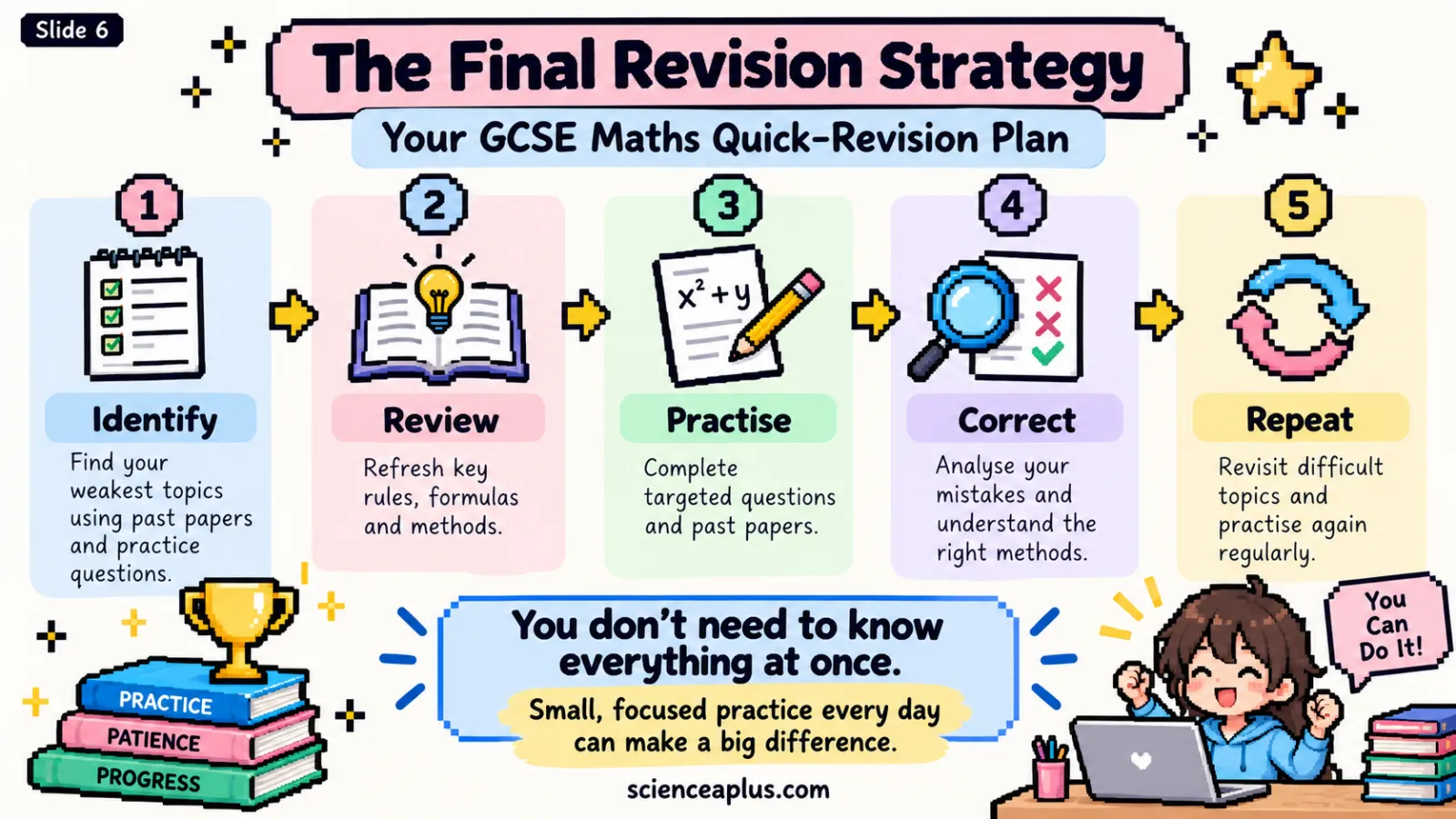
Revising GCSE maths quickly works best when you know exactly what you are revising for. Every board sets three papers at your tier, each lasting 1 hour 30 minutes, and one of them must be done without a calculator. Past that, speed comes from three habits: practise questions instead of rereading notes, mix topics together, and learn from every lost mark. This guide gives you the exam facts first, then the methods, then a 2-week and a 4-week plan.
The facts below were checked against the AQA, Pearson Edexcel and OCR specifications and the Ofqual decision on gov.uk, as they stood in October 2026. Specifications can be updated, so confirm anything that affects your own entry with your teacher or exams officer.
How the GCSE maths exams are set out
All three main boards in England test GCSE maths with three written papers, each worth a third of the grade. Any topic from the whole course can appear on any paper, so you cannot treat Paper 1 as “the number paper” and skip the rest. AQA’s specification says so directly: content from any part of the specification may be assessed.
The differences between boards are small, but they matter for how you practise.
| Board | Papers | Length of each | Marks per paper | Calculator not allowed on |
|---|---|---|---|---|
| AQA (8300) | 3 | 1 h 30 min | 80 | Paper 1 |
| Pearson Edexcel (1MA1) | 3 | 1 h 30 min | 80 | Paper 1 |
| OCR (J560) | 3 per tier | 1 h 30 min | 100 | Paper 2 (Foundation) or Paper 5 (Higher) |
So for AQA and Edexcel the pattern is non-calculator, then calculator, then calculator. OCR numbers its Foundation papers 1–3 and its Higher papers 4–6, and the non-calculator paper is the second one in each tier. Look at your own board’s timetable so that you practise the right paper at the right time.
Your teacher will also have told you which board you are entered for. If you are not sure, ask. Practising on the wrong board’s papers is not a disaster, because the content comes from a common Department for Education (DfE) specification, but the wording and the layout of the papers differ.
Foundation or Higher: tiers and grade ranges
GCSE maths is tiered, which means the papers you sit decide the highest grade you can reach. Everyone is graded on the 9–1 scale, where 9 is the best, but each tier only covers part of it.
- Foundation tier awards grades 1 to 5.
- Higher tier awards grades 4 to 9. A Higher student who just misses a 4 can be given an “allowed” grade 3.
You must take all three papers at the same tier, in the same exam series. That means the tier decision is made before the exams, usually by your teacher with you. Both tiers share the same basic content. The Higher tier adds harder topics and the Foundation tier has more weight on number and ratio, which we look at below.
What does this mean for your revision? If you are on the Foundation tier and aiming for a grade 5, the secure basics (fractions, percentages, ratio, simple algebra) will earn you most of your marks. If you are on the Higher tier and aiming for a 4 or 5, the same basics matter just as much, because AQA says the demand of each paper rises as you work through it, so the opening questions are the most accessible. Chasing the hardest topics first is rarely the quickest route to your target grade.
Do you get a formulae sheet?
Yes. This is the most useful policy change for revision, and the answer has recently been settled for the rest of the current course.
In February 2026 the Minister for School Standards wrote that students taking GCSE maths in 2025, 2026 and 2027 would not need to memorise formulae. Ofqual then consulted and decided that exam boards must keep providing formulae sheets for the remaining lifetime of the current specifications. That covers exams from 2028 onwards, including resits. Boards must publish the sheets by 1 September in the year before the exam, so you can practise with the real thing, and they must give you a clean copy with your papers.
Ofqual added one safeguard. Boards must not set questions that can be answered simply by copying information from the sheet. You still need to know when a formula applies and how to use it.
The sheet is also not the whole story for the topics that students tend to rely on memory for. Pythagoras’ theorem and the sin, cos and tan ratios appear in the specification’s list of formulae that students would normally be expected to know, so check whether yours are on the sheet before you decide how much time to spend on them. Learn the sheet’s layout the way you learn the layout of a paper: you want to find the right formula in seconds.
Where the marks are: topic weightings
Ofqual sets the weighting of each topic area, and it is the same for every board. AQA publishes the approximate percentages for each tier, and the table below uses them.
| Topic area | Foundation tier | Higher tier |
|---|---|---|
| Number | 25% | 15% |
| Algebra | 20% | 30% |
| Ratio, proportion and rates of change | 25% | 20% |
| Geometry and measures | 15% | 20% |
| Probability and statistics (combined) | 15% | 15% |
The pattern is clear. On the Foundation tier, number and ratio together are half of all the marks. On the Higher tier, algebra alone is 30%, and algebra plus ratio is half. Edexcel publishes ranges rather than single figures (for example, 27–33% for Higher algebra), but the order of importance is the same.
That gives you a sensible way to order a short revision plan, which the next part of this guide builds on. If you are still deciding when to begin, our guide on why you should start revising for GCSE early explains what an early start gives you. If you would like someone to check your method with you, read how a tutor can improve your child’s GCSE results, which covers what a good tutor does and what to ask for.
Which GCSE maths topics to revise first
With limited time, ask two questions about every topic: how many marks is it worth, and how likely am I to lose them? The weightings from the first part of this guide answer the first question. Your past paper results will answer the second.
A quick way to use both is to sort topics into three groups.
- Big and shaky: high weighting, and you lose marks on it. Start here.
- Big and secure: high weighting, and you usually score well. Keep these alive with short mixed practice.
- Small and shaky: low weighting and you struggle. Save these for the final days, and only learn the first steps of each.
Be honest when you place topics. Revising what you already know feels productive, but it is the slowest way to gain marks.
Foundation tier: number and ratio come first
At Foundation tier, number and ratio carry about half the marks. These are also the topics that every later topic leans on. Fractions, decimals and percentages, ratio and proportion, and simple algebra come up in problem solving across all three papers.
Make sure you can do the following without hesitation: add, subtract, multiply and divide fractions; convert between fractions, decimals and percentages; find a percentage of an amount; share an amount in a given ratio; use a multiplier for percentage change; and work out speed, distance and time.
Higher tier: algebra is the biggest block
At Higher tier, algebra is about 30% of the marks, so a weak spot there is expensive. Expanding and factorising, solving linear and quadratic equations, rearranging formulae, working with straight-line graphs, and sequences all sit in this block. Geometry is next, together with ratio at 20% each.
Rearranging formulae is a skill that students often avoid, even though it appears in algebra, geometry and science. Our step-by-step guide to rearranging formulas in science and maths shows the method in small steps, and one session on it can help you across several topics.
Master the basics before the clever stuff
When a hard question goes wrong, the cause is often a basic skill that slipped, not the hard idea. A student may understand the principle of a compound interest question but multiply by 5 instead of raising to the power of 5, or may drop a negative sign while rearranging an equation. This is why the graphic below lists six areas to check first.
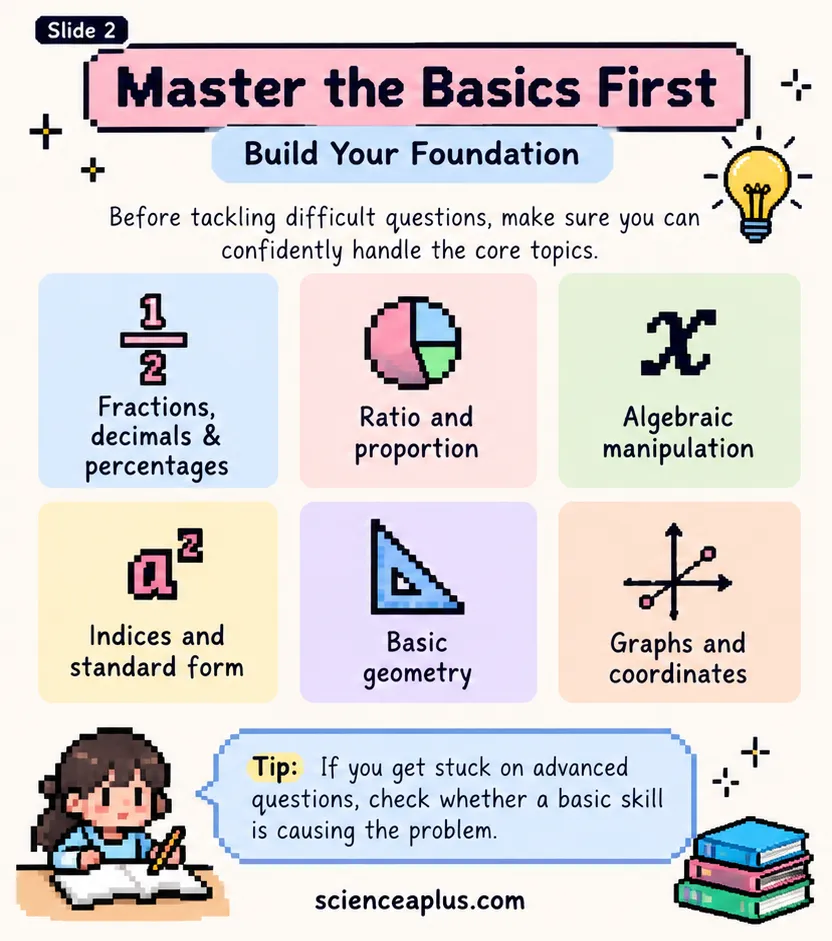
If you get stuck on an advanced question, take the “is it a basic skill?” test. Cover the question and ask which of the six areas it depends on. Then do three quick questions on that area, and come back to the hard one. This cuts the amount of time you waste on questions that are stopped by one small gap.
Use formulae strategically
You do not need to cram every formula. You need a short checklist that connects each type of question to the right formula, plus enough practice to recognise which one is being asked for. The graphic below groups the formulae that students most often need into one view.
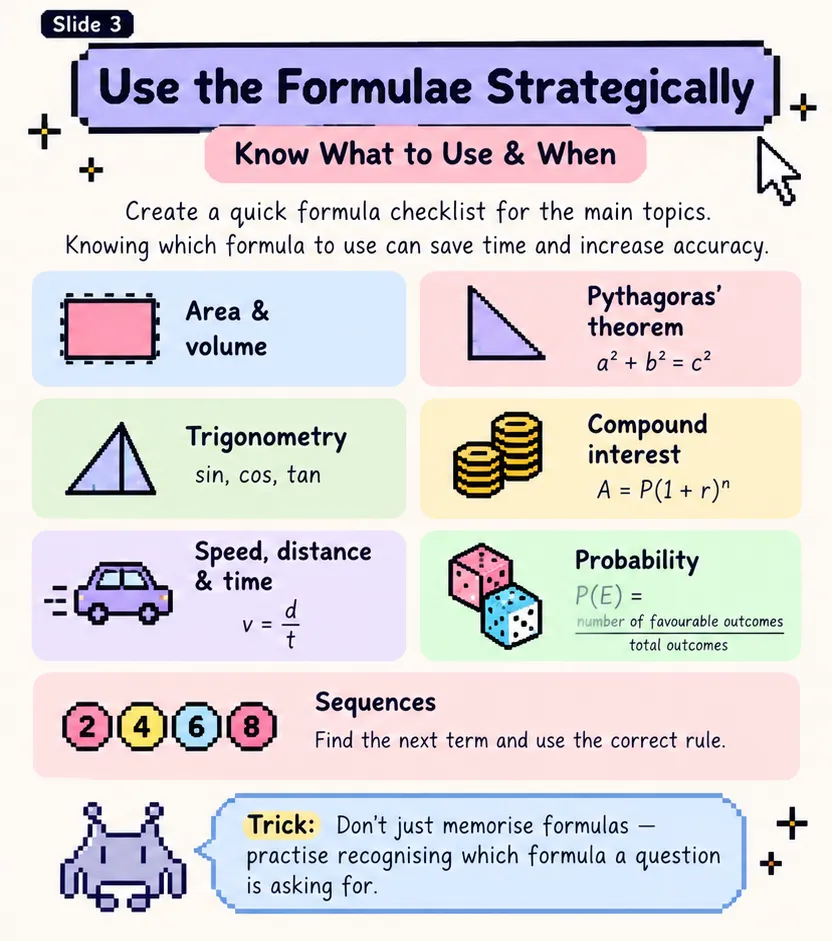
Build your own one-page version in your own handwriting, using your board’s current formulae sheet as the source. Writing it out forces you to notice what is on the sheet and what is not. Then practise the part the sheet cannot do for you: choosing the right formula.
Here are three recognition habits that save time.
- A right-angled triangle with two sides known and one missing usually points to Pythagoras’ theorem. If an angle is involved, think sin, cos or tan.
- Words like “per year”, “each month” or “after n years” suggest a repeated multiplier, for example compound interest.
- “How far, how fast, how long” means speed = distance ÷ time, and its rearrangements.
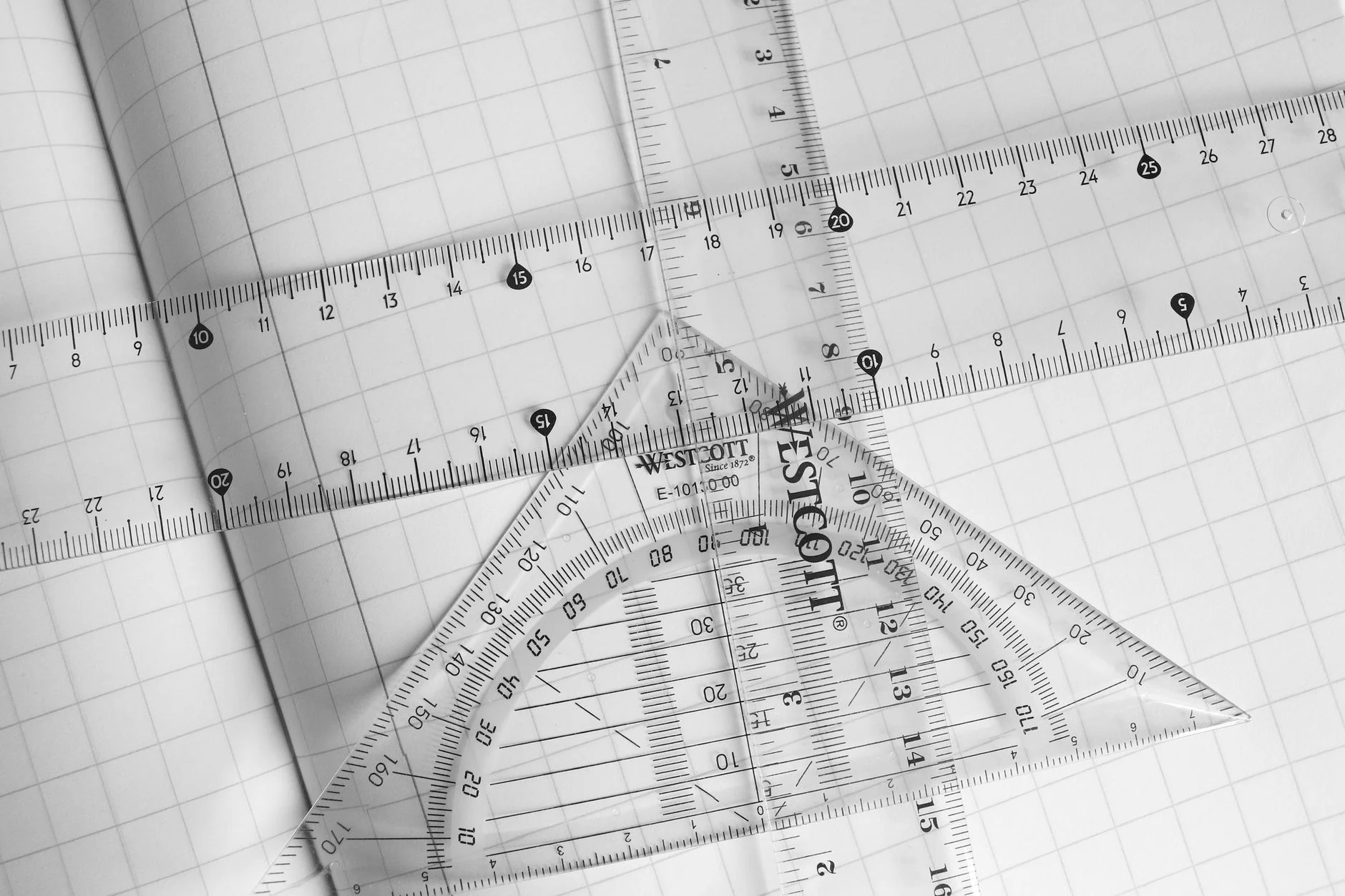
A scientific calculator helps with all of these, but only if you know its buttons. Our guide to scientific calculators and how to use them covers the functions that matter most, and you should use the same model that you will use in the exam. The calculator papers allow it, and a few unfamiliar buttons can cost you minutes.
Worked examples to try now
Try each one on paper before you open the answer. They are typical of the first half of a paper, and each one tests a basic skill that this guide has just covered.
Write 0.00045 in standard form. (1 mark)
Move the decimal point four places to the right to get 4.5, so the answer is 4.5 × 10⁻⁴. A small number gets a negative power of ten.
Increase £60 by 15%. Use a multiplier. (2 marks)
A 15% increase is 100% + 15% = 115%, so the multiplier is 1.15. Then 60 × 1.15 = £69.
Solve 5(x − 2) = 3x + 6. (3 marks)
Expand the bracket: 5x − 10 = 3x + 6. Subtract 3x from both sides: 2x − 10 = 6. Add 10: 2x = 16. So x = 8. Check by substituting: 5 × 6 = 30 and 3 × 8 + 6 = 30.
A bag holds 3 red and 5 blue counters. Two counters are taken out without replacement. What is the probability that both are red? (2 marks)
The first counter is red with probability 3/8. With one red gone, 2 reds remain among 7 counters, so the second is red with probability 2/7. Multiply: 3/8 × 2/7 = 6/56 = 3/28.
A right-angled triangle has shorter sides of 6 cm and 8 cm. Find the hypotenuse. (2 marks)
Use a² + b² = c². Then 36 + 64 = 100, and c = √100 = 10 cm.
Did you lose marks on any of them? Write the skill, not the question, in your error log (we explain how in the next section), for example “multiplier for percentage increase” or “without replacement means the second probability changes”.

Notice what the five examples have in common. None of them needs a clever trick. They need a reliable method, written steps, and a quick check at the end. That is what you are building during a short revision period: dependable methods that you can use under time pressure.
How to revise GCSE maths so that it sticks
Maths is a skill, not a list of facts. You learn it by doing, and you keep it by doing it again after a gap. Reading your notes feels comfortable, but it is one of the weakest ways to prepare. Researchers who reviewed ten common study techniques in 2013 (Dunlosky and colleagues, in Psychological Science in the Public Interest) noted that students lean heavily on highlighting and rereading. They rated practice testing and distributed practice (spreading study over time) as the two with the highest usefulness, and interleaved practice as moderately useful.
Three techniques follow from that research, and they fit maths well: retrieval, spacing and mixing topics.
Retrieval practice: close the book and try
Retrieval practice means pulling an answer out of your memory instead of looking it up. In one well-known experiment, Karpicke and Blunt (Science, 2011) had students study a science text. A group that alternated between reading and writing down what they remembered scored 67% on a later test. A group that read the text repeatedly scored 49%, and a group that made concept maps scored 45%. That study used a science passage rather than maths, but the principle carries over, and maths gives you an easy way to do it: attempt the question before you look at the method.
Here is how to do that in a short session.
- Write the topic name at the top of a blank page, for example “Pythagoras”.
- Without notes, write what you remember: the formula, when it applies, a quick example.
- Then do three questions from memory.
- Open your notes and mark what you missed in a different colour.
The sections you got wrong become your next revision targets. For more ways to practise recall, see our guides on how to practise and remember what you study and how to improve memory for better learning and exams.
Spacing: little and often beats one long session
Distributed practice means returning to a topic after a gap. Rohrer and Taylor (Instructional Science, 2007) tested this with maths problems. College students who practised a problem type across several sessions did much better on a test a week later than those who did all their practice in one go. For you, the practical rule is simple: if you have 6 hours for a topic, three 2-hour sessions on different days are better than a single 6-hour block.
This is the main reason that a quick plan needs a calendar rather than a pile of notes. In a two-week plan, every important topic should come round at least twice.
Interleaving: mix the question types
Most textbooks and homework sheets give you ten questions on the same topic in a row. You know which method to use before you read the question, so the practice feels smooth. The exam does not work like that. On a real paper, a percentage question is followed by a circle question, then a probability question, and your first job each time is to work out which method is needed.
Interleaving trains this. It means shuffling different types of problem in one practice set. In the second experiment of the 2007 Rohrer and Taylor study, students first learned several problem types and then practised them either grouped by type or randomly mixed. When tested a week later, performance was “vastly superior” after mixed practice, according to the authors’ own summary.
A larger test took place in real classrooms. In a pre-registered trial published in 2020, 54 seventh-grade classes in the US did either blocked or interleaved homework for four months. A month later, on an unannounced test, the interleaved group scored 61% and the blocked group 38% (Rohrer and colleagues, Journal of Educational Psychology). The students were younger than GCSE age and the study was in a different country, so treat the exact numbers carefully. The direction of the result is what matters, and it agrees with the earlier lab studies.
One honest caveat: mixed practice feels slower and less successful while you are doing it. Do not let that put you off. If a topic is completely new, start with a short block to learn the method, then move it into your mixed sets within a day or two. For subject-specific ideas on the science side of GCSE, our guide on how to start revising for GCSE science subjects uses the same techniques.
Past papers and mark schemes: your best revision tool
Once you have the basics, past papers become the centre of your revision. They show you the question style, the language examiners use, and how marks are shared out. You can download papers and mark schemes from your exam board’s website.
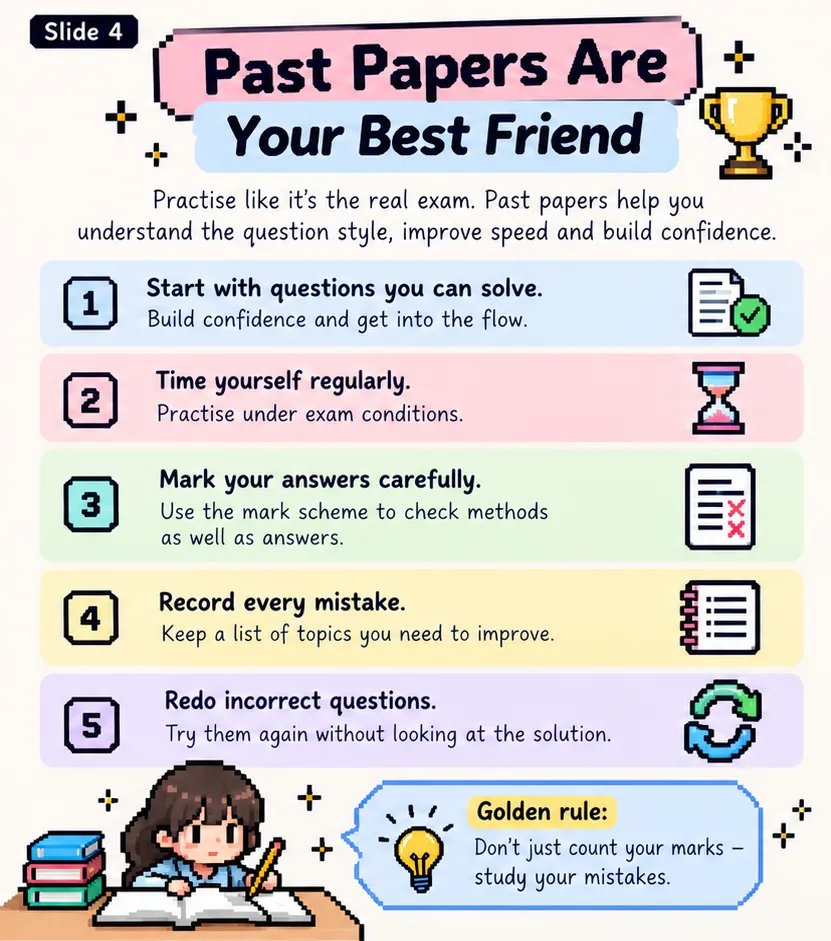
The graphic gives you five steps, and the order is important.
- Warm up with questions you can do. This builds momentum.
- Time yourself. Use 90 minutes for a full paper, or about 1 minute per mark for sections.
- Mark with the mark scheme. Check methods as well as answers.
- Record every mistake. Keep a running list of topics.
- Redo the questions you lost marks on, without looking at the solution.

Learn to read a mark scheme
Mark schemes are not just answer keys. They show where the marks come from. Most use codes along the lines of M for a method mark, A for an accuracy mark that depends on the method, and B for an independent mark, but boards differ, so check the key at the front of each scheme. Seeing that “M1” was earned for writing a correct first step, even though the final answer was wrong, is the best proof that showing working pays.
When you mark your own work, resist the urge to be generous. If the scheme wants a method step that you skipped, you lose that mark, and examiners will do the same.
Keep an error log
The most useful habit in this whole guide is also the simplest. After each paper, write one line for every lost mark: the topic, what went wrong, and the fix. Group the reasons. Typically they fall into four types.
- Did not know it: a gap in knowledge. Revise the topic.
- Knew it but chose the wrong method: a recognition problem. Practise mixed questions.
- Knew the method but slipped: an arithmetic or sign error. Slow down and check.
- Misread the question: underline command words and units before you start.
After two or three papers, you will see the same few entries again and again. Those are your priorities for the final week, and they are almost always fewer than you feared. It is also the point where the golden rule from the graphic applies: do not just count your marks, study your mistakes.
Common GCSE maths mistakes that cost easy marks
Most students lose more marks to slips than to ideas they could not understand. The six mistakes below show up again and again, and each one can be fixed with a habit. Tap a card to see the fix.
Two more habits are worth building. First, write down your working, even when you can do it in your head. Examiners award method marks, and a wrong final answer with a clear method can still score. Second, check units and signs before you move on. A speed in km/h, an area in cm² and a negative length all send a message to you that something is wrong.
Exam tricks that save time
These habits cost nothing to learn, and you can practise them in every past paper. The graphic shows seven, and three of them matter most.
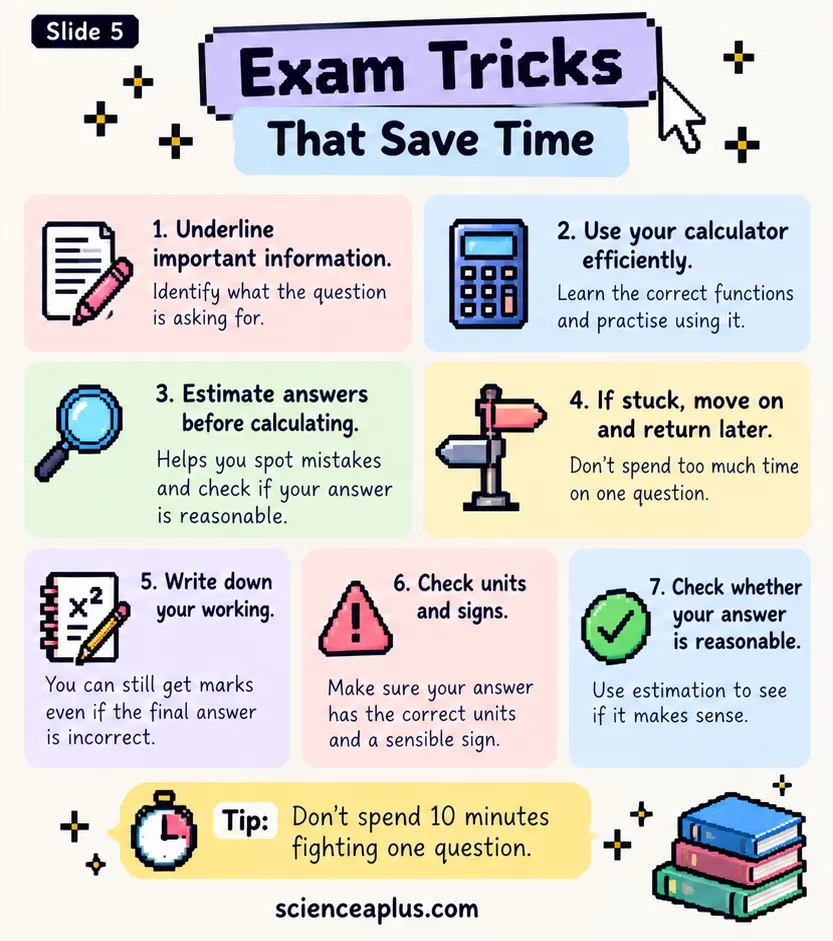
- Estimate first. Round the numbers and work out a rough answer. If your calculator gives a very different result, you have probably pressed a wrong key.
- If you are stuck, move on. Mark the question and return at the end. Do not spend ten minutes fighting one question when other marks are waiting.
- Write down your working. You can still gain marks if the final answer is wrong.
The other four are to underline key information, learn your calculator’s functions, check units and signs, and test whether your answer is reasonable. A length of 700 metres for a classroom table, or a probability of 1.4, is not reasonable.
A 2-week GCSE maths revision plan
Two weeks will not cover the whole course from scratch, but it is long enough to fix your biggest weaknesses and to practise in exam conditions. The plan assumes about 1–2 hours a day. Adjust the amount to your own timetable, and keep the shape.
| Days | What to do |
|---|---|
| 1–2 | Diagnose. Sit one full past paper under timed conditions, mark it with the scheme, and start your error log. Rank topics as “big and shaky”, “big and secure” or “small and shaky”. |
| 3–5 | Fix the biggest gaps. Work on your top three “big and shaky” topics, using retrieval: attempt first, then check. Finish each day with five mixed questions from earlier topics. |
| 6–7 | Formulae and basics. Build your one-page formulae checklist from the real sheet. Do a mixed set on fractions, percentages, ratio and algebra. Rest for part of day 7. |
| 8–10 | Mixed practice. Interleave topics from your error log. Redo questions you lost marks on, without looking at the answers. |
| 11–12 | Full papers. One non-calculator paper and one calculator paper, timed. Mark them carefully and update your error log. |
| 13 | Targeted repair. Fix the top three entries in your log. Keep it short. |
| 14 | Light day. Read your formulae checklist and error log, check your equipment and sleep well. |
A 4-week GCSE maths revision plan
If you have a month, use the extra time for spacing. Each topic comes round at least twice, which is the habit that research on distributed practice recommends.
| Week | Focus | Weekly routine |
|---|---|---|
| 1 | Diagnostic paper, then number, fractions, percentages and ratio | Four short topic sessions, one mixed set, one error-log review |
| 2 | Algebra: expanding, factorising, equations, rearranging, graphs, sequences | Four topic sessions, a mixed set that includes week 1 topics |
| 3 | Geometry and measures, probability and statistics | Four topic sessions, a mixed set that includes weeks 1 and 2 |
| 4 | Full papers and repair | Three timed papers across the week, a repair day after each, and a light final day |
Plans fall apart on the days when you do not feel like starting. If that sounds familiar, read our tips on how to stop procrastinating, and the guide on what to do when you have no motivation to study. Sleep protects everything you have practised, so balancing sleep and work belongs in your plan too.
Your last 48 hours
Do not start new topics. Tick off each item below, and the ticks stay on your device so that you can come back later.
- Read your one-page formulae checklist
- Redo five questions from your error log without looking at the answers
- Pack a calculator you know how to use, with spare batteries if it needs them
- Pack a pencil, pen, ruler, protractor and compasses
- Check the date, time and room for your next paper
- Go to bed at a sensible time
Test yourself: GCSE maths revision
Frequently asked questions about revising GCSE maths
How many papers are there in GCSE maths?
There are three written papers at the tier you are entered for, either Foundation or Higher. Each lasts 1 hour 30 minutes and counts for one third of the grade. AQA and Edexcel give 80 marks per paper, and OCR gives 100. Any topic can appear on any paper.
Which GCSE maths paper has no calculator?
On AQA and Edexcel, Paper 1 is the non-calculator paper, and Papers 2 and 3 allow a calculator. OCR numbers its papers differently: the non-calculator paper is Paper 2 at Foundation tier and Paper 5 at Higher tier. Always check your own board’s timetable.
Do you get a formulae sheet in GCSE maths?
Yes. Ofqual has decided that exam boards must keep providing formulae sheets for the remaining lifetime of the current specifications, including resits. Boards publish the sheet by 1 September the year before, so you can practise with it. The sheet does not tell you which formula to choose.
What grades can you get on Foundation and Higher tier?
Foundation tier awards grades 1 to 5. Higher tier awards grades 4 to 9, and a Higher student who narrowly misses a 4 can receive an allowed grade 3. You must sit all three papers at the same tier, in the same series, so discuss the choice with your teacher early.
Can you revise GCSE maths in two weeks?
You can improve a lot in two weeks, but not by covering everything. Spend the first days finding your weak topics with a timed past paper, fix the largest gaps with retrieval practice, then finish with mixed questions and full papers. Use the 4-week plan above if you have the time.
What are the most important GCSE maths topics?
It depends on your tier. At Foundation tier, number and ratio are 25% each, so together they are half of the marks. At Higher tier, algebra is about 30%, with ratio and geometry at 20% each. Your own error log should decide the order within those areas.
Are past papers enough to revise for GCSE maths?
Past papers are the best test of your skills, but doing them is not enough on its own. The benefit comes from marking each paper with the mark scheme, logging every lost mark, then practising those topics again after a gap. Without that review, you may repeat the same mistakes.
What is interleaved practice in maths?
Interleaved practice means mixing different types of question in one session instead of doing one topic at a time. It feels harder, but studies by Rohrer and colleagues found that students who practised this way scored higher on later tests. It also matches how exam papers jump between topics.
Can I resit GCSE maths if I do not get a grade 4?
Yes. AQA states that students can resit as many times as they wish within the shelf life of the qualification, and November entries are open to students who were at least 16 on the previous 31 August. Students in England without a grade 4 usually need to keep studying maths after 16.