Scandium chemical properties are simple to summarise: scandium (Sc, atomic number 21) is a light, silvery d-block metal that almost always forms the Sc³⁺ ion. Its oxide and hydroxide are amphoteric, its compounds are usually colourless, and it is used in strong aluminium–scandium alloys and solid oxide fuel cells.
What is scandium?
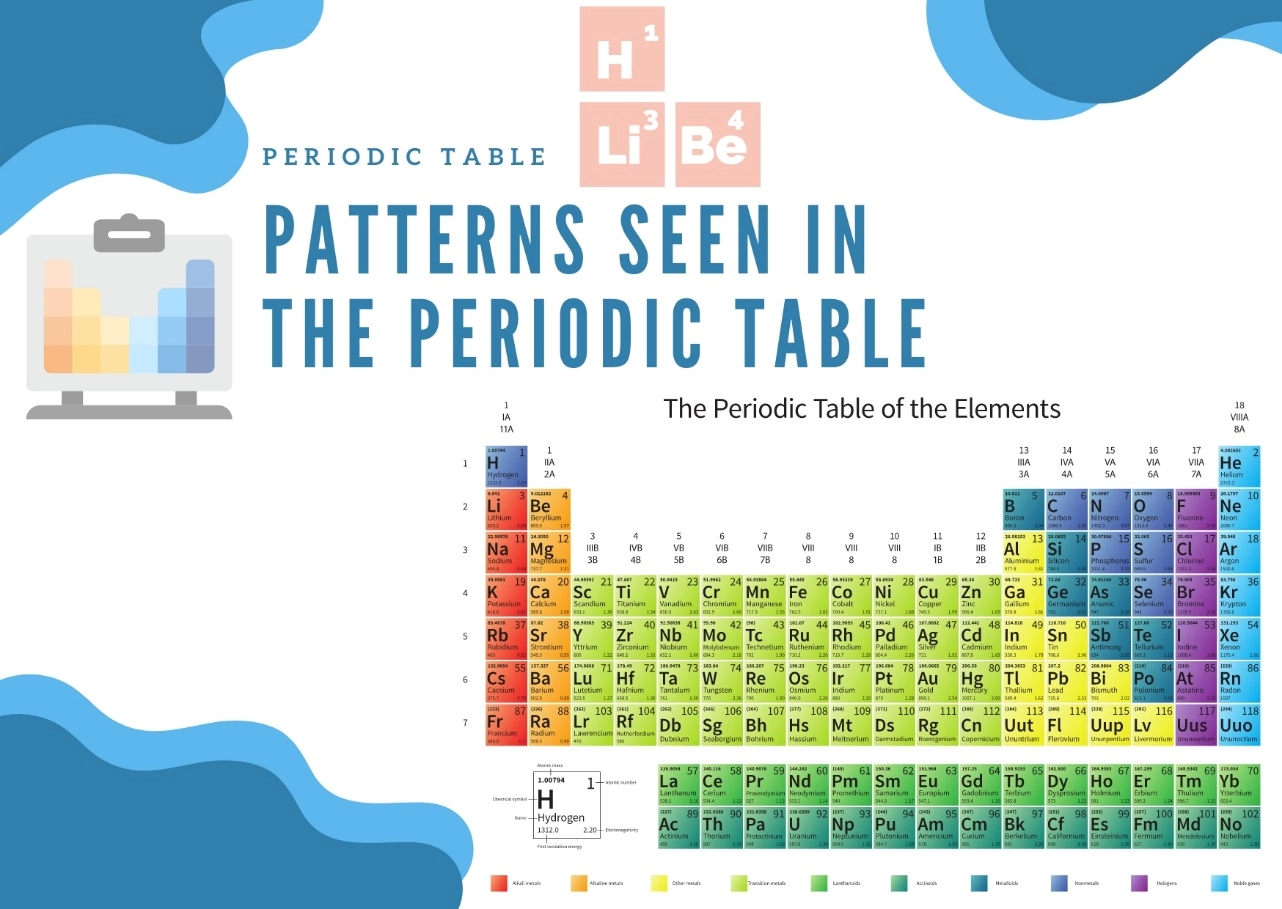
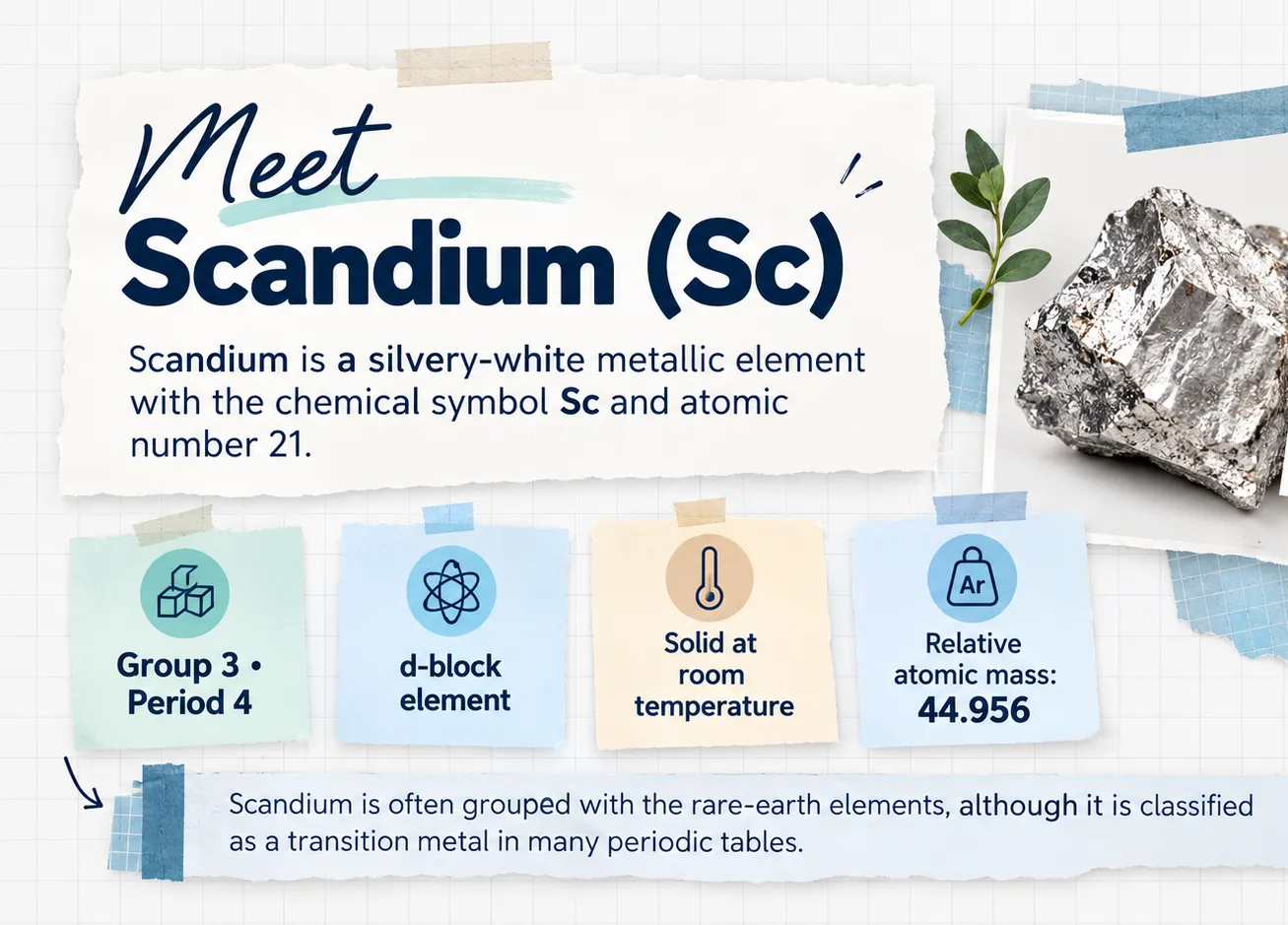
Scandium is a chemical element with the symbol Sc and atomic number 21. It sits in Group 3 and Period 4 of the periodic table, in the d-block, directly between calcium and titanium. Its relative atomic mass is 44.956.
Scandium is a metal, so it is shiny, conducts electricity and forms positive ions. It looks silvery, but it tarnishes in air and burns easily when finely divided. You will not meet it in everyday life, yet it quietly strengthens aircraft parts, bicycle frames and sports equipment.
Scandium is also counted among the 17 rare-earth elements, along with yttrium and the lanthanides. That is a mining and trade label, not a statement about its position in the table, and we will return to it later in this article. If you want to see where scandium sits among its neighbours, our guide to all the metals on the periodic table shows the whole picture.
Protons, electrons and neutrons in scandium
Every scandium atom has 21 protons, so a neutral atom also has 21 electrons. Scandium has only one natural isotope, scandium-45, which makes up 100% of natural scandium. Its mass number is 45, so the number of neutrons is:
neutrons = mass number − atomic number = 45 − 21 = 24
Because there is just one natural isotope, the relative atomic mass of scandium is very close to a whole number (44.956, so about 45). Most elements are not this tidy. Chlorine, for example, is a mixture of isotopes, which gives a fractional value. If you need a refresher on these ideas, see our lesson on atoms, mass number and atomic number.
Physical properties of scandium
The physical properties of scandium explain why engineers like it. It is light, yet it has a high melting point. The table below gathers the key values from the Royal Society of Chemistry (RSC) data.
| Property | Value for scandium |
|---|---|
| Appearance | Silvery metal that tarnishes in air |
| State at 20 °C | Solid |
| Melting point | 1,541 °C (1,814 K) |
| Boiling point | 2,836 °C (3,109 K) |
| Density | 2.99 g/cm³ |
| Relative atomic mass | 44.956 |
| Pauling electronegativity | 1.36 |
| Natural isotope | Scandium-45 (100%) |
The density of 2.99 g/cm³ is close to that of aluminium, but scandium melts at a much higher temperature. That mix of low density and heat resistance is part of why small amounts of scandium make aluminium alloys so useful, as you will see later in this article.
The electronegativity of 1.36 is low. Metals with low electronegativity lose electrons easily, so scandium readily forms positive ions in its compounds. In other words, the physical data already hint at the chemistry to come.
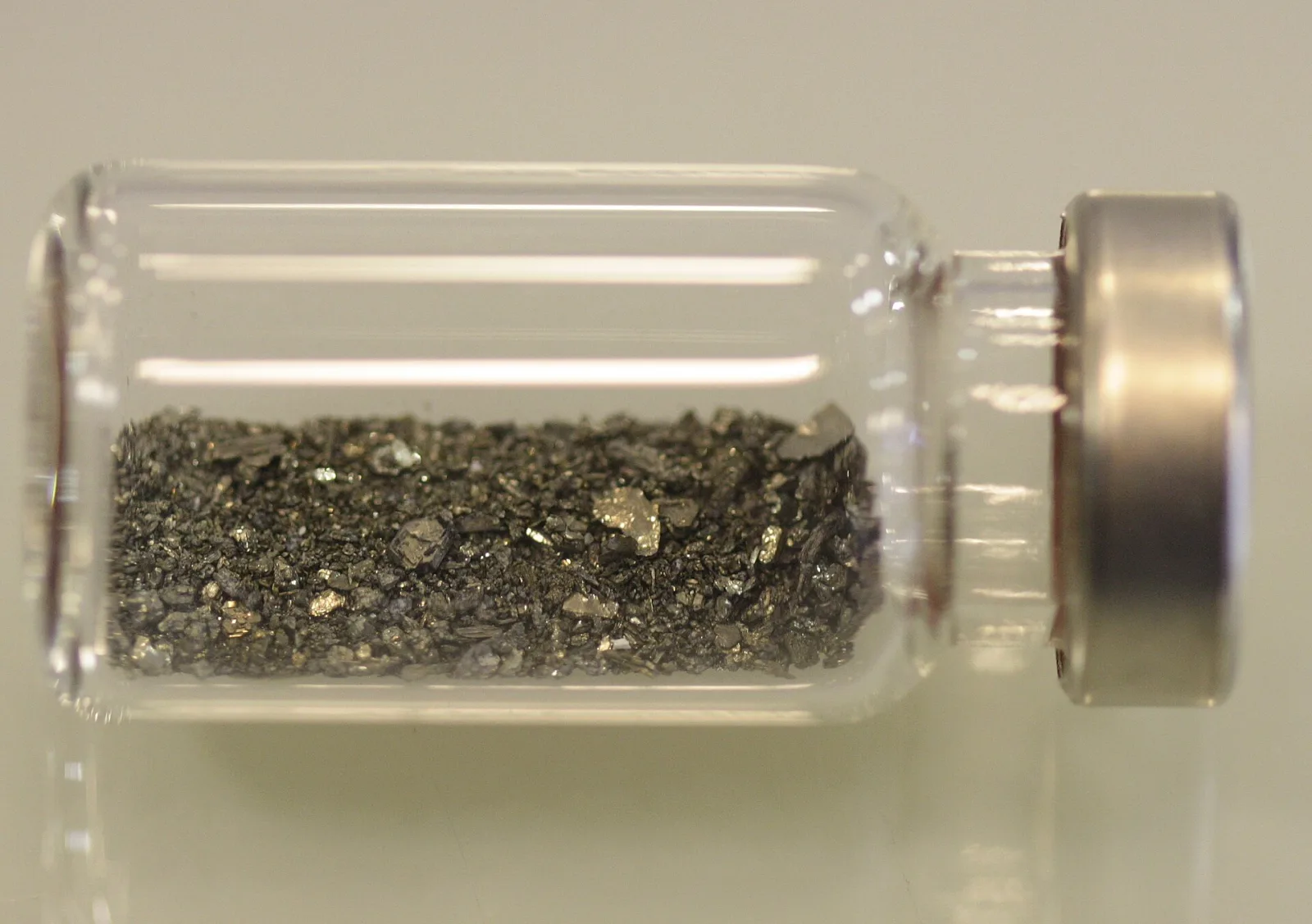
Pure scandium is not easy to photograph. The sealed vial above holds small crystals of the metal, kept away from air so that they do not tarnish. Scandium metal is usually made as a silvery solid in small quantities, which is part of its cost story later in this article.
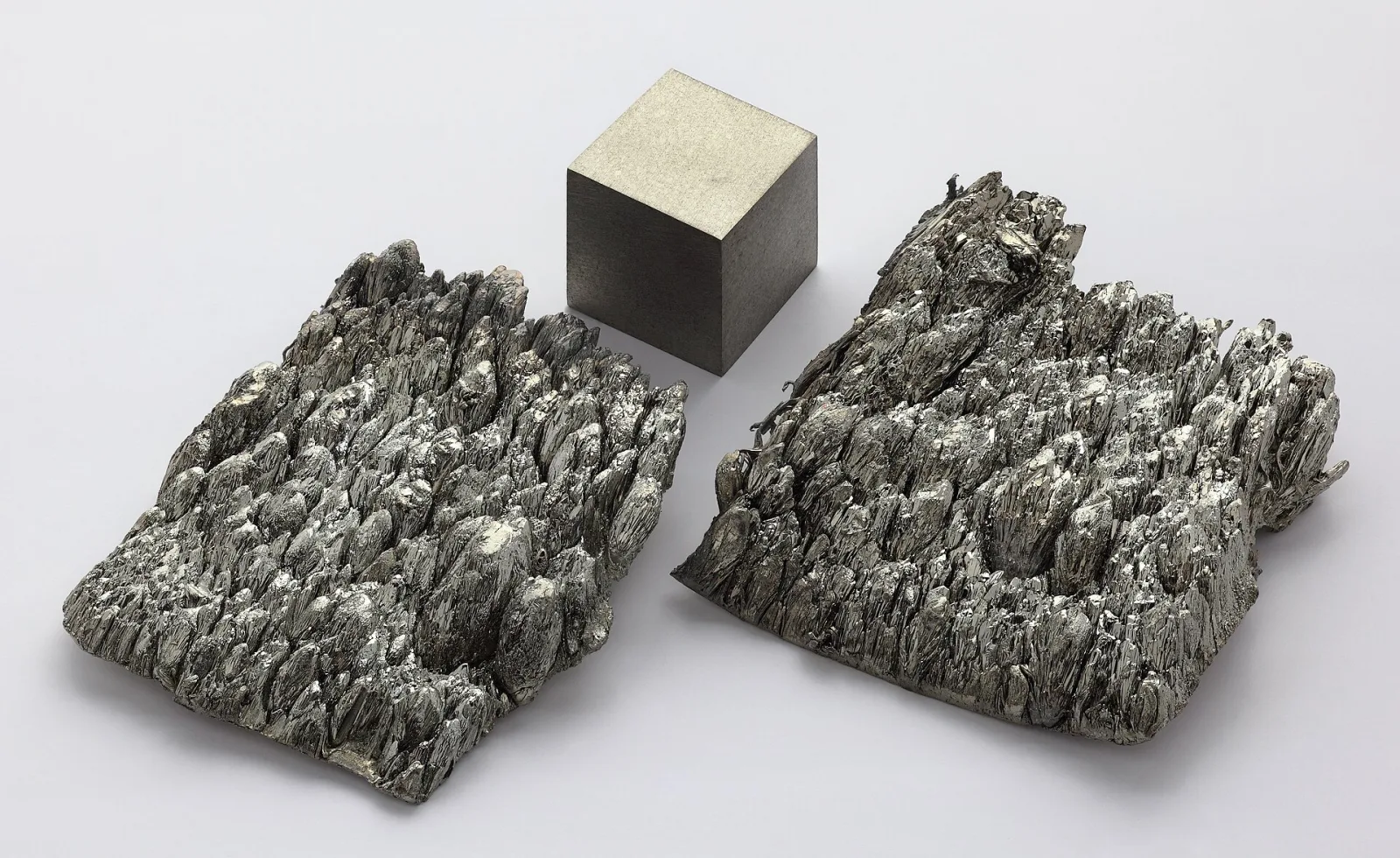
Here is a sense of scale. The cube beside the sublimed scandium pieces measures 1 cm on each side, so its volume is 1 cm³. At a density of 2.99 g/cm³, a solid 1 cm³ cube of scandium has a mass of about 3 g. That is roughly the mass of a few small paper clips, from a metal that melts at over 1,500 °C.
Reading the data like a chemist
When you see a table of physical properties, ask what each number tells you about bonding and structure. A high melting point of 1,541 °C means the metallic bonding is strong, because a lot of energy is needed to overcome the attraction between the positive ions and the delocalised electrons and break up the solid lattice. A solid state at room temperature fits with this. The boiling point of 2,836 °C is even higher, so scandium stays liquid across a wide temperature range.
The low electronegativity tells you that scandium atoms hold on to their outer electrons only loosely. That is what you expect from a metal: in a metallic lattice the outer electrons are delocalised, and in a reaction with a non-metal they are transferred to the other atom. We return to this idea with the reactions below.
Where does scandium sit in the periodic table?
Period 4 starts with potassium and calcium, which are s-block metals. Scandium is the first element of the d-block, because it is where the 3d sub-level begins to fill. Titanium comes next.
That position matters. It is why scandium has only one d electron to lose or share, and why chemists argue about whether it counts as a “proper” transition metal. That debate is the first topic in the next section, where we look closely at its electron configuration.
Scandium electron configuration
The electron configuration of scandium is [Ar] 3d¹ 4s². Written out in full, it is 1s² 2s² 2p⁶ 3s² 3p⁶ 3d¹ 4s². Add up the superscripts and you get 21 electrons, matching the atomic number.
The electrons sit in four shells, which can be written as 2, 8, 9, 2. The third shell holds nine electrons because it contains the 3s², 3p⁶ and 3d¹ electrons together: 2 + 6 + 1 = 9.
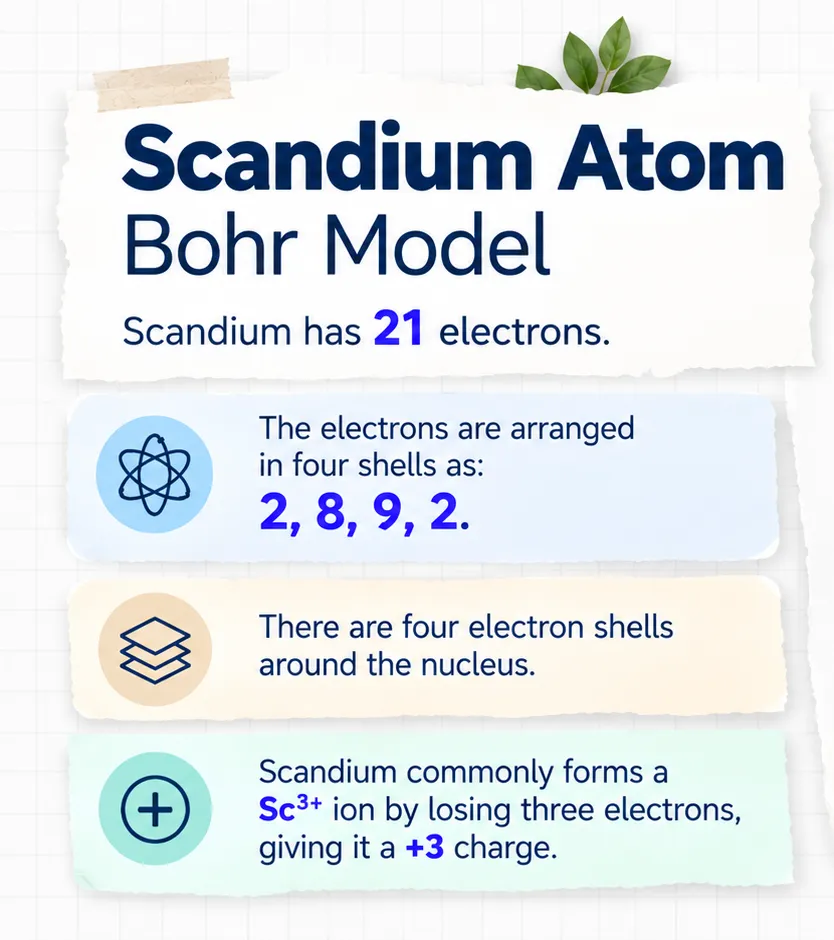
You might wonder why 4s is written after 3d, even though 4s fills first. The 4s sub-level fills before 3d because it is lower in energy when the 3d orbitals are empty. Once the 3d orbital is occupied it drops below 4s in energy, which is why the 4s electrons are lost first. By convention, we list sub-levels in order of shell number, so 3d goes before 4s in the written form. When scandium forms ions, the 4s electrons are lost first, followed by the 3d electron. For a deeper look at the rules, see our lesson on electronic configuration for GCSE chemistry.
How many valence electrons does scandium have?
Scandium has three valence electrons: the two 4s electrons and the one 3d electron. These are the electrons that scandium uses in bonding. Notice that this is slightly different from a main-group metal like calcium, where only the s electrons are used.
The three valence electrons are why scandium is in Group 3. They are also why the common ion is Sc³⁺: lose all three and you are left with the argon core, [Ar], which is a very stable arrangement.
Is scandium a transition metal?
This is a classic exam trap, and the honest answer is “it depends on the definition”.
- IUPAC definition: a transition metal has an atom with a partly filled d sub-level. A scandium atom has one electron in 3d, so it qualifies.
- A-level definition: a transition metal forms at least one ion with a partly filled d sub-level. Sc³⁺ is [Ar], with no d electrons, so scandium does not qualify.
Zinc is the mirror image: it fails both tests, because it has a full 3d sub-level in the atom and in its common Zn²⁺ ion. Scandium is therefore a d-block element that is often treated as a borderline case. Chemguide uses this ion-based definition, and many UK specifications follow it.
Chemical properties of scandium
The key chemical properties of scandium come straight from its electrons. Scandium is a reactive metal that loses three electrons to form Sc³⁺. Its +3 oxidation state is the common one; +2 and +1 are known, but rare.
Why does scandium only form Sc³⁺?
The answer is in the ionisation energies. Each successive electron is harder to remove, but the fourth is far harder than the others.
| Ionisation energy | Value (kJ/mol) | Electron removed from |
|---|---|---|
| 1st | 633 | 4s |
| 2nd | 1,235 | 4s |
| 3rd | 2,389 | 3d |
| 4th | 7,091 | 3p (inside the argon core) |
The jump from 2,389 to 7,091 kJ/mol is huge. The first three electrons are the valence electrons. The fourth would have to come from the full 3p sub-level, which is much closer to the nucleus and strongly held. The energy released when new bonds form cannot pay for that cost, so scandium stops at +3.
Explain why scandium forms Sc³⁺ but not Sc⁴⁺. (2 marks)
The fourth ionisation energy (7,091 kJ/mol) is much larger than the third (2,389 kJ/mol). The fourth electron would have to be removed from the full inner 3p sub-level (the argon core), which is closer to the nucleus and held more strongly.
Why are scandium compounds colourless?
Many transition-metal compounds are bright, such as blue copper(II) sulfate. Colour comes from d electrons moving between slightly different d energy levels and absorbing some visible light. Sc³⁺ has no d electrons, so there is nothing to move. It absorbs no visible light, and its compounds and complexes are colourless or white.
Why are scandium(III) compounds white or colourless? (2 marks)
Sc³⁺ has no d electrons, so there are no d–d transitions. No visible light is absorbed, so the compounds appear white or colourless.
Sc³⁺ ions also have more in common with yttrium ions than with aluminium ions, even though aluminium is a much better-known metal.
Reactions of scandium
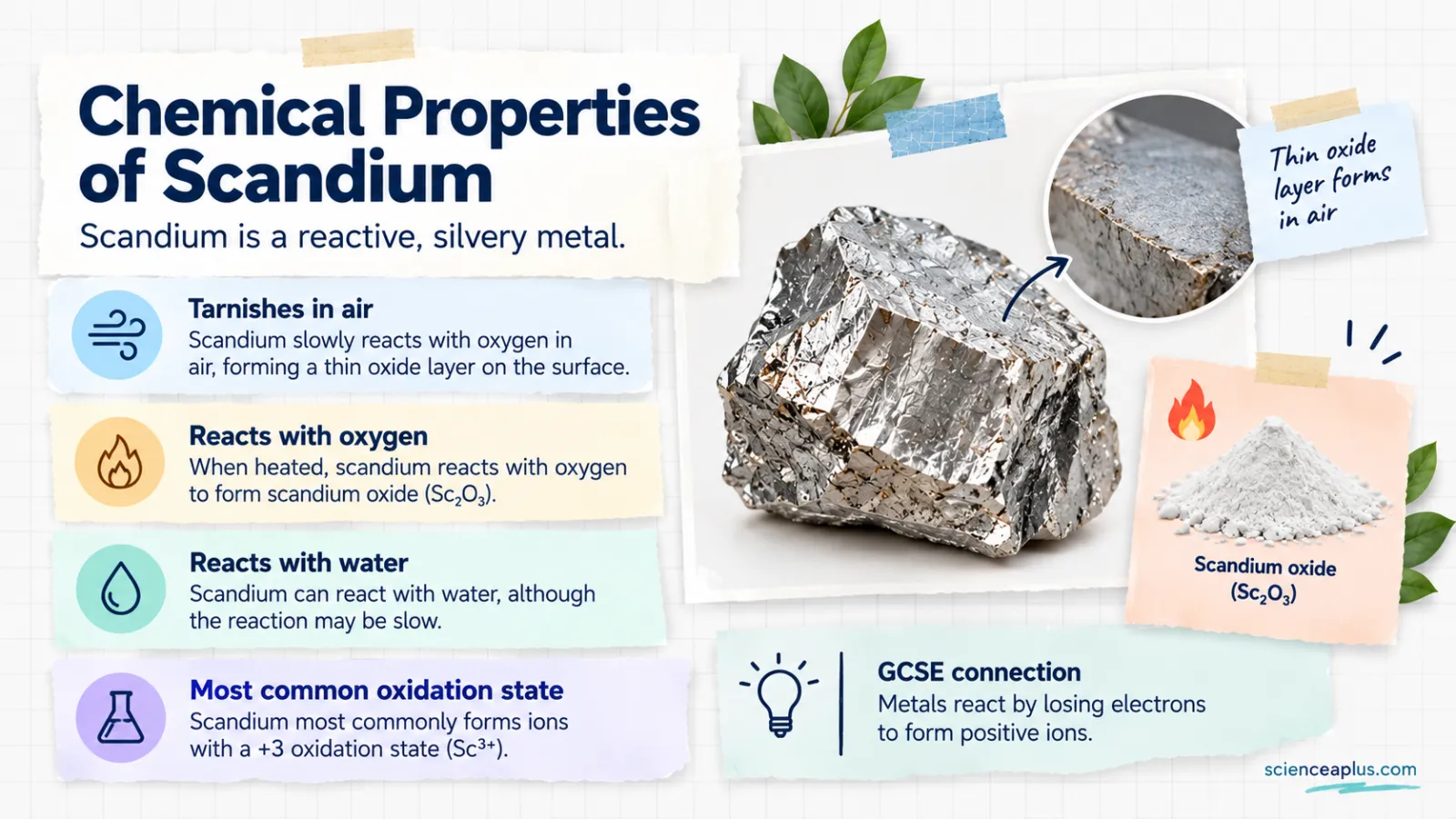
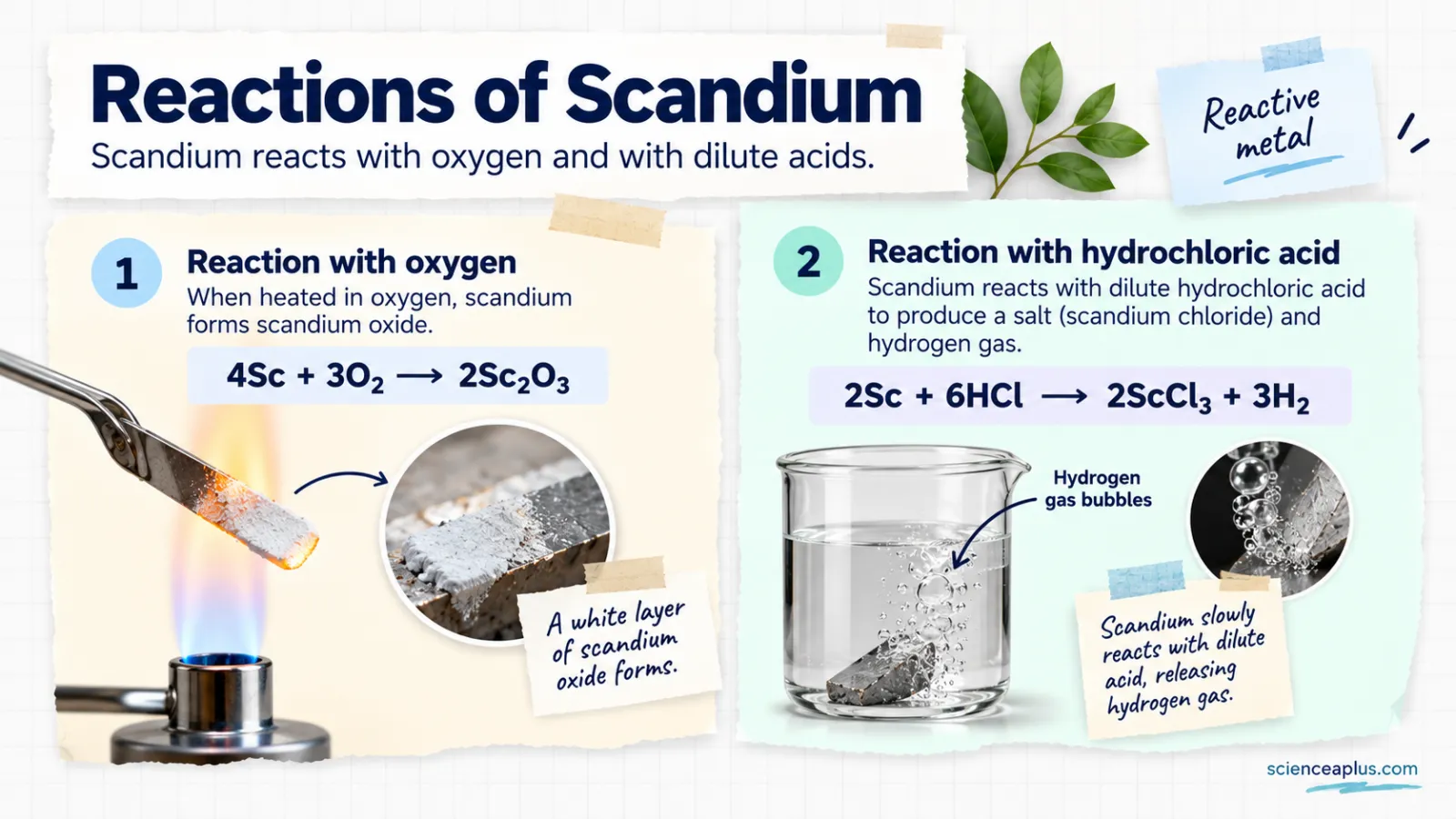
Scandium reacts with oxygen, water, dilute acids and halogens. In every case the metal is oxidised to Sc³⁺. The infographic summarises two of the main reactions.
Scandium with oxygen
Scandium tarnishes slightly in air. If you heat finely divided scandium (turnings), it ignites with a brilliant yellow flame and forms white scandium oxide:
4Sc + 3O₂ → 2Sc₂O₃
Check the balance: 4 Sc and 6 O on each side. The oxide is Sc₂O₃ because two Sc³⁺ ions (+6) balance three O²⁻ ions (−6).
Scandium with water
Scandium reacts with water to form scandium hydroxide and hydrogen gas. The reaction is much less vigorous than those of the Group 1 metals.
2Sc + 6H₂O → 2Sc(OH)₃ + 3H₂
Scandium with dilute acids
Scandium dissolves slowly in most dilute acids, giving a colourless solution and hydrogen. With hydrochloric acid:
2Sc + 6HCl → 2ScCl₃ + 3H₂
The ionic equation, which leaves out the spectator chloride ions, is simpler:
2Sc + 6H⁺ → 2Sc³⁺ + 3H₂
One exception is worth knowing. Scandium does not dissolve in a 1:1 mixture of nitric acid and 48% hydrofluoric acid, possibly because an impermeable passive layer forms. For the general patterns, see our guides to the reactivity of metals and to acids and bases.
Use the calculator to see how much hydrogen a given mass of metal can make. It uses the mole ratio from the balanced equation: 2 mol of Sc gives 3 mol of H₂, so 1 mol of Sc gives 1.5 mol.
For 1 g of scandium, the working is: 1 ÷ 44.956 = 0.0222 mol of Sc; × 1.5 = 0.0334 mol of H₂; × 24 dm³/mol = 0.801 dm³ (801 cm³) at room temperature and pressure. Try aluminium too: its Ar is lower, so the same mass makes more hydrogen.
Scandium with halogens
Like other metals, scandium reacts with halogens to make halides. With chlorine:
2Sc + 3Cl₂ → 2ScCl₃
Every halide has scandium in the +3 state, so the formulas are ScF₃, ScCl₃, ScBr₃ and ScI₃. We compare their properties further down.
Scandium compounds
Almost every scandium compound contains scandium in the +3 state. That makes the formulas easy to predict: Sc³⁺ combines with one chloride per charge (ScCl₃), or with oxide ions in the ratio 2 : 3 (Sc₂O₃). The three compounds below come up most often.
Scandium oxide, Sc₂O₃
Scandium oxide is a white solid and the most important scandium compound commercially. It forms when scandium burns in air, and it is the form in which scandium is usually sold and traded. It is also the material added to zirconia in solid oxide fuel cells, which we meet later in this article.
Scandium oxide is amphoteric, meaning it reacts with both acids and strong alkalis. Amphoteric behaviour is something scandium shares with aluminium, although the two metals differ in other ways.
Scandium hydroxide and amphoteric behaviour
Scandium hydroxide, Sc(OH)₃, is also amphoteric. With an acid it behaves as a base and dissolves to give Sc³⁺ ions:
Sc(OH)₃ + 3H⁺ → Sc³⁺ + 3H₂O
With excess alkali it behaves as an acid and dissolves to give the scandate ion, a soluble complex:
Sc(OH)₃ + 3OH⁻ → [Sc(OH)₆]³⁻
Check the charges in the second equation: on the left, the hydroxide ions add −3 and Sc(OH)₃ is neutral, so the total is 3−. On the right, the complex has a charge of 3−. Both sides balance in atoms and in charge.
Write the equation for scandium hydroxide dissolving in excess sodium hydroxide. (1 mark)
Sc(OH)₃ + 3OH⁻ → [Sc(OH)₆]³⁻ (the sodium ions are spectators).
Scandium halides
The scandium halides show a clear solubility pattern, and it is the fluoride that stands out.
| Compound | Formula | Solubility in water |
|---|---|---|
| Scandium fluoride | ScF₃ | Insoluble |
| Scandium chloride | ScCl₃ | Very soluble |
| Scandium bromide | ScBr₃ | Very soluble |
| Scandium iodide | ScI₃ | Very soluble |
Scandium chemistry also includes organometallic compounds, for example with cyclopentadienyl ligands, but these are specialist topics beyond school courses.
Who discovered scandium?
Scandium is a textbook case of the periodic table making a successful prediction. In 1869, Dmitri Mendeleev predicted an undiscovered element that he called eka-boron, with an atomic mass between 40 and 48. It would sit between calcium and titanium, where his table had a gap. You can read about those neighbours in our guides to calcium and titanium.
Ten years later, in 1879, the Swedish chemist Lars Fredrik Nilson of Uppsala University found a new element in the minerals euxenite and gadolinite. Per Teodor Cleve then recognised that it matched Mendeleev’s eka-boron and told Mendeleev. Nilson named it scandium, from the Latin Scandia, meaning Scandinavia.
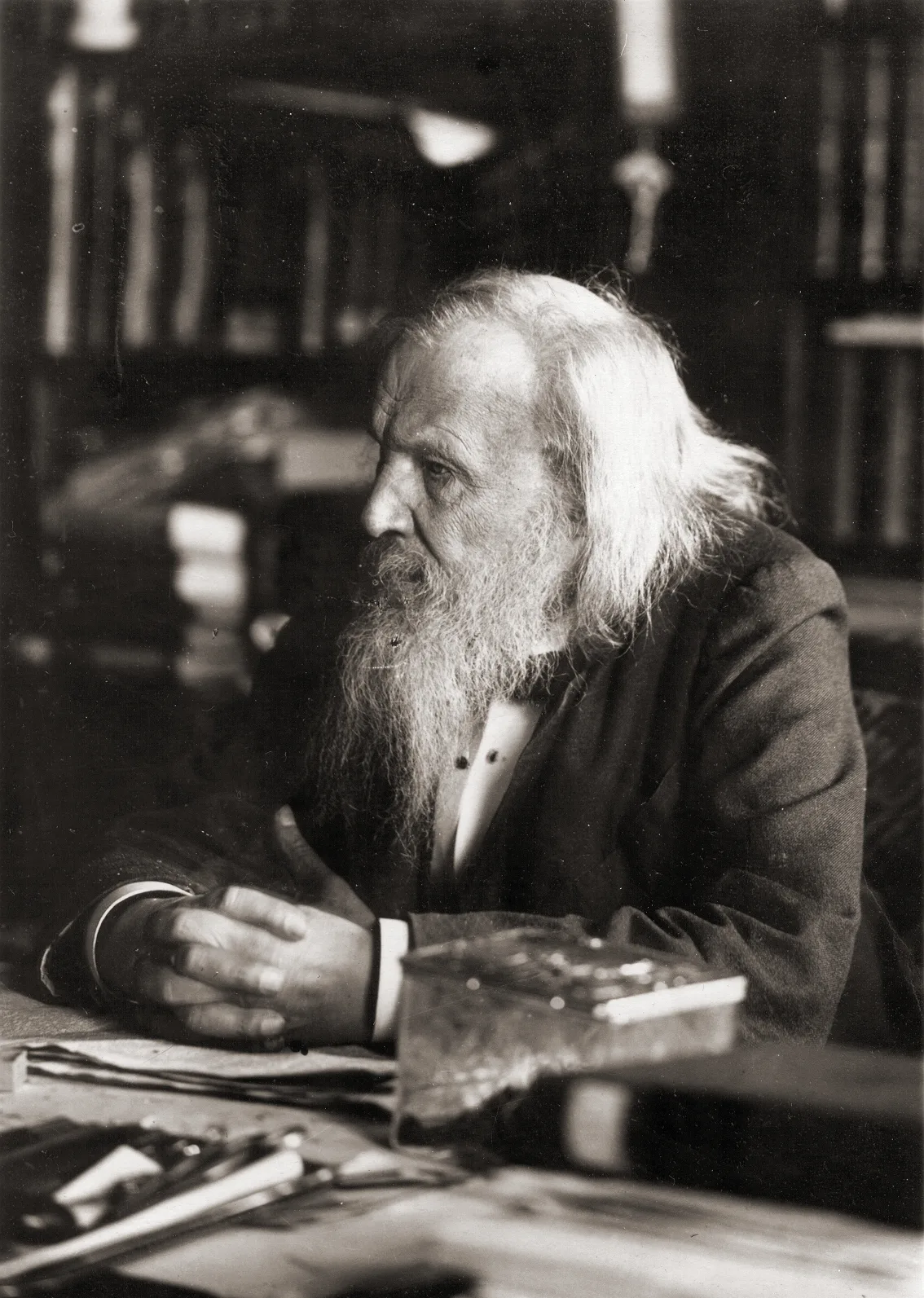
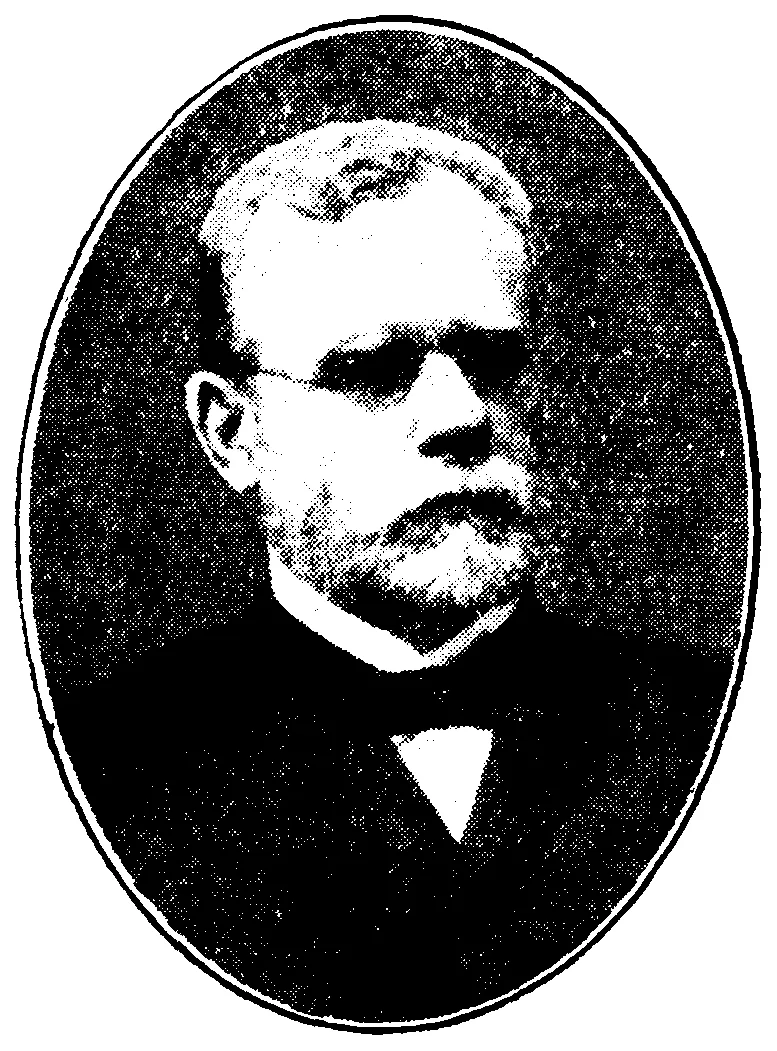
The pure metal took much longer. It was first produced in 1937, by electrolysis of a molten mixture of potassium, lithium and scandium chlorides. The story shows why the periodic table matters: it let Mendeleev describe an element before anyone had seen it. For more on this idea, see our article on patterns in the periodic table.
Where is scandium found?
Scandium is widespread but rarely concentrated. Crustal abundance is about 20 parts per million (estimates vary), comparable to cobalt, and tiny amounts occur in over 800 minerals. The problem is that it rarely collects into rich deposits.
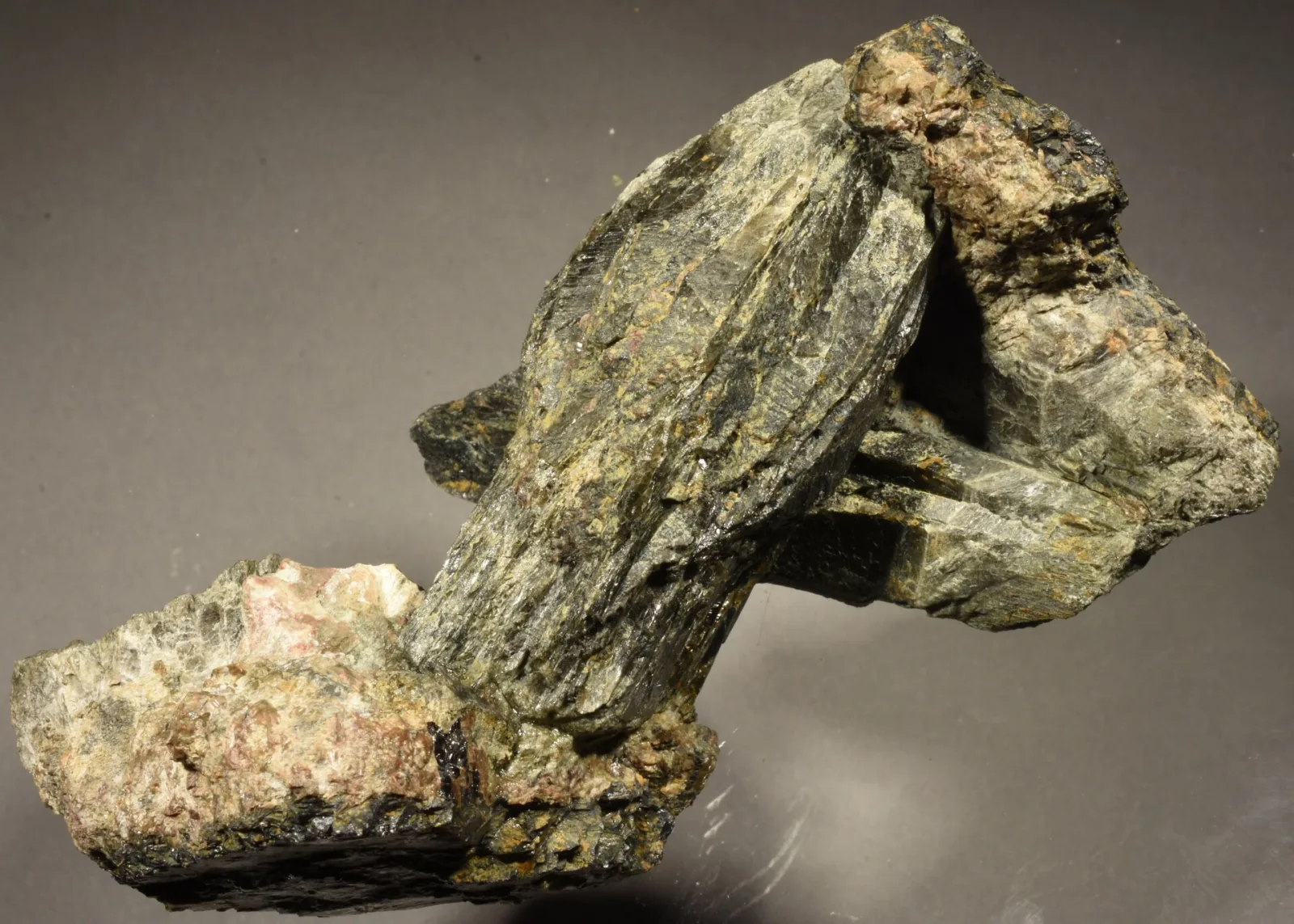
The main scandium mineral is thortveitite, (Sc,Y)₂Si₂O₇, which can contain up to 45% scandium oxide. It is named after the Norwegian engineer Olaus Thortveit, and it is rare.
How is scandium produced, and why is it so expensive?
Scandium is produced almost entirely as a by-product. In 2025, according to the US Geological Survey (USGS), it was produced only as a by-product, mainly from nickel and titanium process streams and from old tailings and residues. It has also been recovered from uranium mill tailings.
The metal is made by reducing scandium fluoride with calcium, a more reactive metal:
2ScF₃ + 3Ca → 2Sc + 3CaF₂
Check the balance: 2 Sc, 6 F and 3 Ca on each side.
The 2025 market in numbers
The USGS estimates for 2025 are that global production was about 80 tonnes of scandium oxide, with capacity of over 90 tonnes a year and consumption of about 60 tonnes. China is the leading producer, and material from the Philippines is refined in Japan. The USA mined none and relies entirely on imports. In April 2025, China added export controls on scandium metal, alloys, oxides and compounds. The USGS notes that, as of December 2025, China had begun issuing general licences while the April 2025 controls stayed in effect.
The USGS also publishes price ranges for 99.99% scandium oxide, ex-works China. These are averages for small lots and vary with purity and source.
| Year | Price range ($ per kg of oxide) |
|---|---|
| 2021 | 890–1,000 |
| 2022 | 820–880 |
| 2023 | 700–740 |
| 2024 | 660–670 |
| 2025 | about 640 (estimate) |
A 99.999% pure metal ingot costs far more, at about $5,200 per kg in 2024–25. Treat all of these as indicative: prices differ by supplier and order size.
So why is scandium costly? Three reasons stand out. There are no mines dedicated to scandium. The market is small. And separating scandium from other elements is hard. Prices have drifted down over recent years, yet scandium is still far dearer than common structural metals.
Uses of scandium
The USGS says the main uses of scandium in 2025 were aerospace alloys and solid oxide fuel cells (SOFCs) for large-scale and backup power. Smaller uses include electronics, alloys for military equipment and sporting goods.
Aluminium–scandium alloys
Adding just 0.1–0.5% scandium to aluminium makes a much stronger alloy. The scandium forms tiny particles of Al₃Sc inside the metal, and these coherent precipitates strengthen the aluminium by getting in the way of the layers of atoms sliding past each other. The result is a light, strong material that is a good fit where every kilogram counts. You can read about the base metal in our guide to aluminium.
Al–Sc alloys have been used in components of MiG-21 and MiG-29 fighter aircraft, and in bicycle frames, baseball bats and tent poles. Some handgun frames also use them. Titanium and aluminium high-strength alloys, and carbon fibre, can substitute for scandium alloys.



Solid oxide fuel cells
A solid oxide fuel cell makes electricity directly from a fuel, and its electrolyte must let oxide ions move through a solid. Adding scandium oxide to zirconia gives scandia-stabilised zirconia, which boosts the ionic conductivity of the electrolyte. The USGS lists solid oxide fuel cells as one of the principal uses of scandium in 2025.
Metal-halide lamps
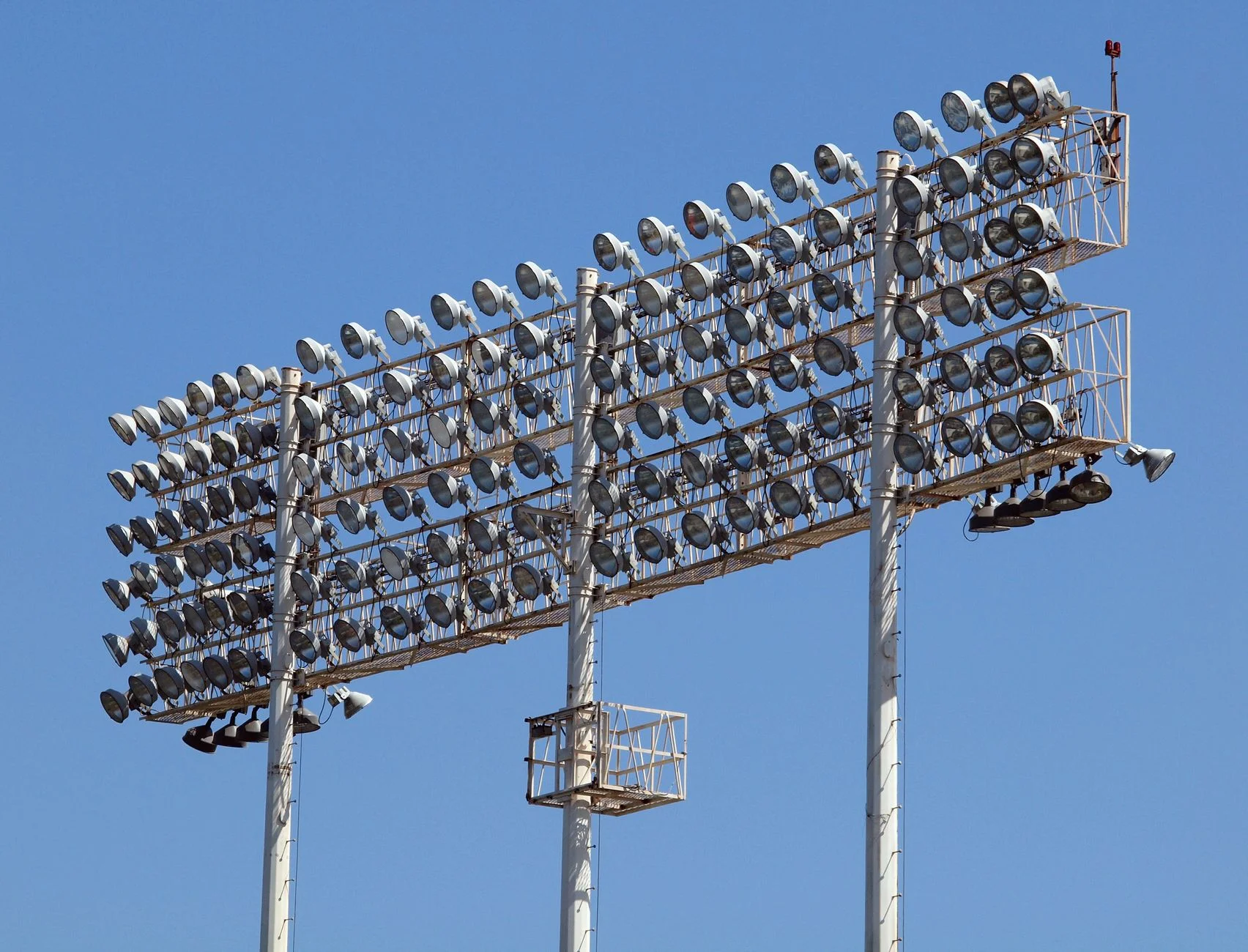
Scandium iodide, mixed with sodium iodide, is used in metal-halide lamps. The light is white and resembles sunlight, with high colour rendering, so it shows colours accurately. Lamps of this type light sports arenas and car parks.
Tracers and medicine
Scandium-46 is a radioactive tracer. In industry it is used in oil refining and to find leaks in underground pipes. In medicine, scandium-44 and scandium-47 are being researched as a “theranostic” pair: scandium-44 is a positron emitter used for PET imaging, and scandium-47 emits beta radiation. Early clinical studies have been reported, but this is research, not routine treatment.
Scandium isotopes
Only scandium-45 is stable. Every other isotope is radioactive and decays over time, at a rate described by its half-life.
| Isotope | Half-life | Use or interest |
|---|---|---|
| Scandium-45 | Stable (100% of natural scandium) | The only natural isotope |
| Scandium-46 | About 83.8 days (the most stable radioisotope) | Industrial tracer |
| Scandium-47 | About 3.35 days | Researched for therapy |
| Scandium-44 | About 4.04 hours | Researched for PET imaging |
The half-life is the time for half of the radioactive atoms in a sample to decay. After one half-life 50% remains, after two 25%, and so on. Try it for scandium-47, whose half-life is about 3.35 days. After 7 days, which is just over two half-lives, about a quarter is left.
Is scandium dangerous?
Scandium has no known biological role. The RSC lists it as a suspected carcinogen. Elemental scandium is generally considered non-toxic, but its compounds have been little tested and are treated as moderately toxic, so they should be handled with care. Fine turnings and powder can ignite in air. This article is educational only; follow your teacher’s or employer’s safety instructions in a lab.
Scandium vs its neighbours
Scandium keeps things simple: it shows only the +3 state in almost all its compounds. Metals further across period 4, such as vanadium and manganese, show several oxidation states and form coloured compounds. Scandium’s lack of d electrons in Sc³⁺ is the reason it behaves so differently.
Scandium in one line
Test yourself
Key points to remember
Frequently asked questions about scandium chemical properties
What are the chemical properties of scandium?
Scandium is a reactive silvery metal that tarnishes in air, burns in oxygen to form scandium oxide, reacts with water and dissolves slowly in dilute acids. It almost always forms the Sc³⁺ ion, its compounds are colourless, and its oxide and hydroxide are amphoteric.
Is scandium a transition metal?
It depends on the definition. A scandium atom has a partly filled 3d sub-level, so it fits the IUPAC definition. But Sc³⁺ has no d electrons, so it fails the A-level definition, which needs an ion with a partly filled d sub-level. It is a d-block element.
What is the electron configuration of scandium?
The electron configuration of scandium is [Ar] 3d¹ 4s², or 1s² 2s² 2p⁶ 3s² 3p⁶ 3d¹ 4s² in full. The 21 electrons are arranged in shells as 2, 8, 9, 2. Scandium has three valence electrons: two in 4s and one in 3d.
Why are scandium compounds colourless?
Scandium compounds are colourless because Sc³⁺ has no d electrons. Colour in transition-metal compounds comes from d electrons absorbing visible light as they move between d energy levels. With none to move, Sc³⁺ absorbs no visible light, so its compounds look white or colourless.
Does scandium react with water?
Yes. Scandium reacts with water to form scandium hydroxide and hydrogen gas. The balanced equation is 2Sc + 6H₂O → 2Sc(OH)₃ + 3H₂. It reacts much less vigorously than the Group 1 metals.
Is scandium a rare earth element?
The USGS counts scandium as one of the 17 rare-earth elements, along with yttrium and the lanthanides. That grouping is used in mining and trade because they occur together. Scandium is not a lanthanide: it is a Group 3 d-block element. Its Sc³⁺ ion resembles yttrium’s.
What is scandium used for?
The main uses are aluminium–scandium alloys for aerospace, and solid oxide fuel cells, where scandium oxide is added to zirconia. Smaller uses include bicycle frames, baseball bats, tent poles, metal-halide lamps that give sunlight-like white light, and scandium-46 as an industrial tracer.
Why is scandium so expensive?
Scandium is made only as a by-product, mainly from nickel and titanium processing and old residues, because no mines are dedicated to it. The market is small and separating scandium is hard. The USGS gave 99.99% scandium oxide a price of about $640 per kg in 2025 (estimate).
Who discovered scandium?
Lars Fredrik Nilson of Uppsala University, Sweden, discovered scandium in 1879 in the minerals euxenite and gadolinite. Mendeleev had predicted the element as eka-boron in 1869, and Per Teodor Cleve recognised the match. It is named after Scandinavia, from the Latin Scandia.