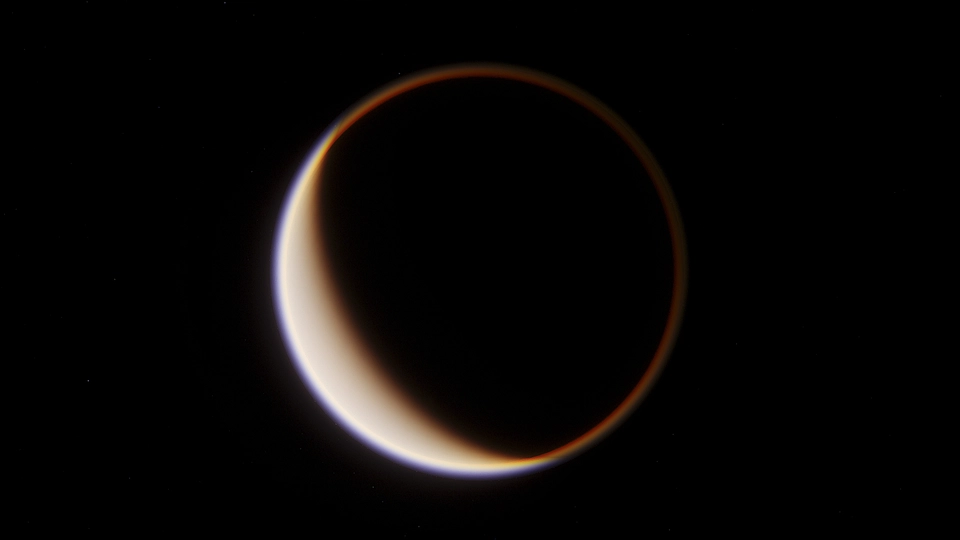
A solar eclipse happens when the Moon passes between the Sun and Earth and blocks some or all of the Sun’s light. A lunar eclipse happens when Earth passes between the Sun and the Moon, so Earth’s shadow falls on the Moon. Both are just shadows in space, but they look dramatic, and they follow rules that scientists can predict centuries ahead.
In this guide you will learn what causes a solar eclipse, how the different types compare, why the Moon fits so neatly over the Sun, and when eclipses occur. We will also cover lunar eclipses, how to watch safely, and the eclipses coming up soon. It is written for GCSE physics students and for anyone who has ever looked up and wondered.
What is an eclipse?
An eclipse is what we see when one object in space moves into the shadow of another, or passes in front of it from our point of view. For Earth, the two that matter most are the Moon and the Sun. The Sun makes its own light. The Earth and Moon do not, so each casts a long shadow into space on the side facing away from the Sun.
When those shadows line up with the right places, we get an eclipse. If the Moon’s shadow touches Earth, people in that spot see a solar eclipse. If the Moon moves into Earth’s shadow, everyone on the night side of Earth sees a lunar eclipse.
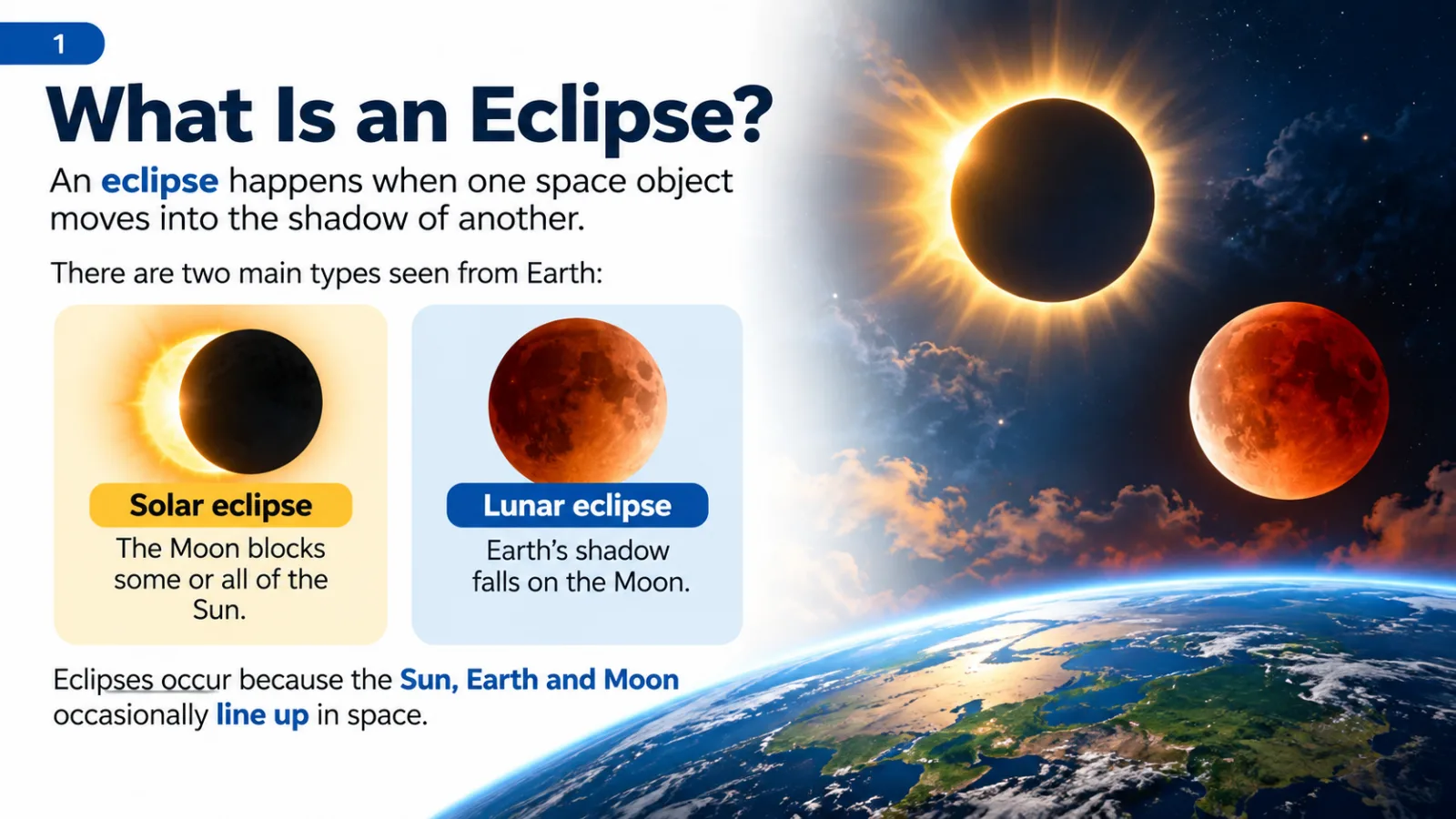
Timing matters too. A solar eclipse can only happen at new Moon, when the Moon sits between us and the Sun. A lunar eclipse can only happen at full Moon, when Earth sits between the Sun and the Moon. That rule alone rules out eclipses on most nights of the month.
What is a solar eclipse?
During a solar eclipse, the Moon travels directly across the line between the Sun and a spot on Earth. The Moon’s shadow sweeps over the surface as a moving patch, and the people inside it see the Sun partly or completely hidden. The daytime sky can darken, the temperature can drop, and in a total eclipse the Sun’s faint outer atmosphere, the corona, becomes visible.
Because the Moon’s shadow is small, only a narrow strip of Earth sees the most spectacular version. Everyone else, over a much wider area, sees a partial eclipse where the Moon takes only a bite out of the Sun.
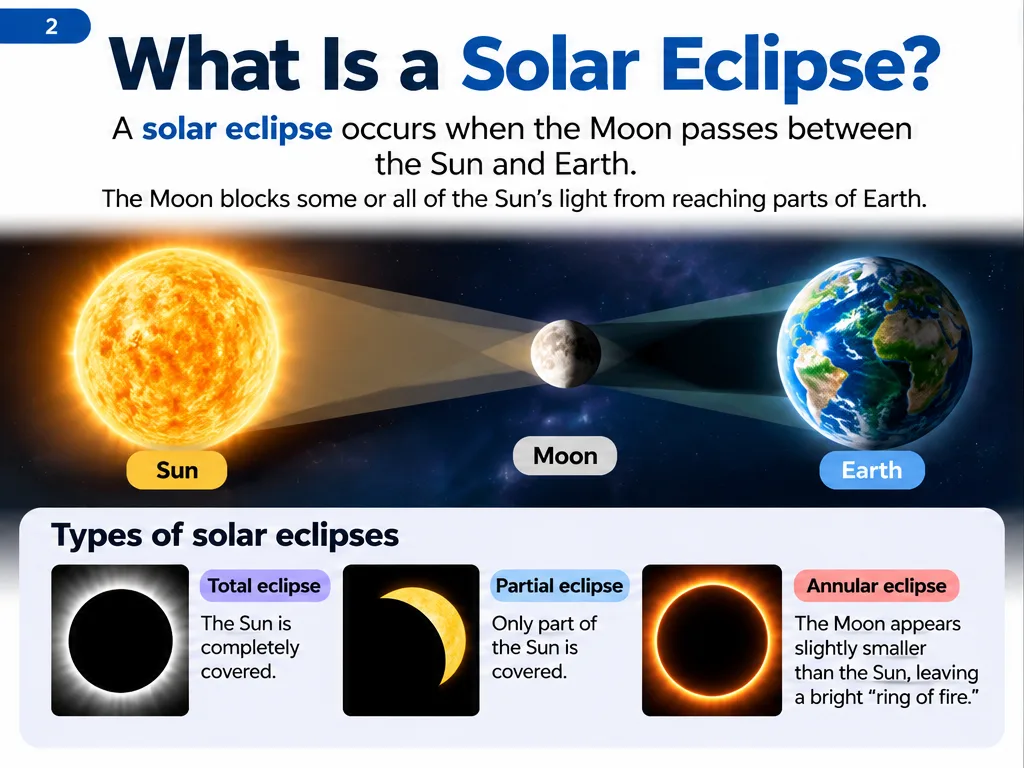
Umbra, penumbra and antumbra
The Sun is not a point of light, so the Moon’s shadow has more than one part. Which part falls on you decides what you see.
- Umbra: the dark centre of the shadow. Stand inside it and you see a total solar eclipse.
- Penumbra: the lighter, partial shadow around the umbra. Stand inside it and you see a partial eclipse.
- Antumbra: the region beyond the tip of the umbra. Stand inside it and the Moon looks too small to cover the Sun, leaving a bright ring. This is an annular eclipse.
Types of solar eclipse
There are four types of solar eclipse. Which one you get depends on how far away the Moon is and how exactly the three bodies line up.
| Type | What you see | Why |
|---|---|---|
| Total | The Moon covers the Sun completely and the corona appears. Totality lasts at most about 7.5 minutes, and typically 2–4 minutes. | You are inside the umbra. The path of totality is usually less than about 250 km wide. |
| Annular | A bright “ring of fire” around a dark Moon. | The Moon is near apogee, its farthest point from Earth, so it looks smaller than the Sun. You are in the antumbra. |
| Partial | The Moon covers only part of the Sun, like a bite. | You are in the penumbra, or the Moon is not quite centred on the Sun. |
| Hybrid | The eclipse changes between annular and total along its path. This is rare. | Earth’s curved surface moves in and out of the umbra’s tip along the path. |
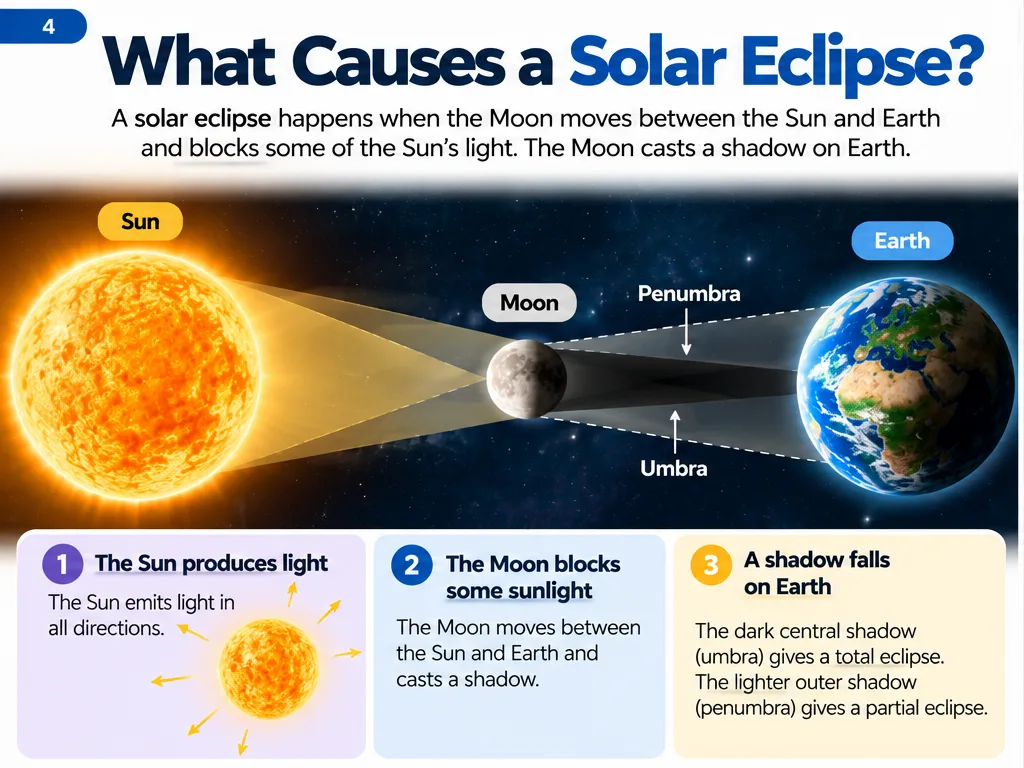
So the answer to what causes a solar eclipse is simple: the Moon’s shadow landing on Earth at new Moon. The type depends on the size of that shadow where it arrives.
The amazing coincidence: why the Moon fits over the Sun
Here is something odd. The Sun is about 400 times wider than the Moon, yet it is also about 400 times farther away. The two effects cancel, so from Earth both look about the same size in the sky, roughly 0.5° across. That is why the Moon can just cover the Sun in a total eclipse.
The numbers behind it are these. The average Earth–Moon distance is 384,400 km. The Earth–Sun distance is about 149.6 million km. Because the Moon’s orbit is not a perfect circle, its distance changes. When it is closer it can fully cover the Sun, and when it is farther it leaves a ring, which is why annular eclipses exist.
You can check the angular size yourself. Use the calculator below with the sizes and distances above, and see how close the Sun and Moon come to matching.
When do solar eclipses occur?
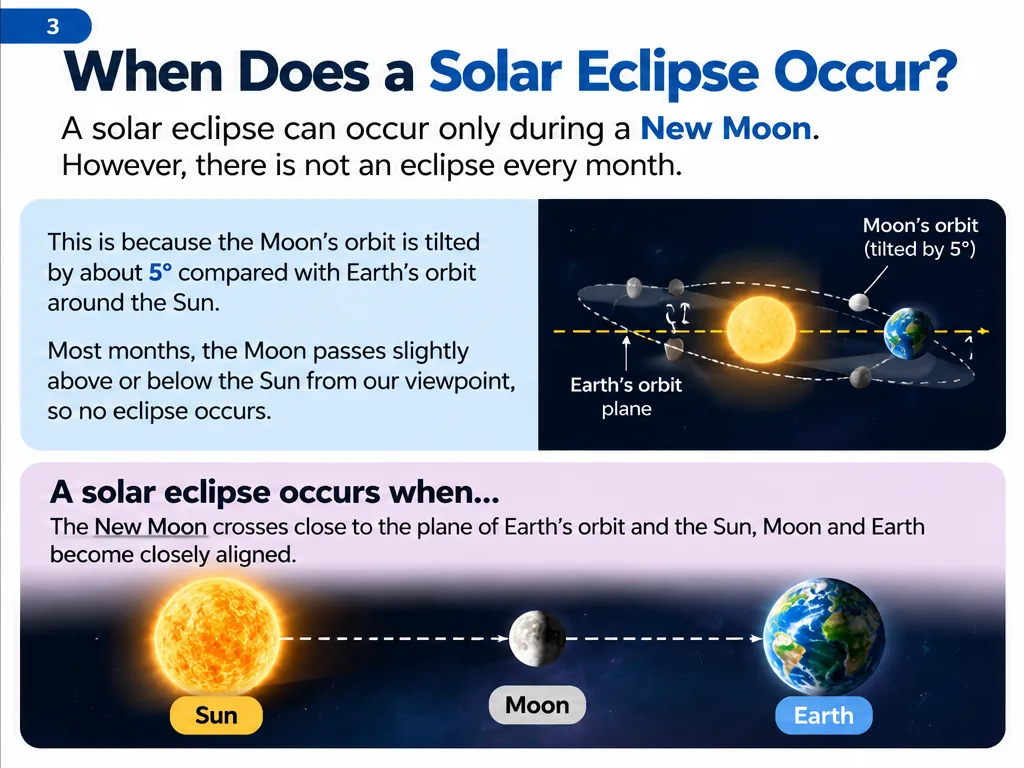
A solar eclipse can only happen at new Moon, when the Moon sits between the Sun and the Earth. That sounds as if we should get one every month, because the Moon goes through a new Moon phase roughly every 29.5 days. In reality, most new Moons pass without any eclipse at all. So when do solar eclipses occur, and why do they seem so rare?
The answer is geometry. The Sun, Moon and Earth have to line up almost perfectly in three dimensions, not just in a flat diagram. Most months they miss by a small but decisive margin.
Why don’t eclipses happen every month?
The Moon’s orbit is tilted by about 5° compared with the plane of Earth’s orbit around the Sun. Astronomers call that plane the ecliptic. Because of the tilt, at most new Moons the Moon passes slightly above or below the straight line from the Sun to the Earth. Its shadow misses us, and no solar eclipse occurs.
The same is true at full Moon. The Moon usually slips just above or below Earth’s shadow, so there is no lunar eclipse either.
The Moon’s tilted orbit crosses the ecliptic at just two points, called nodes. One is where the Moon moves from south to north of the ecliptic, and the other is where it moves back again. An eclipse needs a new or full Moon to fall close to one of these nodes.
Eclipse seasons and the saros cycle
The nodes line up with the Sun about every 173 days, which is roughly twice a year. These windows are called eclipse seasons, and each one lasts about 34–35 days. If a new Moon falls inside an eclipse season, a solar eclipse can occur. If a full Moon falls inside it, a lunar eclipse can occur. Often a season brings one of each, about two weeks apart.
This also explains how often eclipses happen. Every year has at least four eclipses (two solar and two lunar) and at most seven. Yet any single place on Earth sees a total solar eclipse very rarely, on average roughly once every few hundred years (a commonly quoted average is about once every 375 years). The Moon’s shadow is small, so each eclipse covers only a thin strip of the planet.
Eclipses also repeat in a pattern. The saros cycle lasts about 18 years 11 days 8 hours, and after one saros period the Sun, Moon and nodes return to almost the same arrangement. A similar eclipse follows. Ancient Babylonian astronomers used patterns like this to predict eclipses long before anyone could explain them.
What is a lunar eclipse?
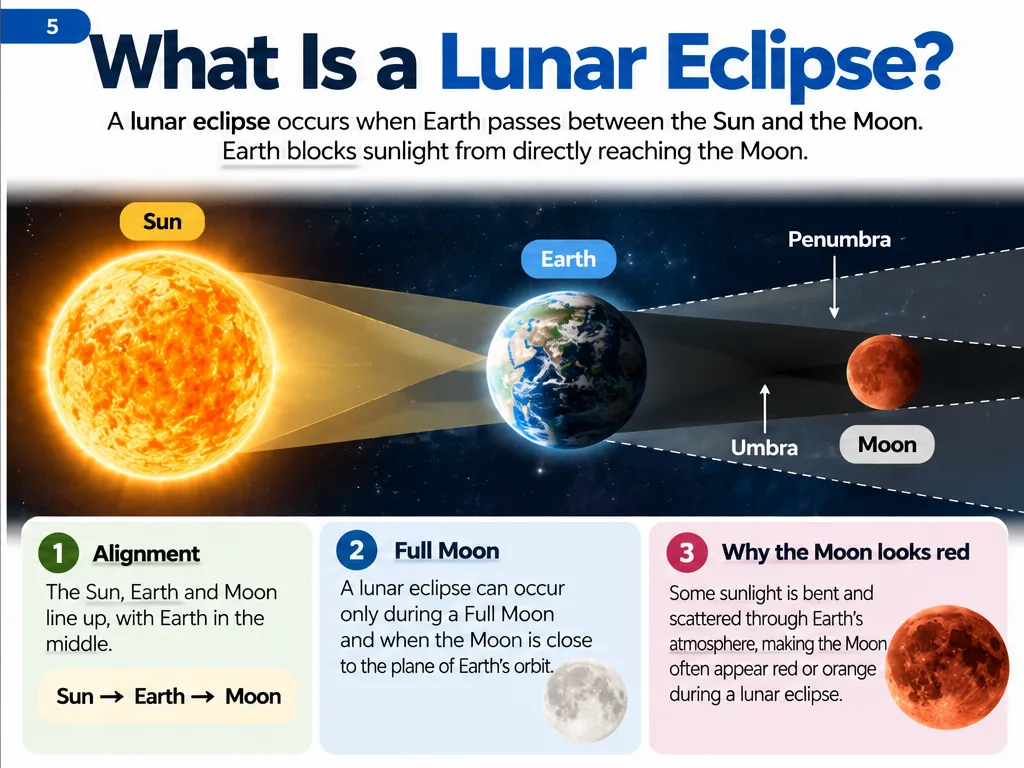
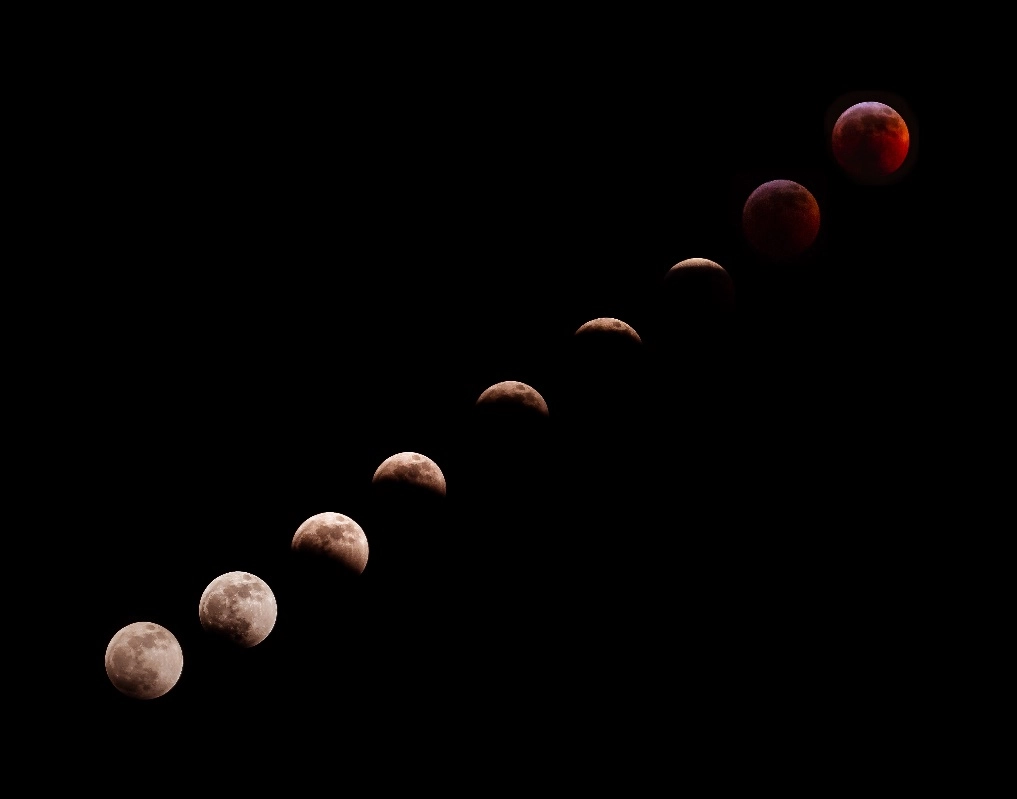
A lunar eclipse is the mirror image of a solar eclipse. The Earth passes between the Sun and the Moon, so Earth’s shadow falls on the Moon. It can only happen at full Moon, when the Moon is on the far side of the Earth from the Sun.
Unlike a solar eclipse, a lunar eclipse can be seen from anywhere on the night side of the Earth. Everyone who can see the Moon at that moment sees the eclipse, which is why far more people have watched a lunar eclipse than a total solar eclipse.
Types of lunar eclipse
The type depends on which part of Earth’s shadow the Moon enters.
- Total lunar eclipse: the whole Moon moves into the dark central shadow (the umbra). The Moon turns red or coppery during totality, which can last up to about 1 hour 45 minutes.
- Partial lunar eclipse: only part of the Moon enters the umbra, so a dark “bite” appears on one side.
- Penumbral lunar eclipse: the Moon passes only through the lighter outer shadow (the penumbra). The shading is subtle and easy to miss.
Total lunar eclipses in recent years include those on 14 March 2025, 7 September 2025 and 3 March 2026.
Why does the Moon turn red?
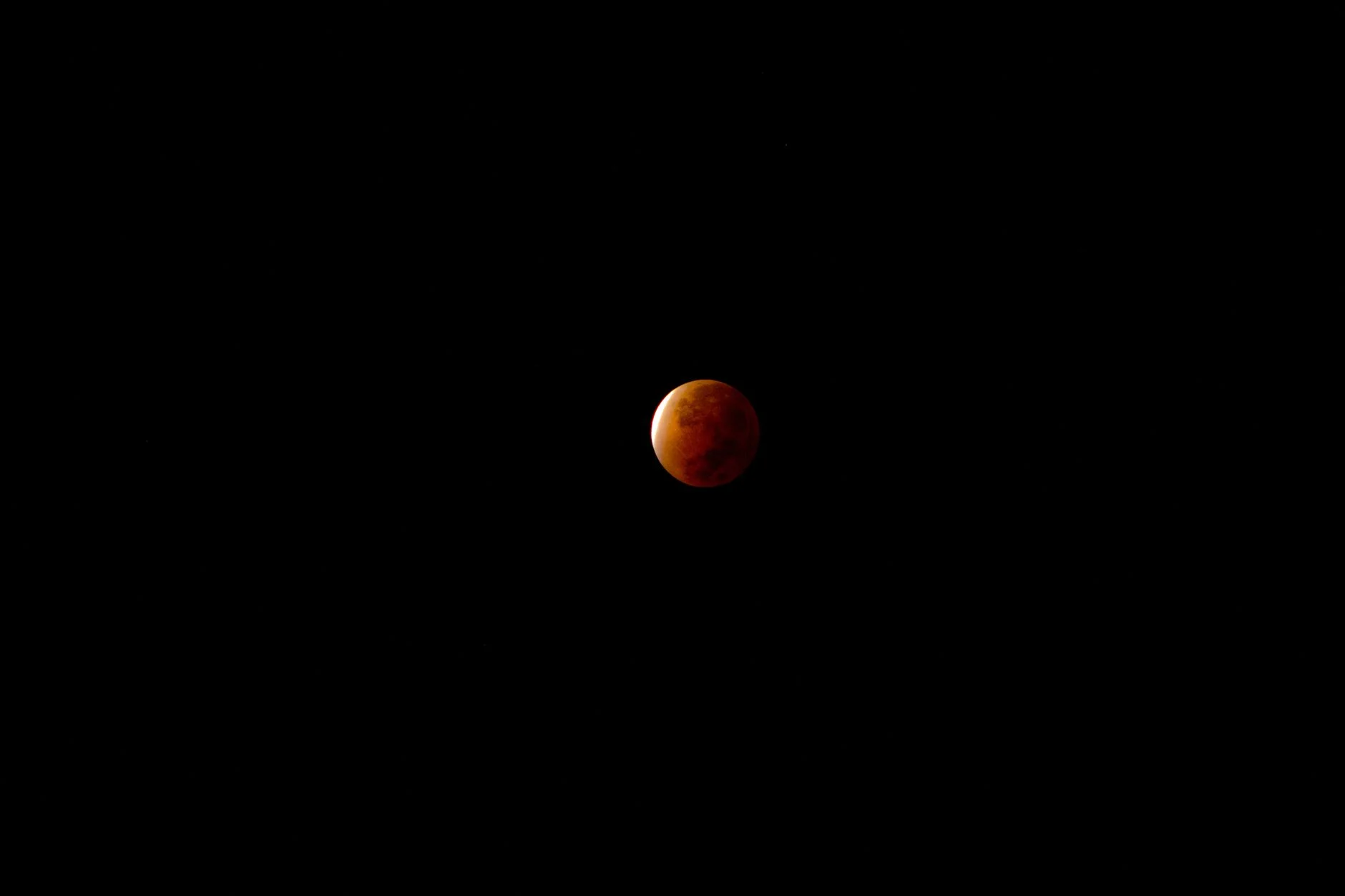
During totality the Moon does not vanish. It glows a deep red or copper colour, which is why people call it a “blood Moon”. The reason is Earth’s atmosphere. Sunlight passing through the edge of the atmosphere is refracted (bent) inwards onto the Moon. On the way, blue light is scattered away by Rayleigh scattering, and mostly red light gets through.
It is the same effect that makes sunrises and sunsets red. You could say that during a total lunar eclipse, every sunrise and sunset on Earth is projected onto the Moon at once. To learn more about the gases doing the scattering, see our guide to the atmospheres of Earth, the Moon and Titan. For other light effects in the sky, read about atmospheric optical phenomena.
Explain why a lunar eclipse cannot happen at new Moon. (3 marks)
A lunar eclipse needs the Earth to be between the Sun and the Moon, so that Earth’s shadow falls on the Moon (1). At new Moon the Moon is between the Sun and the Earth, not on the far side of the Earth (1). The Moon’s unlit side faces us and Earth’s shadow points away from the Moon, so a lunar eclipse can only happen at full Moon (1).
Solar eclipse vs lunar eclipse: the key differences
The two kinds of eclipse are mirror images of each other. In a solar eclipse the Moon moves between the Sun and Earth, so the Moon’s shadow falls on us. In a lunar eclipse Earth moves between the Sun and the Moon, so Earth’s shadow falls on the Moon.
That one change of position explains almost everything else: when each can happen, who can see it, how long it lasts and whether it is safe to look at. The easiest way to remember the timing is that a solar eclipse needs a new Moon, while a lunar eclipse needs a full Moon.
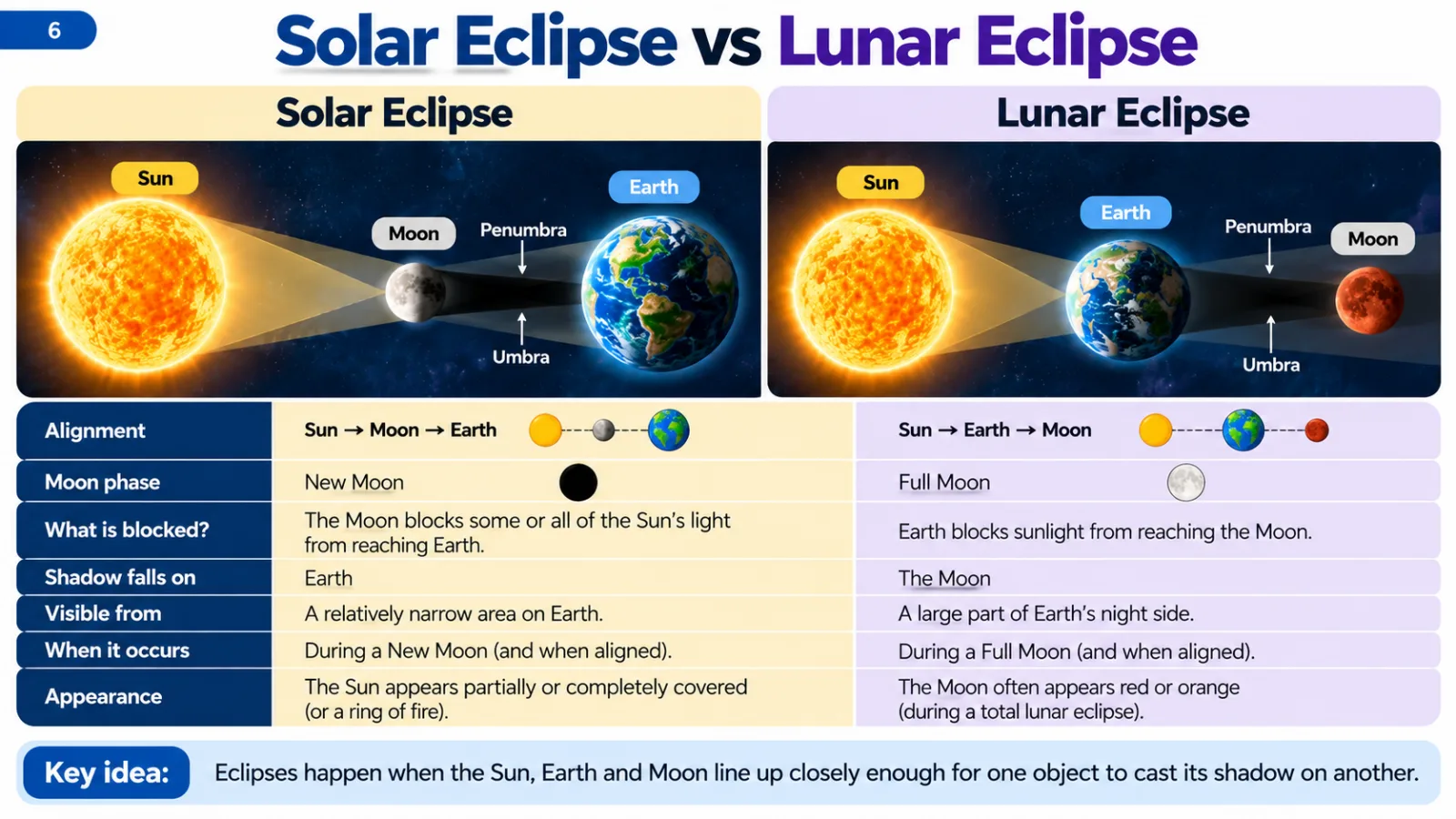
| Feature | Solar eclipse | Lunar eclipse |
|---|---|---|
| Alignment | Sun – Moon – Earth | Sun – Earth – Moon |
| Moon phase | New Moon only | Full Moon only |
| What casts the shadow | The Moon | The Earth |
| Types | Total, annular, partial, hybrid | Total, partial, penumbral |
| Who can see it | Only people inside the Moon’s shadow; totality is seen along a narrow path, usually less than about 250 km wide | Anyone on the night side of Earth |
| How long totality lasts | At most about 7.5 minutes, typically 2–4 minutes | Up to about 1 hour 45 minutes |
| What you see | The Sun blocked out, with the corona visible in totality | The Moon turning red or coppery in totality |
| Safe to watch? | Not with the naked eye, except during totality of a total eclipse | Yes, completely safe |
Both types come from the same geometry, which is why they come in pairs during an eclipse season. Every year has at least four eclipses (two solar and two lunar) and at most seven.
How to watch a solar eclipse safely
This is the one part of eclipse-watching where mistakes cause real harm. Looking directly at the Sun during a partial or annular eclipse can cause permanent eye damage called solar retinopathy. The Sun does not feel painful to look at in the way you might expect, so the damage can happen before you realise it.
The good news is that safe viewing is cheap and simple. Work through this checklist before the next eclipse. Your ticks are remembered in your browser.
- Never look through an unfiltered camera, phone, binoculars or telescope — even while wearing eclipse glasses. These need their own certified solar filter. Throw away glasses that are scratched or damaged.
- Find out what kind of solar eclipse you will see from your location. In the UK, every solar eclipse until 2090 will be partial, so the Sun must never be viewed unprotected — even a deep partial eclipse like 12 August 2026 is not safe without proper protection.
- Buy certified eclipse glasses marked ISO 12312-2 well before the day.
- Do not use ordinary sunglasses, however dark. They are not safe for looking at the Sun.
- Put your eclipse glasses on before you look up, and look away from the Sun before you take them off.
- During a partial or annular eclipse, keep the glasses on for the whole event. Never look at the Sun with the naked eye.
- Prefer not to look at the Sun at all? Use indirect pinhole projection, which projects an image of the eclipsed Sun onto a surface so you watch the image, not the Sun.
- Only if you are inside the path of a total eclipse: the naked eye is safe during the brief phase of totality, when the Sun is completely covered.
- The moment the Sun reappears, put your glasses back on, even if only a thin bright crescent has returned.
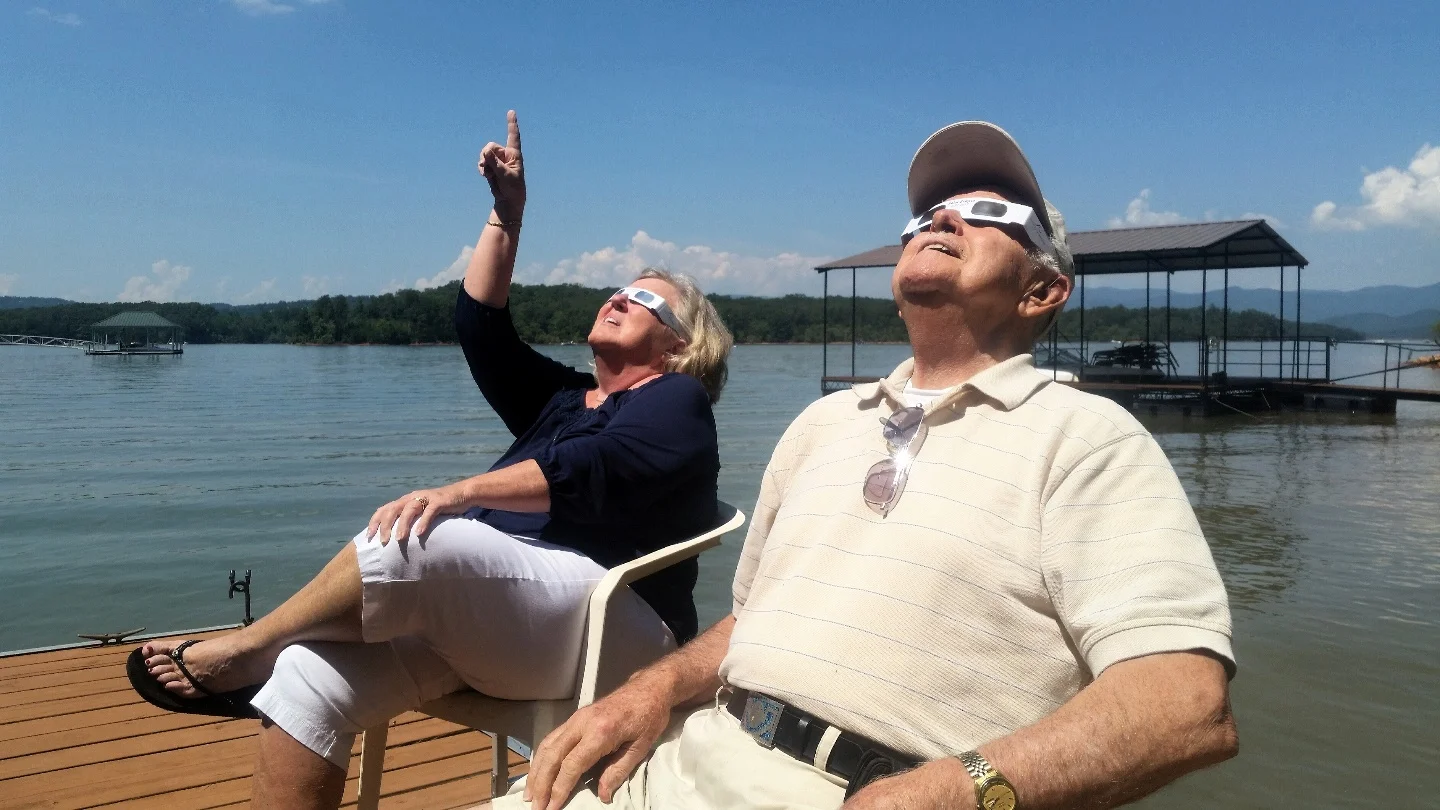
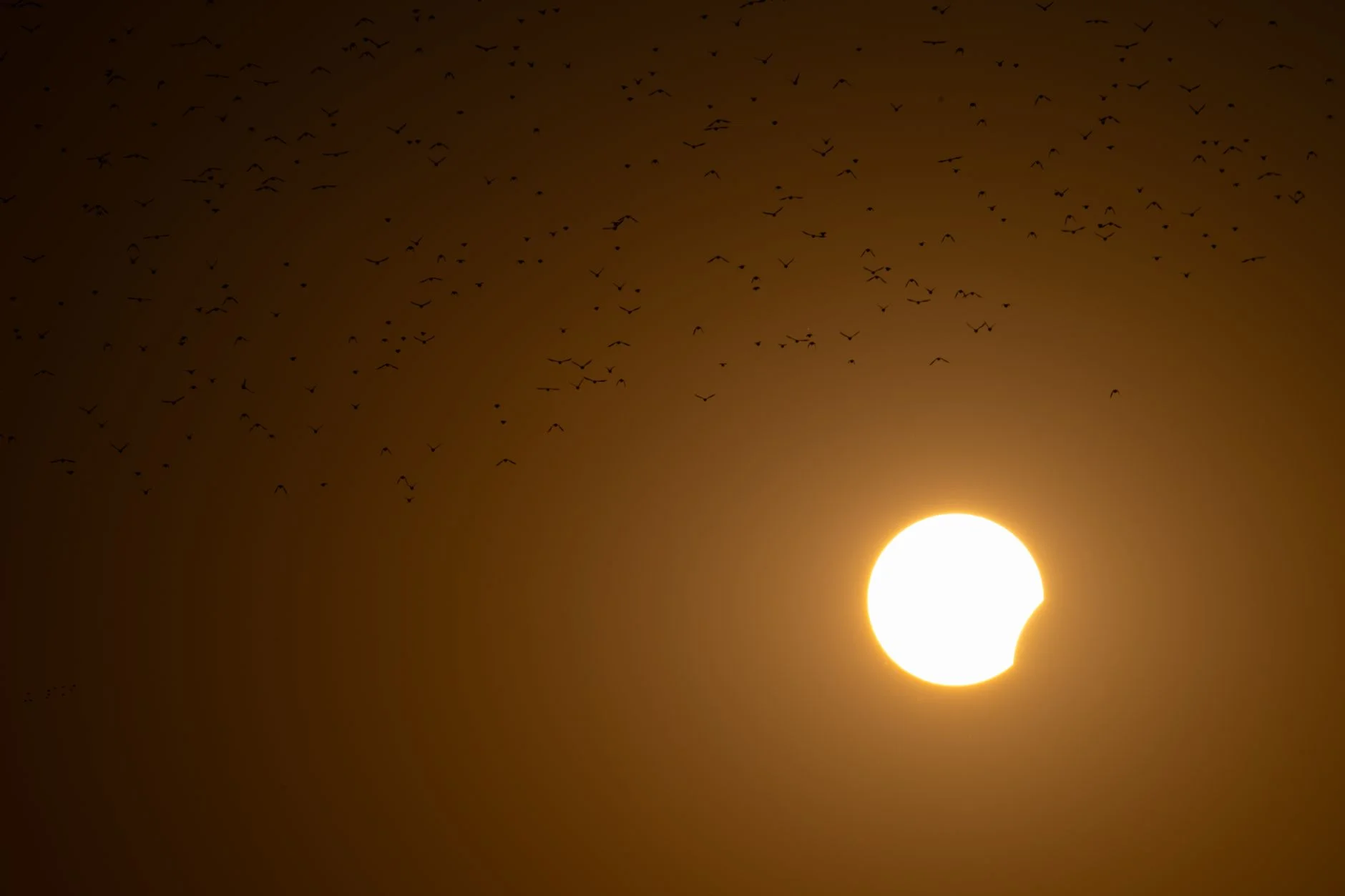
Notice the rule about totality. It is safe to look with the naked eye only while the Sun is completely covered during a total eclipse. Anywhere the Moon covers only part of the Sun, such as outside the narrow path of totality, the eclipse is partial and glasses are needed throughout.
Watching a lunar eclipse
A lunar eclipse is the relaxed cousin of a solar eclipse. You are looking at the Moon, which only reflects sunlight, so a lunar eclipse is completely safe to watch with the naked eye, binoculars or a telescope. No special glasses are needed.
You also do not need to travel. A lunar eclipse can be seen from anywhere on the night side of Earth, so everyone with the Moon above their horizon sees it at the same time. That makes it far more accessible than a total solar eclipse, which is visible only along a narrow track.
What to expect
- Penumbral eclipse: the Moon enters Earth’s partial shadow and is only subtly shaded, so it is easy to miss.
- Partial eclipse: part of the Moon enters the dark umbra, and you can see the curved edge of Earth’s shadow cross the Moon.
- Total eclipse: the whole Moon is in the umbra. It turns red or coppery, the famous “blood moon”, and totality can last up to about 1 hour 45 minutes.
The red colour comes from sunlight that has passed through Earth’s atmosphere. The atmosphere bends (refracts) that light onto the Moon while scattering the blue light away, so the Moon is lit by the glow of all the world’s sunrises and sunsets at once.
A lunar eclipse unfolds slowly, so there is time to watch the shadow creep across the Moon. Many people find it more relaxing than the few dramatic minutes of a total solar eclipse, and it is one of the best astronomy events for a family or a school group.
Recent and upcoming eclipses
Eclipses are predictable, so astronomers publish dates years ahead. Here are the key solar eclipse and lunar eclipse dates around today, 3 October 2026.
- 8 April 2024: a total solar eclipse crossed North America.
- 14 March 2025: a total lunar eclipse.
- 7 September 2025: a total lunar eclipse.
- 3 March 2026: a total lunar eclipse.
- 12 August 2026: a total solar eclipse crossed Greenland, Iceland and Spain. The UK saw a partial eclipse, with more than 90% of the Sun covered in parts.
- 2 August 2027: a total solar eclipse will cross Spain, North Africa and Egypt. Near Luxor, totality will last about 6 minutes 23 seconds.
- 23 September 2090: the next total solar eclipse visible from the UK mainland.
That last date shows how rare totality is. At any one place, a total solar eclipse happens roughly once every few hundred years, on average.
Eclipses that changed science
Eclipses are more than spectacles. Several of them settled real scientific questions.
- Babylonians: ancient Babylonian astronomers predicted eclipses. Careful records from watching the heavens, much like the patterns in the constellations we still use, made this possible.
- Aristotle: he noticed that Earth’s shadow on the Moon during a lunar eclipse is always curved. Only a round Earth casts a round shadow, so this was evidence that Earth is a sphere.
- 1868: during a solar eclipse, astronomers detected a new line in the Sun’s spectrum. It was the first sign of helium, now known as one of the most common elements in the universe.
- 1919: Arthur Eddington’s expedition measured starlight bending near the Sun during an eclipse. The result supported Einstein’s general relativity.
Totality also reveals the Sun’s outer atmosphere, the corona, which is normally hidden by glare. Its changing shape is linked to solar activity, including sunspots and their effects on Earth.
Will eclipses last forever?
No. The Moon is moving away from Earth by about 3.8 cm each year. As it drifts, it will look smaller in our sky, and in hundreds of millions of years it will be too small to cover the Sun completely. Total solar eclipses will stop, and only annular and partial ones will remain.
It is a reminder that today’s near-perfect match between Sun and Moon is temporary. To see how these bodies came to be, read about the origin of our solar system. For another sky effect caused by light, see sun halos and moon halos.
Flip card revision: eclipse key terms
Test yourself
Key points
- A solar eclipse happens at new Moon; a lunar eclipse happens at full Moon.
- The Moon’s orbit is tilted about 5°, so eclipses cluster in eclipse seasons roughly every 173 days.
- Each year has at least 4 and at most 7 eclipses.
- The Sun is about 400 times wider and 400 times farther away than the Moon, so they look almost equal in size.
- Totality of a lunar eclipse can last about 105 minutes and is safe to watch; solar eclipses need certified eye protection.
- Eclipses have helped prove Earth is round, reveal helium and support general relativity.
Frequently asked questions about solar and lunar eclipses
What causes a solar eclipse?
A solar eclipse happens when the Moon passes between the Sun and Earth, casting its shadow on Earth’s surface. It can only occur at new Moon. People standing in the darkest part of the shadow, the umbra, see the Sun completely covered.
When do solar eclipses occur?
Solar eclipses occur at new Moon, but only when the Moon is near one of the two points where its tilted orbit crosses Earth’s orbital plane. This happens during eclipse seasons, roughly every 173 days, so there are at least two solar eclipses somewhere on Earth each year.
Why don’t eclipses happen every month?
The Moon’s orbit is tilted about 5° to Earth’s orbit around the Sun. Most months the new Moon passes above or below the Sun, and the full Moon misses Earth’s shadow. Eclipses only occur when the alignment falls near a crossing point, called a node.
What are the types of solar eclipse?
There are four types. A total eclipse covers the Sun completely. An annular eclipse leaves a bright ring because the Moon looks slightly smaller. A partial eclipse covers only part of the Sun. A hybrid eclipse changes between annular and total along its path, and is rare.
Why does the Moon turn red during a lunar eclipse?
During totality, the only sunlight reaching the Moon has passed through Earth’s atmosphere. The atmosphere bends this light onto the Moon while scattering blue light away, a process called Rayleigh scattering. What remains is red and orange, like all the world’s sunrises and sunsets projected onto the Moon.
How often do eclipses happen?
Every calendar year has at least four eclipses, two solar and two lunar, and at most seven. However, a total solar eclipse is far rarer at any one place. On average it returns to the same spot only about once every few hundred years.
Can you look at a lunar eclipse with the naked eye?
Yes. A lunar eclipse is completely safe to watch, because you are only seeing sunlight reflected from the Moon. You need no filters or special glasses. Binoculars or a telescope can add detail, and it is visible from anywhere on the night side of Earth.
How can I watch a solar eclipse safely?
Never look directly at the Sun during a partial or annular eclipse, as it can cause permanent eye damage called solar retinopathy. Use certified eclipse glasses marked ISO 12312-2, or project the image through a pinhole. Ordinary sunglasses are not safe at any stage.
When is the next total solar eclipse in the UK?
The next total solar eclipse visible from the UK mainland is on 23 September 2090. Before then, the UK only sees partial eclipses, such as the one on 12 August 2026, when some areas saw more than 90% of the Sun covered. A total eclipse crosses Spain on 2 August 2027.