No, Titan is not a planet. It is Saturn’s largest moon, and because it orbits Saturn rather than the Sun, it counts as a moon (a natural satellite). Yet at about 5,150 km across, Titan is wider than the planet Mercury, which is why so many people ask whether this strange, hazy world deserves a promotion.
Is Titan a planet? The short answer
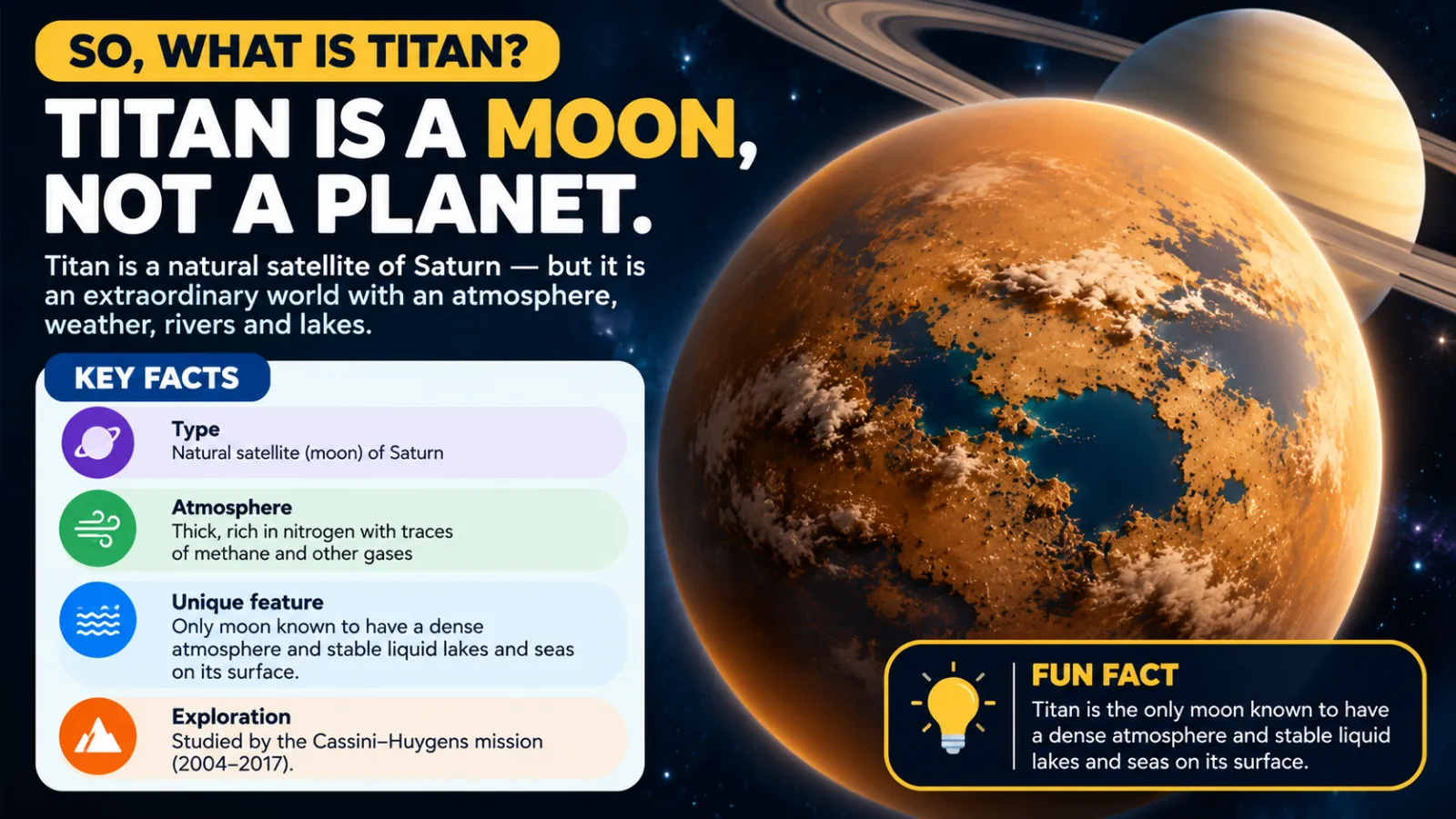
Officially, Titan is a moon. In 2006 the International Astronomical Union (IAU) agreed that a planet must orbit the Sun directly. Titan does not. It circles Saturn about every 16 days (≈ 15.9 days), at roughly 1.2 million km from the giant planet, while Saturn itself travels around the Sun about 1.4 billion km away. That is around 9.5 times Earth’s distance from the Sun.
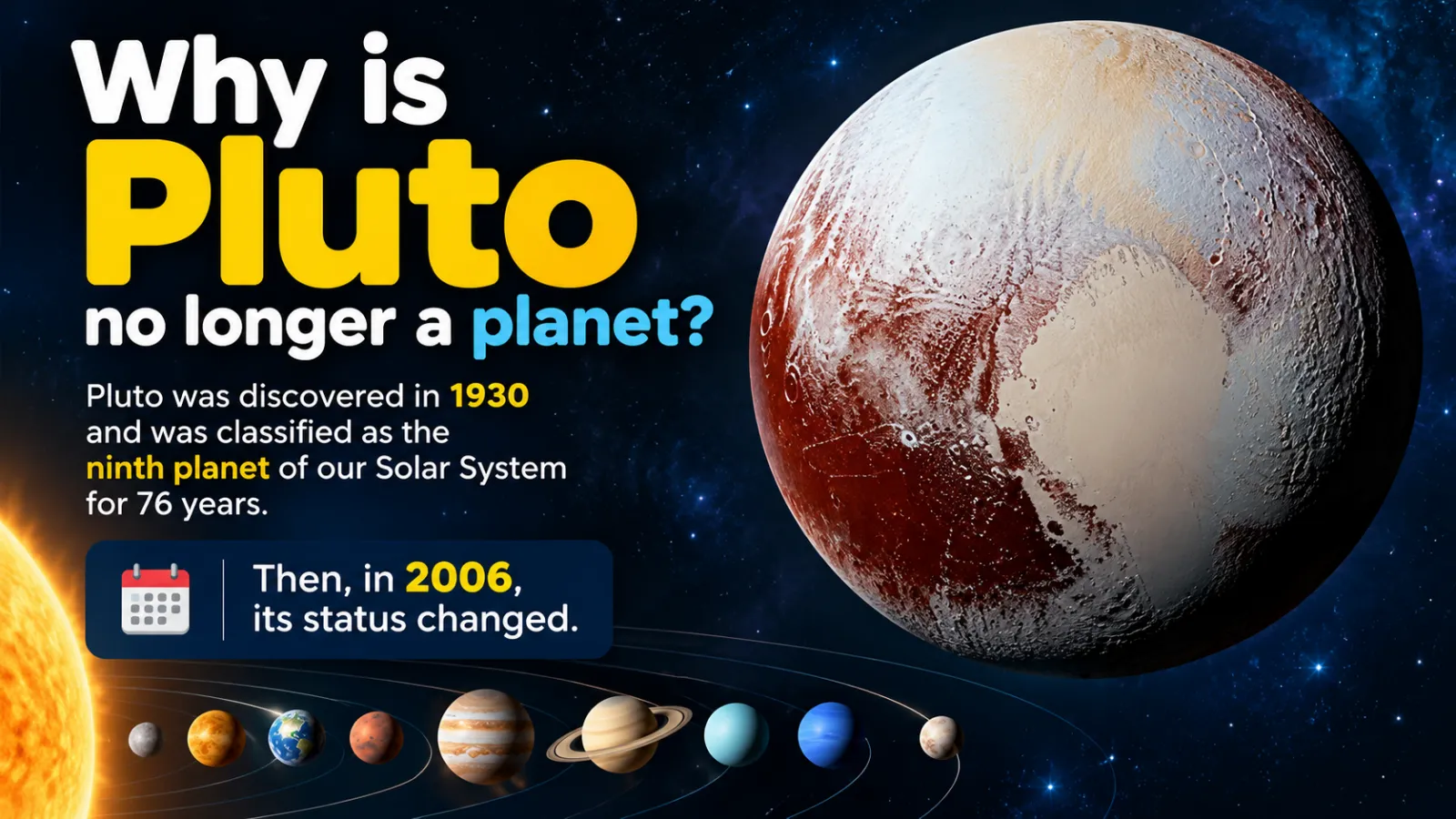
The same 2006 decision is the reason Pluto lost its planet status, and you can read the full story in our article on why Pluto is no longer a planet. Titan never had that debate, because it fails the very first rule: it does not orbit the Sun.
Titan is also the second-largest moon in the Solar System. Only Jupiter’s Ganymede (≈ 5,268 km) is bigger. Dutch astronomer Christiaan Huygens discovered Titan on 25 March 1655, and he was the first person to find a moon of Saturn. Today Saturn has more than 280 known moons, and the number keeps rising as astronomers spot ever smaller ones.
What makes a planet, and why moons don’t count
The IAU definition has three parts. A planet must:
- orbit the Sun directly;
- be massive enough for its own gravity to pull it into a round shape;
- have cleared its orbit of other large objects.
Titan is round, so it passes the second test. It fails the first, because its orbit is around Saturn. Whatever you think of the third rule, the first one settles the question: the orbit decides it, not the size.
Some planetary scientists prefer a different, “geophysical” way of thinking. In that view, any large, round body that has been shaped by its own gravity and has complex geology is a planet-like world, whatever it orbits. By that standard Titan, with its thick air, rivers and lakes, would be a very good candidate. This is a useful way to describe what Titan is like, but it is not the official definition, so in exams and textbooks Titan is a moon.
Explain why Titan is classed as a moon even though it is bigger than Mercury. (2 marks)
Titan orbits Saturn rather than the Sun directly (1 mark), and the IAU says a planet must orbit the Sun, so a body that orbits a planet is a moon or natural satellite whatever its size (1 mark).
Titan by the numbers
Titan facts are easiest to grasp next to worlds you already know. The table compares Titan with Earth’s Moon and with the planet Mercury.
| Property | Titan | Earth’s Moon | Mercury |
|---|---|---|---|
| Diameter | ≈ 5,150 km | ≈ 3,474 km | ≈ 4,880 km |
| Mass compared with Earth | ≈ 2.3% | ≈ 1.2% | ≈ 5.5% |
| Surface gravity | ≈ 1.35 m/s² (≈ 14% of Earth’s) | ≈ 1.62 m/s² (16.5% of Earth’s) | ≈ 3.7 m/s² |
| Surface temperature | ≈ −179 °C | about −173 °C to 127 °C | about −180 °C to 430 °C |
| Atmosphere | Thick, mostly nitrogen | Almost none | Almost none |
Look at the diameter row, then the mass row. Titan is wider than Mercury, but Mercury is made of dense rock and metal, while Titan is a mix of rock and water ice. That is why Mercury has well over twice Titan’s mass despite being a little smaller.
Titan’s atmosphere is the real showstopper. It is the only moon known to have a thick one, which makes it feel far more like a small planet than the airless, cratered Moon. We look at that in detail in the next section.
The raw material for worlds like Titan came from the disc of gas and dust around the young Sun. Moons such as Titan probably formed from material swirling around young Saturn, and you can follow that story in our guide to the origin of our Solar System.
A moon with a thick atmosphere
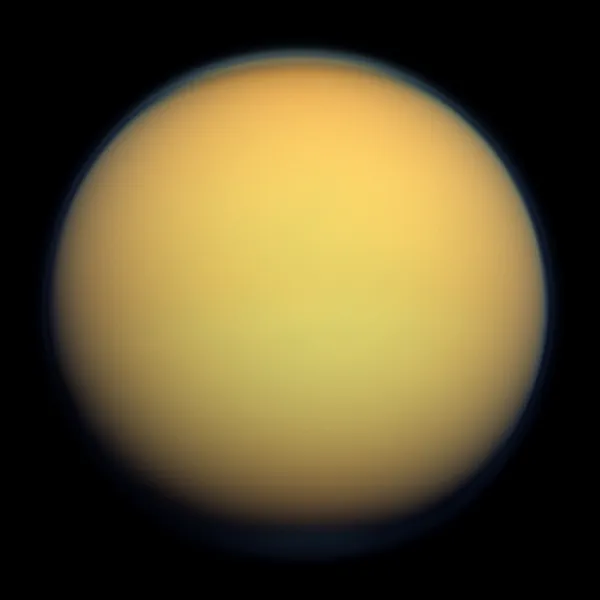
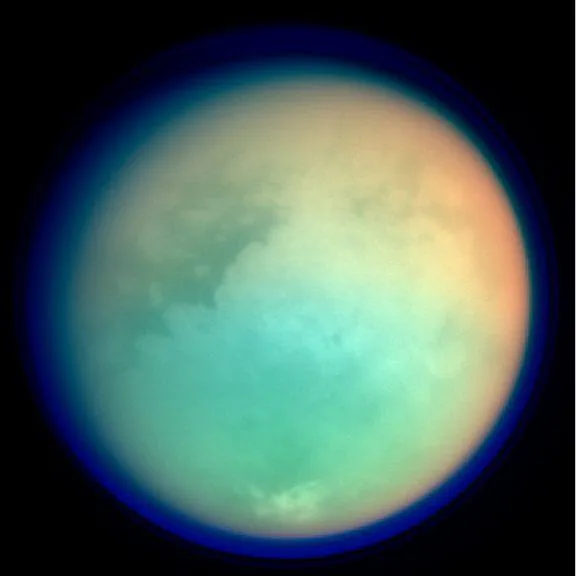
Most moons are airless rocks. Earth’s Moon, for example, has no thick atmosphere to speak of. Saturn’s moon Titan breaks that pattern completely: it is the only moon in the Solar System with a thick atmosphere, and one of the most Earth-like skies we know of, even though it is nothing like the air you breathe.
Titan’s air is about 95% nitrogen, with roughly 5% methane near the surface. That makes it a close cousin of Earth’s atmosphere in one respect, because nitrogen is the main gas in our air too. The big difference is what is missing: there is no breathable oxygen on Titan.
The pressure at the surface is about 1.5 times Earth’s, and the air near the ground is about 4 times denser than the air around you now. Standing on Titan, you would feel the same sort of squeeze you would feel diving a few metres underwater, not the crushing force you would meet on Venus. For a comparison of three very different atmospheres, see our article on the atmosphere of the Earth, the Moon and Titan.
Why is the sky orange?
Sunlight hitting the upper atmosphere breaks apart nitrogen and methane molecules. The pieces join up again into larger organic molecules called tholins. These form a thick, orange-brown haze that hangs over the whole moon.
In ordinary visible light, that haze hides the surface completely. Early images from spacecraft showed an orange ball with almost no features, which is why Titan stayed a mystery for so long.
Seeing through the haze
Scientists got around the haze by using wavelengths that pass through it. Infrared light and radar can both see through the orange murk, and they revealed a surprisingly varied world: dunes of organic particles near the equator, and lakes and seas mostly near the north pole.
So when someone asks “does Titan have an atmosphere?”, the answer is a firm yes. It is thick enough to hide the ground, dense enough to carry clouds and rain, and chemically busy enough to make its own haze.
How cold is Titan?
Very cold. The surface temperature is about −179 °C, which is roughly 94 K. Saturn is about 1.4 billion km from the Sun, around 9.5 times Earth’s distance, so sunlight is faint there, and the haze blocks even more of it.
At that temperature, water behaves in a way that feels backwards. Water ice is as hard as rock, and it acts as the “bedrock” of Titan. Mountains, plains and the ground under the dunes are all made of, or sit on, frozen water. Methane and ethane, which are gases on Earth, can be liquids here.
That mix of nitrogen air, organic chemistry and extreme cold is a big part of why scientists keep returning to Titan. Its chemistry resembles conditions that may have existed on early Earth, only frozen in a very different way.
Titan vs Earth’s Moon
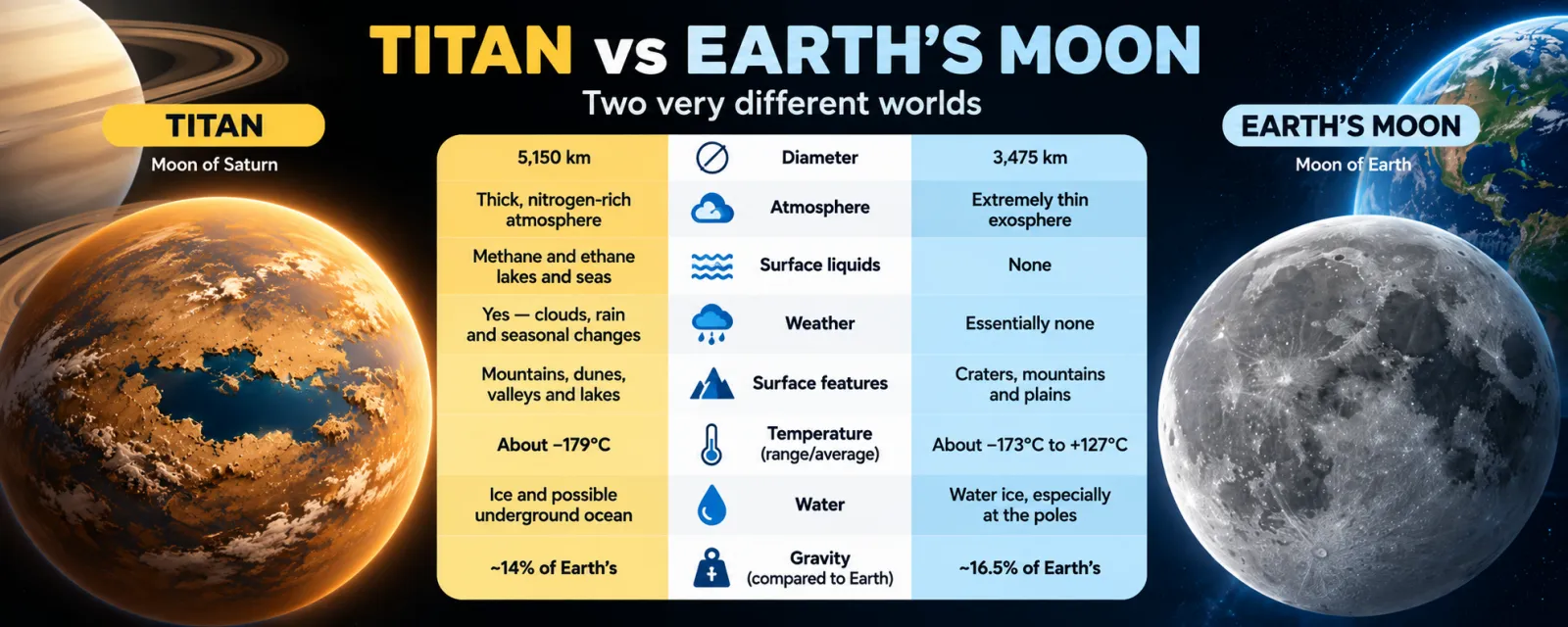
People often picture Titan as “just another moon”, so it helps to compare it with the one we know best. Earth’s Moon is about 3,474 km across. Titan is about 5,150 km across, so it is roughly one and a half times wider.
Titan’s gravity is lower than you might expect for such a big body. The surface gravity is about 1.35 m/s², which is only about 14% of Earth’s. That is a little less than the Moon’s 16.5%. The reason is that Titan is made of a lot of light water ice and has a much lower density than a rocky world of the same size.
Here is how the two moons compare in other ways.
- Size: Titan is about 5,150 km across; the Moon is about 3,474 km.
- Surface gravity: about 14% of Earth’s on Titan; 16.5% on the Moon.
- Atmosphere: thick nitrogen-rich air on Titan; no thick atmosphere on the Moon.
- Surface liquids: lakes and seas of liquid methane and ethane on Titan; none on the Moon.
- Orbit: Titan circles Saturn about every 16 days at roughly 1.2 million km, always showing the same face to its planet.
Because the gravity is low and the air is dense, scientists have joked that a person could, in theory, fly on Titan by flapping strapped-on wings. It is a fun thought experiment rather than a travel plan, but it shows how different Titan is from any airless moon.
How much would you weigh on Titan?
Because gravity on Titan is about 14% of Earth’s, you would weigh far less there than at home. Try the calculator below to see your weight on Titan, the Moon and other worlds.
Lakes and seas of methane
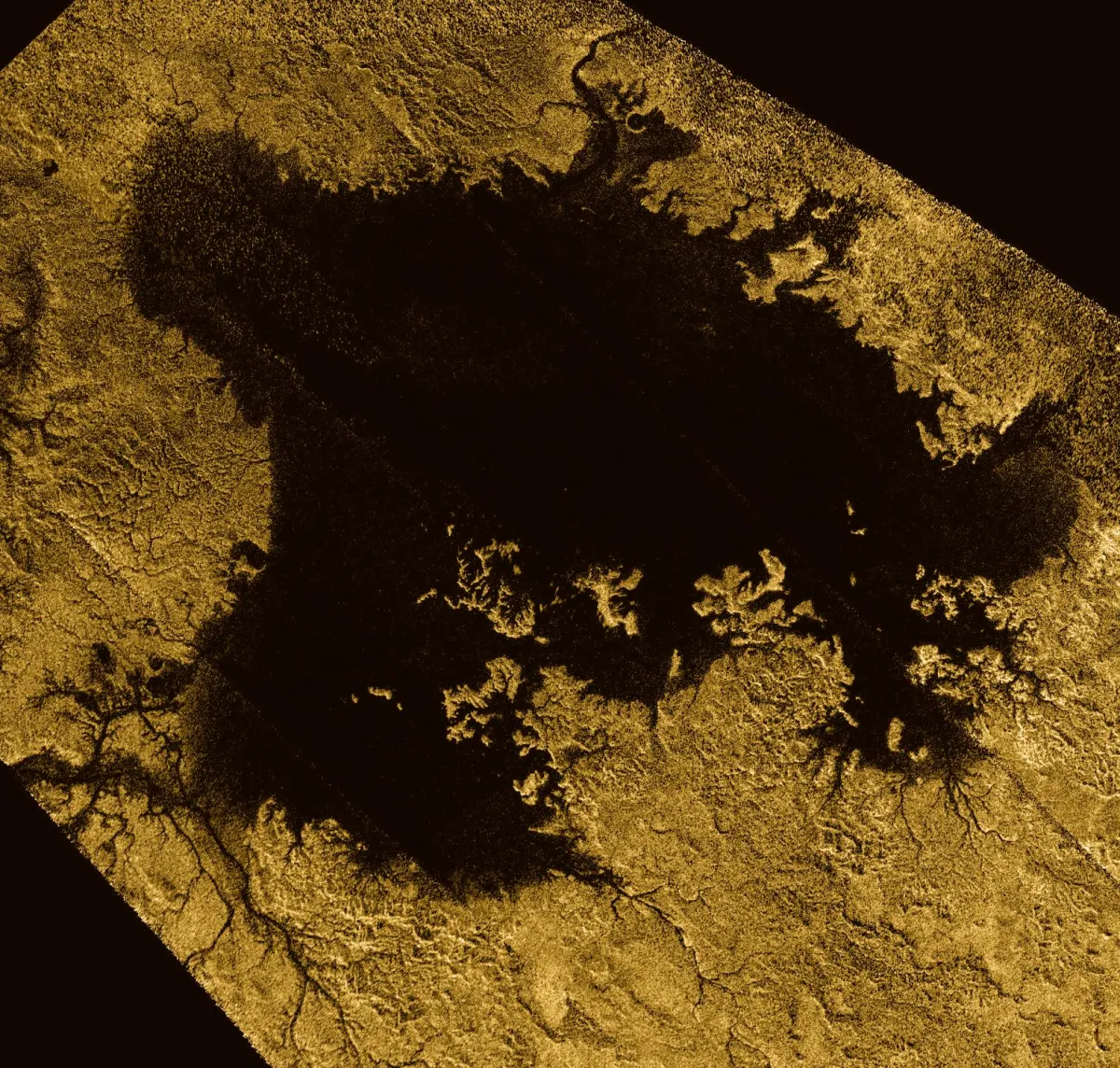
Earth is not the only world in the Solar System with liquid sitting on its surface. Titan is the only place besides Earth known to have stable bodies of surface liquid. The catch is that none of it is water. At −179 °C, water is as hard as granite, so the lakes on Titan are filled with liquid methane and ethane instead.
These are the same two hydrocarbons you might know as gases on Earth. Methane is the main component of natural gas. On Titan, the cold and the thick air keep them liquid, which makes Saturn's largest moon a strange mirror of our own planet.
Most of the lakes and seas are found near Titan's north pole. Three have names that appear again and again in textbooks and mission reports:
- Kraken Mare is the largest of Titan's seas.
- Ligeia Mare is another large sea in the northern polar region.
- Punga Mare completes the trio of big northern seas.
"Mare" is the Latin word for sea. Astronomers first used it for the dark plains on Earth's Moon, which early observers mistook for oceans. On Titan, the name is far more fitting, because these dark patches really are liquid.
Because the liquid is methane and ethane rather than water, you could not swim in it the way you might in a lake on Earth. Anyone standing on the shore would also need to be protected from the extreme cold. Even so, the scene would look oddly familiar: liquid pooled in basins, with shorelines, under a sky.
Rain, rivers and a methane cycle
If there are lakes, there must be a way to fill them. Titan has one. Scientists describe a methane cycle in which methane forms clouds, falls as rain, flows in rivers and collects in lakes. It works much like the water cycle on Earth, with methane playing the part that water plays here.
This is a good example of a general idea in science: the same process can run with different materials if the conditions suit them. On Earth, temperatures sit close to the point where water can be a solid, a liquid or a gas. On Titan, the temperature sits close to the point where methane can do the same.
| Stage | Earth's water cycle | Titan's methane cycle |
|---|---|---|
| Working liquid | Water (H₂O) | Methane (CH₄), mixed with ethane |
| In the air | Water vapour and clouds | Methane clouds |
| Falling | Rain, snow | Methane rain |
| On the surface | Rivers, lakes and seas | Rivers, lakes and seas, mostly near the north pole |
| Ground material | Rock | Water ice acting as rock |
| Typical temperature | Mild enough for liquid water | About −179 °C |
The last two rows show how odd the swap really is. On Titan, water ice behaves like bedrock, the hard foundation that rivers cut channels into and that holds the lakes. Water, the liquid we think of as essential for life, is part of the landscape itself rather than something flowing across it.
Titan's surface is not only liquid, either. Near the equator there are dunes made of organic particles. So the moon has seas near the pole, dunes near the equator and a thick orange atmosphere above it all.
Hidden water underneath
The most surprising liquid on Titan may be the one nobody can see. For years scientists thought there was a global ocean of salty liquid water deep beneath the icy crust. A 2025 reanalysis of Cassini data, published in Nature, now suggests something stranger: a thick layer of icy slush with pockets of liquid water, rather than one global ocean.
It is worth being clear about what "think" means here. Nothing deep inside Titan has been sampled or photographed. These ideas are inferences from how Titan flexes as it orbits Saturn, measured by spacecraft — and the 2025 reanalysis shows how such models can change. Future missions could test them.
The idea also fits with what we know about the moon's make-up. Titan is built from a mixture of rock and water ice, so there is plenty of water available. Deep inside, some of it could stay liquid, as slush or pockets of water, even though the surface is far below freezing.
Could there be life on Titan?
This is the question everyone asks, and the honest answer is that there is no evidence of life on Titan. Nothing has been detected, and nobody should claim otherwise. What makes Titan interesting is not a sign of life but a set of ingredients and conditions worth studying.
First, its organic chemistry resembles conditions that may have existed on early Earth. Studying Titan is a little like looking at a frozen, slowed-down version of the chemistry that came before life on our own planet. That is why NASA's Dragonfly mission, which you will meet in the next section, is designed to study prebiotic chemistry.
Second, pockets of liquid water deep inside could in principle be habitable. Liquid water is the one ingredient that all known life on Earth depends on, so buried water keeps the question open.
Third, there is the surface. Any life there would need chemistry very different from ours, because it would have to work in liquid methane at −179 °C rather than in water. Nobody knows whether such life is possible. It is an open question rather than a prediction.
Carbon is central to all of this. Titan's haze and lakes are built from carbon and hydrogen, two of the most important elements in organic chemistry. Hydrogen is also the simplest atom there is, and you can read about why it dominates the cosmos in our article on the most common element in the universe.
So Titan sits in an interesting middle ground. It is not a planet, and it is not known to host life, yet it has liquid on its surface, liquid water possibly hidden deep below and a chemistry set that resembles early Earth. That combination is exactly why this moon of Saturn is one of the most exciting places to explore.
Exploring Titan: Huygens to Dragonfly
Humans have been studying Titan for more than 370 years, and the story moves from a tiny dot in a telescope to a drone that will fly across an alien landscape. It is a good example of how astronomy works: each generation builds on the questions the last one could not answer. If you want the wider picture of how we study space, our guide to rockets, telescopes, satellites and the ISS covers the tools behind these missions.
Here is the Titan exploration timeline, step by step.
- 1655: on 25 March, the Dutch astronomer Christiaan Huygens discovers Titan. It was the first moon ever found around Saturn.
- 1979: Pioneer 11 flies past Saturn and its moons, followed by Voyager 1 (1980) and Voyager 2 (1981), which showed that Titan is hidden under a thick orange haze.
- 1997: the Cassini–Huygens mission, a joint project of NASA, ESA and the Italian space agency ASI, launches towards Saturn.
- 2004: Cassini reaches Saturn and begins a long study of the planet, its rings and its moons.
- 14 January 2005: the Huygens probe parachutes down to the surface of Titan. It remains the most distant landing ever made by a spacecraft.
- 15 September 2017: the Cassini mission ends, after more than 100 close flybys of Titan.
- July 2028: NASA plans to launch Dragonfly.
- 2034: Dragonfly is due to arrive at Titan.
Why the haze was such a problem
Before the space age, Titan was a blur. Telescopes could show that it was a world of real size, but not what lay beneath its orange haze. The Voyager flybys (Voyager 1 in 1980) showed the haze was a thick atmosphere, which made Titan far more interesting than an ordinary icy moon.
Visible light cannot get through that haze, which is made of organic molecules called tholins. Cassini therefore used infrared cameras and radar, which see through it, to map the surface below. That is how we first learned about the dunes, the rivers and the polar seas.
What Cassini and Huygens taught us
Huygens sent back data as it fell through the atmosphere and after it reached the ground. It confirmed that Titan has a thick nitrogen-rich atmosphere and a solid surface shaped by flowing liquid. Cassini then spent years watching the same moon from orbit around Saturn, passing close by it again and again.
Together, the two spacecraft showed that Titan is the only place besides Earth known to have stable bodies of liquid on its surface. Cassini also showed that Titan flexes under Saturn’s pull, which led scientists to infer liquid water deep below the icy crust (a 2025 reanalysis suggests slush and pockets of water rather than a global ocean). Our article on meteorites and the wider Universe shows how scientists use samples and measurements like these to piece together the history of the Solar System.
Dragonfly: a drone for another world
Dragonfly is a NASA mission built around a nuclear-powered rotorcraft, in effect a large drone, that will land on Titan and then fly between different sites. Launch is planned for July 2028, with arrival in 2034. Flying is practical on Titan because the atmosphere is dense and the gravity is low, so rotors have plenty of air to push against.
The main goal is to study prebiotic chemistry: the kind of organic chemistry that may have happened on early Earth before life began. By moving between sites, Dragonfly can sample very different places, rather than one patch of ground, as a fixed lander would. Nobody expects it to find living things, and there is no evidence of life on Titan so far. The aim is to learn how far this chemistry can go.
Could humans visit Titan?
People sometimes ask whether humans could live on Titan. The honest answer is no, not in any ordinary sense. There is no breathable oxygen in the air, and the surface temperature is about −179 °C, far colder than anywhere on Earth. A visitor would need an oxygen supply and very warm clothing.
Titan does have one surprising advantage. Its surface pressure is only about 1.5 times Earth's, so a visitor would not need a pressure suit to stop their body swelling or boiling, as they would on the Moon or Mars. Warm layers, a breathing mask and a heated shelter would be enough to survive for a short time. The air itself is mostly nitrogen with some methane, which is not something humans can breathe.
Could you really fly on Titan?
Here is where it gets fun. Surface gravity on Titan is about 1.35 m/s², roughly 14% of Earth's, and the air near the surface is about four times denser than ours. Scientists have joked that, with those two facts, a person could fly just by flapping wings strapped to their arms.
It is a thought experiment, not a travel plan. You would still freeze, and you would still have nothing to breathe. But it shows how different a world can be when you change just two things, gravity and air density.
A more realistic way to visit Titan is by robot. Missions like Huygens and Dragonfly do the hard, cold work for us, and send back measurements that no person could safely collect.
Titan flip cards
Frequently asked questions about Titan
Is Titan a planet?
No. Titan is a moon. The International Astronomical Union says a planet must orbit the Sun directly, and Titan orbits Saturn instead. Some planetary scientists describe large, round moons as planet-like worlds, but officially Titan is Saturn's largest moon and the second-largest in the Solar System.
Why is Titan not a planet if it is bigger than Mercury?
Size is not the deciding rule. A planet must orbit the Sun, and Titan orbits Saturn. Titan is wider than Mercury, at about 5,150 km against 4,880 km, but it has less than half Mercury's mass, because it is made largely of ice and rock.
Does Titan have an atmosphere?
Yes, and it is the only moon with a thick one. It is about 95% nitrogen and roughly 5% methane near the surface. Surface pressure is about 1.5 times Earth's, and the air is about four times denser. An orange haze of organic molecules hides the ground in visible light.
What are Titan's lakes made of?
They are made of liquid methane and ethane, not water. At about −179 °C, water is frozen solid and acts like rock. The biggest seas, such as Kraken Mare, Ligeia Mare and Punga Mare, lie mostly near Titan's north pole. Titan is the only other place known with stable liquid on its surface.
How cold is Titan?
The surface temperature is about −179 °C, or roughly 94 K. That is far colder than any place on Earth. Titan is about 1.4 billion km from the Sun, near Saturn, so it receives little sunlight, and its thick atmosphere cannot warm it much.
Could humans live on Titan?
No. There is no breathable oxygen, and the surface is about −179 °C. However, the air pressure is close to Earth's, so a visitor would not need a pressure suit. Warm clothing and an oxygen supply would be needed. Scientists have joked that low gravity and dense air might even allow flapping flight.
Is there life on Titan?
There is no evidence of life on Titan. It is of great interest because its organic chemistry resembles conditions that may have existed on early Earth, and liquid water deep inside could in principle be habitable. Any life on the surface would need chemistry very different from ours.
What is the Dragonfly mission?
Dragonfly is a NASA mission to Titan. It uses a nuclear-powered rotorcraft, or drone, which will land and then fly between sites to study prebiotic chemistry. Launch is planned for July 2028, and arrival is expected in 2034. It will explore far more ground than a fixed lander could.
How many moons does Saturn have?
Saturn has more than 280 known moons, according to 2026 counts. The number keeps rising because astronomers continue to find small ones. Titan is by far the largest, and it was the first Saturnian moon discovered, by Christiaan Huygens in 1655.