The origin of the solar system is a story that begins about 4.6 billion years ago, inside a vast, cold cloud of gas and dust. Under the pull of its own gravity, that cloud collapsed, spun into a flat disc, lit a star at its centre and left behind the planets, moons and rocky leftovers we see today.
So how did the solar system form? In short: a cloud collapsed, the Sun ignited, and the dust in the surrounding disc clumped together into planets. This explanation is called the solar nebula theory, and it is the idea behind your GCSE physics topic on the life cycle of stars and the solar system.
In this guide we follow the formation of the solar system from start to finish, explain the evidence scientists use, and clear up a very common mix-up about the Big Bang. Let’s begin with the key facts.
How old is the solar system?
The solar system is about 4.6 billion years old. We know this because some meteorites contain the oldest solid material ever dated. Tiny white blobs inside them, called calcium–aluminium-rich inclusions, are about 4.568 billion years old. They are thought to be among the very first solids to form in the young solar system.
Scientists measure these ages using radioactive decay. If you want to know more about the rocks that fall from space, see our guide to meteorites and what they tell us about the universe.
Put that number in perspective. The universe is about 13.8 billion years old, so the solar system only appeared when the universe was already roughly two-thirds of the way through its history to date. Many generations of stars had lived and died before our Sun was born.
Keep the two ideas separate and you will avoid a mistake that catches out many students: the Big Bang made the universe, while the collapse of one particular cloud made the Sun and its planets.
The solar nebula: where it all began
Every explanation of the origin of the solar system starts with a solar nebula. A nebula is a giant cloud of gas and dust floating between the stars. Ours was made mostly of hydrogen and helium gas, mixed with tiny grains of dust.
The idea is older than you might expect. The nebular hypothesis was proposed in the 18th century by the philosopher Immanuel Kant in 1755 and the mathematician Pierre-Simon Laplace in 1796. Today’s version, known as the solar nebular disc model, has been refined with modern observations and computer models, but the core idea has survived for more than 200 years.
What was the nebula made of?
Most of the cloud was hydrogen and helium. If you are curious why these two dominate everywhere in space, read what the most common element in the universe is.
The dust was different. It contained heavier elements such as carbon, oxygen, silicon and iron, which were made inside earlier generations of stars. When those stars ended their lives, they scattered these elements into space. That means the rock under your feet and the iron in your blood were forged in stars that died long before the Sun existed.
This is why the planets can be rocky at all. Without the dust from earlier stars, there would have been little but hydrogen and helium to build with.
What triggered the collapse?
A cloud of gas does not collapse by itself just because it is there. Something has to squeeze it enough for gravity to win over the gas pressure that holds it up. Once part of the cloud became dense enough, gravity pulled it inwards and it began to collapse.
One suggestion is that the collapse may have been triggered by a shock wave from a nearby supernova, the explosion of a massive star. The evidence comes from meteorites, which contain traces of short-lived radioactive isotopes such as aluminium-26. Aluminium-26 decays away quickly, so it must have been added to the cloud shortly before the solar system formed, and a nearby exploding star is one way to deliver it.
Scientists still debate this. It is a leading idea rather than settled fact, and that is how science works: a good explanation fits the evidence, and researchers keep testing it.
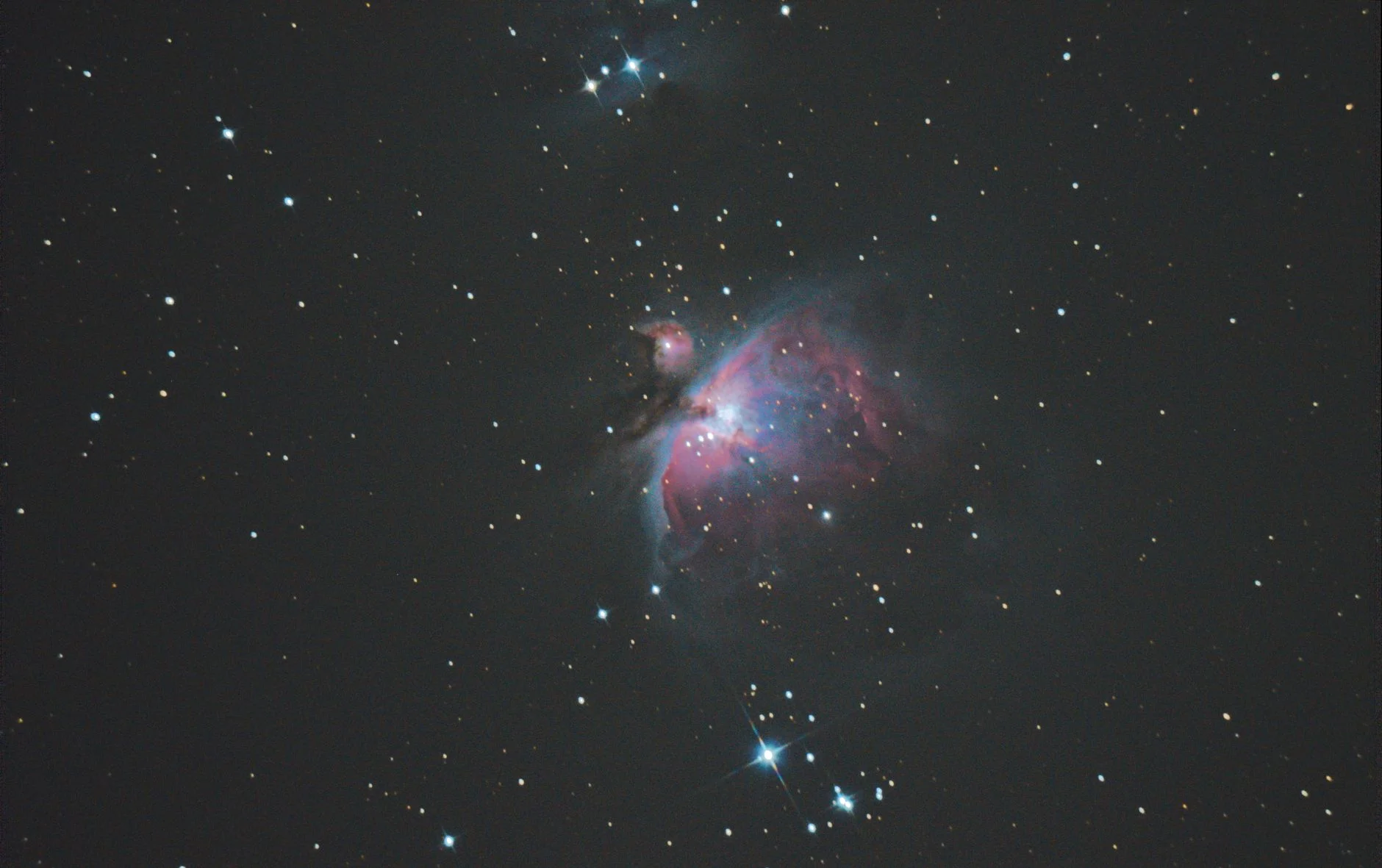
We see the same process happening today. Stellar nurseries such as the Orion Nebula are clouds where new stars are forming right now, which gives us a glimpse of what our own corner of the galaxy looked like billions of years ago.
Whatever started it, the result was the same. A region of the cloud began to fall inwards, and the next stage was about to begin: spinning faster, flattening into a disc and building a star at the centre.
Step by step: how the solar system formed
The solar nebula theory describes the formation of the solar system as a chain of events that took tens of millions of years. Each step follows from the one before it, and the whole story is driven by gravity. Here is the sequence in order.
- A cloud of gas and dust. A huge cloud, mostly hydrogen and helium with a sprinkling of dust, drifted through space. The dust held heavier elements made inside earlier generations of stars.
- The collapse begins. Gravity started to pull the cloud inwards. A shock wave from a nearby supernova may have triggered this, although scientists still debate it.
- The cloud spins faster. As the cloud shrank, it rotated more quickly, because angular momentum is conserved.
- A disc forms. The spinning material flattened into a rotating disc, called a protoplanetary disc, with a bulge at the centre.
- A protostar appears. Most of the mass fell to the centre and heated up, forming a protostar.
- The Sun ignites. When the core reached about 10 million °C, hydrogen fusion began and the Sun was born.
- Planets grow in the disc. Dust grains stuck together and grew into pebbles, then planetesimals, then protoplanets, and finally planets.
- The gas is cleared. The young Sun’s strong solar wind blew the remaining gas out of the inner system, leaving the planets, moons and leftover rocks and ice we see today.
The next two sections look more closely at the Sun and the planets, because that is where most exam questions on this topic concentrate.
How did the Sun form?
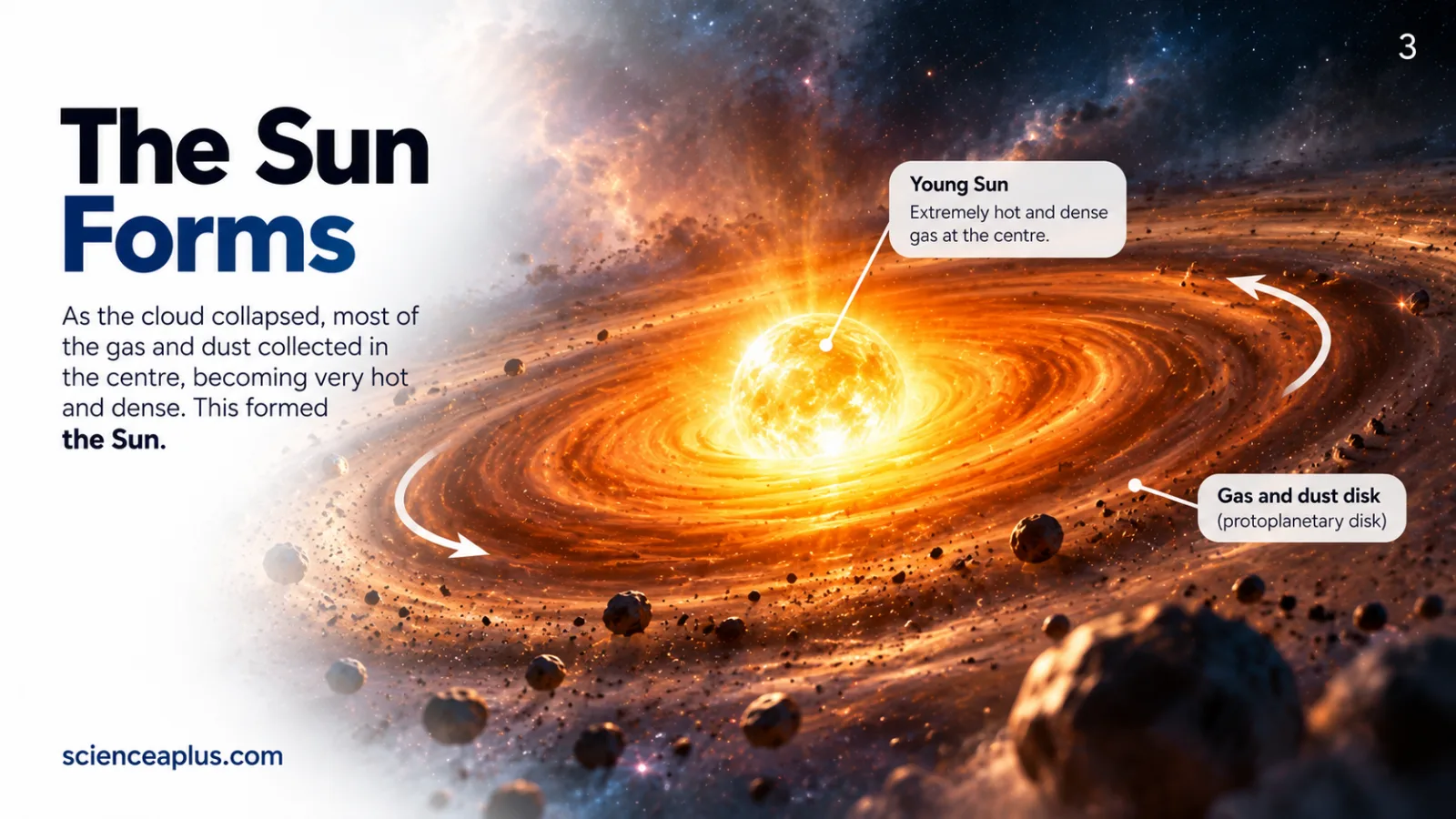
The Sun is the heart of the solar system, so it is the best place to start. As the collapsing nebula pulled together, most of its material fell towards the centre. The result was a dense, hot ball of gas called a protostar.
The collapse did not simply form a ball, though. It also made the cloud spin, and it spun faster as it shrank. This is the same effect you see when an ice skater pulls in their arms during a spin. The spinning cloud flattened into a disc, with the protostar in the middle.
Gravity kept squeezing the protostar, and squeezing heats a gas. Eventually the core became hot and dense enough, at about 10 million °C, for hydrogen nuclei to fuse into helium. Nuclear fusion began, releasing enormous amounts of energy, and the protostar became a true star: our Sun.
The Sun now holds more than 99.8 % of the solar system’s mass. Everything else, including all eight planets, shares the remaining tiny fraction. Fusion still powers the Sun today, and its magnetic activity affects us here on Earth. You can read more about that in our guide to how sunspots affect the Earth.
How did the planets form?
While the Sun was forming, the flattened disc around it was not empty. It held only a small fraction of the cloud’s mass (at least about 1 % of the Sun’s mass) in the form of gas and dust, and that was enough to build a family of planets.
Planet building is called accretion, which means growing by collecting more material. It happened in stages, and each stage needed a different kind of force or collision.
| Stage | What it is | How it grows |
|---|---|---|
| Dust | Tiny grains of rock, metal and (further out) ice | Grains collide gently and stick together |
| Pebbles | Small clumps of stuck-together grains | Continued sticking as they orbit in the disc |
| Planetesimals | Kilometre-sized bodies | Collisions, with gravity starting to pull more material in |
| Protoplanets | Planet-sized embryos | Gravity attracts planetesimals, and collisions merge them |
| Planets | Large, nearly spherical worlds | Mopping up material along their orbit until the path is mostly clear |
The early stages depend on grains sticking together, which is not an easy process. Once bodies reached about a kilometre across, their own gravity took over and growth sped up. Bigger objects pulled in more material, which made them bigger still.
The young Sun’s solar wind then cleared the leftover gas from the inner system. After that, the planets could no longer collect gas from the inner disc. The rocky planets kept growing for tens of millions of years, but only by collisions between solid bodies.
Not every planet formed in the same way, and the reasons depend on where in the disc the material was. That is the subject of the next section, where we look at the frost line and why the inner planets are rocky.
Why are inner planets rocky and outer planets giants?
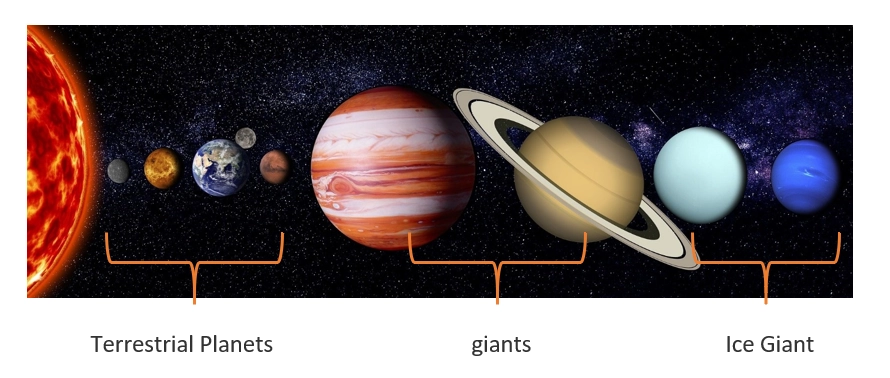
Look at the eight planets in order from the Sun and a clear pattern appears. The four closest are small, dense and rocky. The four furthest are enormous and made mostly of gas and ice. This split is one of the strongest clues about the formation of the solar system, and it comes down to temperature.
The young Sun heated the disc of gas and dust around it. Close to the Sun it was too hot for ices to survive. Far away it was cold enough for water and other ices to freeze solid. The boundary between the two zones is called the frost line, also known as the snow line. In our solar system it lay roughly between the orbits of Mars and Jupiter.
Inside the frost line: small rocky worlds
Inside the frost line only rock and metal could stay solid. These materials are fairly rare in a cloud that is mostly hydrogen and helium, so the building blocks were limited. Dust stuck together, then collided and merged, and the result was small terrestrial planets: Mercury, Venus, Earth and Mars.
These planets were not big enough to hold on to the light gases around them. On top of that, the young Sun’s strong solar wind swept the remaining gas out of the inner system.
Outside the frost line: giants
Beyond the frost line, ices could condense as well as rock and metal. That meant far more solid material was available, so cores grew bigger and faster. Once a core was massive enough, its gravity pulled in huge amounts of hydrogen and helium gas from the disc. This produced the gas giants Jupiter and Saturn. Uranus and Neptune are called ice giants.
| Planet group | Planets | Made of |
|---|---|---|
| Terrestrial (rocky) planets | Mercury, Venus, Earth, Mars | Rock and metal |
| Gas giants | Jupiter, Saturn | Rock and ice cores with thick layers of hydrogen and helium gas |
| Ice giants | Uranus, Neptune | Cores that include ices, surrounded by hydrogen and helium gas |
Some models, such as the Nice model, suggest the giant planets did not stay exactly where they formed. A leading idea is that they migrated after forming, which would help explain the layout we see today.
Leftovers: asteroids, comets and dwarf planets
Not all the material in the disc ended up in a planet. Several regions of the solar system hold leftover building blocks that never merged into larger worlds.
The asteroid belt
Between Mars and Jupiter lies the asteroid belt, a region of rocky bodies. Jupiter probably formed early, and its gravity stirred up the objects nearby so they could not gather into a planet. The asteroid belt is therefore leftover material from a planet that never formed.
The Kuiper belt
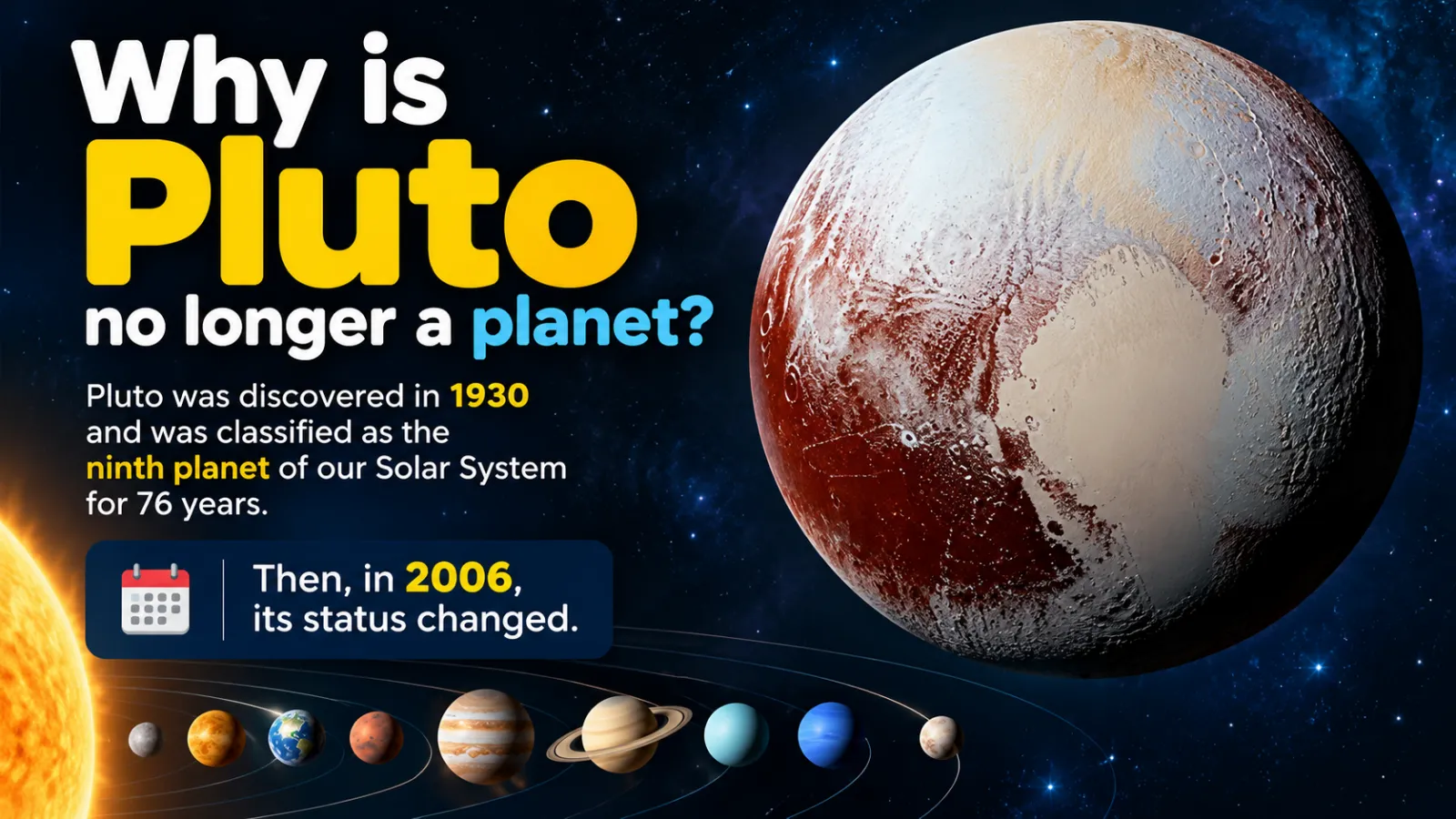
Beyond Neptune is the Kuiper belt, a region of icy bodies. It includes dwarf planets such as Pluto. In 2006 the IAU reclassified Pluto as a dwarf planet, and you can read the full reasoning in our article on why Pluto is no longer a planet.
The Oort cloud
Much further out is the Oort cloud, thought to be the source of long-period comets. Nobody has observed it directly, so it is a hypothesis rather than a confirmed structure. It is a good example of how scientists use evidence to propose something they cannot yet see.
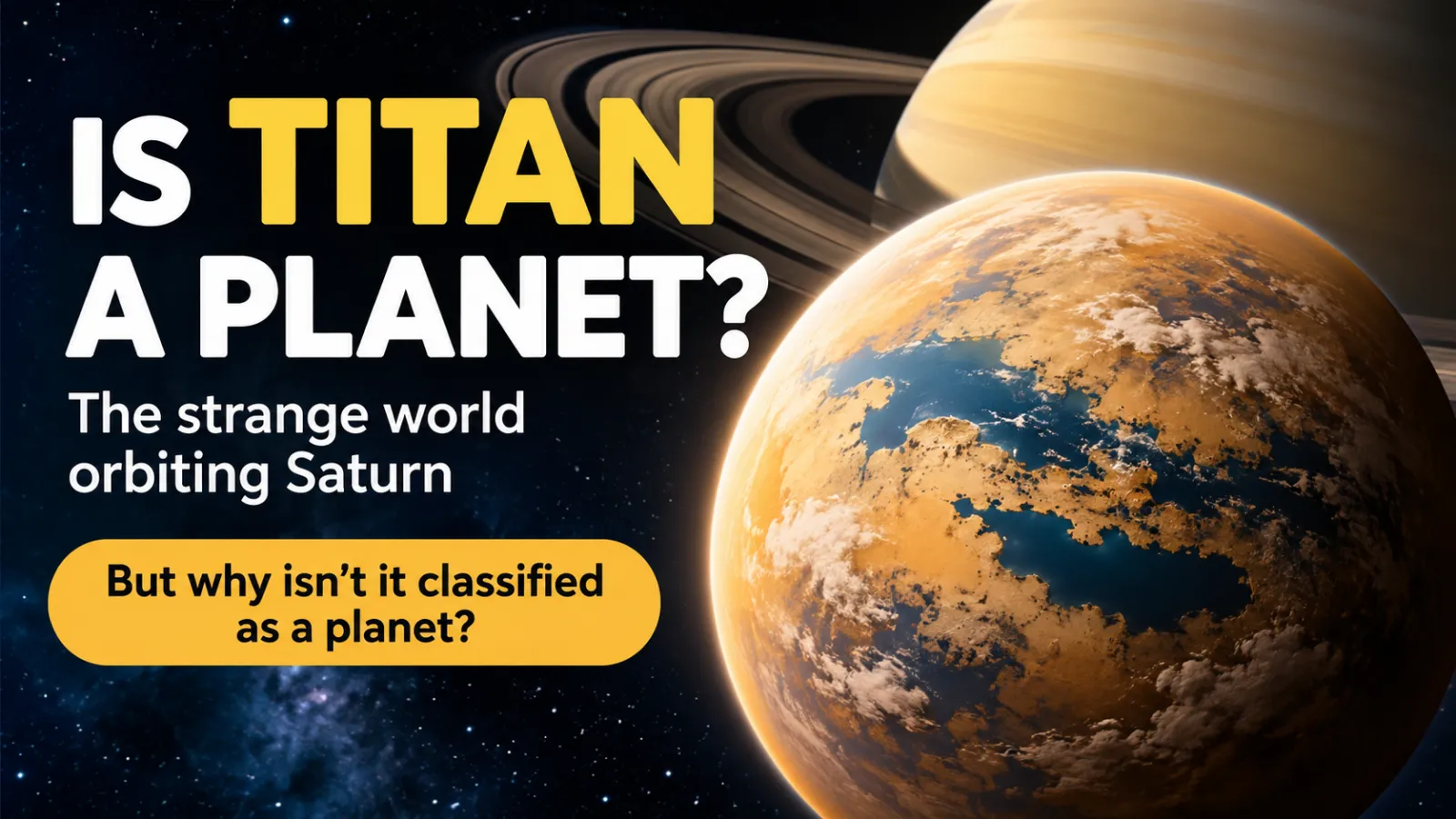
Moons are a separate story. Titan, for example, is a large moon of Saturn and not a planet, a question explored in is Titan a planet?
How did the Moon form?
The Moon is a special case, because it probably did not form from the disc in the usual way. The leading explanation is the giant-impact hypothesis. About 4.5 billion years ago, a Mars-sized body, often called Theia, is thought to have hit the young Earth.
The collision threw material into orbit around Earth. Over time that material clumped together under gravity and became the Moon. This fits the age of the Moon, which matches the early solar system.
Our solar system today
After about 4.6 billion years, the solar system has settled into the layout we know. The Sun sits at the centre and holds more than 99.8% of the total mass. Eight planets orbit it, with the asteroid belt, Kuiper belt and Oort cloud filling the spaces and edges.
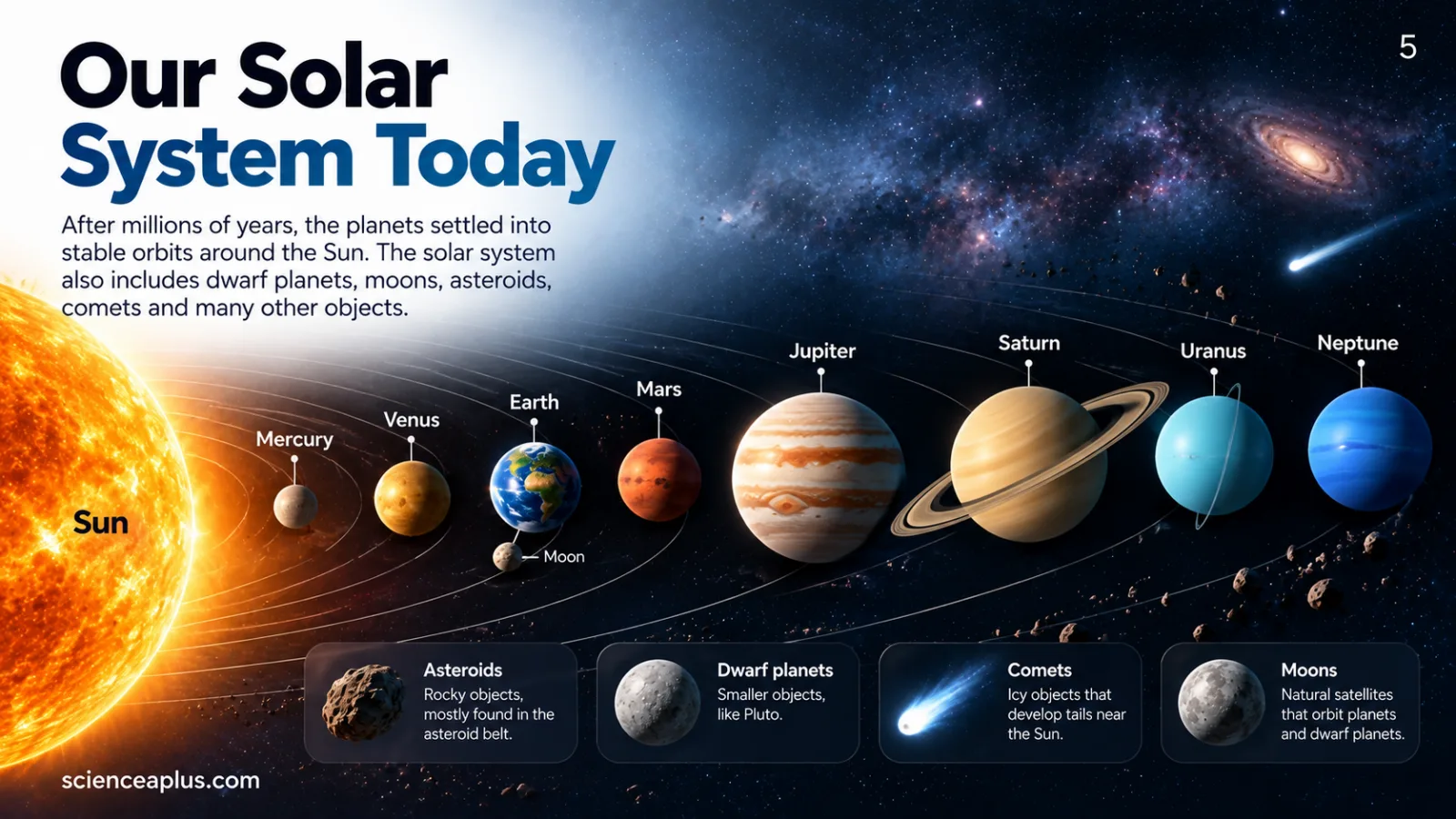
The distances involved are hard to picture, so try the scale tool below. It shows how far apart these objects really are compared with their size.
Before moving on, test your memory of the main objects with these cards.
How do we know? The evidence for the origin of the solar system
Nobody was there 4.6 billion years ago, so scientists work like detectives. Several independent clues all point to the same story, which is why the solar nebula theory is so widely accepted.
- Meteorites. The oldest solids in meteorites, calcium–aluminium-rich inclusions, are about 4.568 billion years old. They are the best clock we have for the birth of the solar system.
- Short-lived isotopes. Some meteorites contain traces of aluminium-26, a radioactive isotope that decays quickly. It may have come from a nearby supernova, which fits the idea that a shock wave helped start the collapse.
- Discs around other stars. In 2014 the ALMA telescope imaged the young star HL Tauri and its protoplanetary disc. It showed bright rings and dark gaps, which may be where new planets are sweeping up material.
- Stellar nurseries. Clouds such as the Orion Nebula contain gas, dust and newborn stars, so we can watch the early stages happening now. Space telescopes such as NASA’s James Webb Space Telescope keep adding detail to these views.
- Computer models. Simulations test how dust, gas and gravity behave. Models such as the Nice model suggest the giant planets moved after forming, which is a leading idea rather than settled fact.
What will happen to the solar system?
The story is not over. The Sun is about halfway through its roughly 10-billion-year main-sequence life, steadily fusing hydrogen into helium. In about 5 billion years it will swell into a red giant.
It will then shed its outer layers as a planetary nebula, leaving a small, dense white dwarf. This follows the GCSE life cycle of a Sun-like star.
- Nebula
- Protostar
- Main sequence
- Red giant
- White dwarf (and, in theory, a black dwarf)
The same gas and dust that formed us will eventually be returned to space, ready for new stars. To see how this fits into the bigger picture of the cosmos, read about beautiful cosmology.
Test yourself: origin of the solar system
Key points to remember
- The solar system formed about 4.6 billion years ago from a collapsing cloud of gas and dust, the solar nebula.
- The cloud spun faster, flattened into a disc, and most mass fell to the centre to form the Sun, which holds more than 99.8% of the total mass.
- Dust grains grew into pebbles, planetesimals, protoplanets and finally planets by accretion.
- The frost line separates small rocky planets from gas and ice giants.
- Asteroids, the Kuiper belt and the hypothesised Oort cloud are leftovers.
- The Moon most likely formed in a giant impact.
- Meteorites, isotopes, telescope images and models support the theory.
- In about 5 billion years the Sun will become a red giant, then a white dwarf.
Frequently asked questions about the origin of the solar system
How did the solar system form?
A cloud of gas and dust called the solar nebula collapsed under gravity about 4.6 billion years ago. It spun faster and flattened into a disc. Most material formed the Sun, while dust in the disc clumped together to build the planets and other bodies.
How old is the solar system?
The solar system is about 4.6 billion years old. The oldest solids found in meteorites, calcium–aluminium-rich inclusions, date to about 4.568 billion years ago. The universe itself is much older, at roughly 13.8 billion years, so the solar system formed well after the Big Bang.
What is the nebular hypothesis?
The nebular hypothesis says the Sun and planets formed from a rotating cloud of gas and dust. Immanuel Kant proposed it in 1755 and Pierre-Simon Laplace in 1796. The modern version, the solar nebular disc model, is supported by meteorites and observations of discs around young stars.
How did the Sun form?
As the solar nebula collapsed, most of its mass fell towards the centre and formed a protostar. When the core became hot and dense enough, at about 10 million °C, hydrogen fusion began. That made it a true star. The Sun now holds more than 99.8% of the solar system’s mass.
How did the planets form?
Planets grew in the protoplanetary disc by accretion. Dust grains stuck together to form pebbles, then kilometre-sized planetesimals. Collisions and gravity merged these into protoplanets, which became planets. The young Sun’s strong solar wind then cleared remaining gas from the inner solar system.
Why are the inner planets rocky?
Close to the young Sun it was too warm for ices to form, so only rock and metal could stay solid. These built small terrestrial planets: Mercury, Venus, Earth and Mars. Beyond the frost line, ices also condensed, producing larger cores that pulled in hydrogen and helium gas.
What is the frost line?
The frost line, or snow line, is the distance from the young Sun beyond which ices could condense. It lies roughly between the orbits of Mars and Jupiter. Inside it only rock and metal were solid, so small rocky planets formed. Outside it, giant planets grew.
How did the Moon form?
The Moon most likely formed about 4.5 billion years ago, when a Mars-sized body, often called Theia, hit the young Earth. This is the giant-impact hypothesis. Debris from the collision gathered together under gravity and became the Moon, which is why scientists favour this explanation.
Will the solar system end?
Yes, but not for a very long time. The Sun is about halfway through its roughly 10-billion-year main-sequence life. In about 5 billion years it will swell into a red giant, then shed its outer layers as a planetary nebula and leave behind a white dwarf.