You glance up on a hazy afternoon and spot a faint, glowing circle floating around the Sun. Or you notice a pale ring around the Moon on a cold night. Neither is a trick of your eyes. A halo is an optical phenomenon produced by sunlight or moonlight refracting, and sometimes reflecting, through tiny ice crystals high in the atmosphere.
The classic sun halo and moon halo are surprisingly common, yet many people never look up long enough to notice them. In this guide you will learn what causes a ring around the sun, why the inside of the ring is darker, where the colours come from, and how it links to the refraction you meet in GCSE physics.
What is a sun halo?
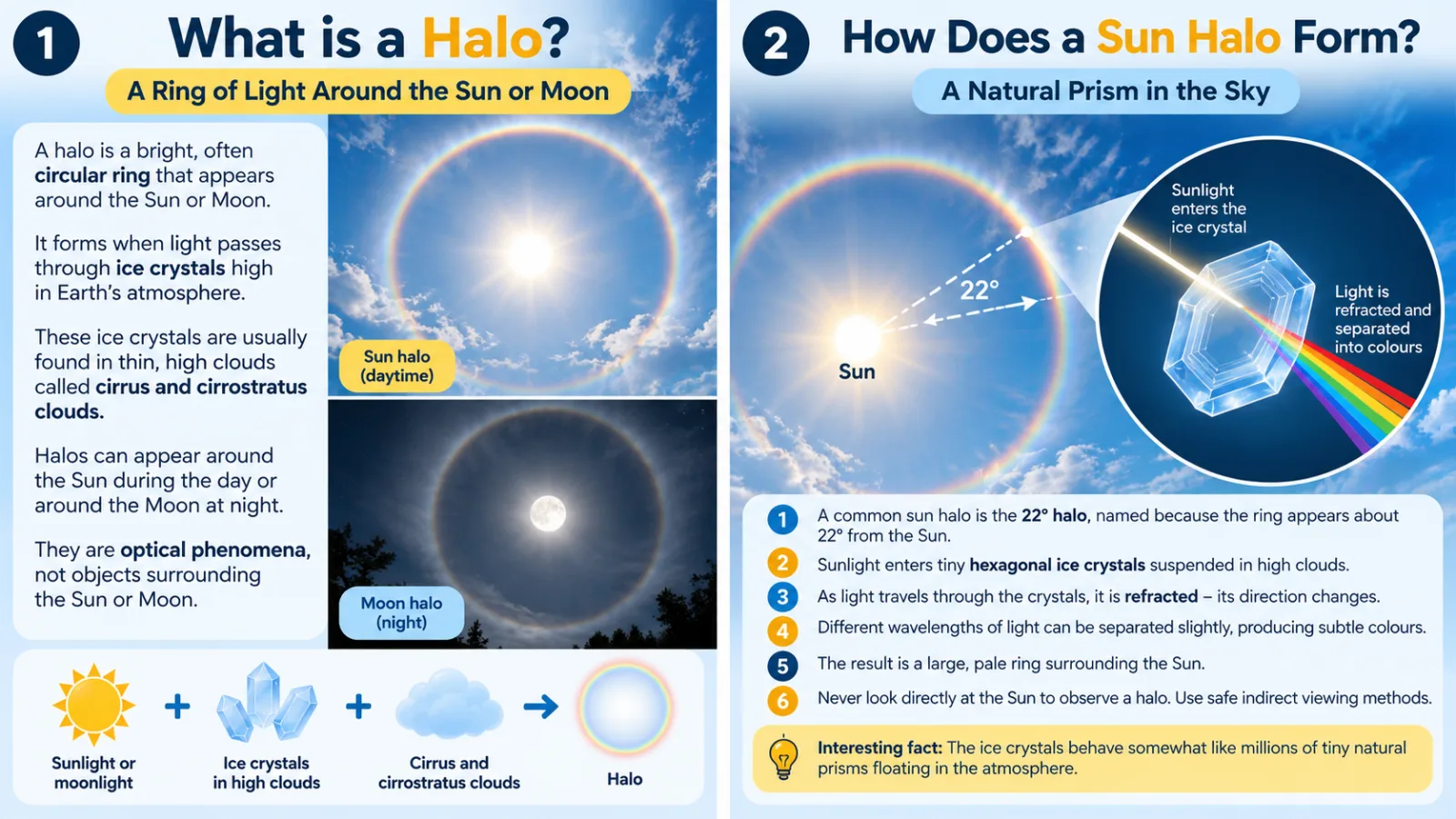
A sun halo is a ring of light that appears around the Sun. The most common type is the 22° halo, a circle with a radius of about 22° centred on the Sun. Because the ring is so large, it often looks bigger than people expect. Hold your hand at arm’s length with your fingers spread: the span from thumb tip to little-finger tip is roughly 20°, so the ring sits at or just beyond your little-finger tip.
The halo can look white, or it can show a little colour. The inner edge is often reddish and the outer edge bluish or white. A moon halo is exactly the same effect, only made with moonlight instead of sunlight.
Halos are actually common. In the UK and similar places they are seen more often than rainbows, and Atmospheric Optics notes that a 22° halo can be seen on average about twice a week in parts of Europe and the United States. We simply tend not to notice them, partly because the Sun is too bright to stare at.
Where the ice crystals are
Halos do not come from the Sun or Moon themselves. They come from ice crystals in the sky. Most halos form in thin, high cloud called cirrus or cirrostratus, which sits about 5–12 km above the ground. At that height the air is cold enough for water to exist as ice rather than liquid droplets.
Cirrostratus often looks like a pale, milky veil across the sky. The Sun is still visible through it, but its edges look softer. That veil is packed with billions of tiny ice crystals, and each one acts like a miniature prism.
There is also a ground-level version. In very cold air, tiny ice crystals can hang close to the surface as diamond dust, and these can create halos too.
How does a sun halo form?
So what causes a halo around the sun? The short answer is refraction. Refraction is the change of direction that happens when light changes speed as it enters a different medium, such as moving from air into ice. The ice crystals in cirrostratus cloud bend the light, and the bending happens at one very particular angle.
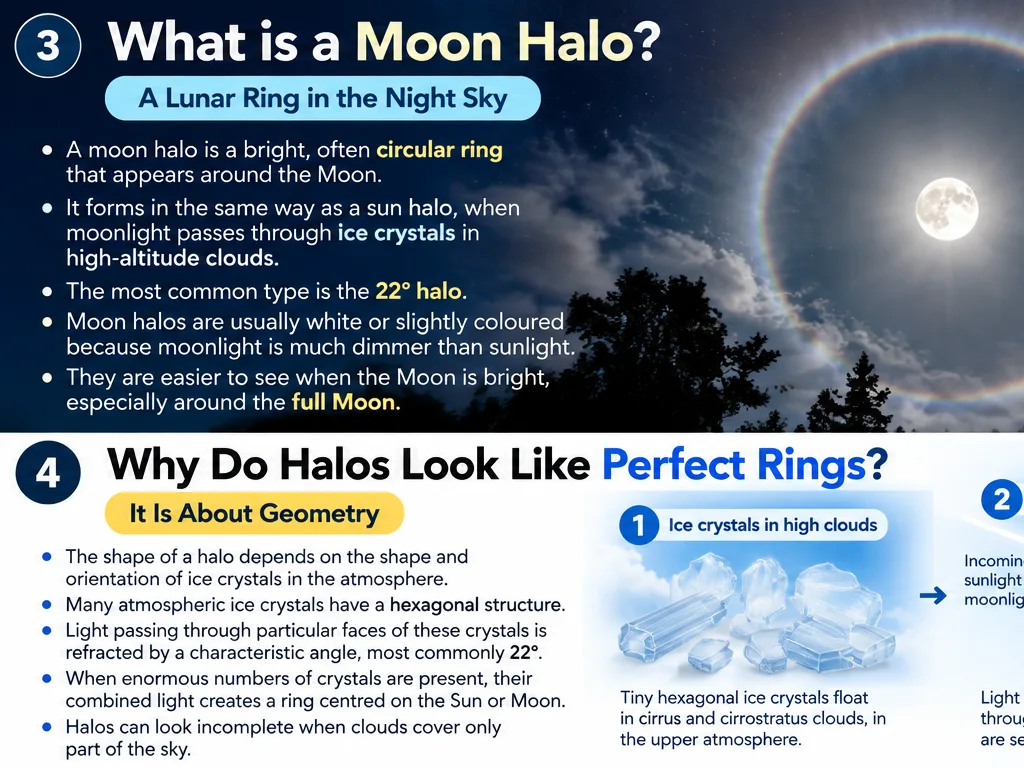
Refraction through a hexagonal prism
Many ice crystals form as hexagonal (six-sided) prisms, a bit like tiny pencils. When sunlight enters one side face of a crystal and leaves through another face, the two faces are inclined at 60° to each other. Light passing through that 60° prism is bent, and the smallest amount it can be bent by is about 22°. Scientists call this the minimum deviation.
light enters one face → leaves a face at 60° → bent ≈ 22°
Now picture millions of crystals, all tilted at random. Some will be oriented just right to send light towards your eye from any direction around the Sun. Because the crystals are randomly oriented, the bright points join up into a full ring rather than a few separate spots. That ring is the 22 degree halo.
Why the inside is darker
Look carefully at a good halo and you will notice that the sky inside the ring looks darker than the sky outside it. This is not an illusion. The crystals cannot bend light by less than about 22°, so no light is refracted at less than 22°. The region inside the ring therefore receives no extra light from the crystals, while the ring itself and the area just outside it are brighter.
Why the colours
Ice behaves like glass here. Light is made of a mixture of colours, and each colour has a different wavelength. Different wavelengths refract by different amounts, which is called dispersion. It is the same effect that splits white light into a spectrum in a glass prism.
Red light is bent the least, so it ends up closest to the Sun, on the inner edge of the ring. Blue light is bent a little more, so it lands towards the outer edge. The spread is small, which is why most halos look mainly white with a faint red inner rim and a bluish outer one.
This is the same basic physics that changes the path of light when it travels through our air. If you want to see another example, read about how refraction in the atmosphere makes stars twinkle.
Measure a 22 degree halo with your hand
You do not need any equipment to check whether a ring in the sky is a genuine 22 degree halo. Your own hand is a handy ruler. The ring has a radius of about 22° around the Sun or Moon, which is roughly the span of an outstretched hand, from thumb tip to little-finger tip, held at arm’s length.
Follow these steps to test a sun halo safely.
- Block the Sun first. Never look straight at it. Move until a building, a post, a tree or your outstretched hand hides the Sun itself.
- Stretch out your arm fully, with your hand open and your fingers spread wide.
- Line up your thumb tip with the centre of the Sun (or with the shadow edge of the object hiding it).
- Look at your little-finger tip. That point should sit on or just inside the ring.
- Check the colours. The inner edge of a halo is often reddish and the outer edge bluish or white, because red light is bent least.
- Look inside the ring. The sky there should look slightly darker than the sky outside it.
If your measurements match, you have found a classic ring around the Sun made by sunlight refracting through ice crystals.
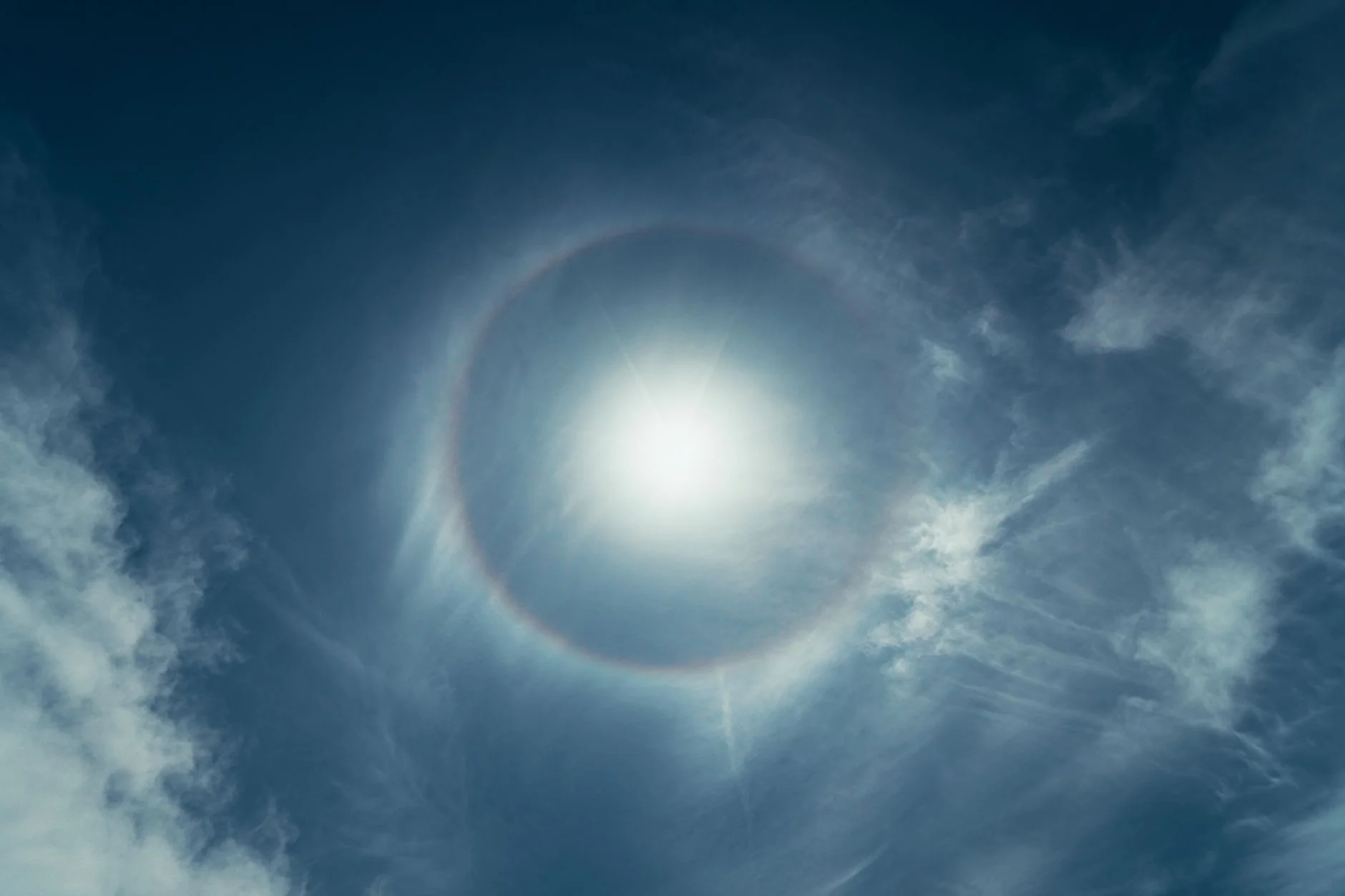
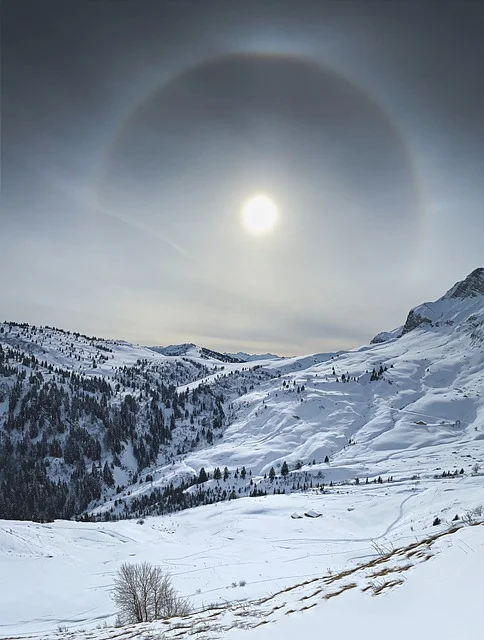
That darker patch inside the ring is not an illusion. No light is refracted through the crystals at less than 22°, so the sky just inside the circle receives less of the halo’s light.
What is a moon halo?
A moon halo is exactly the same effect, only at night. Moonlight refracts through hexagonal ice crystals in thin, high cirrus or cirrostratus cloud, roughly 5–12 km above the ground. Because the crystals are randomly oriented, the light forms a full circle around the Moon with a radius of about 22°.
Many people first notice a ring around the moon on a clear-looking evening, when a thin veil of cloud drifts across the sky. The Moon is bright enough to light up the ice crystals, even though there is no visible cloud in the usual sense.
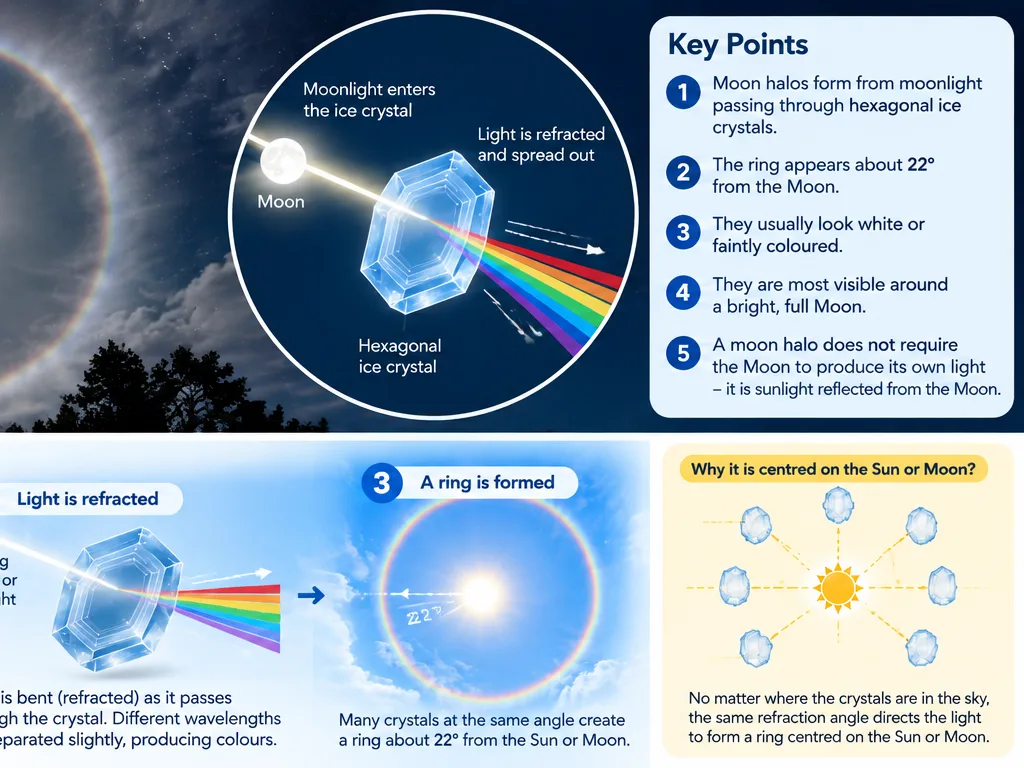
You can use the same hand trick to measure it. A moon halo is also completely safe to look at, so you can stand and study it for as long as you like.
Why moon halos look white
The physics is the same as for the Sun. Each ice crystal acts like a tiny prism, so red light is bent least and blue light most, which would give a reddish inner edge and a bluish or white outer edge.
In practice, a moon halo usually looks pale and whitish. Moonlight is so faint that our eyes cannot pick out colour well, so a moon halo usually looks white to the eye. A bright Moon and a clear sky give you the best chance of spotting a hint of red on the inside of the ring.
Does a ring around the Moon mean rain?
The old saying is that a ring around the moon means rain or snow soon. There is some truth in it, which is why the rhyme has survived for generations.
The ice-crystal cloud that makes a halo, cirrostratus, often runs ahead of an approaching warm front. Rain can sometimes follow within roughly 12–24 hours. Forecasters note that this link is real but not reliable.
A sensible way to use the folklore is as a prompt to check the real forecast. If you see a halo and the sky is also thickening and lowering with cloud from the west, rain may be on its way, so check the forecast.
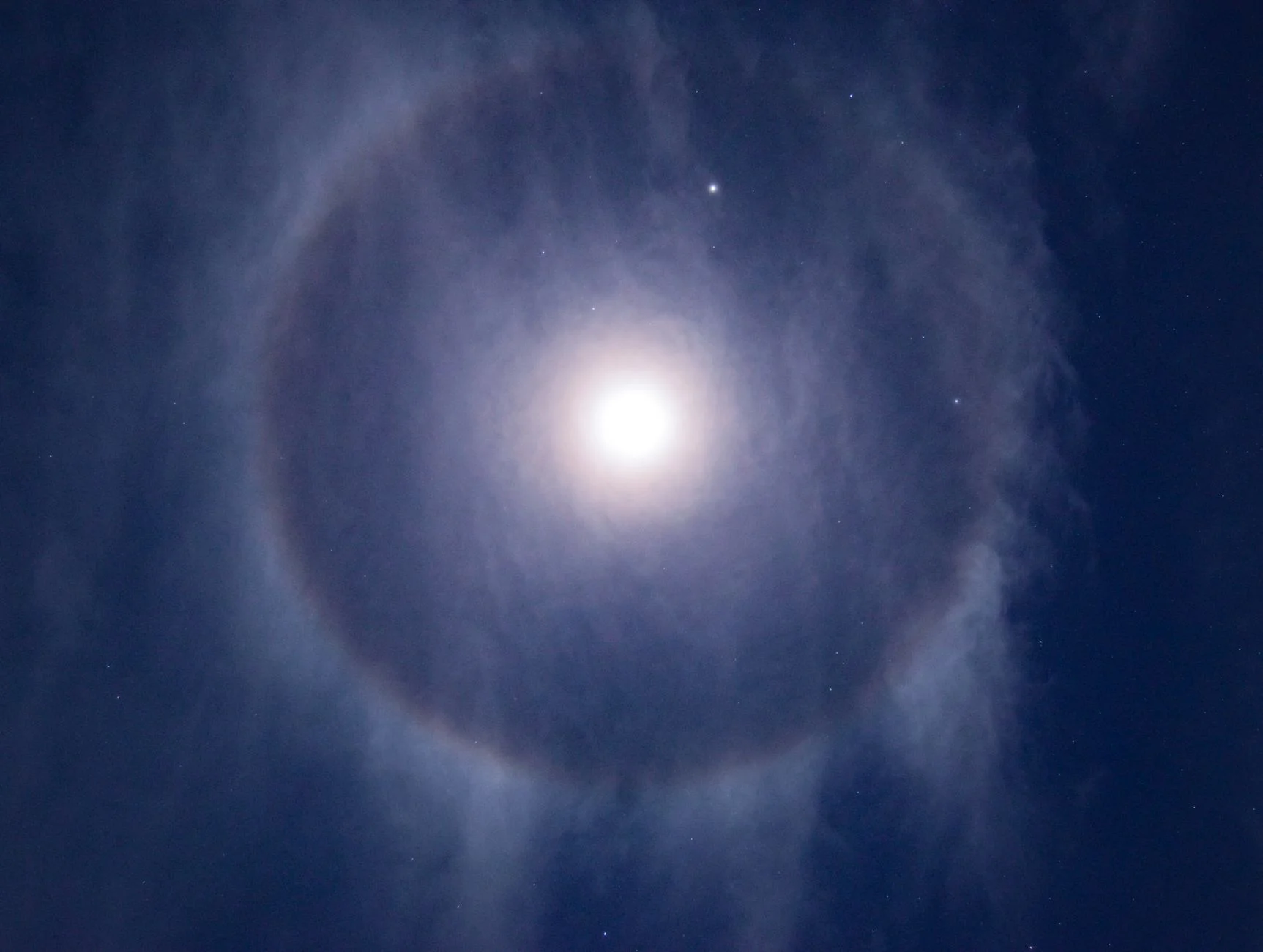
Whether it is the Sun or the Moon, the secret is the same. Hexagonal ice crystals bend light by about 22°, and the ring is simply the pattern of all that bent light reaching your eyes.
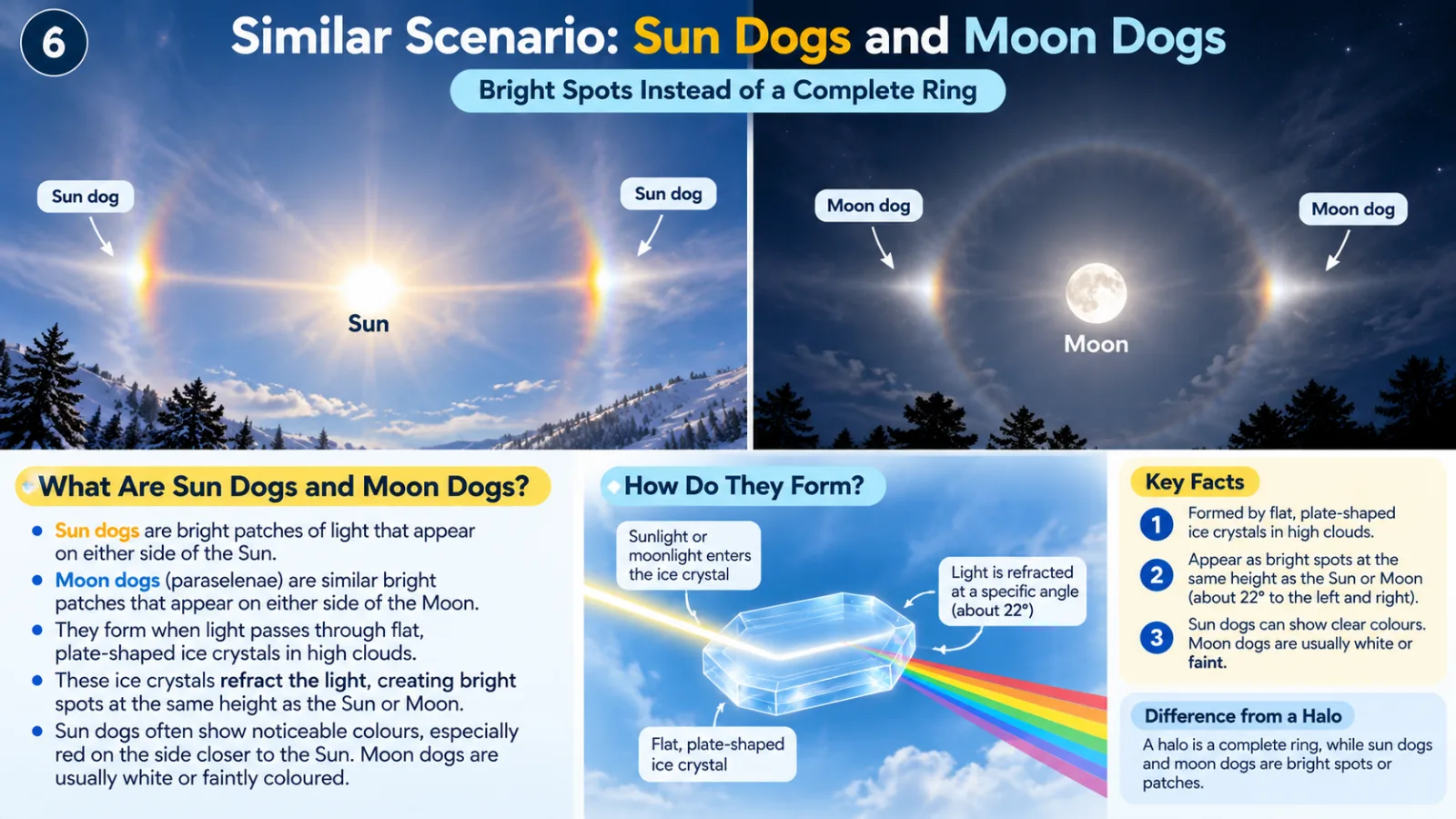
Sun dogs and moon dogs: the bright spots beside a halo
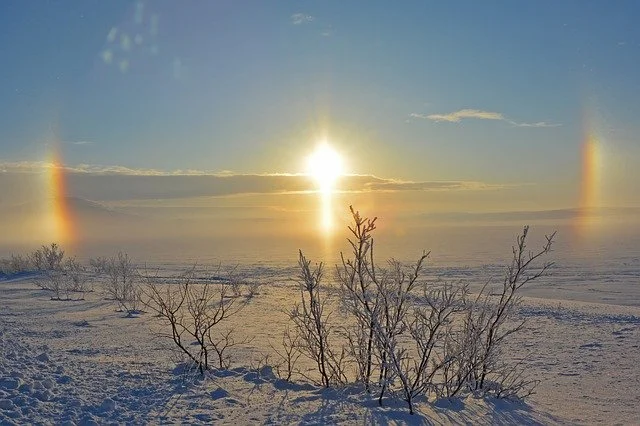
Sometimes a sun halo comes with two glowing patches of light, one on each side of the Sun. These are sun dogs, and their scientific name is parhelia (singular: parhelion, from the Greek for "beside the Sun"). If you have ever asked "what is a parhelion?", it is simply a bright, often coloured spot about 22° to the left or right of the Sun, at the same height above the horizon.
How sun dogs form
Sun dogs come from the same family of ice crystals as the 22° halo, but the crystals behave differently. Instead of tumbling randomly, flat, plate-shaped hexagonal crystals drift downwards with their faces lying horizontally, a bit like falling leaves. Light passes through each plate in the same way every time, so it is bent towards the same two places in the sky instead of being spread into a full ring.
The result is a concentrated patch of light on each side of the Sun. The edge nearest the Sun is red, because red light is bent the least. Further out the colours fade through yellow towards white and blue. Sun dogs are brightest when the Sun is low, but can appear at any time of day.
Other ice-crystal halos: the 46° halo, circumzenithal arc and light pillars
The ordinary 22° halo is only the beginning. The same ice crystals can paint several other shapes across the sky, depending on the crystal shape, how the crystals are lined up and where the Sun is. Tap each card below to test yourself on how each one forms.
The 46° halo
A 46° halo is a much bigger ring than the familiar one, and it is rarer and fainter. The light takes a different path through the crystal, entering a side face and leaving through an end face, so the two faces act like a prism with a 90° angle. A larger prism angle means a larger bend, so the ring sits further out.
The circumzenithal arc
The circumzenithal arc is often called an "upside-down rainbow", and it is easy to confuse with a real rainbow. The giveaway is its position. A circumzenithal arc sits high in the sky above the Sun — roughly 46° above it when the Sun is about 22° up, when it is brightest — and is centred on the zenith, the point directly overhead. A rainbow, by contrast, appears on the opposite side of the sky from the Sun. The arc also needs the Sun to be lower than about 32°, so it is a morning or evening treat.
Light pillars
Light pillars are vertical columns of light stretching above or below the Sun, or above bright lamps at night. Unlike a halo, which is mainly refraction, a pillar is made by reflection from plate-shaped crystals, which act like millions of tiny mirrors. Each one tilts slightly, so the reflections smear into a tall streak.
Halo vs rainbow vs corona: how to tell them apart
Many people mix up these three glowing rings. The key question is what the light is passing through. Halos need ice crystals, while rainbows and coronas need water droplets. A glory is a fourth effect that also involves droplets and appears around the observer’s shadow. The table compares the three most common.
| Feature | Halo | Rainbow | Corona |
|---|---|---|---|
| Made by | Ice crystals | Water droplets | Water droplets in thin cloud |
| Process | Refraction (sometimes reflection) | Refraction and internal reflection | Diffraction |
| Where it appears | Around the Sun or Moon, at about 22° (or 46°) | Opposite the Sun (the antisolar point), radius about 42° | Small rings close around the Sun or Moon |
| Typical cloud | Thin high cirrus or cirrostratus, about 5–12 km up | Rain or spray in the air | Thin cloud |
| Colour order | Red on the inside, bluish-white outside | Coloured arc | Coloured rings close to the light |
A good test is size and position. A small coloured ring hugging the Sun or Moon is a corona. A larger ring about a hand-span away is a halo. An arc on the opposite side of the sky from the Sun is a rainbow. For a wider tour of sky effects, see our guide to atmospheric optical phenomena.
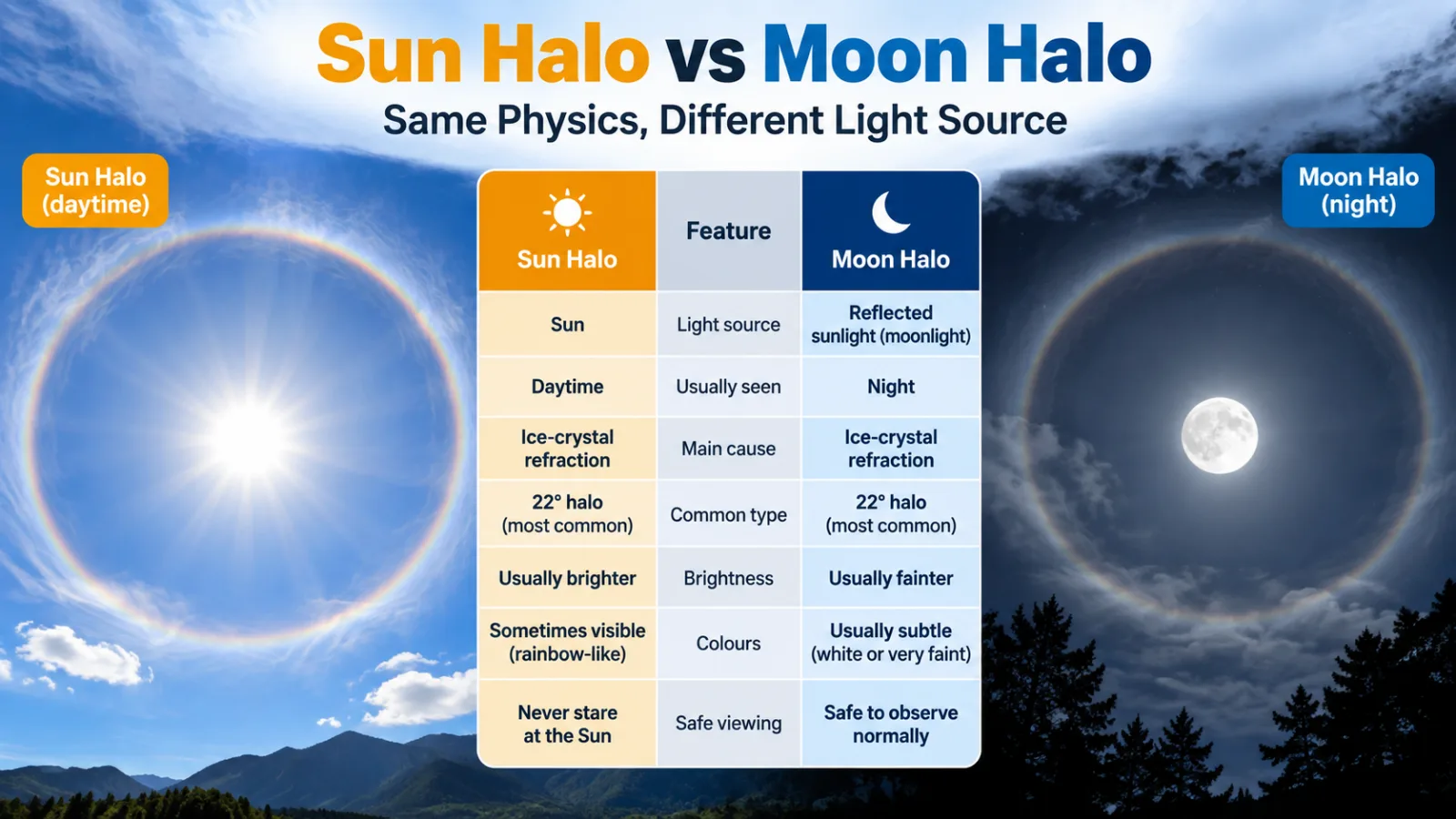
Sun halo vs moon halo: what is the same and what is different?
A sun halo and a moon halo are the same optical phenomenon. In both cases, light refracts through hexagonal ice crystals in thin cirrus or cirrostratus cloud, roughly 5–12 km up. The standard 22° halo has the same size around the Sun and the Moon, because the geometry of the crystals does not care which light source is shining.
The differences come from the light itself and from how we see it. Sunlight is far brighter, so a sun halo often shows a reddish inner edge and a bluish or white outer edge. Moonlight is much fainter, so a moon halo usually looks pale and white to the eye.
| Feature | Sun halo | Moon halo |
|---|---|---|
| Light source | Sunlight | Moonlight |
| Ice crystals | Hexagonal prisms in cirrus or cirrostratus | The same |
| Radius of the common ring | About 22° | About 22° |
| Colour | Reddish inside, bluish or white outside | Usually looks white |
| Bright spots on the ring | Sun dogs (parhelia) | Moon dogs (paraselenae), fainter |
| Safe to look at? | Never look at the Sun itself | Yes |
If you spot a ring around the Moon tonight, you are looking at the same physics that makes a ring around the Sun by day. The only real change is the brightness, and that matters most for safety.
How to see and photograph a halo safely
Halos are common, so you do not need special equipment to find one. You need clear sky, a little patience and a habit of glancing up. Use this checklist the next time thin, milky cloud spreads across the sky.
- Look for a thin, high, milky veil of cloud (cirrostratus) rather than lumpy low cloud.
- Scan the sky about 22° from the Sun or Moon, roughly one outstretched hand at arm’s length.
- For a sun halo, block the Sun with your hand, a building, a tree or a post before you look.
- Check the ring’s colours: a reddish inner edge and a bluish or white outer edge point to refraction by ice.
- Look for bright spots left or right of the Sun at the same height. These are sun dogs.
- For photos, use a wide-angle lens, because a 22° ring needs a field of view of about 44° or more.
- Hide the Sun behind an object in the frame, and never point a camera or binoculars at it.
Halos also tell you something about the sky above you. The ice crystals sit in the upper part of the atmosphere of Earth, far above the weather you feel on the ground. On a clear night with a moon halo, you may also spot bright stars inside or just outside the ring. If you want to put names to them, try how many constellations there are and start with the brightest patterns.
Test yourself: sun and moon halos
Key points: sun halos and moon halos
- A halo is made by sunlight or moonlight refracting through ice crystals in high, thin cloud, about 5–12 km up.
- The 22° halo is the most common. Its radius is about the span of your outstretched hand.
- The inside of the ring is darker, and the inner edge is often reddish because red light bends least.
- Sun and moon halos have the same geometry, but moon halos look white to the eye because moonlight is too faint for our colour vision.
- Rarer ice-crystal effects include the 46° halo, sun dogs, the circumzenithal arc and light pillars.
- Never look directly at the Sun. Block it and look at the halo, or photograph it with a wide-angle lens.
- A ring around the Moon can come before rain, but it is not a reliable forecast.
Frequently asked questions about sun and moon halos
What causes a halo around the sun?
A halo around the Sun is caused by sunlight refracting through hexagonal ice crystals in thin high cloud, such as cirrostratus. Light enters one face and leaves another inclined at 60°, bending by about 22°. Because the crystals are randomly oriented, the light forms a full ring around the Sun.
Does a ring around the moon mean rain?
Sometimes. The cirrostratus cloud that makes a moon halo often runs ahead of an approaching warm front, and rain can follow within roughly 12–24 hours. But the link is not reliable, so a halo is only a hint. Check a proper weather forecast before you plan around it.
What is a 22 degree halo?
A 22 degree halo is the most common type, a ring with a radius of about 22° around the Sun or Moon. That is roughly the span of an outstretched hand at arm’s length. It forms when light passes through hexagonal ice-crystal prisms and is bent by a minimum of about 22°.
What are sun dogs?
Sun dogs, also called parhelia (singular parhelion), are bright, often coloured spots about 22° to the left or right of the Sun, at the same height. They come from flat, plate-shaped hexagonal crystals drifting horizontally. The red side is nearest the Sun, and they are brightest when the Sun is low.
What is the difference between a halo, a corona and a rainbow?
A halo comes from ice crystals refracting light and forms a ring around the Sun or Moon. A corona is a small coloured ring close to the Sun or Moon, caused by diffraction in water droplets. A rainbow comes from water droplets and appears opposite the Sun, with a radius of about 42°.
Is it safe to look at a sun halo?
Only if you never look at the Sun itself. Block the Sun with your hand, a building or a post, and look at the ring around it. Never use binoculars or a camera pointed at the Sun. A moon halo is safe to look at because moonlight is faint.
How do you photograph a halo?
Use a wide-angle lens, because a 22° ring needs a field of view of about 44° or more to fit in the frame. For a sun halo, hide the Sun behind a tree, building or other object. Never point a camera or binoculars directly at the Sun, which is unsafe.
What is a circumzenithal arc?
A circumzenithal arc is a bright, rainbow-coloured arc centred on the zenith, high above the Sun (about 46° above it when the Sun is around 22° up). It sits high in the sky, above the Sun rather than opposite it, and comes from plate-shaped ice crystals. It is visible only when the Sun is lower than about 32°, and is often called an upside-down rainbow.
How common are sun halos?
Sun halos are more common than most people think. Atmospheric Optics notes that a 22° halo can be seen on average about twice a week in parts of Europe and the United States, making halos more frequent than rainbows. People simply do not notice them because they avoid looking near the bright Sun.