
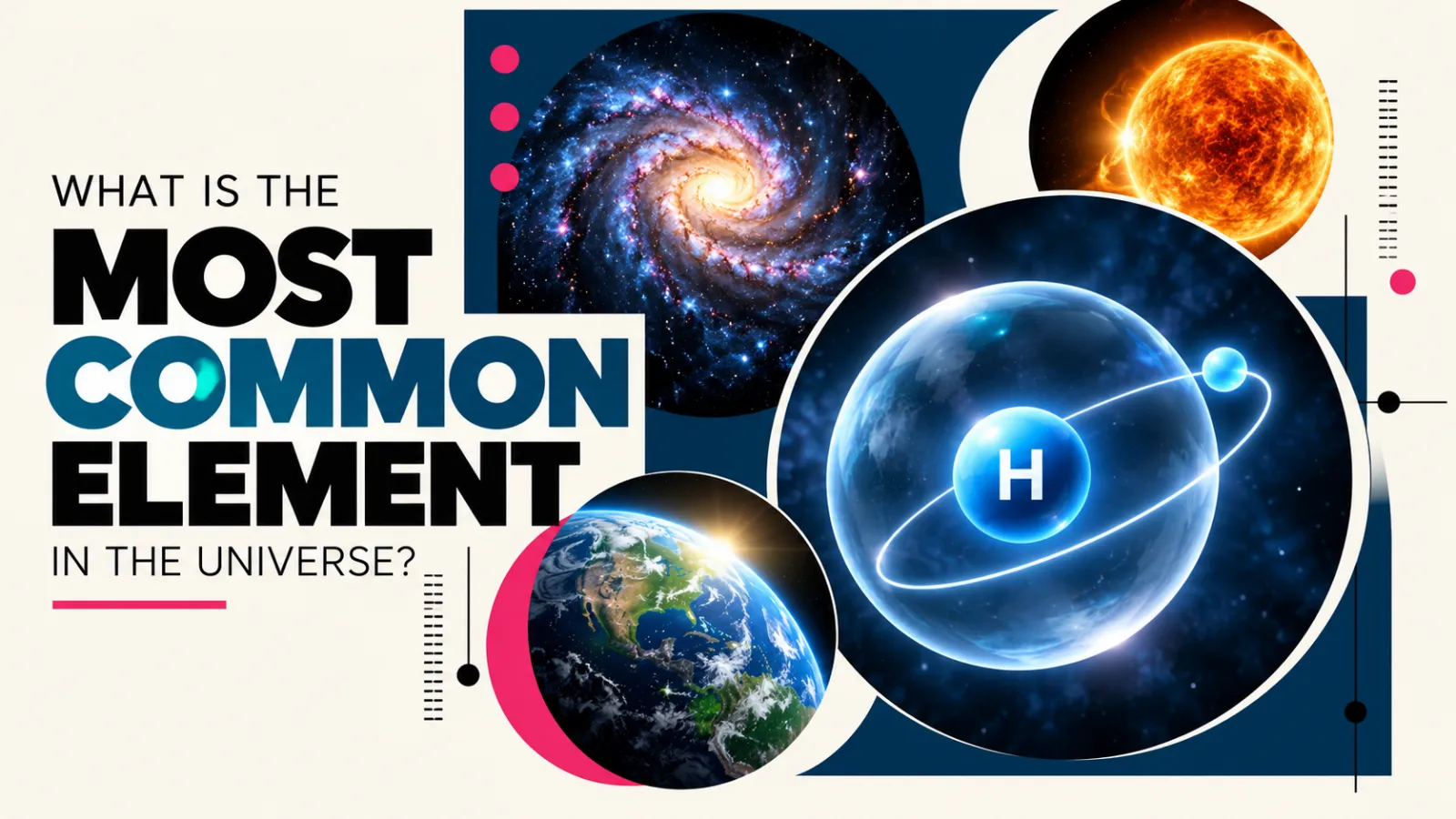
The most common element in the universe is hydrogen. It makes up about 74% of all ordinary matter by mass and roughly 92% of all atoms. Almost all of it was made in the first few minutes after the Big Bang, and it is still the main fuel that makes stars shine.
Helium comes a distant second, and everything else on the periodic table – the oxygen you breathe, the carbon in your cells, the iron in your blood – adds up to only about 2% of the ordinary matter in space. This guide explains why, using the numbers you need for GCSE chemistry and physics, and then brings the story back down to Earth.
Hydrogen: the most common element in the universe
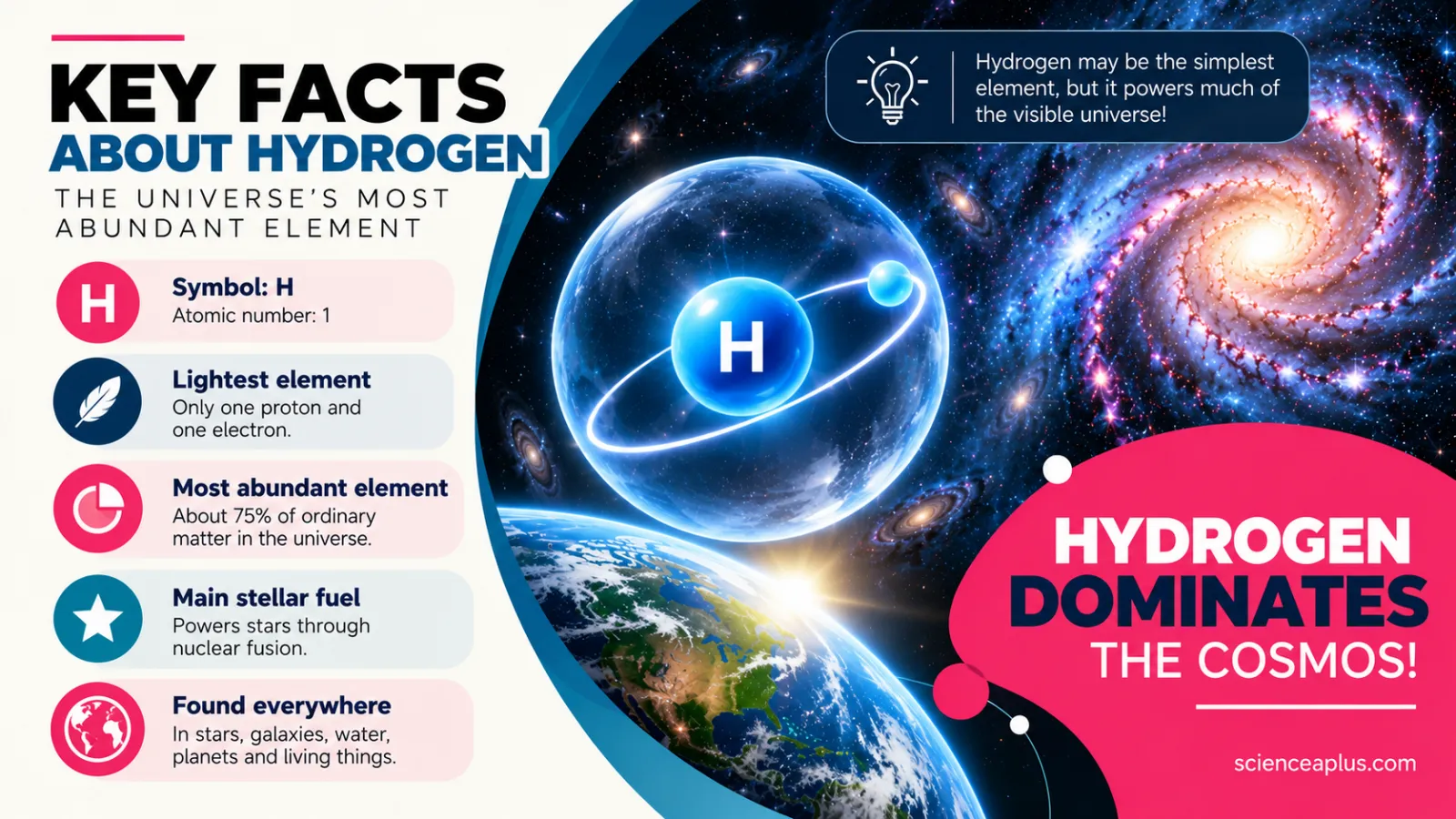
Hydrogen has the symbol H and atomic number 1, so it sits first in the periodic table. It is the lightest and simplest element of all. The most common type of hydrogen atom, called protium, has just one proton and one electron – and no neutron.
If you need a refresher on protons, neutrons, mass number and atomic number, see our guide to the structure of the atom. Hydrogen is the easiest atom to draw, and that simplicity is exactly why there is so much of it.
Three isotopes of hydrogen
Isotopes are atoms of the same element with different numbers of neutrons. Hydrogen has three you should know:
- Protium (¹H) – 1 proton, 0 neutrons. By far the most common.
- Deuterium (²H) – 1 proton, 1 neutron. Stable, but rare.
- Tritium (³H) – 1 proton, 2 neutrons. Radioactive, with a half-life of about 12.3 years.
All three have one proton, so they all behave as hydrogen in chemical reactions. Only their masses differ.
Who discovered hydrogen?
The English scientist Henry Cavendish described hydrogen in 1766. He called it “inflammable air”, and in 1781 he showed that it burns to make water. The French chemist Antoine Lavoisier later named it hydrogen, from Greek words meaning “water former”. You can read more about how the gas behaves in the lab in our page on the properties of hydrogen.
By mass or by number of atoms?
You will see two different numbers quoted for hydrogen, and both are right. It depends on whether you count mass or count atoms.
| Element | Share of ordinary matter by mass | Share of all atoms |
|---|---|---|
| Hydrogen (H) | ≈ 74% | ≈ 92% |
| Helium (He) | ≈ 24% | ≈ 8% |
| All other elements | ≈ 2% | ≈ 0.1% |
Why the difference? A helium-4 atom has about four times the mass of a hydrogen atom. So a gram of helium contains only about a quarter as many atoms as a gram of hydrogen. When you switch from counting kilograms to counting atoms, hydrogen’s lead grows even bigger.
Here is the idea worked through for a 100 g sample with the universe’s mix:
atoms ∝ mass ÷ relative atomic mass → H: 74 ÷ 1 = 74 · He: 24 ÷ 4 = 6
Out of every 80 “units” of atoms, 74 are hydrogen and 6 are helium. That is about 92% hydrogen and 8% helium – the heavier elements barely register when you count atoms. Try your own mix with the calculator below.
The ten most common elements in the universe
Astronomers measure what stars and gas clouds are made of by splitting their light into a spectrum. Each element leaves its own pattern of lines, like a barcode. Putting those measurements together gives this approximate list for the Sun and Solar System (a good guide to our part of the galaxy), ranked by mass:
| Rank | Element | Symbol | ≈ Share by mass |
|---|---|---|---|
| 1 | Hydrogen | H | 74% |
| 2 | Helium | He | 24% |
| 3 | Oxygen | O | 1.0% |
| 4 | Carbon | C | 0.46% |
| 5 | Neon | Ne | 0.13% |
| 6 | Iron | Fe | 0.11% |
| 7 | Nitrogen | N | 0.10% |
| 8 | Silicon | Si | 0.07% |
| 9 | Magnesium | Mg | 0.06% |
| 10 | Sulfur | S | 0.04% |
Two things stand out. First, hydrogen and helium together make up about 98% of ordinary matter. Second, oxygen is the third most common element and carbon the fourth – the two elements life depends on most are also among the commonest made in stars. That is not a coincidence, as you will see later.
Next, the big question: why should one simple element so completely outnumber all the others?
Why is hydrogen so common? A legacy of the Big Bang
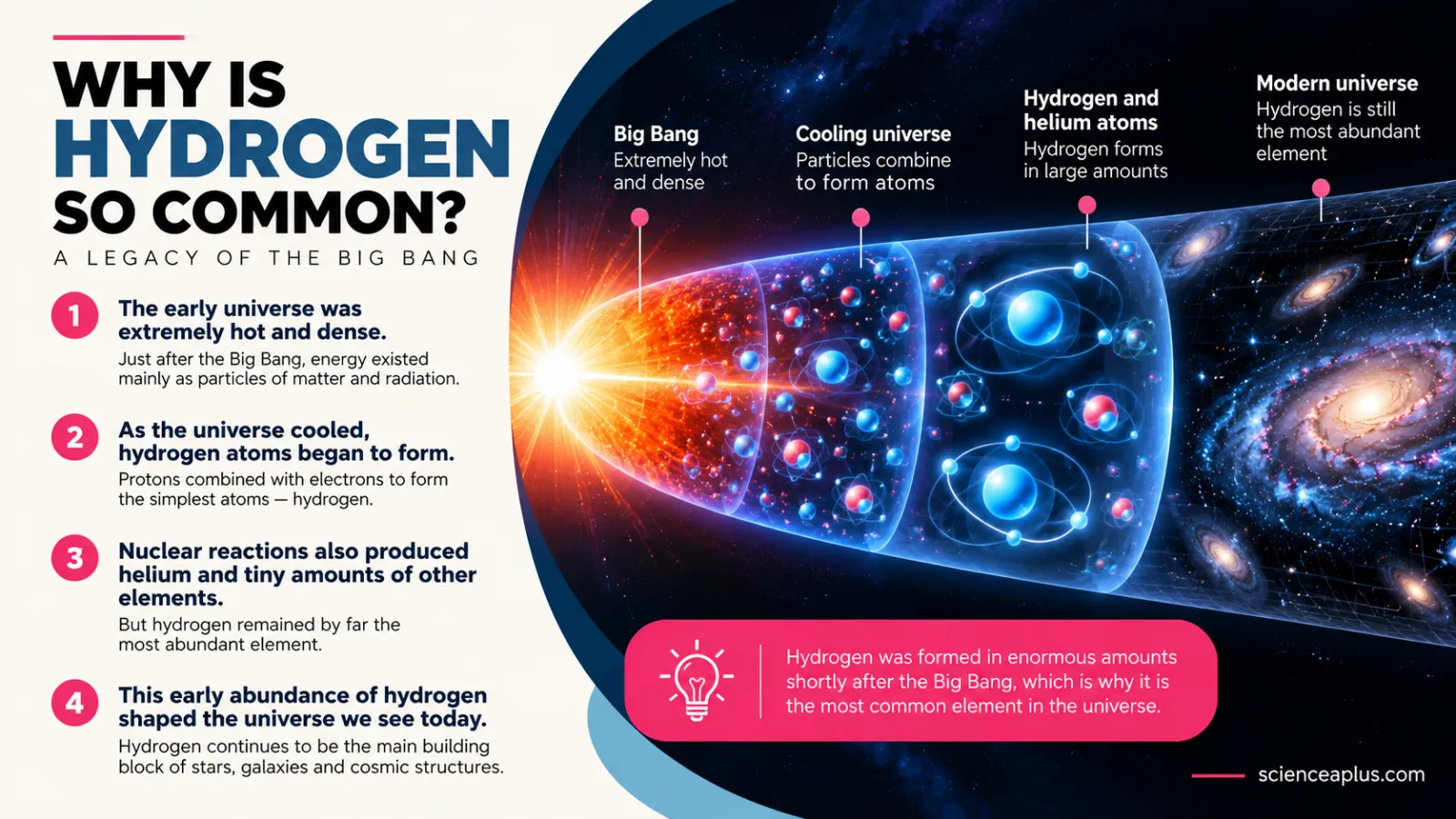
Hydrogen is the most common element because it was the first one the universe made, and it made a lot of it. About 13.8 billion years ago the universe began extremely hot and dense. As it expanded, it cooled, and the building blocks of matter could start to come together.
A hydrogen nucleus is just a single proton, so it needs no building at all. Every heavier element needs protons and neutrons to be fused together, and that takes extreme temperatures and pressures held for long enough. In the young universe, the right conditions lasted only a few minutes.
A timeline of the first 380,000 years
- The first second: the universe is a hot, dense soup of particles and radiation. Protons and neutrons form, but it is far too hot for them to stick together.
- From about 10 seconds to 20 minutes: the universe has cooled enough for protons and neutrons to fuse. This is called Big Bang nucleosynthesis. Almost every neutron ends up inside a helium-4 nucleus, with tiny traces of deuterium, helium-3 and lithium-7.
- After about 20 minutes: the universe is now too cool and too spread out for fusion to continue. The mix is fixed at roughly 75% hydrogen and 25% helium by mass. Only about 1 nucleus in 100,000 is deuterium or helium-3, and about 1 in a billion is lithium-7.
- About 380,000 years: the universe has cooled to about 3,000 K. Electrons can finally join the nuclei to make the first neutral atoms of hydrogen and helium. Light can now travel freely, and that light reaches us today as the cosmic microwave background.
- Later: gravity pulls the hydrogen and helium gas into clumps, and the first stars switch on.
Notice the order. The nuclei of helium were made within the first 20 minutes, but complete atoms – nuclei with electrons around them – had to wait hundreds of thousands of years. Infographics sometimes blur these two steps together. For the bigger picture of how the universe grew and changed after this, see our guide to cosmology, nebulae and galaxies.
Why did the Big Bang stop at helium?
Making heavier elements needs nuclei to collide hard and often. In the early universe the temperature and density fell very quickly as space expanded. By the time enough helium had formed to start building bigger nuclei, the universe had become too cool and too thin for those collisions to happen. Apart from a pinch of lithium, the heavier elements had to wait for the first stars.
So the universe started out with roughly three-quarters hydrogen by mass. Stars have been turning some of that hydrogen into heavier elements ever since, yet after 13.8 billion years hydrogen still makes up about 74%. That tells you how much hydrogen there was to begin with – and how slowly even billions of stars use it up.
Explain why the early universe produced mostly hydrogen and very few heavy elements. (3 marks)
Hydrogen nuclei are single protons, so they existed as soon as protons formed (1). Fusion into heavier nuclei was only possible for a few minutes while the universe was hot and dense enough (1). The universe then expanded and cooled too quickly for further fusion, so apart from helium and a little lithium, no heavier elements were made (1).
Hydrogen clouds: the nurseries of stars

Between the stars of a galaxy drift enormous clouds of gas and dust called nebulae. Like the universe as a whole, they are made mainly of hydrogen. Where a cloud is dense and cold enough, gravity pulls parts of it together into clumps that grow hotter and denser until they become new stars.
The Orion Nebula is the nearest large star-forming region to Earth, about 1,344 light-years away. Thousands of young stars are forming inside it. On a clear winter night in the northern hemisphere you can see it with your own eyes as a fuzzy patch in the “sword” below Orion’s belt, and binoculars show it even better.
Its glow is a clue to what it is made of. Young, very hot stars inside the cloud give out ultraviolet light that energises the hydrogen gas around them, and the gas gives off its own light. Telescopes on the ground and in space map these clouds in visible and infrared light; infrared can pass through dust that hides newborn stars, which is one reason the James Webb Space Telescope was built to see infrared.
Because light takes time to travel, you never see the Orion Nebula as it is today. You see it as it was when that light set off. Pick an object below to find out how far back in time you are looking.
Every one of those distant nebulae and galaxies is, by mass, mostly hydrogen. And once a clump of that hydrogen becomes a star, something remarkable happens in its core.
Hydrogen: the fuel of the stars
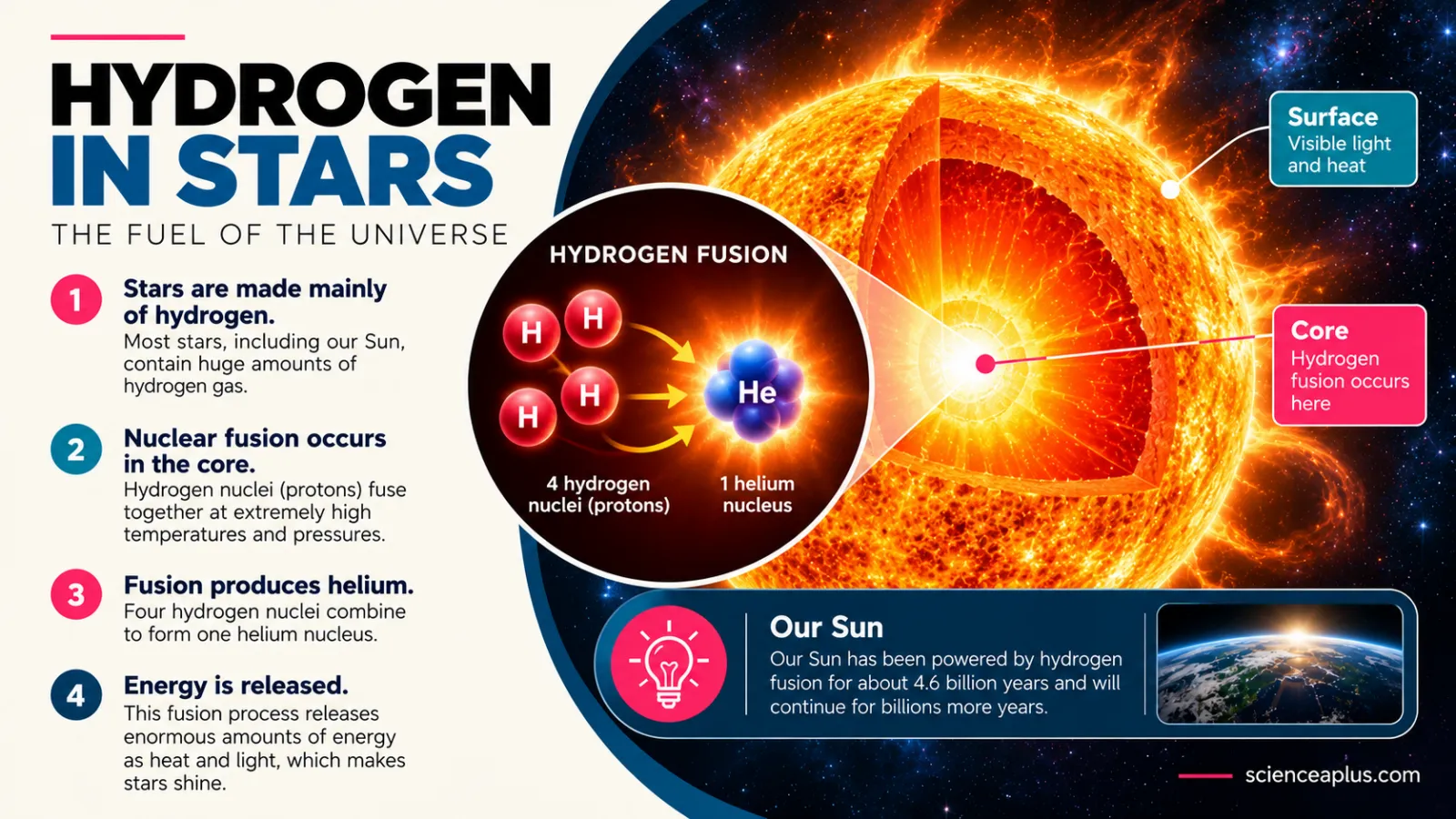
Stars are made mostly of hydrogen and helium, and hydrogen is what keeps them shining. Deep in a star’s core the temperature and pressure are so high that hydrogen nuclei collide hard enough to join together. This is nuclear fusion, and it is the same process that powers our Sun.
The reaction happens in several steps, but the overall result is simple: four hydrogen nuclei become one helium nucleus.
4 ¹H → ⁴He + 2 e⁺ + 2 ν + energy
Here e⁺ is a positron (an anti-electron) and ν is a neutrino, a tiny particle that passes straight out of the Sun. You do not need to know those two particles for most GCSE courses; the key point is that hydrogen nuclei fuse to form helium nuclei and release energy.
Where does the energy come from?
If you weigh the helium nucleus, it has about 0.7% less mass than the four hydrogen nuclei that made it. That “missing” mass has not disappeared. It has been converted into energy, as described by Einstein’s equation:
E = mc²
Because c, the speed of light, is huge, a tiny amount of mass gives a vast amount of energy. That energy slowly works its way out of the star and leaves the surface as light and heat.
How much hydrogen does the Sun use?
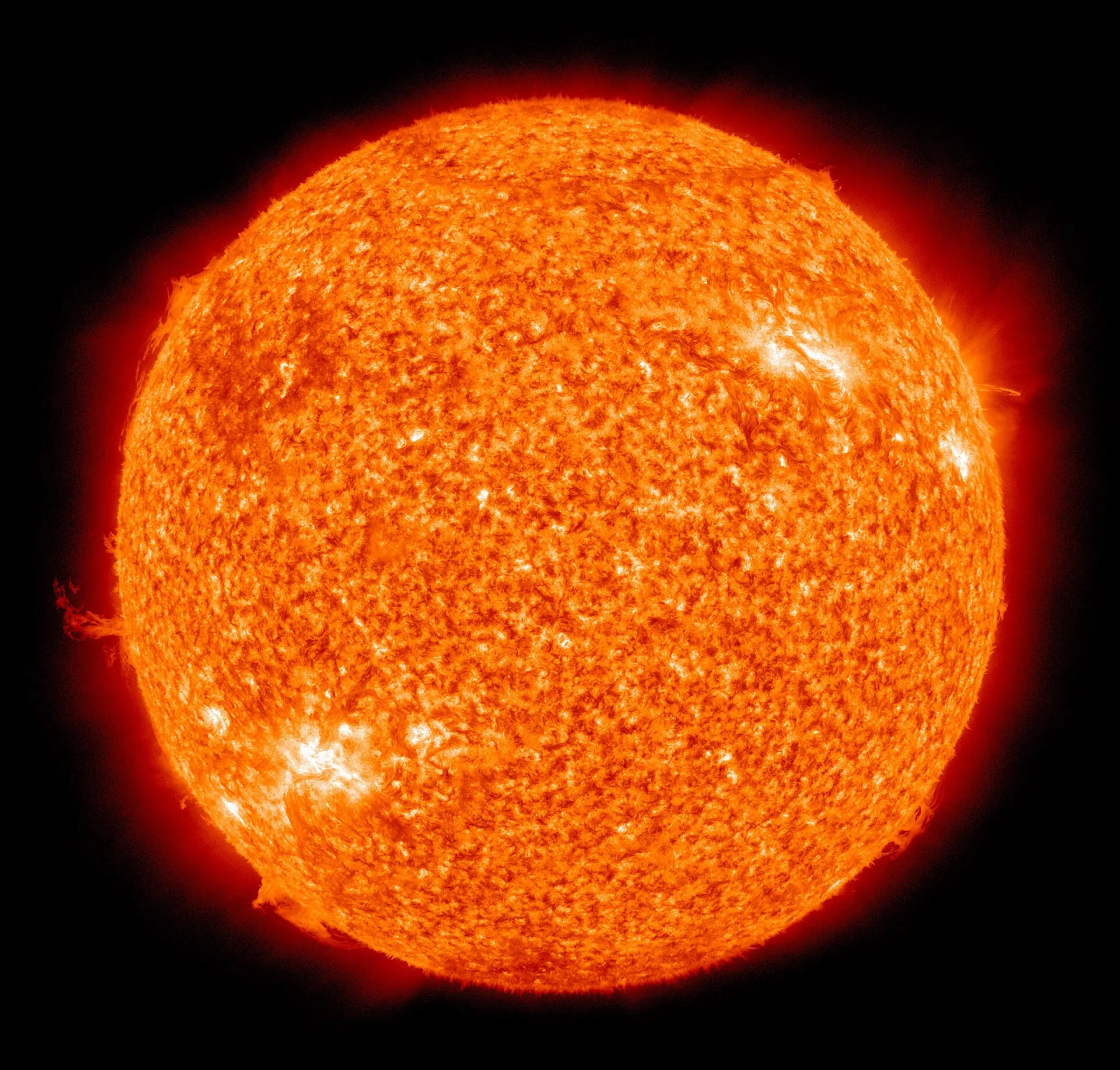
Our Sun fuses about 600 million tonnes of hydrogen every second. In that same second about 4 million tonnes of mass are turned into energy – that is the source of all the sunlight that reaches Earth. The core where this happens is about 15 million °C.
That sounds as if the Sun should run out quickly, but the Sun holds about 99.8% of all the mass in the solar system. It has been shining for about 4.6 billion years and has enough hydrogen in its core to keep going for roughly another 5 billion years. To see how the Sun and planets formed from a spinning cloud of mostly hydrogen gas, read our article on the origin of our solar system.
Helium: the second most common element in the universe
Helium is the second most common element in the universe, at about 24% of ordinary matter by mass. Most of it was made in the Big Bang, and stars add a little more every second by fusing hydrogen.
Fittingly, helium was found in the Sun before it was found on Earth. During a solar eclipse in 1868, the French astronomer Jules Janssen, observing from India, saw a bright yellow line in the spectrum of light from the Sun’s outer layers. It did not match any known element. The English astronomer Norman Lockyer studied the same line, and the two share the credit for the discovery. Lockyer named the new element after helios, the Greek word for the Sun. In 1895 the Scottish chemist William Ramsay finally isolated helium on Earth, from a uranium mineral called cleveite.
Why is helium so rare on Earth?
Despite being so common in space, helium makes up only about 5 parts per million of Earth’s air. Two reasons explain this:
- Helium atoms are very light, so helium released into the air rises and eventually escapes into space.
- Helium is a noble gas and is almost completely unreactive, so it does not get locked away in compounds the way hydrogen is locked into water.
The helium we use comes from underground. Radioactive elements such as uranium and thorium in rocks give out alpha particles, which are helium nuclei. These pick up electrons to become helium atoms, which can collect in the same rock traps as natural gas. Companies extract helium from that natural gas. Its uses include filling balloons and airships, because it is less dense than air, and keeping the superconducting magnets of MRI scanners cold as liquid helium. Find out more about its physical and chemical properties on our helium element page.
Where do all the other elements come from?
If the Big Bang made almost nothing but hydrogen and helium, where did the oxygen, carbon, silicon and iron in our planet come from? The answer is the stars.
- Ordinary stars fuse hydrogen into helium for most of their lives.
- When the core runs low on hydrogen, it gets hotter and can fuse helium into carbon and oxygen. The most massive stars go on to make neon, magnesium, silicon and, finally, iron.
- Iron is the end of the line for fusion in stars, because fusing iron does not release energy.
- Elements heavier than iron are made mainly in supernova explosions and in collisions between neutron stars. Neutron-star mergers may be where much of the gold in the universe was made.
When massive stars explode, they scatter these new elements into space. The material mixes into fresh clouds of hydrogen, and the next generation of stars and planets forms from that enriched gas. This is why oxygen comes third and carbon fourth in the cosmic league table: they are among the main products of stellar fusion. The carbon in every living thing – explored in our guide to the element carbon – was made inside stars that died before the Sun was born.
The hydrogen in your body came from the Big Bang. Where did the carbon and oxygen in your body come from? (2 marks)
They were made by nuclear fusion inside earlier stars (1), then spread into space when those stars died or exploded, becoming part of the gas cloud that formed the Sun and Earth (1).
So almost every element is part of one long story: hydrogen from the Big Bang, cooked step by step into heavier elements by stars. But on Earth the league table looks very different, as the next section shows.
Where do we find hydrogen?
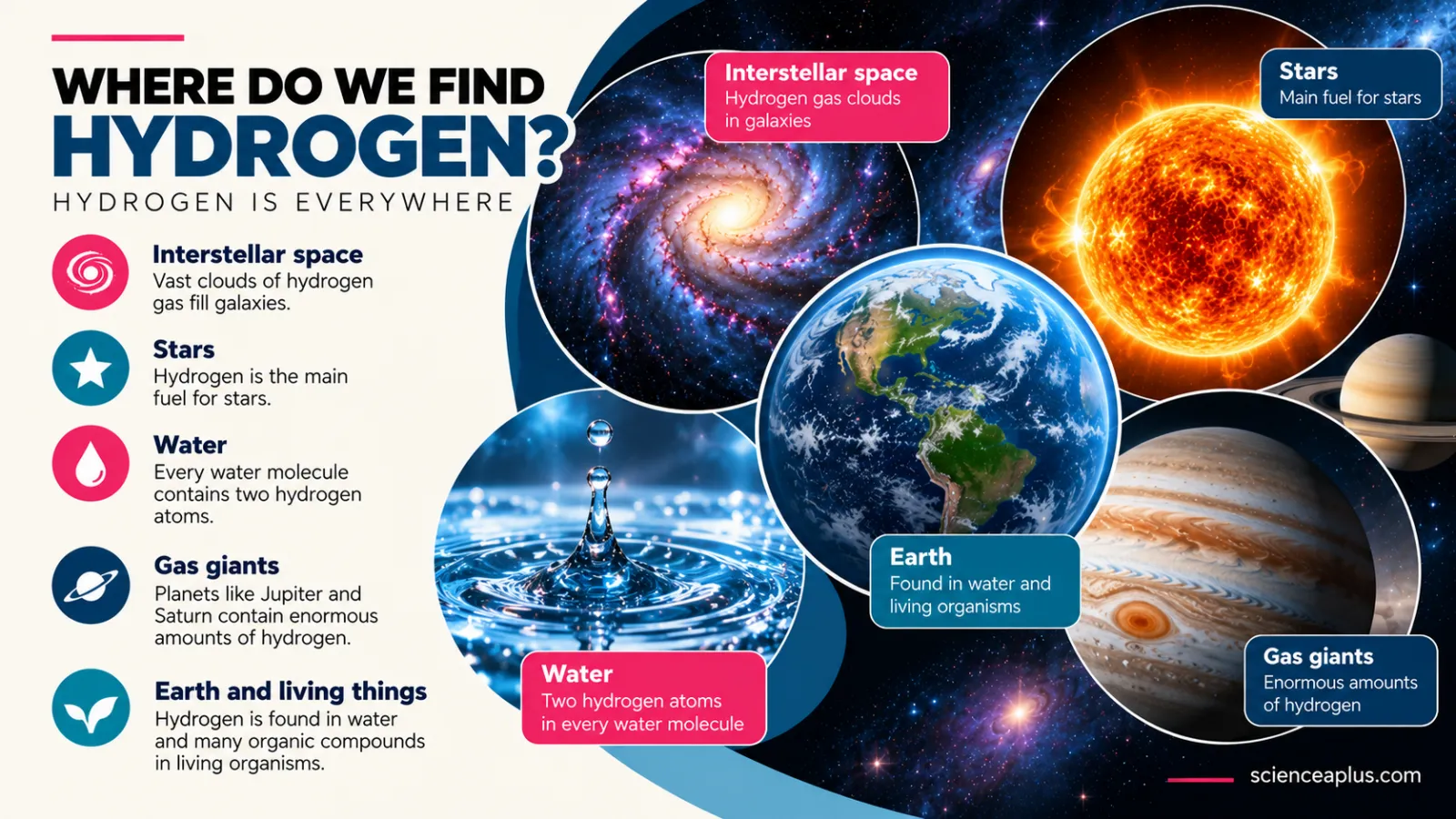
Because hydrogen is the most common element in the universe, it turns up almost everywhere you look – but in very different forms.
- Between the stars: huge clouds of hydrogen gas drift through every galaxy, waiting to form new stars.
- Inside stars: stars are mostly hydrogen and helium, and hydrogen is their main fuel.
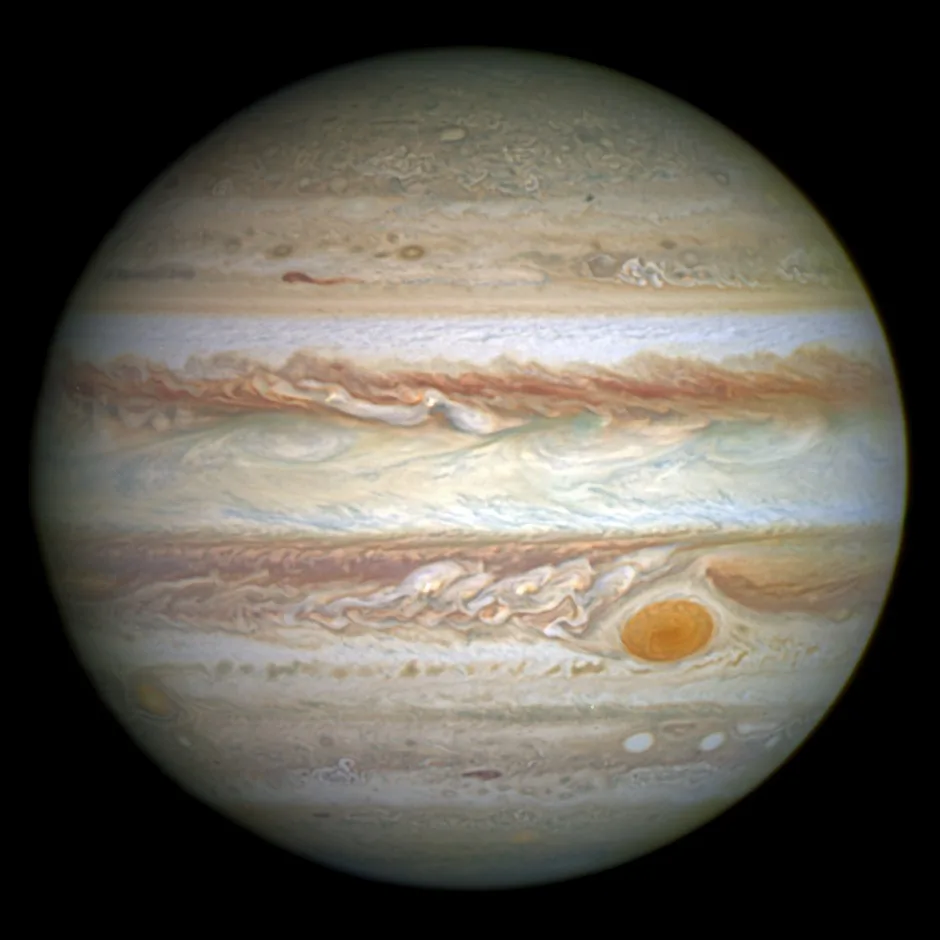
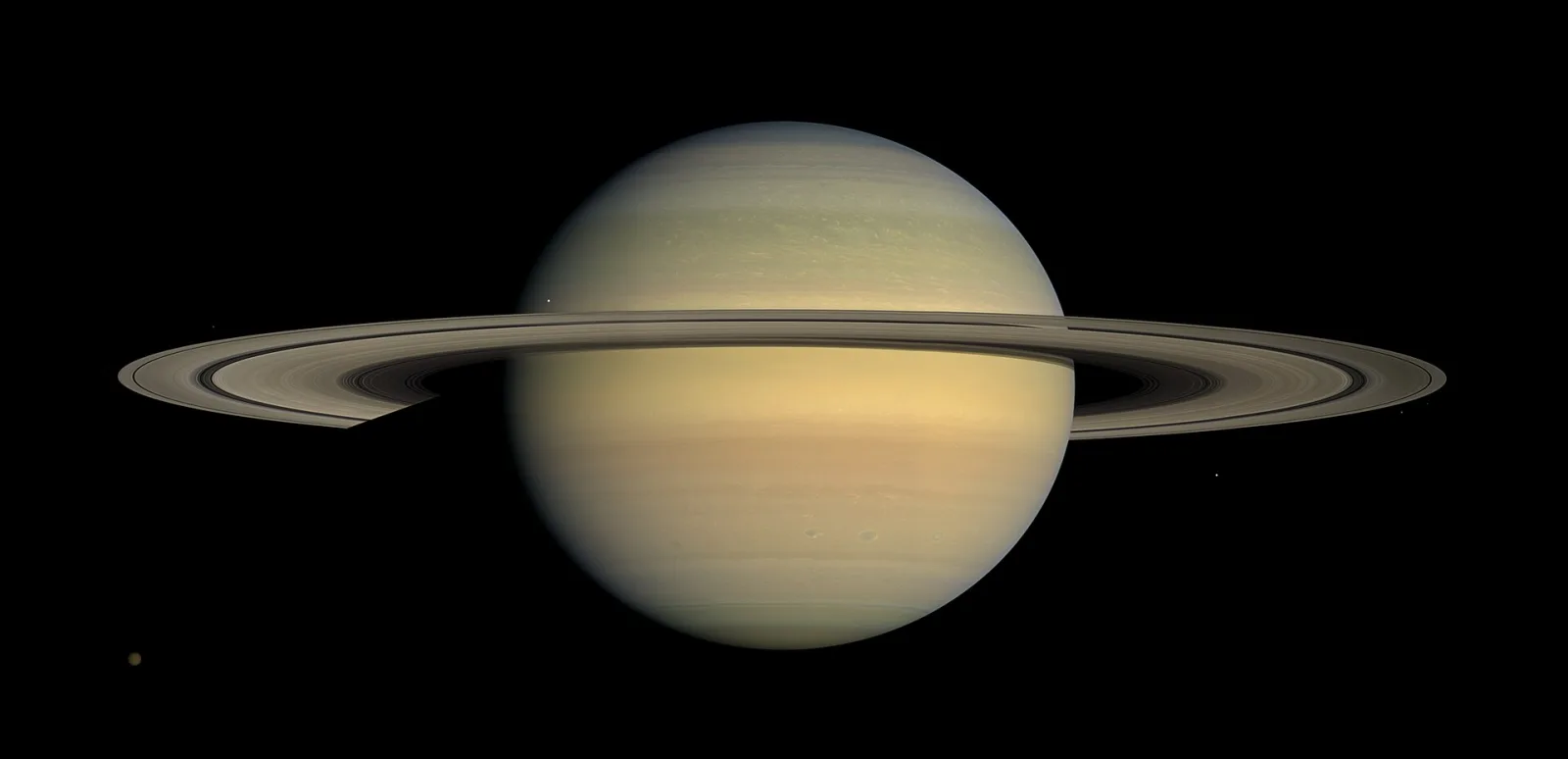
- Gas giants: Jupiter and Saturn are made mostly of hydrogen and helium, with a make-up similar to the Sun’s.
- Water: every water molecule, H₂O, contains two hydrogen atoms.
- Living things: hydrogen is in water and in almost every organic compound, from sugars to DNA.
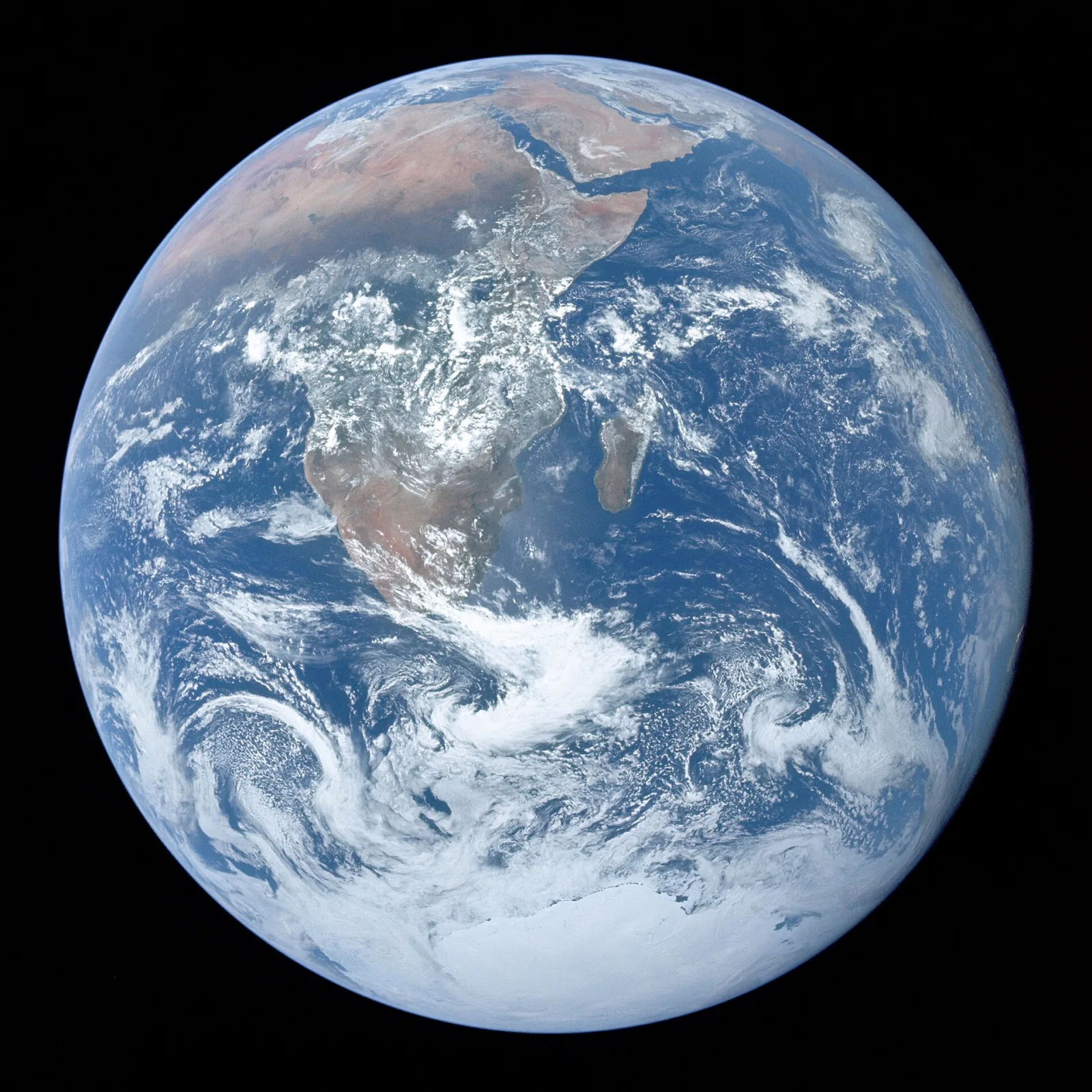
The most common elements on Earth, in the crust, air and your body
Ask “what is the most common element?” about Earth instead of the universe and you get a different answer every time you change the question. Here are the four answers you are most likely to need:
| Where? | Most common element | Next most common |
|---|---|---|
| The universe (ordinary matter, by mass) | Hydrogen ≈ 74% | Helium ≈ 24%, oxygen ≈ 1% |
| The whole Earth (by mass) | Iron ≈ 32% | Oxygen ≈ 30%, silicon ≈ 15%, magnesium ≈ 14% |
| Earth’s crust (by mass) | Oxygen ≈ 46% | Silicon ≈ 28%, aluminium ≈ 8%, iron ≈ 5% |
| The atmosphere (dry air, by volume) | Nitrogen ≈ 78% | Oxygen ≈ 21%, argon ≈ 0.9% |
| The human body (by mass) | Oxygen ≈ 65% | Carbon ≈ 18%, hydrogen ≈ 10%, nitrogen ≈ 3% |
For the whole Earth, iron comes first because our planet’s core is made mostly of iron. In the crust – the thin rocky skin we live on – oxygen is the most common element, bound up with silicon in the silicate minerals that make most rocks. Oxygen, silicon, aluminium and iron together make up about 88% of the crust. You can read more about how this vital element behaves in our guide to oxygen.
The air is mostly nitrogen, with oxygen second. Helium is only about 5 parts per million, and free hydrogen gas is even rarer, because these light gases can escape into space. Our page on the atmospheres of Earth, the Moon and Titan compares our air with other worlds.
So where is Earth’s hydrogen?
Almost all of it is locked up in compounds – above all in water. In every water molecule, two of the three atoms are hydrogen, although hydrogen is only about 11% of water’s mass because each hydrogen atom is so light (2 ÷ 18 ≈ 0.11).
The same trick of counting atoms rather than mass changes the answer for your body too. By mass, you are mostly oxygen, because you are mostly water and each oxygen atom is 16 times heavier than a hydrogen atom. But by number, about 62% of your atoms are hydrogen. So the most common atom in the universe is also the most common atom in you.


Ready to check what you have learned? The quiz below covers the whole article. If you want to see how hydrogen and helium fit into the bigger patterns of groups and periods, our guide to patterns in the periodic table is a good next step.
Frequently asked questions about the most common element in the universe
What is the most common element in the universe?
Hydrogen is the most common element in the universe. It makes up about 74% of all ordinary matter by mass and about 92% of all atoms. Most of it was made in the first few minutes after the Big Bang, and it is still the main fuel that keeps stars, including our Sun, shining today.
How much of the universe is hydrogen?
About 74% of the ordinary matter in the universe is hydrogen by mass, and about 92% of all atoms are hydrogen atoms. Ordinary matter itself is only about 5% of the universe’s total mass and energy, so hydrogen is the most common element rather than the main ingredient of everything that exists.
What is the second most common element in the universe?
Helium is the second most common element in the universe. It makes up about 24% of ordinary matter by mass and about 8% of atoms. Most of it was made during Big Bang nucleosynthesis, and stars add more by fusing hydrogen. Helium was first detected in the Sun’s light during an eclipse in 1868.
What is the third most common element in the universe?
Oxygen is the third most common element in the universe, at about 1% of ordinary matter by mass. Carbon is fourth, followed by neon, iron and nitrogen. Unlike hydrogen and helium, oxygen was not made in the Big Bang; it was produced by nuclear fusion inside stars and spread through space when they died.
Why is hydrogen the most common element?
Hydrogen is the simplest element – its nucleus is a single proton – so it existed almost as soon as the universe began. Fusion into heavier nuclei was only possible for about 20 minutes after the Big Bang, before the universe became too cool and thin. That left roughly three-quarters hydrogen and one-quarter helium by mass.
What is the most common element on Earth?
Counting the whole planet by mass, iron is the most common element on Earth, at about 32%, because Earth’s core is made mostly of iron. Oxygen is a close second at about 30%, followed by silicon and magnesium. If you only look at the rocky crust, oxygen comes first instead.
What is the most common element in the Earth’s crust?
Oxygen is the most common element in Earth’s crust, making up about 46% of it by mass. Silicon is second at about 28%, then aluminium at about 8% and iron at about 5%. Most of the oxygen is combined with silicon and metals in silicate minerals, the materials that make up most rocks.
What is the most common element in the human body?
By mass, oxygen is the most common element in the human body, at about 65%, mainly because the body is mostly water. Carbon, hydrogen and nitrogen come next. By number of atoms, however, hydrogen wins: about 62% of the atoms in your body are hydrogen atoms, most of them in water molecules.
What is the most common element in the air?
Nitrogen is the most common element in Earth’s atmosphere. Dry air is about 78% nitrogen gas by volume, about 21% oxygen and just under 1% argon. Hydrogen and helium, the most common elements in the universe, are very rare in our air because their light atoms and molecules can escape into space.