Pluto is no longer a planet because, on 24 August 2006, the International Astronomical Union (IAU) voted on the first official definition of a planet. A planet must orbit the Sun, be massive enough to pull itself into a nearly round shape, and have cleared the neighbourhood around its orbit. Pluto has not done that, so it became a dwarf planet.
The short answer
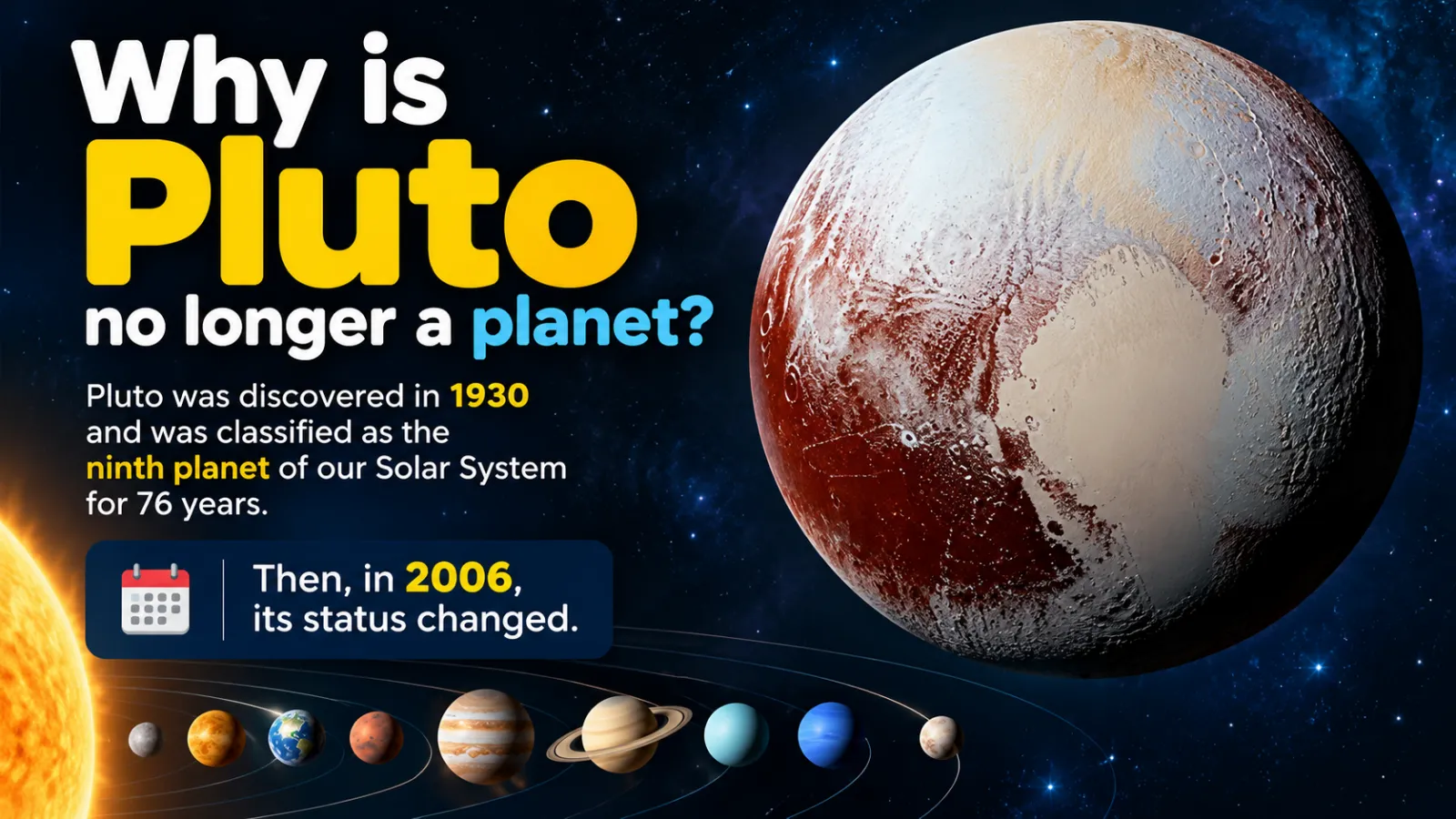
For 76 years, from 1930 to 2006, schoolchildren were taught that the Solar System had nine planets. Then astronomers found more objects like Pluto out beyond Neptune, and one of them, Eris, turned out to be almost exactly Pluto’s size. Suddenly scientists had to decide where to draw the line.
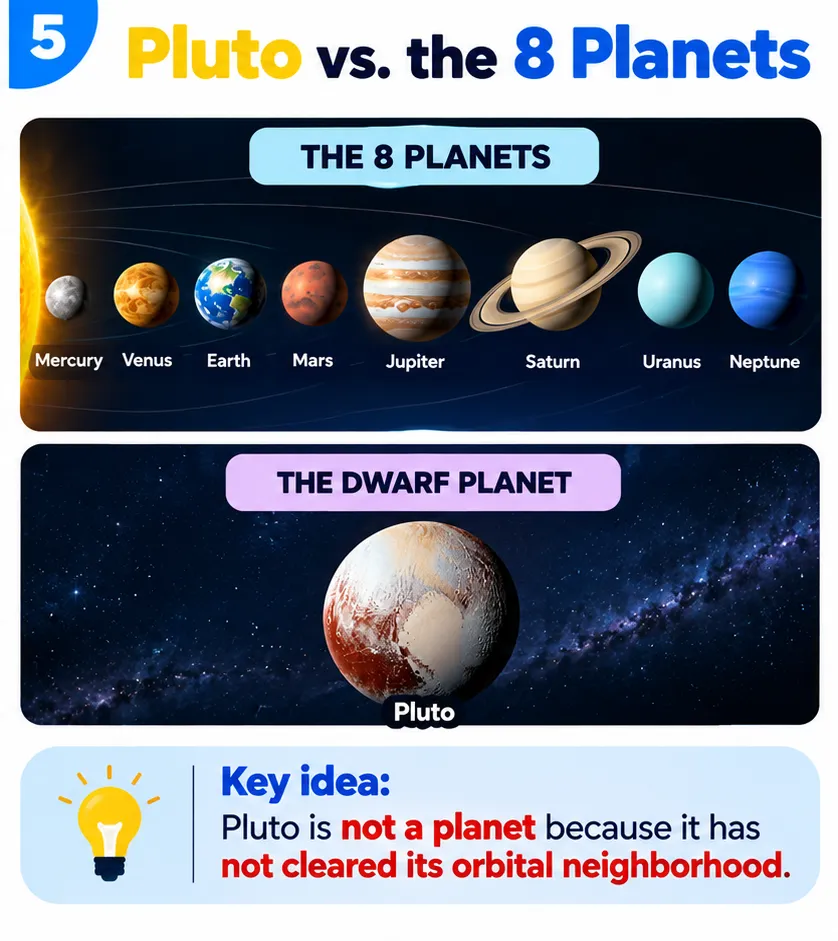
That line was drawn in Prague at the IAU General Assembly. The new definition kept the eight big worlds from Mercury to Neptune as planets. Pluto met two of the three rules, but failed the third, so it was reclassified as a dwarf planet.
So when people ask “is Pluto a planet?”, the official answer is no. Pluto did not shrink or change. What changed was our understanding of the Solar System, and the rules we use to sort its contents.
Pluto’s story: a timeline
Pluto’s path from “ninth planet” to “dwarf planet” took almost a century of discoveries. Here are the key moments.
- 1930: Clyde Tombaugh spots Pluto at Lowell Observatory in Flagstaff, Arizona, on 18 February. The discovery is announced on 13 March, and the world has a ninth planet.
- 1978: Pluto’s largest moon, Charon, is discovered.
- 1992: The first Kuiper Belt object after Pluto and Charon is found. It is called 1992 QB1 and is now named Albion. Pluto is no longer alone out there.
- 2005: Mike Brown’s team announces Eris, found in images taken in 2003. It is about 27% more massive than Pluto and almost the same size.
- 19 January 2006: NASA launches the New Horizons spacecraft towards Pluto, only months before the demotion.
- 24 August 2006: The IAU votes in Prague and Pluto becomes a dwarf planet.
- 14 July 2015: New Horizons flies past Pluto after about 9.5 years, coming within about 12,500 km.
- 1 January 2019: New Horizons flies past Arrokoth, another Kuiper Belt object.
Notice that New Horizons set off before Pluto was demoted, and arrived after. The spacecraft that gave us our first close-up look at Pluto was launched to visit a planet, and it arrived at a dwarf planet.
What makes a planet? The IAU’s three rules
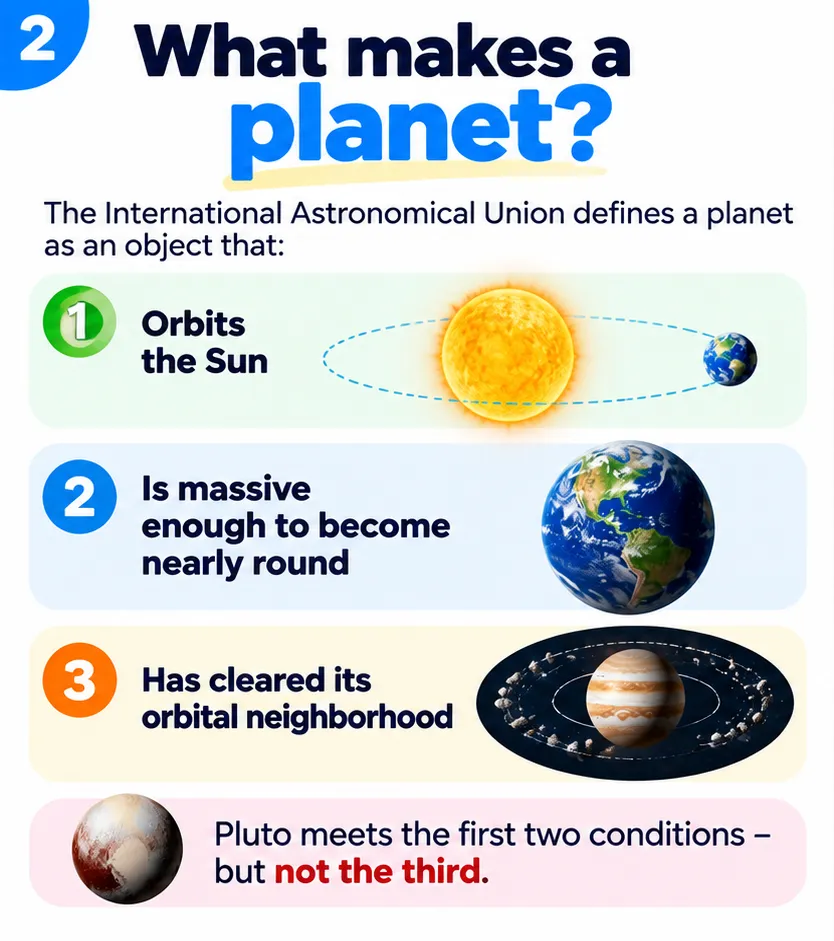
Before 2006, there was no formal answer to the question what makes a planet. Everyone simply knew the list. The IAU’s definition changed that, and it has three parts. An object must meet all three.
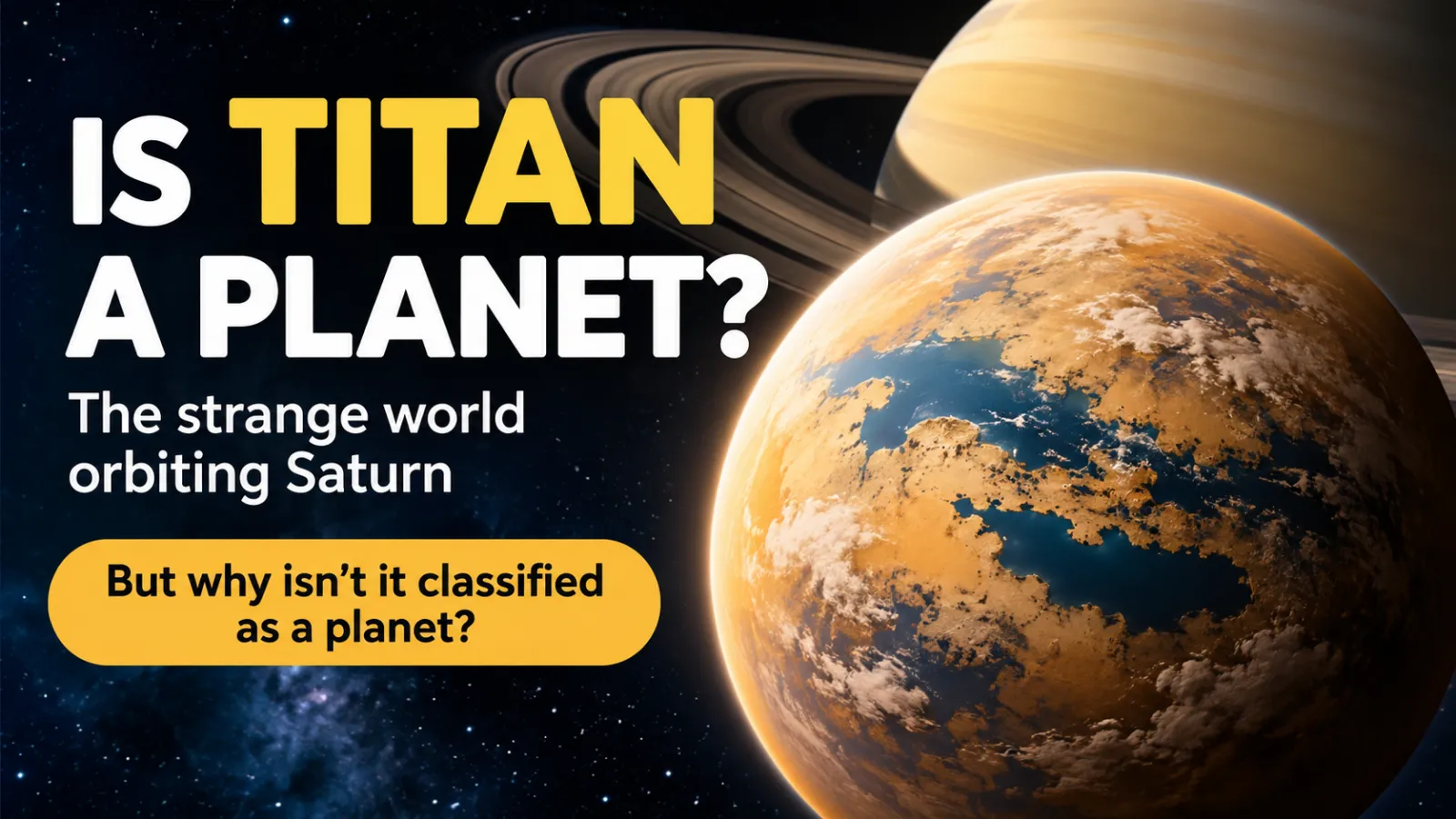
Rule 1: it orbits the Sun. A planet circles our star directly, not another planet. This is why a moon is not a planet, however large it is. Saturn’s moon Titan is wider than the planet Mercury, yet it orbits Saturn, so it fails this rule. If you want to see how that argument works, read our guide on whether Titan is a planet.
Rule 2: it is nearly round. The object needs enough mass for its own gravity to pull it into a nearly round shape. Scientists call this hydrostatic equilibrium. In simple words, gravity pulls everything towards the centre, and a big enough object squashes itself into a ball. Small asteroids and comets lack the gravity to do this, which is why many are lumpy, like potatoes.
Rule 3: it has cleared the neighbourhood around its orbit. This is the one that matters most for Pluto. A planet must be the dominant object in its orbital path, having gathered up or flung away most other material nearby. The eight planets did this long ago, during the early history of the Solar System. You can read more about that in our article on the origin of our Solar System.
Pluto orbits the Sun and is round, so it passes rules 1 and 2. It fails rule 3, because it shares its region with many other icy bodies in the Kuiper Belt, a region of icy objects beyond Neptune.
State the three conditions an object must meet to be a planet. (3 marks)
It must orbit the Sun (1). It must have enough mass for its own gravity to pull it into a nearly round shape, known as hydrostatic equilibrium (1). It must have cleared the neighbourhood around its orbit (1).
Why Pluto fails the third test
Pluto passes the first two tests easily. It orbits the Sun, and it is massive enough for its own gravity to pull it into a nearly round shape. The problem is the third rule: a planet must have cleared its neighbourhood. This is the single reason that people ask why Pluto is no longer a planet.
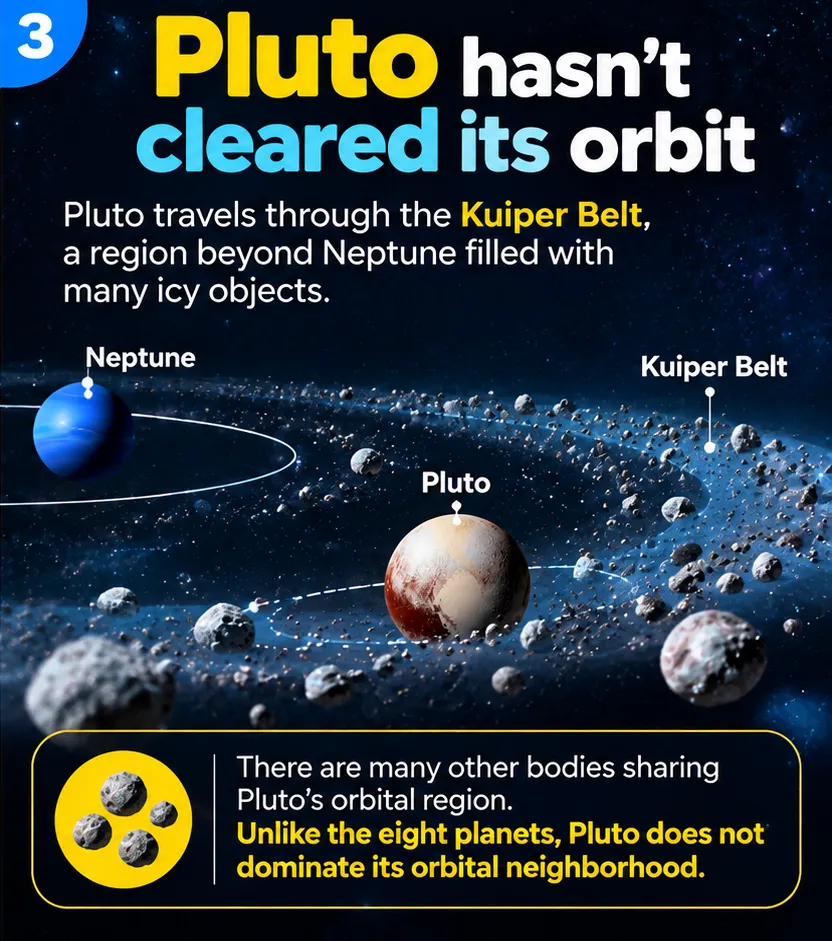
Start with where Pluto lives. It orbits about 5.9 billion km from the Sun (roughly 39.5 AU), out in the Kuiper Belt, a region of icy bodies beyond Neptune. Astronomers did not know the belt existed when Pluto was found in 1930. It took until 1992 for the first Kuiper Belt object after Pluto and Charon to turn up, a small icy world catalogued as 1992 QB1 and now named Albion.
Since then, many more icy bodies have been found in the same region. Pluto is not a lonely traveller in empty space. It is one of the larger members of a crowded belt of icy debris left over from the early Solar System.
What “clearing the neighbourhood” means
Over billions of years, a planet’s gravity acts like a cosmic vacuum cleaner. Smaller objects that share its orbital zone either crash into it, get flung away, or get captured as moons. After enough time, the planet is left as the dominant body in its path.
The eight planets all do this. Mercury, Venus, Earth, Mars, Jupiter, Saturn, Uranus and Neptune each dominate their own orbital zone: almost everything else sharing their path is far smaller, or is controlled by their gravity. Pluto does not. It shares its zone with many other Kuiper Belt objects, and it does not dominate them.
Pluto’s mass makes the point. It has only about 0.2% of the mass of Earth, and Earth is just a medium-sized planet. Compared with the giants, Pluto is tiny. It simply does not have the gravitational muscle to sweep up or scatter its neighbours.
A strange orbit, but not the reason
Pluto’s orbit is also unusual. It is elliptical and tilted about 17° compared with the planets. Between 1979 and 1999, Pluto was actually closer to the Sun than Neptune. Yet the two never collide, because they are locked in a 3:2 resonance: Neptune completes three orbits in the time Pluto completes two, and the timing keeps them apart.
This quirky orbit makes Pluto look different from the planets. But the IAU rule is about dominance, not about tilt or shape of orbit. Pluto fails because it shares its zone with a swarm of similar icy bodies, not because its path is odd.
The same idea helps explain why astronomers separate planets from the rocky debris you might read about in our guide to meteorites and the universe. Objects can be spherical or irregular, large or small, but a planet is the one that rules its patch of space.
The Eris problem
For 76 years, Pluto was the ninth planet. The cracks started to show in the early 2000s, once telescopes got good enough to spot more large objects in the Kuiper Belt. Astronomers began to ask: if Pluto is a planet, what about all the others?
The question became urgent in 2005. A team led by astronomer Mike Brown announced the discovery of a distant object, later named Eris. They found it in images that had actually been taken in 2003. Eris is almost exactly the same size as Pluto, and, crucially, it is about 27% more massive than Pluto.
That left astronomers with an uncomfortable choice. If Pluto counted as a planet, then Eris, which was heavier, had to count too. It was being called the “tenth planet” in some news stories. And if Eris counted, then other large Kuiper Belt bodies would soon follow. The textbooks might need dozens of planets, with more being added every few years.
The other option was to define the word “planet” properly for the first time. Until then, no official definition had existed. The word had been used loosely for centuries, and Pluto had been included mostly out of habit.
The International Astronomical Union (IAU) took up the challenge. On 24 August 2006, at its General Assembly in Prague, members voted on the three-part definition of a planet. Pluto met the first two criteria but not the third. The result was a new category: the dwarf planet.
Pluto becomes a dwarf planet
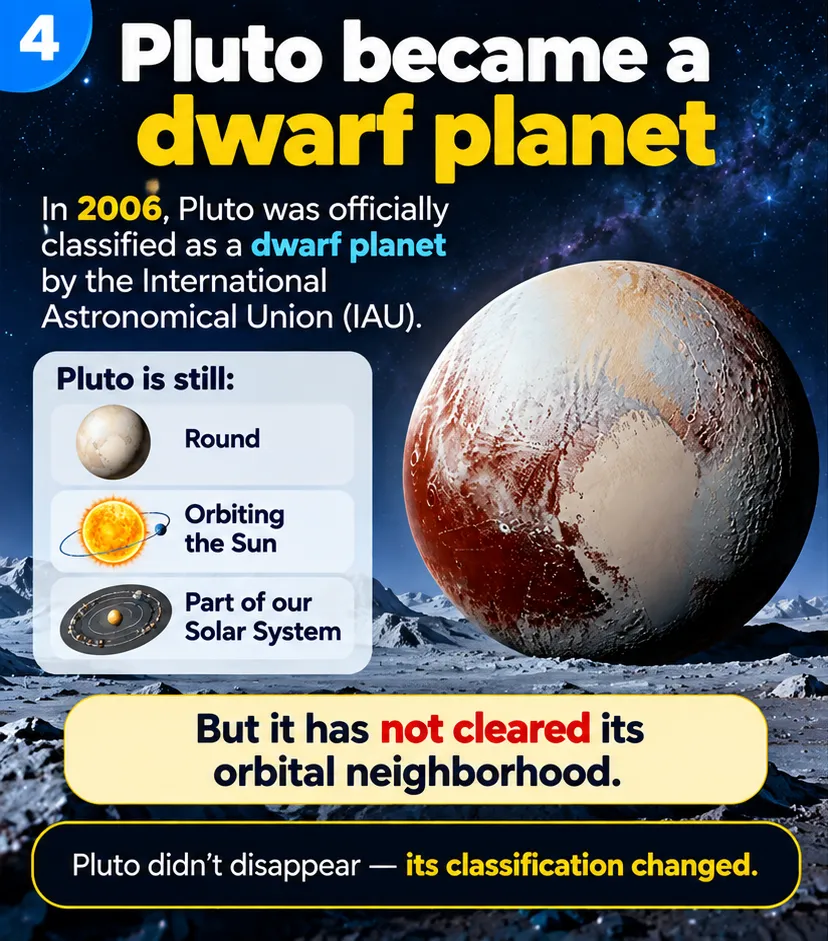
A Pluto dwarf planet label is not an insult or a demotion in importance. A dwarf planet is an object that orbits the Sun and is massive enough to be nearly round, but has not cleared the neighbourhood around its orbit. It is a different class of world, not a failed planet.
Five objects are officially recognised as dwarf planets by the IAU: Ceres, Pluto, Haumea, Makemake and Eris. Many more candidates are waiting to be confirmed. The comparison below shows the key differences.
| Feature | Planet | Dwarf planet |
|---|---|---|
| Orbits the Sun | Yes | Yes |
| Nearly round (own gravity) | Yes | Yes |
| Has cleared its orbit | Yes | No |
| Examples | Earth, Jupiter, Neptune | Pluto, Eris, Ceres |
| Number recognised | 8 (9 before 2006) | 5 (so far) |
Notice the number in the last row. Before 2006, school textbooks listed nine planets. After the IAU vote, that dropped to eight, and the dwarf planet list started with five names. Whatever else changed, Pluto itself did not: it is the same icy world it always was.
The picture above shows how these worlds compare. Eris and Pluto are close in size, while Ceres, which lives in the asteroid belt, is much smaller. What links all three is that none of them dominates its own orbital zone.
The same logic helps you tell planets from stars in the night sky. If you have ever wondered why planets shine steadily while stars flicker, our article on why stars twinkle and planets do not explains how light from each travels to your eye.
Meet Pluto: facts and figures
Before the arguments about its label, it helps to know what kind of world Pluto actually is. It is small, cold, distant and surprisingly active. Even though the answer to “is Pluto a planet?” is officially no, the Pluto dwarf planet is one of the most interesting places in the Solar System.
Pluto has a diameter of about 2,377 km. That is smaller than Earth’s Moon, which is about 3,474 km across, so Pluto is roughly two-thirds of the Moon’s width. Its mass is only about 0.2% of Earth’s, or about a sixth of the Moon’s mass.
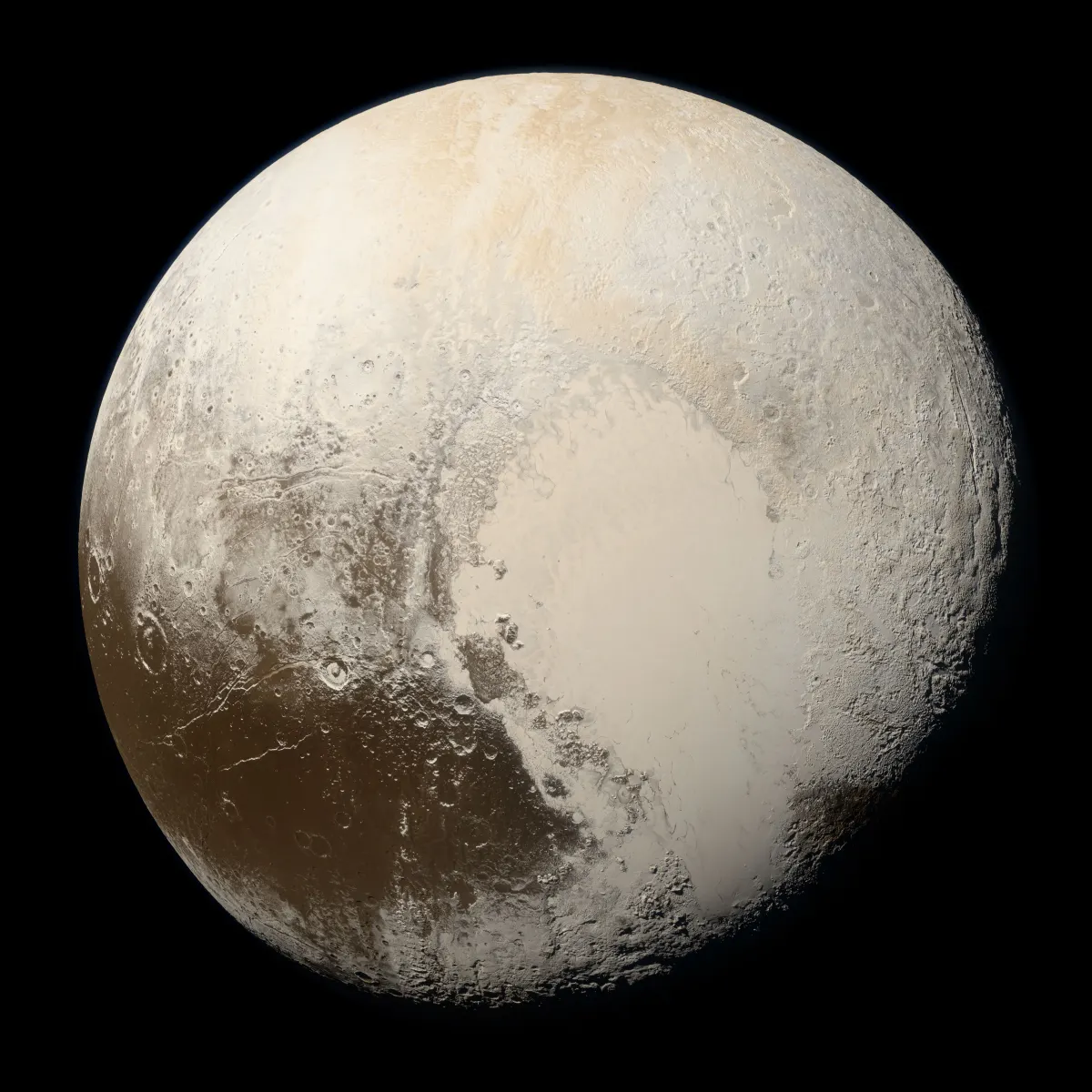
The table below puts the key numbers side by side with familiar objects.
| Property | Pluto | For comparison |
|---|---|---|
| Diameter | ≈ 2,377 km | Earth’s Moon: ≈ 3,474 km |
| Mass | ≈ 0.2% of Earth’s | About a sixth of the Moon’s mass |
| Surface gravity | ≈ 0.62 m/s² | ≈ 6% of Earth’s |
| Average distance from the Sun | ≈ 5.9 billion km (≈ 39.5 AU) | Earth: 1 AU |
| Length of one day | ≈ 6.4 Earth days | Earth: 1 day |
| Length of one year | ≈ 248 Earth years | Earth: 1 year |
| Moons | 5 | Earth: 1 |
| Surface temperature | ≈ −230 °C | – |
Two numbers deserve a closer look. A year on Pluto lasts about 248 Earth years, so Pluto has not yet completed a single orbit since its discovery in 1930. Its orbit is also elliptical and tilted by about 17°, which is why, between 1979 and 1999, Pluto was actually closer to the Sun than Neptune. A 3:2 resonance with Neptune means the two never collide.
A day on Pluto lasts about 6.4 Earth days, and it spins “backwards” (retrograde) with a large axial tilt, so the Sun would appear to rise in the west.
Low gravity changes how heavy you feel. Weight is the force of gravity on your mass, so the same person weighs far less on Pluto than on Earth. Try the calculator below to see your weight on Pluto and on other worlds.
The calculation behind it is the one you meet at GCSE.
W = m × g
Here W is weight in newtons, m is mass in kilograms and g is the gravitational field strength in N/kg (the same value as m/s²). Your mass stays the same everywhere; only your weight changes, because g changes.
What colour is Pluto?
Pluto is mostly shades of reddish-brown, cream and pale tan. The colour comes from tholins, organic compounds that form when ultraviolet light hits methane and nitrogen. Think of them as a dark, sooty stain painted across the icy surface.
The 2015 images from NASA’s New Horizons spacecraft revealed a landscape far more varied than anyone expected. The most famous feature is a huge, heart-shaped region called Tombaugh Regio, named after Pluto’s discoverer. Its left lobe, Sputnik Planitia, is a vast plain of nitrogen ice that looks smooth and bright compared with the darker land around it.
New Horizons also found water-ice mountains up to about 3.4 km high. Water ice behaves like solid rock at Pluto’s temperature of around −230 °C, so these mountains are real, towering landforms.
Pluto even has an atmosphere. It is very thin and made mostly of nitrogen, and it forms layers of blue haze high above the surface. If you want to compare it with other atmospheres, read our guide to the atmospheres of Earth, the Moon and Titan.
Pluto’s five moons
Pluto has 5 known moons: Charon, Nix, Hydra, Kerberos and Styx. Charon is by far the biggest. It was discovered in 1978 and is about 1,212 km across, roughly half of Pluto’s diameter. That is such a large ratio that many astronomers describe Pluto and Charon as a double system.
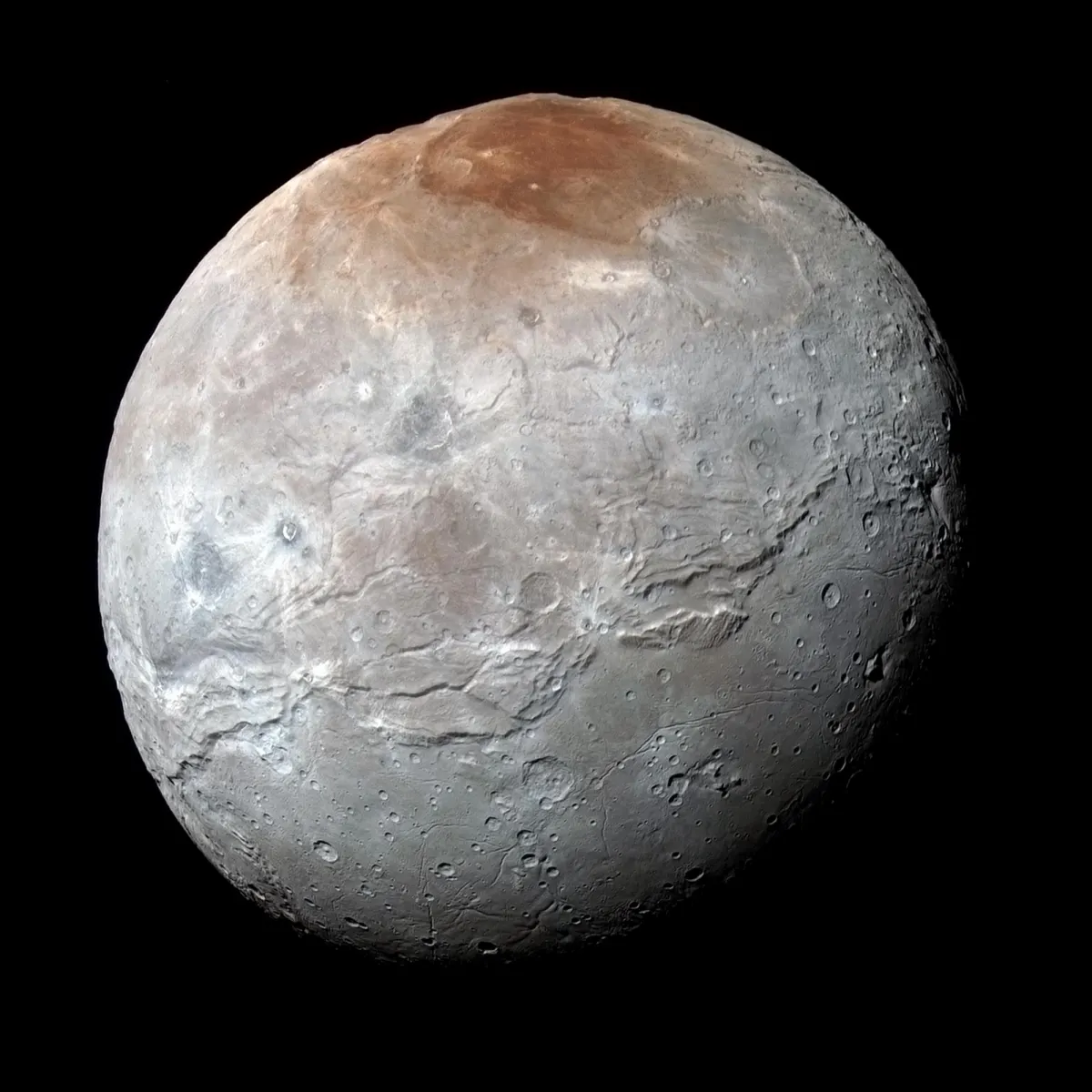
The reason is the barycentre, the point around which two bodies orbit. For the Earth and Moon it lies inside Earth. For Pluto and Charon it lies in space between them, outside Pluto. They also keep the same faces towards each other, which is called being tidally locked. A person standing on the side of Pluto facing Charon would always see it in the same spot in the sky.
The other four moons are much smaller. Nix and Hydra were found in 2005, Kerberos in 2011 and Styx in 2012. Because they are tiny and faint, they were only spotted once telescopes became sensitive enough to see them next to Pluto’s glare.
How long does it take to get to Pluto?
NASA’s New Horizons launched on 19 January 2006, only months before the demotion. It flew past Pluto on 14 July 2015 after about 9.5 years of travel, passing about 12,500 km from the surface at closest approach.
Space missions do not always go to plan, and many have ended in disappointment, so it is worth reading about failures in space travel to appreciate how hard such a journey is. New Horizons worked, and it did not stop at Pluto. On 1 January 2019 it flew past Arrokoth, another Kuiper Belt object, giving us a close look at a small icy body from the outer Solar System.
Distance is easier to grasp as light-travel time. Use the calculator below to see how long light takes to reach Pluto compared with other worlds.
At an average distance of about 5,906 million km, light from the Sun takes roughly 5.5 hours to reach Pluto. Sunlight reaches Earth in about eight minutes, which shows how far out the dwarf planet really is.
Other dwarf planets
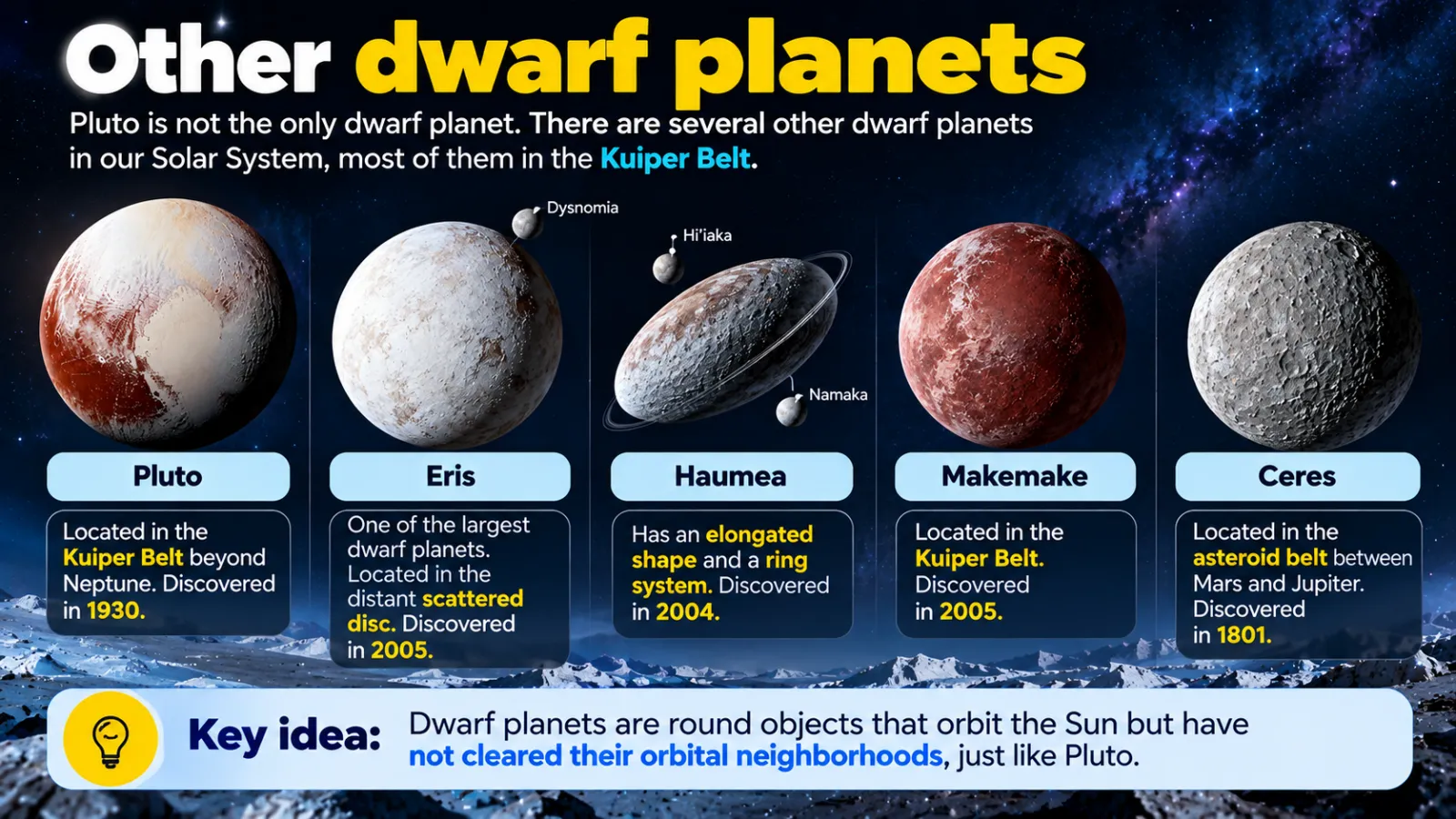
Pluto is not alone. The IAU recognises five dwarf planets in total: Ceres, Pluto, Haumea, Makemake and Eris. Each one orbits the Sun, is massive enough to be nearly round, and has not cleared its orbit. Many more candidates are waiting for astronomers to measure them properly, so the official list of five is probably not the final one.
Ceres is the odd one out, because it lives in the asteroid belt rather than out beyond Neptune. It was discovered in 1801, which means it was found well over a century before Pluto. For a while it was counted as a planet itself, and today it is the only dwarf planet in the inner part of the Solar System.
Eris is the one that started the trouble. Mike Brown’s team announced it in 2005 from images taken in 2003. It sits in the scattered disc, is almost exactly the same size as Pluto, and is about 27% more massive. If Pluto deserved to be a planet, Eris surely did too, and that raised the awkward prospect of a tenth planet, then an eleventh, and so on. That is why the IAU had to write a definition.
Haumea was found in 2004/2005 and is the strangest-looking of the five. It is elongated, more like a stretched egg than a sphere, and it has a ring. Its shape tells us it must spin quickly, which is a good reminder that “nearly round” still leaves room for some surprises.
Makemake was also found in 2005. It is a distant icy world, and like Pluto it belongs to the wider family of icy bodies that make up the Kuiper Belt region beyond Neptune.
Could Pluto become a planet again?
It could in principle, but it is unlikely any time soon. The IAU definition agreed in Prague on 24 August 2006 remains the official one, and Pluto fails the third rule: it has not cleared the neighbourhood around its orbit. Unless the IAU votes to change the definition, Pluto stays a dwarf planet.
That said, not everyone agrees with the decision. Alan Stern, who leads the New Horizons mission, is one of several astronomers who prefer a geophysical definition. In that approach, what matters is what a world is like, not where it sits. If an object is large enough to be round under its own gravity, it counts as a planet, even if it shares its orbit with other bodies.
The geophysical view has real appeal after 2015. New Horizons showed that Pluto has water-ice mountains up to about 3.4 km high, a thin nitrogen atmosphere with blue haze layers and a vast plain of nitrogen ice called Sputnik Planitia. That is a lot of geology for a “minor” object.
The IAU view has its own logic, though. A definition that includes anything round would add many more worlds to the planet list, including Eris, Ceres and the other dwarf planets. Supporters of the 2006 decision argue that the eight planets really do dominate their orbits in a way Pluto does not, and that this difference is worth a separate name.
So the honest answer to “is Pluto a planet?” depends on which definition you use. Under the official one, it is not. Under a geophysical one, it might be. Both camps are looking at the same data, and both agree that Pluto is a fascinating world.
Why the Pluto debate matters
It is easy to dismiss the argument as a squabble over a word. In fact, it shows how science works. Pluto was classed as a planet in 1930 because it was the best description anyone had at the time. When the Kuiper Belt was found in 1992 and Eris followed in 2005, the evidence changed, so the classification changed too.
Notice the timing as well. New Horizons launched on 19 January 2006, months before the demotion, and flew past Pluto on 14 July 2015. The spacecraft was sent to a “planet” and arrived at a dwarf planet, and it taught us more than decades of telescope work had. Reclassifying Pluto did not make it any less worth exploring.
Good classifications help scientists compare like with like. Putting Pluto with Eris, Makemake and the other icy bodies beyond Neptune tells us something real about how the outer Solar System formed. To see how astronomers go about that kind of exploration, read about rockets, telescopes and satellites. For the newest views of the distant Universe, see what NASA’s James Webb Space Telescope is finding.
The lesson for students is a useful one. A definition is a tool, and scientists are allowed to improve their tools when better evidence arrives. That is a strength of science, not a weakness.
Frequently asked questions about Pluto
Why is Pluto not a planet anymore?
Pluto is not a planet because it fails one of the three rules the IAU set in 2006. It orbits the Sun and is nearly round, but it has not cleared the neighbourhood around its orbit. That makes it a dwarf planet, not one of the eight planets.
When was Pluto declared a dwarf planet?
Pluto was reclassified on 24 August 2006, when members of the International Astronomical Union voted at their General Assembly in Prague. Before that, it had been called the ninth planet for 76 years, from its discovery in 1930 by Clyde Tombaugh.
What are the 3 rules to be a planet?
According to the IAU, a planet must orbit the Sun, have enough mass for its own gravity to pull it into a nearly round shape, and have cleared the neighbourhood around its orbit. Pluto meets the first two but not the third.
How many moons does Pluto have?
Pluto has five known moons: Charon, Nix, Hydra, Kerberos and Styx. Charon is by far the largest, at about 1,212 km across, roughly half the diameter of Pluto. Charon was found in 1978, and the four small moons were discovered between 2005 and 2012.
How long is a year on Pluto?
One orbit of the Sun takes Pluto about 248 Earth years, so a year there is very long. A day is much shorter by comparison, at about 6.4 Earth days. Pluto also rotates backwards compared with most planets, which is called retrograde rotation.
How far is Pluto from the Sun?
Pluto’s average distance from the Sun is about 5.9 billion km, or roughly 39.5 AU. Sunlight takes about 5.5 hours to reach it. Its orbit is elliptical, and between 1979 and 1999 Pluto was actually closer to the Sun than Neptune.
What colour is Pluto?
Pluto is mostly reddish-brown, with paler areas such as the heart-shaped Tombaugh Regio. The colour comes from tholins, which are organic compounds formed when ultraviolet light hits methane and nitrogen. Its thin atmosphere also shows blue haze layers.
Could Pluto become a planet again?
It could only happen if the IAU changed its official definition, and there are no signs of that. Some astronomers, including New Horizons lead Alan Stern, prefer a geophysical definition that would include Pluto. For now, the IAU decision from 2006 still stands.
How many dwarf planets are there?
The IAU currently recognises five dwarf planets: Ceres, Pluto, Haumea, Makemake and Eris. Ceres is in the asteroid belt, while the others are in the outer Solar System. Many more objects are candidates, so the number could grow as they are studied.