The education system in Sri Lanka runs for 13 school years, from Grade 1 to Grade 13, and is built around two national exams: the G.C.E. Ordinary Level (O/L) at the end of Grade 11 and the G.C.E. Advanced Level (A/L) at the end of Grade 13. Government schools and state universities are free to attend, and the A/L result decides who gets a university place through a statistical score called the Z-score. This guide explains the structure, then looks closely at how science and maths are taught and marked, with the latest figures for 2025 and 2026.
How the education system in Sri Lanka is organised
School life in Sri Lanka is divided into four stages. Children usually start Grade 1 at around age 5, and each stage ends with a clear milestone. The pathway card below shows the four stages in one picture.
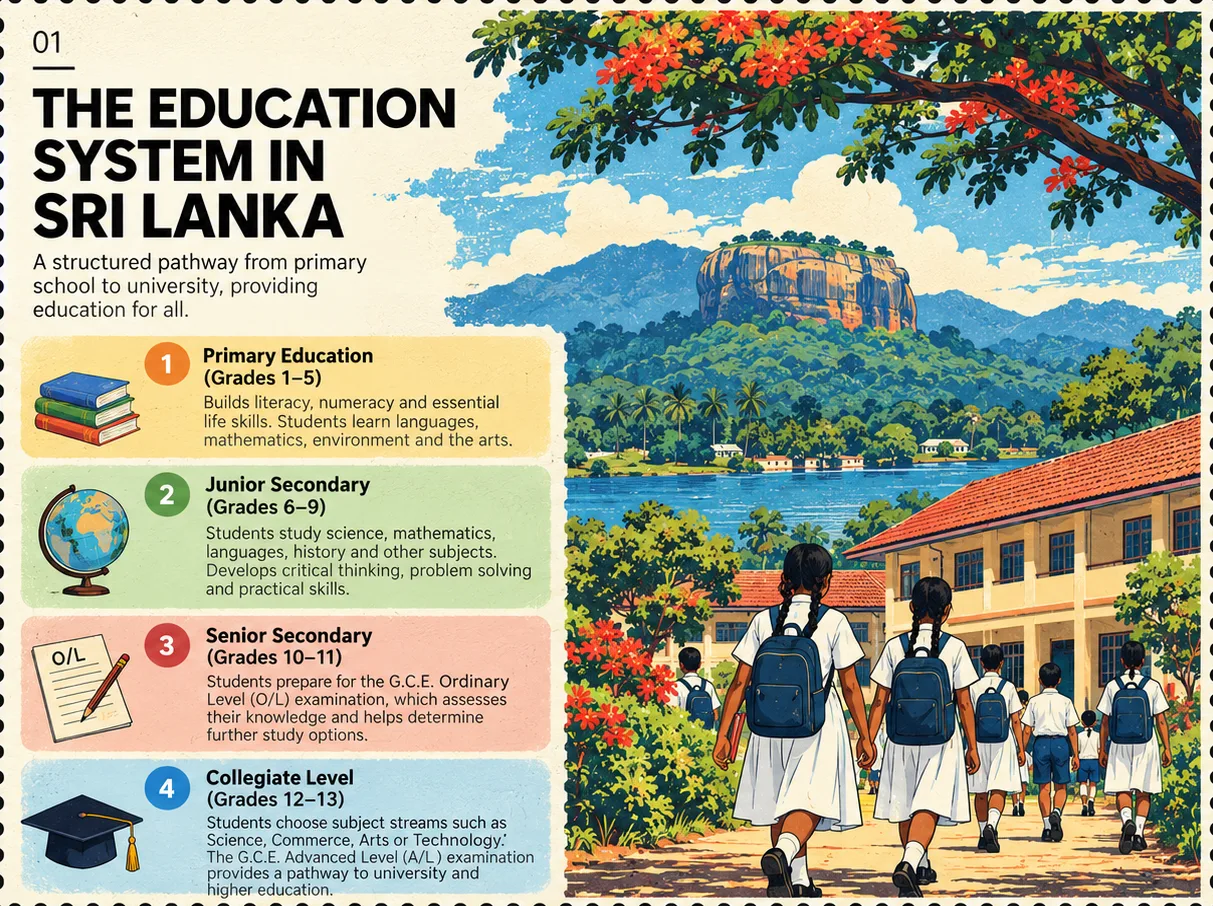
| Stage | Grades | Typical ages | What happens |
|---|---|---|---|
| Primary | 1–5 | 5–10 | Literacy, numeracy, environment studies and the arts. A Scholarship examination is available at the end of Grade 5. |
| Junior secondary | 6–9 | 10–14 | Science, mathematics, languages, history, ICT and practical subjects. |
| Senior secondary | 10–11 | 14–16 | Preparation for the G.C.E. O/L examination. |
| Collegiate | 12–13 | 16–18 | Students pick a stream and sit the G.C.E. A/L examination. |
School attendance is compulsory from age 5 to 16 (the range was extended from 5–14 in 2016), which covers the O/L years. After Grade 13 comes tertiary education: state universities, technical and vocational institutes, and private colleges.
Exam names can confuse newcomers. “G.C.E.” stands for General Certificate of Education, a name Sri Lanka kept from the British-era system. The O/L and A/L are set and marked in Sri Lanka by the Department of Examinations, not by a British board. Compared with the UK, the O/L is roughly parallel to GCSEs and the A/L to A levels, although the systems differ in many details. For another country’s system, see our guide to the American education system.
Free education: where it came from and what it looks like now
Sri Lanka made education free in the 1940s. Most sources date the start of free education to 1 October 1945, under the Minister of Education C. W. W. Kannangara, who is remembered as the “father of free education”. The idea was simple: a child’s school place should not depend on family income.
Today, free education means government schools charge no tuition fees, and state universities charge none either. The Ministry of Education also supplies textbooks to pupils in government schools, and university students can receive Mahapola scholarships and bursaries. Some costs remain, such as private tuition, transport and school supplies, so “free” is not the same as “costless”.
Literacy, enrolment and spending: what the numbers say
Numbers help to separate reputation from reality. The table gathers the most recent World Bank figures for Sri Lanka, each with its year.
| Indicator | Value | Year |
|---|---|---|
| Adult literacy rate (age 15+) | 92.7% | 2024 |
| Youth literacy rate (age 15–24) | 98.9% | 2024 |
| Primary school gross enrolment ratio | 91.5% | 2023 |
| Secondary school gross enrolment ratio | 88.0% | 2023 |
| Government spending on education | 1.8% of GDP | 2023 |
Youth literacy is higher than adult literacy, a pattern seen in many countries. A gross enrolment ratio counts all pupils at a level, including those older or younger than the official age, divided by the number of children of the official age. Spending of 1.8% of GDP is low by international standards, which links to the resource gaps discussed later.
Government schools carry most of the load. The Ministry of Education’s 2025 school census (1 June 2025) counts 10,047 government schools teaching about 3.7 million pupils, alongside smaller numbers of private schools and Pirivena (temple schools). Teaching is available in Sinhala, Tamil and English.

The rest of this article follows the science route step by step, with practice questions, because the exam system is full of percentages, averages and standard deviations. Why does this matter beyond Sri Lanka? See why education is important for your career.
Science and maths in Sri Lankan schools
Science and mathematics are core subjects for every pupil from the first years of secondary school. The National Institute of Education (NIE), the government body that designs school curricula, has a Department of Science that develops the Grade 6–11 science syllabuses and the A/L Physics, Chemistry and Biology syllabuses. Teachers, textbooks and exams all follow these documents.

Grades 6–9: building the foundations
In junior secondary school, pupils study science and mathematics as separate subjects alongside languages, history, ICT and practical skills. The pathway card names critical thinking, problem solving and practical skills as the aims. In science, that means learning to observe, measure, record results and explain what happened, as in our guide to the scientific method.
Percentages and averages learned in these years are exactly the tools needed to read exam statistics and, later, the Z-score.
Grades 10–11: the O/L years
The O/L is taken in nine subjects: six compulsory ones plus three optional ones. The compulsory six are the first language (Sinhala or Tamil), religion, English, mathematics, science and history. Because both are compulsory, their pass rates are useful indicators of how the whole system is doing.
The science behind it: O/L pass rates and what they tell us
Pass rates are real data with real uncertainty. The latest O/L results at the time of writing are for the 2025 examination, held from 17 to 26 February 2026 and released on 19 June 2026.
| Measure (2025 O/L, released June 2026) | Result |
|---|---|
| Mathematics and science pass rates | 70.1% and 72.03% (reports differ on which subject each belongs to) |
| Change from 2024 | Both subjects reported as improved |
| Candidates who qualified to study A/L | 73.16% of school candidates (225,748 students) |
| Candidates with A passes in all subjects (9A) | 11,790 (3.57%) |
| Candidates who failed every subject | 2.36% |
For comparison, the 2024 O/L (released in July 2025) had 73.45% qualifying for A/L, 13,392 candidates with nine A passes (4.15%), and 2.34% failing all subjects. English was 73.82% in 2024.
About seven in ten pupils pass each subject, so roughly three in ten do not. A pass rate is not an average mark and says nothing about how close each pupil came to the boundary. To judge learning properly, researchers also look at the spread of marks, which is what standard deviation measures later in this article.
Maths practice: pass rates and percentages
1. In a school, 150 pupils sat O/L maths and 108 passed. What is the pass rate? (2 marks)
Pass rate = 108 ÷ 150 × 100 = 72%. This is close to the national subject pass rates of about 70–72%.
2. If a national subject pass rate is 72.03%, about how many of 1,000 candidates would you expect to pass, and how many to fail? (2 marks)
Pass: 1,000 × 0.7203 ≈ 720. Fail: 1,000 − 720 = about 280 (28%). These are expected values for a group of this size, not guaranteed counts.
3. 9A passes fell from 4.15% of candidates in the 2024 O/L to 3.57% in the 2025 O/L. Calculate the percentage change. (3 marks)
Change = (3.57 − 4.15) ÷ 4.15 × 100 = −0.58 ÷ 4.15 × 100 ≈ −14.0%. That is a fall of 0.58 percentage points, which is about 14% of the earlier share.
Use the calculator above to check any pair of values.

Quick revision: key terms as flip cards
A/L streams: where science splits into branches
After the O/L, pupils who qualify move into Grades 12–13 and choose an A/L stream. The UGC handbook for 2025/26 names the streams used for university selection as Commerce, Biological Science, Physical Science, Engineering Technology, Biosystems Technology and Arts. Within science, the usual pattern is:
- Physical Science: Combined Mathematics, Physics and Chemistry, leading towards engineering and the physical sciences.
- Biological Science: Biology and Chemistry, plus Physics or Agricultural Science, leading towards medicine, dentistry and the biological sciences.
- Technology streams: Engineering Technology or Biosystems Technology, together with Science for Technology.
Subject choices vary by school, and some schools offer only some streams, so a pupil in a smaller rural school may have fewer options than one in a city. That gap is one of the challenges discussed later. For wider thinking about why these fields matter, read our article on the importance of STEM education, and for study methods, tips to study science faster from textbooks.
University entry in Sri Lanka and the Z-score
Sri Lanka’s state universities are free, and entry is competitive. According to the University Grants Commission (UGC) handbook for 2025/26, the state system offers 255 courses of study, all free of tuition. For the 2024/25 intake, 90,674 students applied and only about 42,172 were selected under the normal intake, which is roughly 47% of applicants (42,172 ÷ 90,674 × 100 ≈ 46.5%).
To be considered, a candidate must be declared eligible by the Commissioner General of Examinations: at least an S grade in all three approved A/L subjects, within three attempts, and at least 30% in the Common General Paper. Selection then depends on the Z-score.
What is a Z-score? The statistics explained
A mark of 70 in one A/L subject may be common, while 70 in another may be rare, so adding raw marks would be unfair. The Department of Examinations converts each mark into a standardised score. According to the UGC, the calculation is based on three things: the student’s raw mark in the subject, the mean (average) mark of that subject for the year, and the standard deviation of that subject for the year.
The formula is:
z = (x − mean) ÷ standard deviation
Here x is the student’s mark. The mean is the average of all marks in that subject. The standard deviation (SD) measures how spread out the marks are: a small SD means most students scored close to the mean, and a large SD means marks were widely scattered. A z-score of +1 therefore means “one standard deviation above the average”, and −1 means “one standard deviation below”.
Try changing the SD in the calculator: the same raw mark gives a much larger z-score when marks are tightly bunched. A z-score says how unusual a result is, not just how big the number is.
Worked example 1: one subject
A student scores 72 in a subject where the mean is 55 and the SD is 12.
z = (72 − 55) ÷ 12 = 17 ÷ 12 ≈ 1.42
That is 1.42 standard deviations above the mean. If marks were roughly normal, that is about the 92nd percentile.
Worked example 2: which subject was better?
Imagine a student with 68 in Chemistry (mean 52, SD 16) and 61 in Physics (mean 40, SD 14). The raw marks suggest Chemistry is stronger. Standardising tells a different story.
Chemistry: z = (68 − 52) ÷ 16 = 1.00
Physics: z = (61 − 40) ÷ 14 = 1.50
Physics is the stronger result relative to other candidates, despite the lower number. These marks are invented for practice.
Worked example 3: combining three subjects
Take a third subject, Combined Mathematics: mark 58, mean 45, SD 13, so z = 13 ÷ 13 = 1.00. Explanations of the UGC method describe the final Z-score as the average of the three subject z-scores:
(1.00 + 1.50 + 1.00) ÷ 3 = 3.50 ÷ 3 ≈ 1.17
The cut-off for each course is set each year by the UGC and depends on how well candidates performed, demand for the course and the seats available.
Maths practice: Z-score questions
1. A student scores 30 in a subject with mean 42 and SD 8. Find the z-score and say what it means. (3 marks)
z = (30 − 42) ÷ 8 = −12 ÷ 8 = −1.5. The student is 1.5 standard deviations below the mean. A negative z-score is not an error; it simply means below average.
2. In a subject with mean 48 and SD 15, what raw mark gives z = 1.0? (2 marks)
Rearrange: x = mean + z × SD = 48 + 1.0 × 15 = 63. A mark of 63 is exactly one standard deviation above the mean.
3. Two students are 10 marks above the mean. In subject A the SD is 5; in subject B the SD is 20. Compare their z-scores. (3 marks)
Subject A: z = 10 ÷ 5 = 2.0. Subject B: z = 10 ÷ 20 = 0.5. The same raw gap is worth four times as much when marks are tightly bunched, because being 10 marks ahead is rare in subject A.
4. Why can the same raw mark give a different Z-score in a different year? (2 marks)
The mean and SD come from all students in that subject that year. If the group scores higher or the spread changes, the same raw mark gives a different z-score.
How the places are shared: merit, districts and quotas
A high Z-score is necessary, but places are not given purely in order of score. For Commerce, Biological Science, Physical Science, Engineering Technology and Biosystems Technology courses, the UGC handbook for 2025/26 describes this rule for each course:
- Up to 40% of places go to the highest Z-scores across the whole island (all-island merit).
- Up to 55% are shared among the 25 administrative districts in proportion to population (the district quota).
- The remaining 5% go to students from 16 districts classed as educationally disadvantaged, shared in proportion to their population.
Most Arts courses use all-island merit only, except Music, Dance, Drama and Visual Arts, which use the district quota system.
Maths practice: sharing the seats
A course has 200 places. How many are in each group under the 40 / 55 / 5 rule? (3 marks)
All-island merit: 200 × 0.40 = 80. District quota: 200 × 0.55 = 110. Disadvantaged districts: 200 × 0.05 = 10. Total: 80 + 110 + 10 = 200. The handbook says actual numbers can differ slightly from proposals.
The district system is meant to make access fairer, because a pupil in a district with fewer resources competes mainly with pupils from the same district for most seats. It is also debated, because students in well-resourced districts may need a higher Z-score for the same course.
When you revise any statistics topic, a comparison table such as the one above is a quick way to remember the rules. Our guide to revising with comparisons shows the technique.
On costs, the UGC handbook says 70% to 80% of university students receive financial assistance, and from 2026 the Mahapola scholarship instalment rose from Rs. 7,500 to Rs. 10,000.
University exam statistics for science learners
The A/L results show how selective the route is. In the 2025 A/L examination (results released on 31 March 2026), 281,810 candidates sat and 176,527 qualified for university admission, a rate of 62.64%. For the 2024 A/L, 274,361 sat and 177,588 qualified, or 64.73%. Qualifying is not the same as getting a place.
Calculate the change in the qualifying rate from 2024 (64.73%) to 2025 (62.64%) in percentage points and in percent. (3 marks)
Percentage points: 62.64 − 64.73 = −2.09 points. Percent change: −2.09 ÷ 64.73 × 100 ≈ −3.2%. So the rate fell by about 2.1 percentage points, or about 3.2% of the 2024 rate.
Education reforms in Sri Lanka, 2025–2026: where things stand
Sri Lanka is in the middle of a large reform of school education. Plans changed during 2026, so this section describes them by date, using news up to 28 October 2026. Details may change again.
- Grade 1: a new curriculum began in 2026 and the government confirmed that it would continue.
- Grade 6: on 12 January 2026 the Cabinet postponed the Grade 6 reforms to 2027, after a controversy over an inappropriate web link in a new English textbook.
- Curriculum framework: news reports from 29 September 2026 said the Cabinet had approved implementing the revised National Curriculum Framework, which allows Grade 1 reforms to continue and clears the way for Grades 2 and 6.
- Assessment: on 9 and 10 October 2026 the Prime Minister and the Cabinet were reported to have approved a Student Assessment Framework for Grades 1 to 11, a concept paper on education reforms and a plan for an Education Council. An assessment framework for the A/L was still being developed.
- Admissions: the UGC and others were asked to develop a unified admissions policy, with a pilot planned from 2028.
Earlier statements from 2025 said the O/L would be held under the new curriculum by 2029, and described a shift towards a module-based approach that depends less on a single final exam. Those timetables were set before the Grade 6 delay, so treat them as plans rather than fixed dates. Teacher unions have criticised parts of the reform, so the final form is not settled.
Pupils sitting the O/L and A/L in the next few years still face the current exams and the Z-score system.
Strengths and challenges of the Sri Lankan system
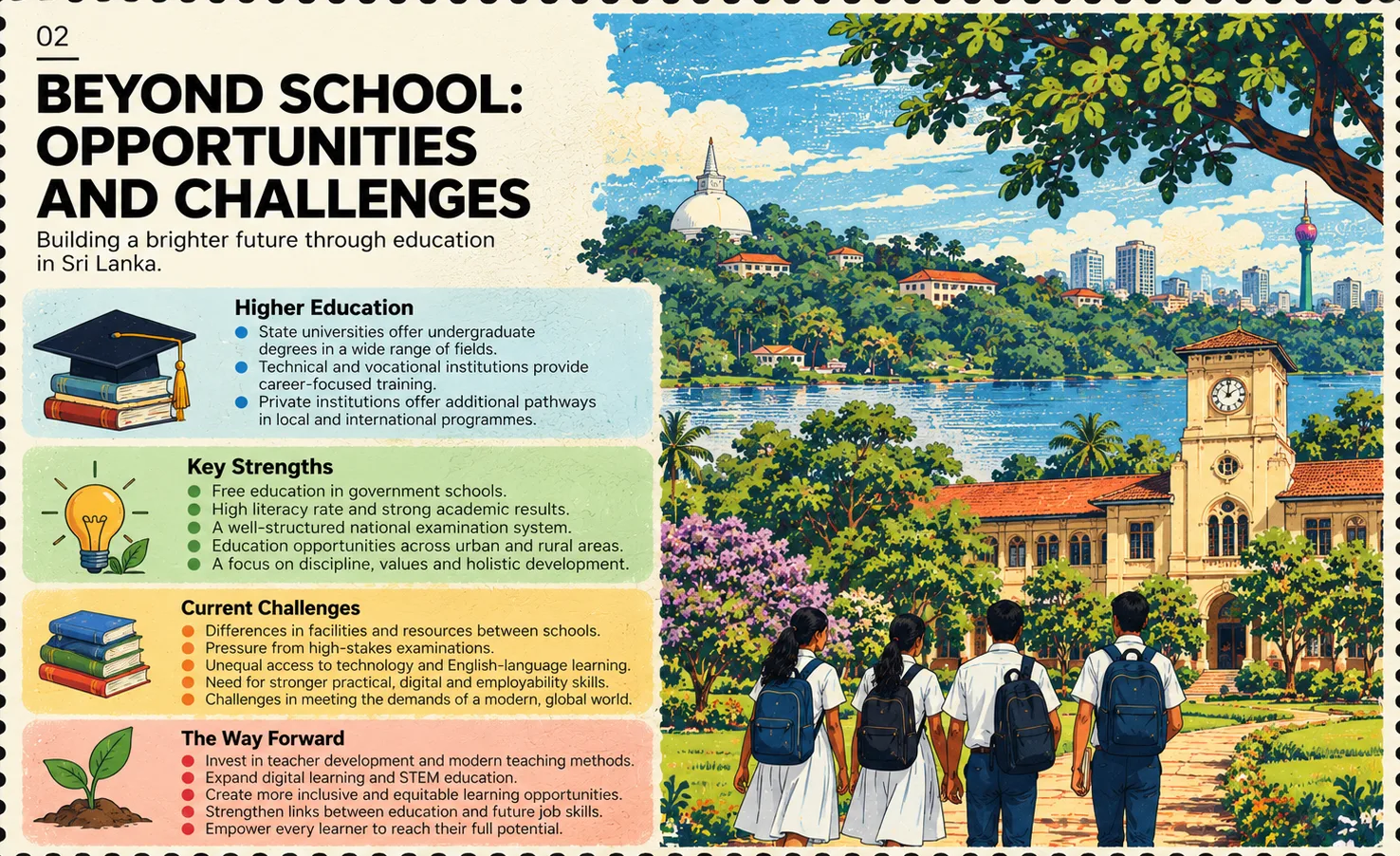
The second card lists the strengths and challenges. Free education, a high literacy rate and a well-structured national examination system are real strengths, supported by the World Bank figures earlier in this article. The challenges are also real:
- Unequal resources. Rural and urban schools differ in laboratories, teachers and technology. Science depends on equipment, so gaps are felt strongly in practical lessons.
- Exam pressure. When one examination decides a university place, pupils feel intense pressure.
- Digital and English-language access. Online learning and many science resources are in English, which not every pupil can easily use. See the advantages and disadvantages of online education.
- Practical and employability skills. The way forward on the card stresses teacher development, digital learning, STEM education and links between education and future jobs.
Learning science well means more than memorising facts: see critical thinking and science education, study tips for kinesthetic learners and how to improve memory for remembering formulas such as the Z-score.
Key points to remember
Frequently asked questions about the education system in Sri Lanka
What are the stages of the education system in Sri Lanka?
There are four school stages: primary (Grades 1–5), junior secondary (Grades 6–9), senior secondary (Grades 10–11, ending with the O/L exam) and collegiate (Grades 12–13, ending with the A/L exam). Tertiary education at universities and vocational institutions follows.
Is education free in Sri Lanka?
Government schools and state universities do not charge tuition fees, a policy usually dated to 1945. Families can still pay for private tuition, transport and supplies.
What is the O/L exam in Sri Lanka?
The G.C.E. Ordinary Level is taken at the end of Grade 11. Pupils sit nine subjects, six of them compulsory, including mathematics and science. The result decides whether a pupil can move on to A/L study.
What is the A/L exam and which streams are there?
The G.C.E. Advanced Level is taken at the end of Grade 13 and is used for university entrance. The streams include Physical Science, Biological Science, Engineering Technology, Biosystems Technology, Commerce and Arts, although schools may offer only some of them.
What is the Z-score in Sri Lanka?
The Z-score converts a raw A/L mark into a standardised score using the subject’s mean and standard deviation for that year: z = (mark − mean) ÷ standard deviation. It lets the UGC compare students across subjects that differ in difficulty.
How are university places allocated?
For most science and commerce courses, up to 40% of places go on all-island merit, up to 55% are shared among districts by population, and 5% go to 16 educationally disadvantaged districts. Most Arts courses use all-island merit only.
What are the latest O/L maths and science pass rates?
For the 2025 O/L, released in June 2026, news reports gave 72.03% and 70.1% for mathematics and science, but reports disagree about which figure belongs to which subject, and both subjects were said to have improved on 2024, so check the Department of Examinations tables.
How many students qualify for university in Sri Lanka?
In the 2025 A/L, 176,527 of 281,810 candidates, or 62.64%, qualified for university admission. Qualifying is not the same as being selected: in 2024/25 about 42,172 of 90,674 applicants were selected under the normal intake.
What is the literacy rate in Sri Lanka?
World Bank data based on UNESCO figures give an adult literacy rate of about 92.7% for 2024 and a youth (15–24) rate of about 98.9%.
What changes are planned in Sri Lankan education?
A new curriculum started for Grade 1 in 2026, Grade 6 changes were postponed to 2027, and the Cabinet has approved a revised curriculum framework and a student assessment framework. Plans for later grades and for the A/L are still developing.