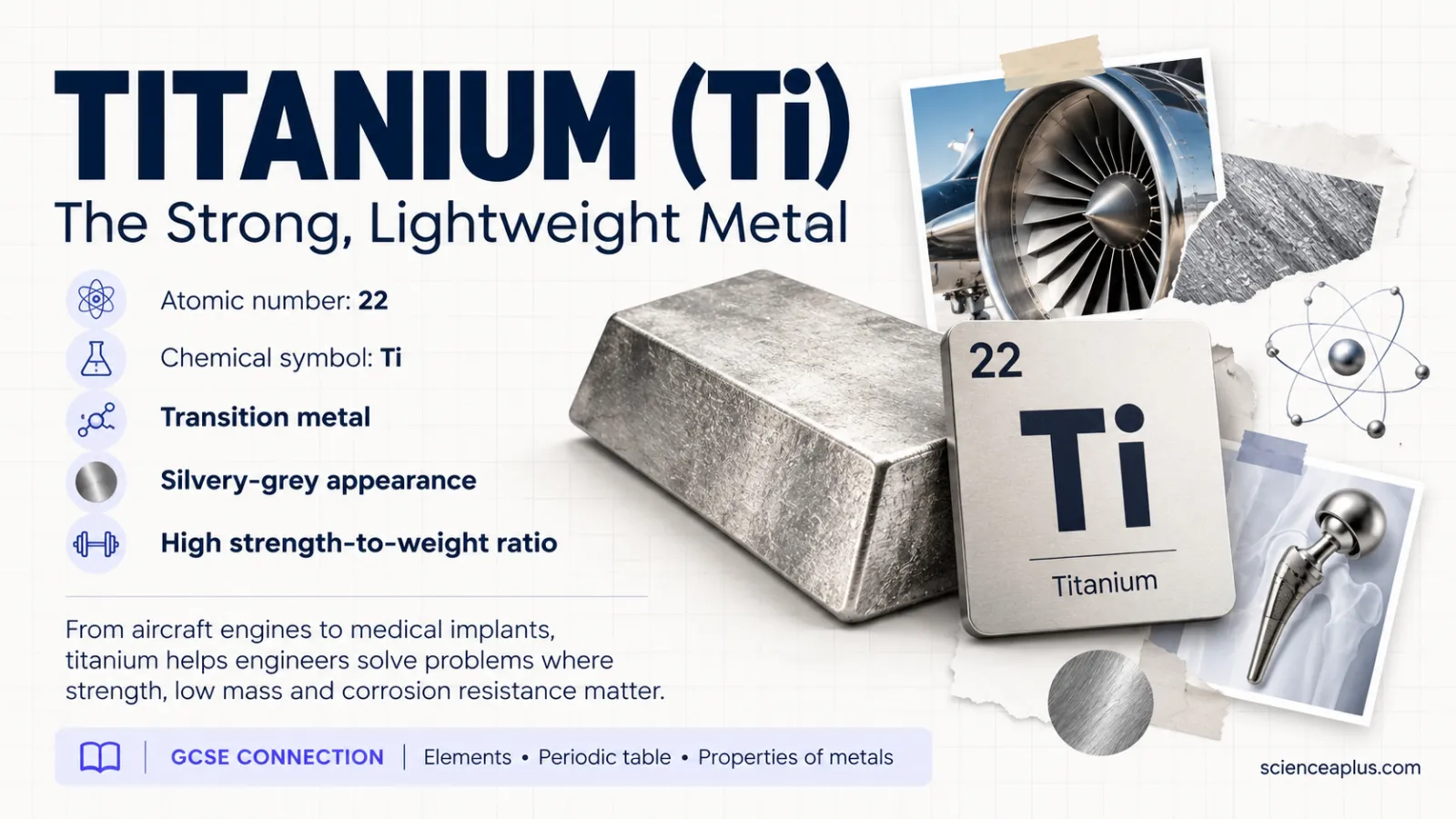
Titanium (Ti, atomic number 22) is a strong, low-density transition metal whose chemical properties are dominated by a thin, self-healing layer of titanium dioxide. That invisible skin explains why a metal that is chemically quite reactive behaves so calmly at room temperature, and why it is trusted in jet engines, seawater pipes and hip replacements.
This guide covers the properties of titanium from the inside out: its electron configuration and oxidation states, its physical and chemical properties, its reactions with balanced equations, how it is extracted, and what it is used for. It is written for GCSE and A-level students, but it also busts a few popular myths along the way.
What is titanium?
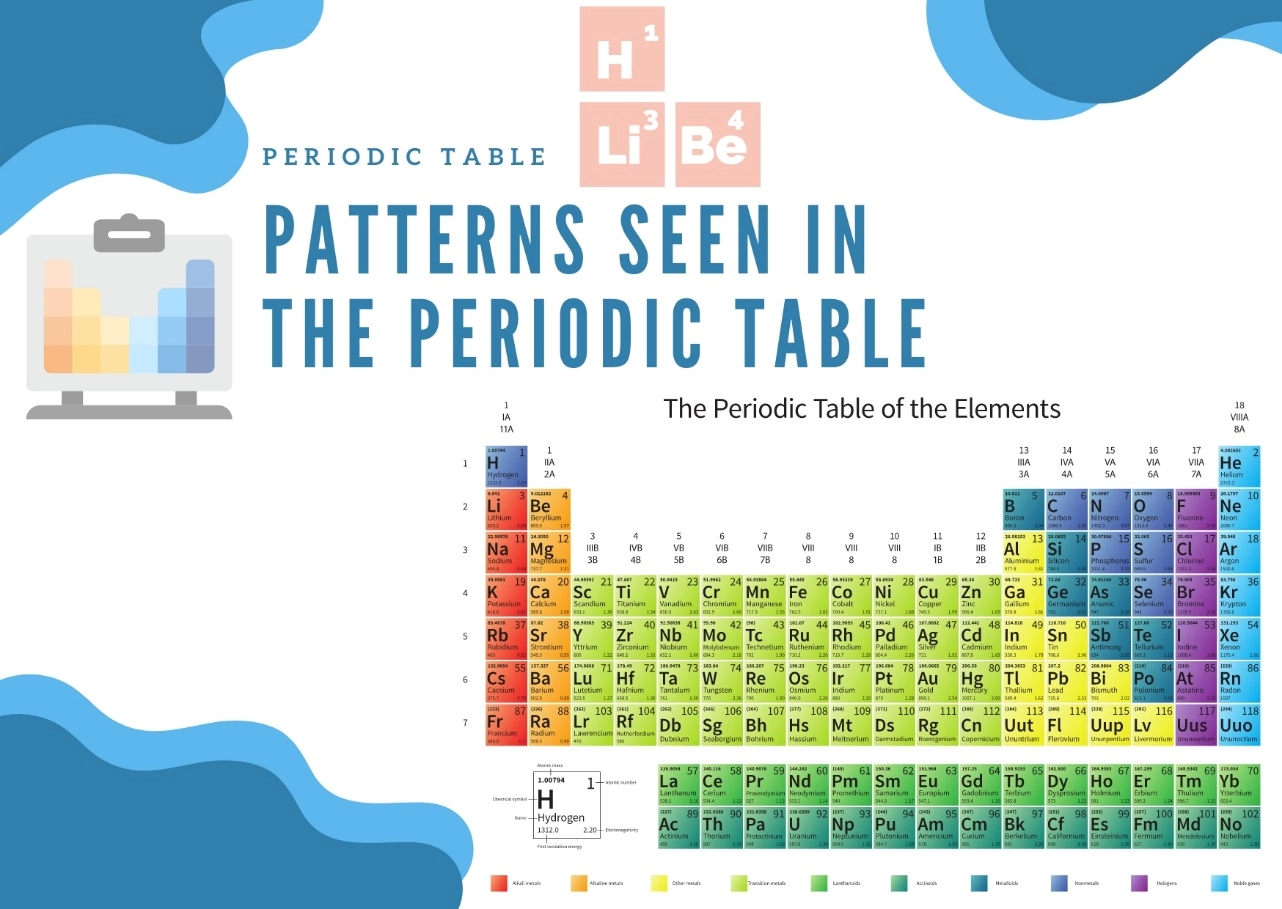
Titanium is a d-block transition metal in group 4 and period 4 of the periodic table. It is a hard, shiny, silvery solid at room temperature, with a relative atomic mass of 47.867. Its name comes from the Titans, the giants of Greek mythology, which is a fitting choice for a metal known for its strength.
Natural titanium is a mixture of five stable isotopes. The most common by far is titanium-48, which makes up about 73.7% of the atoms. The others are titanium-46 (8.25%), titanium-47 (7.44%), titanium-49 (5.41%) and titanium-50 (5.18%).
Titanium sits between two other period 4 metals. On its left is scandium (element 21) and on its right is vanadium (element 23). If you want to see how it compares with its neighbours, the scandium guide is a good place to start. This article keeps the focus on titanium itself.
In the lab, titanium is rarely a simple, shiny metal for long. Whenever it meets oxygen it grows an oxide film, which is the key to almost everything in the next sections.
Titanium electron configuration and oxidation states
Electron configuration of titanium
A titanium atom has 22 electrons. Argon accounts for the first 18, so the short form of the titanium electron configuration is [Ar] 3d² 4s². Written in full, it is 1s² 2s² 2p⁶ 3s² 3p⁶ 3d² 4s².
That leaves four outer electrons, two in the 3d subshell and two in the 4s subshell. Losing all four gives the maximum oxidation state of +4. If you need a refresher on how to build these configurations, see this electronic configuration lesson for GCSE chemistry.
Titanium oxidation states: +4, +3 and +2
The common oxidation states of titanium are +4 and +3, and +2 is also known. The +4 state is by far the most important in titanium chemistry. Titanium(IV) compounds such as TiO₂ and TiCl₄ are white or colourless, while titanium(III) compounds are characteristically violet.
| Oxidation state | Example compound | Ion configuration | Colour and behaviour |
|---|---|---|---|
| +4 | TiO₂, TiCl₄ | [Ar] | White or colourless; the most stable state |
| +3 | TiCl₃ | [Ar] 3d¹ | Violet; acts as a reducing agent |
| +2 | TiCl₂, TiO | [Ar] 3d² | A strong reducing agent; unstable in water |
Why the colours? Ti⁴⁺ has no d electrons, so there is nothing to absorb visible light and the compounds look white or colourless. Ti³⁺ has one d electron, which can absorb some light and give the violet colour. This idea goes beyond GCSE, so treat it as an A-level extension.
Who discovered titanium?
The story of titanium's discovery runs over more than a century and involves a Cornish clergyman, a German chemist and later metallurgists such as Hunter and Kroll.
- 1791: Rev. William Gregor, a Cornish clergyman, found a black magnetic sand (called menachanite, a form of ilmenite) by a stream near Manaccan in Cornwall. It contained iron oxide plus the oxide of an unknown metal.
- 1795: Martin Heinrich Klaproth in Berlin found the oxide of a new element in a red ore called rutile from Hungary. He named it titanium, after the Titans, and later confirmed that Gregor's mineral contained it too.
- 1887: Nilson and Pettersson made impure titanium metal.
- 1910: Matthew A. Hunter made titanium that was 99.9% pure by heating TiCl₄ with sodium in a steel "bomb". This is the Hunter process.
- Around 1940: William Justin Kroll developed the magnesium reduction method that is still largely used today. It became commercial in the late 1940s.
So Gregor found it, Klaproth named it, and Hunter and Kroll worked out how to make the pure metal.
Where is titanium found?
Titanium is the ninth most abundant element in the Earth's crust, making up about 0.57% of it. It turns up in almost all igneous rocks and in the sediments formed from them, so you will meet it in many of the rocks and minerals around you.
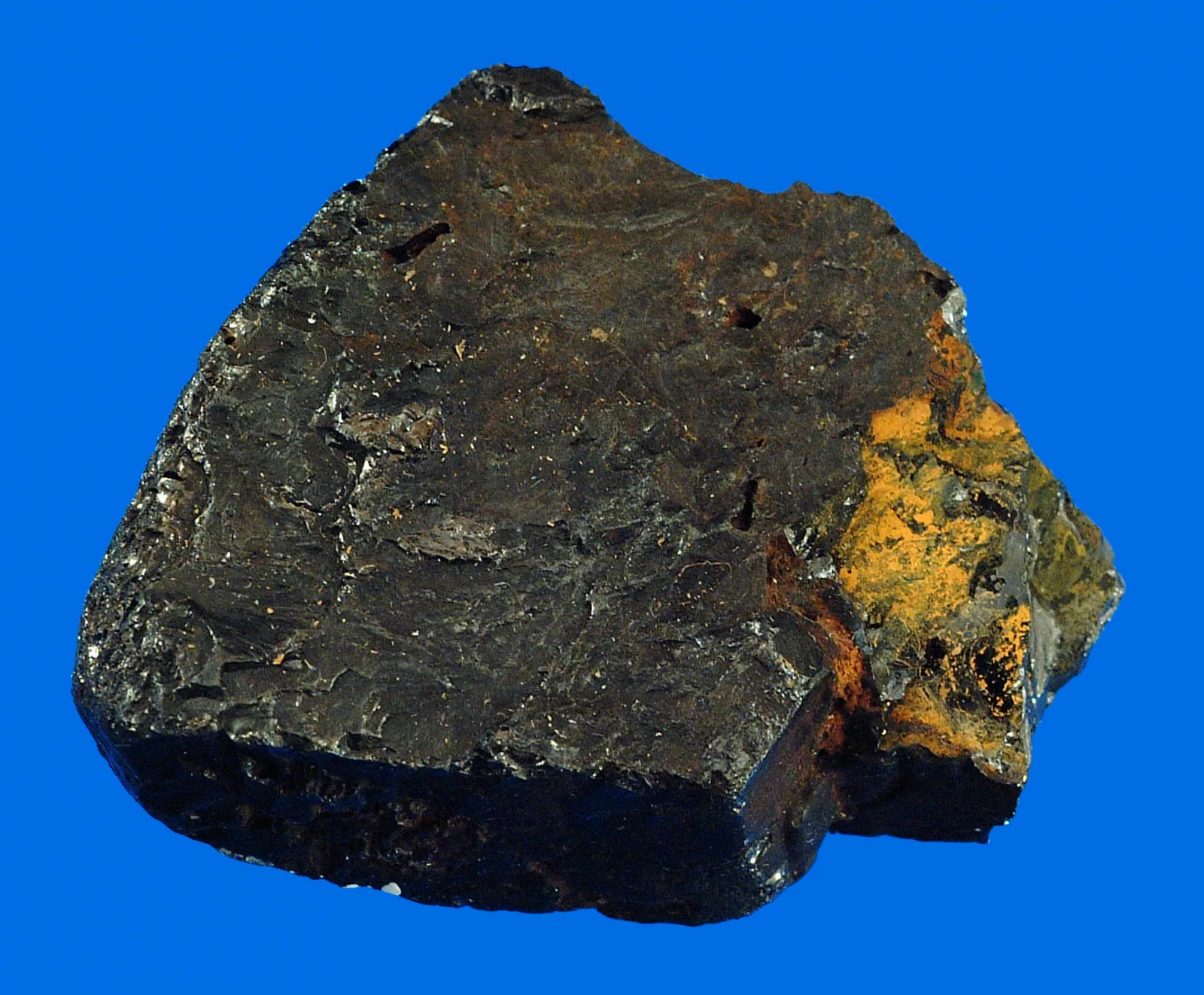
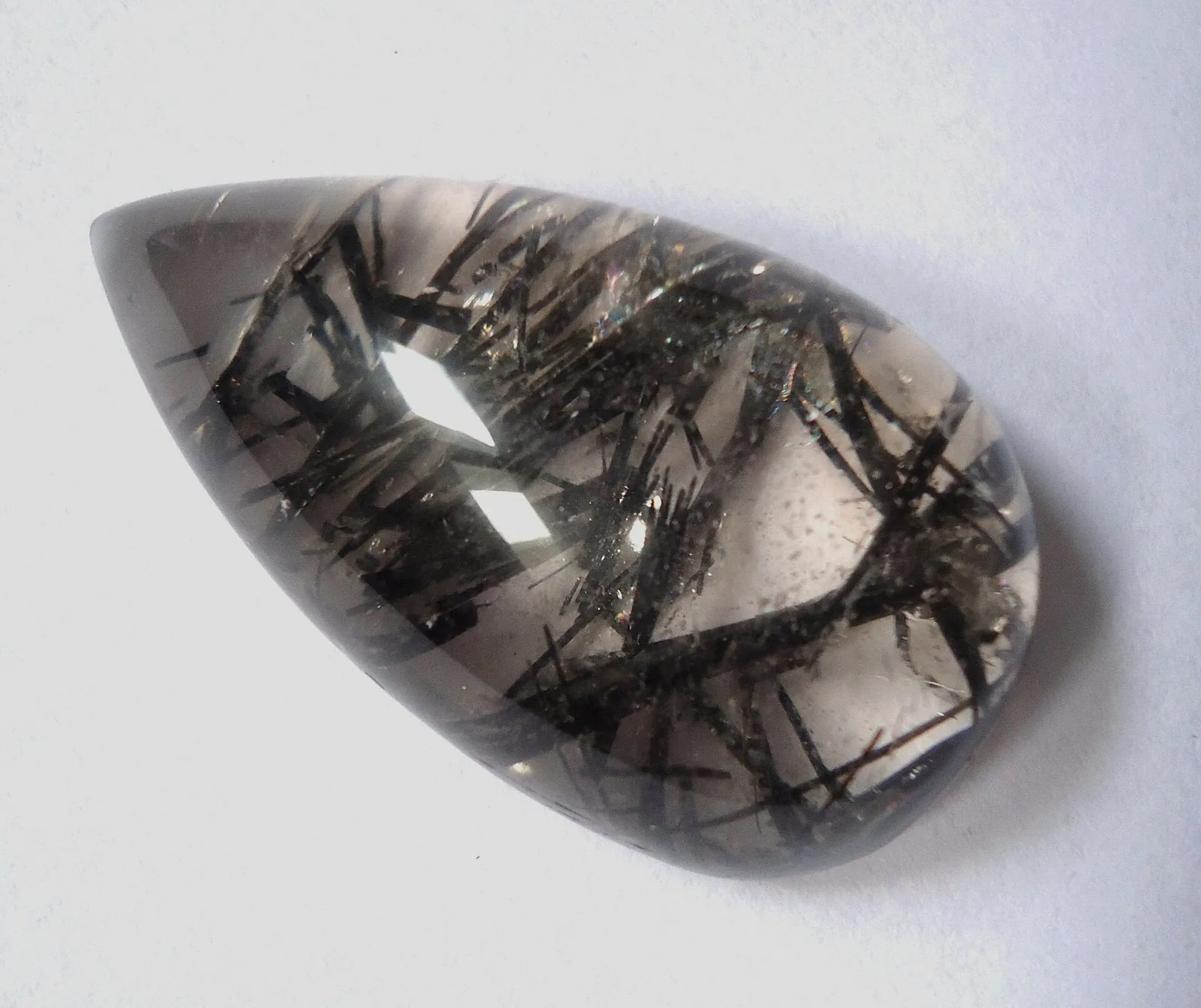
The main ores are ilmenite, which is iron titanium oxide (FeTiO₃), and rutile, which is titanium dioxide (TiO₂). Anatase (also TiO₂) and titanite (CaTiSiO₅) are other titanium minerals. Needles of rutile trapped inside quartz create the beautiful "rutilated quartz" used in jewellery.
Titanium is not just an Earth metal. Rock samples from the Apollo 17 mission to the Moon contained up to 12.1% TiO₂.
On the production side, the US Geological Survey reports that in 2025 China was the leading producer and consumer of titanium mineral concentrates, with about one-third of the world's ilmenite. Mozambique and South Africa ranked second and third.
Here is the puzzle that a later section will answer. Titanium is common, so why is it expensive? The answer lies in how hard it is to get the metal out of its ores.
Physical properties of titanium
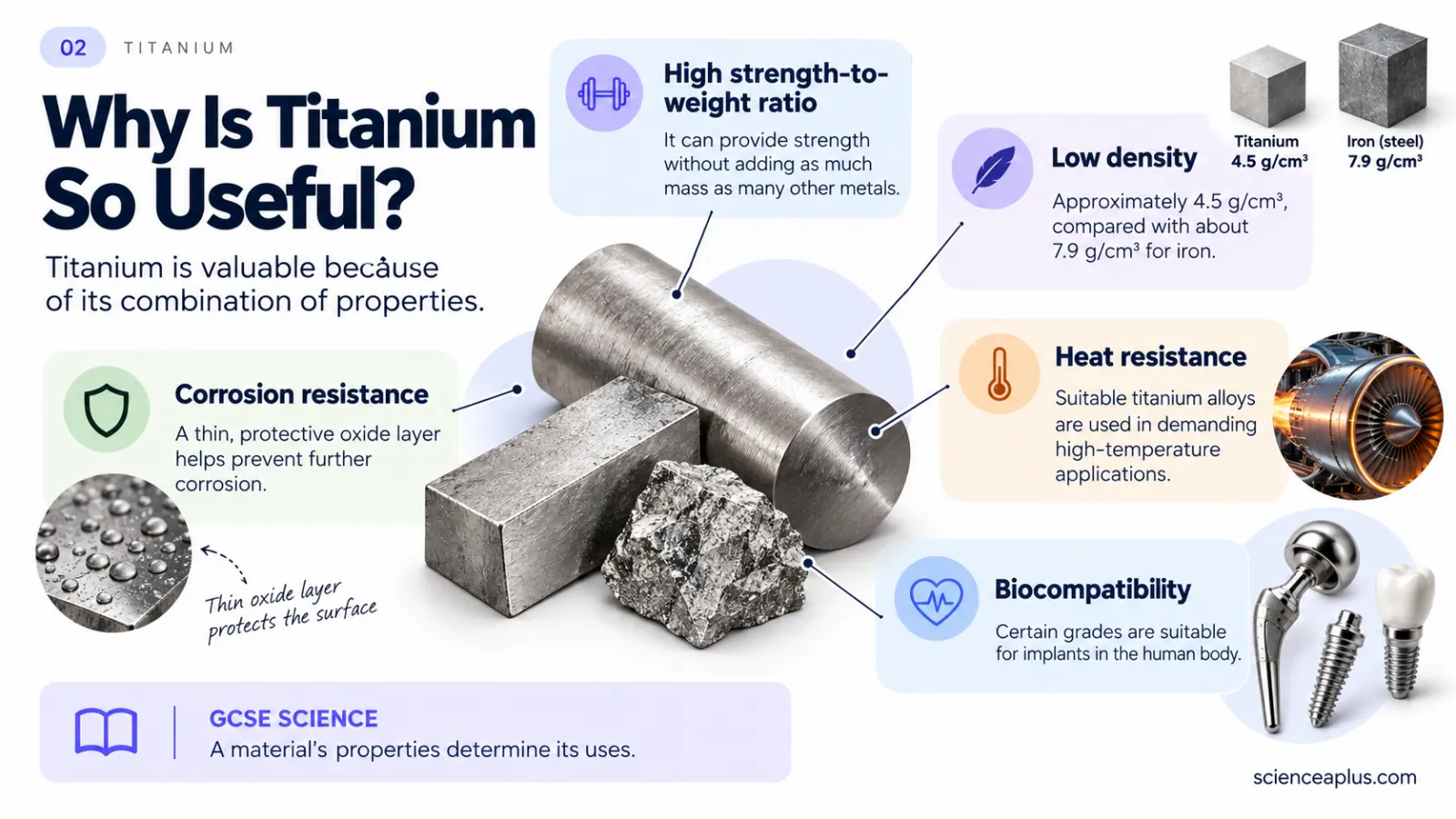
The physical properties of titanium explain most of its uses. It is a low-density metal with a high melting point, and it is strong for its weight. The infographic below sums up why engineers like it, and the table gives the numbers.
| Property | Value | Why it matters |
|---|---|---|
| Appearance | Hard, shiny, silvery metal | Looks good in jewellery and watches |
| Density | 4.506 g/cm³ | About 43% less dense than iron, so parts are lighter |
| Melting point | About 1,670 °C (sources give 1,668–1,670 °C) | Suits hot parts such as jet engines |
| Boiling point | 3,287 °C | Liquid over a huge range, from 1,670 °C to 3,287 °C |
| Strength | Strong for its weight | Aircraft and sports equipment |
| Magnetism | Non-magnetic | A magnet will not stick to it |
| Conductivity | Poor for a metal | Not used for wires, unlike copper |
| Crystal form | Hexagonal (alpha), changing to cubic (beta) at about 880 °C | The metal changes structure when heated |
| Young's modulus | 115.7 GPa | Measures stiffness |
One more detail: titanium is only ductile, meaning easy to draw into wire, when it is free of oxygen. Oxygen dissolved in the metal makes it less ductile, which is one reason it is processed so carefully.
Strength-to-weight ratio: titanium vs steel and aluminium
Is titanium stronger than steel? Titanium is about as strong as many steels but roughly 40–45% lighter. Compared with aluminium, it is roughly 1.7 times as dense (4.506 vs 2.70 g/cm³) but about twice as strong. That is why titanium has one of the highest strength-to-weight ratios of any metal.
Mass is density × volume, so a lower density means a lighter part of the same size. Try it: how much lighter is a titanium part?
Is titanium magnetic?
No. Titanium is not magnetic in everyday terms. It is only very weakly paramagnetic, which you would never notice, so a fridge magnet will not stick to a piece of pure titanium. If a "titanium" object is attracted to a magnet, it is probably made of something else or has steel parts inside.
Melting point and heat resistance
The melting point of titanium is about 1,670 °C, which is very high for a metal that is so light. Together with its strength, this makes titanium alloys useful where parts get hot, such as in aircraft engines. Its boiling point is 3,287 °C.
Chemical properties of titanium
The chemical properties of titanium come down to a competition between two facts. Thermodynamically, titanium is fairly reactive: it burns when hot, and it can be displaced from its compounds only by very reactive metals. Yet at room temperature it hardly reacts at all. The reason is its oxide layer.
The protective oxide layer
In air, titanium immediately forms a thin, non-porous layer of titanium dioxide, TiO₂. When first formed it is only about 1–2 nm thick, but it clings to the surface and protects the metal beneath. Like aluminium, it is protected by its own oxide. If you want the same idea in another metal, read about aluminium and its oxide layer.
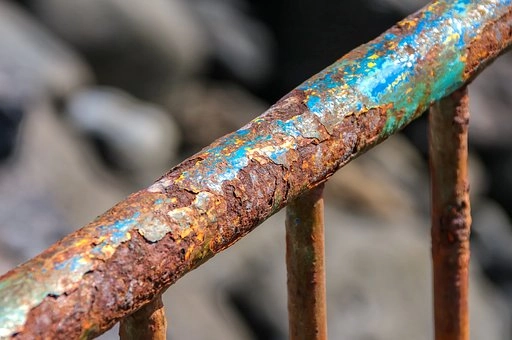
Compare this with iron. Rust is hydrated iron(III) oxide, which is flaky and porous, so it lets air and water reach fresh metal and the damage keeps going. Titanium's oxide stays put, and if you scratch it, a new layer forms straight away. This difference is explained in more detail in our guide on whether iron rusting is a chemical change.
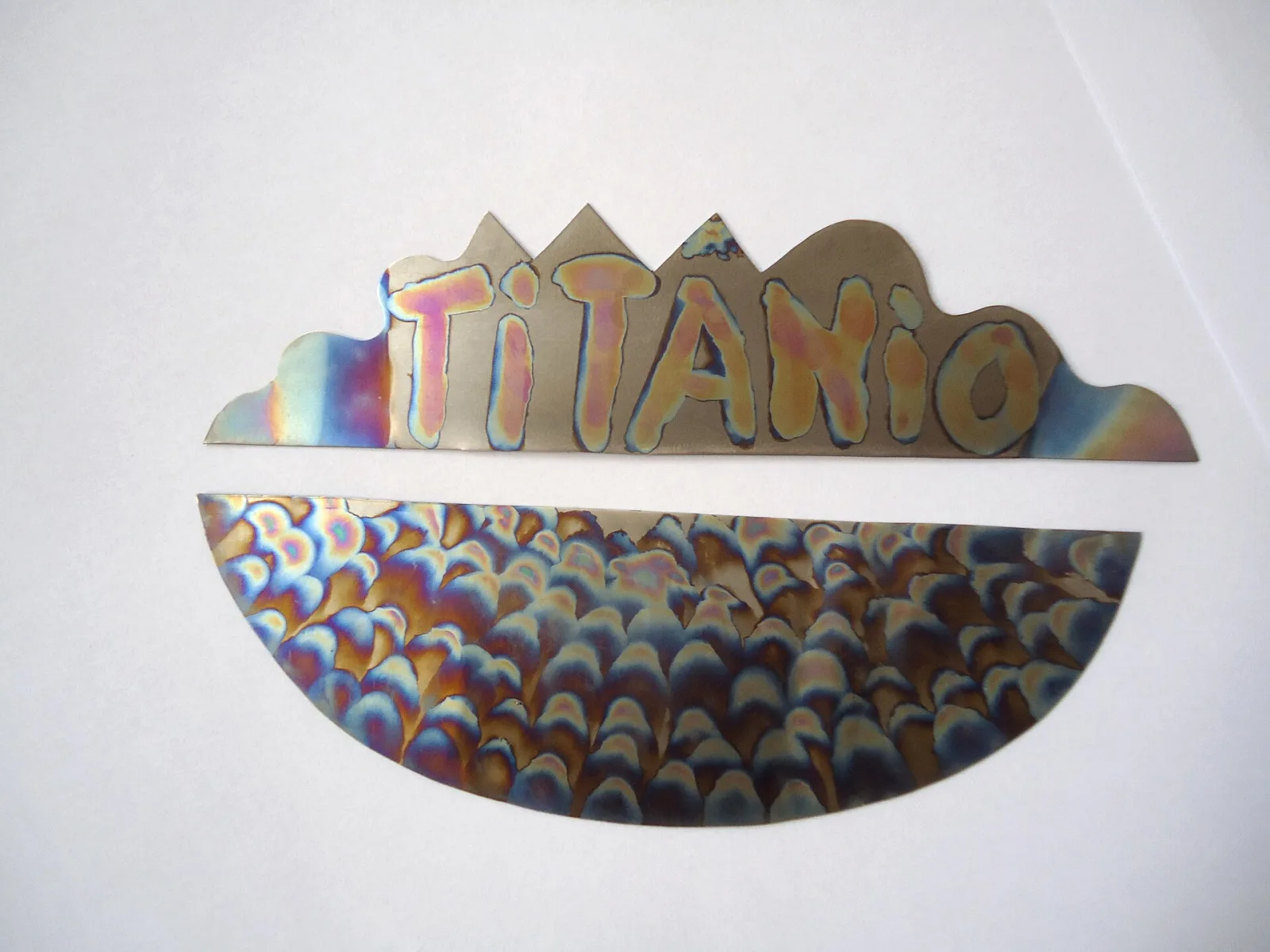
Engineers can thicken the layer on purpose using anodising. The titanium is made the anode in an electrolysis cell, and the oxide film grows thicker. Different thicknesses reflect light in different ways, giving blue, gold, purple and other colours. The colour comes from the thickness of a transparent film, not from dye.
Does titanium rust?
No. Only iron and steel rust. Thanks to its oxide layer, titanium corrodes very little even in seawater. This corrosion resistance is the main reason titanium is used in ships and desalination plants.
Where titanium sits in the reactivity series
Titanium is a fairly reactive metal that looks unreactive. Magnesium can take chlorine from titanium chloride (displacement), and titanium burns in air when it is hot enough. Yet the oxide layer shields it, just as it does for aluminium. For a full refresher, see the reactivity of metals and chemical equations.
Explain why titanium is used for seawater pipes even though it is a fairly reactive metal. (3 marks)
Titanium forms a thin layer of titanium dioxide in air. The oxide layer is non-porous and sticks to the surface, so it stops water, oxygen and chloride ions reaching the metal. If the layer is scratched, it reforms quickly, so the pipe keeps its protection.
A titanium part and a steel part have the same volume. Explain which is lighter. (2 marks)
The titanium part is lighter. Mass = density × volume, and titanium has a density of about 4.5 g/cm³ compared with about 7.9 g/cm³ for iron or steel. With the same volume, the lower density gives the smaller mass.
Reactions of titanium
Most reactions of titanium need heat. The oxide layer has to be broken or driven through before the metal underneath can react, so at room temperature titanium looks inert. Here are the important reactions, all balanced.
Titanium and oxygen
When heated in air, titanium burns to form white titanium dioxide. It reacts readily at about 1,200 °C in air, and at only about 610 °C in pure oxygen. Titanium powder burns especially brightly.
Ti + O₂ → TiO₂
Titanium and nitrogen
Titanium also burns in nitrogen at about 800 °C, forming titanium nitride, a hard, gold-coloured ceramic. It is used to coat drill bits and tools. Because hot titanium picks up nitrogen and becomes brittle, it is welded under argon or helium. You can read more about the gas itself in our guide to nitrogen gas, N₂.
2Ti + N₂ → 2TiN
Titanium with water and steam
Titanium does not react with cold water, because of the oxide layer. At high temperature it reacts with steam to give titanium dioxide and hydrogen.
Ti + 2H₂O → TiO₂ + 2H₂
Titanium with acids and alkalis
At room temperature, titanium resists dilute sulfuric acid and dilute hydrochloric acid, most organic acids and chloride solutions. Hot hydrochloric acid does attack it, forming violet titanium(III) ions:
2Ti + 6HCl → 2TiCl₃ + 3H₂
Dilute hydrofluoric acid dissolves titanium too, forming fluoride complexes and hydrogen. Titanium does not appear to react with alkalis under normal conditions, even when they are hot.
Titanium with the halogens
On heating, titanium reacts with the halogens to give titanium(IV) halides. With chlorine the reaction starts at about 550 °C. Dry chlorine gas can even set titanium on fire.
Ti + 2Cl₂ → TiCl₄
The other halides follow the same pattern: TiF₄ is white, TiBr₄ is orange and TiI₄ is dark brown. Test your recall with the flip cards below.
Titanium tetrachloride, the "tickle"
Titanium tetrachloride, TiCl₄, is a colourless, volatile liquid nicknamed "tickle". In moist air it fumes, because it reacts with water vapour to give titanium dioxide and hydrogen chloride. This is why it has been used to make smoke screens.
TiCl₄ + 2H₂O → TiO₂ + 4HCl
TiCl₄ is corrosive, and the fumes contain hydrogen chloride, so it is only handled with proper precautions.
How is titanium extracted? The Kroll process
Iron ore is reduced by heating it with carbon, so why not do the same for titanium? There are two problems. Titanium forms titanium carbide with carbon, and hot titanium reacts with oxygen and nitrogen. So the metal has to be made in an inert atmosphere, away from air. The Kroll process does exactly this, in three steps.
- Chlorination. The ore (rutile or ilmenite) is heated with carbon to about 1,000 °C while chlorine passes over it. This makes titanium tetrachloride.
TiO₂ + 2C + 2Cl₂ → TiCl₄ + 2CO
- Purification. The liquid TiCl₄ is purified by fractional distillation.
- Reduction. TiCl₄ is reacted with molten magnesium at about 850 °C under a blanket of argon. Magnesium is more reactive than titanium, so it displaces it.
TiCl₄ + 2Mg → Ti + 2MgCl₂
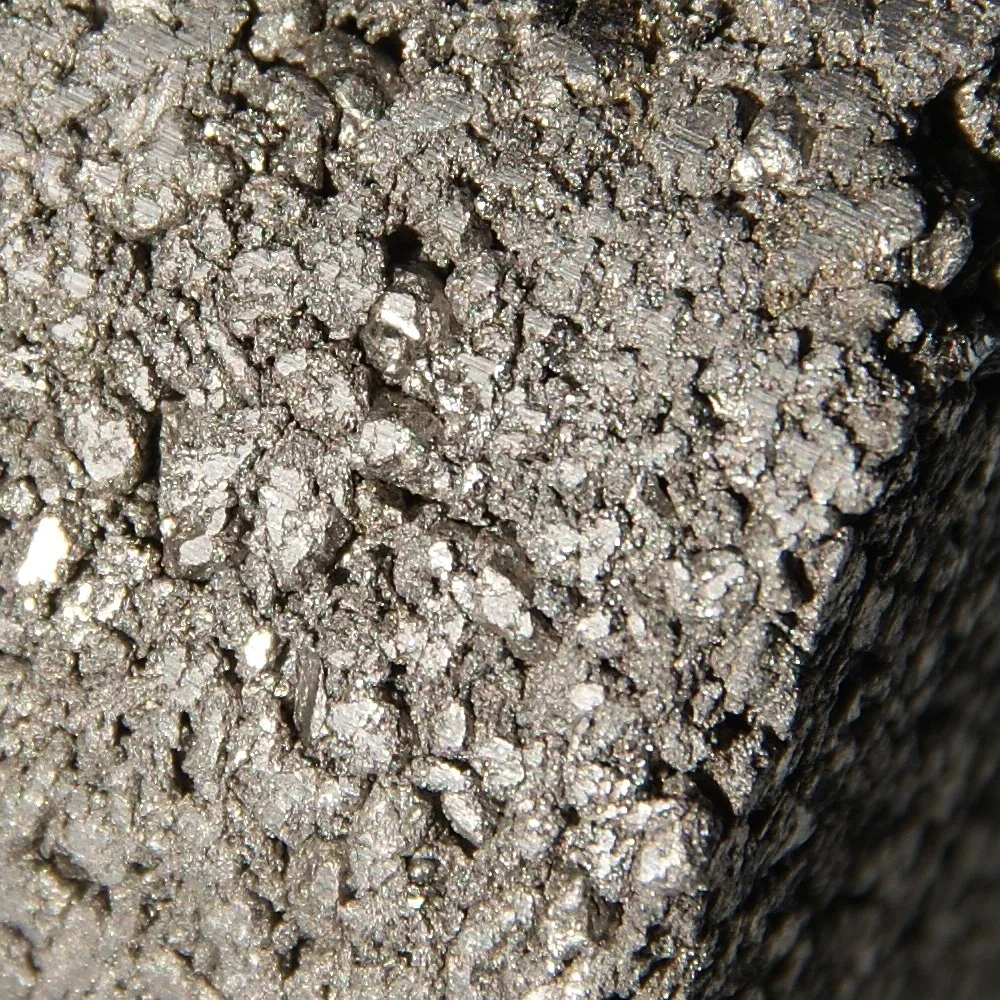
The product is porous "titanium sponge". The reaction relies on magnesium, which is the more reactive metal, to take the chlorine. The sponge is then melted, often with alloying metals, into ingots, and rolled or forged into sheet, bar and tube.
The older Hunter process works the same way but uses sodium instead of magnesium.
TiCl₄ + 4Na → Ti + 4NaCl
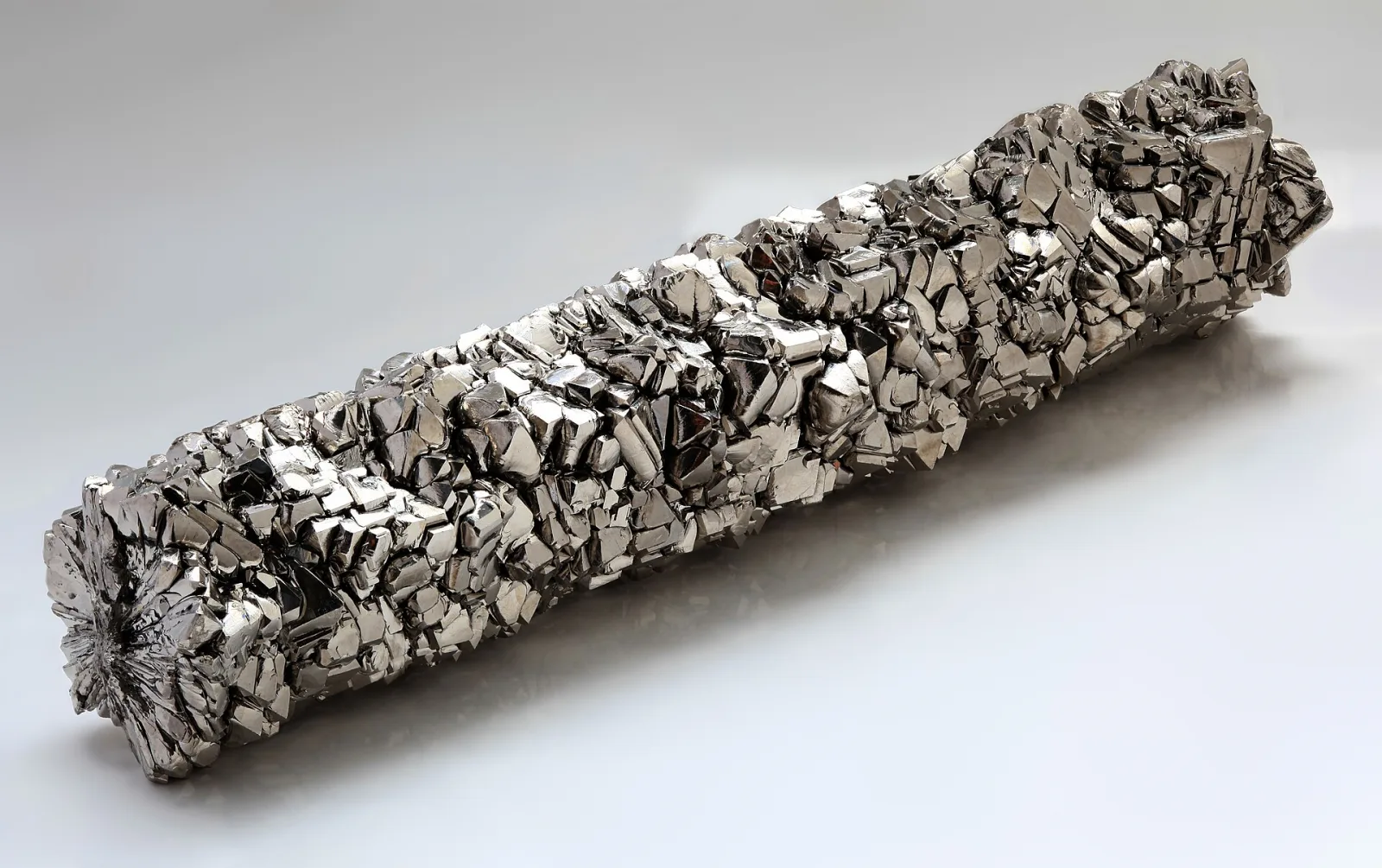
For very pure titanium, there is a third route, the van Arkel–de Boer iodide process of 1925. Titanium iodide vapour is decomposed on a hot filament, leaving the "crystal bar" you saw earlier.
Why is titanium so expensive?
Titanium is the ninth most abundant element in the crust, but it is expensive because it is hard to extract. The Kroll process is a slow batch process rather than a continuous one. It needs high temperatures, chlorine, magnesium and an argon atmosphere, and the sponge must then be melted and shaped in further steps. The RSC puts it simply: titanium is not as cheap as iron because it is more difficult to extract. In short, it is abundant but expensive.
Write a balanced equation for the reduction of titanium(IV) chloride by magnesium and explain why argon is used. (3 marks)
TiCl₄ + 2Mg → Ti + 2MgCl₂. Argon is unreactive, so it stops hot titanium and magnesium reacting with oxygen and nitrogen in the air. Without it, the titanium would form oxide and nitride and become brittle.
Titanium dioxide: the most important titanium compound
Although the metal gets the attention, titanium dioxide is by far the biggest use of titanium. The RSC says the largest use of titanium is in the form of titanium(IV) oxide, and that about 95% of the titanium used worldwide is used as TiO₂. According to the RSC, that is roughly 4 million tonnes of TiO₂ a year.
TiO₂ occurs naturally as three minerals: rutile, anatase and brookite. It is made industrially by the sulfate process or the chloride process. In the chloride process, TiCl₄ is burned in oxygen:
TiCl₄ + O₂ → TiO₂ + 2Cl₂
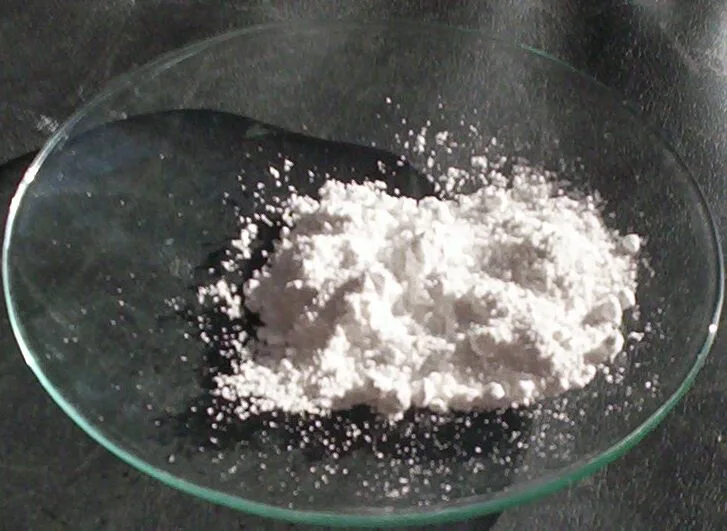
Pure TiO₂ is a bright white, insoluble, opaque powder with excellent covering power. It also has a very high refractive index. You will find it in paint, plastics, paper and sunscreen, which are covered in the next section.
Uses of titanium
In GCSE chemistry, properties determine uses. Titanium is light, strong, heat-resistant, corrosion-resistant and safe in the body, and each use below follows from one or more of those properties.
Aircraft and spacecraft
Titanium alloys, made with metals such as aluminium, vanadium, molybdenum and iron, are used mainly in aircraft, spacecraft and missiles. The low density and the ability to withstand extremes of temperature are the reasons. Large parts of the engines and airframes of big passenger jets are made of titanium.
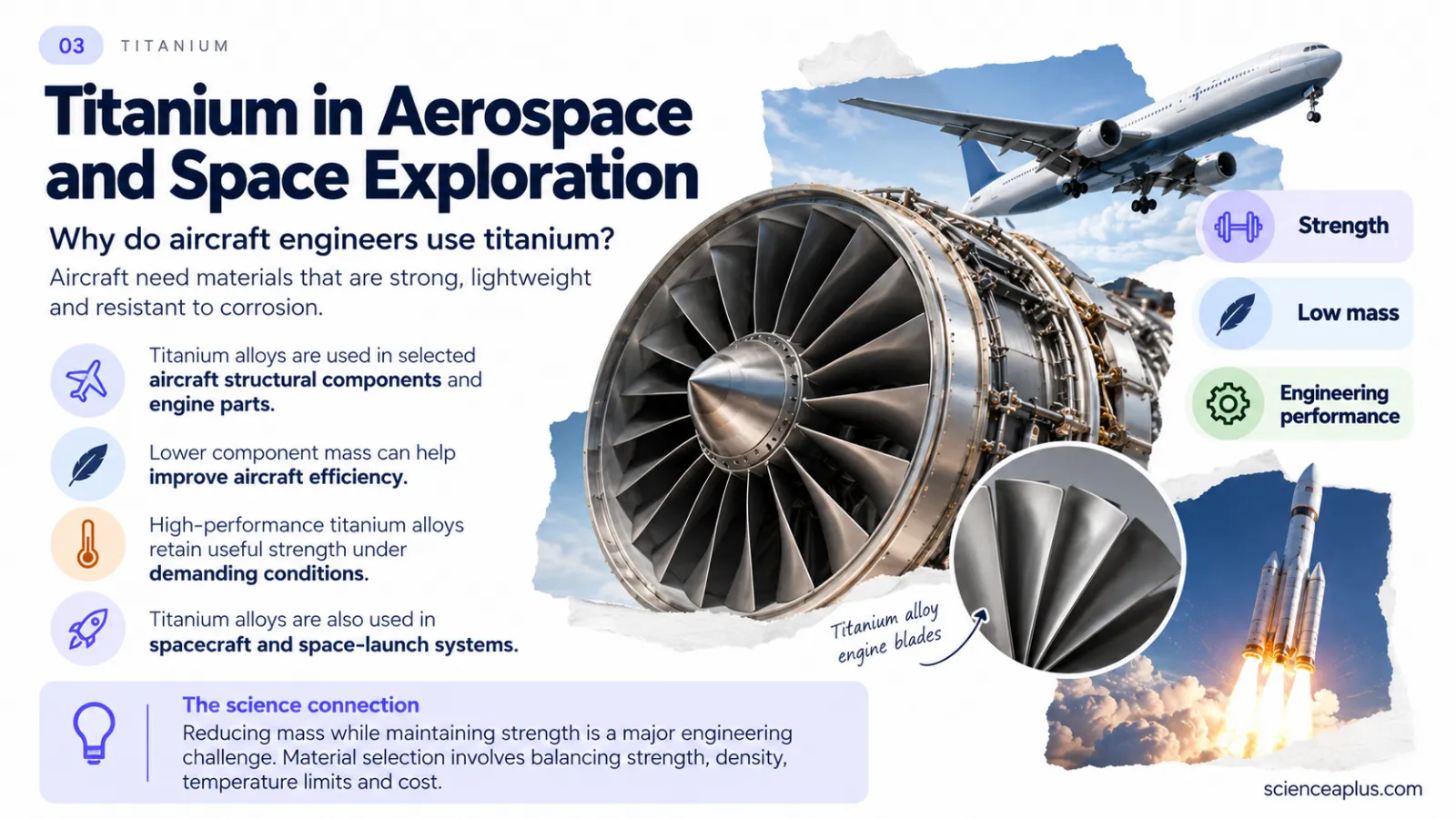
The most famous example is the Lockheed SR-71 Blackbird, the US spy plane that was the fastest crewed jet aircraft. Much of it was built from titanium.

Ships, desalination and chemical plants
Because of its oxide layer, titanium resists seawater. It is used in desalination plants, in condenser pipes in power stations, and in ship and submarine parts, including propeller shafts. Learn how those plants turn seawater into drinking water in our guide to desalination and the salinity of the oceans.
Medical implants
Solid titanium is non-toxic and is not rejected by the body. It also bonds with bone, a process called osseointegration. That makes it ideal for hip and knee joint replacements, dental implants, and bone plates and screws.
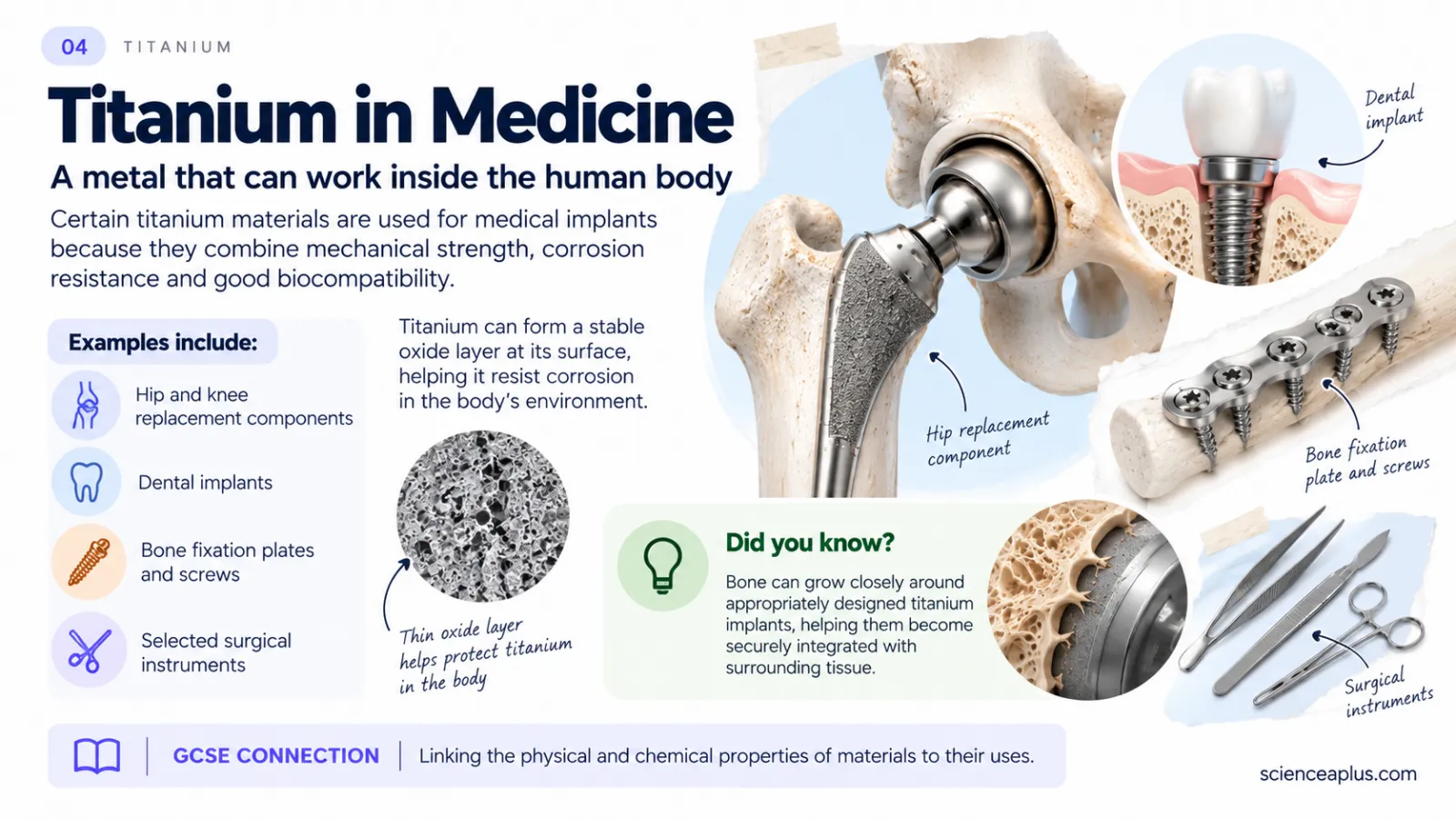
Osseointegration was discovered by the Swedish surgeon Per-Ingvar Brånemark in the early 1950s, when a titanium chamber fused to a rabbit's bone. He placed the first titanium dental implant in 1965.
Titanium dioxide in paint, sunscreen and self-cleaning glass
Remember that most titanium is used as the dioxide. As a pigment, TiO₂ gives a bright white finish in house paint, artists' paint, plastics, enamels and paper.
It is also used in sunscreen, where it stops UV light reaching the skin. Nanoparticles of TiO₂ look invisible on skin, which is one of the ideas covered in nanotechnology and its applications. Sunscreen TiO₂ is coated with silica or alumina, because UV light makes bare TiO₂ generate reactive radicals. That same photocatalysis is put to good use in self-cleaning glass.
Sport, jewellery and the kitchen
Titanium turns up in golf clubs, laptops, bicycles and crutches. It is used in jewellery and watches because it is light and hypoallergenic, and anodising can give it colour.
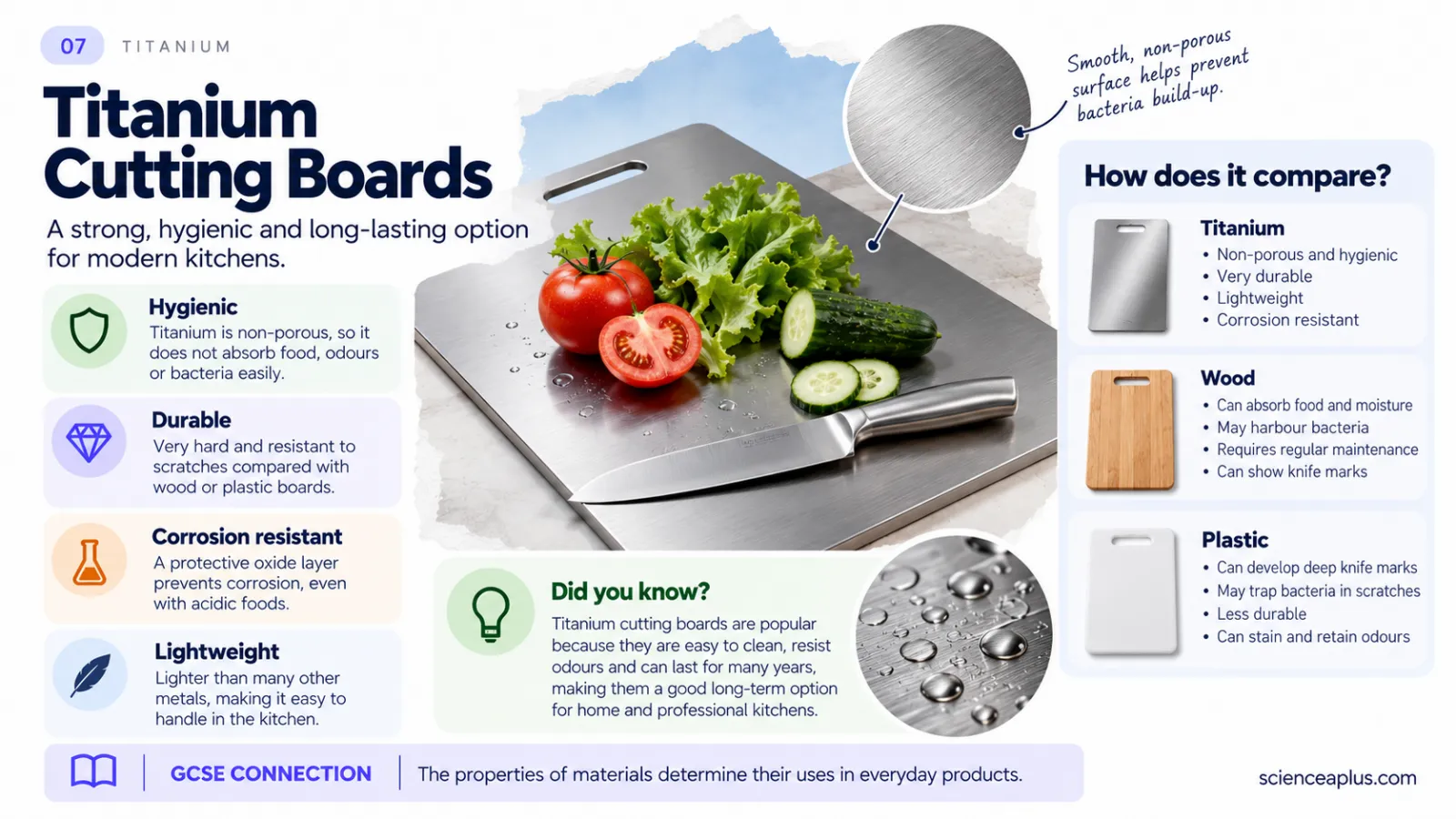
Titanium cutting boards show both sides of the metal. They are non-porous and corrosion-resistant, so they are hygienic and durable. But a test by Prudent Reviews found that titanium boards were the worst of all the materials tested for keeping knives sharp. Wood and plastic boards are gentler on the blade.
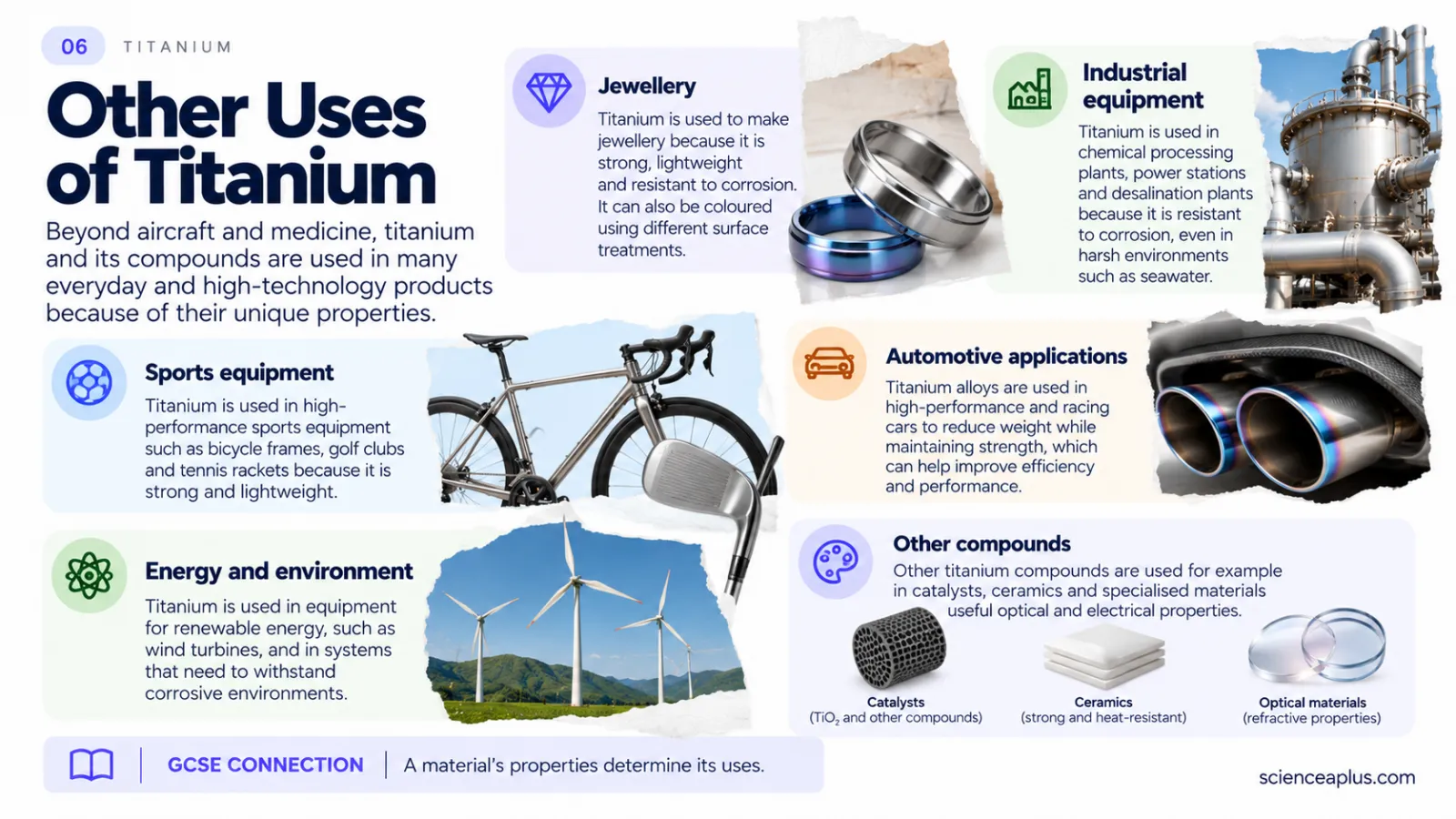
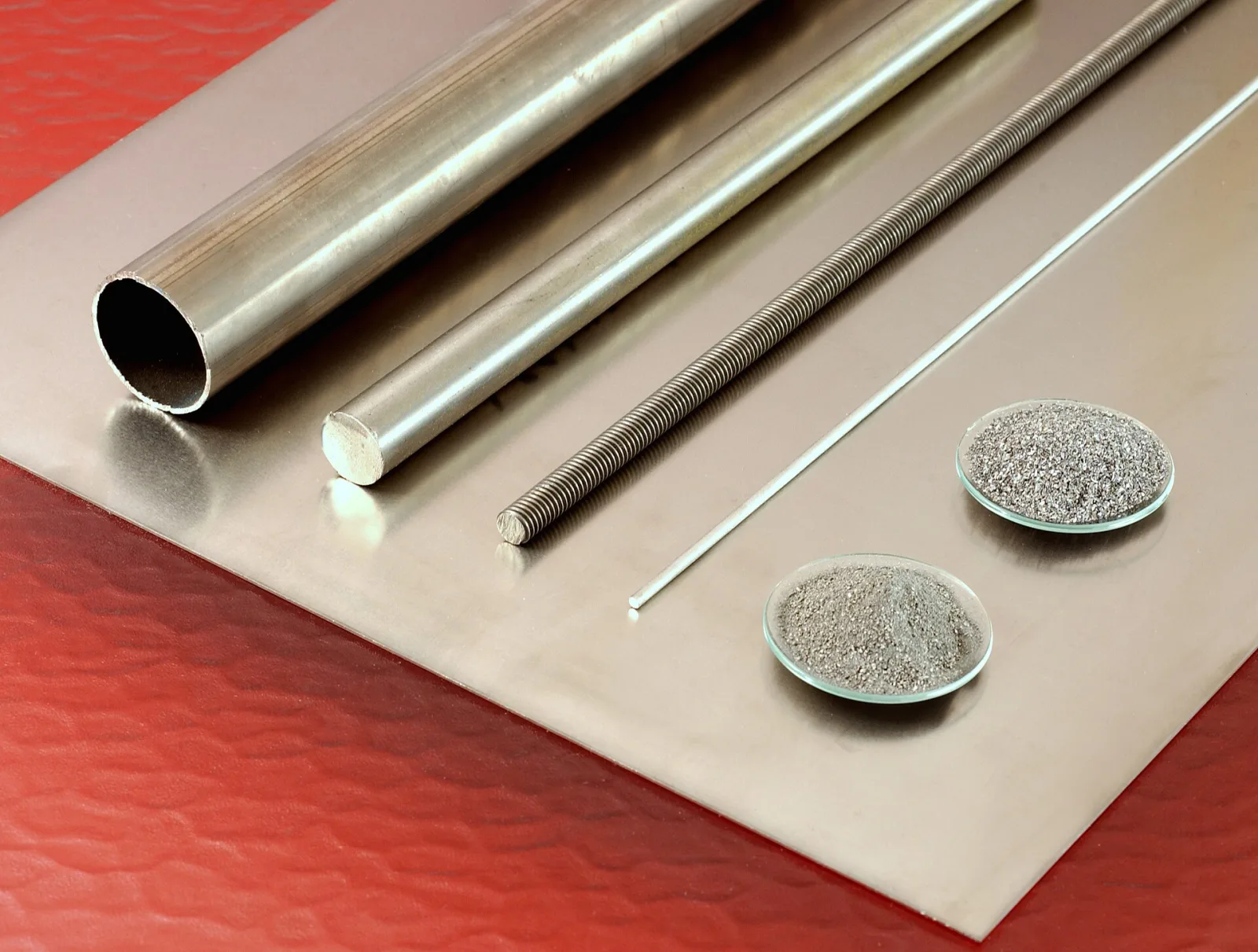
More than 30% of titanium is recycled, according to the RSC, which is encouraging for a metal that costs so much to extract.
Is titanium safe?
Solid titanium metal is non-toxic and has no known biological role. Other forms need more care.
- Powder and shavings are a fire and explosion hazard. Water and CO₂ extinguishers do not work, so a Class D dry powder extinguisher is needed.
- Titanium tetrachloride is corrosive and fumes hydrogen chloride in moist air.
- Titanium dioxide dust is classed by the International Agency for Research on Cancer (IARC) in Group 2B, "possibly carcinogenic to humans", based on rat inhalation studies. The evidence in humans is inadequate. The RSC describes fine titanium dioxide dust as a suspected carcinogen.
Food is a separate question. In 2021 the European Food Safety Authority (EFSA) concluded that TiO₂ could no longer be considered safe as a food additive (E171), because concerns about genotoxicity could not be ruled out. The EU ban has applied since 7 August 2022. In Great Britain, E171 is still authorised. The UK Committee on Toxicity reviewed it and in 2024 set a health-based guidance value of 10 mg per kg of body weight per day, with estimated adult exposures below it.
Test yourself on titanium
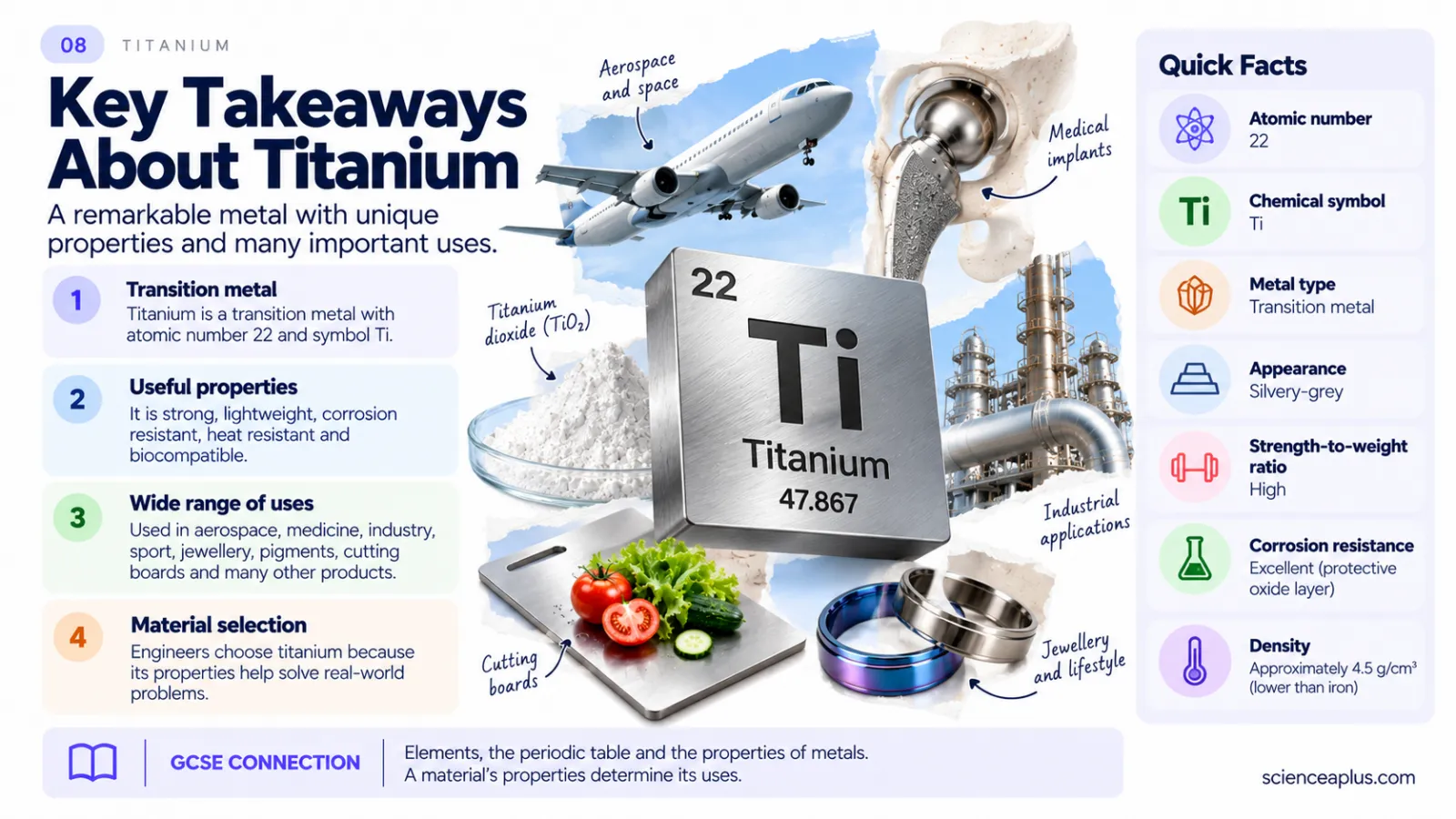
Key points to remember
Frequently asked questions about titanium
What are the main chemical properties of titanium?
Titanium forms a thin, protective layer of titanium dioxide in air, so it resists corrosion at room temperature. Its main oxidation state is +4. When heated it reacts with oxygen, nitrogen and the halogens, and it resists dilute acids and alkalis in the cold.
Does titanium rust?
No. Rust is hydrated iron(III) oxide, which forms only on iron and steel. Titanium instead develops a very thin, non-porous layer of titanium dioxide that sticks to the metal and re-forms if scratched. This is why titanium corrodes very little, even in seawater.
Is titanium magnetic?
No. Titanium is non-magnetic in everyday use, and only very weakly paramagnetic, so a fridge magnet will not stick to pure titanium. It is also a relatively poor conductor of heat and electricity compared with metals such as copper and aluminium.
Is titanium stronger than steel?
Titanium is about as strong as many steels but roughly 40–45% lighter, so it has one of the highest strength-to-weight ratios of any metal. Some heat-treated steels are harder and stronger. Titanium wins when weight matters, as in aircraft, rather than when raw strength is needed.
What is the electron configuration of titanium?
The electron configuration of titanium is [Ar] 3d² 4s², or 1s² 2s² 2p⁶ 3s² 3p⁶ 3d² 4s² in full. It has 22 electrons. The four outer electrons explain its maximum oxidation state of +4. When it forms ions, the 4s electrons are lost first.
Does titanium react with acids?
Titanium resists dilute sulfuric and hydrochloric acid at room temperature. Hot hydrochloric acid attacks it and forms violet titanium(III) chloride and hydrogen: 2Ti + 6HCl → 2TiCl₃ + 3H₂. Dilute hydrofluoric acid dissolves it too. It does not appear to react with alkalis.
Why is titanium so expensive if it is common?
Titanium is the ninth most abundant element in the crust, but it is hard to extract. The Kroll process is a slow batch process that needs chlorine, magnesium, high temperatures and an argon atmosphere. Iron is cheaper because it can be extracted much more easily.
Who discovered titanium?
The Cornish clergyman William Gregor found an unknown metal oxide in black sand near Manaccan in 1791. In 1795 the German chemist Martin Klaproth identified it in rutile and named the element titanium, after the Titans of Greek mythology. Matthew Hunter made 99.9% pure titanium in 1910.
Is titanium dioxide safe?
As a solid pigment it is widely used, but fine dust is classed by IARC as possibly carcinogenic when inhaled (Group 2B). The EU banned titanium dioxide as a food additive (E171) in 2022 after an EFSA opinion. Great Britain still authorises it after a Committee on Toxicity review.