
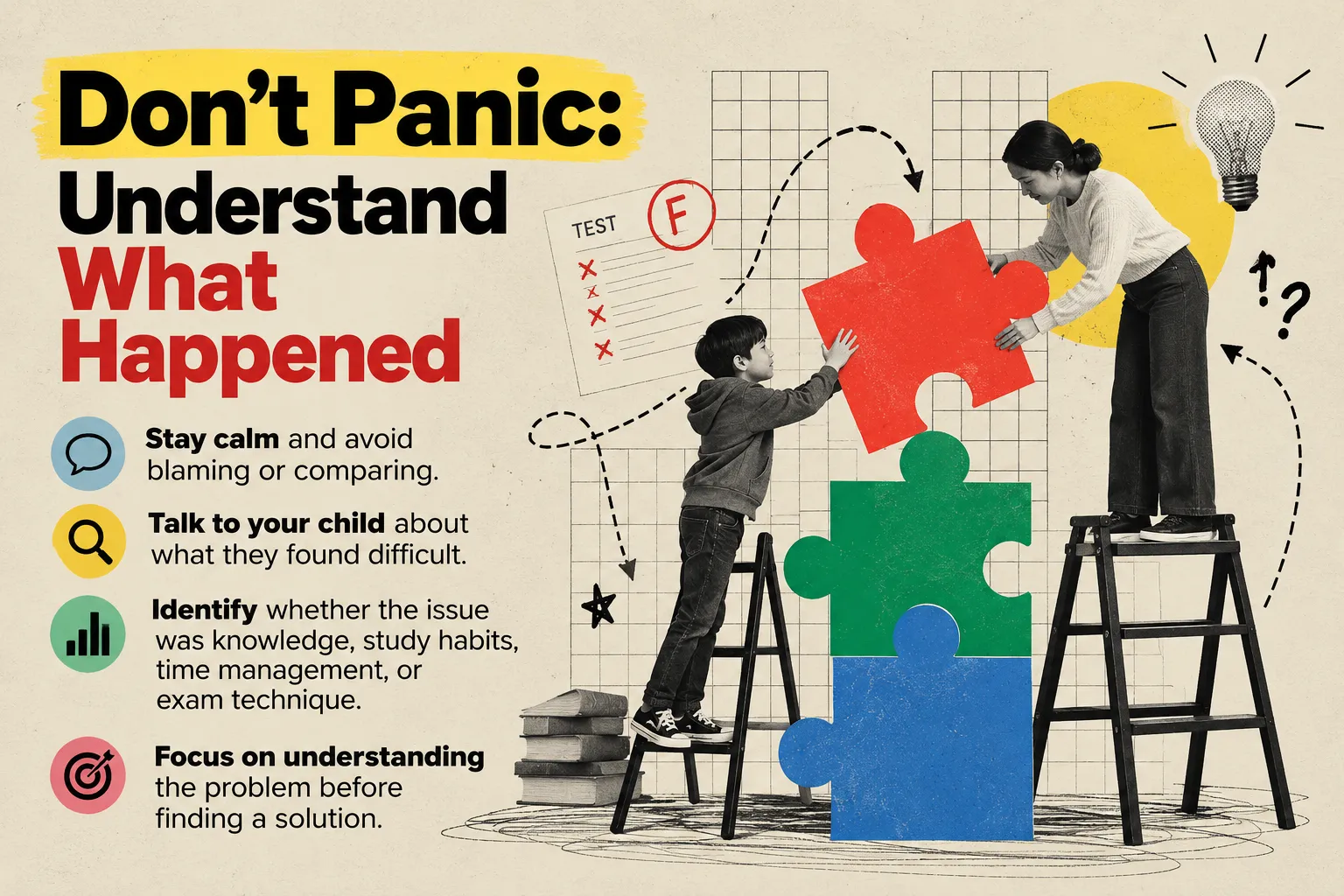
How do you help your child after poor grades? Stay calm, listen before you talk, and find out why the result happened before you decide what to do about it. A disappointing mark is information, not a verdict. Once you know whether the cause was a knowledge gap, exam technique, tiredness, worry or something that needs specialist support, you can pick a small, realistic plan and work through it together.
That is easier said than done when you are holding a report with a 3 on it, or a child has just stormed upstairs. This guide is written for parents of children in Key Stage 3 and Key Stage 4 in the UK, and it is just as useful for teenagers who want to understand what their parents are trying to do. It covers the first conversation, how to find the real cause, how to work with teachers and the school SENCO, what the research on growth mindset does and does not say, a study routine that is realistic for a school week, and when it is time to involve a GP or children's mental health services.
The first 24 hours: what to do (and what to hold back)
Most of us react before we think. The face we pull, the sigh, the "Is that really the best you could do?" all land harder than we realise. A child who already feels they have let everyone down is watching your reaction for clues about how bad it is. If the answer is "very bad", their brain goes into defence mode, and defensive children do not make good problem-solvers.
So give yourself a small delay. It is perfectly fine to say, "Thanks for showing me. I need a bit of time to look at it properly, and then let's talk after tea." That one sentence buys you a calmer conversation and tells your child you are taking it seriously rather than ignoring it.
Some things are worth holding back for now: comparing your child with a sibling or friend, bringing up past mistakes, threatening to take things away, or catastrophising ("You'll never get into sixth form like this"). None of these helps a child learn physics or French vocabulary. They only teach the child that bad news is dangerous to bring home.
How to start the conversation
Choose a calm moment, not the doorstep after school and not bedtime. Side-by-side talk often works better than face-to-face, especially with teenagers: in the car, on a walk, while washing up. Many young people open up more when they do not have to hold eye contact.
Start with feelings, not marks. Something like, "I saw your result. How are you feeling about it?" gives your child space to answer in their own words. Then listen. Resist the urge to fix, correct or reassure too early. Try phrases such as:
- "Tell me what happened in that test."
- "Which parts felt OK, and which parts felt hard?"
- "Was there anything about the way you prepared that you'd change?"
- "Is there anything at school that's been bothering you lately?"
- "What would help most from me?"
That last question matters. Some children want a revision timetable and a quiet room. Others want you to stop asking about school for a day. Letting them have a say from the start means the plan is theirs as well as yours, and plans that children own are far more likely to survive past the second week.


The two photos above show the difference. The first looks like a heated exchange, with the adult standing over a seated child; in the second, the parent has sat down, leaned towards the child and is simply talking. Body language, tone and position do a lot of the work before a single word about grades is spoken.
What a grade does and does not tell you
A single test result is a snapshot of one paper on one day. It reflects what your child knew in that moment, how they managed time, how well they read the questions, and whether they slept the night before. It does not measure how clever they are, how hard they will work next term, or what they will go on to do.
In England, GCSEs are graded 9 to 1, with grade 4 described as a standard pass and grade 5 as a strong pass. That gives families a useful target, but it also means a Year 10 mock result of 3 is a starting point with a long runway, not a final destination. The same is true for end-of-unit tests in Year 8 or 9: they are checks on learning that is still in progress. Teachers use them to adjust what they teach next, and families can use them the same way.
It also helps to ask what the result was compared with. Was it lower than your child's usual work, or in line with a subject they have always found hard? A sudden drop in several subjects points somewhere different from a long-standing struggle with one topic. The first tends to suggest something outside the lesson, such as sleep, friendships, mood or health. The second is more likely to be a gap in understanding. Keeping those two patterns apart will save you a lot of wasted effort later.
Finally, remember that your child has strengths a grade does not capture: persistence, humour, creativity, kindness, practical skills, sport, music. Naming these honestly is not a consolation prize. It reminds a discouraged child that they are more than a mark, and it gives you something to build on. A child who feels competent somewhere is usually more willing to risk struggling somewhere else.
Decide what kind of problem you are dealing with
Before you buy a revision guide or book a tutor, spend a few days gathering information. Look at the paper itself, not only the number. Which questions lost marks? Were they all in one topic? Did your child run out of time? Did they misread the question, or leave blanks? Ask to see the marked paper or teacher feedback, and read it together with the attitude of detectives rather than judges.
Next, think about the wider picture over the past few weeks. Has your child seemed tired, tearful, irritable or withdrawn? Are they avoiding school or homework more than usual? Has anything changed at home or among friends? You do not need to interrogate; just notice. The next section looks at the most common causes in turn, including some that are easy to miss.
If your child's motivation has dipped alongside the grades, our guide on what to do when you have no motivation to study has practical starting points for the student's side of the conversation. And if the whole household feels tense about results, building a calmer routine at home is worth thinking about before the next set of tests arrives.
Finding the real cause of poor grades
"Not trying" is rarely the whole story. It is the explanation adults reach for first because it is simple, but it can hide something more useful. Below are the six most common reasons for a dip in school results. More than one can be true at once, and none is a character flaw.
1. Gaps in knowledge
Subjects such as maths, chemistry and modern languages build on earlier layers. If a child never quite grasped fractions, the algebra that relies on them will wobble, and the physics equations that use algebra will wobble too. The result can look like a sudden collapse when it is really a slow leak that finally showed up in a harder unit.
The fix is to trace the problem back. Ask the teacher which skills the test assumed. Then have your child try a few questions from an earlier topic and see where the first real struggle appears. That is the place to start rebuilding, even if it feels "too easy" for their year group. Short, regular practice at the right level beats long sessions at the wrong one.
2. Exam technique
Some children understand the work but lose marks in predictable ways: not reading command words such as "explain" or "evaluate", writing one point where three are needed, spending ten minutes on a two-mark question, or leaving calculations without units. Exam technique can be taught and practised, and improvements are often quick. Look at the marked paper together and sort the lost marks into "didn't know it" and "knew it but didn't show it".
3. Attention, reading and other learning differences
According to GOV.UK, special educational needs and disabilities (SEND) can affect a child's behaviour or ability to socialise, reading and writing (for example because of dyslexia), understanding, concentration levels (for example because of attention deficit hyperactivity disorder, ADHD) and physical ability. If you wonder whether something like this could be playing a part, perhaps because your child has always found reading slow, struggles to organise work, or is far more capable in conversation than on paper, the first step is to speak to the school's SENCO (special educational needs co-ordinator).
You do not need a diagnosis to ask for that conversation. Many children are supported in school without one. A diagnosis, where it is appropriate, is a separate route usually involving the GP or school and health services, and waiting times vary by area, so it is sensible to ask the school what they can do in the meantime. Do not label your child yourself; simply ask the question and listen to what the school has seen.
4. Sleep and daily routine
The NHS says most teenagers need 8 to 10 hours' sleep a night. Sleep supports concentration, memory and mood, and puberty shifts the body clock later, so many teenagers naturally feel sleepy until around 11pm or midnight. That mismatch with an early school start is a real challenge, not laziness.
Ask honestly what your child's evenings look like. Is the phone in the bedroom? Is homework happening at 10pm? Is there a regular wind-down? Small changes, such as phones charging outside the bedroom and a consistent bedtime, can make a noticeable difference over a couple of weeks. For more detail, see our articles on the effects of sleep deprivation and on balancing sleep and work around GCSEs.
5. Worries, mood and friendships
Learning needs headspace. A child who is anxious about friendships, being left out, being bullied online, family changes or their own future can sit in a lesson physically and not take in a word. If grades have dropped alongside changes in mood, appetite, sleep, energy or enjoyment of things they usually like, the grades are probably a symptom rather than the problem. In that case, the priority is your child's wellbeing, and the final section of this guide explains who to go to.
6. Motivation and self-belief
Some children protect themselves from the pain of failing by deciding they do not care. It can look like defiance or laziness, but underneath is often "if I don't try, I can't fail". Telling that child to "just work harder" tends to make it worse. What helps is evidence that effort pays off in small, visible ways, which is what the later sections on mindset and routines are designed to provide. Our guide to study tips for kinesthetic learners is also worth a look if your child struggles to sit still and learn from reading alone.
Working with teachers and the SENCO
Teachers see your child in a way you cannot: how they behave with classmates, whether they ask for help, how they do under time pressure, how their work compares with their own earlier pieces. Meeting them as partners, not opponents, usually gets you the most useful information.
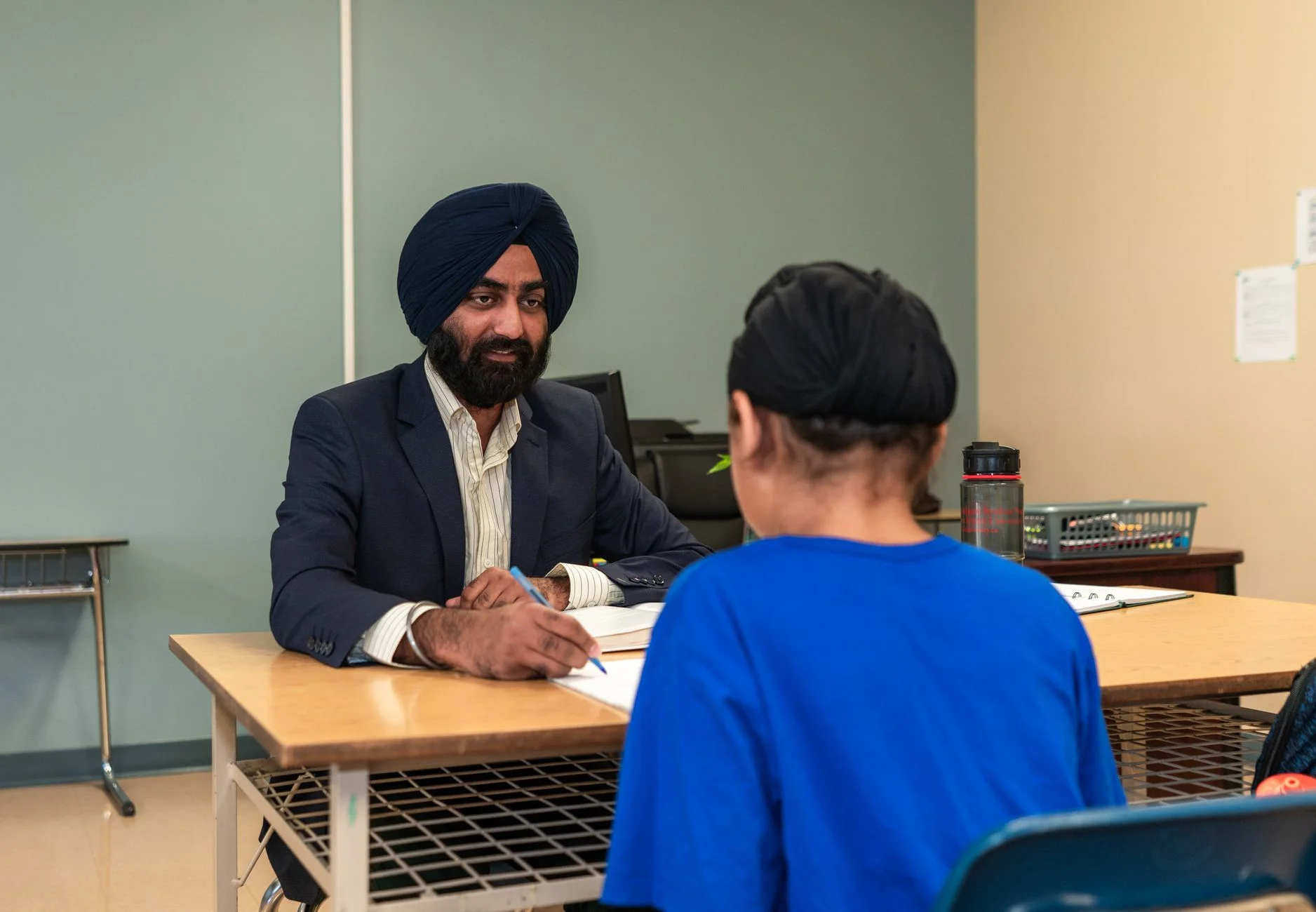
Email the form tutor, head of year or subject teacher first, and be specific and brief: "We were disappointed with X's result in the Year 10 chemistry test. Could we arrange a short call or meeting to understand what went wrong and how we can support at home?" If you are worried about more than one subject, the form tutor or head of year can coordinate. Where you suspect a learning difficulty, ask to speak to the SENCO directly, as GOV.UK advises.
It helps to go in with questions, not conclusions. Good ones include:
- Which topics or skills cost the most marks?
- Is this result typical of my child's work in class, or a surprise?
- How does my child behave in lessons? Do they ask for help?
- Is there anything you have noticed about concentration, reading, handwriting or organisation?
- What can we practise at home, and how will we know it is working?
- Is there extra support in school, such as catch-up sessions or homework club?
- When can we check progress together?
What should you do if you disagree with what the teacher says?
Ask for specific examples (marked work, test papers, notes) so that you are both looking at the same evidence. If you still disagree, ask who else could give a view, such as the head of year or the SENCO, and agree a date to review. Staying factual and polite keeps the door open for your child.
Before you leave any meeting, agree on one or two actions for school, one or two for home, and a date to review. Follow up by email with a short summary so everyone remembers the same thing. Involve your child wherever you can: older students can often attend part of a meeting or write down their own view beforehand. Children who are part of the conversation feel less "talked about" and more in control.
Growth mindset: what the evidence really says
Growth mindset is the idea, developed by psychologist Carol Dweck, that people who believe abilities can be developed through effort and good strategies tend to cope better with setbacks than people who believe abilities are fixed. It is one of the most popular ideas in schools, and parents often hear it as "tell your child they can do anything if they try". The research is more interesting, and more mixed, than that.
Some of the early findings were encouraging. In a study of 373 seventh-graders in the United States, Blackwell, Trzesniewski and Dweck (2007) found that students who believed intelligence could be developed showed rising maths grades over two years, while students who believed it was fixed stayed flat. In a small follow-up intervention, a group taught about the malleable brain reversed a decline in grades, while the comparison group's grades kept falling. In 2019, Yeager and colleagues reported a large, pre-registered study in Nature using a nationally representative US sample: a short online growth-mindset programme of under an hour improved grades among lower-achieving students, and the effect was strongest in schools where peers' attitudes supported the message.
But a larger picture came from Sisk and colleagues in 2018, in Psychological Science. They ran two meta-analyses: one on the link between mindset and achievement (273 studies, 365,915 students) and one on mindset interventions (43 studies, 57,155 students). Their conclusion was that overall effects were weak in both. They did find some support for the idea that students from lower-income families or those at academic risk might benefit more.
What should a parent take from this? Not that mindset is nonsense, and not that it is a magic fix. A fair reading is:
- Believing that ability can grow is probably helpful, particularly for children who are struggling.
- A poster or a single pep talk is unlikely to change results by itself.
- Context matters: children need real opportunities to try, strategies that work, and adults and peers who treat mistakes as normal.
- The effects found in large studies are modest on average, so be wary of anyone promising dramatic results.
If you want to see how mindset plays out in group work, read growth mindset in teamwork for GCSE students.
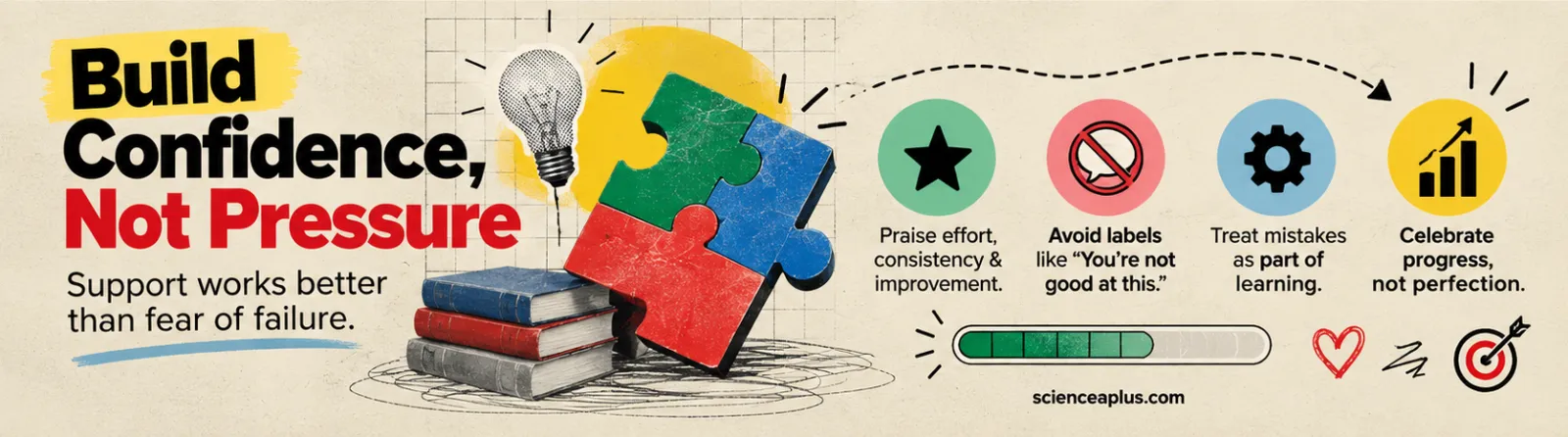
Praise that helps, and praise that backfires
One of the best-known findings is from Mueller and Dweck (1998). In a series of experiments with children around the end of primary school, they reported that praising children for intelligence ("You must be smart at this") could undermine later motivation and performance, compared with praising effort or strategy. Not every later study has found effects as strong, but the practical advice is simple and sensible: say what the child actually did.
- Instead of "You're so clever", try "You kept going on that tricky question, and it worked."
- Instead of "You're hopeless at maths", try "You haven't got this yet. Which step lost you?"
- Instead of "Well done, full marks", try "Your plan for the essay was clear. That's why it flowed."
Turn the result into a plan
Once you know the likely cause, shift from "what went wrong" to "what next". Keep the plan small. A plan with fifteen steps will not survive a school week; a plan with three will.
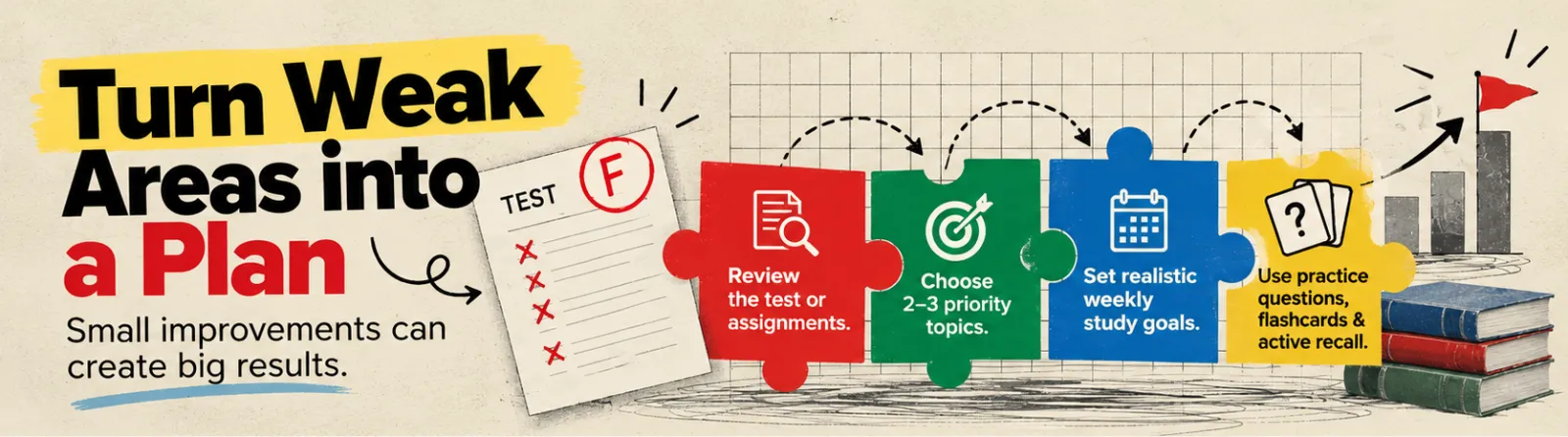
The graphic above lays out four moves that work well together: review the paper, choose a few priority topics, set realistic weekly goals and practise with questions rather than just rereading. Here is how that looks in practice.
- Review the paper together. Sort lost marks into knowledge gaps, technique slips and careless errors.
- Pick two or three priorities. Choose the topics that lost most marks or that later topics depend on.
- Set weekly goals your child agrees to. For instance, "three 20-minute sessions on ratio, then ten practice questions."
- Check in briefly each week. Ask "what's gone well and what's stuck?" and adjust.
- Re-test the same skill after a few weeks and celebrate the movement, however small.
A realistic study routine for a school week
This guide does not replace our dedicated revision articles, so here is the short version, based on what research on learning techniques suggests. In a major review, Dunlosky and colleagues (2013) examined ten popular techniques and rated practice testing (quizzing yourself) and distributed practice (spreading study over time) as having the highest utility, while highlighting and rereading were rated low. That is useful, because highlighting and rereading are exactly what many tired students do.
That translates into a few parent-friendly habits:
- Little and often. Four 20-minute sessions across a week beat one two-hour session on Sunday night.
- Quiz, don't just reread. Cover the notes and ask, "What do I remember about this?" then check. Flashcards, past-paper questions and teach-it-back all count.
- Mix it up. Alternate subjects or topics so that the brain has to retrieve, not just recognise.
- Start with the hardest or most important task while energy is highest.
- Protect sleep and breaks. A tired brain learns less per minute.
For techniques in detail, see how to practise and remember what you study. If your child wants to study but keeps putting it off, our guide on how to stop procrastinating tackles that directly.

Your role is to make the routine easy, not to run it. That might mean a quiet, clutter-free place to work, phones out of the room during study blocks, snacks and water, and a visible weekly planner. Ask "Do you want me to quiz you on this?" rather than standing over a shoulder. Offering to be the quizmaster is one of the most helpful and least intrusive things a parent can do, even if you do not know the subject: you just need the answers on a card.
Use this checklist as a starting point for a household routine. Ticks are saved in your browser.
- We have looked at the marked paper together
- We have chosen two or three priority topics
- Study sessions are in the weekly planner, 20 to 30 minutes each
- Phone is out of reach during study time
- There is a regular bedtime on school nights
- We have a short weekly check-in booked
- We have a date to review progress with the teacher
Rewards, pressure and motivation
Many parents wonder whether to offer rewards for better grades. The evidence on this is mixed, and the problem is that a reward for a number can shift attention from learning to the number. If you want to recognise effort, rewarding the process (finishing the planned sessions, asking for help when stuck) is safer than rewarding the outcome. Our article on extrinsic motivation and study strategies explores this in more depth.
Pressure is similar. Some pressure focuses attention, but too much turns into worry, and worry uses up the mental capacity a child needs to think. High expectations paired with warmth and support tend to work better than high expectations paired with fear. If your child says "I'll never be good enough", treat it as a feeling to listen to, not an argument to win.
When to get extra help
Most dips in grades are solved with a calm conversation, a clearer plan and some patience. But sometimes the right move is to bring in more support. The sooner you ask, the more options you have.
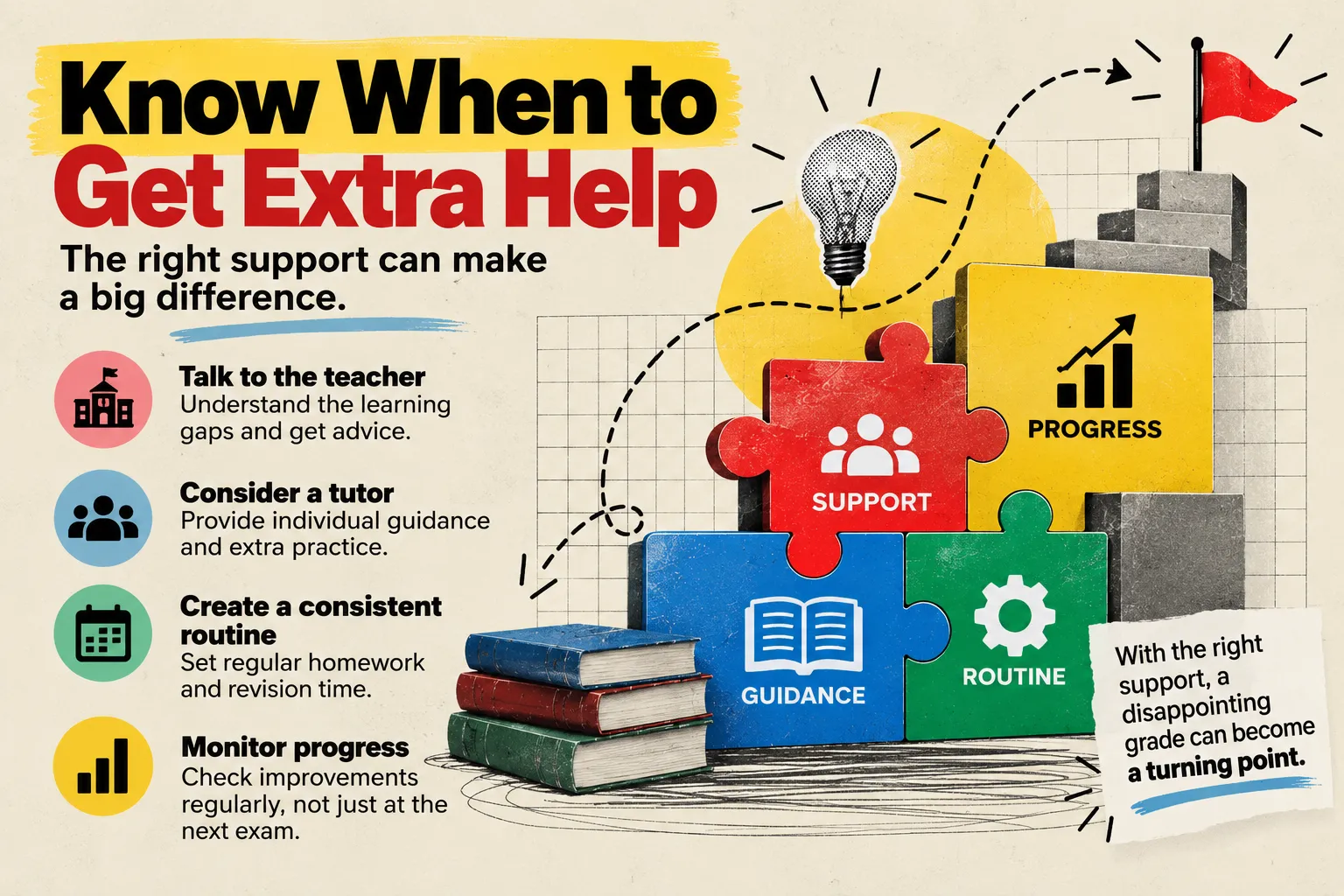
Extra help with learning: school, tutors and routines
Start with the school: the subject teacher, then the head of year or SENCO. Many schools offer catch-up sessions, homework clubs or small-group support. If school-based help is not enough, or your child needs more one-to-one practice, a tutor can be useful. Our guide on how a tutor can improve your child's GCSE results explains what to look for. A good tutor should work from the teacher's feedback, set clear short-term goals and report on progress; a tutor is not a substitute for dealing with sleep, wellbeing or a possible learning difference.
If you are early in the school year or your child is only in Year 9 or 10, starting small habits now pays off later. See why you should start revising for GCSE early for the case, without the panic.
Help with wellbeing: GP, school and CAMHS
According to the NHS, if your child is feeling low or anxious for a prolonged period, or if you have any serious concerns about how they are feeling or acting, you may want to seek professional help. Worries or low mood that stop them enjoying usual activities, stop them going into school, or affect eating and sleeping are all reasons to talk to someone.
As a first step, the NHS suggests speaking to someone you trust at school or college, such as a teacher, school nurse, mental health lead or the SENCO, or to a GP. They can tell you what support is available locally and put you in touch with children and young people's mental health services, often called CAMHS. These services are for anyone under 18 (under 25 in some areas) and offer talking therapies such as counselling, family therapy and, in some cases, medicines. A child under 16 may need a parent's or carer's consent, though not always. In some areas you or your child can refer yourselves; in others a referral from the school, GP or another professional is needed.
You are not expected to manage this alone. YoungMinds runs a free, confidential parents' helpline on 0808 802 5544 (9.30am to 4pm, Monday to Friday), and you can email [email protected] for a reply within three working days, according to the NHS.
Looking after yourself too
Your child's results can feel like a verdict on your parenting. They are not. Teenagers' school performance depends on far more than any one adult. Try to keep some perspective: talk to a friend, a partner or the school if you are feeling anxious yourself, because children pick up on parental stress quickly. A calm adult is one of the most useful resources a struggling student has.
Finally, build in positives. Keep doing the things you enjoy together that have nothing to do with school. Learning is a long game, and a child who feels loved and capable outside lessons is better placed to cope with difficulty inside them.

Frequently asked questions about helping a child after poor grades
How should I react when my child gets bad grades?
Stay calm and pause before you respond. Thank your child for showing you, ask how they feel, and listen without lecturing. Avoid comparing them with others or threatening consequences. Once emotions settle, look at the paper together to work out what went wrong and agree on a small next step.
Why is my child's school performance suddenly dropping?
Common causes include a gap in earlier learning, tiredness, worry, friendship problems, bullying, a learning difference or lost motivation. A drop across many subjects often points to something outside lessons, such as sleep or wellbeing. Talk to your child, then to their teachers, to find the pattern before deciding on help.
Should I punish my child for poor grades?
Punishment tends to teach children to hide bad news rather than learn from it. It is usually more effective to find the cause and agree on a plan. Reasonable boundaries, such as phones out of the room during study time, are fine when they are part of that plan.
How do I talk to my child's teacher about poor grades?
Email the form tutor or subject teacher, say you would like to understand the result and how to support it at home, and ask for a short meeting or call. Bring questions rather than conclusions, ask for examples of lost marks, and agree one or two actions and a review date.
What does a SENCO do?
The special educational needs co-ordinator (SENCO) is the member of school staff responsible for supporting pupils with special educational needs and disabilities. If you think your child may have difficulties with reading, writing, concentration or understanding, GOV.UK advises contacting the school SENCO first to discuss SEN support.
Does growth mindset really improve grades?
The evidence is mixed. A 2018 meta-analysis by Sisk and colleagues found weak overall effects of mindset interventions on achievement, though possible benefits for low-income or academically at-risk students. A 2019 Nature study found improvements for lower-achieving students in supportive school settings. It helps, but it is not a quick fix.
How much sleep does a teenager need for school?
The NHS says most teenagers need 8 to 10 hours' sleep a night, though needs vary. Sleep supports concentration, memory and mood. Puberty shifts the body clock later, so a regular bedtime, a wind-down routine and phones out of the bedroom can help.
When should I see a GP about my child's school worries?
The NHS advises seeking professional help if your child feels low or anxious for a prolonged period or you have serious concerns about how they feel or act. Warning signs include avoiding school, losing interest in usual activities, or changes in eating and sleeping. A GP or school can guide you to CAMHS.
Is a tutor worth it after poor grades?
A tutor can help when a child has specific knowledge gaps or needs regular one-to-one practice, especially if they work from teacher feedback with clear goals. A tutor will not fix tiredness, anxiety or an unidentified learning difference, so find the cause first, then decide whether tutoring fits.
Can a bad grade in Year 10 or 11 be recovered?
Yes. A single test or mock is a snapshot, not a final result. Identifying priority topics, practising with questions and reviewing progress regularly can raise performance over time. Results are not guaranteed, but early action gives your child the most time to improve before final exams.