The James Webb Space Telescope (JWST) is the largest and most powerful space telescope ever launched. It looks at the universe in infrared light, which lets it see the faintest, most distant galaxies, peer through dusty clouds where stars are born, and study the atmospheres of planets orbiting other stars. Since its first images appeared in July 2022, the Webb telescope has changed what we know about the early universe.
This guide explains what the telescope is, who built it, why it was designed to work in infrared, and how that connects to the red-shift you meet in GCSE physics. Later sections cover its instruments, mirror and sunshield, how it compares with Hubble, and the main James Webb telescope discoveries so far.
What is the James Webb Space Telescope?
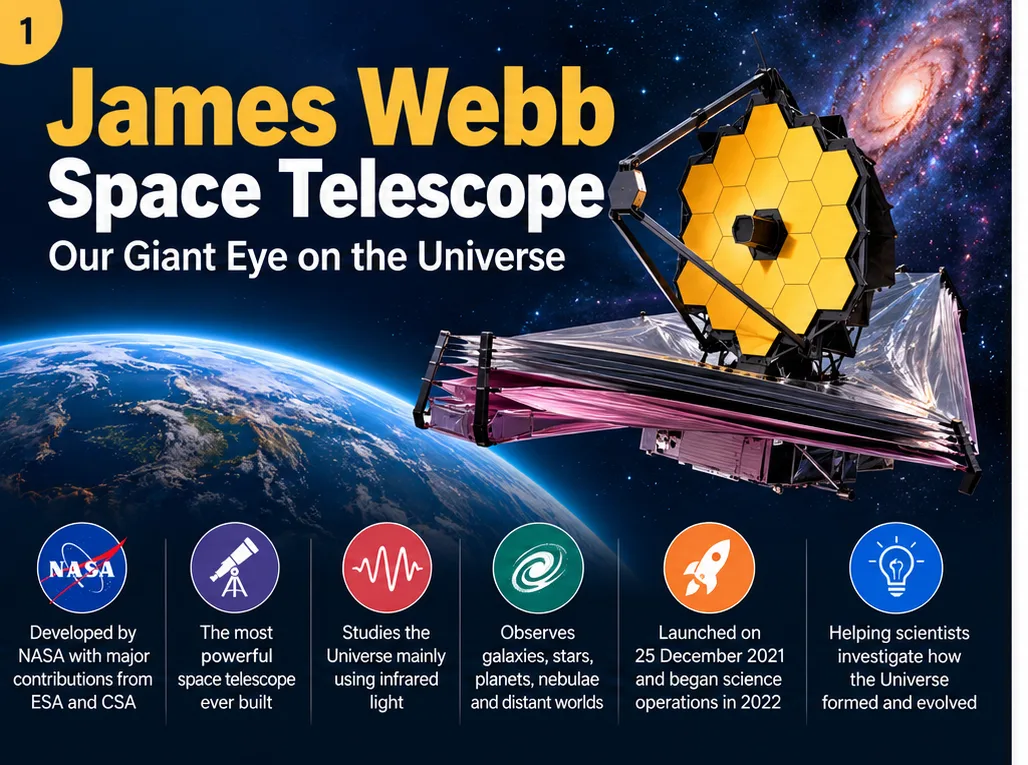
JWST is an infrared space observatory. Its main mirror is 6.5 m across and is made of 18 hexagonal beryllium segments coated with a thin layer of gold. Together they collect about 25 m² of light, roughly 6 times the collecting area of the Hubble Space Telescope, whose mirror is 2.4 m wide.
Webb launched on 25 December 2021 on an Ariane 5 rocket from Kourou, French Guiana. It then travelled to a spot called the Sun–Earth L2 point, about 1.5 million km from Earth, roughly 4 times the distance to the Moon. It arrived in late January 2022 and began a long process of unfolding, cooling down and aligning its mirror.
The telescope detects wavelengths from about 0.6 to 28.8 micrometres. That covers visible red light, near-infrared and mid-infrared, which our eyes cannot see but which carry a huge amount of information about the cosmos.
Who built it and why it’s named after James Webb
Webb is a partnership between NASA, the European Space Agency (ESA) and the Canadian Space Agency (CSA). Northrop Grumman was the prime contractor, and the whole project cost around $10 billion. Teams across many countries built different parts: ESA provided one of the spectrographs and the launch, Canada supplied the fine guidance sensor, and US universities and companies built cameras and structures.
The telescope is named after James E. Webb, who was NASA Administrator from 1961 to 1968. He led the agency through much of the Apollo era, when NASA was preparing to land people on the Moon, and he strongly backed space science as well as crewed flight.
Why was Webb built?
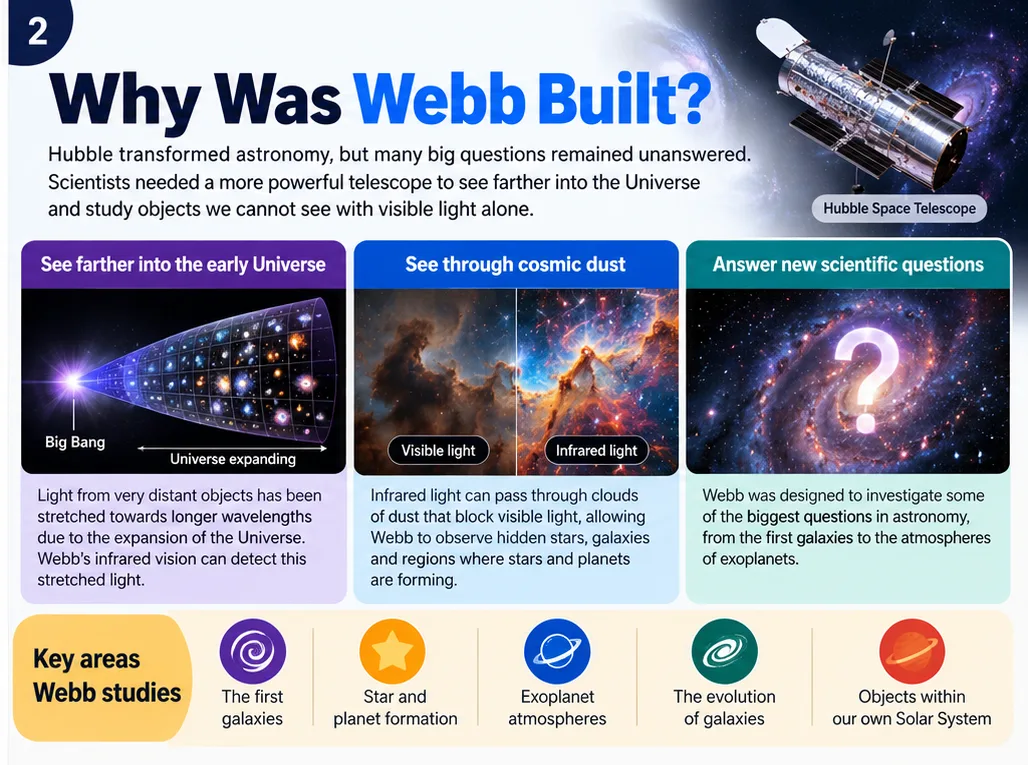
Hubble, launched in 1990, mostly sees visible and ultraviolet light with a little near-infrared. It transformed astronomy, but some of the biggest questions cannot be answered in visible light. Astronomers wanted a telescope designed from the start to work in infrared, and it had to be big, cold and far from Earth’s heat. That is the thinking behind why Webb uses infrared, and it comes down to three jobs.
Seeing the first galaxies
Looking far away means looking back in time, because light takes time to travel. The Big Bang happened about 13.8 billion years ago, so light from the earliest galaxies has been travelling for over 13 billion years to reach us.
During that journey the universe has been expanding. The expansion stretches the light waves, so their wavelength gets longer. This is red-shift. For the most distant galaxies, light that started out as visible or ultraviolet is stretched all the way into the infrared.
distant galaxy light: visible → stretched → infrared
A telescope that only sees visible light would miss these galaxies almost completely. Webb was built to catch that stretched light, which is why it can find galaxies from only about 300 million years after the Big Bang.
Seeing through dust
Stars form inside huge clouds of gas and dust. Visible light is scattered and absorbed by the dust, so newborn stars are often hidden. Infrared has a longer wavelength and passes through much of that dust more easily. Webb can therefore show young stars and planet-forming discs that visible-light telescopes cannot reach.
This is how Webb produced its detailed infrared views of the Pillars of Creation in 2022, the “Cosmic Cliffs” of the Carina Nebula and the Southern Ring Nebula.
Studying other worlds
Cool objects such as planets and brown dwarfs glow mainly in the infrared, so Webb can observe them directly or through their effect on starlight. When a planet passes in front of its star, some starlight filters through the planet’s atmosphere, and gases leave fingerprints in the spectrum. Webb has used this to detect carbon dioxide, water vapour and sulfur dioxide in exoplanet atmospheres.
Infrared is hard to study from the ground, because Earth’s atmosphere absorbs much of it. The telescope must also be extremely cold, otherwise its own heat would swamp the faint signals it is trying to measure. That is why Webb sits far out in space behind a huge sunshield.
Webb works alongside other missions and observatories rather than replacing them. For the wider story of how rockets, satellites and telescopes let us explore space, see our guide to exploring the universe. Next, we look at how Webb’s instruments actually collect and split up that infrared light.
How does the Webb telescope see the universe?
The James Webb Space Telescope works a little like a giant digital camera that sees heat instead of colour. Its huge mirror collects faint infrared light and focuses it onto four science instruments. Each instrument turns that light into either a picture or a spectrum, which is the light split into its separate wavelengths.
Together, the instruments cover wavelengths from about 0.6 to 28.8 micrometres. That runs from the red edge of visible light, through the near-infrared, and out into the mid-infrared. Your eyes cannot see any of it, so astronomers assign visible colours to the data to build the images you see in the news.
| Instrument | What it does | Provided by |
|---|---|---|
| NIRCam | Near-infrared camera. Takes the main deep images of galaxies and stars. | University of Arizona and Lockheed Martin |
| NIRSpec | Near-infrared spectrograph. Splits light into spectra and can observe about 100 objects at once. | European Space Agency (ESA) |
| MIRI | Mid-infrared instrument. Sees the longest wavelengths, including dusty, cool objects. | Europe and the United States |
| FGS/NIRISS | Fine guidance sensor keeps Webb pointing steadily. NIRISS is a near-infrared imager and slitless spectrograph. | Canadian Space Agency (CSA) |
Why do astronomers need both cameras and spectrographs? A picture shows what an object looks like. A spectrum shows what it is made of, because atoms and molecules absorb light at particular wavelengths. That is how Webb can detect gases such as carbon dioxide in the atmosphere of a planet trillions of kilometres away.
The giant gold mirror
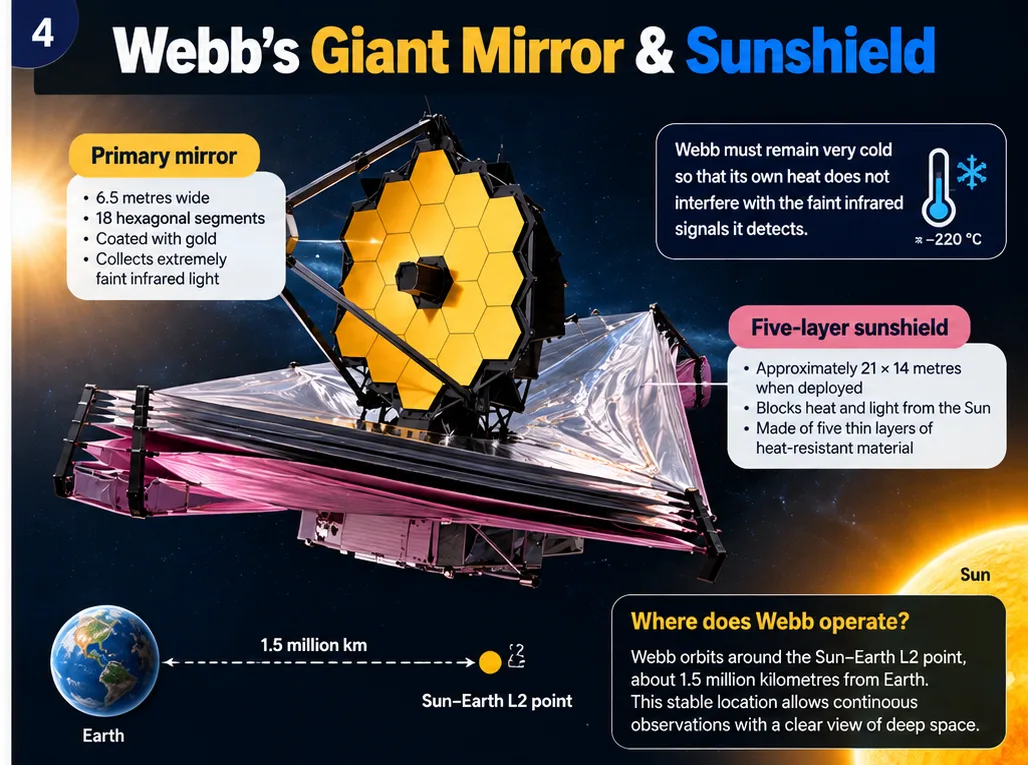
Webb’s primary mirror is 6.5 metres across. That is far too wide to fit inside any rocket, so the mirror is built from 18 hexagonal segments made of beryllium, a light but stiff metal. The segments fit together like honeycomb cells to act as one large mirror.
The whole mirror has a collecting area of about 25 m², roughly six times that of the Hubble Space Telescope, whose mirror is 2.4 m across. A bigger collecting area gathers more photons, so Webb can detect much fainter and more distant objects.
To fit into the nose of an Ariane 5 rocket, the mirror and the rest of the telescope were folded up for launch. After launch they unfolded in space, in a long sequence that engineers had no chance to repair if something went wrong.
Why is Webb’s mirror gold?
Each segment is coated with a very thin layer of gold. The reason is that gold reflects infrared light extremely well, and infrared is exactly what Webb is built to collect. The total amount of gold on the mirror is only about 48 g, so the coating is thinner than a human hair by a huge margin. If you want to know more about the metal itself, see our guide to gold, the precious metal.
The tennis-court sunshield
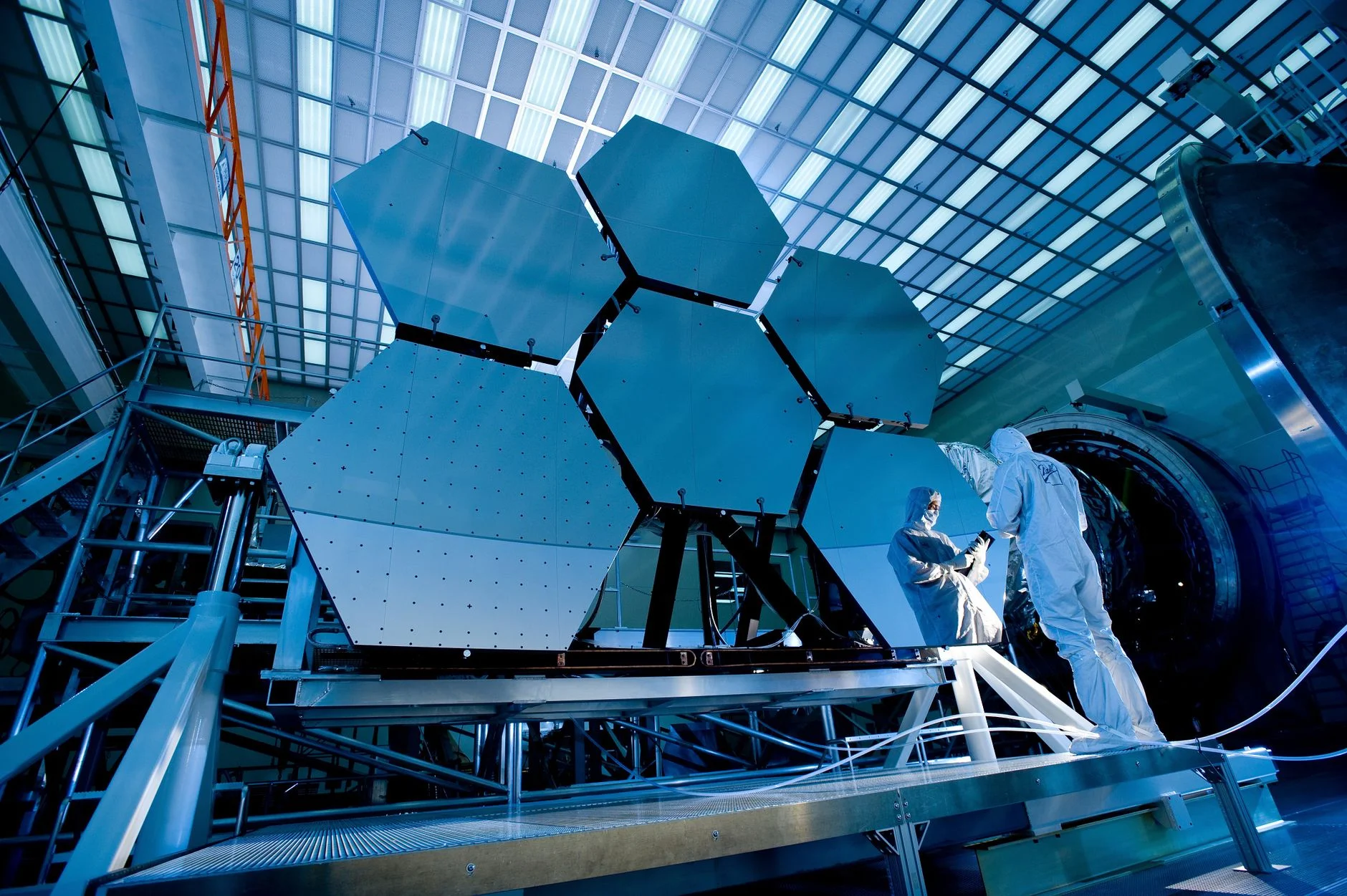
Warm objects glow in infrared. If Webb were warm, its own heat would swamp the faint signals from distant galaxies, a bit like trying to photograph a candle while holding a torch in front of the lens. So the telescope has to be very cold.
The solution is a sunshield made of five layers of Kapton, a thin plastic film. When unfolded, it is about the size of a tennis court, roughly 21 m × 14 m. It always sits between the telescope and the Sun, Earth and Moon, so the mirror and instruments stay in permanent shade.
The temperature difference across the shield is huge. The Sun-facing side can reach over 80 °C, while the telescope side stays below about 50 K, which is −223 °C. Each layer in turn blocks and reflects heat, so the shield works like a stack of extremely effective parasols.
One instrument needs even more help. MIRI sees the longest infrared wavelengths, so it is chilled further to about 7 K by a cryocooler. At that temperature the instrument’s own heat is no longer a problem.
Where is Webb? The L2 point
Unlike Hubble, which orbits Earth, Webb orbits the Sun. It sits near the Sun–Earth L2 point, about 1.5 million km from Earth, roughly four times the distance to the Moon. It reached this orbit in late January 2022, around a month after launch.
At L2 the Sun, Earth and Moon are all in roughly the same direction. That means one sunshield can block all three at once, keeping the telescope cold and stable. It is the best spot for an infrared observatory, but it is also very far away.
Here is a typical exam-style question to test your understanding.
Why can’t astronauts repair Webb in the way they repaired Hubble? (2 marks)
Webb is about 1.5 million km from Earth, roughly four times the distance to the Moon, so it is much too far for a crewed servicing mission (1 mark). Hubble orbits Earth at only about 500 km, which astronauts can reach (1 mark).
Webb vs Hubble: how do the two telescopes compare?
People often ask whether the James Webb Space Telescope replaced Hubble. It did not. Hubble, launched in 1990, still works, and the two telescopes look at the universe in different kinds of light. Astronomers often point both at the same target and combine the results.
The biggest difference is the part of the spectrum each one sees. Hubble observes mainly visible and ultraviolet light, plus some near-infrared. The Webb telescope is built for infrared light, covering about 0.6–28.8 micrometres.
| Feature | Hubble | James Webb Space Telescope |
|---|---|---|
| Launch | 1990 | 25 December 2021 |
| Main mirror | 2.4 m across | 6.5 m across, 18 gold-coated beryllium segments |
| Collecting area | Smaller | About 25 m², roughly 6 times Hubble’s |
| Wavelengths | Mainly visible and ultraviolet, some near-infrared | Infrared, about 0.6–28.8 micrometres |
| Orbit | Around Earth, about 500 km up (now about 475 km) | Around the Sun–Earth L2 point |
| Distance from Earth | Hundreds of kilometres | About 1.5 million km, roughly 4 times the Moon’s distance |
| Temperature | Not cooled to extreme cold | Below about 50 K (−223 °C); MIRI about 7 K |
| Servicing | Astronauts have visited it | Too far away for astronauts to repair |
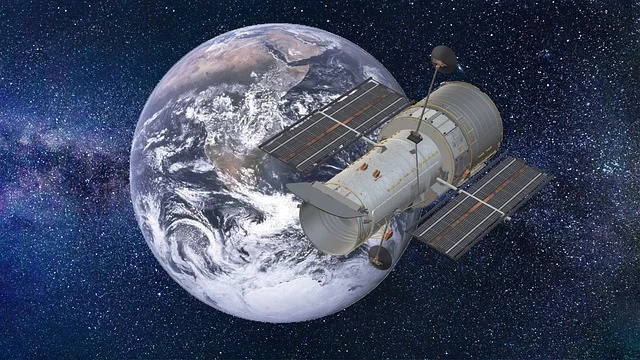
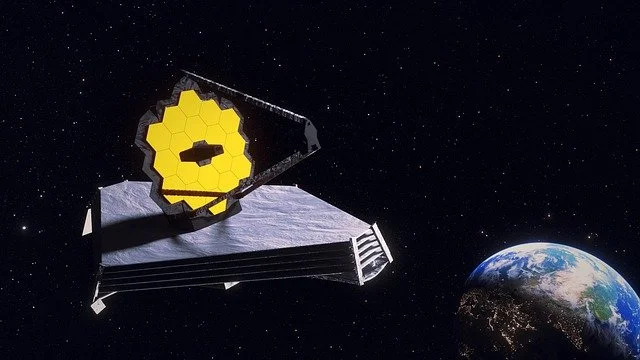
The mirror size matters because a bigger mirror collects more light, so fainter and more distant objects become visible. Webb’s larger collecting area, combined with infrared vision, lets it see things Hubble cannot reach. Distance matters too. Sitting 1.5 million km away, far from Earth’s warmth, helps Webb stay cold enough to detect faint heat signals.
What has the James Webb Space Telescope discovered?
Since the first full-colour images were released on 12 July 2022, James Webb telescope discoveries have appeared almost every month. The first image, Webb’s First Deep Field of the galaxy cluster SMACS 0723, was shown by President Biden on 11 July 2022. Here are the main areas where JWST has changed what we know.
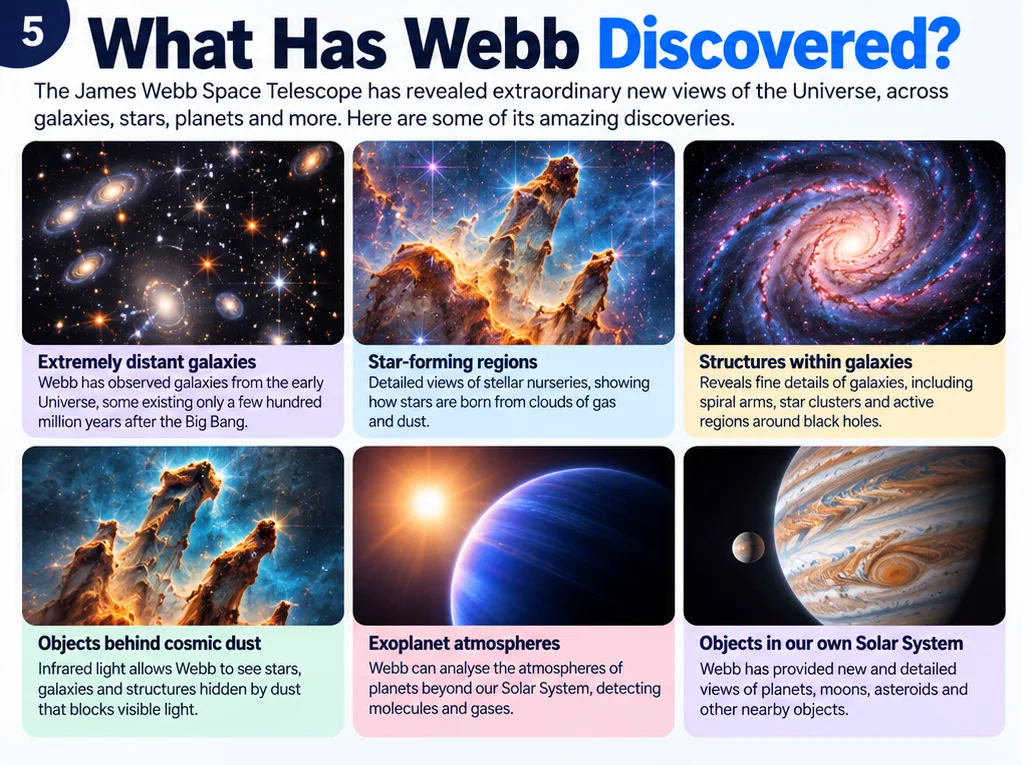
The earliest galaxies
The Big Bang happened about 13.8 billion years ago, and looking far away means looking back in time. Webb has found galaxies from only about 300 million years after the Big Bang. JADES-GS-z14-0, announced in 2024, was seen as it was about 290 million years after the Big Bang and was a record holder until 2025, when Webb found MoM-z14, seen about 280 million years after the Big Bang.
Astronomers have also found more bright early galaxies than they expected. That means models of how quickly galaxies formed need testing and adjusting. It is a good example of science working properly: new evidence, then better ideas. Questions about extreme objects in the early universe link to topics such as black holes and what we can learn from them.
Stars and planets being born
Infrared light passes through dust clouds that hide newborn stars from visible-light telescopes. In 2022, Webb produced detailed infrared views of the Pillars of Creation, and of the Carina Nebula’s “Cosmic Cliffs”. It also imaged the Southern Ring Nebula.
These images show stars forming inside thick dust. Our own Sun and planets formed from a cloud like this, which you can read about in the origin of our Solar System.
Exoplanet atmospheres
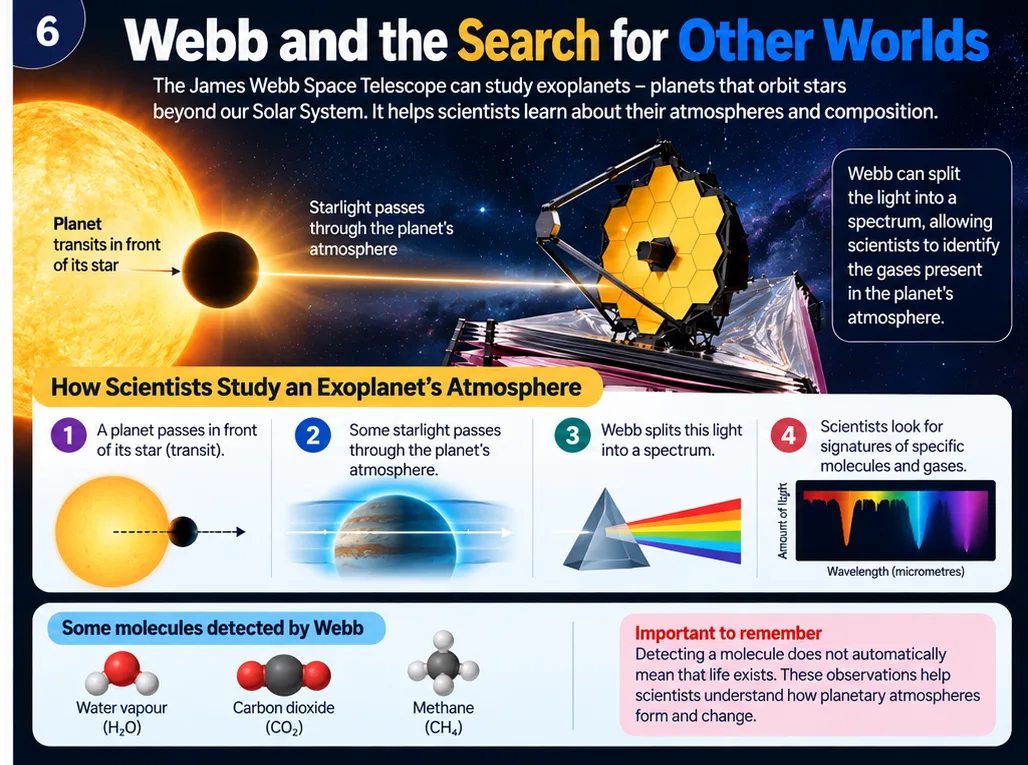
When a planet passes in front of its star, a little starlight filters through the planet’s atmosphere. Webb’s spectrographs split that light, and gases leave their fingerprints. In 2022, JWST made the first clear detection of carbon dioxide in an exoplanet atmosphere, on WASP-39b. It also found water vapour and sulfur dioxide, which forms through photochemistry driven by the star’s light.
Webb has also looked at K2-18b. In 2023 it found possible methane and carbon dioxide in the atmosphere. A claimed hint of dimethyl sulfide is disputed, so these are possible signs, not confirmed ones. Webb has also taken direct images of exoplanets, such as HIP 65426 b in 2022.
Our own Solar System
Webb does not only look far away. It has imaged Neptune’s rings in infrared and captured Jupiter’s auroras. Because the telescope is so sensitive, it needs special care when observing very bright nearby objects, but the results add new detail to planets we thought we knew.
All of this data becomes public through an archive, with most of it released after a 12-month exclusive period. Students and researchers anywhere can study it.
Six discoveries to flip through
Looking back in cosmic time
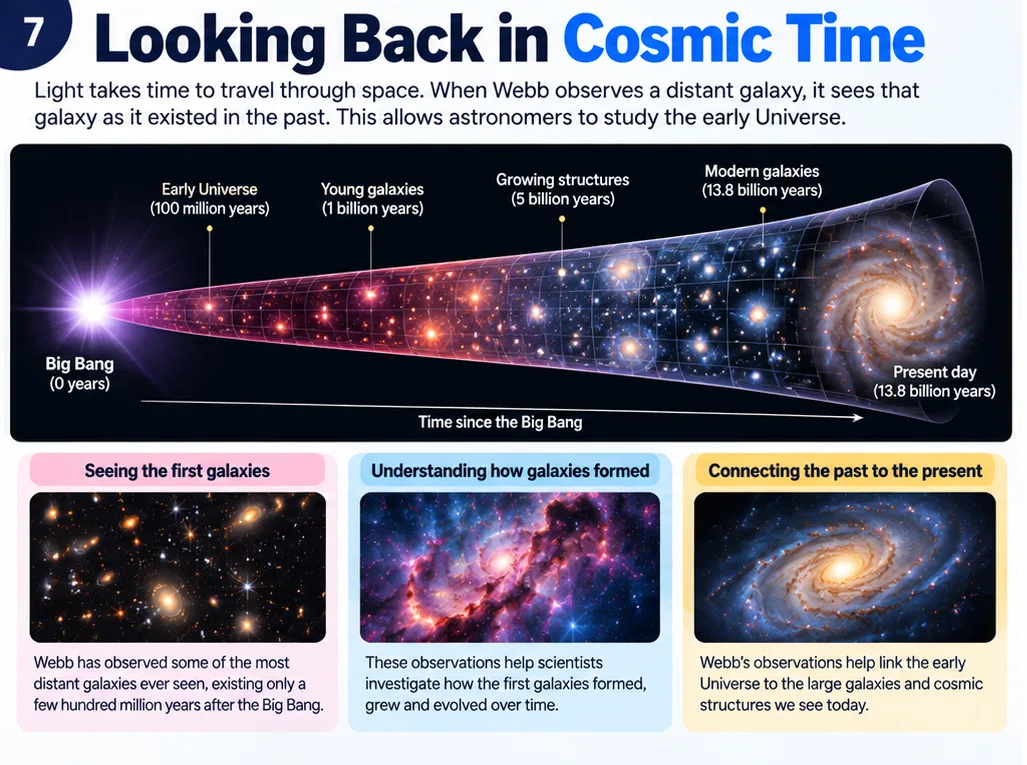
The most surprising thing about the James Webb Space Telescope is that it works as a time machine. Light travels at a fixed speed, so light from a faraway object takes a long time to reach us. When Webb collects it, we see the object as it was when the light set out, not as it is today.
The Big Bang happened about 13.8 billion years ago. A galaxy whose light has travelled for most of that time is seen as a very young galaxy. Looking far away means looking back in time, and that is the reason JWST was built to see the earliest light in the universe.
From visible light to infrared
The universe is expanding, and that stretches the light as it travels. Visible light from the first galaxies has been pulled out into longer wavelengths by the time it arrives, so it reaches us as infrared. This is called red-shift, and it is why the Webb telescope carries infrared instruments covering about 0.6–28.8 micrometres.
Hubble could not see these galaxies properly because it observes mainly visible and ultraviolet light. Webb picked up where Hubble ran out of reach, and its early results included galaxies from only about 300 million years after the Big Bang. JADES-GS-z14-0, announced in 2024, is seen as it was about 290 million years after the Big Bang. It has since been overtaken by MoM-z14 (about 280 million years after the Big Bang, reported in 2025).
Why the expansion matters
The stretching of light is a direct measurement of how space has expanded. By comparing galaxies at different distances, astronomers can test how fast the universe grew over time. That links Webb to some of the biggest open questions, including dark energy, the name given to whatever is driving the expansion.
Webb also looks at tiny patches of sky for a long time rather than scanning everything. If you want to know how we divide up the sky we see from Earth, read our guide to how many constellations there are. For the wider story of how scientists model the universe, see beautiful cosmology.
The future of Webb
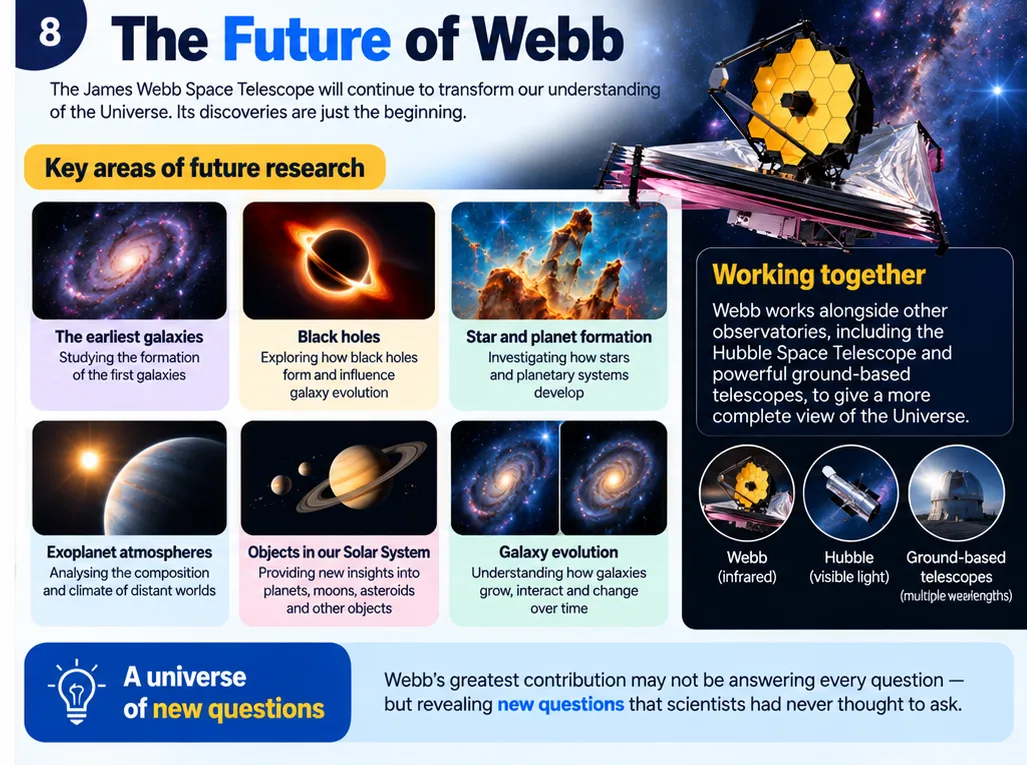
Webb was designed to work for at least 5–10 years. Its launch on 25 December 2021 was so accurate that it saved fuel, and NASA now says it has fuel for about 20 years of science. NASA describes this as significantly more than a 10-year science lifetime.
That matters because Webb cannot be serviced. It sits about 1.5 million km away, far beyond the reach of astronauts, so it has to work with what it carries. Hubble was repaired several times in orbit, but Webb has no such safety net.
In the coming years astronomers will keep studying the earliest galaxies, the birth of stars and the atmospheres of planets around other stars. Webb and Hubble will go on complementing each other for as long as both keep working.
A short timeline of the James Webb Space Telescope
- 1961–1968: James E. Webb is NASA Administrator during the Apollo era. The telescope is later named after him.
- 1990: Hubble is launched. Webb will be built to see what Hubble cannot, in the infrared.
- 25 December 2021: Webb launches on an Ariane 5 rocket from Kourou, French Guiana.
- Late January 2022: Webb arrives at its orbit around the Sun–Earth L2 point.
- 11–12 July 2022: The first image, Webb’s First Deep Field of the galaxy cluster SMACS 0723, is shown on 11 July, and the first full-colour images follow on 12 July.
- 2022: Webb detects carbon dioxide in the atmosphere of the exoplanet WASP-39b.
- 2024: The galaxy JADES-GS-z14-0, seen about 290 million years after the Big Bang, is announced.
- 2025: MoM-z14, seen about 280 million years after the Big Bang, breaks the record.
Test yourself: James Webb Space Telescope quiz
Key points: James Webb Space Telescope
- The James Webb Space Telescope (JWST) is an infrared observatory from NASA, ESA and the Canadian Space Agency, launched on 25 December 2021.
- It has a 6.5 m gold-coated beryllium mirror, a collecting area of about 25 m² and a tennis-court-sized sunshield.
- It sits about 1.5 million km from Earth at the Sun–Earth L2 point and cannot be repaired by astronauts.
- Red-shift stretches light from the first galaxies into the infrared, so looking far away means looking back in time.
- James Webb telescope discoveries include galaxies as early as about 280–290 million years after the Big Bang and carbon dioxide in an exoplanet atmosphere.
- It has fuel for about 20 years, and its data become public after an exclusive period.
Frequently asked questions about the James Webb Space Telescope
What is the James Webb Space Telescope?
The James Webb Space Telescope (JWST) is an infrared space observatory run by NASA with the European and Canadian space agencies. It has a 6.5 m gold-coated mirror and sits about 1.5 million km from Earth. Launched on 25 December 2021, it studies the first galaxies, star birth and the atmospheres of planets around other stars.
How far away is JWST?
Webb orbits the Sun–Earth L2 point, about 1.5 million km from Earth, roughly four times the distance to the Moon. It does not orbit Earth itself, and it follows Earth around the Sun. At this distance astronauts cannot reach it for repairs, unlike the Hubble Space Telescope.
Why does Webb use infrared?
Light from very distant galaxies is stretched into infrared by the expansion of the universe. Infrared also passes through dust clouds that hide newborn stars, and cool objects such as planets and brown dwarfs glow in it. Earth’s atmosphere absorbs much infrared, so the telescope works best in space.
What is the difference between Webb and Hubble?
Hubble, launched in 1990, observes mainly visible and ultraviolet light from roughly 500 km above Earth. Webb observes infrared from about 1.5 million km away, with a mirror 6.5 m across compared with Hubble’s 2.4 m. Webb’s collecting area is roughly six times larger, and the two telescopes complement each other.
How big is Webb’s mirror?
Webb’s primary mirror is 6.5 m across and made of 18 hexagonal beryllium segments coated with a thin layer of gold. Its collecting area is about 25 m², roughly six times Hubble’s. The mirror was folded to fit inside the rocket and then unfolded in space after launch.
What has JWST discovered?
Webb has found galaxies from only about 300 million years after the Big Bang, including JADES-GS-z14-0 at around 290 million years and MoM-z14 at around 280 million years. It has detected carbon dioxide in the atmosphere of the exoplanet WASP-39b, imaged the Pillars of Creation in infrared, and revealed Neptune’s rings in new detail.
How long will JWST last?
Webb was designed to work for at least 5–10 years. Its launch was so accurate that it saved fuel, and NASA expects it to have fuel for about 20 years of science. Astronauts cannot service it, so it has to keep working with the fuel and equipment it carries.
Why is Webb gold?
Gold reflects infrared light very well, and Webb is an infrared telescope. Each of the 18 beryllium mirror segments has a thin gold coating, and only about 48 g of gold is used in total. The coating is very thin, so it is the metal’s reflectivity that matters.
How cold is Webb?
The sunshield keeps most of Webb below about 50 K (−223 °C), while its hot side can reach over 80 °C. The mid-infrared instrument, MIRI, is cooled further to about 7 K by a cryocooler. The telescope must be this cold so its own heat does not swamp faint infrared signals.