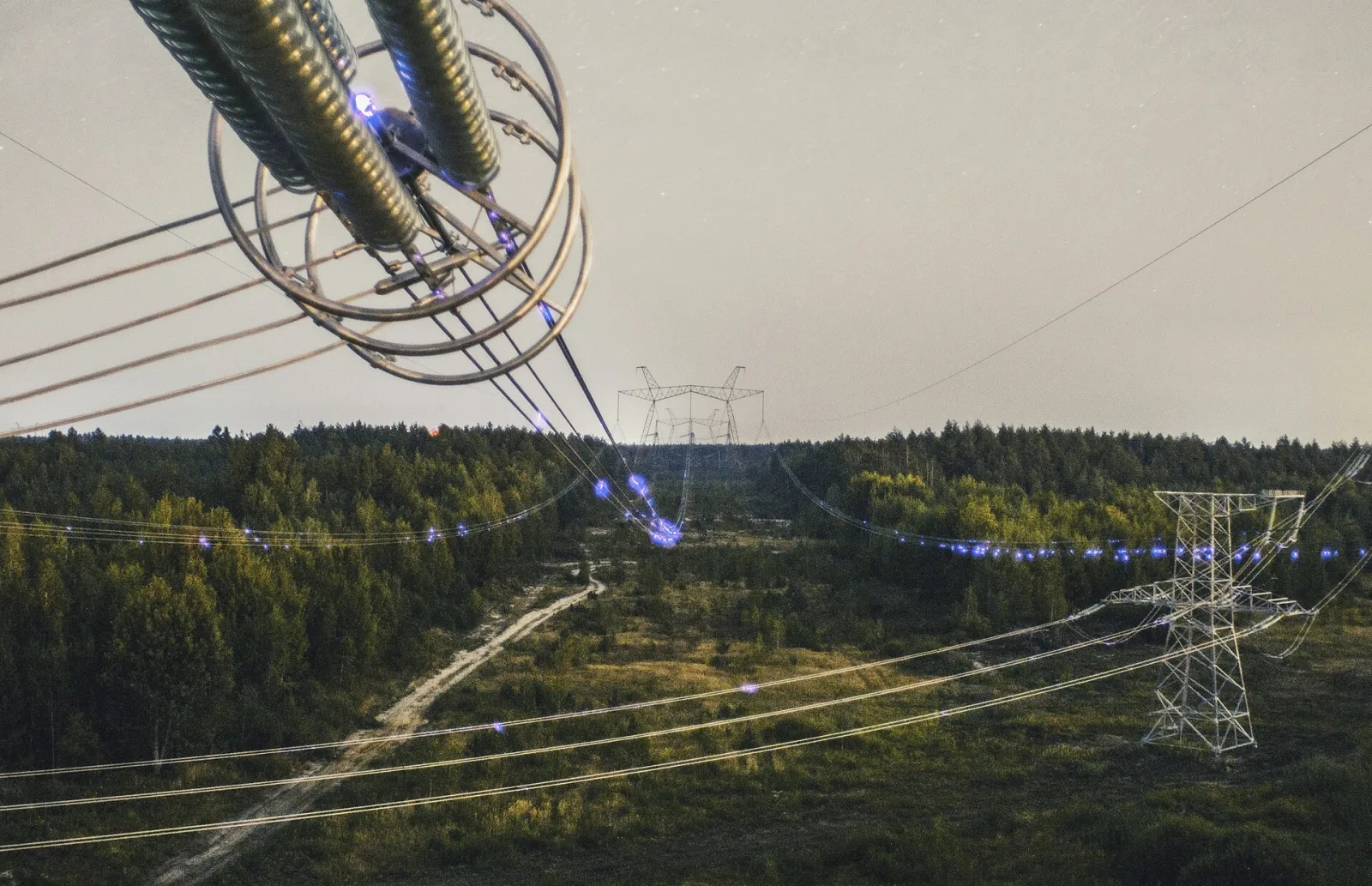
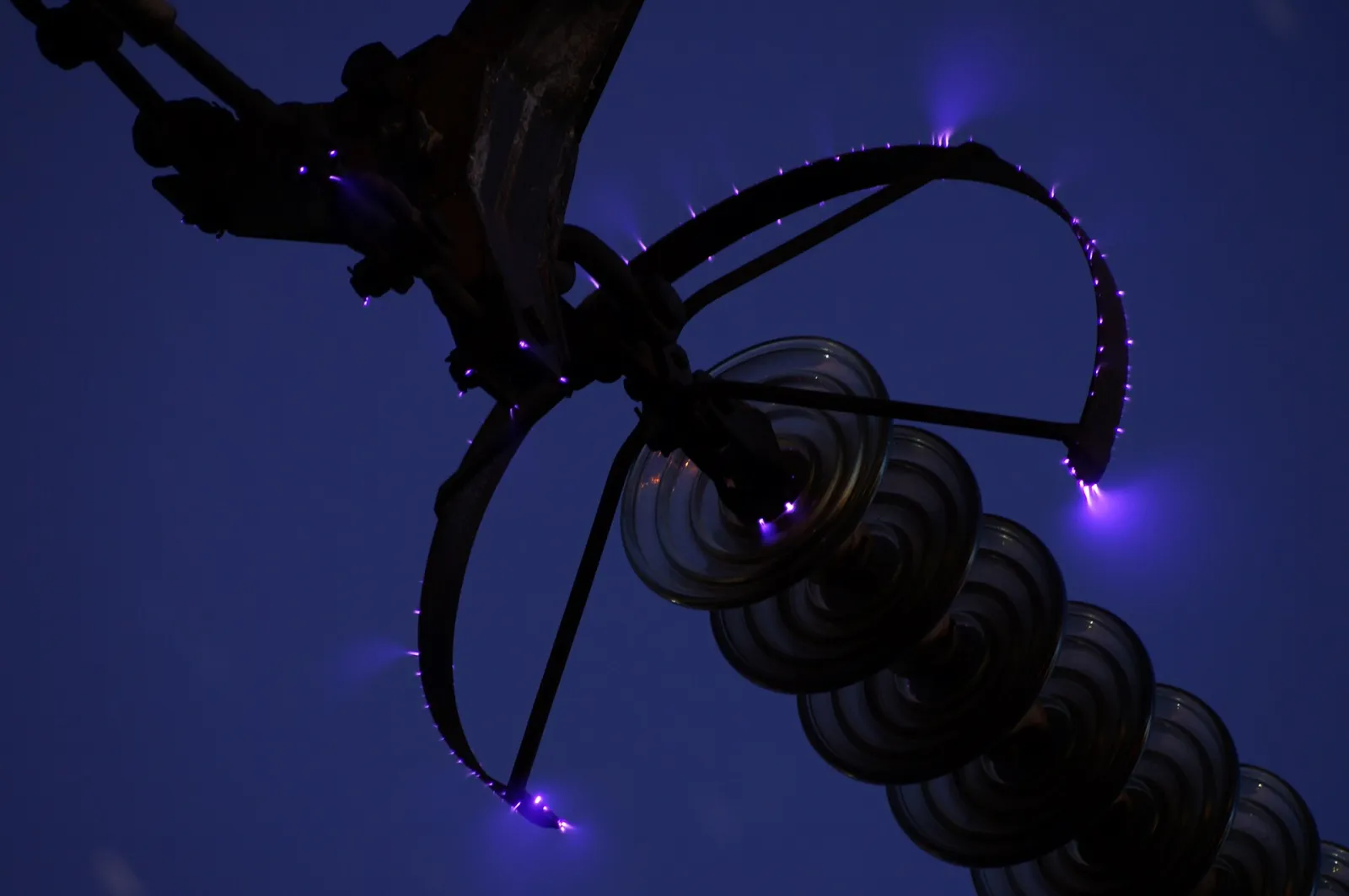
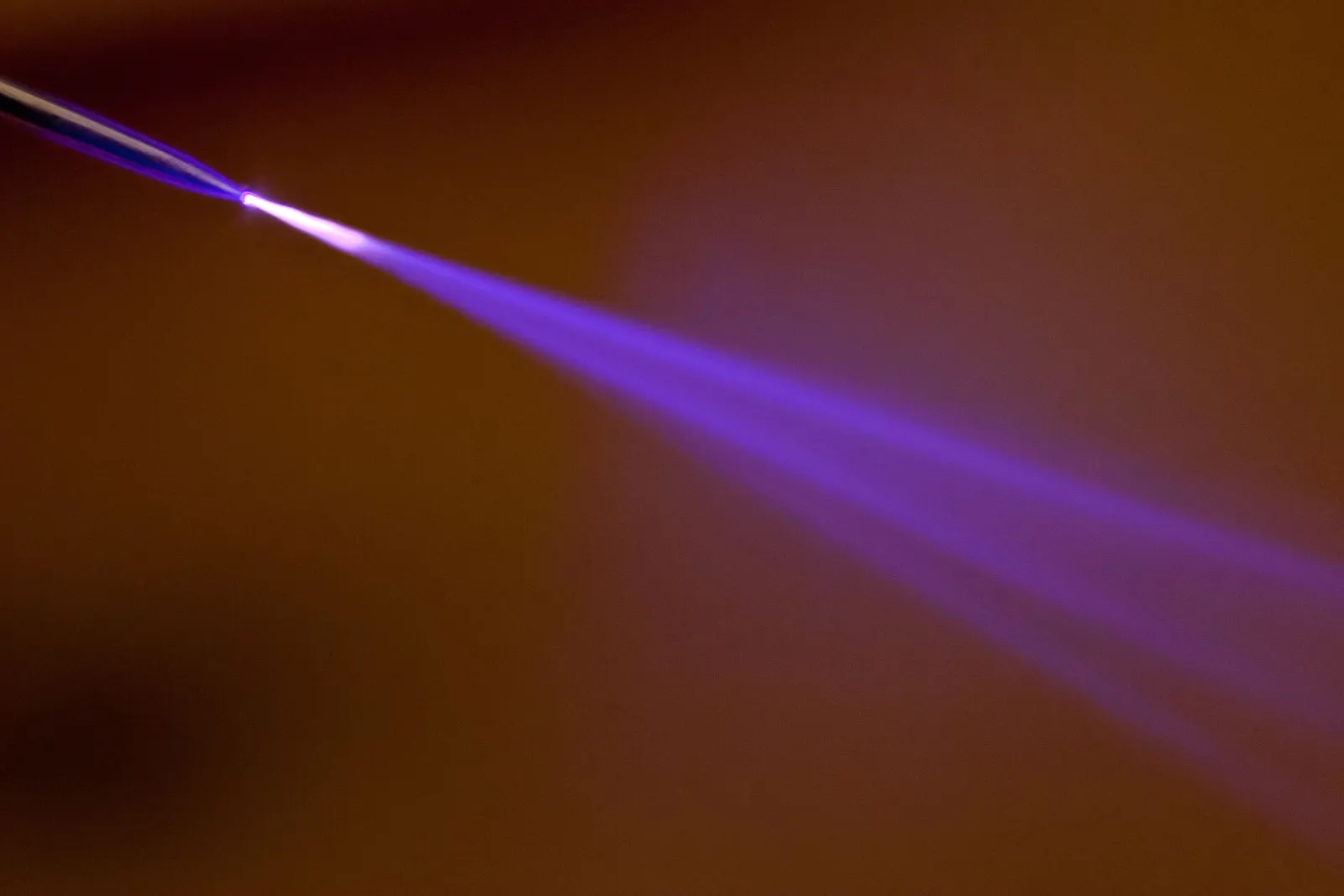
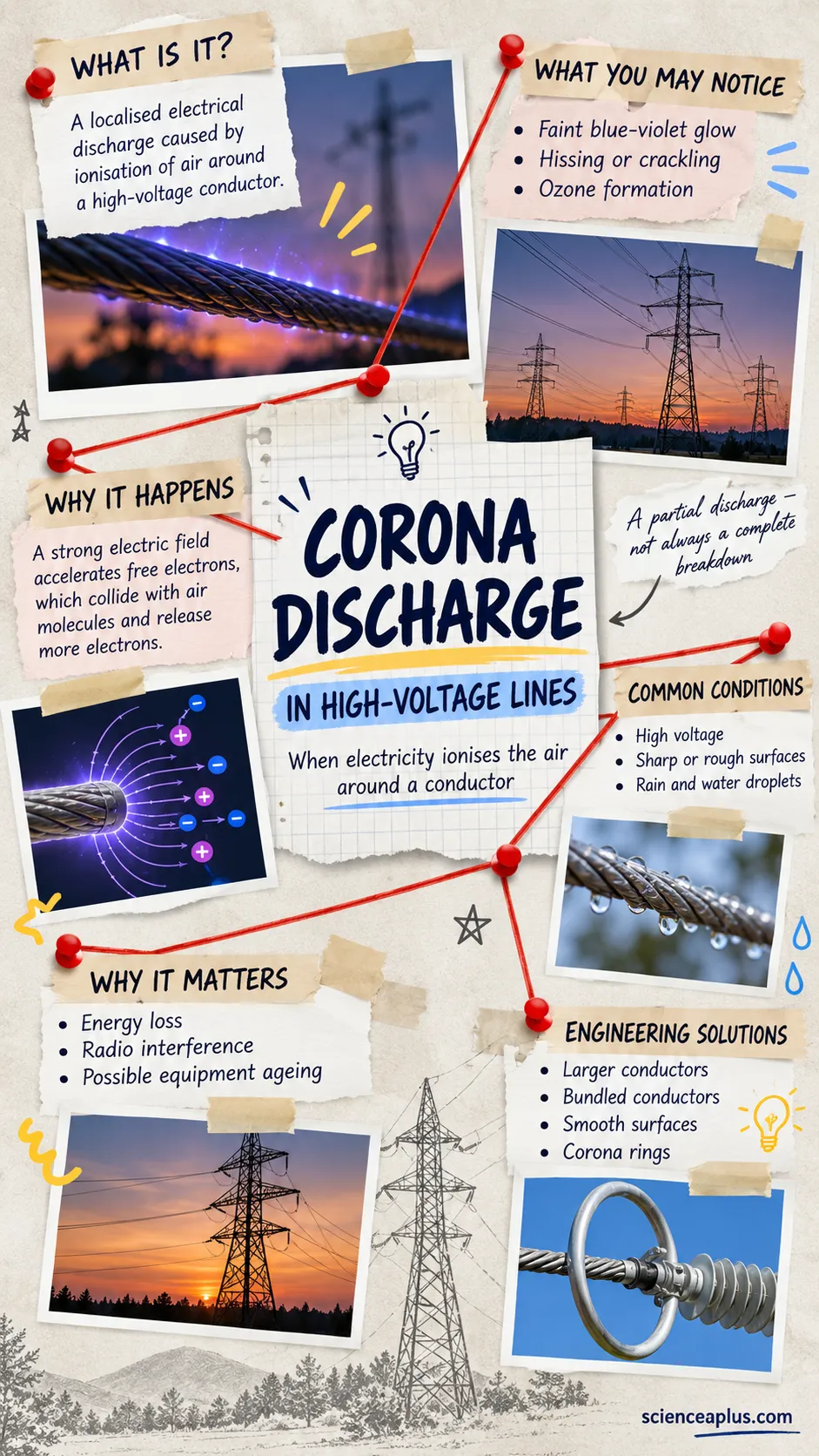
Corona discharge in high voltage lines is a faint glow and crackle that appears when the electric field around a wire becomes strong enough to ionise the air next to it. It is a partial discharge: the air close to the conductor breaks down, but the glow does not jump across to another wire or to the ground. On a damp, dark night near a pylon you may see a violet haze, hear a crackle, or notice a low hum.
This article explains what corona discharge is, how it forms step by step, why sharp points and thin wires start it, why wet weather makes power lines noisy, what it costs, whether it is dangerous and how engineers keep it under control. There is also a calculator, flip cards and a quiz so that you can test yourself.
What is corona discharge?
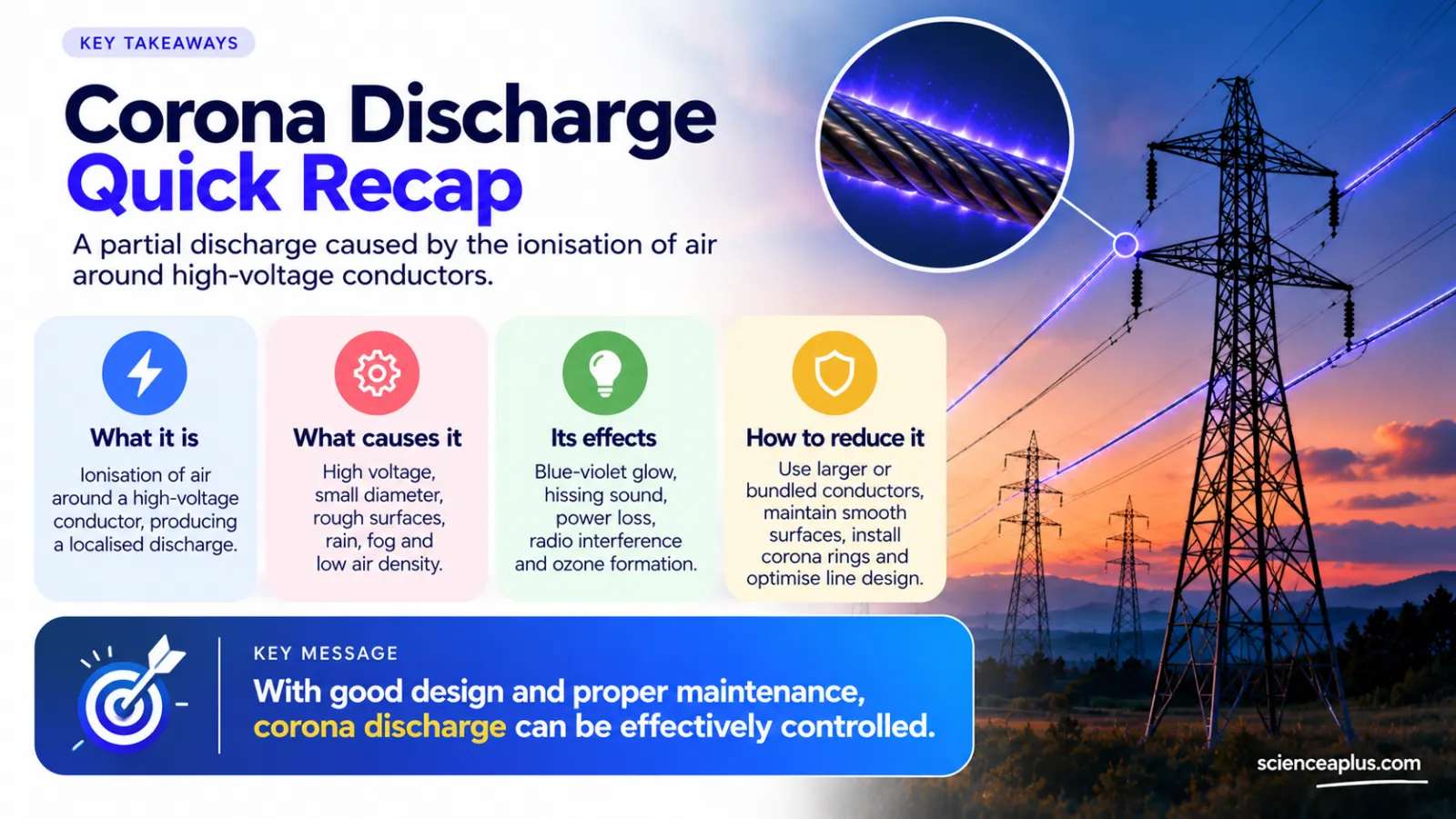
Corona discharge is an electrical discharge caused by the ionisation of a fluid, such as air, surrounding a conductor. In plain terms, a very strong electric field pulls electrons off the gas molecules around a wire and turns a thin layer of air into a glowing, electrically charged gas called a plasma. It is often seen as a bluish glow next to pointed metal conductors.
The key word is partial. In a corona the air breaks down only in a small region close to the conductor. The discharge does not bridge the whole gap between two conductors, so it is not a spark and it is not an arc. That is why a power line can glow quietly for years without the line being "short-circuited".
Charges and electric fields are the starting point for everything here. If you want a refresher on how charge builds up and why like charges repel, the article on static electricity covers it. Here we focus on what happens when the field becomes strong enough to affect the air itself.
How does corona discharge happen? Step by step
Air is normally a very good insulator, which is why a power line can hang in the open without electricity leaking away. But every insulator has a limit. The dielectric strength of dry air at sea-level pressure is about 3,000,000 volts per metre (3 MV/m), which is the same as 30 kV/cm. The exact value depends on the shape of the electrodes, humidity and water drops. Corona begins when the electric field at the surface of a conductor goes above this limit.
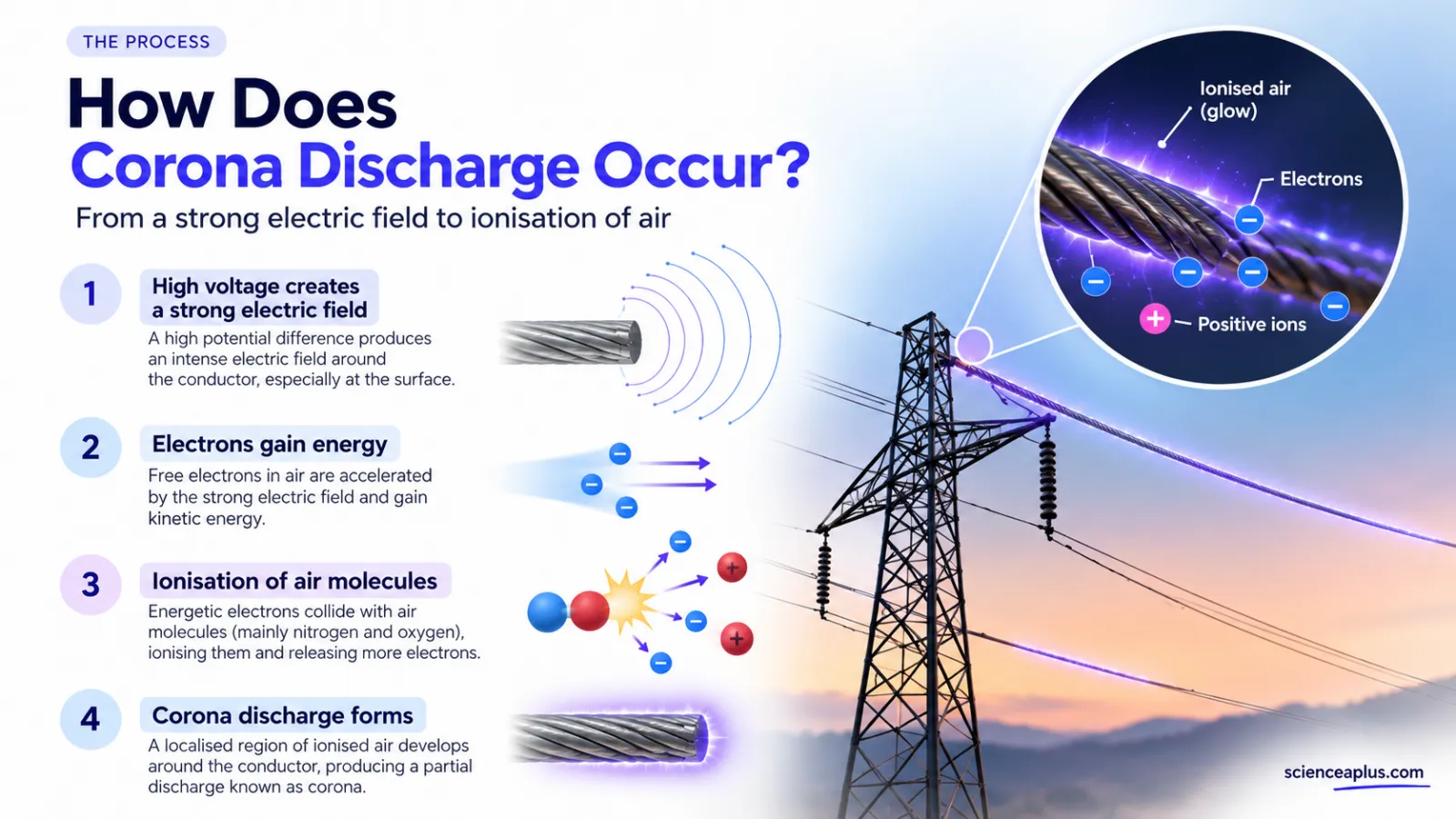
The process happens in four steps:
- A high voltage creates a strong electric field. The field is strongest right at the surface of the conductor, and it gets weaker quickly as you move away from it.
- Free electrons are accelerated. Air always contains a few free electrons. In a strong field they speed up very quickly.
- Collisions release more electrons. A fast electron hits a nitrogen or oxygen molecule hard enough to knock another electron out. Now there are two free electrons and one positive ion. Each of those can do the same again, so the number grows rapidly in an electron avalanche. If you need to revise electrons and ions, see this guide to atoms and sub-atomic particles.
- A glowing layer of ionised air forms. Excited molecules give out light as they settle down, and a thin region of plasma wraps around the conductor.
Corona starts when E (at the surface) > about 3,000,000 V/m (30 kV/cm) in dry air
Notice that the discharge depends on the strength of the electric field, which is set by the voltage and the shape of the conductor. That is why corona is a high voltage effect, not a "high current" effect, and why it is such a concern on the biggest power lines.
Why is the glow violet-blue?
Most of the light from a corona in air comes from excited nitrogen molecules. The strongest emission is in the ultraviolet, near 337 nm, and most of it falls between about 295 and 440 nm. Our eyes can only see the part at the violet end of the spectrum, so the glow looks faint and violet-blue. This is also why corona is best seen at night, when there is no daylight to drown it out. Nitrogen makes up most of the air we breathe; the article on nitrogen gas explains more about it.
Why sharp points and thin wires matter
The electric field is not spread evenly over a charged object. It is concentrated where the surface is most sharply curved: at points, edges and thin wires. Think of the same amount of charge squeezed onto a needle tip compared with a large smooth ball. The tip packs it into a tiny area, so the field there is far stronger.
This is why corona forms first at sharp corners, points and small-diameter wires. On sharp points in air, a corona can start at only about 2 to 6 kV. By contrast, a smooth, fat conductor at the same voltage has a gentler curve and a much weaker field at its surface.
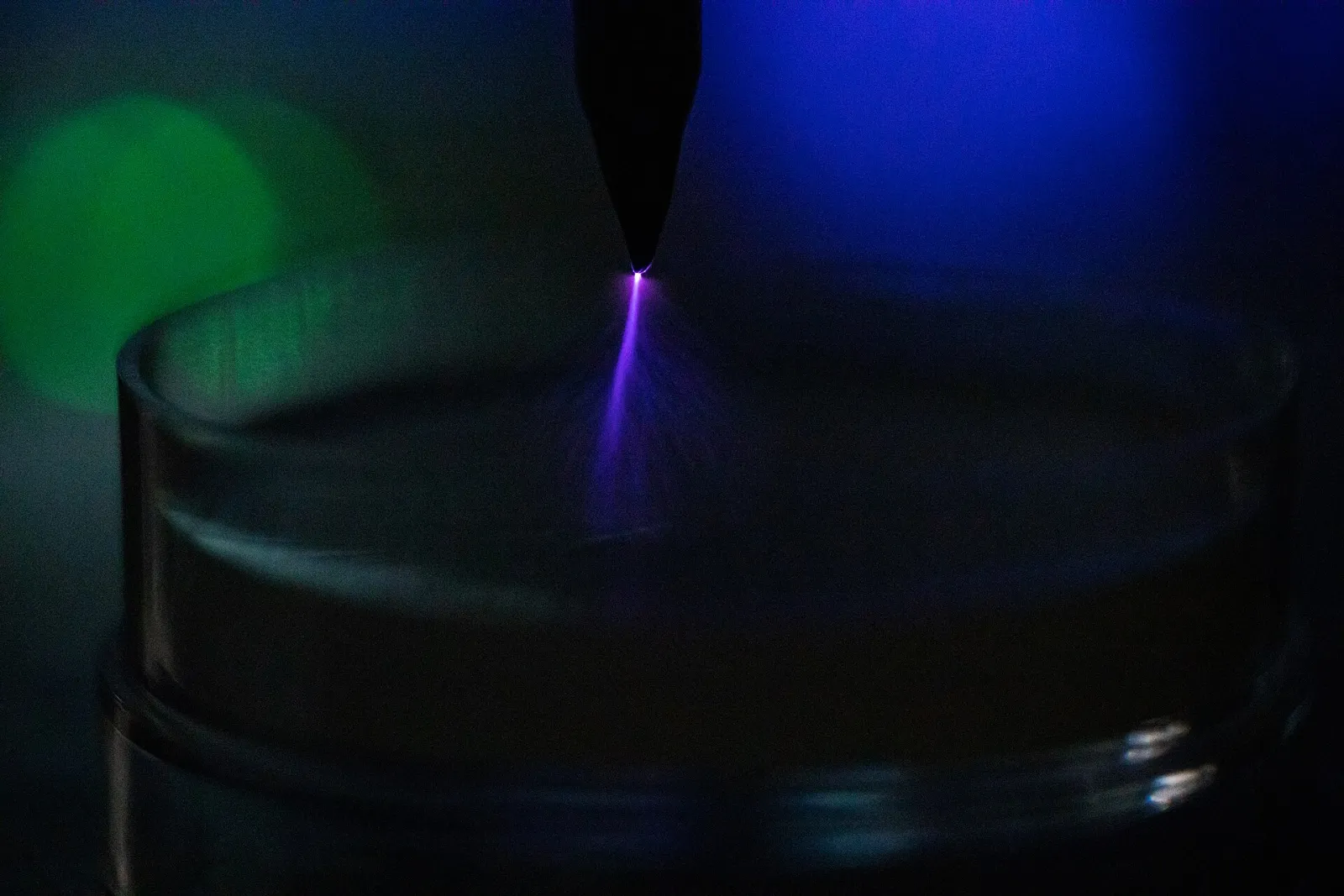
The same idea explains why scratches, nicks, dust and water drops on a power line matter. Each one acts like a tiny sharp point on the surface, concentrating the field locally and lowering the voltage at which corona starts. A new, clean, polished wire starts corona at a higher voltage than an old, weathered or dirty one.
Engineers use this idea in two ways. They avoid sharp edges on line hardware, and they use thicker conductors or several wires side by side to spread the field. You will see both fixes in the section on reducing corona.
Explain why corona discharge forms first at sharp points. (2 marks)
The electric field is strongest where a surface is most sharply curved, so a point concentrates the charge and field into a very small area (1). When the field there exceeds the dielectric strength of air, the air ionises and a corona forms at the point first (1).
Why does a thin wire start corona at a lower voltage than a thick wire? (2 marks)
A thin wire has a more tightly curved surface, so at the same voltage the electric field at its surface is stronger (1). The field reaches the breakdown value of air at a lower voltage, so corona begins sooner (1).
Now that you know what corona discharge is and how it starts, the next step is to see which conditions on a real power line make it more likely, and why high voltage lines are the ones that crackle.
What causes corona discharge on power lines?
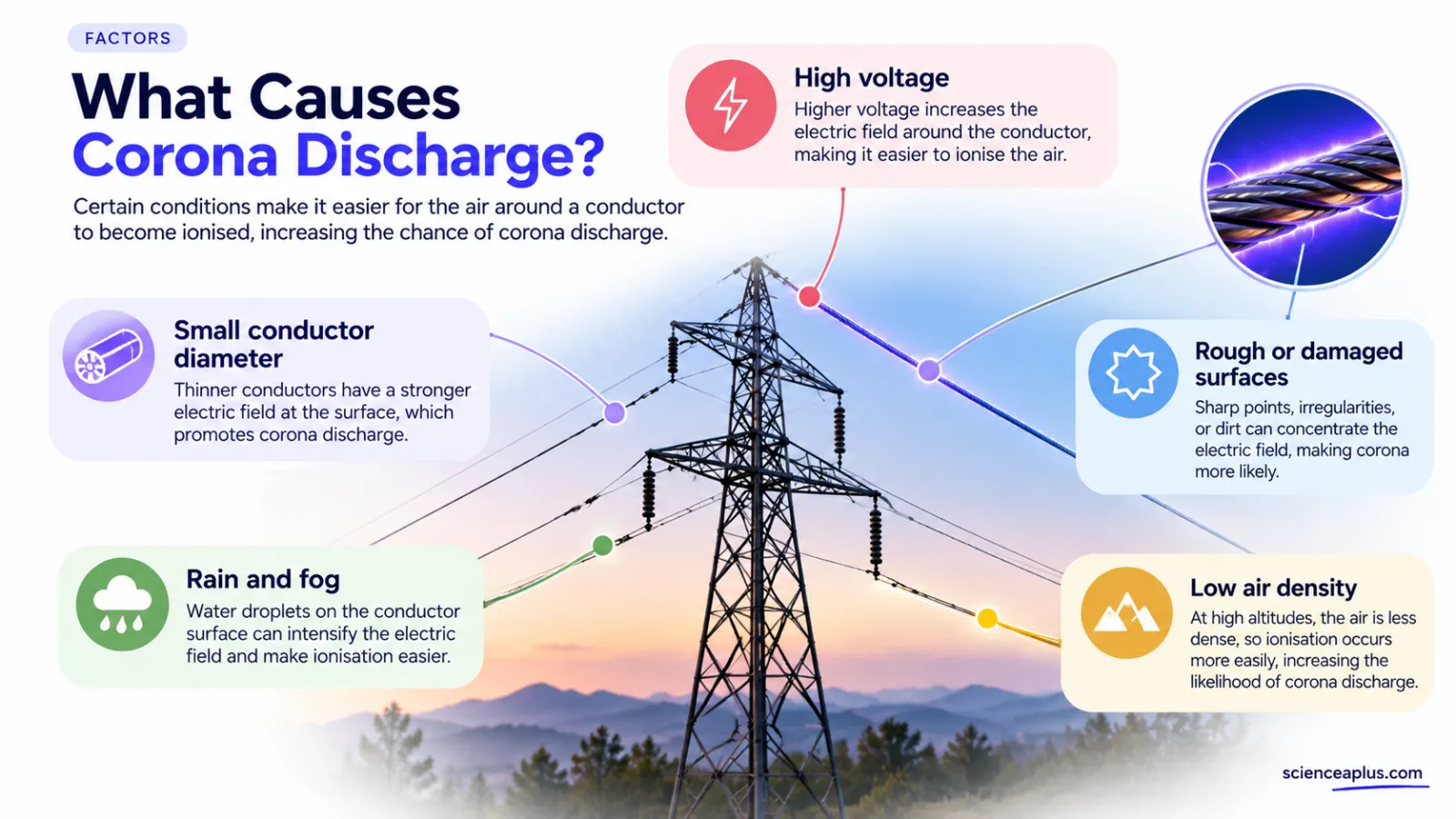
Corona does not appear on every wire at every moment. It depends on whether the electric field at the surface of the conductor beats the dielectric strength of the air around it. Five main factors push that balance one way or the other.
1. High voltage
A higher conductor voltage means a stronger electric field at the surface. This is the most important factor, and it is why corona is a concern on transmission lines rather than on the wires inside your home.
2. Thin conductors
At the same voltage, a thinner wire has a more sharply curved surface, so the field at its surface is stronger. Doubling the radius of a wire noticeably lowers the surface field, which is one reason that high voltage lines use fat conductors.
3. Rough, dirty or damaged surfaces
Scratches, nicks, dust and water drops all act like tiny points on the wire. The engineer Frank Peek, who studied corona in the early twentieth century, wrote this idea into a formula for the voltage at which corona begins. His "irregularity factor" is 1 for a smooth, polished wire and falls to roughly 0.93 to 0.98 for a rough, dirty or weathered one. A lower number means corona starts at a lower voltage.
4. Rain and fog
Water droplets on a conductor distort the field and start many small discharges. We look at this in detail in the next section, because it is the reason power lines crackle and hum in wet weather.
5. Thin air
Peek's formula also includes an air-density factor. Thinner air, for example at high altitude, breaks down more easily, so the corona threshold is lower there.
Peek's idea can be written in words: the corona threshold depends on the radius of the wire, the spacing between the conductors, how rough the surface is and how dense the air is. For a quick estimate of the surface field on a smooth single wire, we can use a simplified version:
E ≈ V ÷ (r × ln(D ÷ r))
Here E is the field at the wire surface, V is the peak voltage between a phase conductor and earth, r is the radius of the wire and D is the spacing between the conductors. The symbol "ln" is the natural logarithm, a button on any scientific calculator. You do not need to remember this for GCSE, but it shows how radius and spacing matter. Try the calculator below. It is a simplified single-wire estimate: it ignores bundles and the effect of the ground, and rain, dirt and altitude would make real lines start corona sooner.
Start with 400 kV and a conductor radius of 1.6 cm. The surface field comes out at about 31.7 kV/cm, just above the roughly 30 kV/cm that dry air can stand. Now change the radius to 3 cm. The field drops to about 18.7 kV/cm, comfortably below the threshold. A fatter wire is a quieter wire.
UK power line voltages and why the biggest lines glow
Electricity is generated at power stations, wind farms and other sources, then stepped up to a very high voltage by transformers so that it can travel long distances efficiently. The article on how generators work explains where the electricity starts its journey. After that, the grid carries it across the country, including power from sources such as wind farms, as discussed in renewable energy: expectations versus reality.
According to the UK Health Security Agency (UKHSA), UK electricity is generated at 50 Hz. The large power lines across the country operate at 400 kV or 275 kV, while smaller local lines run at 132 kV, 66 kV, 33 kV or 11 kV. The supply to homes is 230 V.
| Line | Voltage | Role |
|---|---|---|
| Large transmission lines (England and Wales) | 400 kV and 275 kV | Carry bulk power across the country between power stations and substations |
| 132 kV lines | 132 kV | Transmission in Scotland; local lines in England and Wales |
| Smaller local lines | 66 kV, 33 kV, 11 kV | Carry power from substations towards towns and streets |
| Domestic supply | 230 V | The mains supply in your home |
Three companies own the transmission network: National Grid Electricity Transmission in England and Wales, SP Transmission in southern Scotland and SSEN Transmission in northern Scotland.
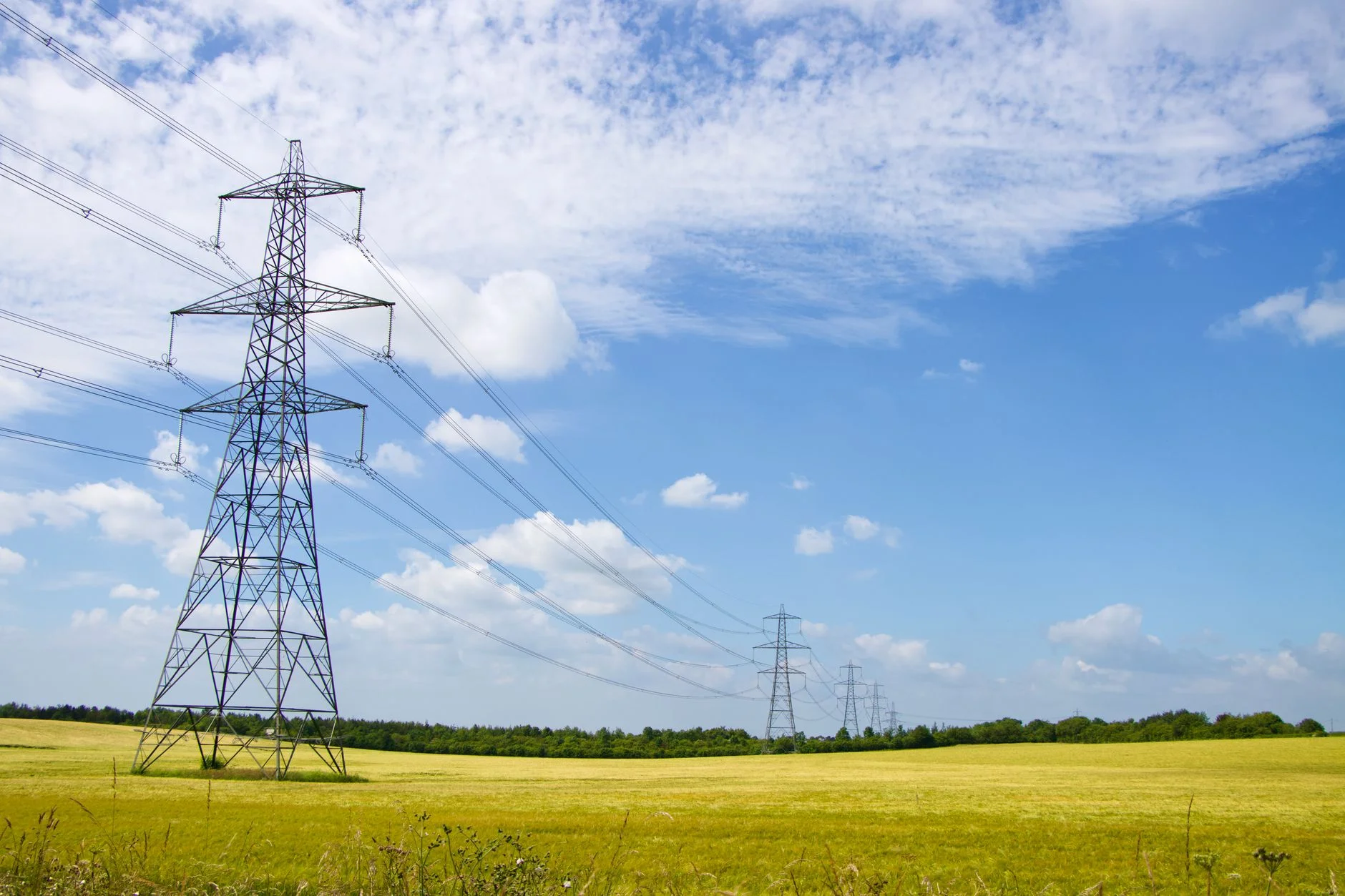
Because corona depends on voltage, the highest-voltage lines are the ones where it matters most. Utility assessments say that corona is usually not a design problem on lines of 230 kV and below. Lower-voltage lines on wooden poles rarely give trouble. At the very highest voltages, a single wire per phase would produce a lot of corona loss and radio interference, so engineers use several wires together, as we will see later in this article.
Why do power lines crackle and hum in the rain?
If you walk near a high voltage line on a wet day and hear crackling, you are listening to corona. National Grid's own technical report explains that conductor noise is caused by corona discharge. In dry weather, most conductors stay below the corona threshold and are usually quiet. Small patches of surface contamination can still cause local corona, which sounds like a crackle and is called "dry noise".
When it rains, things change. Water droplets sitting on the conductor each start corona discharges, and a wet wire can have many of them at once. National Grid calls this "wet noise". It sounds like crackling, sometimes with a hum. The noise is generally highest during rainfall and depends mainly on how hard it is raining. Fog also raises the noise, but less than rain does.
The hum is usually at 100 Hz, and it may have harmonics at 200, 300 or 400 Hz. The reason it is 100 Hz rather than 50 Hz is the way mains electricity works. The voltage in a UK line swings from positive to negative and back 50 times each second. The electric field at the wire is strongest at the positive peak and again at the negative peak, so corona pulses twice per cycle. Twice 50 Hz gives a 100 Hz hum.
Why are power lines noisier in the rain than in dry weather? (3 marks)
Water droplets on the conductor act like small points and distort the electric field (1). This lowers the voltage at which the air ionises, so many corona discharges start along the wire (1). The discharges produce a crackle and a hum, so rainfall raises the noise (1).
Next, we look at what all this glowing and crackling actually costs, whether it is dangerous and how engineers keep it under control.
Effects of corona discharge
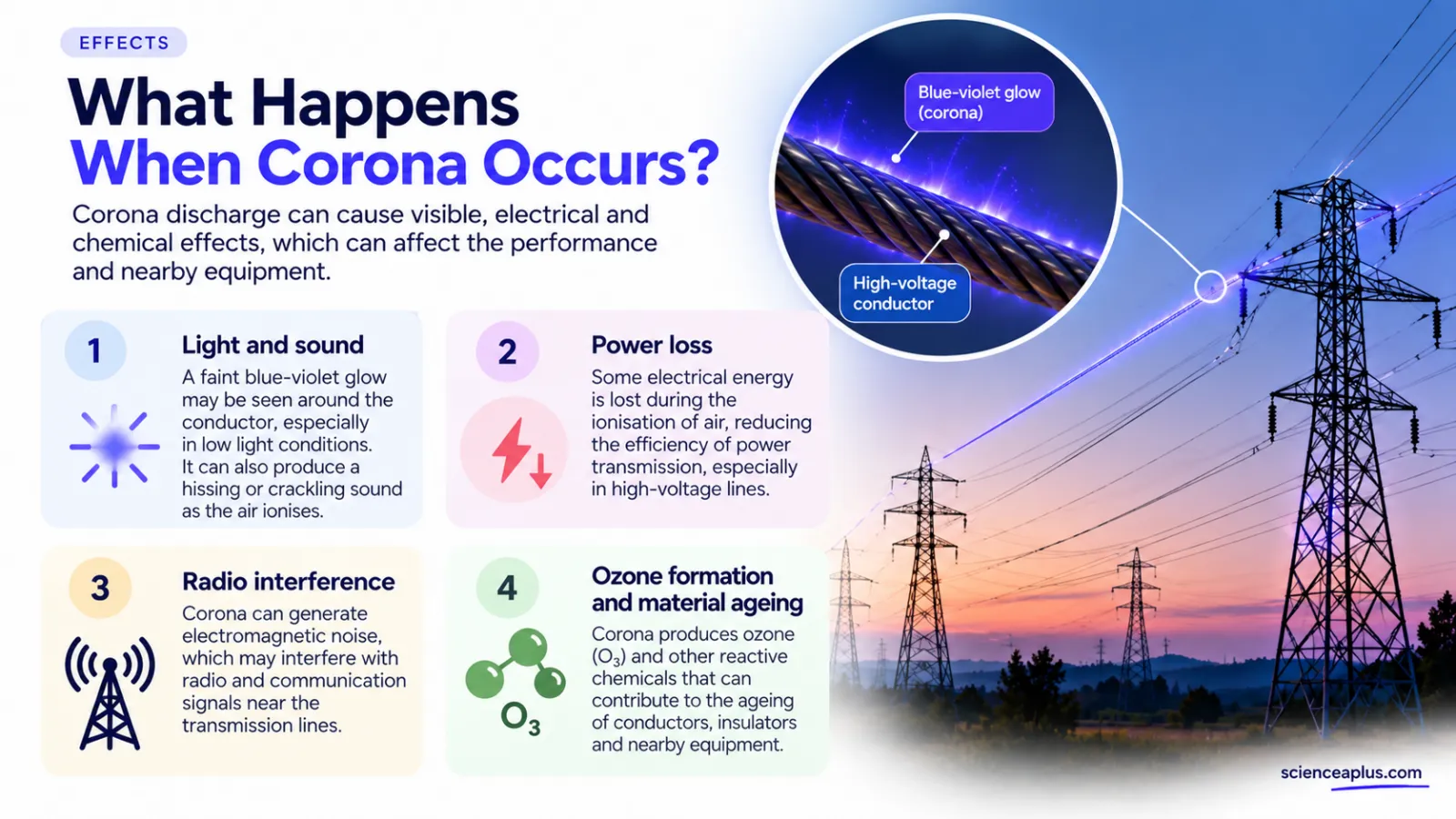
Corona is a physical sign of lost energy. The energy that feeds the discharge is turned into small amounts of light, sound, radio noise, heat and chemical reactions in the air. Because of this, reducing corona is one of the major factors in the design of transmission lines.
Light and sound
The most obvious effects are the ones you can see and hear: a faint violet glow, a crackle and, in wet weather, a hum at 100 Hz. They tell engineers that the field at the surface is high enough to ionise the air.
Wasted energy
Every bit of energy that goes into a corona is energy that does not reach customers. This corona loss is an economically significant waste of energy for utilities. It is also why designers aim to keep lines below the corona threshold in fair weather, rather than simply accepting the loss. Exact figures vary enormously with weather and design, so there is no single "typical" number.
Radio interference
Corona produces radio noise. This noise falls off with distance from the line and with higher frequencies, so when it does cause a problem it is usually for AM radio rather than television. As a general rule, overhead power lines do not interfere with radio or TV. A more common cause is a "gap discharge": tiny sparks across loose or broken hardware, which are cured by tightening or repairing the fittings.
Ozone and nitrogen oxides
Corona in air also drives chemical reactions. It makes ozone (O₃) and nitric oxide (NO). The nitric oxide can go on to form nitrogen dioxide (NO₂), and if water vapour is present, nitric acid (HNO₃). From power lines these amounts are very tiny. For comparison, ozone is a natural part of the air: levels in the countryside are around 10 to 30 parts per billion on a typical night, with peaks near 100 ppb, and can reach 50 to 150 ppb after a thunderstorm. You can read more about this gas in the article on ozone gas, and about nitrogen oxides and acid in the air in rain water and acid rain facts.
NO → NO₂ → HNO₃ (the last step needs water vapour)
Ageing of insulation and fittings
Over many years, corona can slowly age insulation and metal fittings. This is another reason to design out corona, particularly around insulators and connectors.
Is corona discharge dangerous?
Corona is a sign of a strong electric field, so it is natural to ask whether it is harmful to people living or walking nearby. The calm answer, based on UK and international health bodies, is that corona itself is not the main safety concern.
The UK Health Security Agency says that exposures should comply with the international ICNIRP guidelines, and that public exposure is typically well below them. In homes within a few tens of metres of large power lines, magnetic fields are typically a few microteslas, and up to a few tens of microteslas directly under the largest lines. UKHSA also notes that some studies suggest a possible increased risk of childhood leukaemia at average magnetic field exposures above 0.3 to 0.4 µT, but that the overall evidence is not strong enough to draw a firm conclusion that magnetic fields cause the disease, and no mechanism is known. Strong electric fields can cause microshocks, which are small spark discharges when you touch a conducting object.
Corona does release electrically charged particles into the air. The World Health Organization has looked at whether these corona ions could add to the deposition of airborne pollutants on skin and airways. It concluded that it seems unlikely that corona ions have more than a small effect, if any, on long-term health risks, even for the most exposed people.
If you are worried about a particular line near your home, or you have health questions, speak to your GP, or contact your local council or the electricity network operator.
How do engineers reduce corona discharge?
Engineers cannot switch off the physics, but they can reduce the electric field at the surface of a conductor so it stays below the threshold. Here are the main methods.
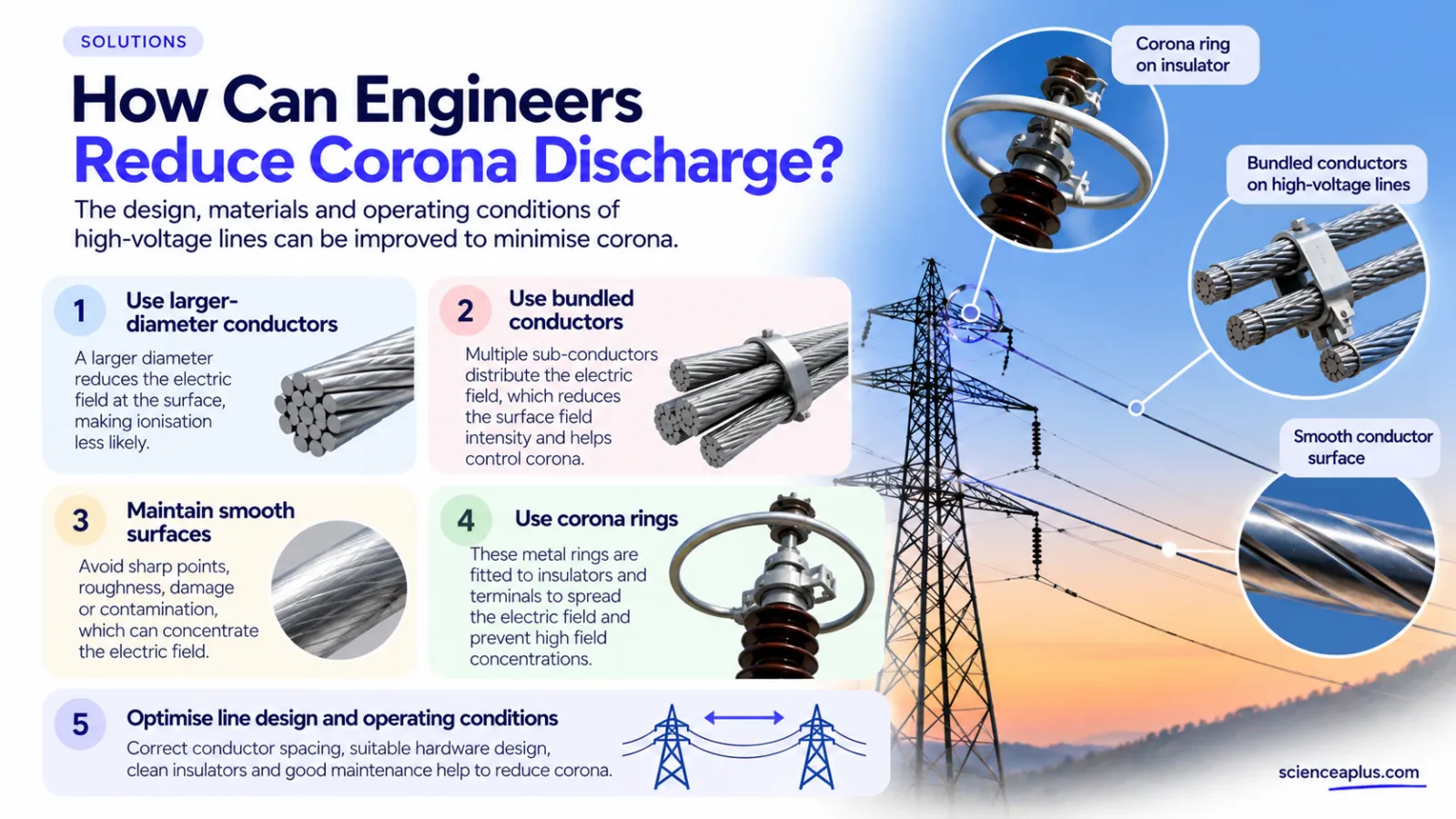
- Use larger conductors. A larger diameter lowers the electric field at the surface, because the curve is gentler. Engineers choose a conductor of sufficient diameter to lower the localised electrical stress.
- Bundle the conductors. Instead of one wire per phase, the highest voltage lines carry two, three or four wires close together. A bundle behaves like a much fatter conductor, so the surface gradient falls considerably.
- Keep surfaces smooth and clean. Hardware is designed without sharp points or edges, and fittings are kept tight and well made. In polluted areas, insulators may be washed.
- Add corona rings. A corona ring is a toroidal (doughnut-shaped) metal ring connected to the high voltage conductor. It spreads the field over a larger area so the peak values fall below the corona threshold. Grading rings around insulators even out the voltage stress along an insulator string.
- Inspect and maintain. Regular checks find damaged or dirty parts before they cause trouble.
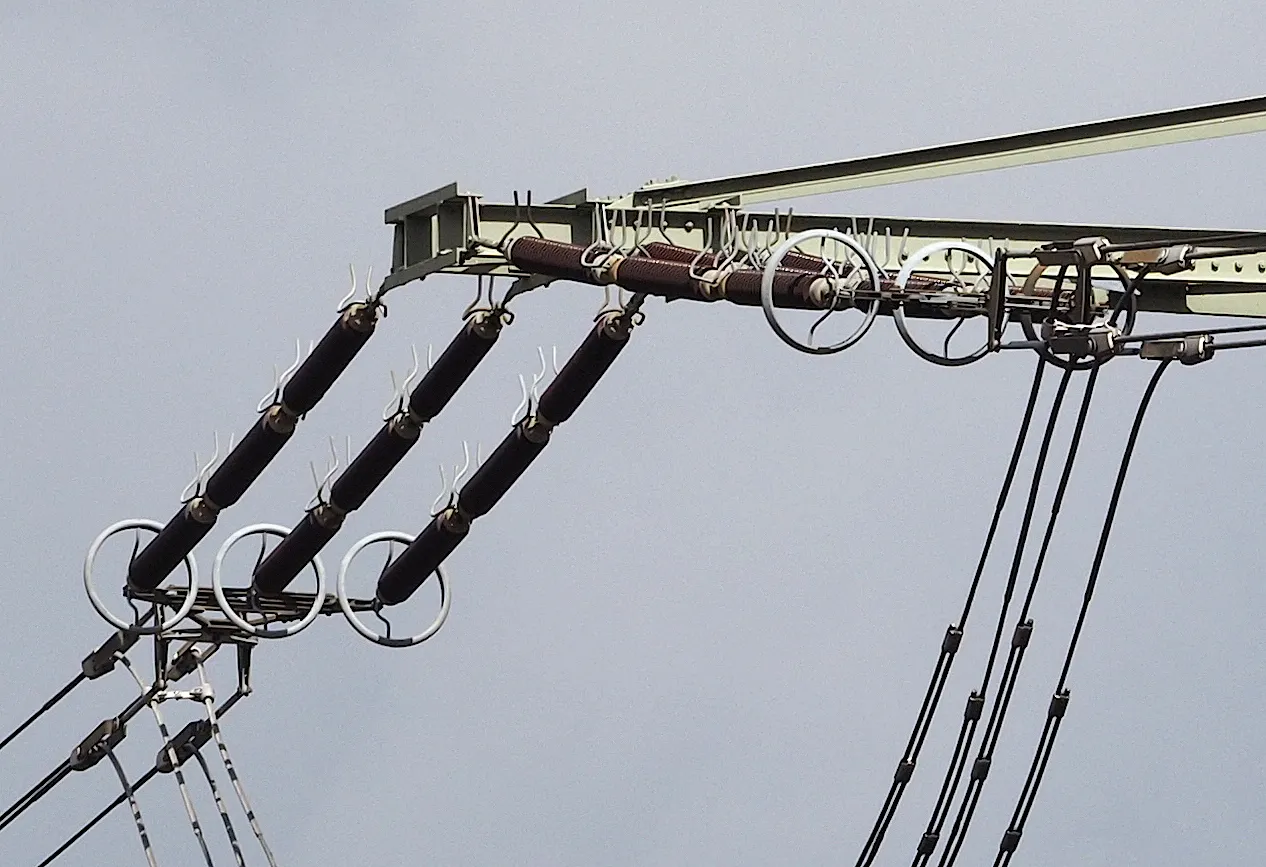
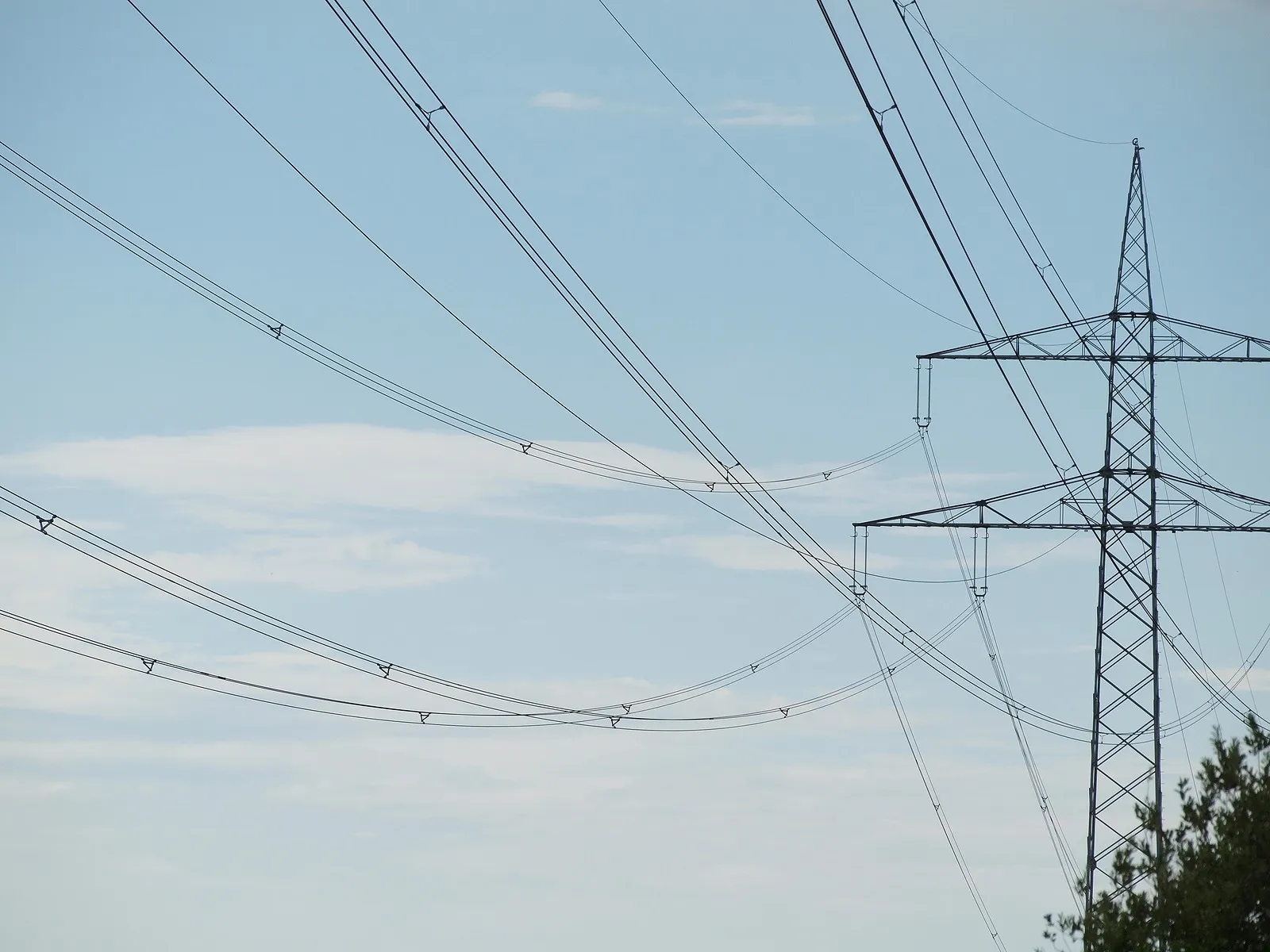
The calculator earlier in this article shows the first fix in action: raising the conductor radius cuts the surface field. Bundles do the same job without needing one huge, heavy wire.
Spotting corona with ultraviolet cameras
Because most corona light is ultraviolet, engineers use special "solar-blind" cameras that work at wavelengths below about 280 nm. Sunlight at ground level has almost none of these wavelengths, because ozone in the atmosphere absorbs them, so a solar-blind camera can show corona even in daylight. These cameras are now also carried on drones, which can inspect lines from a safe distance.
Explain how bundling conductors reduces corona discharge. (3 marks)
Several wires close together act like one larger conductor (1). A larger effective diameter spreads the charge over a bigger surface with a gentler curve (1). This lowers the electric field at the surface of each wire, keeping it below the value needed to ionise the air (1).
What is the job of a corona ring? (2 marks)
A corona ring spreads the electric field over a larger area (1), so the peak field near the end fitting is reduced below the corona threshold (1).
When corona discharge is useful
On a power line, corona is a nuisance. But the same physics can be put to work, and several everyday technologies rely on it. In each case the idea is the same: a sharp electrode or thin wire at high voltage ionises the air, and the resulting charged particles are used to do a job.
Photocopiers and laser printers
In older photocopiers and laser printers, a thin "corona wire" runs parallel to the light-sensitive drum. The corona around the wire sprays an even layer of electric charge onto the drum surface, which is the first step in forming an image. More recent printers use a primary charge roller instead.
Electrostatic precipitators
Many power stations remove solid pollutants from their waste gases with an electrostatic precipitator. Corona discharge ionises the air around electrodes, which gives dust particles an electric charge. The charged particles are then pulled towards earthed collecting plates, where they stick. An early patent for this idea was applied for by Frederick Cottrell, at the University of California, Berkeley, in 1907, and precipitators are widely used at coal- and oil-fired power stations. For the wider picture on pollution from burning fuels, see the article on air pollution.
Ozone generators and pool water
Because corona turns oxygen in the air into ozone, it can be used on purpose to sanitise pool water. Ozone is a powerful oxidising agent. The reaction is balanced like this, and you can read about the gas it starts from in the article on oxygen gas:
3O₂ → 2O₃
Other uses
Corona discharge is also used in air ionisers, in antistatic devices that neutralise unwanted static charge, to ionise samples for mass spectrometry, and to remove unwanted charge from the surface of aircraft in flight.


Corona discharge vs spark vs arc (and St Elmo's fire)
People often mix up three kinds of electrical discharge in gases. The big difference is whether the discharge bridges the gap between two conductors.
| Discharge | Bridges the gap? | What you see and hear | Example |
|---|---|---|---|
| Corona | No: partial and localised | Faint violet glow, hiss or crackle | Wet high voltage line at night |
| Spark | Yes: sudden complete breakdown across a gap | Bright flash and a sharp crack | A static shock from a door handle |
| Arc | Yes: sustained discharge carrying a large current | Intense, steady bright light | An electric welding arc |
Breakdown starts at the sharpest points first, which is one more reason why engineers keep hardware smooth and free of sharp edges.
St Elmo's fire: corona in nature
St Elmo's fire is a luminous corona discharge from the tips of sharp or raised objects, such as ship masts and the nose or wingtips of an aircraft, when the electric field in the atmosphere is high. It is often seen near thunderstorms. It is the same process as the glow on a power line, except that the strong field comes from the storm instead of a wire.
Test yourself: corona in a flash
Frequently asked questions about corona discharge
What is corona discharge?
Corona discharge is a partial electrical discharge caused by the ionisation of air around a conductor, such as a high voltage wire. It often appears as a faint bluish or violet glow, usually near sharp points or thin wires. It does not bridge the gap between conductors, so it is different from a spark.
What causes corona discharge on power lines?
Corona starts when the electric field at the surface of a conductor exceeds the dielectric strength of the surrounding air. High voltage, thin conductors, rough or dirty surfaces, water drops and thin air at altitude all make that more likely. Sharp points and edges on fittings concentrate the field and start corona first.
Why do power lines crackle or hum when it rains?
Water droplets on the conductor start many small corona discharges, so wet lines are noisiest during rainfall. National Grid describes this as wet noise: a crackle, sometimes with a hum, usually at 100 Hz. That is twice the 50 Hz supply frequency, because the field peaks on both half-cycles.
Is corona discharge dangerous to people?
The UK Health Security Agency says public exposure to fields from power lines is typically well below the guideline levels. The main safety concern is avoiding electric shocks, so never climb pylons or go near lines. The World Health Organization thinks corona ions are unlikely to have more than a small effect, if any, on long-term health.
Can you see corona discharge?
Sometimes. On a damp, dark night you may see a faint violet-blue glow on high voltage lines, insulators or corona rings. Most of the light is ultraviolet, which our eyes cannot see. Engineers use solar-blind ultraviolet cameras, sometimes carried on drones, to detect corona even in daylight.
Does corona discharge waste electricity?
Yes. The energy that feeds a corona is lost as light, sound, radio noise, heat and chemical reactions, so it never reaches customers. Corona loss is an economically significant waste for utilities. This is why lines are designed to stay below the corona threshold in fair weather where possible.
How do engineers reduce corona discharge?
They lower the electric field at the conductor surface. Methods include using larger-diameter conductors, bundling two to four wires per phase, keeping hardware smooth, clean and free of sharp points, fitting corona rings and grading rings, and inspecting and maintaining lines so that dirt and loose fittings are fixed early.
What is a corona ring for?
A corona ring is a doughnut-shaped metal ring connected to the high voltage conductor. It spreads the electric field over a larger area, so the peak field near the end fitting falls below the corona threshold. Grading rings around insulator strings also even out the voltage stress along the string.
What is corona discharge used for?
Corona discharge is used in older photocopiers and laser printers, in electrostatic precipitators that clean waste gases, and to make ozone for sanitising pool water. It also appears in air ionisers, antistatic devices, mass spectrometry and equipment that removes unwanted charge from aircraft surfaces in flight.
Is St Elmo's fire a corona discharge?
Yes. St Elmo's fire is a natural corona discharge from the tips of sharp or raised objects, such as ship masts and aircraft wingtips, when the electric field in the atmosphere is high. It is often seen near thunderstorms and glows for the same reason as corona on a power line.