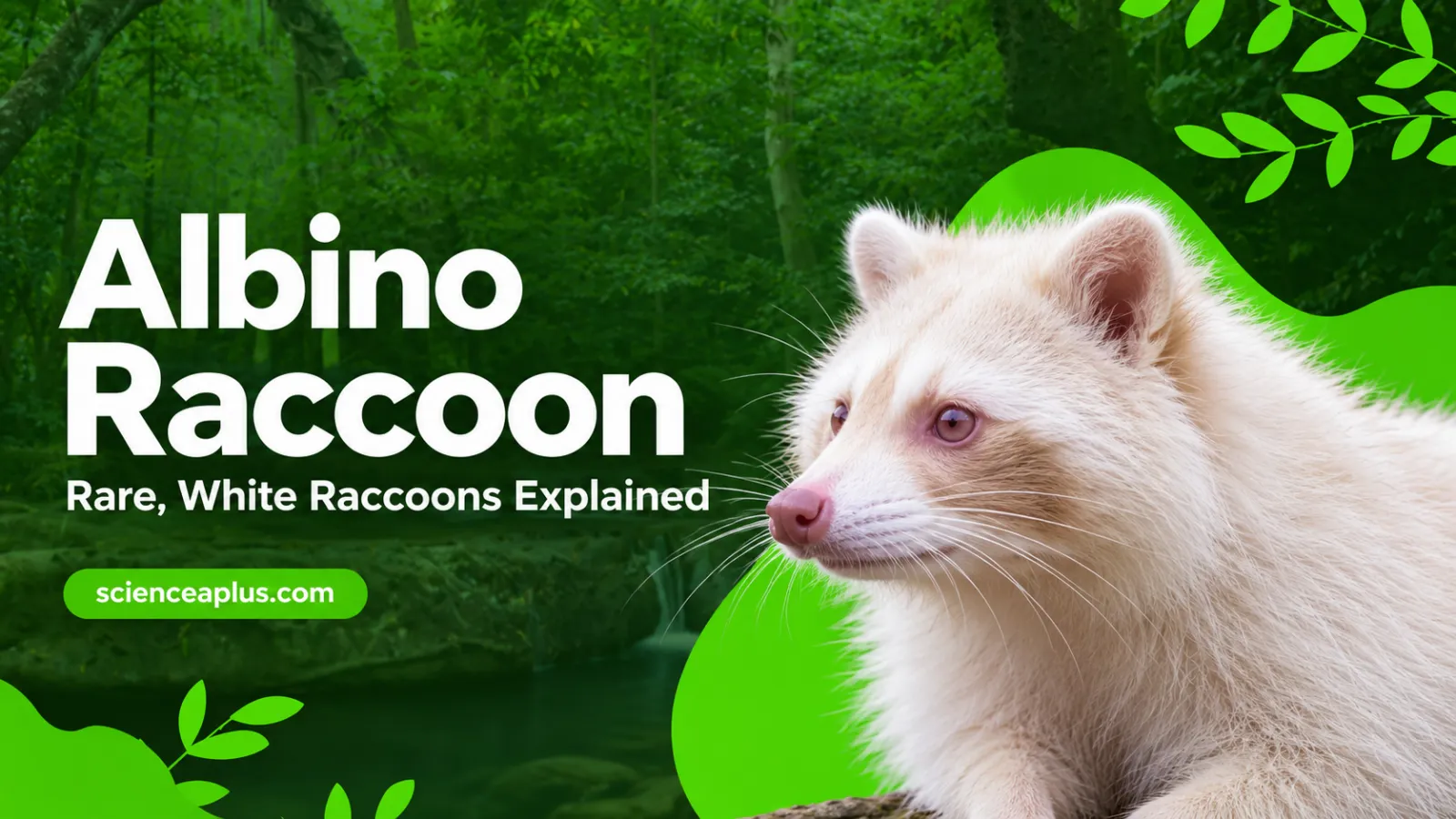
An albino deer is a deer born with little or no melanin, the pigment that colours hair, skin and eyes. The result is a white or near-white coat, a pale pink nose and pinkish or reddish eyes. Albino deer are very rare, and many "white deer" you see in photographs are not albino at all. They are leucistic or piebald, which are different conditions. This guide shows you how to tell them apart and explains the science behind each one.
What is an albino deer?
An albino deer has a genetic condition called albinism. Its body cannot make normal amounts of melanin, so the coat, skin and eyes stay pale. In deer this usually means a white coat, a pink or pale nose, light-coloured hooves and eyes that look pink or red.
The deer is otherwise a normal deer. A white-tailed deer with albinism is still a white-tailed deer, a fallow deer with albinism is still a fallow deer, and so on. Only the pigment is missing. Albinism is not a separate species, and it is not a disease that spreads from one animal to another. If you would like the bigger picture first, our guide to albino animals covers the condition across many species.
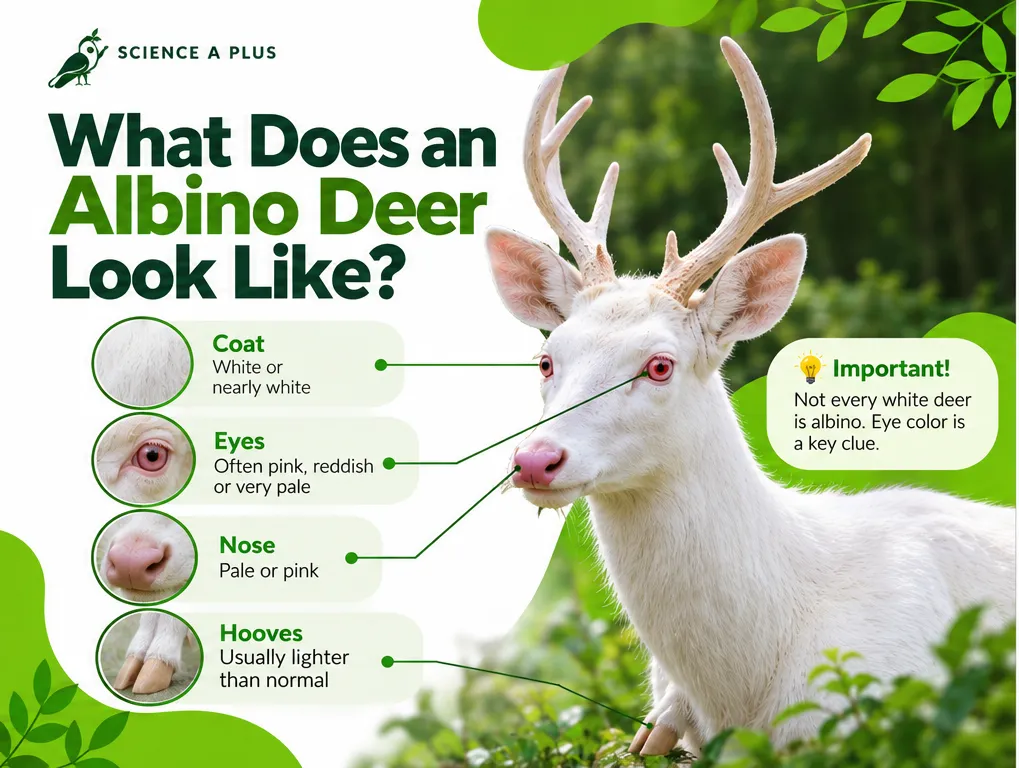
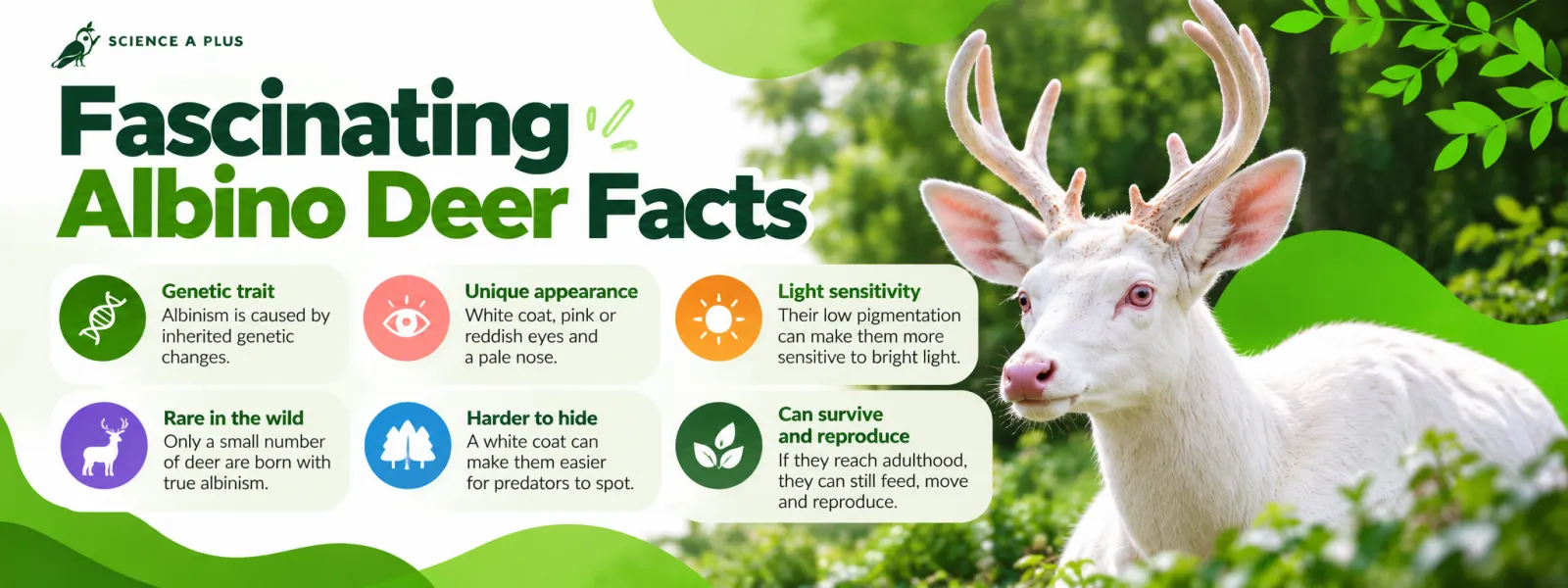
The infographic on this page lists the main clues. Look at the eyes first, then the nose, then the hooves. A deer that is white all over but has dark brown eyes and a dark nose is not an albino, however white its coat looks.
Why do albino deer have pink eyes?
Melanin normally fills the front of the eye (the iris) and the layers behind it. Without melanin, the iris is not opaque. Light passes through it, and the tiny blood vessels inside the eye show through. That is why the eyes of albino mammals look pink or red rather than blue or brown.
The same lack of pigment can make the eyes sensitive to bright light, and in some albino animals it affects how well they see. Deer do not wear sunglasses, so a very bright, open habitat may be harder work for an albino deer than a shady wood. How much any one deer is affected varies, and it is hard to measure in the wild.
What causes albinism in deer?
Albinism is caused by inherited changes to genes that control how melanin is made or moved around the body. Melanin is produced by special cells called melanocytes. If a key gene does not work, these cells produce little or no pigment, and the animal looks white.
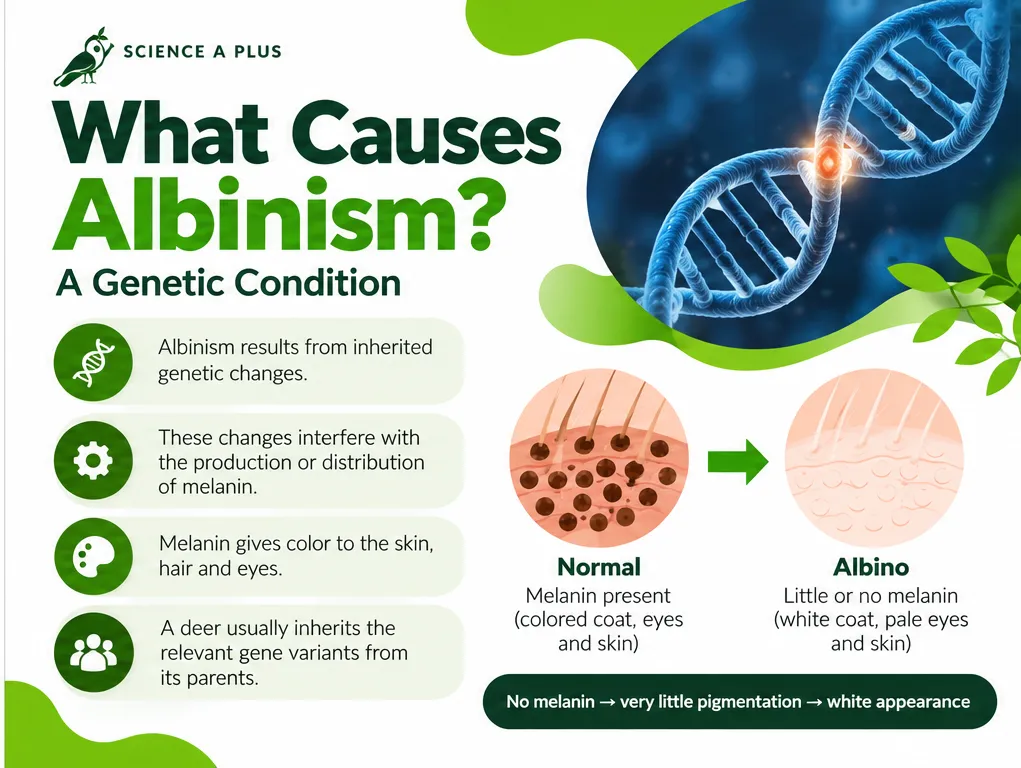
The infographic shows the key idea. A normal deer has melanin in its hair, skin and eyes. An albino deer has very little or none, so every one of those parts looks pale. The chain of events is simple: a gene change, then less melanin, then white hair and pale eyes.
In the albinism usually seen in mammals, the gene changes are recessive. That means a fawn only shows albinism if it inherits a changed copy from both parents. A parent that carries one changed copy and one normal copy looks completely normal. Such a parent is called a carrier. Our explainer on alleles and inheritance shows how dominant and recessive versions of a gene work.
How is albinism inherited? Try the cross calculator
Scientists often use the letter A for the normal version of the gene and a for the albino version. Normal deer are AA or Aa, and an albino deer is aa. If two carriers (Aa) breed, each fawn has a 1 in 4 chance of being aa, a 1 in 2 chance of being a carrier and a 1 in 4 chance of being AA.
Aa × Aa → 25% AA : 50% Aa : 25% aa
These are chances for each fawn, not a guarantee for a whole family. Two carriers could have four fawns and none might be albino, or two might be. Use the calculator below to test other pairings. Pick a genotype for each parent and see what to expect.
Do albino deer live in the wild?
Yes, but they are rare. Hunting and wildlife magazines quote estimates that range from about 1 in 20,000 to 1 in 30,000 for albinism in white-tailed deer. Treat that as a rough figure rather than a survey result, because nobody counts every deer. What is clear is that a recessive condition will be uncommon unless carriers breed with each other often.
Albino deer have been reported in North America, Europe and Asia, wherever deer live. Many of the white deer that people report turn out to be another type of white deer, which we sort out in the next section. Photographs often cannot settle the question, because a pale deer in poor light may seem to have pink eyes when it does not.
Why this matters for people who watch wildlife
Getting the label right is not pedantry. A farmer, a hunter, a photographer and a student all use the same word differently, and the mix-up has real effects. It changes which scientific explanation applies, whether a deer might be legally protected, and what health problems to expect. In the sections that follow, we look at the three main kinds of white deer, the dangers each faces, some famous herds and the laws that protect them.
Albino vs leucistic vs piebald deer
Three different conditions make a deer look white or patchy white. People often lump them together, but biologists keep them apart because the cause and the effects differ.
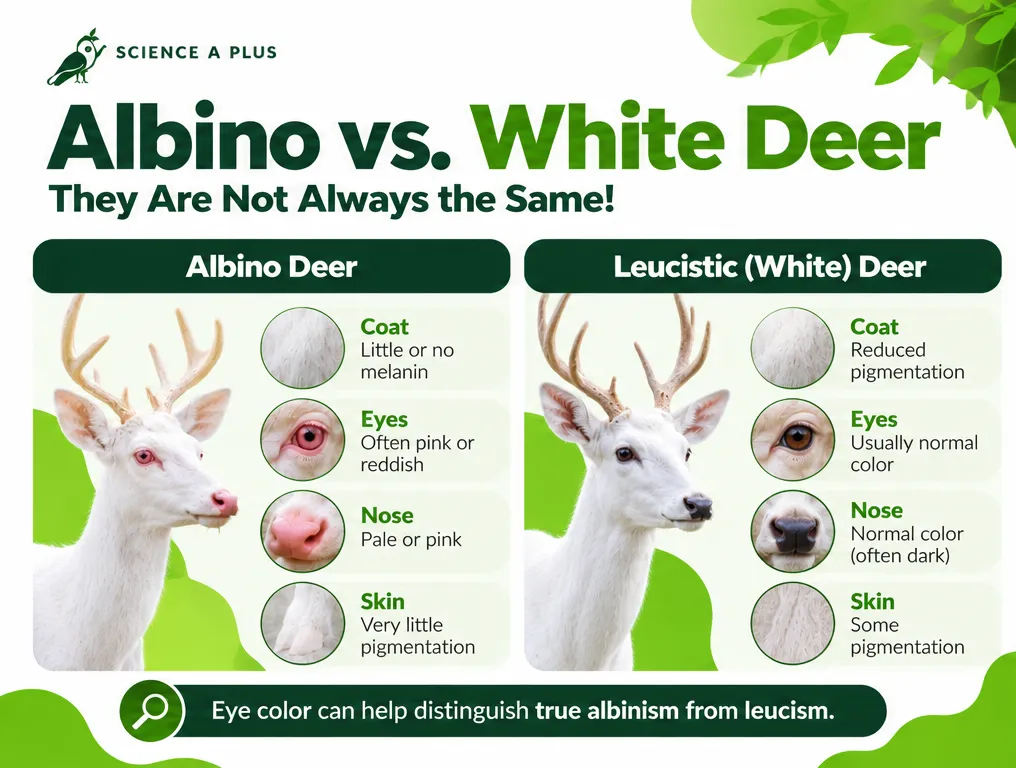
Albinism is a shortage of melanin itself. The coat is white, the nose is pink and the eyes are pink or reddish. Leucism is a reduction in the pigment-producing cells that reach the skin and hair. The coat can be white or pale, but the eyes are usually a normal dark colour and the nose is often dark. Piebaldism gives patches of white on a normal brown coat. Piebaldism is generally treated as a form of leucism.
| Feature | Albino deer | Leucistic deer | Piebald deer |
|---|---|---|---|
| Coat | White or almost white | White or pale | Brown with white patches |
| Eyes | Pink or reddish | Usually normal dark | Usually normal dark |
| Nose | Pale or pink | Often dark | Often dark |
| Main cause | Little or no melanin made | Fewer pigment cells reach the skin | Pigment cells missing from some areas |
| Inheritance | Recessive | Recessive in the Seneca herd | Recessive in white-tailed deer |
Use the table as a guide, not a lab test. In real life, a few animals sit between categories. A photograph from far away cannot prove which one you are looking at, and only genetic testing can settle the hardest cases.
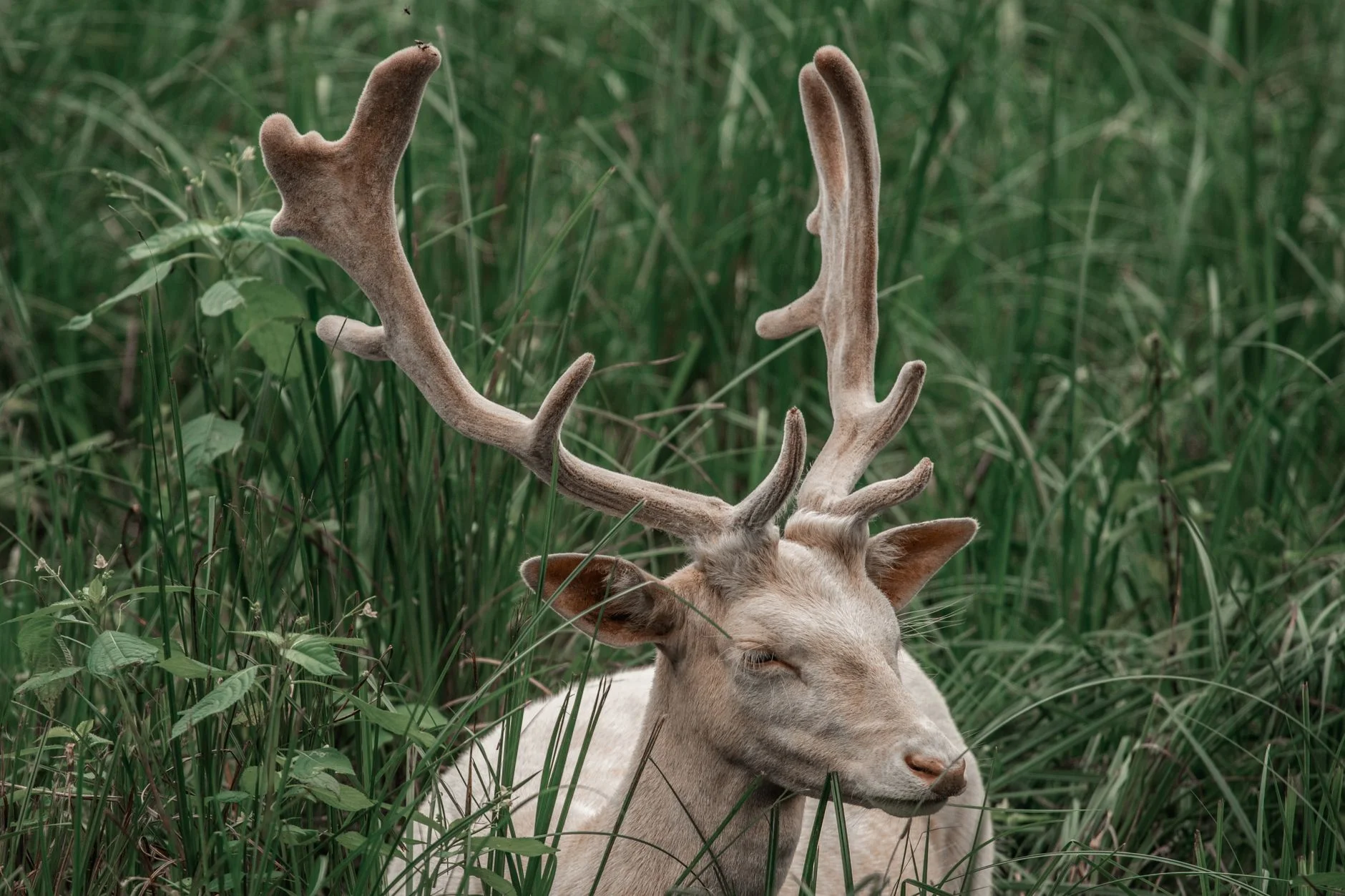
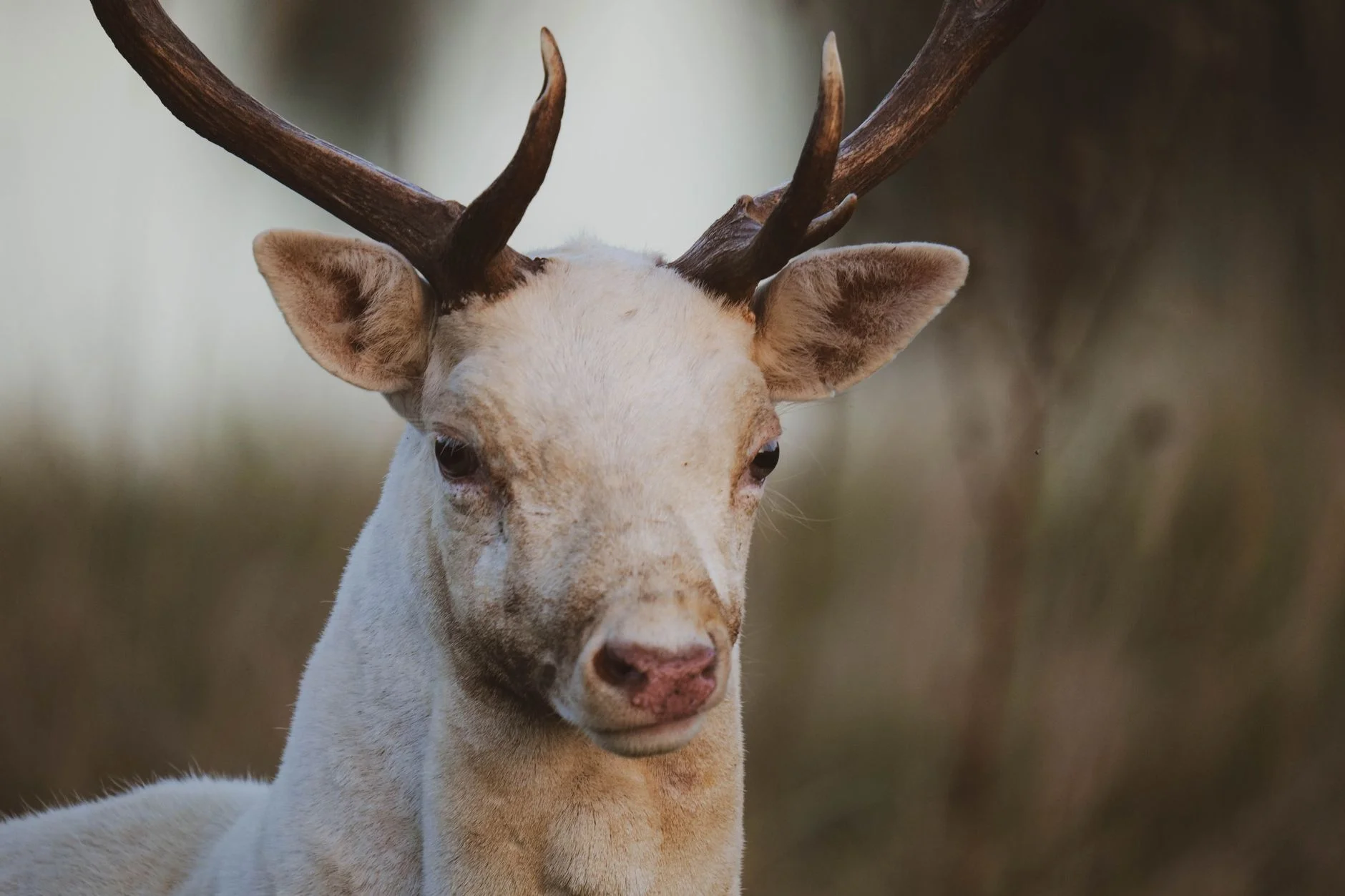
The close-up above shows why eye colour matters. The coat is a pale cream-white, yet the eyes are dark and the nose is pink-brown rather than the pale pink of an albino. The antlers are normal dark brown. Coat colour alone cannot tell you the condition. An albino deer would show pale pink eyes as well as a pale coat.
A white deer has dark brown eyes and a dark nose. Is it more likely to be albino or leucistic? (2 marks)
Leucistic. An albino deer makes little or no melanin, so its eyes would look pink or red and its nose would be pale. Dark eyes show that melanin is present in the eyes.
What is a piebald deer?
A piebald deer has a brown coat with large white patches. The pattern is different on every animal, a bit like the markings on a Friesian cow. In white-tailed deer, the piebald trait is recessive, so a fawn needs the gene from both parents.
Piebald deer are not just pretty. Wildlife organisations that study them report that some have bone and body differences, such as a bowed spine, shorter legs, a short or bent jaw and sometimes internal differences. This varies a lot from deer to deer, so a lightly marked piebald may look completely healthy. For more on how inherited differences can affect health, see our article on inherited diseases.
The piebald pattern is also reported as more common than true albinism. Hunting-press and deer-association sources put it at under 1 per cent (roughly 1 in 1,000) of white-tailed deer, though that figure is an estimate rather than a census.
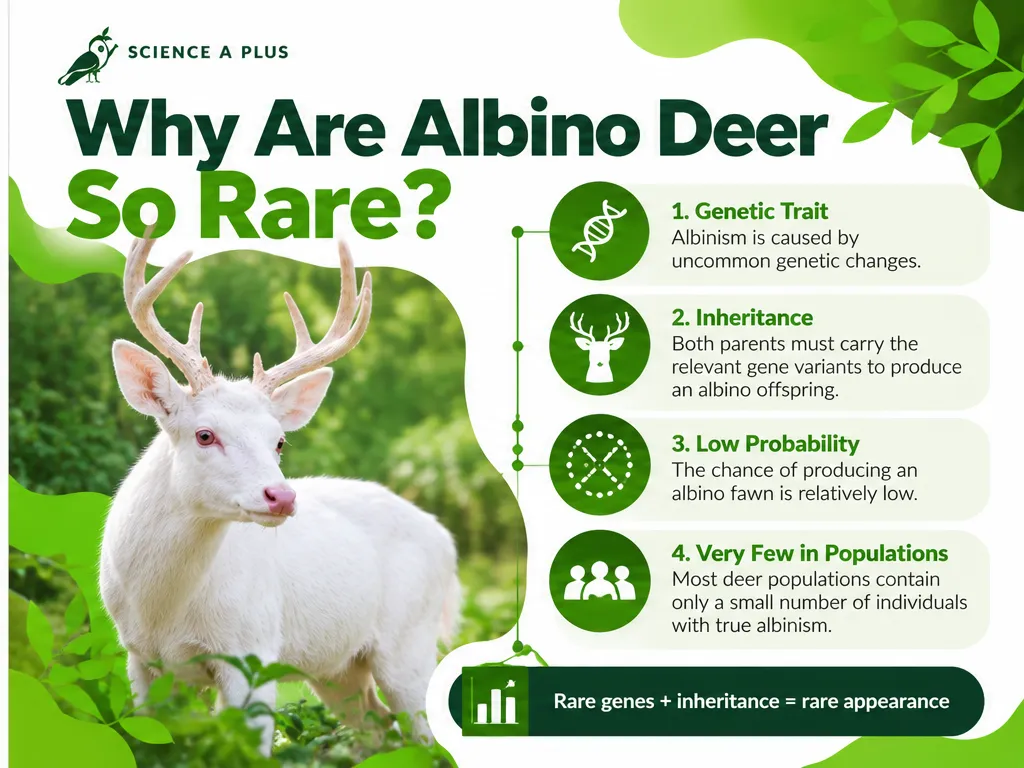
Why are albino deer so rare?
There are four steps to the answer, and the infographic sums them up neatly. Albinism is a genetic trait. It is inherited as a recessive trait, so both parents must carry the changed gene. The chance that any one fawn gets two changed copies is low. And very few deer in a population carry the gene in the first place.
The key phrase is rare genes plus inheritance equals a rare appearance. If only one deer in a hundred carried a recessive gene, then two carriers would meet only once in about ten thousand pairings. Each carrier pair would then still have only a 1 in 4 chance of producing an albino fawn. Multiply the small probabilities together and you reach the very small odds that hunters quote.
That is also why isolated groups can behave differently. If a small herd cannot mix with outsiders, relatives breed with each other, and a rare recessive gene can become much more common. The Seneca herd, which you will meet in the next part, is the best-known example.
What does a white deer look like at different ages?
Fawns of most deer species are born with a spotted coat. White-tailed fawns, for example, have white spots on a reddish-brown coat for their first few months. The spots help the fawn blend into dappled light on the forest floor.
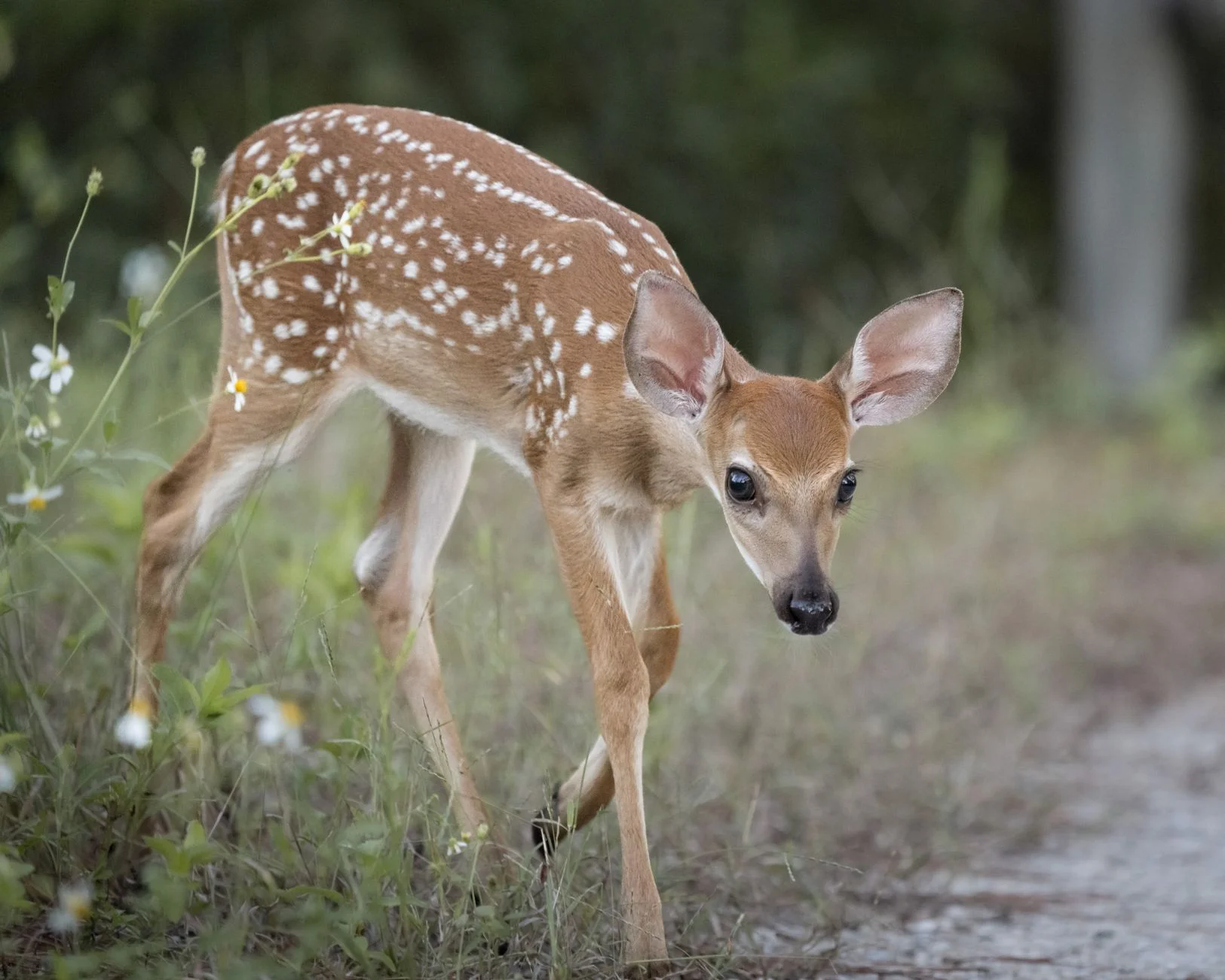
A spotted fawn is a normal fawn. The spots are not a sign of albinism or leucism, and they fade as the fawn grows its adult coat. An albino fawn would be pale or white from birth, with pink eyes. A leucistic fawn might be white or pale with dark eyes. Seasonal changes in the normal coat, such as a greyish winter coat, should not be confused with albinism either.
Do albino deer have antlers?
Male deer of most species grow antlers every year and shed them afterwards. Antlers are bone, covered in a soft furry skin called velvet while they grow. Coat colour does not decide whether a deer grows antlers, so albino, leucistic and piebald bucks all do. Antler colour is not a reliable clue to albinism, so ignore it when judging a white deer.
Antler size depends on age, food and genetics. Some piebald deer are reported to have smaller or odd-shaped antlers because of their bone differences.
Are albino deer completely white?
A true albino has no pigment in its hair, skin or eyes, so its coat is white. That does not mean it looks dazzling white in every photo. Wet hair, dirt, sunlight and shadow all change the apparent shade, and a winter coat can look cream or grey. An animal with obvious brown patches is not a true albino. It is piebald or another colour variant, even if some pictures online call such deer "partial albinos".
For a quick reminder of how this fits into wider biology, remember that camouflage depends on pigment. Take the pigment away and the animal loses its natural disguise, which is the subject of the next part.
Challenges of being an albino deer
Deer are prey animals. Their brown or reddish coats break up their outline against leaves, bark and soil, which is a classic example of camouflage. A white coat removes that disguise, and the infographic lists the main problems an albino deer may face.
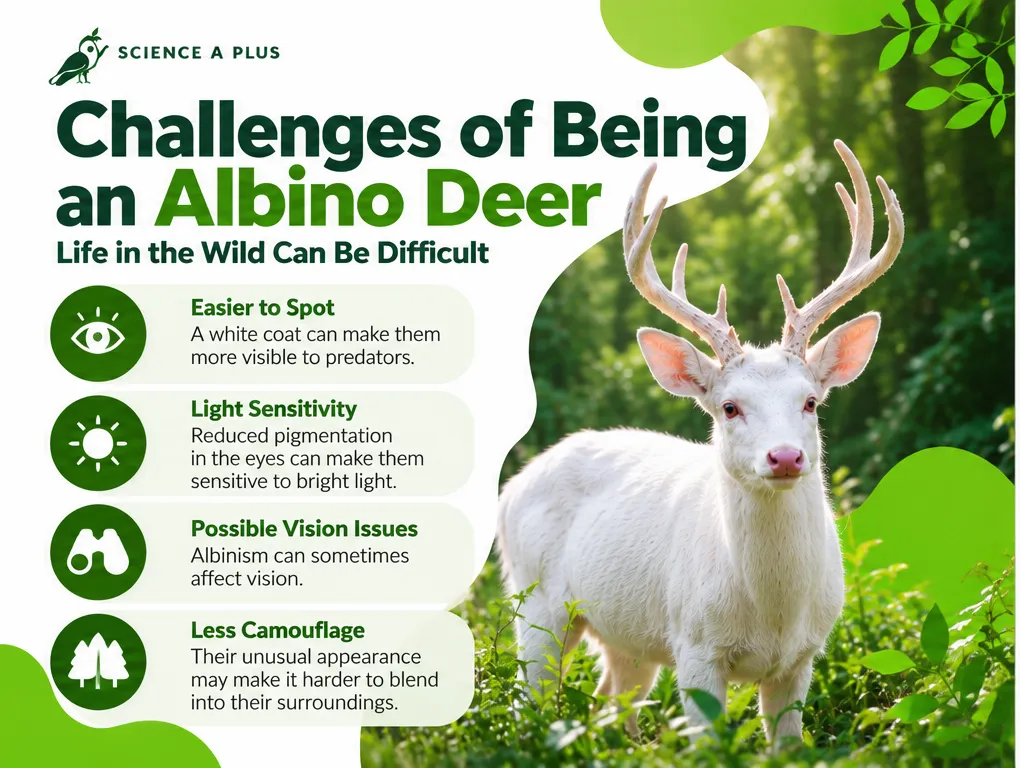
- Easier to spot. A white deer stands out against a dark woodland, so predators and people can see it more easily.
- Light sensitivity. Less pigment in the eyes can make bright light uncomfortable.
- Possible vision problems. Albinism can sometimes affect how well an animal sees.
- Less camouflage. Fawns that rely on hiding while their mother feeds are especially at risk if they are pale.
None of this means every albino deer dies young. Deer that reach adulthood can still feed, move and reproduce. White deer have been reported living for years in parks, estates and protected areas, where predators and hunting are limited. But in the wild, visibility is a real cost, and it is one reason true albino deer are seldom seen.
Who hunts deer, and does colour matter?
Deer sit in the middle of a food chain. They eat plants such as grass, leaves and twigs, and they are eaten by predators such as wolves, coyotes and large cats where those live. In much of Britain, wild deer have no large natural predators, so people manage their numbers instead.
A white coat may make hunting easier for a predator that hunts by sight. Not every predator hunts by eye, though. Many rely on smell and hearing, and deer have sharp senses to match. Be cautious about statements that say white deer are always doomed. The evidence from wild populations is limited, and it is a good example of why scientists ask for data before reaching a conclusion.
The Seneca white deer of New York
The most famous herd of white deer lives in Seneca County, New York. In 1941 the United States Army enclosed the Seneca Army Depot with a 24-mile fence, which trapped a small group of white-tailed deer inside. White deer began to appear in the herd after the fence went up.
The deer were cut off from outsiders, so they bred with each other for many generations. Over time the recessive gene for a white coat became far more common than it would be in a normal wild population. During the 1950s, the depot commander banned soldiers from shooting white deer, which helped the white animals to survive. At its peak, the herd was reported at about 700 deer, with roughly 300 of them white.
These deer are leucistic, not albino. They have brown eyes. That makes them a textbook case of a recessive trait spreading in a small isolated population.
The depot closed in 2000, and the fence no longer guaranteed the herd's future. Since then, part of the land has become a conservation park with tours, which reopened as self-guided drives on 27 June 2020. Reports of the herd's size have varied from year to year, so it is safest to check the current numbers with the conservation park before you quote one.
Are white deer protected by law?
It depends where you are. Some places protect albino or all-white deer, and others treat them like any other deer. Always check the rules where you live before assuming anything.
In Wisconsin, albino and all-white deer have been protected for decades. The state's rule describes them as albino deer or deer with a coat of all white hair, apart from the tarsal glands and parts of the head, which may be another colour. The rule has been questioned locally. Hunting-press articles also list other US states that protect albino deer, but laws change, so read the current regulations from the state wildlife agency.
Notice how the law uses a visual definition. A rule that says "all-white" covers leucistic deer as well as albino ones, because an enforcement officer or hunter in the field cannot easily test a deer's genes. In practice this is why the three kinds of white deer get discussed together.
White deer in Britain
Britain has six wild or semi-wild deer species: red, roe, fallow, sika, muntjac and Chinese water deer. Many of the white deer seen in British parks are white fallow deer, which are not albino. According to the British Deer Society, white fallow deer are less common than the common, menil and black colour forms, but they stand out in a herd.
These white fallow deer are leucistic, a natural colour form of the species rather than albinos. The variety of fallow colours has been linked to the history of deer parks, where people kept and bred them long before they became wild in the UK. White ones also appear in other species: white roe, sika and muntjac deer have all been reported, although they are unusual.
A white red deer stag is far rarer. White red deer are occasionally reported in Scotland. If you visit a park or the Scottish Highlands, remember that sightings like this are rare luck rather than a reason to chase an animal.
Do all deer species turn white?
Any deer species can in principle produce a white or pale animal, because the genes that control pigment are shared across mammals. Species that live in snowy places can also have naturally pale winter coats, but that is a seasonal colour change rather than albinism. Our guide to albino and white peafowl makes a similar point for birds, where a white bird is usually leucistic, not albino.
When you read a news story about a white deer, ask three questions. What colour are the eyes? What colour is the nose? Is the animal white all over, or patchy? Those answers will tell you much more than the headline does.
White deer in folklore and symbolism
People have told stories about white deer for centuries, and many of them share one idea: a white deer is no ordinary animal. In Celtic and Arthurian tales, a white stag is often a messenger from the Otherworld. It leads a hero on a chase that stands for a quest, and it usually vanishes before it can be caught. In many stories, killing a white deer is a wrong that brings bad luck.
Many cultures have stories about hunting a white deer, and they often end badly for the hunter. Storytellers have good reason to choose white: it is rare, striking and easy to see in a dark forest.
In England, the white hart (an old word for a stag) was the badge of King Richard II, who probably took it from his mother's family arms. It appears on the Wilton Diptych painting, and it is still the name of many pubs. The folklore explains why white deer are treated with respect in many places, but it is not science. A stag does not carry a message, and a white coat is explained by genes and melanin, not magic.
How to watch white deer responsibly
If you are lucky enough to see a white or pale deer, you can enjoy it without harming it. Use the checklist below, and tick the points as you read them.
- Keep your distance and use binoculars or a long lens instead of walking closer.
- Stay quiet and downwind so the deer does not catch your scent.
- Never feed wild deer. Human food can make them ill and teaches them to approach people.
- Do not chase or corner a fawn. A fawn lying still alone is usually waiting for its mother, so leave it where it is.
- Keep dogs on a lead near deer, especially in spring and early summer.
- Do not share exact locations online if the animal could attract unwanted attention.
- Read local rules, because some parks and reserves restrict access in the rutting season.
When you take pictures, note what you can see. Record the eye colour, the nose, the hooves and whether the coat is white all over or patchy. These details are exactly what a naturalist or a wildlife group needs, and they make your photograph worth much more than a snap with no notes.
Common myths about albino deer
Guess the deer: flip cards
Quiz: how much do you know about albino deer?
Frequently asked questions about albino deer
What is an albino deer?
An albino deer is a deer born with little or no melanin because of inherited gene changes. It usually has a white coat, a pale or pink nose, light hooves and pink or reddish eyes. It is the same species as other deer, only without the normal pigment.
How rare are albino deer?
Very rare. Hunting and wildlife magazines give estimates ranging from about 1 in 20,000 to 1 in 30,000 for white-tailed deer, but these are rough estimates rather than a census. Albinism is recessive, so it only appears when a fawn inherits the gene from both parents.
What is the difference between an albino deer and a white deer?
"White deer" is a general description. A true albino has pink or reddish eyes and little or no melanin. A leucistic white deer has reduced pigment cells but usually normal dark eyes. The eyes and nose are the quickest way to tell them apart.
Are white deer albino?
Usually not. Most white deer, including the famous Seneca herd in New York and the white fallow deer of British parks, are leucistic and have dark eyes. Only deer with pink or reddish eyes and almost no pigment are true albinos.
What is a piebald deer?
A piebald deer has a brown coat with large patches of white. In white-tailed deer it is a recessive trait. Some piebald deer are reported to have bone differences, such as a bowed spine, shorter legs or a shortened jaw, but lightly marked animals may look healthy.
Can albino deer see well?
Albinism can reduce vision and make bright light uncomfortable, because the eyes lack normal pigment. The effect varies between animals and is hard to measure in the wild. It does not mean every albino deer is blind, and many live and breed normally.
Why are albino deer easier for predators to see?
A brown coat blends into woodland, which is camouflage. A white coat stands out, especially against dark trees and soil. That can raise the risk from predators that hunt by sight, which is one reason albino deer are seldom seen.
Where do the Seneca white deer live?
They live at the former Seneca Army Depot in Seneca County, New York. A 24-mile fence built in 1941 trapped a small herd of white-tailed deer, and the recessive gene for a white coat became common. The deer are leucistic, not albino, and have brown eyes.
Is it illegal to hunt albino deer?
It depends on the place. Wisconsin, for example, protects albino and all-white deer, though the rule has been debated in some counties. Laws differ between states and countries and can change, so always check the current rules from the local wildlife agency.
Are there white deer in the UK?
Yes. Many of the white deer seen in British parks are white fallow deer, which have dark eyes and are not albino. Fallow deer come in common, menil, black and white colour forms. White roe, sika and muntjac deer have been reported, and a rare white red deer stag has been reported in Scotland.