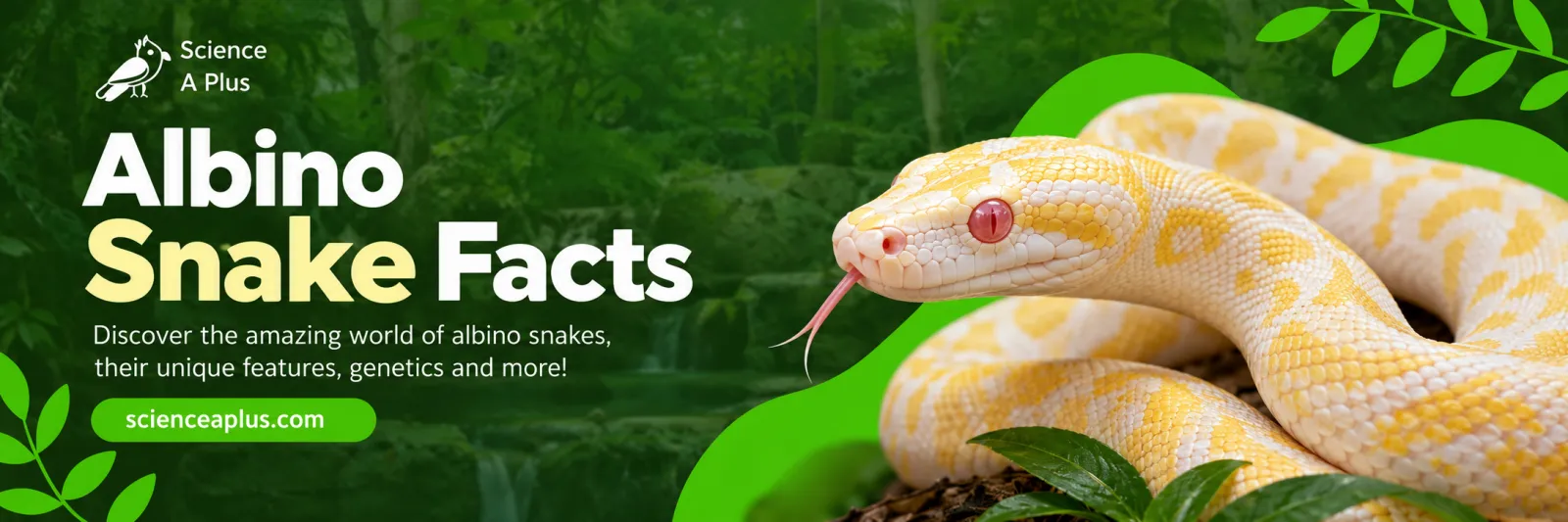
An albino snake is a snake that was born unable to make melanin, the dark pigment that normally colours skin, scales and eyes. The result is a pale snake with pink or red eyes, but not always a white one: many albino snakes are bright yellow, orange or red, because other pigments are still made. This guide explains the biology, the colours, the wild and captive story, and how albinism is inherited.
What is albinism in snakes?
Albinism is an inherited condition in which an animal makes little or no melanin. Melanin is made by special pigment cells, using the enzyme tyrosinase and several other proteins. If the gene for one of these proteins is faulty, the chain of reactions stops and the dark pigment is never made.
The key point is that albinism is a change in one gene and affects one pigment pathway. The snake is still the same species, with the same body, the same diet and the same behaviour. An albino ball python is still a ball python, and an albino corn snake is still a corn snake. Albinism is found in many animals; our guide to albino animals compares them with mammals, birds and amphibians.
Albinism affects the eyes as well as the skin. Without melanin in the iris and the back of the eye, blood vessels show through, so the eyes of a true albino usually look pink or red. In other albino animals, eyes are often sensitive to bright light and sight can be poorer. This has not been well tested in snakes, so treat it as a likely idea rather than a proven fact.
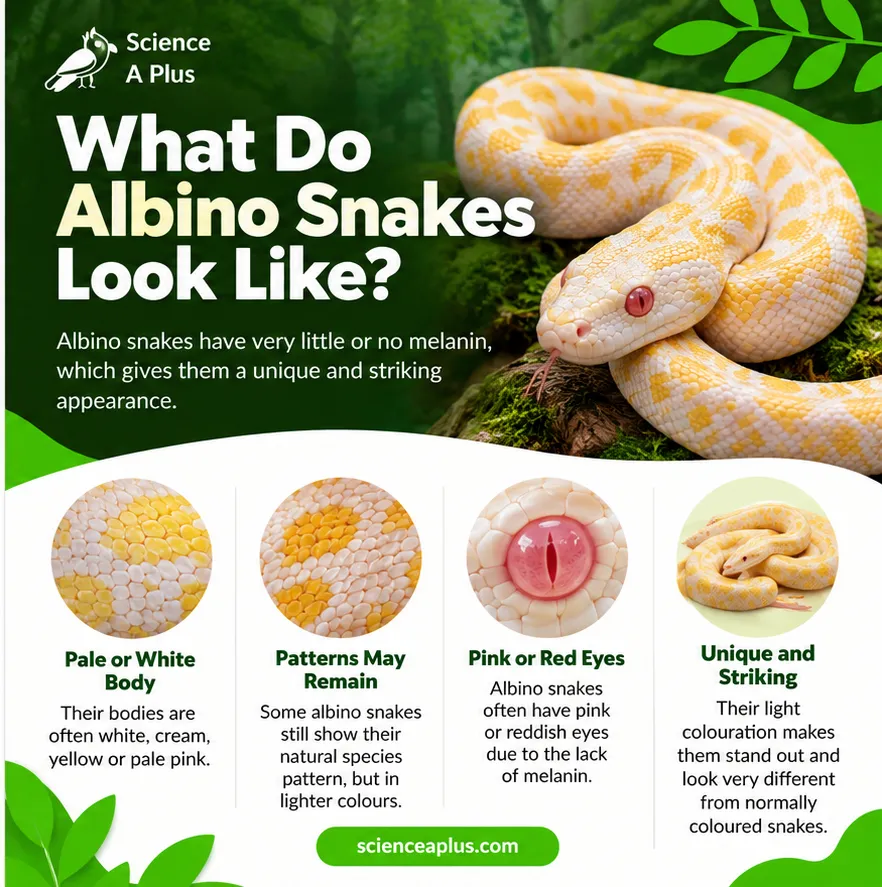
Why are some albino snakes yellow, orange or red?
This is the part that most older web pages get wrong. They say albino snakes have "no pigment at all". In fact, a snake's skin holds several kinds of pigment cell, called chromatophores:
- Melanophores make melanin, the black and brown pigment.
- Xanthophores make yellow pigments, and erythrophores make red ones.
- Iridophores contain tiny crystals that reflect light and add blue, green and shimmering colours.
Albinism switches off only the melanin pathway. The yellow and red cells carry on working, so the snake keeps its yellows, oranges and reds while losing its blacks and browns. That is why an albino Burmese python is cream and golden-yellow, and an albino corn snake is white and orange-red.
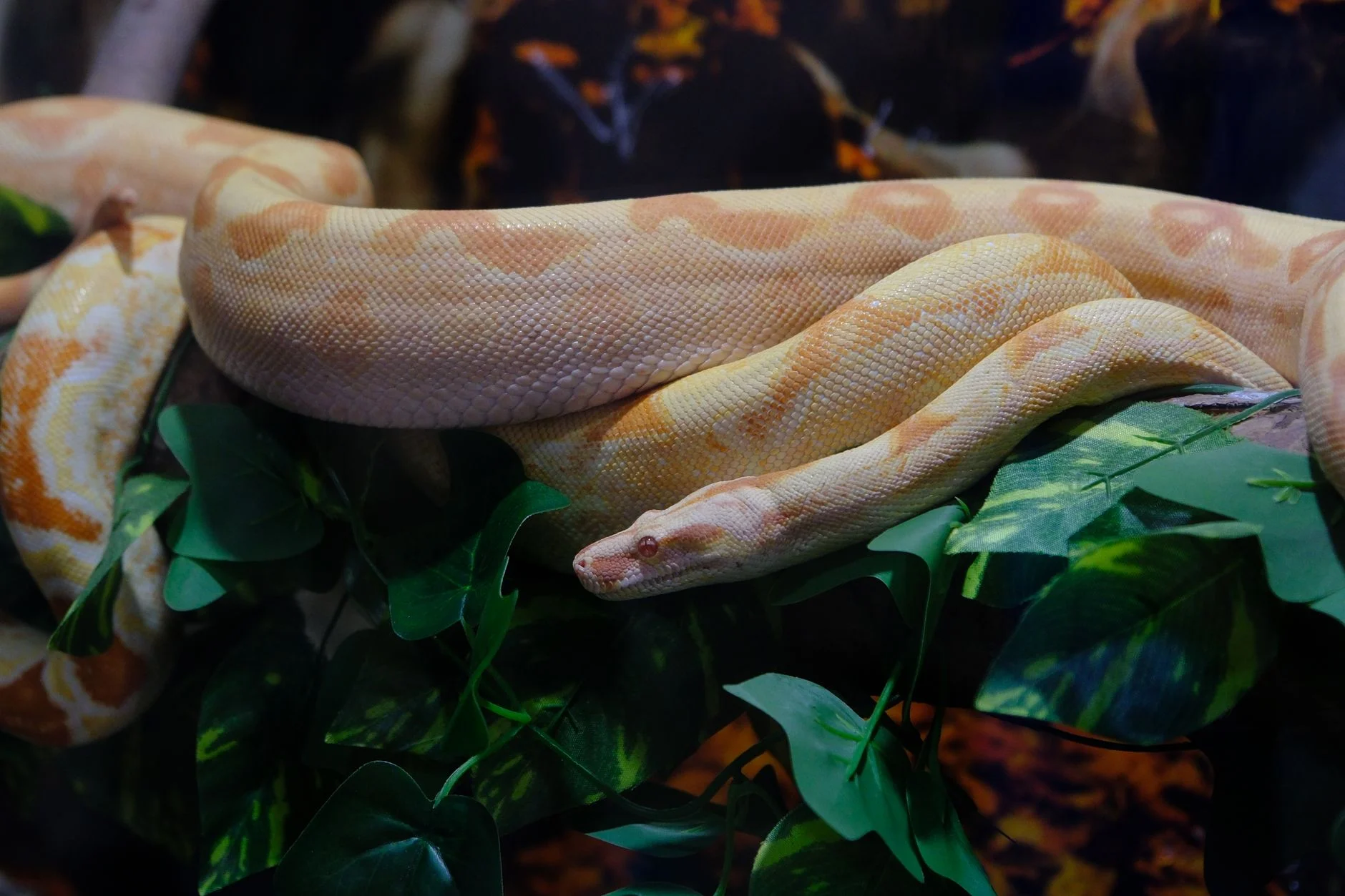
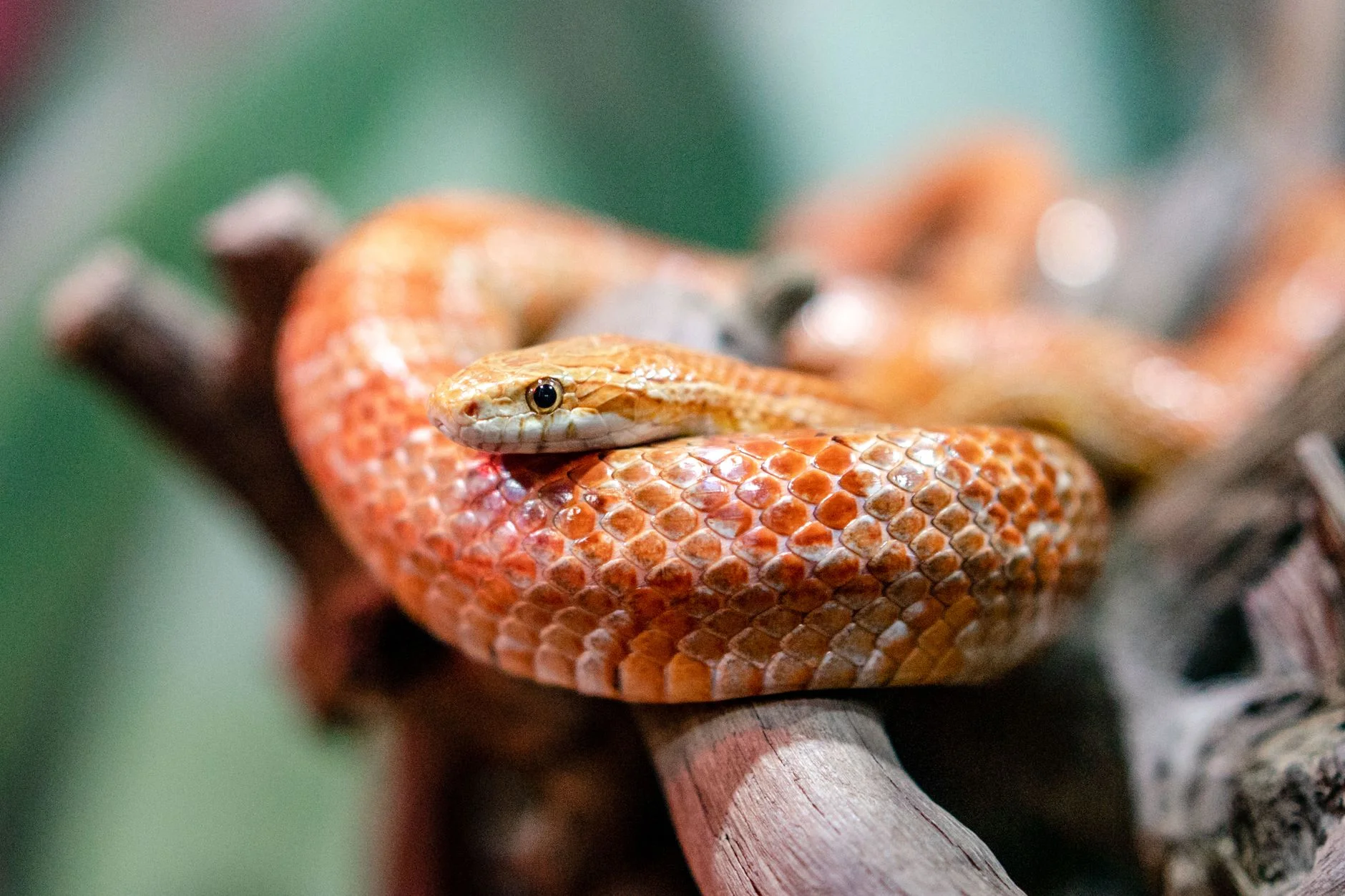
In the corn snake, the oldest colour variant ever recorded is "amelanistic" (often shortened to "amel"). Scientists who studied its DNA in 2015 found that the cause is a mutation in a gene called OCA2, where a stretch of DNA has been inserted into the gene and cuts the protein short. Amel corn snakes have white borders where a normal corn snake has black ones, showing that cells without melanin still help build the normal pattern.
T-negative and T-positive albinism
Snake keepers use two labels you will meet in articles and sales listings. They refer to tyrosinase, the enzyme that starts melanin production.
- T-negative (tyrosinase-negative): the tyrosinase enzyme does not work, so no melanin and no related pigments are made.
- T-positive (tyrosinase-positive): tyrosinase works, so early steps still happen and some melanin-related pigments are made, but a later step fails and no black melanin is produced.
These labels come from reptile keeping rather than from a single official classification, and different species have different genes involved. The corn snake's amelanism, for instance, is linked to OCA2 rather than to the tyrosinase gene. The big idea for GCSE is that different faulty genes can all give an albino look, because several proteins have to work together to build melanin.
What do albino snakes look like?
Because the pigments that remain depend on the species, albino snakes look very different from one another. Here is what they share and where they differ.
| Feature | In albino snakes |
|---|---|
| Black and brown colour | Missing, since there is no melanin |
| Yellow, orange and red | Often still present, which is why many are not white |
| Pattern | Usually still visible, but in softer, lighter colours |
| Eyes | Usually pink or red, because blood vessels show through |
A good rule is that the albino version of a snake looks like the normal version with all the black and brown removed. Picture a normal Burmese python with its brown saddles turned golden-yellow, and you have the albino.
Albino vs leucistic snakes: what is the difference?
A pale or white snake is not automatically an albino. The other common cause is leucism, and mixing the two up is one of the most frequent mistakes, even in pet shops. Keepers and sellers sometimes mix up the two terms.
Leucism is caused by a problem during development. Pigment cells begin life in a strip of embryo tissue called the neural crest and then travel to the skin. If that process fails, fewer pigment cells arrive, and the snake loses several kinds of pigment, not just melanin. The pigment cells in the back of the eye start somewhere else, so leucistic snakes keep dark pupils and eye pigment. Eye colour varies by species; in the Texas rat snake the iris was light grey instead of red.
| Feature | Albino | Leucistic |
|---|---|---|
| What is affected | Melanin only | Several pigment cell types |
| Yellow and red pigment | Usually kept | Often reduced or lost |
| Eyes | Usually pink or red | Usually dark, normal colour |
| Typical look | Pale background, yellow or orange patterns | White or very pale all over, or patchy white |
A real example comes from a leucistic Texas rat snake whose genome was sequenced. Its skin lacked melanophores and xanthophores but still had iridophores, which is why it looked a uniform ivory white. Researchers found a single-letter DNA deletion in a gene called MITF, which helps pigment cells to develop, in some of the leucistic snakes. Not every snake carried it, but all had much lower MITF activity. In the Texas rat snake, the faulty gene made a protein only 286 amino acids long instead of the normal 574.
Other colour morphs that are not albino
The pet trade has bred a huge number of colour forms, called morphs. The word is a breeder's term, not a formal scientific one, but the underlying genetics is real. Corn snakes, the most studied pet species, show the idea well:
- Amelanistic (amel): no melanin. This is the albino corn snake, with orange-red patterns and white outlines.
- Anerythristic (anery): the opposite. The red pigment is missing, so the snake appears in greys, browns, blacks and white.
- Lavender: a pastel pinkish-purple colour. Young lavender corn snakes look grey and take on the purple tone as they age.
- Combinations: breeders combine recessive genes. An opal corn snake combines amel and lavender, and a snow corn snake combines amel and anery (keepers' names for these morphs). It is very pale because both black and red pigment are reduced or missing.
Notice what the combinations tell us. Switch off melanin and you get albino; switch off red as well and you get a snow snake, which is very pale. Each pigment pathway is controlled separately, which is a neat illustration of how genes work like switches.
Albino snakes in captivity
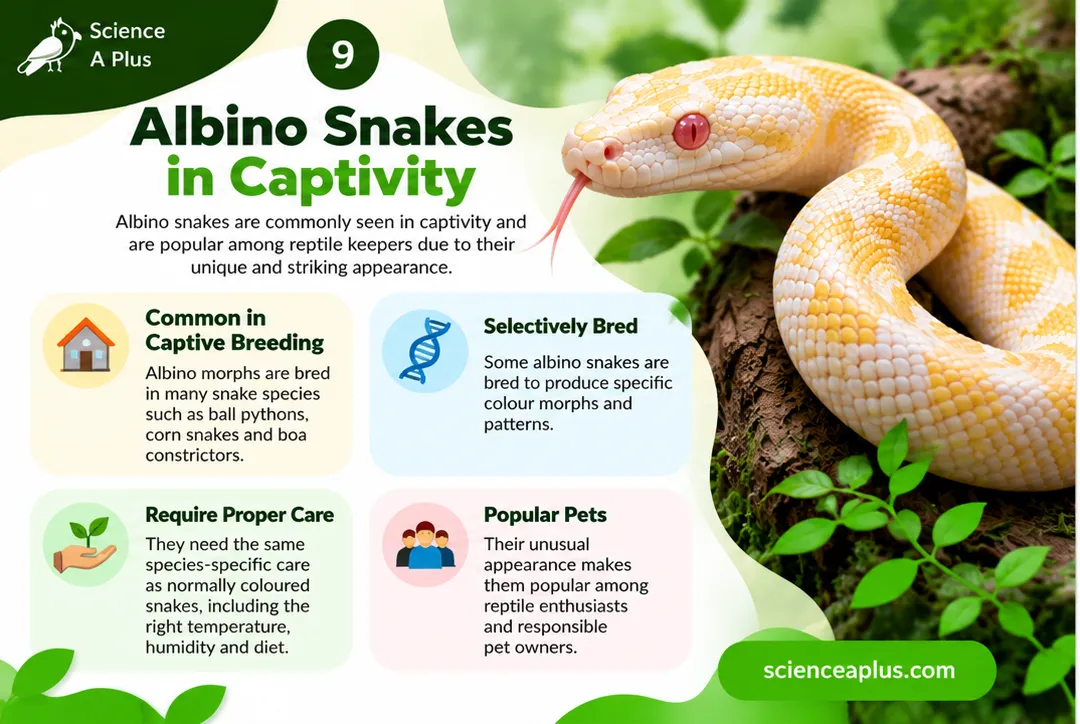
Almost every albino snake you see in a photo or at a reptile show was bred by people. In captivity, an albino hatchling has a good chance of surviving: it is fed, kept warm and safe from predators. Breeders can then pair albino snakes together or with carriers to produce more of them, and over generations whole lines of albino snakes have been developed.
Albino morphs are bred in many species, including ball pythons, corn snakes and boa constrictors, and some are selectively bred for particular colours and patterns. They need the same species-specific care as normally coloured snakes: the right temperature, humidity and diet. Their colour does not change their needs.
Captive breeding has benefits and costs. On the plus side, it lets people enjoy snakes without taking them from the wild. On the downside, breeding for a particular look can spread unhealthy traits if breeders are careless, and health problems can come along with some looks. If you are thinking of keeping a snake, pick a captive-bred animal from a reputable breeder and research its needs before you buy.
Test your understanding
Tap each question to reveal a model answer.
Why are many albino corn snakes orange and white rather than completely white? (2 marks)
Albinism only stops the production of melanin (1). The yellow and red pigment cells still work, so orange and red patterns remain on a pale background (1).
A pale snake has dark eyes. Is it more likely to be albino or leucistic, and why? (2 marks)
Leucistic (1). Leucism affects pigment cells that travel from the neural crest, but eye pigment cells develop separately, so the eyes keep their dark pupils and eye pigment. Albinos usually have pink or red eyes (1).
What is the difference between a snow corn snake and an albino corn snake? (2 marks)
An albino (amel) lacks melanin only (1). A snow corn snake lacks both melanin and red pigment because it combines the amel and anery genes (1).
Albino snakes in the wild: how rare are they?
Albinism is rare in wild snakes. Because the allele is usually recessive, a snake needs two copies to be albino, and most wild snakes that carry one copy are not paired with another carrier. This is why a wild albino snake sighting makes the news, while albino snakes in pet shops are everyday sights.
The obvious guess is that a pale snake is an easy target. Colour is a big part of camouflage, and a yellow-and-white snake on dark leaf litter stands out. But the evidence is more interesting than the guess.
Do albino snakes get eaten more? What the evidence says
In a field study in Bond Swamp, Georgia, researchers made hundreds of clay models of the eastern garter snake in four types: normal, fully albino and two kinds of partly albino. They left the models out in the habitat and checked them for beak marks, which show that a bird attacked. Models of all four types were attacked at similar rates. Albino models were not attacked more than normal ones.
That does not mean albinism is harmless. The study only tested attacks by birds, so other predators may behave differently. And the bright patterns of albino snakes may confuse some predators rather than attract them, but this does not help with the other problems albinism brings.
Eyes, light and hunting
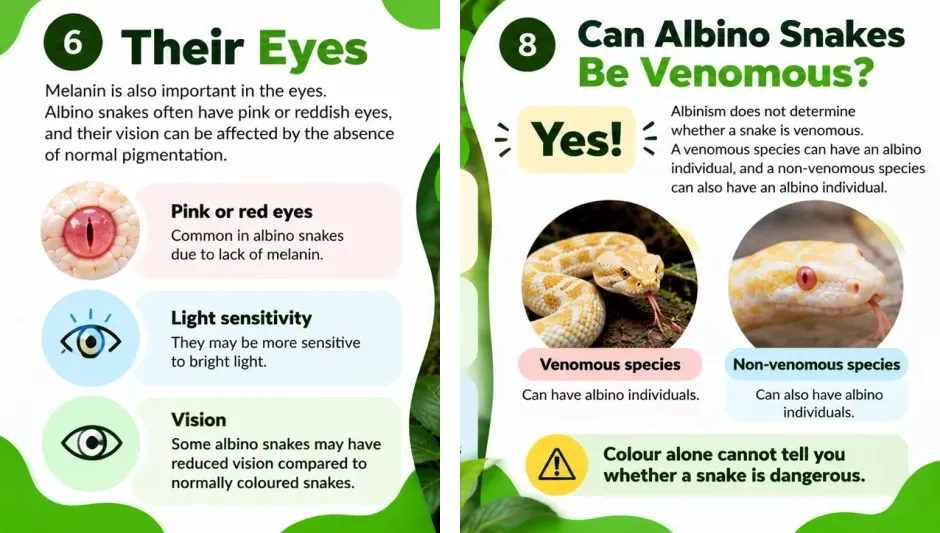
The same missing melanin that affects colour also affects the eyes. In a normal eye, melanin absorbs stray light and helps the eye work properly. In an albino eye, there is less of it, so:
- the eyes look pink or red, as blood vessels show through;
- in other albino animals, bright light is often uncomfortable. This has not been well measured in snakes, so it is a sensible guess rather than a proven fact;
- vision may be poorer, which could make it harder to find prey or spot danger.
Some snakes have a back-up sense. Pythons, boas and pit vipers have heat-sensing pits that detect the warmth of a mammal or bird, even in the dark. This may help an albino python or rattlesnake find food even if its sight is poor, although we should be careful not to claim more than the evidence shows. Albino snakes are rare in the wild for several reasons together: a recessive gene, a low chance of two carriers meeting, and possible disadvantages in sight and hunting.
Can albino snakes be venomous?
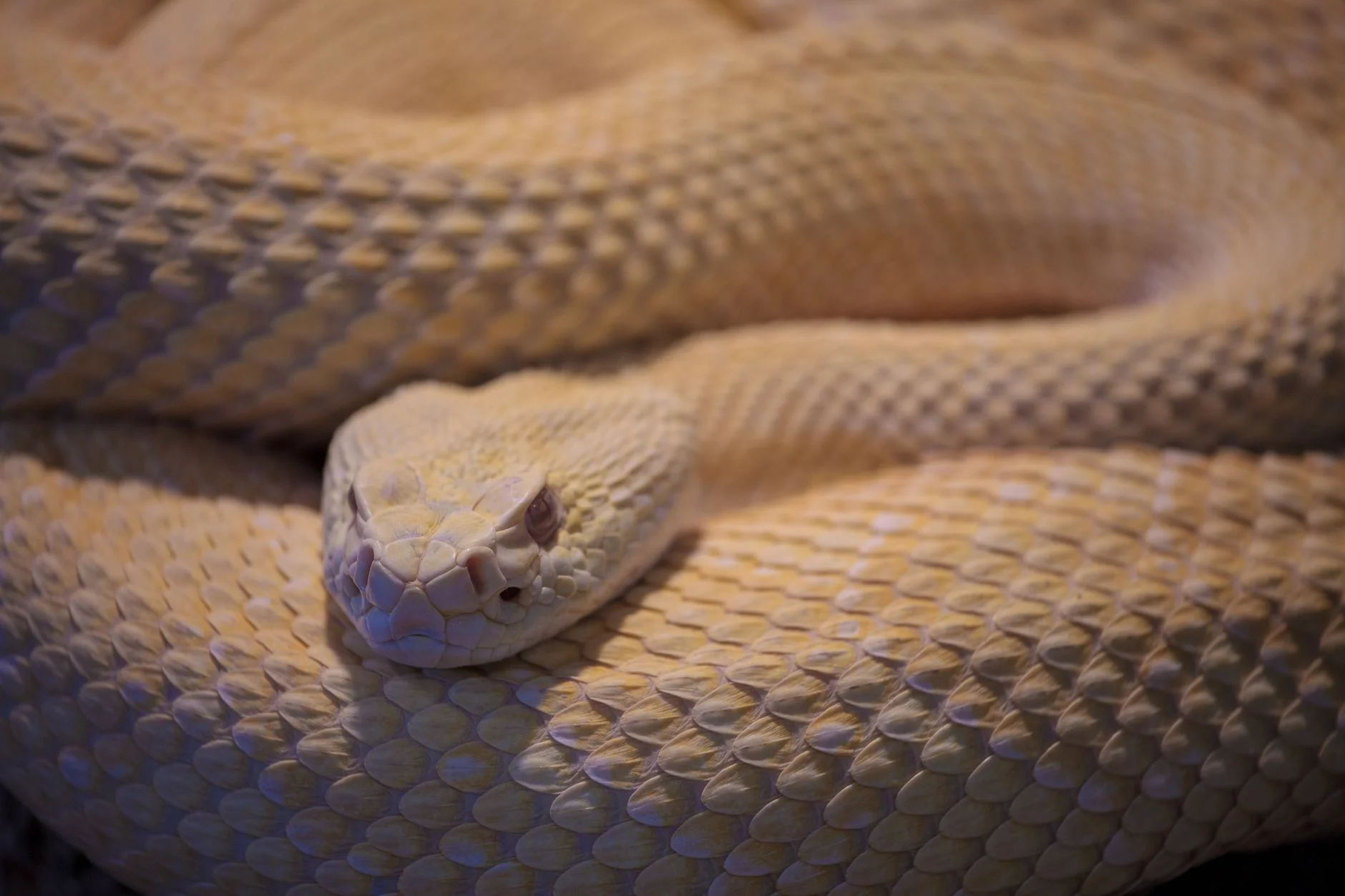
Yes. Albinism changes the colour of a snake, not its venom. Venomous species can have albino individuals, such as albino rattlesnakes, and non-venomous species such as corn snakes and pythons have albino forms too. Colour alone can never tell you whether a snake is dangerous.
Staying safe around snakes
The safe rule for wild snakes is simple: look, do not touch. Back away slowly, give the snake space and let it move off. Do not try to pick up, move or photograph a snake closely, whatever its colour, and never try to catch a venomous species. Many bites happen when people try to handle or kill snakes.
If you want to learn which snakes live near you, use a reliable local field guide. For snakes of different regions, you can read about venomous snakes in Sri Lanka, the harmless trinket snake and the eastern diamondback rattlesnake. Any bite from a snake you cannot identify needs urgent medical help, so call emergency services rather than waiting to see what happens.
In Great Britain, keeping venomous snakes listed in the Dangerous Wild Animals Act 1976 needs a licence from the local council, and venomous species are not suitable for ordinary pet owners.
Thinking of a pet albino snake?
An albino corn snake or ball python can be a rewarding pet, but only if the owner is ready for the long term. Use this checklist before you decide. Ticks are saved in your browser.
- I have chosen a non-venomous, captive-bred species that suits a beginner
- I know how big the snake will grow and have space for a secure enclosure
- I can provide the right heat, humidity and clean water for that species
- I know what the snake eats and am happy to feed it
- I have a plan for the snake's whole lifetime, which may be many years
- I will buy from a reputable breeder and ask to see the animal's health records
- I understand that a snake may need shade, and that albino snakes might be more sensitive to bright light
Albino snakes and the Burmese python
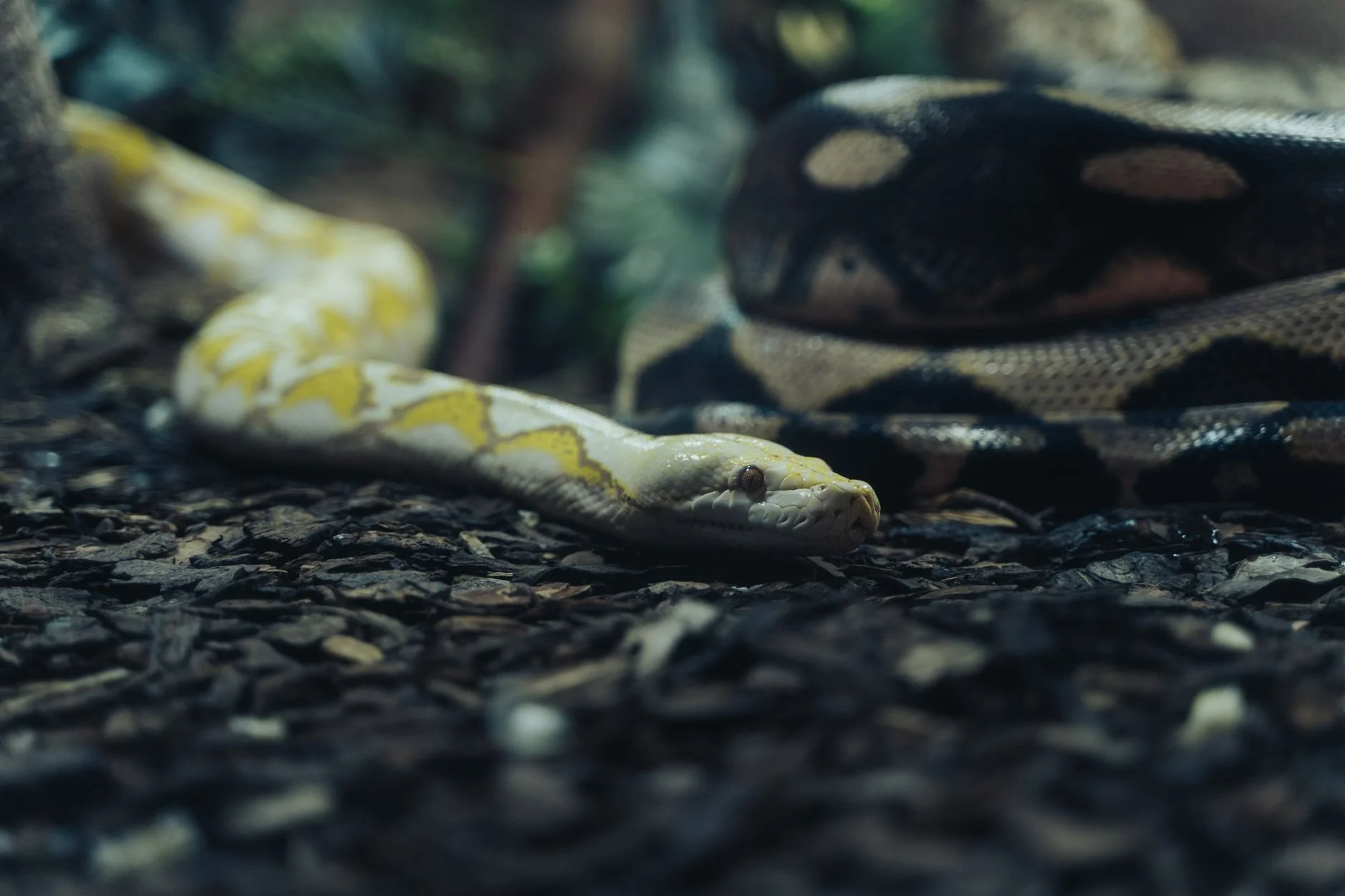
The albino Burmese python is one of the most recognisable albino snakes, with golden-yellow patterns on a cream background. It is also a reminder of why pet choice matters. Burmese pythons grow very large and are an invasive species in Florida, where they are established in the wild, with the pet trade widely blamed for the start of the problem. Any snake bought as a small, pretty pet may one day be a large animal that needs a lot of space.
How is albinism inherited in snakes?
In corn snakes, and in many other pet snakes, albinism is recessive. That means a snake shows albinism only if it inherits the albino allele from both parents. Using the letter a for the albino allele and A for the normal one:
- AA: normal colour, not a carrier.
- Aa: normal colour, but a carrier of the albino allele.
- aa: albino.
If two carriers (Aa × Aa) breed, each egg has a 1 in 4 chance of hatching as an albino, a 1 in 2 chance of being a carrier and a 1 in 4 chance of being a non-carrier. If an albino (aa) breeds with a non-carrier (AA), every baby is a carrier, and none is albino. For more on dominant and recessive alleles, see our guide to alleles and inheritance.
Try it yourself. Choose the genotype of each parent and the number of babies in the clutch. The calculator assumes both parents carry the same albino gene, as different albino mutations may sit in different genes.
Notice the last line of the result. Probabilities describe each baby separately, so a clutch of eight from two carriers might contain no albinos at all, or four. This is the same reasoning used in a Punnett square, only with a calculator doing the work.
Albino snake myths and facts
Albinism attracts a lot of rumours. Here are the main ones, quickly checked.
- "Albino snakes are a separate species." No. An albino is the same species as its normally coloured relatives.
- "They have no pigment at all." No. They lack melanin, and often keep yellow and red pigments.
- "All pale snakes are albino." No. Leucistic snakes can be pale with dark eyes.
- "Albino snakes are harmless." No. Venomous species have albino forms too.
- "Albino snakes die young in the wild." The evidence is mixed: models of albino snakes were not attacked more by birds, but albinism may bring sight problems.
Albino snakes also illustrate wider ideas in biology. They show how a single change to a gene can alter a feature, and why variation matters in adaptation. A trait that is a disadvantage in one habitat may matter less in another. If you want to meet snakes that are perfectly adapted to their surroundings, read about the snakes of the desert.
Flip the cards: albino snake facts
Quiz: how much do you know about albino snakes?
Frequently asked questions about albino snakes
What is an albino snake?
An albino snake is one that cannot make melanin, the dark pigment in skin, scales and eyes, because of an inherited gene change. It usually has pink or red eyes and a pale body, often with yellow, orange or red patterns that remain because those pigments are made by other cells.
Why are albino snakes yellow?
Snakes have separate pigment cells for black melanin, for yellow and red pigments, and for shiny structural colour. Albinism switches off only melanin production. The yellow and red cells keep working, so many albino snakes, such as albino Burmese pythons and corn snakes, look golden, orange or red on a pale background.
Are albino snakes rare?
In the wild, yes. Albinism is usually recessive, so a snake needs two copies of the allele, and wild albinos are very rarely seen. In captivity albino morphs are common, because breeders deliberately pair albino snakes or carriers to produce them in species such as corn snakes and ball pythons.
What is the difference between albino and leucistic snakes?
Albinism removes melanin only and usually gives pink or red eyes. Leucism is caused by pigment cells failing to reach the skin during development, so several pigments are reduced and the snake may be white or patchy. Leucistic snakes keep dark pupils and eye pigment, though eye colour varies by species.
Can albino snakes be venomous?
Yes. Albinism affects colour, not venom, so albino rattlesnakes and other venomous species exist as well as non-venomous albino corn snakes and pythons. You cannot tell whether a snake is dangerous from its colour. Keep your distance from any wild snake and never try to handle one.
Do albino snakes have bad eyesight?
They may. Without melanin in the eye, albino snakes often have red eyes. Albino animals are often sensitive to bright light and may see less well, but this has not been well measured in snakes. Some species have heat-sensing pits that help them find warm-blooded prey, which could partly make up for reduced sight.
Do albino snakes get eaten more in the wild?
Not necessarily. In a Georgia field study using clay models of garter snakes, birds did not attack albino models significantly more than normal ones. The study only tested birds, so other predators might act differently, and sight problems could still be a disadvantage.
Is albinism in snakes inherited?
Yes. In corn snakes, albinism is a recessive trait, so a snake must inherit the albino allele from both parents to be albino. Two carriers (Aa) have a 1 in 4 chance of an albino baby each time. Our calculator above lets you test different crosses.
Are albino snakes a separate species?
No. Albinism is a colour variation within a species, caused by a change in a gene. An albino ball python is still a ball python and an albino corn snake is still a corn snake. They have the same body, diet and behaviour as normally coloured snakes of that species.
Is an albino snake a good pet?
Albino corn snakes and ball pythons are popular pets, but they need the same care as any other snake: a secure enclosure, correct heat and humidity, suitable food and a plan for many years. Choose a non-venomous, captive-bred species from a reputable breeder, and provide shade for sensitive eyes.