Want to know how to read faster without losing understanding? The honest answer is that most adults read non-fiction at about 238 words per minute, and the realistic route to a higher reading speed is better focus, a clear purpose and more background knowledge, not a trick that lets you absorb a book in minutes. This guide separates what works from what is hype, so you can read faster where it is safe to do so and slow down where it matters.
Whether you are facing GCSE or A-level texts, university reading lists or simply a pile of books you never finish, the aim is the same: to spend your time reading efficiently, meaning speed and understanding together. Speed reading as it is sold online has a poor record in research, but there are plenty of evidence-based habits that help.
What is a normal reading speed?
Before you try to read faster, it helps to know where you are starting from. A large meta-analysis by Brysbaert (2019), which combined 190 studies and about 18,500 people, found that the average adult silent reading speed in English is about 238 words per minute (wpm) for non-fiction and 260 wpm for fiction.
Those are averages, not targets. Most adults read non-fiction at roughly 175–300 wpm, so a reading speed anywhere in that band is perfectly normal. Reading aloud is slower, at about 180 wpm, because you are limited by how fast you can speak.
| Reading type | Typical speed |
|---|---|
| Silent reading, non-fiction (average) | about 238 wpm |
| Silent reading, fiction (average) | about 260 wpm |
| Most adults, non-fiction (range) | roughly 175–300 wpm |
| Reading aloud | about 180 wpm |
So how many words per minute should you read? There is no single right answer, because the best speed depends on the text. A familiar story can be read quickly; a page of physics or a dense set of instructions needs a slower pace. If you are curious about your own figure, try the calculator below.
If you are helping a younger reader build the habit, our guide on how to improve reading habits of children covers the routines that make reading feel easy before speed ever becomes a question.
How your eyes read
Reading feels smooth, but your eyes do not glide along a line like a finger on a screen. They move in quick jumps called saccades, with short stops between them called fixations. A typical fixation lasts about a quarter of a second.

At each fixation you see only about 7–8 letters sharply. Your brain stitches these snapshots together into words and sentences so quickly that you never notice the gaps. This is the real limit on how fast you can read: the eyes have to land, the brain has to recognise what is there, and both take time.
Your eyes also sometimes jump backwards to an earlier word or line. These return movements are called regressions, and they are normal. Good readers make them too, and going back to check something you did not quite follow helps understanding. That is why a rule such as "never re-read" is poor advice.
Once you know how the eyes work, the claims made about speed reading become much easier to judge. If each fixation lasts about a quarter of a second and sees only about 7–8 letters sharply, there is a natural limit on how much text a person can truly process.
That does not mean you are stuck at your current pace. Skimming is a useful skill when you use it on purpose, and your normal reading can improve with practice. The honest summary is that the best way to read faster with understanding is to read more and to build your vocabulary and background knowledge. If you are tackling heavy science chapters, our advice on how to study science faster from textbooks shows how to apply this to subjects where every sentence carries information.
In the next part, we move on to ten practical tips that fit with how reading actually works: previewing, setting a purpose, skimming and scanning, and more. None of them promises miracles, but together they can make your reading time count for more.
10 tips to read faster (and still understand)
Here is the honest starting point: nobody can read thousands of words a minute and understand everything. What you can do is stop wasting time. Most slow reading comes from starting cold, having no goal, and reading every part of a text at the same pace. The ten tips below fix those problems, so you read faster where it is safe to do so and slow down where it matters.
Think of it as reading efficiently. Your reading speed may change only a little, but the time you spend per useful idea drops. Tips 1–5 are in this part; tips 6–10 follow.
1. Preview before you read
Before reading a single full sentence, spend 30–60 seconds looking at the shape of the text. Read the title, the headings, any pictures and captions, the bold words, and the introduction and conclusion. You are building a mental map, so the details have somewhere to land.
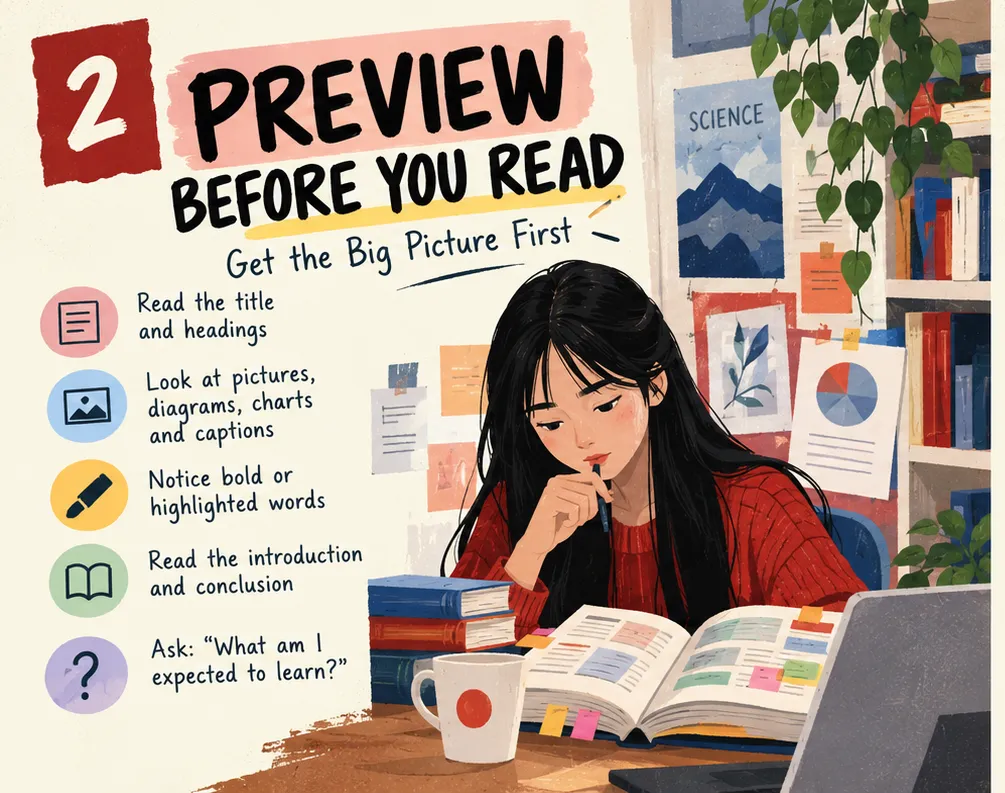
This works because understanding depends on what you already know. A quick preview gives your brain the topic, the key terms and the order of ideas, which makes the real read-through smoother and often quicker. It is also the first step of the study methods in tip 9.
2. Know your purpose
Ask yourself why you are reading before you begin. Are you looking for the main argument, learning a topic for a test, checking one fact, or reading for pleasure? Each purpose needs a different pace and a different level of detail.
Turn the purpose into one or two written questions, such as “What causes this reaction to speed up?” or “What is the author’s main claim?” Reading with a question in mind keeps your attention on what matters and lets you pass over the rest. This habit sits at the heart of accessing and analysing information: decide what you need first, then judge what the text gives you.
The same idea applies to good listening. Listening for a purpose, as explained in our guide to listening skills in education, helps you pick out the key points instead of drowning in detail.
3. Skim and scan
These two skills are often confused, but they do different jobs. Skimming means moving quickly through a text to get the general idea. Scanning means hunting for one specific fact, name or number while ignoring everything else.
| Feature | Skimming | Scanning |
|---|---|---|
| Goal | Get the gist or overall idea | Find a specific fact, date or number |
| What you read | Headings, first sentences, key words | Only the part that matches your target |
| Typical use | Deciding if a chapter is useful | Finding a formula or a date in a textbook |
| Understanding | Partial; you will miss details | Narrow; only the target fact |
Both are genuinely useful, but be realistic. Skimming trades understanding and memory for speed: you cover more text, but you understand and remember less of it. Use it to choose what deserves a proper read, not to replace one.
4. Read groups of words, not single words
Your eyes do not glide along a line. They make quick jumps (saccades) and pause briefly, typically for about a quarter of a second, at each stop (a fixation). Only about 7–8 letters are seen sharply at each pause. Slow readers sometimes feel they must look at every word separately, which makes reading choppy.
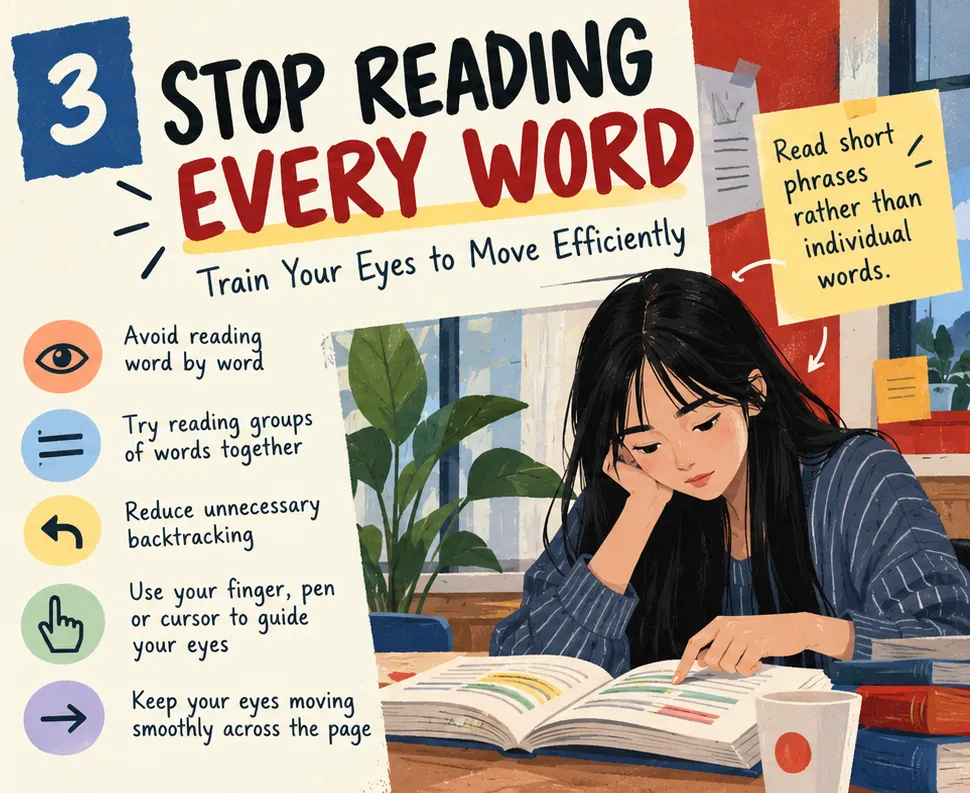
Practising reading in short phrases (“in the first stage”, “the rate of reaction”) can make text feel smoother, because phrases carry meaning better than single words. Try it on easy material first.
A caution, though. This helps a little, and it should not be forced. Your eyes will still jump and pause, and you will still go back over words now and then. Those backward glances (regressions) are normal and often help you understand. Equally, the quiet inner voice you hear as you read is a normal part of reading. Trying to switch it off tends to hurt comprehension, so do not fight it.
5. Use a pacer
A pacer is a finger, pen or card that moves under the line as you read. Some people find it stops them losing their place, drifting off or re-reading the same line, and it can give your eyes a steady rhythm.
Keep your expectations modest. The evidence for large speed gains from pacers is weak. Treat it as a tool for focus and keeping your place, not a trick that doubles your reading speed. If it feels natural, keep it. If it slows you down or distracts you, drop it.
With a clear preview, a purpose, the right skimming or scanning approach, phrase-based reading and perhaps a pacer, you already have a stronger start. Next come the habits that protect your understanding.
6. Remove distractions
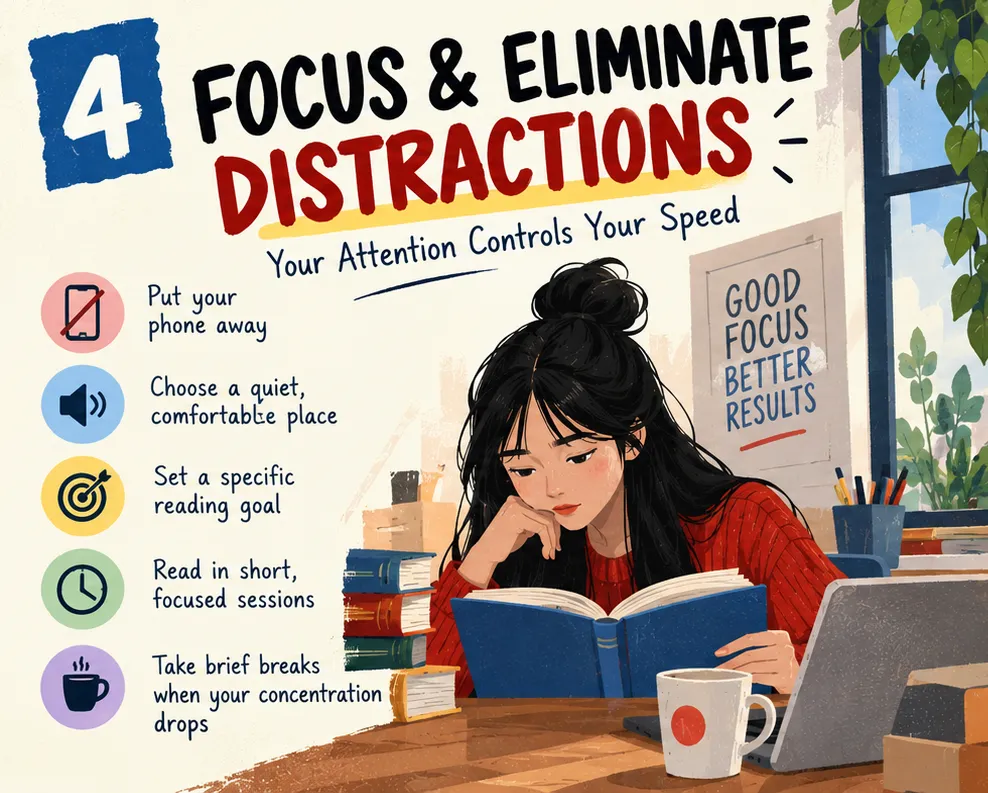
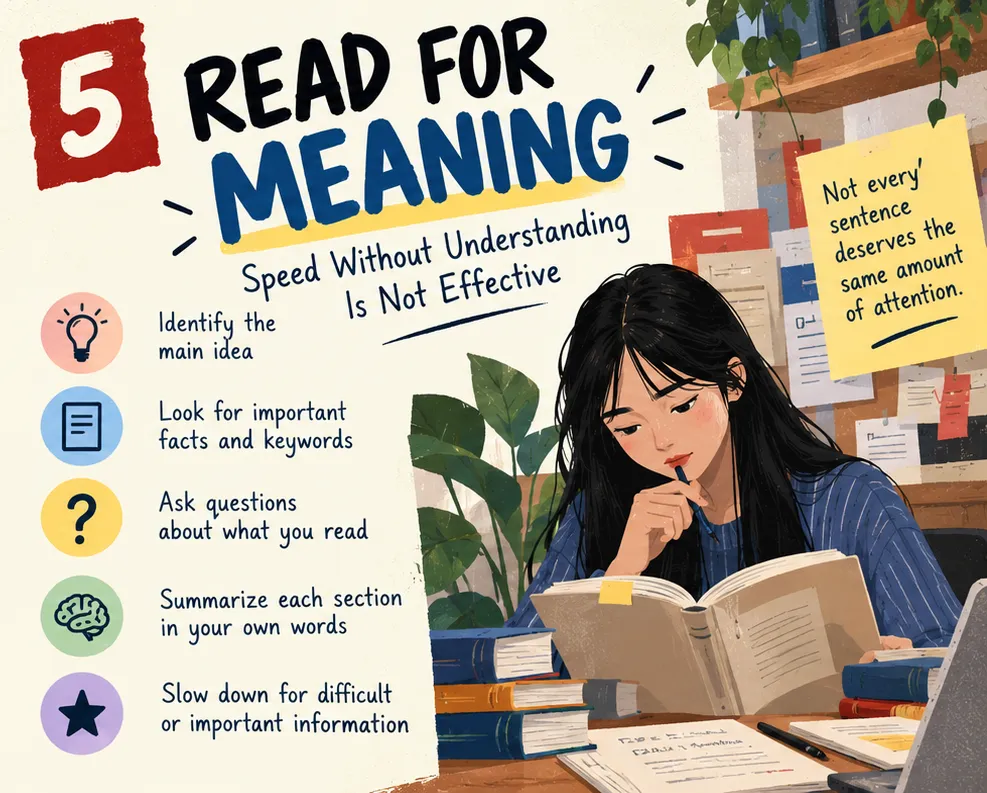
Most advice on how to read faster ignores the biggest drain on your reading speed: your own attention. If your phone buzzes every few minutes, you keep losing your place and have to go back, and that costs far more time than any eye-movement trick can save.
Set up a simple routine. Put your phone out of reach, close spare browser tabs, and read in a focused session with a clear start and finish. Short, focused blocks usually work better than a long, drifting evening where you re-read the same paragraph five times.
If you read on a screen, take regular breaks too. The 20-20-20 rule is commonly recommended: every 20 minutes, look at something about 20 feet (6 metres) away for 20 seconds.
7. Change speed for difficulty
Good readers do not read everything at one pace. They speed up through familiar or less important material and slow down for difficult, important parts, such as a new definition, a worked example or a tricky argument.
This is the honest answer to the speed-reading question. Your reading speed should depend on the text and your purpose. A GCSE science chapter full of new terms deserves a slower pace than a news article on a topic you already know well.
Going back to re-read a confusing sentence is not a failure. Regressions, the small backward jumps your eyes make, are normal and help understanding. Slow down, re-read, and then carry on.
8. Ask questions and summarise
Reading with questions in mind keeps you active. Before each section, turn the heading into a question. For example, "Photosynthesis" becomes "What goes in, and what comes out?" Your eyes then hunt for answers rather than drifting over the words.
After each section, close the book or look away and summarise it in your own words. If you can only repeat the author's sentences, or you cannot say much at all, you have found the part you need to read again.
This also helps memory. Research by Roediger and Karpicke (2006) found that testing yourself strengthens memory more than simply re-reading. Reading faster is no use if nothing stays in your head. For more ideas, see our guide on how to practise and remember what you study.
9. Use SQ3R or PQ4R
These two study methods turn passive reading into an active routine. SQ3R was described by Francis P. Robinson in 1946 in his book Effective Study. PQ4R is an extended version, credited to Thomas and Robinson (1972).
The SQ3R method has five steps:
| Step | What you do |
|---|---|
| Survey | Look over titles, headings, pictures, bold words, and the introduction and conclusion. |
| Question | Turn headings into questions you want answered. |
| Read | Read one section at a time, looking for the answers. |
| Recite | Say or write the main points in your own words, without looking. |
| Review | Go back over the whole chapter and test yourself on the key ideas. |
The PQ4R method has six steps:
| Step | What you do |
|---|---|
| Preview | Skim the chapter to get the overall shape. |
| Question | Ask what you expect each section to explain. |
| Read | Read carefully, section by section. |
| Reflect | Think about what you have read and link it to what you already know. |
| Recite | Say or write the key points from memory. |
| Review | Check your notes and answers against the text. |
Notice that these methods do not make the reading step itself faster. They make your study time more efficient, because you spend it on understanding and recall instead of reading the same page again and again.
What does SQ3R stand for? (5 marks)
Survey, Question, Read, Recite, Review.
10. Read more, every day
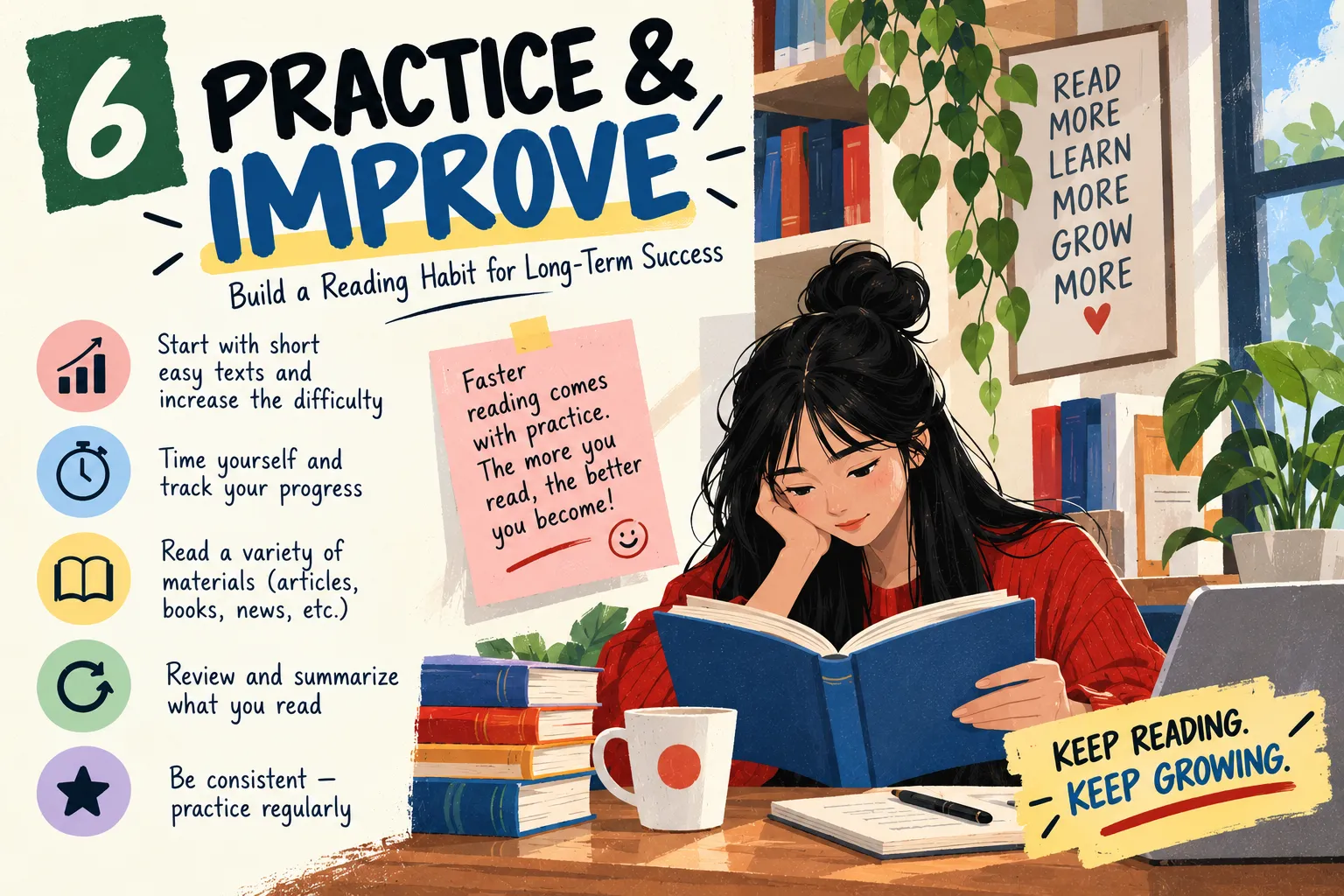
This is the least exciting tip, and the best supported. The most reliable way to read faster with understanding is to read more. Regular reading builds your vocabulary and your background knowledge, so fewer words and ideas stop you in your tracks.
A student who already knows what "diffusion" or "enzyme" means reads a biology page far more smoothly than one meeting those words for the first time. That is why practice matters more than any trick.
Aim for a little every day rather than a lot once a week. Fifteen to twenty minutes of reading you enjoy, plus your focused study sessions, will do more than a weekend course promising miracles. Choose a mix of material, including fiction, news and science articles, and look up new words as you meet them.
For a wider toolkit, read our tips on how to improve memory for better learning and to pass examinations. Combine good reading habits with good memory habits and you will get through more material, and remember more of it.
Does speed reading work?
Mostly, no, at least not in the way the adverts promise. A major review by Rayner and colleagues (2016, in Psychological Science in the Public Interest) found a trade-off between speed and comprehension. Claims of reading thousands of words per minute with full understanding are not supported by the evidence.
That does not make speed reading techniques useless. Skimming really is useful when you only need the gist. The catch is honest and simple: when you skim, you understand and remember less than when you read carefully. Skimming is a tool for a particular job, not a way to read everything faster.

So what does work? The best-supported way to read faster with understanding is unglamorous: read more, and build your vocabulary and background knowledge. When you already know most of the words and ideas on a page, your eyes and brain move through it more quickly. Everything else in this guide, such as previewing, setting a purpose and varying your pace, simply helps you spend your attention wisely.
If you want to read faster without losing meaning, treat any course that promises a huge jump in a weekend with suspicion. A realistic goal is steady improvement and, more importantly, better recall of what you have read.
Reading faster for exams
Exam preparation is where reading efficiency matters most, because you have a lot of material and limited time. But the goal is not to get through your notes quickly. It is to remember them when the paper is in front of you.
Here the research is clear. Retrieval practice, meaning testing yourself, strengthens memory more than re-reading (Roediger and Karpicke, 2006). Re-reading feels productive because the page looks familiar, but familiarity is not the same as being able to recall something. So read a section once with a purpose, then close the book and write down what you remember.
- Preview first. Look at headings, diagrams and bold words in the chapter before you read, so you know what to look for.
- Scan for specifics. Use scanning to find a definition, equation or number you need, rather than rereading the whole page.
- Do past papers. Past papers train you to read exam questions carefully, spot command words and recognise how marks are awarded.
- Budget your time. Divide the time available by the total marks so you know roughly how long each question deserves, and move on if you are stuck.
- Read the question twice. Slowing down on the question is not wasted time. Misreading it is one of the most expensive mistakes you can make.
Procrastination is also a hidden reading-speed killer, because a task you keep avoiding takes far longer than one you start. If that sounds familiar, these tips on how to stop procrastinating are a good companion to this guide.
When to get your eyes checked
Technique can only do so much if your eyes are struggling. If words blur, if you lose your place constantly, or if reading gives you headaches, do not simply push through. Get an eye test.
In the UK, NHS eye tests are free for under-16s and for under-19s in full-time education, and for some other groups too. Check the current NHS guidance or ask an optician if you are unsure whether you qualify. Anyone with sudden changes in vision, or eye pain, should speak to a GP or call NHS 111.

Your reading session checklist
Put the ideas together with this routine. Tick each step as you go; your ticks are remembered in your browser.
- Decide your purpose: write one or two questions you want the text to answer.
- Preview the titles, headings, pictures, bold words, introduction and conclusion.
- Remove distractions, then read in a focused session.
- Slow down for difficult or important parts and speed up for easy ones.
- Summarise each section in your own words without looking.
- Review later by testing yourself instead of simply re-reading.
Flip cards: the language of reading
Key points
- Most adults read non-fiction silently at roughly 175–300 words per minute, with an average of about 238 wpm.
- Reading is a series of quick eye jumps (saccades) and short stops (fixations); going back is normal.
- Speed reading claims of thousands of words per minute with full understanding are not supported by evidence.
- Your inner voice is normal; suppressing it tends to hurt comprehension.
- Preview, set a purpose and vary your speed to read efficiently.
- Skim for the gist and scan for specific facts, but know that skimming costs understanding.
- Retrieval practice beats re-reading for remembering what you have read.
- Get an eye test if words blur or reading gives you headaches.
Frequently asked questions about reading faster
What is the average reading speed?
Most adults read non-fiction silently at roughly 175–300 words per minute. A 2019 meta-analysis by Brysbaert, covering 190 studies and about 18,500 people, found an average of about 238 wpm for non-fiction and 260 wpm for fiction. Reading aloud is slower, at around 180 wpm.
How can I read faster and remember more?
Read with a purpose, preview headings and bold words first, and remove distractions. Then stop after each section and summarise it in your own words, and test yourself later instead of re-reading. Retrieval practice strengthens memory more than re-reading, so it helps you remember more of what you read.
Does speed reading really work?
Not in the way it is advertised. A major 2016 review by Rayner and colleagues found a trade-off between speed and comprehension, so claims of thousands of words per minute with full understanding are not supported. Skimming is useful for the gist, but you understand and remember less than when reading carefully.
Is it bad to read in your head (subvocalise)?
No, it is normal. The inner voice, called subvocalisation, is part of how most people read, and trying to suppress it tends to hurt comprehension. A better route to faster reading is to read more and build vocabulary and background knowledge, which make words and ideas quicker to recognise.
What is the difference between skimming and scanning?
Skimming means reading quickly to get the gist of a text, such as checking headings and the first lines of paragraphs. Scanning means searching for one specific fact, name or number without reading everything. Skimming gives a general overview, while scanning answers a precise question, and both are useful at different times.
What is the SQ3R method?
SQ3R stands for Survey, Question, Read, Recite, Review. Francis P. Robinson described it in 1946 in his book Effective Study. You survey the headings, turn them into questions, read to answer them, recite the answers in your own words, then review. PQ4R is a later version by Thomas and Robinson (1972).
How long does it take to read faster?
There is no fixed timetable, and you should distrust anyone who promises one. Habits such as previewing and setting a purpose can help straight away, but the biggest gains come slowly from reading more and building vocabulary and background knowledge. Think in months of regular reading rather than days.
Should I use my finger when reading?
It can help some readers keep their place and avoid losing the line, so it is worth trying. However, the evidence for large speed gains from a finger or pen pacer is weak. Use it as a tracking aid, not a speed trick, and drop it if it makes understanding worse.
How can I read faster for exams?
Preview the chapter, scan for the facts you need, and read each section once with a purpose. Then close the book and test yourself, because retrieval practice beats re-reading. Practise with past papers, read each question carefully, and slow down for difficult parts rather than rushing everything at the same speed.