Squeeze half a lemon into a glass of water and you have one of the most popular morning drinks in the UK. The claims that come with it are bigger than the glass: it “detoxes” your liver, “alkalises” your blood and melts fat. This guide looks at the disadvantages of drinking lemon water daily as well as the genuine benefits, and uses chemistry and biology to explain what is really happening in your mouth, stomach and kidneys.
The short version is reassuring. For most people a weak glass of lemon water is unlikely to cause problems if they look after their teeth, and it is mostly just water, which is the part that does you good. The risks come from the acid, and they depend on how strong the drink is and how you drink it. Health claims here come from the NHS, the Oral Health Foundation (formerly the British Dental Health Foundation), the British Dietetic Association and peer-reviewed research.
What is lemon water, and what is actually in it?
Lemon water is simply lemon juice, or slices of lemon, in water, served hot, warm or cold. Nothing about it is standardised. One person drops in a thin slice; another squeezes in the juice of two lemons. That difference matters, because the strength of the drink decides almost every risk and benefit we discuss below.
Lemon juice is mostly water. Dissolved in it are sugars, small amounts of minerals such as potassium, vitamin C (ascorbic acid) and, most importantly, citric acid. Citric acid is what makes lemons sour. A peer-reviewed laboratory analysis found about 1.44 g of citric acid per fluid ounce of fresh lemon juice, which is roughly 48 g per litre or about 5% by mass. Real lemons vary. Commercial lemonade products contain far less.

Why does lemon taste sour at all? Sour taste is how your tongue detects hydrogen ions: the more acid in a food, the stronger the signal. It is a built-in warning that something is acidic, and a handy clue when you are deciding how much juice to put in your glass. If the drink makes your face screw up, it is quite acidic.
The science behind it: citric acid and pH
Chemists measure how acidic a solution is with the pH scale. Pure water sits at pH 7, which is neutral. Anything below 7 is acidic and anything above 7 is alkaline. Fresh lemon juice typically has a pH of about 2.0–2.6, which makes it a fairly strong food acid, roughly as acidic as the contents of your own stomach.
The scale is logarithmic, so each step down is a tenfold jump in the concentration of hydrogen ions (H⁺), the particles that make a solution acidic.
pH = −log₁₀[H⁺]
A drink at pH 2 therefore has 10⁵ = 100,000 times the hydrogen-ion concentration of pure water at pH 7. Our guide to acids and bases covers the basics if you want to revise them first.
Why diluting helps, but less than you might think
Adding water lowers the concentration of acid, so a glass of lemon water is much weaker than neat juice. Citric acid is a weak acid, which means only a fraction of its molecules release hydrogen ions at any moment. When you dilute a weak acid, more of the remaining molecules ionise to compensate, so the pH rises more slowly than it would for a strong acid. In practice lemon water is still clearly acidic, with a pH well below 7, even when it tastes mild.
Here is a simple dilution calculation. If you squeeze 15 cm³ (one tablespoon) of juice into 235 cm³ of water, the total volume is 250 cm³, so the juice is 15 ÷ 250 × 100 = 6% of the drink by volume. A strong acid diluted like this would have its concentration cut by a factor of about 17. Citric acid at roughly 49 g per litre gives about 0.7 g of citric acid in that tablespoon, which is now spread through a whole glass.
Juice, slices or zest: does it matter?
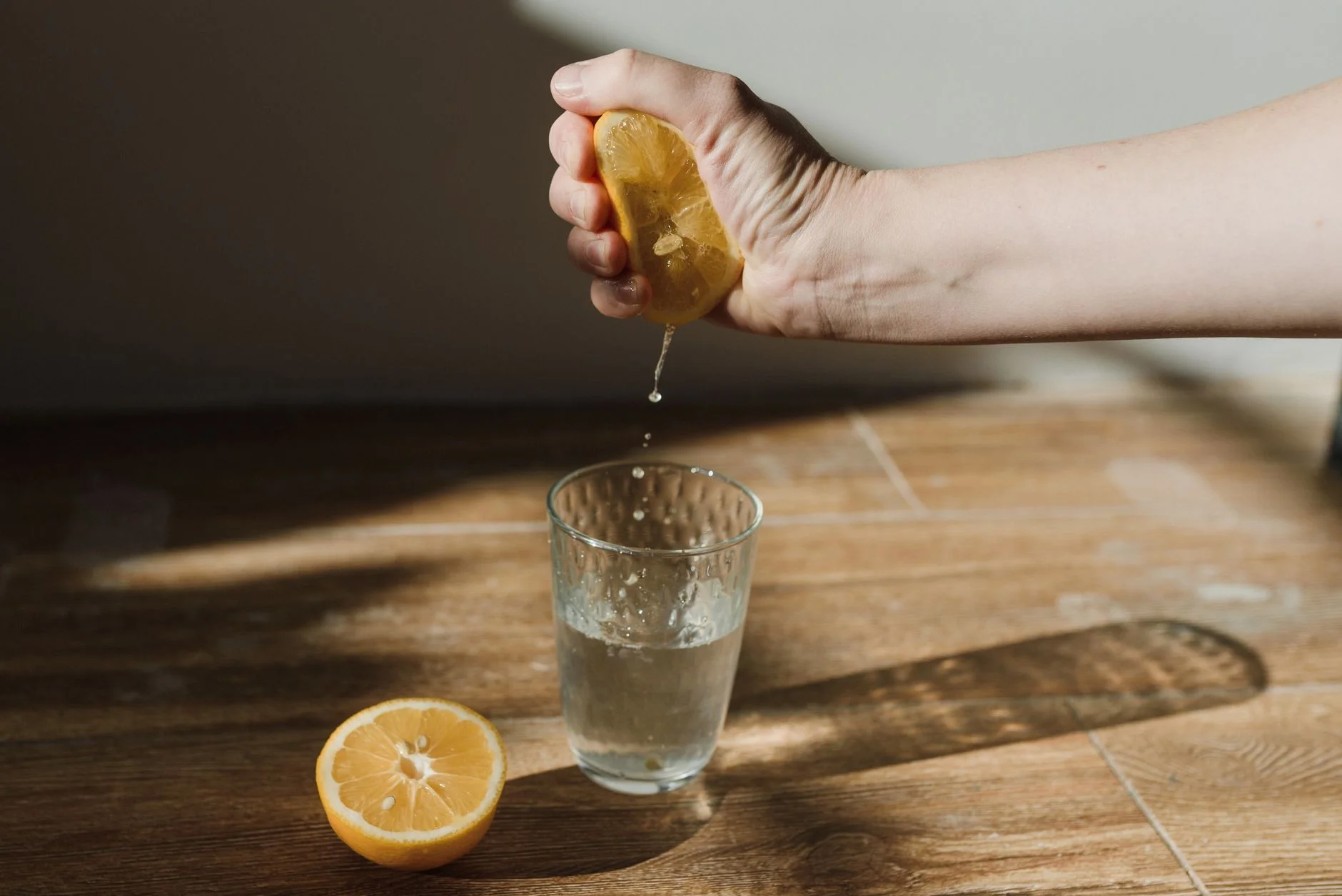
A slice floating in a jug releases much less juice than a squeezed half lemon, so the drink is gentler on teeth. The peel carries oils and fibre but little of the acid. The vitamin C and citric acid are mainly in the juice sacs inside, which is why squeezing makes a stronger drink. Hot water does not make the acid stronger, but it does not remove it either.
Acid in your stomach for comparison
Your stomach already holds something at least as acidic as a glass of lemon water. Textbooks give stomach acid a pH of roughly 1.5–3.5 depending on whether you have just eaten. The lining of the stomach is built to cope with that, with a thick layer of mucus. Your tooth enamel and the lining of your food pipe (oesophagus) are not, which is why lemon water causes trouble in the mouth and in heartburn rather than in the stomach itself.
The wider point: acidity is a property of the drink, but harm depends on how much, how often and where it touches you. That idea runs through the rest of this article.
What the evidence says about lemon water benefits
Before the downsides, give the drink its due. Several claims have real science behind them, though in each case the benefit is smaller than the headlines suggest.
Hydration: it is the water that counts
The biggest genuine benefit of lemon water is that it is water. Your body is mostly water, and your kidneys, blood and cells all rely on you replacing what you lose through sweat, breath and urine. If a squeeze of lemon makes you drink more water instead of sugary drinks, that is a real gain. But plain tap water hydrates you just as well, so lemon is a flavouring rather than a necessity.
Vitamin C: a small contribution
Lemons are famous for vitamin C. The NHS says adults aged 19 to 64 need 40 mg of vitamin C a day, and lists citrus fruit among the good sources. Vitamin C helps protect cells and supports healthy skin, blood vessels, bones and cartilage, and it aids wound healing.
US Department of Agriculture food data give raw lemon juice about 38.7 mg of vitamin C per 100 g, and the whole fruit flesh about 53 mg per 100 g. Lemon water is mostly water, so the amount in a glass is modest. Try the calculator below with a typical glass.
With the default values (25 cm³ of juice in a 250 cm³ glass) you get roughly 10 mg of vitamin C, about a quarter of the daily 40 mg. That is useful but not dramatic, and an orange or a few strawberries would give you more. The NHS also notes that taking more than 1,000 mg a day, which you cannot reach with lemon water, can cause stomach pain, diarrhoea and wind.
Kidney stones and citrate: the best-supported claim
Kidney stones form when minerals such as calcium and oxalate crystallise in concentrated urine. The NHS advice to help prevent them is to drink plenty of water: 2.5 to 3 litres a day for adults, and it suggests adding fresh lemon juice to the water. It also says not to change your diet without speaking to your doctor.
The chemistry behind the lemon suggestion is citrate, the ion left when citric acid loses hydrogen ions. In urine, citrate binds calcium and can stop crystals clumping into stones. Small studies of “lemonade therapy” in people prone to calcium stones have had mixed results. Some found that lemonade or lemon juice raised urinary citrate, while others found no improvement in citrate or urine pH, although urine volume tended to stay higher. These studies used large daily amounts, such as 2 litres of lemonade, and were small, so there is no large trial showing that a daily glass of lemon water means fewer stones. The most reliable part of the advice is probably the simplest: more fluid makes dilute urine.
Disadvantage 1: tooth enamel erosion
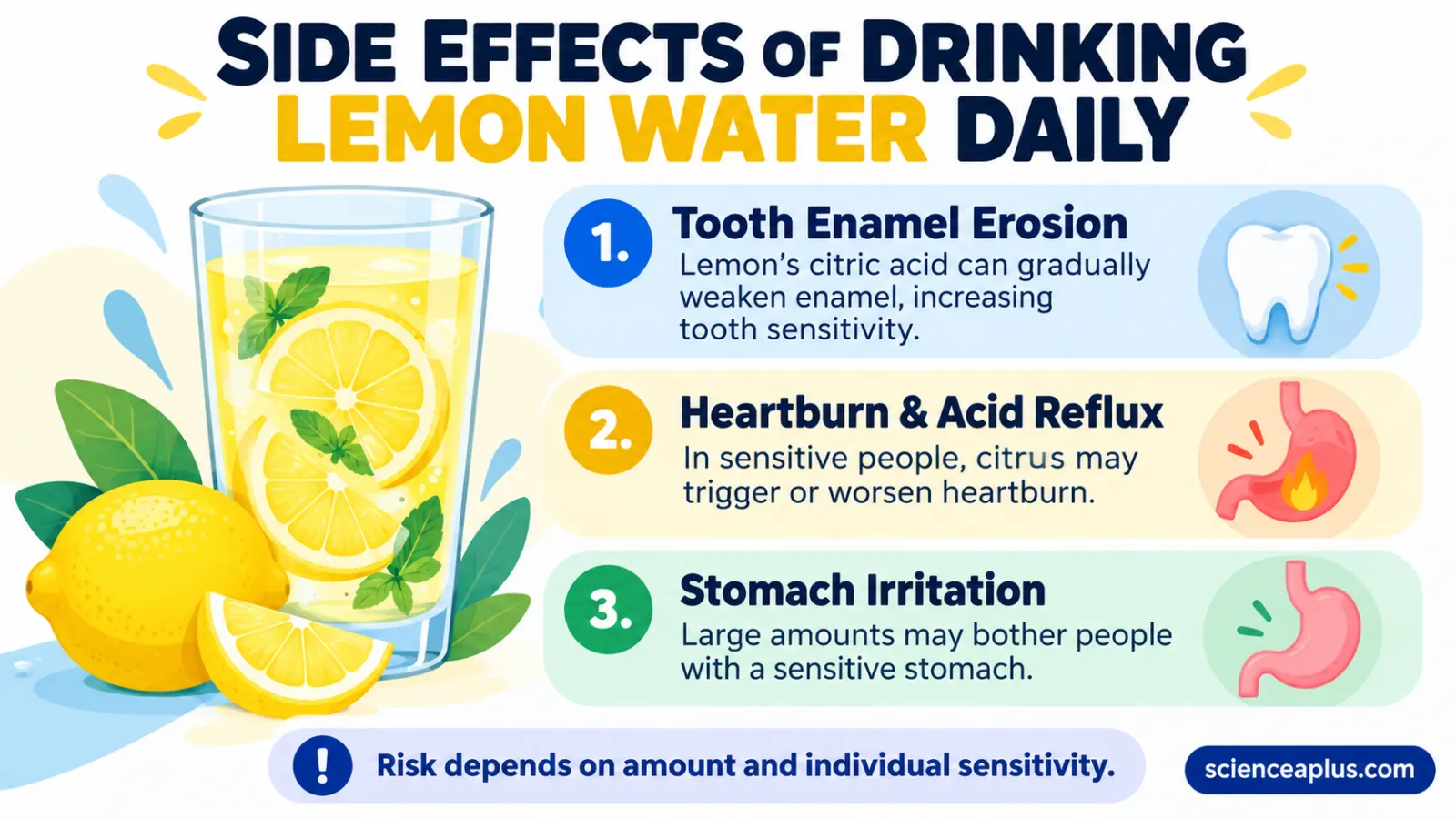
The infographic at the top of this article puts tooth enamel erosion first, and dentists agree. The Oral Health Foundation defines dental erosion as the loss of tooth enamel caused by acid. Unlike tooth decay it does not involve bacteria: acid alone dissolves the hard outer layer, which can expose the softer layer beneath and cause sensitivity. The Oral Health Foundation lists lemon water, including hot water with lemon, among the acidic drinks that can soften enamel, especially if consumed often or sipped over a long time.
Enamel is made mainly of a mineral called hydroxyapatite, which dissolves in acid. The pH at which enamel starts to dissolve is often quoted as around 5.5, so a drink at pH 2–3 is well inside the danger zone. Each sip drops the pH in your mouth, and saliva takes time to neutralise it and bring minerals back.
That is why how you drink it matters more than whether you drink it:
- Frequency. The Oral Health Foundation warns that sipping acidic drinks over a long period is especially risky, because the teeth never get a break to recover.
- Strength. A weak slice-in-a-jug drink is gentler than neat juice or a glass with several lemons squeezed in.
- Brushing. Enamel is softened after acid exposure, so brushing straight away can scrub some away. The advice is to wait at least one hour before brushing.
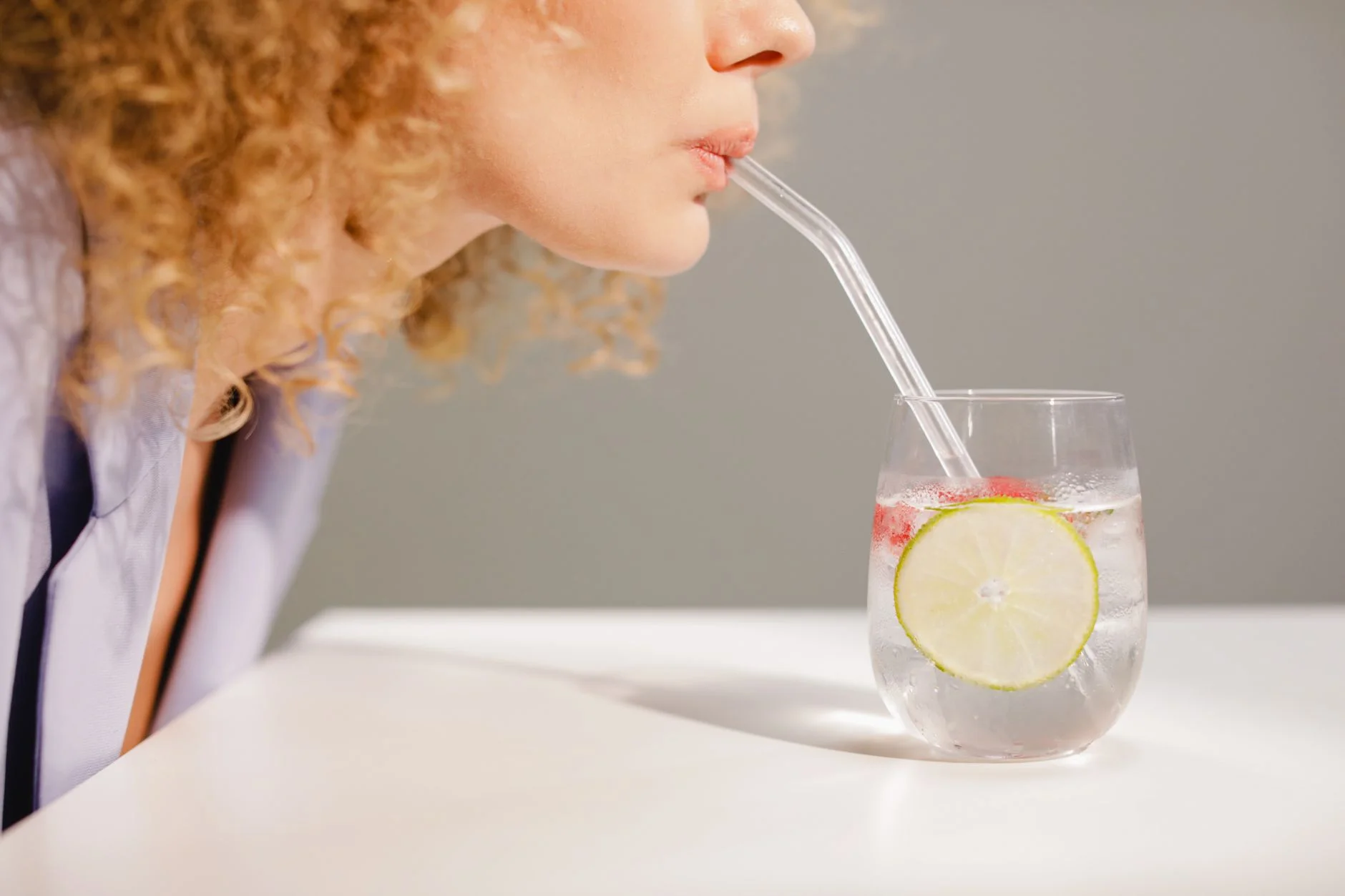
- Straws. The Oral Health Foundation advises using a straw to reduce contact with the teeth.
What happens in your mouth, step by step
Think of it as a race between acid and saliva. Saliva is slightly buffered and contains dissolved calcium and phosphate, so it can neutralise acid and help enamel re-harden, a process called remineralisation. The sequence looks like this:
- You take a sip and the pH in your mouth drops sharply.
- Below the critical pH, the surface of the enamel starts to lose calcium and phosphate ions and softens.
- Saliva gradually dilutes and neutralises the acid, and the pH climbs back up.
- Minerals from saliva can then harden the surface again, as long as it is left in peace.
Repeated sips restart step 1 before step 4 has finished. That is the scientific reason behind the “do not sip all day” advice, and why brushing during step 2 is a bad idea: you are scrubbing a softened surface. Because erosion is gradual, you will not notice a single glass. Damage builds up over months or years, which is why dentists look at habits, not single drinks.
Note that “sugar-free” does not mean “safe for teeth”. The Oral Health Foundation points out that even drinks without sugar can be acidic. Our article on deep cleaning your teeth looks at professional dental care.
Disadvantage 2: heartburn and acid reflux
The infographic at the top lists heartburn second: in sensitive people, citrus may trigger or worsen it. This is a fair summary. Heartburn happens when stomach contents flow back up into the food pipe, which lacks the thick protective mucus layer that lines the stomach. The NHS lists coffee, tomatoes, alcohol, chocolate and fatty or spicy foods among common triggers, and says to avoid your own trigger foods and drinks. Its main heartburn page does not name citrus specifically, so the evidence here is mostly individual experience: some people find lemon water makes their symptoms worse and others notice nothing.
The NHS self-help advice for heartburn is practical: eat smaller, more frequent meals, avoid eating within three or four hours of bed, and do not smoke or drink too much alcohol. Our guide to lifestyle and acid reflux goes through these in more detail.
Disadvantage 3: stomach irritation
The infographic’s third item says that large amounts may bother people with a sensitive stomach. Again the wording “may” and “sensitive” is the honest one. We found no strong clinical evidence that ordinary lemon water damages a healthy stomach, which handles much stronger acid every day. But very sour drinks on an empty stomach can feel uncomfortable for some people, and large amounts of any acidic drink can upset digestion.
The infographic ends with the most useful line of all: risk depends on amount and individual sensitivity. A weak glass once a day is a very different exposure from neat juice several times a day.
How to drink lemon water more safely
The second slide card gives four simple habits that address the risks above. Each one has a scientific reason behind it.
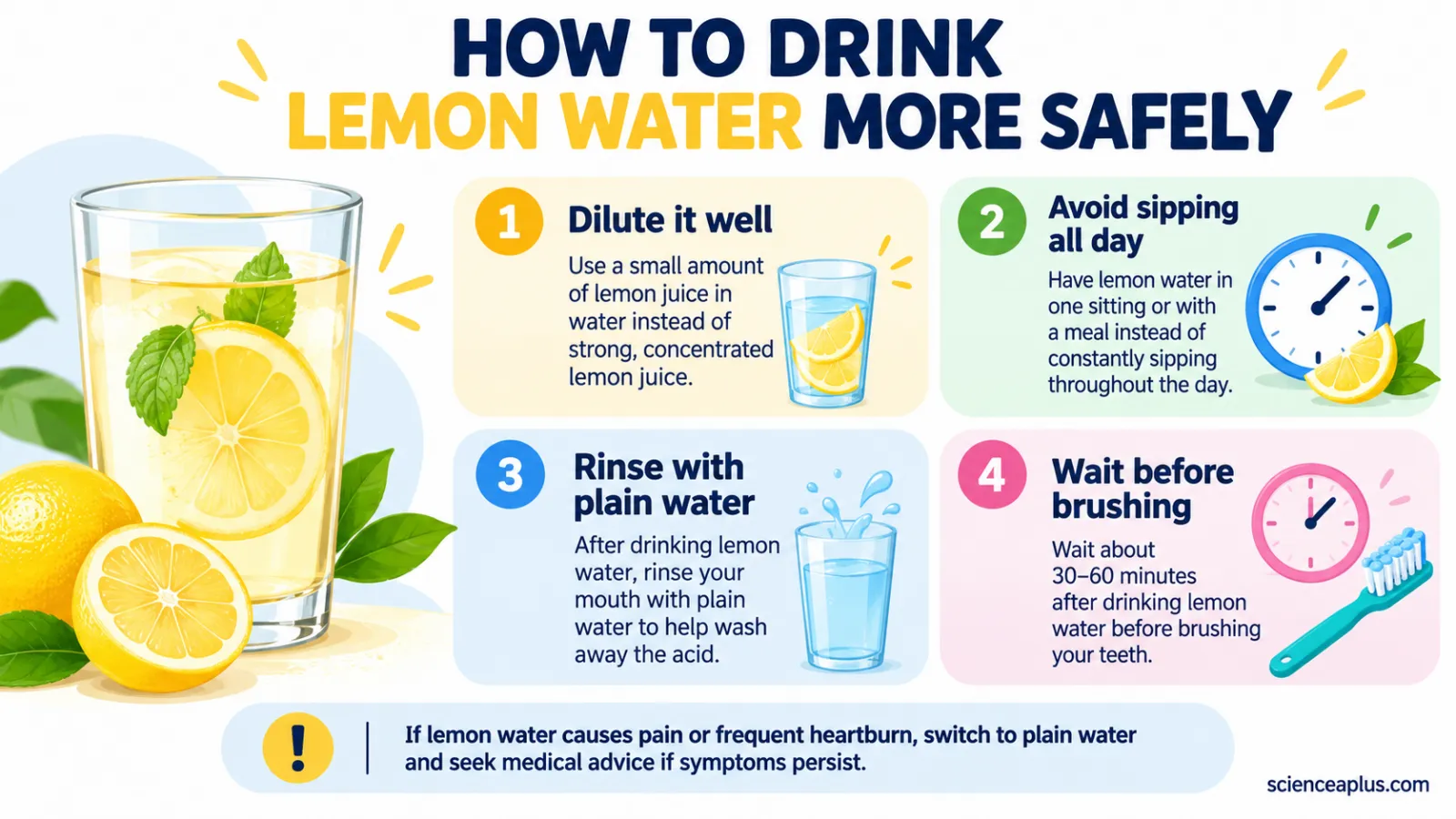
- Dilute it well. Use a small amount of juice in a full glass. A weaker solution has lower acid concentration, so less contact time with enamel at a damaging pH.
- Do not sip all day. Drinking it in one sitting, or with a meal, gives your saliva time to neutralise acid and restore minerals to enamel. Constant sipping keeps your mouth acidic for hours.
- Rinse with plain water. Swilling water around your mouth afterwards can help wash away acid.
- Wait before brushing. The card suggests waiting about 30–60 minutes. The Oral Health Foundation says to wait at least one hour, so if you want to be careful, aim for the full hour.
Using a straw, as the Oral Health Foundation advises, adds one more layer of protection.
Tick off the habits you already follow. Your ticks are saved in this browser only.
- I use a small amount of juice in a full glass
- I drink it in one go or with a meal, not all day
- I use a straw where I can
- I rinse my mouth with plain water afterwards
- I wait an hour before brushing my teeth
Lemon water myths: detox, alkalising and weight loss
This is where the science is most useful, because these claims are common and not supported by good evidence.
“It detoxes your body”
Your body already has a built-in detox system. The British Dietetic Association says it constantly filters out, breaks down and excretes waste products using organs such as the skin, gut, liver and kidneys, and that no special drink does a better job. No known food or drink “flushes” them. Water helps your kidneys make urine, but that is simply normal hydration.
“It alkalises your body”
Lemon juice is acidic, so the “alkalising” claim sounds odd, and the story is that it leaves an alkaline residue after digestion. Whatever the chemistry of the leftovers, your blood pH is tightly controlled by the lungs, kidneys and chemical buffers in the blood, at about 7.35–7.45. A drink cannot shift it in a healthy person; if it did drift far, that would be a medical emergency.
“Warm lemon water first thing is best”
There is no evidence that morning timing matters. Warm drinks have their own pros and cons, covered in our piece on drinking warm water. Warm or cold, the acid in lemon is the same.
Lemon water claims at a glance
| Claim | What the evidence shows | Verdict |
|---|---|---|
| Hydrates you | It is mostly water, and water hydrates | True, but plain water works equally well |
| Gives you vitamin C | A glass supplies a fraction of the 40 mg NHS daily amount | True, in small amounts |
| Helps prevent kidney stones | More fluid is NHS advice; citrate may help, but trials are small | Plausible, not proven |
| Wears down tooth enamel | Acid dissolves enamel; dentists advise caution | True if drunk strong or sipped often |
| Detoxes the body | The liver and kidneys already do this | Not supported |
| Alkalises the blood | Blood pH is tightly regulated | Not supported |
| Burns fat | No good evidence that lemon burns fat | Not supported |
Maths practice: pH, dilution and vitamin C
Lemon water is a good excuse to practise the calculations that turn up in GCSE chemistry and biology. Try each question first, then tap to reveal the worked answer. Use the vitamin C figure of 38.7 mg per 100 g of lemon juice, and assume that 1 cm³ of juice has a mass of about 1 g.
Lemon juice has a pH of 2 and tap water has a pH of about 7. How many times greater is the hydrogen-ion concentration in the juice? (2 marks)
The difference is 7 − 2 = 5 pH units. Each unit is a factor of 10, so 10⁵ = 100,000 times greater.
You squeeze 20 cm³ of lemon juice into 180 cm³ of water. What percentage of the drink is lemon juice by volume? (2 marks)
Total volume = 20 + 180 = 200 cm³. Percentage = 20 ÷ 200 × 100 = 10%.
How much vitamin C is in 20 cm³ of lemon juice, and what percentage of the NHS 40 mg daily amount is that? (3 marks)
20 cm³ ≈ 20 g. Vitamin C = 38.7 × 20 ÷ 100 = 7.74 mg. As a percentage of 40 mg: 7.74 ÷ 40 × 100 ≈ 19%.
Lemon juice contains about 49 g of citric acid per litre. How many grams are in 15 cm³ of juice? (2 marks)
15 cm³ = 0.015 litres. Mass = 49 × 0.015 = 0.735 g, so about 0.7 g.
A person drinks 3 glasses of lemon water a day, each made with 20 cm³ of juice. How much vitamin C do they take in from the juice in a week? (3 marks)
Per glass: 7.74 mg. Per day: 3 × 7.74 = 23.2 mg. Per week: 7 × 23.2 ≈ 162 mg. That is well below the 1,000 mg a day at which the NHS says stomach upsets can start.
Flip cards: test your lemon water knowledge
Key points to remember
Frequently asked questions about drinking lemon water daily
Is it bad to drink lemon water every day?
For most people a weak glass of lemon water each day is unlikely to cause harm, provided they look after their teeth. The main risks are tooth enamel erosion and heartburn in sensitive people, and both depend on how strong the drink is and how you drink it. Dilute it, use a straw, and speak to a dentist or GP if problems appear.
Does lemon water damage your teeth?
It can. Lemon juice is acidic, and acid dissolves tooth enamel, a process called dental erosion. The Oral Health Foundation says to use a straw and to wait at least one hour before brushing. Drinking it in one go instead of sipping all day gives saliva time to repair the surface.
Can lemon water cause acid reflux or heartburn?
In some people, yes. Triggers vary from person to person, and the NHS advises avoiding your own trigger foods and drinks. If lemon water seems to worsen your heartburn, try plain water instead. If you have heartburn most days, speak to a pharmacist or GP.
How much vitamin C is in lemon water?
Not a lot, because the juice is diluted. US data give raw lemon juice about 38.7 mg of vitamin C per 100 g, so 25 cm³ of juice supplies roughly 10 mg. The NHS says adults aged 19 to 64 need 40 mg a day, so one glass gives about a quarter.
Does lemon water help prevent kidney stones?
Possibly. The NHS advises 2.5 to 3 litres of water a day to help prevent stones and suggests adding fresh lemon juice. Lemon contains citrate, which can bind calcium in urine. Studies are small, so the benefit is not proven, and you should not change your diet for stones without speaking to a doctor.
Does lemon water detox the body or burn fat?
No good evidence supports either claim. The British Dietetic Association explains that your body already removes waste through organs such as the liver and kidneys. Lemon water may help weight loss only if it replaces a sugary drink, and that effect comes from the swap rather than from the lemon.
Does lemon water make your body alkaline?
No. Lemon juice itself is acidic, and your blood pH is tightly controlled at about 7.35–7.45 by your lungs, kidneys and buffers. What you drink does not noticeably change it in a healthy person. A large change in blood pH would be a medical emergency, not a diet effect.
Should you drink lemon water through a straw?
Yes, if you want to protect your teeth. The Oral Health Foundation advises using a straw to reduce contact between acidic drinks and the teeth. Combine it with drinking the glass in one sitting, rinsing with plain water afterwards and waiting at least an hour before brushing.
Is hot or cold lemon water better?
There is no evidence that temperature changes the benefits. The acid in the lemon is the same in a hot or cold drink, so the same advice applies to your teeth. Choose whichever helps you drink enough water, and keep the lemon content low.
Who should be careful with lemon water?
People with frequent heartburn, tooth sensitivity or enamel wear should be cautious, as should anyone with kidney disease or a history of stones who wants to change their diet. Anyone who gets hives, swelling or irritation after lemon should stop. Ask a GP or pharmacist for advice that fits your situation.