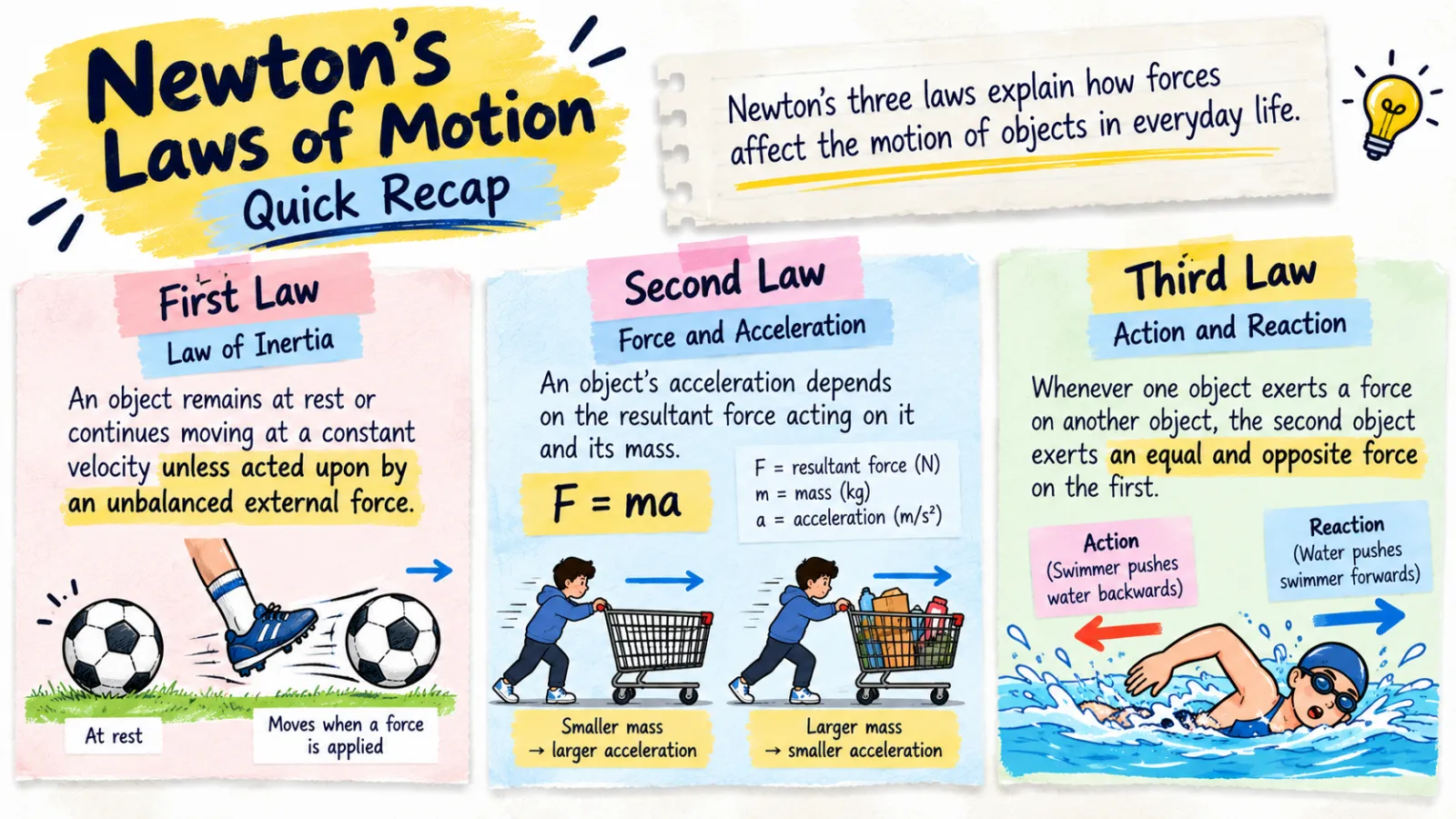
Newton's laws explained simply: things keep doing what they are already doing unless a force changes it; a bigger force gives a bigger acceleration, while a bigger mass gives a smaller one; and every push comes with an equal push back on the other object. That is the whole idea in three short sentences. The rest of this article shows how it plays out in sport, cars and space, clears up the myths that catch people out, and ends with eight maths questions to try yourself.
You will find footballs, sprinters, airbags, a spacecraft that has been coasting for decades and an astronaut flying free with a gas-powered backpack. If you are learning this for the first time, or trying to explain Newton's laws to someone else, start here.
Newton's laws explained simply, one sentence each
Isaac Newton published the three laws in his Principia in 1687. You do not need the history to use them, so here they are in plain English, with an everyday example of each.
| Law | In one sentence | Everyday example |
|---|---|---|
| First law | If the resultant force on an object is zero, it stays still or keeps moving at the same velocity. | A football stays on the grass until someone kicks it. |
| Second law | The bigger the resultant force, the bigger the acceleration; the bigger the mass, the smaller the acceleration. | The same push sends an empty shopping trolley away faster than a full one. |
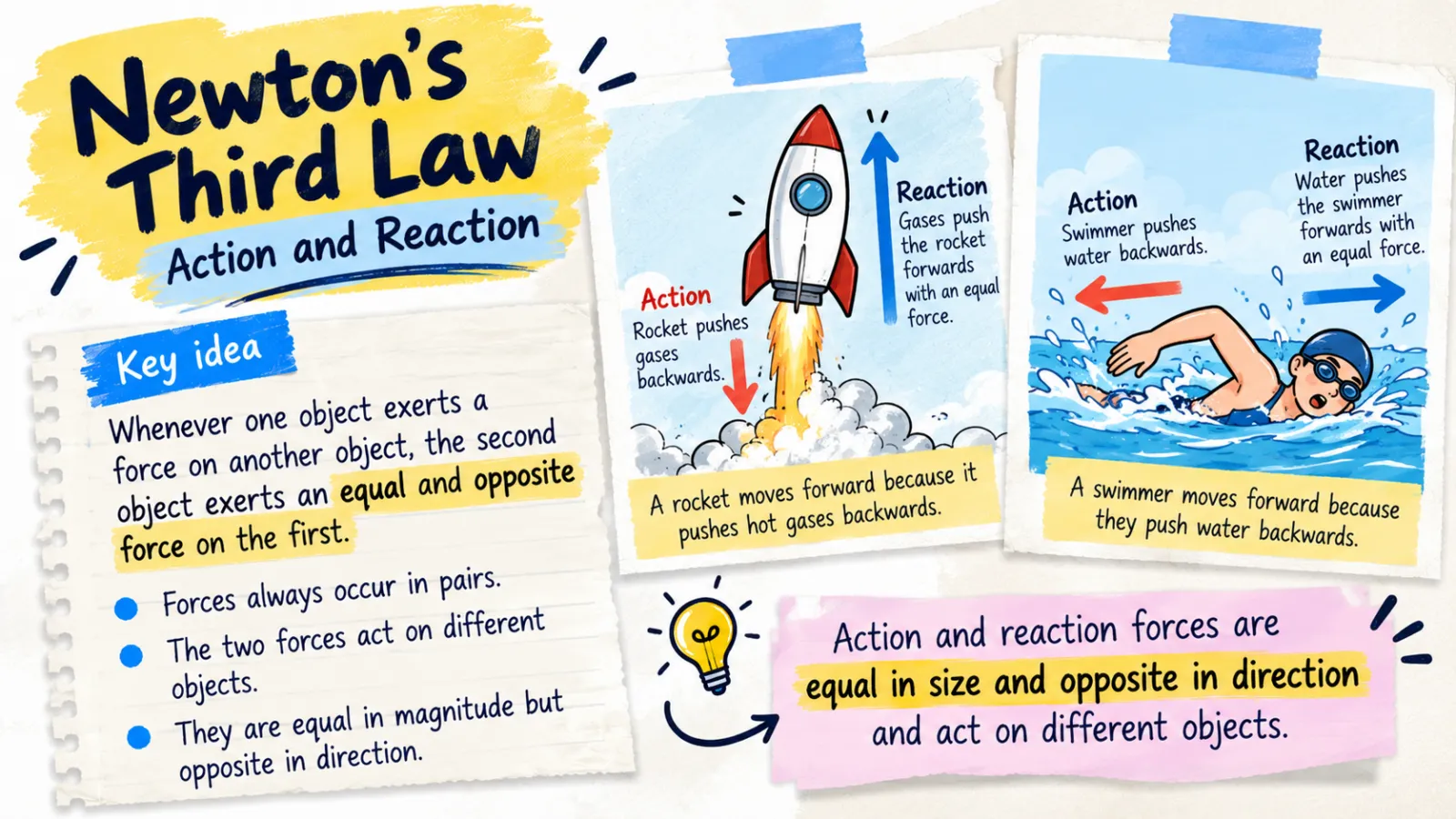
| Third law | When two objects interact, they push on each other with forces that are equal in size and opposite in direction. | A swimmer pushes the water backwards and the water pushes the swimmer forwards. |
Two words do a lot of work here. Resultant force is the single force you get when you add up every force on an object, taking direction into account. Velocity means speed in a particular direction, so "the same velocity" means the same speed and the same direction.
If you want exam wording, definitions and more worked examples, our full GCSE revision guide to Newton's laws of motion goes through them step by step. This article is the friendlier version, built around real situations.
How to explain Newton's laws to a child
Children (and plenty of adults) learn physics best from things they can push, kick and throw. Here are three kid-sized ways to explain Newton's laws that stay accurate.
The lazy ball: first law
A ball on the playground is "lazy". It will sit exactly where it is until something pushes it. Once it is rolling, it would roll in a straight line for ever if nothing got in its way. The simple rule to teach is: objects do not change their motion by themselves. A push or a pull has to do it.
The empty and full pram: second law
Push an empty pram, then push it again with a heavy bag inside. The same push gives a much smaller speed-up the second time. More mass means it is harder to change the motion. Push harder and it speeds up more.
The pool wall: third law
Stand in a swimming pool and push the wall. You move backwards, away from the wall. You pushed the wall, and the wall pushed you. Every push has a push back, and the two forces are the same size.
These ideas show up constantly in daily life, from opening doors to riding bikes. Our guide to physics in everyday life has more examples to point out on the way to school.
Newton's first law explained simply: things keep doing what they are doing
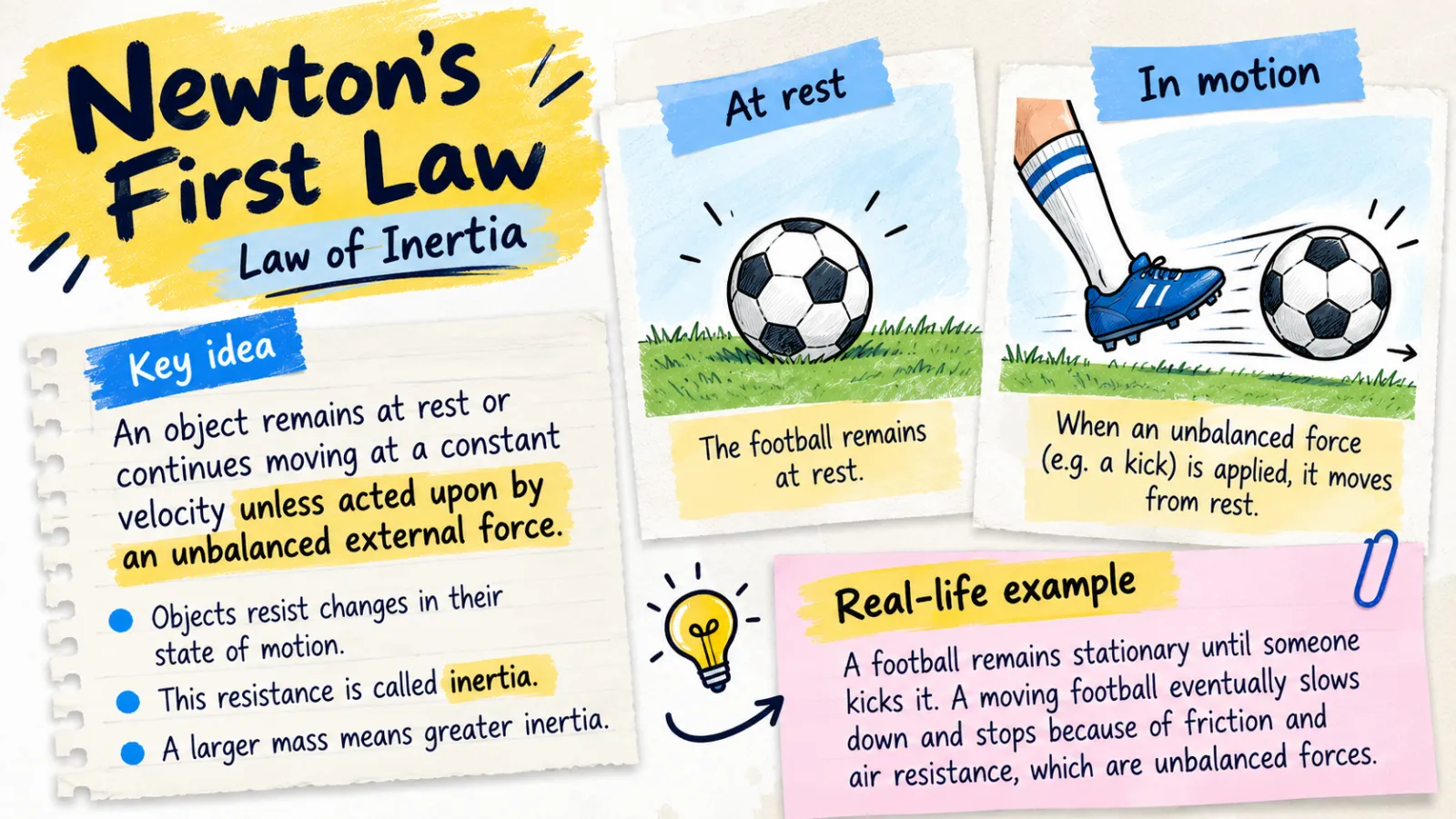
The first law says that if the resultant force on an object is zero, a stationary object stays stationary and a moving object keeps moving at the same velocity. The tendency of an object to carry on in its state of rest or steady motion is called inertia. The bigger an object's mass, the more inertia it has, so the harder it is to start, stop or turn.
In sport: the football
A football on the pitch does nothing until a boot provides an unbalanced force. Once it is in the air or rolling, it carries on moving. If you watch a ball roll across grass, it slows down and stops. That is not because it "runs out of force". Friction with the grass and air resistance are forces acting against its motion, and they slow it. On an imaginary perfectly smooth surface with no air, it would just keep going.

The same idea explains why a heavy ball such as a medicine ball is harder to get moving than a beach ball, and harder to stop once it is rolling. More mass means more inertia.
In cars: the sudden stop
When a car brakes hard, the car slows down, but anything not fixed to it tends to keep moving forwards at the old speed. An unbelted passenger carries on forwards until something stops them. A bag on the back seat slides towards the front, and a phone on the dashboard shoots off. Seat belts exist because your body obeys the first law even when the car does not. They apply a force that slows you along with the car.
A common mistake is to say the belt "stops you moving forward when the car accelerates". It is when the car decelerates, or crashes, that the belt matters.
In space: Voyager 1 keeps coasting
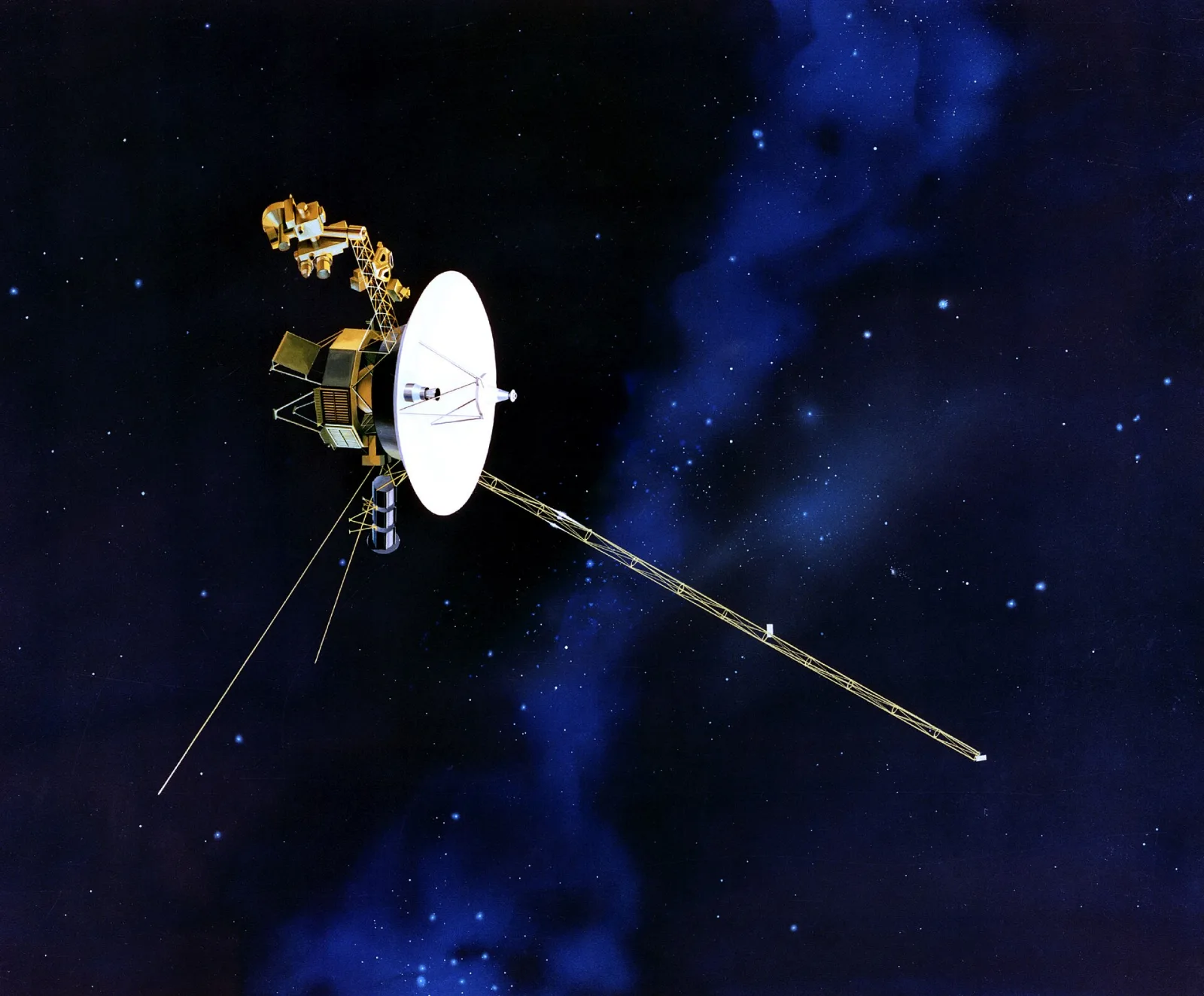
Space is the best place to see the first law at work, because there is almost no friction or air resistance. Voyager 1 launched on 5 September 1977 and entered interstellar space in August 2012, the first spacecraft to leave the heliosphere. It is now travelling at about 17 km/s relative to the Sun.
What is striking is that its engines are not pushing it along. According to NASA's Jet Propulsion Laboratory, its trajectory-correction thrusters were last used for continuous firing on 8 November 1980, and not again until a test on 28 November 2017. Only tiny attitude thrusters give millisecond puffs, to turn the spacecraft so its antenna points at Earth. Voyager has been coasting, which is the first law in action. The Sun's gravity still slows it down slightly, but nothing needs to push it forwards.
That is the first law. Next comes the second law, which tells you exactly how much an object speeds up when a force acts on it.
Newton's second law explained simply: push harder, go faster
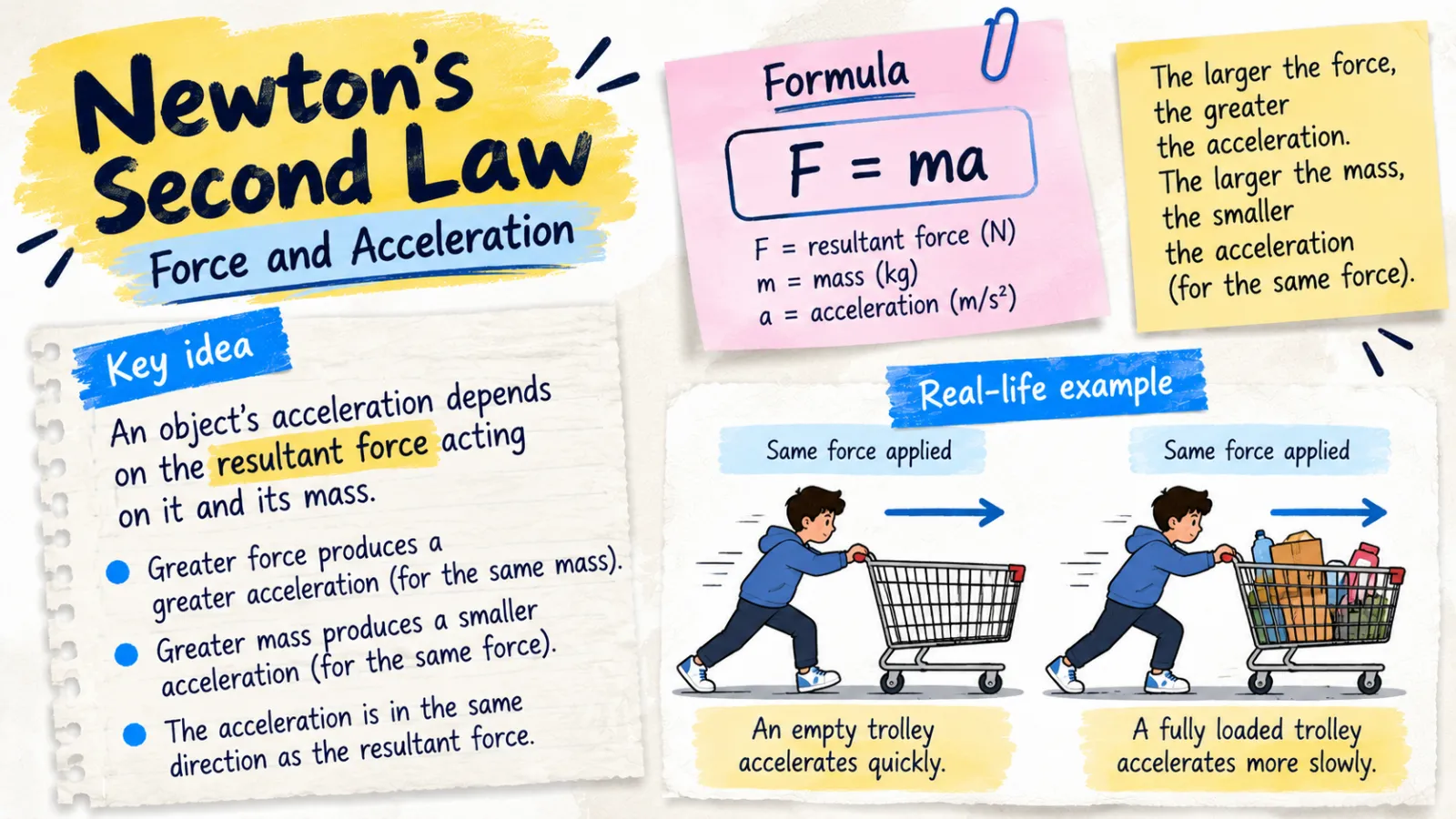
The second law connects three things: force, mass and acceleration. In words, the acceleration of an object is proportional to the resultant force on it and inversely proportional to its mass. The acceleration is in the same direction as the resultant force. As an equation:
F = m × a
Here F is the resultant force in newtons (N), m is the mass in kilograms (kg) and a is the acceleration in metres per second squared (m/s²). One newton is the force that gives a 1 kg mass an acceleration of 1 m/s².
"Proportional" means that doubling the force doubles the acceleration. "Inversely proportional" means that doubling the mass halves the acceleration. Push twice as hard and you get twice the speed-up; push the same amount on twice the mass and you get half.
A quick worked example
Suppose you push a 10 kg box across a smooth floor with a resultant force of 40 N. Rearrange the equation to a = F ÷ m and substitute: 40 ÷ 10 = 4 m/s². Now load the box until it has a mass of 20 kg and push with the same 40 N. The acceleration is 40 ÷ 20 = 2 m/s², exactly half. That is the "inversely proportional" idea in numbers.
A good habit for any question like this is to write down the equation, substitute the numbers with their units, and only then calculate. Checking that the unit of your answer is right (N, kg or m/s²) catches many slips.
In sport: football against tennis ball
An official football has a mass of 410–450 g at the start of a match. A tennis ball is much lighter, between 56.0 and 59.4 g. Give them the same push and the tennis ball, with far less mass, gets a far larger acceleration. That is why a tennis racket sends a ball flying while the same swing at a football would barely move it.
The other half of the law applies too. A harder kick means a larger resultant force on the same ball, so a larger acceleration. Players do this instinctively: more leg speed, more force, more acceleration, faster ball.
In cars: engines against resistance
A car's acceleration depends on the resultant force, which is the driving force minus the resistive forces. Friction and air resistance act against the motion, so they reduce the resultant force. A van loaded with parcels has more mass than the same van empty, so with the same engine force it speeds up more slowly. Our lesson on friction in physics explains where those resistive forces come from.
Electric cars are known for quick acceleration from a standstill, which is the second law again: a large resultant force on a given mass. The physics of electric cars looks at how their motors deliver that force.
In space: a rocket that gets lighter
A rocket burns through huge amounts of fuel, so its mass falls as it climbs. If the thrust stays about the same, the acceleration grows, because the same force now acts on a smaller mass. That is why a rocket's acceleration increases during a burn even when its engines are not pushing any harder.
Catching, crashing and cushioning: momentum made simple
The second law can be rewritten using momentum, which is mass multiplied by velocity. Momentum is measured in kg m/s and the idea is part of the Higher tier at GCSE.
p = m × v
The force needed to change an object's momentum depends on how quickly you do it:
F = change in momentum ÷ time
This has a practical consequence. Longer time means a smaller force for the same change in momentum. Stopping the same moving object in a longer time is gentler.
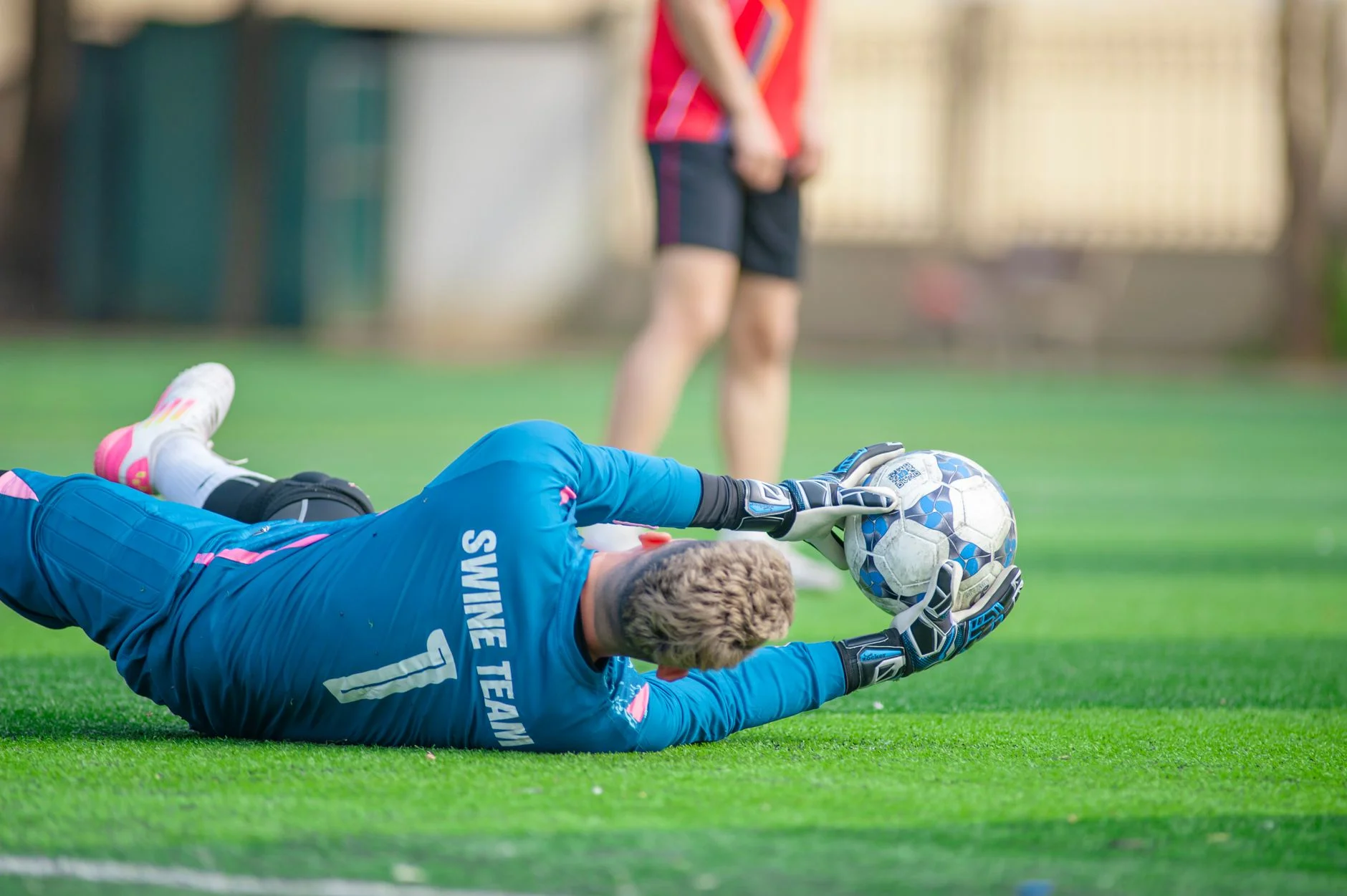
You use this without thinking. A goalkeeper catching a hard shot does not hold her hands rigid. She lets them move back with the ball, which makes the stop last longer and so reduces the force on her hands. Someone landing from a jump bends their knees for the same reason.
AQA lists several safety features that work by increasing the time taken to stop, which lowers the force: air bags, seat belts, gymnasium crash mats, cycle helmets and cushioned playground surfaces. In each case the body still has to lose the same momentum, but it takes longer to do so.
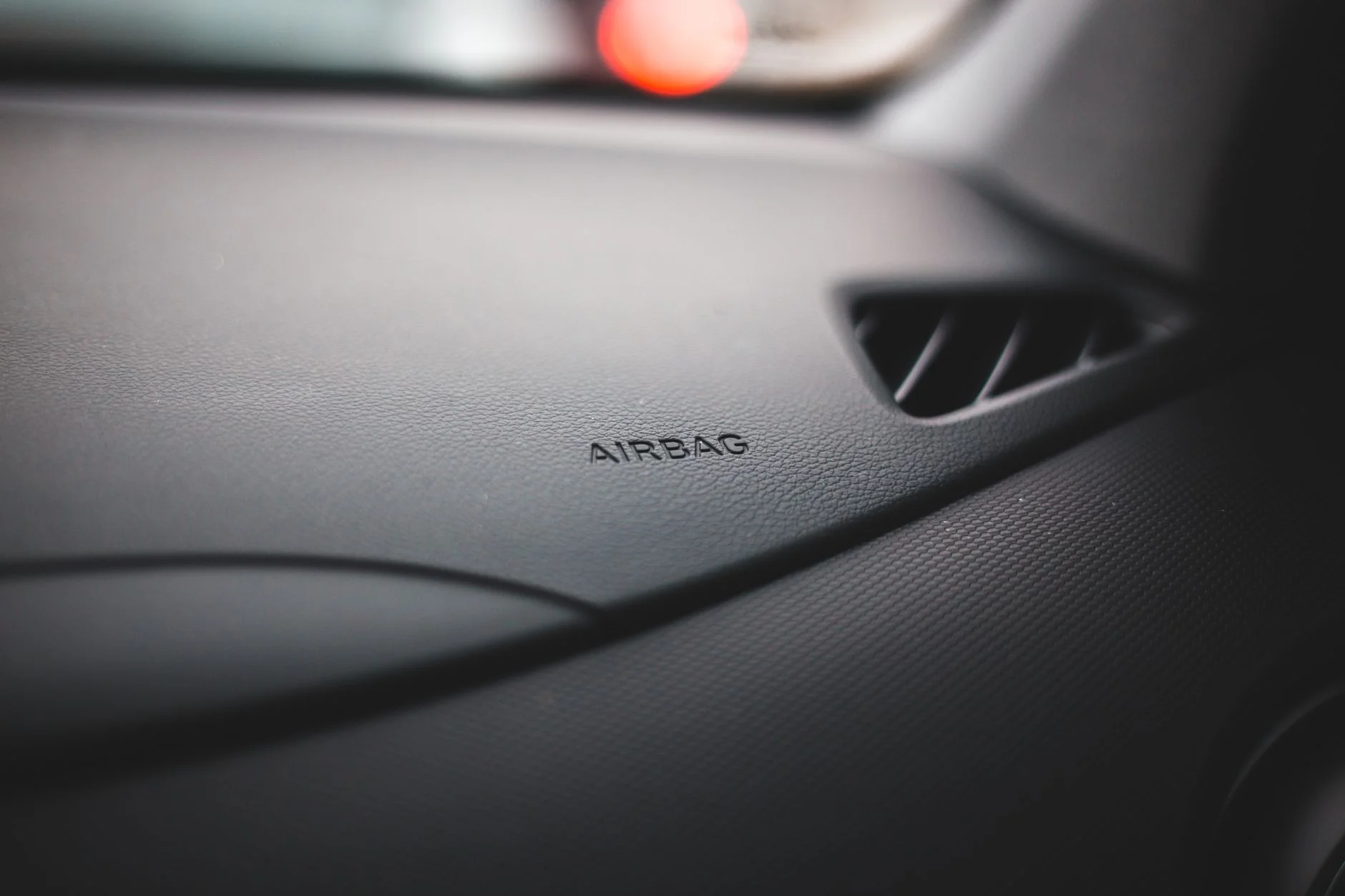
In a crash, an airbag inflates in front of you so your head and chest are brought to rest over a longer time than they would be against a hard dashboard. The same loss of momentum over more time means a smaller average force. Try it yourself with the calculator below, using a ball of football mass.
Change the stopping time and watch the force respond. Halving the time doubles the force. Doubling it halves the force. The numbers in the default setting are practice values, not measurements from a real match.
Notice what the second law does not say. It does not say a force is needed to keep something moving. It says a resultant force is needed to change the motion, which means to speed it up, slow it down or turn it. We come back to that in the myths below.
The second law covers what happens to one object when forces act on it. The third law is about what happens between two objects, and it is often the most surprising of the three.
Newton's third law explained simply: every push has a push back
The third law says that whenever two objects interact, the forces they exert on each other are equal and opposite. If object A pushes on object B, then B pushes back on A with a force of the same size in the opposite direction. NASA puts it like this: whenever one object exerts a force on another, the second object exerts an equal and opposite force on the first.
Three details make the law easier to use:
- The two forces act on different objects, never on the same one.
- They are the same type of force, such as two contact pushes or two gravitational pulls.
- They are equal in size and opposite in direction, always, at the same moment.
In sport: pushing off and pushing back
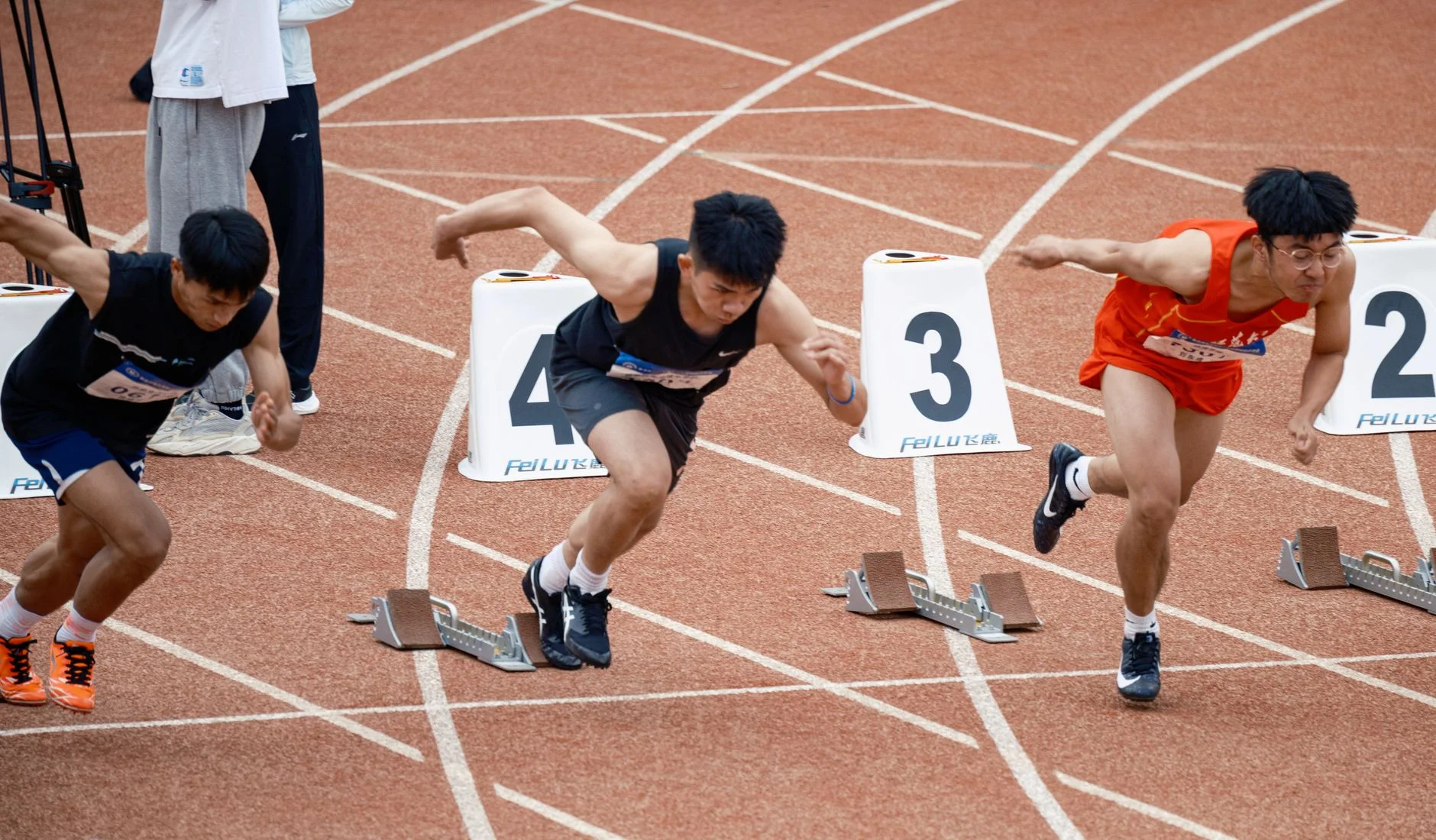
Sprinters are a perfect example. In the starting blocks, a runner pushes their feet backwards against the blocks. The blocks push the runner forwards with an equal force, and that is what launches them down the track. A swimmer works in the same way: hands and feet push the water backwards, and the water pushes the swimmer forwards.
Even jumping follows the rule. You push down on the ground, and the ground pushes up on you. You leave the floor because of the ground's push on you, not your push on the ground.

In cars: what really drives a car forwards
People often say "the engine pushes the car forwards". It is more accurate to follow the chain. The engine turns the wheels, and the tyres push backwards on the road through friction. By the third law, the road pushes the tyres, and so the car, forwards. On a very slippery surface such as ice, the tyres cannot push the road much, so the road cannot push the car much, and the wheels spin.
In a collision, the two vehicles exert equal and opposite forces on each other. The forces match in size, but the accelerations do not. By the second law, the vehicle with the smaller mass gets the bigger acceleration. The third and second laws working together explain why small cars suffer such large changes in motion in crashes with heavier vehicles.
In space: rockets need nothing to push against
A common worry is that a rocket must "push against the air". It does not. A rocket pushes exhaust gas backwards (or downwards at lift-off), and the gas pushes the rocket forwards (or up). Because the push is between the rocket and its own exhaust, it works perfectly well in a vacuum.
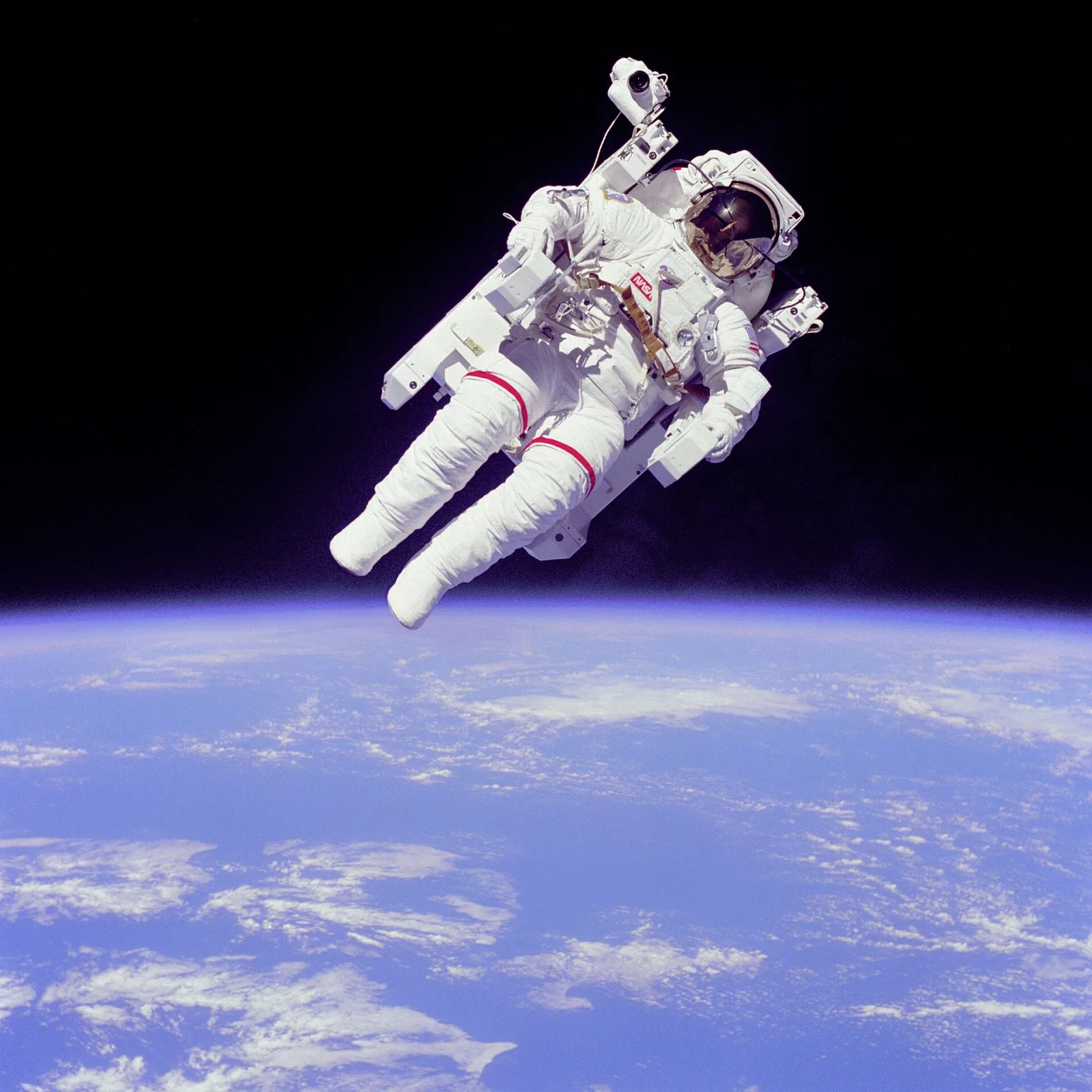
The clearest demonstration is the astronaut's backpack. On 7 February 1984, during mission STS-41-B, Bruce McCandless II made the first untethered spacewalk using the Manned Maneuvering Unit (MMU). The MMU steered using 24 small nitrogen-gas thrusters. Gas puffed out one way, and the astronaut moved the other. He flew about 100 m from the shuttle.
For the wider picture of how rockets, satellites and the International Space Station fit together, see our guide to exploring the universe. If you are curious about how private companies launch rockets today, read about private space flight.
Newton's laws in sport, cars and space at a glance
Here is a quick reference showing which law or laws are at work in each situation from this article.
| Situation | Law(s) | What is happening |
|---|---|---|
| Football waiting to be kicked | First | Zero resultant force, so it stays at rest until a boot acts on it. |
| Ball rolling to a stop | First | Friction and air resistance slow it; it does not "run out of force". |
| Tennis ball against football | Second | The same push gives the lighter ball the larger acceleration. |
| Goalkeeper catching a shot | Second (momentum) | A longer stopping time means a smaller force on the hands. |
| Sprint start | Third | The runner pushes back on the blocks; the blocks push the runner forwards. |
| Braking car | First | Passengers keep moving forwards, so seat belts are needed. |
| Car tyres on the road | Third | Tyres push the road backwards; the road pushes the car forwards. |
| Two vehicles colliding | Second and third | Equal and opposite forces; the lighter vehicle accelerates more. |
| Voyager 1 in deep space | First | No engine pushing it, yet it keeps moving. |
| Rocket in a vacuum | Third | Exhaust gas pushed back, rocket pushed forwards. |
| Astronaut with a gas backpack | Third | Nitrogen pushed out one way, astronaut moves the other. |
Maths practice questions: F = ma, weight and momentum
Time to try the numbers. Use g = 9.8 N/kg on Earth. Questions 7 and 8 use momentum, which is Higher tier. The masses are realistic, but the speeds and forces are made-up practice values, not real records. Tap a question to reveal the full working.
1. A 0.45 kg football is kicked with an average resultant force of 90 N. What is its acceleration? (2 marks)
a = F ÷ m = 90 ÷ 0.45 = 200 m/s².
2. A 70 kg sprinter leaves the blocks with an average acceleration of 4.0 m/s². What is the resultant force on the sprinter? (2 marks)
F = ma = 70 × 4.0 = 280 N.
3. A 1,200 kg car has a driving force of 3,800 N and resistive forces of 800 N. Find the resultant force and the acceleration. (3 marks)
Resultant force = 3,800 − 800 = 3,000 N forwards. a = 3,000 ÷ 1,200 = 2.5 m/s².
4. Find the weight of a 60 kg student on Earth (g = 9.8 N/kg). (2 marks)
W = mg = 60 × 9.8 = 588 N.
5. Find the weight of the same student on the Moon, where g = 1.62 N/kg. (2 marks)
W = mg = 60 × 1.62 = 97.2 N. The mass is still 60 kg.
6. A 0.5 kg model rocket's engine gives 15 N of thrust upwards. Find its weight, the resultant force and the acceleration at lift-off. (3 marks)
W = 0.5 × 9.8 = 4.9 N. Resultant force = 15 − 4.9 = 10.1 N upwards. a = 10.1 ÷ 0.5 = 20.2 m/s² (ignoring air resistance).
7. Find the momentum of a 0.058 kg tennis ball moving at 50 m/s. (2 marks, Higher tier)
p = mv = 0.058 × 50 = 2.9 kg m/s. (Bonus: a 1,200 kg car at 15 m/s has momentum 1,200 × 15 = 18,000 kg m/s.)
8. A goalkeeper stops a 0.45 kg ball moving at 20 m/s in 0.05 s. What is the average force? What if she lets her hands "give" so it takes 0.15 s? (3 marks, Higher tier)
Change in momentum = 0.45 × 20 = 9 kg m/s. F = 9 ÷ 0.05 = 180 N. With 0.15 s: F = 9 ÷ 0.15 = 60 N. Three times the time gives one-third of the force.
Stuck on a step? Go back to the second-law section above and rework the box example. You can check question 8 with the calculator earlier, using the default values.
7 common misconceptions about Newton's laws
Most mistakes with Newton's laws come from everyday experience, where friction and air resistance hide what is really going on. Here are seven myths and the correct ideas to replace them.
1. "If something is moving, a force must be pushing it forwards"
2. "Heavier objects fall faster"
On Earth, a feather falls more slowly than a hammer because of air resistance, not because it weighs less. The famous test was done on the Moon, where there is no air. During Apollo 15 in 1971, Commander David Scott dropped a geological hammer (1.32 kg) and a falcon feather together from about 1.6 m. They hit the surface at the same time.
The Moon's surface gravity is 1.62 m/s², about one-sixth of Earth's, but it is the same for every object there. A heavier object has a bigger weight, but it also has more inertia, so the acceleration comes out the same.
3. "Action and reaction cancel out"
If the forces are equal and opposite, why does anything ever move? Because the two forces in a third-law pair act on different objects. They cannot cancel each other, because cancelling needs forces on the same object. Our GCSE guide covers this exam trap in detail.
4. "In a crash, the bigger vehicle pushes harder"
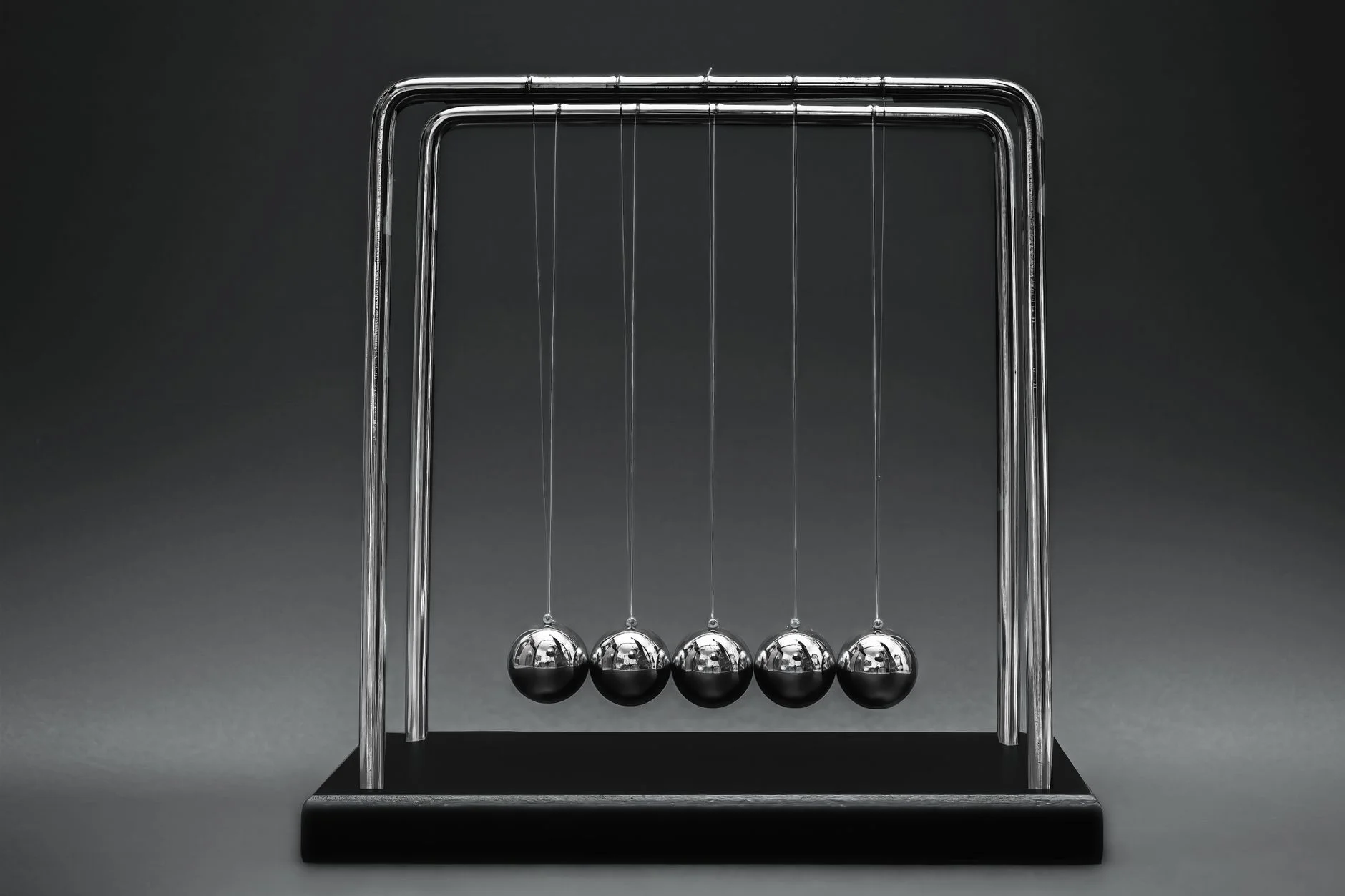
The two vehicles exert equal and opposite forces on each other. What differs is the effect. The second law says the lighter vehicle gets the bigger acceleration, so its occupants feel the larger change in motion. Newton's cradle on a desk shows the same pairing in miniature: each ball-to-ball collision is a matching pair of forces.
5. "There is no gravity in space, so astronauts float"
Astronauts on the International Space Station float because they and the station are in continuous free fall around Earth, not because gravity has vanished. Gravity at the station’s height is still nearly as strong as it is at the surface. The station is falling, but it moves sideways so fast that it keeps missing the ground.
6. "Mass and weight are the same thing"
Mass is how much matter an object contains, measured in kilograms. Weight is the force of gravity on that mass, measured in newtons, and W = m g. A 60 kg student has the same mass on the Moon as on Earth, but a much smaller weight because g is 1.62 N/kg there instead of 9.8 N/kg. For more pairs of ideas that people mix up, see our list of common comparisons in physics.
7. "Newton's law always means motion"
Newton also gave his name to a law of cooling and a law of viscosity, but "Newton's laws" on their own usually means the three laws of motion. The viscosity link leads somewhere fun: non-Newtonian fluids are liquids that do not follow that viscosity rule.
Three quick demos to see Newton's laws at home
These take a few minutes and almost no equipment. Ask an adult to help, and clear a space first. Tick each one off as you try it; your ticks are remembered in your browser.
- First law: the coin and card. Rest a card on a glass with a coin on top. Flick the card away sharply. The coin has inertia, stays where it is for a moment, and drops into the glass.
- Second law: empty and full. Push an empty box or toy trolley with a steady push. Then fill it and push with the same effort. The loaded one accelerates less.
- Third law: balloon rocket. Thread a straw onto a string, tape an inflated balloon to the straw and let go. Air rushes out one way and the balloon moves the other.
Doing demos like these makes ideas stick far better than rereading notes, which is why they are worth including in your plan when you start revising for GCSE science.
Frequently asked questions about Newton's laws explained simply
What are Newton's three laws in simple words?
First, objects keep doing what they are doing (staying still or moving steadily) unless a resultant force acts. Second, a bigger force gives a bigger acceleration and a bigger mass gives a smaller one, F = ma. Third, whenever two objects interact, they push on each other with equal and opposite forces.
How do you explain Newton's laws to a child?
Use things they can try. A ball stays still until kicked (first law). An empty pram speeds up more than a full one with the same push (second law). Pushing a pool wall makes you glide backwards (third law). Keep the key idea: objects do not change their motion by themselves.
What is an example of Newton's first law in sport?
A football on the pitch stays still until a boot gives it an unbalanced force. Once rolling, it slows down only because friction with the grass and air resistance act on it. Without those forces, it would keep moving at the same velocity.
How are Newton's laws used in cars?
All three apply. Passengers keep moving forwards when a car brakes, so belts are needed (first law). Acceleration depends on the resultant force and the mass (second law). Tyres push backwards on the road and the road pushes the car forwards (third law). Airbags use momentum to cut the force.
How do Newton's laws work in space?
With almost no friction, a spacecraft such as Voyager 1 keeps coasting without engines pushing it, which is the first law. Rockets and astronaut backpacks push gas one way and move the other way, which is the third law. They need nothing to push against.
Does a moving object need a force to keep moving?
No. A force is needed to change motion, not to maintain it. A car at a steady speed has balanced forces, so the driving force equals the resistive forces and the resultant force is zero. Objects seem to need a push only because friction and air resistance keep trying to slow them.
Do heavier objects fall faster?
Not when air resistance is absent. On the Moon in 1971, Apollo 15's David Scott dropped a hammer and a feather together and they landed at the same time. On Earth, air resistance has a bigger effect on a feather than a hammer, which is why they normally fall differently.
Why do airbags reduce injuries?
An airbag increases the time it takes your head and chest to stop. Since force equals the change in momentum divided by time, the same change in momentum over a longer time means a smaller average force. Seat belts, crash mats and cycle helmets work the same way.
What is momentum?
Momentum is mass multiplied by velocity, p = m v, measured in kg m/s. A heavier or faster-moving object has more of it. It is part of the Higher tier at GCSE. A change in momentum needs a force, and the longer the time, the smaller the force.