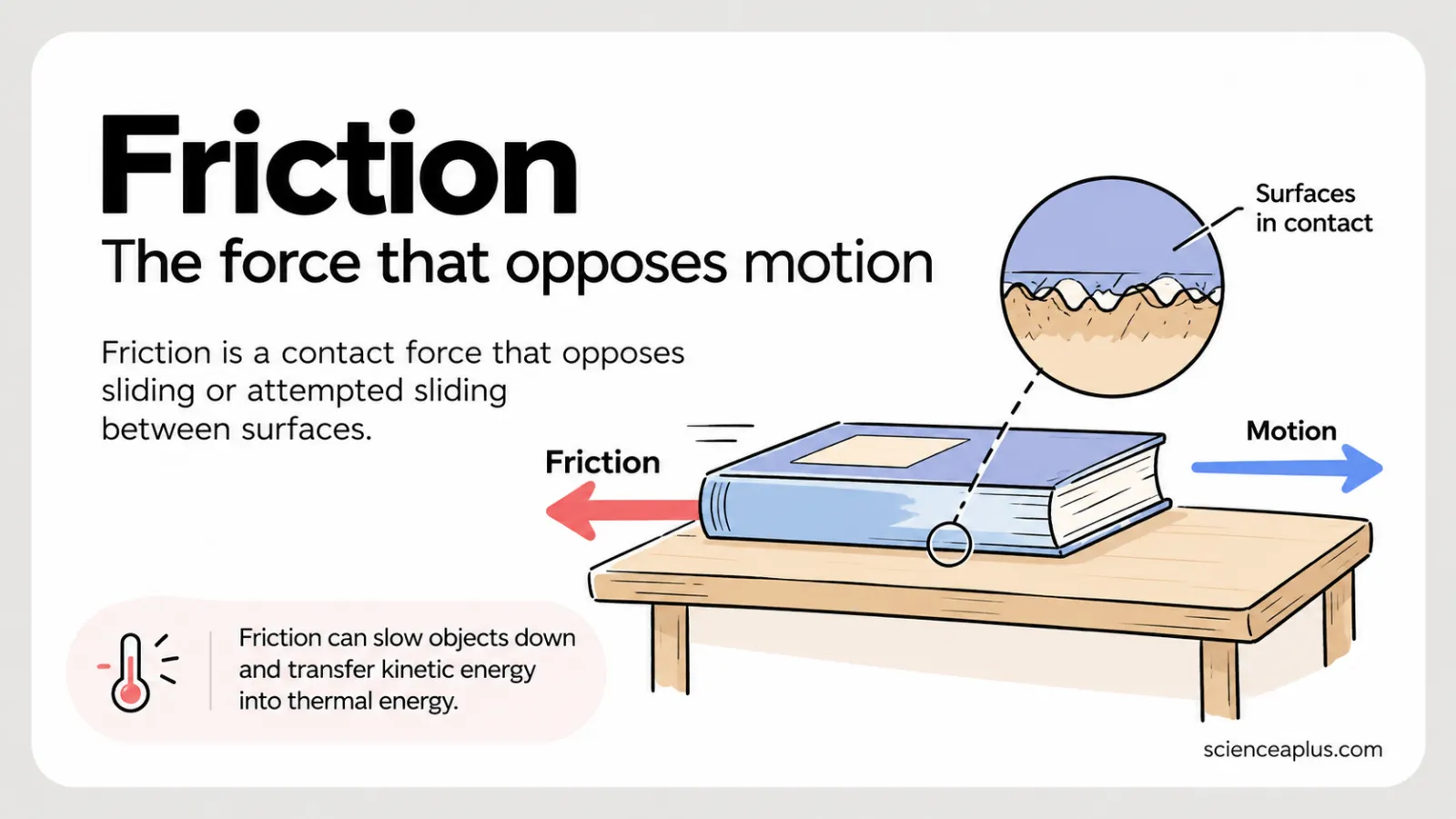
What is friction? Friction is a contact force that opposes the sliding, or attempted sliding, of one surface over another. It acts along the surfaces, in the opposite direction to the motion, and it is measured in newtons (N). It is caused by tiny bumps and contact points on both surfaces. This friction physics lesson covers what friction is, what causes it, its types, what changes its size, how it heats things up and where it helps or hinders.
What is friction? A clear definition
A force is a push or a pull that acts on an object because of an interaction with another object. Some forces need the objects to touch, and these are called contact forces. AQA’s GCSE Physics specification lists "friction, air resistance, tension and normal contact force" as examples. Friction is the one you notice when a book slides across a desk and then stops.
Force is a vector, which means it has both a size and a direction. We draw a force as an arrow: the longer the arrow, the bigger the force. A friction arrow lies along the surfaces, pointing against the way the object moves, or against the way it would move if friction were not there.
Forces always come in interaction pairs. If the desk’s surface drags backwards on the book, the book’s surface drags forwards on the desk by the same amount. Friction therefore acts on both surfaces, in opposite directions. This is Newton’s third law at work, and our lesson on forces and Newton’s laws covers the full set.
What causes friction?
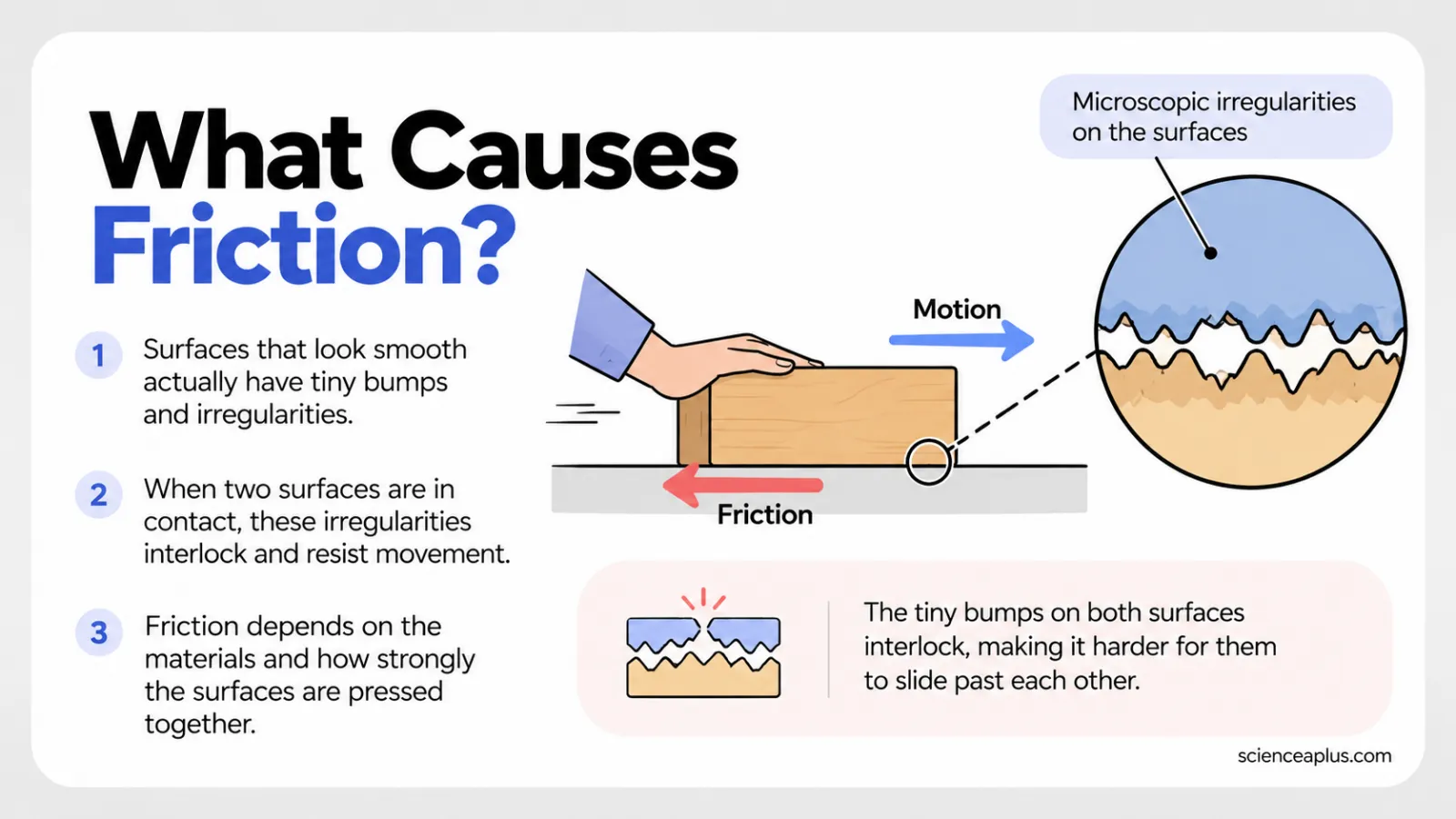
A surface can look and feel perfectly smooth and still be rough on a tiny scale. Under a powerful microscope every surface has bumps and hollows. When two surfaces touch, they meet only at the tips of the highest bumps, so the real area of contact is only a small fraction of the apparent area you can see.
Tiny bumps on every surface
The GCSE model of friction is simple. As one surface slides over the other, the bumps on one catch against the bumps on the other and resist the movement. Rougher surfaces have bigger bumps, so they usually give more friction. Polished surfaces have smaller bumps, so they usually give less.
Sticking at the contact points
Scientists also know that interlocking is only part of the story. At the points where the surfaces really touch, the materials stick to each other. In metals this can be so strong that the contact points "cold weld" together. This is the adhesion theory of friction, developed by Bowden and Tabor, and sliding means shearing these tiny joints apart.
For very smooth surfaces, friction depends on the nature of the molecular forces in the area of contact. That is why two very clean, smooth surfaces can grip each other surprisingly well.
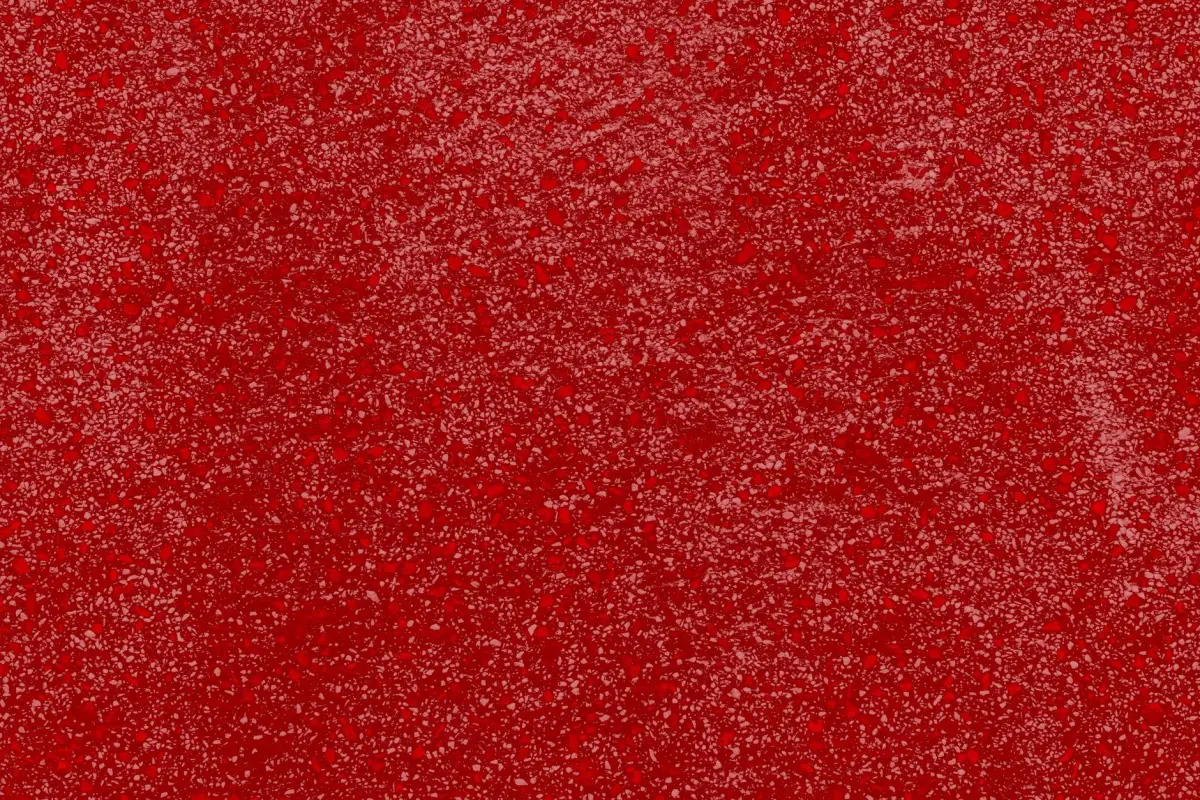
The two photographs below show opposite ends of the story. Sandpaper has obvious bumps, so it is a high-friction surface. Chalk on a climber’s hands is more of a puzzle, because the evidence about it is mixed.

Friction, forces and Newton’s first law
Picture a box on the floor and draw its free-body diagram. A free-body diagram shows every force acting on one object. Here you would draw four arrows: a push to the right, friction to the left, weight pointing down, and the normal contact force from the floor pointing up.
The resultant force is the single force that has the same effect as all the forces together. If the forces are balanced, the resultant force is zero. Suppose you push with 20 N and friction is also 20 N. The two forces cancel, so the box either stays still or carries on at a steady speed.
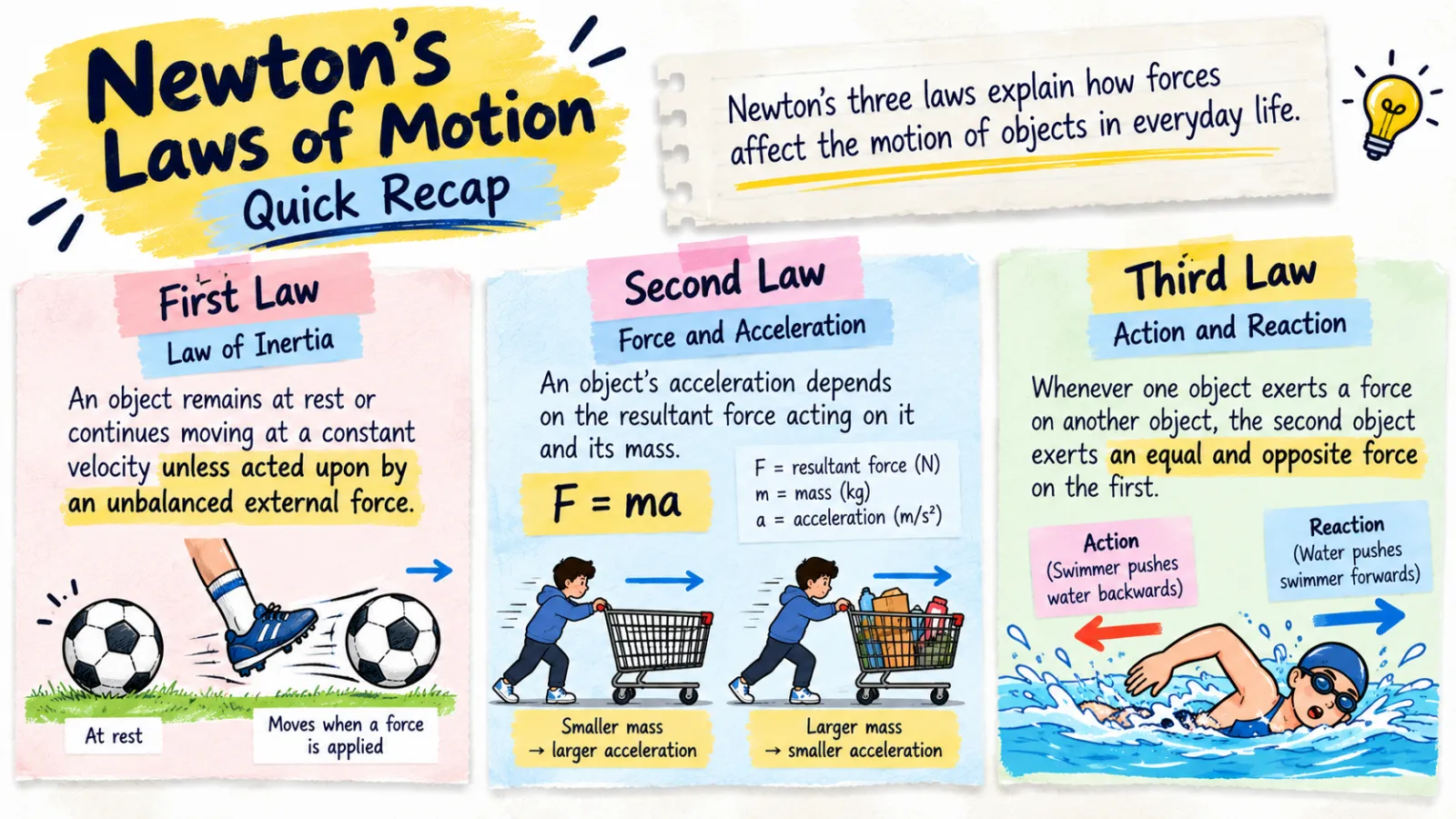
That is Newton’s first law. In AQA’s words, if the resultant force is zero, a stationary object stays stationary and a moving object keeps moving at the same velocity. For a vehicle at a steady speed, the resistive forces balance the driving force. Our article on Newton’s laws explained works through more examples.
Try this exam-style question before reading on. Tap the question to reveal the model answer.
A box is pushed across the floor at a steady speed with a force of 35 N. What is the size of the friction force? Explain your answer. (2 marks)
The friction force is 35 N. The box moves at a steady speed, so the resultant force is zero (Newton’s first law). That means the friction force must balance the 35 N push.
Notice that the answer needs both a number and a reason. Here one mark is for the value and one for the reason. Later in this article you will see how the same idea explains what happens when the push is bigger or smaller than friction.
Types of friction: static, limiting and sliding
The easiest way to understand the types of friction is to push a heavy box with a gentle, steadily growing force. At first nothing happens. Then the box suddenly starts to slide. Friction behaves differently at each stage.
Static friction
Static friction acts when there is no sliding. If you push a heavy box with 10 N and it does not move, the static friction is also 10 N, so the forces balance. Push with 15 N and the friction rises to 15 N. Static friction adjusts itself to match the push, but only up to a limit, beyond which motion occurs.
Limiting friction
Limiting friction is the maximum static friction. It is reached at the moment the box is just about to slide, and it equals the smallest force needed to start the movement. Push any harder and the box begins to move.
Sliding (kinetic) friction
Once the surfaces slide, the friction is called sliding friction, also known as kinetic or dynamic friction. For most pairs of surfaces it is a little smaller than limiting friction, so it takes a bigger force to start something sliding than to keep it sliding. HyperPhysics gives a classroom measurement for wood on wood: a coefficient of about 0.4 when static and about 0.3 when sliding.
This explains a familiar feeling. A heavy wardrobe is hard to get moving, then suddenly easier once it is on its way.
Rolling friction
A wheel or ball that rolls without slipping has far less friction than a block that slides. Engineering ToolBox lists rolling coefficients of roughly 0.01 to 0.02 for car tyres on concrete or asphalt, and about 0.001 to 0.002 for ball bearings and for a steel train wheel on a rail. Compare that with about 0.9 for rubber sliding on dry asphalt. Rolling friction is typically tens to hundreds of times smaller, depending on the wheel and surface, which is why the wheel is such a useful invention.
Fluid friction: air resistance and drag
Air and water also resist movement. Air resistance (drag in air) and water resistance are often described as a type of friction, called fluid friction. AQA lists air resistance as a contact force. It acts opposite to the motion and gets bigger as the speed increases.
That is why a falling object first accelerates, then reaches a speed where the resultant force is zero and it falls at a constant terminal velocity. Terminal velocity is in the AQA GCSE specification; drawing and interpreting velocity–time graphs for it is Physics only.
| Type | When it acts | Size | Example |
|---|---|---|---|
| Static friction | Surfaces are not sliding | Matches the push, up to a limit | A box that will not budge when pushed gently |
| Limiting friction | Just as sliding is about to start | The maximum static friction | The instant a wardrobe starts to move |
| Sliding (kinetic) friction | Surfaces slide over each other | Usually a little less than limiting friction | A book sliding along a desk |
| Rolling friction | A wheel or ball rolls | Much smaller than sliding friction | A bicycle wheel, a ball bearing |
| Fluid friction | An object moves through air or water | Increases as speed increases | A cyclist pushing through the air |
Check you have the terms straight. Tap each card to flip it.
Factors that affect friction
Two things decide how big the friction force is: the surfaces in contact, and how hard they are pressed together. Everything else matters much less.
The surfaces in contact
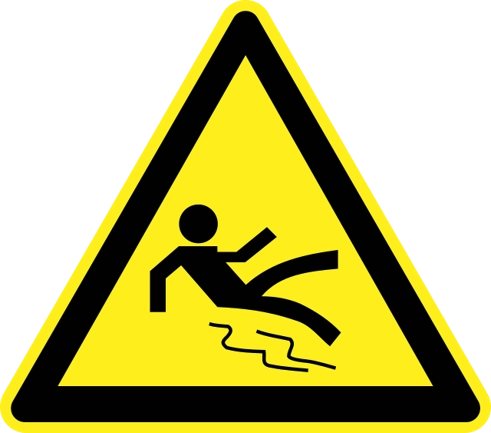
Different materials and different roughness give different friction. Rubber on dry asphalt grips well, while steel on ice barely grips at all. Putting a liquid or a solid film between the surfaces changes things too. Water, oil or ice between the surfaces reduce friction, which is why wet or oily floors are slippery.
How hard the surfaces are pressed together
The harder two surfaces are pressed together, the greater the friction. The force that does the pressing is the normal contact force, the push of a surface at right angles to itself. On a flat, horizontal surface with no other vertical forces, the normal contact force equals the object’s weight.
Weight is found with the equation below, where W is in newtons (N), m is mass in kilograms (kg) and g is the gravitational field strength, about 9.8 N/kg near Earth.
W = m g
Mass and weight are different quantities, as our guide to common comparisons in physics explains. For most everyday dry surfaces, doubling the weight roughly doubles the friction. This is known as Amontons’ law, from work dating back to 1699.
What does not change friction much
The laws of friction, which hold approximately for ordinary dry solids, say that friction is proportional to the normal load and independent of the apparent area of contact. Kinetic friction is also nearly independent of the speed of sliding. Coulomb added that last point to Amontons’ two laws.
These are rules of thumb for most everyday dry surfaces, and they break down in some cases, such as very smooth, sticky surfaces. They are a good model for GCSE and for the practical in the next section.
A quick check of your understanding, in the style of a short exam question.
A student drags a block along a bench, then adds a mass on top and drags it again. Explain why the friction force changes. (2 marks)
The extra mass increases the weight, so the normal contact force between the block and the bench increases. A bigger normal contact force means a bigger friction force.
Why does it take a bigger force to start a wardrobe moving than to keep it moving? (2 marks)
Limiting (maximum static) friction is usually bigger than sliding friction. The push must beat the limiting friction to start the movement, but once sliding only the smaller sliding friction has to be overcome.
How to investigate friction (class practical)
This is a common class investigation rather than an AQA required practical, but it shows the main ideas of friction physics with real numbers. You need a wooden block with a hook or loop, a newton meter, a flat bench, a set of masses and some different surfaces to test.
A newton meter (force meter) measures force in newtons, so it is ideal for measuring friction. The method below finds both the limiting friction and the sliding friction.
- Attach the newton meter to the hook or loop on the wooden block.
- Place the block on a flat, horizontal bench.
- Pull horizontally and slowly increase the force.
- Record the reading just before the block moves. This is the limiting friction.
- Record the reading while the block slides at a steady speed. This is the sliding friction.
- Repeat three times and calculate a mean for each reading.
- Add masses on top of the block, measure the total weight with the newton meter, and repeat the test.
- Change the surface (sandpaper, carpet, glass), keeping the same block and mass, and repeat.
Here is what you should find. A graph of friction against weight gives a straight line through the origin, so friction is proportional to weight. The reading just before the block moves should be bigger than the reading while it slides. The variables are:
- Independent variable: the weight on the block, or the type of surface.
- Dependent variable: the friction force, in newtons.
- Control variables: the block, the surface (when changing weight), the pulling direction and the speed of pulling.
Going further: the coefficient of friction (F = μN)
This section goes beyond the AQA, OCR and Edexcel GCSE specifications. It is A-level Mechanics, but it explains why your practical graph is a straight line. The coefficient of friction, μ (the Greek letter mu), links the friction force to the normal contact force.
F = μN
Here F is the maximum static friction (or the sliding friction), μ is the coefficient of friction and N is the normal contact force. The coefficient has no units. Here are some typical values for clean, dry surfaces, from Engineering ToolBox.
| Surfaces | Coefficient μ (static unless stated) |
|---|---|
| Wood on wood | 0.25–0.5 |
| Rubber on dry asphalt | 0.9 |
| Rubber on wet asphalt | 0.25–0.75 |
| Steel on steel | 0.5–0.8 (kinetic 0.42) |
| Steel on steel, greased | 0.16 |
| Steel on ice | 0.03 |
| PTFE (Teflon) on PTFE | 0.04 |
| Glass on glass | 0.9–1.0 |
Worked example: a 2 kg wooden block rests on a wooden bench with μ ≈ 0.4. Its normal contact force is N = 2 × 9.8 = 19.6 N. The friction force is F = 0.4 × 19.6 ≈ 7.8 N, which is 40% of its weight. The calculator below assumes a flat, horizontal surface. Change the mass and the surfaces to see how the answer moves.
Friction and energy
Whenever something slides against friction, energy is transferred. Work done is force multiplied by distance moved in the direction of the force.
W = F s
W is work done in joules (J), F is force in newtons (N) and s is distance in metres (m). One joule is one newton metre. AQA states that work done against the frictional forces acting on an object causes a rise in the temperature of the object.
Worked example: you push a box 3.0 m at a steady speed against 40 N of friction. At a steady speed your push equals the friction (Newton’s first law), so the work done is W = 40 × 3.0 = 120 J. That energy is transferred to the thermal energy stores of the box, the floor and the surroundings.
Energy is never created or destroyed. It can be transferred usefully, stored or dissipated, and dissipated energy ends up stored in less useful ways. We often call this "wasted" energy. AQA notes that unwanted energy transfers can be reduced through lubrication. For more on the stores themselves, see our article on different kinds of energy and their uses.
You can feel this yourself. Rub your hands together quickly and they warm up, because work is done against friction.
Friction can also move charge. According to AQA, when certain insulating materials are rubbed against each other they become electrically charged, because electrons are rubbed off one material and on to the other. Our page on static electricity explains the details.
Friction in brakes and stopping distances
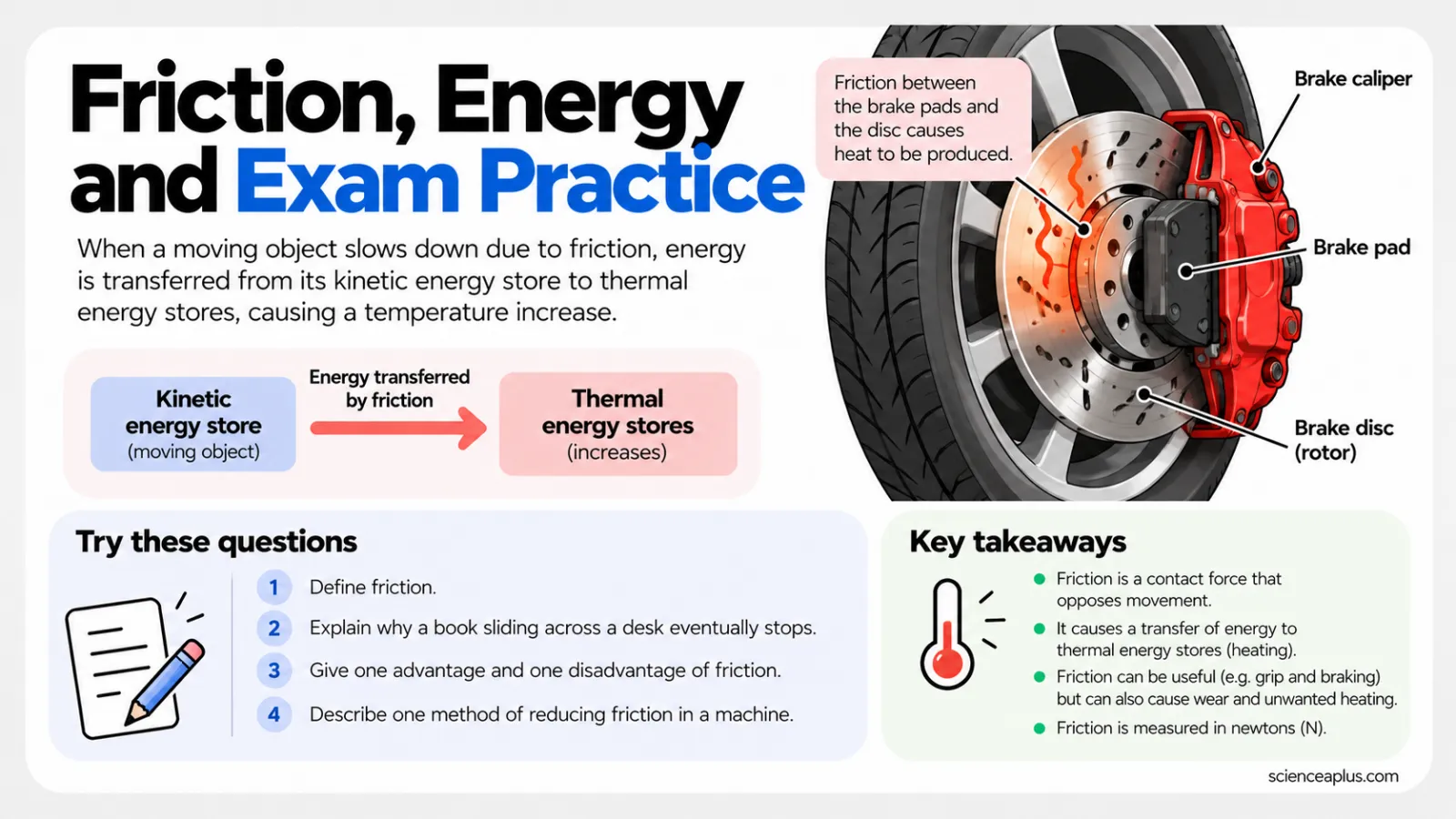
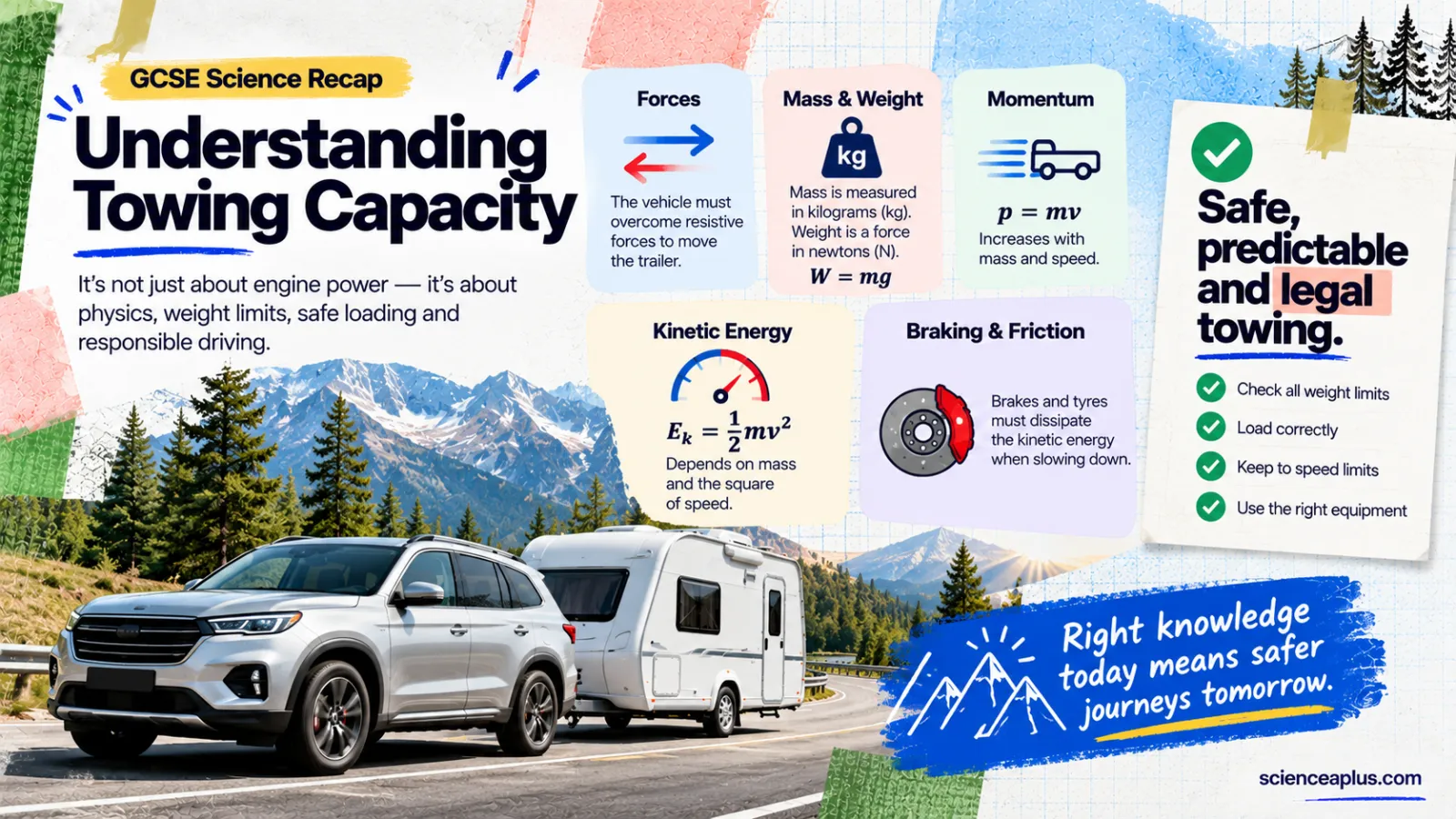
Brakes are friction at work. AQA describes it like this: the work done by the friction force between the brakes and the wheel reduces the kinetic energy of the vehicle, and the temperature of the brakes increases. The greater the speed, the greater the braking force needed to stop in a certain distance. Large decelerations may lead to brakes overheating and/or loss of control.
Stopping distance is the thinking distance plus the braking distance. Braking distance depends on the speed, the condition of the brakes and tyres, and the road surface. The Highway Code warns that in wet weather stopping distances will be at least double those on dry roads (Rule 227), and on ice and snow they can be ten times greater (Rule 230).
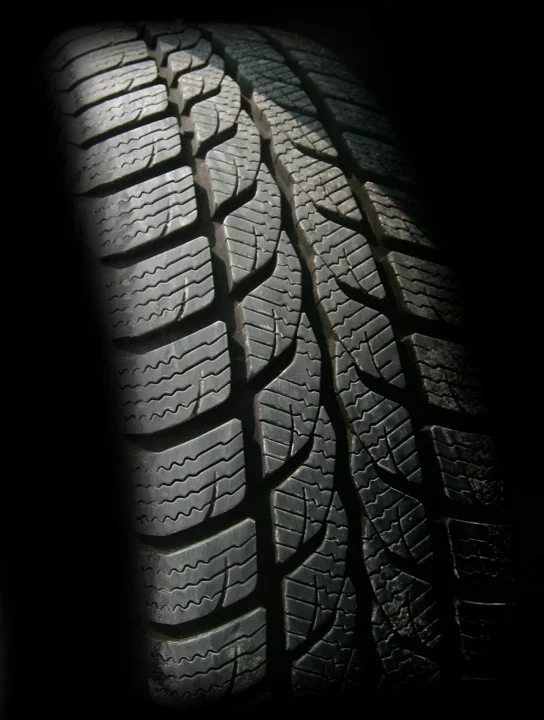
Tyres matter too. Cars must have at least 1.6 mm of tread across the central three-quarters of the tyre and around its entire circumference. Tread grooves channel water away so the tyre keeps touching the road. With too much water a tyre can ride on a wedge of water, called aquaplaning, and lose grip. Read more in our guide to motor vehicle collisions and road safety.
Electric and hybrid cars can use regenerative braking, where the motor acts as a generator so some kinetic energy charges the battery instead of all becoming heat. See the physics of electric cars for how it works.
A car’s brakes do 150 000 J of work to stop it. How much energy is transferred from the car’s kinetic store, and where does it go? (2 marks)
150 000 J is transferred from the kinetic energy store. Mostly it goes to the thermal energy stores of the brakes (and then the surroundings), so the temperature of the brakes rises.
Examples of friction in everyday life
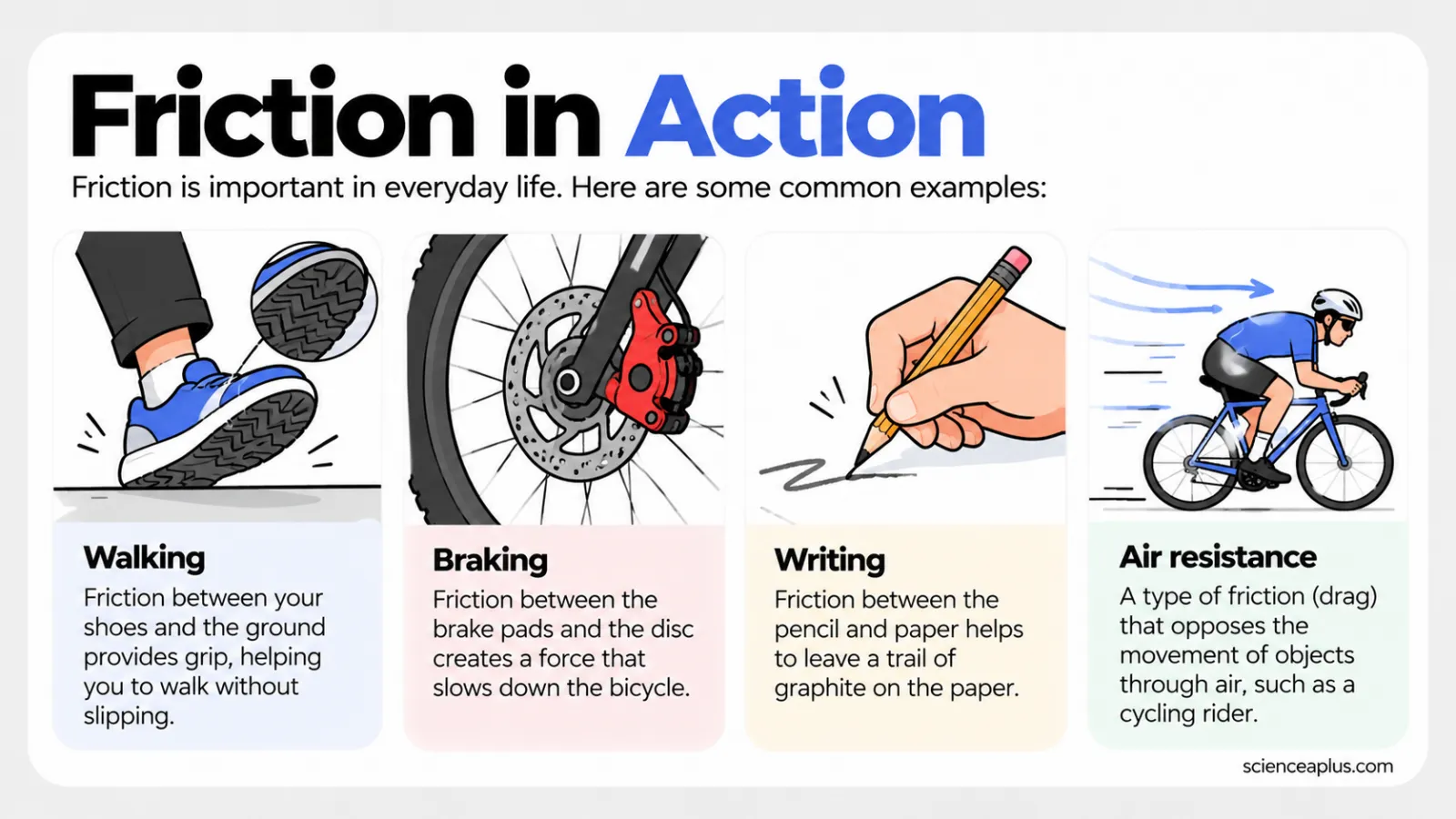
Friction is so common that you only notice it when it goes missing. Here are some of the jobs it does every day.
- Walking: the tread of your shoes grips the ground. On wet or oily floors there is less friction, and people slip.
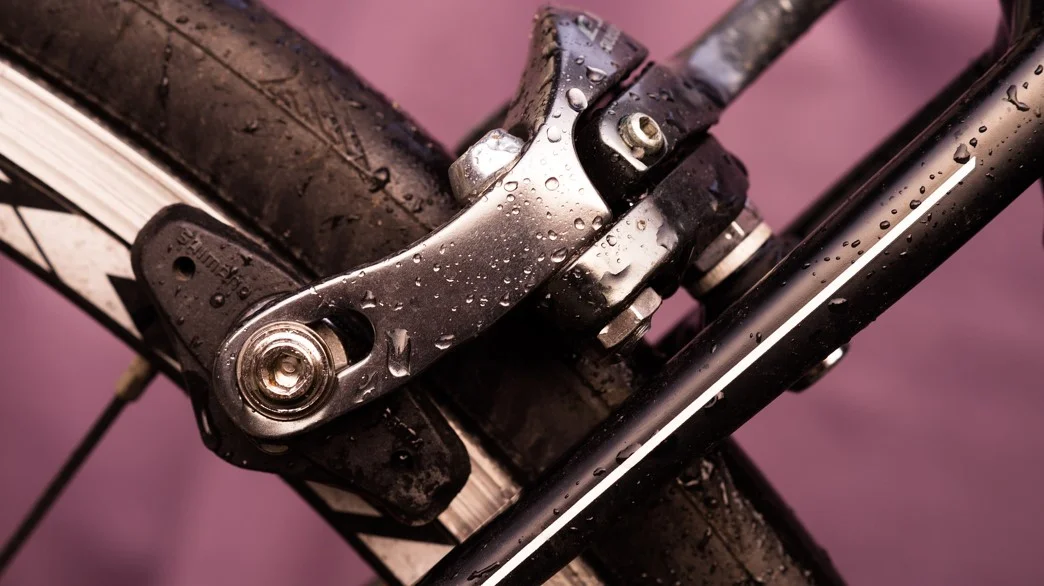
- Braking: bicycle rim brake blocks squeeze the wheel rim, and disc brakes squeeze a disc. Friction slows the wheel.
- Writing: a pencil leaves a trail of graphite on paper because friction rubs thin layers of graphite off the tip on to the page.
- Tyres: rubber tyres grip the road, so a car can speed up, steer and stop.
- Ropes and knots: twisting presses the fibres against each other, and friction between them holds the rope together.
That last example has a recent research twist. A 2022 study in Physical Review Letters by Seguin and Crassous in France found that a small amount of twist hugely amplifies the friction forces that lock fibres together.

Friction is not always welcome. It heats moving parts, wears surfaces away and wastes energy in machines. Those problems have their own article on the disadvantages of friction, so here we focus on how to control it.
How to increase or reduce friction
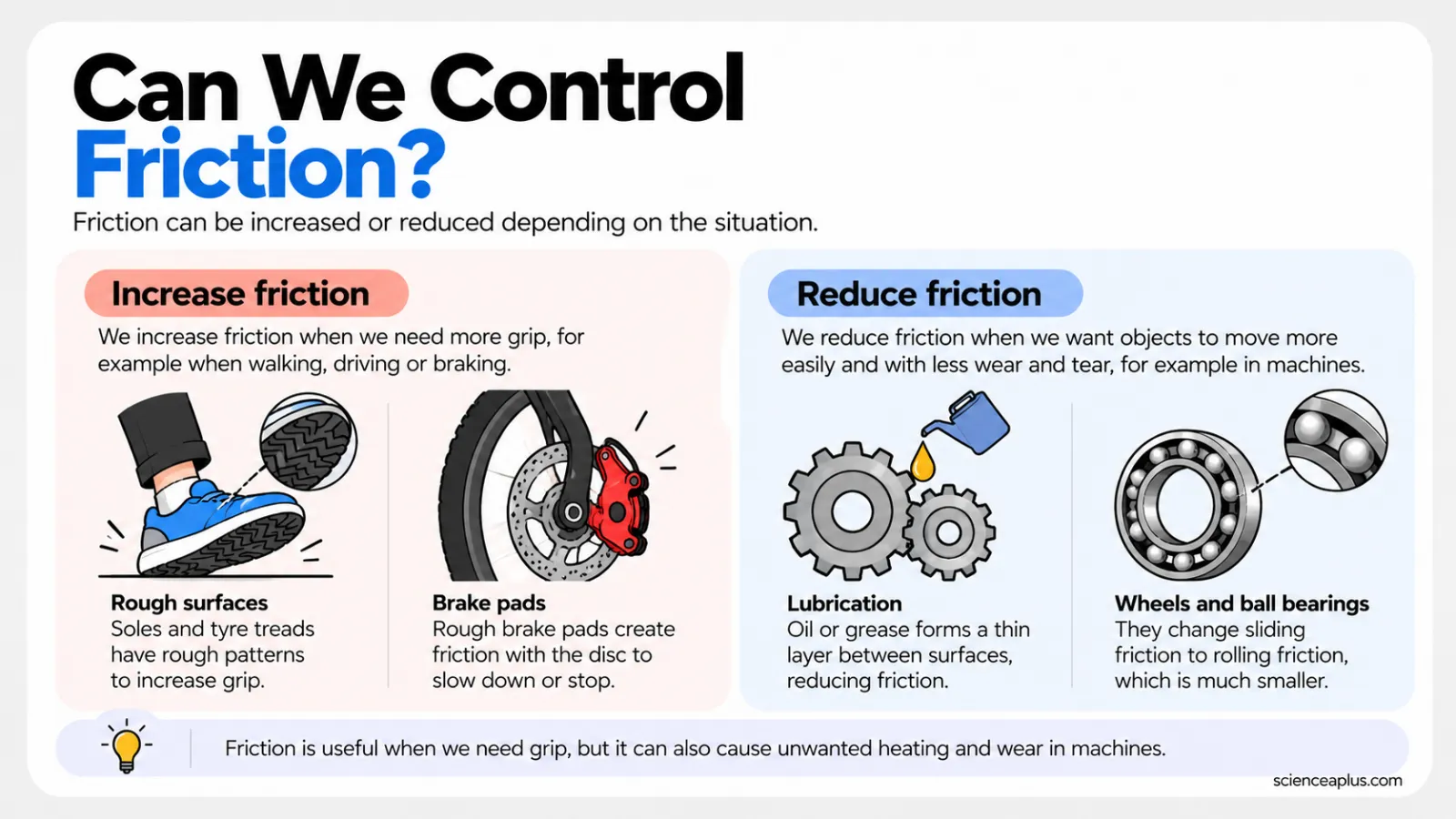
Engineers and designers do not treat friction as good or bad. They adjust it to suit the job.
Increasing friction
To get more grip, use rough or grippy materials and patterns. Tread patterns on shoes and tyres help them hold the ground, rubber soles grip better than smooth plastic, and brake pads are made of high-friction material.
Reducing friction
To cut friction, put something slippery between the surfaces or stop them sliding.
- Lubricants: oil, grease and graphite form a layer between surfaces so the bumps no longer catch. Our guide to hardware lubricants, sealants and adhesives covers common products.
- Graphite: its layers of carbon atoms have no covalent bonds between the layers, so they slide over each other easily. That makes graphite a dry lubricant. Researchers at Queen Mary University of London found that water helps the layers slide. See carbon element details for the structure.
- Wheels and ball bearings: these replace sliding with rolling, which has much less friction.
- Smooth, polished surfaces: smaller bumps mean less catching.
- Streamlining: a smooth shape reduces air resistance.
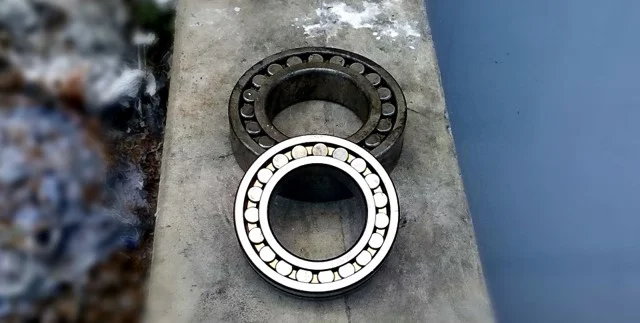
Bearings are the clearest example. A ball or roller between two rings turns what would be sliding into rolling, so machines, bicycle wheels and skateboards spin freely.
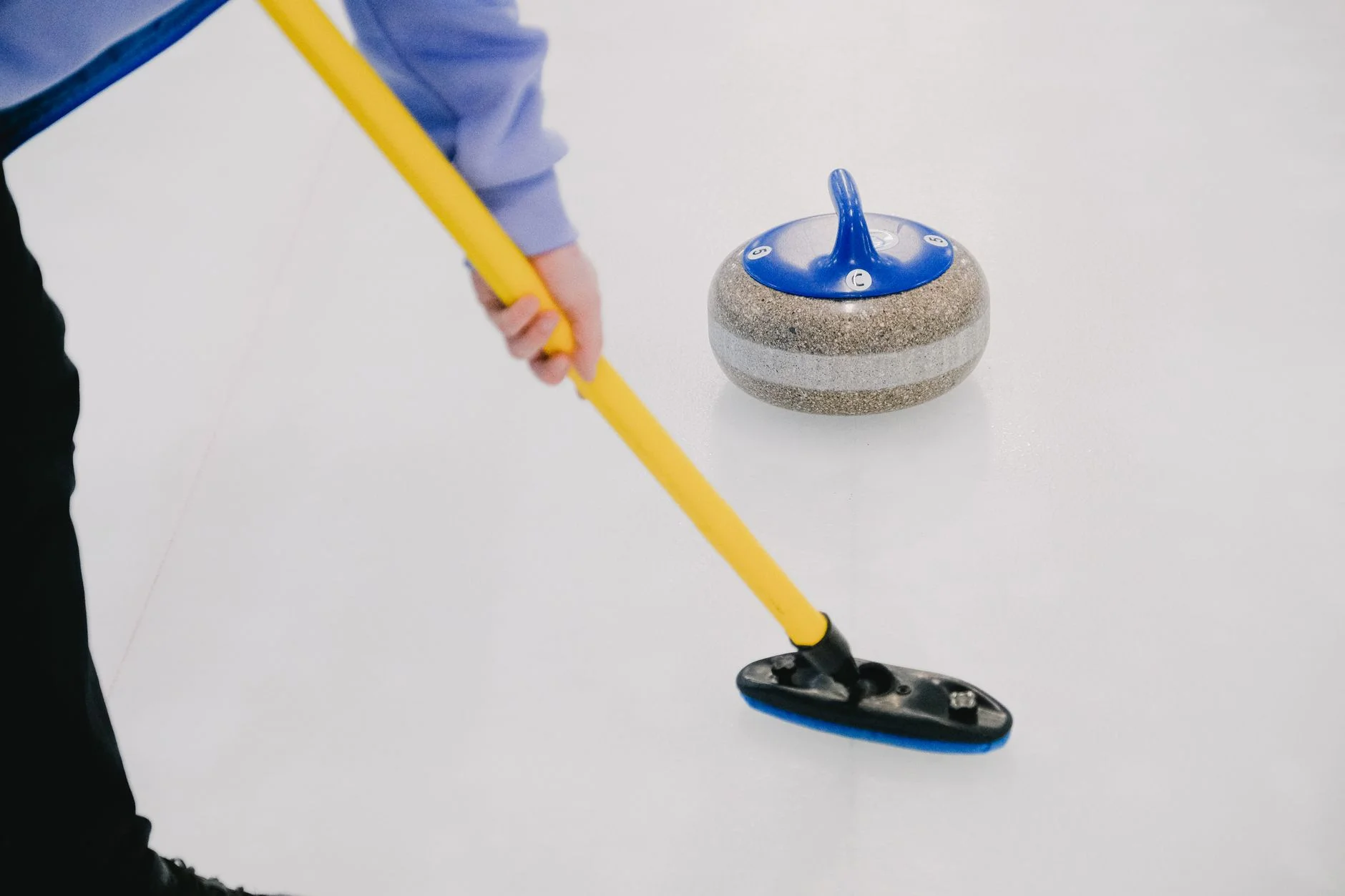
Curling is a surprising case. Players sweep the ice in front of the stone, and this heats up the ice, making it slick and reducing friction, according to ScienceAlert. The stone travels farther and straighter, and it curls less.
Friction exam practice
Try the four questions from the card above. Tap each one to check your answer against the model answer.
1. Define friction. (1 mark)
Friction is a contact force that opposes the sliding (or attempted sliding) of one surface over another.
2. Explain why a book sliding across a desk eventually stops. (3 marks)
Friction acts on the book in the direction opposite to its motion. This is an unbalanced (resultant) force, so the book decelerates. Work done against friction transfers energy from the book’s kinetic store to thermal stores until it stops.
3. Give one advantage and one disadvantage of friction. (2 marks)
Advantage: friction gives grip for walking or braking. Disadvantage: friction causes heating and wear, and wastes energy in machines.
4. Describe one method of reducing friction in a machine. (2 marks)
Lubricate the moving parts with oil or grease. The lubricant forms a layer between them so they do not rub directly. Alternatively, use ball bearings so parts roll instead of slide.
Frequently asked questions about friction
What is friction in simple terms?
Friction is a force that tries to stop surfaces sliding over each other. It acts where two things touch, pointing against the direction of motion or attempted motion. It is why a book stops sliding across a desk and why your shoes grip the floor. It is measured in newtons.
What causes friction?
Even smooth-looking surfaces have microscopic bumps and hollows, so they touch only at the tips of the bumps. At GCSE we say the bumps catch on each other as the surfaces slide. Scientists also know the surfaces stick together at these contact points, and the joints must be sheared to slide.
What are the main types of friction?
The main types are static friction (nothing is sliding), limiting friction (the maximum static friction, just before sliding starts) and sliding or kinetic friction (surfaces are sliding). Rolling friction acts on wheels and balls, and fluid friction, such as air resistance, acts on objects moving through air or water.
Is static friction bigger than sliding friction?
Usually, yes. The maximum static (limiting) friction is typically larger than sliding friction between the same two surfaces. For wood on wood, HyperPhysics gives coefficients of about 0.4 static and 0.3 sliding. That is why it takes a bigger force to start an object moving than to keep it moving.
Does surface area affect friction?
For most everyday dry surfaces, no. Friction depends on the types of surface and the normal contact force pressing them together. A bigger area spreads the weight over more contact points, so each is pressed less hard and the total friction stays about the same. This rule of thumb has exceptions for very smooth, sticky surfaces.
What unit is friction measured in?
Friction is measured in newtons (N), because it is a force. You can measure it with a newton meter by pulling an object along a surface and reading the force just before it moves, or while it slides at a steady speed. The coefficient of friction, μ, has no units.
Is air resistance a type of friction?
Many school sources describe air resistance as a type of friction, called fluid friction. It is a contact force between an object and the air, and it acts opposite to the motion. It increases as speed increases, which is why a falling object eventually reaches a constant terminal velocity.
Why does friction make things hot?
When you push something against friction you do work, and that work transfers energy. According to AQA, work done against the frictional forces acting on an object causes a rise in its temperature. The energy moves from the kinetic store into thermal stores, which is why rubbed hands and braking discs get warm.
How can friction be reduced?
Friction can be reduced by putting a lubricant such as oil, grease or graphite between the surfaces, by using wheels or ball bearings so parts roll instead of slide, by making surfaces smoother, and by streamlining shapes to cut air resistance. Reducing friction also reduces unwanted heating and wear.