
What is a Jerusalem artichoke? The Jerusalem artichoke (Helianthus tuberosus) is the knobbly tuber of a tall North American sunflower. Despite the name, it is not an artichoke and it does not come from Jerusalem. Jerusalem artichoke benefits come mainly from inulin, a fibre that feeds gut bacteria, plus useful amounts of potassium and iron. The catch is wind. This guide is for general education and is not medical advice.

What is a Jerusalem artichoke?

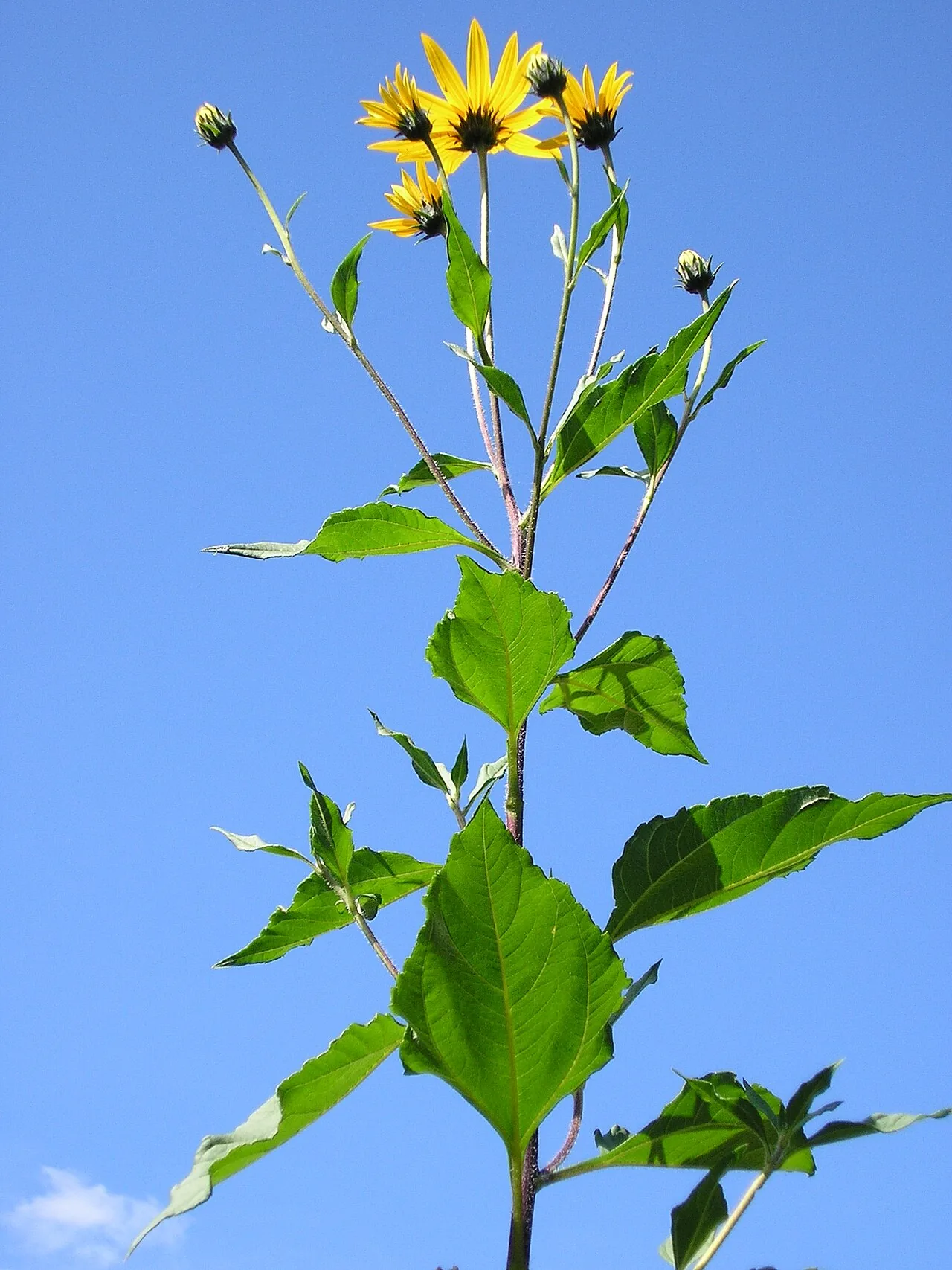
The Jerusalem artichoke is a tall, herbaceous perennial. That means it dies back each winter and regrows from the same underground parts the following spring. It belongs to the daisy or sunflower family, known to scientists as the Asteraceae. The Royal Horticultural Society (RHS) describes it as reaching 2.5 m tall or more, with coarse, hairy leaves and small, yellow, sunflower-like flowers in summer.
It is a true sunflower relative. The common sunflower, Helianthus annuus, sits in the same genus, Helianthus. The big difference is the life cycle. The common sunflower is an annual that grows from seed each year, while the Jerusalem artichoke is a perennial that survives underground.
The plant is native to North America. A weed guide from Ohio State University describes its range as stretching from the East Coast to the Midwest, and from southern Canada to Georgia. The stems can grow as tall as 12 feet, which is about 3.7 m, and they are stout, rough and hairy. In the wild it grows in disturbed ground, meadows, fields, forest edges and along river and lake shores.
It is also tough. Research papers describe the plant as tolerating frost, drought and poor soil, which helps explain why it grows so widely. The RHS rates it as hardy in most of the UK, even in severe winters.
The leaves matter too. Like all green plants, the Jerusalem artichoke uses photosynthesis to make sugars in its leaves during summer. In autumn, a large share of that stored energy is moved underground and packed into the tubers, which is why the part we eat is full of carbohydrate.
Tubers, rhizomes and why the plant spreads
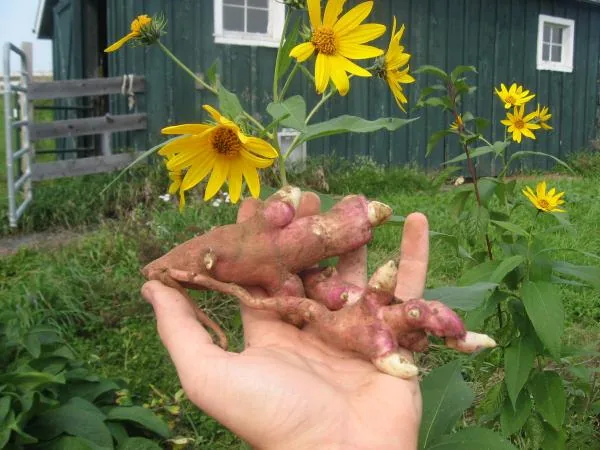

The part of the plant we eat is not a root. It is a stem tuber. The plant grows horizontal underground stems called rhizomes, and the tubers swell at the tips of these rhizomes. According to the Ohio State University guide, the tubers are whitish to pinkish and irregular in size and shape, which gives the vegetable its knobbly look.
You may see Jerusalem artichokes called a root vegetable on cards and in shops. That is a perfectly good kitchen term, but botanically a root and a stem are different organs. A rhizome is a stem that happens to grow underground, and a tuber is a swollen storage section of it.
This underground system explains why the plant spreads so well. The Ohio State guide says it reproduces by seeds, rhizomes and tubers. When a new plant grows from a piece of tuber or rhizome, with no seeds and no pollination involved, that is a form of asexual reproduction called vegetative propagation. Each new plant is a genetic copy of its parent.
The same trick makes gardeners cautious. A single forgotten tuber in the soil can sprout the following spring. We come back to this when we look at growing the plant later in the article.
One more detail ties the biology to the nutrition. Potatoes store their energy as starch, which is a long chain of glucose units. Jerusalem artichokes store most of theirs as a different carbohydrate called inulin. That single difference explains much of what follows, including both the benefits and the wind.
Why is it called a Jerusalem artichoke?
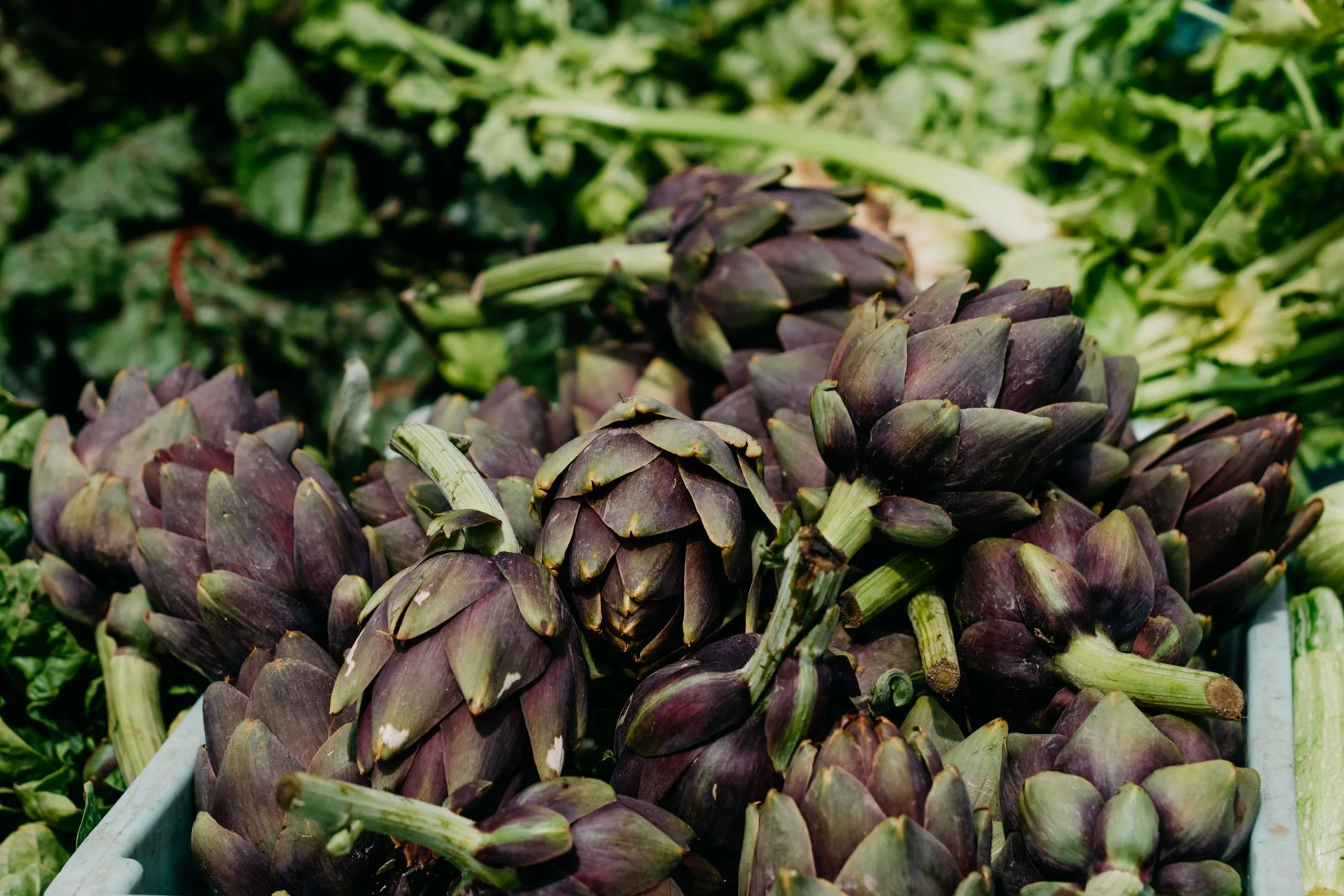
The name is misleading twice over. The Native Plant Trust, a botanical resource for the north-eastern United States, notes that the common name is misleading. The plant has no connection with the city of Jerusalem, and it is not a close relative of the artichoke you buy in a jar or a market.
The most popular explanation for “Jerusalem” is that it is a corruption of the Italian word girasole, which means “turning to the sun”. Ohio State University describes it as “probably” a corruption of this word. It is a sensible theory, since the plant is a sunflower, but nobody can prove it. The “artichoke” part is often said to come from the flavour of the tuber, which some people compare with the globe artichoke.
The globe artichoke is a different plant altogether. The RHS lists it as Cynara cardunculus and says that what we eat are its plump flower buds. It sits in the same wider family, the Asteraceae, but it belongs to a different genus. So the two vegetables are distant cousins, not near relatives.
- Jerusalem artichoke: an underground stem tuber from Helianthus tuberosus.
- Globe artichoke: a flower bud from Cynara cardunculus.
It has picked up several other names along the way. You may see it sold as a sunchoke, a sunroot, or by the name topinambur, which scientific papers also use. It also has a rude nickname, the “fartichoke”, which we explain in the section on wind.
So the sunchoke is a North American sunflower with a European-sounding name and a very old reputation. Next, we look at what is actually inside the tuber.
Jerusalem artichoke nutrition per 100 g
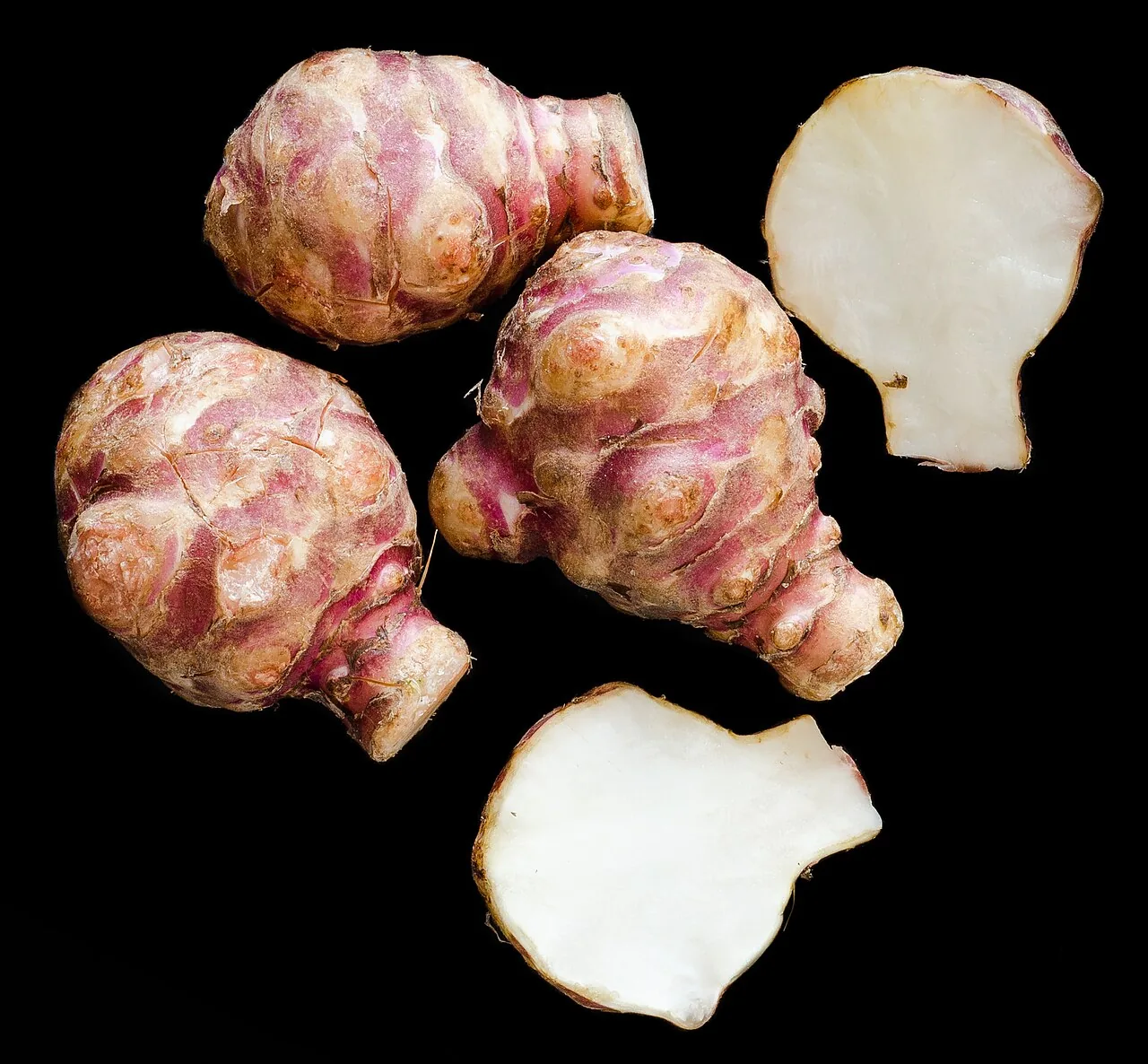
If you want Jerusalem artichoke nutrition facts, the best public source is the US Department of Agriculture’s FoodData Central database. It lists raw Jerusalem artichokes with the figures below for every 100 g. To make the numbers easier to judge, the right-hand column shows each nutrient as a percentage of the adult nutrient reference value (NRV) used on UK and EU food labels. Under labelling rules, 15% of the NRV per 100 g counts as a “significant amount”.
| Nutrient | Per 100 g raw | % of adult NRV |
|---|---|---|
| Energy | 73 kcal (304 kJ) | – |
| Protein | 2.0 g | – |
| Carbohydrate | 17.4 g | – |
| of which total sugars | 9.6 g | – |
| Fibre (standard food-table method) | 1.6 g | – |
| Potassium | 429 mg | 21% |
| Iron | 3.4 mg | 24% |
| Thiamin (vitamin B1) | 0.2 mg | 18% |
| Phosphorus | 78 mg | 11% |
| Vitamin C | 4 mg | 5% |
| Magnesium | 17 mg | 5% |
Water makes up about 78 g of every 100 g, and the fat content is almost zero (0.01 g). Three nutrients clear the 15% mark: iron, potassium and thiamin. Phosphorus is close behind at 11%. Food tables vary between sources, varieties and growing conditions, so treat these as typical raw values rather than exact guarantees. Cooking changes them too.
Potassium is a mineral that your nerves and muscles rely on, and you can read more about the element in our guide to potassium. The tuber also supplies more iron than a potato, as the comparison below shows. Try the calculator to see what a portion of your own size supplies.
Try your own portion size:
Inulin: the Jerusalem artichoke’s secret carbohydrate
Look back at the table and you may notice something odd. The tuber has about 17 g of carbohydrate per 100 g, yet only 1.6 g of fibre. The missing piece is inulin, which standard food-table methods do not count as fibre.
Inulin is a fructan, a carbohydrate built mainly from fructose units joined in chains. Plants use it as a reserve, or storage, carbohydrate in the same way that potatoes use starch. A 2023 review notes that inulin is found in more than 36,000 plant species, and that Jerusalem artichoke tubers and chicory roots are often used to make inulin for the food industry. Published figures put the inulin content of the tuber at roughly 14–19% of its fresh weight, which fits with the 17 g of carbohydrate per 100 g in the table. The real figure varies with variety, growing conditions and storage.
If you have studied biology, the pattern will be familiar. Starch, glycogen and cellulose are all long chains of glucose with different shapes and jobs, which you can compare in our article on cellulose, starch and glycogen. Inulin is built from fructose instead, so it is a different kind of store. For a wider look at sugars, starches and fibre, see our guide to what carbohydrates are.
As for the flavour, the grower Riverford describes it as sweet and nutty, and the RHS says you can use the tubers like potatoes, whether steamed, roasted or baked.
Jerusalem artichoke vs potato
A potato is the vegetable most people would compare it with, so here is the same 100 g comparison. The potato figures also come from USDA FoodData Central and refer to raw potato with flesh and skin.
| Per 100 g raw | Jerusalem artichoke | Potato |
|---|---|---|
| Energy | 73 kcal | 77 kcal |
| Protein | 2.0 g | 2.05 g |
| Carbohydrate | 17.4 g | 17.5 g |
| Fibre (standard method) | 1.6 g | 2.1 g |
| Iron | 3.4 mg | 0.81 mg |
| Potassium | 429 mg | 425 mg |
| Vitamin C | 4 mg | 19.7 mg |
| Main stored carbohydrate | Inulin | Starch |
| FODMAP rating | Rich in fructans (inulin) | Generally low |
The two vegetables are close on energy, protein, carbohydrate and potassium. The Jerusalem artichoke has about four times as much iron, while the potato has about five times as much vitamin C. The biggest difference is the type of carbohydrate. The RHS says the tubers contain a carbohydrate that is not broken down in digestion, and that matters for sensitive guts. FODMAPs, a group of poorly absorbed carbohydrates, are explained in the next section.
That does not make the tuber a poor choice. It simply means you should value it for what it does contain: iron, potassium, thiamin and inulin. No single vegetable supplies everything, which is why a mixture is better than relying on one food.
Check your understanding
Tap each question to reveal a model answer.
Suggest why a food table may underestimate the fibre in Jerusalem artichokes. (2 marks)
Standard methods for measuring dietary fibre do not measure inulin (1 mark). Inulin makes up a large share of the tuber, roughly 14–19% of its fresh weight, so a lot of it goes uncounted (1 mark).
100 g of raw Jerusalem artichoke contains 3.4 mg of iron. The adult NRV for iron is 14 mg. Calculate the percentage of the NRV. (2 marks)
Percentage = 3.4 ÷ 14 × 100 (1 mark) = 24% (1 mark), to the nearest whole number.
Having covered what is inside the tuber, we can ask what happens to it once it reaches your gut.
Jerusalem artichoke benefits for gut health
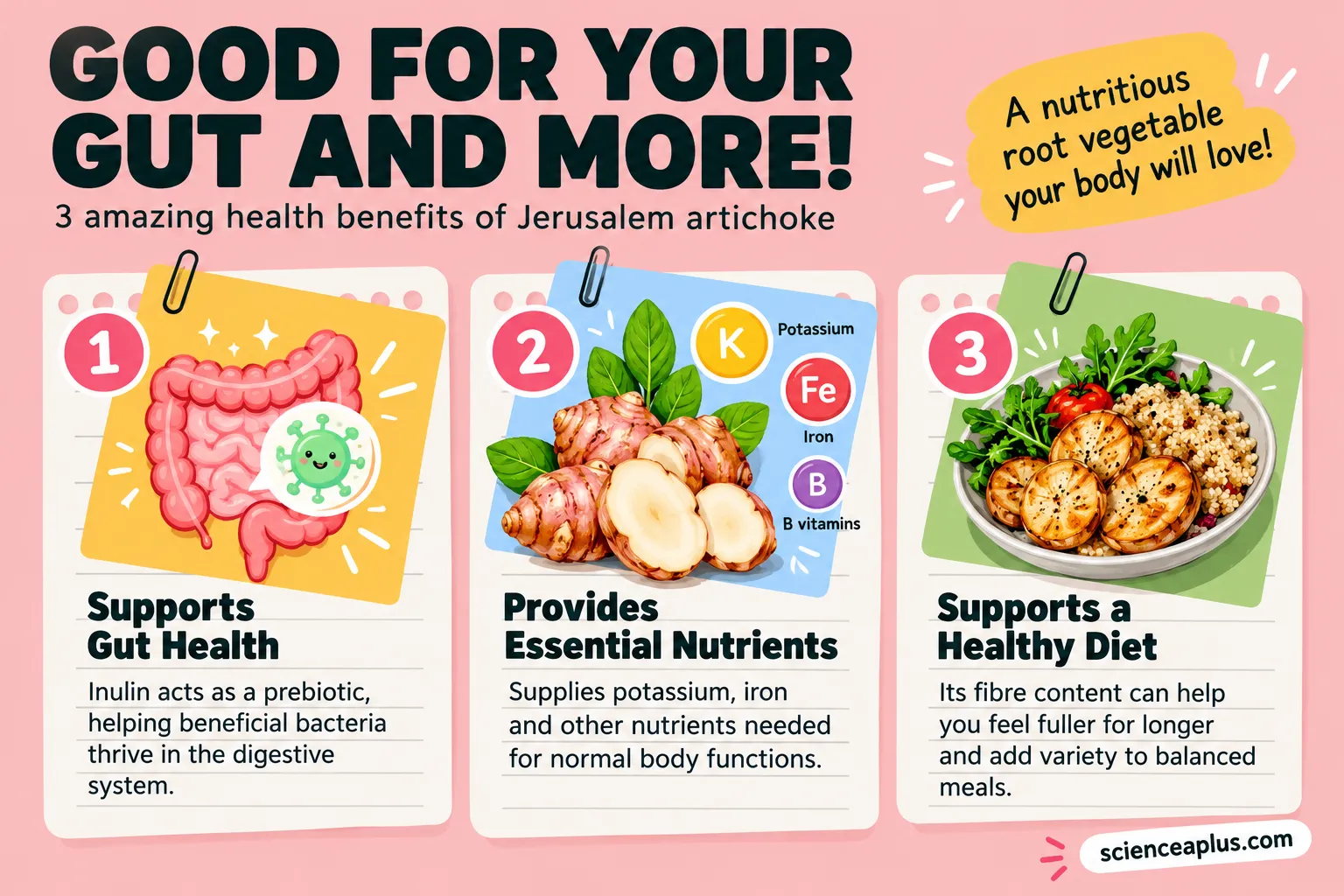
Most of the serious interest in Jerusalem artichoke benefits centres on inulin and the gut. Inulin is widely described as a prebiotic, which means it stimulates the growth of beneficial bacteria in your large intestine. Do not confuse this with a probiotic, which is a live microbe you swallow. Our guide to the benefits of probiotics covers that side, and our article on gut health explains why the community of gut bacteria matters.
The strongest evidence we can point to comes from a small human trial. In 2010, researchers at the University of Reading, led by Ramnani, published a double-blind, placebo-controlled study in the British Journal of Nutrition. It involved 66 healthy volunteers aged 18 to 50, split into three groups of 22. Two groups received a fruit-and-vegetable “shot” containing 5 g a day of Jerusalem artichoke inulin, and the third received a placebo.
The results were specific. Bifidobacteria, a group of beneficial gut bacteria, were significantly higher in both inulin groups. There was also a small rise in two other groups, Lactobacillus and Enterococcus. Other bacterial groups did not change, and neither did the short-chain fatty acids measured in faeces. The volunteers also reported a slight but significant increase in flatulence, although overall it stayed mild.
Fibre is the other side of the story. The NHS says adults should aim for 30 g of fibre a day, yet the average adult eats about 20 g. The NHS adds that eating plenty of fibre is associated with a lower risk of heart disease, stroke, type 2 diabetes and bowel cancer.
What about blood sugar and diabetes?
Many websites say Jerusalem artichokes are good for diabetes. The evidence is much thinner than the headlines. A 2025 systematic review of Helianthus extracts and blood glucose found 14 studies, of which 12 were preclinical (animal) studies and only one was clinical. The authors identified inulin in H. tuberosus as a possible active compound. That is an interesting lead for further research, not a proven effect.
There is a similar need for care with official health claims. In the EU, the authorised claim for inulin covers native chicory inulin only. It says inulin contributes to normal bowel function by increasing stool frequency, and it applies only at 12 g a day. Doses of 5–8 g a day did not change stool frequency in the studies the European Food Safety Authority examined. The claim for chicory inulin does not automatically apply to a plate of roasted Jerusalem artichokes.
The sensible conclusion is that early research is interesting, but a Jerusalem artichoke is not a treatment for diabetes. Nobody should change diabetes medicines or diet without talking to their GP or diabetes team.
Why do Jerusalem artichokes make you fart?
Here is the downside, and the reason for that rude nickname. The Native Plant Trust notes that the tubers contain indigestible inulins that can cause gas. The RHS says the tubers contain a carbohydrate that is not broken down in digestion, so they can cause wind, especially if you eat a lot at one time.
The process works like this. Inulin is not broken down by normal digestion, which relies on enzymes, so it travels on to the large intestine, or colon. There, gut bacteria ferment it. Fermentation produces gases, and gas can cause bloating and wind. In other words, the same process that feeds the friendly bacteria is the process that makes the wind. Gut bacteria ferment the inulin, and the gas follows.
Inulin is a fructan, one of the main types of FODMAP, so Jerusalem artichokes are a fructan-rich food. FODMAPs are short-chain carbohydrates that are poorly absorbed in the small intestine and are highly fermented by bacteria in the large intestine. A 2025 review reports that clinical studies show dose-dependent bloating, flatulence and diarrhoea with fructo-oligosaccharides, particularly above about 10–15 g a day. Dose-dependent means that the more you eat, the stronger the effect tends to be. Potatoes, by contrast, are generally classed as low-FODMAP.
The nickname “fartichoke” has been around for a while, and John Goodyer made the same complaint in the 17th century. He was right about the effect, if not about the manners. Everyone’s gut is different, though, and no reliable source gives a figure for how much gas to expect.
How to enjoy them with less wind
These tips come from the RHS and the NHS. None of them is guaranteed, so see how your own gut responds.
- Start small. The RHS advises beginning with small portions and building up.
- Do not eat a lot in one sitting. The RHS says wind is most likely when you eat a lot at one time.
- Try lemon juice. The RHS says cooking the tubers with lemon juice may help.
- Look for late-season tubers. The RHS says harvesting late in the season may help.
- Eat slowly, and have smaller meals more often. The NHS lists this among its general tips for wind.
The science behind it: from sunlight to gas
Put the biology and chemistry together and the whole story of this vegetable follows one chain of events.
- Summer, in the leaf: photosynthesis turns carbon dioxide and water into sugars using light energy.
- Autumn, in the tuber: the plant moves that stored energy underground. Instead of long chains of glucose (starch), it builds chains of fructose units joined by β(2→1) links, usually with a single glucose unit at one end. That is the structure of inulin, described in a classic review by van Loo and colleagues as a linear fructan chain.
- Eating, in the gut: our digestive enzymes are suited to breaking down starch, and the RHS notes that the tuber’s carbohydrate is not broken down in digestion. Inulin therefore reaches the colon intact.
- Colon, among the bacteria: microbes ferment it. This helps some bacteria grow, as the Reading trial showed for bifidobacteria, and it releases gas, as the volunteers noticed.
The tuber, then, is a storage organ built for a plant’s winter, not for a human’s digestion. The same molecule that works as the plant’s energy reserve is a prebiotic for us and a source of wind.
Jerusalem artichoke words to know
With the science covered, the practical questions are left: how do you cook these tubers, and how do you grow them?
How to cook Jerusalem artichokes
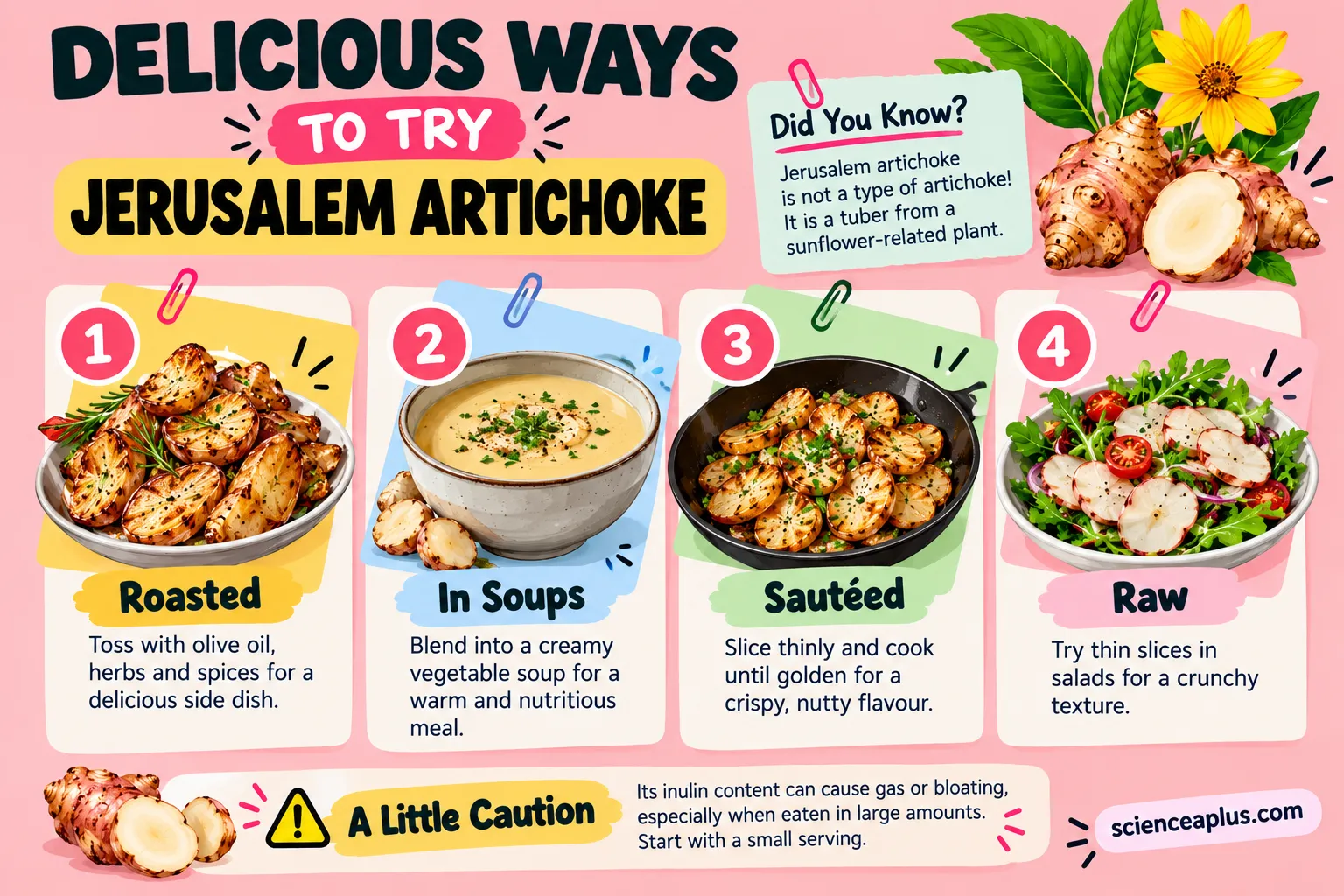
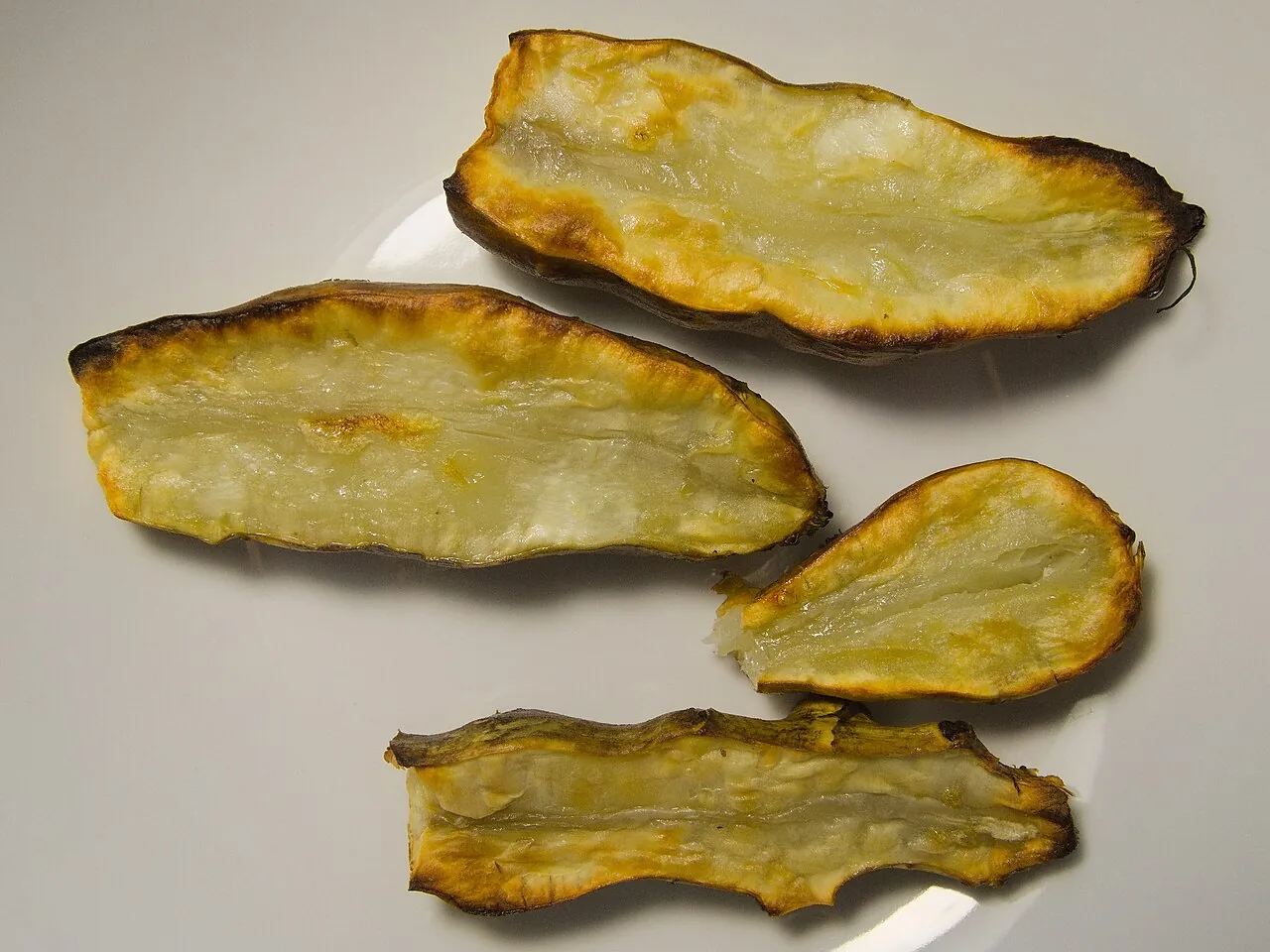
Jerusalem artichokes are in season through the winter and into early spring, according to the UK organic grower Riverford. They taste sweet and nutty, and you can treat them much like potatoes. The RHS suggests steaming, roasting or baking them. Riverford adds that you can boil them, roast them or purée them into soup, and that you can even slice and eat them raw, although raw tubers may also cause wind.
Preparing the tubers
The knobbly shape makes peeling fiddly. Riverford suggests scrubbing the tubers and leaving the skin on, or blanching them for about 5 minutes first to make peeling easier. Cut flesh oxidises and turns grey, so a dash of lemon juice in the water helps to stop that. Lemon juice has a second job, because the RHS says cooking the tubers with it may reduce wind.
Storage is simple. Riverford says the tubers keep for several weeks in a cool, damp place. From spring onwards, they suggest keeping them in the fridge in a perforated bag to slow sprouting.
A Jerusalem artichoke is a good addition to meals, but it is one vegetable among many. Our guide to why we need a balanced diet explains why variety matters more than any single food.
Trying them for the first time
Use this checklist the first time you cook them. Your ticks are saved in your browser.
- Choose firm tubers
- Scrub them well (the skin can stay on)
- Drop cut pieces into water with a dash of lemon juice
- Roast them or make soup
- Start with a small serving
- Notice how your gut feels the next day
- Increase the portion slowly if all is well
How to grow Jerusalem artichokes in the UK

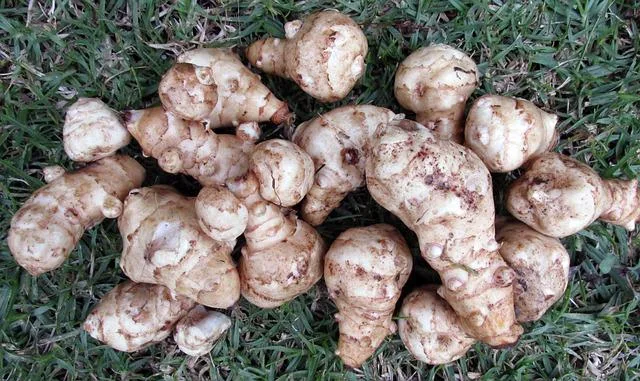
This is a tough plant that tolerates frost, drought and poor soil. The RHS rates the plant as hardy across most of the UK. It prefers full sun but copes with many soils, including chalk, clay, loam and sand. Our guide to soil types explains how those soils differ.
The RHS grow-your-own advice runs through the year like this.
- Late winter to mid-spring: buy tubers and plant them 10–15 cm deep and 30 cm apart. Leave at least 1 m between rows, or 30 cm if you want a dense block.
- As the stems grow: when they are about 30 cm tall, earth them up by about 15 cm. On windy sites, stake them, because plants can grow up to 3 m. The compact variety ‘Dwarf Sunray’ reaches about 120–150 cm.
- Late July or August: instead of staking, you can cut tall stems down to about 1.5 m, but no lower, because that could reduce the crop of tubers.
- Autumn: when the leaves turn yellow, cut the stems down to about 8 cm.
- From late autumn: start harvesting. A plant usually gives 10 or more tubers.
The tubers do not store well once dug, so the RHS suggests leaving them in the ground until you need them. Frost is said to improve the flavour. Slugs and snails can damage both shoots and tubers, so keep an eye out for them.
No garden? The RHS says you can use a container at least 45 cm wide and deep, with one or two tubers in it. Put the container outdoors in a sheltered spot, in sun or partial shade, and water it regularly.
Are Jerusalem artichokes invasive?
They can be. The RHS says the plant has the “potential to become a nuisance”, and any piece left in the soil regrows. So if you want to stop them coming back, you must remove every last piece. In parts of North America, the Ohio State University weed guide goes further and warns that it can become an aggressive weed that is very difficult to control. The Native Plant Trust agrees that it can be weedy and difficult to eradicate.
Maths practice questions
Use the figures from this article. Tap each question to reveal the working.
A portion of 150 g of raw Jerusalem artichoke contains roughly 14–19% inulin by fresh weight. Calculate the range of inulin in the portion. (2 marks)
Lower value: 150 × 0.14 = 21 g (1 mark). Upper value: 150 × 0.19 = 28.5 g (1 mark). So roughly 21–28.5 g. The real figure varies with variety, growing conditions and storage.
Raw Jerusalem artichoke provides 73 kcal per 100 g and raw potato 77 kcal per 100 g. Compare the energy in a 250 g portion of each, and give the difference as a percentage of the potato figure. (3 marks)
Jerusalem artichoke: 73 × 2.5 = 182.5 kcal. Potato: 77 × 2.5 = 192.5 kcal (1 mark for both). Difference = 10 kcal (1 mark). 10 ÷ 192.5 × 100 = 5.2%, so the artichoke has about 5% less energy (1 mark).
A 200 g portion of raw tubers supplies 858 mg of potassium and 6.8 mg of iron. The adult NRVs are 2000 mg and 14 mg. Calculate the percentage of each NRV. (3 marks)
Potassium: 858 ÷ 2000 × 100 = 42.9%, about 43% (1 mark). Iron: 6.8 ÷ 14 × 100 = 48.6%, about 49% (1 mark). Check: this is double the 100 g figures of 21% and 24%, as expected (1 mark).
The Reading volunteers took 5 g of inulin a day. The EU health claim for chicory inulin applies at 12 g a day. (a) What percentage of 12 g is 5 g? (b) Using the 14–19% inulin range, how much raw tuber contains 12 g of inulin? This is a maths exercise only: the EU claim does not apply to the vegetable. (4 marks)
(a) 5 ÷ 12 × 100 = 41.7%, about 42% (1 mark). (b) At 14%: 12 ÷ 0.14 = 85.7 g (1 mark). At 19%: 12 ÷ 0.19 = 63.2 g (1 mark). So roughly 63–86 g of raw tuber (1 mark).
Frequently asked questions about Jerusalem artichokes
Are Jerusalem artichokes good for you?
They can be a useful part of a varied diet. Per 100 g raw they supply 73 kcal and a good share of iron, potassium and thiamin, plus inulin, a prebiotic fibre. They are low in vitamin C, and they can cause wind. Claims about curing diseases are not supported by evidence.
Why do Jerusalem artichokes make you fart?
They contain inulin, a carbohydrate that is not broken down in normal digestion. It reaches the large intestine, where gut bacteria ferment it and release gas. The RHS says they can cause wind, especially if you eat a lot at one time. A small portion is the sensible start.
How do you stop Jerusalem artichokes giving you wind?
You cannot guarantee it, but the RHS suggests starting with small portions and not eating a lot at once. It says cooking with lemon juice or using tubers harvested late in the season may help. The NHS also advises eating slowly and having smaller meals more often.
Can you eat Jerusalem artichokes raw?
Yes. Riverford says you can slice and eat them raw, and they have a sweet, nutty flavour. Raw tubers may cause wind, so begin with a small amount. Scrub them well first. You can also boil, roast, steam or purée them into soup.
Are Jerusalem artichokes the same as sunchokes?
Yes. Sunchoke is another name for the Jerusalem artichoke, Helianthus tuberosus. It is also called sunroot, and scientific papers sometimes use the name topinambur. All of these names describe the same knobbly tuber from a North American sunflower relative.
Is a Jerusalem artichoke related to the globe artichoke?
Only distantly. Both belong to the daisy family, the Asteraceae, but they are different genera. The Jerusalem artichoke is a stem tuber from Helianthus tuberosus, whereas the globe artichoke is the plump flower bud of Cynara cardunculus. It shares its genus with the common sunflower.
Are Jerusalem artichokes good for diabetes?
The evidence is early. A 2025 review of Helianthus extracts and blood glucose found 14 studies, 12 of them in animals and only one clinical. They are not a treatment for diabetes. Speak to your GP or diabetes team before changing your diet or medicines.
Why is it called a Jerusalem artichoke?
The most popular explanation is that “Jerusalem” comes from the Italian girasole, meaning “turning to the sun”, although this is not proven. The plant has no link to the city. “Artichoke” is often said to refer to the tuber’s flavour.
Are Jerusalem artichokes invasive?
They can be. Any piece of tuber left in the soil regrows, and the RHS says the plant has the potential to become a nuisance. Grow them in a large container or a dedicated bed, and remove every last piece when you harvest.