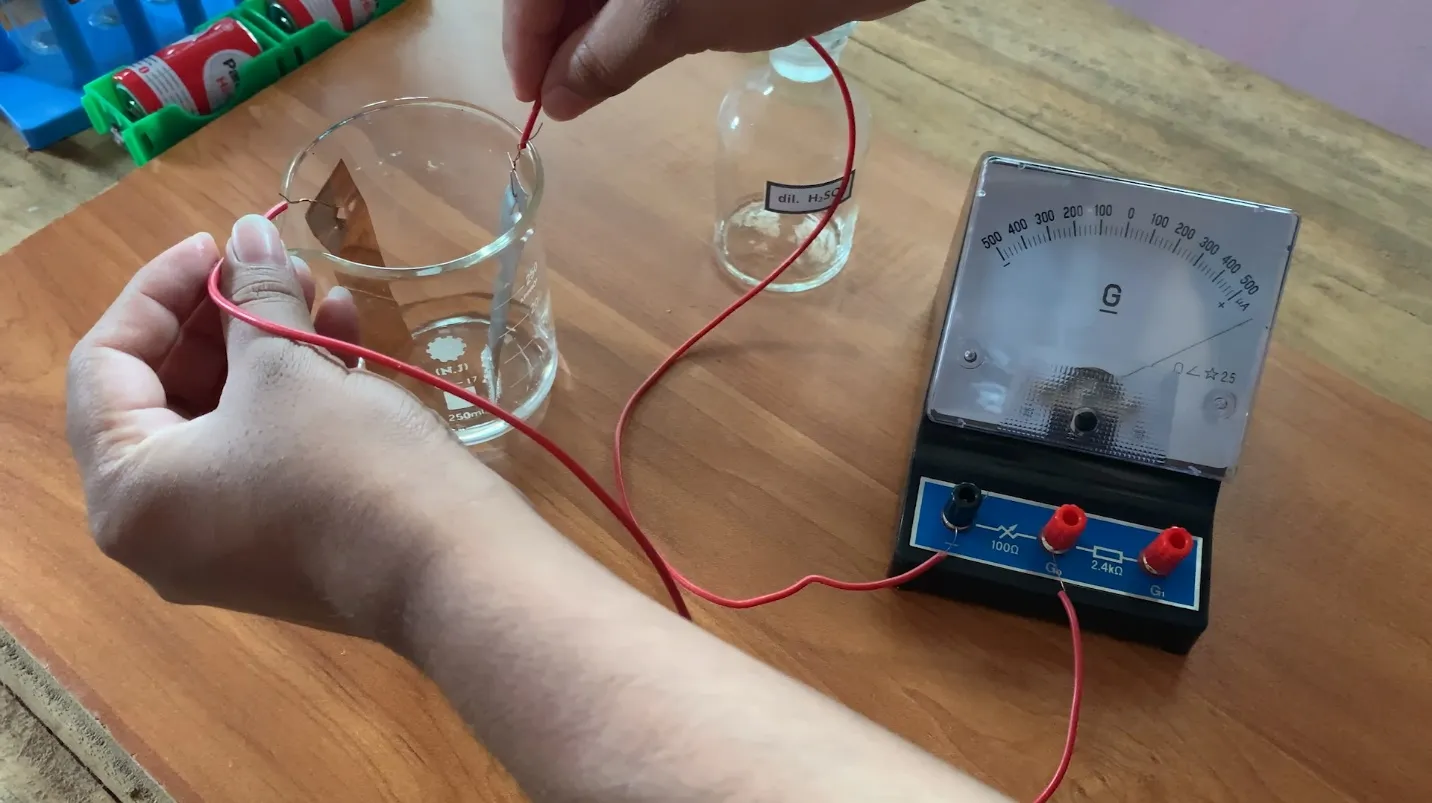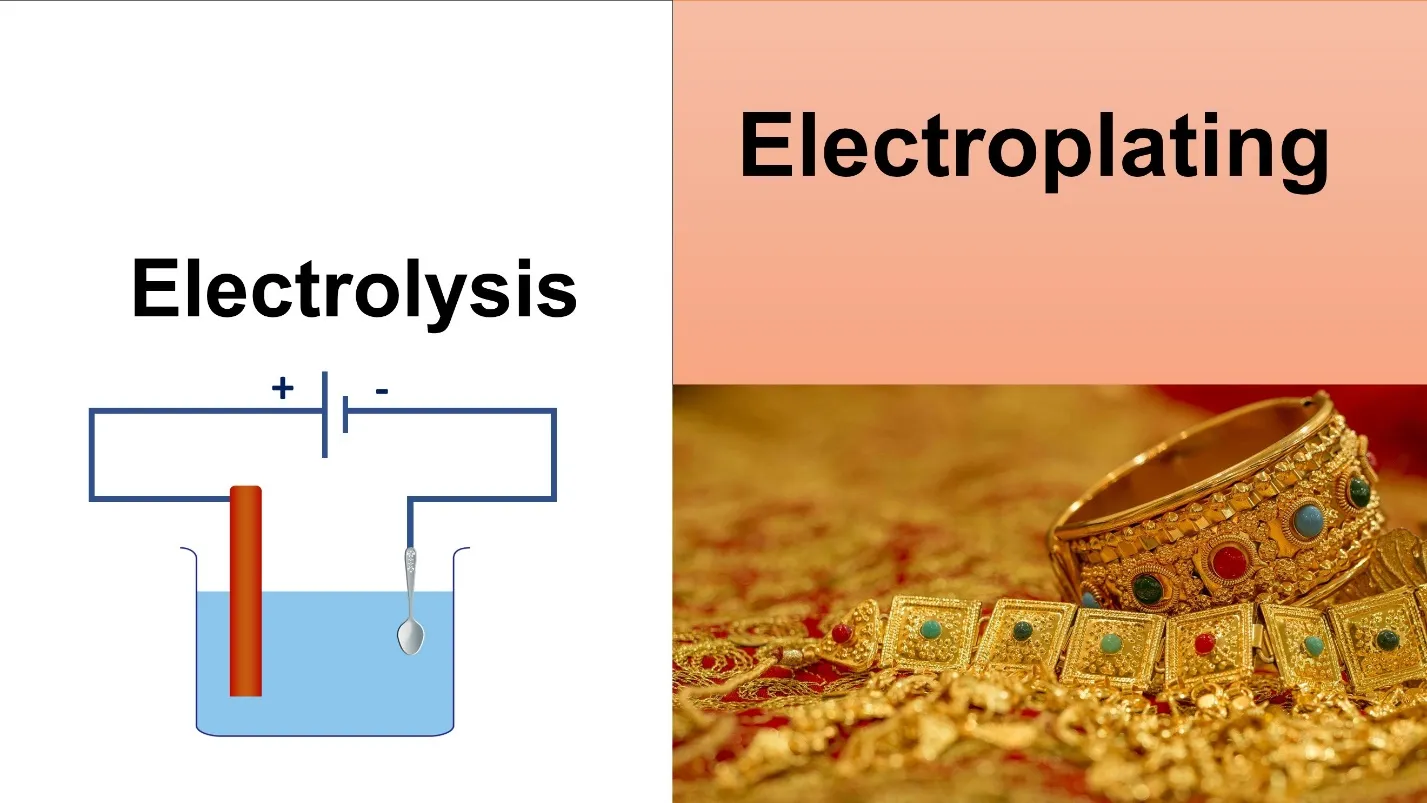
A lemon battery experiment is one of the most popular practicals in school science, and a lime works just as well. Push a copper strip and a zinc strip into a lime, join them to a sensitive meter with two wires, and the needle moves. Electricity from a lime fruit looks like magic, but there is a clear chemical explanation, and it is not the one most websites give.
In this article you will get the full practical method, a risk assessment, the difference between a centre-zero galvanometer and an ordinary ammeter, the real voltages and currents you can expect, how to wire fruits in series to light an LED, and 12 worked maths questions. We start with the idea that matters most: where the energy really comes from.
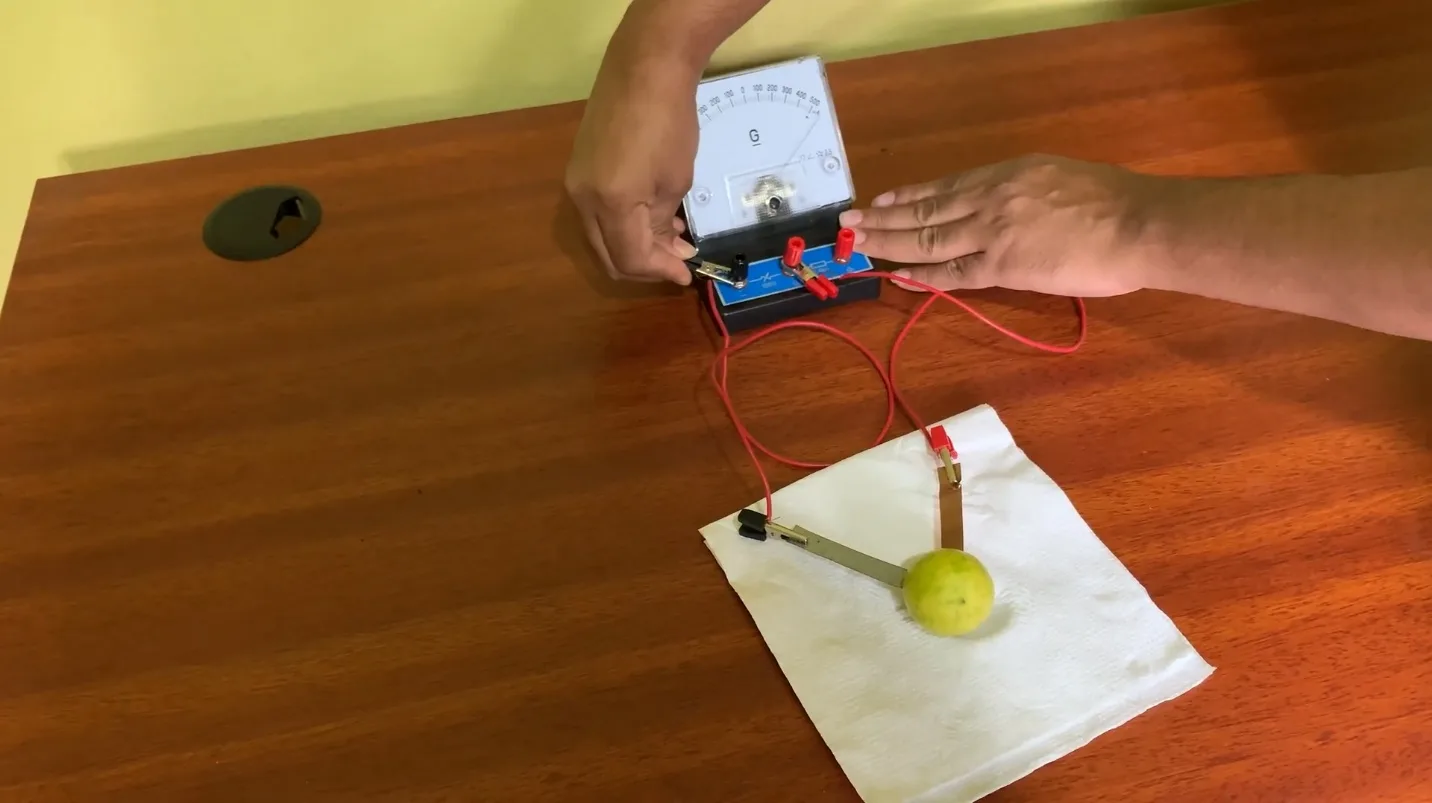
How does a lemon battery work?
An electric cell needs three things: two different conducting electrodes and an electrolyte between them. In a lime or lemon cell the electrodes are a copper strip and a zinc strip, and the electrolyte is the acidic juice inside the fruit. Together they turn energy stored in chemicals into electrical energy, so the chemical energy store is emptied a little as the current flows.
Zinc is more reactive than copper, so zinc atoms give up electrons more readily. You can see why in our guide to the reactivity of metals. The electrons leave the zinc, travel through the wire and the meter to the copper, and ions move through the juice to complete the circuit. By the usual GCSE convention, the conventional current outside the cell is drawn from the copper (positive) to the zinc (negative).
The half-equations
Chemists describe what happens at each electrode with a half-equation. At the zinc strip, zinc atoms are oxidised:
Negative electrode (zinc): Zn → Zn²⁺ + 2e⁻ (oxidation)
At the copper strip, hydrogen ions from the acidic juice pick up electrons and form hydrogen gas, which bubbles off the copper:
Positive electrode (copper): 2H⁺ + 2e⁻ → H₂ (reduction)
Add the two together and the electrons cancel, leaving the overall ionic equation:
Overall: Zn + 2H⁺ → Zn²⁺ + H₂
Remember OIL RIG: oxidation is loss of electrons, reduction is gain. The important point is that the copper is not used up. It simply gives the hydrogen a surface to form on. This explanation follows the careful study of lemon cells by J. Goodisman (2001), who showed that the cell reaction is the more reactive metal dissolving and hydrogen forming on the less reactive one, rather than two metal and metal-ion half-cells.
Where does the energy come from? Not the lime!
Ask a group of students where the energy in a lemon battery comes from and most will say "the lemon". That is the most common misunderstanding, and it appears on many websites.
You can test this idea yourself. Here are three observations that fit the correct explanation:
- Swap the fruit for another acidic liquid. A cup of vinegar, which contains ethanoic (acetic) acid, can replace the lime as the electrolyte, because what the cell needs is ions in a liquid, not a particular fruit. Keep this as a qualitative test and compare the meter reading with the lime.
- Use two strips of the same metal. Two copper strips give no useful current, because the cell needs two different metals to create a difference in how strongly each pushes electrons.
- Look at the strips afterwards. The zinc slowly corrodes while the copper looks unchanged, because the zinc is the material being used up.
There is a further catch. In very acidic juice, zinc dissolves even when nothing is connected, which wastes zinc and limits the voltage. So a more acidic fruit is not automatically a better battery.
Lemon, lime or potato: what the fruit actually does
The fruit’s job is to be the electrolyte, a liquid containing dissolved ions that can carry charge. Inside the cell, ions carry the charge through the juice, while electrons carry it in the wires. Citrus fruits contain citric acid. One published analysis found that lemon juice contains 1.44 g of citric acid per US fluid ounce and lime juice 1.38 g per ounce, which works out at about 49 g per litre for lemon and about 47 g per litre for lime. If acids are new to you, our guide to acids and bases explains what makes a liquid acidic.
The table shows typical pH ranges for the liquids you might use. A lower pH means a more acidic juice with more hydrogen ions.
| Electrolyte | Typical pH | Notes |
|---|---|---|
| Lime juice | 2.00–2.35 | Contains citric acid |
| Lemon juice | 2.00–2.60 | Contains citric acid |
| Apple juice | 3.35–4.00 | Less acidic than citrus |
| Tomato | 4.30–4.90 | Weakly acidic |
| Potato | 5.40–5.90 | Barely acidic, yet still works |
Notice that a potato is far less acidic than a lime, yet a zinc and copper potato cell still gives about 0.76 V. That is because the voltage depends mainly on the two metals, while the fruit mostly affects how much current can flow. We return to this when we compare fruits later in this article.
Same idea as everyday batteries
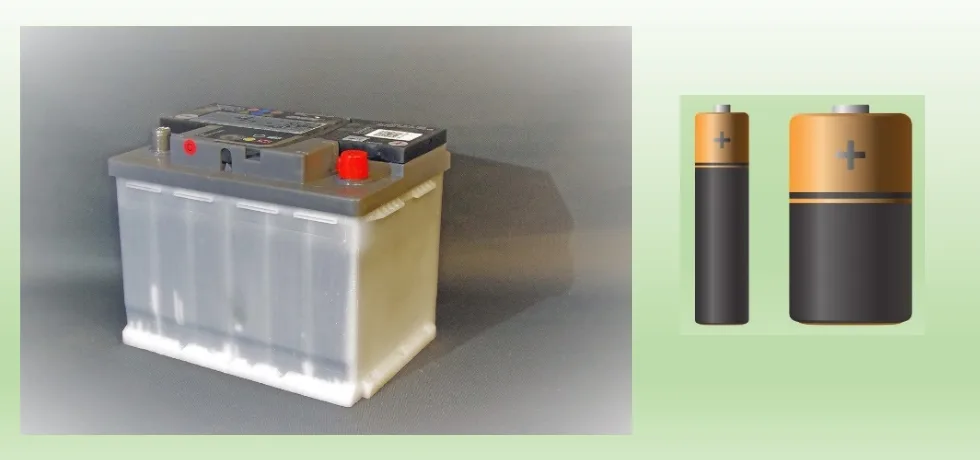
A car battery and the dry cells in a torch also store energy in chemicals and release it as electrical energy. A fruit cell is the simplest version of the same idea, and it uses the same chemistry as the beaker version in our simple cell practical, where a copper and a zinc strip stand in dilute acid. The only real difference is that here the electrolyte lives inside a fruit.
The idea is older than any torch battery. Alessandro Volta announced his pile in a letter dated 20 March 1800 to Joseph Banks, then President of the Royal Society.
Test yourself on the key words
Tap each card to check you can define the terms before you start the practical.
With the chemistry clear, the next step is the practical itself. Gather your apparatus, read the risk assessment, and follow the method below.
Lime battery practical: apparatus
This lime battery practical needs only a few items, and everything is cheap. The photograph shows the equipment laid out on the bench before the start.
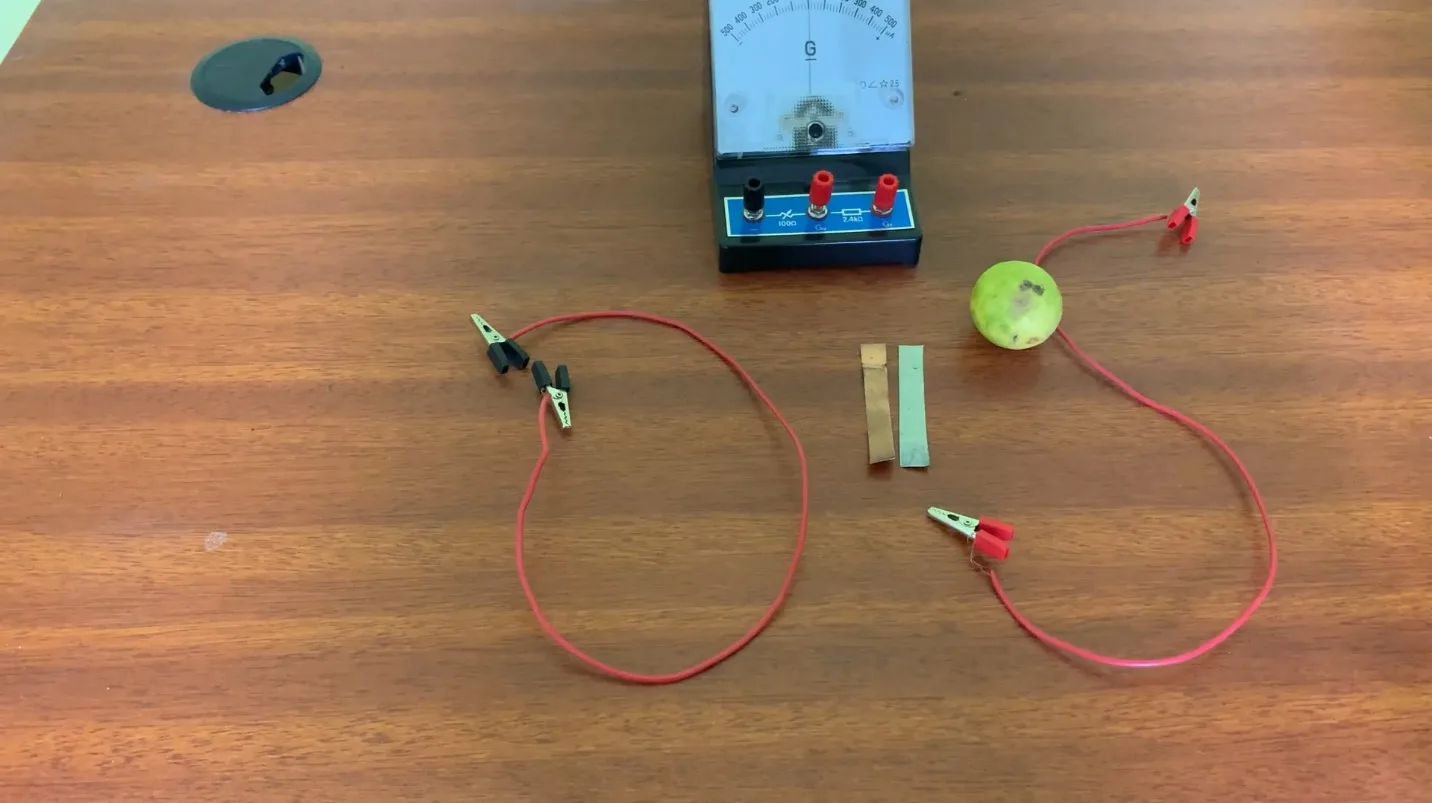
- 1 lime (a lemon works equally well)
- 1 copper strip, about 1 cm wide and 6 cm long
- 1 zinc strip (a galvanised nail can replace it, because the zinc coating does the work)
- 2 leads with crocodile clips
- 1 centre-zero galvanometer (500–0–500 µA)
- Optional: a multimeter set to DC volts, a red LED, extra limes or lemons, a paper towel
- Teacher only: a knife and cutting board for the slits
A copper strip, a length of copper wire or a copper-coated nail can all act as the positive electrode. Whatever you use, keep the same metals for every repeat so the comparison is fair.
Fruit battery risk assessment
Fruit cells are among the safest electrical practicals, because the voltage is so low. Even so, you still need a short risk assessment, and the hazards are mostly physical ones. Check your own school’s rules before you begin.
| Hazard | Risk | Control |
|---|---|---|
| Sharp edges on cut metal strips | Cuts to fingers | Handle strips by the sides, file rough edges, carry them pointing down |
| Knife used to cut slits | Cuts | The teacher cuts the slits, on a cutting board |
| Juice squirting when the fruit is squeezed or rolled | Eye irritation (the juice is acidic) | Roll gently; wear eye protection if your risk assessment requires it |
| Eating the fruit after the experiment | Some metal may have dissolved into it | Never eat it; put it in the bin and wash your hands |
| Connecting the cell to anything else | Damage to equipment or a shock risk | Low-voltage DC only; never connect fruit cells to the mains |
Method: step by step
Work through the checklist below. Your ticks are remembered in your browser, so you can come back to it at the bench.
- Roll the lime firmly on the bench. This breaks the juice sacs inside, so there is more free juice around the metals.
- Ask your teacher to cut two small slits in the lime, about 2 cm apart.
- Push the copper strip into one slit and the zinc strip into the other. The strips must not touch each other inside the lime.
- Clip one lead to the copper strip and connect the other end to a red (+) terminal of the galvanometer.
- Clip the second lead to the zinc strip and connect it to the − terminal of the galvanometer.
- Watch the needle and record the direction and size of the deflection.
- Swap the leads over and observe again. Record what changes.
- Optional: disconnect the galvanometer and measure the voltage across the strips with a multimeter set to DC volts.
- Repeat with a fresh lime and then a lemon, keeping everything else the same.
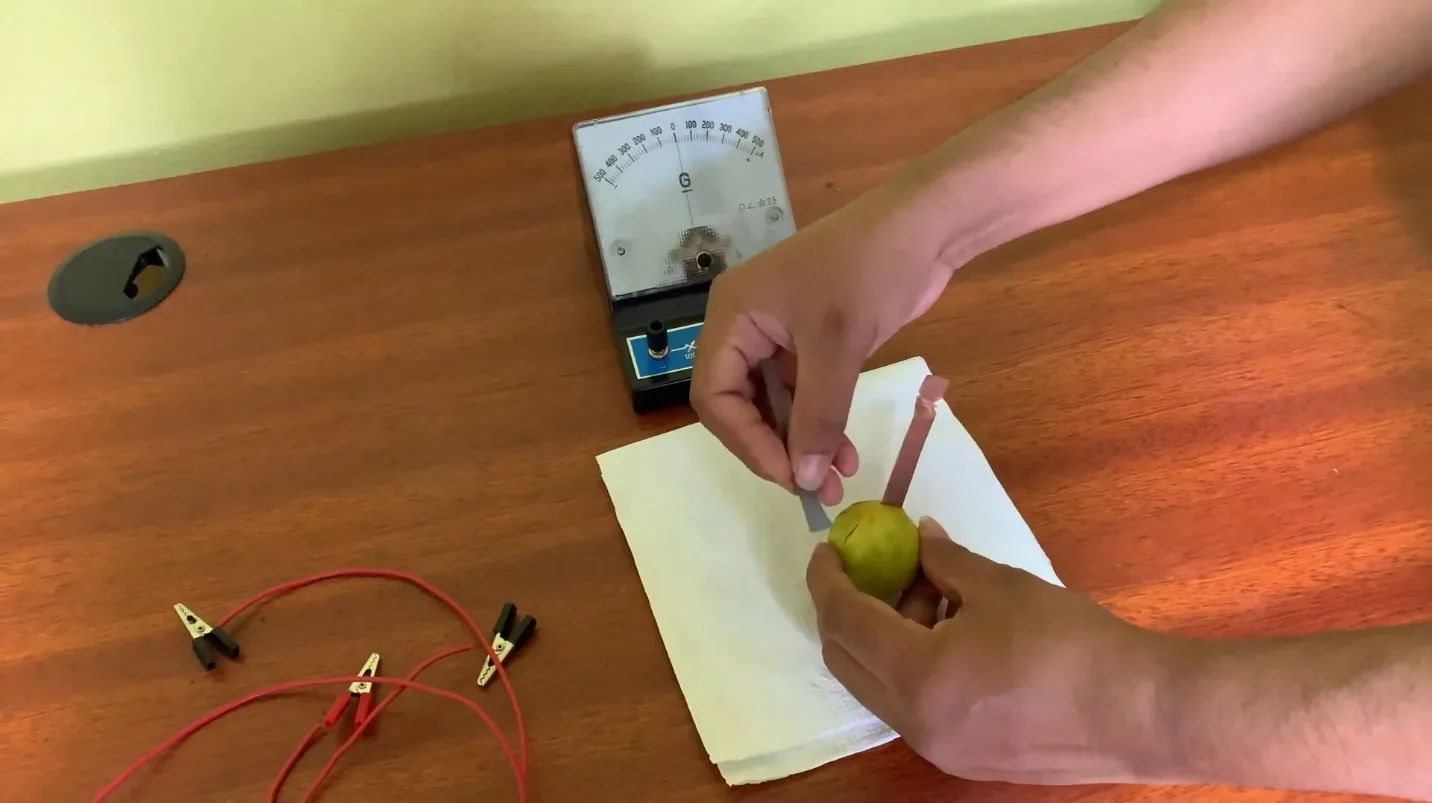
The photograph shows the most delicate moment: pushing the second strip in while keeping it clear of the first. About 2 cm of fruit between the strips is a good start, and it is worth marking the same depth on each strip so every repeat is comparable.
Centre-zero galvanometer vs ammeter: which meter and why?
A fruit cell gives only a tiny current, so the choice of meter matters. The board below shows the two meters from our lab side by side. Spot where the zero is on each.
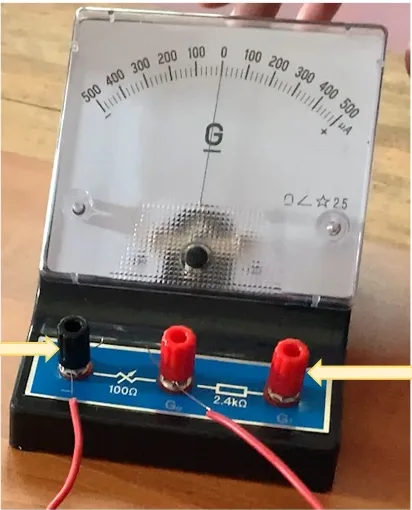
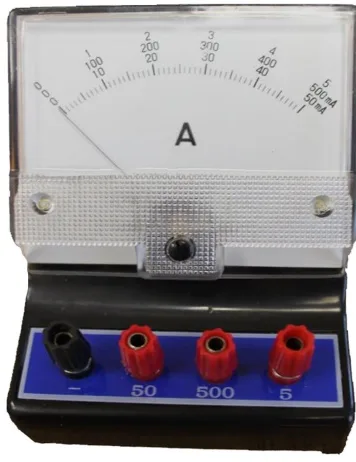
The left-hand meter is a centre-zero galvanometer with a 500–0–500 µA scale. Because the needle rests in the middle, it can swing either way, so it shows the direction of the current as well as its size. The right-hand meter is an ordinary moving-coil ammeter. Its zero is at the left end of the scale, and its terminals give ranges of 0–50 mA, 0–500 mA and 0–5 A.
A galvanometer is a very sensitive meter for detecting small currents. Current through a coil in a magnetic field twists a pointer, the deflection is proportional to the current, and a spring returns the pointer to zero. An ammeter is built from the same kind of meter, but with shunts (current dividers) that let it measure larger currents. That is how its different ranges work.
Now compare the sizes. A lime cell delivers a fraction of a milliamp, so on the 50 mA range of the ammeter the needle hardly moves at all. The maths practice questions below put numbers on this. A centre-zero microamp galvanometer shows the same current clearly. To see why direction matters, read our guide to the direction of current. The same type of meter is also used to detect the small current in the electromagnetic induction practical.
| Feature | Centre-zero galvanometer | Ammeter |
|---|---|---|
| Zero position | In the middle of the scale | At the left end of the scale |
| Scale in our lab | 500–0–500 µA | 0–50 mA, 0–500 mA, 0–5 A |
| Shows direction? | Yes, the needle swings either way | No, it only deflects one way |
| Main job | Detect small currents | Measure larger currents |
| How it is connected | In series | In series |
Our galvanometer has a black − terminal and two red terminals marked G0 and G1, and the dial shows 100 Ω and 2.4 kΩ between the terminals. Different meters are wired differently, so follow your meter’s instructions about which red terminal to use.
Observations and results
When the copper strip is connected to the + terminal and the zinc to the − terminal, the needle should swing to the + side of the scale, as in the photograph. That deflection is the evidence that a current is flowing.
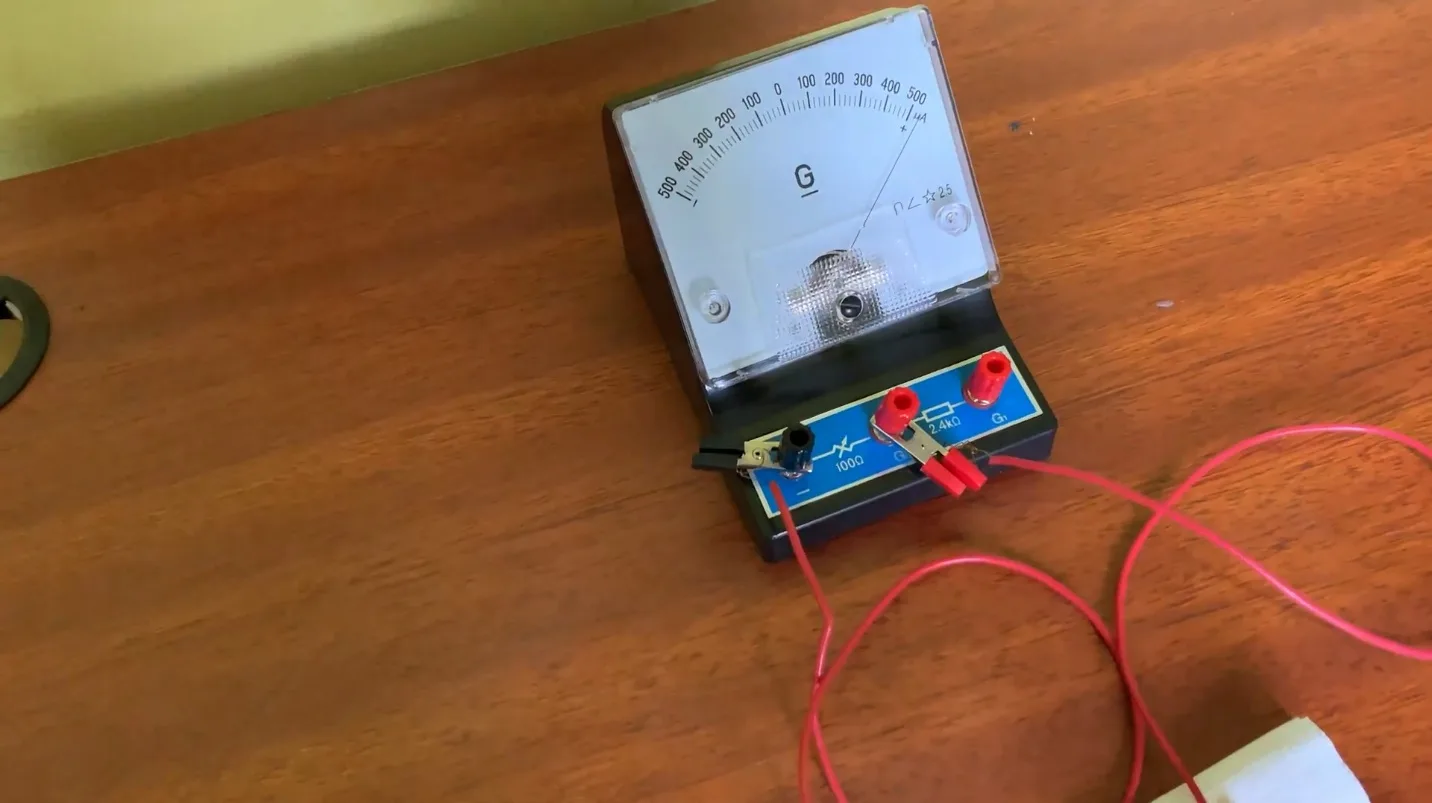
Several things are worth noting as you watch:
- The needle deflects to the + side when the copper is joined to the + terminal.
- When you swap the leads, the needle deflects the other way, because the current through the meter now flows in the opposite direction.
- The reading slowly falls over several minutes. Zinc is being used up and hydrogen collects on the copper, so the cell gradually weakens.
- You may spot tiny bubbles forming on the copper strip. That is the hydrogen gas from the half-equation.
Use the table below to record your own results. Leave it blank until you have taken your readings, and write down exactly what your meter shows.
| Set-up | Galvanometer deflection (µA) | Direction | Voltage (V) |
|---|---|---|---|
| Lime, copper and zinc | your reading | your reading | your reading |
| Lime, leads swapped | your reading | your reading | your reading |
| Lime, copper and copper | your reading | your reading | your reading |
| Lemon, copper and zinc | your reading | your reading | your reading |
Conclusion. A chemical reaction in the cell drives a small electric current round the circuit. The lime acts as the electrolyte, and the energy comes from the zinc reacting with the acid.
Check your understanding
Why must the copper and zinc strips not touch inside the lime? (2 marks)
If they touch, the electrons go straight from the zinc to the copper inside the fruit, which is a short circuit. Almost no current then flows through the external wire and the meter, so the needle does not move properly.
Why does the needle swing the other way when the leads are swapped? (1 mark)
The current through the meter now flows in the opposite direction, and a centre-zero meter shows direction as well as size.
Next we see what happens when you add more fruits, and what real voltages and currents look like.
Lemon battery LED: connecting fruits in series
One lemon battery experiment with a single fruit will move a microammeter needle, but it will not light an LED. A single zinc and copper lemon or lime cell gives about 0.9 V, and a Kent school science club measured about 0.95 V using a galvanised nail and a coin. A 5 mm red LED needs a forward voltage of about 1.85 to 2.1 V, so one fruit falls well short.
The answer is to join fruits in series, which adds their voltages. Wire the copper of one fruit to the zinc of the next, and connect the free ends to the LED. At least two zinc and copper lemon cells in series are needed for an LED, a buzzer or a small digital clock. In practice, three or four fruits often give a visible glow. Blue LEDs need a higher voltage than red ones, so they need more fruits.
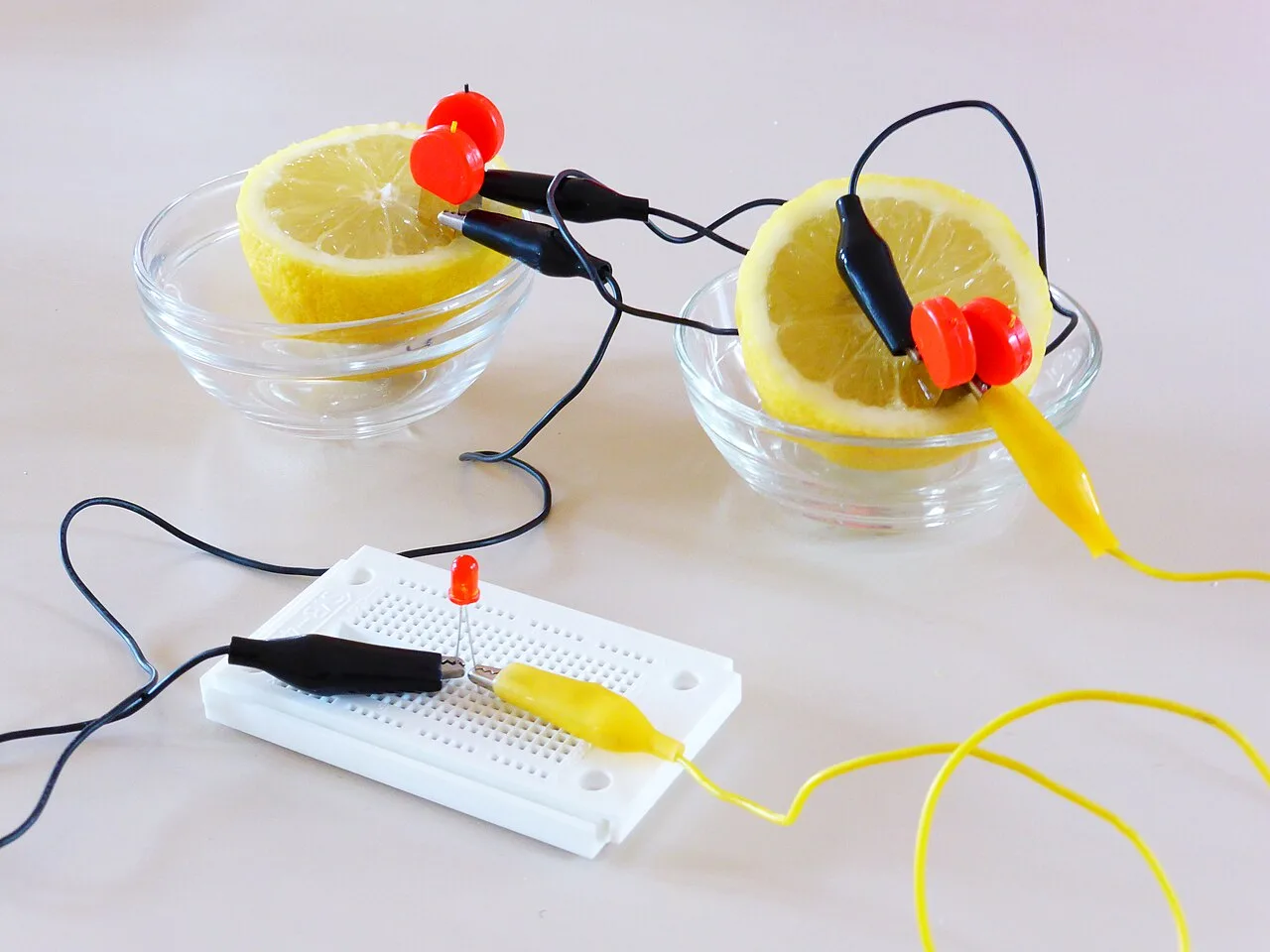
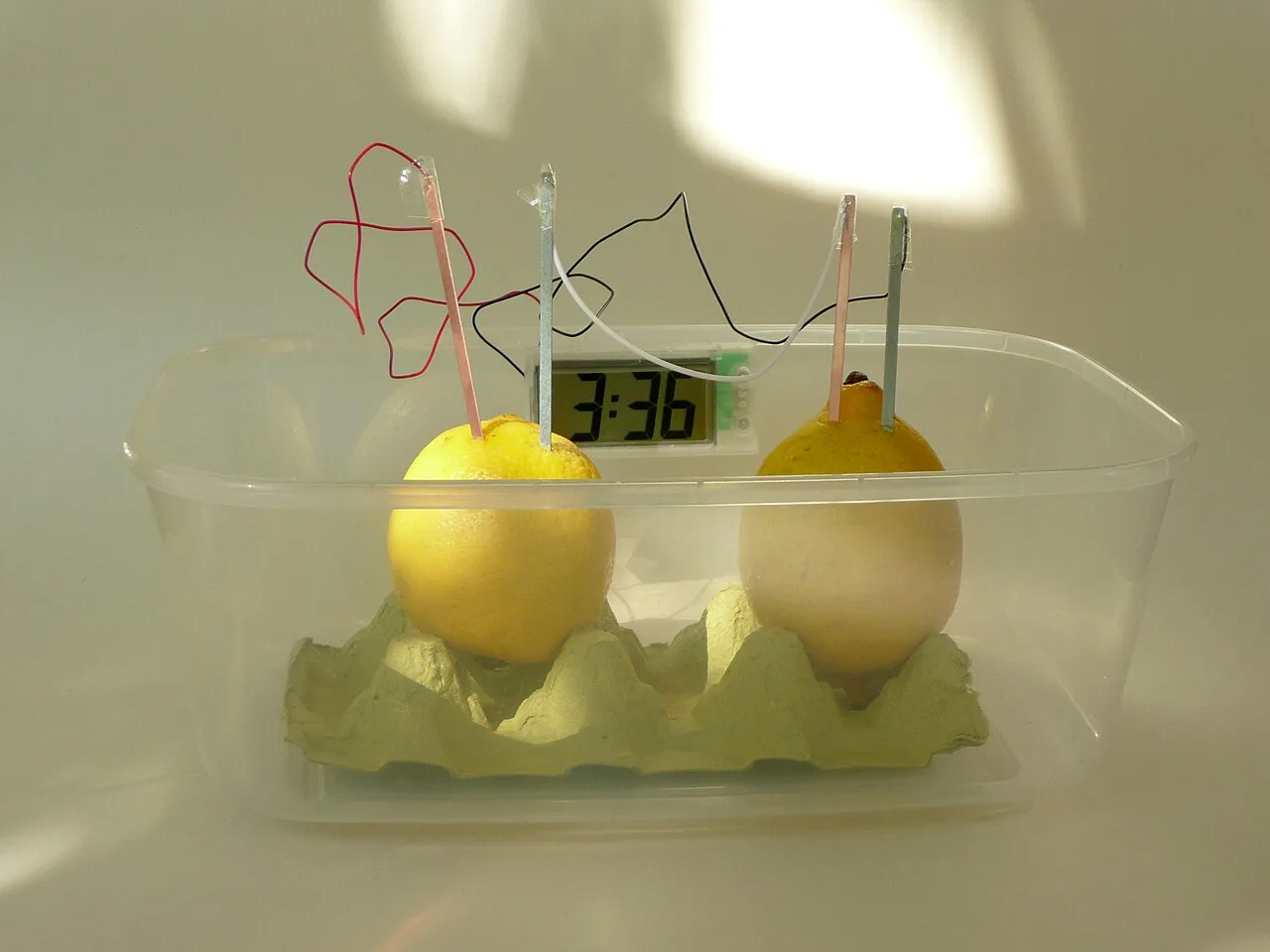
An LED lets current through in one direction only, from anode to cathode, and the anode (+) is the leg that is longer. Connect the longer leg to the copper end of your chain of fruits. If the LED does not light, turn it round before you decide the battery has failed.
Method: lighting an LED with fruits
Follow this checklist once you have a working single-fruit cell. Take care with the order, because a chain of fruits is easy to wire the wrong way round.
- Prepare three or four limes or lemons exactly as before: roll each one, then push a copper strip and a zinc strip into it, about 2 cm apart.
- Use a lead to join the copper strip of the first fruit to the zinc strip of the second fruit.
- Repeat this for each following fruit, so that the cells form a single chain.
- You are left with one free zinc strip at one end and one free copper strip at the other. These are the two terminals of your battery.
- Connect the longer leg (anode) of the red LED to the free copper end, and the shorter leg to the free zinc end.
- Look closely at the LED, in a dim corner of the room if you can. If nothing happens, check the LED direction, then add another fruit.
- Optional: use a multimeter on DC volts to measure the voltage across the whole chain.
Only low-voltage fruit cells should ever be wired like this. Never connect them to the mains, and do not eat any of the fruit afterwards.
Realistic voltages and currents
Fruit cells are weak, and it helps to see how weak. The table gathers the typical values quoted in this article.
| What | Typical value |
|---|---|
| One lemon or lime, zinc and copper, no load | About 0.9 V (0.95 V measured by a school club) |
| Potato, zinc and copper, no load | About 0.76 V |
| Lemon cell with magnesium and copper | Up to about 1.6 V |
| One lemon cell connected across 1 kΩ | 0.33 V (about 0.33 mA) |
| Typical maximum current | Up to about 1 mA |
| Power at the top of the range | Up to about 0.7 mW (0.001 A at 0.7 V); the 1 kΩ test above gives only about 0.11 mW |
| Red LED | Needs about 1.85–2.1 V; rated at about 20 mA |
Why the LED is so dim
The row for 1 kΩ shows something important. A lemon cell measured about 0.9 V with nothing connected, but only 0.33 V once a 1000 Ω resistor was joined across it. The voltage dropped because the cell has a very high internal resistance, in the order of kilohms. Some of the cell’s EMF is "lost" inside the cell itself, so less is left for the circuit.
Connecting fruits in series adds their voltages and their internal resistances, so the current stays below about 1 mA. Putting rows of fruits in parallel lowers the total internal resistance and raises the current. Incandescent torch bulbs do not light because the cell cannot supply enough current. For the same reason a lemon battery cannot charge a phone, because the current and power are tiny. Try the planner below to explore the numbers.
Variables to investigate in a fruit battery experiment
Fruit batteries are a good topic for a fair-test investigation, because there are so many things to change. Choose one independent variable, measure one dependent variable and control the rest.
| Independent variable (change) | Dependent variable (measure) | Control variables (keep the same) |
|---|---|---|
| Type of fruit or vegetable (lime, lemon, tomato, potato, boiled potato) | Voltage with a multimeter, or current with the galvanometer | Same metals, same depth, same distance, same size and ripeness, same time after inserting, same meter |
| Metal pair (zinc and copper, magnesium and copper, galvanised nail and copper, copper and copper) | Voltage or current | Same fruit, same depth, same distance, same meter |
| Distance between the electrodes | Voltage or current | Same fruit, same metals, same depth |
| Depth or area of metal in the fruit | Voltage or current | Same fruit, same metals, same distance |
| Number of fruits in series | Voltage across the chain | Same type of fruit, same metals, same meter |
Which metal pair works best?
The further apart two metals are in the reactivity series, the larger the voltage you can expect. A magnesium and copper lemon cell can reach about 1.6 V, against about 0.9 V for zinc and copper. Our lesson on the activity series shows how to rank metals before you choose a pair. A galvanised nail is steel coated with zinc, so it can replace the zinc strip. You can read about the coating in our article on galvanised steel sheets.
Which fruit gives the most electricity?
The voltage is set mainly by the metals, while the fruit affects the current. Juicier fruit with more free ions can pass more current. A potato is not very acidic, but it still works: a zinc and copper potato cell gives an open-circuit voltage of about 0.76 V. Researchers who tested potato cells found that a boiled potato, or one whose cell membranes had been damaged by electroporation, gave up to ten times more electrical power than an identical untreated potato cell. At the copper strip, look for bubbles of hydrogen gas.
Potato and boiled potato batteries
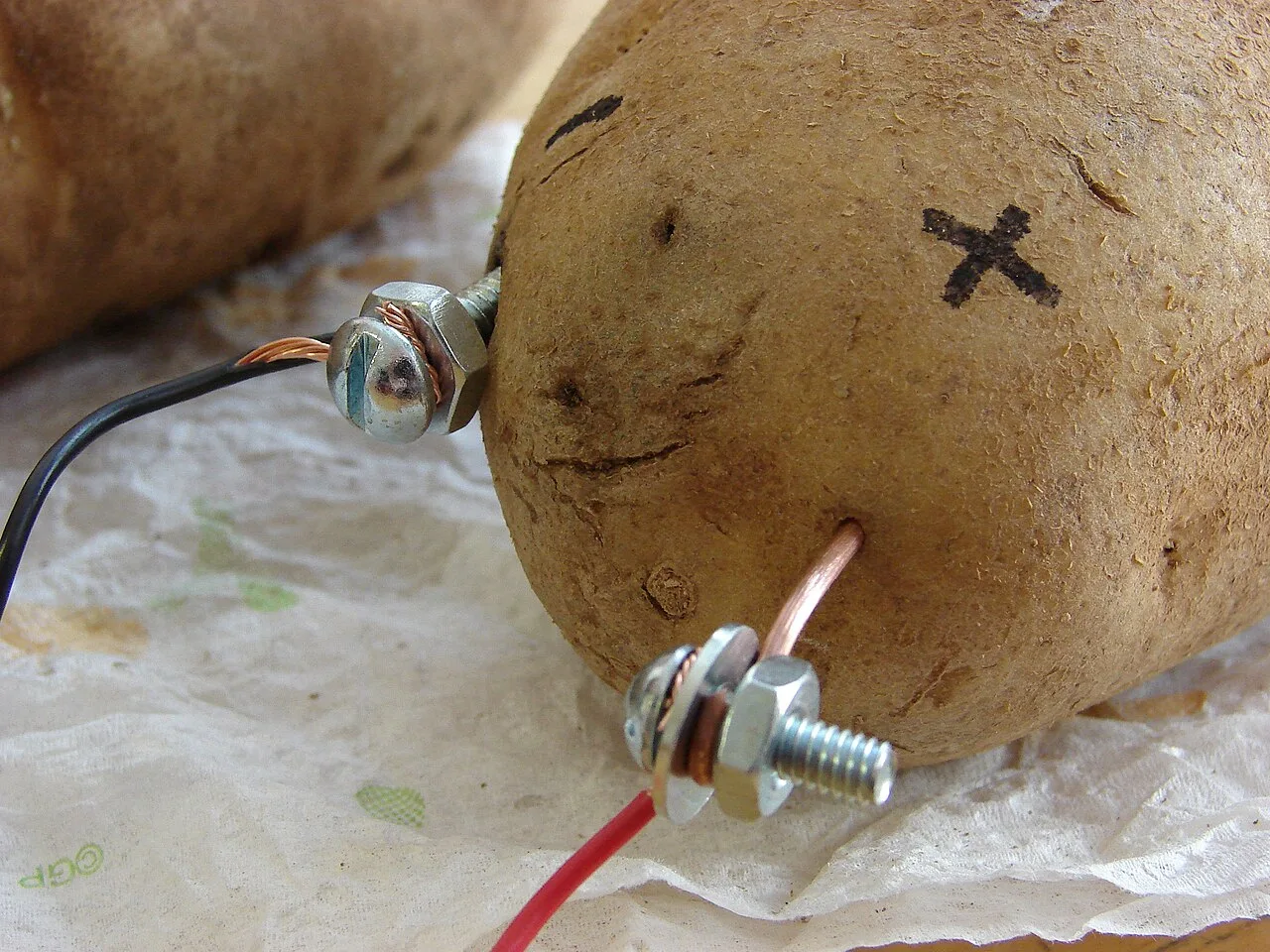
The photograph of the potato cell in the gallery above shows a galvanised bolt and a bare copper wire pushed into a potato. It follows the same pattern as the lime cell: the zinc coating on the bolt is the negative electrode and the copper wire is the positive one. Because a potato is far less acidic than a lime, its hydrogen-ion concentration is lower, yet the open-circuit voltage is still close to 0.76 V. This is a nice example for an evaluation question: the metals decide the voltage, while the fruit or vegetable decides how easily the charge can move.
Boiling is the surprising part. In the study mentioned above, the boiled potato, whose cell membranes were damaged, delivered up to ten times the power of a raw one. If you try it, compare a raw and a boiled potato with identical metals, depth and spacing, and use the same meter for both.
Evaluation: errors and improvements
A good evaluation names a problem, explains its effect and suggests a fix. The readings from a fruit cell are small and they drift, so there is plenty to discuss.
- The reading drifts. Zinc is used up and hydrogen collects on the copper, so the current falls with time. Read the meter at a fixed time, such as 30 s after connecting, every time.
- Dirty electrodes. A coating on the metal changes the result. Clean the strips between runs.
- Strips at different depths. Mark a depth line on each strip so that each repeat has the same area of metal in the juice.
- Fruits differ. No two limes are identical. Repeat with at least three fruits and calculate a mean.
- The meter changes the circuit. A galvanometer has its own resistance, so it affects the current. Use a digital multimeter to measure the voltage.
- Parallax. Read the needle from straight in front, so that the scale is not misread.
Suggest one improvement to make the results more repeatable. (2 marks)
Mark the same depth on both metal strips and push them in to that mark each time (1 mark). This keeps the area of metal in the juice constant, which removes one source of variation (1 mark). Reading the meter at a fixed time after connecting also works.
Everything so far has been qualitative. The next section turns these ideas into calculations.
Maths practice questions: fruit battery calculations
Try each question on paper first, then tap it to reveal the worked solution. Show your working, include units and give sensible significant figures. Where Faraday’s constant is needed, use F = 96 500 C mol⁻¹ and Ar(Zn) = 65.4. The questions get harder as you go, and the last few are labelled as stretch.
Q1. The galvanometer reads 300 µA. Write this current in mA and in A. (1 mark)
300 µA ÷ 1000 = 0.300 mA; 0.300 mA ÷ 1000 = 0.000300 A = 3.00 × 10⁻⁴ A.
Q2. Each lime cell has an EMF of 0.90 V. (a) What is the total EMF of 4 limes in series? (b) What is the smallest number of limes needed to reach the 2.0 V a red LED needs? (2 marks)
(a) 4 × 0.90 = 3.6 V.
(b) 2.0 ÷ 0.90 = 2.22…, so 2 limes (1.8 V) are not enough. Round up to 3 limes (3 × 0.90 = 2.7 V). In practice internal resistance means 3–4 are usually needed.
Q3. A lime cell drives 0.35 mA through a meter. What percentage of full-scale deflection is this on (a) the 500 µA galvanometer, (b) the 50 mA range of the ammeter? (2 marks)
(a) 0.35 mA = 350 µA; 350 ÷ 500 × 100 = 70 %.
(b) 0.35 ÷ 50 × 100 = 0.7 %. The ammeter needle hardly moves, which is why the galvanometer is used.
Q4. A lime cell is connected across a 1000 Ω resistor and the p.d. across the resistor is 0.33 V. Calculate the current. (2 marks)
I = V ÷ R = 0.33 ÷ 1000 = 0.00033 A = 3.3 × 10⁻⁴ A = 0.33 mA (330 µA).
Q5. A fruit battery supplies 0.50 mA for 30 minutes. How much charge flows? (2 marks)
t = 30 × 60 = 1800 s; I = 0.50 mA = 0.00050 A.
Q = I × t = 0.00050 × 1800 = 0.90 C.
Q6. A lemon cell gives 0.30 mA at a terminal p.d. of 0.60 V for 2.0 hours. How much energy is transferred? (3 marks)
t = 2.0 × 3600 = 7200 s.
E = V × I × t = 0.60 × 0.00030 × 7200 = 1.296 J ≈ 1.3 J.
Q7. Using Q4, the lime cell’s output power is P = V × I. Compare it with a red LED at full brightness (2.0 V, 20 mA). (3 marks)
P(cell) = 0.33 × 0.00033 = 0.0001089 W ≈ 1.1 × 10⁻⁴ W (0.11 mW).
P(LED) = 2.0 × 0.020 = 0.040 W (40 mW).
Ratio = 0.040 ÷ 0.0001089 ≈ 367, so about 370 times more power. The LED can only glow dimly.
Q8. Lime juice has a pH of about 2.0 and potato about 5.4. Calculate [H⁺] for each and how many times more acidic the lime juice is. (3 marks)
[H⁺] = 10^−pH.
Lime: 10^−2.0 = 1.0 × 10⁻² mol/dm³ (0.010).
Potato: 10^−5.4 = 3.98 × 10⁻⁶ ≈ 4.0 × 10⁻⁶ mol/dm³.
Ratio = 0.010 ÷ 3.98 × 10⁻⁶ ≈ 2 500 (= 10^3.4 = 2 512).
Yet both give a voltage: the metals set the voltage.
Q9. (Higher / A-level stretch) A lime cell’s EMF is 0.90 V. With a 1000 Ω resistor connected, the terminal p.d. is 0.33 V and the current is 0.33 mA. Calculate the internal resistance. (3 marks)
Lost volts = EMF − terminal p.d. = 0.90 − 0.33 = 0.57 V.
r = lost volts ÷ I = 0.57 ÷ 0.00033 = 1727 Ω ≈ 1.7 kΩ (2 s.f.).
Check: E = I(R + r) = 0.00033 × (1000 + 1727) = 0.00033 × 2727 = 0.90 V ✓
Q10. (Stretch) Each lime: EMF 0.90 V, internal resistance 1.7 kΩ. (a) Find the short-circuit current of one lime. (b) Find the short-circuit current of 4 limes in series. (c) Two such rows of 4 are connected in parallel. Find the new short-circuit current. (4 marks)
(a) 0.90 ÷ 1700 = 5.3 × 10⁻⁴ A = 0.53 mA.
(b) EMF = 4 × 0.90 = 3.6 V; r = 4 × 1700 = 6800 Ω; I = 3.6 ÷ 6800 = 5.3 × 10⁻⁴ A = 0.53 mA. This is the same! Series raises the voltage, not the maximum current.
(c) EMF is still 3.6 V; r = 6800 ÷ 2 = 3400 Ω; I = 3.6 ÷ 3400 = 1.06 × 10⁻³ A ≈ 1.1 mA (doubled).
Q11. (A-level stretch: mass of zinc used) In Q5, 0.90 C flowed. Calculate the mass of zinc that dissolved (Zn → Zn²⁺ + 2e⁻; F = 96 500 C mol⁻¹; Ar Zn = 65.4). (4 marks)
Moles of electrons = Q ÷ F = 0.90 ÷ 96 500 = 9.33 × 10⁻⁶ mol.
Moles of Zn = 9.33 × 10⁻⁶ ÷ 2 = 4.66 × 10⁻⁶ mol.
Mass = 4.66 × 10⁻⁶ × 65.4 = 3.05 × 10⁻⁴ g ≈ 0.30 mg.
(Exact: 0.90 ÷ 96 500 = 9.3264 × 10⁻⁶; ÷ 2 = 4.6632 × 10⁻⁶; × 65.4 = 3.0497 × 10⁻⁴ g.)
The energy came from this tiny mass of zinc, not from the lime.
Q12. (A-level stretch: EMF from E° values) Using E°(Zn²⁺/Zn) = −0.76 V, E°(Cu²⁺/Cu) = +0.34 V and E°(H⁺/H₂) = 0.00 V: (a) calculate the EMF of a standard Daniell cell (zinc in Zn²⁺, copper in Cu²⁺); (b) calculate the EMF of a zinc/hydrogen-ion cell, which is what a fruit cell really is. (3 marks)
EMF = E°(positive) − E°(negative).
(a) 0.34 − (−0.76) = 1.10 V.
(b) 0.00 − (−0.76) = 0.76 V. This is close to the ≈ 0.76 V measured for a zinc and copper potato cell, although the agreement is partly a coincidence because a potato (pH about 5.4) is far from standard conditions.
Real fruit cells read a bit differently (a lemon about 0.9 V) because conditions are far from standard: the acid is not 1 mol/dm³ and the surfaces are not pure.
Common mistakes in the lemon battery experiment
- Saying the lemon is the energy source. The energy comes from the zinc reacting.
- Labelling the copper as the negative electrode. The more reactive metal, zinc, is negative.
- Forgetting that the copper is not consumed. It only provides a surface for hydrogen.
- Connecting the LED the wrong way round. The longer leg goes towards the copper end.
- Using an ammeter’s large range and recording "0 – no current". The current is simply too small for that range.
- Writing Cu²⁺ + 2e⁻ → Cu at the copper of a fruit cell. Hydrogen forms there instead.
Frequently asked questions about the lemon battery experiment
How does a lemon battery work?
A zinc strip and a copper strip are pushed into the lemon. Zinc is more reactive, so it loses electrons and dissolves, while hydrogen ions in the acidic juice take electrons at the copper and form hydrogen gas. The electrons travel through the external wire, which is the electric current.
Does the lemon produce the electricity?
No. The energy comes from the chemical change in the zinc as it dissolves in the acid. The lemon supplies the electrolyte, which is acidic juice containing ions, and holds the two metals apart. Other acidic liquids, or a less acidic potato, can do the same job.
How much voltage does one lemon produce?
A zinc and copper lemon cell typically gives about 0.9 V, and a school club measured about 0.95 V with a galvanised nail and a coin. The current is tiny, up to about 1 mA, so the power is only a fraction of a milliwatt.
How many lemons does it take to light an LED?
A red LED needs about 1.85 to 2.1 V, and one lemon gives about 0.9 V, so you need at least two or three lemons in series. In practice three or four lemons often give a faint glow, because the cells have high internal resistance. Blue LEDs need more.
Which terminal is positive in a lemon battery?
The copper strip is the positive terminal and the zinc strip is the negative terminal. Zinc is the more reactive metal, so it loses electrons and becomes negative. Outside the cell, conventional current is drawn from the copper to the zinc, and electrons flow the other way.
Why use a galvanometer instead of an ammeter?
A fruit cell gives a fraction of a milliamp, which would barely move the needle on the 50 mA range of an ammeter. A centre-zero galvanometer reads in microamps, so it shows the small current clearly, and its needle swings either way to show which direction the current flows.
Which fruit or vegetable makes the most electricity?
The voltage depends mainly on the metals, so most fruits give similar values. The fruit changes how much current can flow. Zinc and copper give about 0.9 V in lemons and about 0.76 V in potatoes, and boiled potato gave up to ten times more power than raw potato in one study.
Can a lemon battery charge a phone?
No. A lemon cell supplies well under 1 mA at less than 1 V, which is only a fraction of a milliwatt of power. That is enough for a sensitive meter, a low-power clock or a dim LED, but far too little to charge a phone.
Can you eat the fruit after the experiment?
No. Some metal may have dissolved into the fruit, and the cut metal strips can leave sharp edges. Put the fruit in the bin, take the strips out carefully and wash your hands afterwards. Treat all fruit used in a science practical as no longer food.