This simple cell experiment turns a strip of copper, a strip of zinc and a beaker of dilute sulfuric acid into a working source of electricity. A sensitive meter shows the current the moment the two metals are joined by a wire, and the same set-up introduces the idea behind the batteries in your home, your torch and your family car.
Below you will find the full method with our own lab photos, an explanation of why the galvanometer deflects, the puzzle of the hydrogen bubbles, the Daniell cell that fixed the simple cell’s problems, a comparison with dry cells and car batteries, and 12 maths questions with worked solutions.
What is a simple cell?
A simple cell is made by connecting two different metals in contact with an electrolyte. The electrolyte is a solution that contains ions free to move, so it can carry charge through the liquid. In this practical the electrolyte is dilute sulfuric acid, which is an ordinary acid in water (see our guide to acids and bases if you want a reminder of what makes a solution acidic).
A simple cell is also called a voltaic cell, after the Italian scientist Alessandro Volta. The cells in a torch or a remote control work on the same principle, although they are built very differently.
The exam boards describe it this way: cells contain chemicals that react to produce electricity, and the voltage a cell produces depends on factors that include the type of electrode and the electrolyte. In practice that means the choice of metals matters a great deal.
The metal that is more reactive becomes the negative electrode, because its atoms give up electrons more easily. Zinc is more reactive than copper, as the reactivity series of metals shows, so in our cell the zinc strip is negative and the copper strip is positive. The bigger the difference in reactivity between the two metals, the bigger the voltage. Two identical metals give no voltage at all, because there is nothing to push the electrons in one direction.
Making electricity from chemical reactions
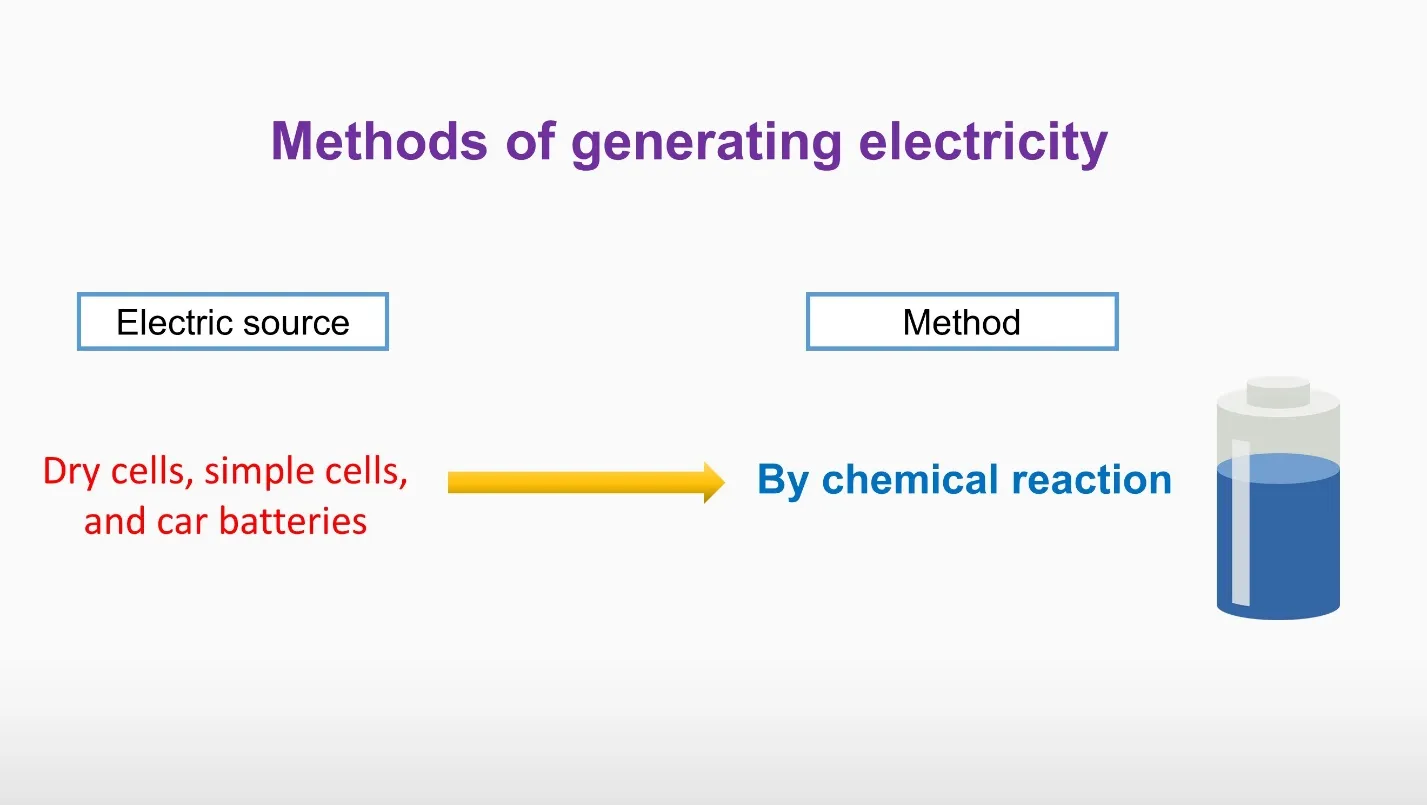
There are many ways of generating electricity. Generators turn kinetic energy into electrical energy, solar cells use light, and even rubbing two materials together can build up charge, as we explain in our article on static electricity. Dry cells, simple cells and car batteries belong to a different family: they make electricity from chemical reactions.
Inside a cell, a chemical reaction is arranged so that electrons are released at one electrode and absorbed at the other. Instead of the electrons passing directly between the reacting particles, they are forced to travel through an external wire. That moving charge is the electric current, and it can make a meter deflect, a bulb glow or a motor turn. In energy terms, energy stored in the chemicals is transferred to the circuit as electrical energy, and some is wasted as heat.
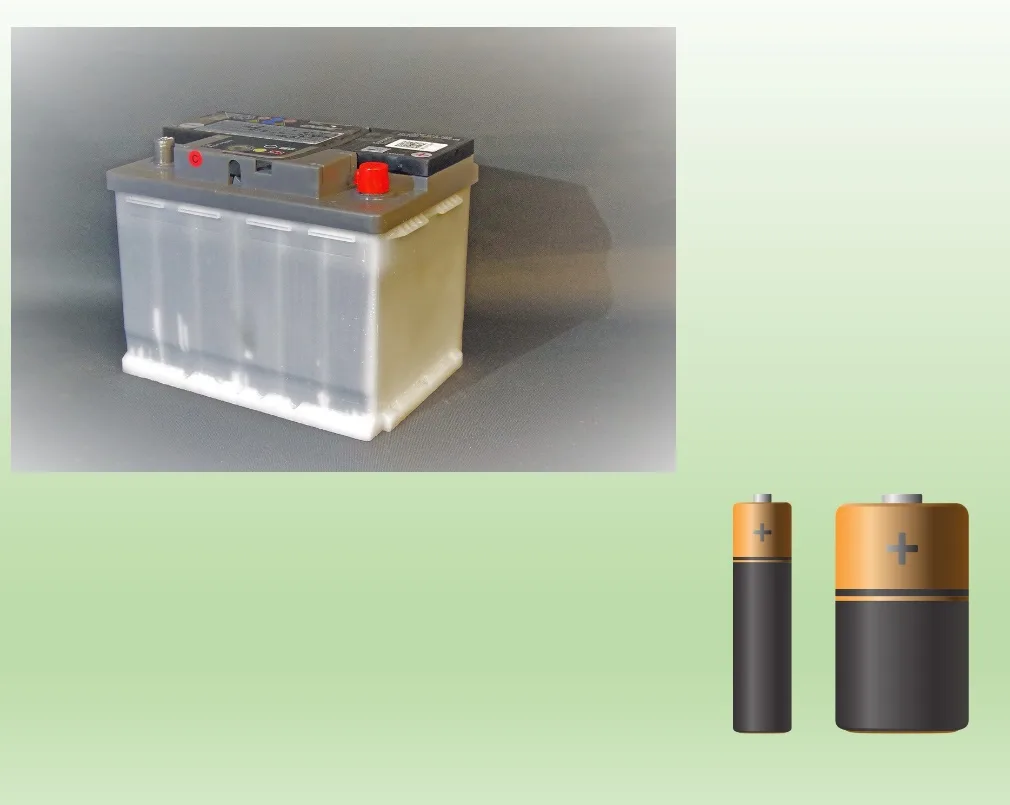
A battery is not the same thing as a cell, although everyday speech mixes the two. Strictly, a battery consists of two or more cells connected together in series, which gives a greater voltage than one cell alone. The 12 V battery under a car bonnet is a good example, and we will count its cells later in the article.
From Volta’s pile to your practical
In 1800 Volta described a new device in a letter to the Royal Society in London, dated 20 March 1800. He stacked pairs of copper (or silver) and zinc discs, with cloth or cardboard soaked in brine between the pairs. This voltaic pile was the first battery that could produce a continuous current.
The pile changed science almost at once. Within weeks, William Nicholson and Anthony Carlisle used one to split water into hydrogen and oxygen by electrolysis, which you can read about in our article on what electrolysis is. Seven years later came Davy’s discovery of sodium and potassium.
Each zinc and copper pair in a pile is one simple cell. Stacking them one on top of another connects the cells in series, which is why the voltage of a pile grows as the stack gets taller. The tall pile in the photo below was shown at the Volta Centenary Exhibition in Como, Italy, in 1899, and was one of the objects salvaged from a fire there on 8 July 1899.
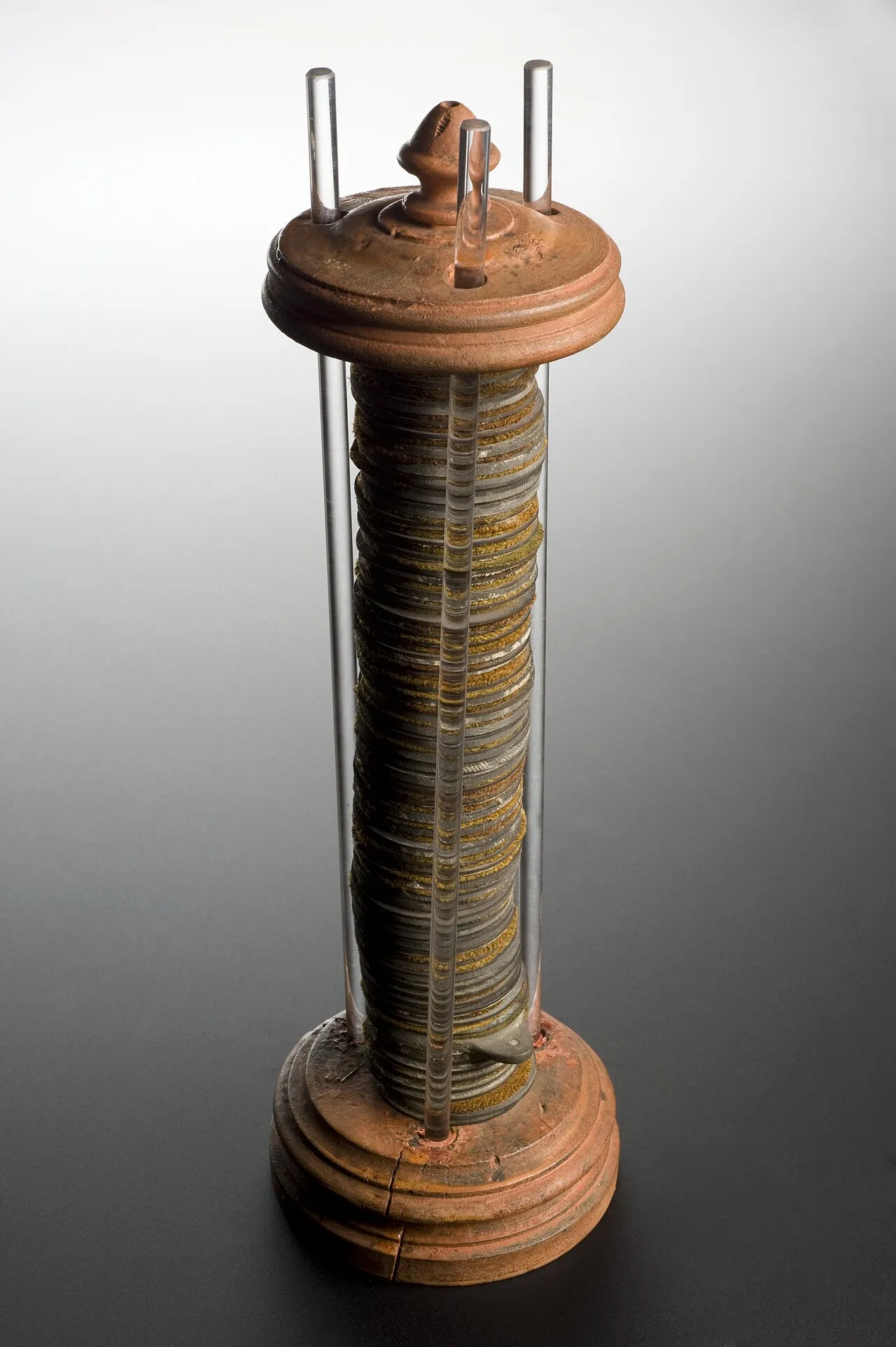
The beaker on your bench does the same job as one pair of discs in that column. A liquid electrolyte replaces the brine-soaked cloth, and wires replace the stack. It is a much smaller version of a device that helped to start modern chemistry and physics.
Simple cell experiment: apparatus and risk assessment
Before you begin, read the apparatus list and the risk assessment carefully. The acid is used at a low concentration, but it still needs respect. Your teacher will have a school risk assessment based on CLEAPSS guidance, and you should follow it in preference to anything written here.
Apparatus
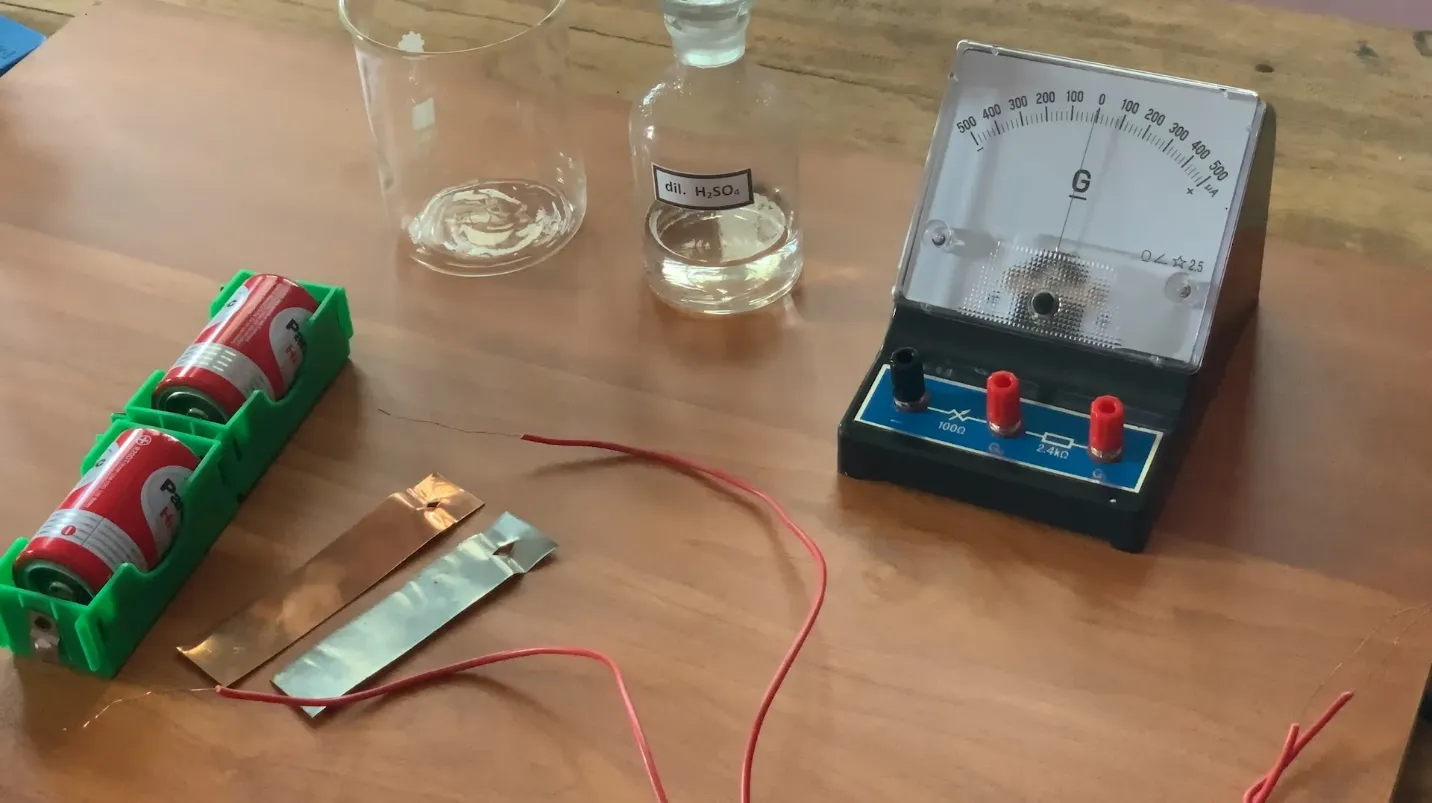
- A small beaker (the one in our photo is 250 cm³)
- Dilute sulfuric acid, about 0.4 mol/dm³ (0.4 M) is enough
- A copper strip and a zinc strip, about the same size
- Emery paper (sandpaper) to clean the strips
- Two connecting wires, with crocodile clips if you have them
- A centre-zero galvanometer that reads in microamps
- Eye protection
- Optional: a torch bulb (see the note below)
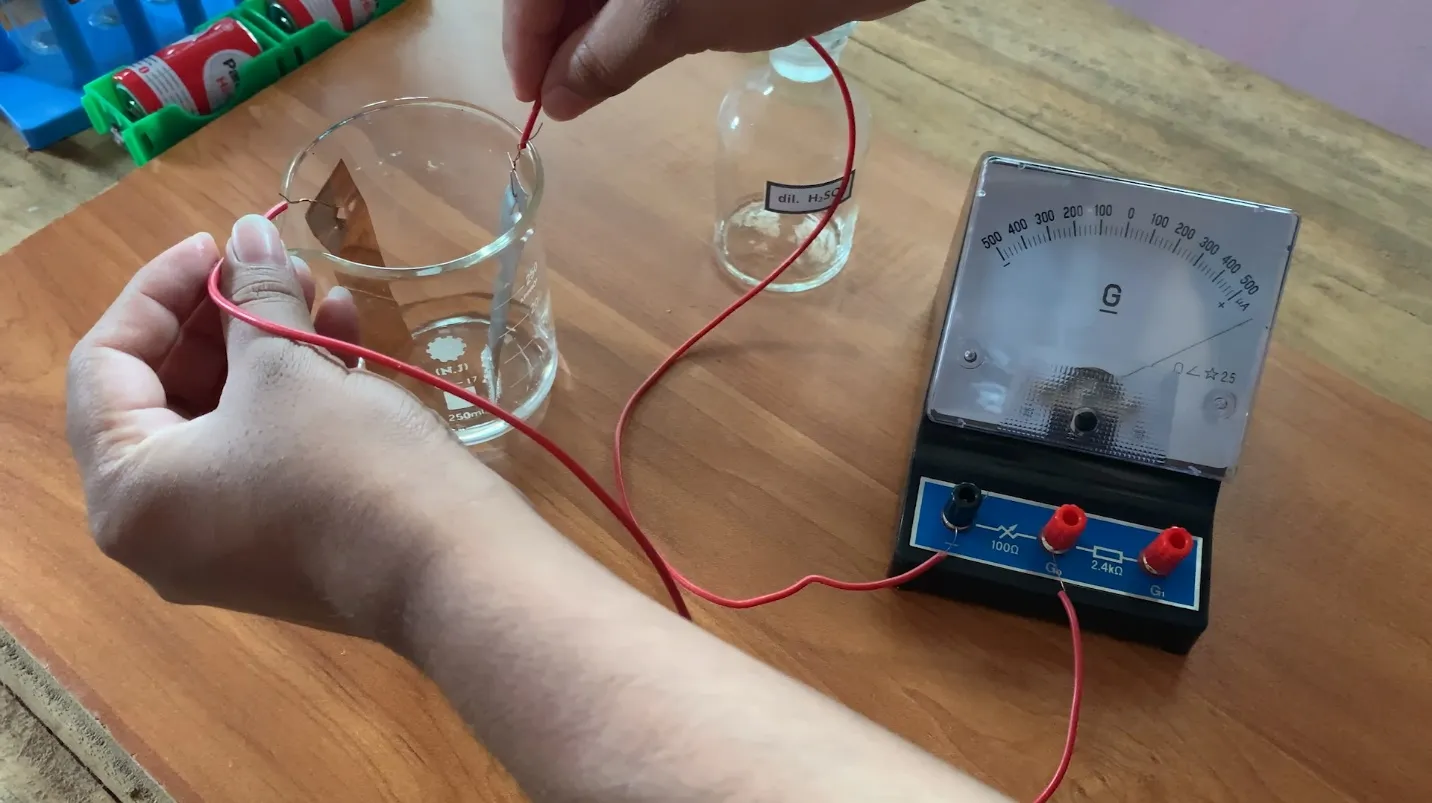
A single simple cell gives only a small current. The meter in our photos reads from 500 µA on one side of zero to 500 µA on the other, which is half a milliamp either way. A torch bulb needs far more current than that, so do not expect it to light. The sensitive galvanometer is the reliable way to show that a current is flowing.
Risk assessment
The table sets out the main hazards. The acid information comes from the CLEAPSS Student Safety Sheet on sulfuric acid.
| Hazard | Risk | Control |
|---|---|---|
| Dilute sulfuric acid (irritant at 0.5 M to below 1.5 M; below 0.5 M it is not classified as hazardous, but can still harm the eyes or skin) | Splashes in the eyes or on the skin | Wear eye protection, use the lowest concentration that works (0.4 M) and a small volume |
| Copper and zinc strips | Cuts from sharp edges or corners | Handle carefully and ask your teacher to fold or smooth sharp corners |
| Hydrogen gas | Flammable | Only tiny amounts form, but keep naked flames away from the bench |
| Spills | Irritation or slipping | Wipe small spills with a damp cloth and tell your teacher |
If acid gets into your eye, irrigate it with gently running tap water for at least 20 minutes and tell your teacher straight away. If it gets on your skin, remove any contaminated clothing, wipe off the acid and irrigate the skin with water for 20 minutes. Use low-voltage direct current only, and never connect any home-made cell to mains electricity. Wash your hands at the end of the practical.
With the apparatus laid out and the hazards controlled, you are ready to build the cell. The method, the observations and the reasons behind them follow in the next section.
Simple cell experiment: step-by-step method
Work through the steps in order and tick each one as you go. Your ticks are remembered in your browser, so you can come back to the list later. Take your time over the cleaning step, because dirty plates are the most common reason for a poor result.
- Put on your eye protection before the acid comes anywhere near your bench.
- Rub both the copper strip and the zinc strip with emery paper until they are shiny. This removes the oxide layer and any grease.
- Attach a connecting wire to the top of each strip, using a crocodile clip or by wrapping the bare end tightly round the metal.
- Half-fill the beaker with dilute sulfuric acid.
- Stand the two strips in the acid on opposite sides of the beaker. They must not touch each other, or the metals themselves, or the wires inside the liquid.
- Connect the copper strip to the + terminal of the galvanometer and the zinc strip to the − terminal. A centre-zero meter works either way round, but this arrangement gives a swing to the + side.
- Watch the needle and record the reading every 30 seconds for 3 minutes.
- Look closely at both plates and note where bubbles appear.
- Disconnect the wires, swap them over, reconnect and watch which way the needle swings this time.
- Rinse the strips, dispose of the acid as your teacher tells you, and wash your hands.
Observations and results
When the circuit is complete, you should see the following. Compare your own bench with the photo at the top of this page, where the needle has swung well over to the + side.
- The needle deflects as soon as the copper and zinc are joined through the meter.
- Bubbles of gas appear on the copper strip while current flows.
- Bubbles also appear on the zinc strip. This is a different effect, called local action, and it is explained later in this article, in the section on polarisation.
- The reading falls gradually over a few minutes.
- When you swap the wires, the needle swings the opposite way.
Sample results table (illustrative)
The readings below are illustrative numbers for analysis practice, not measured data. Your own values will differ, depending on the size of the plates, the acid and the meter, but the pattern should look similar.
| Time (minutes) | 0 | 0.5 | 1 | 1.5 | 2 | 2.5 | 3 |
|---|---|---|---|---|---|---|---|
| Current (µA) | 450 | 380 | 320 | 270 | 220 | 180 | 150 |
In these illustrative results the current falls by 300 µA in 3 minutes, which is two-thirds of its starting value. A cell that loses its current this fast is a clue that something is getting in the way, and the explanation, polarisation, comes later in the article. Question 6 in the maths section uses these same numbers.
A suitable conclusion is that a copper–zinc cell in dilute sulfuric acid produces an electric current, with copper as the positive terminal and zinc as the negative terminal, but that the current does not stay steady.
How does a simple cell work?
To explain how a simple cell works, we follow what happens at each electrode. Chemists write these changes as half-equations, one for each electrode.
At the zinc (negative electrode)
Zinc atoms are oxidised: they lose electrons and become zinc ions that dissolve into the acid.
Zn(s) → Zn²⁺(aq) + 2e⁻
At the copper (positive electrode)
Hydrogen ions from the acid gain electrons at the copper surface and are reduced to hydrogen gas. The copper itself does not react with dilute sulfuric acid, because copper is below hydrogen in the reactivity series. It is simply the surface where the electrons arrive and where the H⁺ ions collect them. You can read more about the gas in our article on hydrogen gas.
2H⁺(aq) + 2e⁻ → H₂(g)
Overall reaction
Adding the two half-equations, the electrons cancel and we are left with the ionic equation and the full equation.
Zn(s) + 2H⁺(aq) → Zn²⁺(aq) + H₂(g)
Zn + H₂SO₄ → ZnSO₄ + H₂
This is the very same reaction that happens when zinc is dropped into acid in a test tube. The difference is that, in the cell, the electrons are made to take a detour through the wire, and that detour is the useful current.
Trace the electrons
Here is the whole journey, step by step. Following it with a finger on a diagram is a good revision technique.
- Zinc atoms in the strip lose electrons and become Zn²⁺ ions, which enter the acid.
- The electrons travel through the wire and the galvanometer from the zinc to the copper.
- At the copper surface, H⁺ ions gain the electrons and become hydrogen atoms, which pair up to form H₂ molecules.
- Hydrogen gas leaves as bubbles.
- Inside the acid, ions move to keep the charges balanced: Zn²⁺ ions are added by the zinc, and H⁺ ions are used up at the copper.
Notice that electrons travel only in the metal parts of the circuit. Inside the electrolyte, the charge is carried by ions. Conventional current, the direction we draw on circuit diagrams, is defined as flowing from the positive terminal round to the negative one, so in the wire it runs from the copper to the zinc, the opposite way to the electrons. Our article on the direction of current goes through that convention in detail.
Why the galvanometer deflects
A galvanometer detects small currents. When current passes through its coil, it turns the needle against a spring, and the bigger the current, the further the needle moves. A centre-zero galvanometer rests at 0 in the middle of the scale and can swing either way. That is useful here, because the direction of the swing shows the direction of the current, and swapping the leads makes the needle swing the other way.
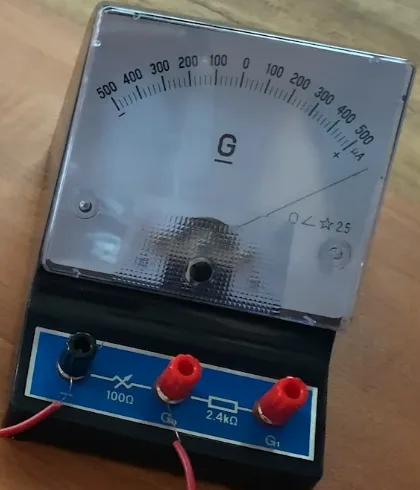
The scale on our meter runs from 500 to 0 to 500 microamps. One microamp (1 µA) is 0.000001 A, so the full-scale reading of 500 µA is only 0.5 mA. This is why the meter is the right tool for a simple cell and a torch bulb is the wrong one.
The deflection also tells you something about the metals. Replace the zinc with a metal closer to copper in the reactivity series and the needle swings less, because the voltage is smaller. Replace it with magnesium, which is more reactive than zinc, and the swing is larger. The activity series lesson explains why the order of the metals matters so much.
Flip cards: test your recall
Variables and evaluation
A good practical write-up identifies the variables. In this experiment the independent variable is the pair of metals you choose, or the concentration of the acid, if you decide to test that instead. The dependent variable is the current or the voltage. Everything else needs to be controlled: the area of the plates, how deep they sit in the acid, the distance between the plates, the temperature and the meter you use.
Think about what could go wrong, because evaluation questions are common in exams. The likely sources of error are:
- dirty or oxidised plates, which raise the resistance at the surface;
- plates that are not parallel, or whose distance apart changes between runs;
- trying to read a needle that is falling all the time;
- polarisation building up during the experiment.
Each error has an improvement. Clean the plates before every run, clamp them in a holder so the gap is fixed, use a digital meter or a data logger, take readings at fixed times, and repeat the experiment and average the results.
Check your understanding
Explain why the zinc plate is the negative terminal of a simple cell. (2 marks)
Zinc is more reactive than copper (and than hydrogen), so its atoms lose electrons more easily: Zn → Zn²⁺ + 2e⁻. The electrons build up on the zinc strip and make it the negative terminal.
State the direction of electron flow in the external circuit and the direction of conventional current. (2 marks)
Electrons flow from the zinc to the copper through the external wire. Conventional current flows the opposite way, from the copper (positive) to the zinc (negative).
Hydrogen bubbles and polarisation in a simple cell
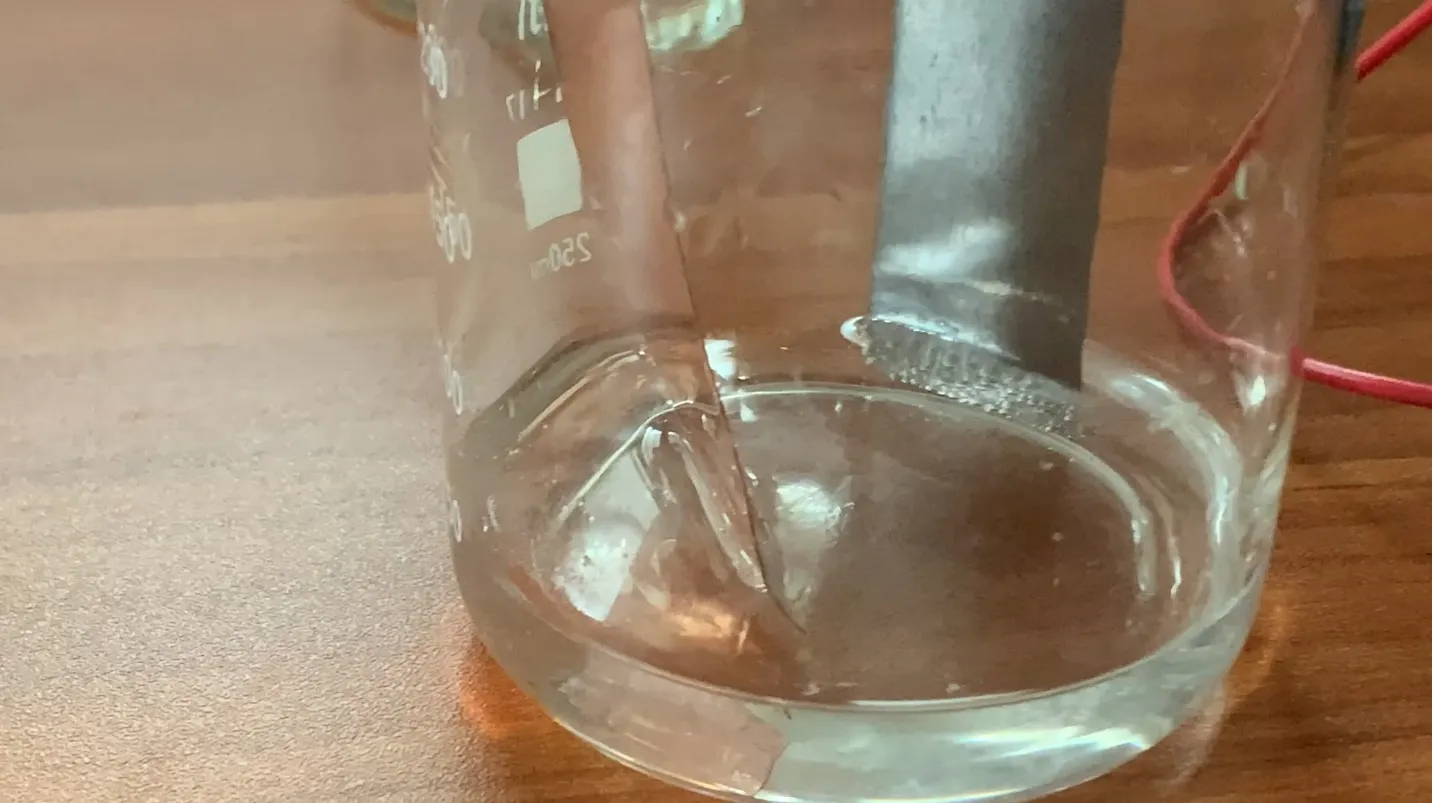
When current flows, hydrogen gas forms at the surface of the copper plate. Victorian electricians described it clearly: a few bubbles of hydrogen appear on the copper, not at the zinc and not throughout the liquid. At first the bubbles are small and leave the plate easily.
Then the trouble starts. The bubbles stick to the copper in great numbers and form a film over its surface. This gas layer insulates the plate from the acid, so fewer H⁺ ions can reach the copper to collect electrons. It also raises the internal resistance of the cell. The current falls quickly and can sometimes almost stop. This effect is called polarisation, and it is why the needle creeps back towards zero in the results table earlier in the article.
Why were there bubbles on the zinc in our photo?
Look again at the photograph above. A line of small bubbles clings to the zinc strip at the surface of the acid, and that looks wrong, because the half-equation says hydrogen should form on the copper. The explanation is local action.
The zinc sold for general use is not perfectly pure. It contains impurities, such as small particles of iron, and these act like tiny cells on the surface of the zinc. The zinc reacts directly with the acid, with no help from the circuit at all.
Zn + H₂SO₄ → ZnSO₄ + H₂
This reaction goes on even when the circuit is open, and it wastes zinc without delivering any useful current. You can test it yourself: stand a zinc strip in the acid with the wire disconnected. If bubbles still appear, they come from local action. Modern batteries use more highly purified zinc to prevent it. In the 19th century the remedy was to coat the zinc with mercury (amalgamation), but mercury is an environmental hazard and is no longer used in batteries. Students should never use it.
Defects of a simple cell and their remedies
| Defect | Cause | Effect | Remedy |
|---|---|---|---|
| Polarisation | Hydrogen film on the copper | Current falls quickly | A depolariser: an oxidising agent that removes the hydrogen, such as manganese dioxide in dry cells (potassium dichromate was used in the past), or a Daniell-type design |
| Local action | Impurities in the zinc | Zinc is wasted even when the cell is not in use | Purer zinc (historically a mercury coating, no longer used) |
| Liquid electrolyte | The acid is a liquid | It can spill, so the cell is not portable | A paste electrolyte, as in the dry cell |
| Zinc is used up | Zn → Zn²⁺ + 2e⁻ | The cell runs down and cannot be recharged | Replace the zinc, or use a rechargeable cell |
The Daniell cell: the simple cell’s big improvement
In 1836 the British chemist and meteorologist John Frederic Daniell invented a cell that solved the bubble problem. He was looking for a way to get rid of the hydrogen, and his answer was a second electrolyte, copper(II) sulfate, whose Cu²⁺ ions accept the electrons instead of H⁺ ions, so no hydrogen forms.
In the original design, a copper pot held a solution of copper(II) sulfate. Inside it stood an unglazed (porous) earthenware pot containing a zinc electrode in dilute sulfuric acid (zinc sulfate solution may be used instead). The porous wall lets ions pass but keeps the two solutions from mixing.
The half-equations show why this works. Zinc in zinc sulfate is the negative electrode, just as before, and copper in copper(II) sulfate is the positive electrode.
Zn(s) → Zn²⁺(aq) + 2e⁻
Cu²⁺(aq) + 2e⁻ → Cu(s)
Zn + Cu²⁺ → Zn²⁺ + Cu
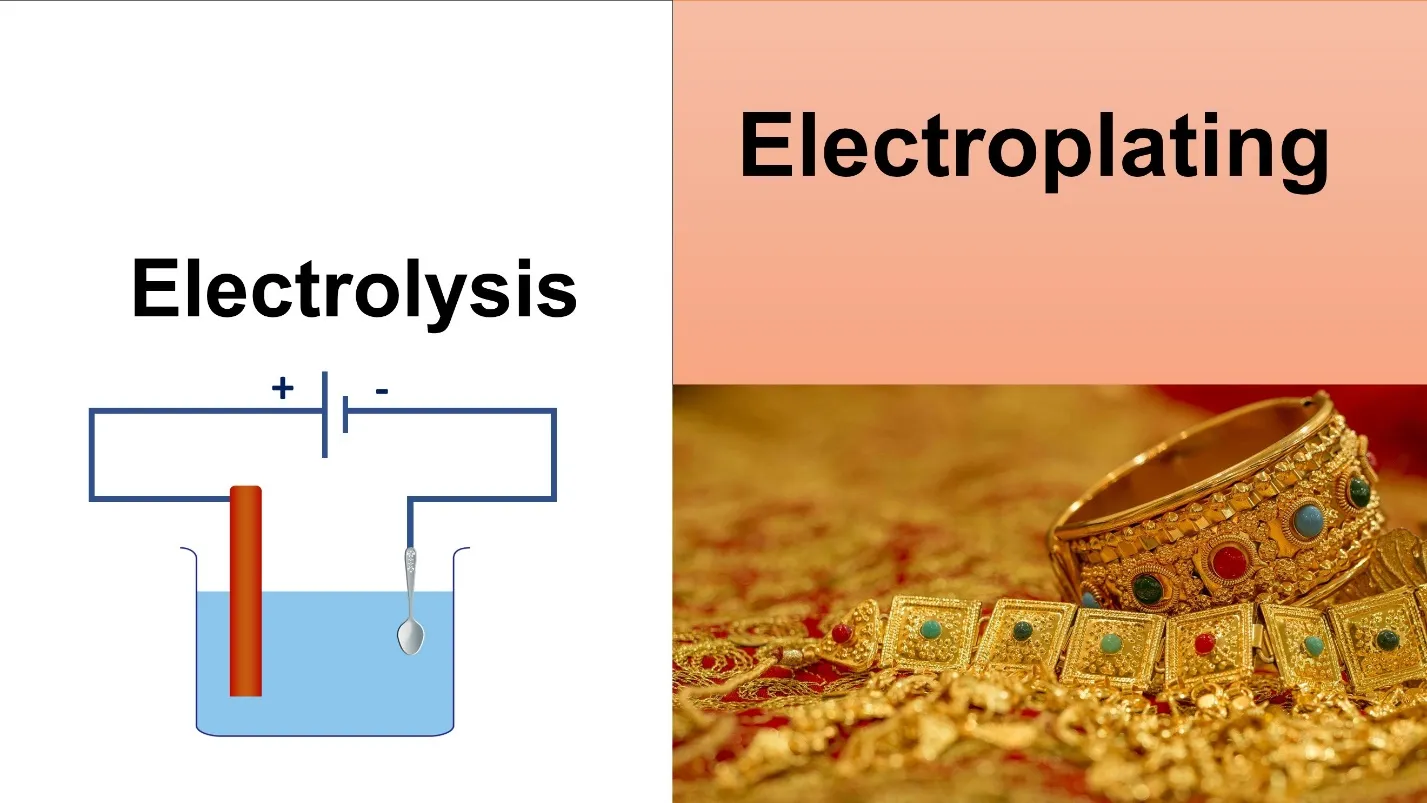
At the copper electrode, copper is deposited instead of hydrogen gas being formed, so the plate never gets covered with a film of gas. The standard EMF is 1.10 V at 25 °C. The copper deposited is the same change as in copper plating, which you can explore in our practical on electrolysis and electroplating.
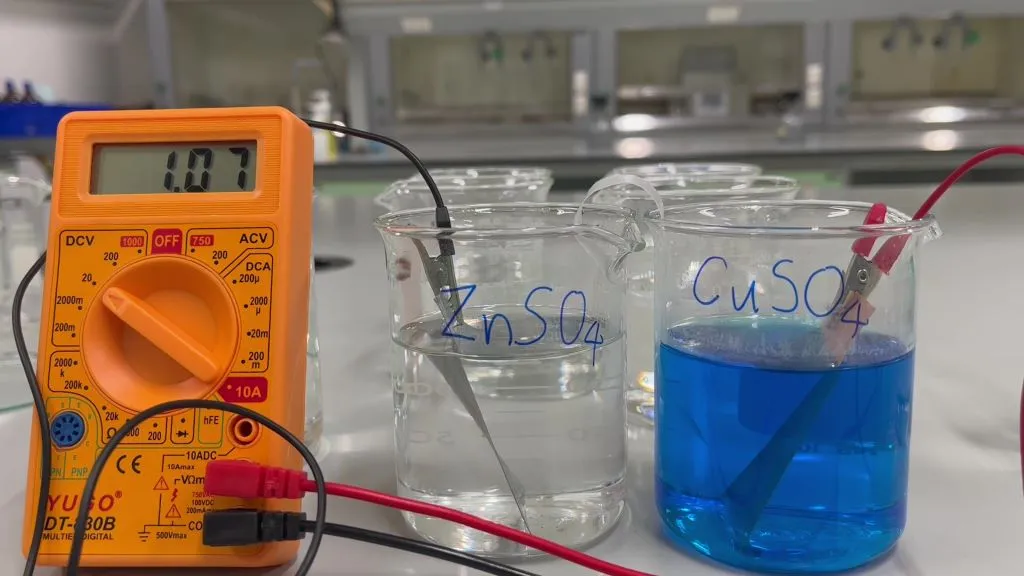
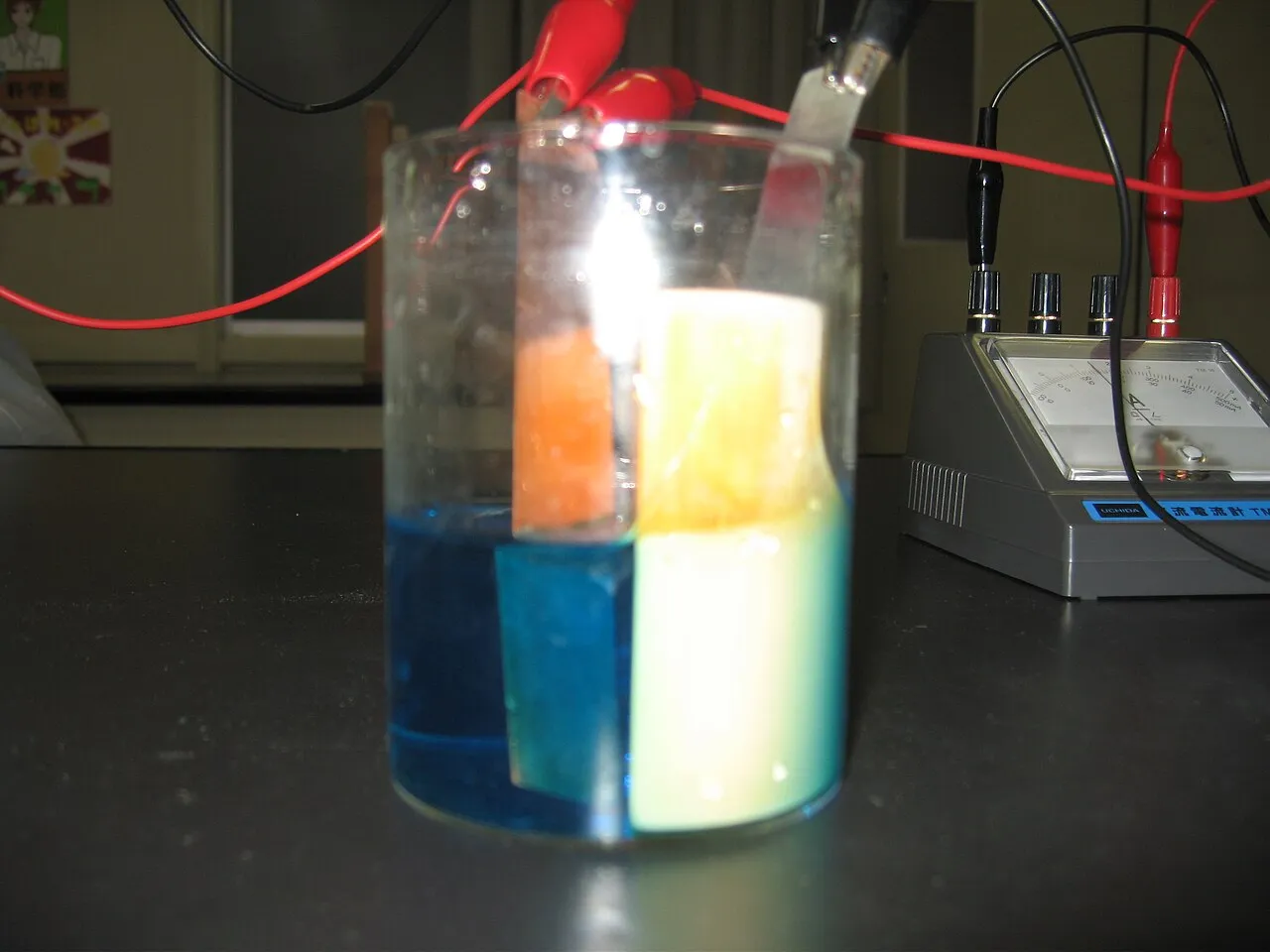
In a school laboratory the cell is often built from two half-cells in separate beakers joined by a salt bridge, commonly made with potassium nitrate. The meter in the photo above reads 1.07 V, close to the standard value of 1.10 V. The salt bridge and the porous pot do the same job: they let ions move to complete the circuit while keeping the solutions apart.
A Daniell cell is chemically reversible in principle: push a small current through it the other way and the reactions run backwards, which turns it into an electrolysis cell. It was still treated as a primary cell in practice. Our article on what is electrolysis explains that other side of the story.
Daniell cells and the telegraph
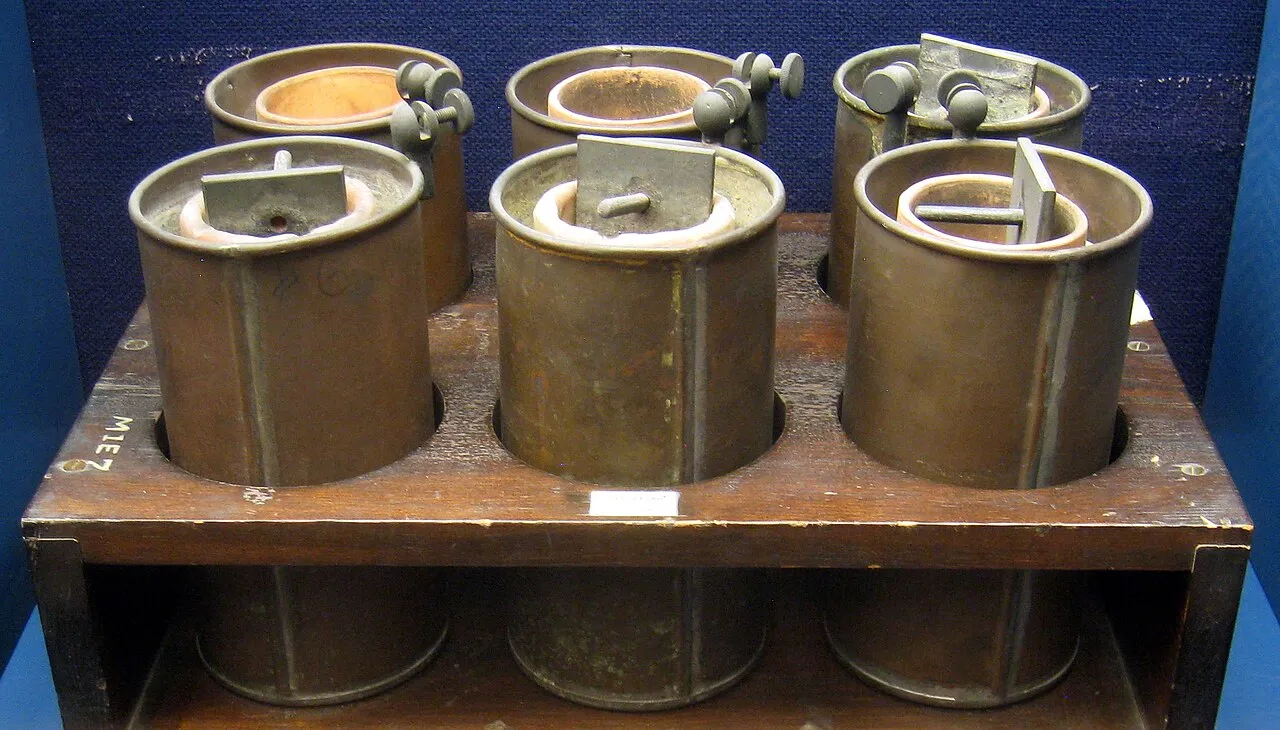
A variant, the gravity or crowfoot cell, was invented in the 1860s by Callaud and became popular for electrical telegraphy. In 1881 the International Conference of Electricians designed the electrical units so that the Daniell cell’s EMF would be about 1.0 volt. A set of Daniell cell batteries from 1836 is displayed at the National Museum of American History in Washington, DC.
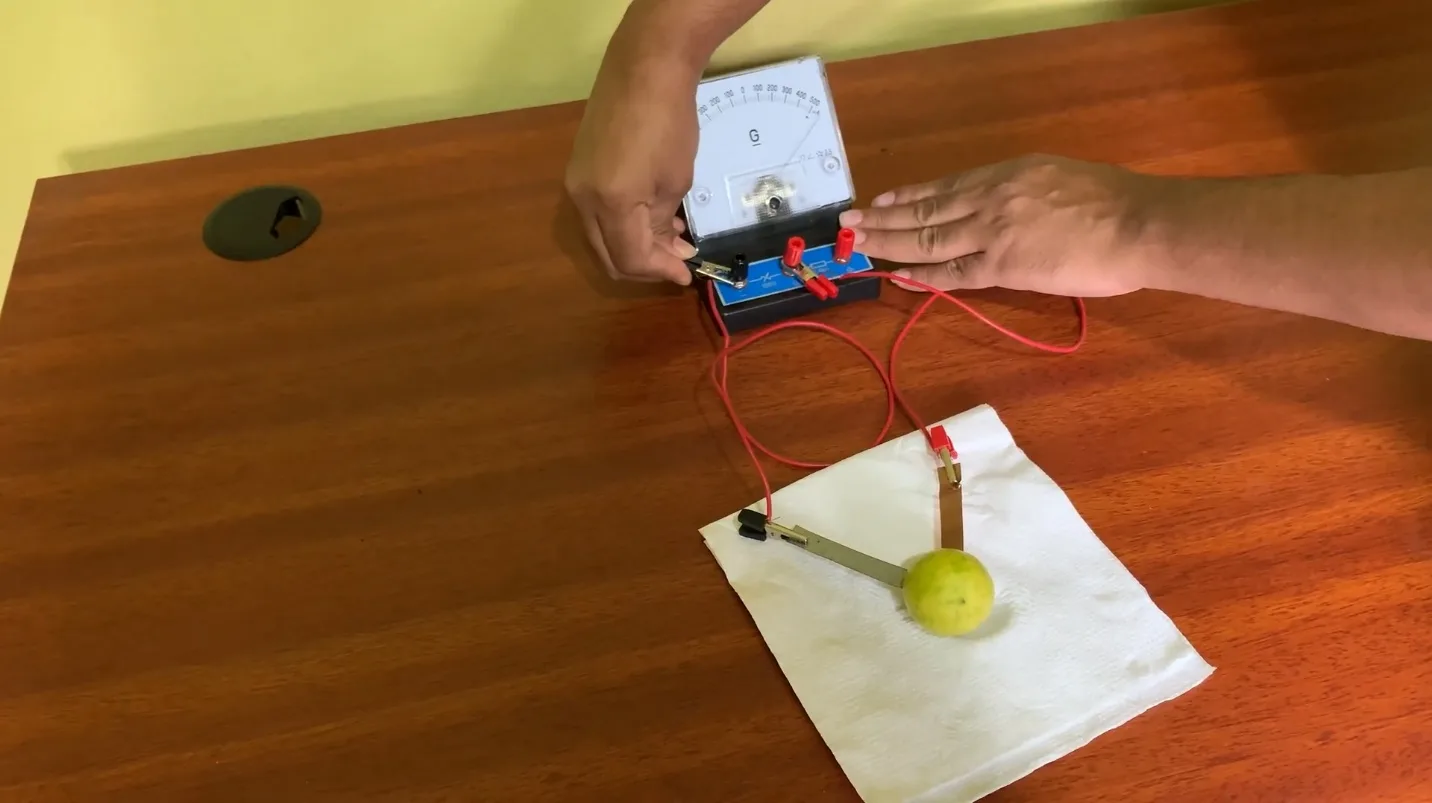
Swap the acid for fruit juice and you have a fruit battery, which we cover in our lime fruit cell practical.
Simple cells vs dry cells vs car batteries
Cells are grouped into two types. A primary cell is not rechargeable: the reactions stop when one of the reactants has been used up. A secondary cell can be recharged, because the reactions are reversed when an external current is supplied. Alkaline batteries are non-rechargeable.
| Simple cell | Daniell cell | Zinc–carbon dry cell | Lead–acid car battery | |
|---|---|---|---|---|
| Negative electrode | Zinc | Zinc | Zinc case | Lead |
| Positive electrode | Copper | Copper | Carbon rod with manganese dioxide | Lead dioxide |
| Electrolyte | Dilute sulfuric acid | Zinc sulfate and copper(II) sulfate | Ammonium chloride paste | Sulfuric acid |
| Voltage per cell | Typically under 1 V, and it falls | 1.10 V (standard) | About 1.5 V | About 2 V; six cells make 12 V |
| Polarisation | Yes | No (copper is deposited) | Manganese dioxide acts as a depolariser | Not a problem |
| Rechargeable? | No | Not in practice | No | Yes |
| Portable? | No, it has a liquid | No, it has liquids | Yes | Yes, but heavy |
The dry cell grew out of the wet Leclanché cell. Carl Gassner patented a “dry” version in 1886, with a zinc case as the negative electrode and a carbon rod in the middle that collects current from the manganese dioxide. The paste means there is no liquid to spill, and the manganese dioxide removes the hydrogen, which is the cure for polarisation.
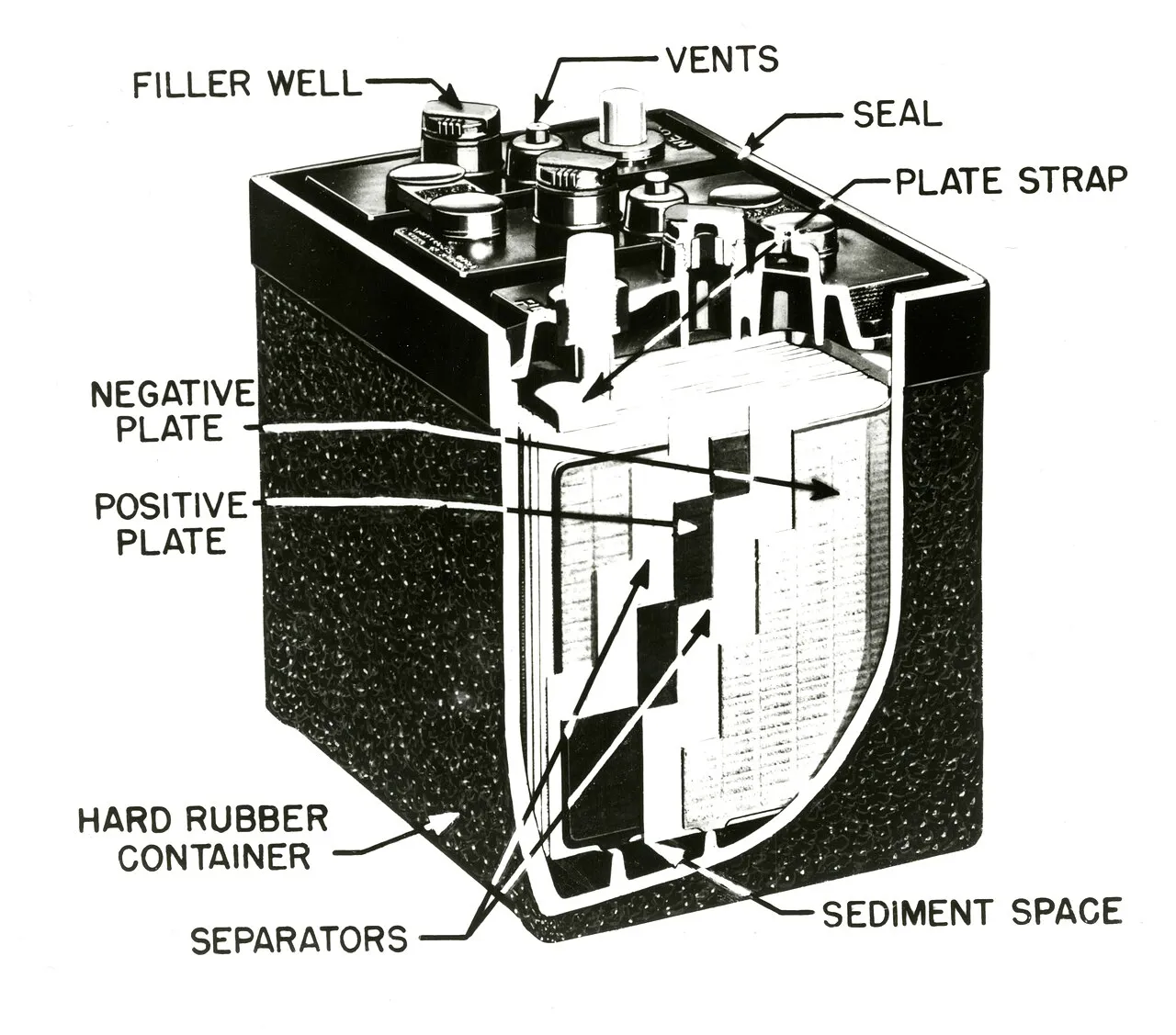
The lead–acid battery was first invented in 1859 by Gaston Planté and was the first rechargeable battery. Its negative plate is lead, its positive plate is lead dioxide, and its electrolyte is sulfuric acid, at a concentration high enough to be classed as corrosive. Each cell gives about 2 V, so a 12 V car battery is six cells in series. It can supply the very high current that a starter motor needs, but it is heavy for the energy it stores.
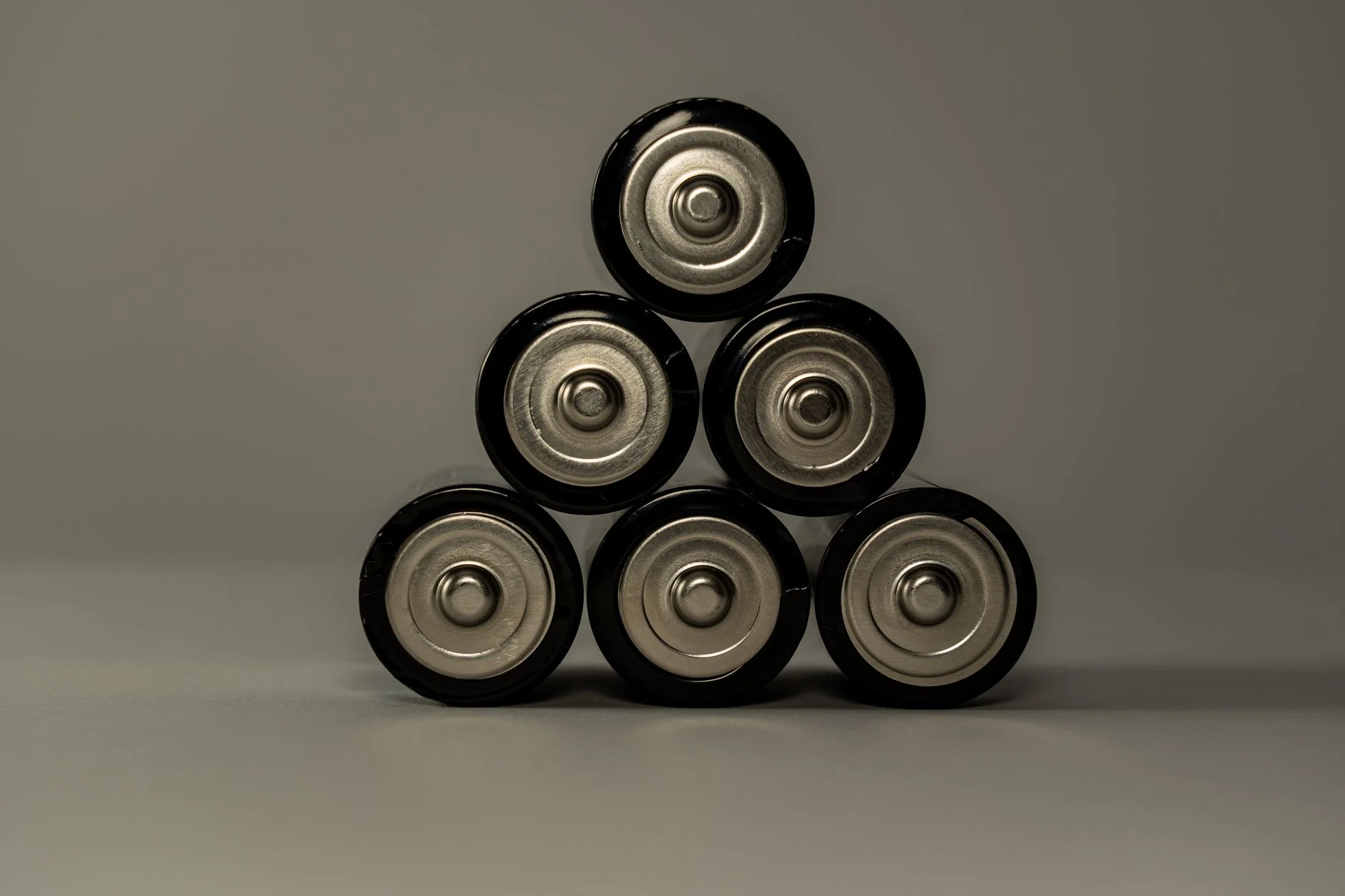
Today’s portable devices and electric vehicles use newer rechargeable designs. You can read about them in our overview of different types of batteries and in the article on how electric cars work.
Maths practice questions
These 12 questions are graded: Q1–4 are foundation level, Q5–6 are higher level, Q7–9 add some A-level content (the Faraday constant and internal resistance), and Q10–12 are stretch questions. Use F = 96 500 C mol⁻¹, Ar of zinc = 65.4, Ar of copper = 63.5 and a molar gas volume of 24 dm³ mol⁻¹ at room temperature and pressure. Try each one on paper first, then tap to reveal the worked solution.
Q1. The galvanometer reads 350 µA. Write this in milliamps and in amps. (1 mark)
350 µA ÷ 1000 = 0.350 mA. 0.350 mA ÷ 1000 = 0.000350 A = 3.50 × 10⁻⁴ A.
Q2. A simple cell gives a potential difference of 0.90 V across a 2.4 kΩ resistor. Calculate the current in µA. (2 marks)
I = V ÷ R = 0.90 ÷ 2400 = 0.000375 A = 375 µA (3.75 × 10⁻⁴ A). This fits on a 500 µA scale.
Q3. Each simple cell gives 0.80 V. How many cells in series are needed for at least 2.5 V, and what total voltage do they give? (2 marks)
2.5 ÷ 0.80 = 3.125, so round up to 4 cells. Total voltage = 4 × 0.80 = 3.2 V. (Three cells would give only 2.4 V, which is not enough.)
Q4. A 1.5 V dry cell supplies 0.20 A for 30 minutes. Calculate the power and the energy transferred. (3 marks)
P = V × I = 1.5 × 0.20 = 0.30 W. Time t = 30 × 60 = 1800 s. E = P × t = 0.30 × 1800 = 540 J.
Q5. A simple cell drives 0.40 mA for 10 minutes. Calculate the charge that flows. (2 marks)
I = 0.40 mA = 0.00040 A. t = 10 × 60 = 600 s. Q = I × t = 0.00040 × 600 = 0.24 C.
Q6. Using the illustrative results table (450 µA at 0 minutes, 150 µA at 3 minutes), calculate the percentage fall in current and the average rate of fall. (3 marks)
Fall = 450 − 150 = 300 µA. Percentage fall = 300 ÷ 450 × 100 = 66.7 % (3 s.f.). Average rate = 300 ÷ 3 = 100 µA per minute. The cause is polarisation.
Q7. A zinc–copper cell delivers 0.50 A for 30 minutes. Calculate the mass of zinc used up. (4 marks)
Q = I × t = 0.50 × 1800 = 900 C. Moles of electrons = 900 ÷ 96 500 = 9.33 × 10⁻³ mol (0.009326). Zn → Zn²⁺ + 2e⁻, so moles of Zn = 9.33 × 10⁻³ ÷ 2 = 4.66 × 10⁻³ mol (0.004663). Mass = 0.004663 × 65.4 = 0.305 g (3 s.f.).
Q8. For the same charge as in Q7, what volume of hydrogen forms at the copper plate at room temperature and pressure? (2 marks)
2H⁺ + 2e⁻ → H₂, so moles of H₂ = moles of electrons ÷ 2 = 4.66 × 10⁻³ mol. Volume = 0.004663 × 24 = 0.112 dm³ = 112 cm³.
Q9. (Higher) A simple cell has an EMF of 0.90 V. With a 10 Ω resistor the current is 0.060 A. (a) Find the potential difference across the resistor and the cell’s internal resistance. (b) Polarisation raises the internal resistance to 20 Ω. Find the new current. (4 marks)
(a) V = I × R = 0.060 × 10 = 0.60 V. Lost volts = 0.90 − 0.60 = 0.30 V. Internal resistance r = 0.30 ÷ 0.060 = 5.0 Ω. (b) I = EMF ÷ (R + r) = 0.90 ÷ (10 + 20) = 0.030 A. The current halves.
Q10. A 12 V car battery is made from lead–acid cells of about 2.0 V each. (a) How many cells are there? (b) Suppose a starter motor draws 150 A for 2.0 s. Calculate the charge and the energy transferred. (3 marks)
(a) 12 ÷ 2.0 = 6 cells. (b) Q = I × t = 150 × 2.0 = 300 C. E = V × I × t = 12 × 150 × 2.0 = 3600 J (3.6 kJ). The 150 A is an illustrative figure, not a real specification.
Q11. (A-level stretch) Use E° values (Zn −0.76 V, Cu +0.34 V, Mg −2.37 V, H⁺/H₂ 0.00 V) to calculate the standard EMF of (a) a Daniell cell, (b) a magnesium–copper cell, (c) zinc against hydrogen ions, the simple cell’s reaction. (3 marks)
E°(cell) = E°(more positive) − E°(more negative). (a) 0.34 − (−0.76) = 1.10 V. (b) 0.34 − (−2.37) = 2.71 V. (c) 0.00 − (−0.76) = 0.76 V.
Q12. (Stretch) A Daniell cell supplies 0.20 A for 1.0 hour. Calculate the mass of copper deposited and the mass of zinc used. (4 marks)
Q = 0.20 × 3600 = 720 C. Moles of electrons = 720 ÷ 96 500 = 7.46 × 10⁻³ mol (0.007461). Moles of Cu = moles of Zn = 0.007461 ÷ 2 = 3.73 × 10⁻³ mol (0.003731). Mass of copper = 0.003731 × 63.5 = 0.237 g. Mass of zinc = 0.003731 × 65.4 = 0.244 g.
Common mistakes and exam tips
- Saying copper is the negative electrode. In a copper–zinc cell the zinc is negative and the copper is positive.
- Saying electrons flow through the acid. Electrons flow in the wire; ions carry the charge in the electrolyte.
- Confusing polarisation (hydrogen on the copper, only while current flows) with local action (impure zinc dissolving, even on open circuit).
- Forgetting to convert µA or mA to amps, and minutes to seconds, before using Q = I × t.
- Saying the copper dissolves. It is the zinc that is used up.
- Letting the plates touch, which short-circuits the cell.
- Giving one fixed voltage for a simple cell. Its voltage is typically less than 1 V and falls as it is used.
Zinc is used up in this cell because it is the more reactive metal, and the same idea explains why zinc protects steel in galvanised steel sheets: the zinc corrodes first. If you enjoyed this practical, try another one on chemical indicators in the laboratory.
Frequently asked questions about the simple cell
What is a simple cell experiment?
A simple cell experiment joins two different metals, usually copper and zinc, through an electrolyte such as dilute sulfuric acid. A wire and a sensitive meter complete the circuit. The meter deflects, showing that the chemical reaction between the zinc and the acid is producing an electric current.
How does a simple cell work?
The more reactive metal, zinc, loses electrons and dissolves as Zn²⁺ ions. The electrons travel through the external wire to the copper. There, hydrogen ions from the acid gain them and form hydrogen gas. Ions moving in the electrolyte keep the charges balanced, which completes the circuit.
Which electrode is positive in a simple cell?
In a copper–zinc cell the copper is the positive electrode and the zinc is the negative electrode. The more reactive metal is always negative, because it gives up electrons more readily. Conventional current leaves the cell from the positive copper terminal and returns through the zinc.
Why do bubbles form on the copper plate of a simple cell?
Electrons arriving at the copper plate are picked up by hydrogen ions from the acid, which become hydrogen gas: 2H⁺ + 2e⁻ → H₂. The copper does not dissolve or react. It is only the surface where this reduction happens, so the bubbles are hydrogen from the acid.
What is polarisation in a simple cell and how can it be prevented?
Polarisation is the build-up of a film of hydrogen bubbles on the copper plate. The film insulates the plate from the acid and raises the cell’s internal resistance, so the current falls. It is prevented with a depolariser, an oxidising agent such as manganese dioxide, or by using a Daniell-type cell.
What is local action in a simple cell?
Local action happens when impurities in the zinc, such as iron particles, form tiny cells on its surface. The zinc then reacts directly with the acid and gives off hydrogen, even when the circuit is open. It wastes zinc. Using purer zinc prevents it, and historically mercury was used for this.
Why are simple cells not used in everyday life?
A simple cell gives a small voltage, typically under 1 V, and the current falls quickly because of polarisation. Local action wastes zinc, and the liquid acid can spill, so it is not portable. Dry cells and rechargeable batteries solve these problems and are far more convenient.
How is a Daniell cell better than a simple cell?
In a Daniell cell, copper is deposited from copper(II) sulfate solution at the positive electrode instead of hydrogen gas forming. With no hydrogen film, the cell does not suffer from polarisation. It gives a steady standard EMF of 1.10 V, which is why it was used for telegraphy.
What is the difference between a simple cell and a dry cell?
A simple cell has two metals in a liquid electrolyte, so it spills and polarises. A zinc–carbon dry cell has a zinc case, a carbon rod, manganese dioxide as a depolariser and a paste electrolyte. It gives about 1.5 V, is portable and cannot be recharged.