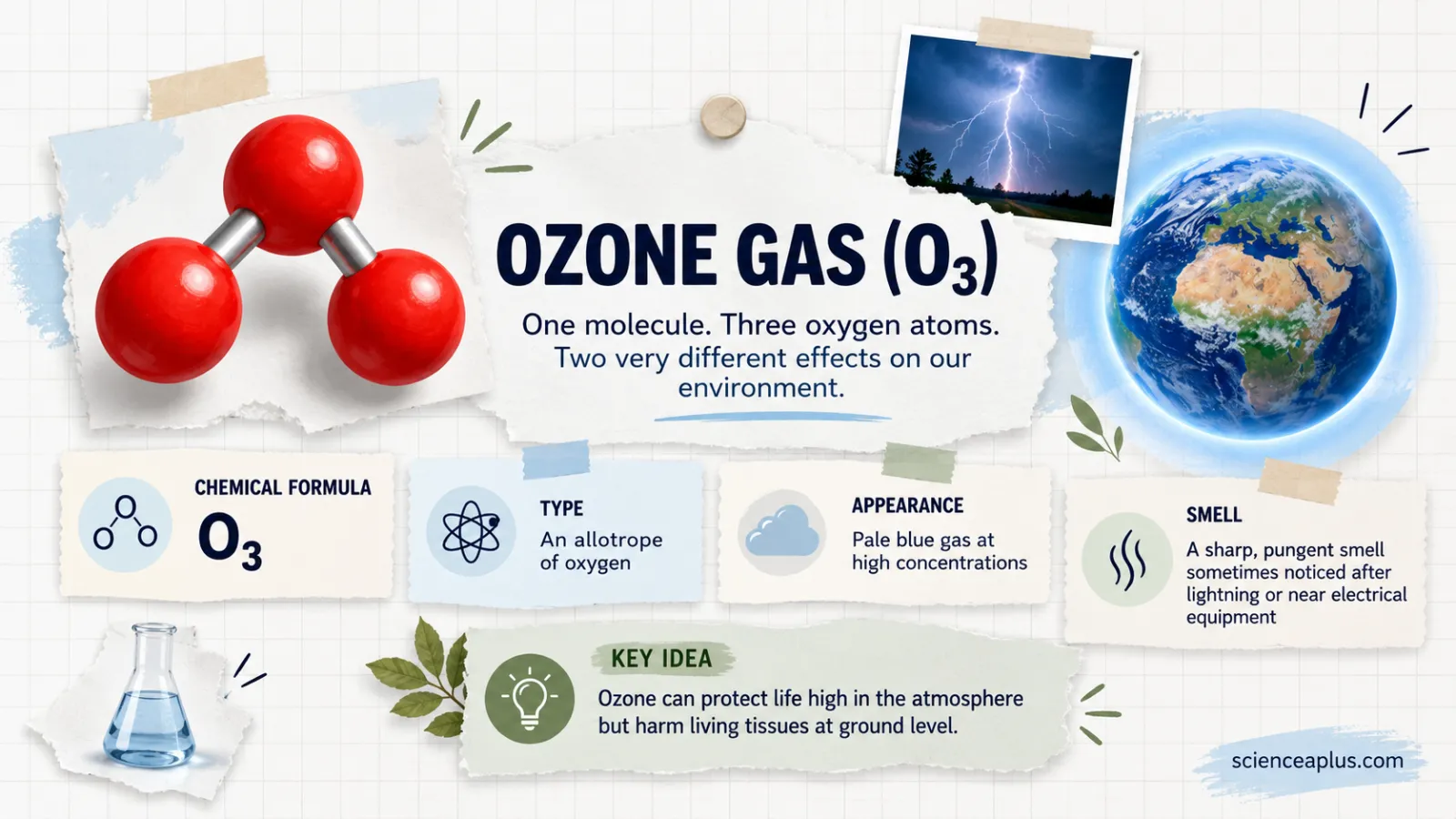
Ozone gas (O3, or O₃) is a pale blue gas made of three oxygen atoms joined together, and it is one of the strangest double agents in science. High in the atmosphere it forms a thin shield that absorbs harmful ultraviolet light. Down at street level it is a pollutant that irritates eyes and lungs.
This guide covers both sides. First the molecule itself: its structure, properties, smell and chemistry. Then the ozone layer, the hole that CFCs punched in it, the recovery that scientists are now measuring, and the uses and dangers of ozone in everyday life. It suits GCSE and A-level chemistry students, teachers and anyone curious about the gas with the odd smell.
What is ozone gas (O3)?
Ozone is an allotrope of oxygen. That means it is made of the same element as the oxygen we breathe, but the atoms are arranged differently. Ordinary oxygen, O₂, has two atoms per molecule. Ozone, O₃, has three. The molar mass of ozone is 48.00 g/mol (16.00 × 3), compared with 32.00 g/mol for O₂.
The name comes from the Greek word ozein, meaning “to smell”. The German-Swiss chemist Christian Friedrich Schönbein named the gas around 1840 after noticing the sharp smell that follows lightning. Its formula, O₃, was worked out later, by Jacques-Louis Soret in 1865. You will find more about the element itself in our guide to oxygen as a chemical element.
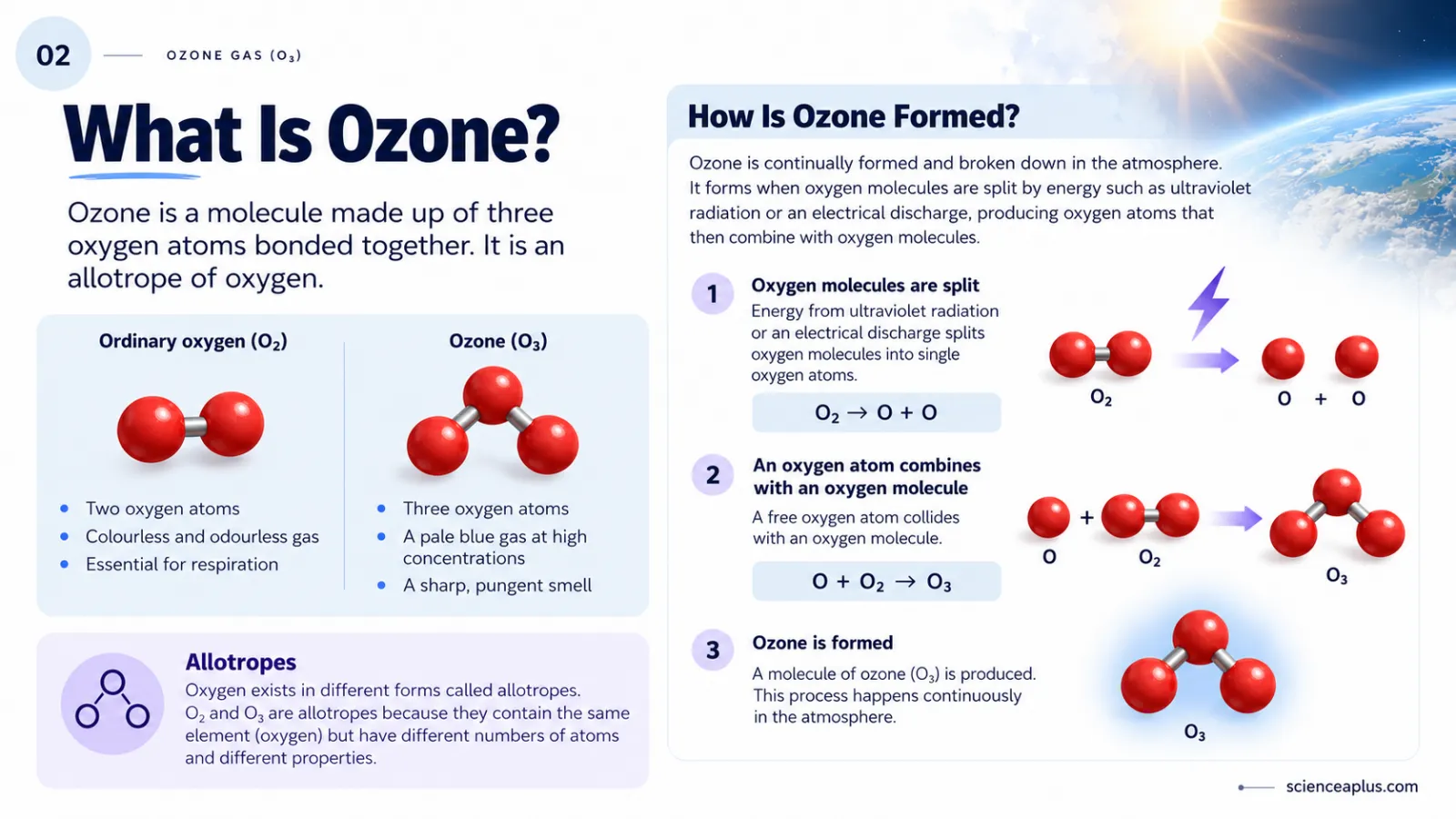
Ozone forms when oxygen molecules are split apart and the free oxygen atoms join onto other O₂ molecules. In the atmosphere the splitting is done by ultraviolet light. Near the ground, lightning and electrical sparks can do the same job. Because the reaction needs energy, ozone is always a little unstable and slowly turns back into O₂.
Ozone vs oxygen: same element, different molecule
It is easy to mix up O₂ and O₃, but their behaviour is very different. Oxygen is the stable, odourless gas we breathe. Ozone is a rarer, reactive gas that we only tolerate in tiny amounts. The table compares the two. For the everyday gas, see our page on oxygen gas (O₂).
| Property | Oxygen (O₂) | Ozone (O₃) |
|---|---|---|
| Atoms per molecule | 2 | 3 |
| Molar mass | 32.00 g/mol | 48.00 g/mol |
| Colour of the gas | Colourless | Colourless to pale blue |
| Smell | None | Sharp, like chlorine bleach |
| Stability | Stable | Unstable, slowly reverts to O₂ |
| Oxidising power | Moderate | Very strong |
| Where it is found | All through the atmosphere | About 90% in the stratosphere |
Structure of ozone: bent shape and resonance
For GCSE, it is enough to say that an ozone molecule has three oxygen atoms in a bent shape, a little like a water molecule. A-level students need the detail. The O–O–O bond angle is 116.8°, and both O–O bonds are exactly the same length, 127.8 pm. That is the key clue to its structure.
If one bond were a single bond and the other a double bond, they would have different lengths. They do not. So chemists draw two resonance structures, one with the double bond on the left and one with it on the right. The real molecule is a hybrid of the two, with a bond order of 1.5 on each side. The central oxygen atom also carries one lone pair of electrons.
Because the electrons are not shared perfectly evenly, ozone is slightly polar, with a small dipole moment of 0.53 D. If you need to refresh the basics of sharing electrons, see our covalent bonds lecture notes.
Physical properties of ozone
At room temperature ozone is a colourless to bluish gas with a characteristic smell. In concentrated form it looks pale blue. Cool it enough and it condenses to a dark blue liquid, then freezes to a violet-black solid. The table gives the key values.
| Property | Value |
|---|---|
| Colour (gas) | Colourless or pale blue |
| Colour (liquid and solid) | Dark blue liquid, violet-black solid |
| Boiling point | −112 °C |
| Melting point | −193 °C |
| Density compared with air | About 1.6 times denser |
| Solubility in water | Only slightly soluble |
| Smell | Sharp and pungent, noticed at a few hundredths of a ppm |
Ozone is not flammable itself, but it makes other substances burn more fiercely. Concentrated ozone gas or liquid ozone can decompose explosively, which is why it is only used at low concentrations.
What does ozone smell like?
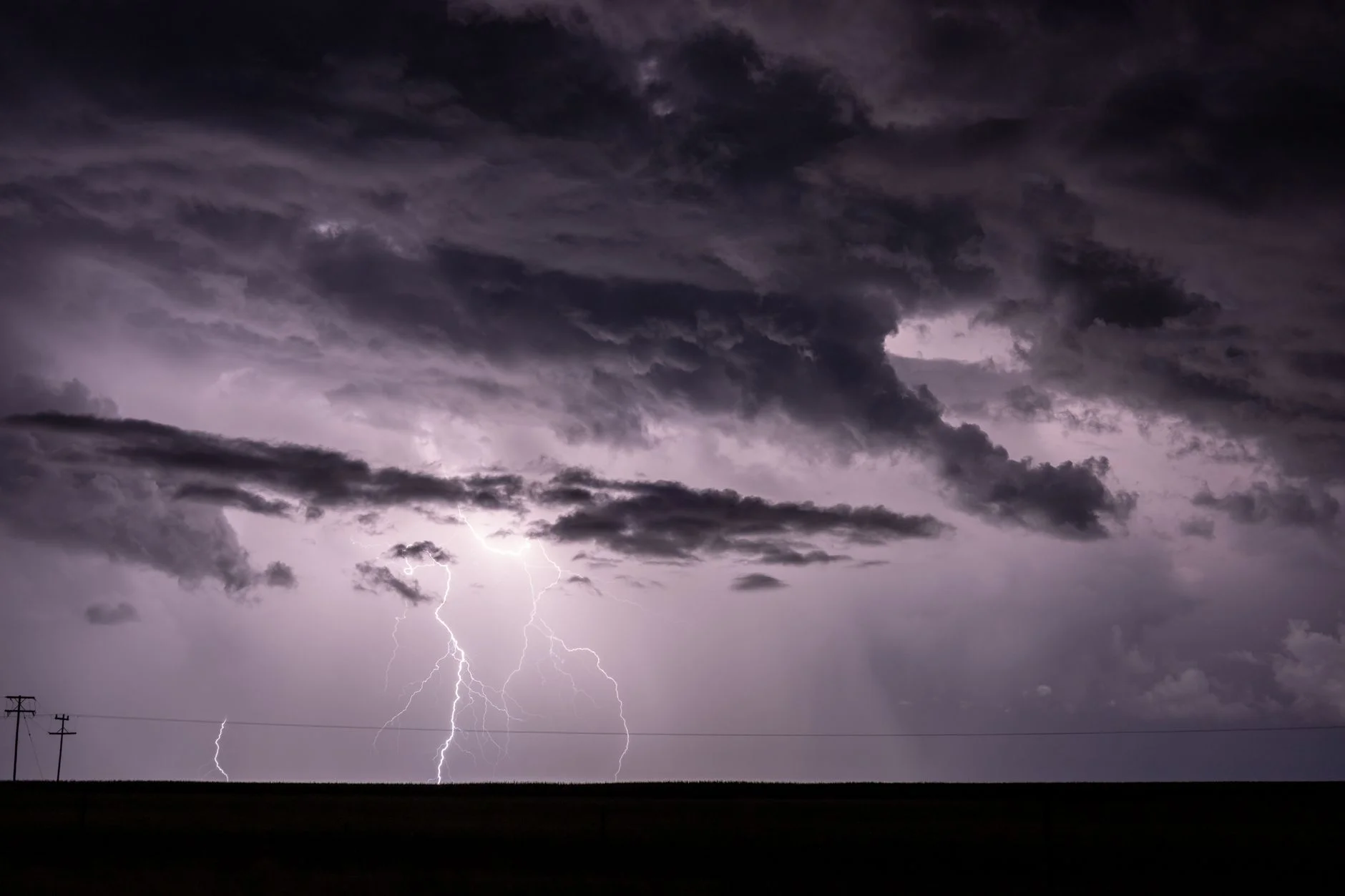
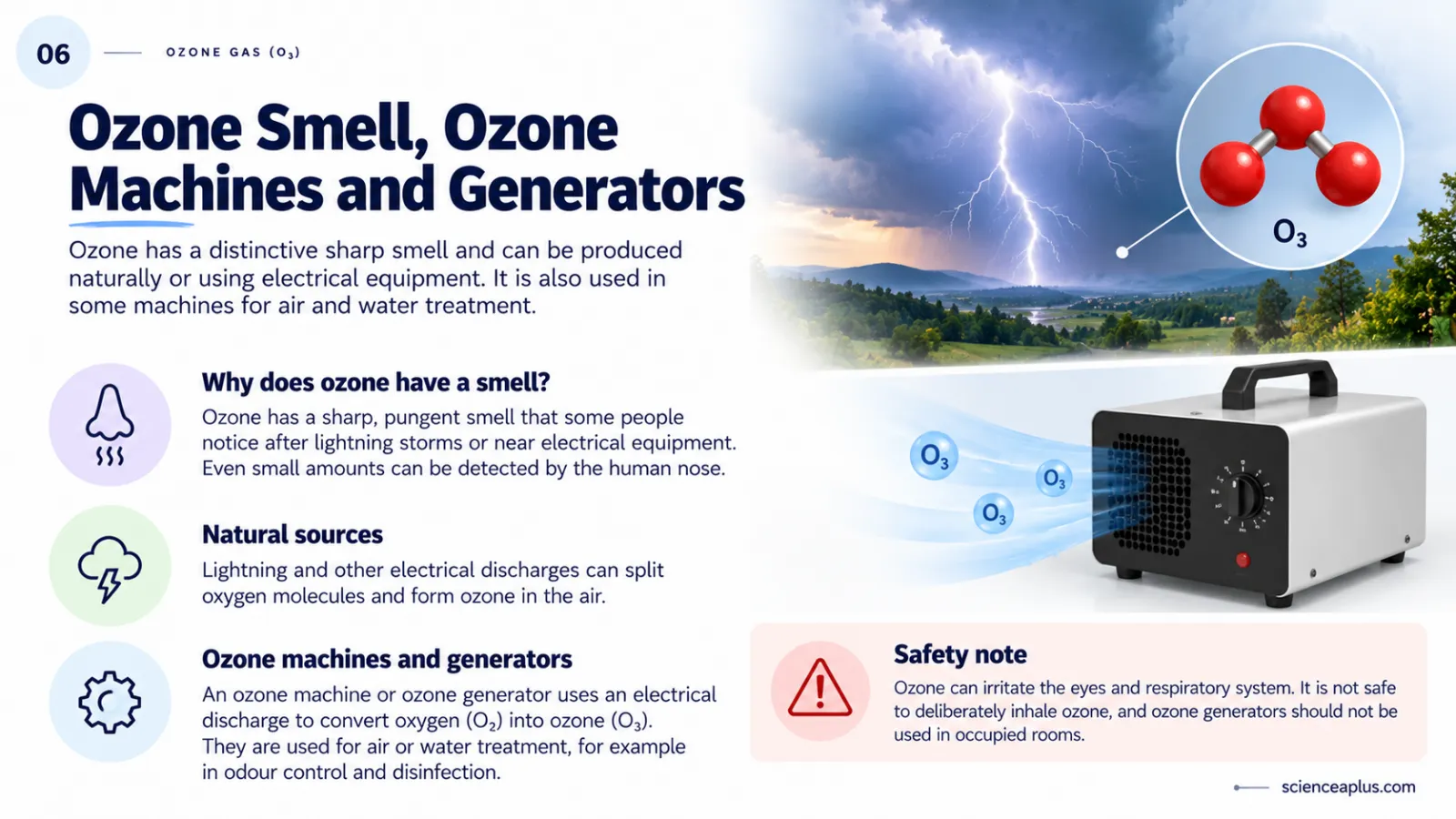
Most people describe the smell of ozone as sharp and clean, like chlorine bleach. You may have noticed it near a thunderstorm, an electric motor or a photocopier, anywhere that electrical sparks split oxygen molecules. The nose is very sensitive to it: people can detect ozone at about 0.02 to 0.05 parts per million. That is roughly the range where air-quality guidelines start (100 µg/m³ is about 0.05 ppm), so smell is a warning sign, not proof that the air is safe.
That sensitivity is useful, but do not rely on it. Smell is not a safe way to judge exposure, and the fresh smell after a storm is only partly ozone.
Chemical properties: a powerful oxidising agent
Ozone is a very strong oxidising agent, far stronger than ordinary oxygen. Its standard electrode potential is +2.07 V for the half-equation O₃ + 2H⁺ + 2e⁻ → O₂ + H₂O. For comparison, chlorine (Cl₂ to Cl⁻) is +1.36 V. Among the chemicals used to treat water, ozone is second only to the hydroxyl free radical.
Why ozone is unstable
Making ozone from oxygen is endothermic: it takes in energy.
3O₂ → 2O₃ ΔH = +285 kJ
The ozone molecule therefore sits at a higher energy level than the oxygen it came from, which is why it is unstable and keen to react. When ozone gives up its extra oxygen atom, it oxidises whatever it meets.
The potassium iodide test
Ozone oxidises iodide ions to iodine. The reaction is used to detect and measure ozone, because the iodine turns the solution brown and gives a blue-black colour with starch.
O₃ + 2KI + H₂O → I₂ + O₂ + 2KOH
Reacting with nitrogen monoxide
Ozone also reacts quickly with nitrogen monoxide from vehicle exhausts.
NO + O₃ → NO₂ + O₂
This reaction helps explain why ozone can be lower in the middle of a busy city and higher in the countryside downwind. We return to that later in this article.
One more reaction is worth knowing for A-level. In ozonolysis, ozone splits C=C double bonds in alkenes to give aldehydes or ketones, and industry uses this to make chemicals.
Explain why ozone is a stronger oxidising agent than oxygen. (2 marks)
Ozone is formed endothermically, so it is at a higher energy level and unstable (1). It readily gives up an oxygen atom to oxidise other substances, and it has a very positive electrode potential (+2.07 V), so it is a powerful oxidising agent (1).
Now that we know what the molecule is like, the next part looks at where most of it lives: the ozone layer.
How is ozone formed? The Chapman cycle
Most ozone on Earth is made high in the atmosphere by sunlight acting on ordinary oxygen. In 1930 the British scientist Sydney Chapman explained how, and the steps are still called the Chapman cycle. There are four reactions to know.
Step 1. Short-wavelength ultraviolet light splits an oxygen molecule into two oxygen atoms.
O₂ + UV → O + O
Step 2. A free oxygen atom joins an oxygen molecule, forming ozone.
O + O₂ → O₃
Step 3. Ozone absorbs ultraviolet light and splits. This is how the ozone layer shields us, and the oxygen atom it releases quickly forms ozone again.
O₃ + UV → O₂ + O
Step 4. Ozone is also lost naturally when an oxygen atom meets an ozone molecule.
O + O₃ → 2O₂
For A-level, step 2 needs a third molecule, M, to carry away the surplus energy: O + O₂ + M → O₃ + M. Without it the new molecule would simply fly apart again.
Notice what the cycle does with ultraviolet light. Step 1 uses UV to make ozone, and step 3 uses UV to break it again. Both steps soak up harmful radiation. Ozone and oxygen together therefore act as a double filter: oxygen absorbs the most energetic UV when it splits, and ozone absorbs more of what is left.
Why the layer stays in balance
Steps 2 and 3 form a loop: ozone is split by UV, and the oxygen atom it releases quickly joins another oxygen molecule to make ozone again. Only step 4, and the other loss reactions described later in this article, remove ozone for good. Because the loop recycles so quickly, the layer can absorb a huge amount of UV without being used up, as long as nothing else is destroying ozone faster than sunlight can make it.
Where is the ozone layer?
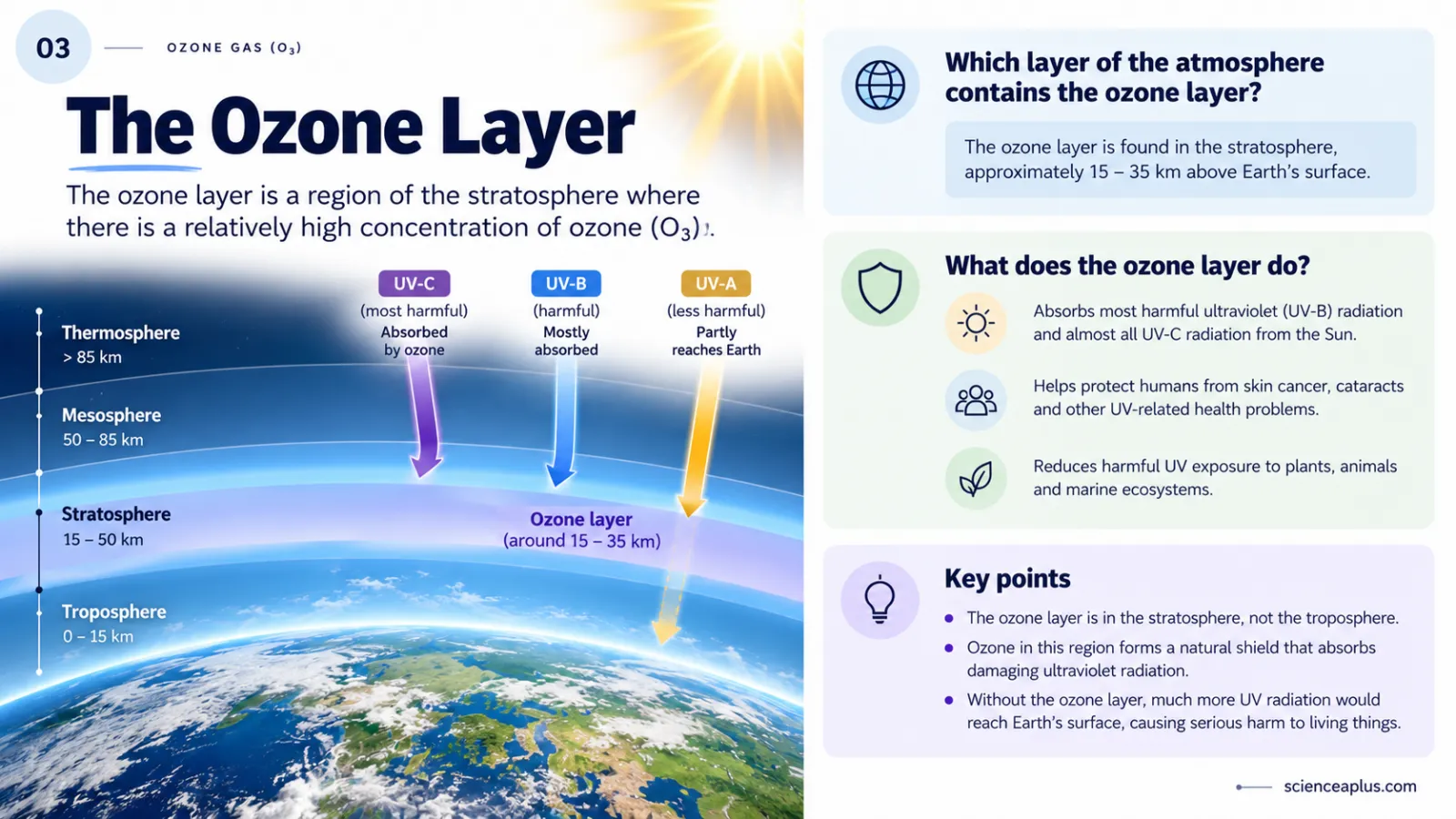
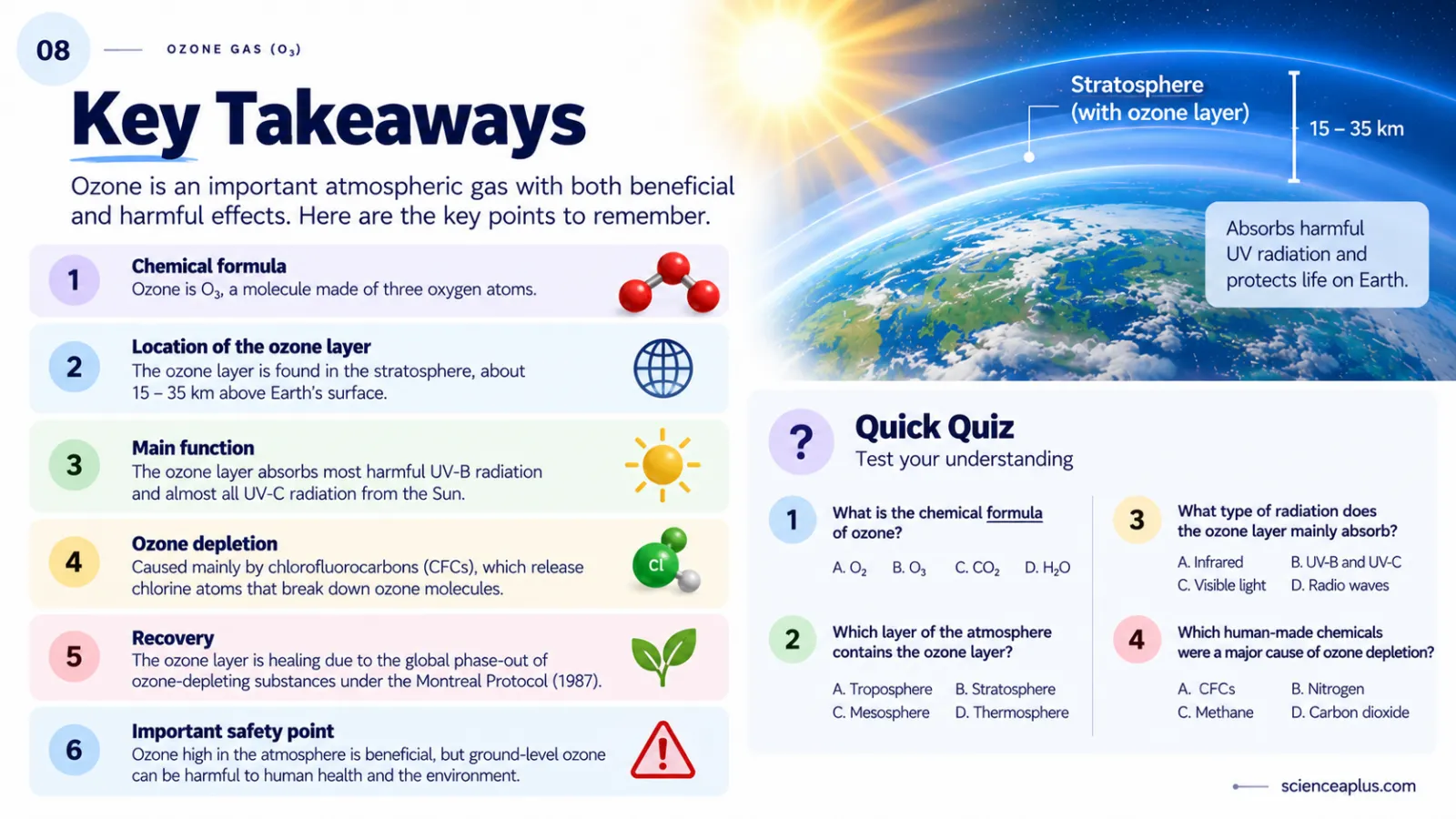
About 90% of Earth’s ozone is in the stratosphere, the layer of atmosphere above the weather. The other 10% is in the troposphere, the layer where we live. The ozone layer lies mostly between about 15 and 35 km above the surface.
It is not a solid shell. Even in the thickest part, there are only a few molecules of ozone for every million air molecules. The layer works because the atmosphere is so deep: a thin sprinkling of ozone, spread over many kilometres, adds up to a very effective filter. For the full tour of atmospheric layers, see our guide to the atmosphere of Earth, the Moon and Titan.
What does the ozone layer do?
The ozone layer absorbs ultraviolet (UV) radiation from the Sun. Ultraviolet light has more energy per photon than visible light, and the shorter the wavelength, the more harmful it is. Scientists split it into three bands.
| UV band | Wavelength | What happens in the atmosphere |
|---|---|---|
| UV-C | Shorter than 280 nm | Almost all absorbed within the ozone layer (by ozone and oxygen together) |
| UV-B | 280–315 nm | Most is absorbed by the ozone layer; the rest reaches the surface |
| UV-A | 315–400 nm | Barely absorbed, so most reaches the surface |
The UV-B that does get through is still important to us. It causes sunburn and raises the risk of skin cancer and cataracts, which is why a thinner ozone layer would be dangerous. Sunscreen, shade and clothing remain sensible whenever the Sun is strong.

When ozone absorbs UV light, the energy it takes in warms the surrounding air. Optical effects such as blue skies and halos come from different processes, where light is scattered or refracted rather than absorbed. If you enjoy that side of the atmosphere, read about atmospheric optical phenomena.
Measuring ozone: Dobson units
The ozone layer was discovered in 1913 by the French physicists Charles Fabry and Henri Buisson. Later, the British scientist G. M. B. Dobson built a spectrophotometer to measure it and set up a worldwide monitoring network, which ran from 1928 to 1958. The unit of total ozone is named after him.
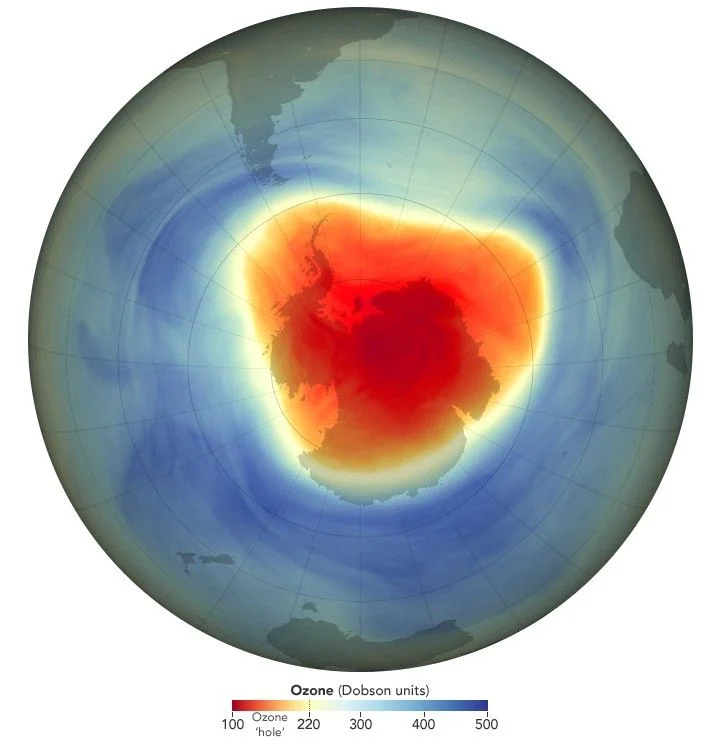
One Dobson unit (DU) is a layer of pure ozone 0.01 mm thick, if all the ozone above a point were squeezed down to 0 °C and sea-level pressure. The average ozone layer is about 300 DU. That means all the ozone in a column of air would make a layer only 3 mm thick, far thinner than a pencil.
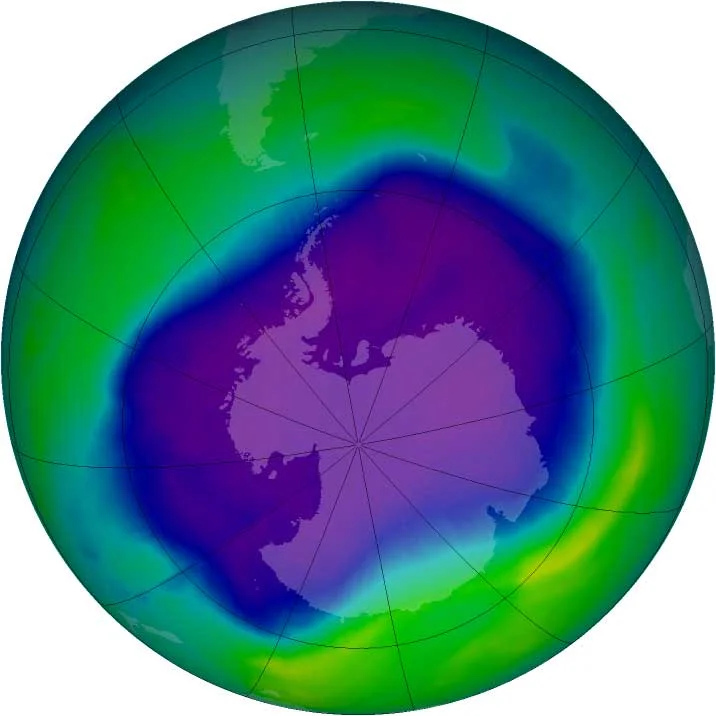
An “ozone hole” is defined as an area where total ozone falls to 220 DU or lower. Inside the Antarctic hole, values can drop to about 100 DU. Try the calculator to see what different readings look like.
If total ozone is 250 DU, how thick would it be as pure ozone at 0 °C and sea-level pressure? (1 mark)
250 × 0.01 mm = 2.5 mm.
So the ozone layer is vital but thin, and chemistry can damage it. That is the story told later in this article.
What causes ozone depletion? CFCs and halons
For much of the 20th century, chlorofluorocarbons (CFCs) looked like wonder chemicals. They were used in refrigeration, as propellants in aerosol cans and in making foam. They were also very stable, and that is exactly what made them a problem. Because CFCs hardly react in the lower atmosphere, they survive long enough to drift up into the stratosphere.
There, ultraviolet light breaks them apart and releases chlorine atoms. In 1974 Mario Molina and F. Sherwood Rowland proposed that this would destroy ozone. They shared the 1995 Nobel Prize in Chemistry with Paul Crutzen for their work on stratospheric ozone. Halons, used in fire extinguishers, are a second group of culprits: they release bromine, which is even more effective at destroying ozone, atom for atom. For more on the element at the centre of the story, see chlorine (Cl).
How chlorine atoms destroy ozone (A-level equations)
AQA A-level Chemistry (specification 3.3.3.3, “Ozone depletion”) expects you to know that ozone is beneficial because it absorbs UV, and that chlorine atoms catalyse its decomposition. The mechanism has an initiation step and two propagation steps.
Initiation. UV light breaks a C–Cl bond in a CFC, for example CCl₃F, to give a chlorine radical:
CCl₃F → CCl₂F• + Cl• (UV)
Propagation. The chlorine radical attacks ozone, and the product attacks a second ozone molecule, regenerating the chlorine:
Cl• + O₃ → ClO• + O₂
ClO• + O₃ → 2O₂ + Cl•
Overall. Add the two propagation steps and the ClO• cancels. The chlorine is left unchanged:
2O₃ → 3O₂
Because the chlorine atom is regenerated, it acts as a catalyst. A single chlorine atom can destroy thousands of ozone molecules before it finally reacts with another gas. You may also see a different second step in some textbooks, ClO + O → Cl + O₂. That is another version of the same catalytic idea. To revise how catalysts work, read our guide to catalysts, promoters and accelerators.
Explain how one chlorine atom can destroy many ozone molecules. (3 marks)
The chlorine atom reacts with ozone to form ClO• and O₂ (1). ClO• reacts with another ozone molecule to form two O₂ and regenerate the chlorine atom (1). The chlorine atom is not used up, so it acts as a catalyst and can repeat the cycle many times (1).
The Antarctic ozone hole
In May 1985 Joe Farman, Brian Gardiner and Jonathan Shanklin of the British Antarctic Survey reported a dramatic fall in ozone over Antarctica in the journal Nature, based on measurements from the Halley research station. The “ozone hole” was born, and the world took notice.
The hole forms in the southern spring, between August and October. CFCs are well mixed around the whole planet, so Antarctica is not special because more CFCs were released there. It is special because of the cold. During the polar winter the stratosphere above Antarctica gets extremely cold, around −80 °C, and polar stratospheric clouds form. Reactions on the surface of these cloud particles free reactive chlorine. When sunlight returns in spring, that chlorine destroys ozone rapidly.
Scientists call an area an ozone hole when total ozone falls to 220 DU or lower. Values that low were not observed before 1979. The largest ozone hole ever observed was in 2006.
The Montreal Protocol: how the world fixed it
The response was remarkably quick. The Montreal Protocol was agreed on 16 September 1987 and came into force on 1 January 1989. It has been ratified by 198 parties, making it the first universally ratified treaty in United Nations history. The date it was agreed is now marked each year as World Ozone Day.
The treaty has phased out nearly 99% of banned ozone-depleting substances. A later deal, the Kigali Amendment of 2016, phases down hydrofluorocarbons (HFCs). These replace CFCs and do not harm the ozone layer, but they are powerful greenhouse gases. The 2022 assessment estimated that Kigali could avoid 0.3 to 0.5 °C of warming by 2100. It also said the Montreal Protocol as a whole avoids global warming of roughly 0.5 to 1 °C by the middle of the century.
Is the ozone layer healing? Recovery dates
Yes, and the evidence is steady. The latest published scientific assessment is the 2022 WMO/UNEP assessment, released in January 2023. It found that, if current policies stay in place, total column ozone should return to its 1980 values at these times:
- Around 2040 for most of the world (60°S to 60°N).
- About 2045 over the Arctic.
- Around 2066 over Antarctica.
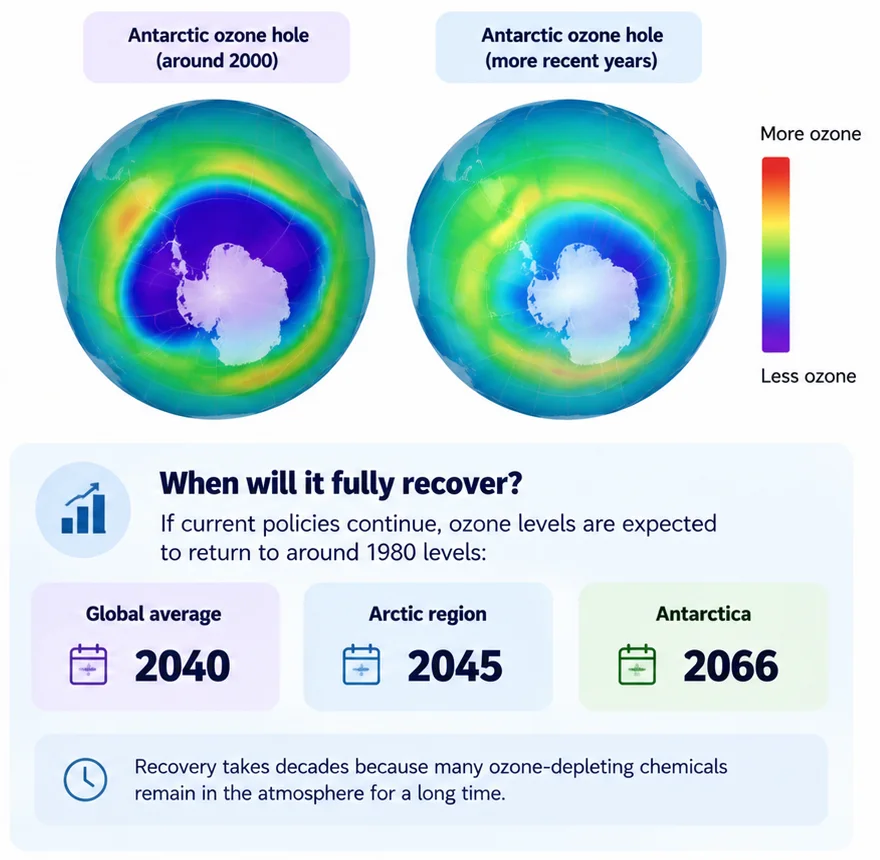
Recent observations agree with the direction of travel. NASA and NOAA ranked the 2025 Antarctic ozone hole as the fifth smallest since 1992. Its average area from 7 September to 13 October was about 18.7 million km², and the largest single-day extent was 22.86 million km² on 9 September 2025. NASA says the average size was about 30% smaller than the 2006 record hole (18.71 against 26.60 million km² on average over the season). The hole also broke up nearly three weeks earlier than usual for the past decade. Ozone-depleting substances in the Antarctic stratosphere have fallen by about a third since peaking around the year 2000.
On World Ozone Day in September 2026, the World Meteorological Organization described the 2025 hole as between the fourth and fifth smallest since 1992 and said that, since 2000, the ozone layer has been recovering. WMO Secretary-General Celeste Saulo called it “an environmental success story”.
The recovery is not finished, though. NASA’s Paul Newman said that “we still have a long way to go before it recovers to 1980s levels”. A new scientific assessment is due at the end of 2026, so check for updated recovery dates when it appears. Until then, the 2022 figures above remain the latest published ones.
Is ozone a greenhouse gas?
Yes. Ozone absorbs infrared radiation, and ozone in the lower atmosphere is listed alongside carbon dioxide, methane and nitrous oxide among the gases that warm the climate. But the two environmental stories are separate: NOAA states that ozone depletion is not the principal cause of global climate change. The big driver is the build-up of greenhouse gases, explained in our guide to the climate crisis and the greenhouse effect. The two meet in one place only: some CFC replacements are greenhouse gases, which is why the Kigali Amendment exists.
Next, we come back down to Earth, where ozone causes very different problems.
Ground-level ozone: the “bad” ozone
The same molecule that protects us in the stratosphere is a pollutant near the ground. The US EPA sums it up as “good up high, bad nearby”. Ground-level ozone is a secondary pollutant: nothing emits it directly. It forms when nitrogen oxides (NOx) and volatile organic compounds (VOCs), mainly from road vehicles, react in sunlight. It is a major part of photochemical smog.
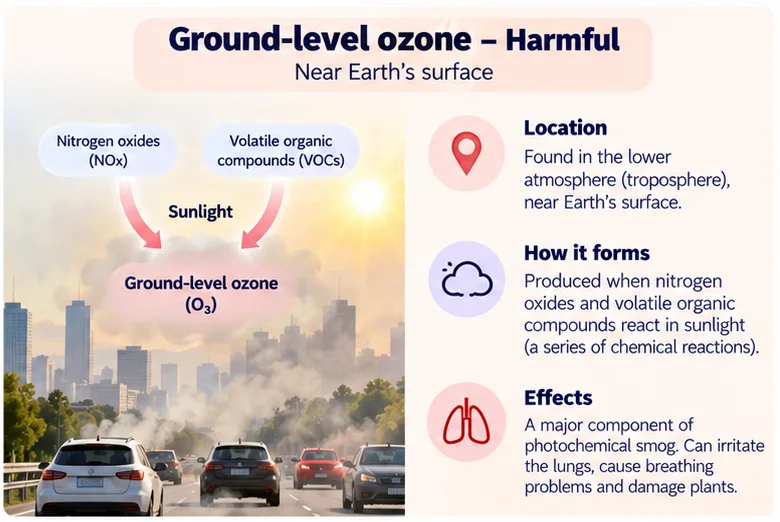
For A-level, the key step is the photolysis of nitrogen dioxide, followed by oxygen atoms joining oxygen molecules:
NO₂ + sunlight → NO + O
O + O₂ → O₃
Because the chemistry needs sunlight and time, ozone often peaks downwind of cities. Defra’s UK-AIR service notes that it often affects rural areas far from the original emission site. In busy city centres the reverse can happen: fresh traffic emits nitrogen monoxide, and NO + O₃ → NO₂ + O₂ removes ozone locally.
Health effects of ozone
Ozone is an irritant. The ILO-WHO International Chemical Safety Card lists sore throat, cough, headache, shortness of breath and laboured breathing, with lung oedema after high exposure. The US EPA states that when inhaled, ozone can damage the lungs. It can also worsen asthma and weaken the body’s defences against respiratory infection. To see which parts of the body are involved, read our overview of the human respiratory system. Ozone also damages plants and crops.
Safe limits: WHO and UK
Several bodies set limits for ozone. They use different averaging times, so compare like with like.
| Body | Limit | What it means |
|---|---|---|
| WHO 2021 guideline | 100 µg/m³ | 8-hour mean (99th percentile, so it can be exceeded on 3–4 days a year) |
| WHO 2021 guideline | 60 µg/m³ | Average over the peak ozone season |
| UK objective (Defra) | 100 µg/m³ | 8-hour mean, not exceeded more than 10 times a year |
| UK target value (Defra) | 120 µg/m³ | 8-hour mean, not exceeded more than 25 times a year, averaged over 3 years |
| UK workplace limit (HSE EH40) | 0.2 ppm (0.4 mg/m³) | 15-minute short-term exposure limit |
The WHO peak-season guideline is new in the 2021 update. Notice how much lower the outdoor figures are than the workplace limit: they protect everyone, including children and people with lung disease, over long periods.
Uses of ozone
Ozone’s great strength is also its danger: it is a very strong oxidising agent. Because it is unstable, it is always made where it is used, mostly by corona discharge (an electric discharge through dry air or oxygen). UV lamps can also make it.
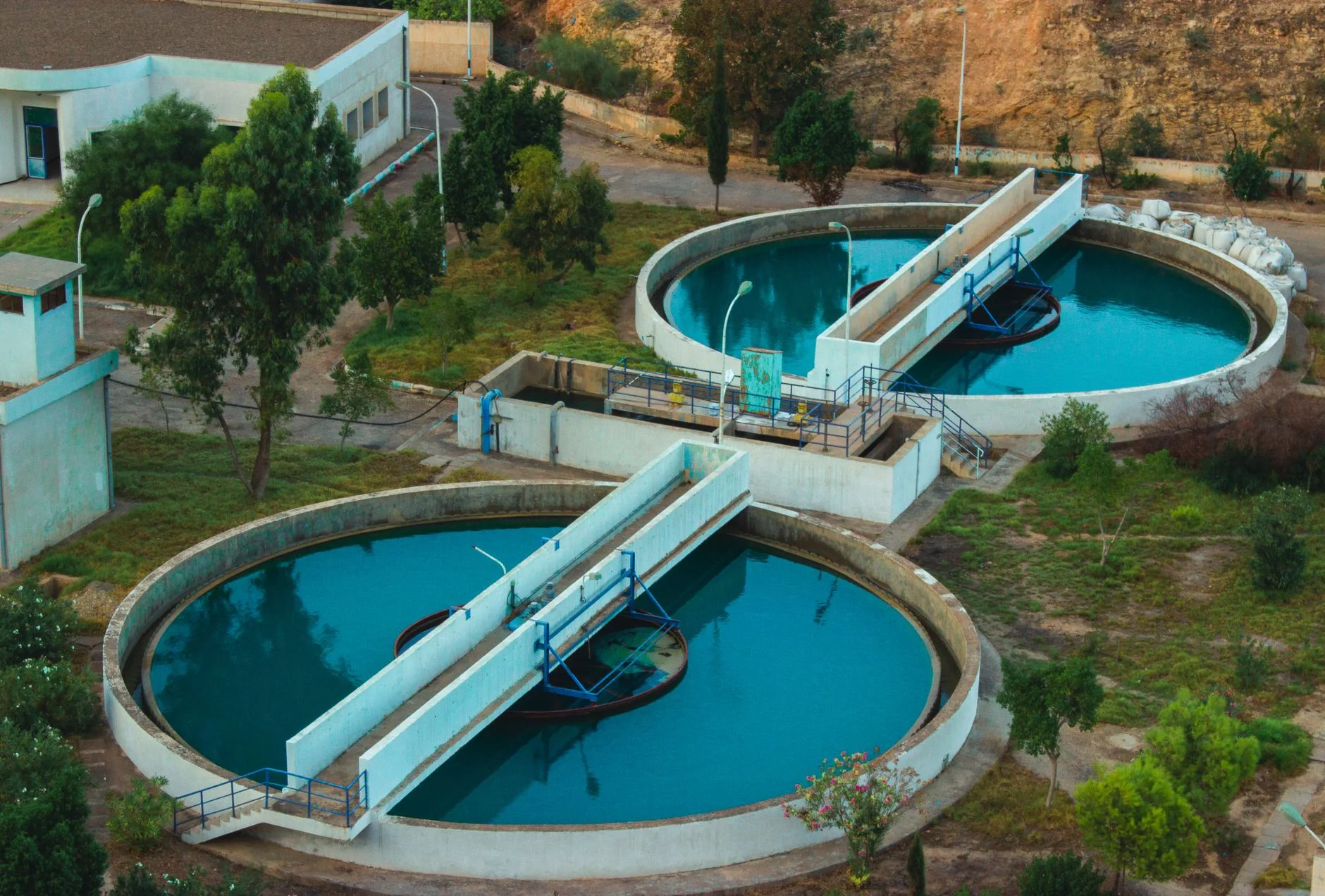
- Drinking-water treatment. It was first used for drinking water in 1893 in the Netherlands and is widely used in Europe. It needs less contact time and concentration than chlorine, chlorine dioxide or chloramine, and it also removes colour, taste and odour.
- Bleaching. Wood pulp for paper can be bleached with ozone instead of chlorine.
- Swimming pools and spas. Ozone is used alongside chlorine for disinfection.
- Chemical industry. Ozonolysis splits C=C bonds to make aldehydes and ketones, used in making chemicals and medicines.
- Odour control in empty rooms. For example after a fire, but only where nobody is present.
Ozone leaves no lasting residual in water, so a little chlorine or chloramine is still added to protect water in the pipes. In water rich in bromide, ozone can form bromate, a regulated by-product. Another water-treatment oxidant you may meet is explained in our guide to potassium permanganate (KMnO₄).
Ozone safety: generators and “ozone therapy”
Some devices are sold as home air cleaners that make ozone on purpose. The US EPA says ozone is generally ineffective in controlling indoor air pollution at concentrations that do not exceed public health standards. If one is used at all, it should be only where no person or pet is exposed.
“Ozone therapy” is no safer. US federal rule 21 CFR 801.415 states: “Ozone is a toxic gas with no known useful medical application in specific, adjunctive, or preventive therapy.” It also limits medical devices to no more than 0.05 ppm of ozone in the air circulating through them. Never inhale ozone on purpose.
In the lab, ozone is handled in a fume cupboard, and remember that it enhances the combustion of other materials, so keep it away from flammable substances.
Flip cards: test your memory
Frequently asked questions about ozone gas
What is ozone gas?
Ozone gas is O₃, a molecule made of three oxygen atoms. It is an allotrope of oxygen, a pale blue gas with a sharp smell, and a very strong oxidising agent. Most of it sits in the stratosphere, where it absorbs harmful ultraviolet radiation from the Sun.
Is ozone gas harmful to humans?
Yes, when breathed in. Ozone irritates the eyes and airways, can damage the lungs and can worsen asthma. That is why ozone near the ground is regulated as a pollutant. High up in the stratosphere it is beneficial, because it shields us from ultraviolet radiation.
What does ozone smell like?
Ozone has a sharp, pungent smell, often compared with chlorine bleach. People can detect it at a few hundredths of a part per million, which overlaps the levels that air-quality guidelines aim to stay under, so smell is a warning sign, not proof that the air is safe. You may notice it after lightning or near electrical sparks, which split oxygen molecules.
Where is the ozone layer and what does it do?
The ozone layer is in the stratosphere, mostly between about 15 and 35 km above the surface. It absorbs almost all UV-C and most UV-B radiation, which reduces sunburn, skin cancer and cataract risk. It absorbs UV rather than reflecting it, and some UV-B still reaches the ground.
What causes the hole in the ozone layer?
Man-made chemicals such as CFCs and halons. UV light in the stratosphere releases chlorine and bromine atoms, which catalyse ozone destruction. The hole forms over Antarctica because the extremely cold winter stratosphere forms polar stratospheric clouds, and the chemistry speeds up when sunlight returns in spring.
Is the ozone layer healing?
Yes. The 2022 WMO/UNEP assessment projects a return to 1980 values around 2040 globally, about 2045 over the Arctic and around 2066 over Antarctica, if current policies continue. A new assessment is due at the end of 2026, so check for updated dates.
Is ozone a greenhouse gas?
Yes. Ozone absorbs infrared radiation, and ozone in the lower atmosphere is one of the gases that warm the climate. However, NOAA states that ozone depletion is not the principal cause of global climate change. The two problems are linked but separate.
What is ozone used for?
Ozone is used to disinfect drinking water and swimming pools, to bleach wood pulp, and in industrial ozonolysis to split C=C bonds. It is made on site because it is unstable. It may also be used to control odours in unoccupied spaces.
Are ozone generators safe to use at home?
No. The US EPA says ozone is generally ineffective at cleaning indoor air at concentrations that meet public health standards, and it can damage the lungs. If one is used at all, it must only be where no person or pet is exposed.