Sunspots are darker, cooler patches on the Sun’s visible surface, created by intense magnetic fields. They affect the Earth because the same magnetic activity that forms them also launches solar flares and coronal mass ejections, which drive space weather: auroras, radio blackouts, satellite problems and, rarely, power-grid damage.
So how do sunspots affect the Earth? Mostly through what happens around them. A sunspot is a sign that the Sun’s magnetic field is tangled and strained, and when that strain snaps, energy and charged particles can head our way. Most of the time the result is a beautiful aurora. Occasionally it is something much more disruptive.
In this guide you will learn what sunspots are, why they look dark, how people have studied them for more than 400 years, and how solar storms and space weather connect the Sun to everyday life on Earth. It suits GCSE students studying the Sun, magnetism and the electromagnetic spectrum, and anyone curious about the star we orbit.
What are sunspots?
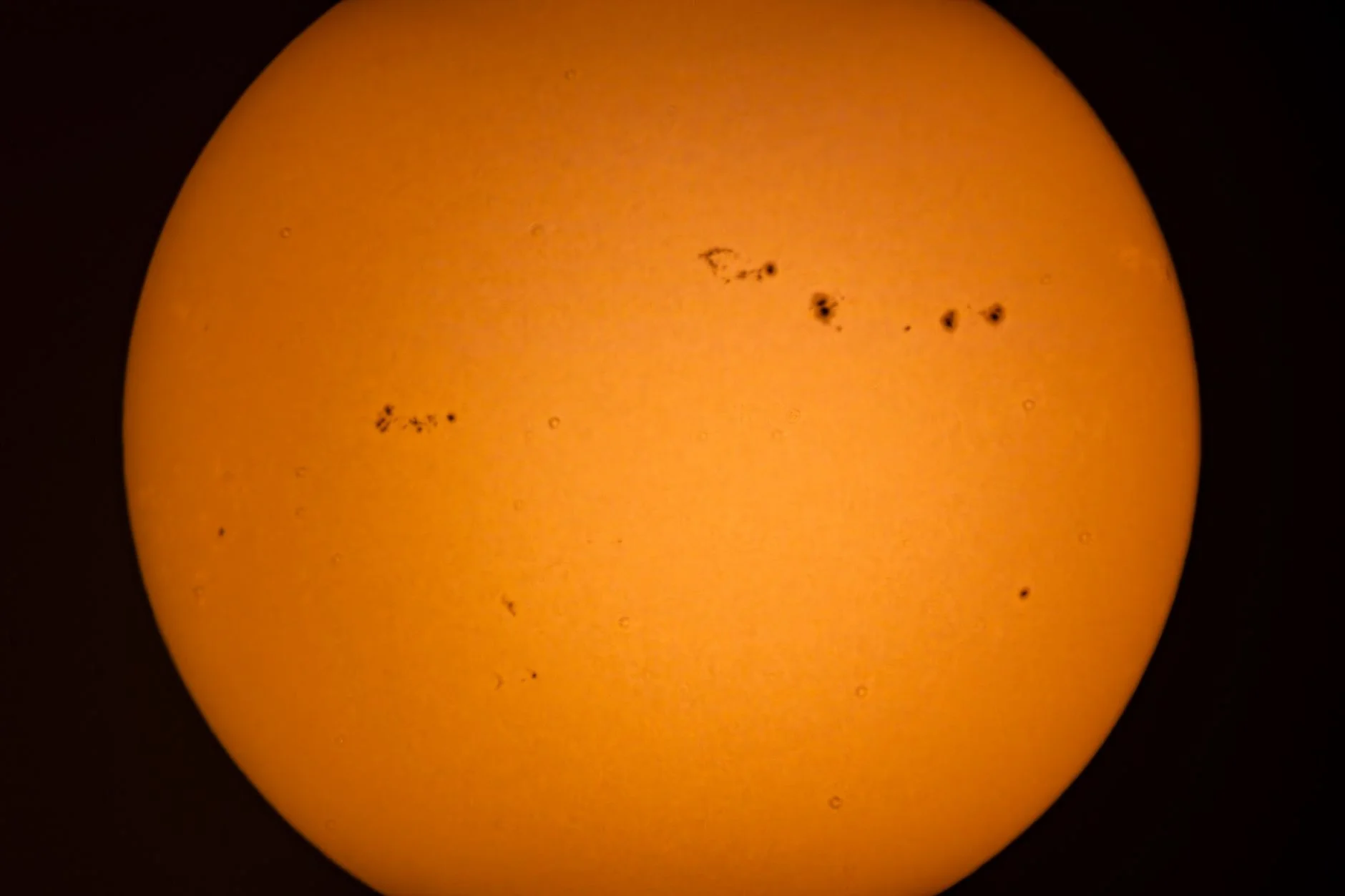
Sunspots are dark blemishes on the photosphere, the Sun’s visible surface. Many are larger than the whole Earth. They last anywhere from a few days to a few months, and they drift across the Sun’s disc as it rotates, taking about 27 days to turn once as seen from Earth.
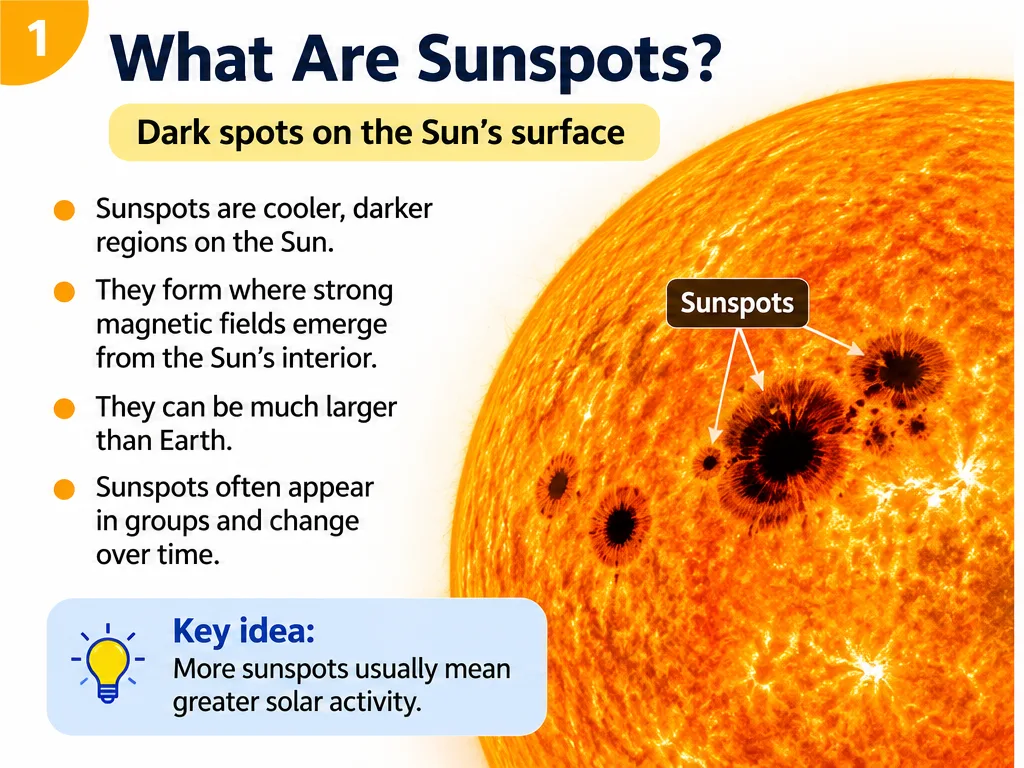
A typical sunspot has two parts. The umbra is the dark central core. Around it sits the penumbra, a lighter, fibrous fringe. Sunspots often appear in groups, and the biggest groups are the ones most likely to produce flares.
| Feature | Sunspot | Normal surface |
|---|---|---|
| Temperature | About 3,500 °C (dark core) | About 5,500 °C |
| Brightness | Looks dark by contrast | Bright yellow-white |
| Magnetic field | Thousands of times stronger than Earth’s | Much weaker |
| Size | Many are larger than Earth | Covers the whole visible disc |
| Lifetime | Days to a few months | Continuous |
Why are sunspots dark?
Sunspots are not black holes or burnt patches. They look dark only because they are cooler than their surroundings. Hotter gas glows more brightly than cooler gas, so a region at about 3,500 °C looks dim next to gas at about 5,500 °C.
So why are they cooler? Heat normally rises from inside the Sun by convection, in the same way that hot water circulates in a pan. Inside a sunspot, the magnetic field is so strong that it inhibits convection, so less heat is carried up to the surface. The patch cools, and it looks dark.
Sunspots and magnetism
Sunspots are, at heart, magnetic features. The Sun is a ball of hot, electrically charged gas called plasma, and moving plasma generates magnetic fields. Because the Sun spins faster at its equator than near its poles, these fields get twisted and stretched. Where bundles of field lines burst through the surface, a sunspot forms.
The magnetic fields in sunspots are thousands of times stronger than Earth’s own field. If you want to compare them with the most powerful magnets people can build, see our guide to the strongest magnets.
A short history of sunspot watching
People noticed sunspots long before telescopes existed, and the story of how we came to understand them runs through some of the biggest names in science.
- Ancient China: astronomers recorded dark spots on the Sun with the naked eye, usually when haze or dust dimmed the glare.
- 1610–1611: Thomas Harriot, Galileo Galilei, Christoph Scheiner and Johannes Fabricius all observed sunspots through early telescopes at around the same time.
- 1843: German amateur astronomer Samuel Heinrich Schwabe announced that sunspot numbers rise and fall in a cycle of about 11 years.
- 1908: George Ellery Hale showed that sunspots are magnetic, the first evidence of magnetic fields beyond Earth.
- Today: spacecraft and giant ground-based telescopes track the Sun around the clock, and we know the Sun’s magnetic poles flip every cycle, giving a full magnetic cycle of about 22 years.
Schwabe’s discovery is a lovely example of patient science. He observed the Sun on almost every clear day for years before the pattern showed up in his records. Hale then explained why the spots form, linking sunspots to magnetism for the first time.
The 11-year solar cycle
Sunspots do not appear at a steady rate. Their number rises and falls in a rhythm called the solar cycle, which lasts about 11 years on average, although individual cycles have ranged from roughly 9 to 14 years. At solar minimum the Sun's face can be blank for days. At solar maximum it can carry dozens of spots at once.
The German astronomer Samuel Heinrich Schwabe spotted the pattern in 1843 after years of counting sunspots. The explanation came later. George Ellery Hale showed in 1908 that sunspots are magnetic, and we now know the cycle is driven by the Sun's changing magnetic field. The field becomes tangled as the Sun rotates, bursts through the surface as sunspots, and then relaxes again.
There is a twist. Around the time of solar maximum, the Sun's magnetic poles swap over, so north becomes south and south becomes north. It takes two sunspot cycles for the field to return to how it started, which makes the full magnetic cycle about 22 years long.
Where are we now? Solar Cycle 25
Solar Cycle 25 began in December 2019. Forecasters expected a fairly modest peak, but the Sun had other ideas. On 15 October 2024 NASA and NOAA announced that the Sun had reached its solar maximum period, and that activity had exceeded predictions. The strongest flare of the cycle so far was an X9.0 on 3 October 2024.
Solar maximum is not a single day. It is a stretch of months to years when activity stays high, and scientists only recognise the true peak looking back. Activity will decline over the next few years toward the next minimum, expected around 2030. That does not mean the danger vanishes: big flares and storms can still happen on the way down.
Sunspots and solar activity
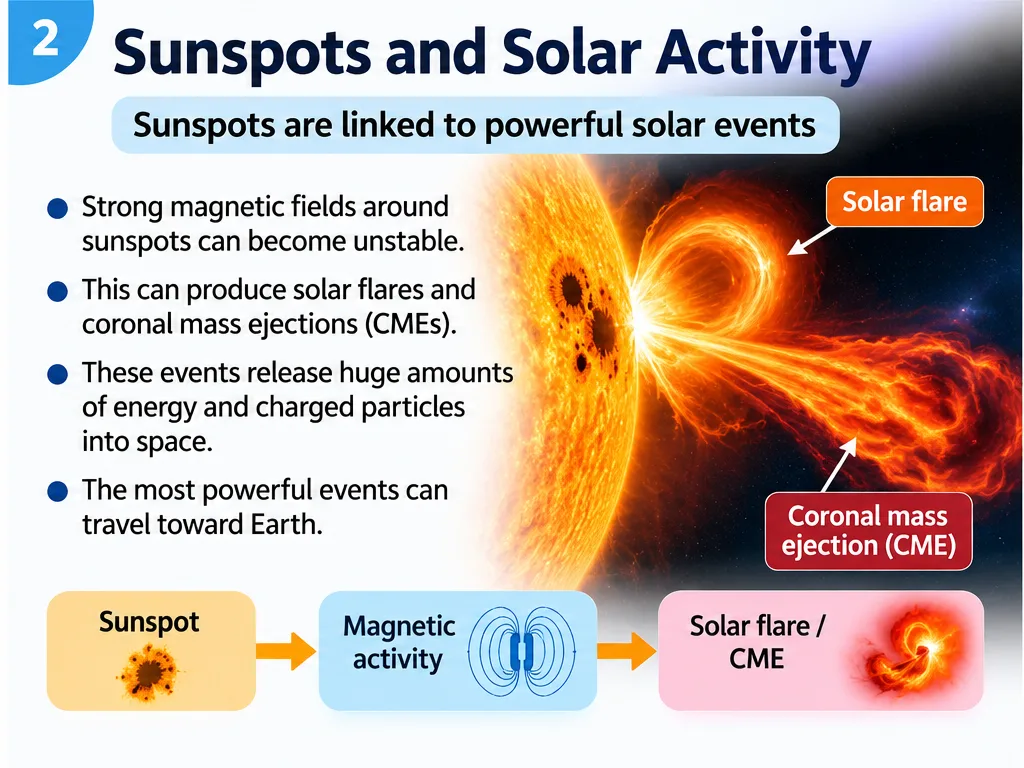
Sunspots are more than dark blemishes. They mark places where very strong magnetic fields push up through the surface, and those fields store huge amounts of energy. When the field lines snap and reconnect, that energy is released in a sudden burst. This is why sunspot groups are the starting point for most of the Sun's violent behaviour, and why watching them is the foundation of space weather forecasting.
There are two main kinds of eruption, and they affect Earth in very different ways.
Solar flares
A solar flare is a sudden burst of radiation released when magnetic energy is let go near a sunspot. Flares give out light and X-rays across the electromagnetic spectrum. Because this radiation travels at the speed of light, it reaches Earth in about 8 minutes 20 seconds, with no time to react.
Flares are ranked by strength using five letters. Each class is ten times stronger than the one before it.
| Class | Strength compared with the class below | Order of strength |
|---|---|---|
| A | Weakest class | Smallest |
| B | 10 times stronger than A | ×10 |
| C | 10 times stronger than B | ×100 compared with A |
| M | 10 times stronger than C | ×1,000 compared with A |
| X | 10 times stronger than M | ×10,000 compared with A |
Within a class, a number gives finer detail, so an X9.0 flare is roughly nine times stronger than an X1.0. The X9.0 flare of 3 October 2024 was the biggest of Cycle 25 at the time of writing.
On Earth, the flare's X-rays and ultraviolet light disturb the upper atmosphere on the daylit side of the planet. The result can be a radio blackout, when high-frequency radio signals fade or vanish for a while. The atmosphere shields us at ground level, so flares do not harm people on the surface.
Coronal mass ejections
A coronal mass ejection (CME) is a different beast. Instead of light, it is a giant cloud of magnetised plasma, containing billions of tonnes of material, thrown out into space. Flares and CMEs often happen together, but not always, and one can occur without the other.
Matter is far slower than light. A typical CME takes about one to three days to cross the gap to Earth, although the fastest ones have made the trip in around 15 to 18 hours. That delay is useful, because it gives forecasters a chance to warn power companies and satellite operators.
When a CME reaches Earth it meets our planet's magnetic shield, the magnetosphere. A strong hit shakes it violently and triggers a geomagnetic storm. NOAA rates these on the G scale, from G1 (minor) to G5 (extreme). So the next time you read about a solar storm, you can think of it as a flare for the quick flash and a CME for the slow punch.
How solar activity reaches Earth
Put the pieces together and you can follow the whole chain, from a sunspot to a problem on the ground. First, the magnetic field above a sunspot group becomes unstable. Next, a flare lights up, and its radiation arrives within minutes. If a CME was launched too, it travels out through space and, if it is aimed our way, hits the magnetosphere a day or two later. The magnetosphere then channels charged particles toward the poles, where they create auroras and can disturb electric currents in the ground and in our technology.
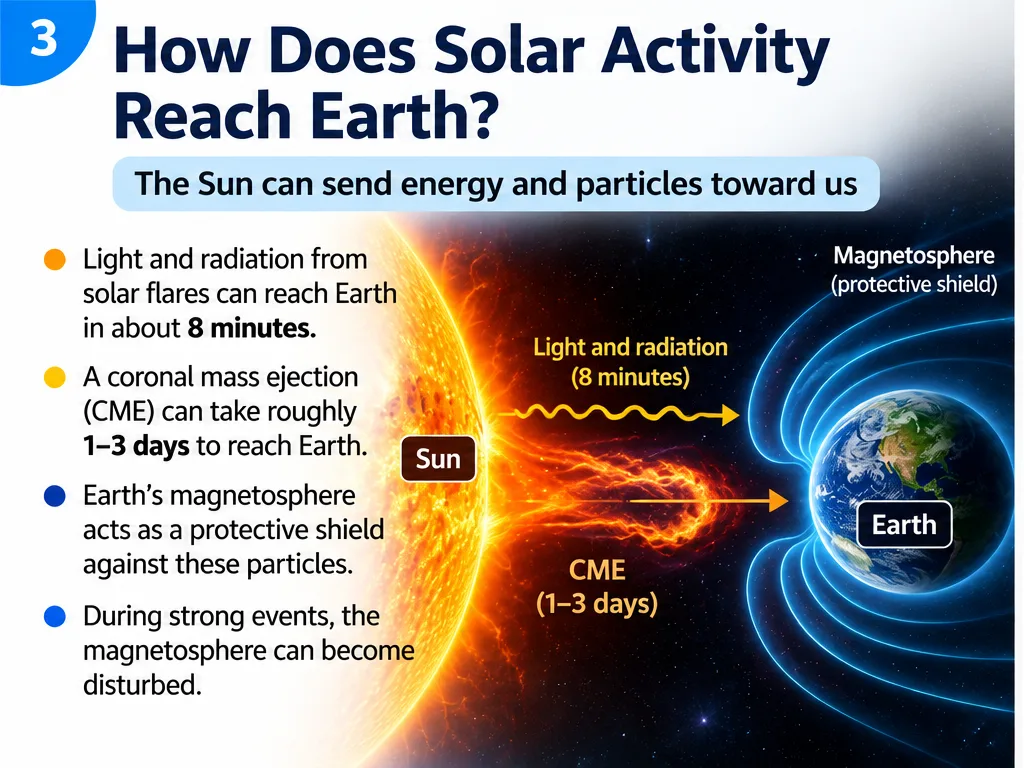
That timeline explains why space weather forecasters keep an eye on both the speed and the direction of each eruption. A CME that blasts off the far side of the Sun is almost harmless to us. One launched straight at Earth is a different matter. Spacecraft stationed between the Sun and Earth, such as DSCOVR, can give roughly 15 to 60 minutes of final warning as a CME arrives.
How hard would a given CME hit? Try the calculator below. Enter a launch speed and see how long a CME might take to reach Earth.
The aurora connection: how solar storms light up the sky
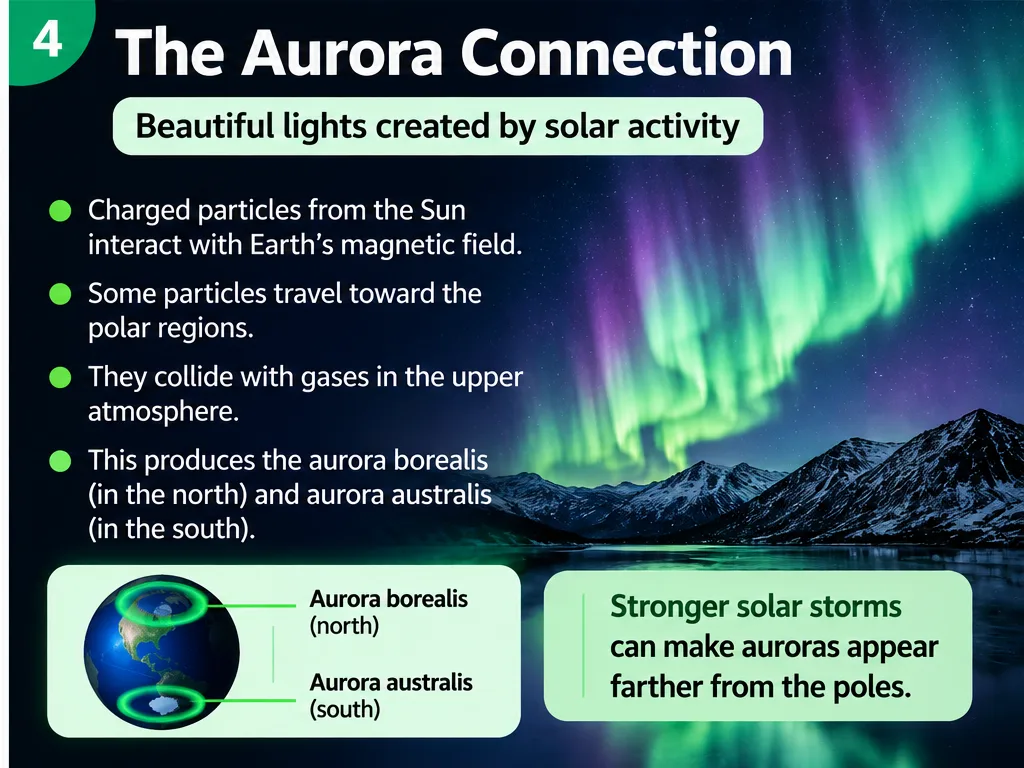
The most beautiful answer to “how do sunspots affect the Earth?” appears in the night sky. When a coronal mass ejection (CME) or a stream of fast particles from an active region reaches us, charged particles are guided by Earth’s magnetic field towards the polar regions. There they collide with gases in the upper atmosphere and make them glow. We call the result the aurora: the northern lights (aurora borealis) and southern lights (aurora australis).
Why are auroras different colours?
The colour depends on which gas is hit and how high up the collision happens. Different gases glow in different colours, a bit like the neon in a shop sign.
- Green: collisions with oxygen at roughly 100–250 km up. This is the most common aurora colour.
- Red: oxygen again, but higher in the atmosphere.
- Blue and purple: collisions with nitrogen.
During a quiet spell, auroras stay close to the polar regions. During a strong geomagnetic storm, the glowing oval expands, pushing auroras to much lower latitudes than usual. That is why people far from the Arctic Circle sometimes get a surprise show.
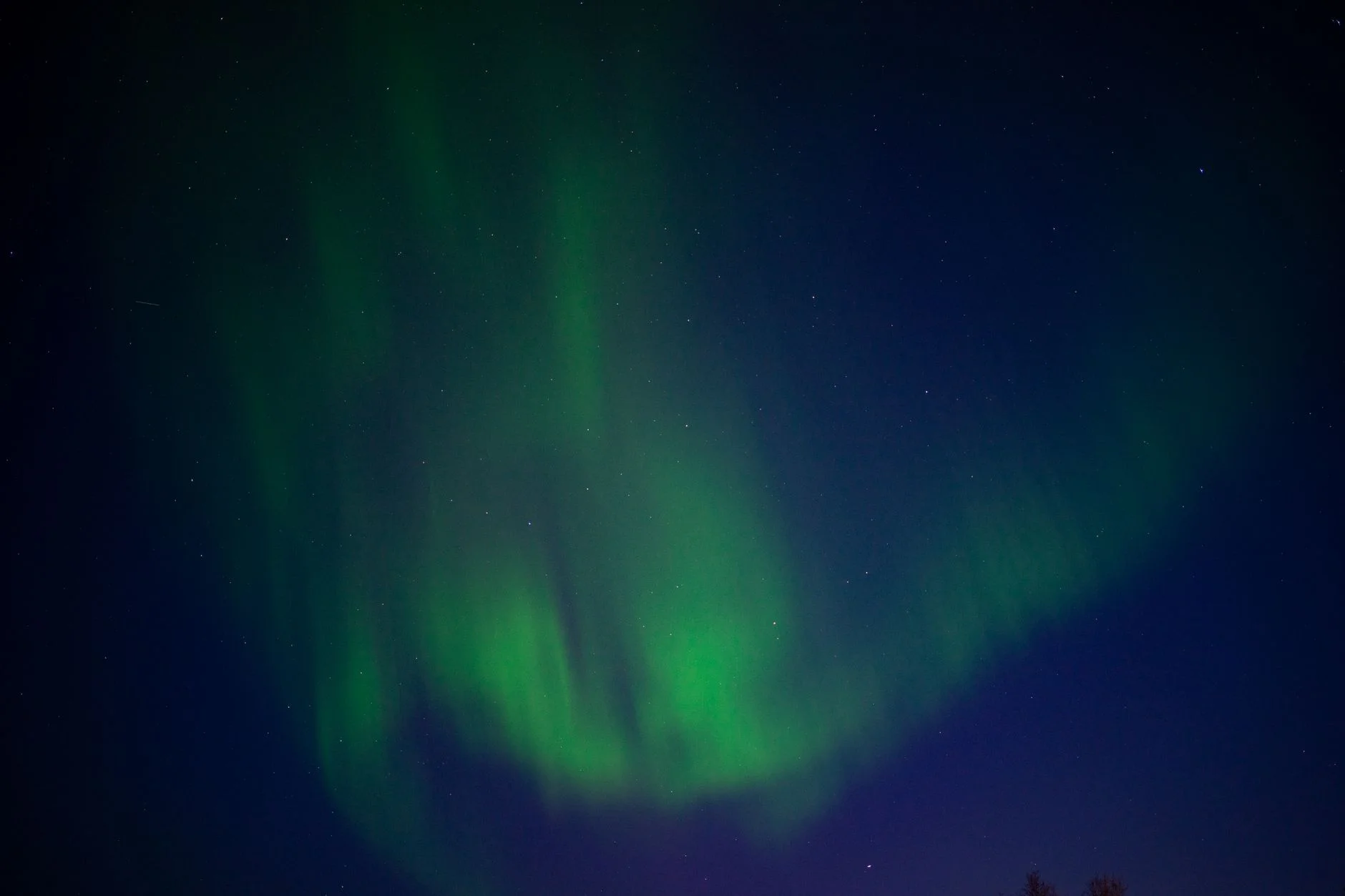
That storm came during solar maximum, when sunspots are at their most numerous and the Sun’s magnetic fields are at their most tangled. Space weather forecasters rate storms on the NOAA G1–G5 scale, where G1 is minor and G5 is extreme.
Can sunspots affect technology?
Sunspots themselves are far away and harmless to us. The trouble comes from the flares and CMEs that burst out of the magnetic regions around them. Modern life depends on radio, satellites and electricity networks, so space weather matters more than ever. Here are the main ways solar storms can affect technology.
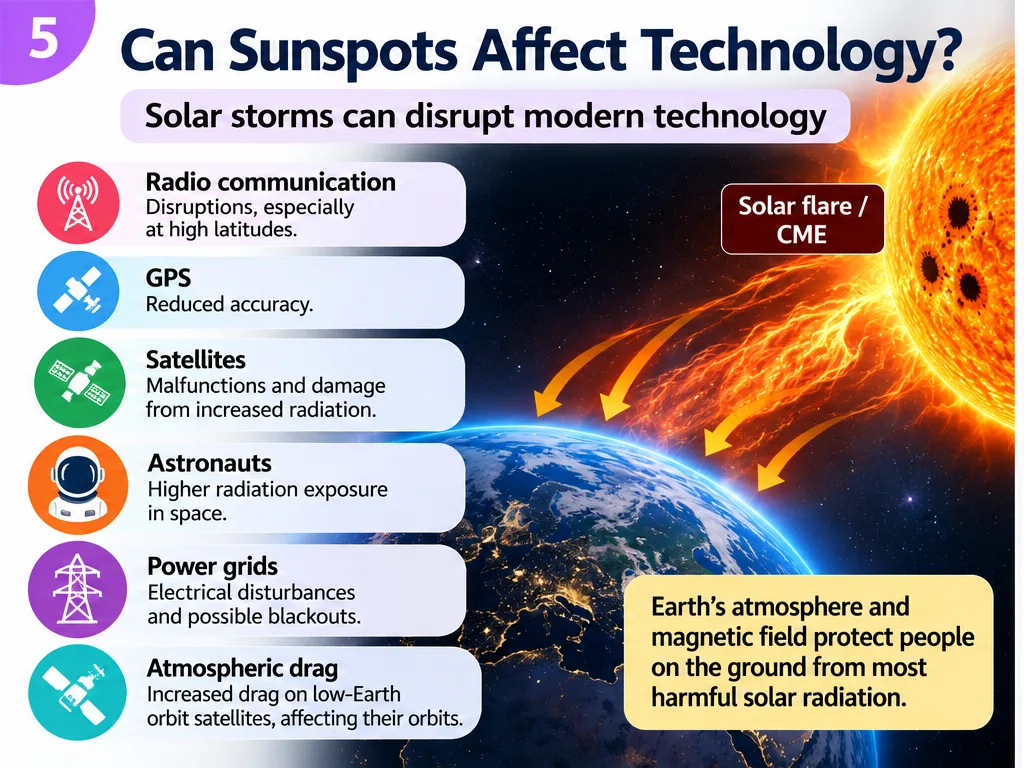
- Radio: X-rays from a solar flare arrive in about 8 minutes 20 seconds and can cause HF radio blackouts on the daylit side of Earth. Aircraft and ships that rely on HF radio can lose contact for a time.
- GPS: disturbances in the upper atmosphere can introduce errors into satellite navigation signals.
- Satellites: storms can damage electronics, and they heat and expand the upper atmosphere, which increases drag on satellites in low orbit. In February 2022, about 38 of 49 newly launched Starlink satellites were lost after a geomagnetic storm increased atmospheric drag. Crowded orbits and dead satellites add to the wider problem of space junk.
- Power grids: a fast-changing magnetic field can drive geomagnetically induced currents through long conductors such as power lines. On 13 March 1989, a storm caused a blackout across Quebec that lasted about 9 hours and affected 6 million people.
- Pipelines: the same induced currents can speed up corrosion in long metal pipelines.
- Astronauts: people outside Earth’s protective magnetic field, or in orbit, face a higher radiation risk during strong storms. This is one challenge for anyone exploring the universe beyond our atmosphere.
- Aviation: airlines can reroute flights away from polar routes during strong storms.
Space weather is not always bad news for technology. Solar panels, for example, depend on sunlight, so it is natural to wonder whether a stormy Sun helps or harms them. Total sunlight output changes very little over the cycle, so everyday solar energy keeps working as normal. The risk to a solar farm comes from storm-induced currents in the grid it connects to, not from the sunspots themselves.
Famous storms: tap to find out what happened
History gives us plenty of examples of the Sun hitting back. Test your memory with these six cards.
Notice the pattern: the Sun is not “attacking” us. These events are a reminder that we live inside the Sun’s extended atmosphere, and that our technology is more exposed to it every decade.
The Carrington Event: the biggest storm on record
On 1–2 September 1859 the Sun produced the most famous space weather event in history. Two British astronomers, Richard Carrington and Richard Hodgson, were each observing a large group of sunspots on 1 September 1859 when they saw a patch of the Sun flash brilliantly white. They had witnessed a white-light flare, one of the first ever recorded.
The consequences reached Earth only about 17 hours later. Telegraph systems sparked, and some operators found their equipment kept working even with the batteries disconnected. Auroras were seen near the tropics, far from the poles where they normally appear.
No storm as strong has hit Earth since – although a similar eruption narrowly missed us in July 2012 – which is why the Carrington Event is the benchmark for the worst-case scenario. In 1859 the technology at risk was a few telegraph wires. Today it is power grids, satellites, GPS and radio. A similar storm now could cause major disruption and could be very costly, which is one reason space weather is taken seriously by governments.
The same sunspots that make the Sun look “spotty” are the places where such storms begin. If you want the wider story of how a storm travels from the Sun to Earth, the sections above on flares and coronal mass ejections explain each step.
Do sunspots affect Earth’s climate?
This is one of the most common questions about sunspots, and the honest answer is: only slightly, and not in the way people often claim. When there are more sunspots the Sun is a touch brighter overall, because bright regions around the spots more than make up for the dark patches. But the total solar irradiance changes by only about 0.1 % over the 11-year cycle.
That is a very small wobble compared with the changes in greenhouse gases that have built up in the atmosphere. You can read how that works in our guide to global warming and the greenhouse effect.
The Maunder Minimum
Between about 1645 and 1715 astronomers saw very few sunspots. This period is called the Maunder Minimum, and it overlapped part of the “Little Ice Age” in Europe. It is tempting to link the two, but scientists think volcanic eruptions and other factors mattered more. The Maunder Minimum shows that the Sun can change, not that sunspots control our weather.
Why do sunspots matter? Forecasting space weather
Sunspots matter because they are the early warning sign. A big, tangled group of sunspots has strong magnetic fields, and that is where flares and coronal mass ejections are most likely to erupt. Watching sunspots lets forecasters predict space weather, much as clouds and pressure charts help predict rain.
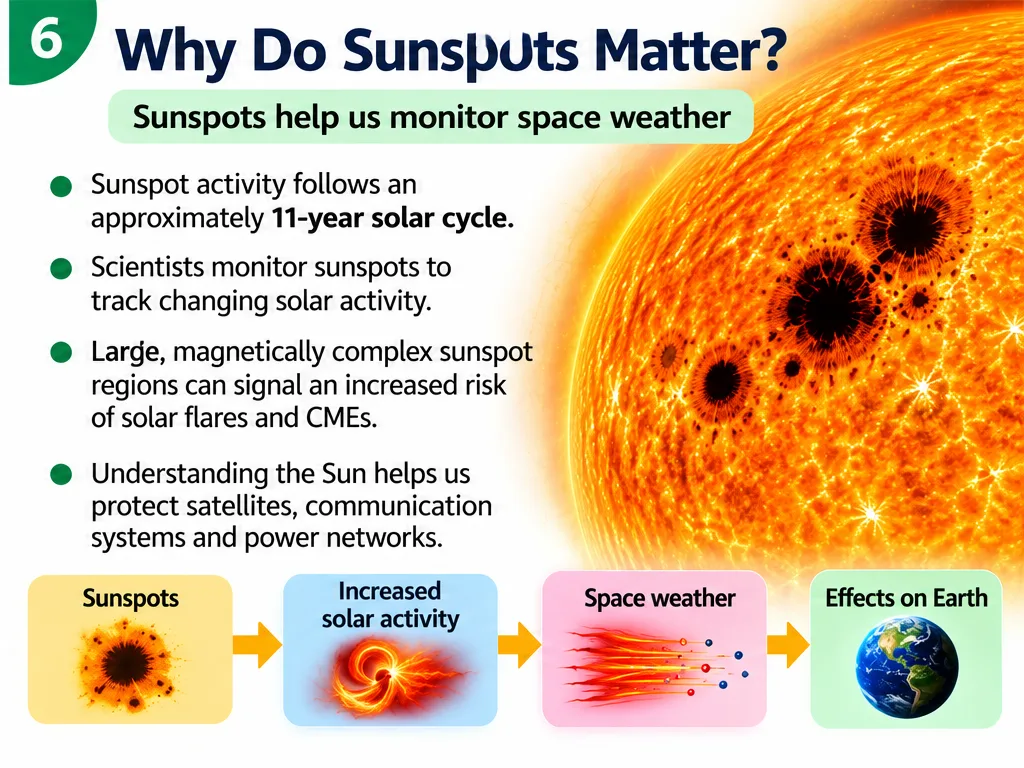
Several organisations do this job every day. The NOAA Space Weather Prediction Center in the USA and the Met Office Space Weather Operations Centre in the UK, which has run since 2014, issue forecasts and alerts. They rely on spacecraft that watch the Sun from space:
- SOHO (1995, ESA/NASA) has watched the Sun for decades.
- Solar Dynamics Observatory (2010) takes detailed images of sunspots and flares.
- Solar Orbiter (2020, ESA/NASA) studies the Sun from close range.
- DSCOVR, positioned at the L1 point between the Earth and the Sun, measures the solar wind and gives roughly 15–60 minutes’ warning of an arriving coronal mass ejection.
- Parker Solar Probe made the closest-ever approach to the Sun on 24 December 2024, passing 6.1 million km from its surface.
On the ground, the Daniel K. Inouye Solar Telescope in Hawaii, the largest solar telescope, studies sunspot magnetism in fine detail. To understand where the Sun itself came from, see the origin of our Solar System.
How to see sunspots safely
You can watch sunspots yourself, but only with the right method. Looking at the Sun can permanently damage your eyes, so the safe approach is to look at an image of the Sun rather than the Sun itself. Work through this checklist before you start.
- Never look at the Sun directly, and never through binoculars or a telescope without a proper certified solar filter.
- Choose a pinhole or solar projection method, so you look at an image on a surface and not at the Sun.
- For pinhole projection, make a small hole in card and let sunlight fall through it onto a white sheet held a short distance behind, with your back to the Sun.
- For a closer look, use a telescope or binoculars fitted with a certified solar filter over the front lens, and ask an experienced astronomer or a local astronomy society to help.
- Draw what you see each day and mark the date and time on every sketch.
- Compare your drawings over a week or two to watch the spots move across the disc as the Sun rotates.
Because the Sun rotates once in about 27 days as seen from Earth, a spot that appears on one edge takes roughly two weeks to cross to the other. Your sketches will show it moving, and sometimes growing or fading.
Test yourself
Key points
- Sunspots are cooler, darker regions on the Sun’s surface caused by intense magnetic fields.
- They follow an 11-year cycle, and solar flares and coronal mass ejections are most likely near large sunspot groups.
- The Carrington Event of 1859 is the largest storm on record, and a similar one today could be very costly.
- Sunspots change the Sun’s output by only about 0.1 %, and solar changes do not explain recent global warming.
- Spacecraft such as SOHO, DSCOVR and Parker Solar Probe, plus forecasters at NOAA and the Met Office, help us predict space weather.
- Observe the Sun only by projection or with a certified solar filter, never directly.
Frequently asked questions about sunspots
What are sunspots?
Sunspots are darker, cooler regions on the Sun’s visible surface, the photosphere. Their dark cores are about 3,500 °C, compared with roughly 5,500 °C around them. Intense magnetic fields cause them, and many are larger than Earth. They last from days to a few months.
Why are sunspots dark?
Sunspots look dark only by contrast. Their strong magnetic fields inhibit convection, which normally carries heat up from inside the Sun, so they are cooler than their surroundings. An isolated sunspot would still shine brightly if you could see it on its own against a dark sky.
How do sunspots affect the Earth?
Sunspots themselves have little direct effect, but the magnetic regions around them produce solar flares and coronal mass ejections. These can cause radio blackouts, GPS errors, satellite problems, power-grid disturbances and auroras. Their effect on climate is very small, because the Sun’s output changes by only about 0.1 %.
How long is the sunspot cycle?
The sunspot cycle lasts about 11 years, although it can vary from roughly 9 to 14 years. Samuel Heinrich Schwabe discovered it in 1843. The Sun’s magnetic poles flip every cycle, so the full magnetic cycle takes about 22 years.
Are we at solar maximum now?
NASA and NOAA announced on 15 October 2024 that the Sun had reached the solar maximum period of Solar Cycle 25, which began in December 2019. Activity exceeded predictions. It will decline over the next few years toward a minimum around 2030.
Can a solar storm knock out power?
Yes, in some cases. Geomagnetically induced currents can damage power grids. On 13 March 1989 a geomagnetic storm caused a blackout of about nine hours in Quebec, affecting around six million people. Forecasts and warnings now give grid operators time to prepare.
Do sunspots cause global warming?
No. Total solar irradiance varies only about 0.1 % over the sunspot cycle, and the IPCC concludes that solar changes do not explain recent global warming. The warming trend continues whether the Sun is near maximum or minimum, so sunspots are not the cause.
What was the Maunder Minimum?
The Maunder Minimum was a period from about 1645 to 1715 when very few sunspots were seen. It overlapped part of the “Little Ice Age”, but scientists think volcanic eruptions and other factors mattered more than the quiet Sun in cooling the climate.
How can I observe sunspots safely?
Never look at the Sun directly, or through binoculars or a telescope without a proper certified solar filter. Safe options are pinhole projection or solar projection, where you look at an image of the Sun on a white surface. Draw what you see over several days.