Space junk, also called space debris, is every non-functional human-made object orbiting Earth: dead satellites, spent rocket stages, fragments from explosions and collisions, flecks of paint and even lost tools. More than 45,000 objects are tracked from the ground, and more than a million smaller pieces are circling out of sight at about 28,000 km/h. Left alone, the problem gets worse, which is why how to solve space junk has become one of the biggest questions in modern spaceflight.
This guide explains what space junk is, how much of it there is, why it is so dangerous (with the GCSE physics behind it), and the three-step plan scientists and engineers are using to clean up Earth’s orbit.
What is space junk?
Since Sputnik 1 launched in 1957, thousands of rockets have carried satellites into orbit. Almost everything we have sent up is still there in some form, or is in the slow process of falling back. Anything that no longer does a useful job counts as space debris.
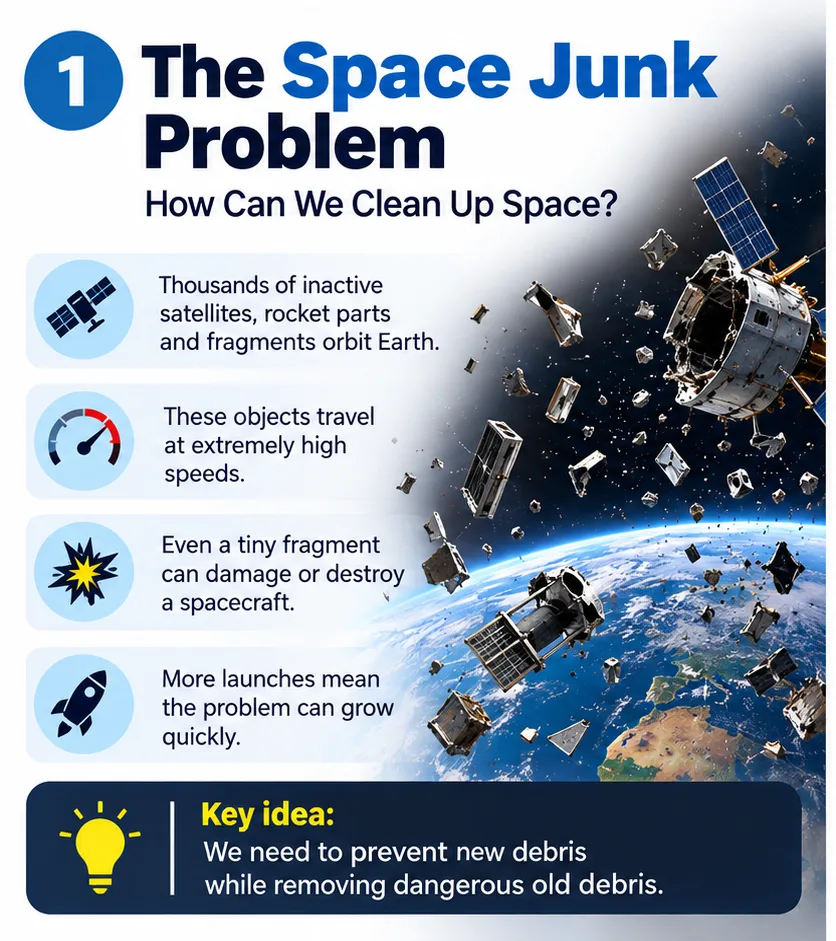
Space junk comes in several main types:
- Dead satellites: spacecraft that have run out of fuel or power, or that simply failed, and drift without control.
- Spent rocket stages: the upper parts of launch vehicles, often large, heavy and left in orbit after delivering their payload.
- Fragments: thousands of pieces created when old rocket stages or satellites explode (usually from leftover fuel or batteries) or when objects collide.
- Tiny particles: paint flecks, bolts, insulation and frozen coolant. They are small, but they are moving extremely fast.
- Lost equipment: gloves, tools and other items dropped or released during missions.
Not all of this is “junk” in the way we use the word on Earth. Of the more than 45,000 tracked objects, only about 11,000 are active satellites. The rest is debris, and the total mass of everything in orbit is now more than 15,000 tonnes, according to ESA (the European Space Agency).
How much space junk is there?
Nobody can count every fragment, so scientists combine what radars and telescopes can see with statistical models. The result, based on ESA estimates, is a rough picture of how the numbers grow as the pieces get smaller.
| Size of object | Approx. number in orbit | Danger |
|---|---|---|
| Larger than 10 cm | Tens of thousands — more than 45,000 tracked and catalogued (including working satellites) | Can destroy a satellite |
| Larger than 1 cm | More than 1 million | Can disable a satellite |
| Larger than 1 mm | Well over 100 million | Can damage sensitive parts such as sensors and windows |
The key point is that the pieces we can track are only a tiny fraction of the total. Tracking systems typically follow objects larger than about 10 cm in low Earth orbit (some radars can spot pieces down to about 5 cm). The millions of smaller fragments are invisible to them, yet they are still dangerous.
Why is space junk so dangerous?
The secret is speed. In low Earth orbit, objects travel at about 7–8 km/s, or roughly 28,000 km/h. When two objects meet at different angles, the average collision speed is about 10 km/s. That is many times faster than a rifle bullet, so even a tiny object carries a huge amount of energy.
This is where the physics comes in. Kinetic energy depends on mass and, crucially, on the square of speed:
KE = ½ m v²
Here KE is kinetic energy in joules (J), m is mass in kilograms (kg) and v is speed in metres per second (m/s). Because speed is squared, doubling the speed makes the energy four times bigger. If you want to revisit how forces and motion fit together, our guide to Newton’s laws of motion is a good place to start.
Now try a real example. A 1 cm aluminium sphere has a mass of about 1.4 g (0.0014 kg). Travelling at 10 km/s (10,000 m/s):
KE = ½ × 0.0014 × 10 000² ≈ 70 000 J
That is about 70,000 joules from an object the size of a marble, delivered in an instant, similar to the energy of a 1,000 kg car travelling at about 40 km/h. This is why a 1 cm piece can disable a satellite and why anything larger than 10 cm can destroy one completely.
Try it yourself with the calculator below. Change the mass and speed of a piece of debris and see how much energy it would carry on impact.
Kessler syndrome: the chain reaction
In 1978, NASA scientists Donald Kessler and Burton Cour-Palais proposed an unsettling idea. If enough objects crowd a region of orbit, one collision creates fragments, those fragments cause more collisions, and the cycle feeds itself. This runaway process is now called Kessler syndrome.
Think of a game of snooker where the break never stops. Each ball you hit sends out more balls, and every new ball is another chance of a collision. In orbit, the "balls" are travelling at around 10 km/s relative to each other, so even tiny pieces hit with enormous energy.
Kessler syndrome is not a sudden disaster that happens overnight. It is a slow, spreading problem. A single collision can add thousands of new pieces, and each piece can stay in orbit for years, decades or centuries depending on its height. That is why the busiest orbits, at a few hundred to a thousand or so kilometres above us, are the ones scientists worry about most.
The key point for GCSE physics is that the danger depends on how many objects share the same space and how fast they move. More objects means more collisions, and more collisions means more objects. Cleaning up even a few of the largest pieces cuts the chance of a chain reaction starting.
Events that made the space junk problem worse
Most space debris was not created by a single dramatic moment. It built up gradually from rocket stages and dead satellites. A few events, however, caused sudden jumps. Here are the ones that matter most, in date order.
- 2007: China’s anti-satellite (ASAT) test. A missile destroyed the weather satellite Fengyun-1C. It produced over 3,000 trackable fragments, the largest single debris event on record, and many pieces remain in high orbits where they will stay for a very long time.
- 2009: Iridium 33 and Kosmos-2251. A working American communications satellite collided with a defunct Russian one. It was the first accidental collision between two intact satellites, and it created roughly 2,000 tracked fragments.
- 2021: Russia’s ASAT test on Kosmos 1408. The test created around 1,500 trackable fragments. The ISS crew were told to shelter in their spacecraft as a precaution while the debris cloud passed near the station’s orbit.
- April 2022: the US moratorium. The United States announced it would not carry out destructive direct-ascent ASAT missile tests.
- December 2022: the UN General Assembly resolution. The assembly passed a resolution calling on all countries to adopt a similar moratorium.
Notice the pattern. The biggest event was a deliberate destruction of a satellite, the second biggest (2009) was an accident that better tracking and coordination might one day prevent, and the 2021 test showed the danger had not gone away. Space travel has always carried risks, and our guide to failures in space travel shows how many of them come from small mistakes with large consequences.
Can space junk fall on Earth?
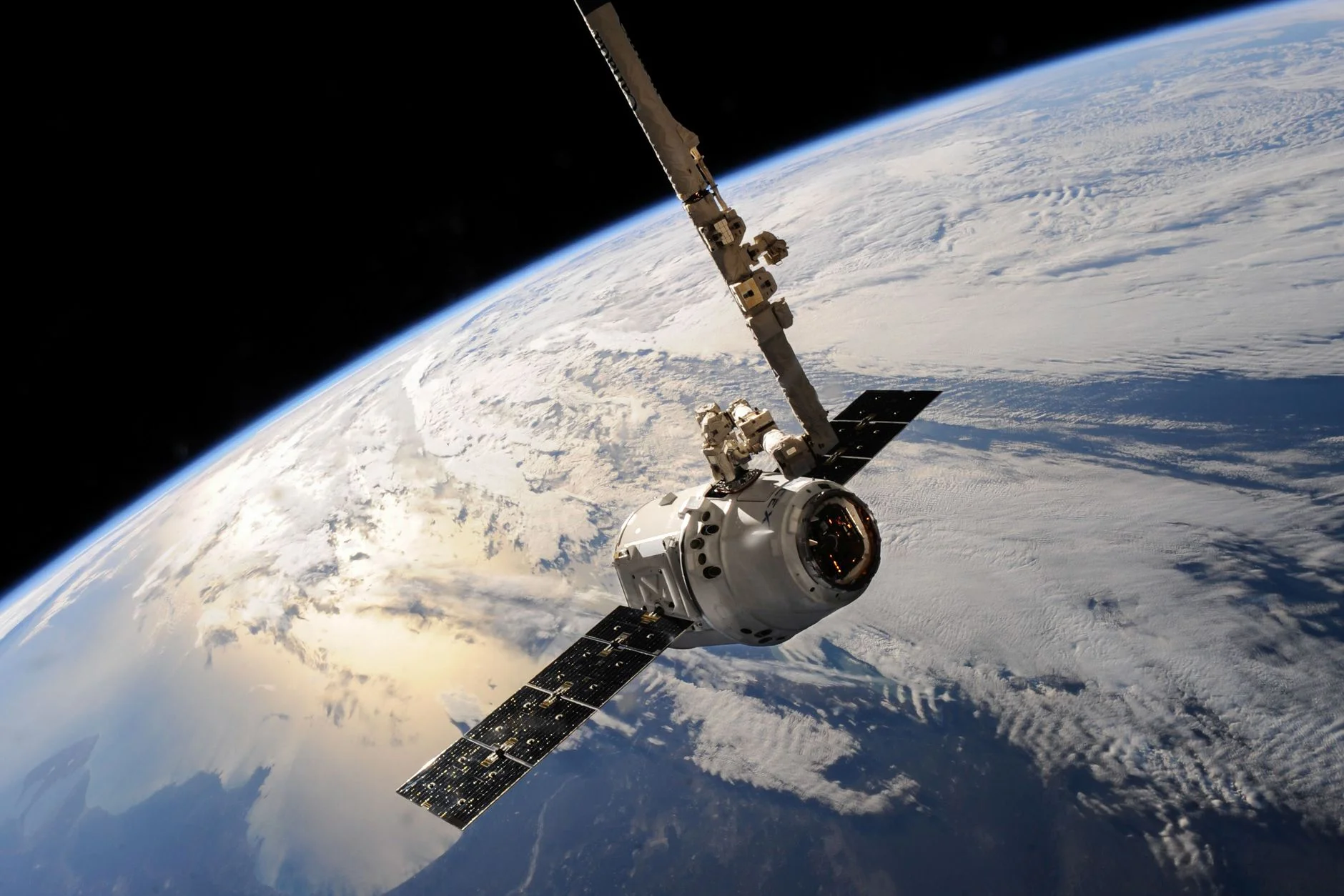
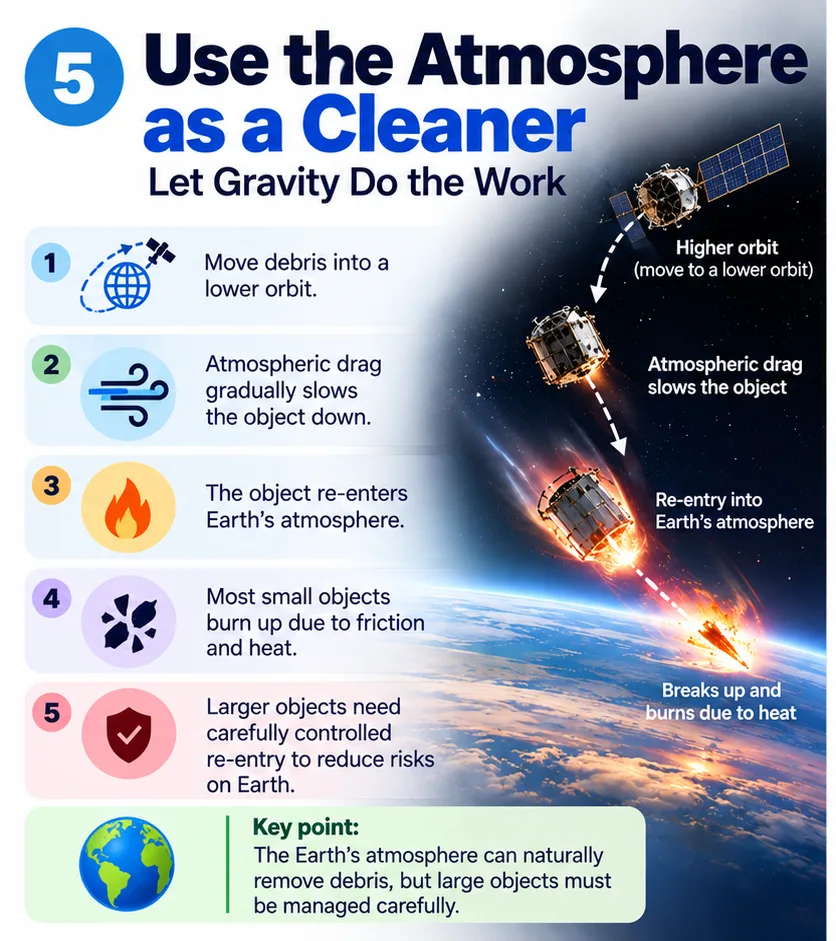
Yes, and it does so all the time. Satellites and rocket parts in low Earth orbit are slowed by a thin trace of atmosphere. This atmospheric drag makes their orbits shrink until they dip into denser air and re-enter.
How long that takes depends mainly on height:
- Below about 400 km, objects usually re-enter within months to a few years.
- At around 800 km, the process takes decades to centuries.
- Above about 1,000 km, objects can stay up for centuries or longer.
This is why space debris removal matters most at greater heights, where nature will not clear the debris for us. It also explains why satellites launched into lower orbits are a much smaller long-term problem.
Why does re-entering debris glow?
Many people say re-entry heating is caused by friction with the air. That is only a small part of the story. At speeds of several kilometres per second, a spacecraft cannot push the air out of the way fast enough. The air in front is squashed into a hot layer called a shock wave. Compression of the air is the main source of heat, and that hot gas then heats the object.
You can feel a small version of this effect when you pump up a bicycle tyre. Squashing air makes it warm. At orbital speeds, the temperature of the compressed air rises dramatically, which is why most debris burns up or breaks apart high above the ground. The same physics is behind shooting stars, and you can read more in our article on meteorites and the universe. The layers of air involved are described in the atmosphere of the Earth, the Moon and Titan.
Does anything survive?
Most pieces vaporise, but large and dense parts such as fuel tanks and titanium components can reach the surface. Two well-known examples show how this works:
- Skylab, 1979: the American space station broke up on re-entry and scattered fragments across parts of Western Australia.
- Long March 5B, 2020–2022: several of these large Chinese rocket core stages made uncontrolled re-entries, drawing worldwide attention each time.
Controlled re-entry is the safer approach. Operators can aim a spacecraft at the South Pacific Ocean Uninhabitable Area, the remote region sometimes called the spacecraft cemetery, so that any survivors fall far from people and ships.
How worried should you be?
Very little. ESA estimates that the chance of any one person being seriously injured by re-entering debris in a year is roughly 1 in 100 billion — being struck by lightning is about 60,000 times more likely. In fact, only one person is known to have been touched by re-entering debris. Lottie Williams, in Oklahoma in 1997, was brushed on the shoulder by a piece of rocket and was not hurt.
The real risk of space junk is not to people on the ground. It is to the satellites we rely on for weather forecasts, navigation, banking and communication, and to the astronauts who live above us.
Step 1: stop creating more space junk
If you want to know how to solve space junk, start with a simple idea from any leaking bath: turn off the tap before you reach for the mop. Space debris removal missions are exciting, but they are slow and expensive. The cheapest fix is to stop adding to the problem in the first place.
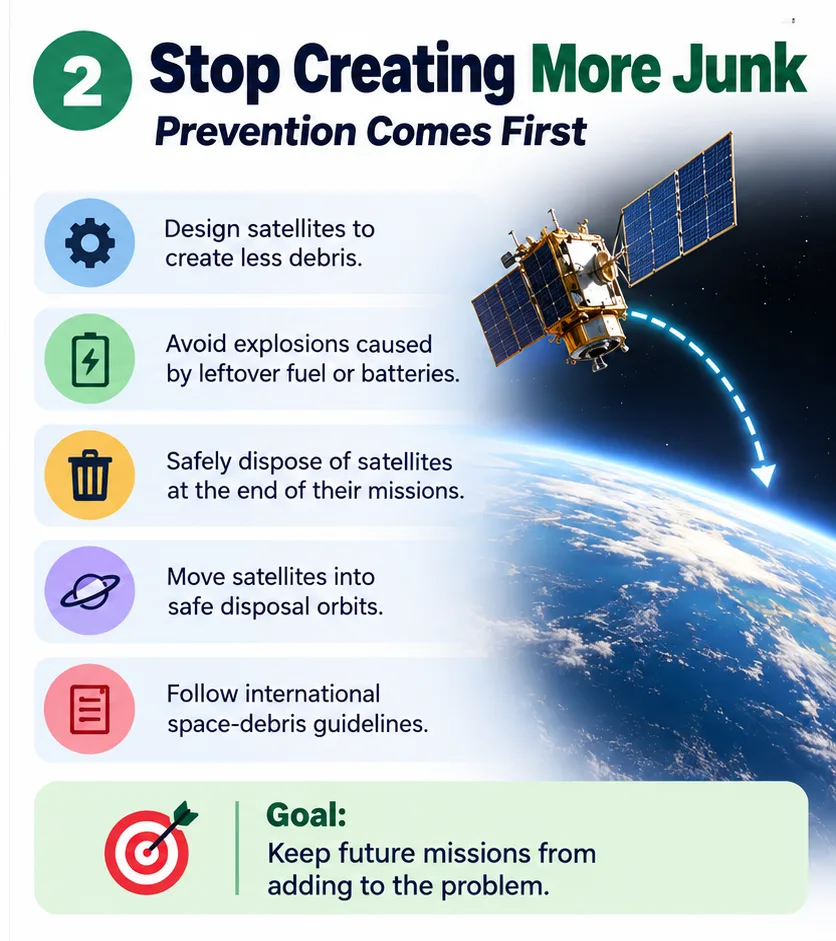
That is the thinking behind a set of international rules and good habits. Most of them are guidelines agreed by space agencies, including the Inter-Agency Space Debris Coordination Committee (IADC), rather than laws that can be enforced everywhere. Together they aim to make sure that a satellite does not become a permanent hazard the moment it stops working.
The 25-year rule and the 5-year rule
For many years the standard guideline has been the 25-year rule. A satellite in low Earth orbit should be removed from its useful orbit, or brought down to burn up, within 25 years of the end of its mission. The logic is based on atmospheric drag. Objects below about 400 km re-enter within months to a few years, but at around 800 km the same job takes decades to centuries, and above about 1,000 km it takes centuries or longer.
Many experts now think 25 years is too long, especially with so many new satellites being launched. In September 2022 the US Federal Communications Commission (FCC) adopted a stricter 5-year rule for new satellites in low Earth orbit. ESA goes further still with its Zero Debris approach. Its Zero Debris Charter, launched in 2023, sets an aim of limiting debris production by 2030.
Passivation: making dead satellites safe
Not every piece of space debris comes from a collision. Some comes from explosions. Leftover fuel and charged batteries in an abandoned rocket stage or satellite can burst years after launch, scattering fragments in all directions.
The fix is called passivation. At the end of a mission, operators vent any remaining fuel and discharge the batteries so that nothing is left to blow up. It is a small step that has prevented a great deal of fragmentation, and it is now a standard part of mission planning.
Graveyard orbits and Point Nemo
Where a satellite goes at the end of its life depends on where it works. Satellites in geostationary orbit, about 36,000 km above the equator, are too high for drag to help. Instead, they are boosted into a graveyard orbit roughly 300 km above the geostationary ring. This frees up the valuable working slots and parks the dead craft out of the way.
Satellites and large rocket stages in low Earth orbit are better brought down on purpose. Controlled re-entry steers the spacecraft so that any pieces that survive land in the South Pacific Ocean Uninhabitable Area, the most remote stretch of sea on Earth. It is often called Point Nemo, or the spacecraft cemetery.
Step 2: track every object
You cannot dodge what you cannot see. The second step in tackling space debris is knowing where every piece is, and where it will be tomorrow. Tracking turns a vague danger into a list of numbers that engineers can act on.
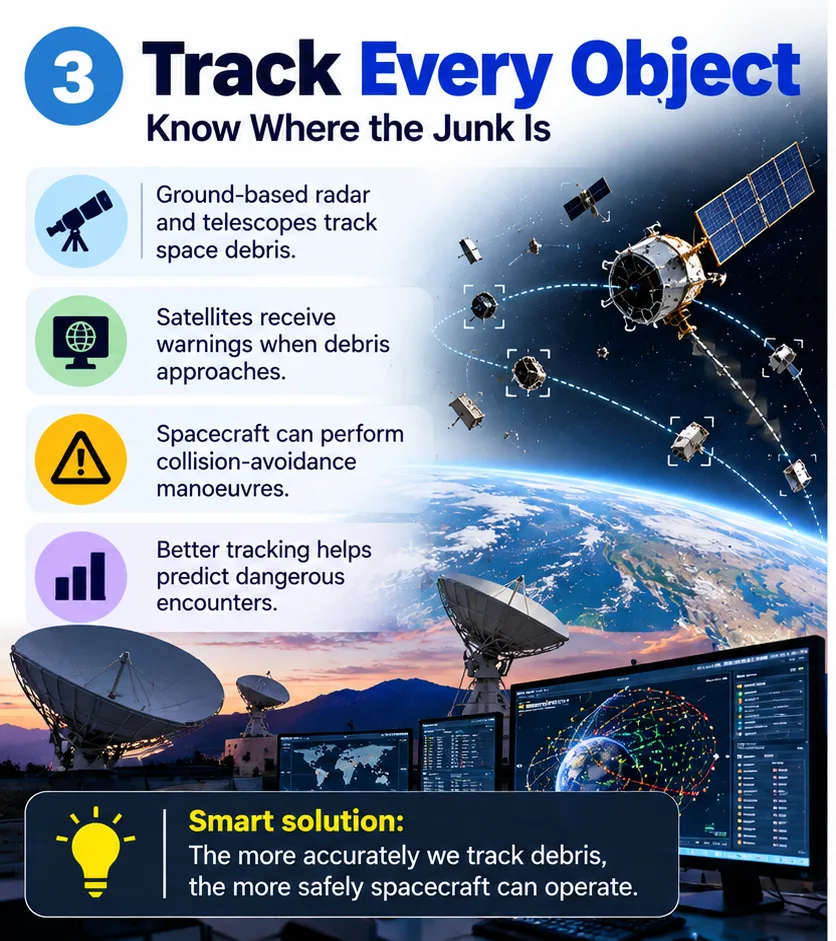
Today, surveillance networks follow more than 45,000 objects. The best-known public catalogue is kept by the US Space Force. Its 18th Space Defense Squadron maintains the data published at space-track.org. In Europe, the ESA Space Debris Office in Darmstadt, Germany, monitors the environment and produces its own analysis. Commercial companies such as LeoLabs also sell tracking data.
Radar, telescopes and lasers
Different tools suit different orbits.
- Radar sends out radio waves and listens for the echo. It works day and night, in any weather, and is the main tool for low Earth orbit. Space Fence is one example.
- Optical telescopes watch for sunlit objects against a dark sky. They suit higher orbits, but they need clear, dark conditions.
- Laser ranging bounces laser pulses off an object to measure its distance very precisely, which sharpens predictions of where it is heading.
There is a catch. Typical tracking limits in low Earth orbit are about 10 cm, with some radars able to see down to around 5 cm. That leaves a huge population of smaller pieces untracked. Statistical models suggest there are more than 1 million pieces larger than 1 cm and well over 100 million larger than 1 mm. They can still disable a satellite or damage sensitive parts, yet nobody can steer around them.
From tracking to action
Once an object is catalogued, computers predict its path and compare it with other objects. If the chance of a close approach is high enough, the satellite’s operator can fire thrusters to move out of the way. This is a collision-avoidance manoeuvre. The International Space Station has made more than 40 of them since 1999. When there is too little warning, the crew may shelter in their spacecraft as a precaution, as happened after the 2021 anti-satellite test.
Together, steps 1 and 2 stop the problem growing and give us the data to dodge what is already there. They cannot remove the large dead objects that remain. For that, we need the third step.
Test yourself with flip cards
Use the cards below to check the key terms from this part of the article. Try to answer in your head before you flip each one.
Step 3: remove the big pieces
Stopping new debris and tracking what is already up there will not be enough on their own. Some orbits already hold large dead objects that could break apart in a collision and create thousands of new fragments. That is why space debris removal is the third step in any plan for how to solve space junk, and it starts with the largest pieces.
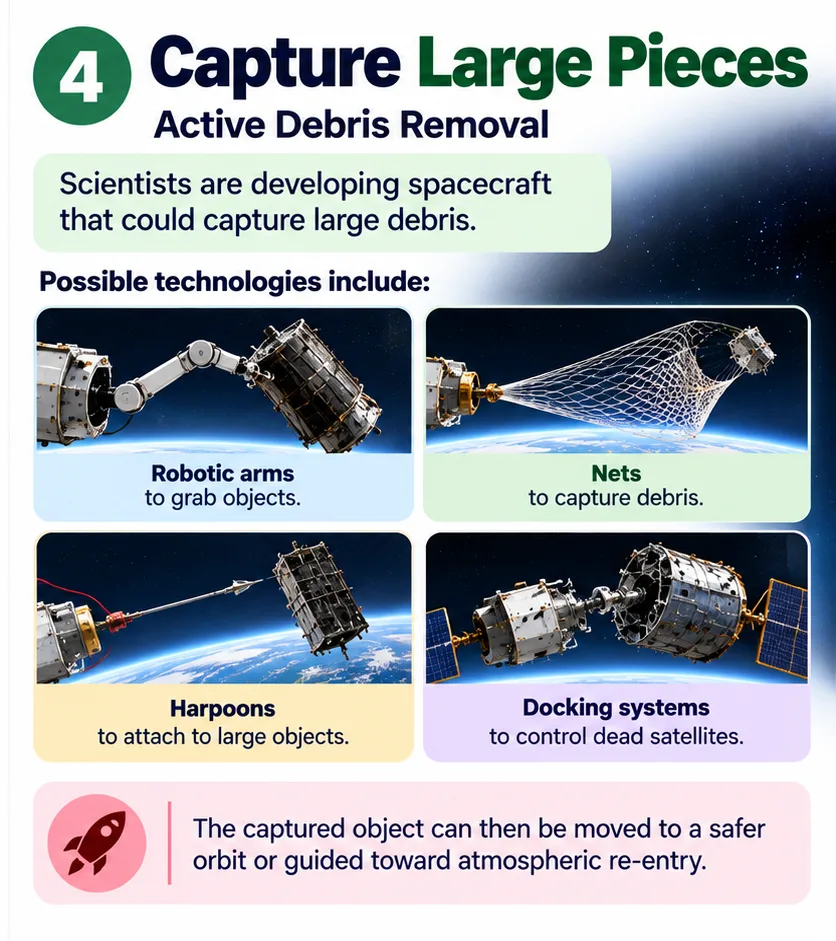
Several missions have already tested the key skills: finding a target, approaching it safely and grabbing it.
- RemoveDEBRIS (University of Surrey, 2018–2019) tested a net (2018) and a harpoon (2019) in orbit.
- ELSA-d (Astroscale, 2021) demonstrated magnetic capture.
- ADRAS-J (Astroscale, 2024) inspected a spent Japanese H-IIA upper stage at close range. It was the first close approach to a real piece of large debris.
- ClearSpace-1 (ESA) was re-scoped to capture the PROBA-1 satellite. The launch is planned for later this decade.
Other ideas are still at the research stage. Drag sails would increase air resistance so a dead satellite falls out of orbit sooner. Electrodynamic tethers use a long conducting cable to slow a spacecraft down. Ground-based and space-based lasers could, in theory, nudge small objects into lower orbits.
Megaconstellations: help or hindrance?
Megaconstellations are networks of thousands of small satellites that provide internet and other services. Starlink is the best-known example, and Amazon Leo and the Chinese Guowang and Qianfan constellations are adding to the traffic. More satellites in low Earth orbit means more chances for a close approach.
Operators say they are managing the risk. Starlink satellites manoeuvre automatically to avoid collisions and are designed to deorbit within about 5 years. If every operator did the same, dead satellites would not linger. The danger is a fleet that fails faster than it can be cleared.
The commercial side of this story is covered in our guides to private space flight and the future of commercial space flight. For the bigger picture of satellites, telescopes and the ISS, see exploring the universe.
Who is responsible for space junk?
The Outer Space Treaty of 1967 says that a launching state remains responsible for its objects in space. That means a dead satellite still belongs to its owner, even decades later. A state keeps ownership and control of its space objects, so removing another country’s debris needs that country’s permission.
This makes cleaning up as much a legal and political problem as an engineering one. Agencies are now working on the Zero Debris approach, with the aim of reaching it by 2030.
Exam-style question
Why is a 1 cm fragment of space junk so dangerous? (3 marks)
Collisions in orbit happen at an average relative speed of about 10 km/s. Kinetic energy is KE = ½mv², so it rises with the speed squared. A 1 cm aluminium sphere (about 1.4 g) at 10 km/s carries about 70,000 J, similar to a 1,000 kg car travelling at about 40 km/h, which can disable a satellite.
Test yourself on space junk
Key points about space junk
- There are more than 45,000 tracked objects, and models suggest more than 1 million pieces larger than 1 cm.
- Speed makes small fragments dangerous, because kinetic energy depends on v².
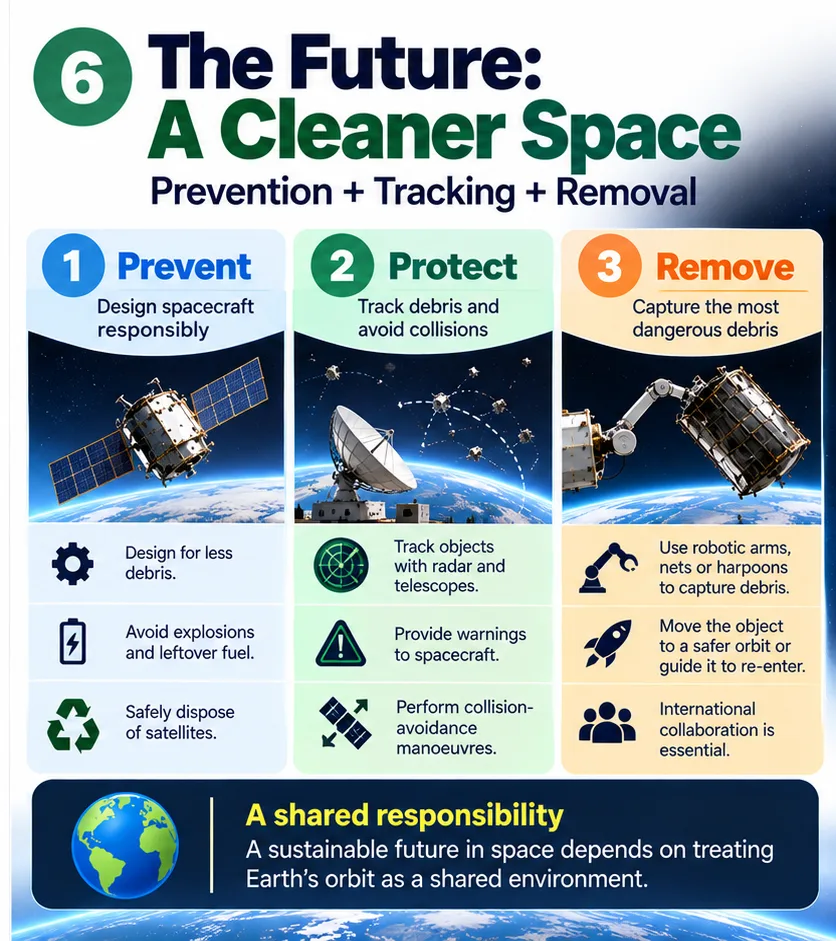
- The three steps are: stop creating junk, track every object and remove the big pieces.
- Space debris removal has been tested by RemoveDEBRIS, ELSA-d and ADRAS-J, and ClearSpace-1 is planned for later this decade.
- Megaconstellations add traffic, so quick deorbiting and automatic avoidance matter.
- Launching states stay responsible for their objects under the Outer Space Treaty.
Frequently asked questions about space junk
How much space junk is there?
More than 45,000 objects are tracked by surveillance networks, and about 11,000 or more of them are active satellites. Statistical models suggest more than 1 million pieces larger than 1 cm and well over 100 million larger than 1 mm. ESA estimates the total mass of objects in orbit at more than 15,000 tonnes.
Why is space junk dangerous?
Debris in low Earth orbit travels at roughly 7–8 km/s, and collisions happen at around 10 km/s on average. Because kinetic energy depends on speed squared, even a 1 cm fragment carries a huge amount of energy. Objects over 10 cm can destroy a satellite, and 1 cm can disable one.
What is Kessler syndrome?
Kessler syndrome is a proposed chain reaction in which collisions create fragments, and those fragments cause further collisions. Donald Kessler and Burton Cour-Palais described the idea in 1978. In the worst case, some orbits could become too cluttered to use safely for satellites.
How is space debris tracked?
Radar, optical telescopes and laser ranging follow objects, and the results feed catalogues such as the US Space Force’s space-track.org and the work of ESA’s Space Debris Office in Darmstadt. Commercial firms like LeoLabs also track objects. The typical limit in low Earth orbit is about 10 cm.
Can space junk fall on Earth?
Yes, but most of it burns up first. Heating comes mainly from air compressed in front of the object. Large, dense parts such as fuel tanks can survive, as with Skylab in 1979. The risk to any individual is extremely small, far less than being struck by lightning.
Who cleans up space junk?
Active removal is still at the demonstration stage. Missions such as ESA’s ClearSpace-1 (re-scoped to capture the PROBA-1 satellite) and Astroscale’s ELSA-d and ADRAS-J are demonstrations. Under the Outer Space Treaty, launching states stay responsible for their objects, so removing another country’s debris needs permission.
What is the 25-year rule?
It is a long-standing guideline that a satellite in low Earth orbit should leave orbit within 25 years of the end of its mission. In September 2022 the US FCC adopted a stricter 5-year rule for new low Earth orbit satellites. Both aim to stop dead satellites lingering.
Can space junk be removed?
Yes, in principle. Tests so far include magnetic capture (ELSA-d, 2021), a net (RemoveDEBRIS, 2018) and a harpoon (RemoveDEBRIS, 2019) and close inspection of a spent H-IIA rocket stage (ADRAS-J, 2024). Drag sails, tethers and lasers are being researched. Space debris removal starts with the largest pieces.
Do megaconstellations make space junk worse?
They increase traffic, because Starlink alone has thousands of satellites. Starlink satellites manoeuvre automatically and are designed to deorbit within about 5 years. Whether constellations help or hinder depends on how reliably operators avoid collisions and remove failed satellites. That is why the topic matters.