On a clear night, the stars seem to shimmer, flicker and sometimes flash red and blue. It looks as if each one is a tiny candle in a draught. So why do stars twinkle? The short answer is that starlight is bent by moving pockets of air in Earth’s atmosphere, and the bending changes many times a second. The stars themselves are shining steadily.
That one idea explains a lot: why twinkling stars are easiest to spot near the horizon, why planets usually shine with a calm, steady light, and why astronomers build telescopes on mountain tops or launch them into space. This guide walks through the science step by step, starting with the basic physics you meet in GCSE science.
Why do stars twinkle?
Stars are enormous, hot balls of gas, but they are also unimaginably far away. By the time their light reaches us, it has travelled for years across empty space in almost perfectly straight lines. Out there, nothing disturbs it.
The trouble starts in the last few moments of the journey. Just before it reaches your eye, the light has to pass through Earth’s atmosphere, which is full of moving air at different temperatures. Every time the path of the light is nudged, the star seems to change brightness, shift position slightly and even change colour. Your brain reads that rapid flicker as a twinkle.
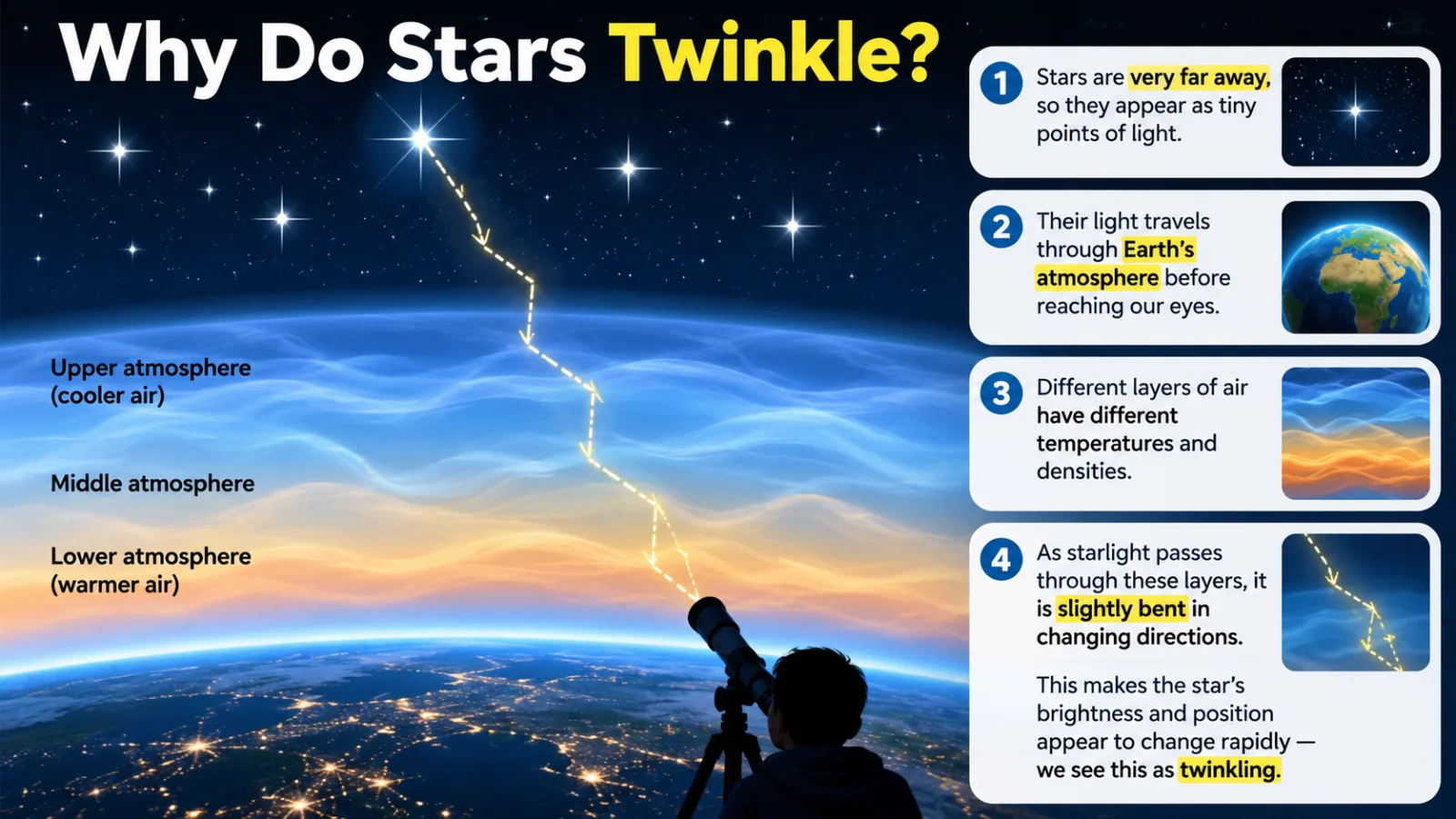
Refraction in a moving atmosphere
The key idea here is refraction. Light changes direction when it changes speed as it passes between materials of different density. You may have seen this when a straw looks bent in a glass of water. Light goes from water into air and changes speed, so it changes direction.
Air does the same thing on a smaller scale. Warmer air is less dense and has a lower refractive index than cooler air. The atmosphere is a patchwork of pockets of air at different temperatures and densities, and each pocket bends light by a slightly different amount. Wind and rising warm air keep shuffling these pockets around, so the bending keeps changing.
different air temperatures → different refractive index → light bends by different amounts
The result is that the light from a star takes a slightly different path from one moment to the next. The image dances in brightness, position and colour, and it does so many times a second. That rapid change is what we see as twinkling stars.
Earth’s atmosphere is the key
Without the atmosphere, there would be no twinkling at all. The stars would shine as fixed, steady points, which is exactly what astronauts see. The air is the only thing standing between the star and your eye that can change from moment to moment.
Our atmosphere is not a smooth, even blanket. It is layered and constantly stirred by weather, by the Sun heating the ground and by wind flowing over mountains and buildings. Warm air rises, cool air sinks, and the boundaries between them are ragged and ever-changing. If you want to know more about how the layers of air are built and how Earth’s atmosphere compares with those of other worlds, see our guide to the atmosphere of the Earth, Moon and Titan.
On a still, calm night the air is usually more settled and the twinkling is gentler. On a windy night, or when warm air is rising from rooftops and chimneys, the stars can shake and shimmer much more. The stars have not changed. The air in front of them has.
The scientific name: scintillation
Scientists have a proper name for twinkling: astronomical scintillation, sometimes called atmospheric scintillation. It describes rapid changes in a star’s brightness, position and colour caused by turbulence in Earth’s atmosphere.
It is worth noticing that scintillation is really three effects in one:
- Brightness: the star seems to get brighter and dimmer as light is bent towards or away from your eye.
- Position: the star seems to jiggle slightly as the direction of the light shifts.
- Colour: different colours of light are bent by slightly different amounts, so a bright star can flicker between colours.
When you hear someone talk about scintillation, they are talking about exactly the thing you see when you look up and wonder why stars twinkle. It is a property of the air, not of the star.
This also gives you a handy way to remember it. Heat shimmer is what happens when you look through a few metres of hot air. Twinkling is what happens when you look through the many kilometres of air above your head. The next part of this guide explains why planets, which shine through the very same air, usually escape the flicker.
Why don’t planets twinkle?
Look at the evening sky on a clear night and you may spot a bright “star” that sits perfectly still while its neighbours shimmer. Chances are it is a planet. So why don’t planets twinkle when the same air is bending their light too?
The air is just as turbulent. The difference is the size of the object you are looking at. Planets look like tiny discs, while stars look like single points. That one difference changes everything.
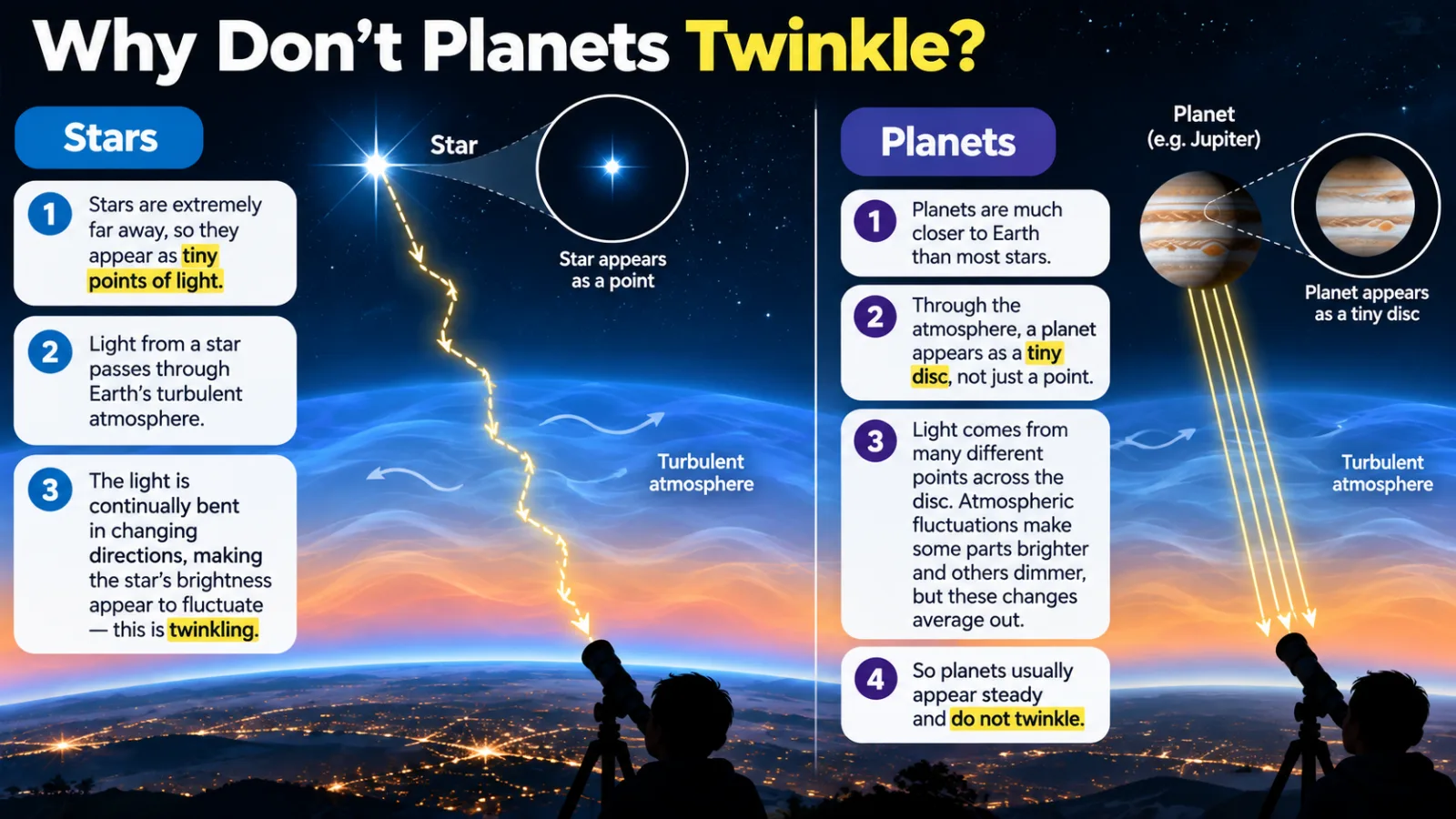
Points versus discs
Stars are so far away that, even through big telescopes, they appear as point sources. Betelgeuse, one of the largest-looking stars in the sky, is only about 0.04–0.05 arcseconds across. That is far too small for any telescope to show as a disc.
Planets are much closer, so they show a measurable size. Jupiter appears about 30–50 arcseconds across, and Venus can reach about 66 arcseconds. For comparison, your eye can only just resolve about 66 arcseconds, which is 1 arcminute.
Now picture what happens to the light. A star sends all its light down one narrow path through the atmosphere. If a pocket of air bends that path, the whole star appears to jump, dim or brighten at once. That is scintillation, and it is why we see twinkling stars.
A planet is different. Light reaches you from many points across its disc, and each point travels through a slightly different patch of air. Some rays are bent one way, others another way. Some are brightened, others dimmed. When your eye adds them all together, the fluctuations average out, and the planet shines with a steady light.
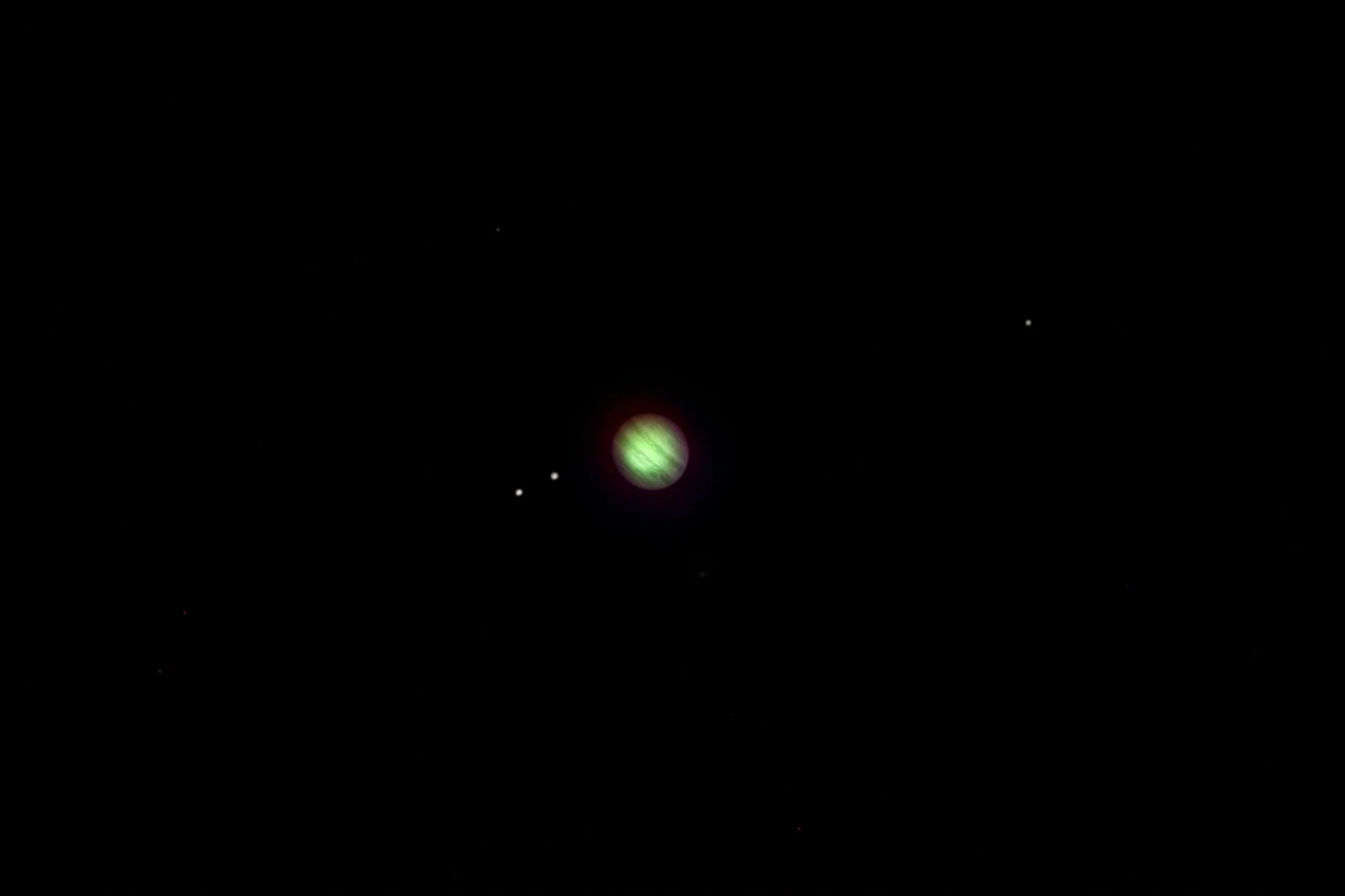
Compare Jupiter with a star yourself
Numbers make this clearer. Betelgeuse spans roughly 0.04–0.05 arcseconds, while Jupiter spans about 30–50 arcseconds. That makes Jupiter hundreds of times wider in the sky than one of the biggest-looking stars. Use the calculator below to work out how many times larger Jupiter looks, and try swapping in the other values.
apparent size ratio = angular size of planet ÷ angular size of star
When planets do twinkle
The rule is “usually”, not “never”. A planet very low near the horizon has to shine through much more air, and in very turbulent air even a planet’s disc can shimmer. You may see Venus flicker just after sunset when it is close to the skyline. High in the sky on a steady night, the same planet will glow calmly.
So a steady light is a good clue, but it is not a guarantee. We will use it, along with other clues, to tell planets from stars later in this guide.
Stars vs planets: how they compare
Here is a side-by-side summary of why twinkling shows up for one and not the other.
| Feature | Stars | Planets |
|---|---|---|
| Apparent shape | Point source (Betelgeuse is only about 0.04–0.05 arcseconds across) | Tiny disc (Jupiter about 30–50 arcseconds, Venus up to about 66 arcseconds) |
| Light path through the air | One narrow path | Many paths from across the disc |
| Effect of turbulence | Whole star flickers in brightness, position and colour | Fluctuations average out, so the light looks steady |
| Usual appearance | Twinkles, most strongly near the horizon | Shines steadily, but may shimmer very low down |
| Movement over days and weeks | Fixed pattern relative to other stars | Moves against the background stars |
| Position in the sky | Anywhere | Near the ecliptic (the zodiac band) |
| In binoculars or a small telescope | Still a point of light | Shows a disc (Jupiter’s four large moons are visible in binoculars) |
The table shows that the physics is the same for both, because both shine through Earth’s moving air. Only the size of the source changes what we see.
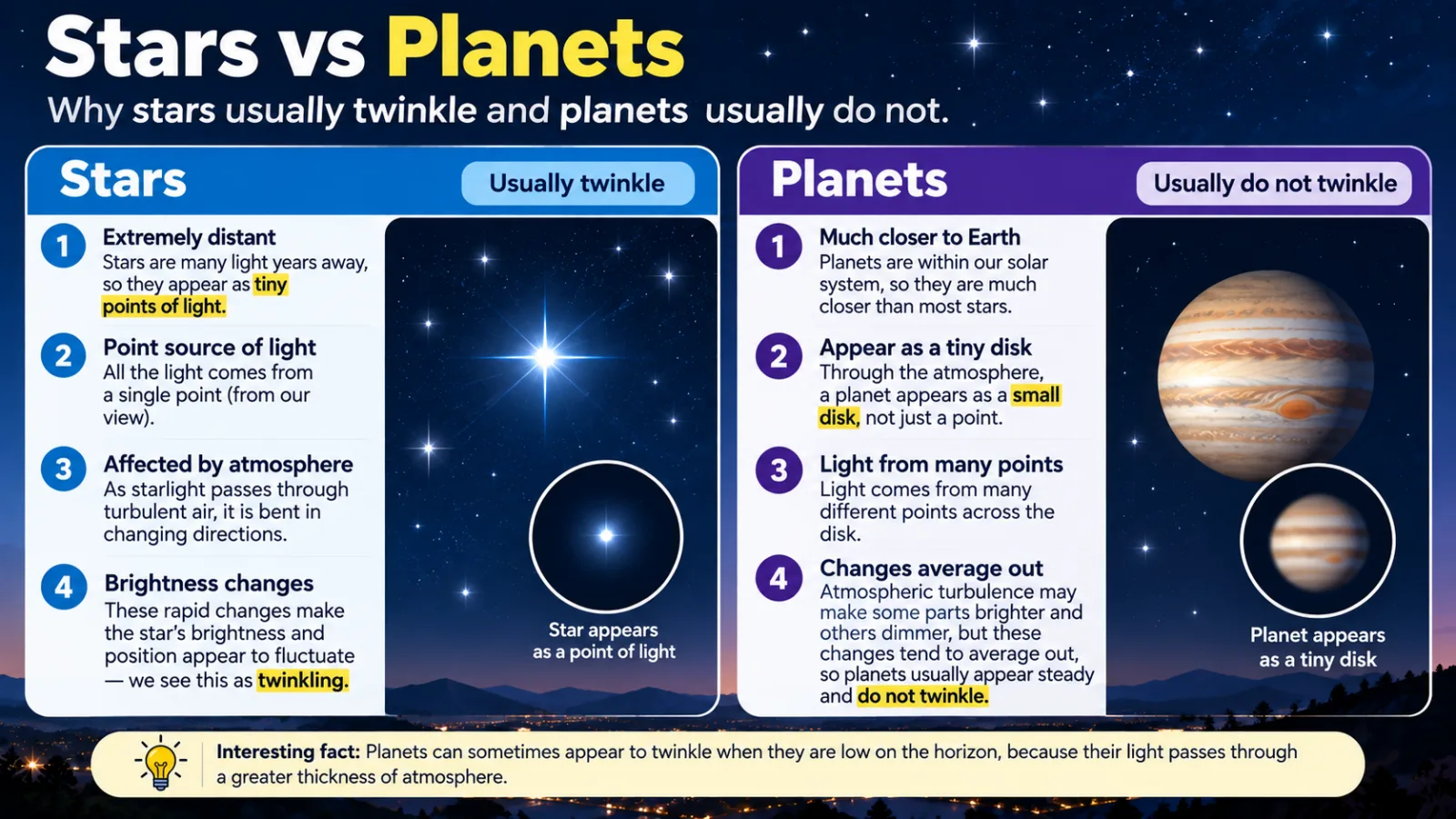
Why do stars twinkle more near the horizon?
Look at a star high overhead and its twinkle is gentle. Look at one just above the rooftops and it can seem to shake, flicker and even change colour. The reason is simple: more air means more twinkling.
Starlight arriving from straight above passes through the thinnest possible slice of atmosphere. Light from a star near the horizon has to travel at a shallow angle, crossing dozens of times more air. Every pocket of warm or cool air along that longer path bends the light a little, so the total wobble is much bigger.
That is why twinkling stars are most obvious low in the sky, and why the same star can look calm at midnight and restless an hour after it rises.
Why do stars flash different colours?
Refraction does not bend every colour by exactly the same amount. Blue light is bent slightly more than red light, a spreading effect called dispersion. Near the horizon, the thick, moving atmosphere acts a bit like a very weak, wobbling prism.
As the air shifts, first one colour and then another is steered towards your eye. The star seems to flash red, green and blue in turn. This is the answer to the popular question “why is Sirius flashing colours?”. Sirius, about 8.6 light-years away, is the brightest star in the night sky, so its colour flickers are easy to spot when it is low down.
Planets can join in too. A planet that is very low, or seen through very turbulent air, may also twinkle. Even its disc cannot average out the extra distance through the atmosphere.
Do stars twinkle in space?
No. Astronauts on the International Space Station see stars as steady, unblinking points of light. Space telescopes such as Hubble see them the same way. There is no atmosphere in the way, so there is no moving air to bend the light.
This is a neat test of the whole explanation. If twinkling were something stars did themselves, like a candle flame flickering, astronauts would see it as well. They do not. The twinkling happens in the last few moments of the light’s journey, high above your head.
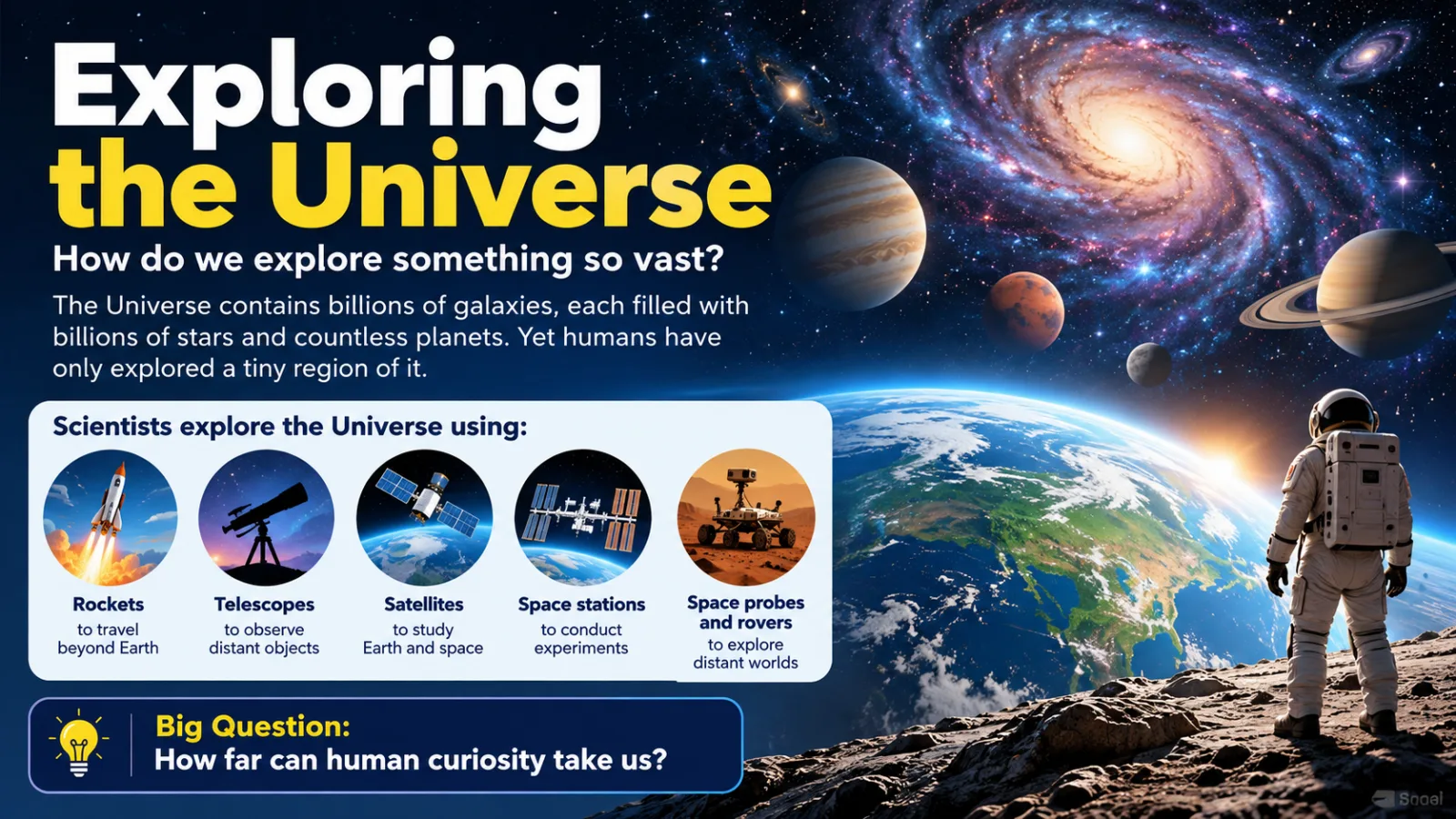
It is also one reason space telescopes give such sharp images. Their view is not smeared by the atmosphere. You can read more about these instruments in our overview of rockets, telescopes, satellites and the International Space Station. Our article on NASA’s James Webb Space Telescope shows what a telescope can do when it works from space.
Twinkling and telescopes: astronomical seeing
For a ground-based astronomer, twinkling is a nuisance. It blurs a star’s sharp point into a shimmering blob and spoils fine detail. Astronomers call this blurring seeing, and they measure it in arcseconds. At a good site, seeing is about 0.5–1 arcsecond. Poor nights are much worse.
Seeing is the main reason that professional observatories are not built near cities. Instead they stand on high, dry mountains, above much of the turbulent air. Famous sites include:
- Mauna Kea, Hawaii, a high volcanic peak above much of the atmosphere.
- The Atacama Desert, Chile, one of the driest places on Earth.
- La Palma, in the Canary Islands, where the air above the sea is often smooth and steady.
Dry air and altitude mean less water vapour and less turbulence between the telescope and the stars, so the image holds steadier.
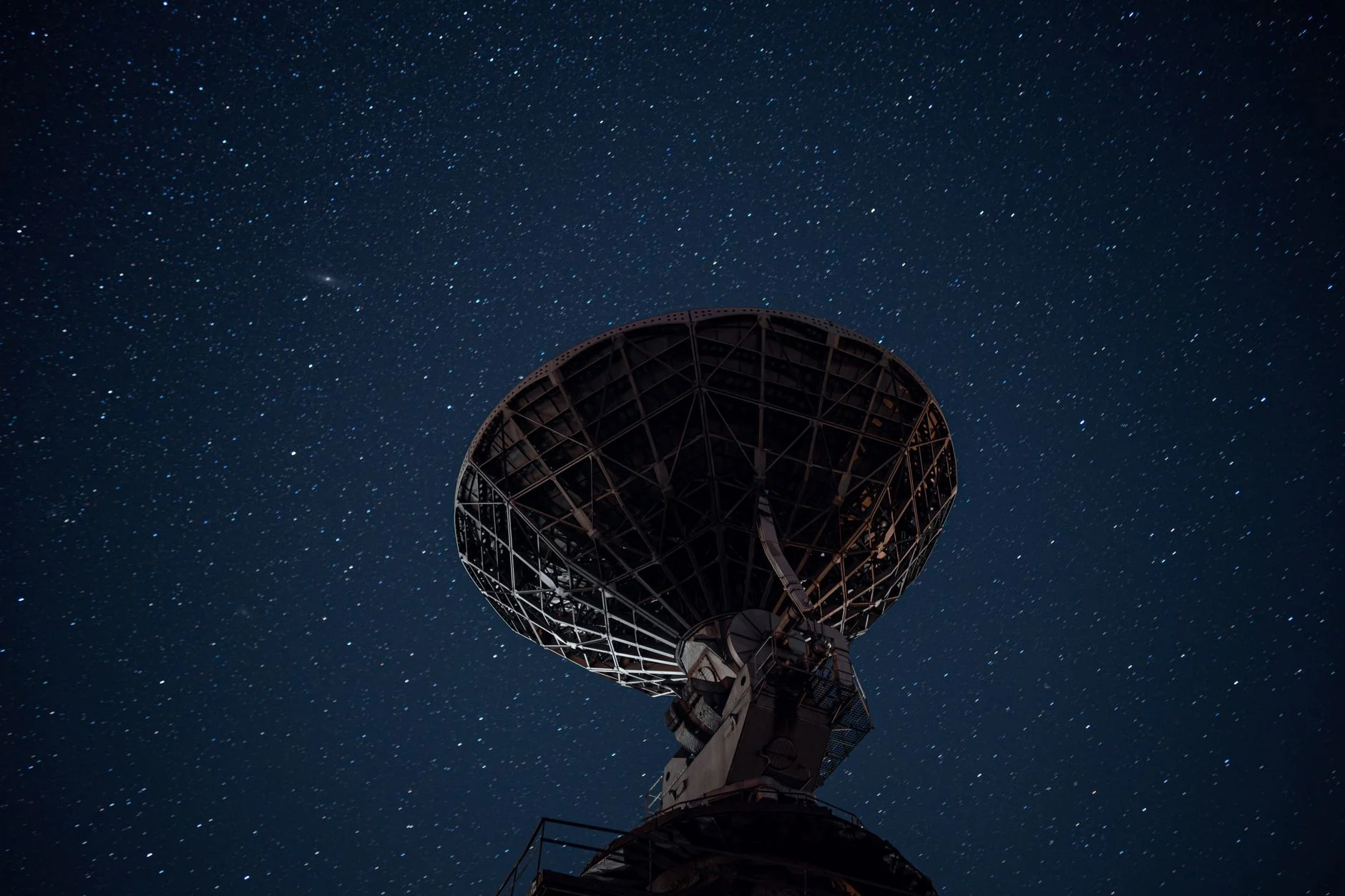
Even on the best mountain, though, some turbulence remains. To fix that, astronomers needed a cleverer trick.
Adaptive optics: un-twinkling the stars
Adaptive optics is a technology that cancels out twinkling as it happens. A sensor measures how the incoming starlight is being distorted. A computer then reshapes a thin deformable mirror so that it bends the light back into a sharp image. The mirror changes shape hundreds to more than a thousand times every second, fast enough to keep up with the shifting air.
The system needs a bright star to measure the distortion, and there is not always one in the right place. So many observatories make their own. A powerful laser beam is fired into the sky and excites sodium atoms in a layer about 90 km up. The glowing spot acts as an artificial laser guide star, and the system measures how its light is distorted.
Adaptive optics is used on telescopes such as Keck and the Very Large Telescope. It is also planned for the Extremely Large Telescope in Chile, whose 39 m mirror is due to see first light later this decade.
Between them, mountain sites, space telescopes and adaptive optics let us study the universe in far more detail than the naked eye could manage. If you enjoy the big picture, our article on beautiful cosmology shows what all that careful observing has revealed.
Key terms: flip the cards
Test your memory of the vocabulary from this section. Try to answer each card before you flip it.
How to tell a star from a planet
Knowing why planets don’t twinkle gives you a free field guide. On a clear night, the steadiness of a bright point of light is one of the best clues to what it is. Use the checklist below the next time you are out under a dark sky, and tick off what you notice.
- Does it shine steadily instead of flickering? Planets usually do not twinkle, because their tiny discs average out the atmosphere’s wobble.
- Is it one of the brightest objects in the sky? Venus and Jupiter often outshine every star.
- Is it sitting near the ecliptic, the band of sky where the Sun, Moon and planets travel (the zodiac band)?
- Has it moved against the background stars? Check again after a few days or weeks, using a nearby star pattern as a marker.
- Does it show a tiny disc in binoculars or a small telescope, rather than a sharp point?
- Can you see Jupiter’s four large moons in binoculars as faint dots in a line beside it?
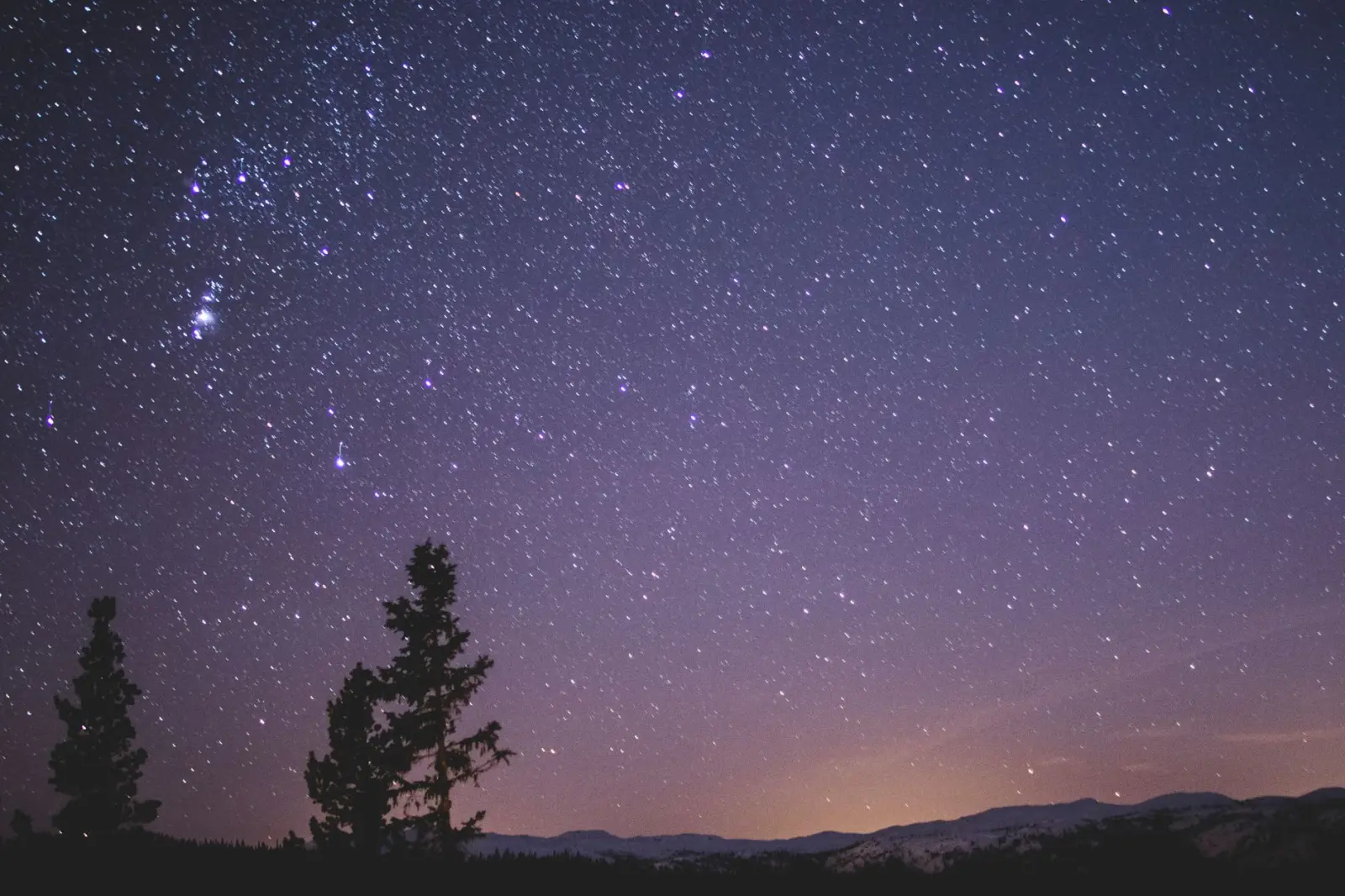
No single clue is perfect. A planet very low near the horizon can twinkle, because its light then crosses far more air. A star high overhead can look surprisingly calm. The best approach is to combine two or three clues, especially position and movement over several nights.
Exam practice: explaining twinkling
Examiners like questions that link everyday observations to the physics of refraction. Try this one first, then tap to reveal a model answer.
Explain why stars twinkle but planets usually do not. (4 marks)
Starlight passes through Earth’s atmosphere, where pockets of air at different temperatures and densities have different refractive indices. The light is refracted by different amounts, and because the air is constantly moving, the bending changes many times a second, so the star’s brightness, position and colour flicker. Stars are so far away that they appear as point sources, so all their light follows one path and the whole beam is affected together. Planets appear as tiny discs, so light from many points across the disc is affected differently, and the fluctuations average out. Planets therefore shine steadily.
Test yourself: twinkling stars quiz
Key points: why stars twinkle
- Twinkling is scintillation. Turbulent air bends starlight by changing amounts, many times a second, changing a star’s brightness, position and colour.
- Refraction is the cause. Air of different temperatures and densities has different refractive indices. Warmer air is less dense.
- Stars are point sources. Even Betelgeuse is only about 0.04–0.05 arcseconds across, so all its light is disturbed together.
- Planets are tiny discs. Jupiter is about 30–50 arcseconds and Venus up to about 66, so the flicker averages out and they usually shine steadily.
- Horizon effects. Low objects twinkle more, and bright stars such as Sirius can flash different colours.
- No atmosphere, no twinkling. Space telescopes and the ISS see steady stars.
- Astronomers fight it. They build observatories on high, dry mountains and use adaptive optics.
Twinkling is one of several effects that make the sky look different from how it would in a vacuum. If you enjoyed it, read about sun halos and moon halos, another atmospheric optics effect, or find out how solar and lunar eclipses happen.
Frequently asked questions about twinkling stars
Why do stars twinkle?
Stars twinkle because their light passes through Earth’s turbulent atmosphere. Pockets of air at different temperatures and densities refract the light by different amounts, and as the air moves the bending changes many times a second. This makes the star’s brightness, position and colour flicker. The effect is called scintillation.
Why don’t planets twinkle?
Planets appear as tiny discs rather than single points. Light from different parts of the disc takes slightly different paths through the air, so the fluctuations average out. The result is a steadier glow. Planets can still twinkle when they are very low near the horizon or the air is very turbulent.
Why do stars twinkle different colours?
The atmosphere refracts different colours of light by slightly different amounts, an effect called dispersion. When a bright star is low in the sky, its colours are separated a little and flicker in and out as the air moves. That is why stars can seem to flash red, green and blue.
Do stars twinkle in space?
No. Twinkling happens because of Earth’s atmosphere, so in space there is nothing to bend the light. Astronauts on the International Space Station and telescopes like Hubble see stars shining steadily. This is one reason space telescopes can take sharper images than telescopes on the ground.
How can you tell a star from a planet?
Planets usually do not twinkle, they move against the background stars over days or weeks, and they stay near the ecliptic. They are often among the brightest objects in the sky, and in binoculars or a small telescope they show a disc rather than a point of light.
Why do stars twinkle more near the horizon?
Light from a star near the horizon has to travel through much more air than light from a star straight overhead, dozens of times more. More air means more pockets of turbulence to bend the light, so the twinkling is stronger and the colour flashes are more obvious.
What is adaptive optics?
Adaptive optics is a technology that corrects for atmospheric blurring. A deformable mirror changes shape hundreds to over a thousand times per second to cancel out the distortions. Telescopes such as Keck and the VLT often use a laser guide star in the sodium layer, about 90 km up, to measure the turbulence.
Does the Sun twinkle?
Not noticeably to the eye. The Sun appears as a large disc, so the atmosphere’s fluctuations average out, just as they do for planets. Shimmering edges and shadow bands can appear around eclipses. Never look directly at the Sun, as it can permanently damage your eyes.
Why is Sirius flashing colours?
Sirius is the brightest star in the night sky, about 8.6 light years away. When it is low near the horizon, its light crosses a lot of turbulent air, which refracts different colours by slightly different amounts. As a result Sirius can seem to flash colours rapidly.