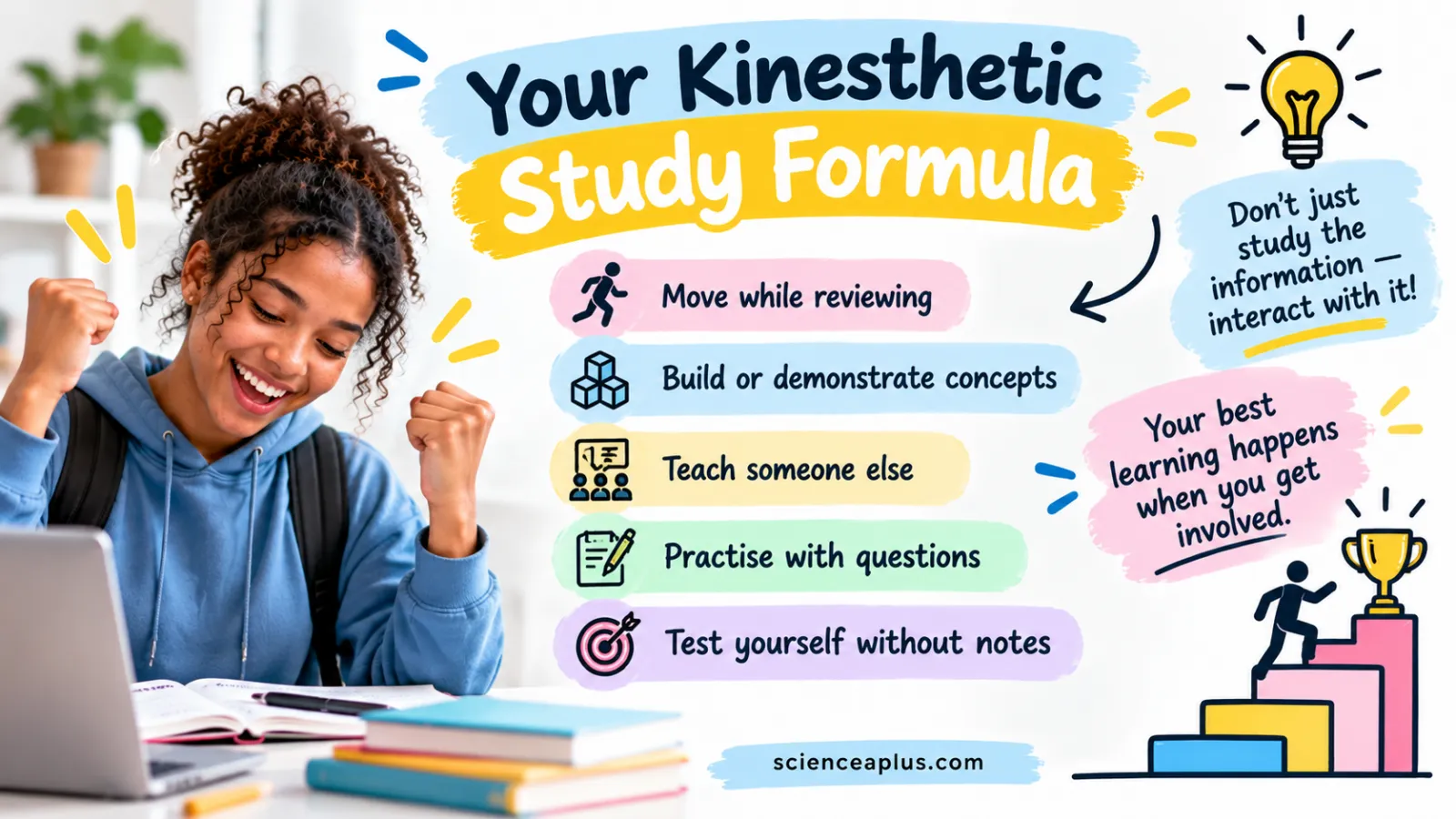
What is a kinesthetic learner? It is someone who says they learn best by moving, touching and doing rather than by reading or listening. It is one of the "learning styles" in popular models such as VAK and VARK. The honest twist: research has not found that teaching to a person's preferred style improves results. The good news is that the study methods people usually recommend for kinesthetic learners (practising, building, explaining, drawing and moving) do work, and they work for everyone.
What does "kinesthetic learner" mean?
The idea comes from learning-style models that sort people into groups. In Neil Fleming's VARK model, the groups are visual, aural, read/write and kinesthetic. In the shorter VAK version, they are visual, auditory and kinesthetic. A "kinesthetic" or "tactile" learner is described as someone who prefers to learn through experience: moving, touching and doing, such as science projects and experiments.
You may recognise the description. You fidget during long lectures. You would rather build the model than read about it. You think better while pacing. These feelings are real, and they are worth listening to. The question is what they mean for how you should study, and that is where the evidence gets awkward.
Are learning styles real? What the evidence says
The big test of the idea is called the meshing hypothesis. It says that instruction works best when it matches your preferred style, so a "visual learner" should be given pictures and a "kinesthetic learner" should be given hands-on tasks.
In 2008, a panel of four psychologists (Harold Pashler, Mark McDaniel, Doug Rohrer and Robert Bjork) reviewed the research for the journal Psychological Science in the Public Interest. They set out what a fair test would need. Students are first sorted by learning style. They are then randomly assigned to different teaching methods. Everyone sits the same final test. And the result must show a crossover: students of one style do best with one method, while students of another style do best with a different method.
Their findings were blunt. People do express preferences about how they like information presented, and people do differ in specific abilities. But the panel found virtually no evidence for the crossover pattern. Very few studies even used a design capable of testing it, and some of those that did produced results that flatly contradicted the meshing idea. They concluded that there was no adequate evidence base to justify using learning-style assessments in general education, and that limited school resources would be better spent on methods with strong evidence.
Later studies point the same way. In 2015, Rogowsky, Calhoun and Tallal tested whether adults comprehended material better when it was delivered in their preferred way (listening or reading), and the results did not support matching. In 2018, Husmann and O'Loughlin surveyed 426 undergraduate anatomy students. Most did not even use study strategies that lined up with their VARK result, and their exam performance was not correlated with their VARK scores. Students who happened to match their strategies to their style did no better. The authors concluded that the conventional wisdom about learning styles should be rejected by educators and students alike.
The panel did add one fair caveat: because the research is so thin, it would be wrong to say every possible version of learning styles has been tested and failed. Many versions simply have not been tested at all. That is a reason for caution, not a reason to build your revision around the idea.
Why the learning-styles idea feels so true
If the evidence is this weak, why is the idea everywhere? A 2020 systematic review by Newton and Salvi pulled together 37 studies covering 15,405 educators in 18 countries. On average, 89.1% said they believed in matching teaching to learning styles, and 95.4% of trainee teachers agreed that it is effective. A separate analysis by Newton in 2015 found that 89% of recent research papers on learning styles in higher education endorsed the idea in some way. So the belief is common among teachers and in published work, which makes it easy for a student to meet it and assume it must be proven. (The 2020 review also warns that many of those surveys were small, so the exact figures are rough.)
There are good reasons it feels right:
- Preferences are real. You really might enjoy building more than reading, and enjoying something helps you stick with it.
- Doing is memorable. Experiments and models are good for learning, as the next section shows. But they help most people, not just those who label themselves kinesthetic.
- Labels are comforting. "I'm a kinesthetic learner" explains why sitting still with a textbook feels hard.
The downside of the label is that it can quietly narrow your options. A student who decides "I'm not a reading learner" may avoid the very practice that would help most. Reading, writing and listening are still how most of the GCSE course is taught and tested. If you want a closer look at how a good tutor handles this question for GCSE students, the myth box in our guide to how a tutor can improve GCSE results covers it from the parent's side.
So what should a "kinesthetic learner" do instead?
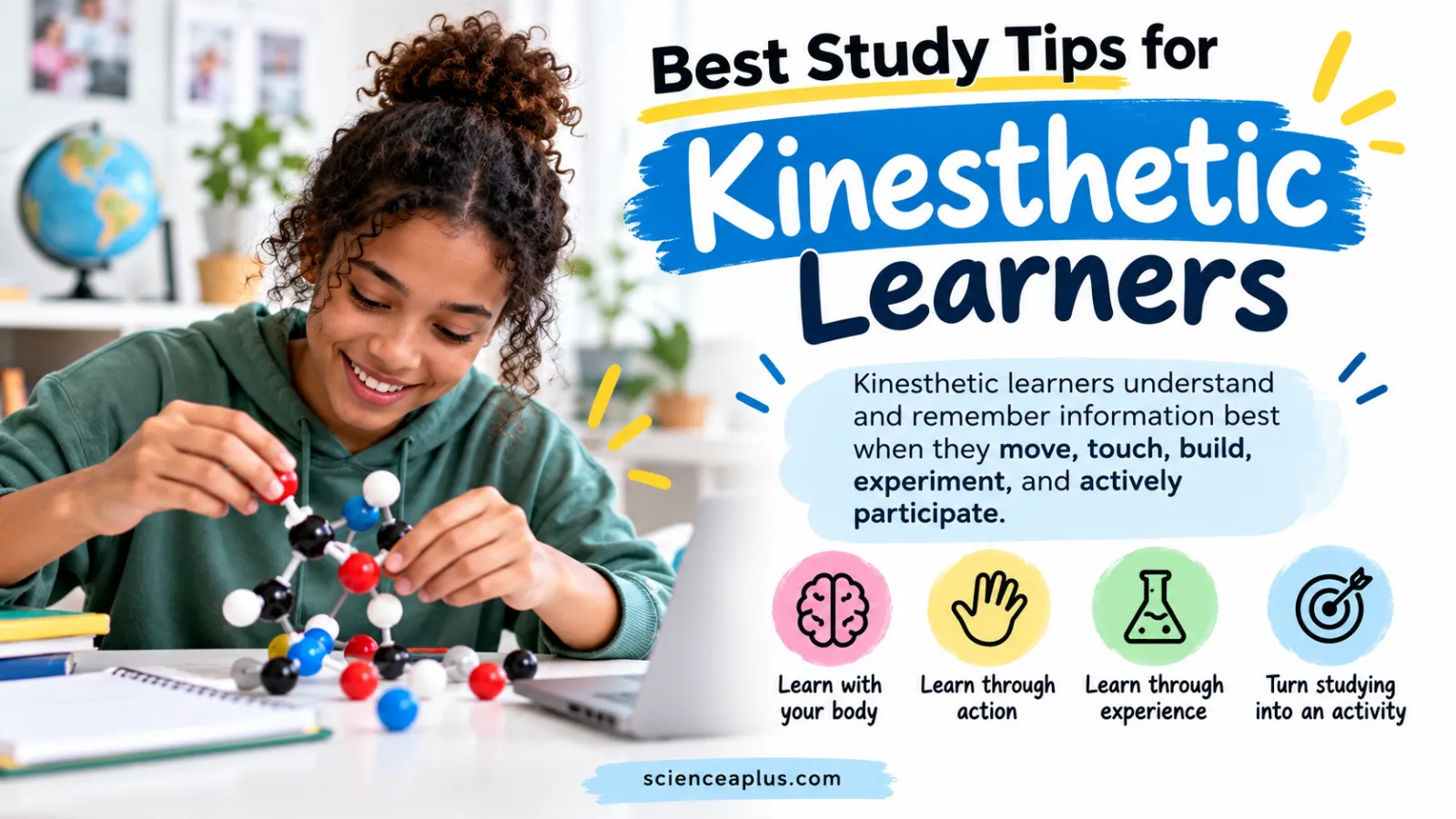
Treat "kinesthetic" as a description of what you enjoy, not a rule for how your brain works. Then choose study methods based on what the research shows works for everybody, and pick the active versions of them if that keeps you going. In short:
- Test yourself instead of rereading.
- Spread your revision out over days and weeks.
- Explain ideas out loud to another person.
- Draw, build and act things out when the content has a shape, a process or a movement in it.
- Move around between sessions because exercise is good for you and may give a small boost to thinking.
Notice that none of these require you to be a particular type of learner. They are good news if you like moving, and they are good news if you do not. The sections below give the evidence for each one, then a plan you can follow. Along the way, you will see why "learning by doing" is a better description than "learning style", and how to make memory work in your favour. For the wider picture, see our guide on how to improve memory for better learning and exams.
Why learning by doing really does help
Rejecting the learning-styles label does not mean rejecting hands-on learning. Several strands of research show that doing, moving and making can improve memory and understanding. The catch is that these benefits show up across groups of students, not only in people who call themselves kinesthetic. Here are the four best-supported ideas.
1. The enactment effect: actions you perform are remembered better
Around 1980, researchers gave people short action phrases such as "brush the teeth" or "shuffle the cards". Some people only heard the phrases. Some watched someone else do the action, some imagined it, and some actually performed it. The group that performed the action recalled the most. This is called the enactment effect (or the self-performed task effect). It has since been repeated many times, in children and in adults.
The study materials were simple action phrases, not exam content, so we should not stretch the result too far. But it fits a simple rule: when you do something yourself, your memory of it has an extra layer of movement and sensation attached.
2. Gestures help learning stick
In a 2008 experiment, Cook, Mitchell and Goldin-Meadow taught children a new maths concept. Some children were required to gesture while they learned it. Others were asked to speak but not gesture. The children who gestured retained the new knowledge better when they were tested later, while simply speaking out loud did not give the same boost. The researchers suggested that gesture may help by giving learners an extra, embodied way of representing new ideas.
The practical lesson: when you explain a process, use your hands. Show the direction of a force, the path of blood through the heart, or the steps of a calculation.
3. Physical experience of a physics idea improved understanding
In 2015, Kontra, Lyons, Fischer and Beilock ran three laboratory experiments and one randomised field experiment in a college physics class. Students who briefly felt the forces involved in angular momentum for themselves scored higher on a quiz about the topic. Brain imaging suggested that this was because sensory and movement areas of the brain became active when the students later reasoned about the concept. Physical experience, in other words, can give an abstract idea some real-world meaning.
This was a college physics topic, and the study does not show that every subject needs a physical demonstration. It does show that tying a hard concept to something you can feel is worth doing.

4. Drawing beats writing for remembering
Wammes, Meade and Fernandes ran seven free-recall experiments in which people either drew or wrote out each word on a list. Drawn words were recalled better than written ones. The researchers could not explain the result by deeper processing, by imagery or by the "picture superiority" effect on its own. They proposed that drawing helps because it brings together meaning, visual detail and the movement of the hand in a single memory. You do not need to be a good artist. A quick sketch of a cell, a circuit or a food chain does the job.
Where hands-on learning fits in GCSE science
Science is a natural fit for learning by doing, because many of the big ideas can be demonstrated. Practical work gives you real observations to attach theory to. For example, when you carry out a titration or make a standard solution, you handle the equipment and see the numbers behind the concept. Our standard solution practical guide walks through one such method step by step.

Models do a similar job for ideas you cannot see. Building a molecule from a kit shows the angles and bonds in a way a flat diagram cannot. Making a model of the heart, a cell or the DNA double helix forces you to decide what goes where. If you want to pair building with comparing, the tables in our biology notes comparisons give you a ready-made list of things to model, label and test yourself on.
A good rule is to follow every practical or model with a few minutes of recall. Close the book and write down what happened and why. The doing gives you the experience, and the recall locks it in. The next section explains why that second step matters so much.
Learning styles: myth versus fact
Use these flip cards to check what you now know. Tap a card to see the answer.
Why did Pashler and colleagues insist on a "crossover" pattern before accepting learning styles? (2 marks)
Because the claim is that each style needs a different method. The method that is best for one style group must not be the best for another. If one method (for example, practice testing) is simply best for everyone, learning styles add nothing.
That last point is the key to the rest of this guide. If one method is best for everyone, the sensible plan is to use the proven methods and make them as active as you like.
Study tips for kinesthetic learners that the evidence supports
These methods are ordered by strength of evidence, not by how "kinesthetic" they sound. The first two are the best-supported techniques in a large review of study methods by John Dunlosky and colleagues (2013), and teaching others also has good research behind it. The rest add movement, making and talking to them. Each one has a hands-on version for people who like to be active.
1. Test yourself from memory (retrieval practice)
Dunlosky's team reviewed ten popular study techniques and rated practice testing as high utility, because it helps learners of different ages and abilities across many kinds of tasks. Rereading and highlighting, which most students rely on, were rated low utility.
One classic experiment shows why. In 2006, Roediger and Karpicke had students study short prose passages, then either reread them or take free-recall tests with no feedback. Five minutes later, rereading gave better recall. But after two days and after one week, the students who had been tested remembered substantially more. Rereading also made the students more confident that they knew the material, which is the trap: it feels productive but gives weaker long-term results.
The active version: write everything you can remember on a whiteboard or sheet of scrap paper, then check your notes and fix the gaps. Do it standing up if you like. Use flashcards but say or write the answer before you flip the card. Our guide to how to practise and remember what you study has more on this.

2. Space your practice out (distributed practice)
Dunlosky and colleagues also gave distributed practice, meaning spreading study sessions over time instead of cramming, a high utility rating. If you have 3 hours of revision for a topic, three separate hours on different days will usually beat one three-hour block. This suits people who struggle to sit still: short sessions are easier to start, and you get a natural reason to get up and move between them.
3. Teach someone else
Explaining a topic is one of the most active things you can do. In a 2018 study, Koh, Lee and Lim compared four groups. Learners either did unrelated arithmetic problems (the control group), taught without notes, taught with notes, or practised retrieving the material without teaching. One week later on a comprehension test, the group that taught without notes and the group that did retrieval practice outperformed the group that taught with notes and the control group. The authors suggest that the benefit of teaching may really be a retrieval benefit: you have to pull the ideas out of your memory.
The practical rule: when you teach, put your notes away first. Use a whiteboard, draw as you talk, and ask your "student" to interrupt with questions. If nobody is around, explain it to a toy, a pet or an empty chair. The point is to say it out loud and spot where you get stuck.

4. Draw it, build it, then check it
As the drawing research showed, making your own sketch beats copying out words. Pair it with retrieval: sketch the water cycle, the circuit or the cell from memory, then compare with your notes and add what you missed in a different colour. Turning notes into something new (a table, a flow chart, a set of cards sorted into categories) makes you process the ideas rather than copy them out. Our revision-with-comparisons guide shows how comparison tables work well for this.
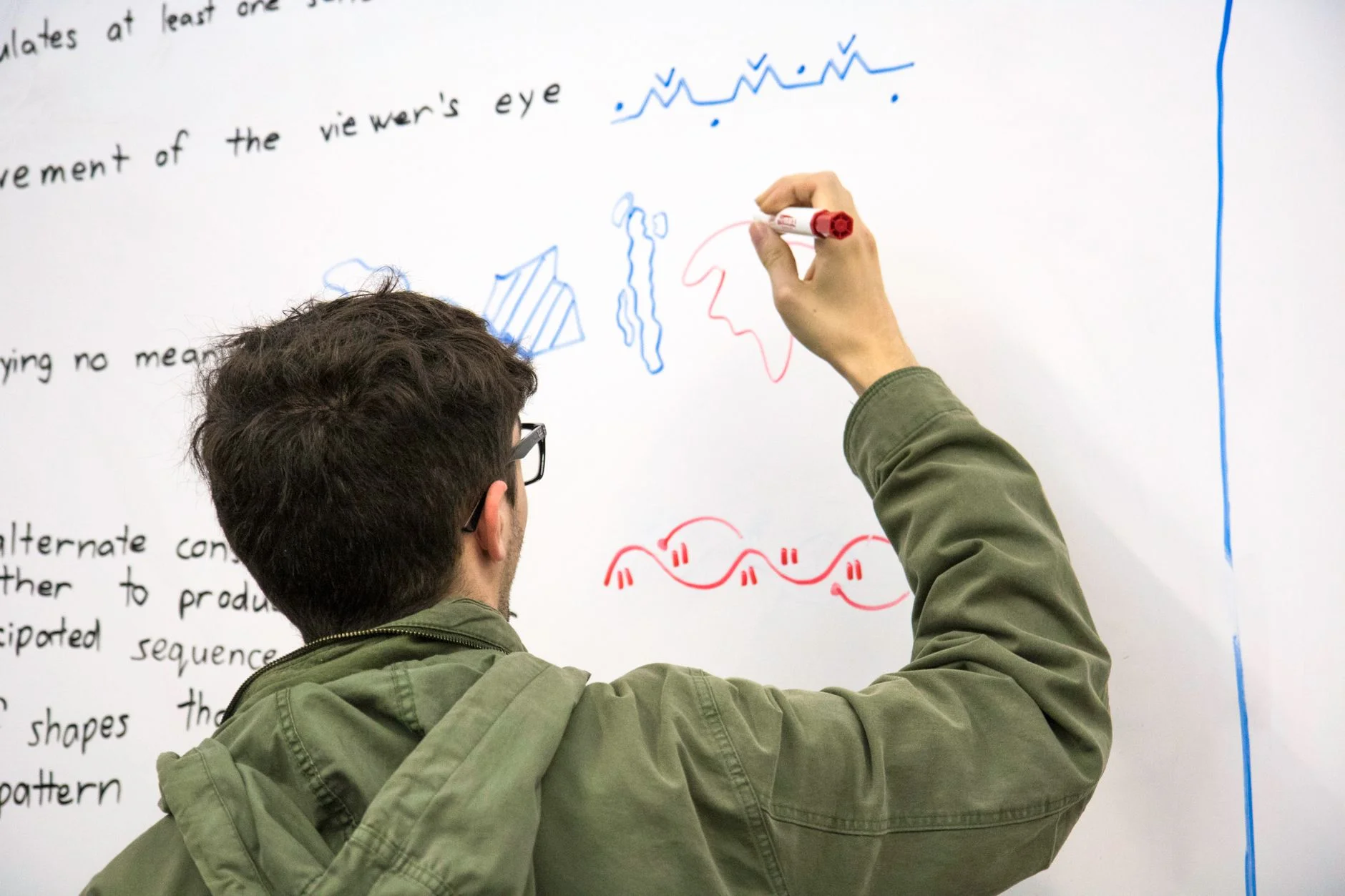
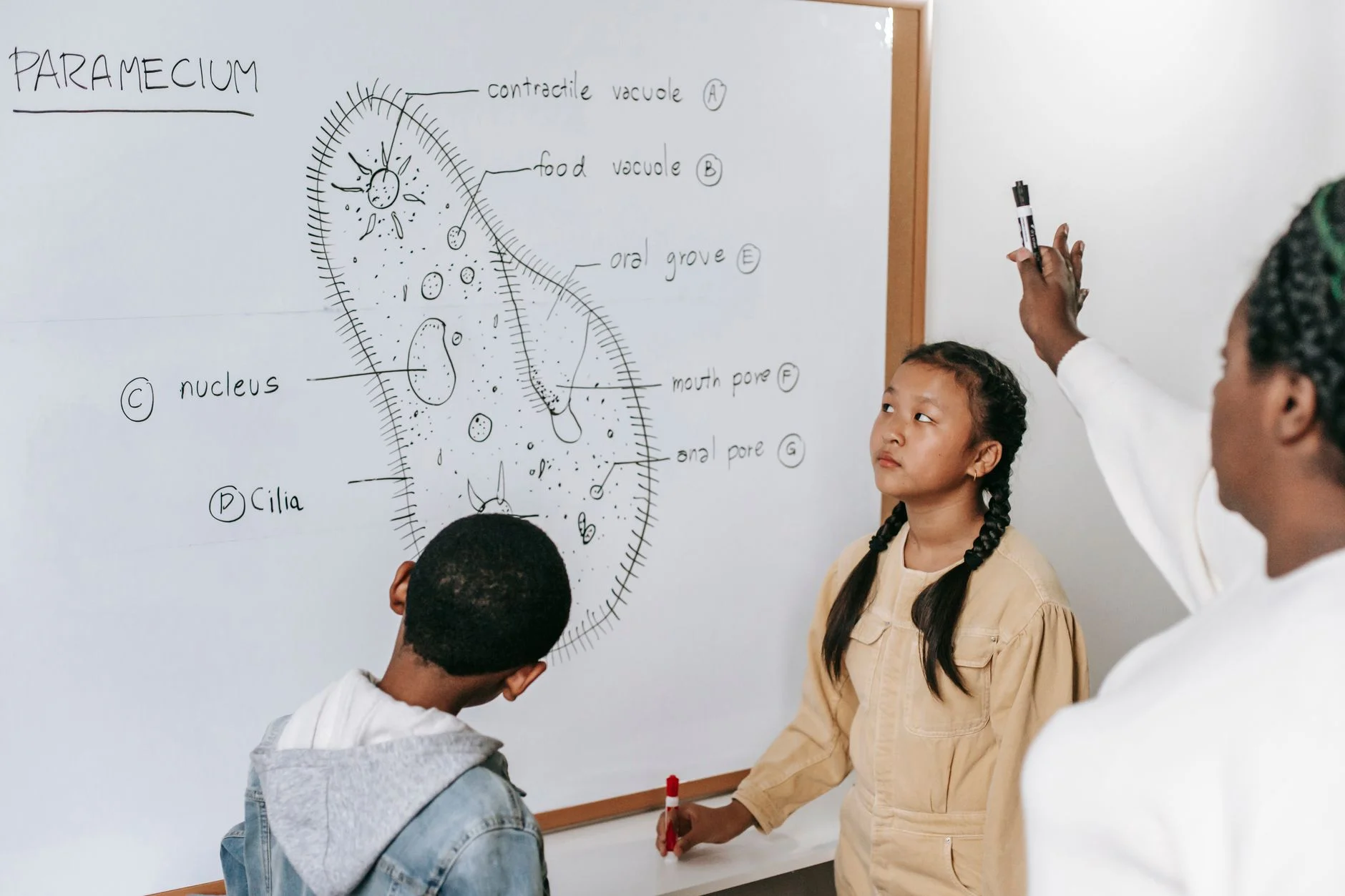
Mind maps are popular with active learners. They were not one of the ten techniques rated in the Dunlosky review, so we cannot call them proven. If you enjoy them, use them as a way to retrieve (draw one from memory) rather than a pretty copy of your notes.
5. Act it out and use your hands
Gesture helped children retain a new maths idea in the 2008 study, and performing actions helps memory in the enactment studies. Based on that, using your body to rehearse a sequence is a sensible technique. For example, you can use your arms to show the stages of mitosis, or walk the path of the blood around the heart and say each name aloud. We have no GCSE-specific trial showing that role-play beats other methods, so treat it as a memorable way to rehearse, then check the facts afterwards with a self-test.
6. Study with other people
Group study works well when everyone takes a turn to explain or quiz each other, because it combines teaching and retrieval. It works badly when it turns into chatting while you copy out notes. Set a rule: close the books, take turns to ask questions, and write down what nobody could answer.
7. Make revision a game
Timed quizzes, flashcard races and point-based challenges can make revision more fun, and most of them are retrieval practice in disguise. The test is simple: are you pulling answers out of your head, or are you looking at the answer? If it is the first, the game is helping.

What to do less of
The same review rated highlighting, rereading and summarising as low utility. That does not mean you can never use a highlighter. It means they should not be your main method. If you highlight, use it to mark what to test yourself on later, not as proof that you have learned it. For more ways to get through science textbook chapters actively, see our tips on studying science faster from textbooks.
You have 30 minutes to revise photosynthesis. Describe a plan that uses retrieval, drawing and teaching. (3 marks)
Spend 5 minutes drawing the process from memory (including the word equation). Spend 5 minutes checking your notes and correcting the diagram in a different colour. Spend 10 minutes explaining it aloud, without notes, to someone else. Spend the final 10 minutes answering a few practice questions and noting any you got wrong for next time.
Movement, exercise and study breaks: what the research says
Many students who like to move want to know whether exercise itself helps studying. The evidence is encouraging but modest, and it is worth being exact about what each study found.
- A single session of exercise gives a small boost. A 2012 meta-analysis by Chang and colleagues combined 79 studies on one session of exercise and cognitive performance. The overall effect was positive but small (g = 0.097), with larger effects possible for particular tasks and exercise settings.
- Walking helped schoolchildren's attention and test scores. In a 2009 study by Hillman and colleagues, 20 children aged about 9.5 walked on a treadmill for 20 minutes at a moderate pace. Afterwards they were more accurate on an attention task and scored better on an academic achievement test than after a resting session. This is a small study of primary-age children, so treat it as a promising sign, not a guarantee for exam results.
- Walking can boost creative thinking. Oppezzo and Schwartz (2014) found that walking increased creative idea generation. In the first experiment, 81% of participants did better on a creative "alternate uses" test while walking. But walking helped only 23% of participants on a test with a single correct answer. So a walk may help you brainstorm an essay plan more than it helps you solve an equation.

None of these studies show that you should read a hard textbook chapter while walking. The sensible reading is to use movement around your study, and to use it for review or idea-generation tasks. For learning brand-new, complicated material, sit down, focus, and then walk while you try to recall and explain it.

A 60-minute active study session you can copy
This plan puts the best-supported methods in order, with movement built in. It is a suggestion, not a research-tested recipe, so adjust it to the topic and to your own concentration. Tick the boxes as you go (the ticks are saved in your browser).
- Minutes 0–5: close your notes and write or draw everything you remember about the topic from the last session.
- Minutes 5–10: check your notes. Correct and add to your page in a different colour.
- Minutes 10–25: learn something new, such as a chapter or video. Sit down, make short notes, and mark what you could be asked.
- Minutes 25–30: stand up, stretch, get a drink of water or take a short walk.
- Minutes 30–45: use a whiteboard or paper to explain the new material aloud, with no notes. Draw as you talk.
- Minutes 45–55: answer practice questions or flashcards. Say or write the answer before you check.
- Minutes 55–60: write down what you got wrong and book a time to revisit it in a few days.
Active ideas for different subjects
- Biology: draw the digestive system or a cell from memory, label it, then check. Trace the route of food or blood out loud while walking around the room.
- Chemistry: build molecules from a kit, then write the formula and say the name. Rehearse the steps of a practical using the equipment if you can.
- Physics: feel the idea first (a spinning wheel, a swinging mass, a spring), then write the equation and explain what each symbol means.
- Maths: use real objects to see a pattern, then practise questions on a whiteboard and explain each step.

Keeping going when it is hard
Active methods feel harder than rereading, and that is normal: the effort is part of why they work. If you are struggling to get started, our guides on what to do when you have no motivation to study and on how to stop procrastinating give practical first steps. If you need a reason to move, read how to motivate yourself to exercise. And for ideas on setting your own goals and rewards, see extrinsic motivation and study strategies for GCSE.
Frequently asked questions about kinesthetic learners
What is a kinesthetic learner?
A kinesthetic (or tactile) learner is someone who says they prefer learning by moving, touching and doing, rather than by reading or listening. The term comes from learning-style models such as VAK and VARK. It describes a preference, and research has not shown that it predicts how well you will learn.
Are learning styles real?
People do have preferences, but the idea that teaching should match a preferred style has little support. A 2008 review by Pashler and colleagues found virtually no evidence for it and concluded there was no adequate basis for using learning-style tests in schools. Later studies, including one of 426 anatomy students, found the same.
How do I know if I am a kinesthetic learner?
You may notice that you enjoy experiments, models and moving around while you think. But online quizzes cannot reliably tell you how to learn best. A more useful test is to try several methods, check what you remember a week later using a self-test, and keep the ones that get results.
What are the best study tips for kinesthetic learners?
Test yourself from memory, spread revision over several days, explain topics aloud without notes, and draw or build models and then check them. These are the best-supported methods for all students, and each has an active version, such as using a whiteboard, standing up or walking between sessions.
Is hands-on learning better than reading?
Not automatically. Studies show that performing actions, gesturing, drawing and physical experience can help memory or understanding. But reading and listening are still essential, and the activity must make you think about the content. The strongest approach is a mix: learn, then do something that makes you recall and apply it.
Does walking while studying help you remember?
The evidence does not show that reading while walking improves memory. Studies found that a bout of walking or exercise can give a small boost to attention and thinking afterwards, and walking can help generate creative ideas. A good approach is to learn seated, then walk while you recall and explain.
How often should I take study breaks?
There is no research-backed magic number. Many study guides suggest a short break every 20 to 30 minutes, but that figure is a rule of thumb, not a research result. A movement break gives you a chance to stretch, drink water and refocus. Spreading study over several days is better supported than any exact break length.
Why does sitting still to study feel so hard?
Many people find long stretches of passive reading boring, and that is not a sign of a special learning type. Passive rereading is also a weak method. Switching to active tasks such as self-quizzing, explaining and drawing makes sessions more engaging and more effective. Short movement breaks are a reasonable way to keep going.
Can teachers use learning styles in lessons?
Teachers do not need to sort pupils by style. A better approach is to choose the teaching method that suits the content: diagrams for structure, demonstrations for processes, practice questions for recall. Pashler and colleagues advised that resources are better spent on methods with strong evidence.